E-Commerce Market Regulation in Microeconomics | Microeconomics | Trường Đại học Quốc tế, Đại học Quốc gia Thành phố Hồ Chí Minh
Vietnam's economic landscape is undergoing a rapid transformation, with digital technologies reshaping various sectors. Among these, the e-commerce industry stands out as a cornerstone of the digital economy, fueled by rising Internet penetration, widespread smartphone adoption, and an increasingly tech-savvy population. As of 2023, Vietnam boasts over 77 million Internet users, with more than 70% of the population actively engaging in online shopping. Platforms like Shopee, Lazada, Tiki, and Sendo have become household names, offering a diverse range of goods from groceries to high-end electronics. Tài liệu được sưu tầm và soạn thảo dưới dạng file PDF để gửi tới các bạn cùng tham khảo, ôn tập đầy đủ kiến thức, chuẩn bị cho các buổi học thật tốt. Mời bạn đọc đón xem!
Môn: Microeconomics 613 tài liệu
Trường: Trường Đại học Quốc tế, Đại học Quốc gia Thành phố Hồ Chí Minh 1.9 K tài liệu
Tác giả:


Preview text:
1
National Economics University …...0O0…… NEU BUSINESS SCHOOL Final Assignment Microeconomics December 3th , 2024
OVERVIEW OF THE ELECTRONIC COMMERCE MARKET
AND ROLES OF THE GOVERNMENT IN REGULATION AND ANTITRUST POLICY WORK
● COMPLETED BY TEAM 7:
- Phùng Hà Diệp Anh - 11245337
- Phạm Ngọc Quỳnh Anh - 11245336 - Hoàng Hà Vi - 11245491 - Tô Thành Long - 11245422
- Trương Gia Phúc Lâm - 11245396 CATALOGUE
INTRODUCTION................................…………………………………………… 4
Reasons.................................................. 4
………………………………………
Overview.............................…………………………………………………….4
MARKET CLASSIFICATION.................. 5
……………………………………
Number of firms..................................………………………………………… 6
Nature of products...............................…………………………………………7
Barriers to Entry……………………………………………………………….7
Advertising and Differentiation..........................................................................9
Information Asymmetry......................................................................................9
Conclusion.............................................................................................................9
FACTORS AFFECTING DEMAND AND SUPPLY OF THE
TECHNOLOGICAL RIDE-HAILING MARKET IN VIETNAM.......................10
Overview...............................................................................................................10
Factors affecting the demand for e-commerce market in Viet Nam...............10
Consumer's income.....................................................................................10
Price of related goods..................................................................................11
Consumer tastes...........................................................................................11
Expectations................................... ……………………………………….12
Factors affecting the supply of market in Viet Nam......................................13
Technology..................................... ………………………………………..13
Input price......................................................................................................13
Expectations...................................................................................................14
Number of firms.............................................................................................15 2
Conclusion......................................................................................................16
GOVERNMENT ROLES IN REGULATION AND ANTI-MONOPOLY
WORK……………………………………………………………………………..18
MARKET EFFICIENCY....................................................................................18
Externalities...................................................................................................18
Positive externalities.......................................................................................19
Monopoly power............................................................................................19
THE GOVERNMENT'S SOLUTION............................................................20
Negative externalities..................................................................................20
Monopoly power.......................................................................................... 21
PREDICTIONS OF THE TECHNOLOGICAL E-COMMERCE
MARKET...................................................................................................................21
EPILOGUE................................................................................................................25
REFERENCES...........................................................................................................26 INTRODUCTION 3 Reasons
Vietnam's economic landscape is undergoing a rapid transformation, with digital
technologies reshaping various sectors. Among these, the e-commerce industry stands
out as a cornerstone of the digital economy, fueled by rising Internet penetration,
widespread smartphone adoption, and an increasingly tech-savvy population. As of
2023, Vietnam boasts over 77 million Internet users, with more than 70% of the
population actively engaging in online shopping. Platforms like Shopee, Lazada,
Tiki, and Sendo have become household names, offering a diverse range of goods
from groceries to high-end electronics.
The remarkable growth of these platforms reflects a broader shift in consumer
behavior, as convenience, competitive pricing, and seamless digital transactions
become essential. E-commerce platforms have not only bridged the gap between
urban and rural consumers but also enabled small and medium-sized enterprises
(SMEs) to access broader markets without significant infrastructure investments. This
transformation has positioned e-commerce as a vital driver of Vietnam's economic modernization.
Given the industry's central role in Vietnam's economy, understanding its market
structure provides valuable insights into competition dynamics, efficiency, and growth
potential. This essay explores whether Vietnam's e-commerce industry operates closer
to a pure competition model, characterized by numerous small sellers and
consumers, or leans toward monopoly-like dominance, often associated with a few
powerful players controlling significant market share. By doing so, we aim to shed
light on the competitive dynamics of the sector and its implications for consumers, sellers, and policymakers. Overview
E-commerce involves the buying and selling of goods and services through digital
platforms, typically facilitated by Internet-based transactions. In Vietnam, this sector
has flourished in tandem with the country's rapid digitization. Platforms such as
Shopee, Lazada Tiki ,
, and Sendo lead the market, each offering unique features to
attract both sellers and buyers. For instance, Shopee emphasizes flash sales and
gamification, Lazada invests in logistics and livestream shopping, Tiki prioritizes fast
delivery through its TikiNow service, and Sendo appeals to rural users with localized
strategies and affordable pricing.
The rise of e-commerce in Vietnam can be attributed to several key factors:
1. Technological Advancement: Improved Internet infrastructure and
widespread smartphone use have made online shopping accessible to the masses.
2. Government Support: Policies encouraging digital transformation, such as the
"National Digital Transformation Program by 2025," have created a favorable
environment for e-commerce growth. 4
3. Consumer Behavior: A young, urbanized population prefers the convenience
of online shopping, especially during the COVID-19 pandemic, which accelerated digital adoption.
4. Competitive Strategies: E-commerce platforms invest heavily in logistics,
technology, and marketing to capture market share, leading to innovation and improved user experiences.
Despite these advancements, challenges persist, such as high logistics costs,
counterfeit goods, and intense competition among platforms. These factors influence
the industry's supply and demand dynamics, shaping its current and future trajectory.
This assignment will analyze how these elements interact to define the market
structure of Vietnam's e-commerce sector and explore the main factors that have
influenced supply and demand in recent years. By doing so, we aim to provide a
comprehensive understanding of the industry's growth, competitive landscape, and broader economic impact. MARKET CLASSIFICATION
The Vietnamese e-commerce market has undergone a remarkable transformation over
the past two decades, evolving from a nascent industry with limited players to a highly
competitive and concentrated sector. To determine the market classification, we will
evaluate the following criteria: number of firms, nature of products, barriers to 5
entry, market power, advertising and differentiation, and information asymmetry. Number of Firms
The e-commerce market in Vietnam began to take shape in the early 2000s with
platforms like Chodientu (2006), the country’s first C2C (consumer-to-consumer)
marketplace, inspired by eBay’s model. Over time, other players entered, including
Vatgia (2007) and 123Mua (2009), but many of these early platforms struggled with
low Internet penetration and limited digital payment options.
The real boom came in the 2010s with the arrival of global and regional giants like
Lazada (2012) and Tiki (2010, initially focused on books). By 2015, the market
welcomed Shopee, backed by Sea Group, which quickly became a dominant force
thanks to its aggressive promotional strategies. Local competitors such as Sendo
(founded in 2012 under FPT Corporation) also emerged to cater to specific Vietnamese market needs.
However, the fierce competition led to the exit or diminished presence of smaller
players like Deca.vn (shut down in 2016) and Zalora (which exited in 2017). By
2023, the market is dominated by Shopee, Lazada, Tiki, and Sendo, alongside
smaller niche players like Chợ Tốt, Meta.vn, and Thegioididong (focused on
electronics). Shopee leads with over 50% market share, followed by Lazada with
20%, Tiki with 15%, and Sendo with approximately 10%. This concentration reflects
an oligopolistic market structure, where a few major players control most of the market. Nature of Products 6
E-commerce platforms in Vietnam offer diverse product categories, including
electronics, fashion, groceries, and home appliances. Despite this variety, there is
considerable overlap in the types of products available across platforms.
● Shopee dominates in low-cost goods and frequently offers flash sales and
gamified shopping experiences to attract price-sensitive consumers.
● Lazada excels in high-ticket items such as electronics, thanks to its strong
logistics and trust as part of the Alibaba ecosystem.
● Tiki, which began as a bookseller, differentiates itself with a focus on fast
delivery, especially through TikiNow, catering to urban, time-sensitive customers.
● Sendo, backed by domestic investors, caters more to rural and lower-tier city
markets with affordable products and localized promotions.
While these platforms largely offer substitutable products, differentiation arises
through features such as delivery speed, pricing, and promotional campaigns. Barriers to Entry
Entering the e-commerce market in Vietnam involves significant challenges:
1. High Initial Investment: Building an e-commerce platform requires
substantial investment in technology, marketing, and logistics infrastructure.
New entrants often struggle to compete with established players’ economies of scale.
2. Logistics and Delivery Network: Effective e-commerce operations depend on
an efficient delivery network. Companies like Shopee and Lazada have
invested heavily in warehousing and last-mile delivery, raising the entry threshold for competitors.
3. Consumer Trust and Brand Recognition: Platforms with established
reputations and high visibility (e.g., Shopee and Tiki) dominate due to strong
brand loyalty and trust, leaving new players at a disadvantage.
4. Network Effects: Large platforms benefit from network effects where more
buyers attract more sellers and vice versa, creating a self-reinforcing cycle.
The exit of numerous smaller platforms, such as Deca.vn and Vingroup's Adayroi
(shut down in 2019), highlights the challenges of surviving in this competitive market. 7 Market Power
Major e-commerce platforms in Vietnam hold substantial market power. Shopee, for
instance, leverages its position as a market leader to dictate pricing trends, frequently
engaging in price wars to maintain dominance. Lazada, backed by Alibaba, can afford
to invest heavily in logistics and customer acquisition without immediate profitability
pressures, further strengthening its competitive position.
This concentration of power allows leading platforms to negotiate favorable terms
with suppliers and logistics providers, creating additional barriers for smaller or new entrants.
Advertising and Differentiation
Advertising plays a pivotal role in the e-commerce sector. Platforms compete
aggressively through online marketing campaigns, flash sales, and discount programs.
● Shopee is known for its high-profile advertising strategies, including
partnerships with celebrities and influencers, along with extensive use of gamification in shopping.
● Lazada invests heavily in livestream shopping, leveraging its Alibaba
ecosystem to offer innovative features.
● Tiki focuses on loyalty-building measures such as subscription services (e.g.,
TikiNow) and exclusive partnerships.
● Sendo targets rural areas with localized campaigns and accessible pricing
models, distinguishing itself from competitors focused on urban consumers. 8
These strategies ensure that each platform carves out a distinct identity, despite
offering largely similar products. Information Asymmetry
E-commerce platforms hold a significant advantage in terms of data. Platforms like
Shopee and Lazada collect vast amounts of user data, allowing them to tailor
marketing efforts and optimize user experience. This access to proprietary data creates
a significant entry barrier, as new entrants lack the same level of consumer insights.
Furthermore, there is limited transparency regarding product quality and seller
credibility on some platforms, which can create trust issues for consumers. However,
established players have worked to address this through improved review systems and
guarantees, further strengthening their market positions. Conclusion
The Vietnamese e-commerce market is best classified as an oligopoly. A small
number of dominant players—Shopee, Lazada, Tiki, and Sendo—control the majority
of the market share, with significant barriers preventing new entrants from challenging
their dominance. While competition remains fierce, the market is characterized by
high levels of concentration, aggressive advertising, and powerful network effects.
The government plays an increasingly important role in regulating this sector,
ensuring fair competition and preventing monopolistic practices. As Vietnam’s digital
economy continues to grow, the e-commerce market is expected to remain a dynamic
and vital part of the country’s economic landscape. 9
FACTORS AFFECTING DEMAND AND SUPPLY OF THE E-
COMMERCE MARKET IN VIETNAM Overview
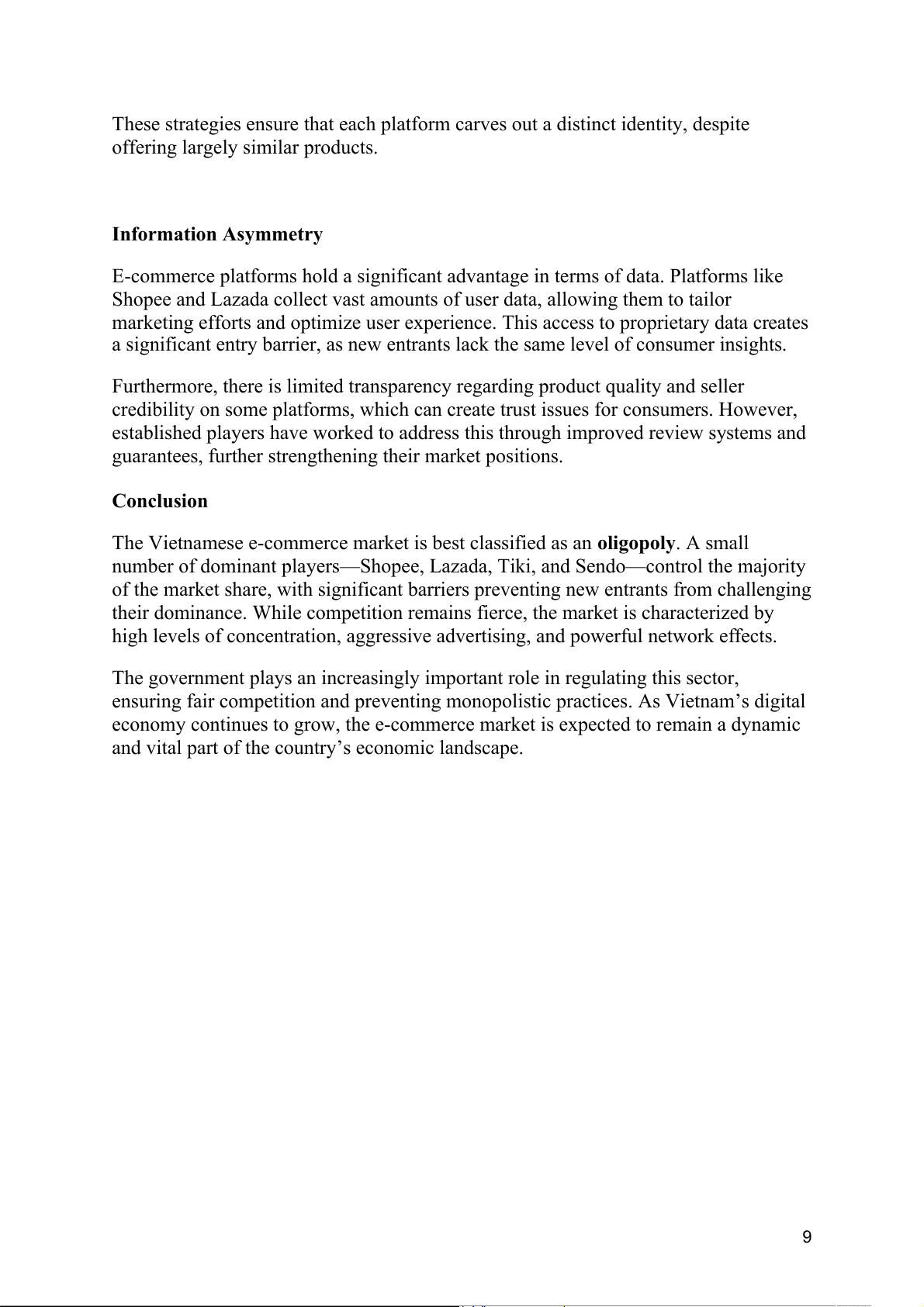
E-commerce platforms have revolutionized the way people shop. From humble
beginnings as simple online storefronts, they have evolved into sophisticated digital
marketplaces. Today's platforms offer a wide range of features, including personalized
recommendations, secure payment gateways, and seamless checkout processes. As
technology continues to advance, e-commerce platforms are becoming even more
integrated with social media and mobile devices, creating a truly omnichannel shopping experience.
Factors affecting the demand of the e-commerce market in Vietnam
Consumer’s income
According to data from the International Labor Organization (ILO) in Vietnam during
the Covid 19 pandemic, the average monthly income of workers is 5.2 million VND,
down 5% compared to the same period last year. Informal workers' income decreased
more than formal workers with a decrease of 8.4% (down 4.7% over the same period
the previous year). This makes consumers prioritize cheaper and proper options like e- commerce shopping platforms. 10
Therefore, online shopping with a variety of goods and prices may be an optimal
choice for every consumer with every level of income.
Price of related goods
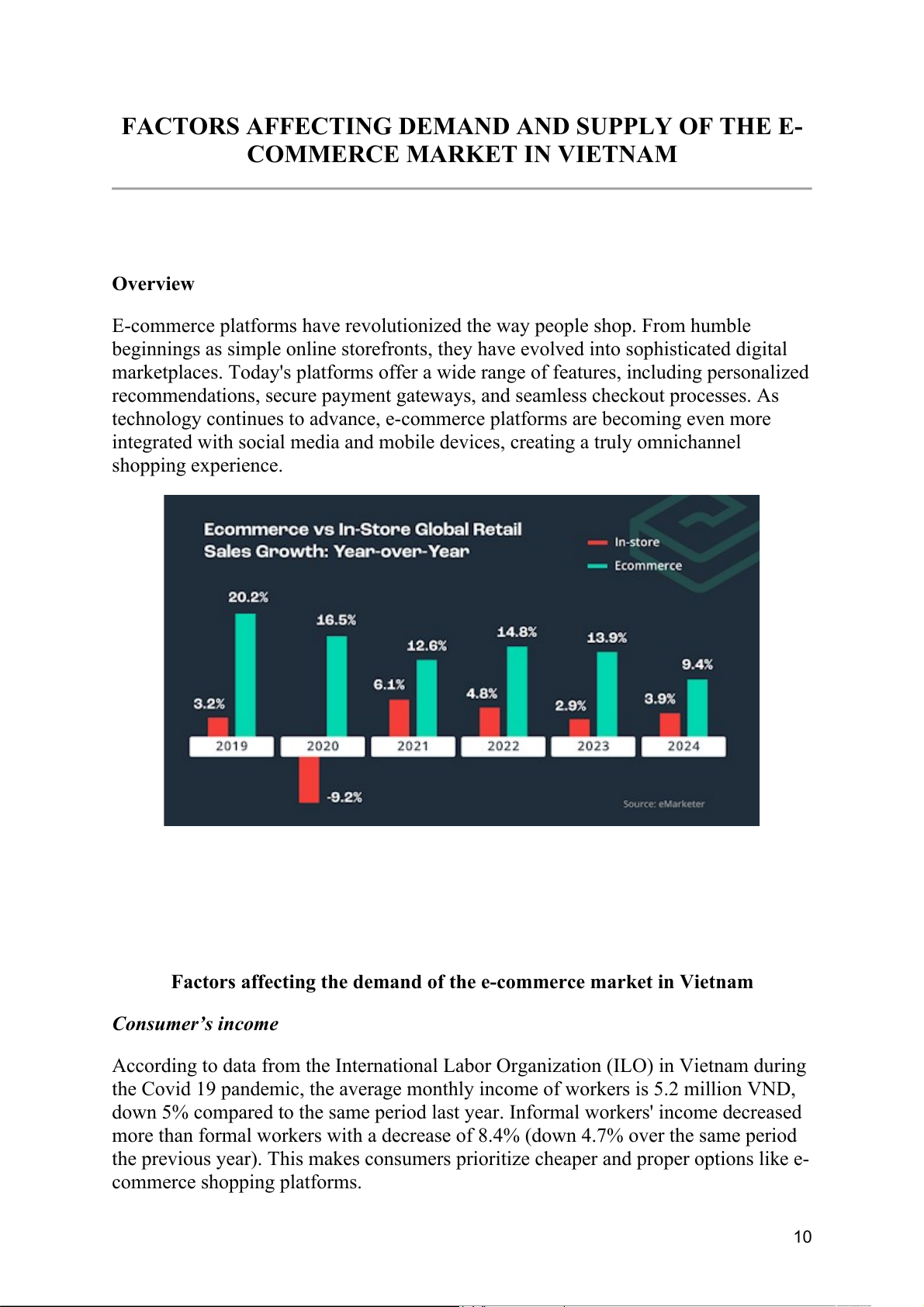
Before online shopping appeared, when technology was not yet modern and Internet
coverage was not yet too popular, consumers chose traditional ways to buy goods as
going to offline stores. Consumers who lived far from that store had to spend more
money on traveling than the nearer one. Moreover, some stores may have a higher
price than others since they have to rent premises, this may lead to unstable prices.
Therefore, with e-commerce platforms with convenience such as national shipping,
express shipping, and various types of goods in one online app, prices are also more
reasonable because stores do not need to rent premises to sell their goods and many
vouchers are sponsored for customers such as freeship voucher, voucher discount 50%
with code. This led to a rapid increase in demand for online shopping. Consumer tastes
In the era of developing digital technology, consumers tend to optimize their own
choices and prioritize the use of technology-enabled services. This allows e-commerce
platforms to develop as every company provides products and applications to help
customers access products more quickly and conveniently than before. In addition,
businesses also expand their many types of goods and services such as selling
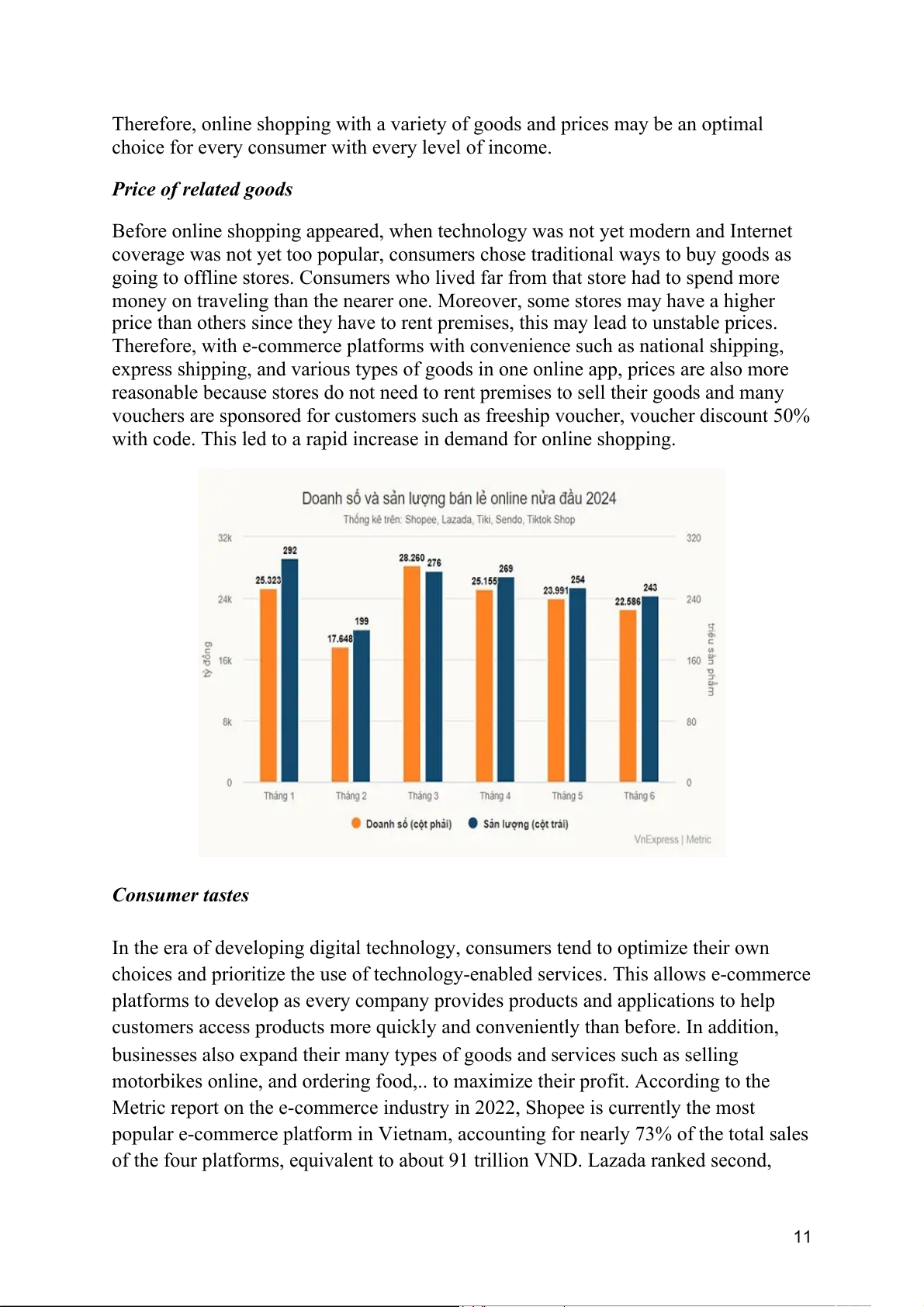
motorbikes online, and ordering food,.. to maximize their profit. According to the
Metric report on the e-commerce industry in 2022, Shopee is currently the most
popular e-commerce platform in Vietnam, accounting for nearly 73% of the total sales
of the four platforms, equivalent to about 91 trillion VND. Lazada ranked second, 11
accounting for 20% with revenue of 26.5 trillion VND," the Reputa report emphasized. Expectations
Consumers' expectations towards manufacturers are also one of the important factors
when considering changes in demand for each firm. Supposedly, customers can expect
to receive more incentives if they use the service enough, leading to the phenomenon
of "consumption accumulation" Many young people now know how to use their
vouchers to minimize the price that they have to pay reality, thereby increasing
demand, or predicting benefits when using the program. Discounts and incentives
from brands to choose the most beneficial products for yourself.
In general, expectations are the least sustainable factor when it comes to changes in
demand. However, in certain periods, such as during epidemics or armed conflicts,
expectations are the primary factor influencing consumer choices and strategic decision producers.
Factors affecting the supply of e-commerce market in Viet Nam Technology
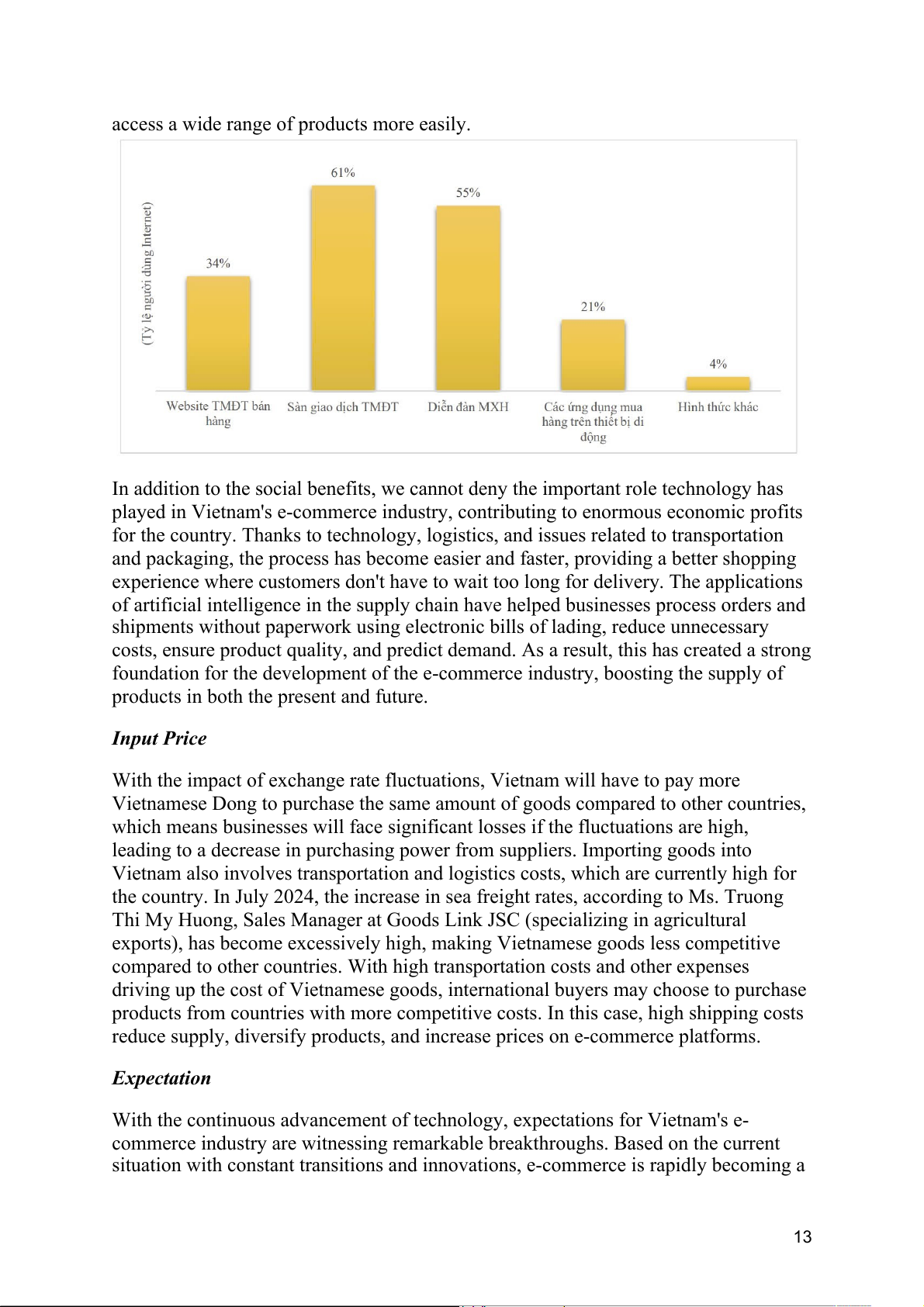
People are increasingly moving towards a more modern and convenient lifestyle in the
future. For this reason, technology has been created and continuously upgraded to
improve and bring many benefits that help Vietnamese consumers purchase goods and 12
access a wide range of products more easily.
In addition to the social benefits, we cannot deny the important role technology has
played in Vietnam's e-commerce industry, contributing to enormous economic profits
for the country. Thanks to technology, logistics, and issues related to transportation
and packaging, the process has become easier and faster, providing a better shopping
experience where customers don't have to wait too long for delivery. The applications
of artificial intelligence in the supply chain have helped businesses process orders and
shipments without paperwork using electronic bills of lading, reduce unnecessary
costs, ensure product quality, and predict demand. As a result, this has created a strong
foundation for the development of the e-commerce industry, boosting the supply of
products in both the present and future. Input Price
With the impact of exchange rate fluctuations, Vietnam will have to pay more
Vietnamese Dong to purchase the same amount of goods compared to other countries,
which means businesses will face significant losses if the fluctuations are high,
leading to a decrease in purchasing power from suppliers. Importing goods into
Vietnam also involves transportation and logistics costs, which are currently high for
the country. In July 2024, the increase in sea freight rates, according to Ms. Truong
Thi My Huong, Sales Manager at Goods Link JSC (specializing in agricultural
exports), has become excessively high, making Vietnamese goods less competitive
compared to other countries. With high transportation costs and other expenses
driving up the cost of Vietnamese goods, international buyers may choose to purchase
products from countries with more competitive costs. In this case, high shipping costs
reduce supply, diversify products, and increase prices on e-commerce platforms. Expectation
With the continuous advancement of technology, expectations for Vietnam's e-
commerce industry are witnessing remarkable breakthroughs. Based on the current
situation with constant transitions and innovations, e-commerce is rapidly becoming a 13
primary shopping channel. It not only boosts sales for sellers but also provides
numerous opportunities for market expansion and growth.
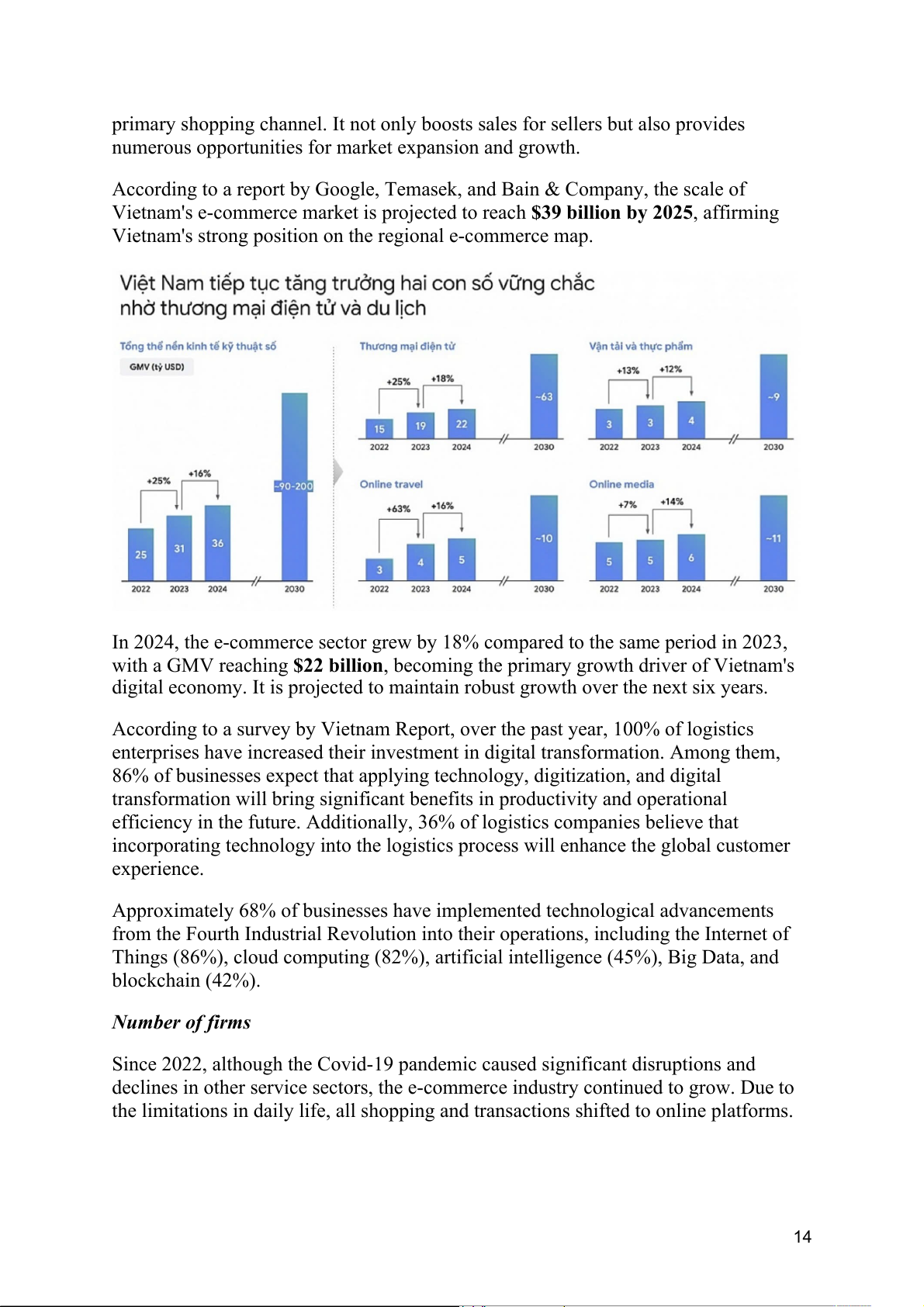
According to a report by Google, Temasek, and Bain & Company, the scale of
Vietnam's e-commerce market is projected to reach $39 billion by 2025, affirming
Vietnam's strong position on the regional e-commerce map.
In 2024, the e-commerce sector grew by 18% compared to the same period in 2023,
with a GMV reaching $22 billion, becoming the primary growth driver of Vietnam's
digital economy. It is projected to maintain robust growth over the next six years.
According to a survey by Vietnam Report, over the past year, 100% of logistics
enterprises have increased their investment in digital transformation. Among them,
86% of businesses expect that applying technology, digitization, and digital
transformation will bring significant benefits in productivity and operational
efficiency in the future. Additionally, 36% of logistics companies believe that
incorporating technology into the logistics process will enhance the global customer experience.
Approximately 68% of businesses have implemented technological advancements
from the Fourth Industrial Revolution into their operations, including the Internet of
Things (86%), cloud computing (82%), artificial intelligence (45%), Big Data, and blockchain (42%). Number of firms
Since 2022, although the Covid-19 pandemic caused significant disruptions and
declines in other service sectors, the e-commerce industry continued to grow. Due to
the limitations in daily life, all shopping and transactions shifted to online platforms. 14
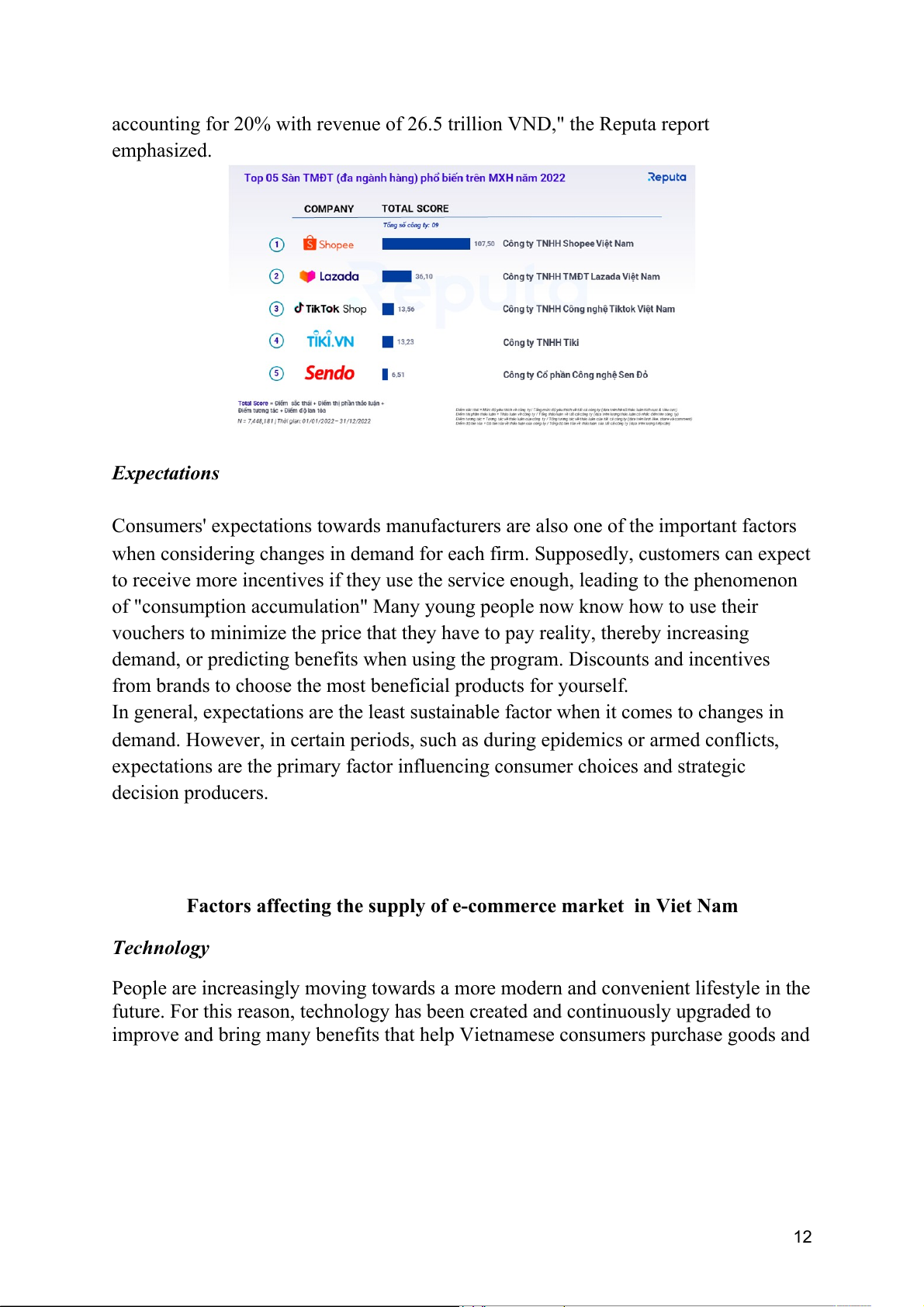
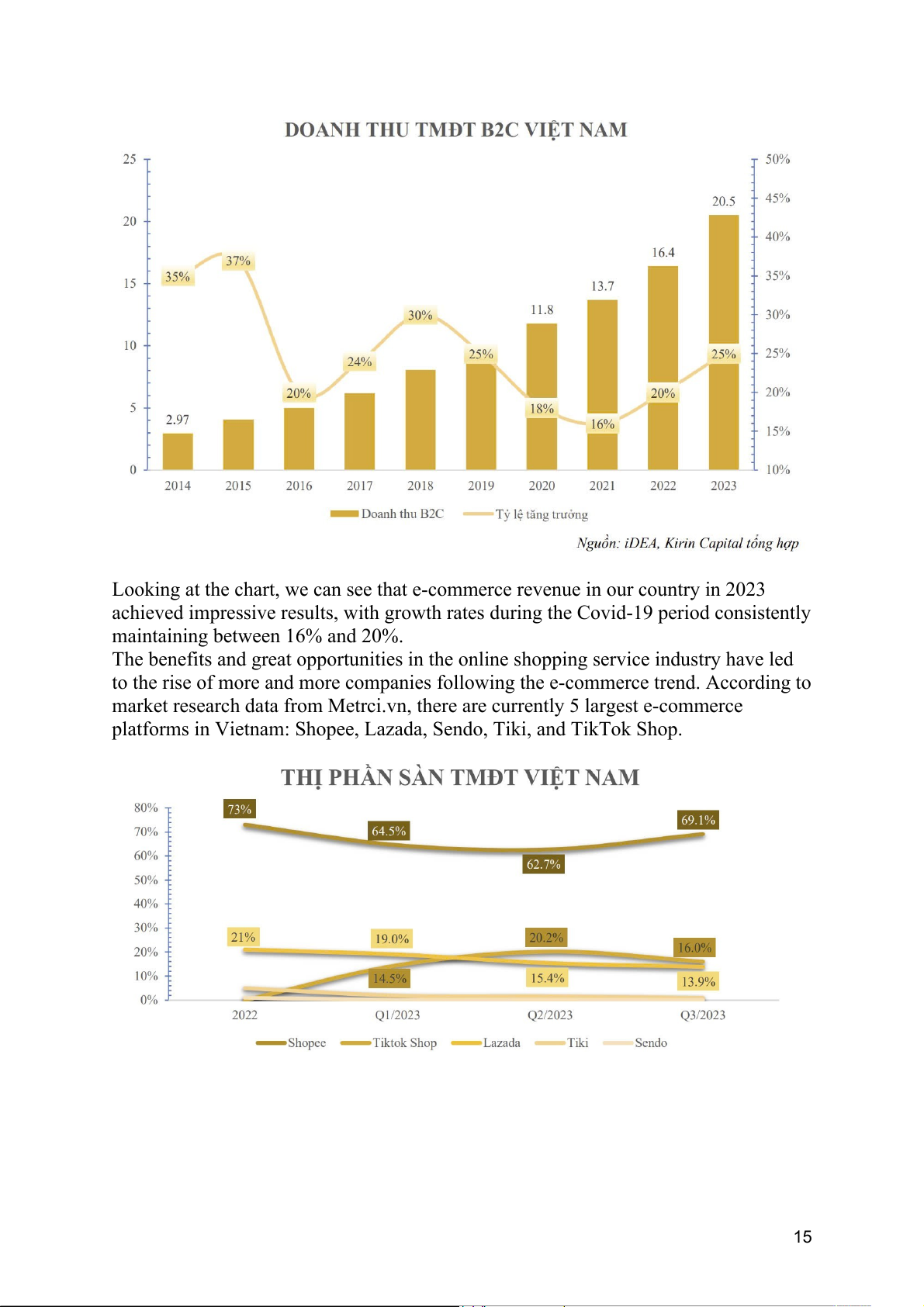
Looking at the chart, we can see that e-commerce revenue in our country in 2023
achieved impressive results, with growth rates during the Covid-19 period consistently
maintaining between 16% and 20%.
The benefits and great opportunities in the online shopping service industry have led
to the rise of more and more companies following the e-commerce trend. According to
market research data from Metrci.vn, there are currently 5 largest e-commerce
platforms in Vietnam: Shopee, Lazada, Sendo, Tiki, and TikTok Shop. 15
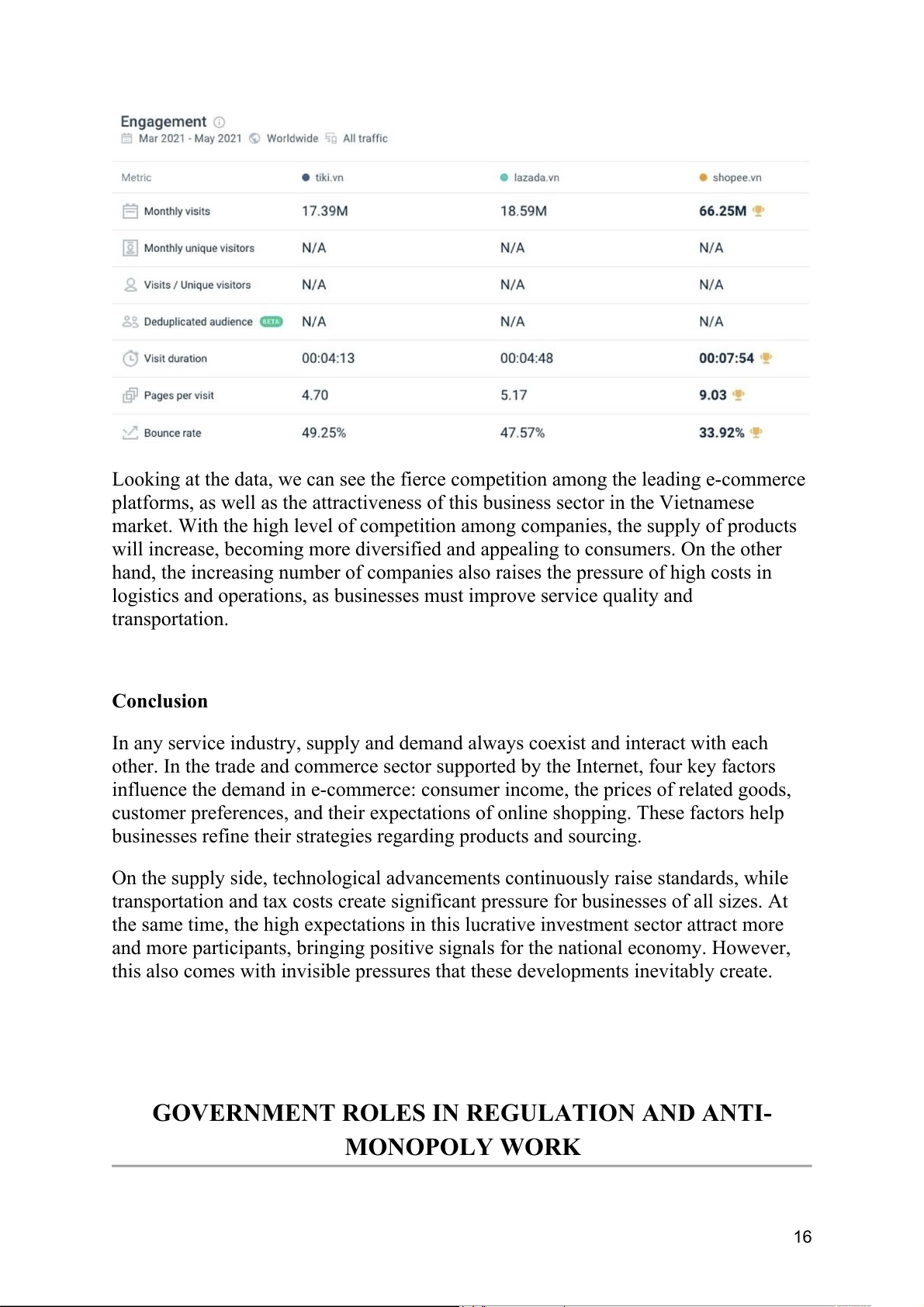
Looking at the data, we can see the fierce competition among the leading e-commerce
platforms, as well as the attractiveness of this business sector in the Vietnamese
market. With the high level of competition among companies, the supply of products
will increase, becoming more diversified and appealing to consumers. On the other
hand, the increasing number of companies also raises the pressure of high costs in
logistics and operations, as businesses must improve service quality and transportation. Conclusion
In any service industry, supply and demand always coexist and interact with each
other. In the trade and commerce sector supported by the Internet, four key factors
influence the demand in e-commerce: consumer income, the prices of related goods,
customer preferences, and their expectations of online shopping. These factors help
businesses refine their strategies regarding products and sourcing.
On the supply side, technological advancements continuously raise standards, while
transportation and tax costs create significant pressure for businesses of all sizes. At
the same time, the high expectations in this lucrative investment sector attract more
and more participants, bringing positive signals for the national economy. However,
this also comes with invisible pressures that these developments inevitably create.
GOVERNMENT ROLES IN REGULATION AND ANTI- MONOPOLY WORK 16 MARKET EFFICIENCY
The e-commerce market efficiency could be analyzed into two main criteria:
externalities and monopoly power. This type of market operation (especially with
dominant platforms like Shopee, Lazada, and Tiki) is not entirely efficient. Externalities:
Negative externalities:
The first problem of rapid expansion of online shopping in Vietnam would be the
increase in packaging waste, particularly plastic packaging, which resulted in
environmental pollution. In 2023, it was estimated that e-commerce in Vietnam
generated approximately 332,000 tons of packaging waste, with plastic packaging
accounting for 171,000 tons of this total. This high volume of plastic packaging
materials highlights the considerable environmental impact of the sector. Furthermore,
with the e-commerce industry continuing to grow at an annual rate of over 25%,
projections indicate that by 2030, plastic waste from e-commerce in Vietnam could reach as much as 800,000 tons.
Another issue is that the development of Vietnam's e-commerce was powered by e-
logistics, this combination has brought economic growth for the country. However it
also comes with the escalating greenhouse gas emissions, leading to air pollution.
According to McKinsey, predictions indicate that Vietnam's total GHG emissions
might approach 1.5 billion tons of CO2 equivalent by 2050, highlighting the urgent
need for sustainable interventions. A substantial portion of these emissions,
approximately 19.3%, according to Vietnam Briefing, is attributed to transportation
activities and work integral to e-commerce — from parcel transit between customer
homes and warehouses to shipments destined for airports.
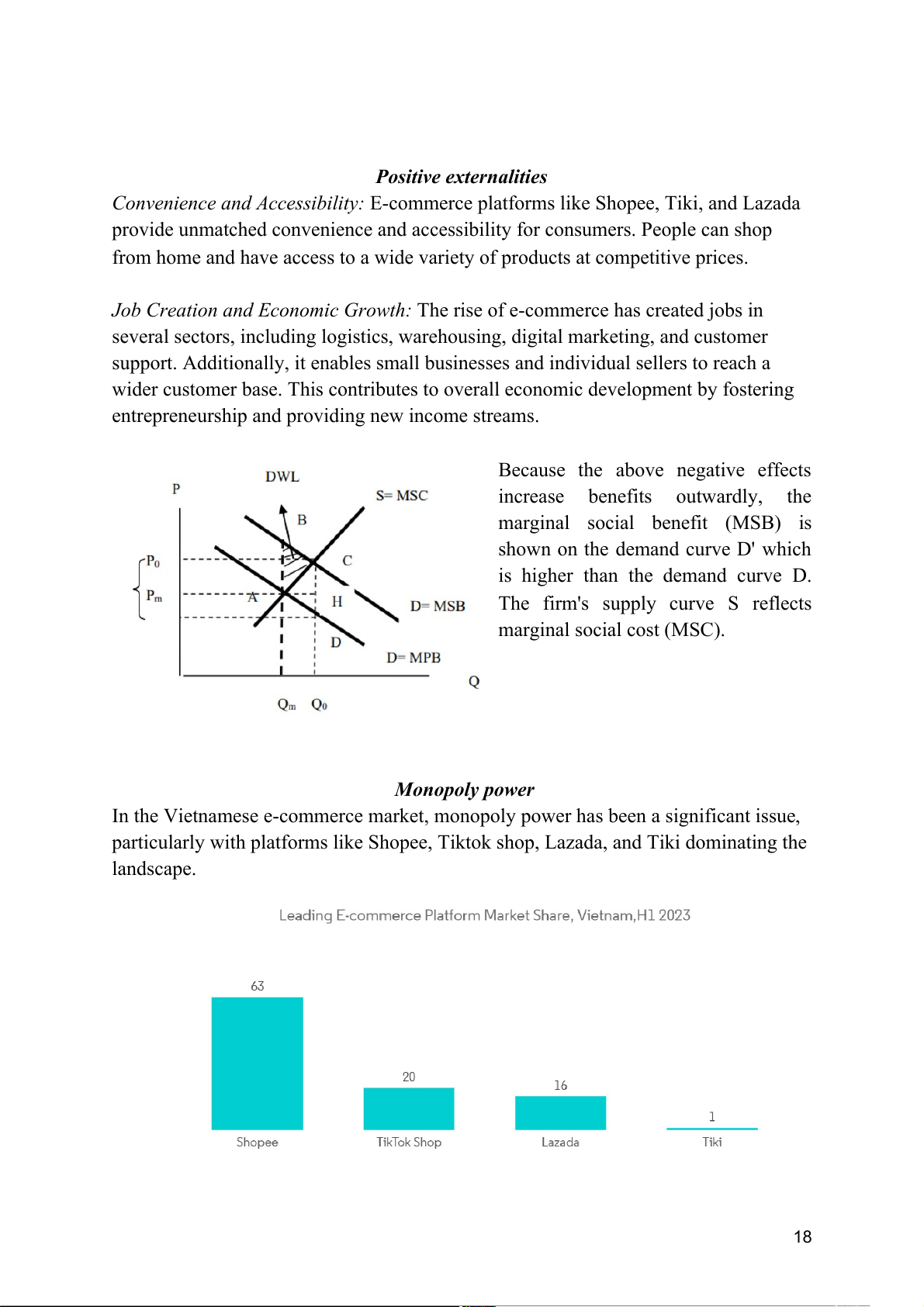
Due to the negative effects of pollution
and increasing external costs, the social
marginal cost (MSC), which includes
the cost of pollution, is greater than the
individual marginal cost, as shown in
Fig represented by the supply curve S'
being higher than the supply curve S.
The firm's demand curve D reflects the social marginal benefit. 17
Positive externalities
Convenience and Accessibility: E-commerce platforms like Shopee, Tiki, and Lazada
provide unmatched convenience and accessibility for consumers. People can shop
from home and have access to a wide variety of products at competitive prices.
Job Creation and Economic Growth: The rise of e-commerce has created jobs in
several sectors, including logistics, warehousing, digital marketing, and customer
support. Additionally, it enables small businesses and individual sellers to reach a
wider customer base. This contributes to overall economic development by fostering
entrepreneurship and providing new income streams.
Because the above negative effects
increase benefits outwardly, the
marginal social benefit (MSB) is
shown on the demand curve D' which
is higher than the demand curve D.
The firm's supply curve S reflects marginal social cost (MSC). Monopoly power
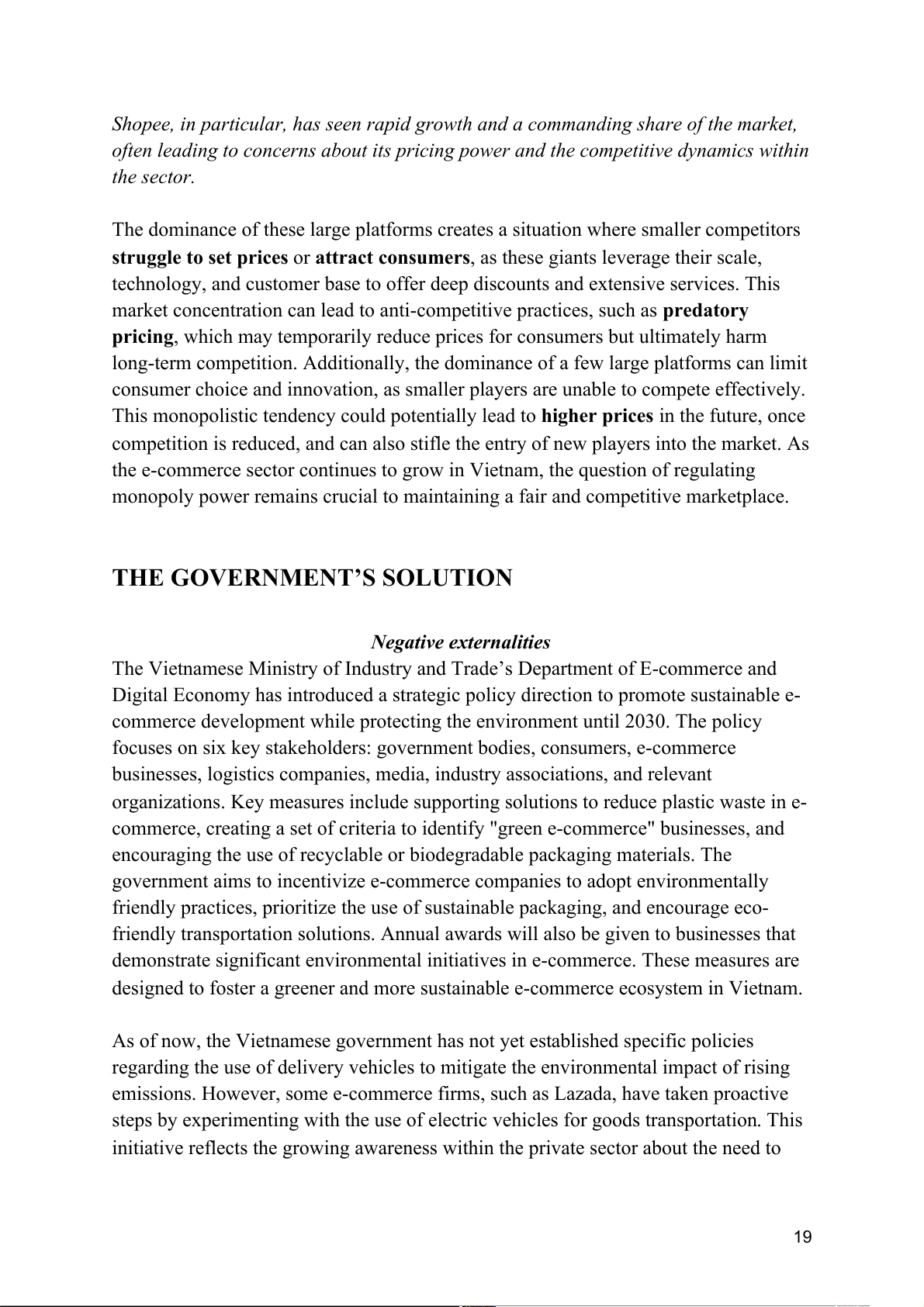
In the Vietnamese e-commerce market, monopoly power has been a significant issue,
particularly with platforms like Shopee, Tiktok shop, Lazada, and Tiki dominating the landscape. 18
Shopee, in particular, has seen rapid growth and a commanding share of the market,
often leading to concerns about its pricing power and the competitive dynamics within the sector.
The dominance of these large platforms creates a situation where smaller competitors
struggle to set prices or attract consumers, as these giants leverage their scale,
technology, and customer base to offer deep discounts and extensive services. This
market concentration can lead to anti-competitive practices, such as predatory
pricing, which may temporarily reduce prices for consumers but ultimately harm
long-term competition. Additionally, the dominance of a few large platforms can limit
consumer choice and innovation, as smaller players are unable to compete effectively.
This monopolistic tendency could potentially lead to higher prices in the future, once
competition is reduced, and can also stifle the entry of new players into the market. As
the e-commerce sector continues to grow in Vietnam, the question of regulating
monopoly power remains crucial to maintaining a fair and competitive marketplace.
THE GOVERNMENT’S SOLUTION
Negative externalities
The Vietnamese Ministry of Industry and Trade’s Department of E-commerce and
Digital Economy has introduced a strategic policy direction to promote sustainable e-
commerce development while protecting the environment until 2030. The policy
focuses on six key stakeholders: government bodies, consumers, e-commerce
businesses, logistics companies, media, industry associations, and relevant
organizations. Key measures include supporting solutions to reduce plastic waste in e-
commerce, creating a set of criteria to identify "green e-commerce" businesses, and
encouraging the use of recyclable or biodegradable packaging materials. The
government aims to incentivize e-commerce companies to adopt environmentally
friendly practices, prioritize the use of sustainable packaging, and encourage eco-
friendly transportation solutions. Annual awards will also be given to businesses that
demonstrate significant environmental initiatives in e-commerce. These measures are
designed to foster a greener and more sustainable e-commerce ecosystem in Vietnam.
As of now, the Vietnamese government has not yet established specific policies
regarding the use of delivery vehicles to mitigate the environmental impact of rising
emissions. However, some e-commerce firms, such as Lazada, have taken proactive
steps by experimenting with the use of electric vehicles for goods transportation. This
initiative reflects the growing awareness within the private sector about the need to 19
reduce carbon emissions and improve environmental sustainability in the e-commerce delivery process. Monopoly power
Currently, the Vietnamese government does not have specific and clear policies aimed
at directly reducing monopoly power in the e-commerce sector. However, it has begun
to focus on promoting competition and creating conditions for new businesses to
enter the market, thereby limiting the dominance of large players such as Shopee, Lazada, and Tiki.
The Vietnamese government has implemented stricter tax regulations for large e-
commerce platforms, requiring foreign companies like Shopee and Lazada to pay
taxes fully within Vietnam. This measure aims to ensure a level playing field between
foreign and domestic businesses, fostering fair competition. Additionally, the
government has made efforts to reform its legal framework, particularly with the
Competition Law 2018, to maintain a fair business environment and encourage
healthy competition among e-commerce enterprises.
Anti-monopoly regulations and controls on mergers and acquisitions have been
introduced to prevent market dominance and market distortion caused by large
platforms. These measures reflect the government’s commitment to promoting a more
competitive and diverse e-commerce ecosystem in Vietnam.
PREDICTIONS OF THE E-COMMERCE MARKET IN VIETNAM ● Overview:
With the rapid advancement of modern technology and the increasing consumer
demand in society, e-commerce platforms and online shopping applications have
become some of the fastest-growing markets. This growth is particularly notable with
the emergence of many livestream-supporting applications, which aim to stimulate
consumer demand and cater to the growing preference for online shopping among various customer segments. 20
Tài liệu liên quan:
-
Tự Luận Vimo: Phân Tích Cung, Cầu và Thị Trường Cạnh Tranh| Microeconomics | Trường Đại học Quốc tế, Đại học Quốc gia Thành phố Hồ Chí Minh
5 3 -
Review Questions: Thinking Like an Economist | Microeconomics | Trường Đại học Quốc tế, Đại học Quốc gia Thành phố Hồ Chí Minh
5 3 -
Final Exam Quizlet Questions & Answers | Microeconomics | Trường Đại học Quốc tế, Đại học Quốc gia Thành phố Hồ Chí Minh
5 3 -

Đề thi giữa kỳ II | Microeconomics | Trường Đại học Quốc tế, Đại học Quốc gia Thành phố Hồ Chí Minh
5 3 -
Final Group Project_ The Beer Industry | Microeconomics | Trường Đại học Quốc tế, Đại học Quốc gia Thành phố Hồ Chí Minh
4 2