Final Exam: Understanding & Managing Chocolate Shelf Life | Kinh tế vĩ mô | Trường Đại học kinh tế Thành Phố Hồ Chí Minh
All foods are perishable by nature. Numerous changes can take place in foods during processing and storage. Conquering shelf-life issues in confections can be challenging, to say the least. This paper will define shelf life and discuss issues directly impacting shelf life, such as for- mulation, manufacturing,storage and distribution, and then discuss possible remedies to overcome these issues. Tài liệu được sưu tầm và soạn thảo dưới dạng file PDF để gửi tới các bạn cùng tham khảo, ôn tập đầy đủ kiến thức, chuẩn bị cho các buổi học thật tốt. Mời bạn đọc đón xem!
Môn: Kinh tế vĩ mô ( UEH) 0.9 K tài liệu
Trường: Đại học Kinh tế Thành phố Hồ Chí Minh 2.8 K tài liệu
Tác giả:


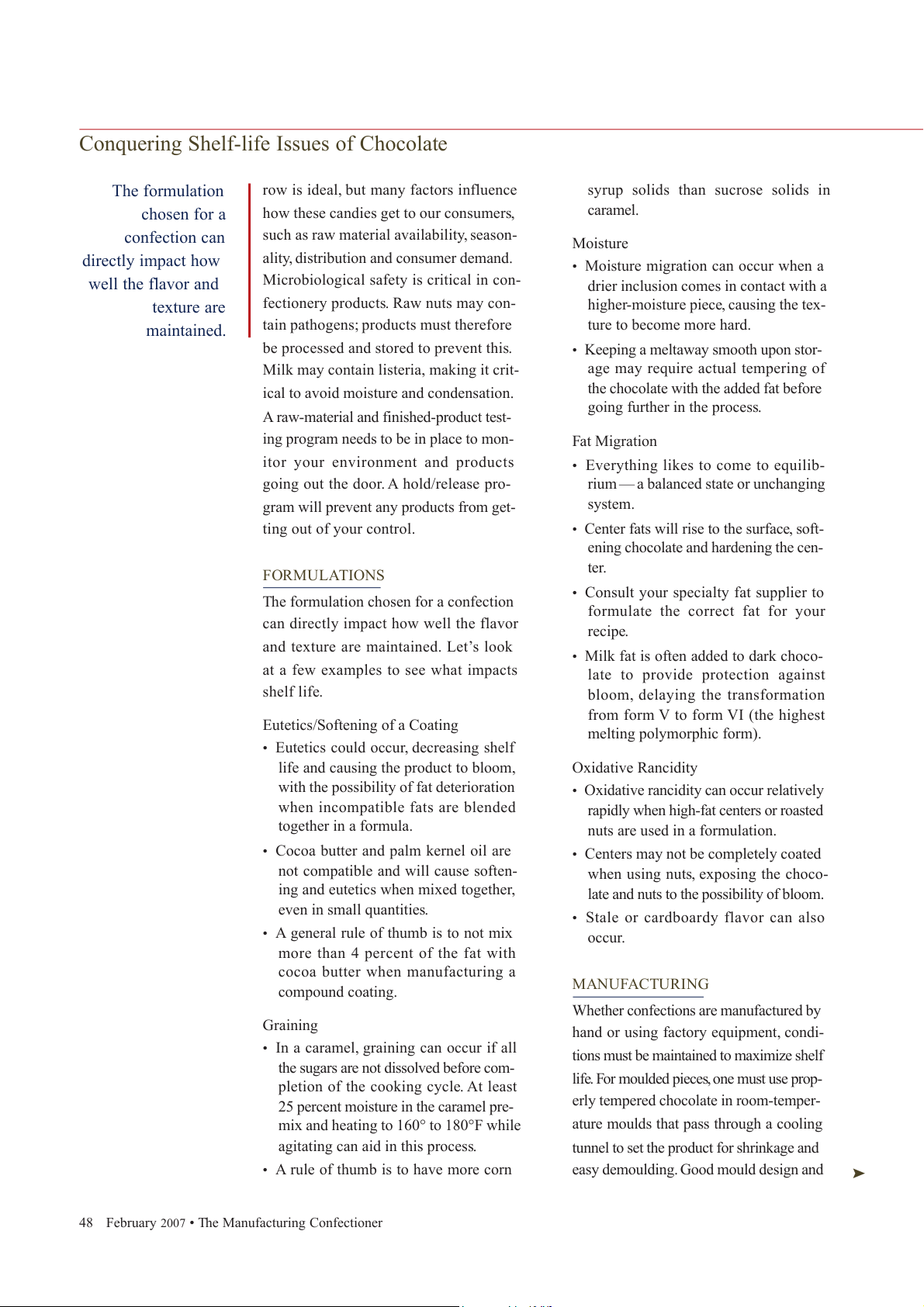

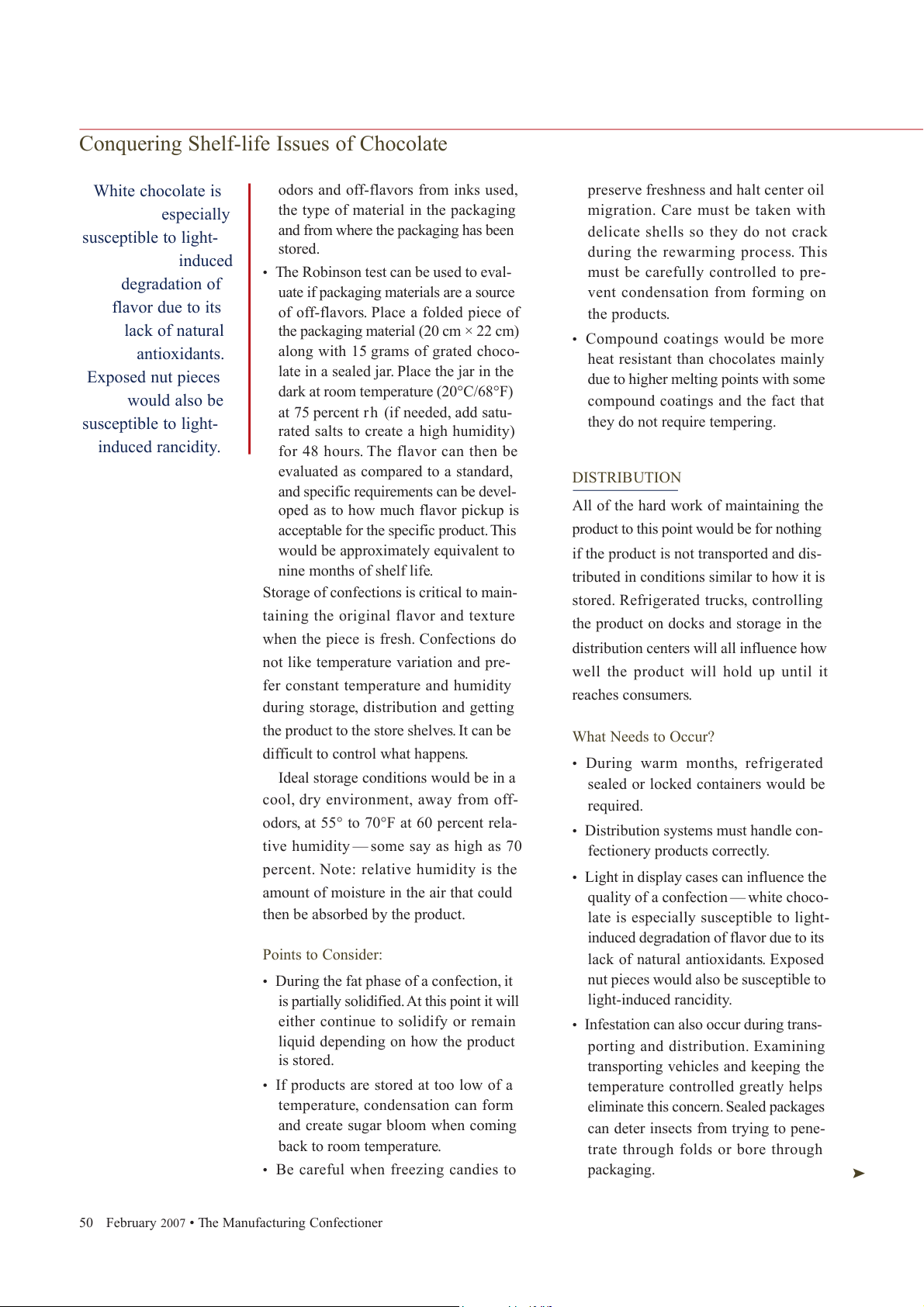
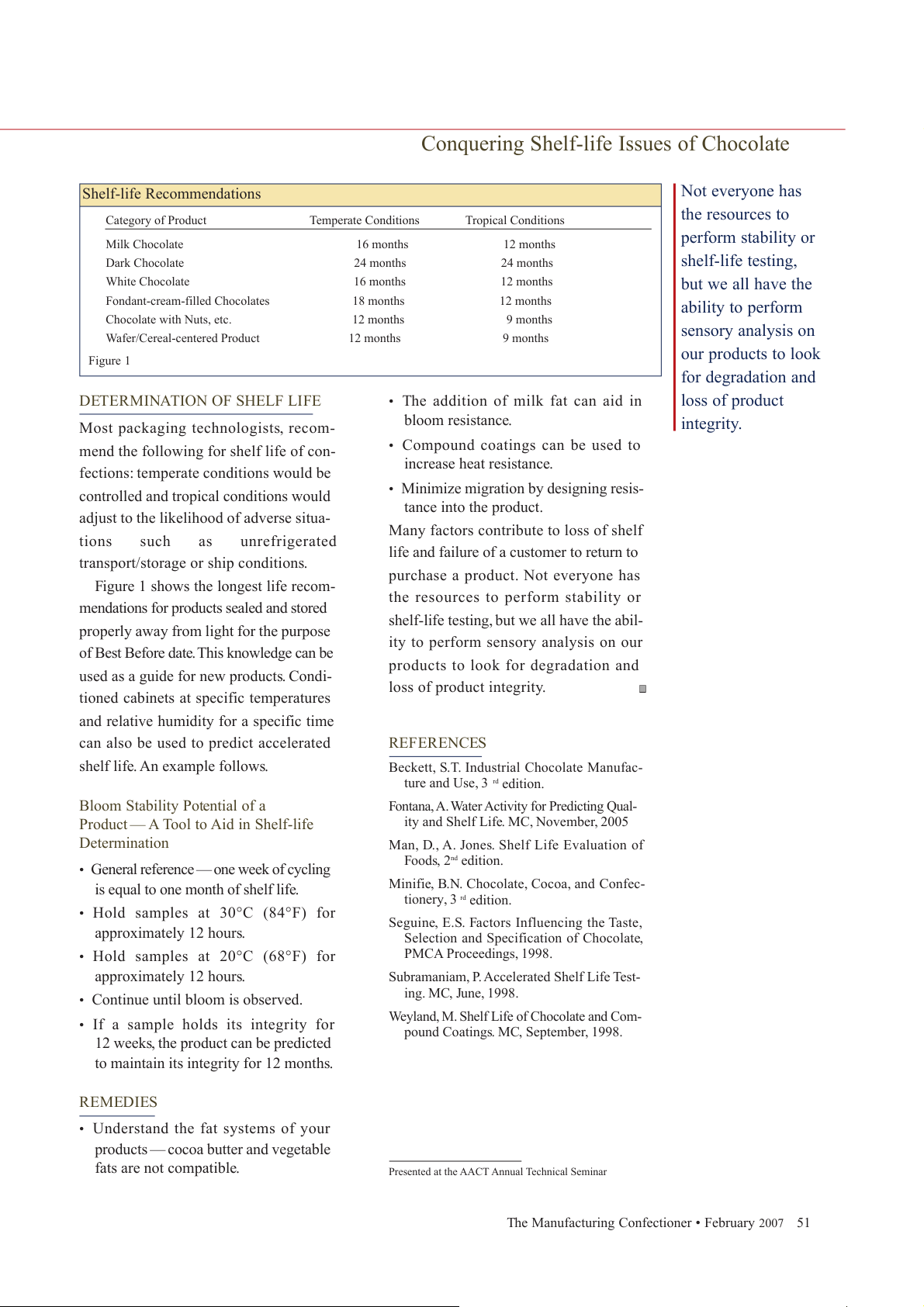
Preview text:
Conquering Shelf-life Issues of Chocolate
Ingredients, processes, packaging and ambient conditions all
affect shelf life. Understanding and controlling these factors
will help to ensure product quality and encourage repeat purchases. Marlene Stauffer Blommer Chocolate Co.
All foods are perishable by nature.
minerals and vitamins. It is an intimate mix-
Numerous changes can take place in foods
ture of solid particles suspended in fat.
during processing and storage. Conquer-
Chocolate is very shelf stable due princi-
ing shelf-life issues in confections can be
pally to the unique properties of cocoa.
challenging, to say the least. This paper
Chocolate contains cocoa butter and, some-
will define shelf life and discuss issues
times, milk or milk fat. It has a fast flavor
directly impacting shelf life, such as for-
release and melts at body temperature.
mulation, manufacturing, storage and dis-
Cocoa solids contain a natural antioxidant Marlene Stauffer is
tribution, and then discuss possible reme-
in the form of tocopherols, and cocoa but- the director of quality dies to overcome these issues.
ter breaks down to inoffensive short-chain assurance/research
fatty acids.As a result, most chocolate prod- and development at Blommer Chocolate WHAT IS SHELF LIFE?
ucts can be classified as medium- or long- Company. She has
life products. Compound coatings contain
The shelf life of a food product is the period been with Blommer
vegetable fat, have a slower flavor release since 1982.
of time during which it will retain accept-
and can be heat resistant. When adding
able appearance, aroma, flavor and texture.
inclusions and making candies using choco-
Key elements of shelf life for the confec-
late, shelf-life factors can be altered and
tioner are microbiological safety, eutetics,
categorized into two main classes:
bloom, migration (fat or moisture), loss of
• Those which are inherent in the product texture and rancidity.
itself and cannot be prevented by pack-
Chocolate is a high-energy foodstuff with aging alone.
a complex nutritional profile, containing
• Those which are dependent on the envi-
fat (either cocoa butter or, if it is a confec- ronment and may be controlled.
tionery coating, vegetable fat), carbohy-
In a perfect world, making mouthwatering
drates and protein. It does provide some
confections today and selling them tomor- ➤
The Manufacturing Confectioner • February 2007 47
Conquering Shelf-life Issues of Chocolate The formulation
row is ideal, but many factors influence
syrup solids than sucrose solids in chosen for a
how these candies get to our consumers, caramel. confection can
such as raw material availability, season- Moisture directly impact how
ality, distribution and consumer demand.
• Moisture migration can occur when a
Microbiological safety is critical in con- well the flavor and
drier inclusion comes in contact with a
fectionery products. Raw nuts may con- texture are
higher-moisture piece, causing the tex-
tain pathogens; products must therefore ture to become more hard. maintained.
be processed and stored to prevent this.
• Keeping a meltaway smooth upon stor-
Milk may contain listeria, making it crit-
age may require actual tempering of
ical to avoid moisture and condensation.
the chocolate with the added fat before going further in the process.
A raw-material and finished-product test-
ing program needs to be in place to mon- Fat Migration
itor your environment and products
• Everything likes to come to equilib-
going out the door. A hold/release pro-
rium — a balanced state or unchanging
gram will prevent any products from get- system. ting out of your control.
• Center fats will rise to the surface, soft-
ening chocolate and hardening the cen- FORMULATIONS ter.
• Consult your specialty fat supplier to
The formulation chosen for a confection
formulate the correct fat for your
can directly impact how well the flavor recipe.
and texture are maintained. Let’s look
• Milk fat is often added to dark choco-
at a few examples to see what impacts
late to provide protection against shelf life.
bloom, delaying the transformation
from form V to form VI (the highest
Eutetics/Softening of a Coating melting polymorphic form).
• Eutetics could occur, decreasing shelf
life and causing the product to bloom, Oxidative Rancidity
with the possibility of fat deterioration
• Oxidative rancidity can occur relatively
when incompatible fats are blended
rapidly when high-fat centers or roasted together in a formula.
nuts are used in a formulation.
• Cocoa butter and palm kernel oil are
• Centers may not be completely coated
not compatible and will cause soften-
when using nuts, exposing the choco-
ing and eutetics when mixed together,
late and nuts to the possibility of bloom. even in small quantities.
• Stale or cardboardy flavor can also
• A general rule of thumb is to not mix occur.
more than 4 percent of the fat with
cocoa butter when manufacturing a compound coating. MANUFACTURING
Whether confections are manufactured by Graining
hand or using factory equipment, condi-
• In a caramel, graining can occur if all
tions must be maintained to maximize shelf
the sugars are not dissolved before com-
pletion of the cooking cycle. At least
life. For moulded pieces, one must use prop-
25 percent moisture in the caramel pre-
erly tempered chocolate in room-temper-
mix and heating to 160° to 180°F while
ature moulds that pass through a cooling
agitating can aid in this process.
tunnel to set the product for shrinkage and
• A rule of thumb is to have more corn
easy demoulding. Good mould design and ➤
48 February 2007 • The Manufacturing Confectioner
Conquering Shelf-life Issues of Chocolate
consistent moulding procedures will min-
• If a piece has an uneven surface to coat, Confections do not imize potential problems.
this could cause the center to be like temperature
During enrobing a center is passed
exposed, creating conditions for variation and reduced shelf life.
through a curtain of chocolate or com- prefer constant
pound coating and then over a bottomer
• Incorrect viscosity may also alter cov-
erage rate as well as increase feet temperature and
to coat the bases. Sometimes bases are
formed at the base of each piece. humidity during
coated with a compound coating first to storage.
aid in integrity or to prevent fat migra- Cooling
tion, and then enrobed with chocolate.
• Chocolate and compound require dif-
Pieces can also be double enrobed to
ferent cooling tunnel conditions.
ensure extra coating if the center is vul-
–Chocolate needs to be cooled gently
with moderate air flow (55° to 60°F).
nerable to softening or leakage, or difficult
–Compound coatings are best cooled
to coat. If enrobed centers are cooled too
in colder tunnels (40° to 45°F) because
rapidly, the chocolate could crack; if
they spontaneously solidify in a stable
cooled too slowly, it could end up discol- crystal form.
ored and soft. The big issue is that this
• All tunnels should warm to nearly room
problem may not be apparent right away
temperature at exiting to prevent con-
and could emerge later in the distribution densation.
process or when your customer purchases the product. PACKAGING AND STORAGE ISSUES
Packaging types will have a great influ- Solid Chocolate
ence on the stability of the confectionery Temper
product over time.The goal is to keep fla-
• Improperly tempered chocolate will
vor and texture in and moisture or off-fla-
continue to stabilize after the product is
vors out. Moisture can cause cracking of,
wrapped and has left the factory, which
may lead to soft texture and the appear-
for example, pretzels coated with choco- ance of fat crystals or bloom.
late and could make them soggy. Milk
• Lack of contraction (shrinkage) in a
chocolate is more susceptible to flavor
mould for product releases can be due
degradation if packaging is not controlled. to improper tempering.
There are many types of packaging mate-
• Dull appearances, poor snap and long
rials such as polypropylene, metalized or
set times can be from improper tem-
multilayered films. Packaging suppliers pering.
are excellent resources for the best type of Moulding
packaging for a specific product.
• Improperly designed moulds can lead
Following are some things to take into to poor-quality products. consideration:
• Warm moulds can delay onset of crys-
• Heat sealing — be careful if shrink film- tallization.
ing is used; this could cause bloom due to excessive heat.
• Cold moulds can expose chocolate to
premature cooling, forming incorrect
• High-moisture pieces may lose and trap crystals.
moisture. This could cause molding if
tight packaging is being used. Some- Enrobing
times wax paper is the best option due
• If centers are too warm, they can detem- to its semi-permeability. per the chocolate.
• Packaging material could cause off- ➤
The Manufacturing Confectioner • February 2007 49
Conquering Shelf-life Issues of Chocolate White chocolate is
odors and off-flavors from inks used,
preserve freshness and halt center oil
the type of material in the packaging
migration. Care must be taken with especially
and from where the packaging has been
delicate shells so they do not crack susceptible to light- stored.
during the rewarming process. This induced
• The Robinson test can be used to eval-
must be carefully controlled to pre- degradation of
uate if packaging materials are a source
vent condensation from forming on flavor due to its
of off-flavors. Place a folded piece of the products. lack of natural
the packaging material (20 cm × 22 cm)
• Compound coatings would be more antioxidants.
along with 15 grams of grated choco-
heat resistant than chocolates mainly
late in a sealed jar. Place the jar in the Exposed nut pieces
due to higher melting points with some
dark at room temperature (20°C/68°F) would also be
compound coatings and the fact that
at 75 percent rh (if needed, add satu- susceptible to light- they do not require tempering.
rated salts to create a high humidity) induced rancidity.
for 48 hours. The flavor can then be
evaluated as compared to a standard, DISTRIBUTION
and specific requirements can be devel-
oped as to how much flavor pickup is
All of the hard work of maintaining the
acceptable for the specific product.This
product to this point would be for nothing
would be approximately equivalent to
if the product is not transported and dis- nine months of shelf life.
tributed in conditions similar to how it is
Storage of confections is critical to main-
stored. Refrigerated trucks, controlling
taining the original flavor and texture
the product on docks and storage in the
when the piece is fresh. Confections do
distribution centers will all influence how
not like temperature variation and pre-
well the product will hold up until it
fer constant temperature and humidity reaches consumers.
during storage, distribution and getting
the product to the store shelves. It can be What Needs to Occur?
difficult to control what happens.
• During warm months, refrigerated
Ideal storage conditions would be in a
sealed or locked containers would be
cool, dry environment, away from off- required.
odors, at 55° to 70°F at 60 percent rela-
• Distribution systems must handle con-
tive humidity — some say as high as 70 fectionery products correctly.
percent. Note: relative humidity is the
• Light in display cases can influence the
amount of moisture in the air that could
quality of a confection — white choco-
then be absorbed by the product.
late is especially susceptible to light-
induced degradation of flavor due to its Points to Consider:
lack of natural antioxidants. Exposed
• During the fat phase of a confection, it
nut pieces would also be susceptible to
is partially solidified.At this point it will light-induced rancidity.
either continue to solidify or remain
• Infestation can also occur during trans-
liquid depending on how the product
porting and distribution. Examining is stored.
transporting vehicles and keeping the
• If products are stored at too low of a
temperature controlled greatly helps
temperature, condensation can form
eliminate this concern. Sealed packages
and create sugar bloom when coming
can deter insects from trying to pene- back to room temperature.
trate through folds or bore through
• Be careful when freezing candies to packaging. ➤
50 February 2007 • The Manufacturing Confectioner
Conquering Shelf-life Issues of Chocolate Shelf-life Recommendations Not everyone has the resources to Category of Product Temperate Conditions Tropical Conditions perform stability or Milk Chocolate 16 months 12 months Dark Chocolate 24 months 24 months shelf-life testing, White Chocolate 16 months 12 months but we all have the
Fondant-cream-filled Chocolates 18 months 12 months ability to perform Chocolate with Nuts, etc. 12 months 9 months sensory analysis on Wafer/Cereal-centered Product 12 months 9 months our products to look Figure 1 for degradation and DETERMINATION OF SHELF LIFE
• The addition of milk fat can aid in loss of product
Most packaging technologists, recom- bloom resistance. integrity.
mend the following for shelf life of con-
• Compound coatings can be used to increase heat resistance.
fections: temperate conditions would be
controlled and tropical conditions would
• Minimize migration by designing resis- tance into the product.
adjust to the likelihood of adverse situa-
Many factors contribute to loss of shelf tions such as unrefrigerated
life and failure of a customer to return to
transport/storage or ship conditions.
purchase a product. Not everyone has
Figure 1 shows the longest life recom-
the resources to perform stability or
mendations for products sealed and stored
shelf-life testing, but we all have the abil-
properly away from light for the purpose
ity to perform sensory analysis on our
of Best Before date.This knowledge can be
products to look for degradation and
used as a guide for new products. Condi- loss of product integrity. ■
tioned cabinets at specific temperatures
and relative humidity for a specific time
can also be used to predict accelerated REFERENCES
shelf life. An example follows.
Beckett, S.T. Industrial Chocolate Manufac- ture and Use, 3 rd edition. Bloom Stability Potential of a
Fontana,A.Water Activity for Predicting Qual-
Product — A Tool to Aid in Shelf-life
ity and Shelf Life. MC, November, 2005 Determination
Man, D., A. Jones. Shelf Life Evaluation of Foods, 2nd edition.
• General reference — one week of cycling
is equal to one month of shelf life.
Minifie, B.N. Chocolate, Cocoa, and Confec- tionery, 3 rd edition.
• Hold samples at 30°C (84°F) for
Seguine, E.S. Factors Influencing the Taste, approximately 12 hours.
Selection and Specification of Chocolate,
• Hold samples at 20°C (68°F) for PMCA Proceedings, 1998. approximately 12 hours.
Subramaniam, P. Accelerated Shelf Life Test-
• Continue until bloom is observed. ing. MC, June, 1998.
Weyland, M. Shelf Life of Chocolate and Com-
• If a sample holds its integrity for
pound Coatings. MC, September, 1998.
12 weeks, the product can be predicted
to maintain its integrity for 12 months. REMEDIES
• Understand the fat systems of your
products — cocoa butter and vegetable fats are not compatible.
Presented at the AACT Annual Technical Seminar
The Manufacturing Confectioner • February 2007 51
Tài liệu liên quan:
-

Tiểu luận Phân Tích Giá Trái Cây 2023 | Kinh tế vĩ mô | Trường Đại học kinh tế Thành Phố Hồ Chí Minh
17 9 -
Bộ câu hỏi trắc nghiệm - Kinh tế học thị trường và cầu cung | Kinh tế vĩ mô | Trường Đại học kinh tế Thành Phố Hồ Chí Minh
17 9 -
Câu Hỏi Ôn Tập Phần Thị Trường | Kinh tế vĩ mô | Trường Đại học kinh tế Thành Phố Hồ Chí Minh
24 12 -
Kinh Tế Vi Mô: Câu Hỏi và Đáp Án Quan Trọng | Kinh tế vĩ mô | Trường Đại học kinh tế Thành Phố Hồ Chí Minh
21 11 -
Tiểu luận Món Huế và Thị Trường F&B Việt Nam | Kinh tế vĩ mô | Trường Đại học kinh tế Thành Phố Hồ Chí Minh
16 8