Final Group Project: Steel Market Research Analysis | Microeconomics | Trường Đại học Quốc tế, Đại học Quốc gia Thành phố Hồ Chí Minh
Steel is one of the most important construction and industrial materials, serving as a cornerstone of Vietnam's economic and social development. The choice of steel as the research subject is motivated not only by the strategic importance of this sector but also by the urgent need to better understand the market structure and factors influencing supply and demand. Tài liệu được sưu tầm và soạn thảo dưới dạng file PDF để gửi tới các bạn cùng tham khảo, ôn tập đầy đủ kiến thức, chuẩn bị cho các buổi học thật tốt. Mời bạn đọc đón xem!
Môn: Microeconomics 613 tài liệu
Trường: Trường Đại học Quốc tế, Đại học Quốc gia Thành phố Hồ Chí Minh 1.9 K tài liệu
Tác giả:



Preview text:
NATIONAL ECONOMICS UNIVERSITY NEU BUSINESS SCHOOL .....0O0..... Final Group Project MICROECONOMICS
Topic: Steel Market Research & Analysis Presented by: Group 7 1. Nguyễn Công Hưng 2. Nguyễn Trung Kiên 3. Lưu Thế Mạnh
4. Nguyễn Thị Kiều Trang Class: EBBA 16.2 Ha Noi – 2024 FINAL GROUP ASSIGNMENT Market Research TABLE OF CONTENTS INTRODUCTION I. Market Classification
1. Characteristics of market structure
2. Market structure analysis of the Vietnam steel industry
3. Comparison to other market II.
Factors Affecting Supply and Demand 1. Factors Affecting Supply 2. Factors Affecting Demand
3. Trends in Supply and Demand Over Recent Years and the Government’s Role III.
Conclusion and Evaluation 1. Summary of Key Points
2. Future outlook for the Commodity References GROUP 7 1 FINAL GROUP ASSIGNMENT Market Research INTRODUCTION
Steel is one of the most important construction and industrial materials, serving as a
cornerstone of Vietnam's economic and social development. The choice of steel as the
research subject is motivated not only by the strategic importance of this sector but also by
the urgent need to better understand the market structure and factors influencing supply and
demand. In the context of deep economic integration and intensifying competition, a study on
the steel market will provide valuable insights for policymakers, support businesses, and
promote the sustainable development of the industry
Vietnam's steel industry began to take shape in the 1960s, with initial reliance on imports to
meet domestic demand. By the 1990s, the establishment of the Vietnam Steel Corporation led
to significant progress, attracting both foreign and domestic investments. Over the next few
decades, the industry rapidly expanded, with key segments like construction steel, steel pipes,
and galvanized steel seeing growth of up to 69% in production between 2015 and 2018.
Vietnam became a leader in Southeast Asia, ranking 14th globally for steel production in
2019 and accounting for over 30% of the region's output. The country also experienced a
substantial increase in steel exports, rising from 1 million tons in 2010 to 6 million tons by 2018.
However, in 2019, the industry faced challenges due to global protectionism and a slowdown
in the domestic real estate sector, leading to a slight dip in production. The COVID-19
pandemic in 2020 further disrupted the steel supply chain, with trade activities severely
affected and many companies experiencing significant profit losses.
By 2024, the industry continues to struggle with external challenges, including ongoing
protectionism and the slow recovery of the construction sector. Despite these difficulties,
Vietnam remains a key player in the global steel market, but the outlook remains uncertain
due to these persistent hurdles.
Overview of the Industry and the Commodity GROUP 7 2 FINAL GROUP ASSIGNMENT Market Research
I. Market classification
1. Vietnam steel market classification
In order to gain a deeper and more comprehensive understanding of the characteristics and
operational mechanisms of the Vietnamese steel market, market classification is an essential step.
According to microeconomic theory, the classification of market structures is based on the analysis
and evaluation of the following factors: Market Number of Nature of Market power Barriers Non-price structure firms product of entry Competition Perfect Many small Homogenous No No No Competition firms “price taker” Monopolisti
Many relatively Differentiation Low Low Advertising c small firms Competition Oligopoly Some relatively Identical High High Advertising big firms Differentiation Monopoly Only one Unique Very high Very high No big firms (“price maker”)
By analyzing and evaluating the aforementioned factors, we can easily identify and classify
the structure of the Vietnamese steel market: Number of Firms
cannot directly compete with the giants in
The Vietnamese steel market involves many
terms of production scale, pricing, or
companies, including domestic firms and
distribution networks. As a result, they have
foreign-invested enterprises. However, the
to find ways to differentiate their products,
majority of the market share is concentrated
such as by producing specialized or high-
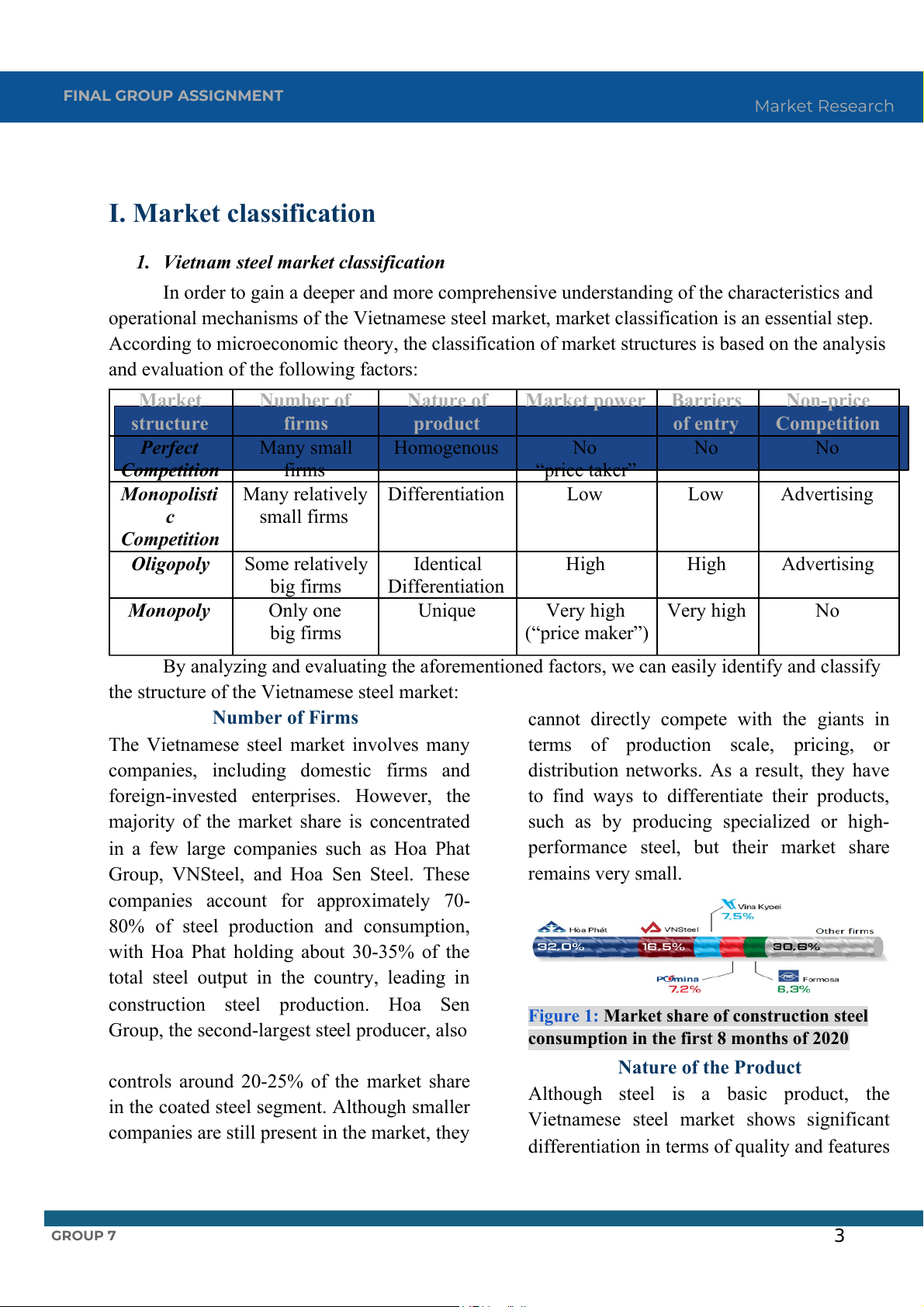
in a few large companies such as Hoa Phat
performance steel, but their market share
Group, VNSteel, and Hoa Sen Steel. These remains very small.
companies account for approximately 70-
80% of steel production and consumption,
with Hoa Phat holding about 30-35% of the
total steel output in the country, leading in
construction steel production. Hoa Sen
Figure 1: Market share of construction steel
Group, the second-largest steel producer, also
consumption in the first 8 months of 2020 Nature of the Product
controls around 20-25% of the market share
Although steel is a basic product, the
in the coated steel segment. Although smaller
Vietnamese steel market shows significant
companies are still present in the market, they
differentiation in terms of quality and features GROUP 7 3 FINAL GROUP ASSIGNMENT Market Research
among products from different companies.
In a market where large firms dominate most
Generally, Vietnamese steel is primarily
of the market share, their market power— or
produced for the construction industry;
ability to significantly influence steel prices
however, there are notable differences in
and production volumes—is obvious. Due to
product quality between various brands. Steel
large production scales and widespread
produced by large corporations like Hoa Phat
distribution networks, these firms can adjust
and Hoa Sen is of high quality, with
prices and distribution strategies as they see
characteristics such as high durability, good
fit without facing significant resistance from
corrosion resistance, and ease of construction.
smaller competitors. This market power
Notably, they not only supply basic
reduces the level of actual competition in the
construction steel but also offer products like
market and reinforces the oligopolistic nature
rolled steel, galvanized steel, and steel plates
of the steel industry. While smaller
to meet the specialized needs of the industry.
companies cannot significantly influence
This gives them a competitive advantage in
pricing decisions, the larger firms can achieve
expanding their market share and creating a
stable profits through controlling supply and
distinct difference compared to smaller
pricing strategies. Additionally, their market
enterprises, which primarily produce lower-
power is further demonstrated by their ability
quality steel or focus on products with fewer
to negotiate with partners and suppliers,
differentiating features. The diversity of
allowing them to maintain steady profits and
products combined with continuous market dominance.
innovation in production technology has
helped these large companies maintain their
competitive advantage and strengthen their position in the industry.
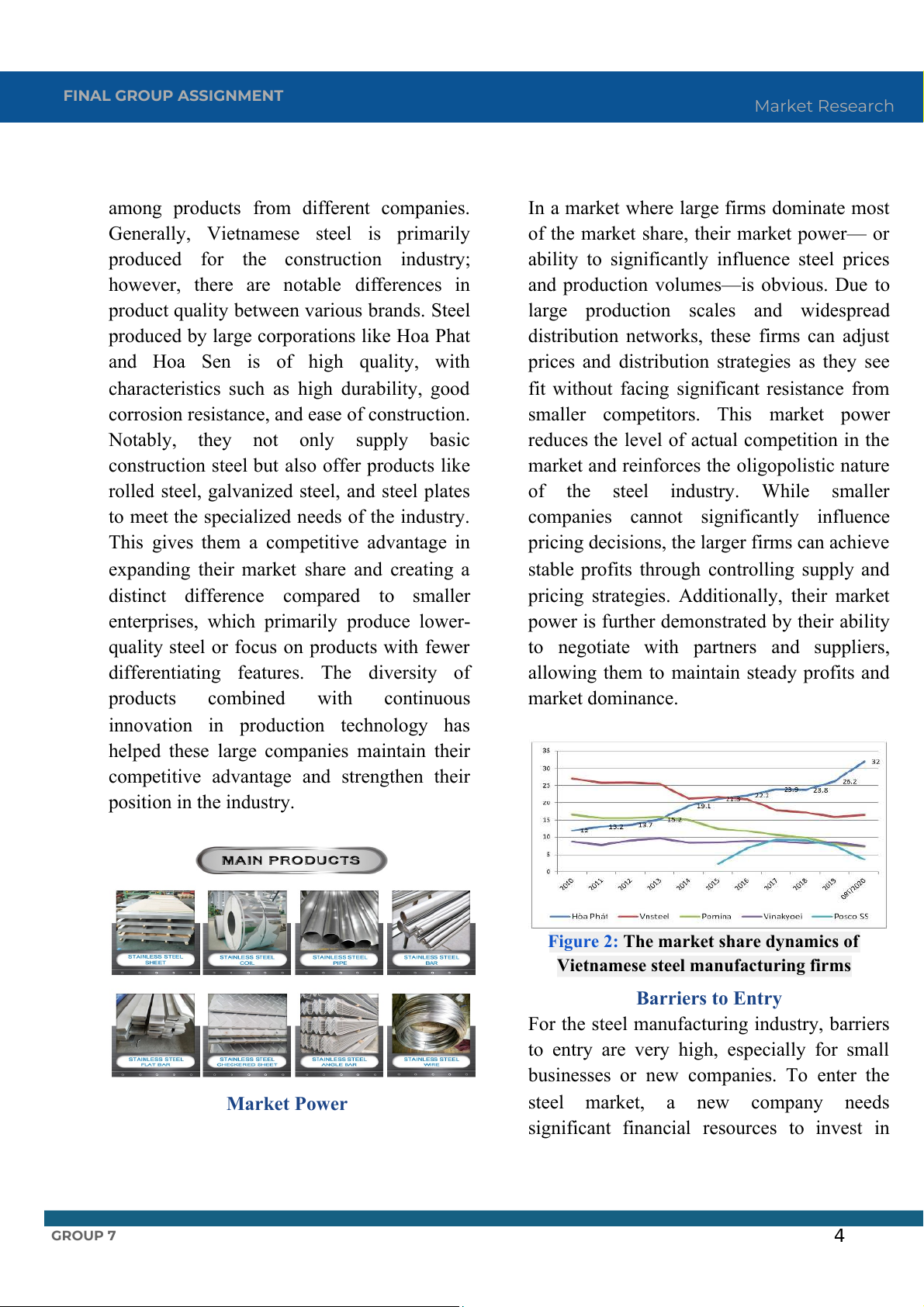
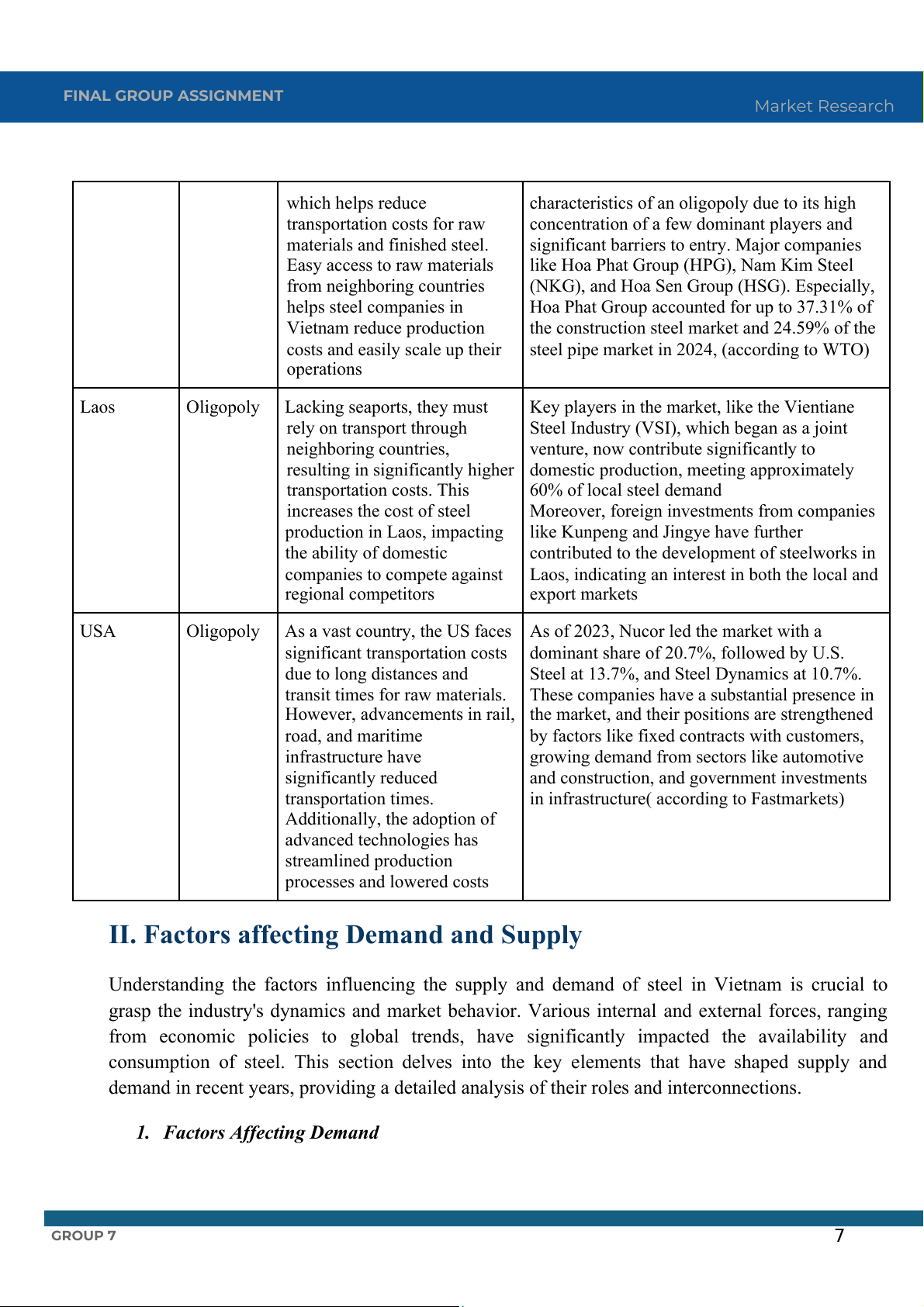
Figure 2: The market share dynamics of
Vietnamese steel manufacturing firms Barriers to Entry
For the steel manufacturing industry, barriers
to entry are very high, especially for small
businesses or new companies. To enter the Market Power
steel market, a new company needs
significant financial resources to invest in GROUP 7 4 FINAL GROUP ASSIGNMENT Market Research
production plants, technology lines, and
customer service, and product innovation. For
distribution networks. Furthermore, large
the steel market, large corporations like Hoa
enterprises already control access to key
Phat and Hoa Sen have been investing
resources such as iron ore, scrap steel, and
heavily in brand building, image promotion,
other input materials, making it even more
and product quality improvements to attract
challenging for newcomers to enter the
customers. For instance, strong marketing
market. Legal regulations and licensing
strategies, long-term product warranties, and
requirements within the steel industry also
efficient customer service have helped these
add to the entry barriers. It is evident that
companies retain customers and create
such high entry barriers create a market
differentiation in consumers' minds. This
where large firms can easily maintain their
non-price competition is a significant factor dominant positions.
where companies not only rely on price
adjustments but also develop other strategies
to maintain and expand their market share.
Focusing on non-price factors helps large
firms reduce price competition pressure and maintain stable profits.
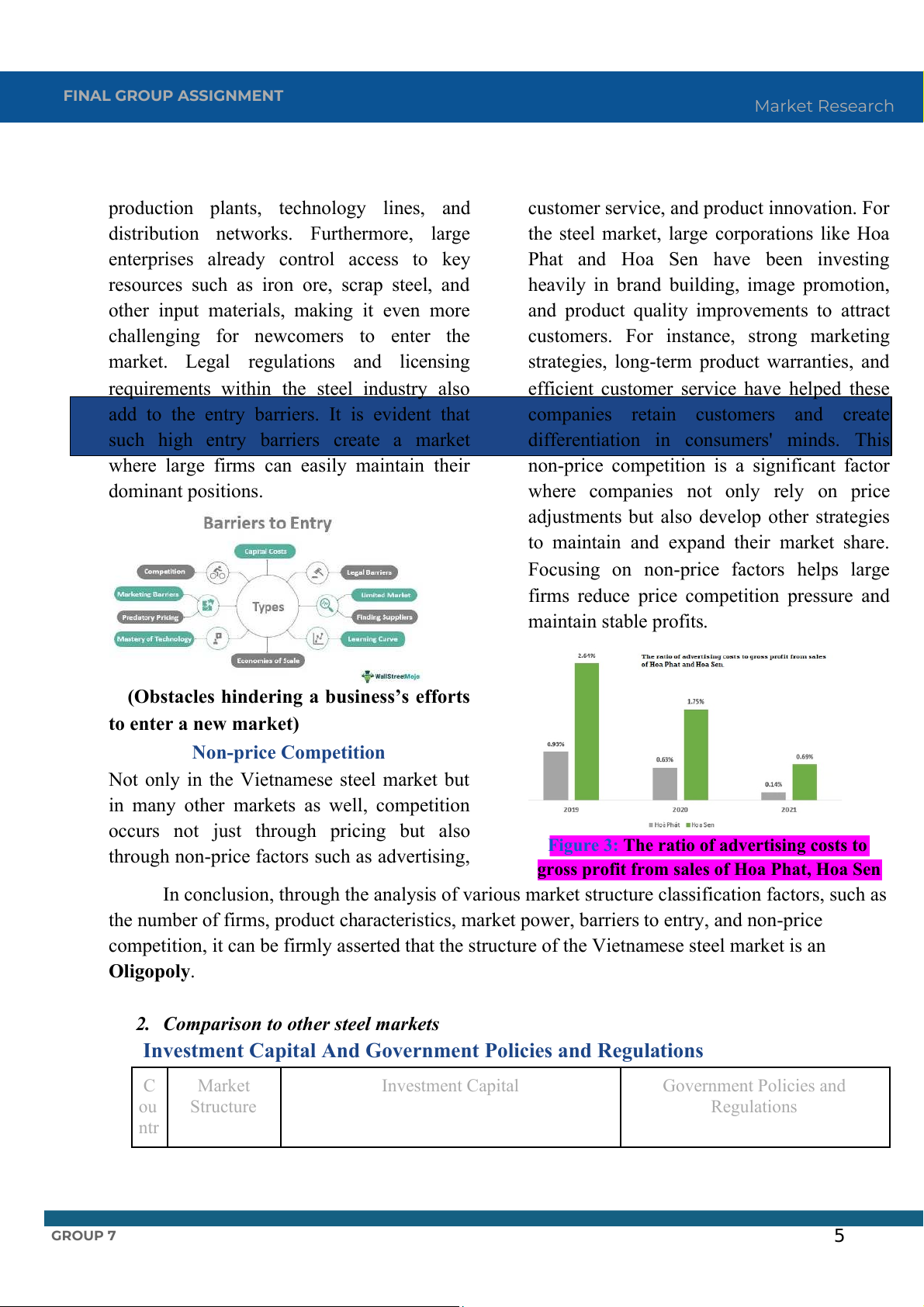
(Obstacles hindering a business’s efforts to enter a new market)
Non-price Competition
Not only in the Vietnamese steel market but
in many other markets as well, competition
occurs not just through pricing but also
through non-price factors such as advertising,
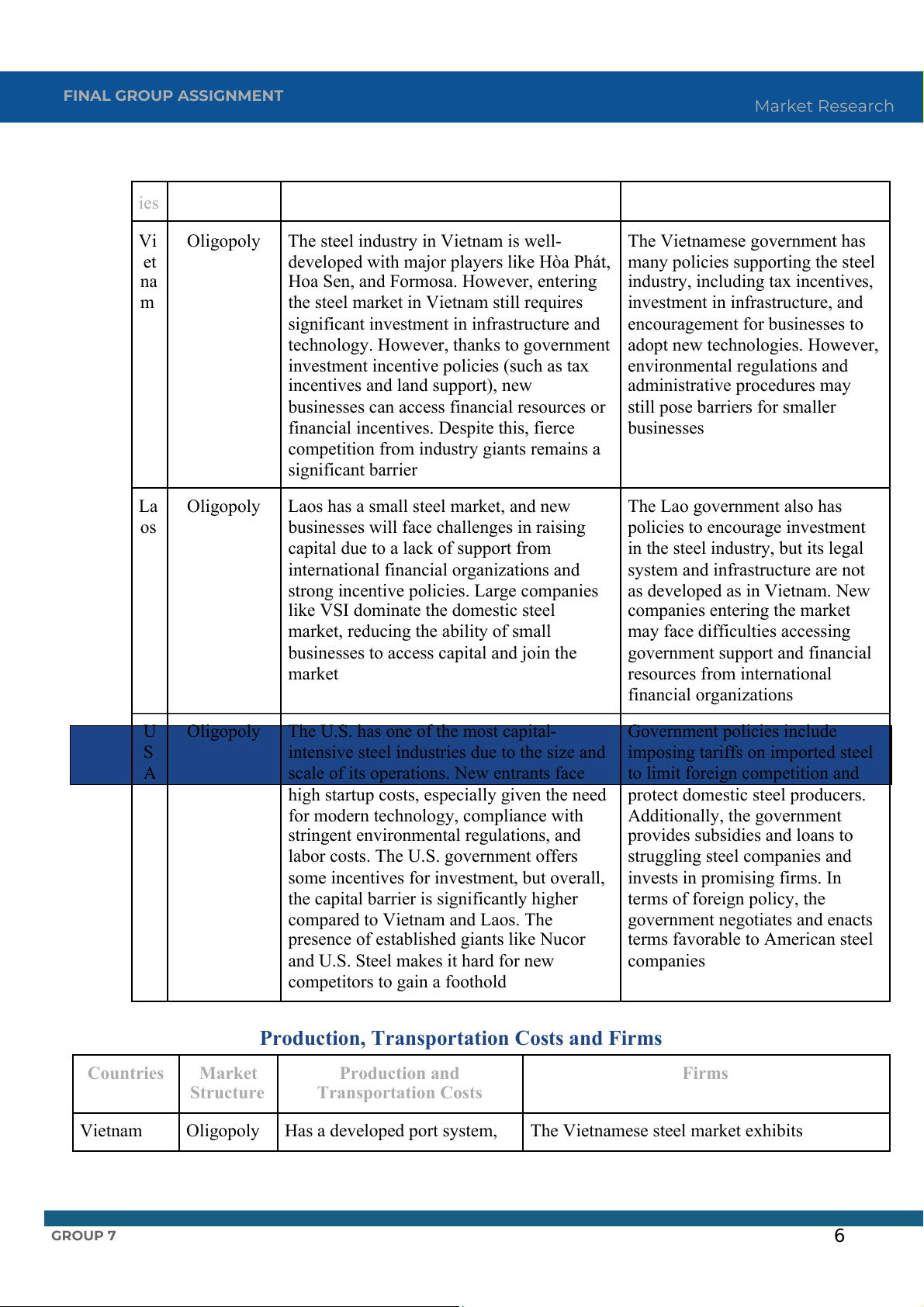
Figure 3: The ratio of advertising costs to
gross profit from sales of Hoa Phat, Hoa Sen
In conclusion, through the analysis of various market structure classification factors, such as
the number of firms, product characteristics, market power, barriers to entry, and non-price
competition, it can be firmly asserted that the structure of the Vietnamese steel market is an Oligopoly.
2. Comparison to other steel markets
Investment Capital And Government Policies and Regulations C Market Investment Capital Government Policies and ou Structure Regulations ntr GROUP 7 5 FINAL GROUP ASSIGNMENT Market Research ies Vi Oligopoly
The steel industry in Vietnam is well- The Vietnamese government has et
developed with major players like Hòa Phát, many policies supporting the steel na
Hoa Sen, and Formosa. However, entering
industry, including tax incentives, m
the steel market in Vietnam still requires
investment in infrastructure, and
significant investment in infrastructure and
encouragement for businesses to
technology. However, thanks to government adopt new technologies. However,
investment incentive policies (such as tax environmental regulations and
incentives and land support), new administrative procedures may
businesses can access financial resources or still pose barriers for smaller
financial incentives. Despite this, fierce businesses
competition from industry giants remains a significant barrier La Oligopoly
Laos has a small steel market, and new The Lao government also has os
businesses will face challenges in raising
policies to encourage investment
capital due to a lack of support from
in the steel industry, but its legal
international financial organizations and
system and infrastructure are not
strong incentive policies. Large companies
as developed as in Vietnam. New
like VSI dominate the domestic steel companies entering the market
market, reducing the ability of small
may face difficulties accessing
businesses to access capital and join the
government support and financial market resources from international financial organizations U Oligopoly
The U.S. has one of the most capital- Government policies include S
intensive steel industries due to the size and imposing tariffs on imported steel A
scale of its operations. New entrants face
to limit foreign competition and
high startup costs, especially given the need protect domestic steel producers.
for modern technology, compliance with Additionally, the government
stringent environmental regulations, and
provides subsidies and loans to
labor costs. The U.S. government offers
struggling steel companies and
some incentives for investment, but overall, invests in promising firms. In
the capital barrier is significantly higher terms of foreign policy, the
compared to Vietnam and Laos. The
government negotiates and enacts
presence of established giants like Nucor
terms favorable to American steel
and U.S. Steel makes it hard for new companies competitors to gain a foothold
Production, Transportation Costs and Firms Countries Market Production and Firms Structure Transportation Costs Vietnam Oligopoly Has a developed port system,
The Vietnamese steel market exhibits GROUP 7 6 FINAL GROUP ASSIGNMENT Market Research which helps reduce
characteristics of an oligopoly due to its high transportation costs for raw
concentration of a few dominant players and materials and finished steel.
significant barriers to entry. Major companies Easy access to raw materials
like Hoa Phat Group (HPG), Nam Kim Steel from neighboring countries
(NKG), and Hoa Sen Group (HSG). Especially, helps steel companies in
Hoa Phat Group accounted for up to 37.31% of Vietnam reduce production
the construction steel market and 24.59% of the
costs and easily scale up their
steel pipe market in 2024, (according to WTO) operations Laos Oligopoly Lacking seaports, they must
Key players in the market, like the Vientiane rely on transport through
Steel Industry (VSI), which began as a joint neighboring countries,
venture, now contribute significantly to
resulting in significantly higher domestic production, meeting approximately transportation costs. This 60% of local steel demand increases the cost of steel
Moreover, foreign investments from companies production in Laos, impacting
like Kunpeng and Jingye have further the ability of domestic
contributed to the development of steelworks in companies to compete against
Laos, indicating an interest in both the local and regional competitors export markets USA Oligopoly
As a vast country, the US faces As of 2023, Nucor led the market with a
significant transportation costs dominant share of 20.7%, followed by U.S. due to long distances and
Steel at 13.7%, and Steel Dynamics at 10.7%.
transit times for raw materials. These companies have a substantial presence in
However, advancements in rail, the market, and their positions are strengthened road, and maritime
by factors like fixed contracts with customers, infrastructure have
growing demand from sectors like automotive significantly reduced
and construction, and government investments transportation times.
in infrastructure( according to Fastmarkets) Additionally, the adoption of advanced technologies has streamlined production processes and lowered costs
II. Factors affecting Demand and Supply
Understanding the factors influencing the supply and demand of steel in Vietnam is crucial to
grasp the industry's dynamics and market behavior. Various internal and external forces, ranging
from economic policies to global trends, have significantly impacted the availability and
consumption of steel. This section delves into the key elements that have shaped supply and
demand in recent years, providing a detailed analysis of their roles and interconnections.
1. Factors Affecting Demand GROUP 7 7 FINAL GROUP ASSIGNMENT Market Research
1.1. Economic Growth (GDP)
Economic growth directly impacts steel demand because it fuels construction, manufacturing, and
infrastructure development. In Vietnam, steady GDP growth has boosted steel consumption,
particularly in urbanization and industrial expansion projects.
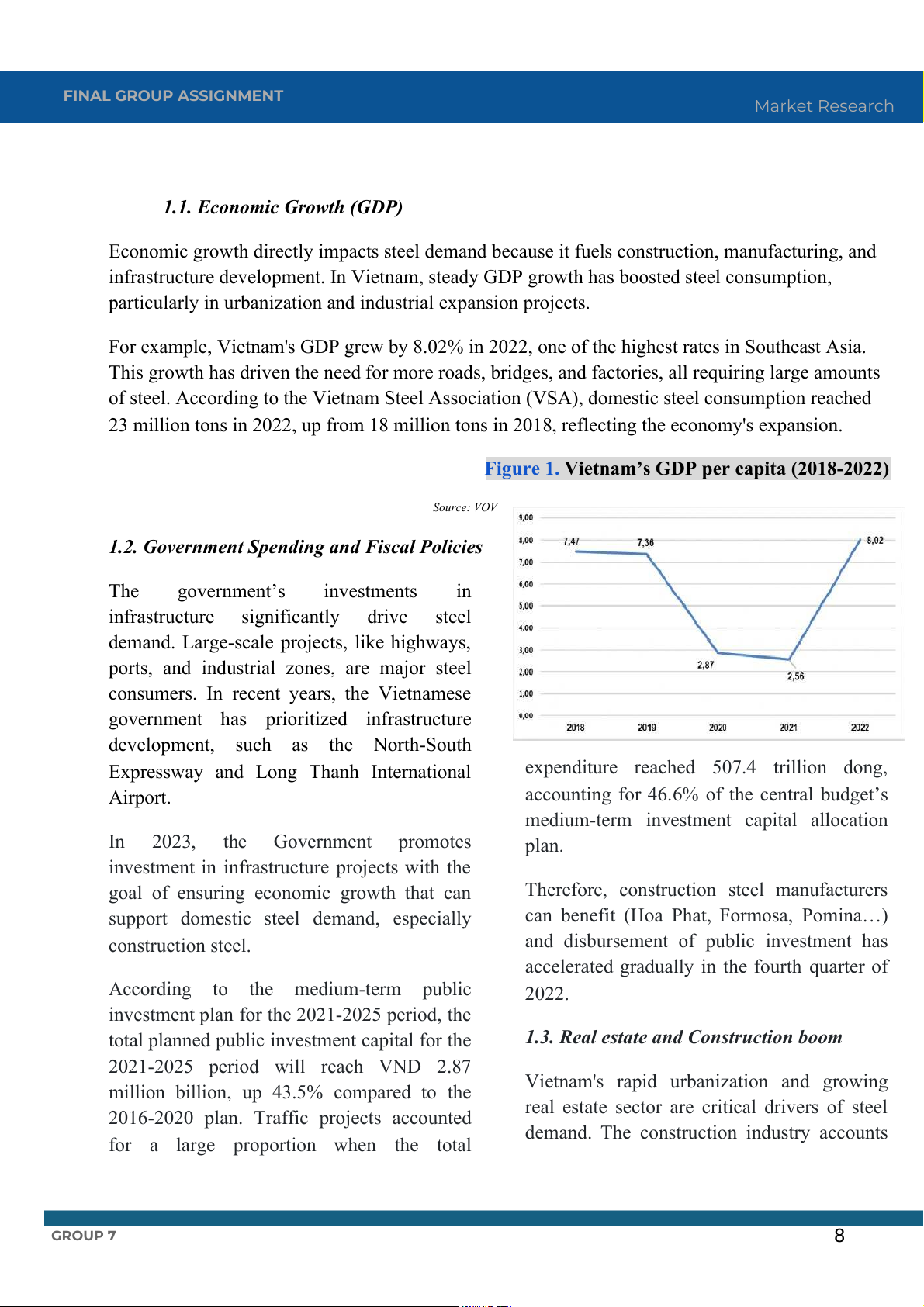
For example, Vietnam's GDP grew by 8.02% in 2022, one of the highest rates in Southeast Asia.
This growth has driven the need for more roads, bridges, and factories, all requiring large amounts
of steel. According to the Vietnam Steel Association (VSA), domestic steel consumption reached
23 million tons in 2022, up from 18 million tons in 2018, reflecting the economy's expansion.
Figure 1. Vietnam’s GDP per capita (2018-2022) Source: VOV
1.2. Government Spending and Fiscal Policies
The government’s investments in
infrastructure significantly drive steel
demand. Large-scale projects, like highways,
ports, and industrial zones, are major steel
consumers. In recent years, the Vietnamese
government has prioritized infrastructure
development, such as the North-South
Expressway and Long Thanh International
expenditure reached 507.4 trillion dong, Airport.
accounting for 46.6% of the central budget’s
medium-term investment capital allocation
In 2023, the Government promotes plan.
investment in infrastructure projects with the
goal of ensuring economic growth that can
Therefore, construction steel manufacturers
support domestic steel demand, especially
can benefit (Hoa Phat, Formosa, Pomina…) construction steel.
and disbursement of public investment has
accelerated gradually in the fourth quarter of
According to the medium-term public 2022.
investment plan for the 2021-2025 period, the
total planned public investment capital for the
1.3. Real estate and Construction boom
2021-2025 period will reach VND 2.87
million billion, up 43.5% compared to the
Vietnam's rapid urbanization and growing
2016-2020 plan. Traffic projects accounted
real estate sector are critical drivers of steel
demand. The construction industry accounts
for a large proportion when the total GROUP 7 8 FINAL GROUP ASSIGNMENT Market Research
for more than half of the total steel
volumes. Despite these challenges, exports
consumption. Between 2019 and 2021,
increased from 1 million tons in 2010 to
residential and commercial construction grew
around 10 million tons in 2021. When global
significantly, with major projects in Hanoi,
demand is strong, it boosts domestic
Ho Chi Minh City, and Da Nang. In 2021, the
production, but external constraints can
real estate sector's growth rate reached 5.71%,
reduce overall steel consumption in Vietnam.
contributing to increased demand for (Figure 2)
construction steel. The expansion of housing,
high-rise buildings, and industrial parks keeps
1.5. Substitute Materials
the need for steel consistently high.
The availability and cost of alternative
materials like aluminum, wood, and plastic
1.4. Global Market Trends and Exports
influence steel demand. When these
Vietnam’s steel demand is also influenced by
substitutes become expensive or scarce,
global trends. The country has become a
industries may rely more on steel. For
significant steel exporter, particularly within
instance, in 2021, global supply chain
Southeast Asia. However, external factors
disruptions increased the price of construction
such as trade tariffs and protectionist policies
timber, leading to a higher demand for steel affect this market.
as a substitute. This trend is particularly
evident in construction and manufacturing,
For example, in 2019, Vietnam faced anti-
where the versatility and durability of steel
dumping duties from the United States and make it a preferred choice.
the European Union, impacting export
Figure 2. Vietnam's steel export volume and price developments in 2021 GROUP 7 9 FINAL GROUP ASSIGNMENT Market Research
To visualize these complex interactions, supply and demand graphs offer a clear depiction of
market shifts. Each factor—whether related to production constraints or rising infrastructure needs
—has contributed to noticeable shifts in the supply and demand curves over time. The following
graphs illustrate these shifts, showing how external forces and strategic responses have reshaped the Vietnamese steel market.
2. Factors Affecting Supply 2.1. Price
Price is a key determinant of supply in the
affect how price changes translate into supply
steel industry, with direct effects on decisions.
profitability, production decisions, and
overall market supply. Manufacturers adjust
their output based on price changes, the cost
of inputs, and market expectations. In the
Vietnamese steel industry, external factors
like global commodity prices, trade policies,
and local economic conditions significantly GROUP 7 FINAL GROUP ASSIGNMENT Market Research
Construction steel prices closed in 2023 at
quarter of 2023, the factors that caused prices
VND 13.8-15.3 million/ton. Beginning 2024,
to be adjusted upward were due to increased
the construction steel segment "entered the
prices of raw materials (iron ore, coke, scrap,
market" with a price increase of VND
electricity prices), financial costs (bank
150,000 - 370,000/ton, up to VND 14-14.5
interest rates, ...) and increased exchange
million/ton and remained stable until the end rates.
of February. From the beginning of the fourth
VSA predicts that after Tet holiday, competition between factories will be fierce on selling prices
to expand or maintain market share. Currently, domestic factories are facing many difficulties due
to high inventory prices, low selling prices, and financial costs. (Figure 3)
Figure 3. Hoa Phat CB300 steel price from 2022 to 2/2024 Source: Steel online
1.2. Production Costs
Steel supply is heavily influenced by input
From the beginning of the fourth quarter of
costs, primarily iron ore and coking coal,
2023, the factors that caused the price to be
which constitute up to 75% of production
adjusted upward were due to the underlying
expenses. Global iron ore prices surged by
causes of increased raw material prices (iron
60% in 2022, impacting Vietnamese
ore, coke, scrap, electricity prices), financial
manufacturers who rely on imports,
costs (bank interest rates, ...) and USD/VND
particularly from Australia and Brazil. Such
devaluation. Factories had to adjust prices to
price volatility necessitated adjustments in
partly compensate for the increased price of
domestic production pricing and impacted
raw materials, although demand remained profit margins. low.
The world HRC steel market fluctuates,
creating the domestic HRC market is difficult
to do purified steel production enterprise
(CRC, religion galvanizing, steel pipes,...)
using HRC raw materials output products. GROUP 7 11 FINAL GROUP ASSIGNMENT Market Research
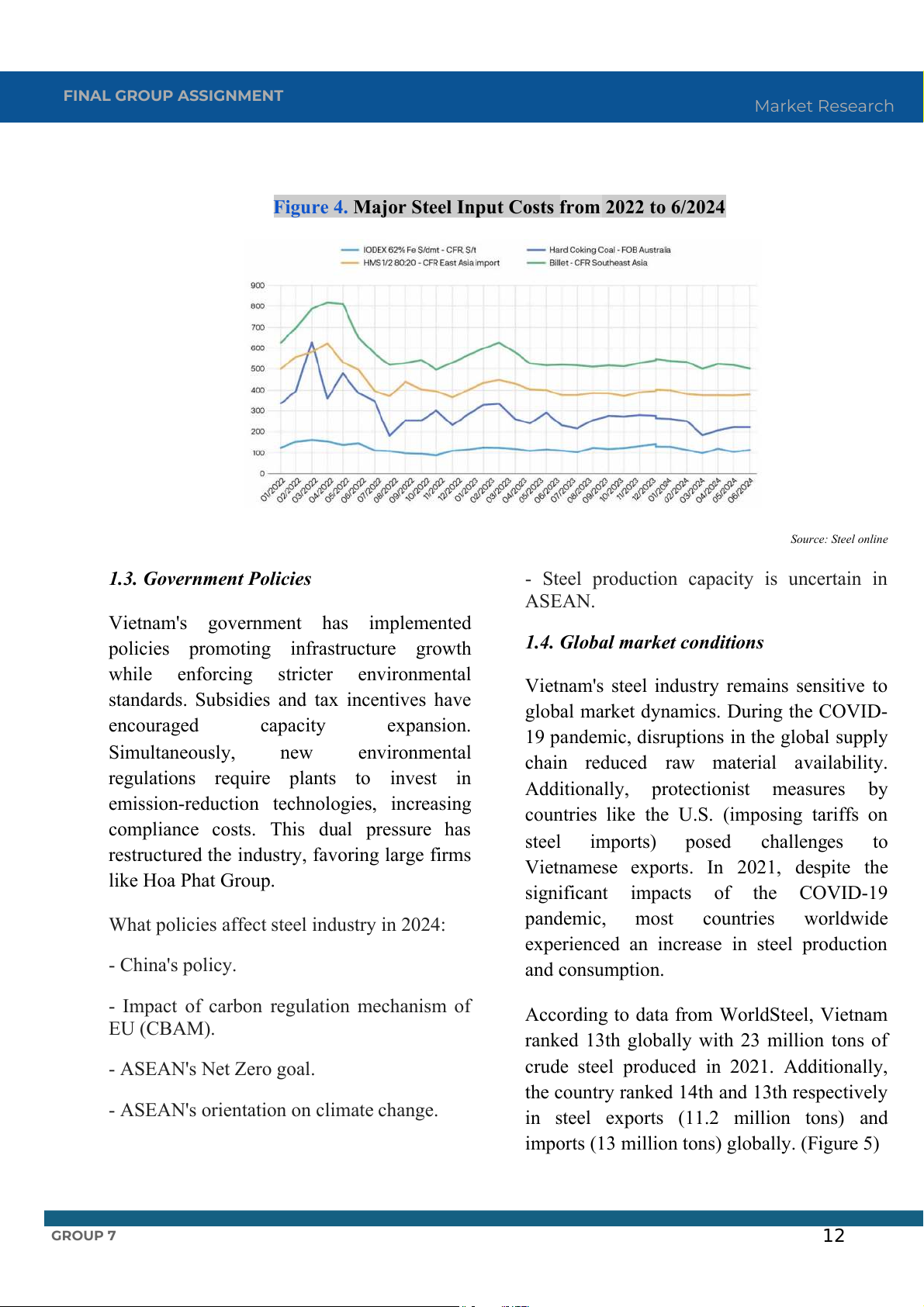
Figure 4. Major Steel Input Costs from 2022 to 6/2024 Source: Steel online
1.3. Government Policies
- Steel production capacity is uncertain in ASEAN.
Vietnam's government has implemented
policies promoting infrastructure growth
1.4. Global market conditions
while enforcing stricter environmental
Vietnam's steel industry remains sensitive to
standards. Subsidies and tax incentives have
global market dynamics. During the COVID- encouraged capacity expansion.
19 pandemic, disruptions in the global supply
Simultaneously, new environmental
chain reduced raw material availability.
regulations require plants to invest in
Additionally, protectionist measures by
emission-reduction technologies, increasing
countries like the U.S. (imposing tariffs on
compliance costs. This dual pressure has
steel imports) posed challenges to
restructured the industry, favoring large firms
Vietnamese exports. In 2021, despite the like Hoa Phat Group.
significant impacts of the COVID-19
What policies affect steel industry in 2024:
pandemic, most countries worldwide
experienced an increase in steel production - China's policy. and consumption.
- Impact of carbon regulation mechanism of
According to data from WorldSteel, Vietnam EU (CBAM).
ranked 13th globally with 23 million tons of - ASEAN's Net Zero goal.
crude steel produced in 2021. Additionally,
the country ranked 14th and 13th respectively
- ASEAN's orientation on climate change.
in steel exports (11.2 million tons) and
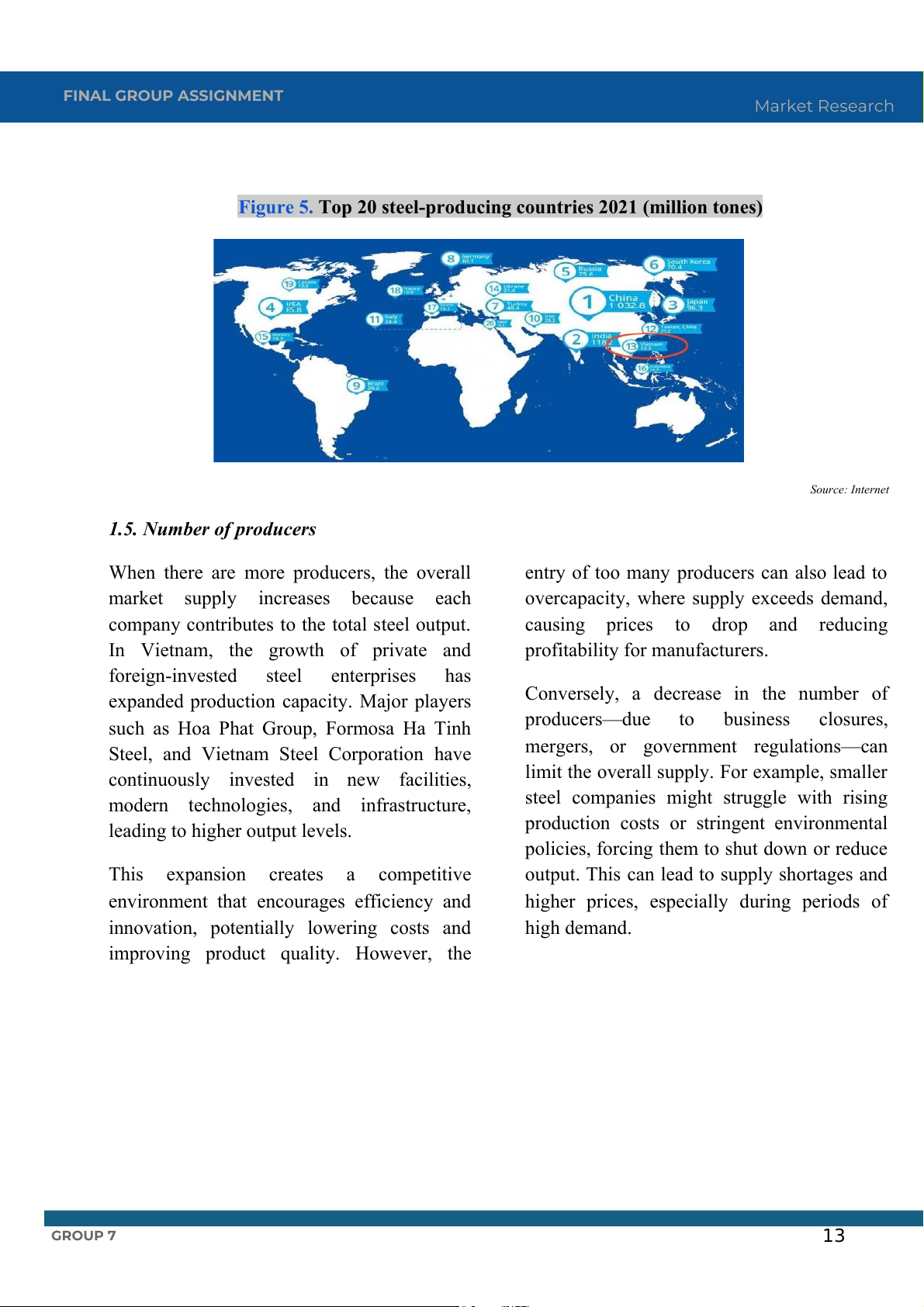
imports (13 million tons) globally. (Figure 5) GROUP 7 12 FINAL GROUP ASSIGNMENT Market Research
Figure 5. Top 20 steel-producing countries 2021 (million tones) Source: Internet
1.5. Number of producers
When there are more producers, the overall
entry of too many producers can also lead to
market supply increases because each
overcapacity, where supply exceeds demand,
company contributes to the total steel output.
causing prices to drop and reducing
In Vietnam, the growth of private and
profitability for manufacturers.
foreign-invested steel enterprises has
expanded production capacity. Major players
Conversely, a decrease in the number of
such as Hoa Phat Group, Formosa Ha Tinh
producers—due to business closures,
Steel, and Vietnam Steel Corporation have
mergers, or government regulations—can
continuously invested in new facilities,
limit the overall supply. For example, smaller
modern technologies, and infrastructure,
steel companies might struggle with rising
leading to higher output levels.
production costs or stringent environmental
policies, forcing them to shut down or reduce
This expansion creates a competitive
output. This can lead to supply shortages and
environment that encourages efficiency and
higher prices, especially during periods of
innovation, potentially lowering costs and high demand.
improving product quality. However, the GROUP 7 13 FINAL GROUP ASSIGNMENT Market Research
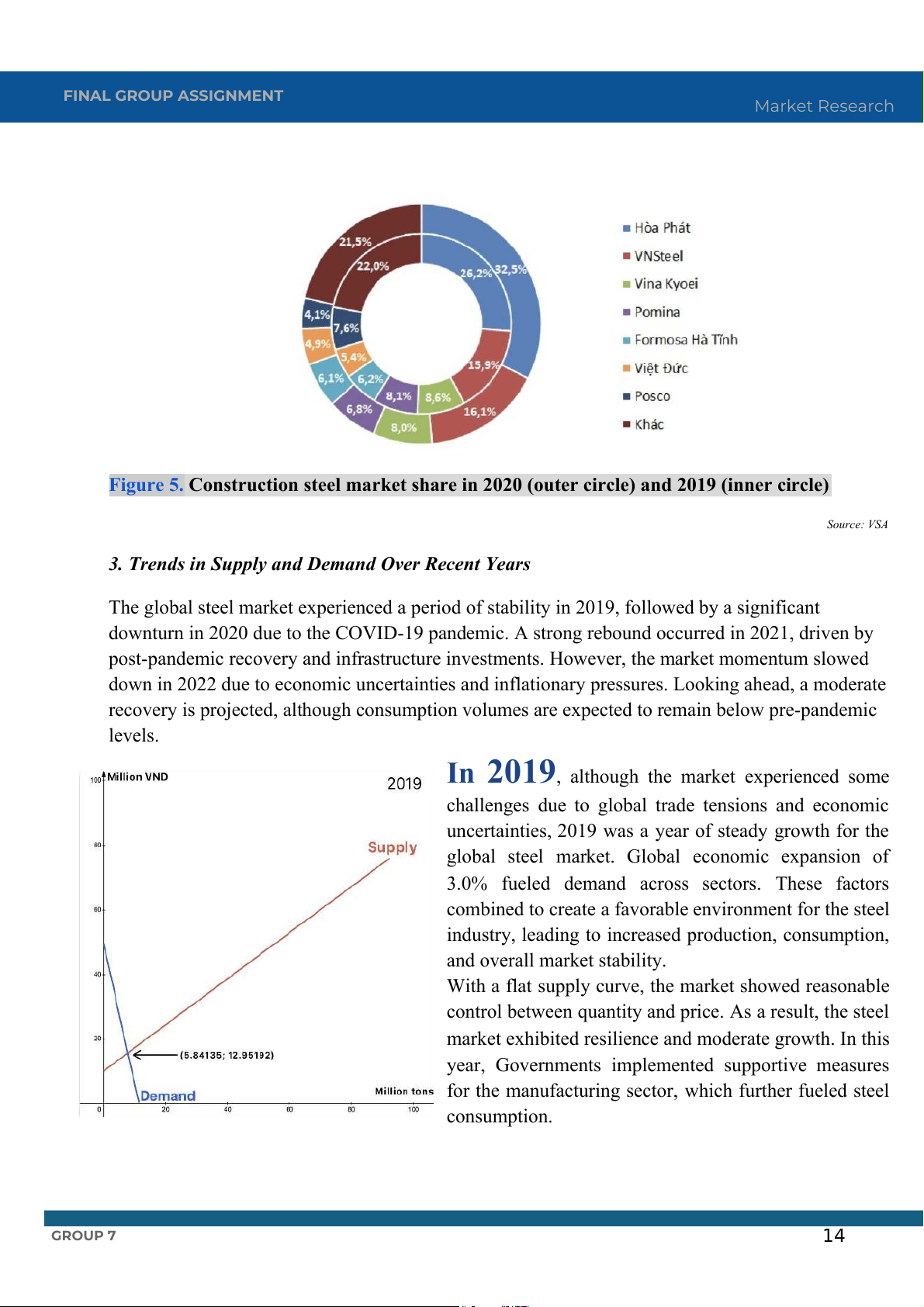
Figure 5. Construction steel market share in 2020 (outer circle) and 2019 (inner circle) Source: VSA
3. Trends in Supply and Demand Over Recent Years
The global steel market experienced a period of stability in 2019, followed by a significant
downturn in 2020 due to the COVID-19 pandemic. A strong rebound occurred in 2021, driven by
post-pandemic recovery and infrastructure investments. However, the market momentum slowed
down in 2022 due to economic uncertainties and inflationary pressures. Looking ahead, a moderate
recovery is projected, although consumption volumes are expected to remain below pre-pandemic levels.
In 2019, although the market experienced some
challenges due to global trade tensions and economic
uncertainties, 2019 was a year of steady growth for the
global steel market. Global economic expansion of
3.0% fueled demand across sectors. These factors
combined to create a favorable environment for the steel
industry, leading to increased production, consumption, and overall market stability.
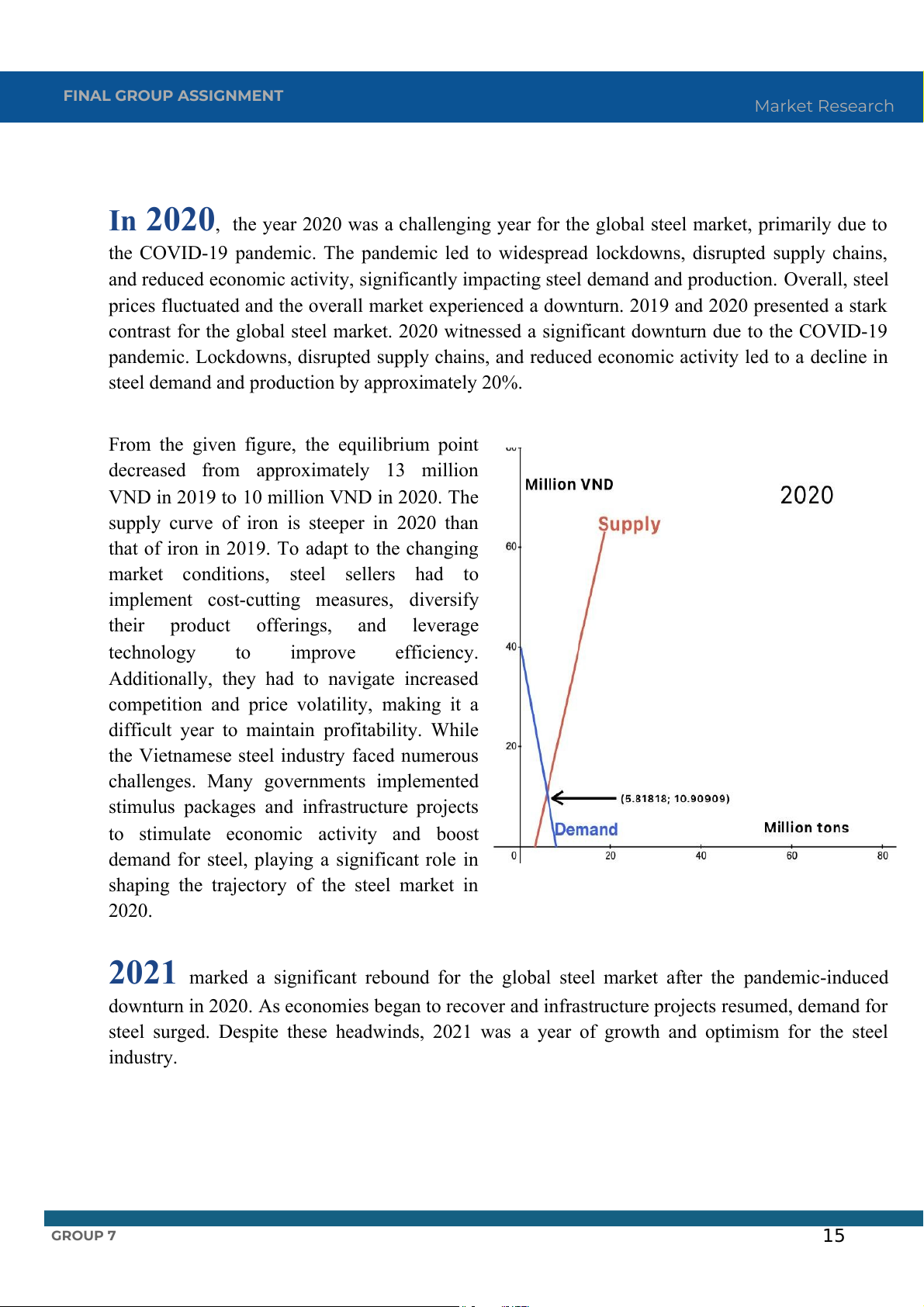
With a flat supply curve, the market showed reasonable
control between quantity and price. As a result, the steel
market exhibited resilience and moderate growth. In this
year, Governments implemented supportive measures
for the manufacturing sector, which further fueled steel consumption. GROUP 7 14 FINAL GROUP ASSIGNMENT Market Research
In 2020, the year 2020 was a challenging year for the global steel market, primarily due to
the COVID-19 pandemic. The pandemic led to widespread lockdowns, disrupted supply chains,
and reduced economic activity, significantly impacting steel demand and production. Overall, steel
prices fluctuated and the overall market experienced a downturn. 2019 and 2020 presented a stark
contrast for the global steel market. 2020 witnessed a significant downturn due to the COVID-19
pandemic. Lockdowns, disrupted supply chains, and reduced economic activity led to a decline in
steel demand and production by approximately 20%.
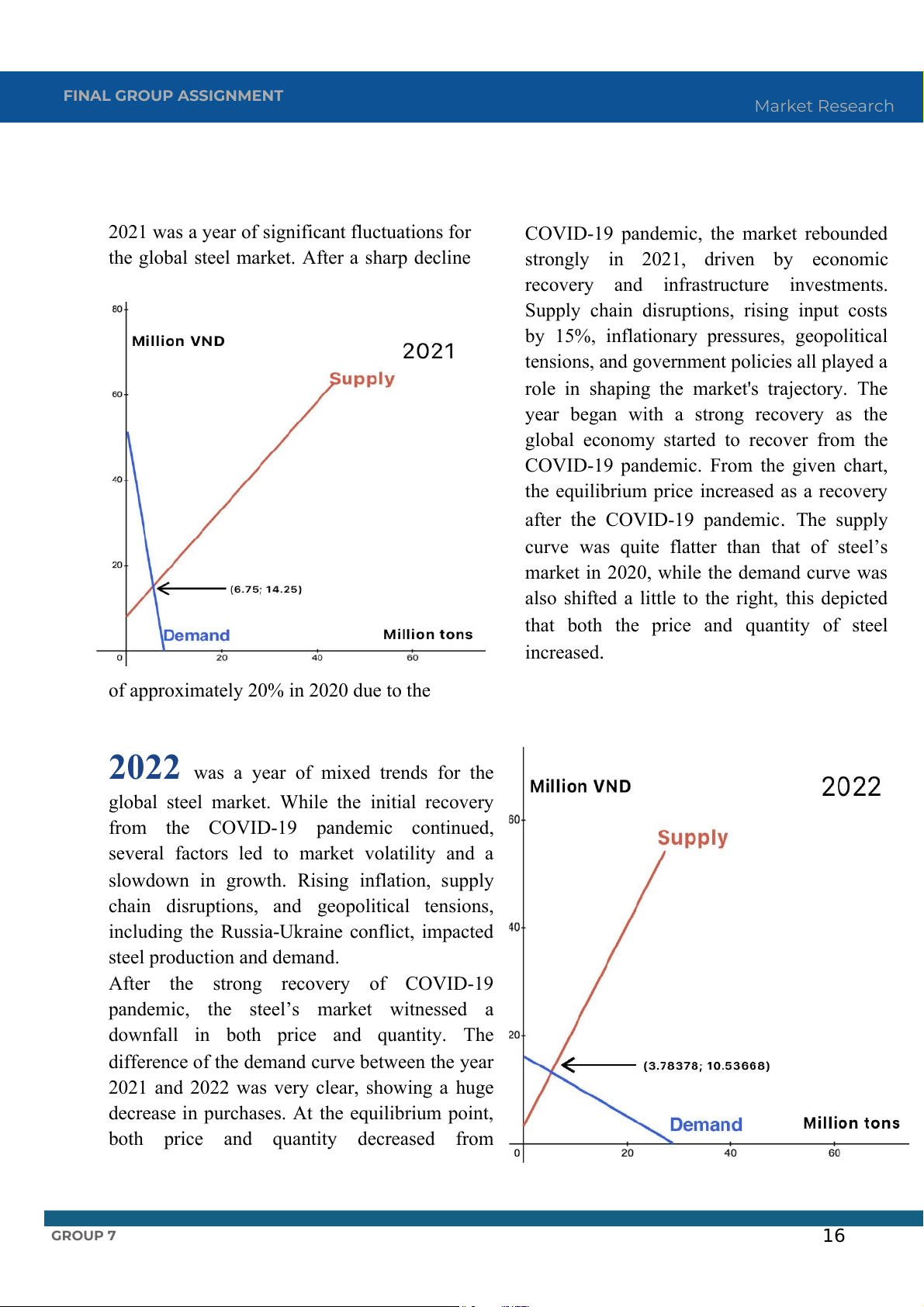
From the given figure, the equilibrium point
decreased from approximately 13 million
VND in 2019 to 10 million VND in 2020. The
supply curve of iron is steeper in 2020 than
that of iron in 2019. To adapt to the changing
market conditions, steel sellers had to
implement cost-cutting measures, diversify
their product offerings, and leverage
technology to improve efficiency.
Additionally, they had to navigate increased
competition and price volatility, making it a
difficult year to maintain profitability. While
the Vietnamese steel industry faced numerous
challenges. Many governments implemented
stimulus packages and infrastructure projects
to stimulate economic activity and boost
demand for steel, playing a significant role in
shaping the trajectory of the steel market in 2020.
2021 marked a significant rebound for the global steel market after the pandemic-induced
downturn in 2020. As economies began to recover and infrastructure projects resumed, demand for
steel surged. Despite these headwinds, 2021 was a year of growth and optimism for the steel industry. GROUP 7 15 FINAL GROUP ASSIGNMENT Market Research
2021 was a year of significant fluctuations for
COVID-19 pandemic, the market rebounded
the global steel market. After a sharp decline
strongly in 2021, driven by economic
recovery and infrastructure investments.
Supply chain disruptions, rising input costs
by 15%, inflationary pressures, geopolitical
tensions, and government policies all played a
role in shaping the market's trajectory. The
year began with a strong recovery as the
global economy started to recover from the
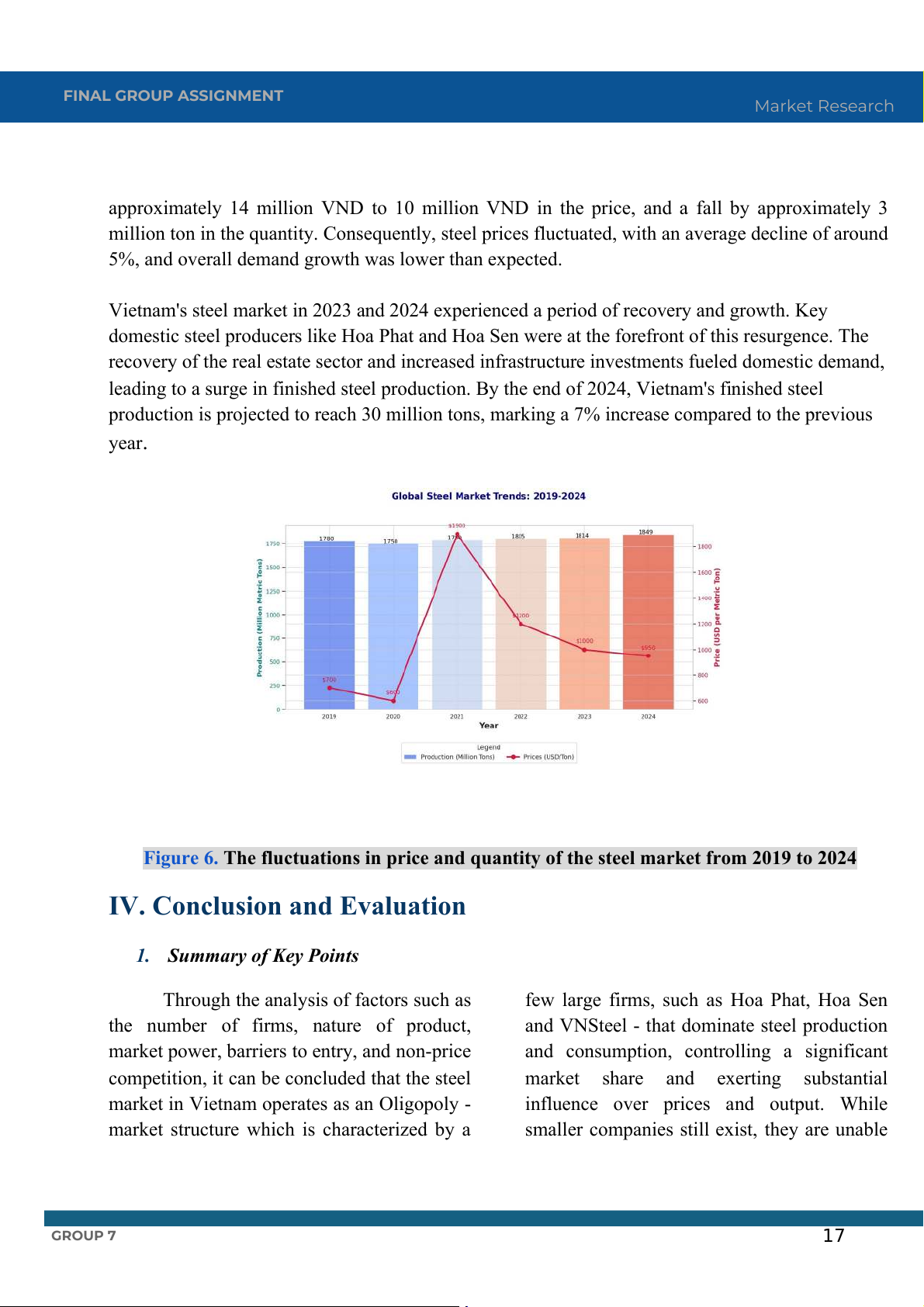
COVID-19 pandemic. From the given chart,
the equilibrium price increased as a recovery after the COVID-19 pandemic. The supply
curve was quite flatter than that of steel’s
market in 2020, while the demand curve was
also shifted a little to the right, this depicted
that both the price and quantity of steel increased.
of approximately 20% in 2020 due to the
2022 was a year of mixed trends for the
global steel market. While the initial recovery
from the COVID-19 pandemic continued,
several factors led to market volatility and a
slowdown in growth. Rising inflation, supply
chain disruptions, and geopolitical tensions,
including the Russia-Ukraine conflict, impacted steel production and demand.
After the strong recovery of COVID-19
pandemic, the steel’s market witnessed a
downfall in both price and quantity. The
difference of the demand curve between the year
2021 and 2022 was very clear, showing a huge
decrease in purchases. At the equilibrium point,
both price and quantity decreased from GROUP 7 16 FINAL GROUP ASSIGNMENT Market Research
approximately 14 million VND to 10 million VND in the price, and a fall by approximately 3
million ton in the quantity. Consequently, steel prices fluctuated, with an average decline of around
5%, and overall demand growth was lower than expected.
Vietnam's steel market in 2023 and 2024 experienced a period of recovery and growth. Key
domestic steel producers like Hoa Phat and Hoa Sen were at the forefront of this resurgence. The
recovery of the real estate sector and increased infrastructure investments fueled domestic demand,
leading to a surge in finished steel production. By the end of 2024, Vietnam's finished steel
production is projected to reach 30 million tons, marking a 7% increase compared to the previous year.
Figure 6. The fluctuations in price and quantity of the steel market from 2019 to 2024
IV. Conclusion and Evaluation
1. Summary of Key Points
Through the analysis of factors such as
few large firms, such as Hoa Phat, Hoa Sen
the number of firms, nature of product,
and VNSteel - that dominate steel production
market power, barriers to entry, and non-price
and consumption, controlling a significant
competition, it can be concluded that the steel
market share and exerting substantial
market in Vietnam operates as an Oligopoly -
influence over prices and output. While
market structure which is characterized by a
smaller companies still exist, they are unable GROUP 7 17 FINAL GROUP ASSIGNMENT Market Research
to compete directly with the industry giants
significant fluctuations, particularly during
due to high barriers to entry. The Vietnamese
the COVID-19 pandemic, global supply chain
steel market is marked by clear product
crises, and international political-economic
differentiation and non-price competition,
factors. However, there was a strong recovery
which further strengthens the dominance of
in 2021 due to government support policies leading companies.
and domestic infrastructure demand. Despite
this, the market continues to face significant
The fluctuations in supply and demand
challenges, including rising material costs,
within the Vietnamese steel market are
underdeveloped production technologies, and
influenced by various factors. While supply is
fierce competition from international
impacted by microeconomic elements such as competitors.
input costs and quality, the scale and
productivity of companies, as well as their
In general, the Vietnamese steel
technological capabilities; demand is strongly
market currently operates as an Oligopoly,
influenced by macroeconomic factors like
where large companies dominate and have a
national economic growth, government
strong influence over pricing, production
policies, and the prices of substitute products.
levels, and consumption trends. Therefore,
These factors not only affect steel
macroeconomic shifts and government
consumption but also shape production
policies play a crucial role in shaping the
strategies, pricing, and market scale for
future direction and development of this
companies in the sector. In recent years, the industry.
Vietnamese steel market has experienced
2. Future outlook for the Commodity
Vietnam's steel industry is actively embracing
output is projected to reach 28-30 million
the global transition toward sustainability by
tons, with domestic consumption estimated at
focusing on producing and utilizing 21-22.5 million tons.
environmentally friendly products, in
alignment with the nation’s COP26
Vietnam's GDP is forecasted to grow by 6-
commitment to achieving net-zero carbon
6.5% in 2024, reflecting steady economic
emissions by 2050. Steel production is
progress. As a critical global material, steel
anticipated to grow by approximately 10% in
plays a vital role in Vietnam's development,
2024 and 8% in 2025, driven by recovering
with demand rising alongside infrastructure
domestic demand across various economic
expansion currently . Per capita steel
sectors. During this period, finished steel
consumption, at 240 kg/person, is projected to GROUP 7 18 FINAL GROUP ASSIGNMENT Market Research
reach 290-300 kg/person by 2030. The
enterprises is reducing production costs and
country’s steel production not only satisfies
enhancing competitiveness in global markets.
domestic needs but also supports exports to
Simultaneously, the global steel industry is
over 100 countries. Additionally, the adoption
striving to meet climate goals, including
of modern, efficient technologies by
limiting global temperature increases to 1.5°C
According to SSI Research, Vietnam's steel
projected to remain strong, supported by
industry, despite facing a significant decline
favorable global demand, widened price
in domestic consumption in 2023 due to
advantages, and stricter European import
macroeconomic and real estate challenges, is
controls on Russian steel. Vietnam's
expected to recover in 2024 with a 6%
competitiveness in steel exports has remained
increase in sales and nearly 7% growth in
robust, even amid a sharp rise in Chinese
domestic demand. Export volumes are exports. GROUP 7 19
Tài liệu liên quan:
-
Tự Luận Vimo: Phân Tích Cung, Cầu và Thị Trường Cạnh Tranh| Microeconomics | Trường Đại học Quốc tế, Đại học Quốc gia Thành phố Hồ Chí Minh
5 3 -
Review Questions: Thinking Like an Economist | Microeconomics | Trường Đại học Quốc tế, Đại học Quốc gia Thành phố Hồ Chí Minh
5 3 -
Final Exam Quizlet Questions & Answers | Microeconomics | Trường Đại học Quốc tế, Đại học Quốc gia Thành phố Hồ Chí Minh
5 3 -
Đề thi giữa kỳ II | Microeconomics | Trường Đại học Quốc tế, Đại học Quốc gia Thành phố Hồ Chí Minh
5 3 -
Final Group Project_ The Beer Industry | Microeconomics | Trường Đại học Quốc tế, Đại học Quốc gia Thành phố Hồ Chí Minh
4 2