Frank 8e Chapter 1 PPT: Understanding Economic Principles | Microeconomics | Trường Đại học Quốc tế, Đại học Quốc gia Thành phố Hồ Chí Minh
Explain and apply the Scarcity Principle, which says that having more of any good thing necessarily requires having less of something else. 2. Explain and apply the Cost-Benefit Principle, which says that an action should be taken if, but only if, its benefit is at least as great as its cost. 3. Discuss three important pitfalls that occur when applying the Cost-Benefit Principle inconsistently. Tài liệu được sưu tầm và soạn thảo dưới dạng file PDF để gửi tới các bạn cùng tham khảo, ôn tập đầy đủ kiến thức, chuẩn bị cho các buổi học thật tốt. Mời bạn đọc đón xem!
Môn: Microeconomics 613 tài liệu
Trường: Trường Đại học Quốc tế, Đại học Quốc gia Thành phố Hồ Chí Minh 1.9 K tài liệu
Tác giả:





Preview text:
Chapter 1 Thinking Like an Economist
©2022 McGraw Hill. All rights reserved. Authorized only for instructor use in the classroom. No reproduction or distribution without the prior written consent of McGraw Hill. Learning Objectives
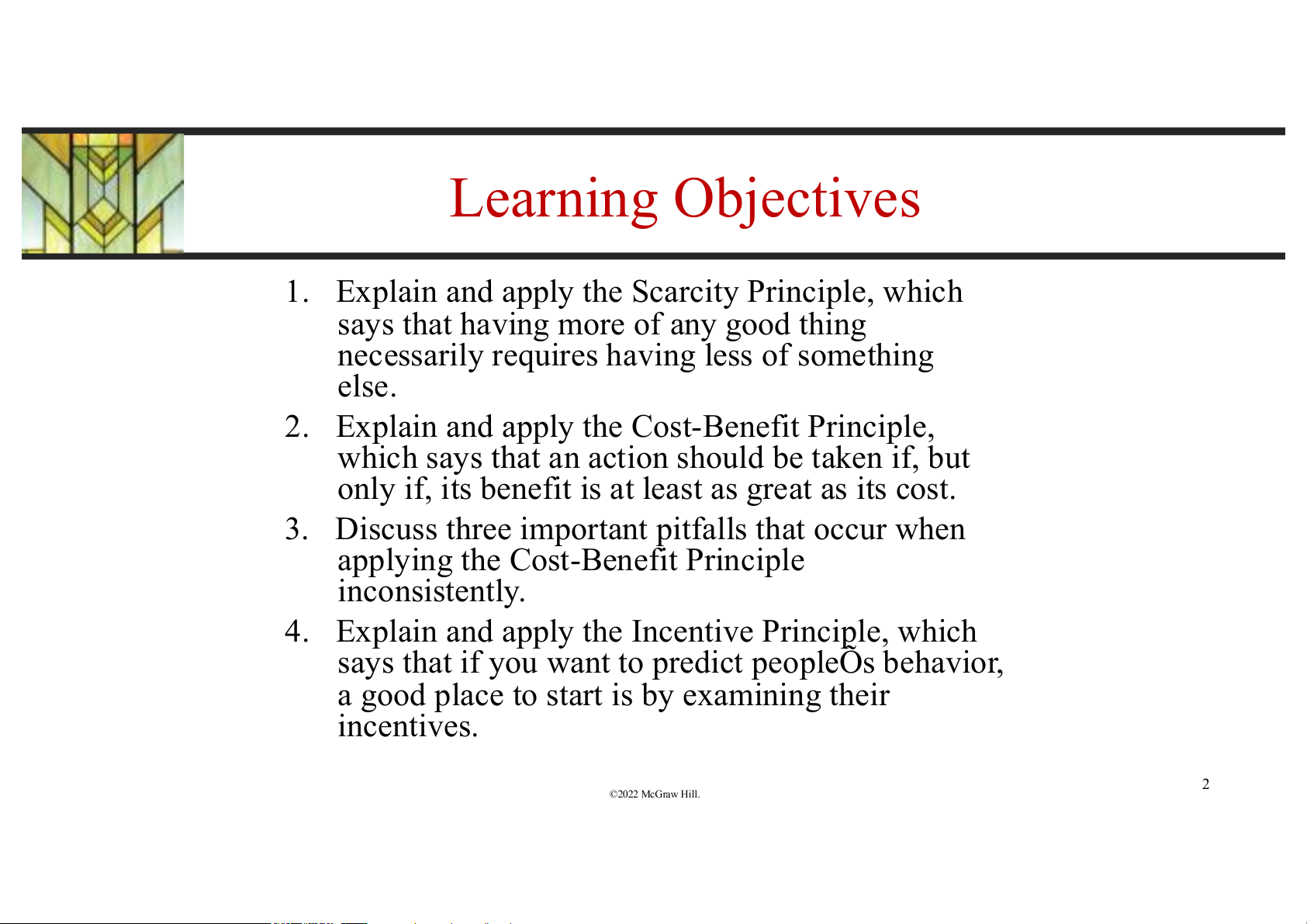
1. Explain and apply the Scarcity Principle, which
says that having more of any good thing
necessarily requires having less of something else.
2. Explain and apply the Cost-Benefit Principle,
which says that an action should be taken if, but
only if, its benefit is at least as great as its cost.
3. Discuss three important pitfalls that occur when
applying the Cost-Benefit Principle inconsistently.
4. Explain and apply the Incentive Principle, which
says that if you want to predict peopleÕs behavior,
a good place to start is by examining their incentives. 2 ©2022 McGraw Hill. The Scarcity Principle
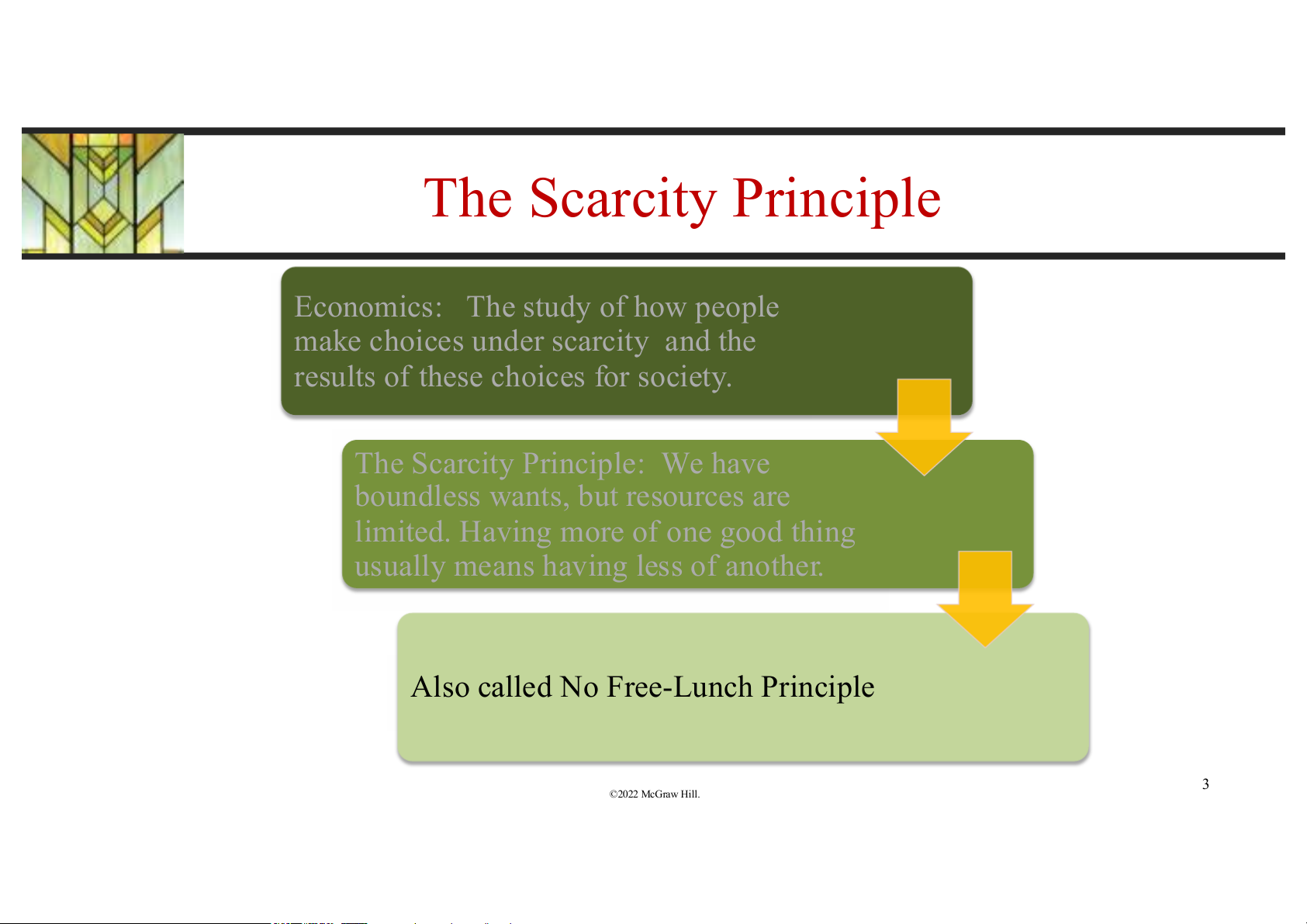
Economics: The study of how people
make choices under scarcity and the
results of these choices for society.
The Scarcity Principle: We have
boundless wants, but resources are
limited. Having more of one good thing
usually means having less of another.
Also called No Free-Lunch Principle 3 ©2022 McGraw Hill.
The Scarcity Principle: Examples Scarcity is involved in Global Political Career Buying warming elections choices bottled water 4 ©2022 McGraw Hill. The Cost-Benefit Principle
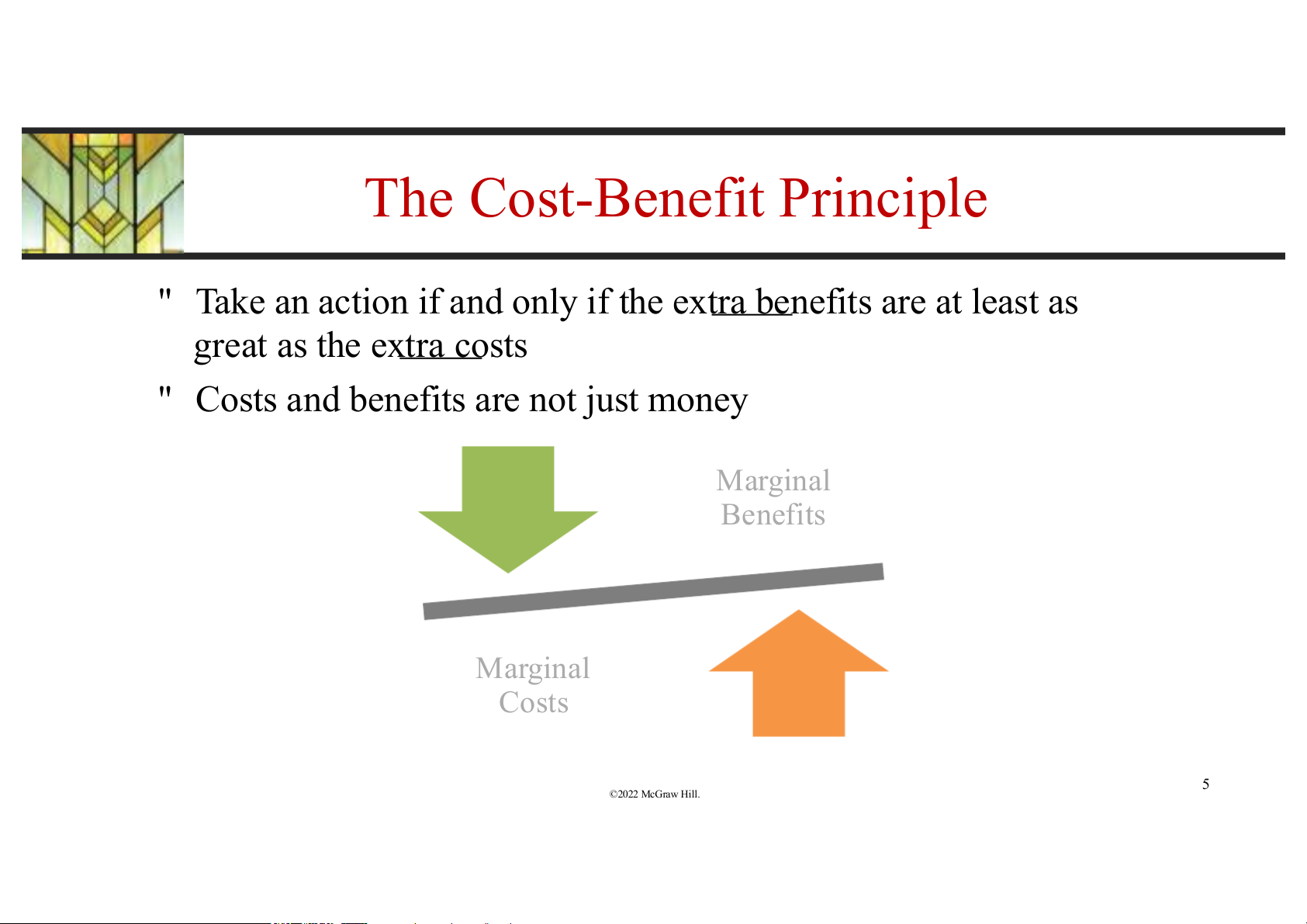
" Take an action if and only if the extra benefits are at least as great as the extra costs
" Costs and benefits are not just money Marginal Benefits Marginal Costs 5 ©2022 McGraw Hill.
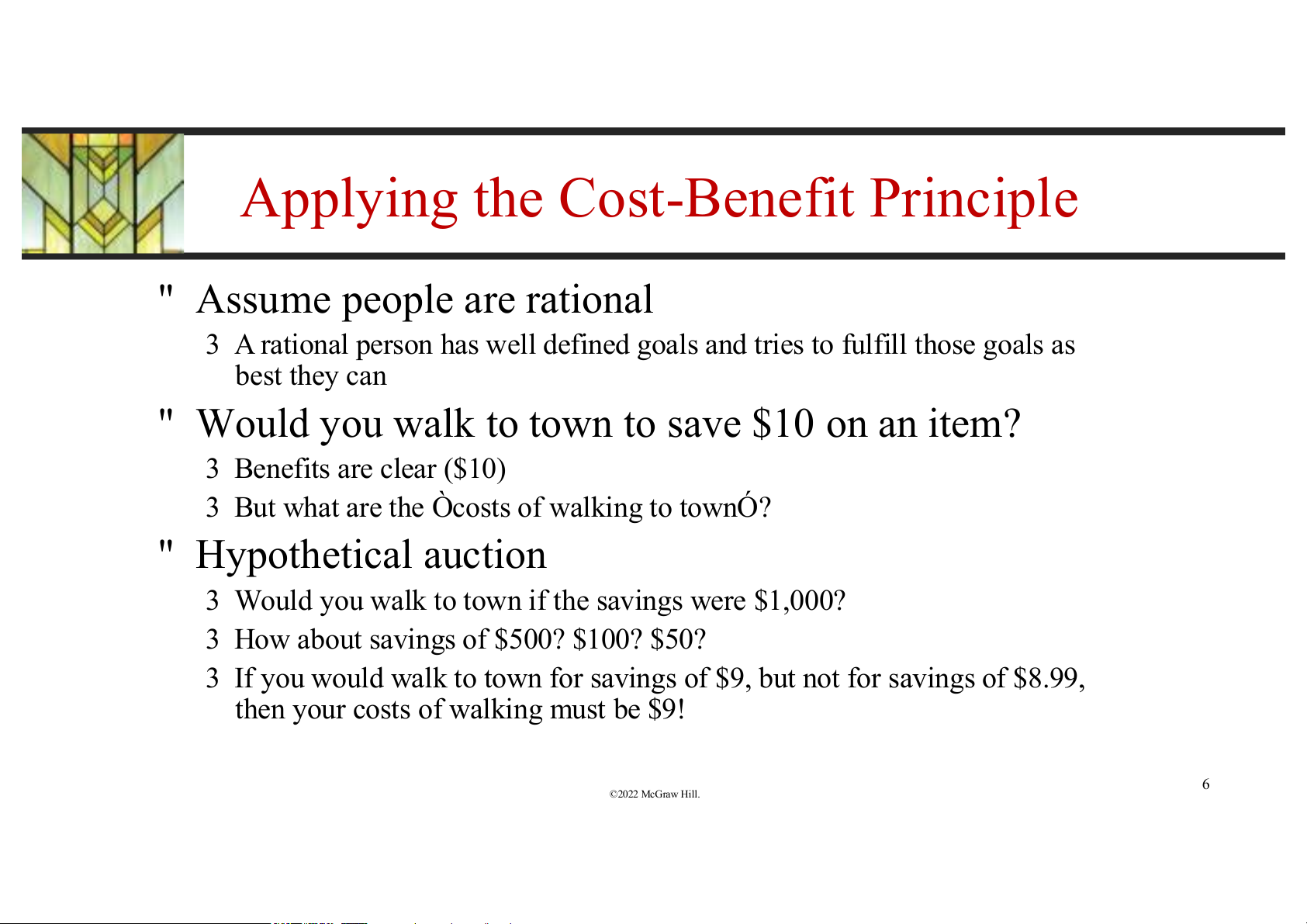
Applying the Cost-Benefit Principle " Assume people are rational
3 A rational person has well defined goals and tries to fulfill those goals as best they can
" Would you walk to town to save $10 on an item? 3 Benefits are clear ($10)
3 But what are the Òcosts of walking to townÓ? " Hypothetical auction
3 Would you walk to town if the savings were $1,000?
3 How about savings of $500? $100? $50?
3 If you would walk to town for savings of $9, but not for savings of $8.99,
then your costs of walking must be $9! 6 ©2022 McGraw Hill.
Cost Ð Benefit Principle Examples You clip grocery You speed on coupons, but the way to work Jeff Bezos but not on the does not way to school At the ballpark, you pay extra to You skip your buy a soda from regular dental the hawkers in check-up the stands 7 ©2022 McGraw Hill. Economic Surplus
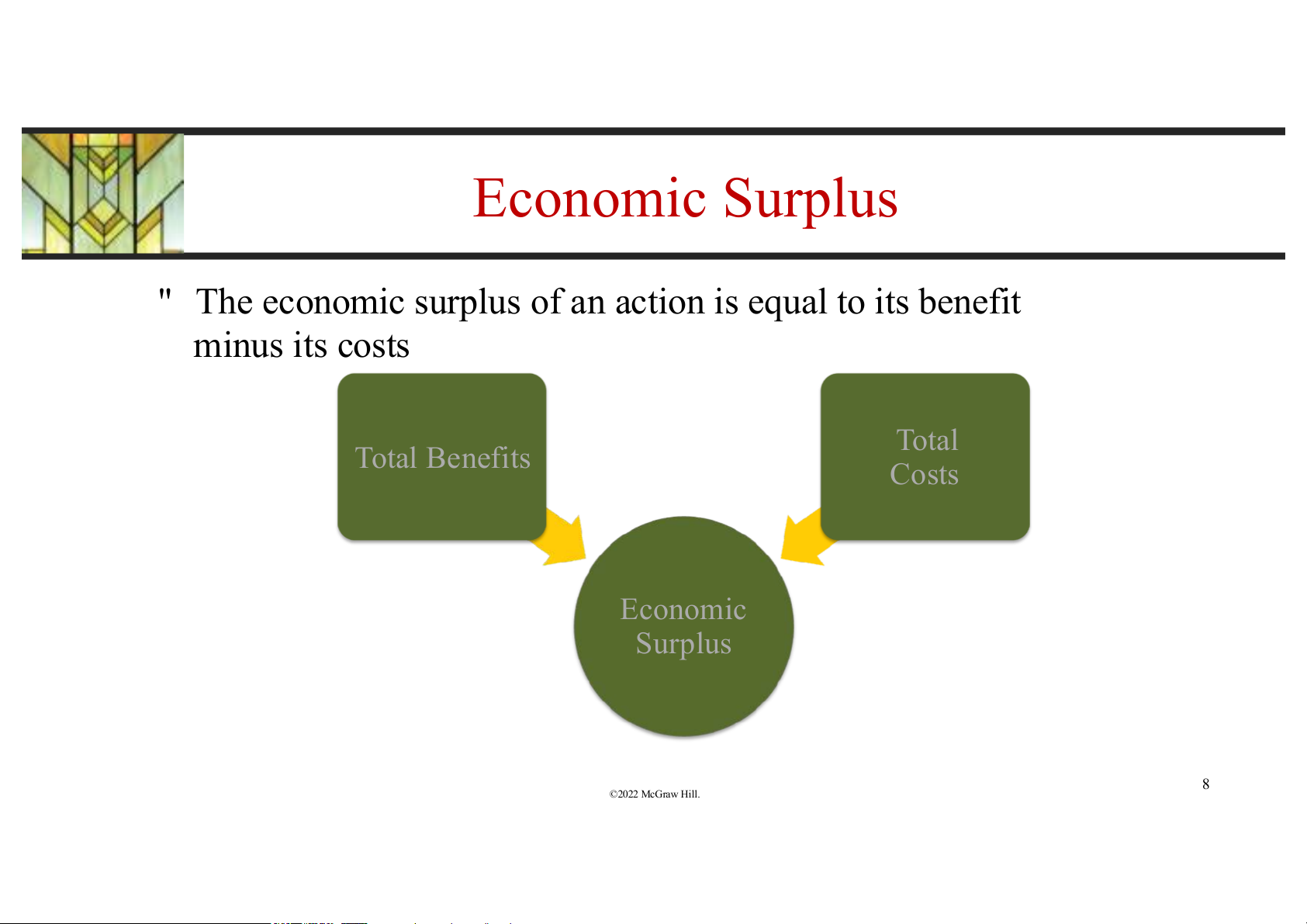
" The economic surplus of an action is equal to its benefit minus its costs Total Total Benefits Costs Economic Surplus 8 ©2022 McGraw Hill. Economic Surplus
" The economic surplus of an action is equal to its benefit minus its costs
" Economic surplus = Total Benefits Ð Total Costs
" If we get $10 of savings from walking to town, and our costs of
walking to town are $9, then the economic surplus from
walking to town is $10 - $9 = $1. 9 ©2022 McGraw Hill. Opportunity Cost
" Opportunity cost is the value of what must be
foregone in order to undertake an activity
3 Consider explicit and implicit costs " Examples:
3 Give up an hour of dogwalking to go to the movies
3 Give up watching your favorite Netflix show to walk to town
" Caution: NOT the combined value of all possible activities
3 Opportunity cost considers only your best alternative 10 ©2022 McGraw Hill. Economic Models " Simplifying assumptions
3 Which aspects of the decision are absolutely essential?
3 Which aspects are irrelevant?
" Abstract representation of key relationships
3 The Cost-Benefit Principle is a model
" If costs of an action increase, the action is less likely
" If benefits of an action increase, the action is more likely 11 ©2022 McGraw Hill. Three Decision Pitfalls
" Economic analysis predicts likely behavior
" Three general cases of mistakes
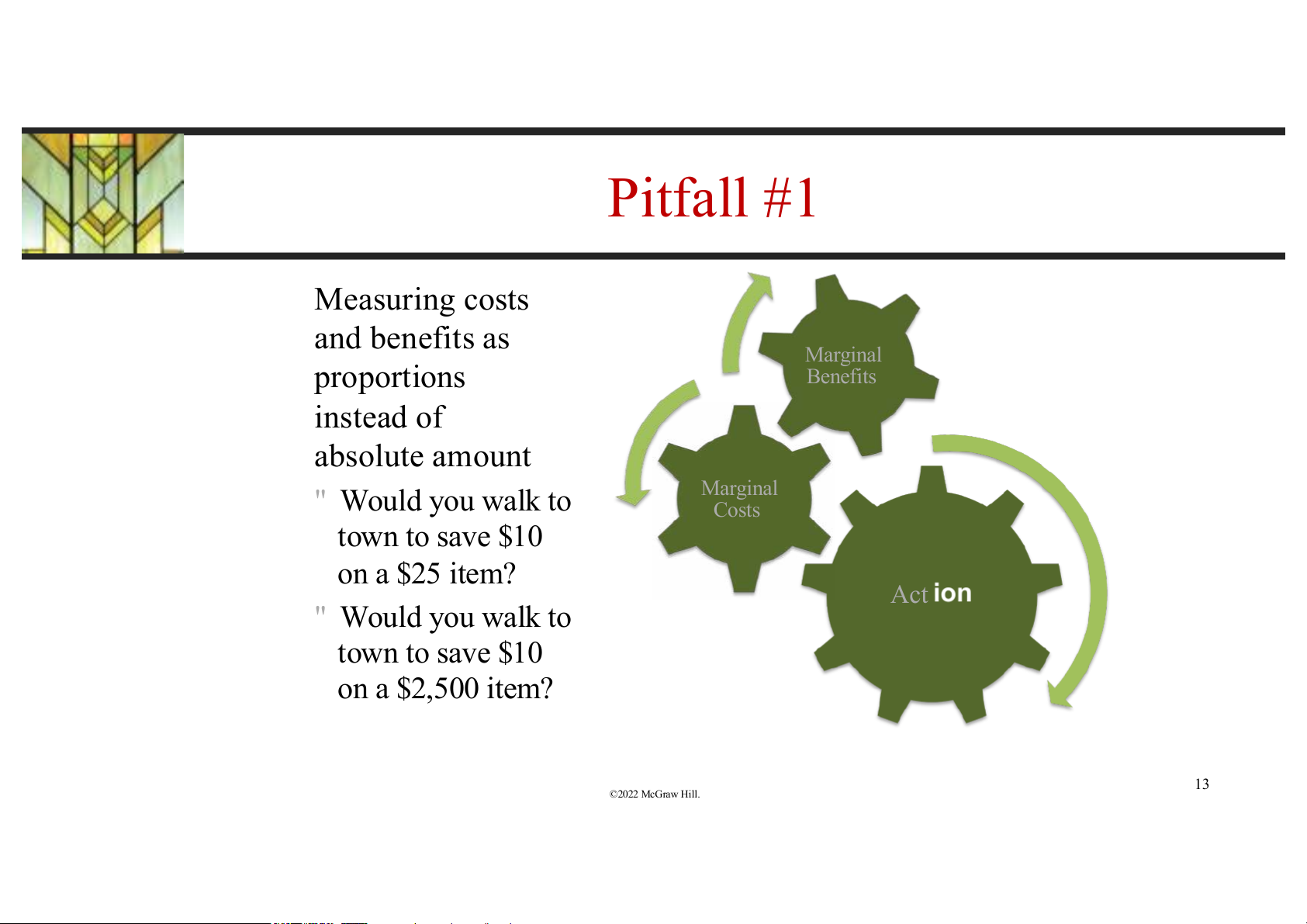
1. Measuring costs and benefits as proportions instead of absolute amounts 2. Ignoring implicit costs
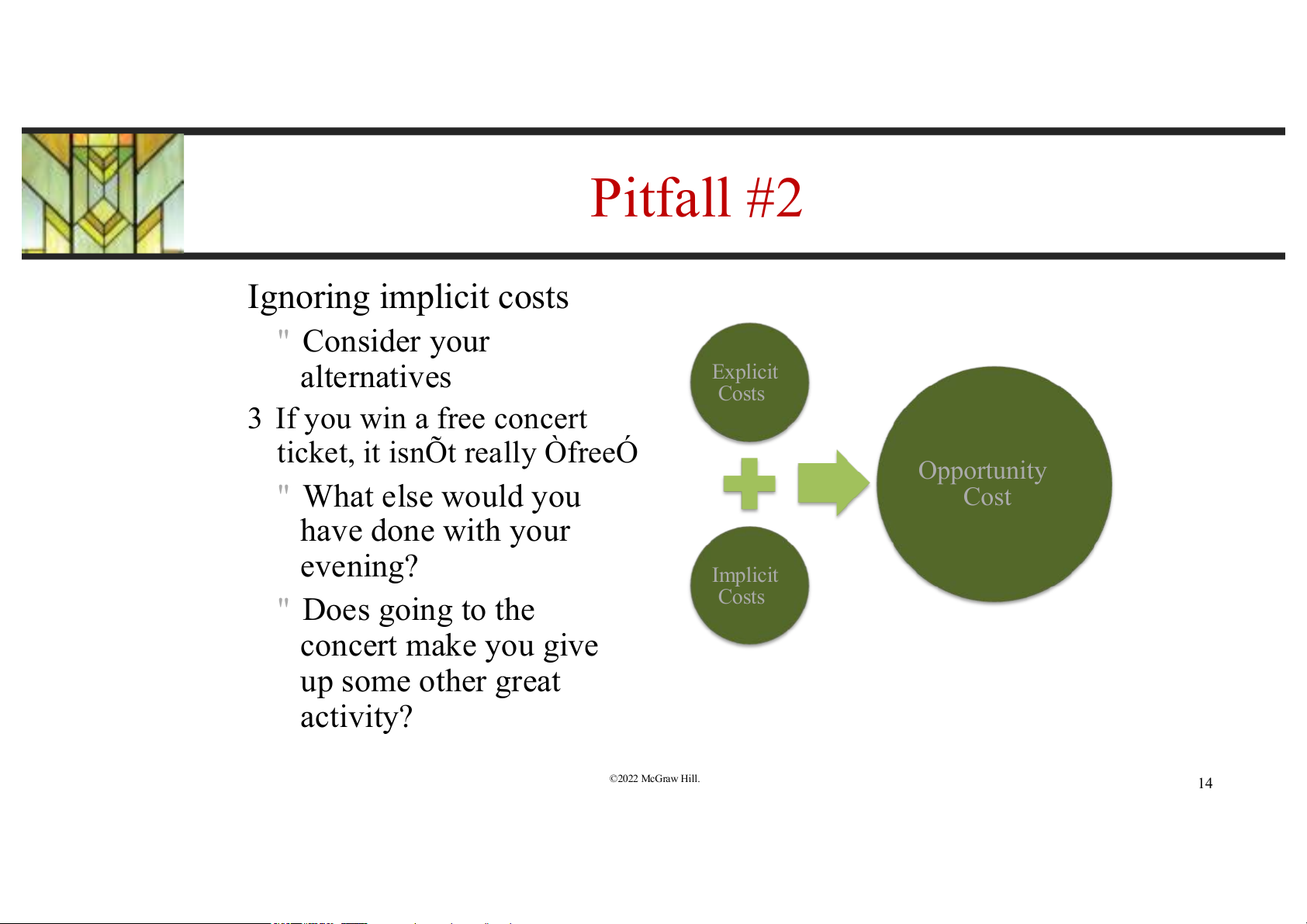
3. Failure to think at the margin 12 ©2022 McGraw Hill. Pitfall #1 Measuring costs and benefits as Marginal proportions Benefits instead of absolute amount " Would you walk to Marginal Costs town to save $10 on a $25 item? Act " Would you walk to town to save $10 on a $2,500 item? 13 ©2022 McGraw Hill. Pitfall #2 Ignoring implicit costs " Consider your alternatives Explicit Costs 3 If you win a free concert
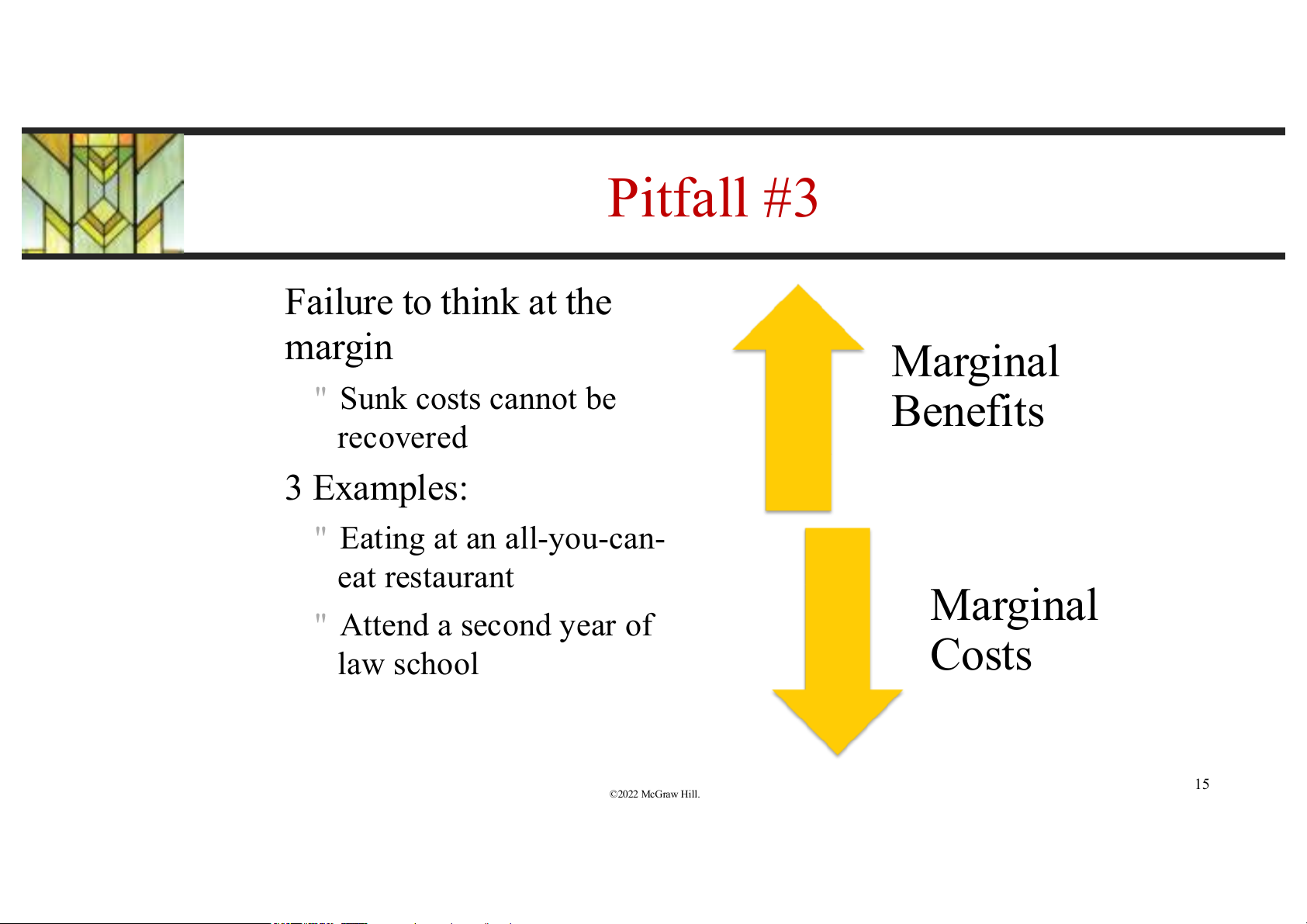
ticket, it isnÕt really ÒfreeÓ Opportunity " What else would you Cost have done with your evening? Implicit " Does going to the Costs concert make you give up some other great activity? ©2022 McGraw Hill. 14 Pitfall #3 Failure to think at the margin Marginal " Sunk costs cannot be Benefits recovered 3 Examples: " Eating at an all-you-can- eat restaurant Marginal " Attend a second year of law school Costs 15 ©2022 McGraw Hill. Marginal Analysis Ideas
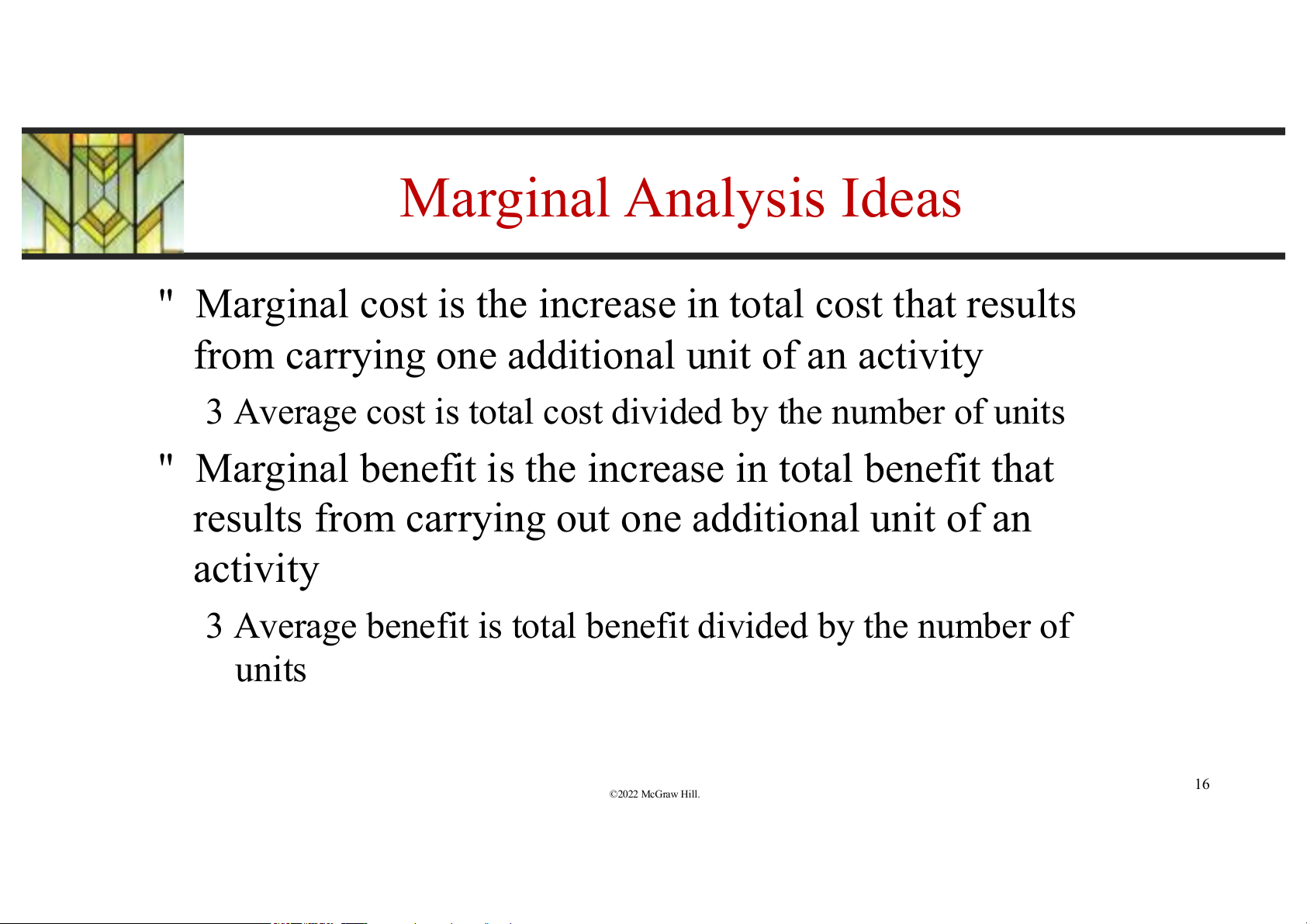
" Marginal cost is the increase in total cost that results
from carrying one additional unit of an activity
3 Average cost is total cost divided by the number of units
" Marginal benefit is the increase in total benefit that
results from carrying out one additional unit of an activity
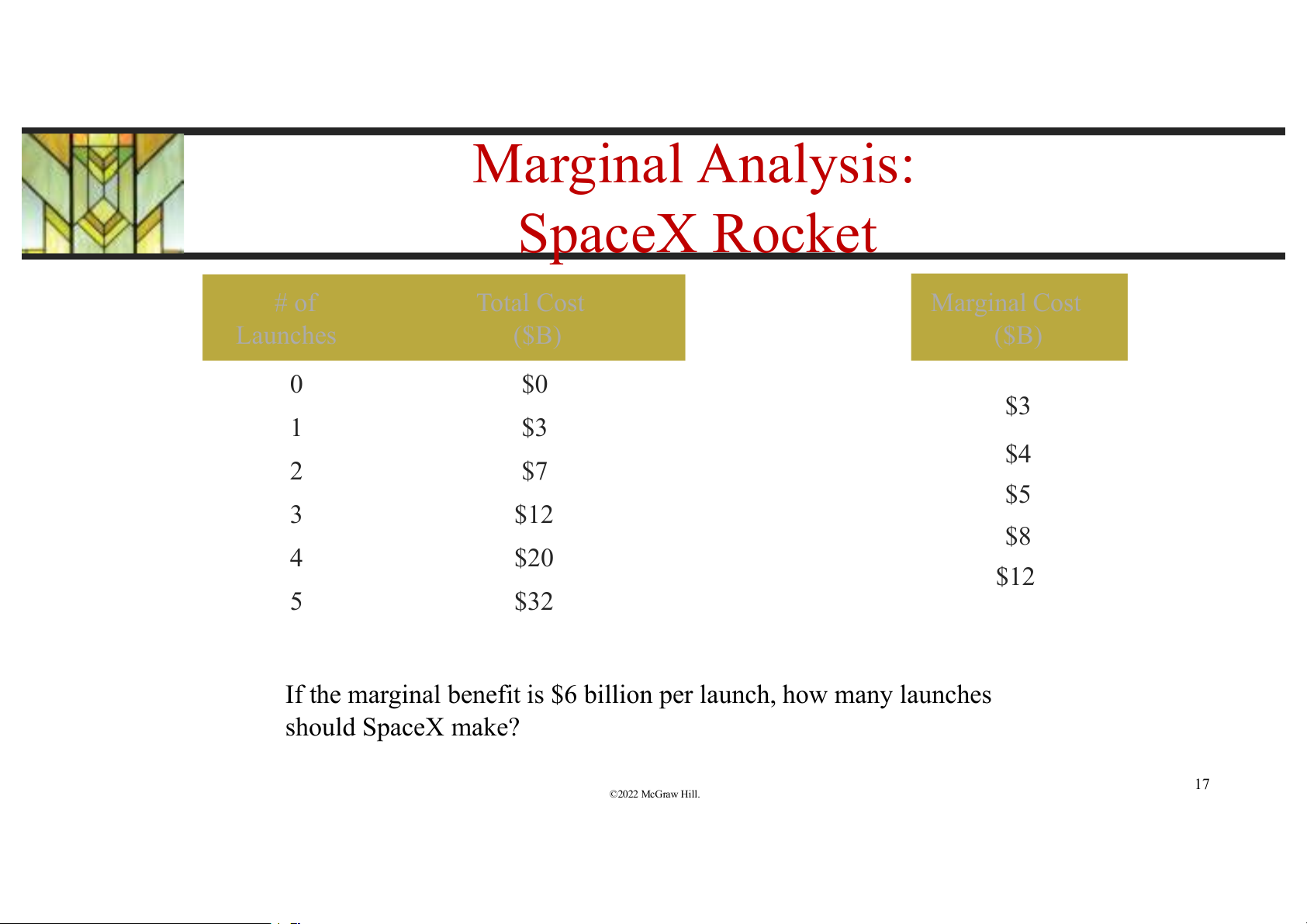
3 Average benefit is total benefit divided by the number of units 16 ©2022 McGraw Hill. Marginal Analysis: SpaceX Rocket # of Total Cost Marginal Cost Launches ($B) ($B) 0 $0 $3 1 $3 $4 2 $7 $5 3 $12 $8 4 $20 $12 5 $32
If the marginal benefit is $6 billion per launch, how many launches should SpaceX make? 17 ©2022 McGraw Hill.
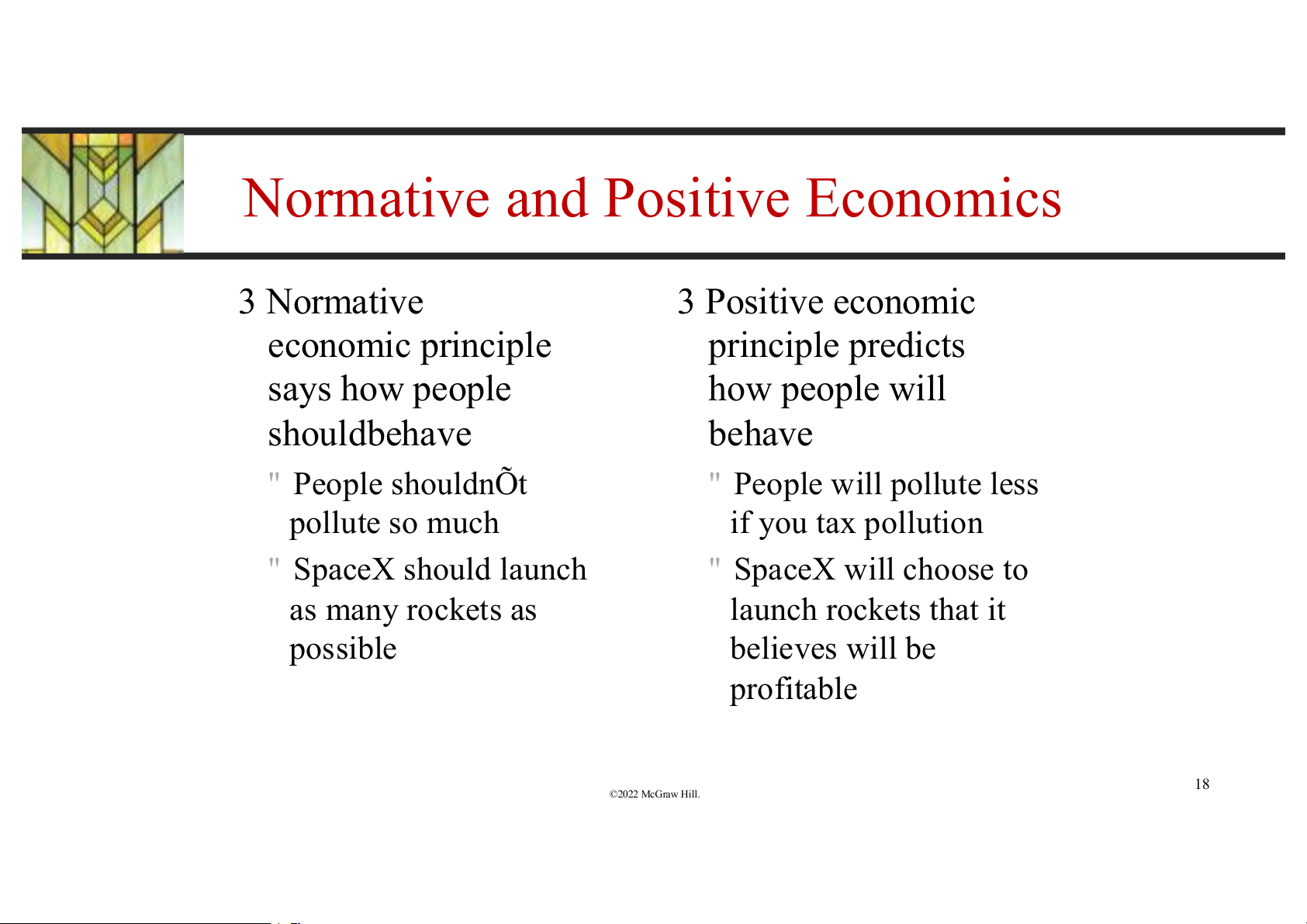
Normative and Positive Economics 3 Normative 3 Positive economic economic principle principle predicts says how people how people will shouldbehave behave " People shouldnÕt " People will pollute less pollute so much if you tax pollution " SpaceX should launch " SpaceX will choose to as many rockets as launch rockets that it possible believes will be profitable 18 ©2022 McGraw Hill. Incentive Principle
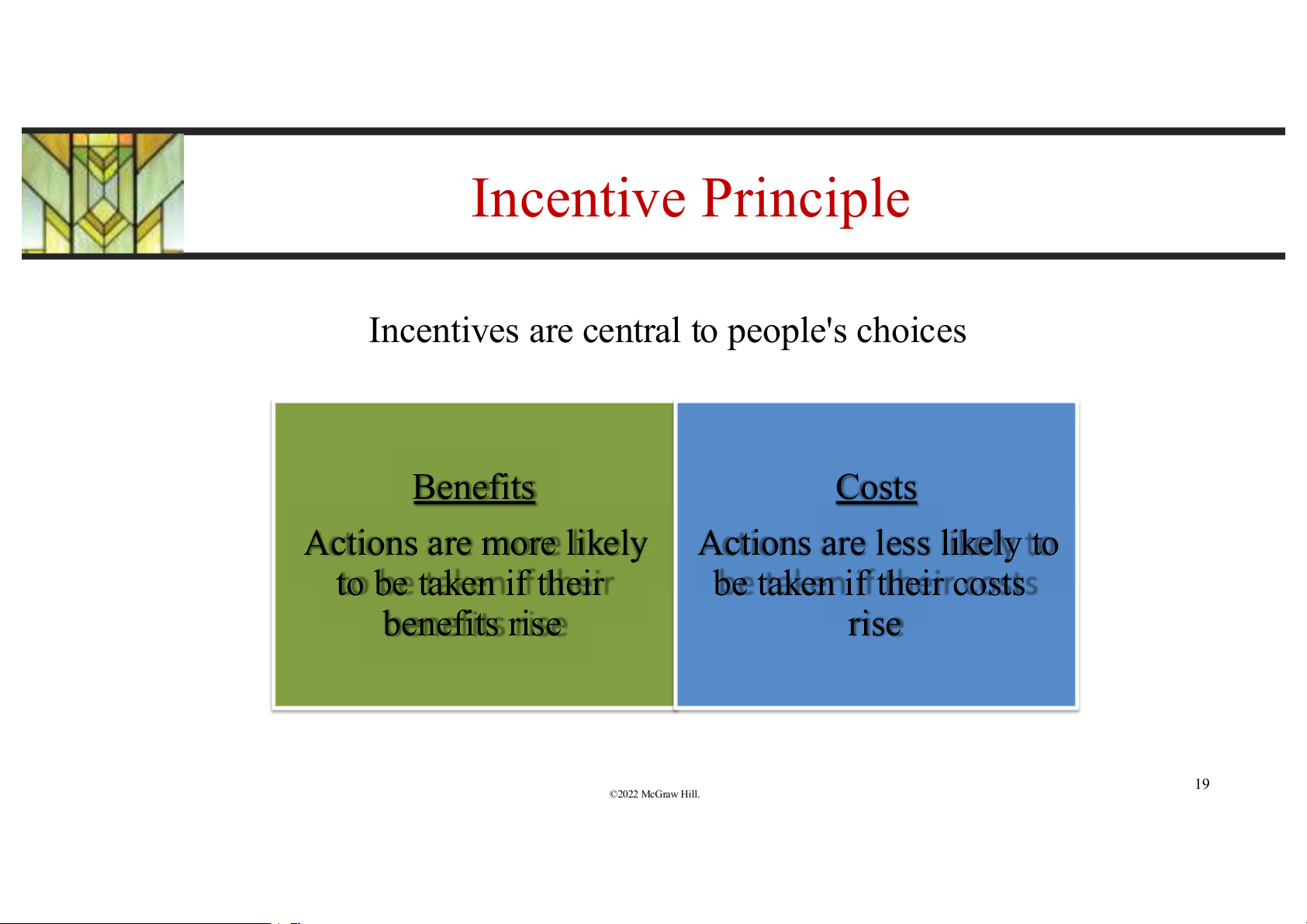
Incentives are central to people's choices Benefits Costs
Actions are more likely Actions are less likely to to be taken if their be taken if their costs benefits rise rise 19 ©2022 McGraw Hill.
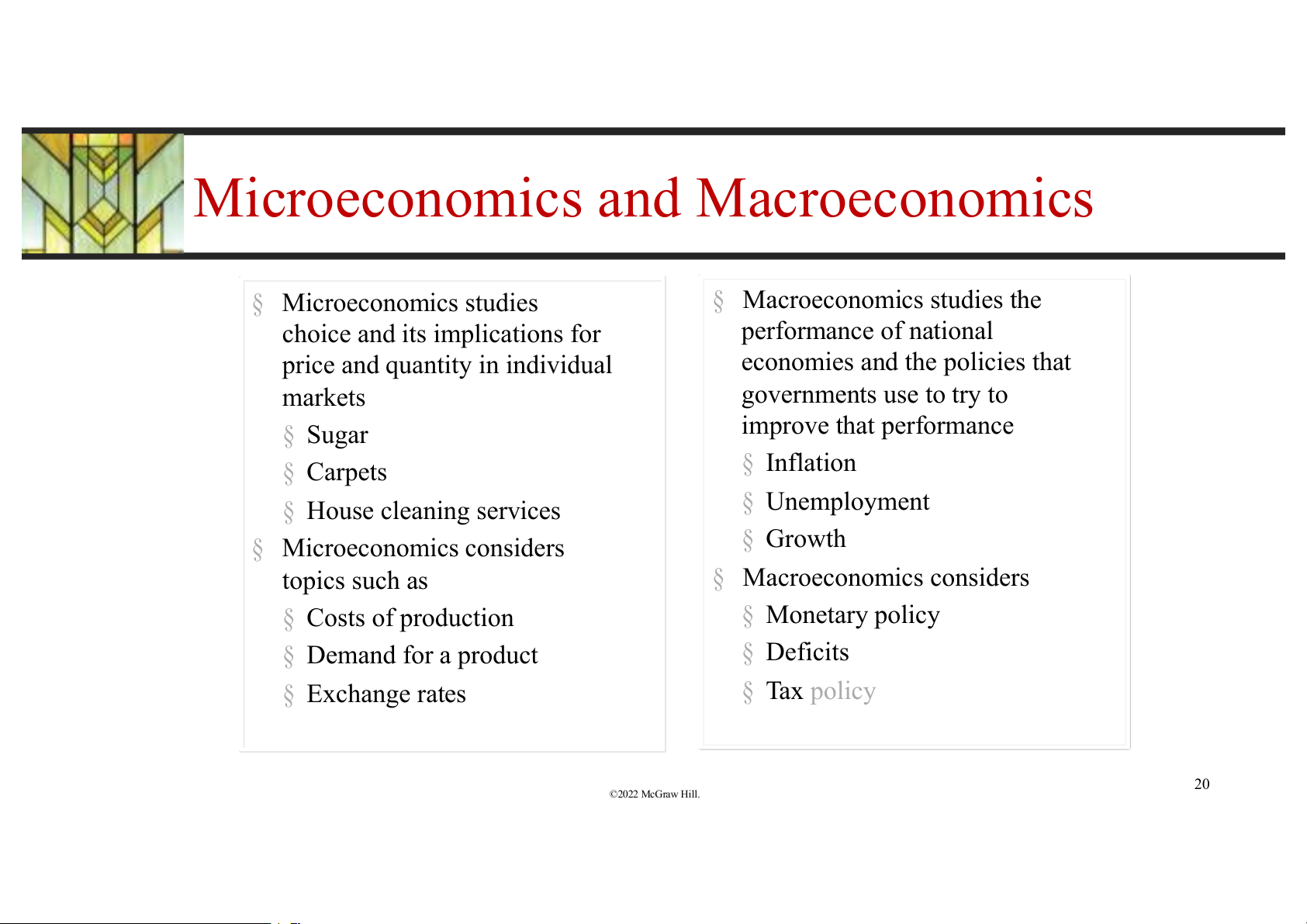
Microeconomics and Macroeconomics § Microeconomics studies § Macroeconomics studies the
choice and its implications for performance of national
price and quantity in individual
economies and the policies that markets governments use to try to § Sugar improve that performance § Carpets § Inflation § House cleaning services § Unemployment § Microeconomics considers § Growth topics such as § Macroeconomics considers § Costs of production § Monetary policy § Demand for a product § Deficits § Exchange rates § Tax policy 20 ©2022 McGraw Hill.
Tài liệu liên quan:
-
Tự Luận Vimo: Phân Tích Cung, Cầu và Thị Trường Cạnh Tranh| Microeconomics | Trường Đại học Quốc tế, Đại học Quốc gia Thành phố Hồ Chí Minh
5 3 -
Review Questions: Thinking Like an Economist | Microeconomics | Trường Đại học Quốc tế, Đại học Quốc gia Thành phố Hồ Chí Minh
5 3 -
Final Exam Quizlet Questions & Answers | Microeconomics | Trường Đại học Quốc tế, Đại học Quốc gia Thành phố Hồ Chí Minh
5 3 -

Đề thi giữa kỳ II | Microeconomics | Trường Đại học Quốc tế, Đại học Quốc gia Thành phố Hồ Chí Minh
5 3 -
Final Group Project_ The Beer Industry | Microeconomics | Trường Đại học Quốc tế, Đại học Quốc gia Thành phố Hồ Chí Minh
4 2