Greening the Dark Side of Chocolate: Qualitative Insights on Sustainability | Kinh tế vĩ mô | Trường Đại học kinh tế Thành Phố Hồ Chí Minh
Despite the plethora of discourse about how sustainable development should be pursued, the production of agricultural commodities is held responsible for driving c. 80% of global deforestation. Partially as a response, the private sector has made commitments to eliminate deforestation, but it is not yet clear what factors these commitments should take into account to effectively halt deforestation while also contributing to broader sustainable development. Tài liệu được sưu tầm và soạn thảo dưới dạng file PDF để gửi tới các bạn cùng tham khảo, ôn tập đầy đủ kiến thức, chuẩn bị cho các buổi học thật tốt. Mời bạn đọc đón xem!
Môn: Kinh tế vĩ mô ( UEH) 0.9 K tài liệu
Trường: Đại học Kinh tế Thành phố Hồ Chí Minh 2.8 K tài liệu
Tác giả:

Preview text:
Environmental Conservation
Thematic Section: Forests in Flux
Greening the Dark Side of Chocolate: A
Qualitative Assessment to Inform Sustainable Supply Chains cambridge.org/enc
Marisa Camilher Camargo1, Nicholas J Hogarth1,2, Pablo Pacheco3,
Isilda Nhantumbo 4 and Markku Kanninen1,3 Research Paper
1Viikki Tropical Resources Institute (VITRI), Department of Forest Sciences, PO Box 27 (Latokartanonkaari 7),
Cite this article: Camargo MC, Hogarth NJ,
FI-00014, University of Helsinki, Finland
2 ,Helsinki Institute of Sustainability Science (HELSUS), University of
Pacheco P, Nhantumbo I, Kanninen M (2019)
Helsinki, Finland,3Center for International Forestry Research (CIFOR), Jalan CIFOR, Situ Gede, Bogor Barat
Greening the Dark Side of Chocolate: A
16115, Indonesia and 4International Institute for Environment and Development (IIED), 4 Hanover St,
Qualitative Assessment to Inform Sustainable Edinburgh EH2 2EN, UK
Supply Chains. Environmental Conservation
46: 9–16. doi:10.1017/S0376892918000243 Summary Received: 15 May 2017 Revised: 25 February 2018
Despite the plethora of discourse about how sustainable development should be pursued, the Accepted: 30 May 2018
production of agricultural commodities is held responsible for driving c. 80% of global
First published online: 18 September 2018
deforestation. Partially as a response, the private sector has made commitments to eliminate Keywords
deforestation, but it is not yet clear what factors these commitments should take into account
Cocoa; chocolate; supply chain;
to effectively halt deforestation while also contributing to broader sustainable development. In
sustainability; sustainable development;
the context of private sector commitments to zero-deforestation, this study characterizes the deforestation; private sector
perceptions of different types of stakeholders along the cocoa and chocolate supply chain in
order to determine the main challenges and solutions to encourage sustainable production. Author for correspondence:
Marisa Camilher Camargo, Email: marisa.
The main purpose is to understand the key factors that could facilitate a transition to a more camargo@helsinki.fi
sustainable supply while harmonizing the multiple actors’ interests. A qualitative thematic
analysis of perceptions was conducted based on responses from 59 interviews with different
stakeholders along the cocoa and chocolate supply chain in six key producing and consuming
countries. Thematic analysis of the responses revealed six main themes: (1) make better use of
policies, regulations and markets to help promote sustainability; (2) improve information and
data (e.g., impacts of climate change on cocoa) to inform sound interventions; (3) focus on the
landscape rather than the farm-level alone and improve integration of supply chain actors; (4)
promote better coordination between stakeholders and initiatives (e.g., development assistance
projects and corporate sustainability efforts); (5) focus on interdependent relationships
between social, environmental and economic dimensions to achieve sustainable development;
and (6) engage with the private sector. The study shows the importance of identifying different
stakeholder priorities in order to design solutions that accommodate multiple interests. It also
emphasizes the need to improve coordination and communication between stakeholders and
instruments in order to address the three different dimensions of sustainability in a synergistic
manner, considering the interactions from production of raw material to end consumer. Introduction
Proponents of sustainable development suggest that economic growth should be designed to
meet the needs of the present generation without jeopardizing the rights of generations to
come (Brundtland 1987). Sustainable production and supply chains should thus find an
optimal long-term balance between economic, social and environmental issues (Fay 2012,
Borel‐Saladin & Turok 2013).
Despite the omnipresent discourse that sustainable growth should be pursued, production
of agricultural commodities to supply the needs of the world’s growing population is
increasing hastily and is responsible for driving c. 80% of global deforestation (Hosonuma
et al. 2012). These include ‘forest risk commodities’ such as beef and leather, cocoa, palm oil,
rubber, soya, pulp and paper (Newton et al. 2013, Rautner et al. 2013, Lawrence & Vandecar
© Foundation for Environmental Conservation
2015). In response, businesses, scholars and governments have turned their attention to 2018.
supporting sustainability in commodity supply chains (Brickell & Elias 2013, Green 2015). A
‘zero-deforestation movement’ has emerged based on the notion that more radical efforts had
to be made to delink commodity production from deforestation (Lambin et al. 2018).
Consumer goods manufacturers, traders and corporate processing groups have pledged to
eliminate deforestation from their supply chains, although they use different definitions of
https://doi.org/10.1017/S0376892918000243 Published online by Cambridge University Press 10 Marisa Camilher Camargo et al.
forests and compliance timeframes (Hower 2014, United Nations processors, manufacturers, transporters, the packaging industry,
2014). In 2017, 12 of the world’s leading cocoa and chocolarteetailers and final consumers (Afoakwa 2014; Camargo & Nham-
companies collectively committed to end deforestation and forestumbo 2016) (Supplementary Material S1, available online).
degradation in the global cocoa supply chain, with an initial focus In this study, findings from a thematic analysis of perceptions
on Côte d’Ivoire and Ghana (World Cocoa Foundation 2017). from different types of stakeholders connected to the production
It is, however, not yet clear what factors these zero-f cocoa and chocolate – in both producing and consuming
deforestation commitments should take into account in order tocountries – are systematically characterized in terms of what they
effectively ensure that social, environmental and economic issuesbelieve are the main challenges and solutions to encouraging the
are addressed according to the principles of sustainable devel-
sustainability of supply chains. This study aims to understand the
opment. Moreover, the challenge is to ensure that these pledgefsactors shaping the challenges and potential solutions to transi-
are not reduced to simply conserving remnant forest plots adjat-ioning towards more sustainable production of cocoa (commod-
cent to agricultural production areas, but that they contributeity) and chocolate (end product) in the context of commitments to
towards enhancing the sustainability of the landscapes where thezero deforestation. The results can be used to inform what elements
raw materials are sourced, as well as the supply chains from
zero-deforestation pledges should take into account in order to
farmer to consumer. The latter will entail actions aimed atcontribute to sustainable development, especially in terms of
ensuring forest protection, and thus securing the provision ofaddressing livelihoods. This will also help inform the future
ecosystem services, but also on stimulating the uptake of
directions, policies, investments and other decisions that could
improved production practices that should result in improvedcontribute to the transition from a singular focus on zero defor-
cocoa famer income and well-being.
estation to a more holistic approach that embraces sustainability.
So far, the literature on zero-deforestation commitments has
focused mostly on the challenges and risks associated with
implementing these on the ground, with a heavy focus onMethods
deforestation, but with less attention given to the actions at dif-
ferent stages along the supply chain that are needed to address theSample
environmental issues found upstream in the chain (primary Stakeholders were interviewed in six countries: Ghana and Brazil
production stage). This is problematic for three main reasons: (1)(the second and sixth largest producers of cocoa in the world);
drivers of unsustainable commodity production are sometimesThe Netherlands (the largest global importer and processor of
found elsewhere in the end-product supply chain, such as the lack
cocoa); the USA and Belgium (major consumers of chocolate);
of demand for certified sustainable products in consumingand Denmark (during an international cocoa conference).
countries; (2) deforestation and its associated carbon emissions Stakeholders were selected using purposive and snowball
and biodiversity loss represent only some of the many environ-sampling approaches. They included farmers, manufacturers, inves-
mental externalities related to the production of end productstors, government representatives, non-governmental organizations
(e.g., chocolate); and (3) the livelihoods of smallholder farmers(,NGOs), researchers and technical assistance (TA) providers work-
who are the main cocoa suppliers, constitute a major challenge
ing on cocoa or similar agricultural commodities. Fifty-nine inter-
that needs to be addressed concomitantly with environmentalviews with 69 stakeholders were carried out between October 2014
concerns (Kopnina 2017). Therefore, a limited focus on the
and July 2015 (six interviews accommodated two or three people).
commodity and deforestation at the farm level might not helpSupplementary Material S3 provides more details on the methods.
address the problem in the long term.
Cocoa is a very important cash crop for millions of farmers
and the national economies of several countries in West Africa, aIsnterviews
well as in Brazil and Indonesia (FAO 2014). Notwithstanding the
The majority of the interviews were carried out in person by the
benefits that cocoa brings, it has been directly linked to defofri-rst author of this paper (MCC). Because the pool of stakeholders
estation and forest degradation in production areas (Gockowski &ranged from cocoa farmers to industry representatives, the
Sonwa 2011). Although cocoa production has a lower contribu-
interviews were not designed to have one set of specific questions.
tion to deforestation compared to other commodities such as beef
Instead, an interview guide was developed based on five pertinent
and soy (Henders et al. 2015), research suggests that over the ltaost
pics drawn from a review of the literature. This helped give
50 years, cocoa cultivation has contributed to the disappearancefocus to the interviews, but also allowed the interviewer to cus-
of 14–15 million ha of tropical forests globally (Clough et a t l
o .mize questions to individual stakeholders’ realities. The open-
2009). Moreover, production continues to expand to meet thended approach was based on the understanding that stake-
growing international demand, further increasing pressure on holders’ preferences are mainly socially constructed, based on
forest areas. Yet it is still important to address the impacts o
d fiferent interests and experiences and shaped by social interac-
cocoa on forest conversion since it has been leading to local antd ion (Rubin & Rubin 2011).
regional climatic changes (Laderach et al. 2013) that will likely At the start of each interview, interviewees were informed that
impact not only cocoa production, but also the livelihoods of
the research was examining the three dimensions of sustainable
millions of cocoa producers and their dependants living in the
development (social, environmental and economic) and that their
cocoa belt (Schroth et al. 2016, Coulibaly et al. 2017).
responses would be kept anonymous. In most interviews, except
Cocoa production is only one part of the chain, with severa
wlith farmers and some producing country actors, we explained
other sectors still needing to interact before chocolate – the finalthat the research was being carried in the context of the recent
product – can be produced, including other basic ingredientsindustry commitments to promote zero-deforestation supply
(sugar, lecithin, vanilla, milk powder, nuts, etc.), the agriculturalchains. The interview guide is summarized in Supplementary
inputs industry (e.g., seedlings, fertilizers), local buyers (traders),Material S3.
https://doi.org/10.1017/S0376892918000243 Published online by Cambridge University Press Environmental Conservation 11
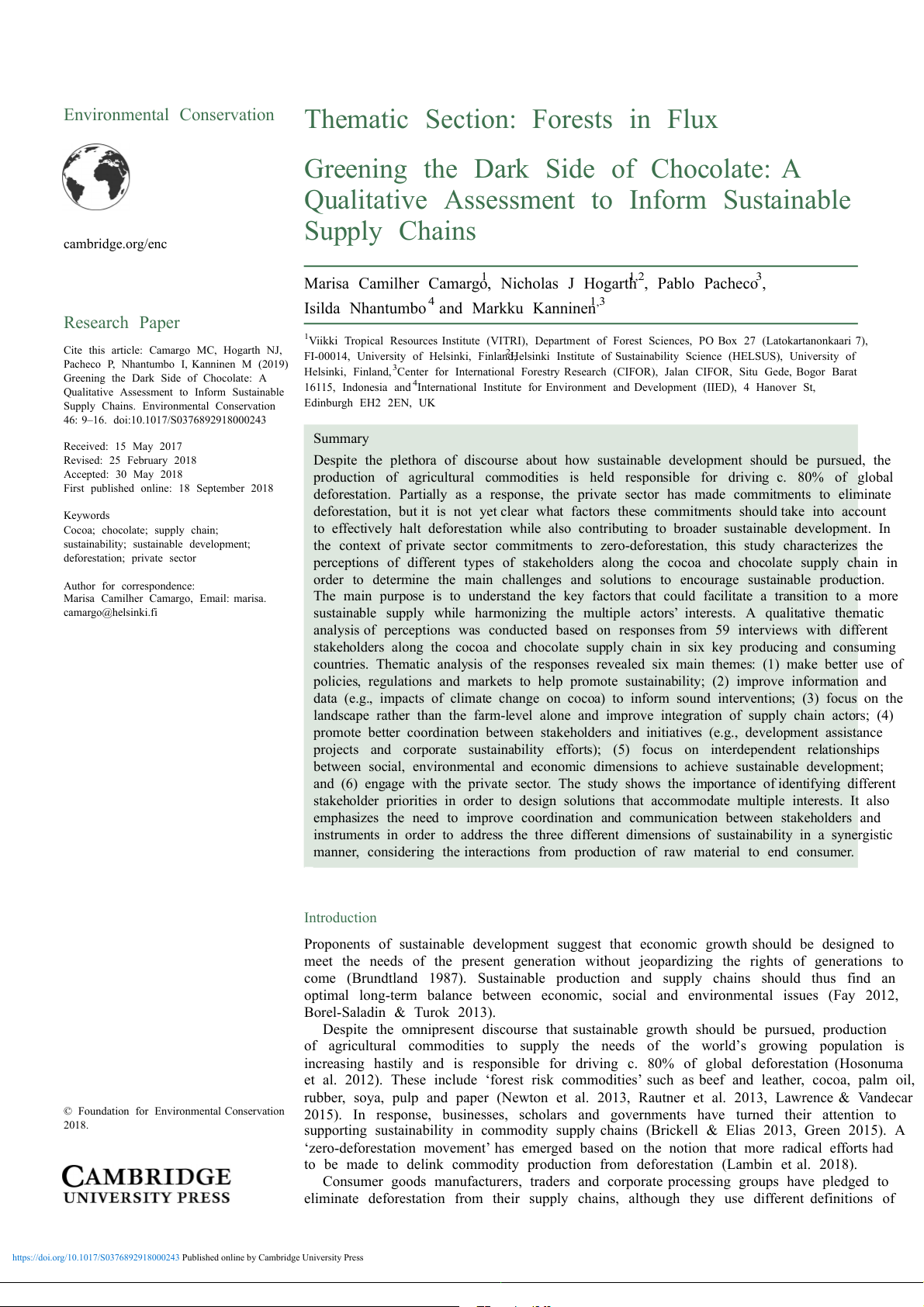
Table 1. Number of interviews per stakeholder group per sample country. NGO = non-governmental organization Cocoa-producer countries
Cocoa-importing/processing/consumer countries Stakeholder groups Ghana Brazil Subtotal USA Belgium and Denmark The Netherlands Subtotal Total Research 2 2 4 0 0 0 0 4 NGOs 3 3 6 4 1 1 6 12 International institutions 3 0 3 3 0 2 5 8 Farmers 4 2 4 0 0 0 0 6 Government –consuming 0 0 0 2 4 0 6 6 Government –producing 4 0 4 0 0 0 0 4 Technical assistance 1 1 2 1 0 3 4 6 Industry 4 2 6 1 3 1 5 11 Investors 0 0 0 1 0 1 2 2 Total 21 10 31 12 8 8 28 59 Analysis
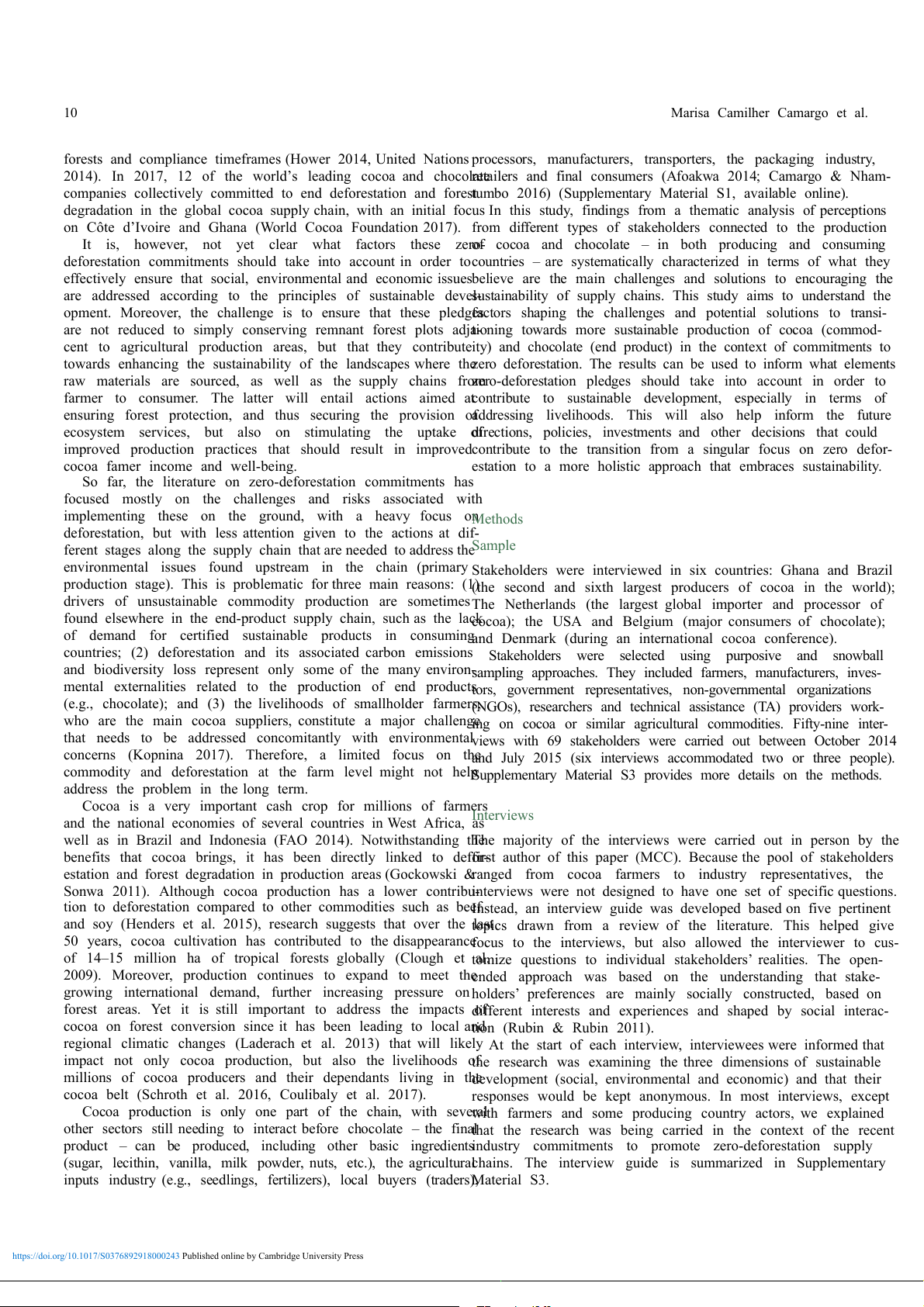
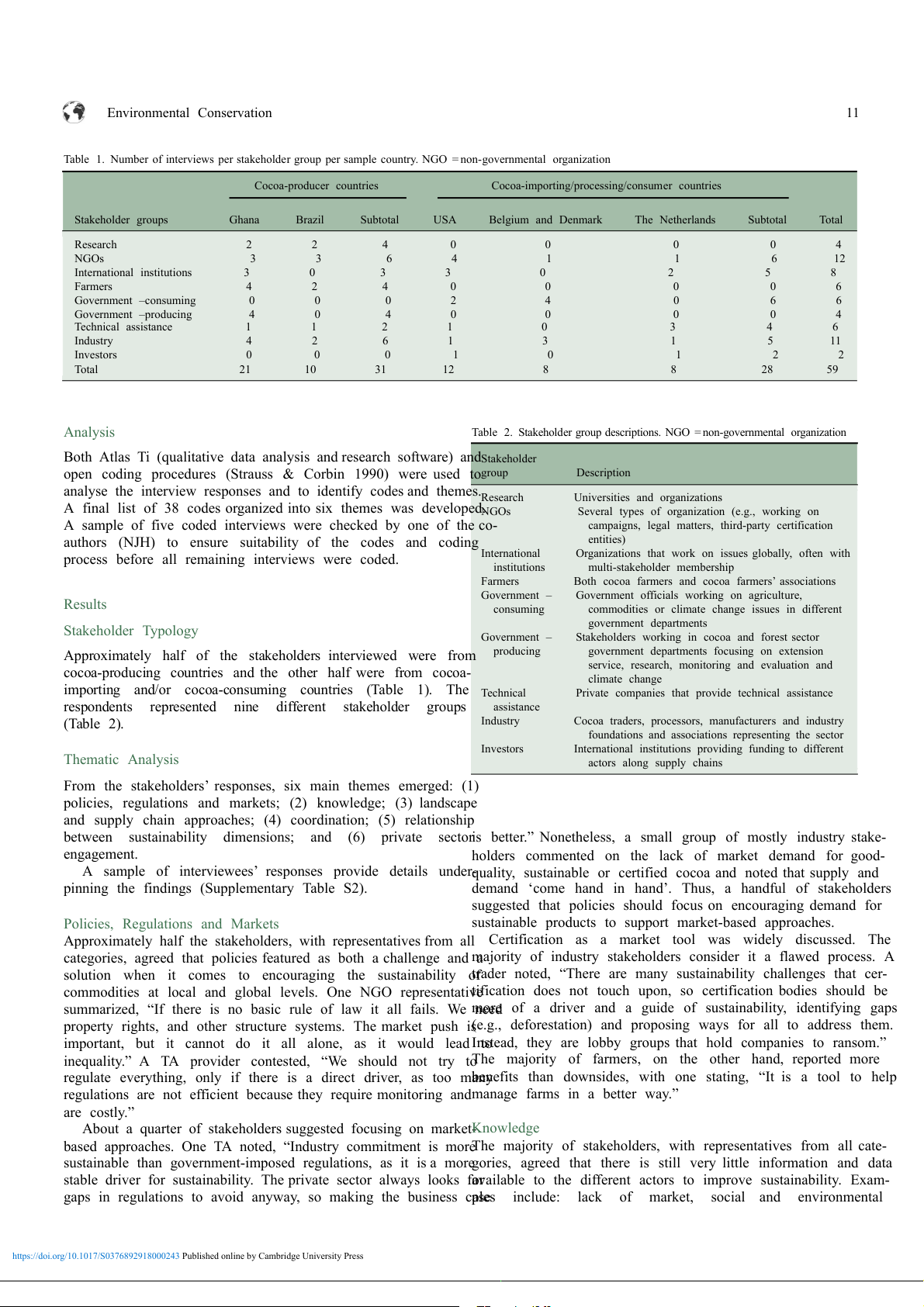
Table 2. Stakeholder group descriptions. NGO = non-governmental organization
Both Atlas Ti (qualitative data analysis and research software) andStakeholder
open coding procedures (Strauss & Corbin 1990) were used togroup Description
analyse the interview responses and to identify codes and themes.Research Universities and organizations
A final list of 38 codes organized into six themes was developed.NGOs
Several types of organization (e.g., working on
A sample of five coded interviews were checked by one of the co-
campaigns, legal matters, third-party certification
authors (NJH) to ensure suitability of the codes and coding entities)
process before all remaining interviews were coded. International
Organizations that work on issues globally, often with institutions multi-stakeholder membership Farmers
Both cocoa farmers and cocoa farmers’ associations Government –
Government officials working on agriculture, Results consuming
commodities or climate change issues in different Stakeholder Typology government departments Government –
Stakeholders working in cocoa and forest sector
Approximately half of the stakeholders interviewed were from producing
government departments focusing on extension
cocoa-producing countries and the other half were from cocoa-
service, research, monitoring and evaluation and climate change
importing and/or cocoa-consuming countries (Table 1). The Technical
Private companies that provide technical assistance respondents represented nine different stakeholder groups assistance (Table 2). Industry
Cocoa traders, processors, manufacturers and industry
foundations and associations representing the sector Investors
International institutions providing funding to different Thematic Analysis actors along supply chains
From the stakeholders’ responses, six main themes emerged: (1)
policies, regulations and markets; (2) knowledge; (3) landscape
and supply chain approaches; (4) coordination; (5) relationship
between sustainability dimensions; and (6) private sectoris better.” Nonetheless, a small group of mostly industry stake- engagement.
holders commented on the lack of market demand for good-
A sample of interviewees’ responses provide details under-quality, sustainable or certified cocoa and noted that supply and
pinning the findings (Supplementary Table S2).
demand ‘come hand in hand’. Thus, a handful of stakeholders
suggested that policies should focus on encouraging demand for
Policies, Regulations and Markets
sustainable products to support market-based approaches.
Approximately half the stakeholders, with representatives from all Certification as a market tool was widely discussed. The
categories, agreed that policies featured as both a challenge and a
majority of industry stakeholders consider it a flawed process. A
solution when it comes to encouraging the sustainability of
trader noted, “There are many sustainability challenges that cer-
commodities at local and global levels. One NGO representativteification does not touch upon, so certification bodies should be
summarized, “If there is no basic rule of law it all fails. We ne m e o d
re of a driver and a guide of sustainability, identifying gaps
property rights, and other structure systems. The market push is(e.g., deforestation) and proposing ways for all to address them.
important, but it cannot do it all alone, as it would lead I t
nostead, they are lobby groups that hold companies to ransom.”
inequality.” A TA provider contested, “We should not try toThe majority of farmers, on the other hand, reported more
regulate everything, only if there is a direct driver, as too man b y
enefits than downsides, with one stating, “It is a tool to help
regulations are not efficient because they require monitoring andmanage farms in a better way.” are costly.”
About a quarter of stakeholders suggested focusing on market-Knowledge
based approaches. One TA noted, “Industry commitment is moreThe majority of stakeholders, with representatives from all cate-
sustainable than government-imposed regulations, as it is a moregories, agreed that there is still very little information and data
stable driver for sustainability. The private sector always looks foarvailable to the different actors to improve sustainability. Exam-
gaps in regulations to avoid anyway, so making the business cas ples include: lack of market, social and environmental
https://doi.org/10.1017/S0376892918000243 Published online by Cambridge University Press 12 Marisa Camilher Camargo et al.
information, as well as tools to guide development assistance and Approximately 20% of the interviewees, most of whom were
corporate sustainability projects; lack of TA to farmers; and a lacfk
rom international institutions from consuming countries, also
of information on the real impacts of climate change, on sus
b -rought attention to the need to promote better policy coordi-
tainable production practices and to inform the business case fornation. One industry representative summarized, “I am on the
the private sector. To address this, a government representativeboard of the International Cocoa Initiative, which was created to
from a producing country suggested, “A lot of it boils down to
l ok into labour issues along the supply chain. I am mostly
research. We need to get the basis of what is happening and sho c w
oncerned about putting in place policies in consuming countries
the trends to the private sector that this ‘business as usual’ issuch as boycott campaigns and trade barriers. But these don’t
leading to decreased productivity. This is a way to have a win–wirn
esolve the problem. Cocoa-producing countries should have
scenario for all.” A TA provider added, “Farmers also need
better policies on the ground on sanitation, teaching/education,
training on managerial and bargaining skills, not only on how to
which contributes considerably to child labour. In most cases, the
increase yield,” a comment that demonstrates how TA is some-child labour is simply related to lack of close schools, which gives
times designed to address industry needs, rather than farmers’farmers no options, so I feel that boycotts alone would only
interests and long-term well-being.
punish the farmers. Policy coherence is very important.”
Some half of the stakeholders highlighted the importance of
Landscape and Supply Chain Approaches
improving communication and information, especially to con-
sumers and retailers. A TA provider noted, “Consumers do not
Led by NGOs, approximately half of the stakeholders from all
groups, except investors and farmers, noted the benefits ofunderstand what goes on in the field, so we need to stimulate
adopting a landscape approach. One NGO commented, “Differ-them to check data, scan the bar code in their smartphone and be
interested in how things are produced.”
ent companies source from different farmers spread in the land, Approximately 20% of the stakeholders noted that emerging
so the same patches of mosaics of the environment, in a way,
stakeholder platforms are positive forums to bring together
belong to different companies. If one company is trying to address
diverse groups. However, they also noted that they should be
deforestation and the other is not, this poses a problem. If not all
more innovative, integrate the private sector more systematically
the farmers within that landscape are certified; it is difficult to
and overcome competitiveness issues among stakeholders, such as
address deforestation. Monitoring is also very difficult patch perbetween certification schemes.
patch.” Only a few stakeholders noted the challenges associated
with promoting landscape-wide interventions.
Climate change was also widely discussed by about half of th R e
elationship between Sustainability Dimensions
stakeholders from all groups. The main argument was thatMore than half of the stakeholders, but not investors, discussed
synergies between the reducing emissions from deforestation andsome type of positive relationship between the sustainability
forest degradation (REDD + ) framework and efforts to ‘green’ dimensions. Overall, stakeholders agreed that to ensure the
commodities (e.g., monitoring systems and safeguards) should bedelivery of the long-term supply of cocoa and livelihoods, both
explored instead of having processes running in parallel. Butfarms and the landscape where they reside need to be ecologically
c. 10% of the stakeholders saw carbon as a wrong single focusa.n A
d socially resilient to, for example, the impacts of climate
government representative from a producing country summar- change. But for that to happen, there is a need for a clear and
ized, “The focus should not only be on carbon, but also on otheer
vidence-based business case on sustainable supply chains and on
benefits because that is when people will start getting interested
te.sted production models and information dissemination and
Carbon does not drive farmers’ interest as much water, foreducation of farmers on many aspects such as the impacts of example.”
climate change in ecosystems that are not resilient. This will allow
Focusing on the rest of the supply chain, more than half of tth h e
em to increase yield over time and reduce the pressure on
stakeholders from all groups, but not investors, spoke about thenatural forests, while ameliorating their livelihoods.
importance of working with different actors along supply chains Nonetheless, about half of the stakeholders highlighted the
to inform them about the benefits of becoming more sustainablec.ompetition between sustainability dimensions and that eco-
A trader noted, “We need to raise awareness of all players in t n h o e
mic aspects often take precedent, leaving environmental
supply chain, for example stimulate retailers to demand certifiedaspects to be addressed last. Approximately 15% of the stake-
products.” A private company complemented this by saying, holders indicated that sustainability encompasses too many issues
“Sometimes companies do not understand the risks and rewards,that cannot be addressed simultaneously due to limited budgets
so this exercise to explore the supply chain might ensure better and human resources.
sustainability. It is an exercise to discover challenges.” Only a
handful of stakeholders highlighted the role of the investmentPrivate Sector Engagement
sector in helping to promote change.
Overall, the majority of stakeholders saw added value in engaging
the private sector to promote sustainability through identifying
Coordination of Activities and Stakeholders
and communicating risks (e.g., impacts of climate change, repu-
The majority of stakeholders were in favour of promoting morteation), a view that was led by NGOs, or identifying positive
cooperation and coordination between different initiatives. Aincentives (e.g., de-risking investments), which mostly came from
government representative from a producing country mentioned, industry, investors and TA providers. Nonetheless, stakeholders
“If you look around Ghana, there are many projects and proh-ighlighted several challenges, such as difficulty in communica-
grammes from industry and international organizations trying to tion (e.g., limited forums to promote discussions), secrecy of
deal with cocoa, but I am not sure how these are working togie-
nformation due to competitiveness and a strong emphasis on
ther.” Stakeholders noted that more coordination would alloweconomic aspects to the detriment of social and environmental
higher cumulative results, including opportunities for scaling up.issues.
https://doi.org/10.1017/S0376892918000243 Published online by Cambridge University Press Environmental Conservation 13
Approximately 20% of the stakeholders, mostly industry andpower over others (French et al. 1959, Park et al. 2017). This
TA providers, highlighted that the private sector is diverse, with
power asymmetry allows more powerful stakeholders to have
differences in perspectives also existing within the same compa-greater leverage in determining suppliers’ practices (Ulstrup
nies; different solutions need to be developed to engage different
Hoejmose et al. 2013). This leads to the situation whereby
types of players. A government official from a producing countryfarmers, who are often not well educated or informed, do not
noted, “Small- to medium-sized enterprises cannot look 20 years
have a strong voice and their preferences are not prioritized. This
ahead of their business; this is different from something thatmay eventually diminish their buy-in, putting in question the
Unilever has to do to survive. We need to come up with inn e o
n -tire intervention (e.g., zero-deforestation projects promoted by vative options.”
industry). Thus, it is important to integrate farmers well in the
The majority of stakeholders noted that the industry com- development of these interventions and to build their entrepre-
mitments and pledges towards zero deforestation and sustain- neurial skills in order to ensure their long-term commitment to
ability are steps in the right direction. One TA summarized, “For
continuing to grow cocoa, as they are the centrepieces of the
cocoa, the big breakthrough to start dealing with sustainability isupply chain.
the fear that cocoa will run out. So industry began committing to
use sustainable cocoa only. For them it is a business case – Policy Mix
without cocoa there is no Mars – sustainability is guaranteeing the future.”
The literature and this study have shown that when designing
interventions, policy and market instruments can help advance
the agenda (Nikolakis & Innes 2017), but they need to be carefully Discussion
evaluated and coordinated so as not to do more harm than good.
Five areas that deserve further reflection are: stakeholder pre-In recognizing the strengths and weaknesses of different instru-
ferences and power imbalances; policy mix; going from defor-
ments, Gunningham and Young (1997) argue against a ‘single
estation to sustainability; landscape approach; and supply chaininstrument’ tactic and have proposed a policy mix approach. The approach.
goal is to find an optimal combination between instruments, such
as voluntary, property rights, regulatory, price based and moti-
vational and informational, along with identifying which stake-
Stakeholder Preferences and Power Imbalances
holder groups are in the best position to implement them in order
This is the first study on the cocoa and chocolate supply chain th t a
o teffectively reach the goal – in this case, sustainable develop-
explores different perspectives of stakeholders on the challenges
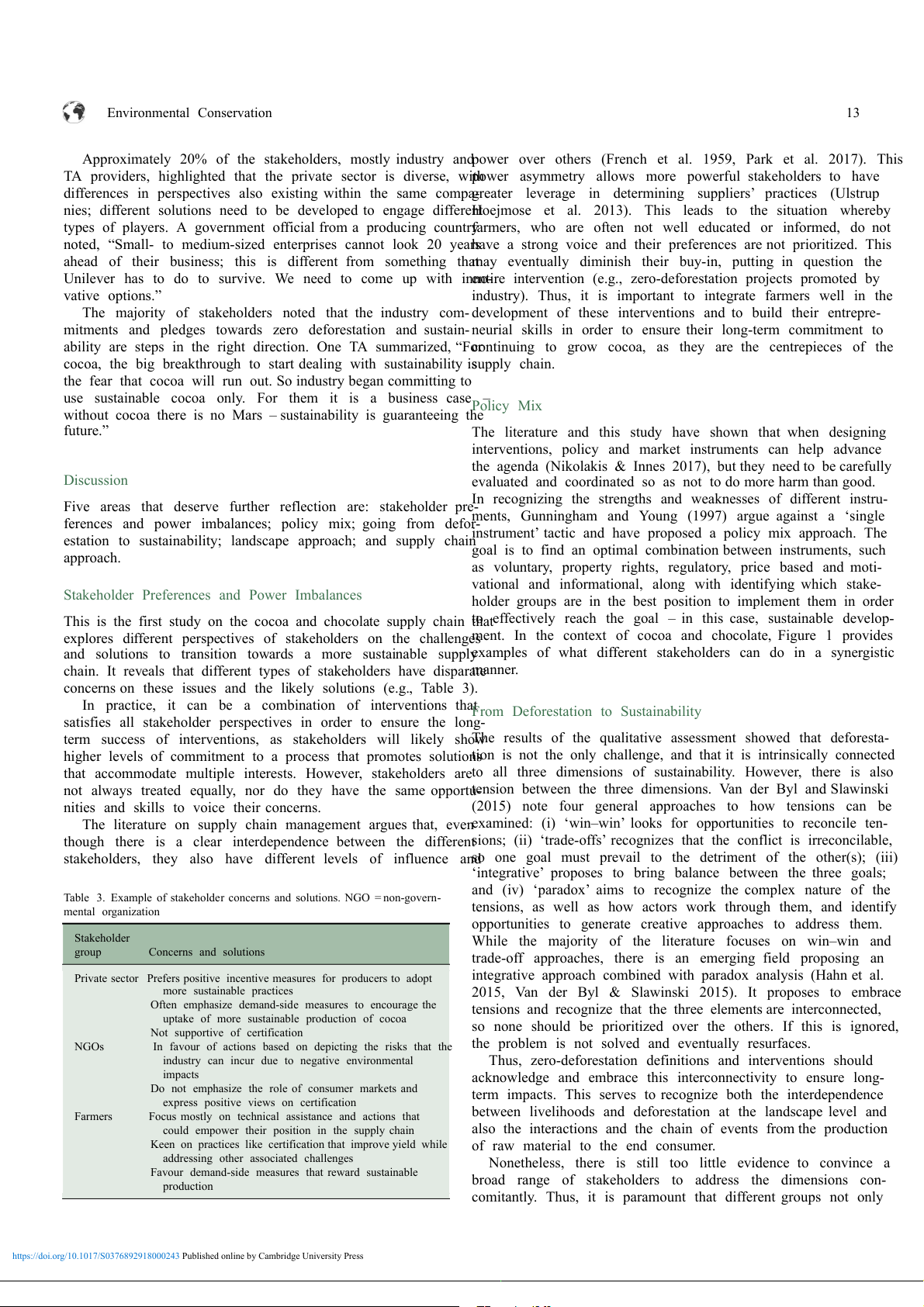
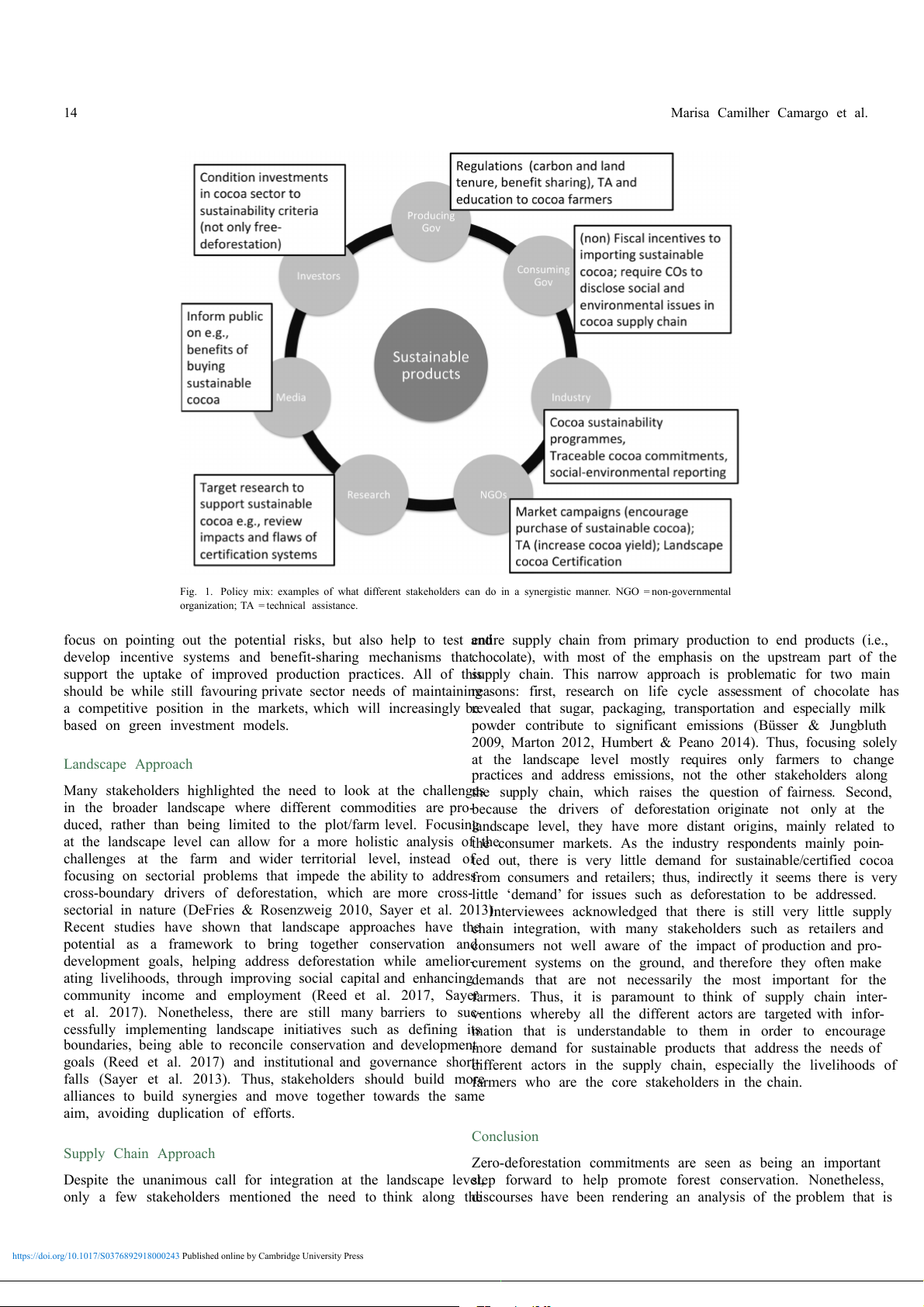
ment. In the context of cocoa and chocolate, Figure 1 provides
and solutions to transition towards a more sustainable supplyexamples of what different stakeholders can do in a synergistic
chain. It reveals that different types of stakeholders have disparate manner.
concerns on these issues and the likely solutions (e.g., Table 3).
In practice, it can be a combination of interventions thatFrom Deforestation to Sustainability
satisfies all stakeholder perspectives in order to ensure the long-
term success of interventions, as stakeholders will likely show
The results of the qualitative assessment showed that deforesta-
higher levels of commitment to a process that promotes solutiontsion is not the only challenge, and that it is intrinsically connected
that accommodate multiple interests. However, stakeholders areto all three dimensions of sustainability. However, there is also
not always treated equally, nor do they have the same opportut-ension between the three dimensions. Van der Byl and Slawinski
nities and skills to voice their concerns.
(2015) note four general approaches to how tensions can be
The literature on supply chain management argues that, evenexamined: (i) ‘win–win’ looks for opportunities to reconcile ten-
though there is a clear interdependence between the differentsions; (ii) ‘trade-offs’ recognizes that the conflict is irreconcilable,
stakeholders, they also have different levels of influence and
so one goal must prevail to the detriment of the other(s); (iii)
‘integrative’ proposes to bring balance between the three goals;
and (iv) ‘paradox’ aims to recognize the complex nature of the
Table 3. Example of stakeholder concerns and solutions. NGO = non-govern-
tensions, as well as how actors work through them, and identify mental organization
opportunities to generate creative approaches to address them. Stakeholder
While the majority of the literature focuses on win–win and group Concerns and solutions
trade-off approaches, there is an emerging field proposing an
Private sector Prefers positive incentive measures for producers to adopt
integrative approach combined with paradox analysis (Hahn et al. more sustainable practices
2015, Van der Byl & Slawinski 2015). It proposes to embrace
Often emphasize demand-side measures to encourage the
tensions and recognize that the three elements are interconnected,
uptake of more sustainable production of cocoa
so none should be prioritized over the others. If this is ignored,
Not supportive of certification NGOs
In favour of actions based on depicting the risks that the
the problem is not solved and eventually resurfaces.
industry can incur due to negative environmental
Thus, zero-deforestation definitions and interventions should impacts
acknowledge and embrace this interconnectivity to ensure long-
Do not emphasize the role of consumer markets and
term impacts. This serves to recognize both the interdependence
express positive views on certification
between livelihoods and deforestation at the landscape level and Farmers
Focus mostly on technical assistance and actions that
could empower their position in the supply chain
also the interactions and the chain of events from the production
Keen on practices like certification that improve yield while
of raw material to the end consumer.
addressing other associated challenges
Nonetheless, there is still too little evidence to convince a
Favour demand-side measures that reward sustainable
broad range of stakeholders to address the dimensions con- production
comitantly. Thus, it is paramount that different groups not only
https://doi.org/10.1017/S0376892918000243 Published online by Cambridge University Press 14 Marisa Camilher Camargo et al.
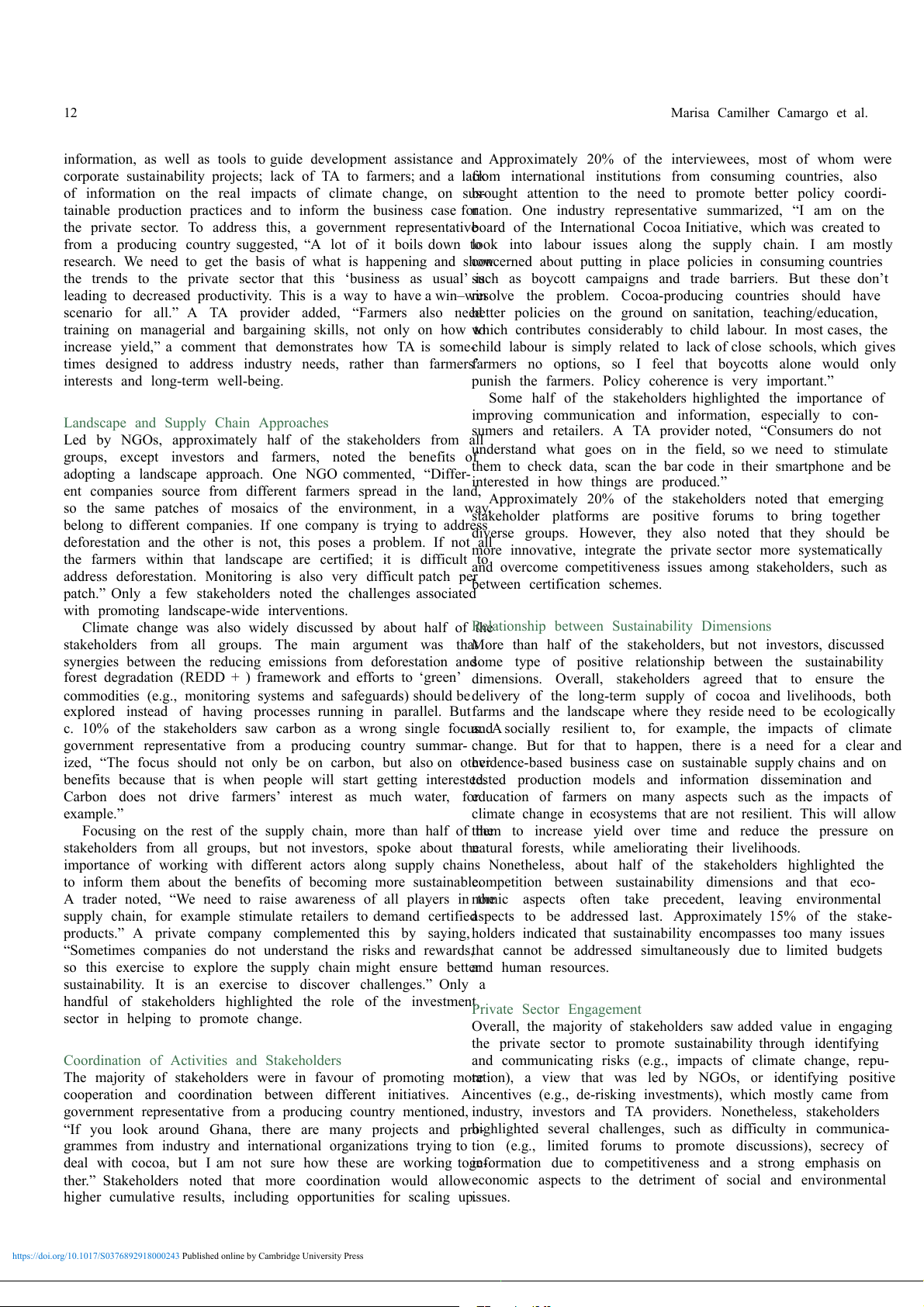
Fig. 1. Policy mix: examples of what different stakeholders can do in a synergistic manner. NGO = non-governmental
organization; TA = technical assistance.
focus on pointing out the potential risks, but also help to test an e d
ntire supply chain from primary production to end products (i.e.,
develop incentive systems and benefit-sharing mechanisms thatchocolate), with most of the emphasis on the upstream part of the
support the uptake of improved production practices. All of this
supply chain. This narrow approach is problematic for two main
should be while still favouring private sector needs of maintaining
reasons: first, research on life cycle assessment of chocolate has
a competitive position in the markets, which will increasingly berevealed that sugar, packaging, transportation and especially milk
based on green investment models.
powder contribute to significant emissions (Büsser & Jungbluth
2009, Marton 2012, Humbert & Peano 2014). Thus, focusing solely Landscape Approach
at the landscape level mostly requires only farmers to change
practices and address emissions, not the other stakeholders along
Many stakeholders highlighted the need to look at the challengets
he supply chain, which raises the question of fairness. Second,
in the broader landscape where different commodities are pro-because the drivers of deforestation originate not only at the
duced, rather than being limited to the plot/farm level. Focusinglandscape level, they have more distant origins, mainly related to
at the landscape level can allow for a more holistic analysis oft t h h
e econsumer markets. As the industry respondents mainly poin-
challenges at the farm and wider territorial level, instead ofted out, there is very little demand for sustainable/certified cocoa
focusing on sectorial problems that impede the ability to addressfrom consumers and retailers; thus, indirectly it seems there is very
cross-boundary drivers of deforestation, which are more cross-little ‘demand’ for issues such as deforestation to be addressed.
sectorial in nature (DeFries & Rosenzweig 2010, Sayer et al. 2013).
Interviewees acknowledged that there is still very little supply
Recent studies have shown that landscape approaches have the
chain integration, with many stakeholders such as retailers and
potential as a framework to bring together conservation andconsumers not well aware of the impact of production and pro-
development goals, helping address deforestation while amelior-curement systems on the ground, and therefore they often make
ating livelihoods, through improving social capital and enhancingdemands that are not necessarily the most important for the
community income and employment (Reed et al. 2017, Sayerfarmers. Thus, it is paramount to think of supply chain inter-
et al. 2017). Nonetheless, there are still many barriers to suc-
ventions whereby all the different actors are targeted with infor-
cessfully implementing landscape initiatives such as defining its
mation that is understandable to them in order to encourage
boundaries, being able to reconcile conservation and developmentmore demand for sustainable products that address the needs of
goals (Reed et al. 2017) and institutional and governance short-
different actors in the supply chain, especially the livelihoods of
falls (Sayer et al. 2013). Thus, stakeholders should build morfearmers who are the core stakeholders in the chain.
alliances to build synergies and move together towards the same
aim, avoiding duplication of efforts. Conclusion Supply Chain Approach
Zero-deforestation commitments are seen as being an important
Despite the unanimous call for integration at the landscape level
s ,tep forward to help promote forest conservation. Nonetheless,
only a few stakeholders mentioned the need to think along the
discourses have been rendering an analysis of the problem that is
https://doi.org/10.1017/S0376892918000243 Published online by Cambridge University Press Environmental Conservation 15
too narrow, emphasizing deforestation and emissions at the FAO (2014) FAOSTAT online database. URL http://faostat.fao.org
upstream/ground level when there are many other environmentalFay M (2012) Inclusive Green Growth: The Pathway to Sustainable
and social challenges that need addressing before cocoa and Development. Washington, DC: World Bank.
chocolate can be called sustainable. For zero-deforestation com-French JR, Raven B, Cartwright D (1959) The bases of social power.
mitments to effectively contribute to sustainable development, a In: Classics of Organization Theory, eds. JM Shafritz, JS Ott & JS Jang, pp.
251–260. Boston, MA: Cengage Learning.
broader discussion and actions are needed in which the inter-
Gockowski J, Sonwa D (2011) Cocoa intensification scenarios and their
dependencies of stakeholders along the supply chain are predicted impact on CO2 emissions, biodiversity conservation, and rural
acknowledged and the deforestation issue is addressed con- livelihoods in the Guinea rain forest of West Africa. Environmental
comitantly with other challenges, especially livelihoods. Thus, Management 48(2): 307–321.
stakeholders along the chain need to work together in a coordi
G-reen W (2015) G7 leaders pledge to ‘promote safe and sustainable supply chains’.
nated fashion towards stimulating a market that rewards not only URL http://www.supplymanagement.com/news/2015/g7-leaders-pledge-to-pro
zero-deforestation cocoa, but also sustainable chocolate produc- mote-safe-and-sustainable-supply-chains - sthash.fKcthBTr.dpuf
tion. Such a broadened approach will enhance the likelihood of
Gunningham N, Young MD (1997) Toward optimal environmental policy: the
improving long-term forest conservation, and also help generate case of biodiversity conservation. Ecology Law Quarterly 24, 243–298.
more positive livelihood outcomes for the cocoa farmers involved,Hahn T, Pinkse J, Preuss L, Figge F (2015) Tensions in corporate
sustainability: towards an integrative framework. Journal of Business Ethics
who are the heart of the supply chain. 127(2): 297–316.
Henders S, Persson UM, Kastner T (2015) Trading forests: land-use change
Supplementary Material. For supplementary material accompanying this
and carbon emissions embodied in production and exports of forest-risk
paper, visit http://www.journals.combridge.org/ENC
commodities. Environmental Research Letters 10(12): 125012.
Supplementary material can be found online at http://dx.doi.org/10.1017/ Hosonuma N, Herold M, De Sy V, De Fries RS, Brockhaus M, Verchot L, et al. S0376892918000243
(2012) An assessment of deforestation and forest degradation drivers in
developing countries. Environmental Research Letters 7(4): 4009.
Acknowledgements. The authors would like to thank the interviewees that Hower M (2014) APP, Cargill plant U.N. deforestation pledge for 2030. URL
participated in this study, Verina Ingram (Wageningen University) and Denis
https://www.greenbiz.com/blog/2014/09/26/app-cargill-un-deforestation-pledge
Sonwa (CIFOR) for their valuable insights and the reviewers for their con-
Humbert S, Peano L (2014) Developing inventory data for chocolate: structive comments.
importance to consider impacts of potential deforestation in a consistent
way among ingredients (cocoa, sugar and milk). Presented at: 9th
Financial Support. This work was supported by the International Tropical
International Conference on Life Cycle Assessment in the Agri-Food Sector,
Timber Organization (ITTO; MCC, grant number 32/14A) and the Depart-
8–10 October 2014, San Francisco, CA.
ment for International Development (DFID; MCC and IN, accountable grantKopnina H (2017) Commodification of natural resources and forest ecosystem
component code 202834-101, purchase order 40054020).
services: examining implications for forest protection. Environmental Conservation 44(1): 24–33. Conflict of Interest. None.
Laderach P, Martínez-Valle A, Schroth G, Castro N (2013) Predicting
the future climatic suitability for cocoa farming of the world's leading Ethical Standards. None.
producer countries, Ghana and Côte d'Ivoire. Climatic Change 119(3–4): 841–854.
Lambin EF, Gibbs HK, Heilmayr R, Carlson KM, Fleck LC, Garrett RD, de References
Waroux YlP, et al. (2018) The role of supply-chain initiatives in reducing
Afoakwa EO (2014) Cocoa Production and Processing Technology. Boca Raton,deforestation. Nature Climate Change 8, 109–116. FL: CRC Press.
Lawrence D, Vandecar K (2015) Effects of tropical deforestation on climate
Borel‐Saladin JM, Turok IN (2013) The green economy: incremental change and agriculture. Nature Climate Change 5(1): 27–36.
or transformation? Environmental Policy and Governance 23(4): 209–220.Marton S (2012) Bittersweet comparability of carbon footprints. In: 8th
Brickell E, Elias P (2013) Great expectations: realising social and environ- International Conference on Life Cycle Assessment in the Agri-Food Sector
mental benefits from public-private partnerships in agricultural supply (LCA Food 2012), pp. 767–768. Saint Malo, France: INRA.
chains. URL http://theredddesk.org/sites/default/files/resources/pdf/2013-
Newton P, Agrawal A, Wollenberg L (2013) Enhancing the sustainability of /8500.pdf
commodity supply chains in tropical forest and agricultural landscapes.
Brundtland GH (1987) Report of the World Commission on Environment and Global Environmental Change 23(6): 1761–1772.
Development: 'Our Common Future'. New York, NY: United Nations.
Nikolakis W, Innes JL (2017) Evaluating incentive-based programs to support
Büsser S, Jungbluth N (2009) LCA of chocolate packed in aluminium foil forest ecosystem services. Environmental Conservation 44(1): 1–4.
based packaging. ESU-Services Ltd., Uster (CH). URL http://packaging.
Park KO, Chang H, Jung DH (2017) How do power type and partnership quality
world-aluminium.org/fileadmin/_migrated/content_uploads/ESU-Chocolate_
affect supply chain management performance? Sustainability 9(1): 127. 2009_-Exec_Sum_03.pdf
Rautner M, Leggett M, Davis F (2013) The Little Book of Big Deforestation
Camargo M, Nhamtumbo I (2016) Towards Sustainable Chocolate: Greening Drivers. Oxford, UK: Global Canopy Programme.
Reed J, van Vianen J, Barlow J, Sunderland T (2017) Have integrated
the Cocoa Supply Chain. London, UK: IIED.
landscape approaches reconciled societal and environmental issues in the
Clough Y, Faust H, Tscharntke T (2009) Cacao boom and bust: sustainabilitytropics? Land Use Policy 63, 481–492.
of agroforests and opportunities for biodiversity conservation. ConservationRubin HJ, Rubin IS (2011) Qualitative Interviewing: The Art of Hearing Data. Letters 2(5): 197–205. Los Angeles, CA: Sage.
Coulibaly SK, Terence MM, Erbao C, Bin ZY (2017) Climate change effects on
Sayer J, Sunderland T, Ghazoul J, Pfund J-L, Sheil D, Meijaard E, Venter M, et
cocoa export: case study of Cote d’Ivoire. In: Allied Social Science
al. (2013) Ten principles for a landscape approach to reconciling
Association (ASSA)/American Economic Association (AEA) – African agriculture, conservation, and other competing land uses. Proceedings of
Finance and Economic Association (AFEA) Jan 8 Session, pp. 1–29.the National Academy of Sciences 110(21): 8349–8356.
Chicago, IL: African Finance and Economic Association.
Sayer JA, Margules C, Boedhihartono AK, Sunderland T, Langston JD, Reed J,
DeFries R, Rosenzweig C (2010) Toward a whole-landscape approach for Riggs R, et al. (2017) Measuring the effectiveness of landscape approaches
sustainable land use in the tropics. Proceedings of the National Academy of
Sciences 107(46): 19627–19632.
to conservation and development. Sustainability Science 12(3): 465–476.
https://doi.org/10.1017/S0376892918000243 Published online by Cambridge University Press 16 Marisa Camilher Camargo et al.
Schroth G, Läderach P, Martinez-Valle AI, Bunn C, Jassogne L (2016
U)nited Nations (2014) 2014 Climate Change Summit – Chair’s Summary. URL
Vulnerability to climate change of cocoa in West Africa: patterns, http://www.un.org/climatechange/summit/wp-content/uploads/sites/2/2014/05/
opportunities and limits to adaptation. Science of the Total Environment 556,Climate-Summit-Chairs-Summary_26September2014CLEAN.pdf 231–241.
Van der Byl CA, Slawinski N (2015) Embracing tensions in corporate
Strauss A, Corbin J (1990) Basics of Qualitative Research. Newbury Park, CA:sustainability: a review of research from win–wins and trade-offs to Sage.
paradoxes and beyond. Organization & Environment 28(1): 54–79.
Ulstrup Hoejmose S, Grosvold J, Millington A (2013) Socially responsible
World Cocoa Foundation (2017) Collective Statement of Intent: The Cocoa
supply chains: power asymmetries and joint dependence. Supply Chain and Forests Initiative. URL http://www.worldcocoafoundation.org/cocoa-
Management: An International Journal 18(3): 277–291.
forests-initiative-statement-of-intent
https://doi.org/10.1017/S0376892918000243 Published online by Cambridge University Press
Tài liệu liên quan:
-
Tiểu luận Phân Tích Giá Trái Cây 2023 | Kinh tế vĩ mô | Trường Đại học kinh tế Thành Phố Hồ Chí Minh
19 10 -
Bộ câu hỏi trắc nghiệm - Kinh tế học thị trường và cầu cung | Kinh tế vĩ mô | Trường Đại học kinh tế Thành Phố Hồ Chí Minh
19 10 -
Câu Hỏi Ôn Tập Phần Thị Trường | Kinh tế vĩ mô | Trường Đại học kinh tế Thành Phố Hồ Chí Minh
24 12 -
Kinh Tế Vi Mô: Câu Hỏi và Đáp Án Quan Trọng | Kinh tế vĩ mô | Trường Đại học kinh tế Thành Phố Hồ Chí Minh
22 11 -
Tiểu luận Món Huế và Thị Trường F&B Việt Nam | Kinh tế vĩ mô | Trường Đại học kinh tế Thành Phố Hồ Chí Minh
17 9