Hotel Management System SRS Document | Phân tích thiết kế hệ thống | Trường Đại học Thủ Dầu Một
This Hotel Management System Software Requirement Specification (SRS) main objective is to provide a base for the foundation of the project. It gives a comprehensive view of how the systemis supposed to work and what is to be expected by the end users. Client’s expectation and requirements are analyzed to produce specific unambiguous functional and non-functional requirements, so they can be used by development team with clear understanding to build a systemas per end user needs. Tài liệu được sưu tầm và soạn thảo dưới dạng file PDF để gửi tới các bạn cùng tham khảo, ôn tập đầy đủ kiến thức, chuẩn bị cho các buổi học thật tốt. Mời bạn đọc đón xem!
Môn: Phân tích và thiết kế hệ thống 69 tài liệu
Trường: Trường Đại học Thủ Dầu Một 243 tài liệu
Tác giả:

Preview text:
Hotel Management System Submitted by
Shirsha Chakraborty (21051426)
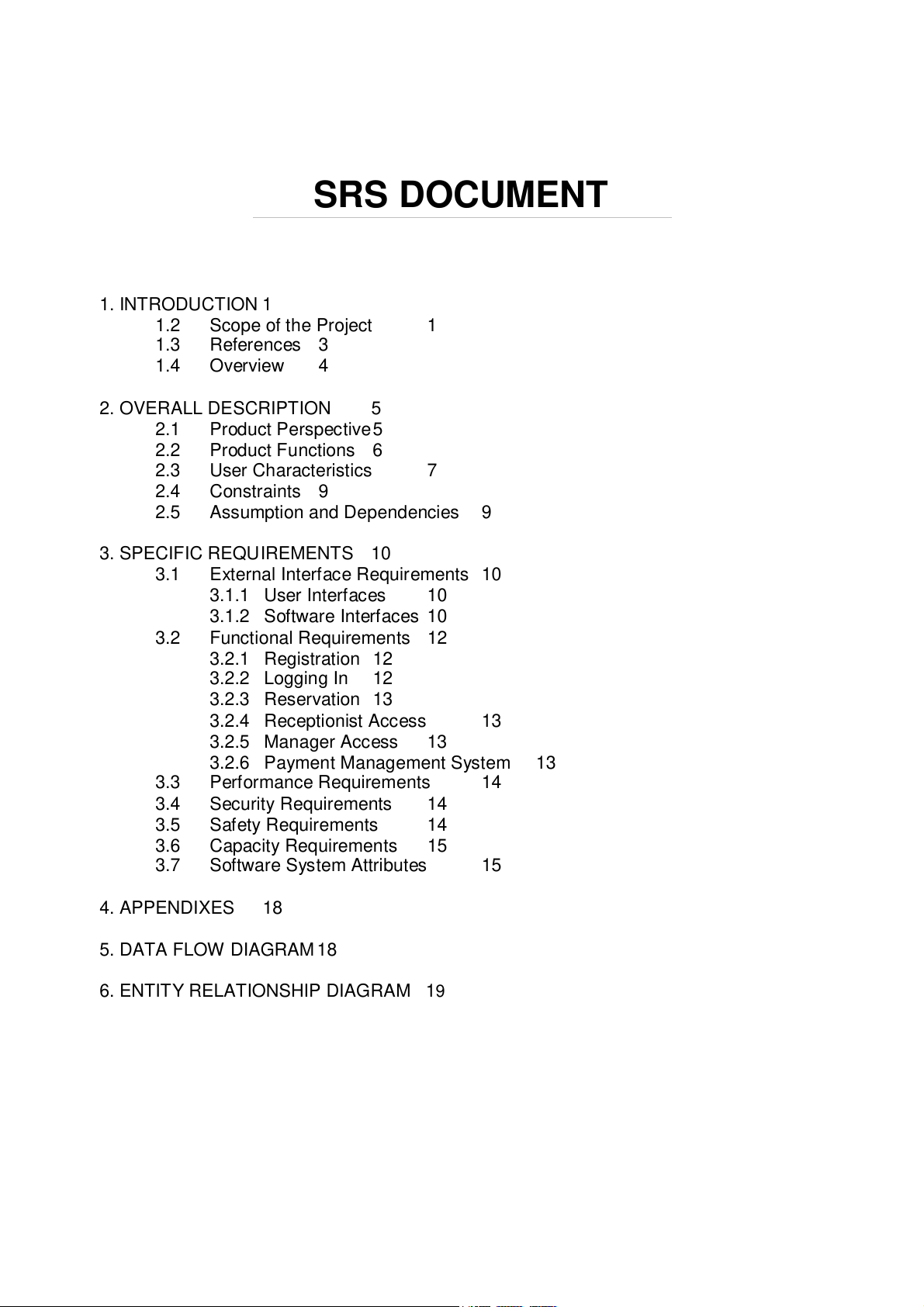
Roshni Ray Choudhury (21051426) Gunjan Chakraborty (21051395) Priyanshu Shekhar (21051415) SRS DOCUMENT 1. INTRODUCTION 1 1.2 Scope of the Project 1 1.3 References 3 1.4 Overview 4 2. OVERALL DESCRIPTION 5 2.1 Product Perspective 5 2.2 Product Functions 6 2.3 User Characteristics 7 2.4 Constraints 9 2.5 Assumption and Dependencies 9 3. SPECIFIC REQUIREMENTS 10 3.1
External Interface Requirements 10 3.1.1 User Interfaces 10 3.1.2 Software Interfaces 10 3.2 Functional Requirements 12 3.2.1 Registration 12 3.2.2 Logging In 12 3.2.3 Reservation 13 3.2.4 Receptionist Access 13 3.2.5 Manager Access 13
3.2.6 Payment Management System 13 3.3 Performance Requirements 14 3.4 Security Requirements 14 3.5 Safety Requirements 14 3.6 Capacity Requirements 15 3.7 Software System Attributes 15 4. APPENDIXES 18 5. DATA FLOW DIAGRAM 18
6. ENTITY RELATIONSHIP DIAGRAM 19 1 INTRODUCTION
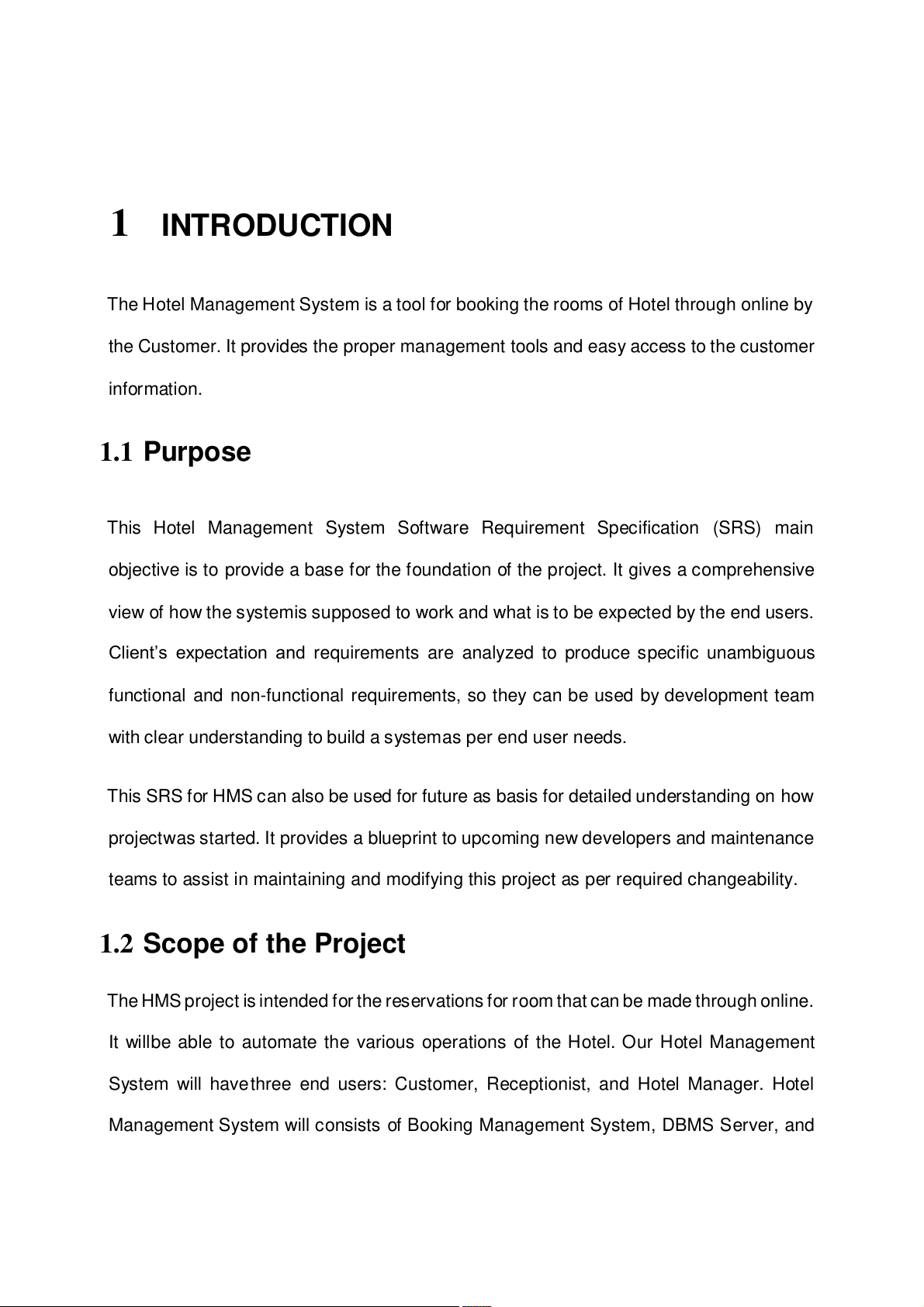
The Hotel Management System is a tool for booking the rooms of Hotel through online by
the Customer. It provides the proper management tools and easy access to the customer information. 1.1 Purpose
This Hotel Management System Software Requirement Specification (SRS) main
objective is to provide a base for the foundation of the project. It gives a comprehensive
view of how the system is supposed to work and what is to be expected by the end users.
Client’s expectation and requirements are analyzed to produce specific unambiguous
functional and non-functional requirements, so they can be used by development team
with clear understanding to build a system as per end user needs.
This SRS for HMS can also be used for future as basis for detailed understanding on how
project was started. It provides a blueprint to upcoming new developers and maintenance
teams to assist in maintaining and modifying this project as per required changeability.
1.2 Scope of the Project
The HMS project is intended for the reservations for room that can be made through online.
It wil be able to automate the various operations of the Hotel. Our Hotel Management
System wil have three end users: Customer, Receptionist, and Hotel Manager. Hotel
Management System wil consists of Booking Management System, DBMS Server, and
Report Generator. Customers will be able to check for room’s availability, select the
rooms, and pay for the room. Receptionist wil have access to update or modify booking
details. Manager wil able to view the financial report and able to update room information such as cost and category.
The main goal of this introduced automated HMS software is to simplify every day process
of hotel. Day to day Hotels are increasing and they need to automate to provide customer
ease of access. It wil be able to take care of services to customer in a quick manner. This
automation wil be able to replace the drawbacks of large customer information physical
files which were difficult to handle. Secure Transaction, quick retrieval of information, ease
of use, quick recovery of errors, fault tolerance are some of the benefits that development
team wil be working on to achieve end user satisfaction. 1.3 References
Software Engineering 9th Edition, Ian Sommervil e
Mohapatra, H., & Rath, A. K. (2020). Fundamentals of software engineering:
designed o provide an insight into the software engineering concepts. BPB Publications. 1.4 Overview
The remaining sections of this documentations describes the overal descriptions which
includes product perspective and functions, characteristics of users. It also consists of
Assumptions, and Constraints. Overal description is listed in section 2. Section 3 includes
Specific Requirements which consists of Functional and Non-functional requirements,
External Interface Requirements, Software System Attributes, Performance
Requirements, Capacity Requirements, Availability Requirements, Safety Requirements
and Requirement Traceability Matrix. 2 OVERALL DESCRIPTION
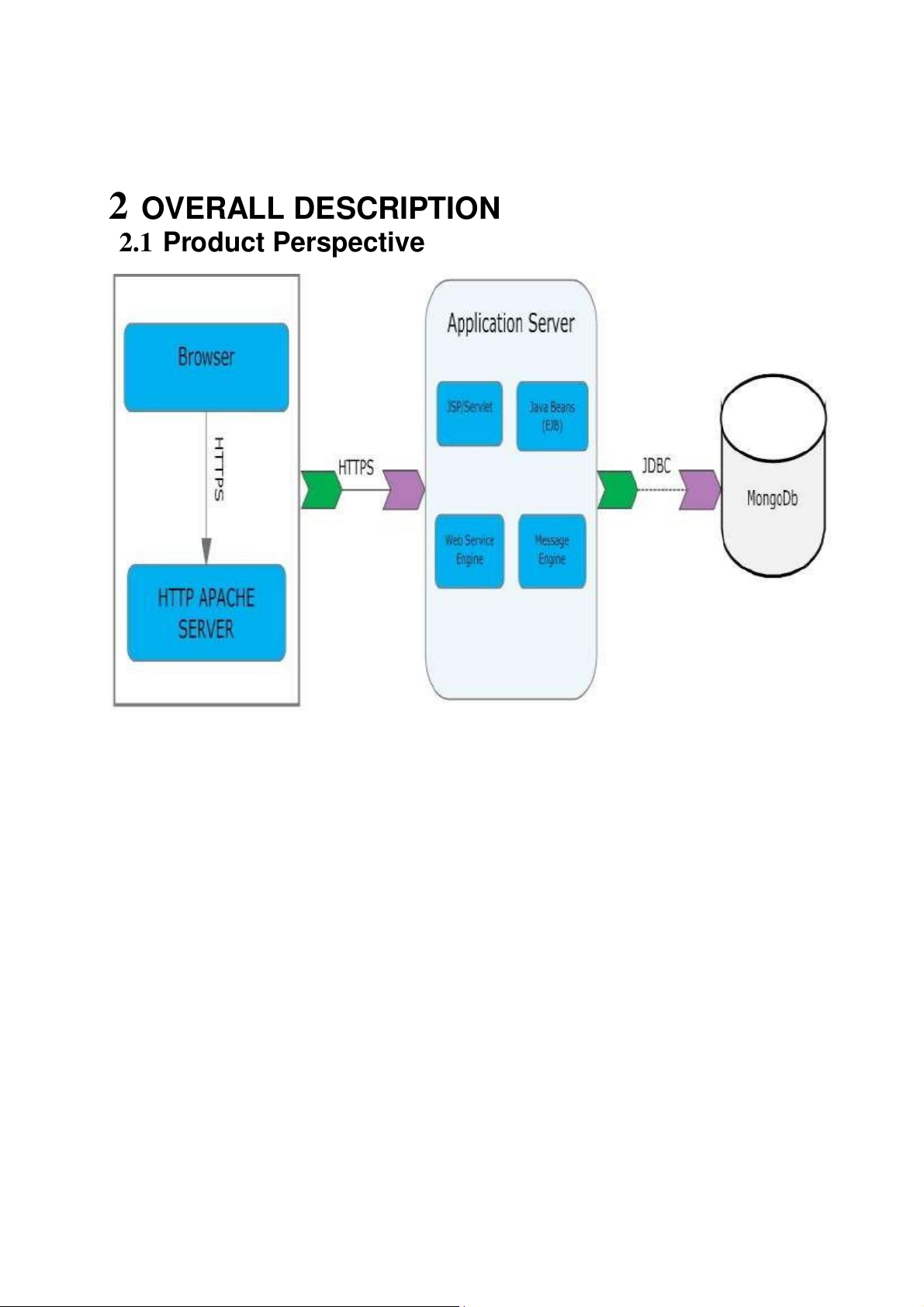
2.1 Product Perspective
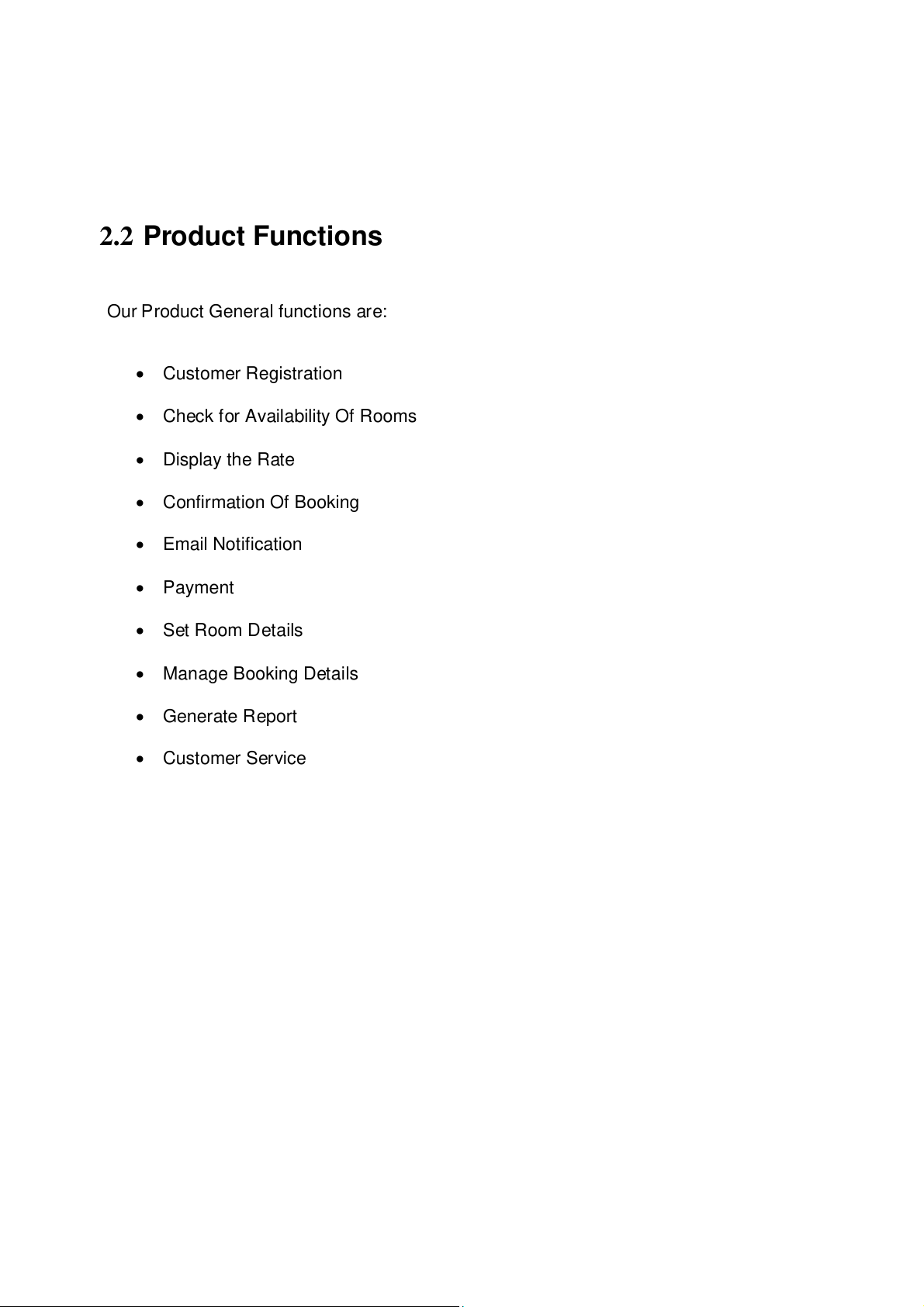
2.2 Product Functions
Our Product General functions are: Customer Registration
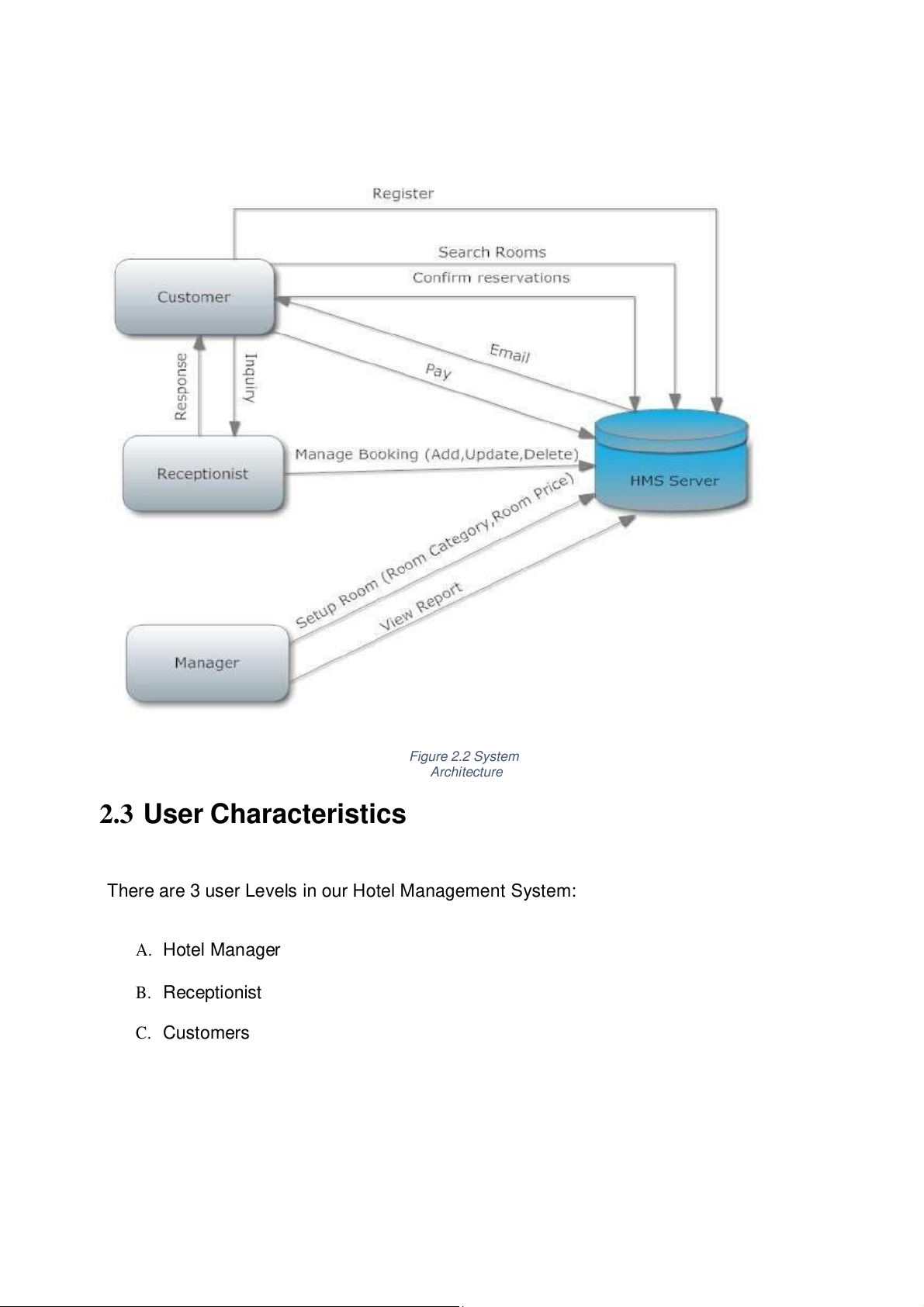
Check for Availability Of Rooms Display the Rate Confirmation Of Booking Email Notification Payment Set Room Details Manage Booking Details Generate Report Customer Service Figure 2.2 System Architecture
2.3 User Characteristics
There are 3 user Levels in our Hotel Management System: A. Hotel Manager B. Receptionist C. Customers Hotel Manager
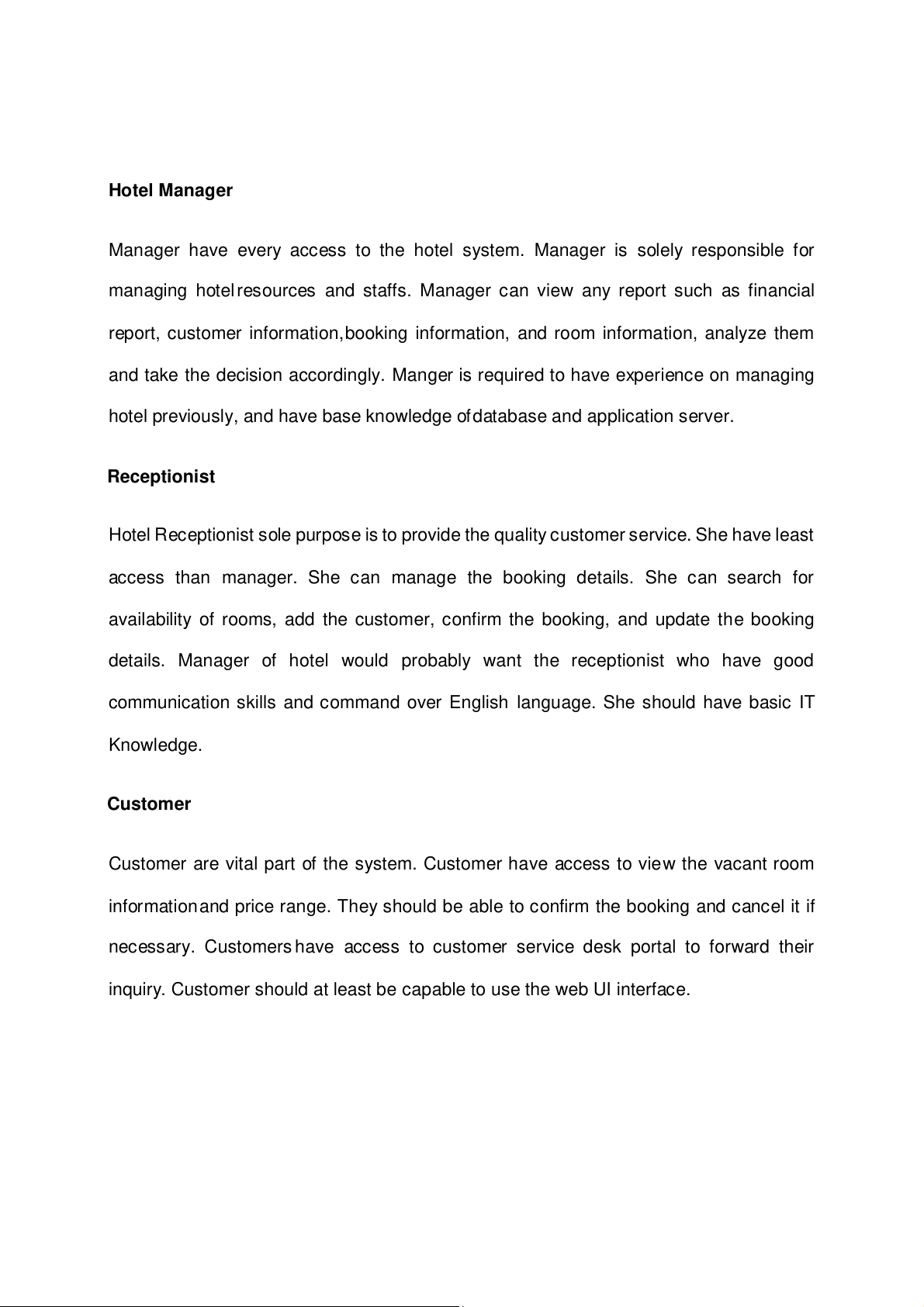
Manager have every access to the hotel system. Manager is solely responsible for
managing hotel resources and staffs. Manager can view any report such as financial
report, customer information, booking information, and room information, analyze them
and take the decision accordingly. Manger is required to have experience on managing
hotel previously, and have base knowledge of database and application server. Receptionist
Hotel Receptionist sole purpose is to provide the quality customer service. She have least
access than manager. She can manage the booking details. She can search for
availability of rooms, add the customer, confirm the booking, and update the booking
details. Manager of hotel would probably want the receptionist who have good
communication skil s and command over English language. She should have basic IT Knowledge. Customer
Customer are vital part of the system. Customer have access to view the vacant room
information and price range. They should be able to confirm the booking and cancel it if
necessary. Customers have access to customer service desk portal to forward their
inquiry. Customer should at least be capable to use the web UI interface. 2.4 Constraints
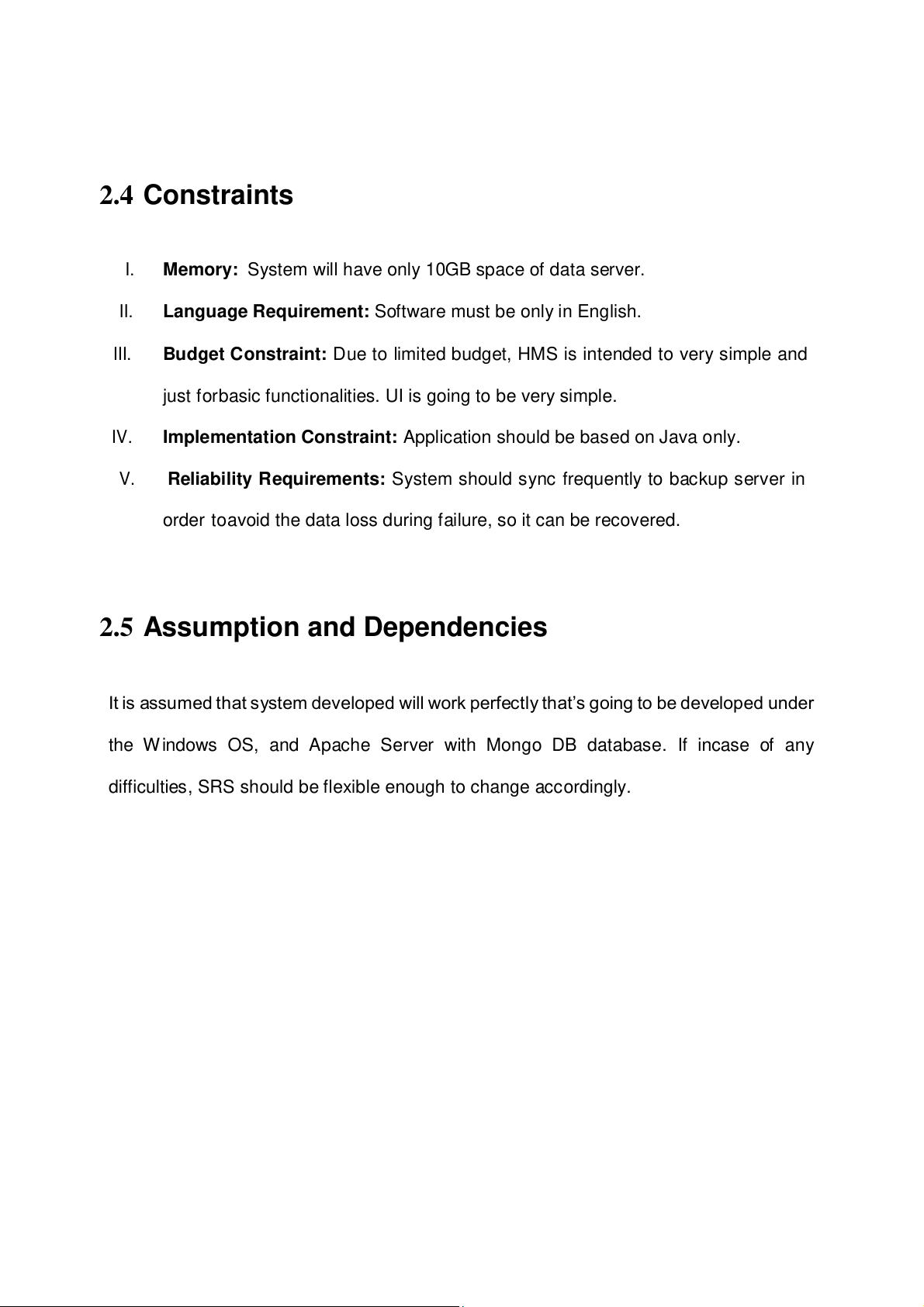
I. Memory: System wil have only 10GB space of data server.
I . Language Requirement: Software must be only in English.
I I. Budget Constraint: Due to limited budget, HMS is intended to very simple and
just for basic functionalities. UI is going to be very simple. IV.
Implementation Constraint: Application should be based on Java only.
V. Reliability Requirements: System should sync frequently to backup server in
order to avoid the data loss during failure, so it can be recovered.
2.5 Assumption and Dependencies
It is assumed that system developed will work perfectly that’s going to be developed under
the Windows OS, and Apache Server with Mongo DB database. If incase of any
difficulties, SRS should be flexible enough to change accordingly.
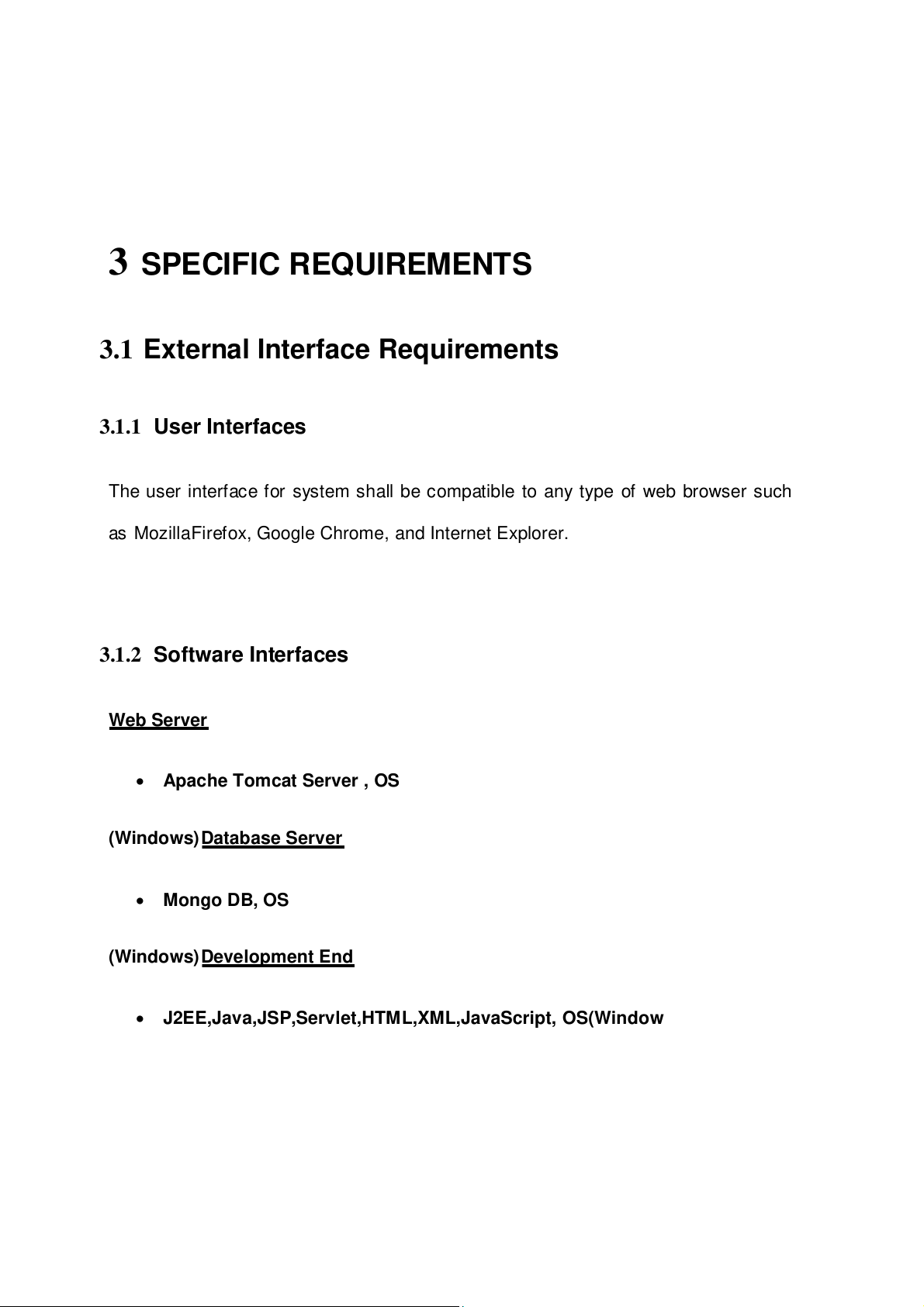
3 SPECIFIC REQUIREMENTS
3.1 External Interface Requirements 3.1.1 User Interfaces
The user interface for system shal be compatible to any type of web browser such
as Mozil a Firefox, Google Chrome, and Internet Explorer.
3.1.2 Software Interfaces Web Server
Apache Tomcat Server , OS
(Windows) Database Server Mongo DB, OS
(Windows) Development End
J2EE,Java,JSP,Servlet,HTML,XML,JavaScript, OS(Window
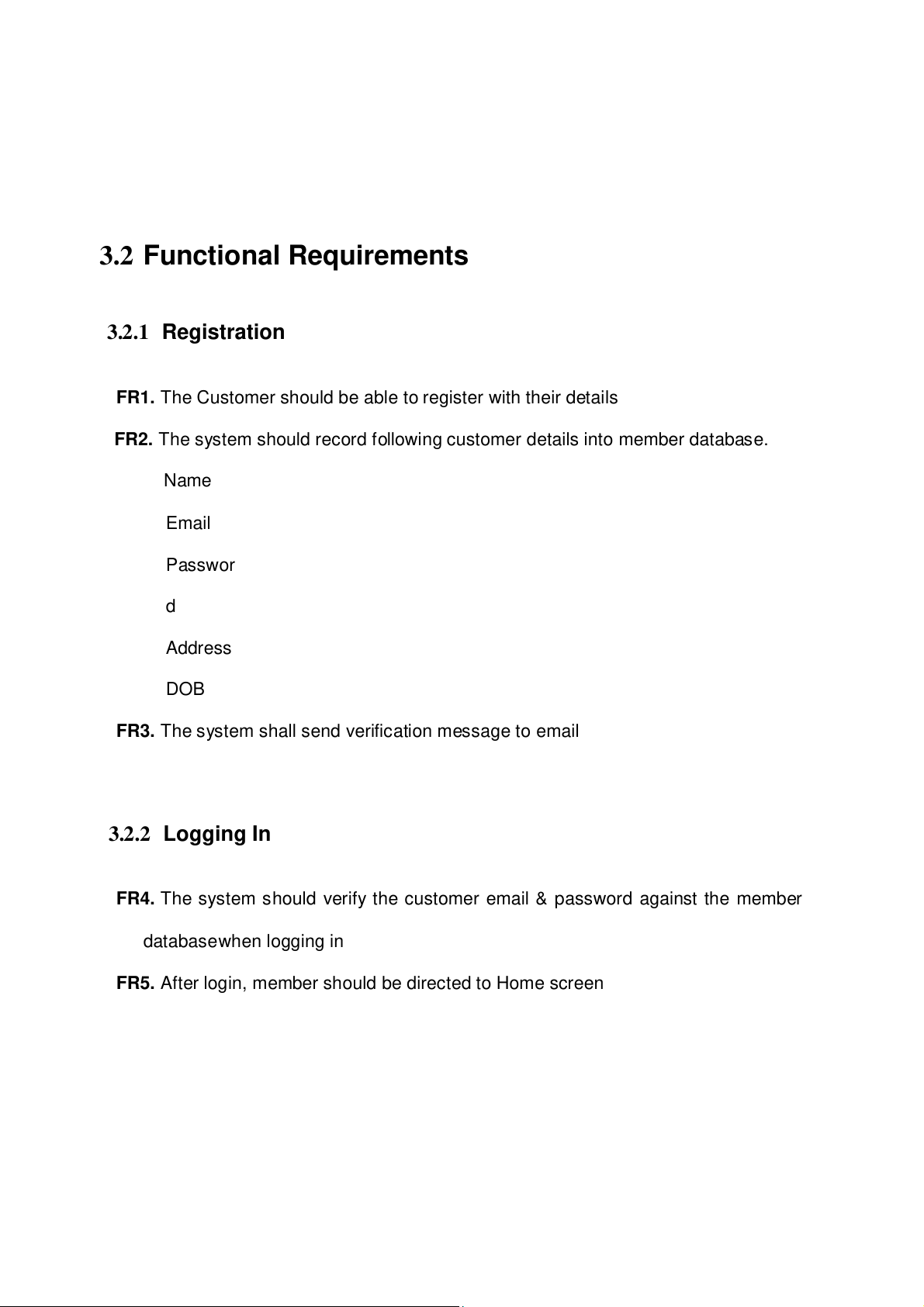
3.2 Functional Requirements 3.2.1 Registration
FR1. The Customer should be able to register with their details
FR2. The system should record folowing customer details into member database. Name Email Passwor d Address DOB
FR3. The system shal send verification message to email 3.2.2 Logging In
FR4. The system should verify the customer email & password against the member database when logging in
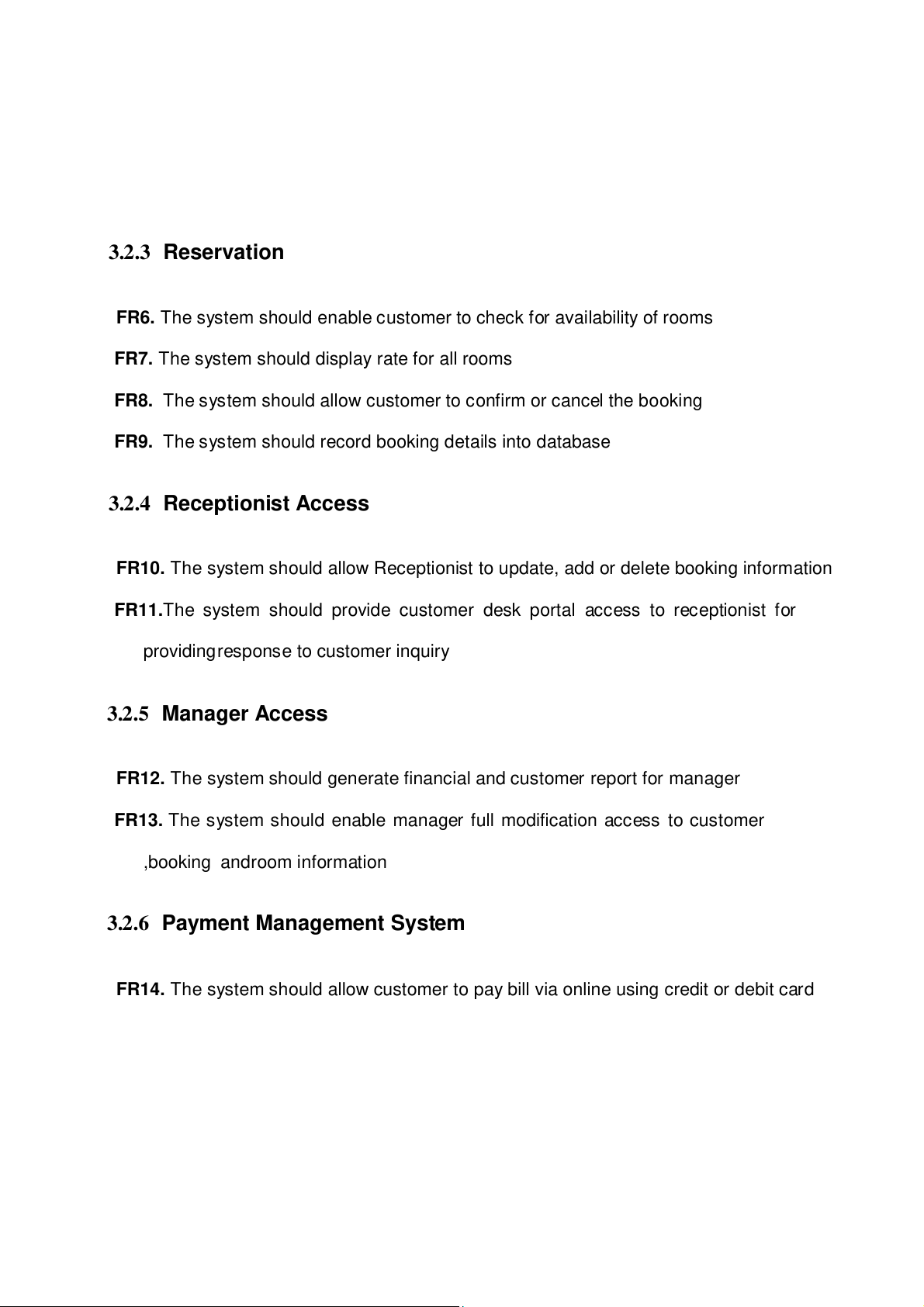
FR5. After login, member should be directed to Home screen 3.2.3 Reservation
FR6. The system should enable customer to check for availability of rooms
FR7. The system should display rate for al rooms
FR8. The system should alow customer to confirm or cancel the booking
FR9. The system should record booking details into database
3.2.4 Receptionist Access
FR10. The system should al ow Receptionist to update, add or delete booking information
FR11.The system should provide customer desk portal access to receptionist for
providing response to customer inquiry 3.2.5 Manager Access
FR12. The system should generate financial and customer report for manager
FR13. The system should enable manager ful modification access to customer ,booking and room information
3.2.6 Payment Management System
FR14. The system should al ow customer to pay bil via online using credit or debit card
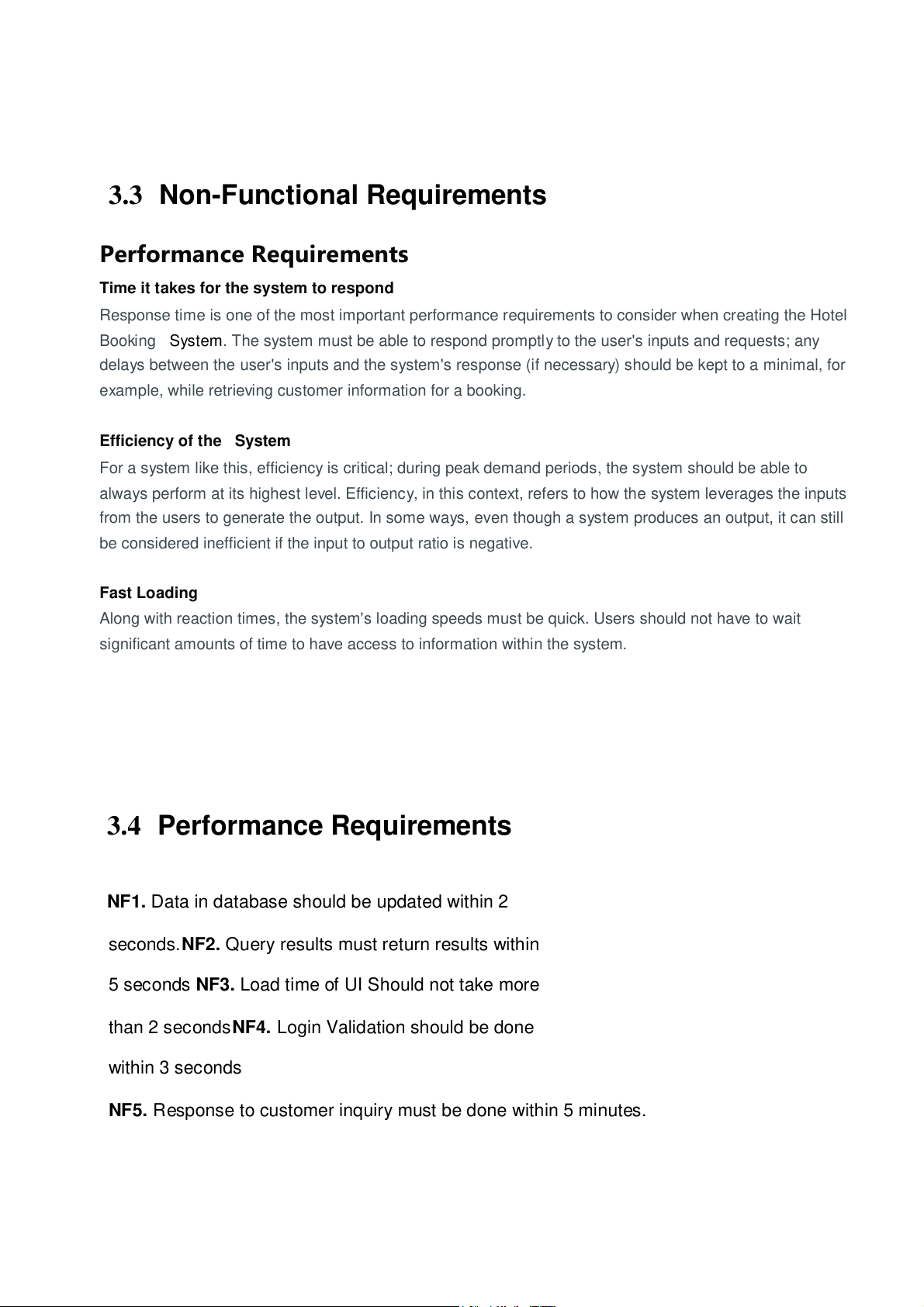
3.3 Non-Functional Requirements Performance Requirements
Time it takes for the system to respond
Response time is one of the most important performance requirements to consider when creating the Hotel
Booking System. The system must be able to respond promptly to the user's inputs and requests; any
delays between the user's inputs and the system's response (if necessary) should be kept to a minimal, for
example, while retrieving customer information for a booking.
Efficiency of the System
For a system like this, efficiency is critical; during peak demand periods, the system should be able to
always perform at its highest level. Efficiency, in this context, refers to how the system leverages the inputs
from the users to generate the output. In some ways, even though a system produces an output, it can stil
be considered inefficient if the input to output ratio is negative. Fast Loading
Along with reaction times, the system's loading speeds must be quick. Users should not have to wait
significant amounts of time to have access to information within the system.
3.4 Performance Requirements
NF1. Data in database should be updated within 2
seconds. NF2. Query results must return results within
5 seconds NF3. Load time of UI Should not take more
than 2 seconds NF4. Login Validation should be done within 3 seconds
NF5. Response to customer inquiry must be done within 5 minutes.
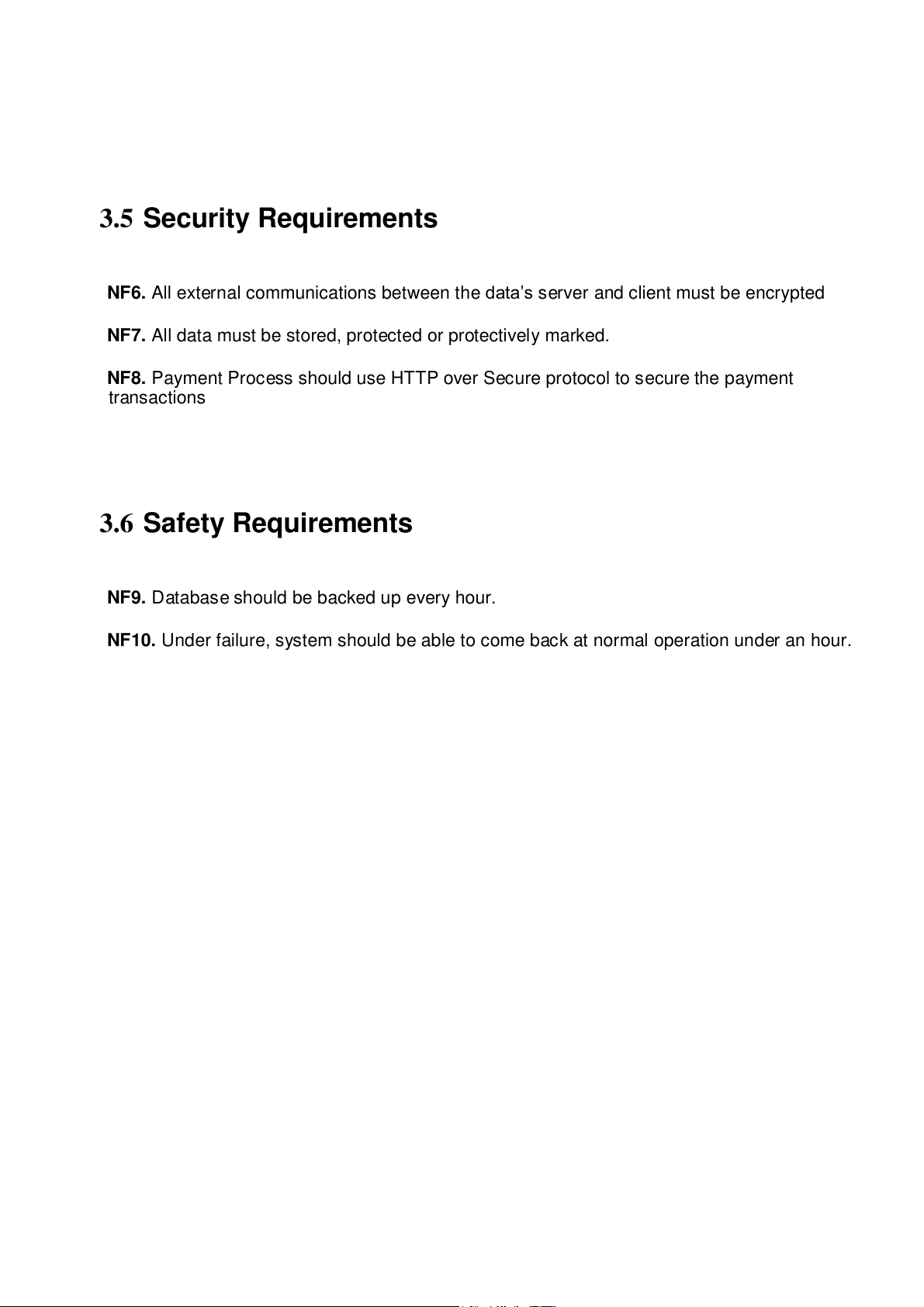
3.5 Security Requirements
NF6. Al external communications between the data’s server and client must be encrypted
NF7. Al data must be stored, protected or protectively marked.
NF8. Payment Process should use HTTP over Secure protocol to secure the payment transactions
3.6 Safety Requirements
NF9. Database should be backed up every hour.
NF10. Under failure, system should be able to come back at normal operation under an hour.
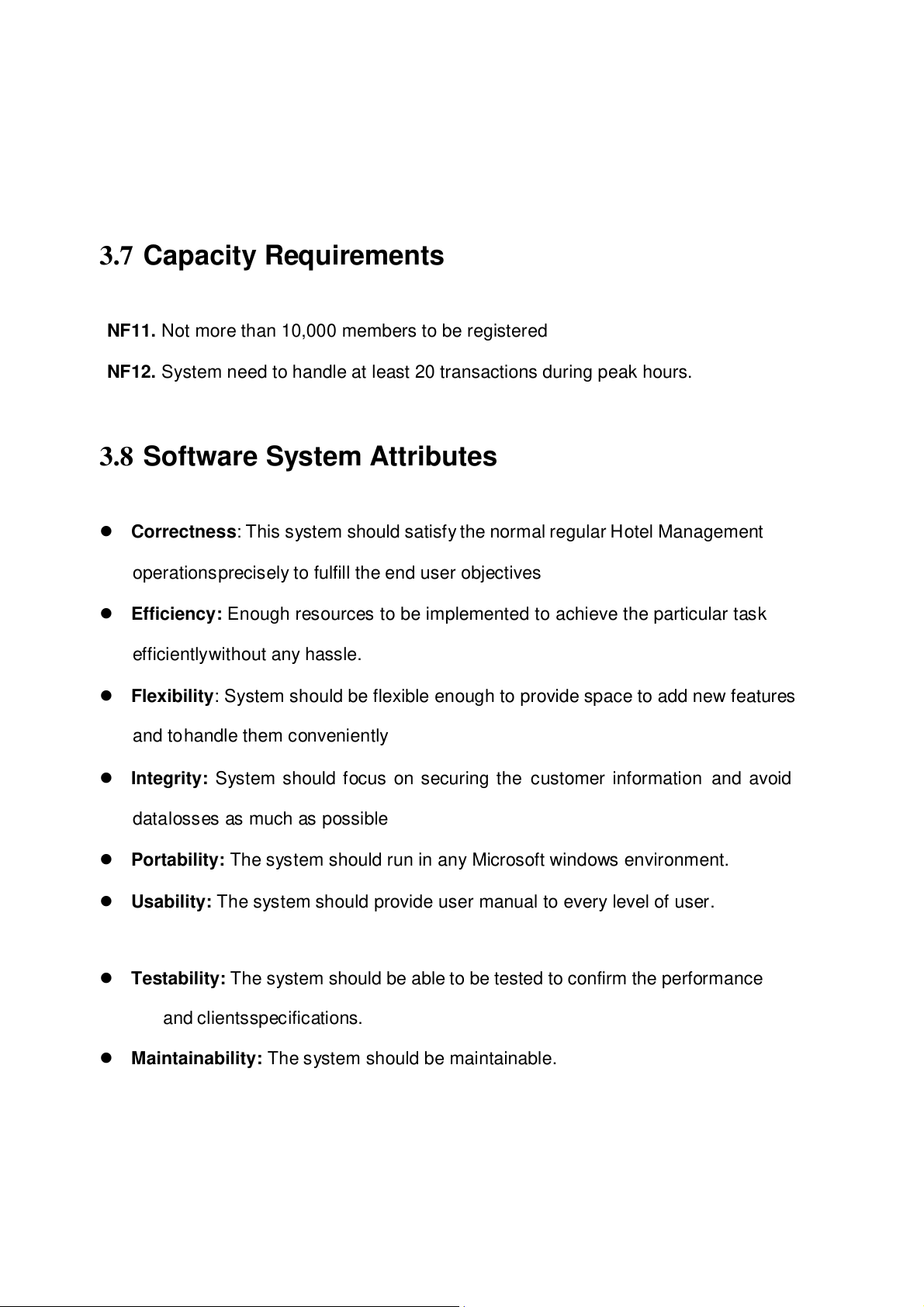
3.7 Capacity Requirements
NF11. Not more than 10,000 members to be registered
NF12. System need to handle at least 20 transactions during peak hours.
3.8 Software System Attributes
Correctness: This system should satisfy the normal regular Hotel Management
operations precisely to fulfil the end user objectives
Efficiency: Enough resources to be implemented to achieve the particular task
efficiently without any hassle.
Flexibility: System should be flexible enough to provide space to add new features
and to handle them conveniently
Integrity: System should focus on securing the customer information and avoid
data losses as much as possible
Portability: The system should run in any Microsoft windows environment.
Usability: The system should provide user manual to every level of user.
Testability: The system should be able to be tested to confirm the performance and clients specifications.
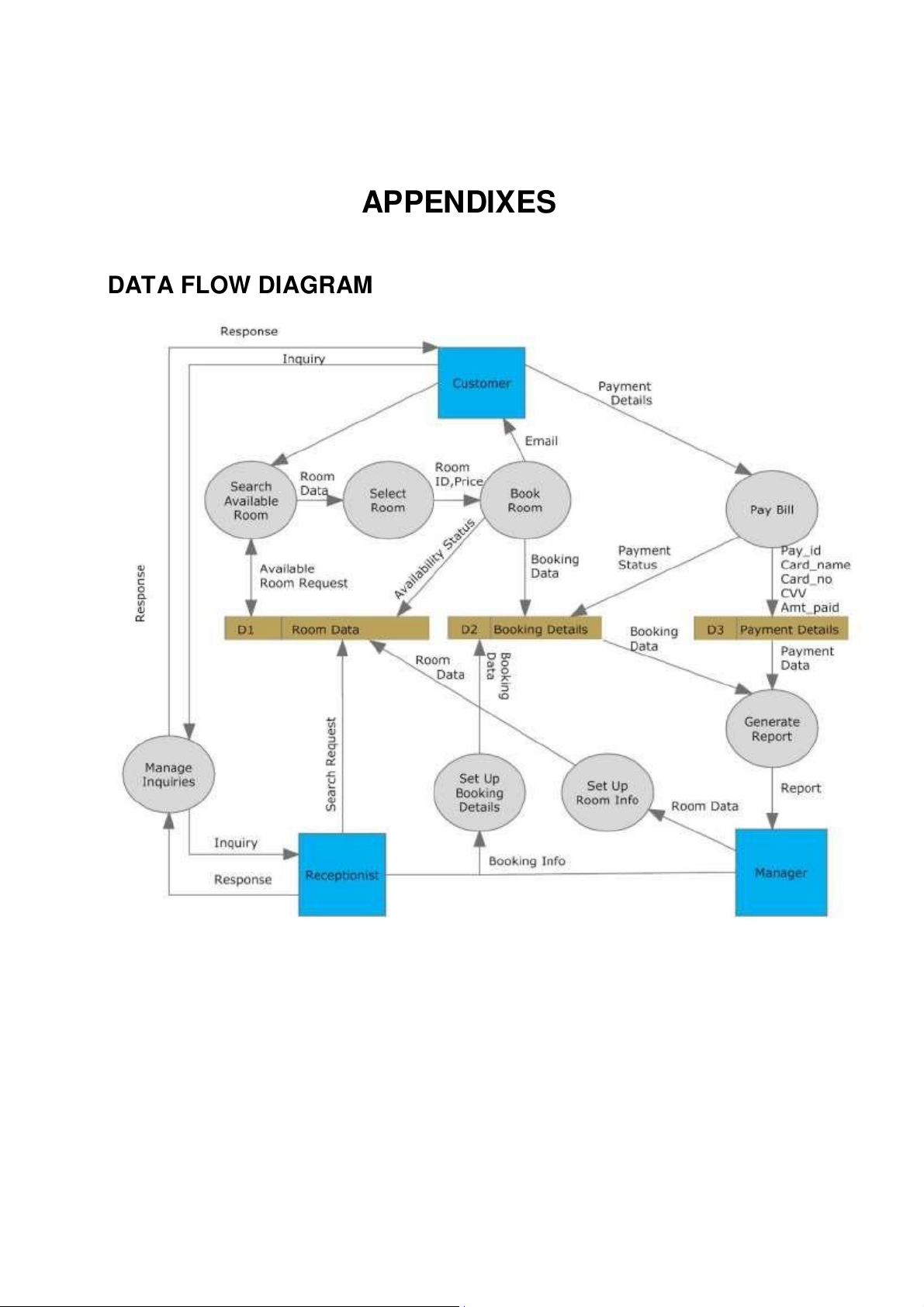
Maintainability: The system should be maintainable. APPENDIXES DATA FLOW DIAGRAM
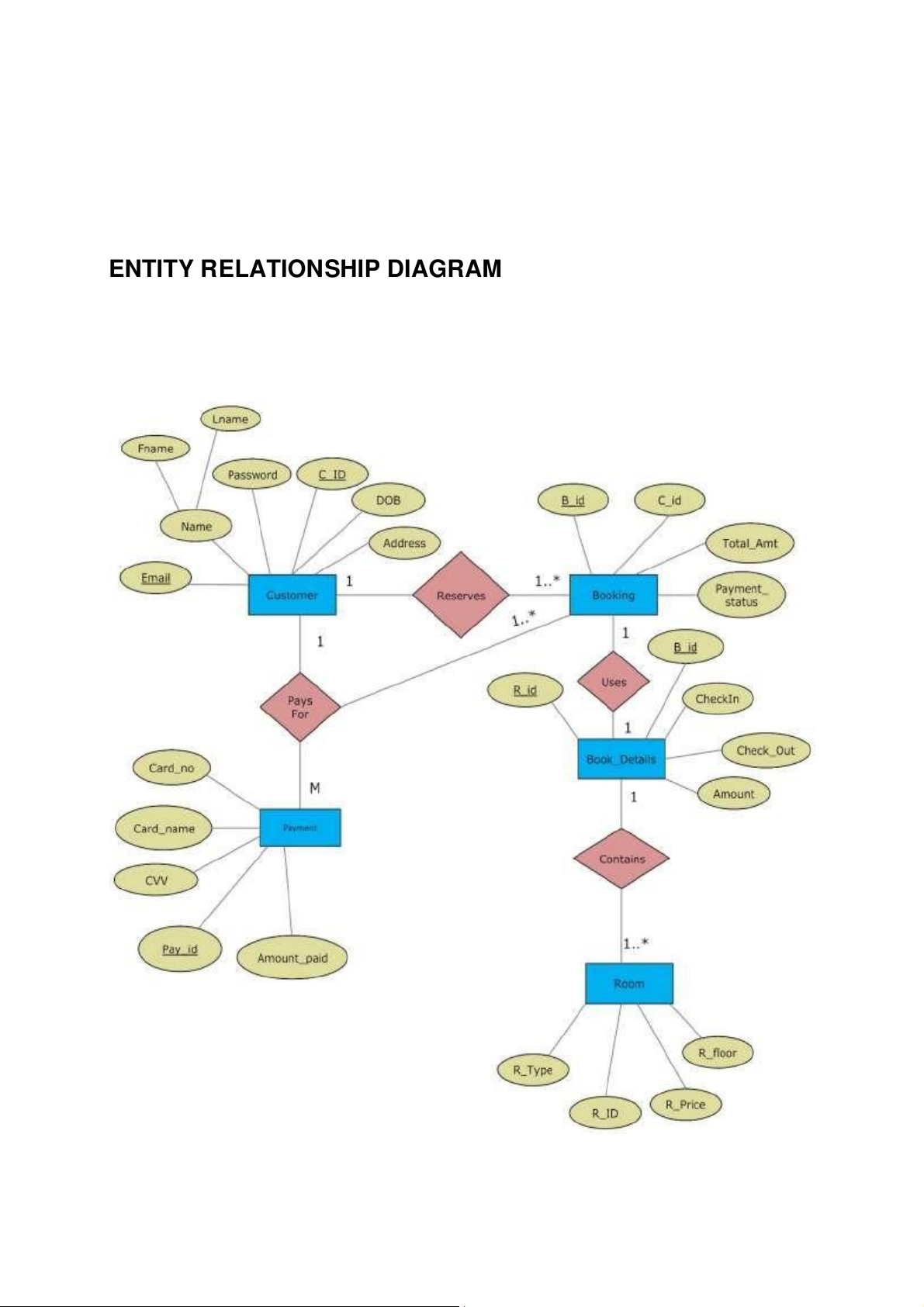
ENTITY RELATIONSHIP DIAGRAM
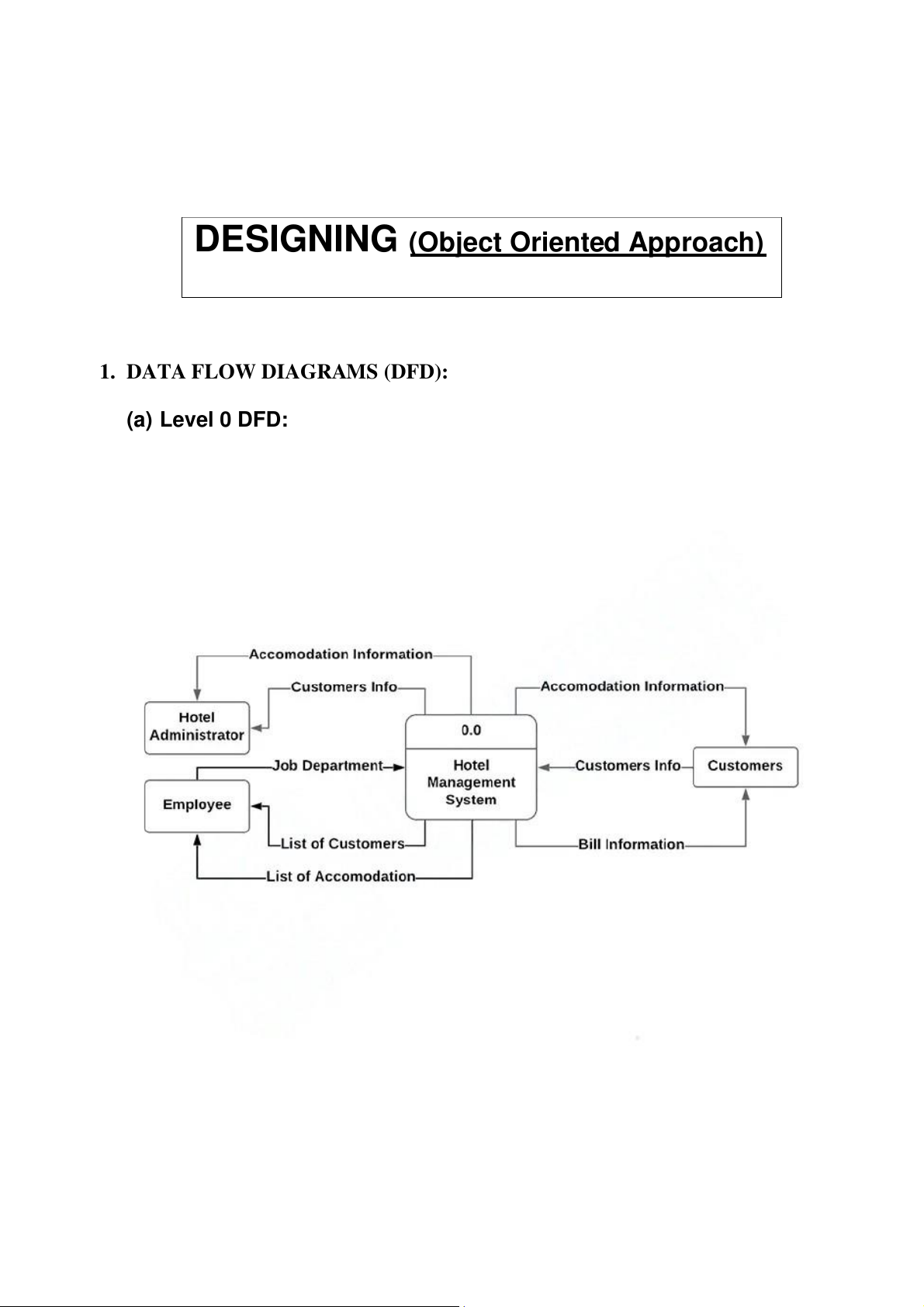
DESIGNING (Object Oriented Approach)
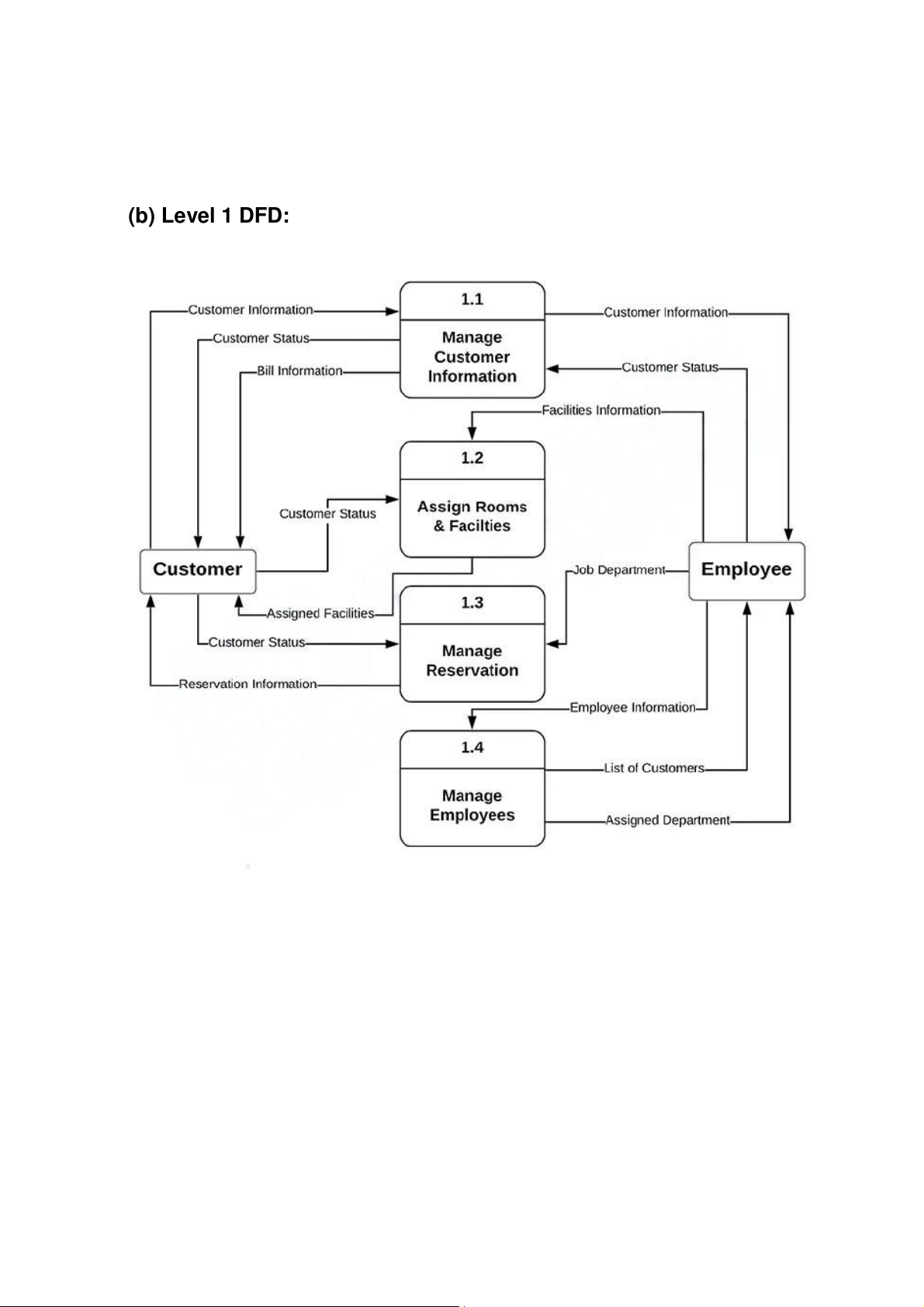
1. DATA FLOW DIAGRAMS (DFD): (a) Level 0 DFD: (b) Level 1 DFD:
Tài liệu liên quan:
-
Hướng dẫn Quy Trình Quản Lý Nhà Hàng PTTK: Nhiệm Vụ và Quy Tắc | Phân tích thiết kế hệ thống | Trường Đại học Thủ Dầu Một
39 20 -
Chương 3: Phân Tích & Thiết Kế Hệ Thống Thông Tin (Systems Design) | Phân tích thiết kế hệ thống | Trường Đại học Thủ Dầu Một
37 19 -
Hệ thống Quản lý Kinh doanh của Thầy Tĩnh | Phân tích thiết kế hệ thống | Trường Đại học Thủ Dầu Một
40 20 -
Câu hỏi thi cuối kỳ: Tóm tắt và thiết kế hệ thống quản lý | Phân tích thiết kế hệ thống | Trường Đại học Thủ Dầu Một
33 17 -
Phân Tích Hệ Thống Quản Lý Cửa Hàng YumYum | Phân tích thiết kế hệ thống | Trường Đại học Thủ Dầu Một
30 15