Lesson I-7 Elasticity Practice Questions & Answers | Microeconomics | Trường Đại học Quốc tế, Đại học Quốc gia Thành phố Hồ Chí Minh
Tài liệu được sưu tầm và soạn thảo dưới dạng file PDF với mục đích hỗ trợ học tập và tham khảo. Nội dung tài liệu được trình bày rõ ràng, dễ tiếp cận, phù hợp cho việc ôn tập và củng cố kiến thức trong quá trình học đại học. Đây sẽ là nguồn tư liệu hữu ích giúp các bạn sinh viên chuẩn bị tốt hơn cho các buổi học, đồng thời mở rộng thêm hiểu biết về môn học. Hy vọng tài liệu này sẽ mang lại nhiều giá trị và hỗ trợ các bạn trong hành trình học tập. Mời bạn đọc cùng tham khảo!
Môn: Microeconomics 613 tài liệu
Trường: Trường Đại học Quốc tế, Đại học Quốc gia Thành phố Hồ Chí Minh 1.9 K tài liệu
Tác giả:


Preview text:
Practice Questions and Answers from Lesson I-7: Elasticity
Practice Quest ions and An swers from L esson I-7: Elasticity
The following questions pr actic e these skil ls:
Use the midpoint method for calculatin g percent change.
Compute price elasti city of demand.
Identify elastic and inelastic demand accordin g to the pr ice elastic ity of demand.
For elastic demand, apply the negative re lation between pr ice and revenue.
For inelastic demand, apply the positive relation between price and revenue.
Remember dem and is more elastic when there are more substitute s or closer substitutes.
Compute the price elasticity of supply.
Compute cross-pr ice ela st ic it ie s of demand .
Relate cros s-price elasticit ies of demand to gross substi tutes and gro ss complements.
Identify elastic and inelastic portions of a linear demand curve.
Compute income elasticity of demand.
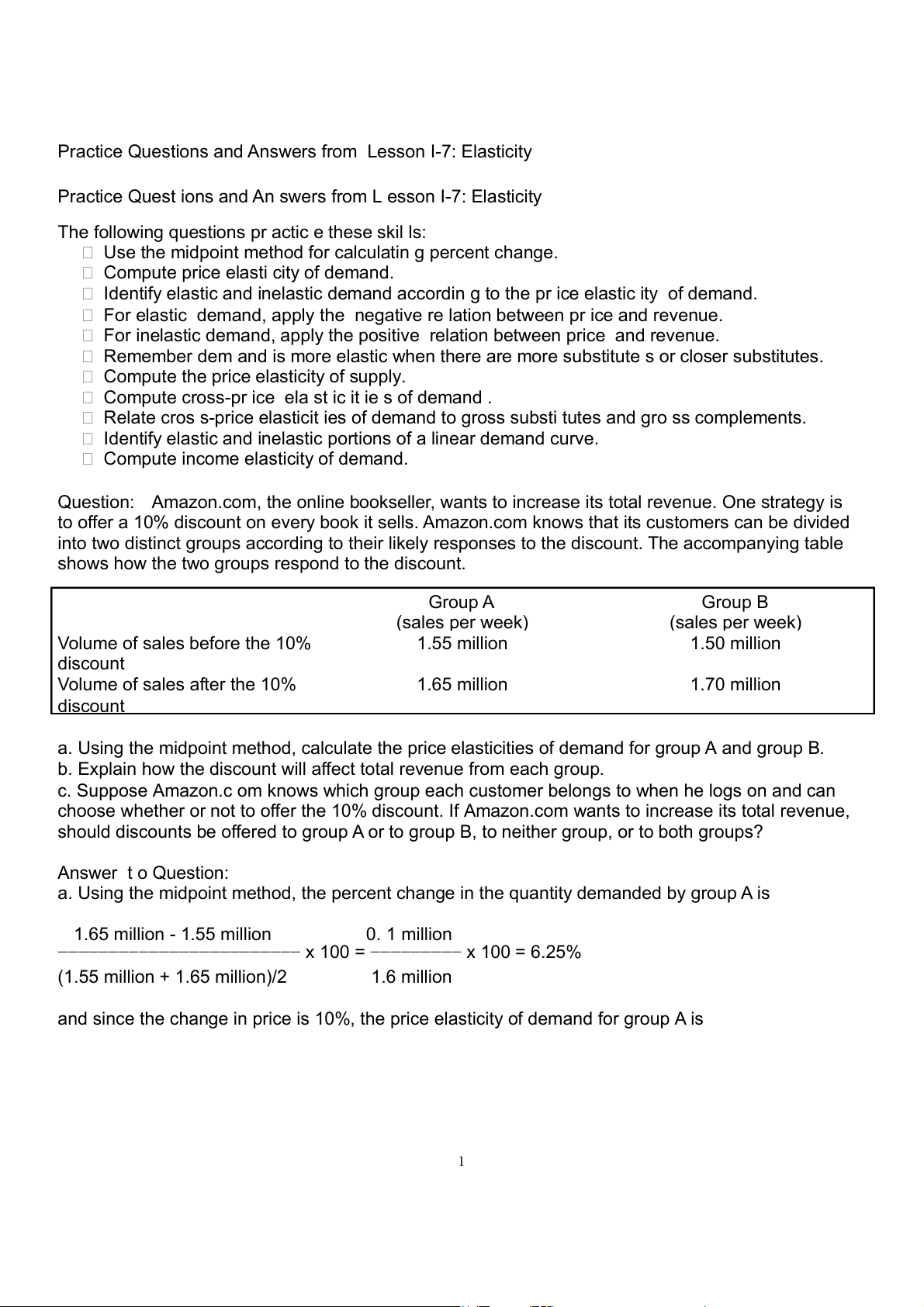
Question: Amazon.com, the online booksel er, wants to increase its total revenue. One strategy is
to offer a 10% discount on every book it sel s. Amazon.com knows that its customers can be divided
into two distinct groups according to their likely responses to the discount. The accompanying table
shows how the two groups respond to the discount. Group A Group B (sales per week) (sales per week)
Volume of sales before the 10% 1.55 mil ion 1.50 mil ion discount Volume of sales after the 10% 1.65 mil ion 1.70 mil ion discount
a. Using the midpoint method, calculate the price elasticities of demand for group A and group B.
b. Explain how the discount wil affect total revenue from each group. c. Suppose Amazo .
n c om knows which group each customer belongs to when he logs on and can
choose whether or not to offer the 10% discount. If Amazon.com wants to increase its total revenue,
should discounts be offered to group A or to group B, to neither group, or to both groups? Answer t o Question:
a. Using the midpoint method, the percent change in the quantity demanded by group A is
1.65 mil ion - 1.55 mil ion 0. 1 mil ion
−−−−−−−−−−−−−−−−−−−−−−−− x 100 = −−−−−−−−− x 100 = 6.25%
(1.55 mil ion + 1.65 mil ion)/2 1.6 mil ion
and since the change in price is 10%, the price elasticity of demand for group A is 1
Practice Questions and Answers from Lesson I-7: Elasticity 6.25%/10% = 0.625
Using the midpoint method, the percent change in the quantity demanded by group B is 1.7 mil ion - 1.5 mil ion 0 2 . mil ion
−−−−−−−−−−−−−−−−−−−−−−−− x 100 = −−−−−−−−− x 100 = 12.5%
(1.5 mil ion + 1.7 mil ion)/2 1. 6 mil ion
and since the change in price is 10%, the price elasticity of demand for group B is 12.5%/10% = . 1 25
b. For group A, since the price elasticity of demand is 0.625 (demand is inelastic), total revenue wil
decrease as a result of the discount . For group B, since the price ela sticity of demand i s 1.25 (demand
is elastic), total revenue wil increase as a result of the discount.
c. If Amazon.com wants to increase total revenue, it should definitely not offer the discount to group A
and it should definitely offer the discount to group B.
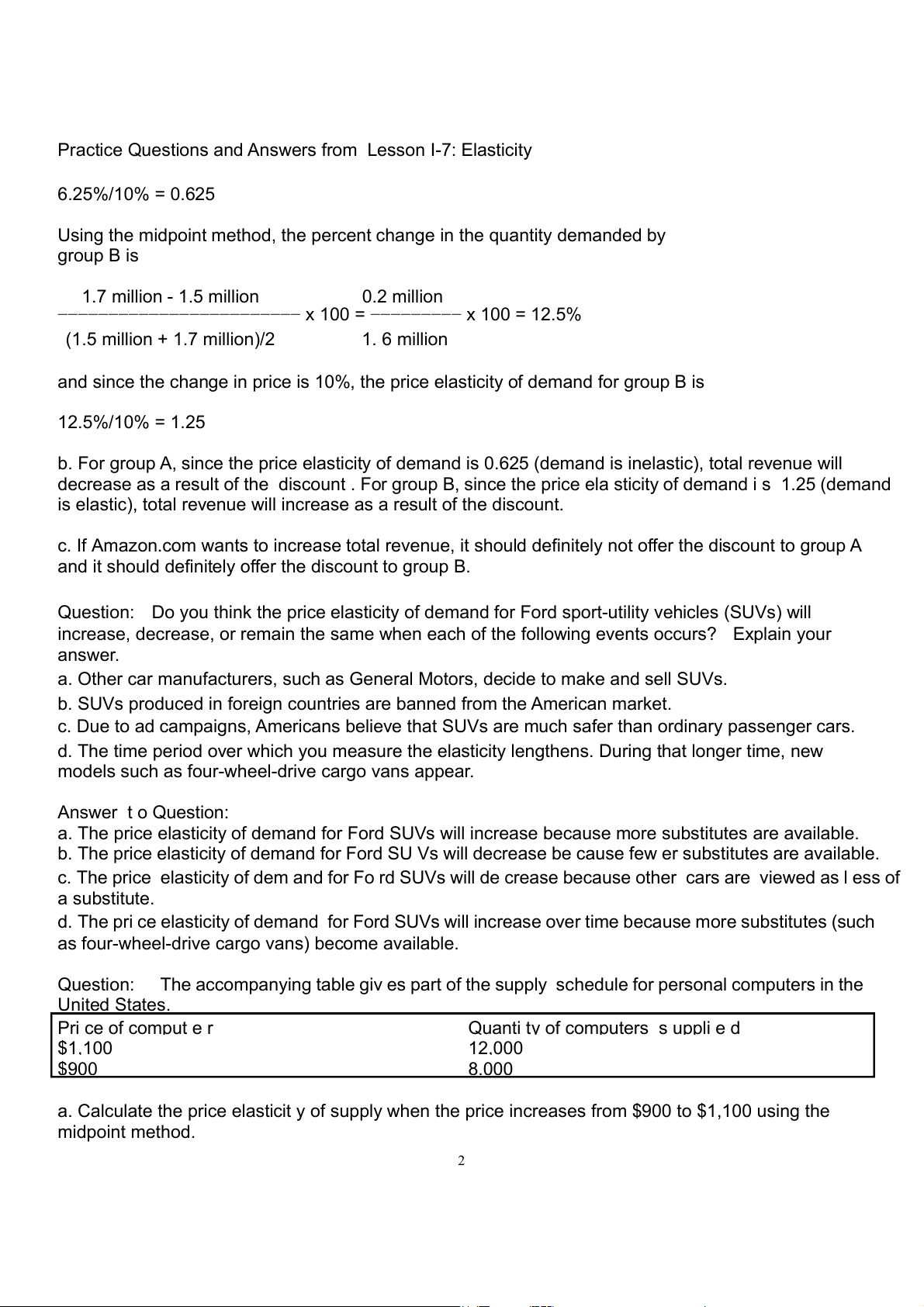
Question: Do you think the price elasticity of demand for Ford sport-utility vehicles (SUVs) wil
increase, decrease, or remain the same when each of the fol owing events occurs? Explain your answer.
a. Other car manufacturers, such as General Motors, decide to make and sel SUVs.
b. SUVs produced in foreign countries are banned from the American market.
c. Due to ad campaigns, Americans believe that SUVs are much safer than ordinary passenger cars.
d. The time period over which you measure the elasticity lengthens. During that longer time, new
models such as four-wheel-drive cargo vans appear. Answer t o Question:
a. The price elasticity of demand for Ford SUVs wil increase because more substitutes are available.
b. The price elasticity of demand for Ford SU Vs wil decrease be cause few er substitutes are available.
c. The price elasticity of dem and for Fo rd SUVs wil de crease because other cars are viewed as l ess of a substitute.
d. The pri ce elasticity of demand for Ford SUVs wil increase over time because more substitutes (such
as four-wheel-drive cargo vans) become available.
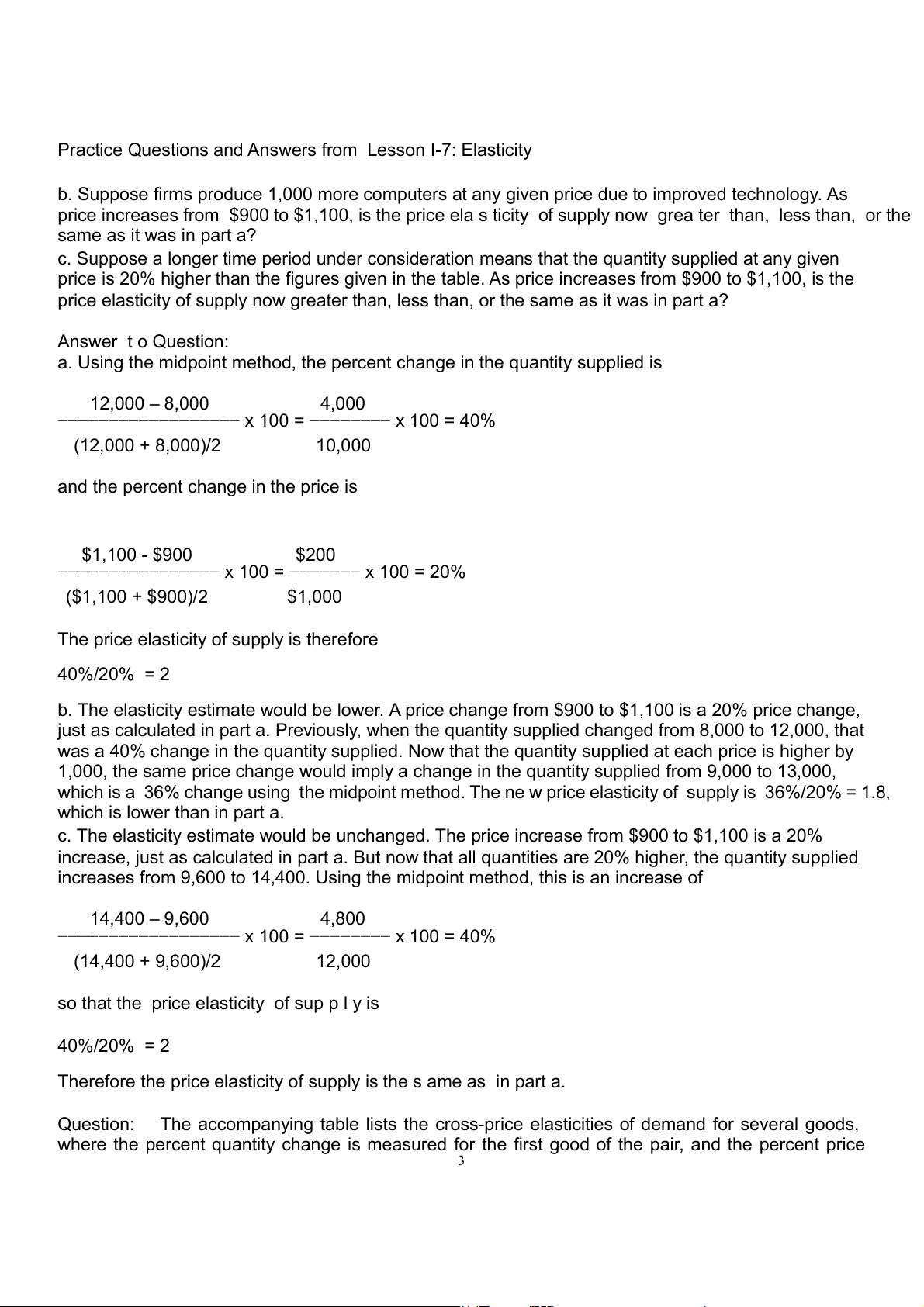
Question: The accompanying table giv es part of the supply schedule for personal computers in the United States. Pri ce of comput e r
Quanti ty of computers s uppli e d $1,100 12,000 $900 8,000
a. Calculate the price elasticit y of supply when the price increases from $900 to $1,100 using the midpoint method. 2
Practice Questions and Answers from Lesson I-7: Elasticity
b. Suppose firms produce 1,000 more computers at any given price due to improved technology. As
price increases from $900 to $1,100, is the price ela s ticity of supply now grea ter than, less than, or the same as it was in part a?
c. Suppose a longer time period under consideration means that the quantity supplied at any given
price is 20% higher than the figures given in the table. As price increases from $900 to $1,100, is the
price elasticity of supply now greater than, less than, or the same as it was in part a? Answer t o Question:
a. Using the midpoint method, the percent change in the quantity supplied is 12,000 – 8,000 4,000
−−−−−−−−−−−−−−−−−− x 100 = −−−−−−−− x 100 = 40% (12,000 + 8,000)/2 10,000
and the percent change in the price is $1,100 - $900 $200
−−−−−−−−−−−−−−−− x 100 = −−−−−−− x 100 = 20% ($1,100 + $900)/2 $1,000
The price elasticity of supply is therefore 40%/20% = 2
b. The elasticity estimate would be lower. A price change from $900 to $1,100 is a 20% price change,
just as calculated in part a. Previously, when the quantity supplied changed from 8,000 to 12,000, that
was a 40% change in the quantity supplied. Now that the quantity supplied at each price is higher by
1,000, the same price change would imply a change in the quantity supplied from 9,000 to 13,000,
which is a 36% change using the midpoint method. The ne w price elasticity of supply is 36%/20% = 1.8,
which is lower than in part a.
c. The elasticity estimate would be unchanged. The price increase from $900 to $1,100 is a 20%
increase, just as calculated in part a. But now that al quantities are 20% higher, the quantity supplied
increases from 9,600 to 14,400. Using the midpoint method, this is an increase of 14,400 – 9,600 4,800
−−−−−−−−−−−−−−−−−− x 100 = −−−−−−−− x 100 = 40% (14,400 + 9,600)/2 12,000
so that the price elasticity of sup p l y is 40%/20% = 2
Therefore the price elasticity of supply is the s ame as in part a.
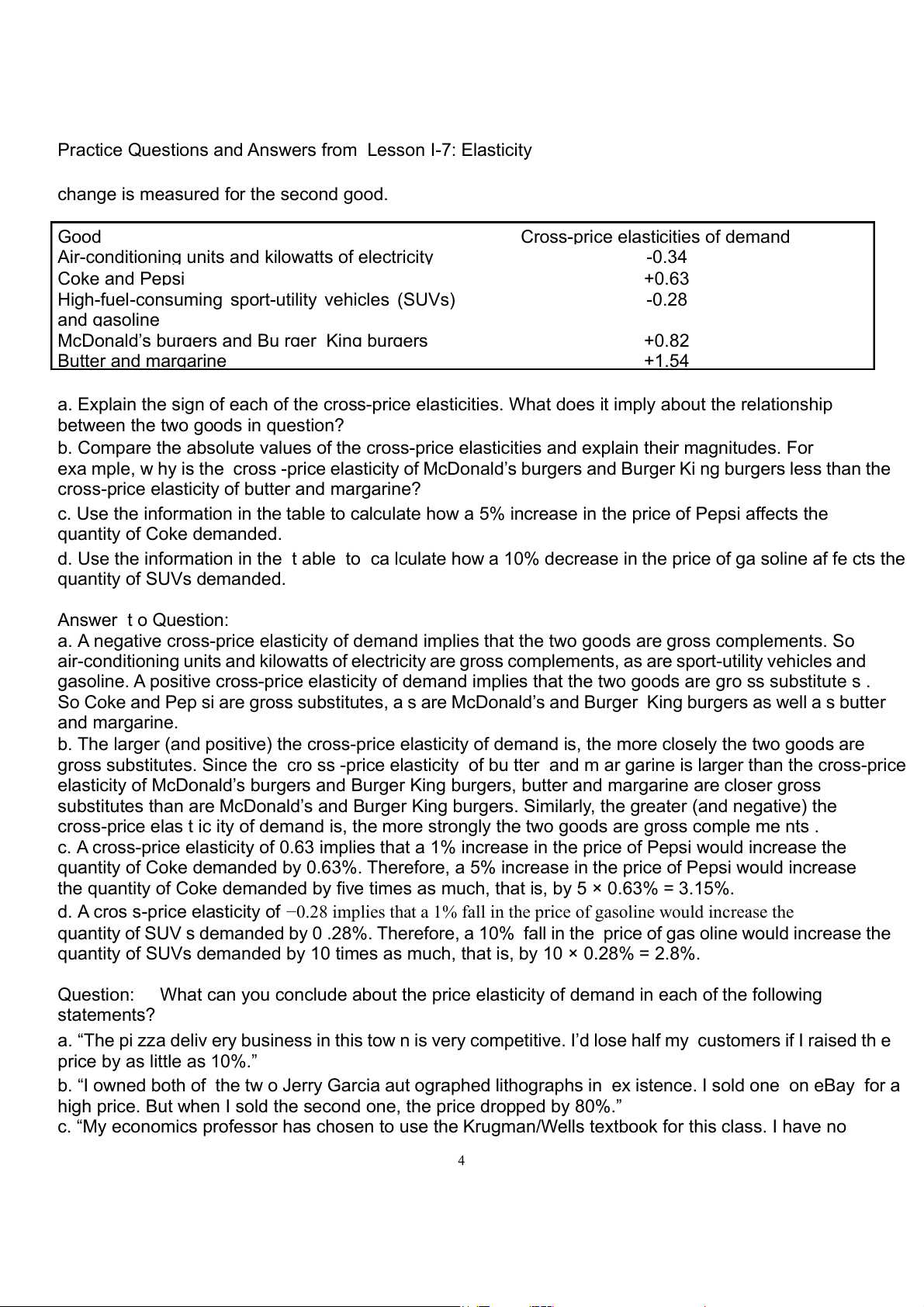
Question: The accompanying table lists the cross-price elasticities of demand for several goods,
where the percent quantity change is measured for the first good of the pair, and the percent price 3
Practice Questions and Answers from Lesson I-7: Elasticity
change is measured for the second good. Good
Cross-price elasticities of demand
Air-conditioning units and kilowatts of electricity -0.34 Coke and Pepsi +0.63
High-fuel-consuming sport-utility vehicles (SUVs) -0.28 and gasoline
McDonald’s burgers and Bu rger King burgers +0.82 Butter and margarine +1.54
a. Explain the sign of each of the cross-price elasticities. What does it imply about the relationship
between the two goods in question?
b. Compare the absolute values of the cross-price elasticities and explain their magnitudes. For
exa mple, w hy is the cross -price elasticity of McDonald’s burgers and Burger Ki ng burgers less than the
cross-price elasticity of butter and margarine?
c. Use the information in the table to calculate how a 5% increase in the price of Pepsi affects the quantity of Coke demanded.
d. Use the information in the t able to ca lculate how a 10% decrease in the price of ga soline af fe cts the quantity of SUVs demanded. Answer t o Question:
a. A negative cross-price elasticity of demand implies that the two goods are gross complements. So
air-conditioning units and kilowatts of electricity are gross complements, as are sport-utility vehicles and
gasoline. A positive cross-price elasticity of demand implies that the two goods are gro ss substitute s .
So Coke and Pep si are gross substitutes, a s are McDonald’s and Burger King burgers as wel a s butter and margarine.
b. The larger (and positive) the cross-price elasticity of demand is, the more closely the two goods are
gross substitutes. Since the cro ss -price elasticity of bu tter and m ar garine is larger than the cross-price
elasticity of McDonald’s burgers and Burger King burgers, butter and margarine are closer gross
substitutes than are McDonald’s and Burger King burgers. Similarly, the greater (and negative) the
cross-price elas t ic ity of demand is, the more strongly the two goods are gross comple me nts .
c. A cross-price elasticity of 0.63 implies that a 1% increase in the price of Pepsi would increase the
quantity of Coke demanded by 0.63%. Therefore, a 5% increase in the price of Pepsi would increase
the quantity of Coke demanded by five times as much, that is, by 5 × 0.63% = 3.15%.
d. A cros s-price elasticity of −0.28 implies that a 1% fall in the price of gasoline would increase the
quantity of SUV s demanded by 0 .28%. Therefore, a 10% fal in the price of gas oline would increase the
quantity of SUVs demanded by 10 times as much, that is, by 10 × 0.28% = 2.8%.
Question: What can you conclude about the price elasticity of demand in each of the fol owing statements?
a. “The pi zza deliv ery business in this tow n is very competitive. I’d lose half my customers if I raised th e price by as little as 10%.”
b. “I owned both of the tw o Jerry Garcia aut ographed lithographs in ex istence. I sold one on eBay for a
high price. But when I sold the second one, the price dropped by 80%.”
c. “My economics professor has chosen to use the Krugman/Wel s textbook for this class. I have no 4
Practice Questions and Answers from Lesson I-7: Elasticity
choice but to buy this book.”
d. “I always spend a total of exactly $10 per week on coffee.” Answer t o Question: a.
This statement says that a 10% increase in price redu ces the q uantity demanded by 50%. T hat
is, the price elasticity of demand is -50%/10% = -5 So demand is elastic.
b. The fact that it was necessary for price to drop by 80% in order to sel one more unit (an in crease in
quantity of 67%, using the midpoint method) indicates that the demand for Jerry Garcia autographed lithographs is inelastic.
c. There is no substitute available, so demand is inelastic. (Although, over time, as more used
Krugman/Wel s textbooks become available, the price elasticity of demand wil increase.)
d. Demand is un it-elastic: no mat ter what the price of coffee is, the total revenue to t he producer (which
is my total expenditure on coffee) remains the same.
Question: The accompany ing table shows the price and yearly quantity sold of souvenir T-shi rts in th e
town of Crystal Lake according to the average income of the tourists visiting. Price of T-shirt Quantity of T-shirts demanded Quantity of T-shirts demanded when the average tourist when the average tourist income is $20,000 income is $30,000 $4 3,000 5,000 $5 2,400 4,200 $6 1,600 3,000 $7 800 1,800
a. Using the midpoint method, calculate the price elasticity of demand when the price of a T-shi rt ri ses
from $5 to $6 and the average tourist income is $20,000. Also calculate it when the average tourist income is $30,000.
b. Using the midpoint method, calculate the income elasticity of demand when the price of a T-shirt is
$4 and the average tourist income increases from $20,000 to $30,000 . Also calculate it when th e pri ce is $7. Answer t o Question:
a. Suppose the average tourist income is $20,000. Using the midpoint method, the percent change in the quantity demanded is 1,600 – 2,400 -800
−−−−−−−−−−−−−−−−−− x 100 = −−−−−−− x 100 = -40% (1,600 + 2,400)/2 2,000
and the percent change in the price is 5
Practice Questions and Answers from Lesson I-7: Elasticity $6 - $5 $1
−−−−−−−−−−− x 100 = −−−−− x 100 = 18.2% ($6 + $5)/2 $5.5
The price elasticity of demand is therefore 40%/18.2% = 2. 2
Now suppose the av erage tourist income is $30,000 . The percent change in the quantity demanded is 3,000 – 4,200 -1,200
−−−−−−−−−−−−−−−−−− x 100 = −−−−−−− x 100 = -33.3% (3,000 + 4,200)/2 3,600
and the percent change in the price is $6 - $5 $1
−−−−−−−−−−− x 100 = −−−−− x 100 = 18.2% ($6 + $5)/2 $5.5
The price elasticity of demand is therefore 33.3%/1 8.2% = 1. 8
b. Suppose the price of a T-shirt is $4. Using the midpoint method, the percent
change in the quantity demanded is 5,000 – 3,000 2,000
−−−−−−−−−−−−−−−−−− x 100 = −−−−−−− x 100 = 50% (5,000 + 3,000)/2 4,000
and the percent change in income is $30,000 - $20,000 $10,000
−−−−−−−−−−− −
− −−−−−−− x 100 = −−−−−−−− x 100 = 40% ($30,00 0 + $20,000)/2 $25,000 The incom
e elasticity of demand is therefore 50%/40% = 1.25
No w suppose the price of a T-shirt is 7
$ . Using the midpoint method, the
percent change in the quantity demanded is 1,800 – 800 1,000
−−−−−−−−−−−−−−−− x 100 = −−−−−−− x 100 = 76.9% (1,800 + 800)/2 1,30 0
and the percent change in income is, as before, 6
Practice Questions and Answers from Lesson I-7: Elasticity $30,000 - $20,000 $10,000
−−−−−−−−−−− −
− −−−−−−− x 100 = −−−−−−−− x 100 = 40% ($30,00 0 + $20,000)/2 $25,000
The income elasticity of deman d is therefore 76.9%/40% = 1. 9
Question: In each of the fol owing cases, do you think the price elasticity of supply is
(i) perfectly elastic; (i ) perfectly inelastic; (i i) elastic, but not perfectly elastic; or
(iv) inelastic, but not perfectly inelastic? Explain using a diagram.
a. An increase in demand this summer for luxury cruises leads to a huge jump in the sales price of a cabin on the Queen Mary 2.
b. The price of a kilowatt of electricity is the same during periods of high electricity demand as during
periods of low electricity demand.
c. Fewer people want to fly during February than during any other month. The airlines cancel about
10% of their flights as ticket prices fal about 20% during this month.
d. Owners of vacation homes in Maine rent them ou t during the summer. Due to the soft economy this
year, a 30% decline in the price of a vacation rental leads more than half of homeowners to occupy their
vacation homes themselves during the summer. Answer t o Question: a.
Supply is perfectly inelastic: the quantity of cabins on the Queen Mary 2 is fixed. As demand
increases (a rightward s hift in the demand curv e), the pric e of a cabin on the Queen Mary 2 increases,
without an increase in the quantity supplied. See the accompanying diagram. b.
Supply is perfectly elastic. As demand changes (for instance, as demand increases in times of
high electricity demand), price does not change but the quantity supplied does change. c.
Supply is inelastic. As price fal s by 20%, the quantity supplied fal s by 10%. This implies a price elasticity of supply of 10%/20% = 0.5
which is inelastic. See the accompanying diagram. 7
Practice Questions and Answers from Lesson I-7: Elasticity d.
Supply is elastic. As price fal s by 30%, the quantity supplied fal s by more than 50%. This
implies a price elasticity of supply greater than 50%/30% = 1.7. See the accompanying diagram.
Question: Taiwan is a major world supplier of semiconductor chips. A recent earthquake severely
damaged the production facilities of Taiwanese chip-producing companies, sharply reducing the
amount of chips they could produce.
a. Assume that the total revenue of a typical non-Taiwanese chip manufacturer rises due to these
events. In terms of an elasticity, what must be true for this to happen? Il ustrate the change in total
revenue with a diagram, indica ting the price e f fect and the quantity effect of the Taiwan earthquake on
this company’s total revenue.
b. Now assume that the total revenue of a typical non-Taiwanese chip manufacturer fal s due to these
events. In terms of an elasticity, what must be true for this to happen? Il ustrate the change in total
revenue with a diagram, indica ting the price e f fect and the quantity effect of the Taiwan earthquake on
this company’s total revenue. Answer t o Question:
a. If the increase in price results in an increase in total revenue, then the price effect (which tends to
increase total revenue) must outweigh the quan tity effect (which tends to reduce total revenue). That is,
demand must have been inelastic. In the accompanying diagram, as supply shifted leftward from S to 1
S , the fal in total rev enue due to the quantity effect (area A) is outw eighed by the gain in total revenue 2
due to the price effect (area B). 8
Practice Questions and Answers from Lesson I-7: Elasticity
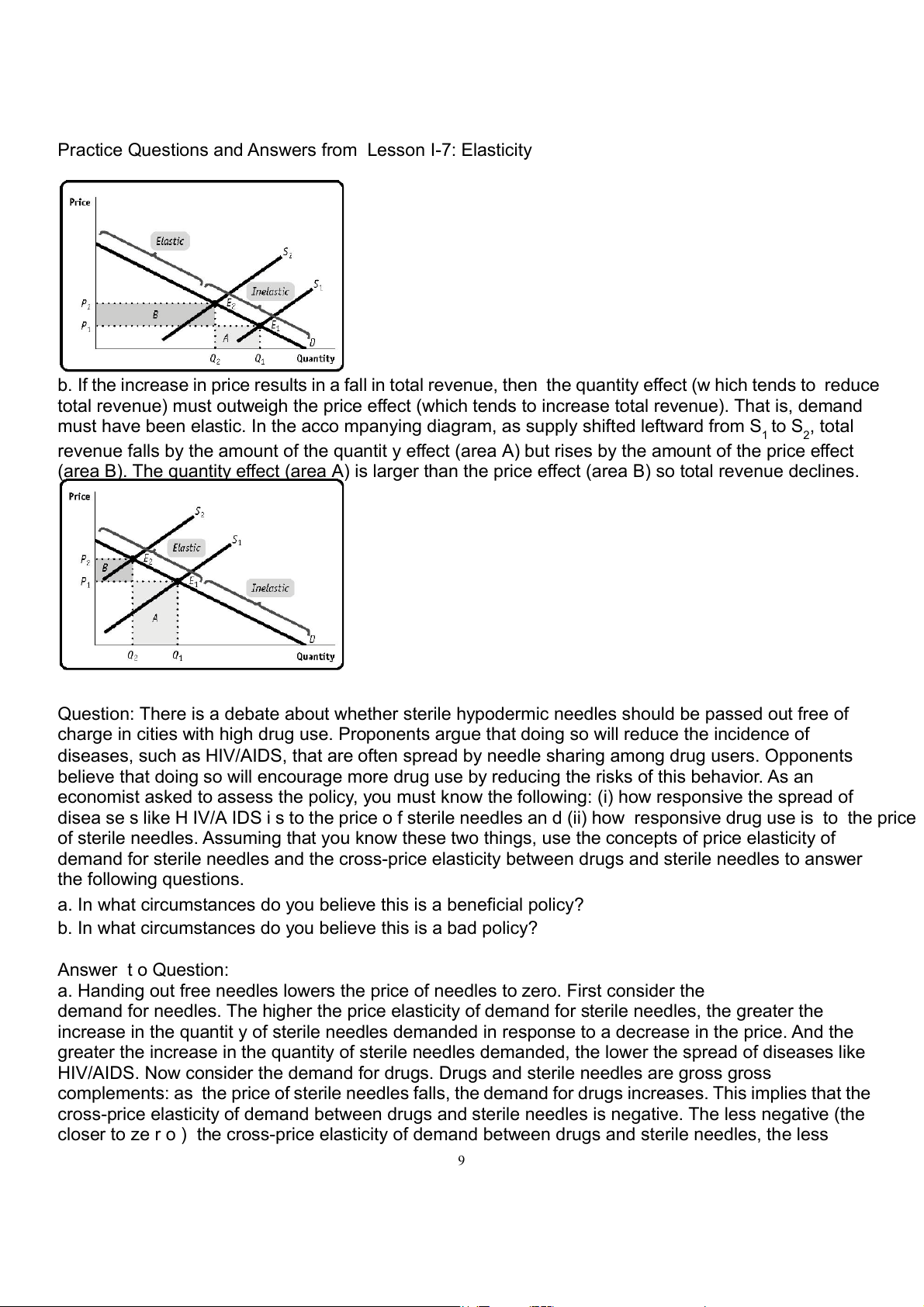
b. If the increase in price results in a fall in total revenue, then the quantity effect (w hich tends to reduce
total revenue) must outweigh the price effect (which tends to increase total revenue). That is, demand
must have been elastic. In the acco mpanying diagram, as supply shifted leftward from S to S , total 1 2
revenue fal s by the amount of the quantit y effect (area A) but rises by the amount of the price effect
(area B). The quantity effect (area A) is larger than the price effect (area B) so total revenue declines.
Question: There is a debate about whether sterile hypodermic needles should be passed out free of
charge in cities with high drug use. Proponents argue that doing so wil reduce the incidence of
diseases, such as HIV/AIDS, that are often spread by needle sharing among drug users. Opponents
believe that doing so wil encourage more drug use by reducing the risks of this behavior. As an
economist asked to assess the policy, you must know the fol owing: (i) how responsive the spread of
disea se s like H IV/A IDS i s to the price o f sterile needles an d (i ) how responsive drug use is to the price
of sterile needles. Assuming that you know these two things, use the concepts of price elasticity of
demand for sterile needles and the cross-price elasticity between drugs and sterile needles to answer the fol owing questions.
a. In what circumstances do you believe this is a beneficial policy?
b. In what circumstances do you believe this is a bad policy? Answer t o Question:
a. Handing out free needles lowers the price of needles to zero. First consider the
demand for needles. The higher the price elasticity of demand for sterile needles, the greater the
increase in the quantit y of sterile needles demanded in response to a decrease in the price. And the
greater the increase in the quantity of sterile needles demanded, the lower the spread of diseases like
HIV/AIDS. Now consider the demand for drugs. Drugs and sterile needles are gross gross
complements: as the price of sterile needles fal s, the demand for drugs increases. This implies that the
cross-price elasticity of demand between drugs and sterile needles is negative. The less negative (the
closer to ze r o ) the cross-price elasticity of demand between drugs and sterile needles, the less 9
Practice Questions and Answers from Lesson I-7: Elasticity
responsive is the demand for drugs to the price of sterile needles. So the policy would be beneficial if
the price elasticity of demand for sterile needles is high (elastic) and the cross-price elasticity of
demand between drugs and sterile needles is negative and low (close to zero, that is, weakly complementary).
b. Similar reasoning as in part a implies that the policy would be a bad idea if the price elasticity of
demand for sterile needles is low (inelastic) and the cross-price elasticity of demand between drugs
and sterile needles is high and negative (stro ngly complementary).
Question: Worldwide, the average coffee grower has increased the amount of acreage under cul-
tivation over the past few years. The result has been that the average coffee plant t a ion produces
significantly more coffee than it did 10 to 20 years ago. Unfortunately for the grow ers, however, this has
also been a period in which their total revenues have plunged. In terms of an elasticity, what must be
true for these events to have occurred? Il ustrate these events with a diagram, indicating the quantity
effect and the price effect that gave rise to these events.
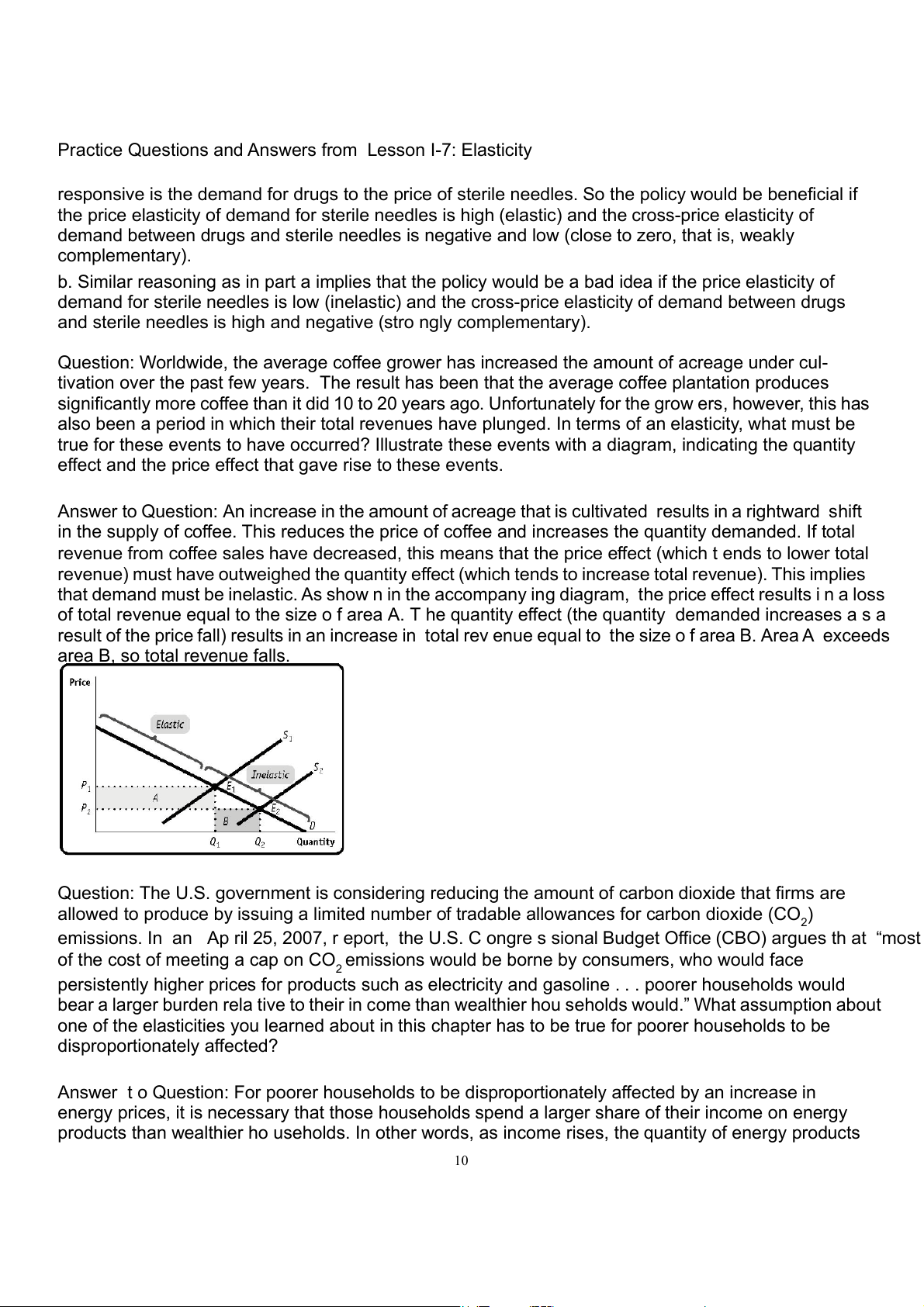
Answer to Question: An increase in the amount of acreage that is cultivated results in a rightward shift
in the supply of coffee. This reduces the price of coffee and increases the quantity demanded. If total
revenue from coffee sales have decreased, this means that the price effect (which t ends to lower total
revenue) must have outweighed the quantity effect (which tends to increase total revenue). This implies
that demand must be inelastic. As show n in the accompany ing diagram, the price effect results i n a loss
of total revenue equal to the size o f area A. T he quantity effect (the quantity demanded increases a s a
result of the price fal ) results in an increase in total rev enue equal to the size o f area B. Area A exceeds
area B, so total revenue fal s.
Question: The U.S. government is considering reducing the amount of carbon dioxide that firms are
al owed to produce by issuing a limited number of tradable al owances for carbon dioxide (CO ) 2
emissions. In an Ap ril 25, 2007, r eport, the U.S. C ongre s sional Budget Office (CBO) argues th at “most
of the cost of meeting a cap on CO emissions would be borne by consumers, who would face 2
persistently higher prices for products such as electricity and gasoline . . . poorer households would
bear a larger burden rela tive to their in come than wealthier hou seholds would.” What assumption about
one of the elasticities you learned about in this chapter has to be true for poorer households to be disproportionately affected?
Answer t o Question: For poorer households to be disproportionately affected by an increase in
energy prices, it is necessary that those households spend a larger share of their income on energy
products than wealthier ho useholds. In other words, as income rises, the quantity of energy products 10
Practice Questions and Answers from Lesson I-7: Elasticity
demanded has to increase less than proportionately. So the CBO must think that the income elasticity
of demand for ener gy products, althou gh positive, is le ss t han 1: energy products are in come-inelastic.
In fact, this is just what the CBO report says: “lower-income hou seholds tend to spend a larger fractio n
of their income than wealthier households do and . . . energy products account for a bigger share of their spending.”
Question: According to a Honda press release on October 23, 2006, sales of the fuel-efficient
four-cylinder Honda Civic rose by 7.1% from 2005 to 2006. Over the same period, according to data
from the U.S. Energy Information Administration, the av erage price of regular gasoline rose from $2.2 7
per gal on to $2.57 per gal on. Using the midpoint method, calculate the cross-price elasticity of
demand between Honda Civics and regular gasoline. According to your estimate of the cross -price
elasticity, are the two goods gross complement s or gro ss sub stitute s? Does your an swer make sense?
Answer t o Question: An incre ase in price from $2.27 to $2.57, using the midpoint method, is a percent increase of $2.57 - $2.27 $0.30
−−−−−−−−−−−−−−−− x 100 = −− − − −− x 100 = 12.4% ($2.57 + $2.27)/2 $2.42
So the cross-price elasticity of demand is 7.1%/12.4% = 0.6
Since the cross-price elasti city of demand between Honda Civics and regular gasoline is positiv e, your
estima te say s th at t he two are gross su bstitu tes. This answer migh t seem perplexing because cars and
gasoline are general y gross complements: you need gasoline to run a (gasoline-powered) car like a
Honda Civic. So the complementary relationship between gas and cars implies that the cross-price
elasticity between them is nega tive. But a Hon da Civ ic adds another dimension to the comparison : it is
a fuel-efficient car, not a gas-guzzler. And fuel-efficient cars and gas guzzlers are gross sub stitu tes. So
as gasoline prices rise, the demand for gas-guzzling cars fal s and the demand for fuel-effici e nt car s
(such as the Honda Civic), which are g r o ss substitute s, rises. So the subst itute nature between
gas-guzzlers and Honda Civ ics implies a positive cross-price elasticity between gas and Honda C ivics.
Which effect is stronger? Clearly it is the substitution effect that is stronger, because the data show a
positive cross-price elasticity. 11
Tài liệu liên quan:
-
Tự Luận Vimo: Phân Tích Cung, Cầu và Thị Trường Cạnh Tranh| Microeconomics | Trường Đại học Quốc tế, Đại học Quốc gia Thành phố Hồ Chí Minh
5 3 -
Review Questions: Thinking Like an Economist | Microeconomics | Trường Đại học Quốc tế, Đại học Quốc gia Thành phố Hồ Chí Minh
5 3 -
Final Exam Quizlet Questions & Answers | Microeconomics | Trường Đại học Quốc tế, Đại học Quốc gia Thành phố Hồ Chí Minh
5 3 -
Đề thi giữa kỳ II | Microeconomics | Trường Đại học Quốc tế, Đại học Quốc gia Thành phố Hồ Chí Minh
5 3 -

Final Group Project_ The Beer Industry | Microeconomics | Trường Đại học Quốc tế, Đại học Quốc gia Thành phố Hồ Chí Minh
4 2