Micro Essay - Economic Paradox in Agriculture | Microeconomics | Trường Đại học Quốc tế, Đại học Quốc gia Thành phố Hồ Chí Minh
In the agriculture industry, an intriguing economic phenomenon often prevails, where farmers despite reaping bountiful harvests, find themselves dissatisfied with the outcome. This paradoxical phenomenon is also known by the saying “2Farmers are not happy with good harvests”.2This essay will delve into the underlying factors of this trend and provide a microeconomic theory-based analysis. Tài liệu được sưu tầm và soạn thảo dưới dạng file PDF để gửi tới các bạn cùng tham khảo, ôn tập đầy đủ kiến thức, chuẩn bị cho các buổi học thật tốt. Mời bạn đọc đón xem!
Môn: Microeconomics 613 tài liệu
Trường: Trường Đại học Quốc tế, Đại học Quốc gia Thành phố Hồ Chí Minh 1.9 K tài liệu
Tác giả:


Preview text:
Name: Nguyễn Hồng Anh MSV : 11230790
Class: International Business Administration 65B TT
In the agriculture industry, an intriguing economic phenomenon
often prevails, where farmers despite reaping bountiful harvests,
find themselves dissatisfied with the outcome. This paradoxical
phenomenon is also known by the saying “2Farmers are not happy
with good harvests”.2This essay will delve into the underlying
factors of this trend and provide a microeconomic theory-based analysis.
Firstly, agricultural demand is mostly considered as inelastic in
scientific terms due to its inherent properties. This is mainly
because the majority of agricultural products are food, which is a
basic necessity of life and vital for human sustenance. Given that
individuals have finite dietary requirements, their consumption of
such essential products has limitations, and therefore, even if the
price of these goods decreases, individuals will not significantly increase their consumption.
Additionally, many agricultural
goods, such as staple crops: corn,
vegetables, fruits and meat, have
fundamental characteristics of freshness, perishability, and
difficulty in long-term preservation.
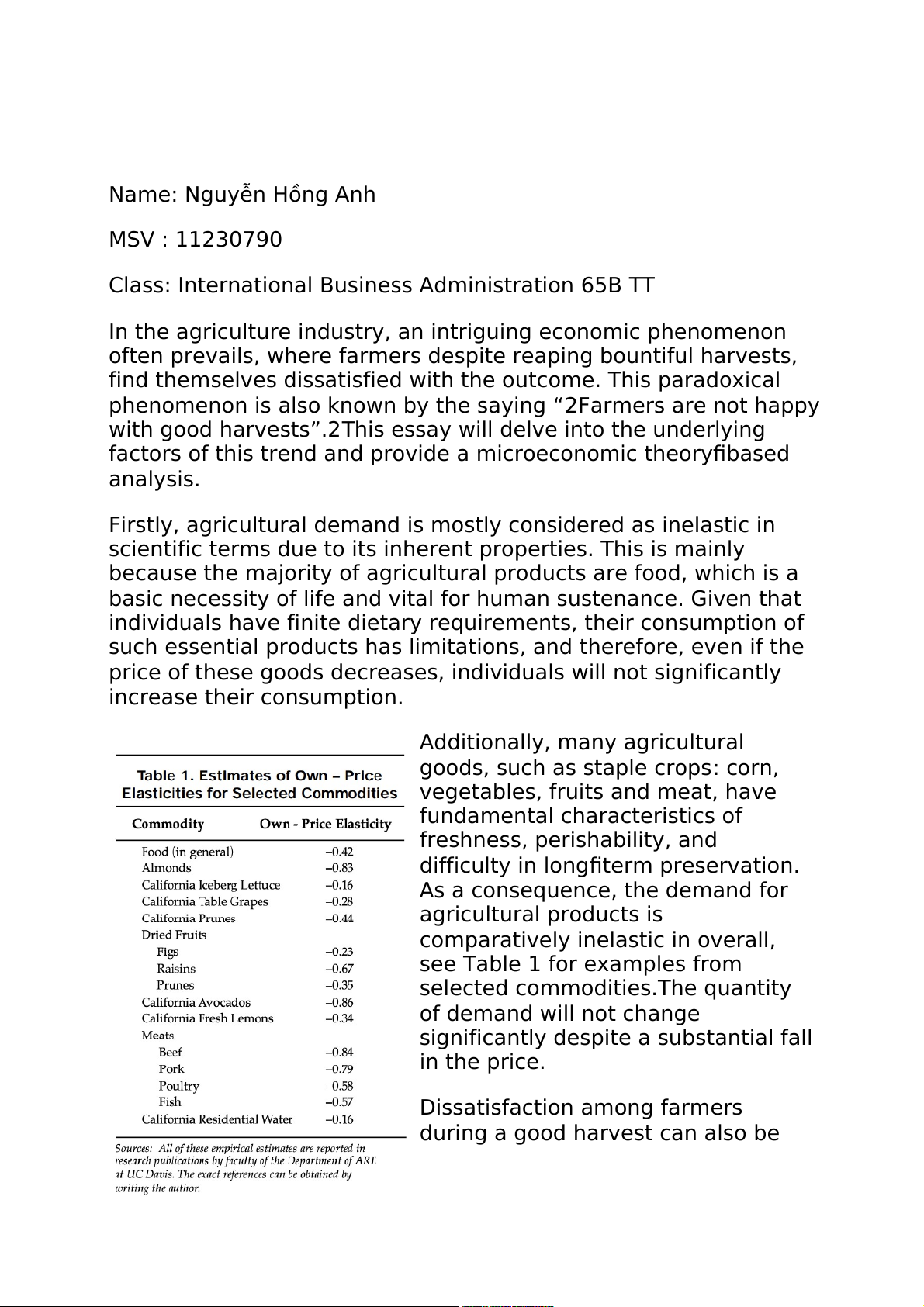
As a consequence, the demand for agricultural products is
comparatively inelastic in overall, see Table 1 for examples from
selected commodities.The quantity of demand will not change
significantly despite a substantial fall in the price. Dissatisfaction among farmers
during a good harvest can also be
explained through the basic law of demand and supply, which
indicates that a surplus in supply often leads to decreases in
prices. When farmers have a bountiful harvest and increase the
supply of their agricultural products, the relatively stable
consumer demand, due to its inelastic nature, can lead to an
oversupply situation in the market. Overproduction of goods often
results in a significant drop in prices. This, in turn, directly
impacts the total revenue earned by farmers. The significant
production growth does not yield a proportional increase in
profits. This outcome leads to disappointment and frustration
among farmers who had hoped for greater financial returns from their efforts.
An additional explanation for discontent among farmers can also
be found in the Law of Diminishing Marginal Utility, which states
for any goods or service, the additional satisfaction and utility
gained from each subsequent commodity always decrease since
each incremental good has less valuable use. This law can be
applied for both farmers and consumers' perspectives.
During an abundant yield, farmers might feel content with the
initial yield as the first production meets their immediate needs
for selling such as local demand, and contractual agreements.
However, as the harvest growth is beyond average needs,
continuous supply entails surplus, leading to a fall in farmers'
satisfaction. This can be attributed to several factors in the
process of product allocation.” The surplus can become a burden
for farmers since it requires more storage, labor, transport fees,
and imperative solutions to effectively manage and preserve the
surplus. Moreover, due to the indicated supply and demand law, a
large surplus in the market can potentially cause a price drop,
reducing the total revenue. Consequently, a good harvest might
have an inverse impact on producers by posing more challenges
and financial strains. Additional utility from surplus pales in
comparison with farmers' efforts and expectations, contributing to
a paradoxical sense of dissatisfaction
From consumers perspective, consuming an increasing amount of
agricultural goods also entails diminishing marginal utility. At first,
customers might be drawn in by the price reduction and buy a
larger amount of goods. However, the short-run gains in demand
dissipate in the long run as individuals all have a limit nutritional
needs. After reaching satiation point, they derive less utility from
successive goods and consider alternative choices or refrain from further spending.
This phenomenon becomes particularly noticeable with seasonal
agriculture products. For instance, summertime in Vietnam is the
harvest season for many tropical foods including logan, plum, and
lychee. During this season, consumers tend to buy these products
in larger quantities compared to other times of the year.While the
demand for these products rises significantly during this period, it
often falls short of matching the market surplus. Having
ultimately satisfied by a specific product, and the price reduction
alone may not be a strong enough incentive to prompt them to
buy more. This trend results in a big price downfall at the end of
the season, up to 4-5 times lower than the original price
A practical example of this situation can seen in Hanoi, Vietnam.
Among the various agricultural products stranded at the border
crossings due to the tightening of borders by China to prevent the
spread of Covid-19, the situation is most severe for products like
lychees and longans. These fruits are particularly susceptible to
spoilage and damage under these circumstances (VNExpress). As
a result, many street corners and social media platforms in Hanoi
have witnessed the emergence of 'rescue' points for Thai lychees
and longans. A survey of these points reveals that the prices of
Thai lychees vary from 12,000 to 13,000 VND per kilogram, while
those transported from Lạng Sơn fluctuate between 9,000 and 10,000 VND per kilogram.
This situation is also a burden in the US economy, in a recent
report by Reuters, they indicated that favorable weather and
technology improvements led to an unexpectedly bumper corn
harvest.22While this entails advantages for consumers with lower
price for corn-based goods, it poses several difficulties for
farmers.22According to The U.S Agriculture Department
(USDA),22this surplus in corn output has exceeded the amount
that has been storaged in U.S silos for the past seven years. In
addition, the surplus is anticipated to rise substantially by 50% in
2024, causing a three-year price drop in the U.S market. this
situation evidently illustrates the consequences of a bountiful
harvests, and the financial challenges it impacts on farmers,
exemplifying the conflicting nature in agriculture (Reuters).
The contradictory phenomenon “ farmers are not happy with good
harvest” can be interpreted under the lens of mathematics.
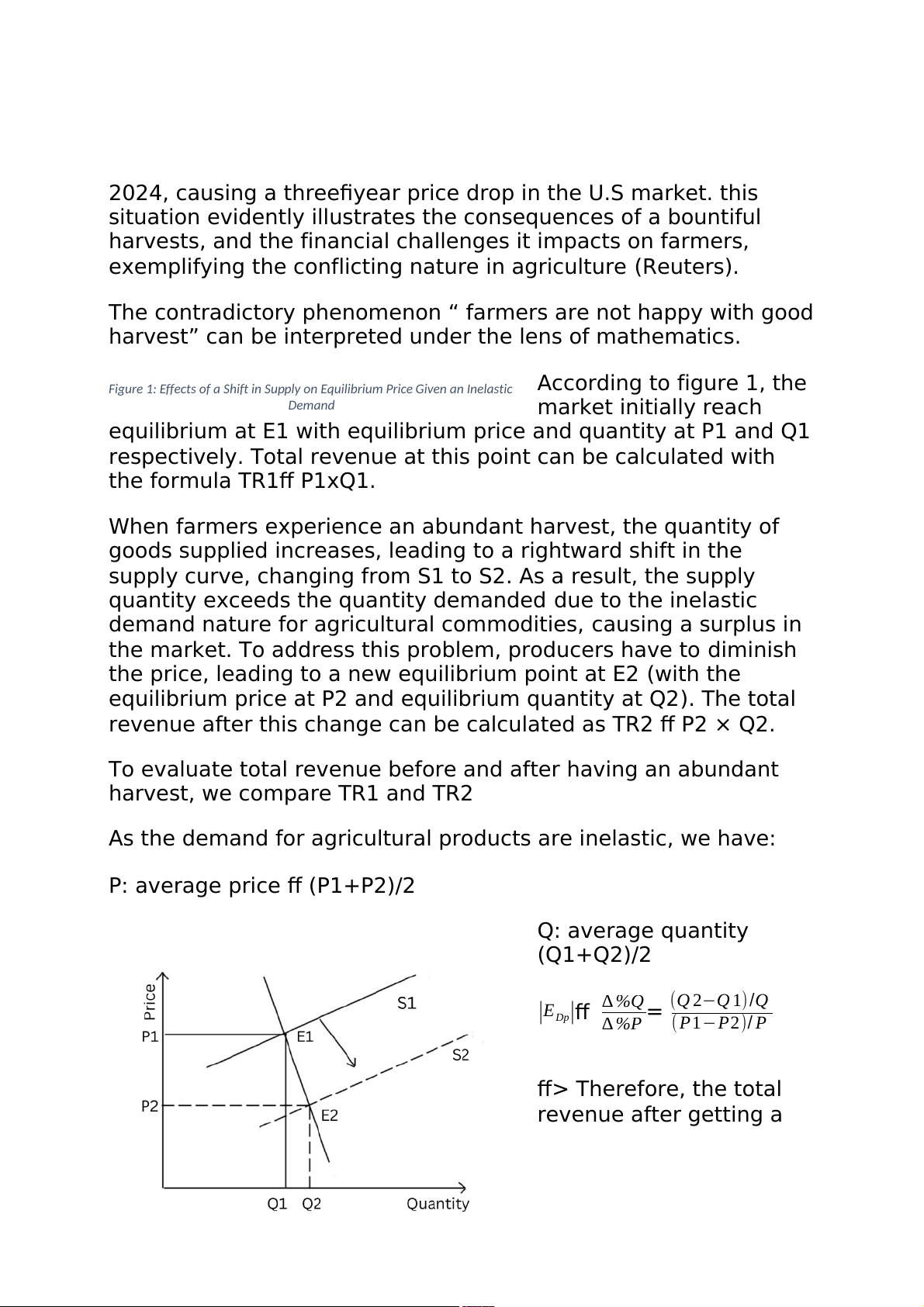
Figure 1: Effects of a Shift in Supply on Equilibrium Price Given an Inelastic According to figure 1, the Demand market initially reach
equilibrium at E1 with equilibrium price and quantity at P1 and Q1
respectively. Total revenue at this point can be calculated with the formula TR1= P1xQ1.
When farmers experience an abundant harvest, the quantity of
goods supplied increases, leading to a rightward shift in the
supply curve, changing from S1 to S2. As a result, the supply
quantity exceeds the quantity demanded due to the inelastic
demand nature for agricultural commodities, causing a surplus in
the market. To address this problem, producers have to diminish
the price, leading to a new equilibrium point at E2 (with the
equilibrium price at P2 and equilibrium quantity at Q2). The total
revenue after this change can be calculated as TR2 = P2 × Q2.
To evaluate total revenue before and after having an abundant
harvest, we compare TR1 and TR2
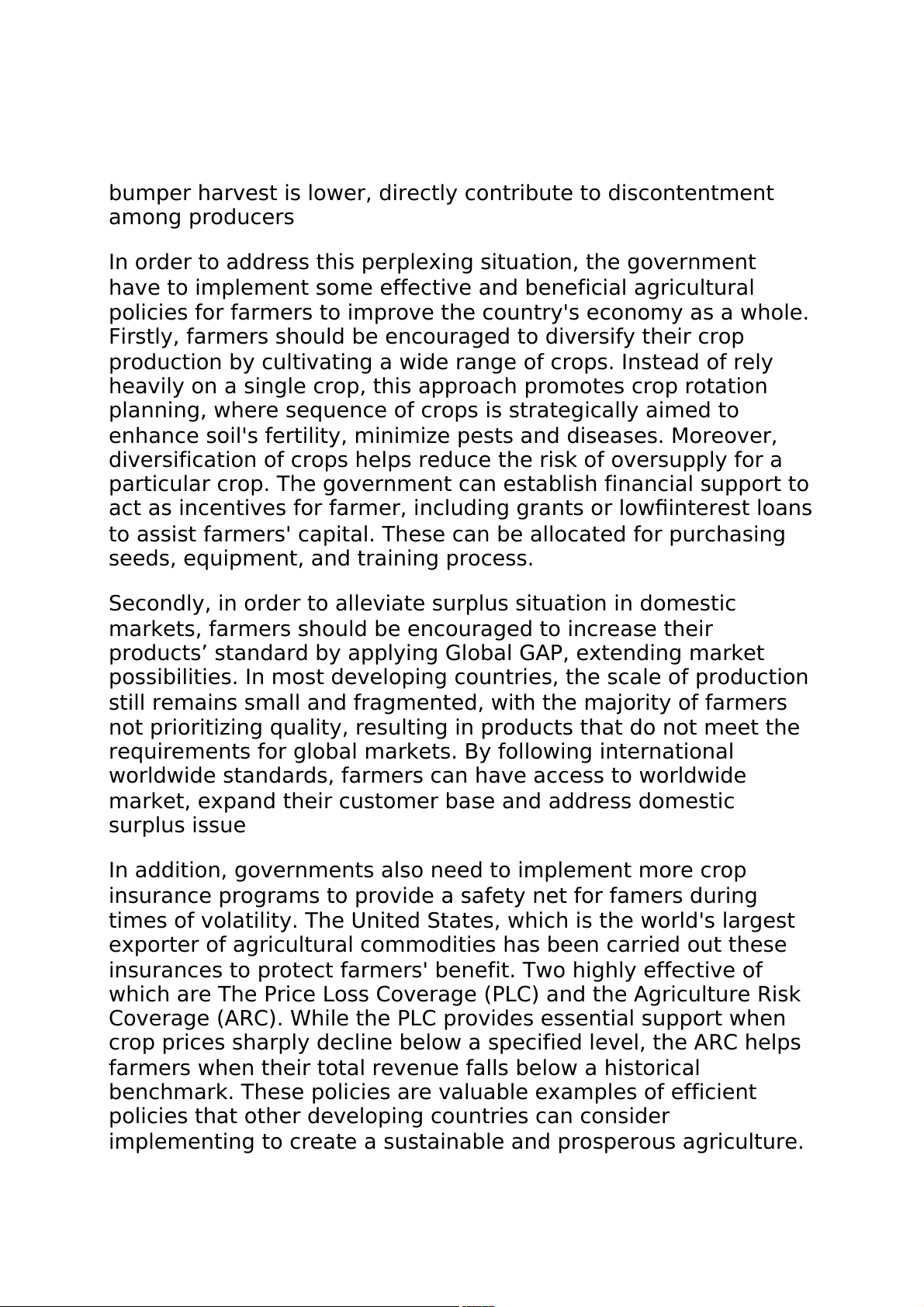
As the demand for agricultural products are inelastic, we have: P: average price = (P1+P2)/2 Q: average quantity (Q1+Q2)/2 | ∆ %Q
(Q 2−Q 1)/Q E |= = Dp ∆%P
(P1−P2)/ P => Therefore, the total revenue after getting a
bumper harvest is lower, directly contribute to discontentment among producers
In order to address this perplexing situation, the government
have to implement some effective and beneficial agricultural
policies for farmers to improve the country's economy as a whole.
Firstly, farmers should be encouraged to diversify their crop
production by cultivating a wide range of crops. Instead of rely
heavily on a single crop, this approach promotes crop rotation
planning, where sequence of crops is strategically aimed to
enhance soil's fertility, minimize pests and diseases. Moreover,
diversification of crops helps reduce the risk of oversupply for a
particular crop. The government can establish financial support to
act as incentives for farmer, including grants or low-interest loans
to assist farmers' capital. These can be allocated for purchasing
seeds, equipment, and training process.
Secondly, in order to alleviate surplus situation in domestic
markets, farmers should be encouraged to increase their
products’ standard by applying Global GAP, extending market
possibilities. In most developing countries, the scale of production
still remains small and fragmented, with the majority of farmers
not prioritizing quality, resulting in products that do not meet the
requirements for global markets. By following international
worldwide standards, farmers can have access to worldwide
market, expand their customer base and address domestic surplus issue
In addition, governments also need to implement more crop
insurance programs to provide a safety net for famers during
times of volatility. The United States, which is the world's largest
exporter of agricultural commodities has been carried out these
insurances to protect farmers' benefit. Two highly effective of
which are The Price Loss Coverage (PLC) and the Agriculture Risk
Coverage (ARC). While the PLC provides essential support when
crop prices sharply decline below a specified level, the ARC helps
farmers when their total revenue falls below a historical
benchmark. These policies are valuable examples of efficient
policies that other developing countries can consider
implementing to create a sustainable and prosperous agriculture.
In conclusion, the contradictory phenomenon where "Farmers are
not happy with good harvests" can be attributed to the inelastic
demand of agriculture products, the fundamental principles of
supply and demand, and the law of diminishing marginal utility.
To address this perplexing situation, governments should
encourage farmers by diversifying crop production, adopting
international quality standards like Global GAP, and create more insurance programs. Works Cited
VNExpress. Điệp khúc 'giải cứu' nông sản Việt. 1 1 2022. 4410939.html>.
Reuters. Analysis: Bumper US corn harvests sinks price, pushes
global supply to surplus. 19 10 2023.
corn-harvest-sinks-prices-pushes-global-supply-surplus-2023- 10-19/>.
https://vnexpress.net/diep-khuc-giai-cuu-nong-san-viet- 4410939.html
https://s.giannini.ucop.edu/uploads/giannini_public/
19/11/1911b7ab-e01d-4d63-8faf-ea1c0bfe746e/v2n2_1.pdf
https://snnptnt.quangnam.gov.vn/webcenter/documentContent? dDocName=PORTAL185346
Tài liệu liên quan:
-

Tự Luận Vimo: Phân Tích Cung, Cầu và Thị Trường Cạnh Tranh| Microeconomics | Trường Đại học Quốc tế, Đại học Quốc gia Thành phố Hồ Chí Minh
5 3 -
Review Questions: Thinking Like an Economist | Microeconomics | Trường Đại học Quốc tế, Đại học Quốc gia Thành phố Hồ Chí Minh
5 3 -
Final Exam Quizlet Questions & Answers | Microeconomics | Trường Đại học Quốc tế, Đại học Quốc gia Thành phố Hồ Chí Minh
5 3 -

Đề thi giữa kỳ II | Microeconomics | Trường Đại học Quốc tế, Đại học Quốc gia Thành phố Hồ Chí Minh
5 3 -

Final Group Project_ The Beer Industry | Microeconomics | Trường Đại học Quốc tế, Đại học Quốc gia Thành phố Hồ Chí Minh
4 2