Microeconomics Concepts and Discussion Questions | Microeconomics | Trường Đại học Quốc tế, Đại học Quốc gia Thành phố Hồ Chí Minh
Question 2: Describe a business plan that you want to do at present (a plan that you must spend whole time on)? Let talk in detail about resources (labor, materials…) you need for the bussiness plan, and how you are going to use them in an efficient way. From that what is your oppurtunity cost to be student? Tài liệu được sưu tầm và soạn thảo dưới dạng file PDF để gửi tới các bạn cùng tham khảo, ôn tập đầy đủ kiến thức, chuẩn bị cho các buổi học thật tốt. Mời bạn đọc đón xem!
Môn: Microeconomics 613 tài liệu
Trường: Trường Đại học Quốc tế, Đại học Quốc gia Thành phố Hồ Chí Minh 1.9 K tài liệu
Tác giả:

Preview text:
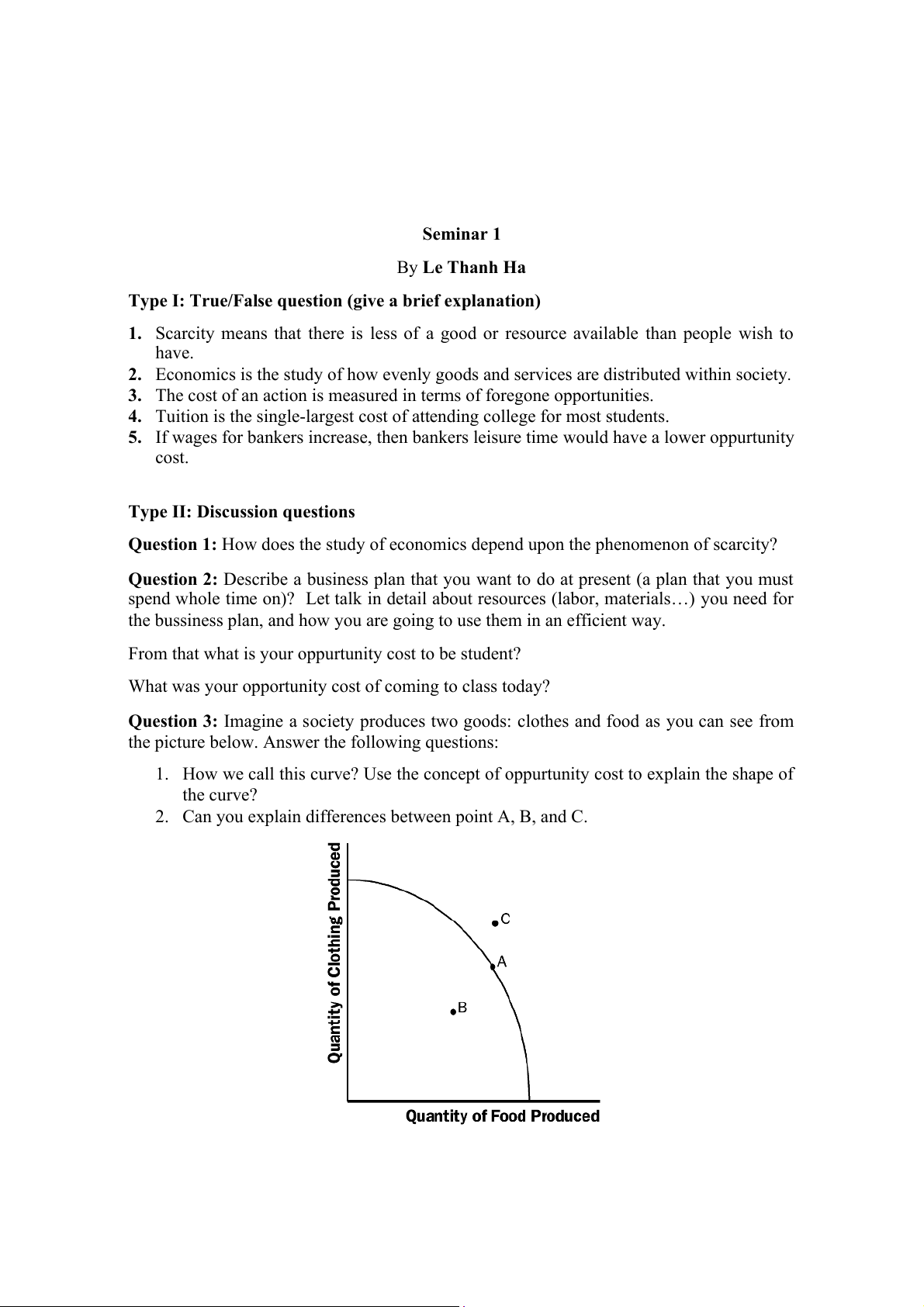
Seminar 1 By Le Thanh Ha
Type I: True/False question (give a brief explanation)
1. Scarcity means that there is less of a good or resource available than people wish to have.
2. Economics is the study of how evenly goods and services are distributed within society.
3. The cost of an action is measured in terms of foregone opportunities.
4. Tuition is the single-largest cost of attending college for most students.
5. If wages for bankers increase, then bankers leisure time would have a lower oppurtunity cost.
Type II: Discussion questions
Question 1: How does the study of economics depend upon the phenomenon of scarcity?
Question 2: Describe a business plan that you want to do at present (a plan that you must
spend whole time on)? Let talk in detail about resources (labor, materials…) you need for
the bussiness plan, and how you are going to use them in an efficient way.
From that what is your oppurtunity cost to be student?
What was your opportunity cost of coming to class today?
Question 3: Imagine a society produces two goods: clothes and food as you can see from
the picture below. Answer the following questions:
1. How we call this curve? Use the concept of oppurtunity cost to explain the shape of the curve?
2. Can you explain differences between point A, B, and C.
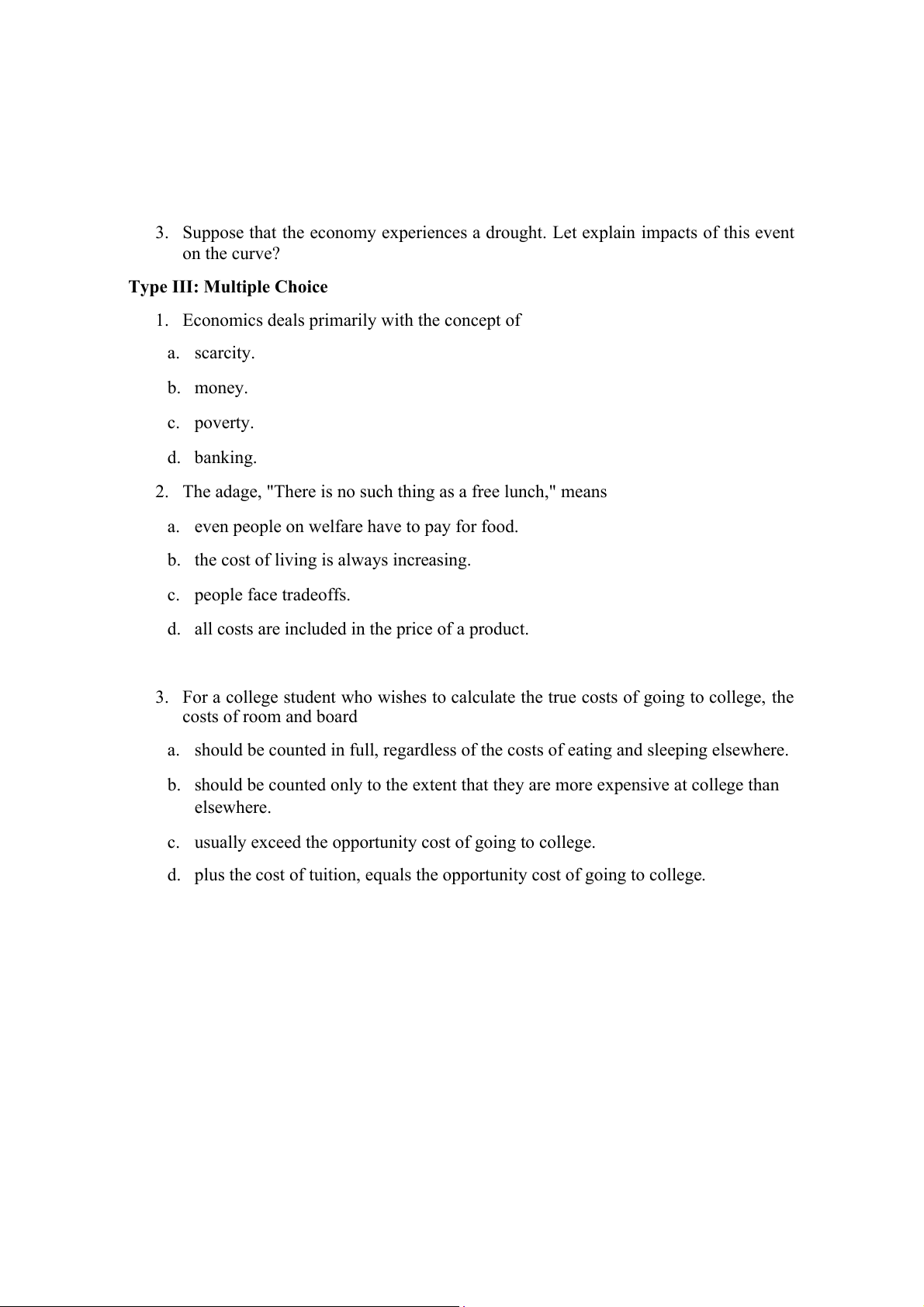
3. Suppose that the economy experiences a drought. Let explain impacts of this event on the curve?
Type III: Multiple Choice
1. Economics deals primarily with the concept of a. scarcity. b. money. c. poverty. d. banking.
2. The adage, "There is no such thing as a free lunch," means
a. even people on welfare have to pay for food.
b. the cost of living is always increasing. c. people face tradeoffs.
d. all costs are included in the price of a product.
3. For a college student who wishes to calculate the true costs of going to college, the costs of room and board
a. should be counted in full, regardless of the costs of eating and sleeping elsewhere.
b. should be counted only to the extent that they are more expensive at college than elsewhere.
c. usually exceed the opportunity cost of going to college.
d. plus the cost of tuition, equals the opportunity cost of going to college.
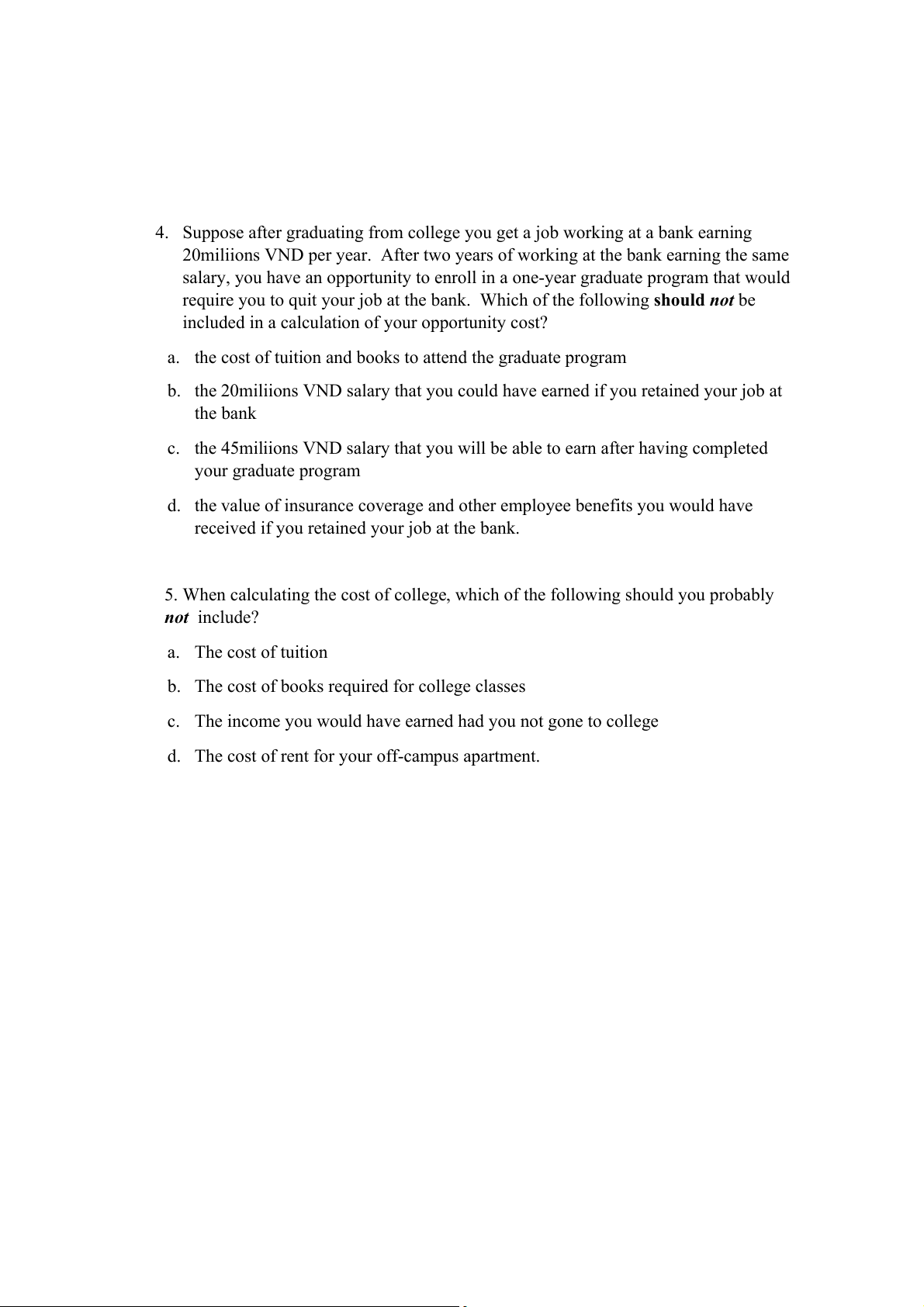
4. Suppose after graduating from college you get a job working at a bank earning
20miliions VND per year. After two years of working at the bank earning the same
salary, you have an opportunity to enroll in a one-year graduate program that would
require you to quit your job at the bank. Which of the following should not be
included in a calculation of your opportunity cost?
a. the cost of tuition and books to attend the graduate program
b. the 20miliions VND salary that you could have earned if you retained your job at the bank
c. the 45miliions VND salary that you will be able to earn after having completed your graduate program
d. the value of insurance coverage and other employee benefits you would have
received if you retained your job at the bank.
5. When calculating the cost of college, which of the following should you probably not include? a. The cost of tuition
b. The cost of books required for college classes
c. The income you would have earned had you not gone to college
d. The cost of rent for your off-campus apartment.
Tài liệu liên quan:
-
Tự Luận Vimo: Phân Tích Cung, Cầu và Thị Trường Cạnh Tranh| Microeconomics | Trường Đại học Quốc tế, Đại học Quốc gia Thành phố Hồ Chí Minh
5 3 -
Review Questions: Thinking Like an Economist | Microeconomics | Trường Đại học Quốc tế, Đại học Quốc gia Thành phố Hồ Chí Minh
5 3 -
Final Exam Quizlet Questions & Answers | Microeconomics | Trường Đại học Quốc tế, Đại học Quốc gia Thành phố Hồ Chí Minh
5 3 -
Đề thi giữa kỳ II | Microeconomics | Trường Đại học Quốc tế, Đại học Quốc gia Thành phố Hồ Chí Minh
5 3 -
Final Group Project_ The Beer Industry | Microeconomics | Trường Đại học Quốc tế, Đại học Quốc gia Thành phố Hồ Chí Minh
4 2