Microeconomics Final Exam Cheat Sheet by egomezc | Microeconomics | Trường Đại học Quốc tế, Đại học Quốc gia Thành phố Hồ Chí Minh
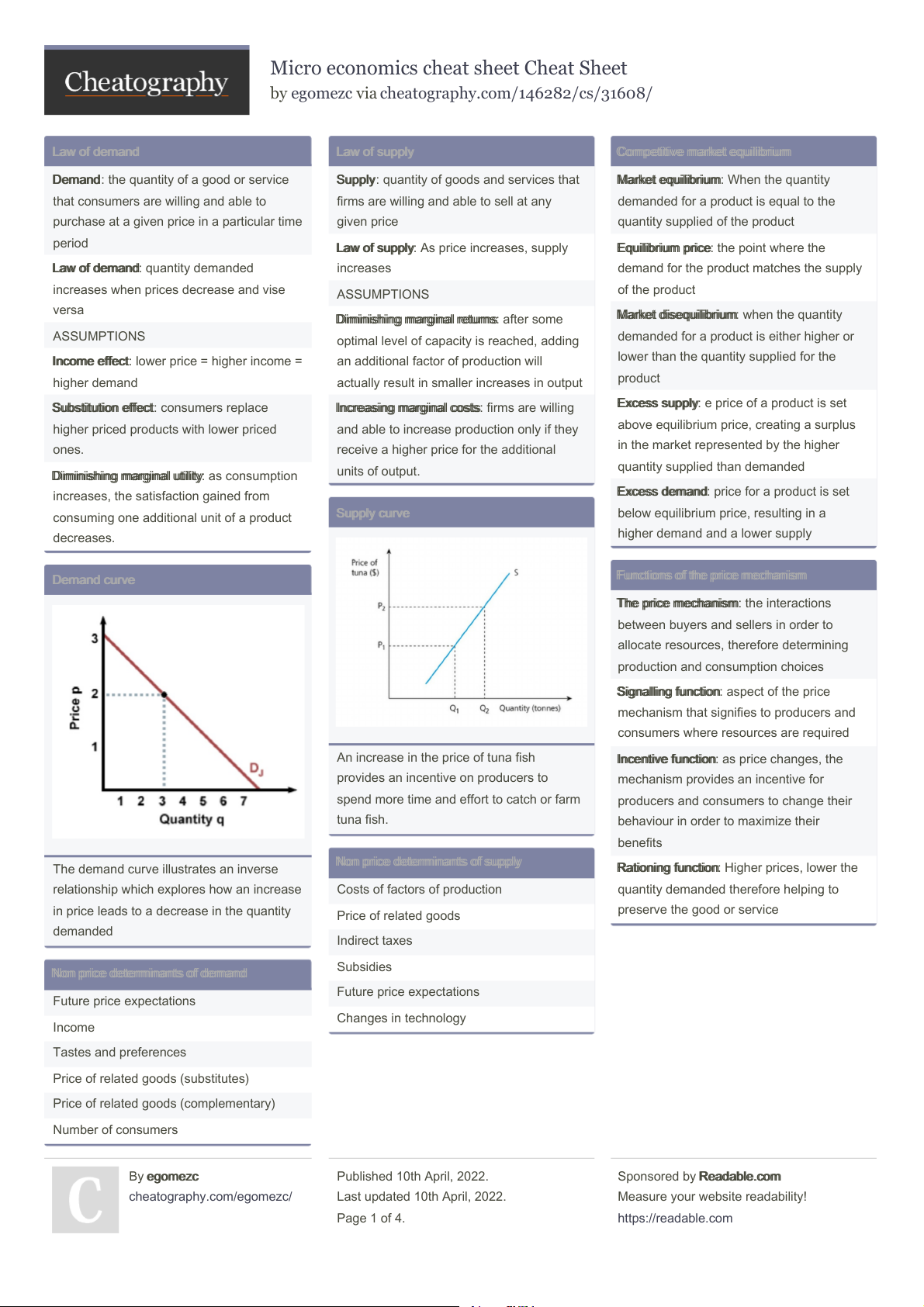
Demand: the quantity of a good or service that consumers are willing and able to purchase at a given price in a particular time period Law of demand: quantity demanded Law of demand increases when prices decrease and vise versa ASSUMPTIONS Income effect: lower price = higher income = higher demand Substitution effect: consumers replace higher priced products with lower priced ones. Tài liệu được sưu tầm và soạn thảo dưới dạng file PDF để gửi tới các bạn cùng tham khảo, ôn tập đầy đủ kiến thức, chuẩn bị cho các buổi học thật tốt. Mời bạn đọc đón xem!
Môn: Microeconomics 613 tài liệu
Trường: Trường Đại học Quốc tế, Đại học Quốc gia Thành phố Hồ Chí Minh 1.9 K tài liệu
Tác giả:


Preview text:
Micro economics cheat sheet Cheat Sheet
by egomezc via cheatography.com/146282/cs/31608/ Law of demand Law of supply
Competitive market equilibrium
Demand: the quantity of a good or service
Supply: quantity of goods and services that
Market equilibrium: When the quantity
that consumers are willing and able to
firms are willing and able to sell at any
demanded for a product is equal to the
purchase at a given price in a particular time given price
quantity supplied of the product period Law of supply
Law of supply: As price increases, supply Equilibrium price
Equilibrium price: the point where the Law of demand
Law of demand: quantity demanded increases
demand for the product matches the supply
increases when prices decrease and vise ASSUMPTIONS of the product versa
Diminishing marginal returns
Diminishing marginal returns: after some
Market disequilibrium: when the quantity ASSUMPTIONS
optimal level of capacity is reached, adding
demanded for a product is either higher or
Income effect: lower price = higher income =
an additional factor of production will
lower than the quantity supplied for the higher demand
actually result in smaller increases in output product
Substitution effect: consumers replace
Increasing marginal costs: firms are willing Excess supply
Excess supply: e price of a product is set
higher priced products with lower priced
and able to increase production only if they
above equilibrium price, creating a surplus ones.
receive a higher price for the additional
in the market represented by the higher
quantity supplied than demanded
Diminishing marginal utility
Diminishing marginal utility: as consumption units of output.
increases, the satisfaction gained from Excess demand
Excess demand: price for a product is set
consuming one additional unit of a product Supply curve
below equilibrium price, resulting in a decreases.
higher demand and a lower supply Demand curve
Functions of the price mechanism
The price mechanism: the interactions
between buyers and sellers in order to
allocate resources, therefore determining
production and consumption choices Signalling function
Signalling function: aspect of the price
mechanism that signifies to producers and
consumers where resources are required
An increase in the price of tuna fish Incentive function
Incentive function: as price changes, the
provides an incentive on producers to
mechanism provides an incentive for
spend more time and effort to catch or farm
producers and consumers to change their tuna fish.
behaviour in order to maximize their benefits
Non price determinants of supply
The demand curve illustrates an inverse
Rationing function: Higher prices, lower the
relationship which explores how an increase Costs of factors of production
quantity demanded therefore helping to
in price leads to a decrease in the quantity preserve the good or service Price of related goods demanded Indirect taxes Subsidies
Non price determinants of demand Future price expectations Future price expectations Changes in technology Income Tastes and preferences
Price of related goods (substitutes)
Price of related goods (complementary) Number of consumers By egomezc egomezc Published 10th April, 2022. Sponsored by Readable.com Readable.com cheatography.com/egomezc/ Last updated 10th April, 2022.
Measure your website readability! Page 1 of 4. https://readable.com
Micro economics cheat sheet Cheat Sheet
by egomezc via cheatography.com/146282/cs/31608/ Surpluses Behavioural economics
Price elasticity of demand (cont)
Consumer: Benefit to buyers who can
Choice architecture: the deliberate design of
PED < 1 → price inelastic demand
purchase the product at a lower price than
different ways of presenting choices to
PED = 0 → perfectly price inelastic demand
they were willing and able to pay
members of society, and the impact of these
PED = ∞ → perfectly price elastic demand
Producer: Benefit to firms who receive a
methods on decision-making.
PED = 1 → unitary elastic demand
price that is higher than the price at which
Nudge theory: the practice of influencing the they were willing to supply at
choices that people make. Nudges are Price elasticity of supply
Social: Sum of consumer and producer
created by choice architects using small
The degree of responsiveness of quantity
surplus at a given market price and output,
prompts or tweaks to alter social and
supplied of a product due to a change in its
thereby maximizing economic welfare
economic behaviour, but without taking
away the power for people to choose. price Allocative efficiency Formula
Formula: PES = % change in quantity Business objectives supplied / % change in price profit maximization
profit maximization: Sales level where DEGREES OF PES VALUES profits are the highest
PES > 1 → price elastic supply CSR
CSR: commit ethical objectives to benefit
PES < 1 → price inelastic supply stakeholders
PES = 0 → perfectly price inelastic supply Market share
Market share: a firm's portion of the total
PES = ∞ → perfectly price elastic supply value of sales revenue
PES = 1 → unitary elastic supply
Satisfaction: aim for a satisfactory or
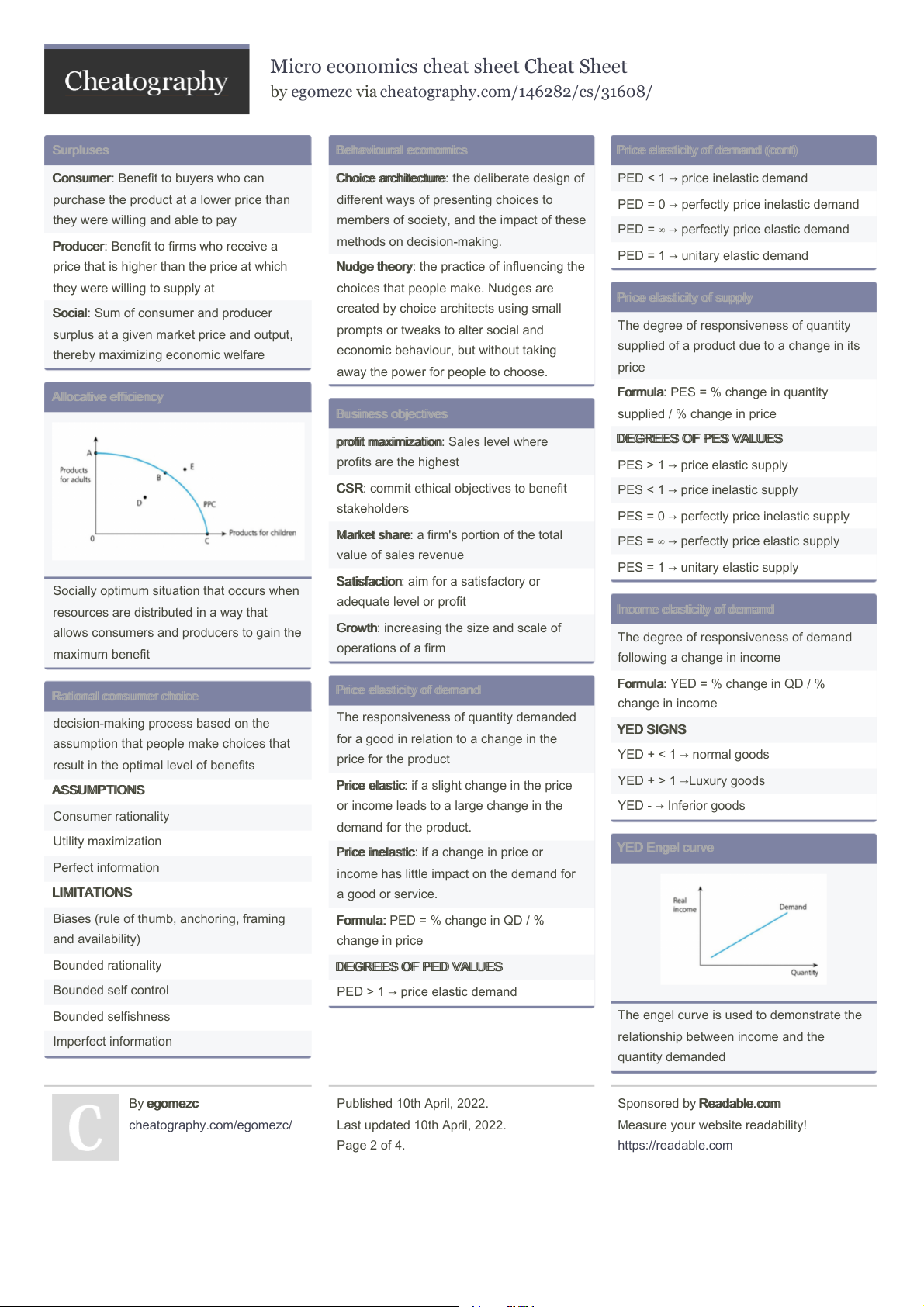
Socially optimum situation that occurs when adequate level or profit
resources are distributed in a way that Income elasticity of demand
allows consumers and producers to gain the Growth
Growth: increasing the size and scale of
The degree of responsiveness of demand operations of a firm maximum benefit following a change in income Formula
Formula: YED = % change in QD / % Price elasticity of demand Rational consumer choice change in income
The responsiveness of quantity demanded
decision-making process based on the YED SIGNS
assumption that people make choices that
for a good in relation to a change in the price for the product YED + < 1 → normal goods
result in the optimal level of benefits YED + > 1 →Luxury goods ASSUMPTIONS Price elastic
Price elastic: if a slight change in the price
or income leads to a large change in the YED - → Inferior goods Consumer rationality demand for the product. Utility maximization
Price inelastic: if a change in price or YED Engel curve Perfect information
income has little impact on the demand for LIMITATIONS a good or service.
Biases (rule of thumb, anchoring, framing Formula:
Formula: PED = % change in QD / % and availability) change in price Bounded rationality DEGREES OF PED VALUES Bounded self control
PED > 1 → price elastic demand Bounded selfishness
The engel curve is used to demonstrate the Imperfect information
relationship between income and the quantity demanded By egomezc egomezc Published 10th April, 2022. Sponsored by Readable.com Readable.com cheatography.com/egomezc/ Last updated 10th April, 2022.
Measure your website readability! Page 2 of 4. https://readable.com
Micro economics cheat sheet Cheat Sheet
by egomezc via cheatography.com/146282/cs/31608/
Reasons for government intervention
Market failure - externalities main terms Externalities Earn government revenue
Market failure: when the signalling,
The external costs or benefits of an Support firms
incentive and rationing functions of the price
economic transaction, causing the market
mechanism fail to operate optimally, which
to fail to achieve the socially optimal level of
Support households on low incomes
leads to a loss in economic welfare. It is consumption and production
Influence the level of production
when there is a misallocation of resources
Positive consumption: When consuming a
Influence the level of consumption private benefits
private benefits: advantages or gains of
good or service, provides a benefit to an To correct market failure
production and consumption enjoyed by an unrelated third party Promote equity individual firm or person.
Positive production: the positive effect an
Private costs: actual expenses incurred by
activity imposes on an unrelated third party
Main forms of government intervention an individual firm or person Negative consumption
Negative consumption: when consuming a PRICE CONTROLS Social benefits
Social benefits: benefits of consumption or
good causes a harmful effect to a third party
Government regulations establishing a
production, that is, the sum of private
Negative production: the production process
maximum or minimum price to be charged benefits and external benefits
results in a harmful effect on a third party.
for certain goods and services. They consist
Social costs: costs of consumption or
INTERVENTION TO CORRECT EXTERN‐
of price ceilings and price floors.
production, that is, the sum of private costs ALITIES
price ceilings: limits the maximum price in and external costs
Indirect taxes, carbon taxes, education,
order to encourage output and consum‐
MPB: additional value enjoyed by
international agreements, subsidies, direct ption.
households and firms from the consumption provision Price floor
Price floor: binding minimum price in order
or production of an extra unit of a particular
to encourage production and supply good or service. Public goods INDIRECT TAXES MPC
MPC additional expense of production for
Collective consumption goods that have
firms or the extra charge paid by customers
A government levy or charge on the sale of
two key characteristics of being non
for the output or consumption of an extra
goods and services, rather than on incomes rivalrous and non excludable unit of a good or service or wealth.
Non rivalrous: a person’s consumption of a
MSB: total gains to society from an extra
specific: charge a fixed amount of tax per
public good does not limit the benefits
unit of production or consumption of a unit sold available to other people. particular good or service Ad valorem
Ad valorem: impose a percentage tax on the
Non excludable: firms cannot exclude MSC
MSC total expenses to society from an extra value of a good or service.
people from the benefits of consumption
unit of production or consumption of a SUBSIDIES FREE RIDER PROBLEM particular product
a sum of money granted to help keep the
When people have access to a good or
price of a commodity or service low.
service without having to pay for it. As a
result, the good or service will be under DIRECT PROVISION
provided or not provided at all in the free
Government provides certain goods and market
services deemed to be in the best interest of the public. By egomezc egomezc Published 10th April, 2022. Sponsored by Readable.com Readable.com cheatography.com/egomezc/ Last updated 10th April, 2022.
Measure your website readability! Page 3 of 4. https://readable.com
Micro economics cheat sheet Cheat Sheet
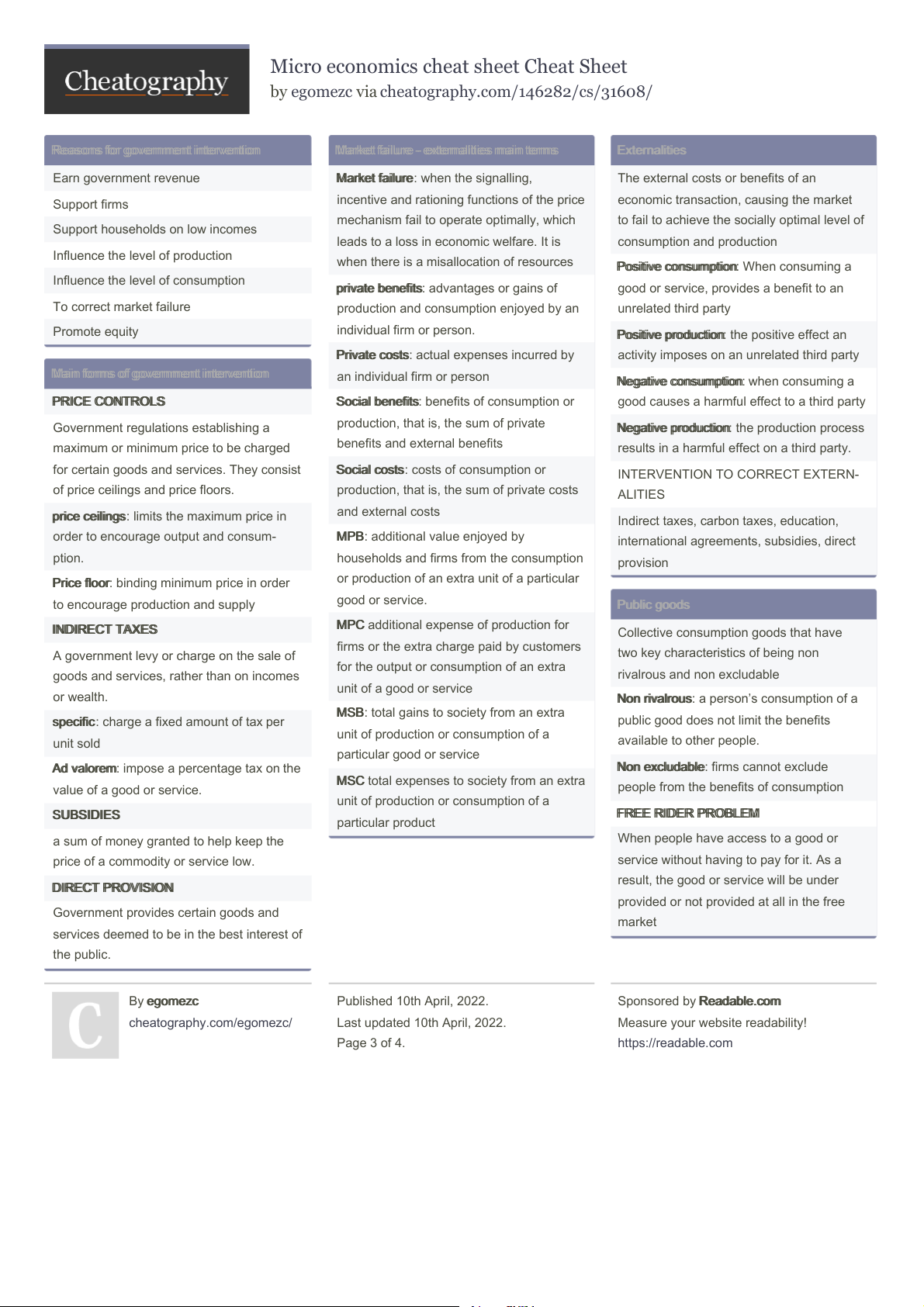
by egomezc via cheatography.com/146282/cs/31608/ Asymmetric information
A source of market failure that exists when
one economic agent (buyer or seller) has
more information than the other in an
economic transaction. It occurs owing to
incomplete information or inaccessibility to information. Adverse selection
Adverse selection: the undesired decisions
or outcomes that occur when buyers and
sellers have access to imperfect inform‐ ation. Moral hazard
Moral hazard: situation where a party
protected from risk behaves differently than
if they were fully exposed to the risk.
Responses to asymmetric information GOVERNMENT RESPONSES legislation Provision of information PRIVATE RESPONSES
Signalling: used by parties with access to
more information to maximize their own level of satisfaction Screening
Screening: used by parties with access to
less information to maximize their own level of satisfaction By egomezc egomezc Published 10th April, 2022. Sponsored by Readable.com Readable.com cheatography.com/egomezc/ Last updated 10th April, 2022.
Measure your website readability! Page 4 of 4. https://readable.com
Tài liệu liên quan:
-

Tự Luận Vimo: Phân Tích Cung, Cầu và Thị Trường Cạnh Tranh| Microeconomics | Trường Đại học Quốc tế, Đại học Quốc gia Thành phố Hồ Chí Minh
5 3 -
Review Questions: Thinking Like an Economist | Microeconomics | Trường Đại học Quốc tế, Đại học Quốc gia Thành phố Hồ Chí Minh
5 3 -
Final Exam Quizlet Questions & Answers | Microeconomics | Trường Đại học Quốc tế, Đại học Quốc gia Thành phố Hồ Chí Minh
5 3 -

Đề thi giữa kỳ II | Microeconomics | Trường Đại học Quốc tế, Đại học Quốc gia Thành phố Hồ Chí Minh
5 3 -

Final Group Project_ The Beer Industry | Microeconomics | Trường Đại học Quốc tế, Đại học Quốc gia Thành phố Hồ Chí Minh
4 2