Multiple Choice Questions on Monopolistic Competition and Oligopoly | Microeconomics | Trường Đại học Quốc tế, Đại học Quốc gia Thành phố Hồ Chí Minh
Question 22: Game theory can be used to demonstrate: A: that oligopolistic firms are mutually interdependent. B: that independent pricing will lead to low-price policies. C: that oligopolists can increase their profits through collusion. D: all of the above. Question 23: The kinked demand curve model helps to explain price rigidity because: A: there is a gap in the marginal revenue curve, within which changes in marginal cost will not affect output or price. B: demand is inelastic above and elastic below the ‘going’ price. C: the model assumes firms are engaging in some form of collusion. D: the associated marginal revenue curve is perfectly elastic at the ‘going’ price. Tài liệu được sưu tầm và soạn thảo dưới dạng file PDF để gửi tới các bạn cùng tham khảo, ôn tập đầy đủ kiến thức, chuẩn bị cho các buổi học thật tốt. Mời bạn đọc đón xem!
Môn: Microeconomics 393 tài liệu
Trường: Trường Đại học Quốc tế, Đại học Quốc gia Thành phố Hồ Chí Minh 1.7 K tài liệu
Tác giả:

Preview text:
Multiple choice topic – 9
Question 1: Under monopolistic competition, entry to the industry is:
A: completely free of barriers.
B: more difficult than under pure competition, but not nearly as difficult as under pure monopoly.
C: more difficult than under pure monopoly. D: blocked.
Question 2: Which of the following is not characteristic of monopolistic competition?
A: Easy entry to the industry.
B: Relatively large numbers of sellers. C: Product differentiation.
D: Production at minimum ATC in the long run.
Question 3: If the number of firms in a monopolistically competitive industry increases,
and the degree of product differentiation diminishes:
A: the likelihood of realising economic profits in the long run would be enhanced.
B: individual firms would now be operating at outputs where their average total costs would be higher.
C: the industry would more closely approximate pure competition.
D: the likelihood of collusive pricing would increase.
Question 4: The monopolistic competition model predicts that:
A: allocative efficiency will be achieved.
B: productive efficiency will be achieved.
C: firms will engage in non-price competition.
D: firms will realise economic profits in the long run.
Question 5: A monopolistically competitive firm has a :
A: highly elastic demand curve.
B: highly inelastic demand curve.
C: perfectly inelastic demand curve.
D: perfectly elastic demand curve.
Question 6: The monopolistically competitive seller's demand curve will tend to become more elastic, the: 1
A: more significant the barriers to entering the industry.
B: greater the degree of product differentiation.
C: larger the number of competitors.
D: smaller the number of competitors.
Question 7: A monopolistically competitive firm's marginal revenue curve:
A: is downsloping and coincides with the demand curve.
B: coincides with the demand curve and is parallel to the horizontal axis.
C: is downsloping and lies below the demand curve.
D: does not exist because the firm is a ‘price maker’.
Question 8: Monopolistically competitive firms:
A: realise normal profits in the short run, but losses in the long run.
B: tend to incur persistent losses in both the short run and long run.
C: may realise either profits or losses in the short run, but tend to realise a normal profit in the long run.
D: persistently realise economic profits in both the short run and long run.
Question 9: The monopolistically competitive seller maximises profits by producing at the point where:
A: total revenue is at a maximum.
B: average costs are at a minimum.
C: marginal revenue equals marginal cost.
D: price equals marginal revenue.
Question 10: In the long run, a monopolistically competitive firm's economic profits:
A: will be maximised where price equals average cost.
B: may be positive, zero, or negative. C: are always positive. D: tend towards zero.
Question 11: Other things being the same, if more firms enter a monopolistically
competitive industry, we would expect:
A: the demand curves facing existing firms to shift to the right.
B: the demand curves facing existing firms to shift to the left.
C: the demand curves facing existing firms to become less elastic.
D: that losses would necessarily occur. 2
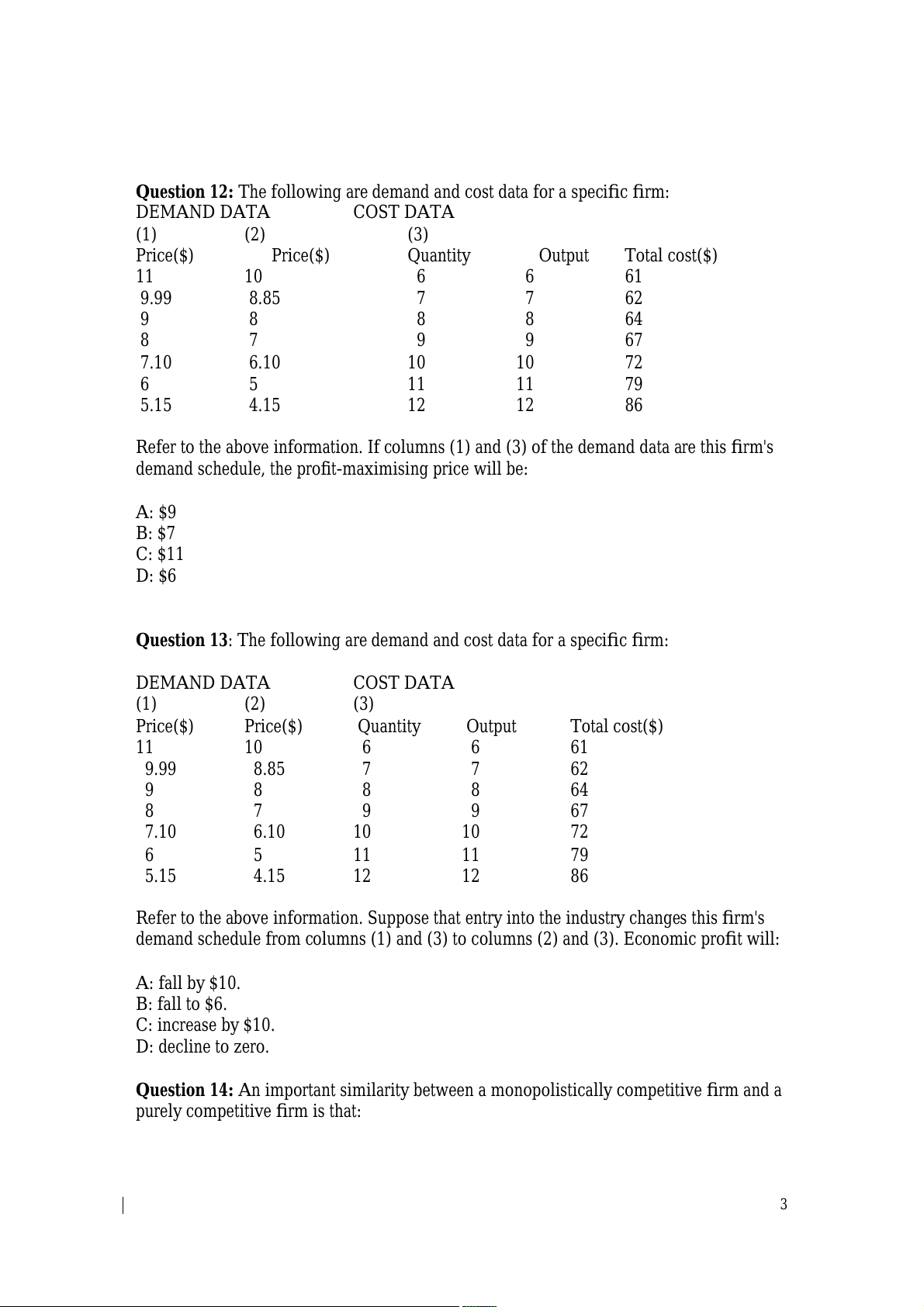
Question 12: The following are demand and cost data for a specific firm: DEMAND DATA COST DATA (1) (2) (3) Price($) Price($) Quantity Output Total cost($) 11 10 6 6 61 9.99 8.85 7 7 62 9 8 8 8 64 8 7 9 9 67 7.10 6.10 10 10 72 6 5 11 11 79 5.15 4.15 12 12 86
Refer to the above information. If columns (1) and (3) of the demand data are this firm's
demand schedule, the profit-maximising price will be: A: $9 B: $7 C: $11 D: $6
Question 13: The following are demand and cost data for a specific firm: DEMAND DATA COST DATA (1) (2) (3) Price($) Price($) Quantity Output Total cost($) 11 10 6 6 61 9.99 8.85 7 7 62 9 8 8 8 64 8 7 9 9 67 7.10 6.10 10 10 72 6 5 11 11 79 5.15 4.15 12 12 86
Refer to the above information. Suppose that entry into the industry changes this firm's
demand schedule from columns (1) and (3) to columns (2) and (3). Economic profit will: A: fall by $10. B: fall to $6. C: increase by $10. D: decline to zero.
Question 14: An important similarity between a monopolistically competitive firm and a
purely competitive firm is that: 3
A: both face perfectly elastic demand schedules.
B: economic profits tend toward zero for both.
C: both realise productive efficiency.
D: both realise allocative efficiency.
Question 15: In equilibrium, a monopolistically competitive producer achieves:
A: neither ‘productive efficiency’ nor ‘allocative efficiency’.
B: both ‘productive efficiency’ and ‘allocative efficiency’.
C: ‘productive efficiency’, but not ‘allocative efficiency’.
D: ‘allocative efficiency’, but not ‘productive efficiency’.
Question 16: Non-price competition refers to:
A: competition between products of different industries, e.g. competition between
aluminium and steel in the manufacture of automobile parts.
B: price increases by a firm, which are ignored by its rivals.
C: advertising, product promotion, and changes in the real or perceived characteristics of a product.
D: reductions in production costs which are not reflected in price reductions.
Question 17: Oligopolistic industries are characterised by:
A: a few dominant firms and substantial entry barriers.
B: a few dominant firms and no barriers to entry.
C: a large number of firms and low entry barriers.
D: a few dominant firms and low entry barriers.
Question 18: The mutual interdependence which characterises oligopoly arises because:
A: the products of various firms are homogeneous.
B: the products of various firms are differentiated.
C: a small number of firms produce a large proportion of industry output.
D: the demand curves of firms are kinked at the prevailing price.
Question 19: Barriers to entry in oligopolistic industries may consist of: A: economies of scale. B: patents.
C: ownership of essential resources. D: all of the above.
Question 20: Economists use game theory to analyse the choices faced by the managers
of oligopolistic firms primarily because: 4
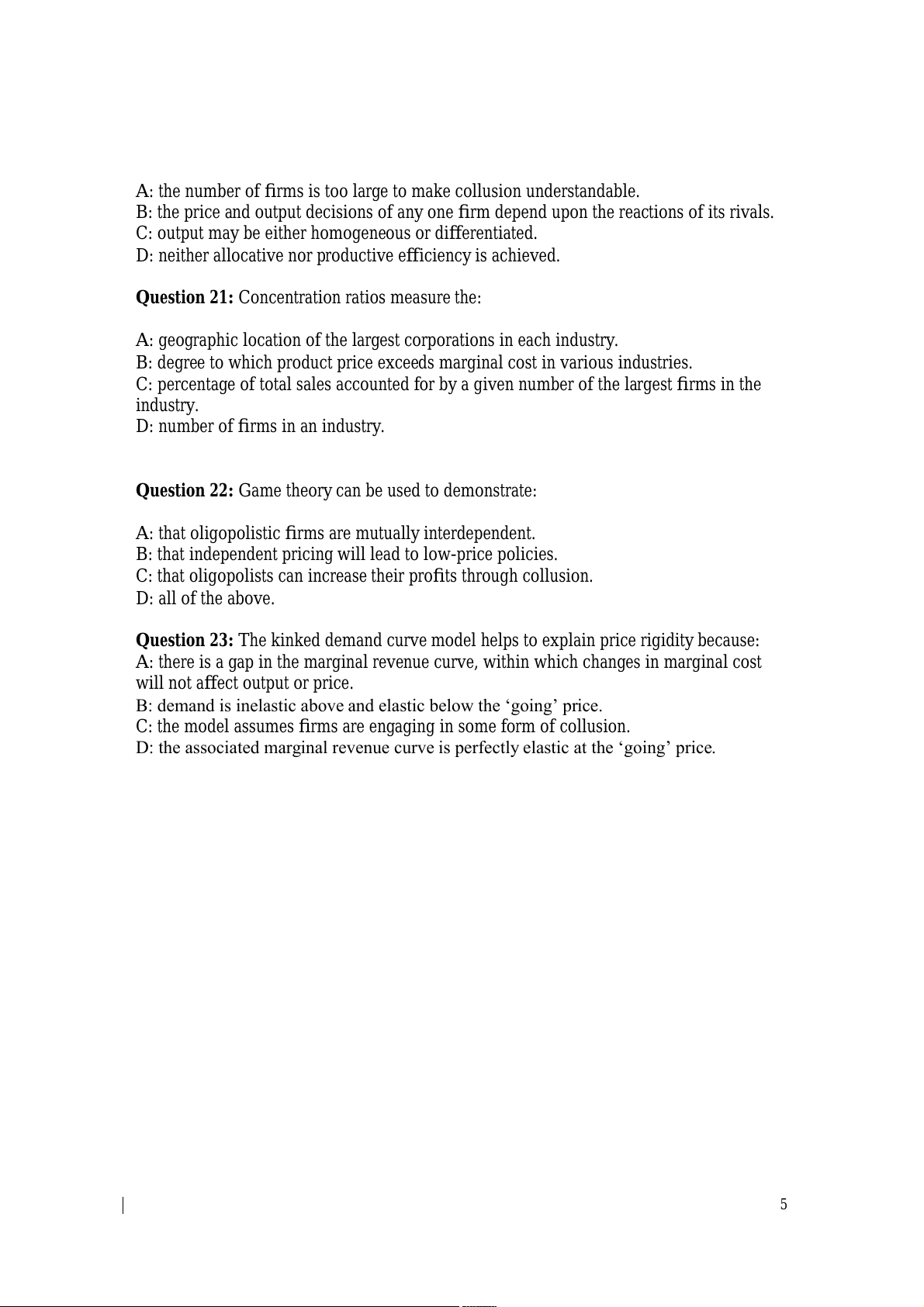
A: the number of firms is too large to make collusion understandable.
B: the price and output decisions of any one firm depend upon the reactions of its rivals.
C: output may be either homogeneous or differentiated.
D: neither allocative nor productive efficiency is achieved.
Question 21: Concentration ratios measure the:
A: geographic location of the largest corporations in each industry.
B: degree to which product price exceeds marginal cost in various industries.
C: percentage of total sales accounted for by a given number of the largest firms in the industry.
D: number of firms in an industry.
Question 22: Game theory can be used to demonstrate:
A: that oligopolistic firms are mutually interdependent.
B: that independent pricing will lead to low-price policies.
C: that oligopolists can increase their profits through collusion. D: all of the above.
Question 23: The kinked demand curve model helps to explain price rigidity because:
A: there is a gap in the marginal revenue curve, within which changes in marginal cost
will not affect output or price.
B: demand is inelastic above and elastic below the ‘going’ price.
C: the model assumes firms are engaging in some form of collusion.
D: the associated marginal revenue curve is perfectly elastic at the ‘going’ price. 5
Tài liệu liên quan:
-
Vi mô và Tính Toán Giới Hạn Lợi Ích Cuối Kỳ | Microeconomics | Trường Đại học Quốc tế, Đại học Quốc gia Thành phố Hồ Chí Minh
1 1 -
Firm Behavior & Market Structures Exam Notes | Microeconomics | Trường Đại học Quốc tế, Đại học Quốc gia Thành phố Hồ Chí Minh
1 1 -
Monopolist & Firm Analysis Assignment | Microeconomics | Trường Đại học Quốc tế, Đại học Quốc gia Thành phố Hồ Chí Minh
1 1 -

Public Economy 18: The Impact of Tariffs on Voter Participation and Policy | Microeconomics | Trường Đại học Quốc tế, Đại học Quốc gia Thành phố Hồ Chí Minh
1 1