Numbers and Operations in Quantitative Methods | Microeconomics | Trường Đại học Quốc tế, Đại học Quốc gia Thành phố Hồ Chí Minh
Add, subtract, multiply and divide positive, negative and zero numbers. Tài liệu được sưu tầm và soạn thảo dưới dạng file PDF với mục đích hỗ trợ học tập và tham khảo. Nội dung tài liệu được trình bày rõ ràng, dễ tiếp cận, phù hợp cho việc ôn tập và củng cố kiến thức trong quá trình học đại học. Đây sẽ là nguồn tư liệu hữu ích giúp các bạn sinh viên chuẩn bị tốt hơn cho các buổi học, đồng thời mở rộng thêm hiểu biết về môn học. Hy vọng tài liệu này sẽ mang lại nhiều giá trị và hỗ trợ các bạn trong hành trình học tập. Mời bạn đọc cùng tham khảo!
Môn: Microeconomics 613 tài liệu
Trường: Trường Đại học Quốc tế, Đại học Quốc gia Thành phố Hồ Chí Minh 1.9 K tài liệu
Tác giả:


Preview text:
Lecture 1 NUMBERS QUANTITATIVE METHODS AND OPERATIONS Lecture 1 LEARNING OBJECTIVES
Add, subtract, multiply and divide positive, negative and zero numbers.
Combine these operations using brackets.
Make rough estimates before using a calculator.
Understand how to round to so many decimal places or
significant figures and how to use scientific notation. Lecture 1 INTRODUCTION
Numbers are used everywhere to describe and measure, to
allocate resources and to plan ahead.
Without numbers, accurate measurement would be impossible
to quantify physical phenomena (e.g. temperature), medical
diagnostics (e.g. blood pressure), and economic statistics (e.g. profit and GDP). Lecture 1 1. NUMBERS INTEGERS (WHOLE NUMBERS)
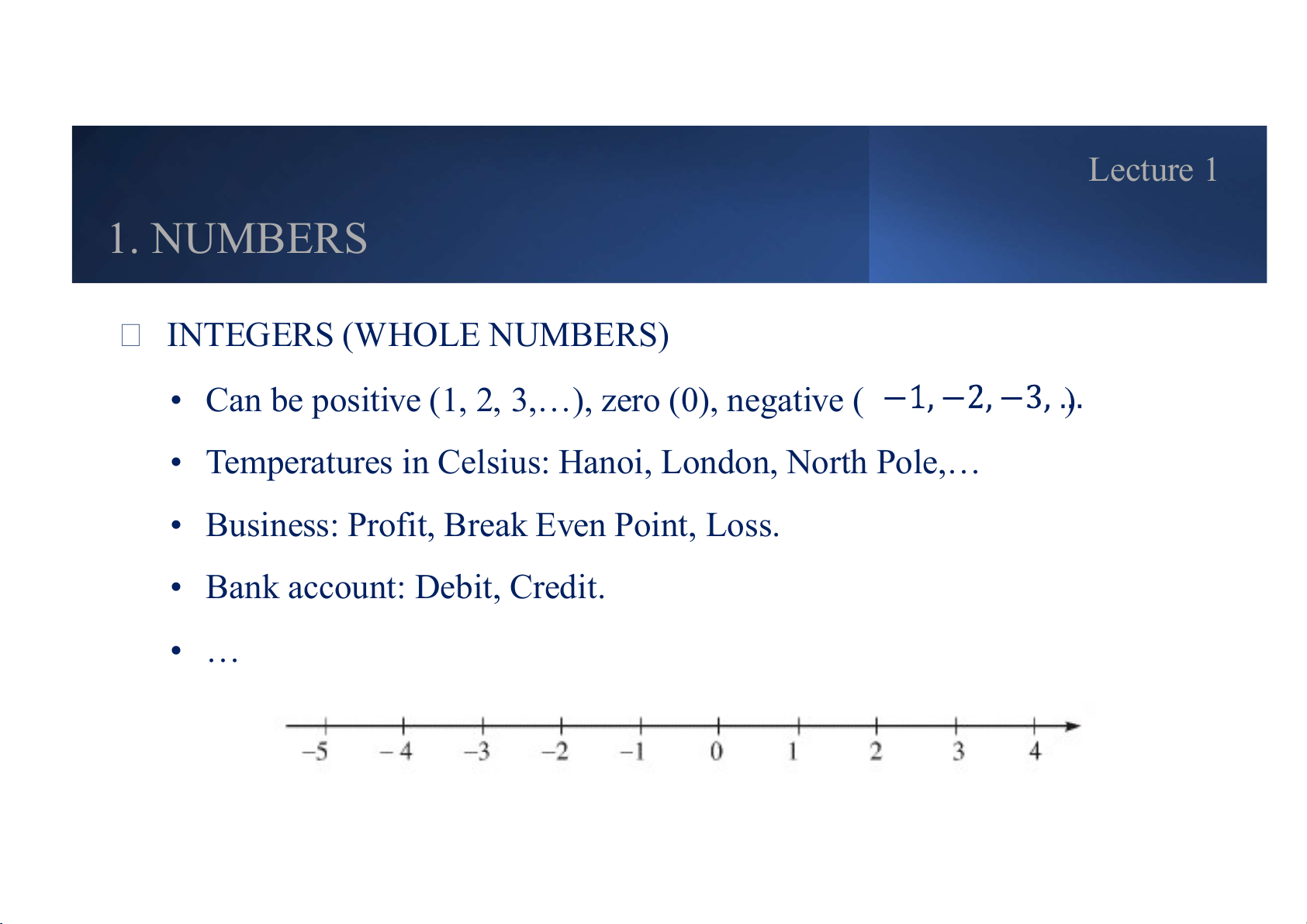
• Can be positive (1, 2, 3,…), zero (0), negative ( )
• Temperatures in Celsius: Hanoi, London, North Pole,…
• Business: Profit, Break Even Point, Loss.
• Bank account: Debit, Credit. • … Lecture 1 1. NUMBERS RATIONAL NUMBERS
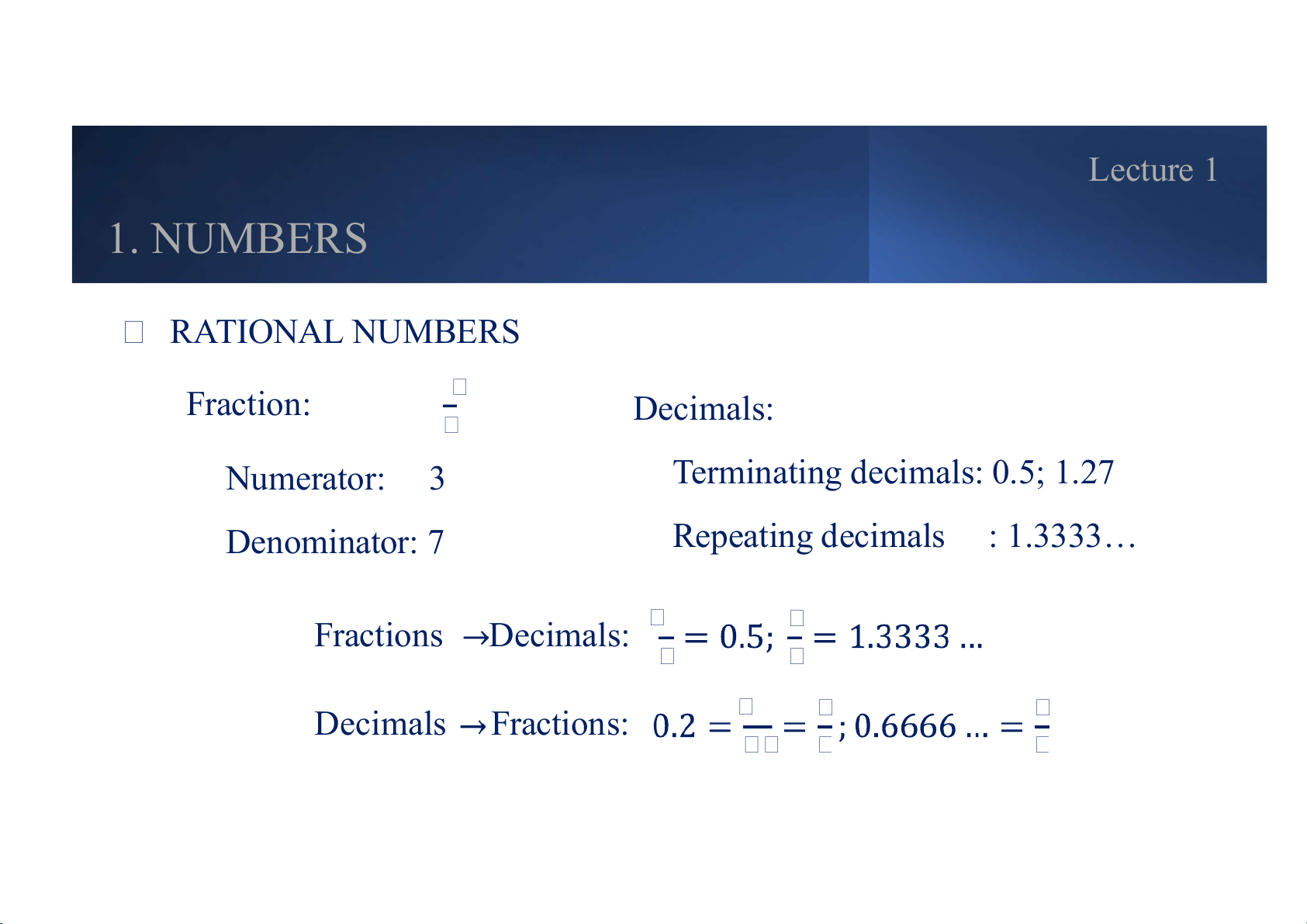
• Can be expressed as “ratios” of two integers • Fractions: • Decimals:
• Integers (as special rational numbers): Lecture 1 1. NUMBERS RATIONAL NUMBERS Fraction: Decimals: Numerator: 3
Terminating decimals: 0.5; 1.27 Denominator: 7
Repeating decimals : 1.3333… Fractions Decimals: Decimals Fractions: Lecture 1 1. NUMBERS
Some numbers are too big or too small to
show all the details, so we need some more
efficient ways to represent the numbers
without losing too much information. Lecture 1 1. NUMBERS ROUNDING
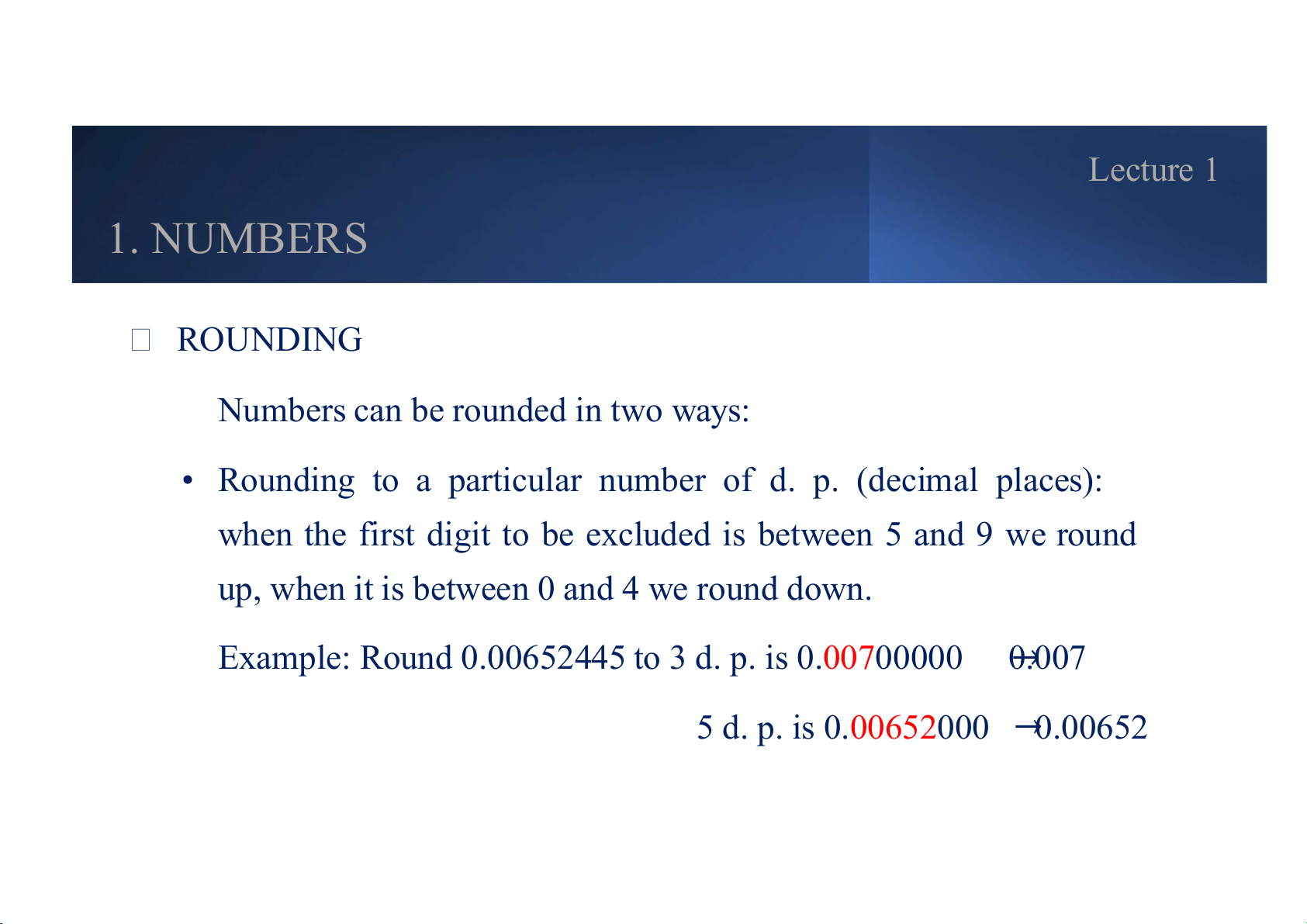
Numbers can be rounded in two ways:
• Rounding to a particular number of d. p. (decimal places):
when the first digit to be excluded is between 5 and 9 we round
up, when it is between 0 and 4 we round down.
Example: Round 0.00652445 to 3 d. p. is 0.00700000 0.007 5 d. p. is 0.00652000 0.00652 Lecture 1 1. NUMBERS ROUNDING
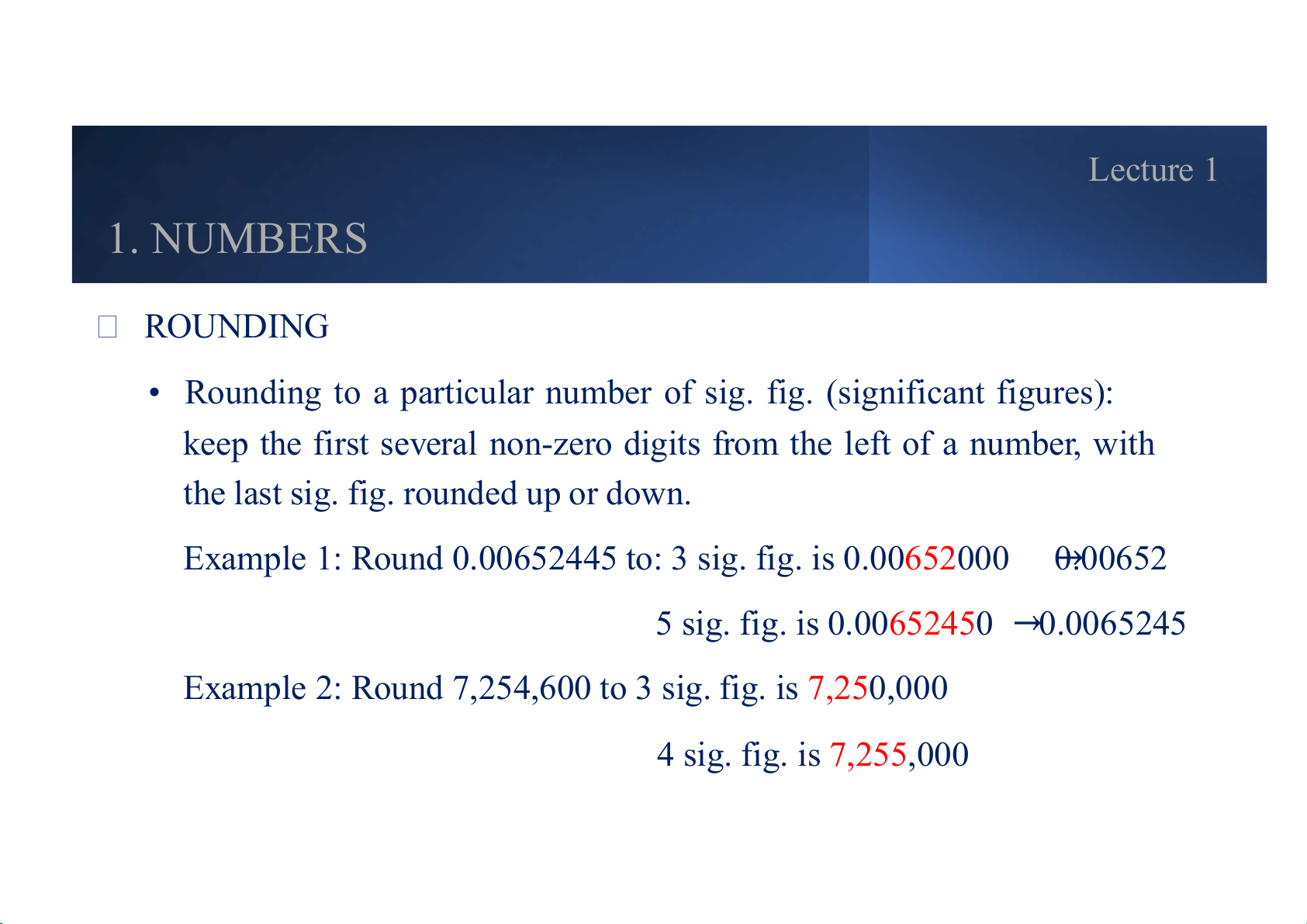
• Rounding to a particular number of sig. fig. (significant figures):
keep the first several non-zero digits from the left of a number, with
the last sig. fig. rounded up or down.
Example 1: Round 0.00652445 to: 3 sig. fig. is 0.00652000 0.00652
5 sig. fig. is 0.00652450 0.0065245
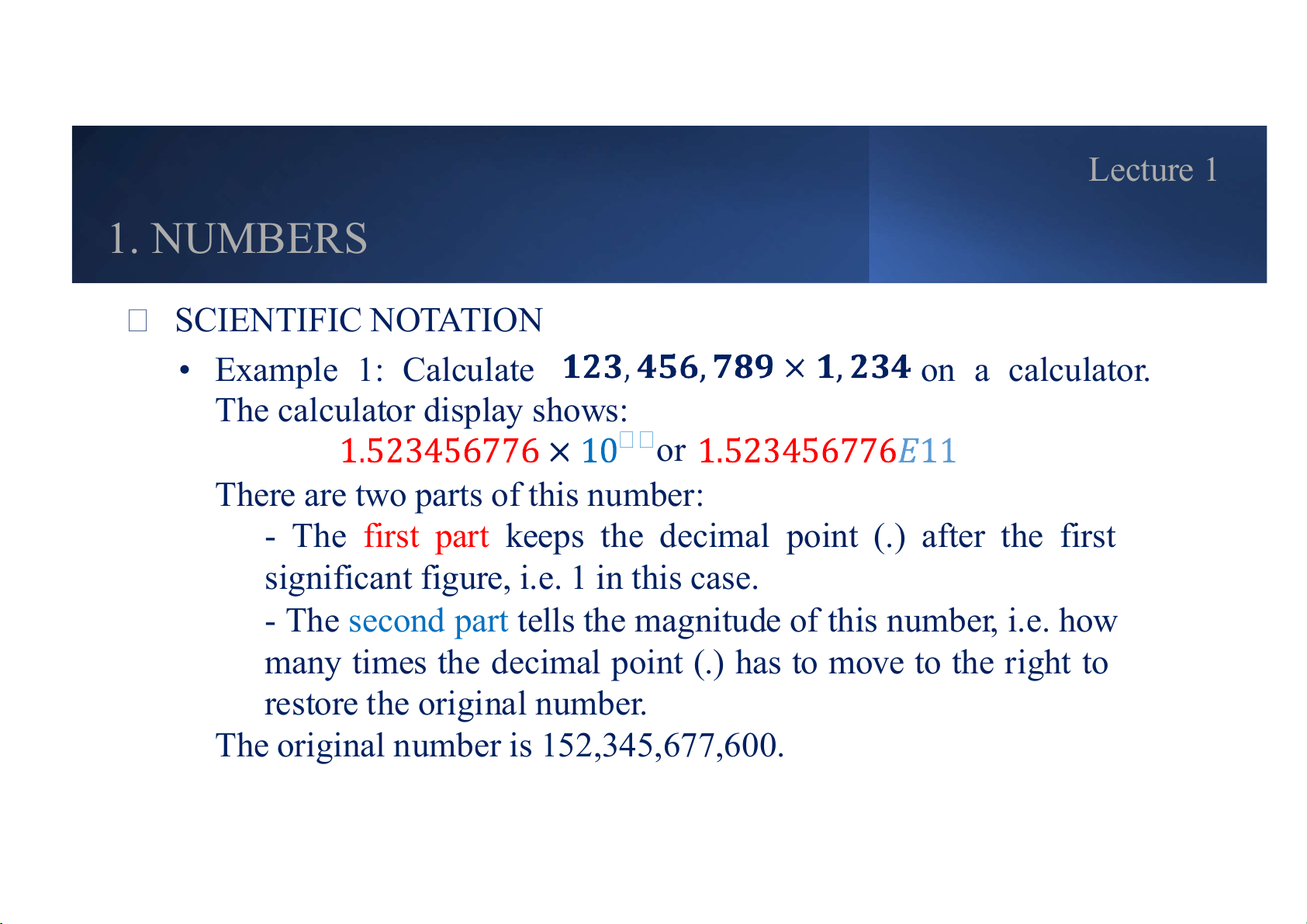
Example 2: Round 7,254,600 to 3 sig. fig. is 7,250,000 4 sig. fig. is 7,255,000 Lecture 1 1. NUMBERS SCIENTIFIC NOTATION • Example 1: Calculate on a calculator. The calculator display shows: or
There are two parts of this number:
- The first part keeps the decimal point (.) after the first
significant figure, i.e. 1 in this case.
- The second part tells the magnitude of this number, i.e. how
many times the decimal point (.) has to move to the right to restore the original number.
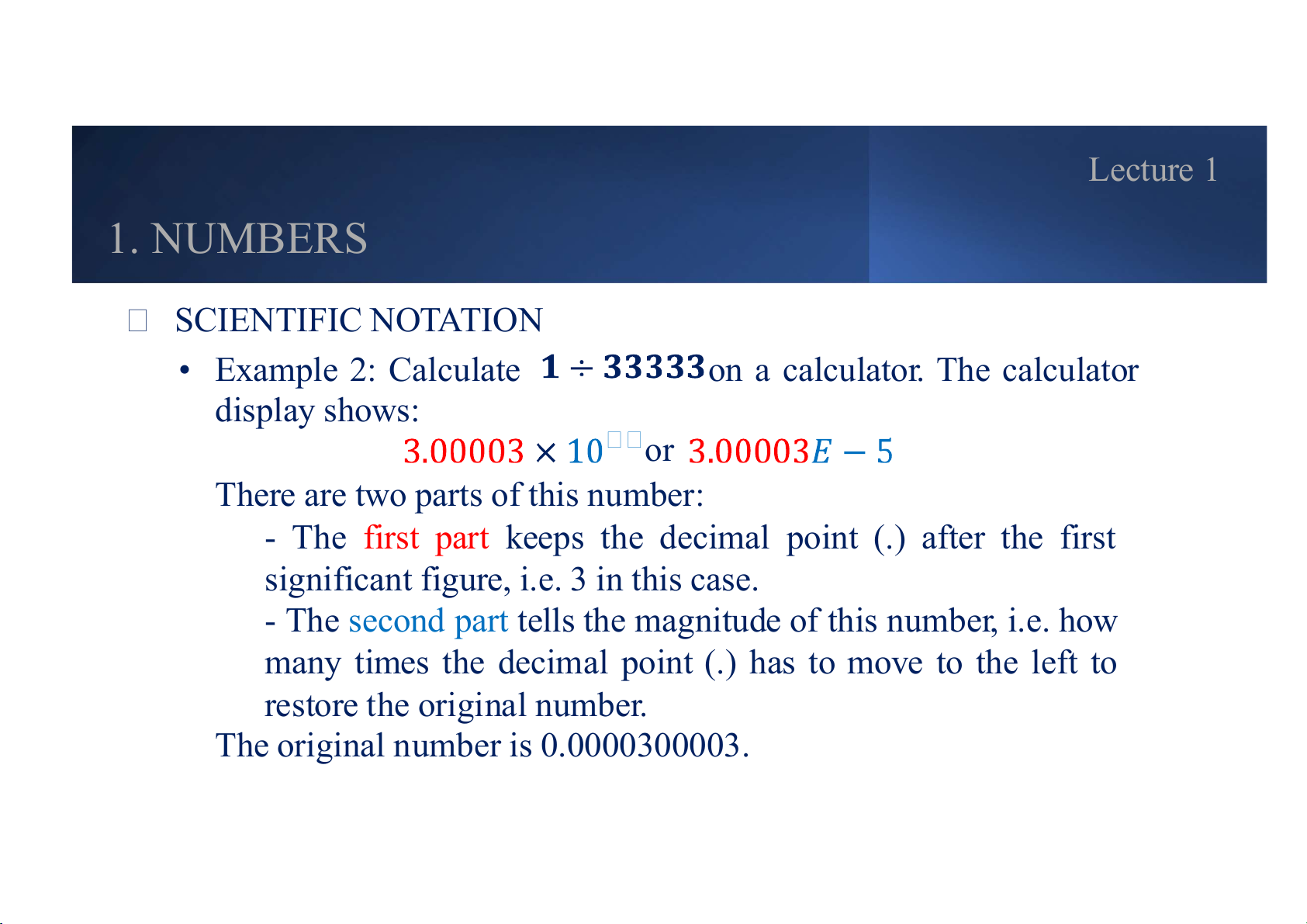
The original number is 152,345,677,600. Lecture 1 1. NUMBERS SCIENTIFIC NOTATION • Example 2: Calculate
on a calculator. The calculator display shows: or
There are two parts of this number:
- The first part keeps the decimal point (.) after the first
significant figure, i.e. 3 in this case.
- The second part tells the magnitude of this number, i.e. how
many times the decimal point (.) has to move to the left to restore the original number.
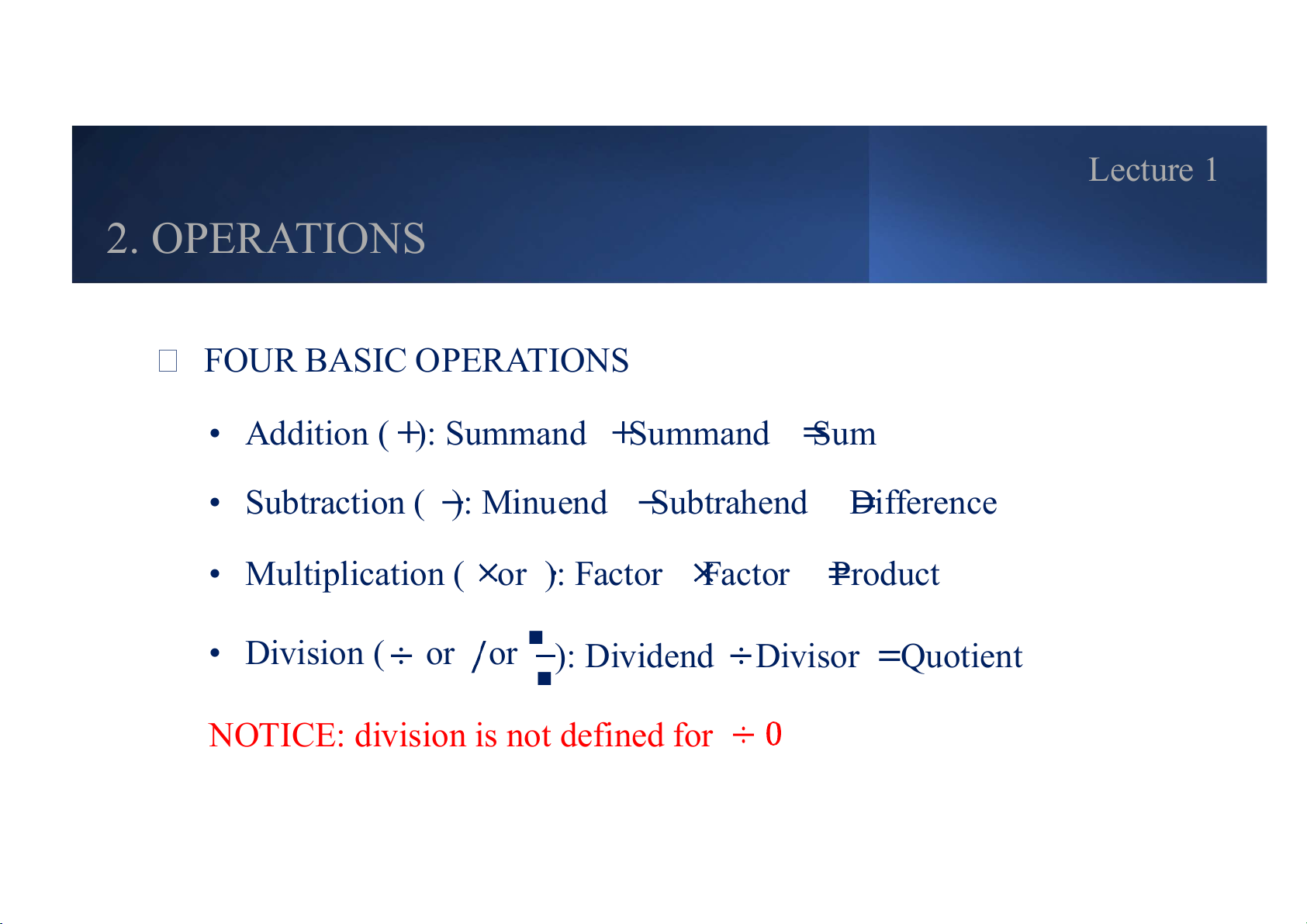
The original number is 0.0000300003. Lecture 1 2. OPERATIONS FOUR BASIC OPERATIONS
• Addition ( ): Summand Summand Sum
• Subtraction ( ): Minuend Subtrahend Difference
• Multiplication ( or ): Factor Factor Product • Division (
or or ∎ ): Dividend Divisor Quotient ∎
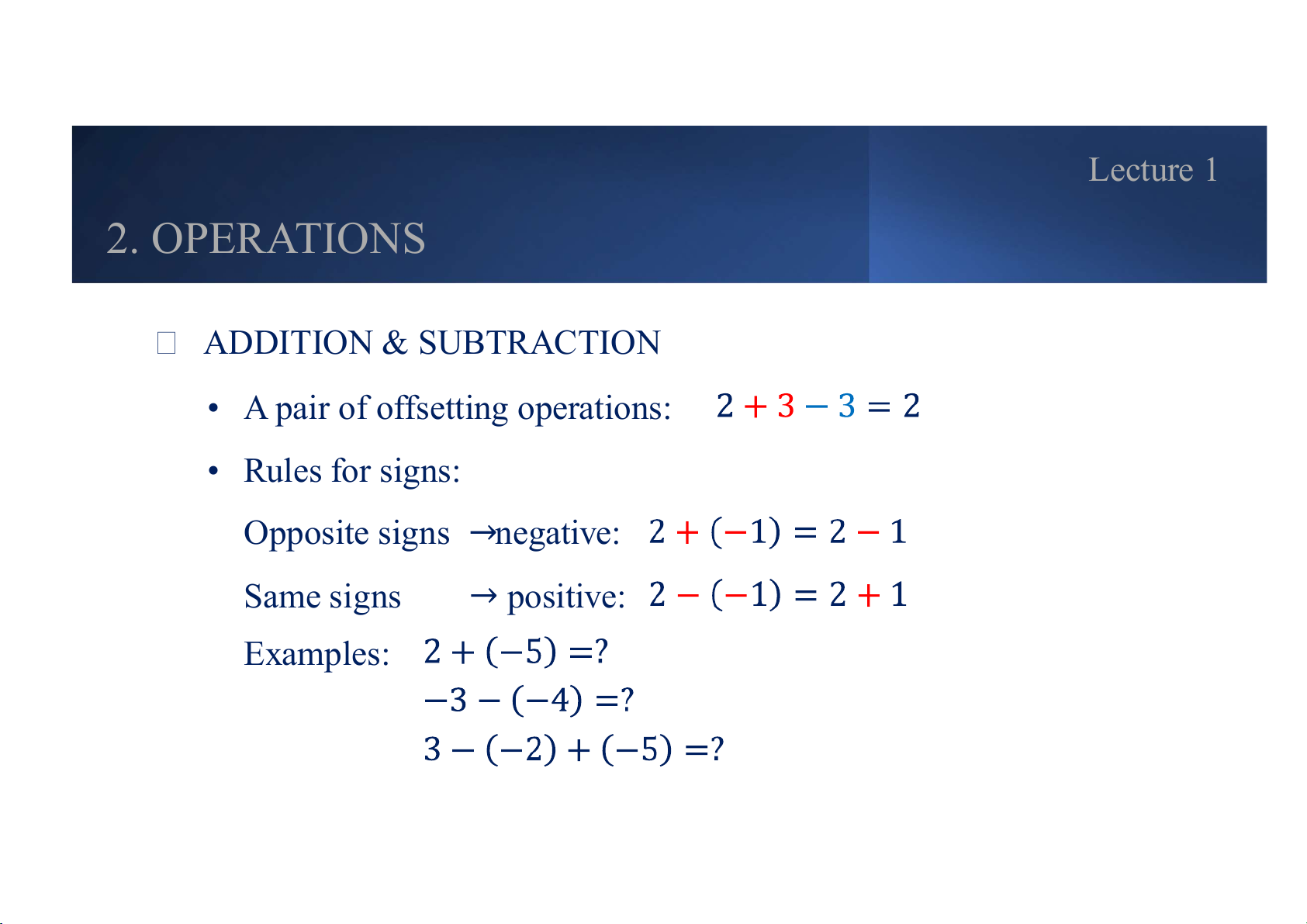
NOTICE: division is not defined for Lecture 1 2. OPERATIONS ADDITION & SUBTRACTION
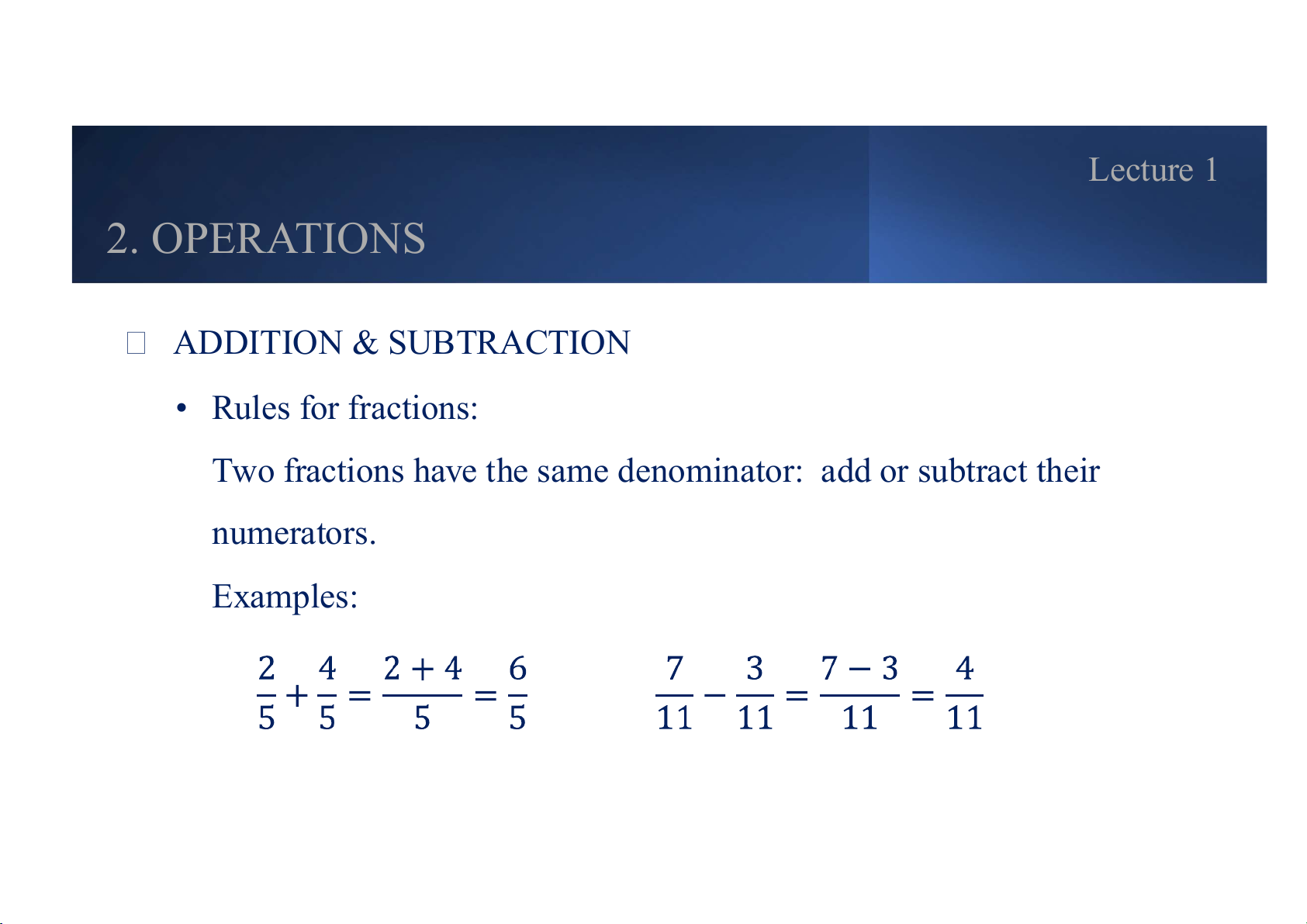
• A pair of offsetting operations: • Rules for signs: Opposite signs negative: Same signs positive: Examples: Lecture 1 2. OPERATIONS ADDITION & SUBTRACTION • Rules for fractions:
Two fractions have the same denominator: add or subtract their numerators. Examples: Lecture 1 2. OPERATIONS ADDITION & SUBTRACTION • Rules for fractions:
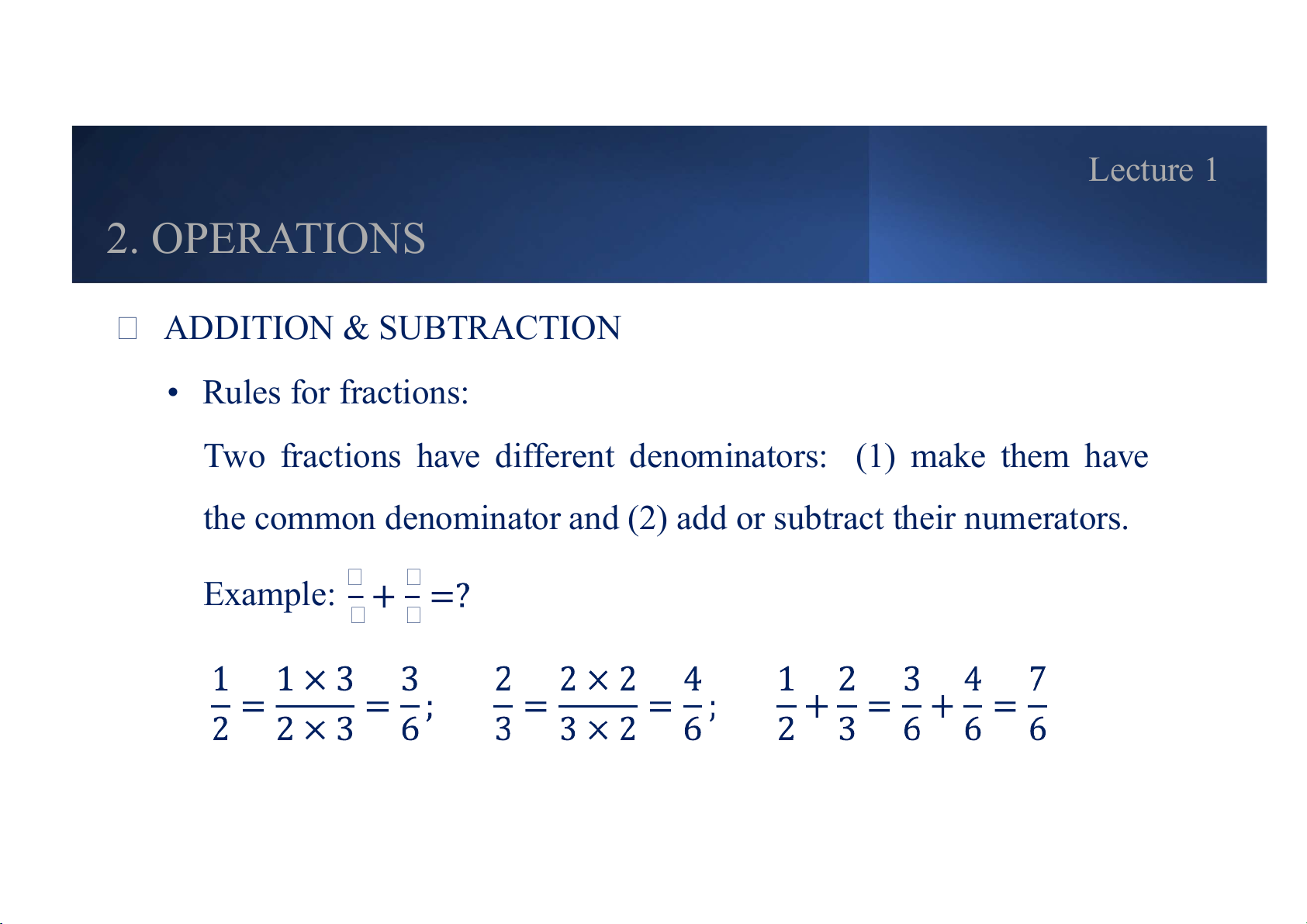
Two fractions have different denominators: (1) make them have
the common denominator and (2) add or subtract their numerators. Example: Lecture 1 2. OPERATIONS ADDITION & SUBTRACTION
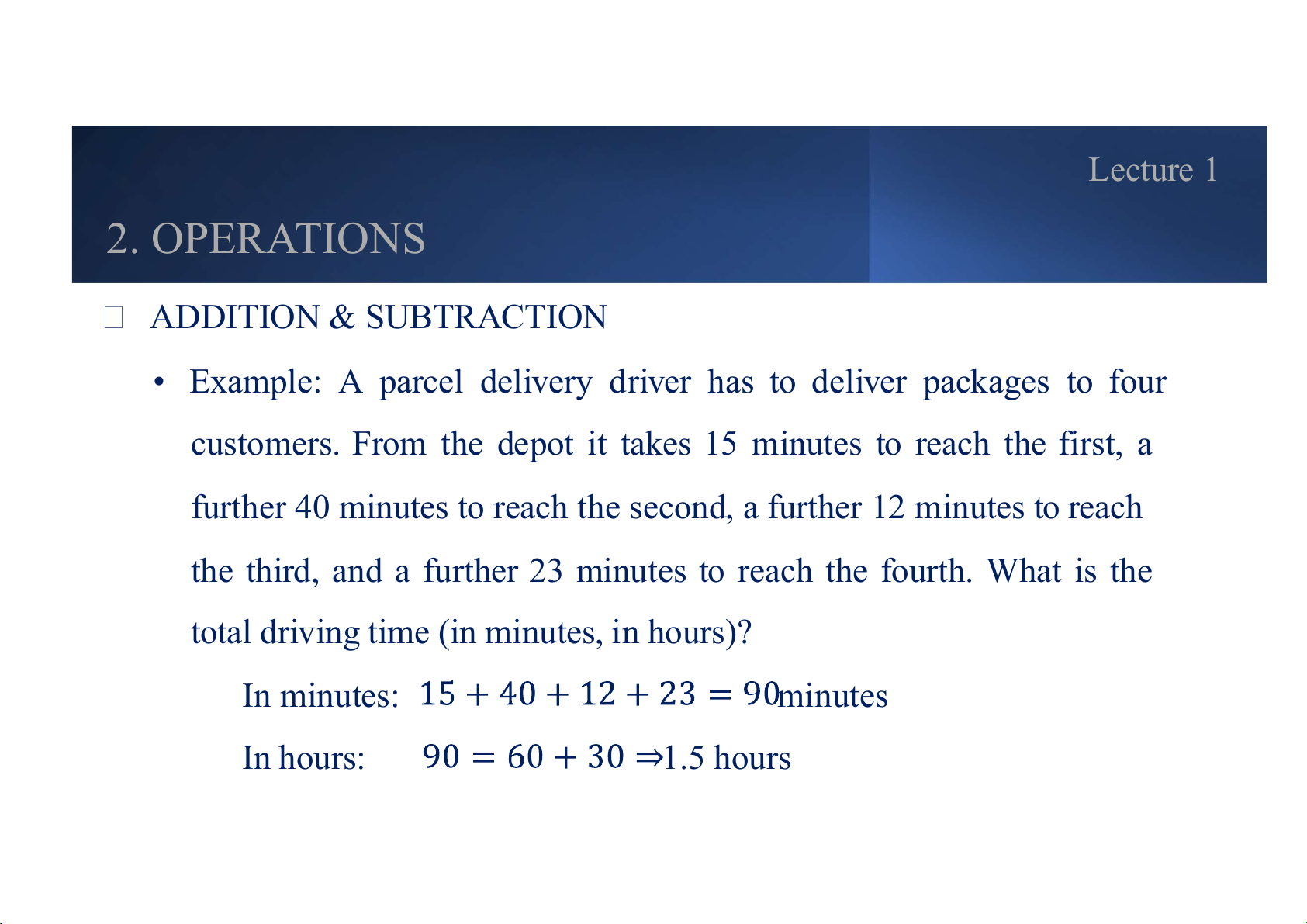
• Example: A parcel delivery driver has to deliver packages to four
customers. From the depot it takes 15 minutes to reach the first, a
further 40 minutes to reach the second, a further 12 minutes to reach
the third, and a further 23 minutes to reach the fourth. What is the
total driving time (in minutes, in hours)? In minutes: minutes In hours: 1.5 hours Lecture 1 2. OPERATIONS MULTIPLICATION & DIVISION
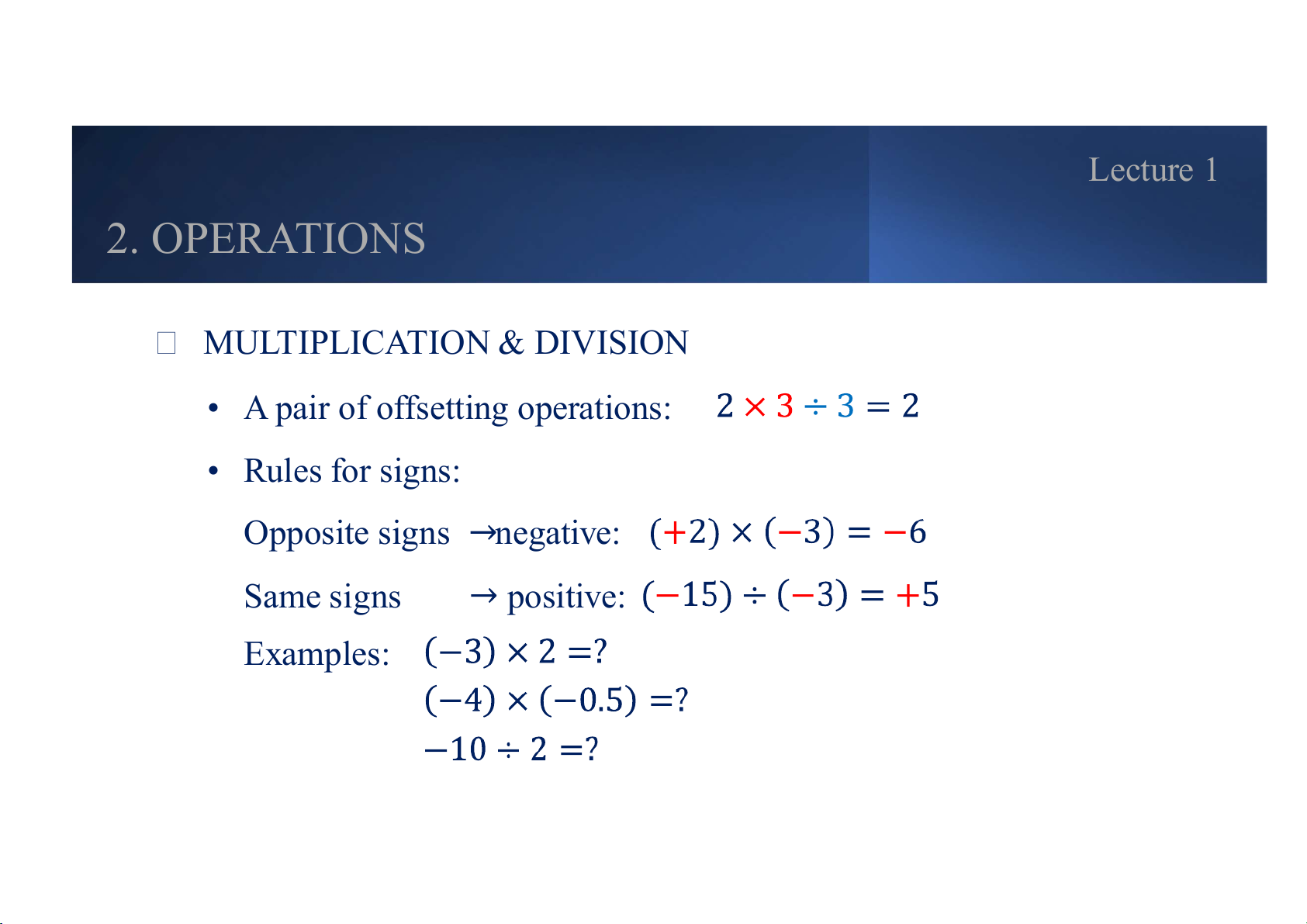
• A pair of offsetting operations: • Rules for signs: Opposite signs negative: Same signs positive: Examples: Lecture 1 2. OPERATIONS MULTIPLICATION & DIVISION • Rules for fractions:
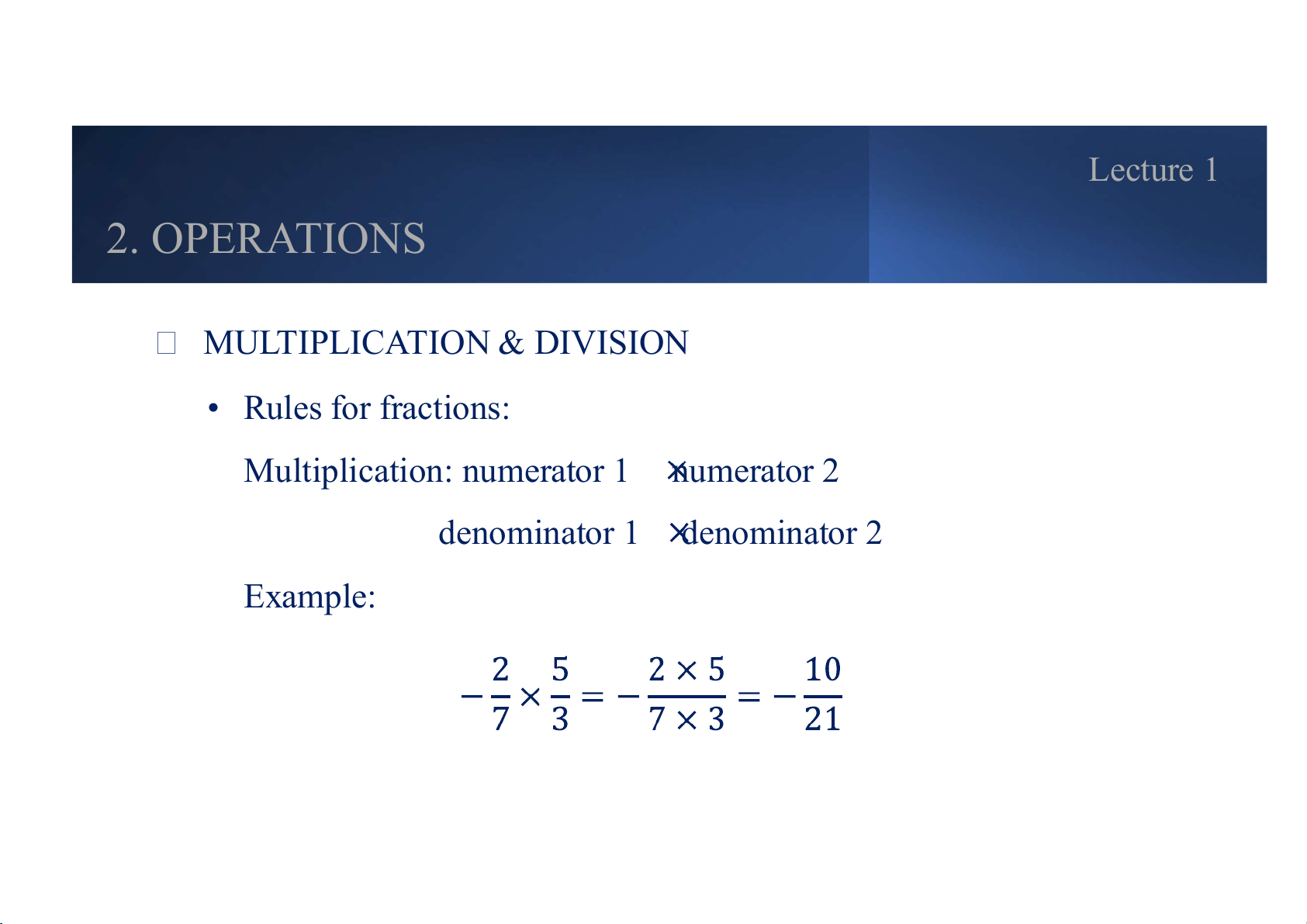
Multiplication: numerator 1 numerator 2 denominator 1 denominator 2 Example: Lecture 1 2. OPERATIONS MULTIPLICATION & DIVISION • Rules for fractions:
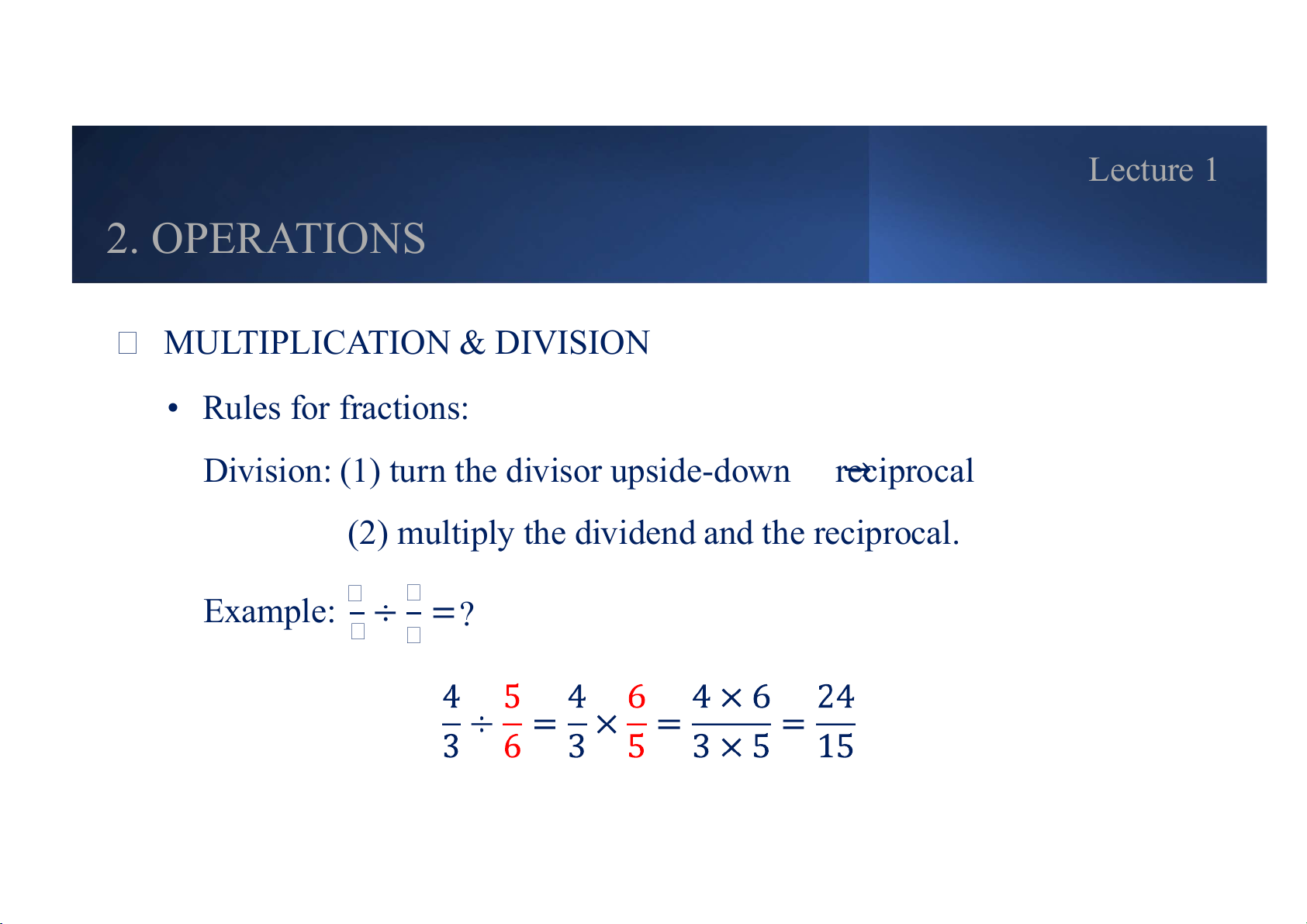
Division: (1) turn the divisor upside-down reciprocal
(2) multiply the dividend and the reciprocal. Example: ? Lecture 1 2. OPERATIONS MULTIPLICATION & DIVISION
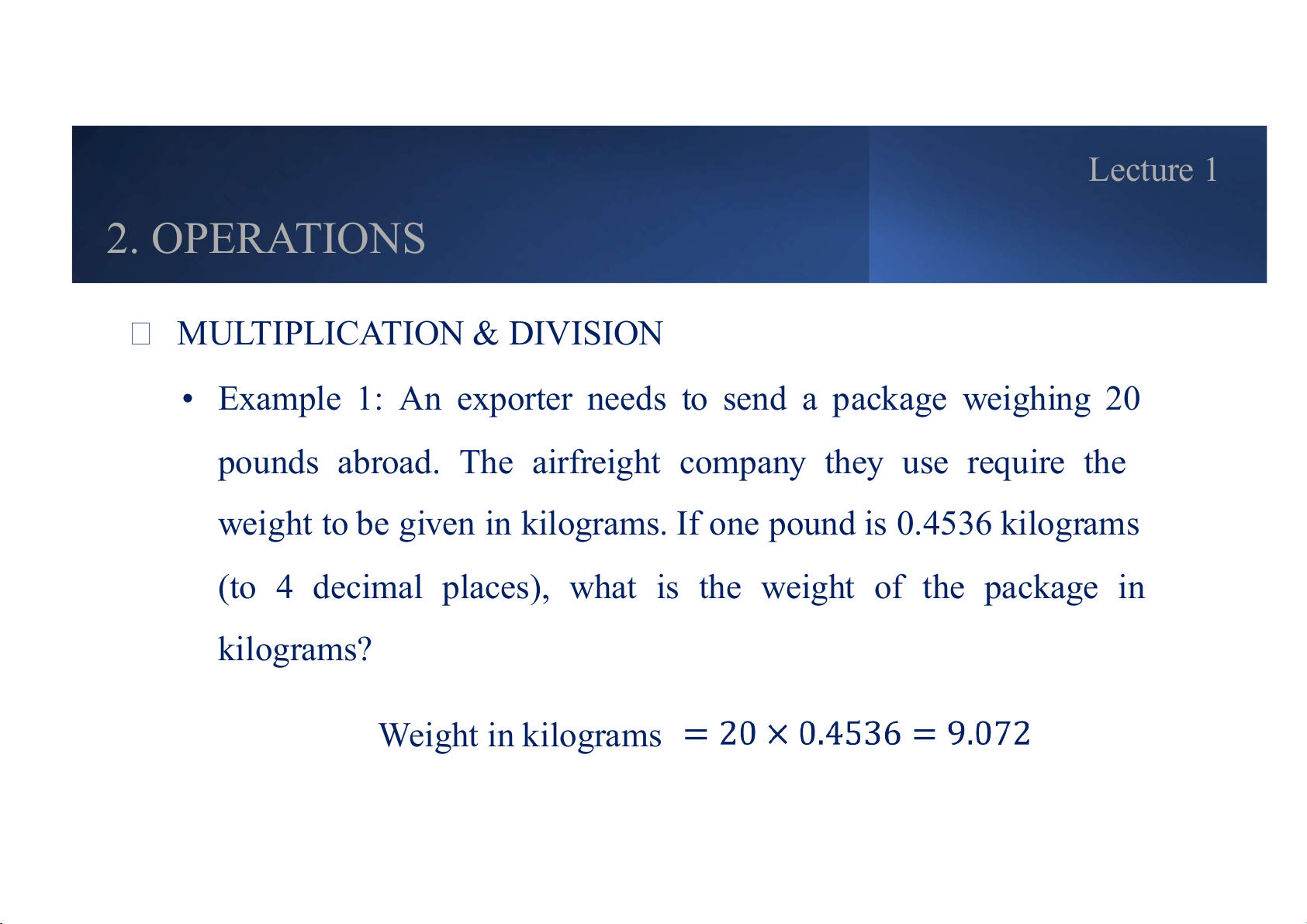
• Example 1: An exporter needs to send a package weighing 20
pounds abroad. The airfreight company they use require the
weight to be given in kilograms. If one pound is 0.4536 kilograms
(to 4 decimal places), what is the weight of the package in kilograms? Weight in kilograms
Tài liệu liên quan:
-
Tự Luận Vimo: Phân Tích Cung, Cầu và Thị Trường Cạnh Tranh| Microeconomics | Trường Đại học Quốc tế, Đại học Quốc gia Thành phố Hồ Chí Minh
5 3 -
Review Questions: Thinking Like an Economist | Microeconomics | Trường Đại học Quốc tế, Đại học Quốc gia Thành phố Hồ Chí Minh
5 3 -
Final Exam Quizlet Questions & Answers | Microeconomics | Trường Đại học Quốc tế, Đại học Quốc gia Thành phố Hồ Chí Minh
5 3 -
Đề thi giữa kỳ II | Microeconomics | Trường Đại học Quốc tế, Đại học Quốc gia Thành phố Hồ Chí Minh
5 3 -
Final Group Project_ The Beer Industry | Microeconomics | Trường Đại học Quốc tế, Đại học Quốc gia Thành phố Hồ Chí Minh
4 2