Phân Tích Oligopoly Trong Ngành Gọi Xe Công Nghệ | Microeconomics | Trường Đại học Quốc tế, Đại học Quốc gia Thành phố Hồ Chí Minh
Revolution 4.0 is taking place with a terrible development speed "unprecedented in history". With the development of applications (referred to as Applications) on mobile today, the jobs through applications are many, some of which are motorbike taxi jobs. has many applications to all people. Joining is very convenient. Tài liệu được sưu tầm và soạn thảo dưới dạng file PDF để gửi tới các bạn cùng tham khảo, ôn tập đầy đủ kiến thức, chuẩn bị cho các buổi học thật tốt. Mời bạn đọc đón xem!
Môn: Microeconomics 613 tài liệu
Trường: Trường Đại học Quốc tế, Đại học Quốc gia Thành phố Hồ Chí Minh 1.9 K tài liệu
Tác giả:








Preview text:
Đại Học Kinh Tế Quốc Dân Viện Quản Trị Kinh Doanh MICROECONOMICS MICROECONOMICS FINAL ASSIGNEMENT GROUP 4 Kieu Anh Ngo Quang Huy Hoang Van Phuong Nguyen Ba Hung Nguyen Thi Thuy Linh I, Market research:
1.1, What is the Technology Ride-hailing Market?
Revolution 4.0 is taking place with a terrible development speed
"unprecedented in history". With the development of applications
(referred to as Applications) on mobile today, the jobs through
applications are many, some of which are motorbike taxi jobs. has
many applications to all people. Joining is very convenient.
This "Job" is now very popular, anyone can participate, the income is
quite good, the working time is just natural.
So what is motorbike taxi technology?
+) Technological motorbike taxi refers to people who do the same
service as a traditional motorbike taxi: it is the owner of the demand
that they want and will receive a cost account for the effort that
person left. The big point other big app is not found on the phone
information will not be found, the row will connect with the customer
information an application on the phone information.
+) Customers will provide basic information such as departure
point, destination and phone number to contact.
+) When that technology motorbike taxi company accepts to go,
there will be information of the person who needs to go to contact
and pick up passengers, then start the journey and will complete the trip upon arrival.
+) Technology motorbike taxi drivers and customers do not have to
pay because the price of the ride has been calculated based on the
shortest distance according to the location of the map and
converted into money. The two sides base the price on the application to pay each other.
+) And the motorbike taxi driver is responsible for deducting part of
the fee of the ride that has been run to the application provider
called the commission cost. The percentage is high or low depending on the application.
Benefits that motorbike taxi technology brings:
+ For users: can call a car faster, book a car 24/24, have a car
quickly and be picked up, the price is very affordable, travel is more
secure because the driver is very well managed. closely, be
evaluated for services, the driver will carry you, know the price in
advance, travel route, can change the route ....
+ For technology drivers: can take advantage of leisure time to earn
extra income, if running full-time, the income is quite good, the
number of customers is large, covering all districts, customers are
received through applications, do not have to find customers, can
take the initiative in time, the procedure is not too complicated.
There are many ride-hailing apps currently on the market to help
you become a technology driver and increase your income such as
Grab, T.net, Vato, Didi, Xelo, Mailinh bike... However, the number of
customers of the apps are not the same, there are apps with many
customers, there are apps with little known customers.
It is also very easy to become a motorbike taxi driver as long as you
have a basic profile: ID card, driving license, motorbike (still in good
use, almost any car can be registered). car insurance, other
documents such as student card, resume or criminal record, so you
can apply to become a motorbike taxi driver.
You must learn 1 or a few sessions of using the app and how to
communicate with customers to activate the application, once the
application is activated, you can start driving. After that, depending
on the company, you have advanced lessons, self-study sessions or
exchange with drivers ... to help drivers more convenient and safer on trips.
When participating, you will be granted the right to use, use the
uniform when driving and comply with the operating principles of the specified apps. 1.2, What Is an Oligopoly?
An oligopoly is a term used to explain the structure of a specific
market, industry, or company. A market is deemed oligopolistic or
extremely concentrated when it is shared between a few common
companies. The firms comprise an oligopolistic market, making it
possible for already-existing smaller businesses to operate in a market dominated by a few.
1.3, Technology drive-hailing is oligopoly a. Number of firm
- Technology ride-hailing industry has many relatively small firms like Grab, Be, Gojek,...
- Under Oligopoly, there are a few firms although the exact number
of firms is undefined. Also, there is severe competition since each
firm produces a significant portion of the total output.
- The industry is characterised by a growing population as well as a
rising number of middle income individuals. Consequently, various
foreign beverage companies have expanded to this lucrative market,
creating a competitive market environment. b. Nature of product
-Under oligopoly, the products of the firms are either homogeneous
or differentiated. Differentiation: A firm can try to make its products
different from those of its competitors in several ways: physical
characteristics of the product, location from which the product is
sold, intangible aspects of the product, and perceptions of the
product. Products that are distinctive in these ways are called differentiated products.
- Intangible aspects can differentiate a product, too. Some intangible
aspects may be promises like a guarantee of satisfaction or money
back, a reputation for high quality, services like free delivery, or
offering a loan to purchase the product. Finally, product
differentiation may occur in the minds of buyers. For example, many
people could not tell the difference between the transportation of
the different firms but the service will have an important role in customers’ minds. c. Market power
- Under Oligopoly, since firms hold a significant share in the total
output of the industry, each firm is affected by the price and output
decisions of rival firms. Therefore, there is a lot of interdependence
among firms in an oligopoly. Hence, a firm takes into account the
action and reaction of its competing firms while determining its price and output levels. d. Barrier of entry
-Under Oligopoly, a firm can earn supernormal profits in the long run
as there are barriers to entry like patents, licenses, control over
crucial raw materials, etc. These barriers prevent the entry of new
firms into the industry. Technology ride-hailing industry has barriers of entry. e. Non-price competition
-Under Oligopoly, firms want to act independently and earn
maximum profits on one hand and cooperate with rivals to remove
uncertainty on the other hand. Depending on their motives,
situations in real-life can vary making predicting the pattern of
pricing behavior among firms impossible. The firms can compete or
collude with other firms which can lead to different pricing situations.
Technology drive-hailing tries to avoid price competition due to the
fear of price wars in Oligopoly and hence depend on non-price
methods like advertising, after sales services, warranties, etc. This
ensures that firms can influence demand and build brand recognition. II, Grab Overview 2.1, What is Grab?
Grab is a technology company that provides transportation
services and is headquartered in Singapore. Vietnam is also a
country with strong Grab activities. Although providing car service
like Uber in Malaysia and Singapore. In line with the traffic situation
in Vietnam, Grab has promoted the service of moving by motorbike.
It can be said that Grab appears as a new breeze in moving in
Southeast Asian countries. You can travel faster than a taxi due to
the application of technology to calling a car. But it is extremely
secure compared to traditional motorbike taxis. Grab is currently
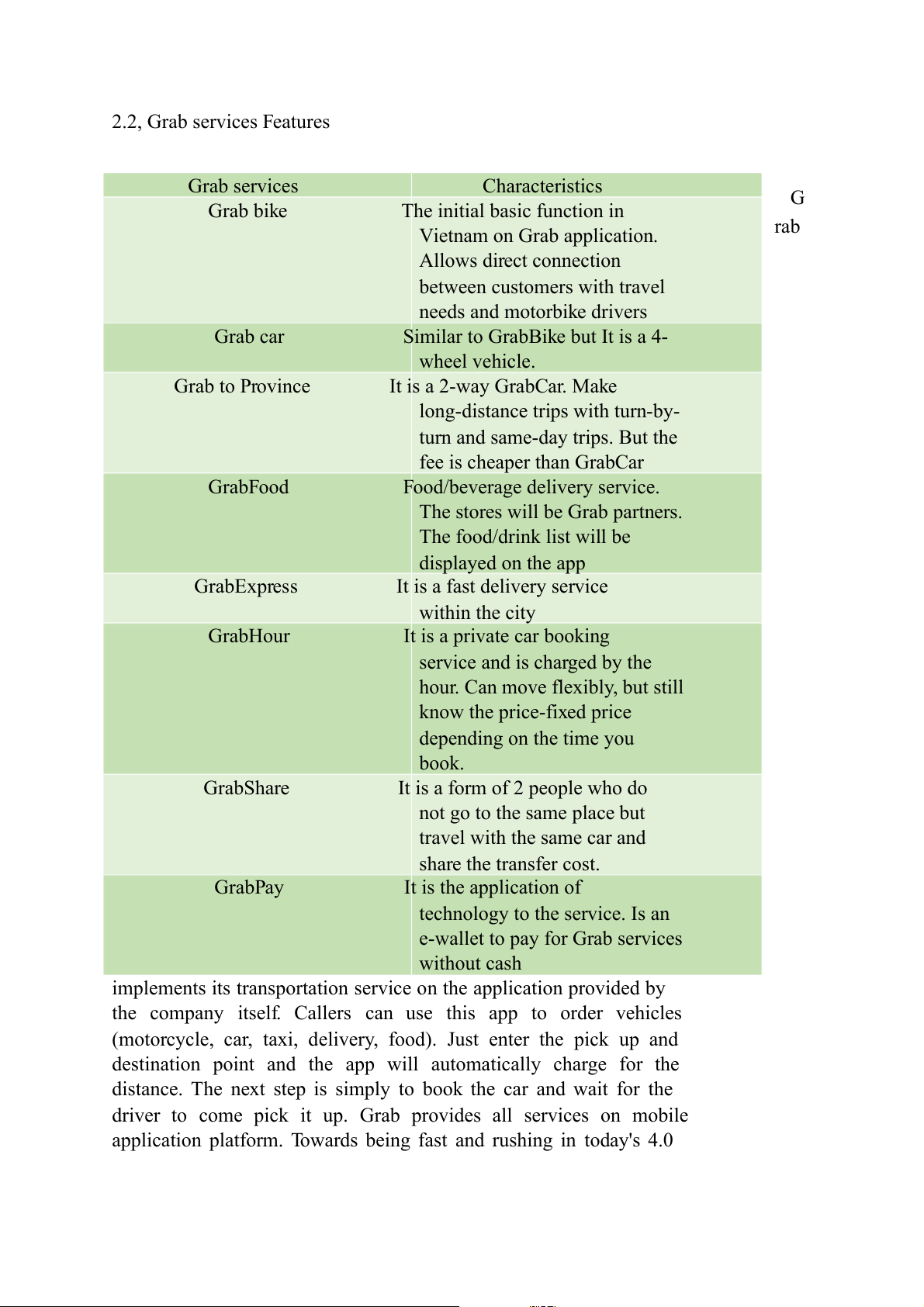
experiencing strong growth in 8 countries and 195 cities in Southeast Asia 2.2, Grab services Features Grab services Characteristics G Grab bike The initial basic function in rab Vietnam on Grab application. Allows direct connection between customers with travel needs and motorbike drivers Grab car
Similar to GrabBike but It is a 4- wheel vehicle. Grab to Province It is a 2-way GrabCar. Make
long-distance trips with turn-by-
turn and same-day trips. But the fee is cheaper than GrabCar GrabFood
Food/beverage delivery service.
The stores will be Grab partners. The food/drink list will be displayed on the app GrabExpress It is a fast delivery service within the city GrabHour It is a private car booking service and is charged by the
hour. Can move flexibly, but still know the price-fixed price depending on the time you book. GrabShare
It is a form of 2 people who do not go to the same place but travel with the same car and share the transfer cost. GrabPay It is the application of
technology to the service. Is an
e-wallet to pay for Grab services without cash
implements its transportation service on the application provided by
the company itself. Callers can use this app to order vehicles
(motorcycle, car, taxi, delivery, food). Just enter the pick up and
destination point and the app will automatically charge for the
distance. The next step is simply to book the car and wait for the
driver to come pick it up. Grab provides all services on mobile
application platform. Towards being fast and rushing in today's 4.0
era. And over time, Grab also roughly expanded its services. Create
convenience and speed for customers.
Grab will be a bridge for driver partners who have free cars and
want to earn more income with customers who need to use
technology motorbike taxi services. This will be the best way to
meet the needs and profits for both parties. At the same time, it
solves the problem of crowded traffic in Vietnam.
2.3, The difference of Grab compared to other company
+) In Vietnam today, the technology vehicle segment is no longer an
attractive piece of cake in the market for new applications and
services because the presence of 3 big companies: Grab, Gojeck, Be.
However, if counted in Vietnam alone, Grab is still quite unique in
this market. However, we will learn the difference of Grab compared
to the other two car companies.
Grab aims to grow regionally from the very beginning. The basic
services in all markets are GrabTaxi and GrabCar, while GrabBike is
only available in Indonesia, Thailand, Vietnam and Cambodia.
Grab has strong roots in providing a wide range of transportation
services. This is understandable as inadequate transport systems
are a major problem in most Southeast Asian countries, except
Singapore and Malaysia. By solving this problem, Grab has the
ability to acquire loyal customers who use their service for their
daily commute across Southeast Asia. In Vietnam, Grab is at the top
with the number of completed rides with more than 146 million rides
(70%) 5 times higher than Be (31 million).
+) We can see that Grab builds a very smart pricing strategy when
they know how to capture customer psychology by subsidizing
technology drivers and discounting, promotions even Free 0 VND or
give money to new customers. You can ride a luxury car, the price is
extremely cheap, even if you go for free, no customer can refuse.
We can see that Grab's business strategy is better than accepting
losses to implement a long-term strategy. They call for direct
investment and are willing to burn money to lose.
+) The company positions itself as a popular, everyday brand,
instead of focusing on aggressive marketing campaigns, Grab
focuses on reminding people of themselves when booking a car.
Grab's logo, colors, and uniforms are factors that help customers
feel easy to remember, close and bring friendliness to users. As you
can see, there has not been a technology ride-hailing company that
optimizes its brand identity element into the customer's mind as
well as grab. As we can see, Grab applies Visual Marketing to
express "kung fu" design elements, graphics, images into the
strategy to attract viewers and position the brand in the minds of customers.
Remembering the brand identity, remembering the image is a goal
that not every business can do. Grab is quite wise when using the
color language of natural green to hit the viewer's eye. Whenever
we look at the color green, we immediately think of Grab's brand.
+) Many rival firms think that Grab's policy of increasing rush hour
fares is a key weakness, and many competitors have focused on it.
The problem is, Grab changes fares not because they can't fix the
price, but because they don't want to. Rates are often driven by
supply and demand. At peak hours, the demand increases and the
supply remains unchanged, causing the freight rates to be pushed
up. To fix prices, automakers must increase supply or accept
reduced profits. In terms of driver supply, Grab is number one. In
terms of financial ability to bear losses, Grab is also number one.
Therefore, Grab is the car company with the most ability to fix peak
hour prices compared to all other competitors. But they don't apply
that policy: They don't want to. And the results of many ride-hailing
companies prove the above points: Some companies manage
drivers very well, then have many management problems when the
number of drivers increases. Some other carriers try to fix rush hour
prices, so that customers can't call for a car because the driver
doesn't want to run or switch to Grab. Many competitors rush to do
what Grab doesn't want to do, only to bitterly understand why Grab doesn't want to do it.
2.3, Advantages of Grab compared to other car companies
+) When running Grab, the fare on Grab will be higher, the price of a
run will be more worthy. For Grab, the ride will be more regular, less
standing for a long time like Gojek or Be. Especially when you run far
away from the city, you still have to run back because Grab's
coverage is very wide and the number of customers is very large, so
you can easily increase your income compared to Gojek because
Gojek when running far away you will rarely have a hoe to run back.
+) An extremely convenient point of Grab service that Gojek or Be
does not have is being able to choose a running service such as
supermarket pickup, GrabFood, GrabBike, Grab delivery and can turn
each service on and off for example when you don't want it. Food
delivery can turn off GrabFood or if you don't want to carry people, you can turn off GrabBike.
III, Key factors that affect demand and supply of transport and technological delivery 3.1, Determinants of supply Input
The technology - motorbike industry in vietnam also needs basic
ingredients to operate as gasoline, oil. Although our country has
huge amounts of minerals, we don' t have enough technology to
create good oil. So most of the oil in vietnam is imported from
abroad. With the source of imported fuel nearly 100%, the
proportion of these ingredients in the capital cost of gasoline plants
in vietnam is much larger than the overall share of the world. The
world' s petrol and oil prices are usually not stable to make
businesses difficult to move, risk the exchange rate, affecting profit
margins. Gasoline prices are crucial to the profits of technology
companies, while in the vietnamese market, the price of gasoline is
higher than other parts of the world. Although the vietnamese state
has had many policies and supports in the stability of petrol and oil
prices, it is also inevitable that the increasing price of petrol and oil
has been depleted by exhaustion. There are more and more people
using motorbikes leading to increasing gasoline consumption, prices
will be increasingly competitive. The final results of the technology
sector will not have a good market and profit margins are also reduced. Technology
The growing science, information infrastructure, more popular than
ever, 3g 4g, in Vietnam, is among the cheapest in the region,
everyone has at least one smartphone.
*Opportunity: customers reach grab more easily.
Grab is constantly updating its app and algorithms to accurately
calculate the distance and destination. Moreover, the firm also
calculated the shortest distance and less traffic jam that helped
drivers save money, time, distance to move. This is also a form to
reduce production costs and improve efficiency.
Government policies: taxes; subsidy o Taxes
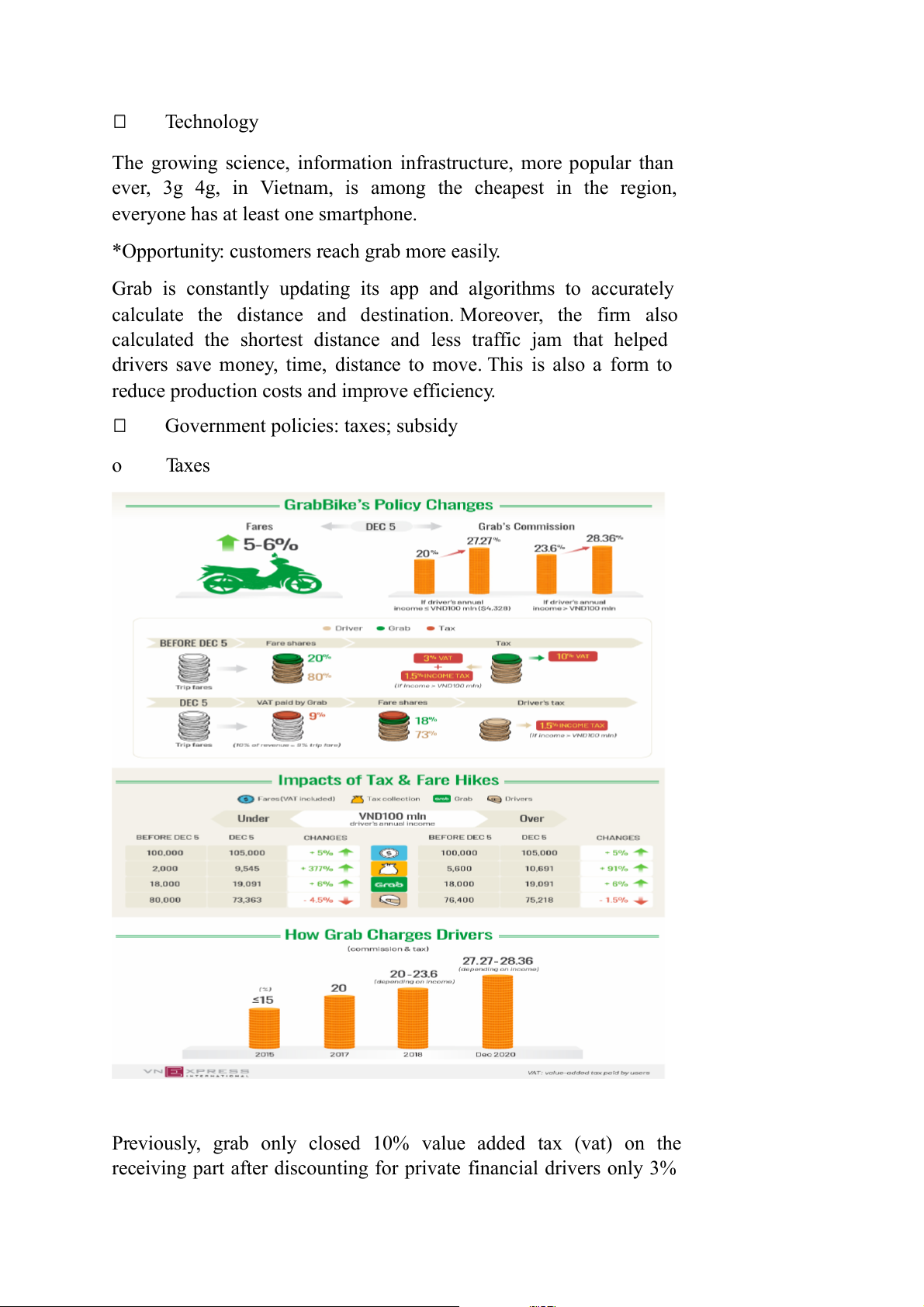
Previously, grab only closed 10% value added tax (vat) on the
receiving part after discounting for private financial drivers only 3%
vat. According to the new regulations since 5. 12, grab must pay the
vat 10% to the total turnover paid by the customer for each bus.
And this added tax mainly affects on the drivers’ income or in other
words, the grab company have to pay most of this tax, customers have to pay little.
On this issue, grab's representatives also said:' in order to comply
with new regulations, grab has carefully considered to propose new
rates suitable, and fulfill obligations from the freight charge that the
user currently pays. Application fees (discount) applied to drivers are
still unchanged. The total tax collector shall be submitted to the
state treasury and the tax agency certified by the tax agency to fulfill the tax liability'. o Subsidy
Technological vehicles enjoy many advantages such as being able to
go on taxi-forbidden routes within specified hours; or without having
to use a car crest…. It helps technology drivers be more proactive
when working and shortens travel time. That is a huge advantage of
the technology car companies that the government has bestowed.
Petrol prices are usually supported and balanced by the government.
Therefore, technology car companies usually do not have to suffer
too much difference in profit margin. It is a great support of the
government for not only technology car companies but also for the whole people.
In the role of regulating and protecting the economy, the
government has a great influence on the supply of products. The
lower the tax, the higher the supply of that product. On the other
hand, if stricter rules are imposed and excise taxes are added, the
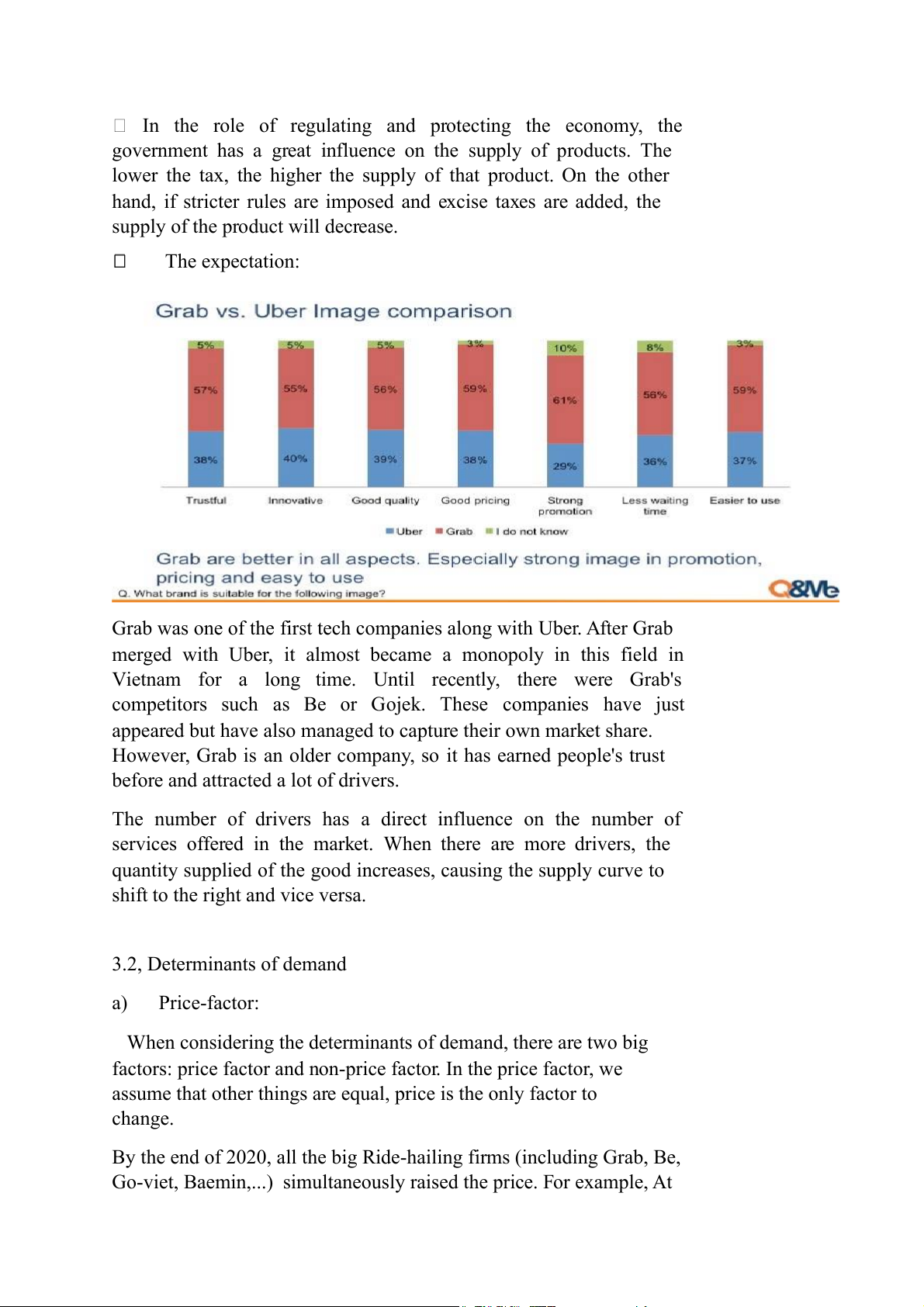
supply of the product will decrease. The expectation:
Grab was one of the first tech companies along with Uber. After Grab
merged with Uber, it almost became a monopoly in this field in
Vietnam for a long time. Until recently, there were Grab's
competitors such as Be or Gojek. These companies have just
appeared but have also managed to capture their own market share.
However, Grab is an older company, so it has earned people's trust
before and attracted a lot of drivers.
The number of drivers has a direct influence on the number of
services offered in the market. When there are more drivers, the
quantity supplied of the good increases, causing the supply curve to
shift to the right and vice versa. 3.2, Determinants of demand a) Price-factor:
When considering the determinants of demand, there are two big
factors: price factor and non-price factor. In the price factor, we
assume that other things are equal, price is the only factor to change.
By the end of 2020, all the big Ride-hailing firms (including Grab, Be,
Go-viet, Baemin,...) simultaneously raised the price. For example, At
11am on December 5, Grab simultaneously adjusted the minimum
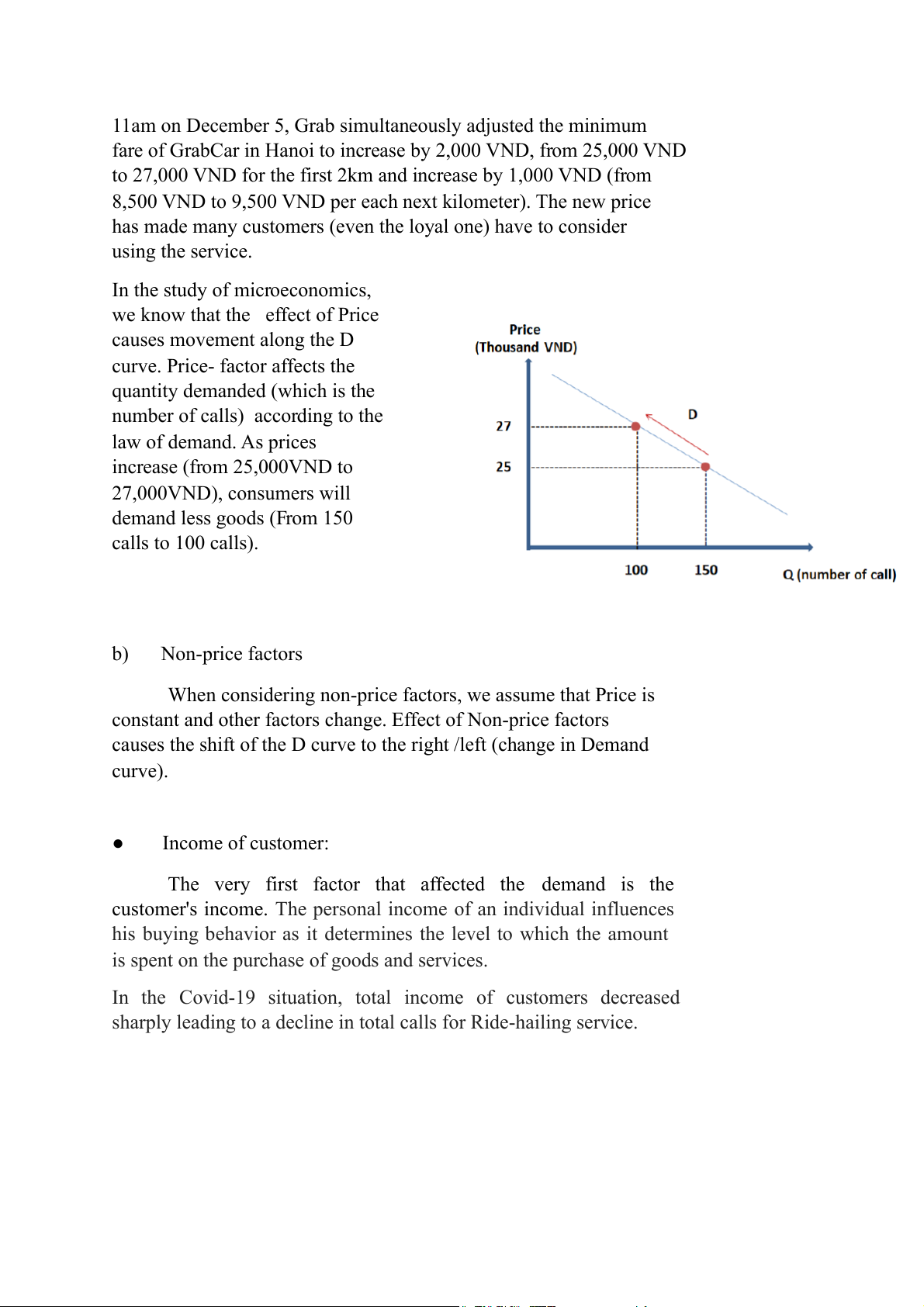
fare of GrabCar in Hanoi to increase by 2,000 VND, from 25,000 VND
to 27,000 VND for the first 2km and increase by 1,000 VND (from
8,500 VND to 9,500 VND per each next kilometer). The new price
has made many customers (even the loyal one) have to consider using the service.
In the study of microeconomics,
we know that the effect of Price causes movement along the D
curve. Price- factor affects the
quantity demanded (which is the
number of calls) according to the law of demand. As prices increase (from 25,000VND to 27,000VND), consumers will demand less goods (From 150 calls to 100 calls). b) Non-price factors
When considering non-price factors, we assume that Price is
constant and other factors change. Effect of Non-price factors
causes the shift of the D curve to the right /left (change in Demand curve). ● Income of customer:
The very first factor that affected the demand is the
customer's income. The personal income of an individual influences
his buying behavior as it determines the level to which the amount
is spent on the purchase of goods and services.
In the Covid-19 situation, total income of customers decreased
sharply leading to a decline in total calls for Ride-hailing service.
It can be clearly seen from the bar chart above that the
number of calls fell dramatically from 2019 (before the epidemic) to
2020 (when the epidemic happened complicatedly throughout the
year). After the COVID-19 epidemic had new developments, people
have limited going out. Besides, the majority of students and
workers also return to their hometown early and choose the form of
private car. For that reason, the ride-hailing service has fallen into a
"sluggish" situation. “Every year on Tet days like this, I work non-
stop, earning more than 1 million dong a day. These years are very
empty, winter can only get 400,000 - 500,000 VND per day,
otherwise it is 200,000 VND / day.” - said a driver. ● Taste and preferences:
According to a report by ABI Research, the ride-hailing market in
Vietnam has not yet witnessed many breakthroughs as Grab is still
the market leader in ride-hailing. With the completion of 62.5 million
rides in the first half of this year, Grab successfully captured 74.6%
of the market share, a slight donation compared to 73% in the first half of 2019.
Another rival of Grab, Be, seems to have mastered the No. 2
position, but is also gradually being shortened by Gojek. Specifically,
the Be app accounts for 12.4% of the domestic car-hailing market,
while Indonesian rival Gojek ranks right behind with 12.3%.
It can be clearly seen that Grab still wins the customer’s heart up to
now. From the very first time they joined the Vietnamese market, the
company has done a lot of things such as changing promotion plans,
building a fast market penetration strategy, offering promotions to
stimulate demand, brand positioning in line with target customers,
changing to fit the local culture,... Because of those efforts, Grab has
gradually become a preference among other firms in the market.
They make Vietnamese residents automatically choose to Grab if
they want to call for a ride-hailing. ● Price of related goods:
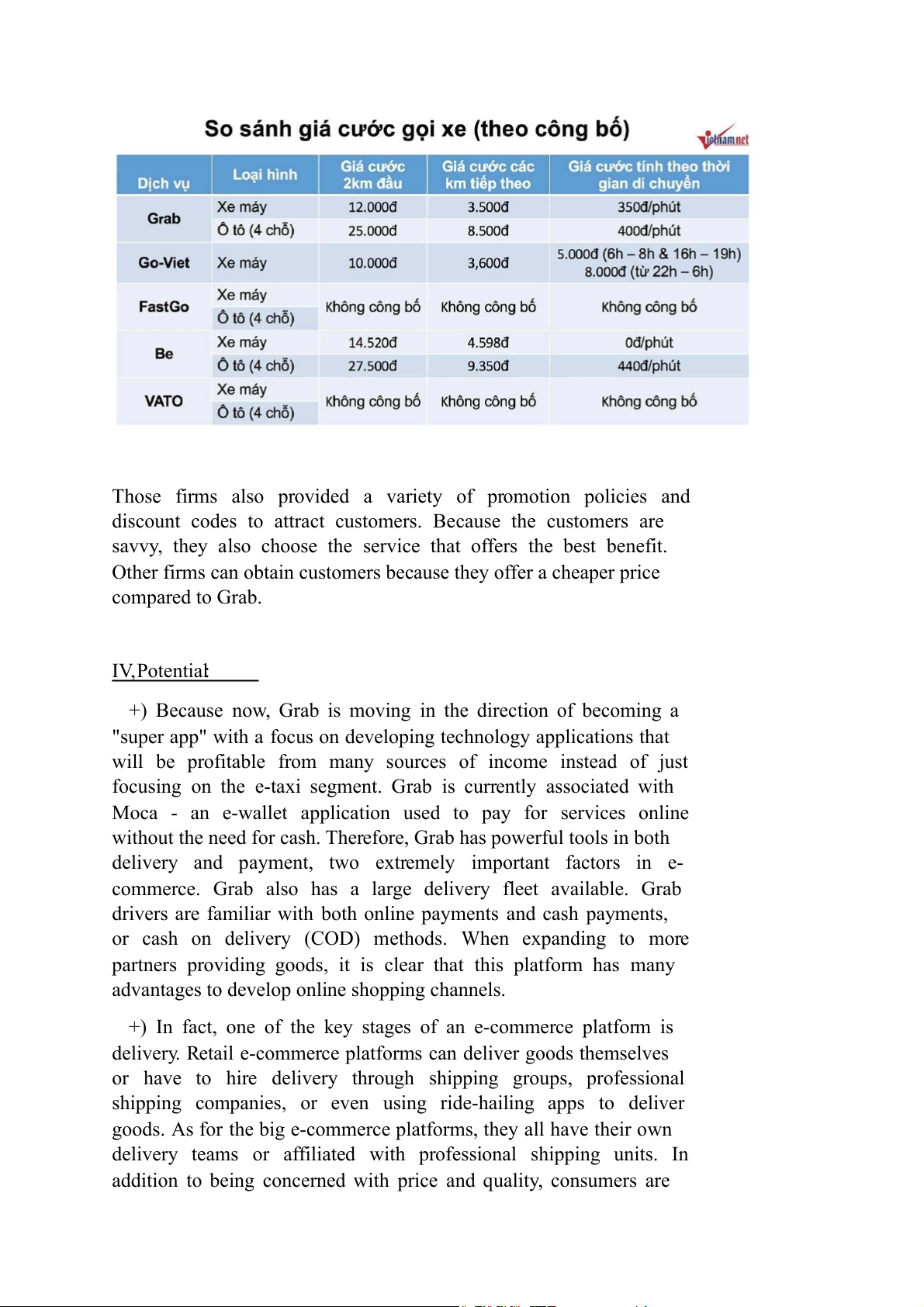
There are some differences among the provided prices of some
firms in this market. Joining the market quite late compared to Grab,
some firms such as Be, Go-Viet,... have offered a slightly cheaper
price. For example, with the travel distance from 48 To Huu to 6
Lang Ha during peak hours 11:30 - 13:00, the Go Viet app (GoRide
service) costs 8,000 VND and the Grab app (GrabBike service) costs
30,000 VND. VND. Through a simple comparison, it is easy to see
that the Gojek app has a much cheaper fare than the Grab app. The
table below show the actual price of those firms:
Those firms also provided a variety of promotion policies and
discount codes to attract customers. Because the customers are
savvy, they also choose the service that offers the best benefit.
Other firms can obtain customers because they offer a cheaper price compared to Grab. IV, Potential :
+) Because now, Grab is moving in the direction of becoming a
"super app" with a focus on developing technology applications that
will be profitable from many sources of income instead of just
focusing on the e-taxi segment. Grab is currently associated with
Moca - an e-wallet application used to pay for services online
without the need for cash. Therefore, Grab has powerful tools in both
delivery and payment, two extremely important factors in e-
commerce. Grab also has a large delivery fleet available. Grab
drivers are familiar with both online payments and cash payments,
or cash on delivery (COD) methods. When expanding to more
partners providing goods, it is clear that this platform has many
advantages to develop online shopping channels.
+) In fact, one of the key stages of an e-commerce platform is
delivery. Retail e-commerce platforms can deliver goods themselves
or have to hire delivery through shipping groups, professional
shipping companies, or even using ride-hailing apps to deliver
goods. As for the big e-commerce platforms, they all have their own
delivery teams or affiliated with professional shipping units. In
addition to being concerned with price and quality, consumers are
very concerned about fast and cheap delivery. Grap has taken
advantage of this and hit the customer's heart when it has a strong
transport team, covering every corner and delivering at a low cost.
Therefore, the delivery of goods can be done as soon as the
customer completes the purchase, regardless of Saturday or
Sunday, even at night, meeting all the needs of the buyer.
+) Previously, in 2018, GrabPay - a cashless payment method to
pay when using services on the Grab application was activated.
GrabPay acts as a convenient ordinary e-wallet with full payment,
purchase, and money transfer features, while major e-commerce
platforms such as Lazada and Tiki do not have their own payment tools.
+) In the context of the epidemic, Grab announced the Small
Business Growth Program to help small businesses in Southeast Asia
adapt to the post-Covid-19 new normal. The program includes tools.
and initiatives to support direct businesses to easily switch to online
businesses, while helping partners operating on the Grab platform
increase visibility and adjust their operations to suit their needs. The
economy is undergoing rapid digital transformation. The highlight
program is the GrabMerchant platform in 6 countries, including
Vietnam. It is an all-in-one self-service platform for business owners
to grow their customer base online, optimize operations, and control
costs. May said, GrabMerchant is like a final piece in Grab's e-
commerce picture when Grab has a delivery team and payment tool for a long time.
+) According to media company Dealstreetasia, food businesses
(F&B) who previously used GrabFood will gradually switch to
GrabMerchant, integrating fresh food merchants, essential goods
(GrabMart) and merchants use GrabPay. Grab's figures show that
120,000 users joined the platforms between March and May this
year. However, Grab's advantage also lies in opening many new
business forms. For example, Grab can supply goods and materials
to small and medium-sized businesses and owe them payment for a
certain period of time. Or you can let users buy goods and services
on Grab until the end of the month to pay without paying interest V, Challenge :
+) Like other technology companies, Grab's challenges are legal
issues. Vietnam is one of Grab's biggest markets, and the
government does not have a specific mechanism to regulate the
group's business. Grab's business has repeatedly suffered from
lawsuits initiated by local taxi corporations.
+) In the current trend, more and more domestic technology car
companies appear. Typically BE, BE are on a very good development
momentum. Vietnamese users will prioritize using Vietnamese
goods. Be also offers very good strategies in the context of the
economy being heavily affected by the pandemic. Therefore, Grab
will have to watch out for the rapid development of some
Vietnamese technology car companies.
+) The time when the epidemic is raging is also affecting Grab's
revenue more or less. The social distancing in some major cities in
Vietnam has caused all travel activities to be postponed.
Tài liệu liên quan:
-
Tự Luận Vimo: Phân Tích Cung, Cầu và Thị Trường Cạnh Tranh| Microeconomics | Trường Đại học Quốc tế, Đại học Quốc gia Thành phố Hồ Chí Minh
5 3 -
Review Questions: Thinking Like an Economist | Microeconomics | Trường Đại học Quốc tế, Đại học Quốc gia Thành phố Hồ Chí Minh
5 3 -
Final Exam Quizlet Questions & Answers | Microeconomics | Trường Đại học Quốc tế, Đại học Quốc gia Thành phố Hồ Chí Minh
5 3 -
Đề thi giữa kỳ II | Microeconomics | Trường Đại học Quốc tế, Đại học Quốc gia Thành phố Hồ Chí Minh
5 3 -
Final Group Project_ The Beer Industry | Microeconomics | Trường Đại học Quốc tế, Đại học Quốc gia Thành phố Hồ Chí Minh
4 2