Principles of Economics Quiz: 50 Key Questions & Answers | Microeconomics | Trường Đại học Quốc tế, Đại học Quốc gia Thành phố Hồ Chí Minh
Principles of Economics – Part I Quiz (50 Questions) 1. 1. What is the first principle of economics? A. People respond to incentives B. Trade can make everyone better off C. People face trade-offs D. Governments can always improve market outcomes Answer: C 2. 2. What does the concept of 'opportunity cost' describe? A. Money lost in failed investments B. The direct price of a product C. What you give up to get something else D. The income effect. Tài liệu được sưu tầm và soạn thảo dưới dạng file PDF để gửi tới các bạn cùng tham khảo, ôn tập đầy đủ kiến thức, chuẩn bị cho các buổi học thật tốt. Mời bạn đọc đón xem!
Môn: Microeconomics 613 tài liệu
Trường: Trường Đại học Quốc tế, Đại học Quốc gia Thành phố Hồ Chí Minh 1.9 K tài liệu
Tác giả:


Preview text:
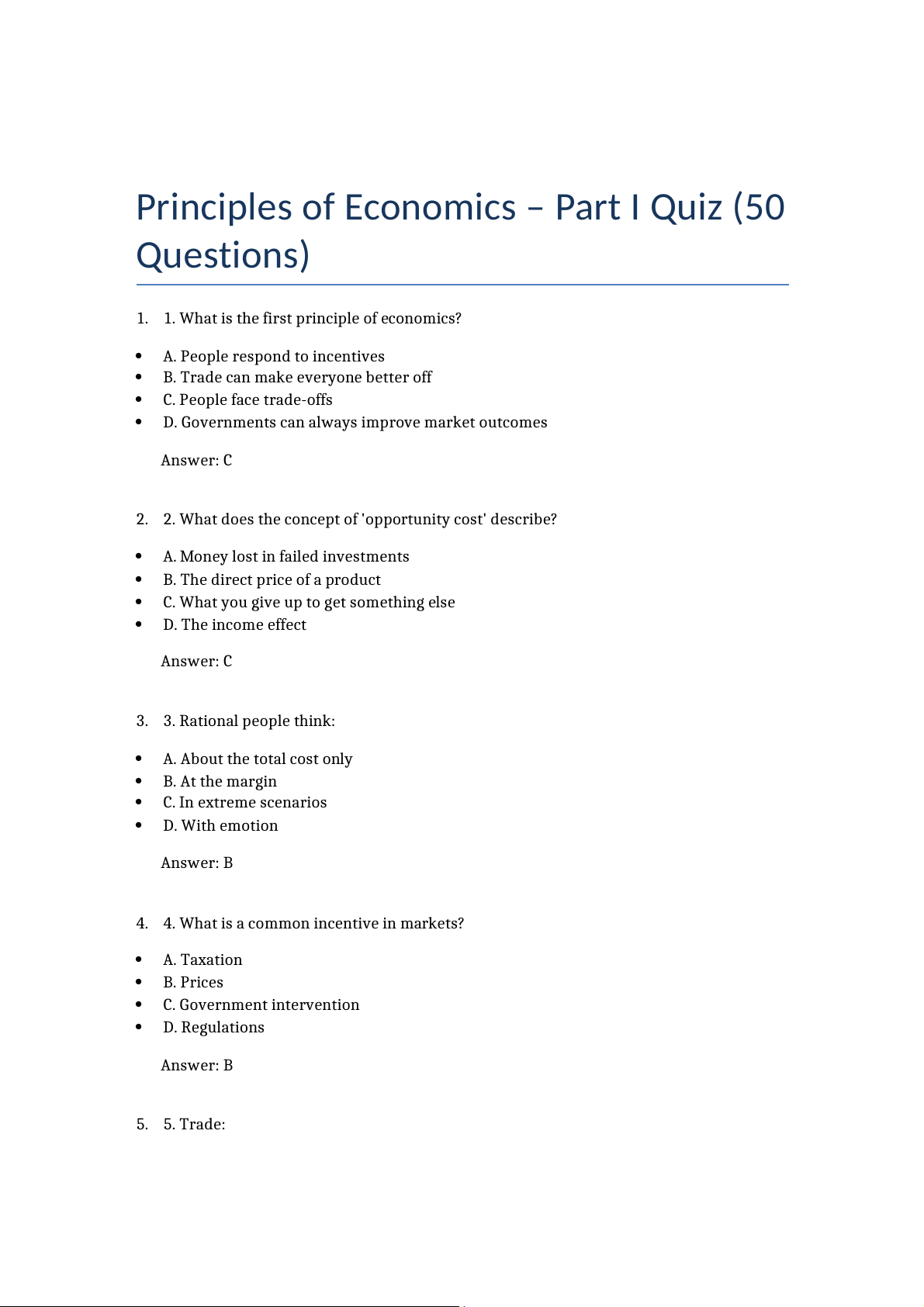
Principles of Economics – Part I Quiz (50 Questions)
1. 1. What is the first principle of economics?
A. People respond to incentives
B. Trade can make everyone better off C. People face trade-offs
D. Governments can always improve market outcomes ✅ Answer: C
2. 2. What does the concept of 'opportunity cost' describe?
A. Money lost in failed investments
B. The direct price of a product
C. What you give up to get something else D. The income effect ✅ Answer: C 3. 3. Rational people think: A. About the total cost only B. At the margin C. In extreme scenarios D. With emotion ✅ Answer: B
4. 4. What is a common incentive in markets? A. Taxation B. Prices C. Government intervention D. Regulations ✅ Answer: B 5. 5. Trade: A. Always benefits the seller B. Allows people to specialize C. Harms developing countries
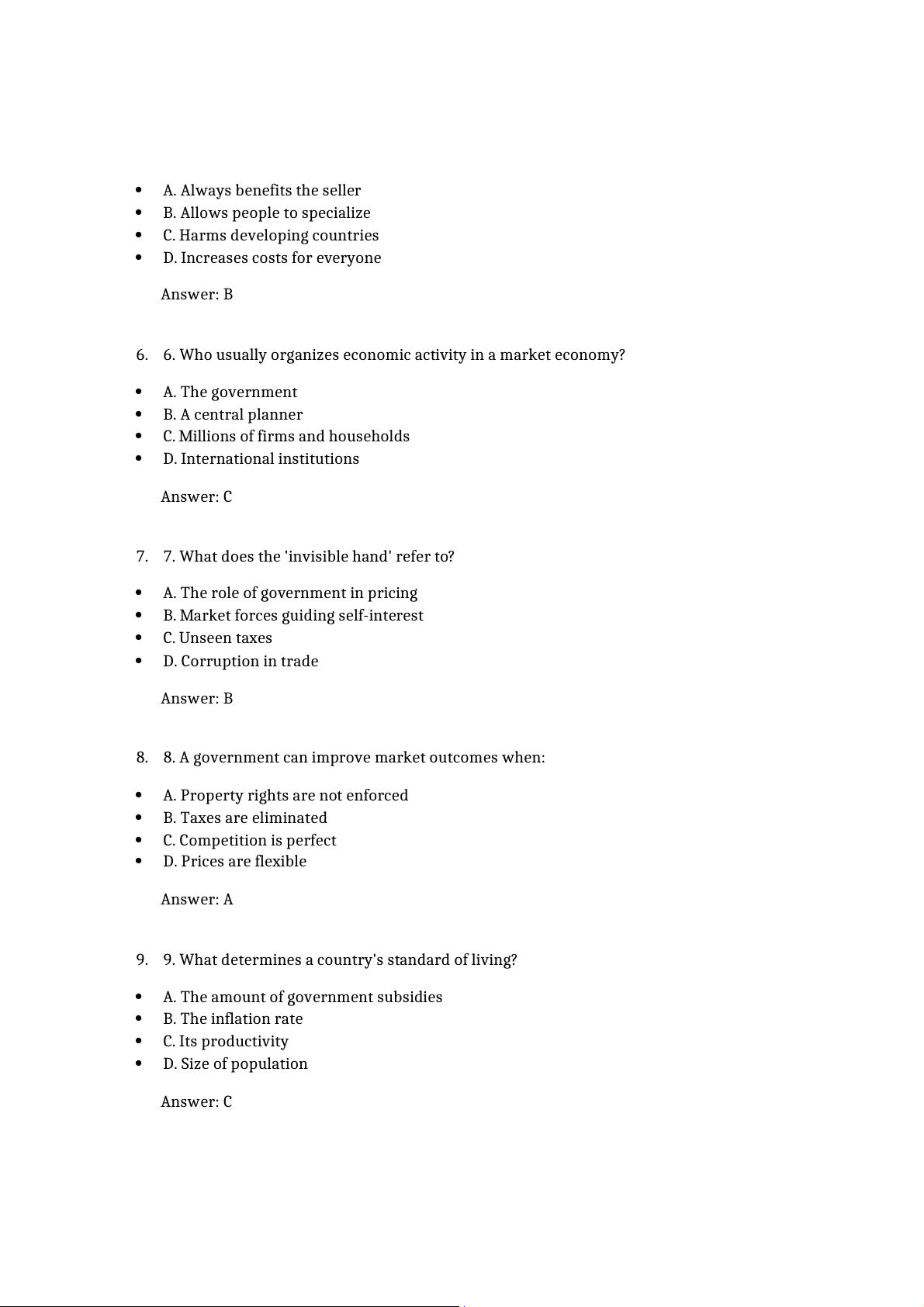
D. Increases costs for everyone ✅ Answer: B
6. 6. Who usually organizes economic activity in a market economy? A. The government B. A central planner
C. Millions of firms and households D. International institutions ✅ Answer: C
7. 7. What does the 'invisible hand' refer to?
A. The role of government in pricing
B. Market forces guiding self-interest C. Unseen taxes D. Corruption in trade ✅ Answer: B
8. 8. A government can improve market outcomes when:
A. Property rights are not enforced B. Taxes are eliminated C. Competition is perfect D. Prices are flexible ✅ Answer: A
9. 9. What determines a country's standard of living?
A. The amount of government subsidies B. The inflation rate C. Its productivity D. Size of population ✅ Answer: C
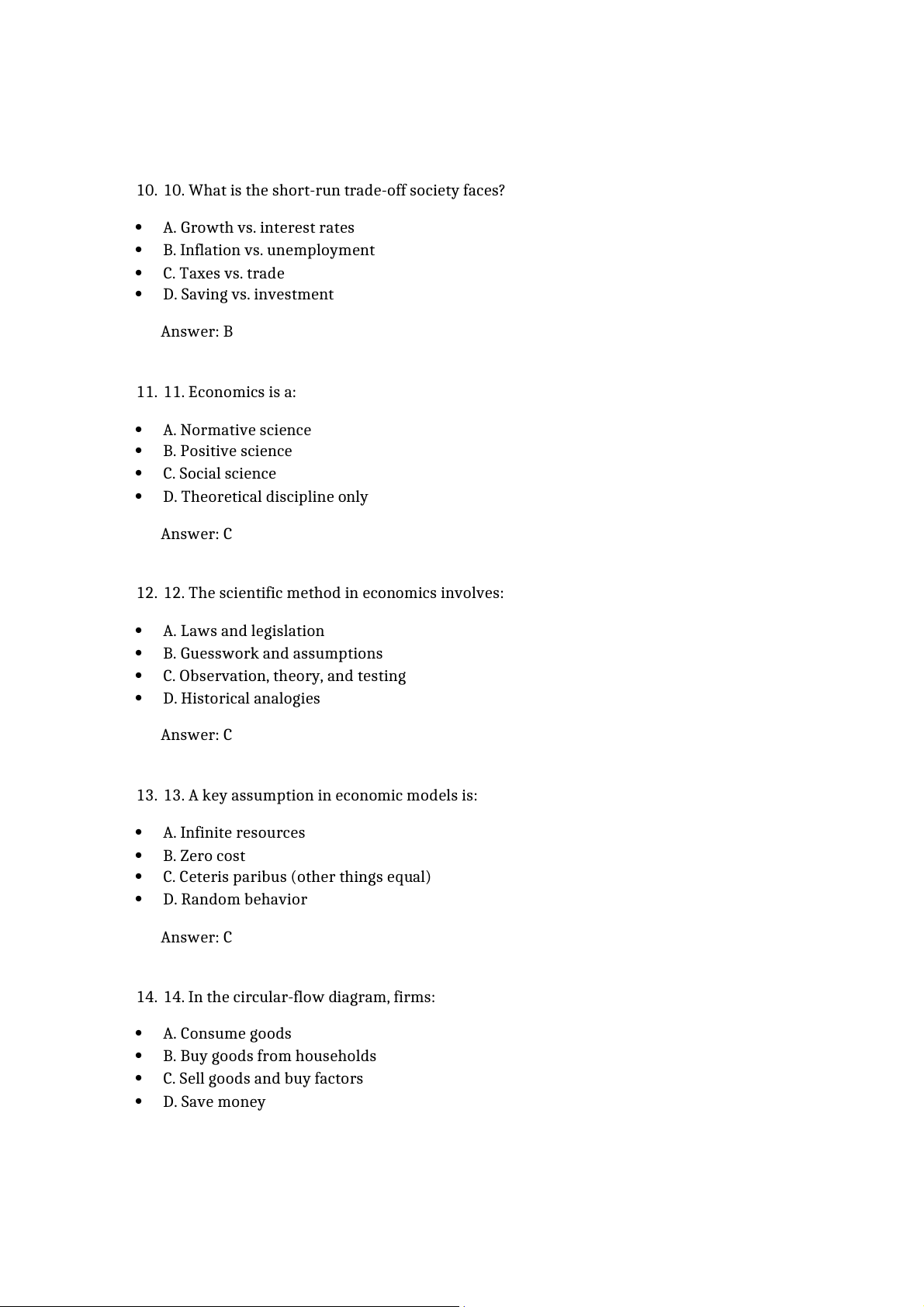
10. 10. What is the short-run trade-off society faces? A. Growth vs. interest rates B. Inflation vs. unemployment C. Taxes vs. trade D. Saving vs. investment ✅ Answer: B 11. 11. Economics is a: A. Normative science B. Positive science C. Social science D. Theoretical discipline only ✅ Answer: C
12. 12. The scientific method in economics involves: A. Laws and legislation B. Guesswork and assumptions
C. Observation, theory, and testing D. Historical analogies ✅ Answer: C
13. 13. A key assumption in economic models is: A. Infinite resources B. Zero cost
C. Ceteris paribus (other things equal) D. Random behavior ✅ Answer: C
14. 14. In the circular-flow diagram, firms: A. Consume goods B. Buy goods from households C. Sell goods and buy factors D. Save money ✅ Answer: C
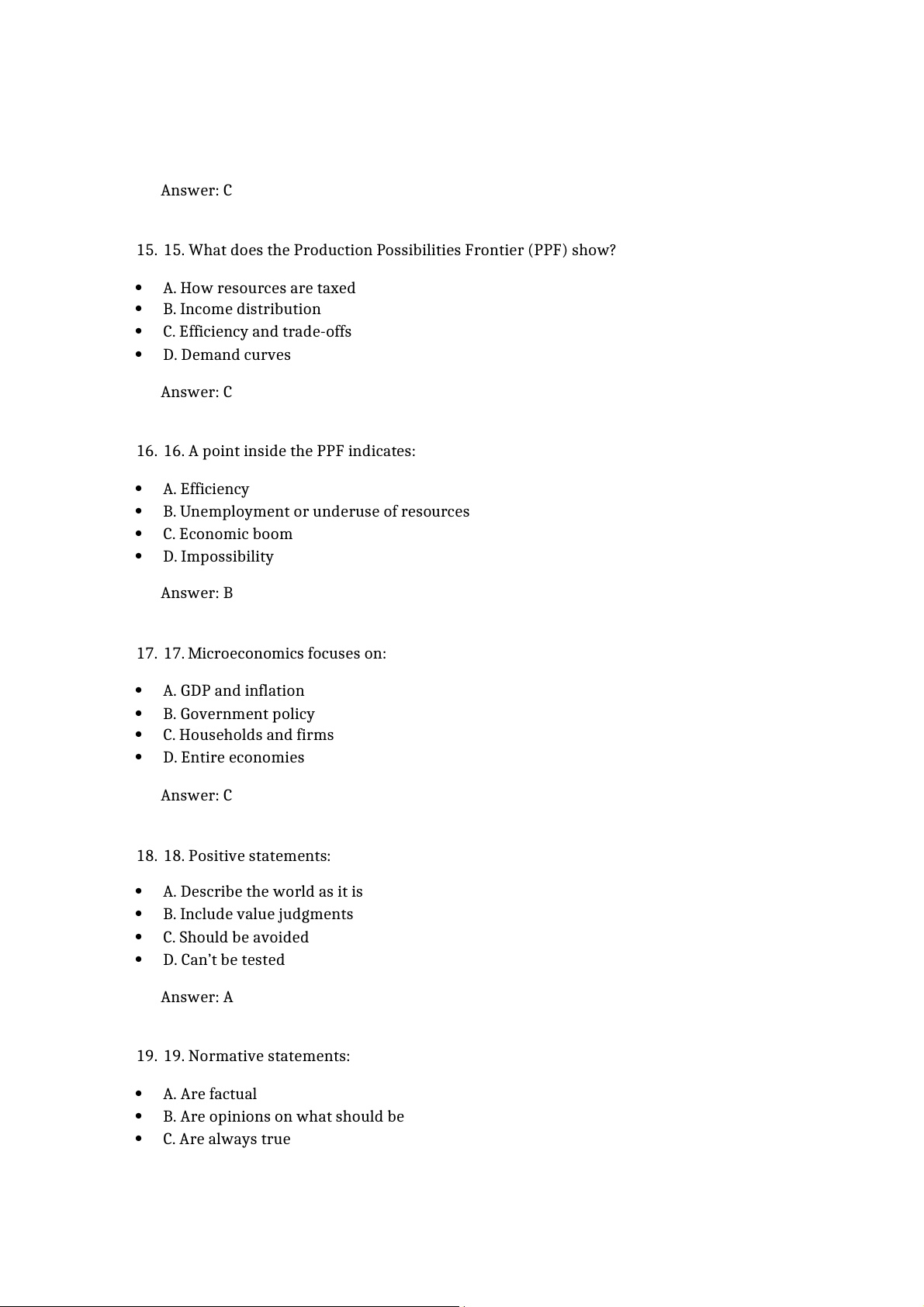
15. 15. What does the Production Possibilities Frontier (PPF) show? A. How resources are taxed B. Income distribution C. Efficiency and trade-offs D. Demand curves ✅ Answer: C
16. 16. A point inside the PPF indicates: A. Efficiency
B. Unemployment or underuse of resources C. Economic boom D. Impossibility ✅ Answer: B
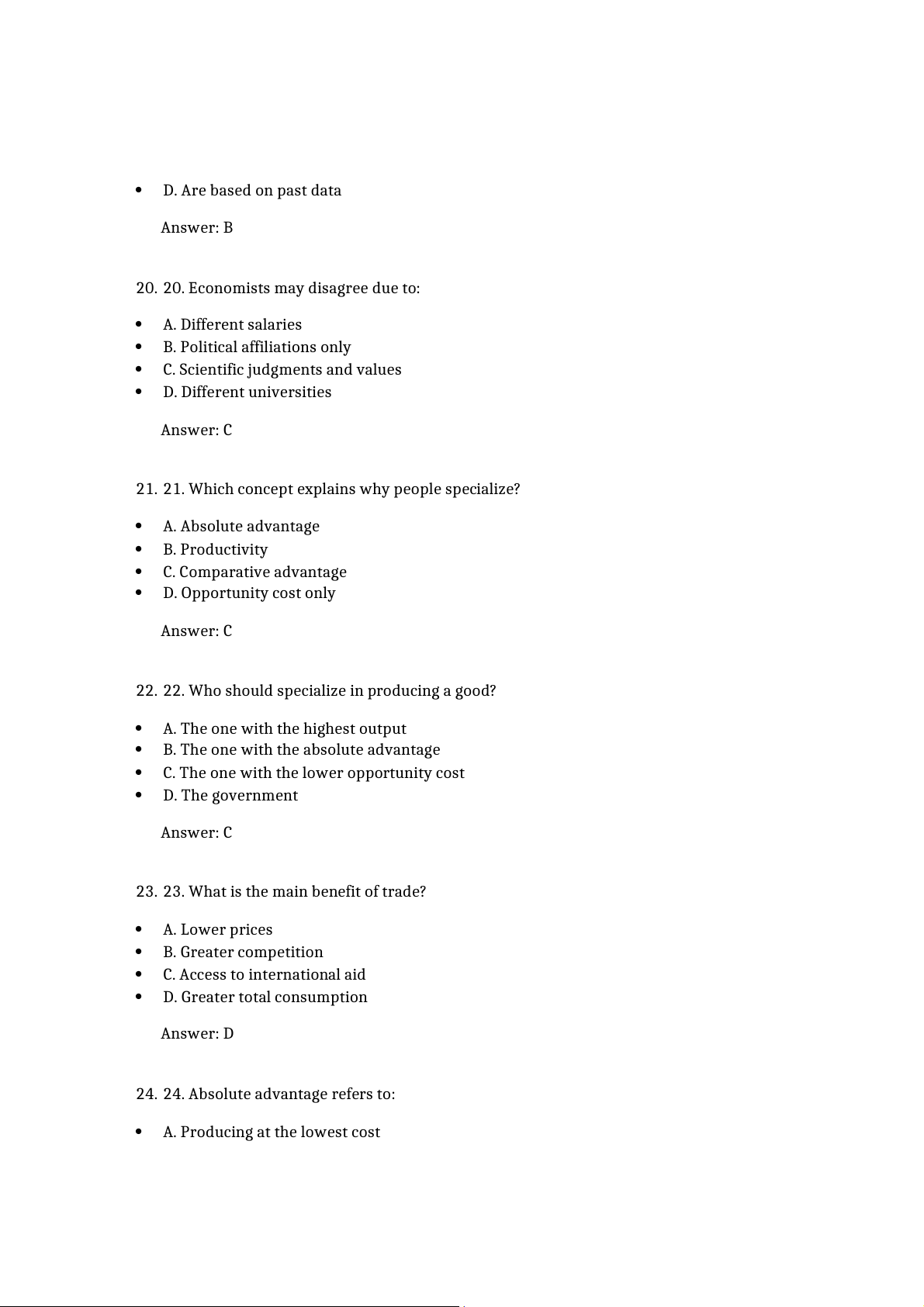
17. 17. Microeconomics focuses on: A. GDP and inflation B. Government policy C. Households and firms D. Entire economies ✅ Answer: C 18. 18. Positive statements: A. Describe the world as it is B. Include value judgments C. Should be avoided D. Can’t be tested ✅ Answer: A 19. 19. Normative statements: A. Are factual
B. Are opinions on what should be C. Are always true D. Are based on past data ✅ Answer: B
20. 20. Economists may disagree due to: A. Different salaries B. Political affiliations only
C. Scientific judgments and values D. Different universities ✅ Answer: C
21. 21. Which concept explains why people specialize? A. Absolute advantage B. Productivity C. Comparative advantage D. Opportunity cost only ✅ Answer: C
22. 22. Who should specialize in producing a good?
A. The one with the highest output
B. The one with the absolute advantage
C. The one with the lower opportunity cost D. The government ✅ Answer: C
23. 23. What is the main benefit of trade? A. Lower prices B. Greater competition C. Access to international aid D. Greater total consumption ✅ Answer: D
24. 24. Absolute advantage refers to:
A. Producing at the lowest cost
B. Producing more with fewer inputs C. Having more resources D. Government subsidies ✅ Answer: B
25. 25. A country that trades based on comparative advantage will: A. Import all goods B. Have unemployment C. Consume beyond its PPF D. Reduce efficiency ✅ Answer: C
26. 26. Specialization increases: A. Prices B. Economic efficiency C. Tariffs D. Income inequality ✅ Answer: B
27. 27. If one person has an absolute advantage in both goods, trade: A. Is not possible B. Can still be beneficial C. Becomes zero-sum D. Hurts the weaker party ✅ Answer: B
28. 28. Trade-offs occur because: A. Resources are scarce B. Markets fail C. Governments regulate D. People save money ✅ Answer: A
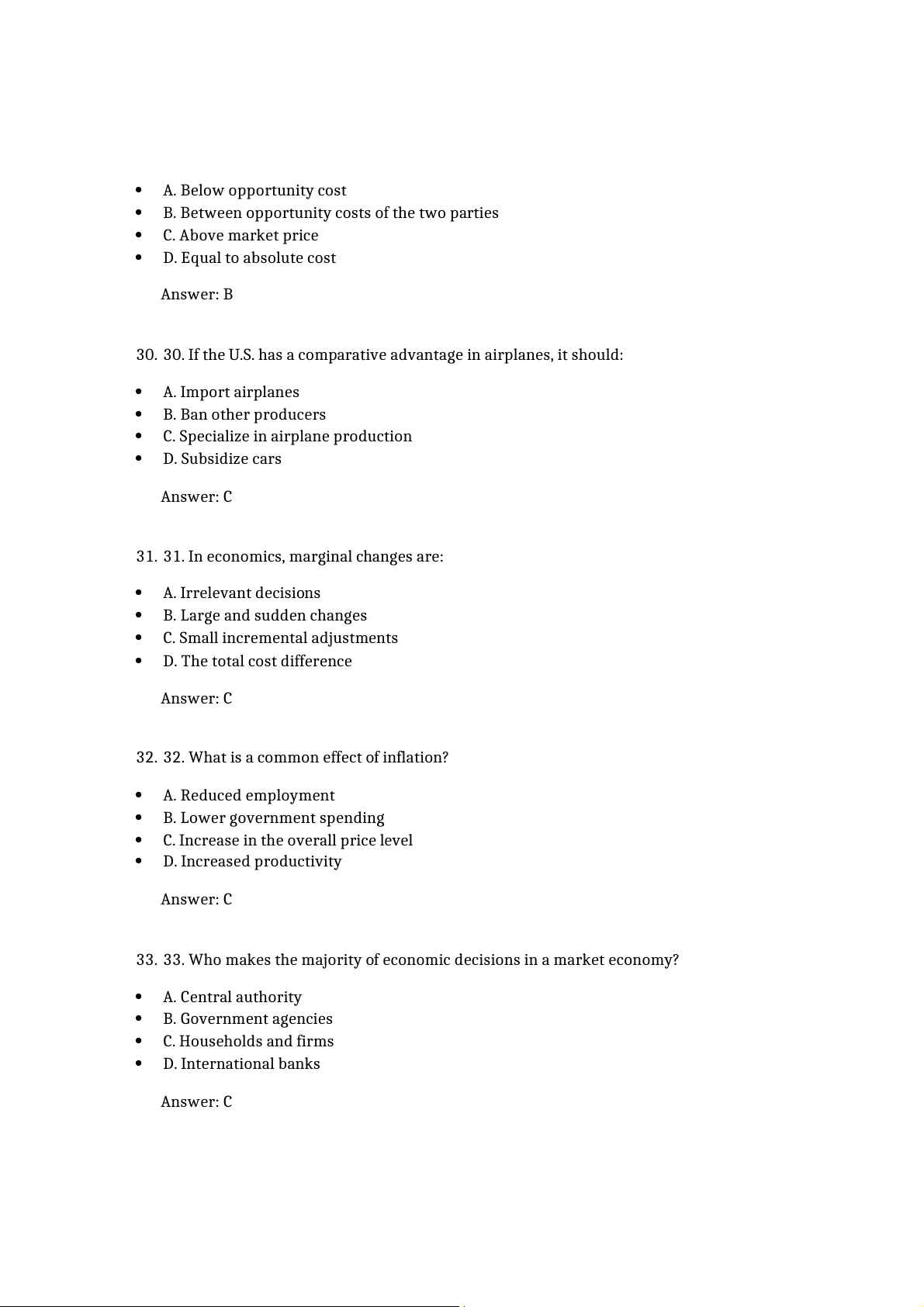
29. 29. The price of a trade must lie: A. Below opportunity cost
B. Between opportunity costs of the two parties C. Above market price D. Equal to absolute cost ✅ Answer: B
30. 30. If the U.S. has a comparative advantage in airplanes, it should: A. Import airplanes B. Ban other producers
C. Specialize in airplane production D. Subsidize cars ✅ Answer: C
31. 31. In economics, marginal changes are: A. Irrelevant decisions B. Large and sudden changes
C. Small incremental adjustments D. The total cost difference ✅ Answer: C
32. 32. What is a common effect of inflation? A. Reduced employment B. Lower government spending
C. Increase in the overall price level D. Increased productivity ✅ Answer: C
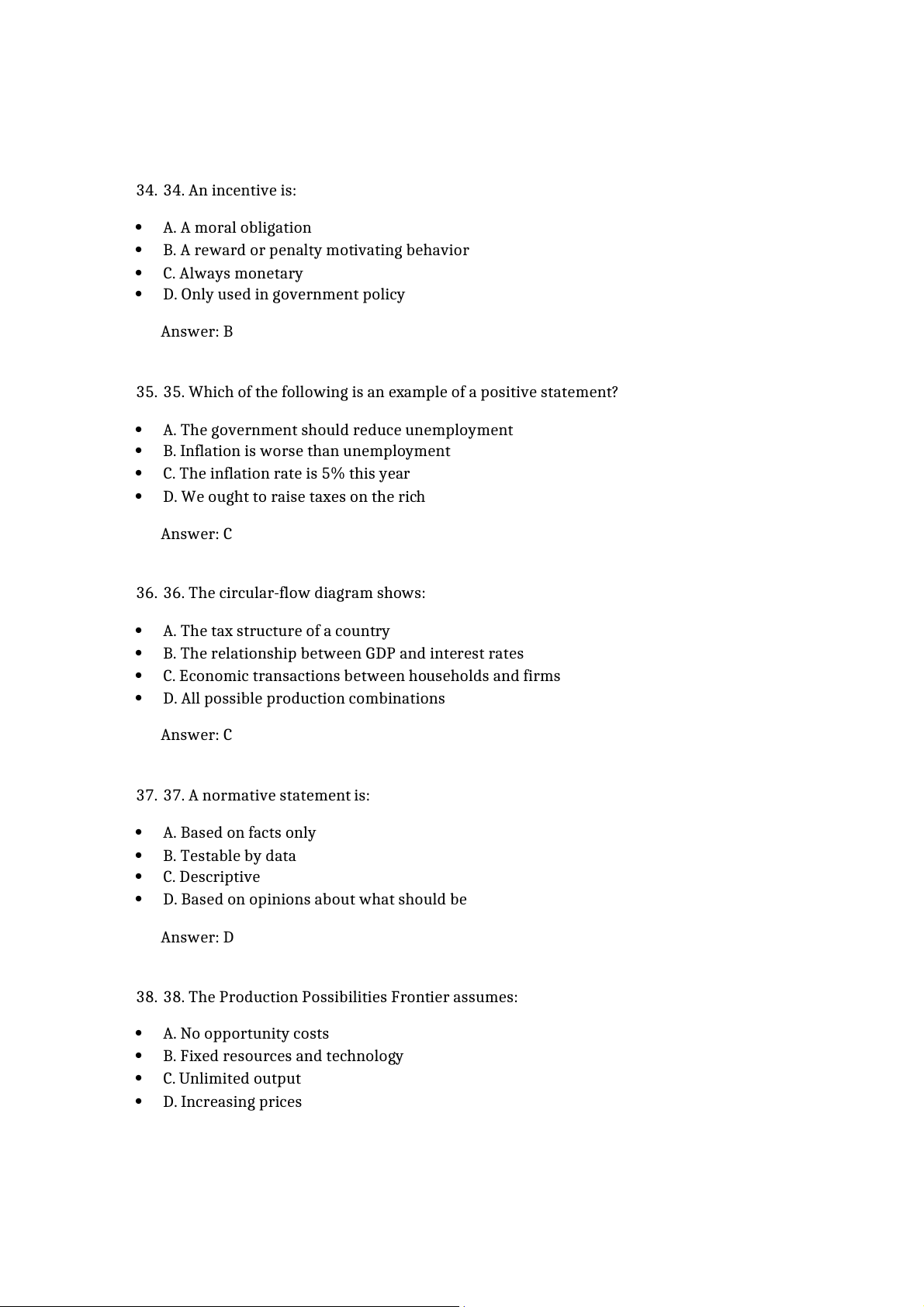
33. 33. Who makes the majority of economic decisions in a market economy? A. Central authority B. Government agencies C. Households and firms D. International banks ✅ Answer: C 34. 34. An incentive is: A. A moral obligation
B. A reward or penalty motivating behavior C. Always monetary
D. Only used in government policy ✅ Answer: B
35. 35. Which of the following is an example of a positive statement?
A. The government should reduce unemployment
B. Inflation is worse than unemployment
C. The inflation rate is 5% this year
D. We ought to raise taxes on the rich ✅ Answer: C
36. 36. The circular-flow diagram shows:
A. The tax structure of a country
B. The relationship between GDP and interest rates
C. Economic transactions between households and firms
D. All possible production combinations ✅ Answer: C
37. 37. A normative statement is: A. Based on facts only B. Testable by data C. Descriptive
D. Based on opinions about what should be ✅ Answer: D
38. 38. The Production Possibilities Frontier assumes: A. No opportunity costs
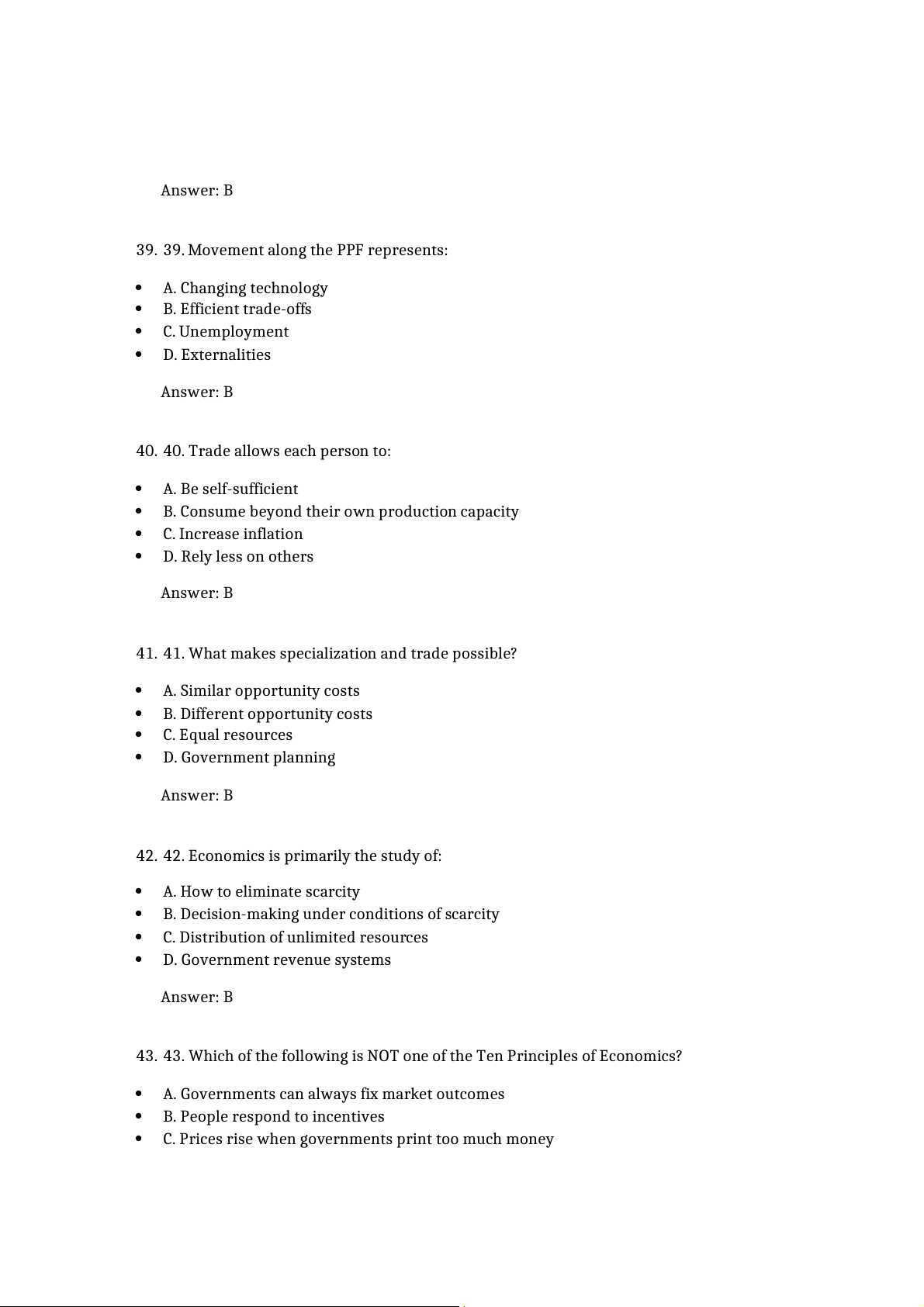
B. Fixed resources and technology C. Unlimited output D. Increasing prices ✅ Answer: B
39. 39. Movement along the PPF represents: A. Changing technology B. Efficient trade-offs C. Unemployment D. Externalities ✅ Answer: B
40. 40. Trade allows each person to: A. Be self-sufficient
B. Consume beyond their own production capacity C. Increase inflation D. Rely less on others ✅ Answer: B
41. 41. What makes specialization and trade possible? A. Similar opportunity costs B. Different opportunity costs C. Equal resources D. Government planning ✅ Answer: B
42. 42. Economics is primarily the study of: A. How to eliminate scarcity
B. Decision-making under conditions of scarcity
C. Distribution of unlimited resources D. Government revenue systems ✅ Answer: B
43. 43. Which of the following is NOT one of the Ten Principles of Economics?
A. Governments can always fix market outcomes
B. People respond to incentives
C. Prices rise when governments print too much money
D. Trade can make everyone better off ✅ Answer: A
44. 44. Gains from trade are based on: A. Moral advantage B. Comparative advantage C. Absolute production level D. GDP growth ✅ Answer: B
45. 45. The economic definition of efficiency is: A. Maximum government control
B. Minimum cost for maximum output
C. Maximizing output from given resources D. Balanced taxation ✅ Answer: C
46. 46. The role of assumptions in economic models is to:
A. Reflect real-world complexity
B. Simplify the world to improve understanding C. Confuse beginners D. Ignore opportunity costs ✅ Answer: B
47. 47. A country should export goods for which it has: A. No demand B. High opportunity cost C. Comparative advantage D. Absolute disadvantage ✅ Answer: C
48. 48. Economic models such as the PPF and circular-flow are:
A. Exact copies of real economies B. Useful simplifications C. Incomplete and not used D. Designed only for academics ✅ Answer: B
49. 49. Which of the following best illustrates thinking at the margin? A. Quitting school entirely
B. Deciding whether to study one more hour C. Saving all your income
D. Investing in two businesses simultaneously ✅ Answer: B
50. 50. Which of the following would shift a country's PPF outward?
A. Increase in consumer spending B. Technological innovation C. Decrease in working hours D. More imports ✅ Answer: B
Tài liệu liên quan:
-
Tự Luận Vimo: Phân Tích Cung, Cầu và Thị Trường Cạnh Tranh| Microeconomics | Trường Đại học Quốc tế, Đại học Quốc gia Thành phố Hồ Chí Minh
5 3 -
Review Questions: Thinking Like an Economist | Microeconomics | Trường Đại học Quốc tế, Đại học Quốc gia Thành phố Hồ Chí Minh
4 2 -
Final Exam Quizlet Questions & Answers | Microeconomics | Trường Đại học Quốc tế, Đại học Quốc gia Thành phố Hồ Chí Minh
5 3 -
Đề thi giữa kỳ II | Microeconomics | Trường Đại học Quốc tế, Đại học Quốc gia Thành phố Hồ Chí Minh
4 2 -
Final Group Project_ The Beer Industry | Microeconomics | Trường Đại học Quốc tế, Đại học Quốc gia Thành phố Hồ Chí Minh
4 2