Social Shopping Motivations and Their Impact on Impulsive Buying Behavior | Kinh tế vĩ mô | Trường Đại học kinh tế Thành Phố Hồ Chí Minh
Purpose: The study aimed to examine the causal relationship between social influences and impulsive buying behavior & compulsive buying behavior in context of fashion shopping. Methodology/Design: Questionnaire was administered to 372 young consumers. A structural equation model using AMOS 22 was analyzed utilizing maximum likelihood method. Tài liệu được sưu tầm và soạn thảo dưới dạng file PDF để gửi tới các bạn cùng tham khảo, ôn tập đầy đủ kiến thức, chuẩn bị cho các buổi học thật tốt. Mời bạn đọc đón xem!
Môn: Kinh tế vĩ mô ( UEH) 0.9 K tài liệu
Trường: Đại học Kinh tế Thành phố Hồ Chí Minh 2.8 K tài liệu
Tác giả:





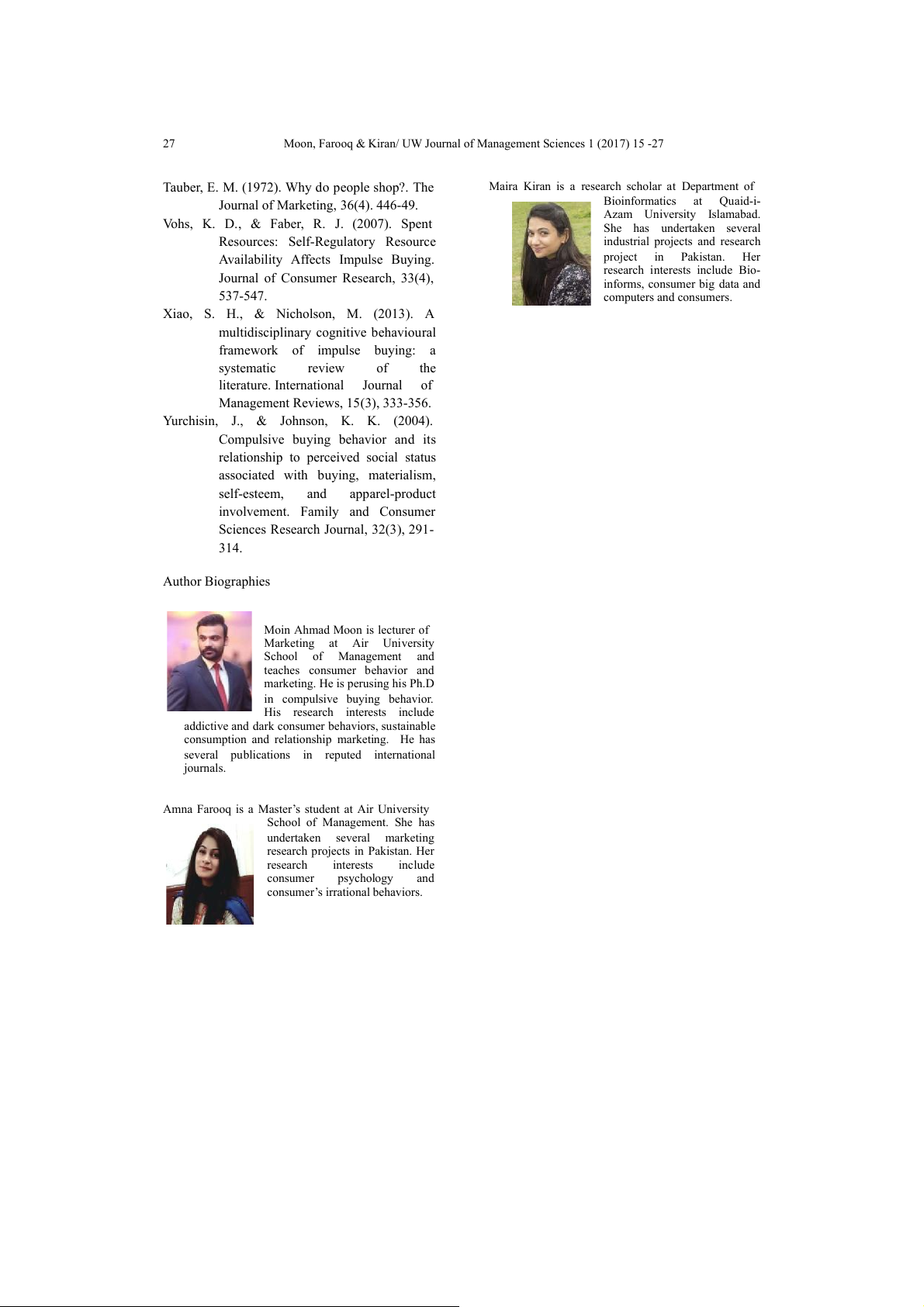
Preview text:
15
UW Journal of Management Sciences 1 (2017) 15 -27 University of Wah Journal of Management Sciences www.uow.edu.pk
Social Shopping Motivations of Impulsive and Compulsive Buying Behaviors
Moin Ahmad Moon a*, Amna Farooq a, Maira Kiran b
a Air University School of Management, Air University Multan Campus, Pakistan
b Faculty of Bioinformatics, Quaid-i-Azam University, Islamabad, Pakistan ARTICLE INFORMATION ABSTRACT
Purpose: The study aimed to examine the causal relationship between social influences ARTICLE HISTORY:
and impulsive buying behavior & compulsive buying behavior in context of fashion shopping. Received: 25 Jul, 2017
Methodology/Design: Questionnaire was administered to 372 young consumers. A Revised: 25 Aug, 2017
structural equation model using AMOS 22 was analyzed utilizing maximum likelihood Accepted: 5 Sep, 2017 method.
Findings: Informational influences, normative influences, and risk towards fashion,
social comparison orientation and social shopping motivations had significant
relationship with impulsive buying. Social risk towards fashion did not encourage KEYWORDS:
social shopping motivation and social shopping motivations proved to be significant
predictor of impulsive and compulsive buying. Compulsive Buying
Originality/Value: Study is amongst the very first to investigate social influences of Behavior
impulsive and compulsive buying behavior in a developing economy. Impulsive Buying
Implication: Theoretical and practical implications are discussed along with future Behavior recommendations. Social Influences
Limitations: This study was limited to university students of one city of Pakistan and to Social Shopping fashion products.. Motivation © 2017 Published by UWJMS INTRODUCTION
to acquisition of quantities that are either not
Consumer buying process may be categorized
required or not affordable (Hoyer & MacInnis,
into three specific behaviors. These behaviors are
2007). Compulsive buying behavior is generated
rational, impulsive and compulsive buying
to counter negative feelings like stress, anxiety or
behaviors (impulsive disorder) (LaRose, 2001;
depression but in a long run this counter behavior
Kwak et al., 2004). Compulsive buying as an idea
turns into a detrimental behavior for the
has been defined as a buying behavior that is
consumer and society (Edwards, 1993).
continuous and repetitive and it is stimulated in
Therefore, development of insights into this
result of some negative feelings or events (Faber
problematic behavior is essential for the sake of
& O' Guinn, 1992). Compulsive purchasing leads
providing guidelines to society and consumer.
∗ Corresponding author at: Air University School of Management, Air University Multan Campus, Pakistan
4th Floor Khan Center Abdali Road Multan Pakistan. Tel: +923007656856
E-mail address: moin@aumc.edu.pk(Moin Ahmad Moon).
Moon, Farooq & Kiran/ UW Journal of Management Sciences 1 (2017) 15 -27 16
Some consumers are very conscious about their
relationship of social influences and irrational
purchasing. They compare it with their society
behaviors and to investigate the relationship of
(Attiq & Azam, 2015; Moon, Attiq & Rasool,
impulsive buying behavior (not impulsiveness)
2015). They are more likely be pressurized by
and compulsive buying behavior.
peer groups, friends and family. In consumer and
societal psychology, the phenomenon of pressure LITERATURE REVIEW
adaptation from group is known as social
influence (Goldsmith & Clark, 2008). Social Compulsive Buying Behavior
influences are considered very important aspect
of consumer’s purchasing behavior and several
Compulsive buying as an idea has been defined
marketing scholars have exerted enormous efforts
in plethora of literature as “a buying behavior that
to examine effects of these social influences
is continuous and repetitive and it is stimulated in
(Dholakia & Talukdar, 2004). There are several
result of some negative feelings or events”
social factors that may motivate a consumer to
(Edwards, 1993, p. 70). The concept of shop.
compulsive buying has been theorized as a
response to the void created in the life of the
According to social learning theory (Bandura,
people. People try to fill the void and lack in the
2001), social and cultural influences have a
significant impact on the way in which people
life through buying of material possession and
buy impulsively or compulsively (Vohs & Faber,
through compulsive buying. This spending
through compulsive buying grants the individuals
2007). Shopping behavior endorsed by society
power and control over life (Moon, Attiq &
psychologically gratifies a consumer and make
Rasool, 2015 a). Negative feelings in the life of
him/her socially acceptable (Black, 2007). These
people such as boredom and stress also cause
social motives may result in formation of
anxiety. People try to address the anxiety through
impulsive buying behavior and compulsive
compulsive buying. Through this compulsive
buying behavior and are concern of inquiry in
buying, people tend to grant meaning to their life this research.
(Kukar-Kinney et al., 2009). It can be concluded
In collectivist cultures, it is argued that people
that compulsive buying is used to alleviate the
consider shopping as a way to socialize and
negative feelings which may afflict people (Faber
& O'Guinn, 1992). It can be concluded that
familiarize with other people (Lee & Kacen,
people are motivated by a very strong and
2008). Impulsive and compulsive buying
irresistible urge to engage in compulsive buying
behavior has been majorly a topic of discussion
(Yurchisin & Johnson, 2004).
in individualistic cultures (Attiq & Azam, 2012).
Social perspective of compulsive buying
behavior is required to be probed in different Impulsive Buying Behavior
cultures because there is a huge difference
“Impulsive buying is an unintentional behavior
between individualistic and collectivist culture
that involves prompt decision making and
(Kukar-Kinney et al., 2009). After deeply
studying the literature on consumer’s irregular
propensity of acquiring the product immediately”
(Rook & Gardner, 1993). Han et al (1991)
behaviors i.e. impulsive buying behavior and
introduced the term fashion oriented impulsive
compulsive buying behavior and their relevance
buying synonymizing suggestion impulse buying.
to social factors, this study aimed at achieving the
Impulsive buying behavior and compulsive
following objectives to bridge identified gap in
buying behavior are considered irrational
this area of research. To investigate the 17
Moon, Farooq & Kiran/ UW Journal of Management Sciences 1 (2017) 15 -27
behaviors (LaRose, 2001). Impulsive buying
social shopping motivation triggers irrational
behavior and compulsive buying behavior are buying behavior.
difficult to distinguish all together based on their
consequences. Both these behaviors result in
H2: Social Shopping motivation has a significant
excessive, unnecessary and unwanted purchases
influence on impulsive buying behavior.
that, in turn, lead to damaging penalties (Moon,
Hassan & Attiq, 2015, 2015a; Xiao & Nicholson,
H3: Social Shopping motivation has a significant
2013). Products acquired in result of these
influence on compulsive buying behavior.
behaviors are usually same products like
electronic apparatus and apparel products. Both
Susceptibility to Interpersonal Influence
of these behaviors are caused by lack of strength
of will and lack of self-control, which are
Consumer susceptibility is known as consumer’s
categorized as personality disorder (Kwak et al.
vulnerability or defenselessness. Consumer
2006). Therefore, we assume that impulsive
susceptibility to interpersonal influences is
buying would result in compulsive buying known as consumer’s vulnerability or behavior.
defenselessness to his interpersonal influences.
Interpersonal influences are composed of two
H1: Impulsive buying behavior has a significant
dimensions i.e. informative and normative
influence on compulsive buying behavior.
influences (Cheng, Chuang, Wang & Kug, 2013).
Tendency to believe information gathered from Social Shopping Motivation
others to be precise reality is known as
informational influence (Moon, Habib & Attiq,
Shopping motivation is defined as the internal
2015; Goldsmith & Clark, 2008). Susceptibility
force that derives a consumer to shop or buy.
to normative influence is known as the desire of a
Shopping motivations are categorized into two
consumer to develop consistent beliefs views and
forms of physiological needs of consumer i.e.
specifications of buying decisions with others.
personal and social (Moon et al., 2017; Tauber,
These consumers want to be recognized and
1972). Personal motive (novelty seeking, self-
enhance their image, so they are more likely to
satisfaction, browsing) and social motives
become impulsive and compulsive purchasers
(interaction with people) may be experienced by
(Bearden, Netemeyer, & Teel 1989; Halepete,
a consumer during a shopping trip. Satisfaction,
Littrell & Park, 2009). Consumers with high
amusement and pleasure extracted from buying
susceptibility to normative influence are more
products while socializing with peer groups,
brand conscious than people with low
friends and family members is known as social
susceptibility. They usually have impulsive or
shopping motivation (Arnold & Reynolds, 2003).
compulsive tendencies (Lysonski & Durvasula,
Shopping can be more than a product acquiring
2013). Literature provides that interpersonal
activity for people who suffer isolation,
influences are very significant in shaping up
loneliness, boredom or depression (Moon,
buying behaviors of teenagers, specifically,
Hassan & Attiq, 2015a; Ha & Jang, 2013).
irrational behaviors (Liu & Laird, 2008).
Shopping is a social activity for disturbed people.
Interpersonal influences of a consumer have an
When consumers feel low or irritated, they go for
immediate and significant impact on consumers
shopping and make unplanned and irrational
buying behavior, as consumers tend to rely on
purchases. Doing so relieves them for some time
their normative and informative beliefs (Hale,
(Ridgway et al. 2008). Therefore, we assume that
2003). The acceptance or rejection of a
consumer’s particular buying behavior by his/her
Moon, Farooq & Kiran/ UW Journal of Management Sciences 1 (2017) 15 -27 18
reference group (i.e. colleagues, friends and
uncertainty of a consumer that whether fashion
family) puts consumer into huge pressure to
products he/she purchases are going to accepted
indulge into a behavior that aligns consumer with
or not (Song, Hwang, Kim & Kwak, 2011). This
reference group. That is why normative beliefs
uncertainty or risk carries anxieties and stresses
are considered strong interpreter of consumer
along with it. We implied that these stresses and
buying behavior (Fishbein & Ajzen, 2005;
anxieties might motivate a consumer to indulge
Crespo & Bosque, 2010). Therefore, we proposed
in excessive and repetitive shopping i.e.
that interpersonal influences develop shopping
impulsive and compulsive buying.
motivations and results in irrational purchasing.
H10: Social risk towards fashion has a significant
H4: Susceptibility to informative influence has a
influence on social shopping motivation.
significant influence on social shopping motivation.
H11: Social risk towards fashion has a significant
influence on impulsive buying behavior.
H5: Susceptibility to informative influence has a
significant influence on impulsive buying
H12: Social risk towards fashion has a significant behavior.
influence on compulsive buying behavior.
H6: Susceptibility to informative influence has a Social Comparison Orientation
significant influence on compulsive buying behavior.
Social comparison orientation is the extent of a
person’s involvement in the process comparing
H7: Susceptibility to normative influence has a
him/her with others in the society (Dameyasani &
significant influence on social shopping
Abraham, 2013). It is universally acknowledged motivation.
that people compare themselves with others but
H8: Susceptibility to normative influence has a
the inclination of this social comparison varies.
significant influence on impulsive buying
Some people are more likely to indulge in social behavior.
comparison and resultantly require more social
connections (Moon, Hassan & Attiq, 2015b;
H9: Susceptibility to normative influence has a
Gibbons & Buunk, 1999). This comparison may
significant influence on compulsive buying
be undertaken in two ways i.e. downward and behavior.
upward comparison (Suls & Wheeler, 2002). In upward comparison, people make their Social Risk towards Fashion
comparisons with people who are superior to
them and in downward comparison they compare
An individual’s opinion regarding a fashion
themselves with people who are of low standards.
product or service being disapproved by other
impulsive and compulsive buying.
people (Society) is known as social risk towards
fashion (Attiq & Azam, 2014; Dowling &
H10: Social risk towards fashion has a significant
Staelin, 1994). Having information related to new
influence on social shopping motivation.
fashions, styles and prevailing trends motivates
an individual to shop. To have latest information
H11: Social risk towards fashion has a significant
about newest trends in fashion is important for a
influence on impulsive buying behavior.
consumer to go for shopping (Jointer, Brown &
Kistner, 2014). Social risk towards fashion is the 19
Moon, Farooq & Kiran/ UW Journal of Management Sciences 1 (2017) 15 -27
H12: Social risk towards fashion has a significant
urge motivates them to purchase extra, unplanned
influence on compulsive buying behavior.
and unnecessary items. This leads them to
demonstrate impulsive and/or compulsive buying Social Comparison Orientation behavior.
Social comparison orientation is the extent of a
H13: Social comparison orientation has a
person’s involvement in the process comparing
significant influence on social shopping
him/her with others in the society (Dameyasani & motivation.
Abraham, 2013). It is universally acknowledged
that people compare themselves with others but
H14: Social comparison orientation has a
the inclination of this social comparison varies.
significant influence on impulsive buying
Some people are more likely to indulge in social behavior.
comparison and resultantly require more social
connections (Moon, Hassan & Attiq, 2015b;
H15: Social comparison orientation has a
Gibbons & Buunk, 1999). This comparison may
significant influence on compulsive buying
be undertaken in two ways i.e. downward and behavior.
upward comparison (Suls & Wheeler, 2002). In upward comparison, people make their Theoretical Framework
comparisons with people who are superior to
them and in downward comparison they compare Social learning theory suggests that
themselves with people who are of low standards.
environmental factors work as a stimulus to
Downward comparison is used to boost their self-
influence behavior (Bandura, 2001). To study the
esteem and self-enhancement. Motivation behind
social learning process of an individual from the
comparison is self-assessment (Mangleburg,
behavioral perspective, few models were
Doney, & Bristol, 2004). Association between
developed. Stimulus response model (Hull, 1951)
social comparison orientation and consumer
provides us with understanding of behavior
behavior is evident from various studies (Moschis
development process. Specific stimuli’s and their
et al., 2009). This social comparison orientation
respective responses are the core focus of this
influences consumers buying behavior and
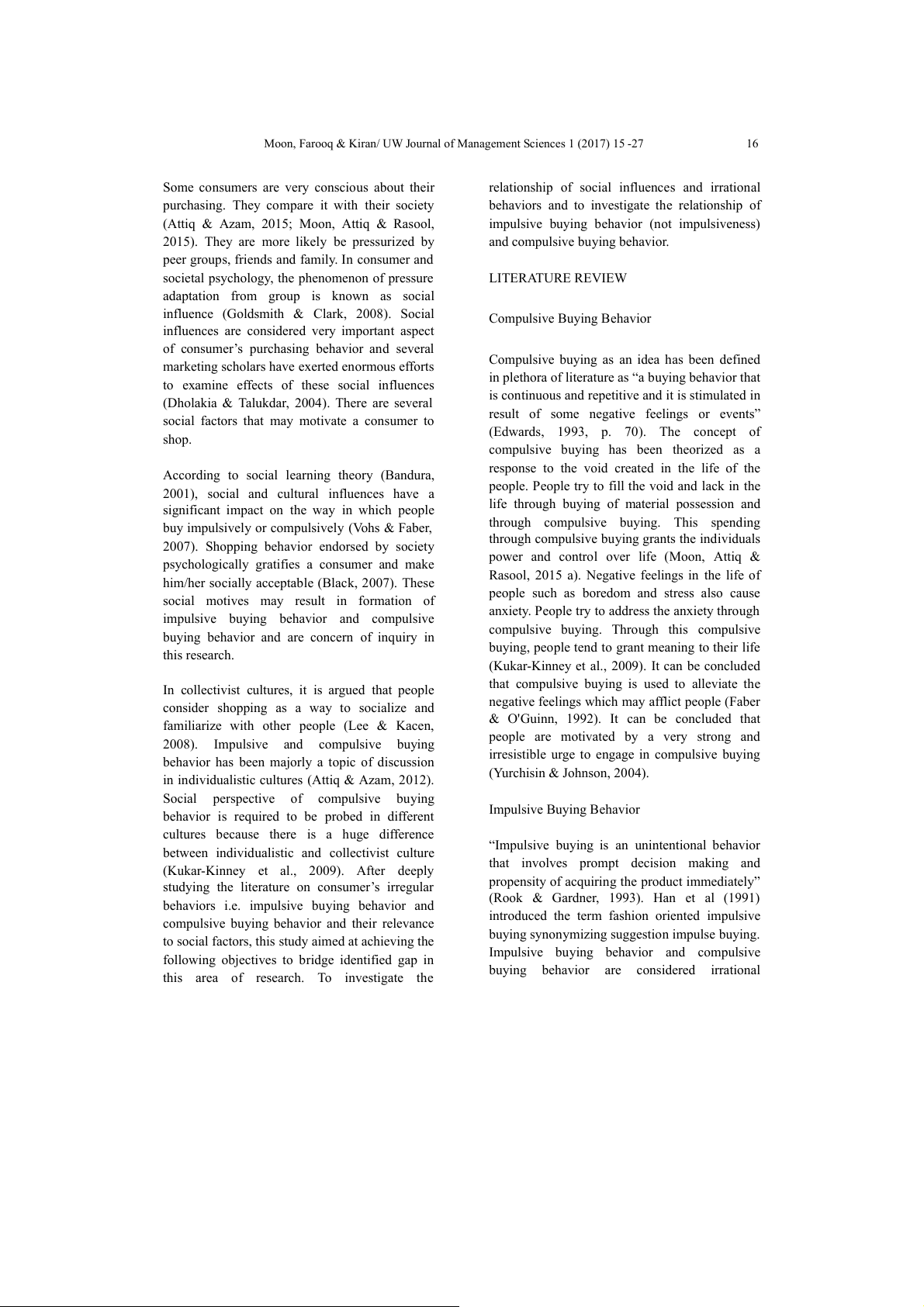
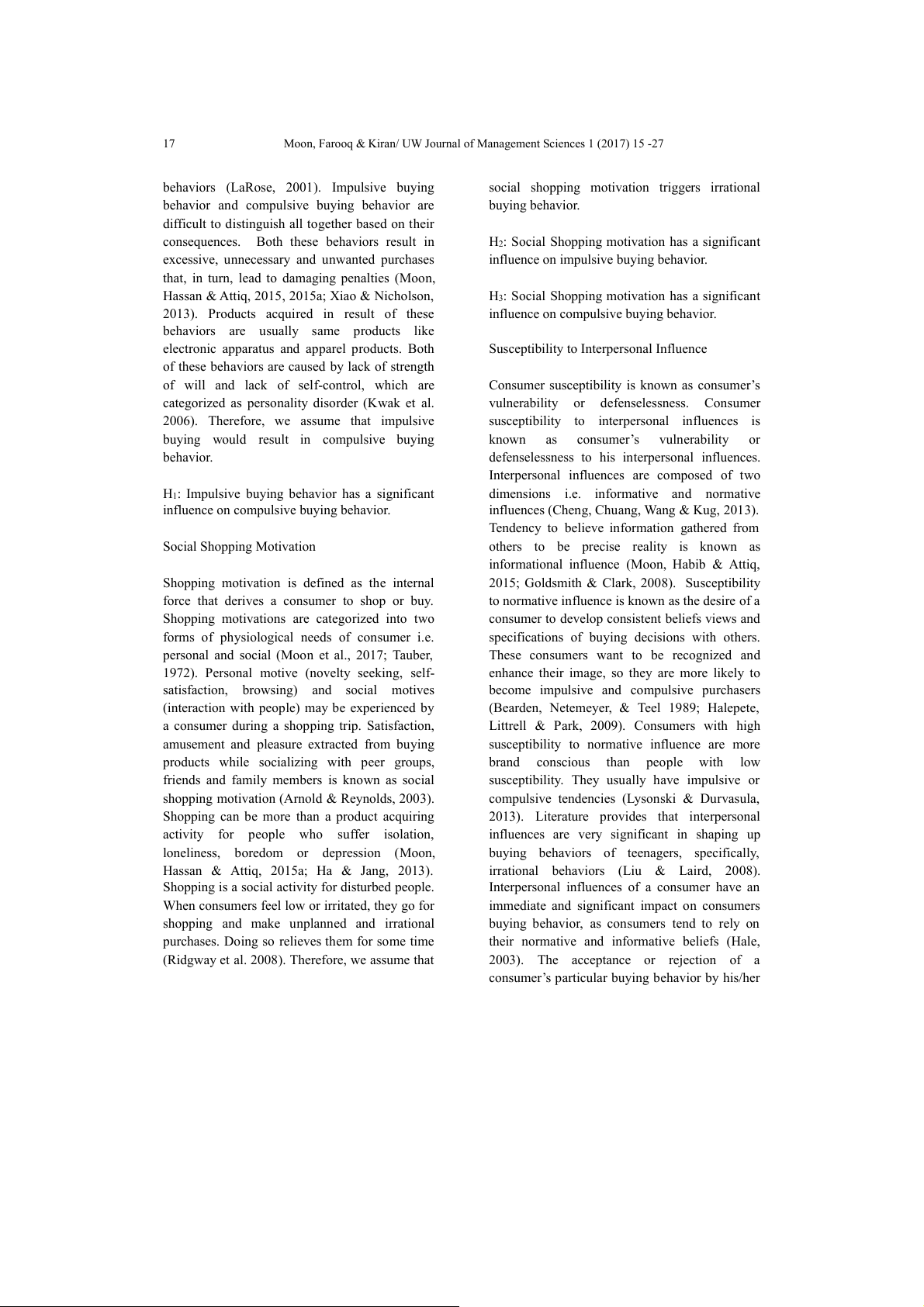
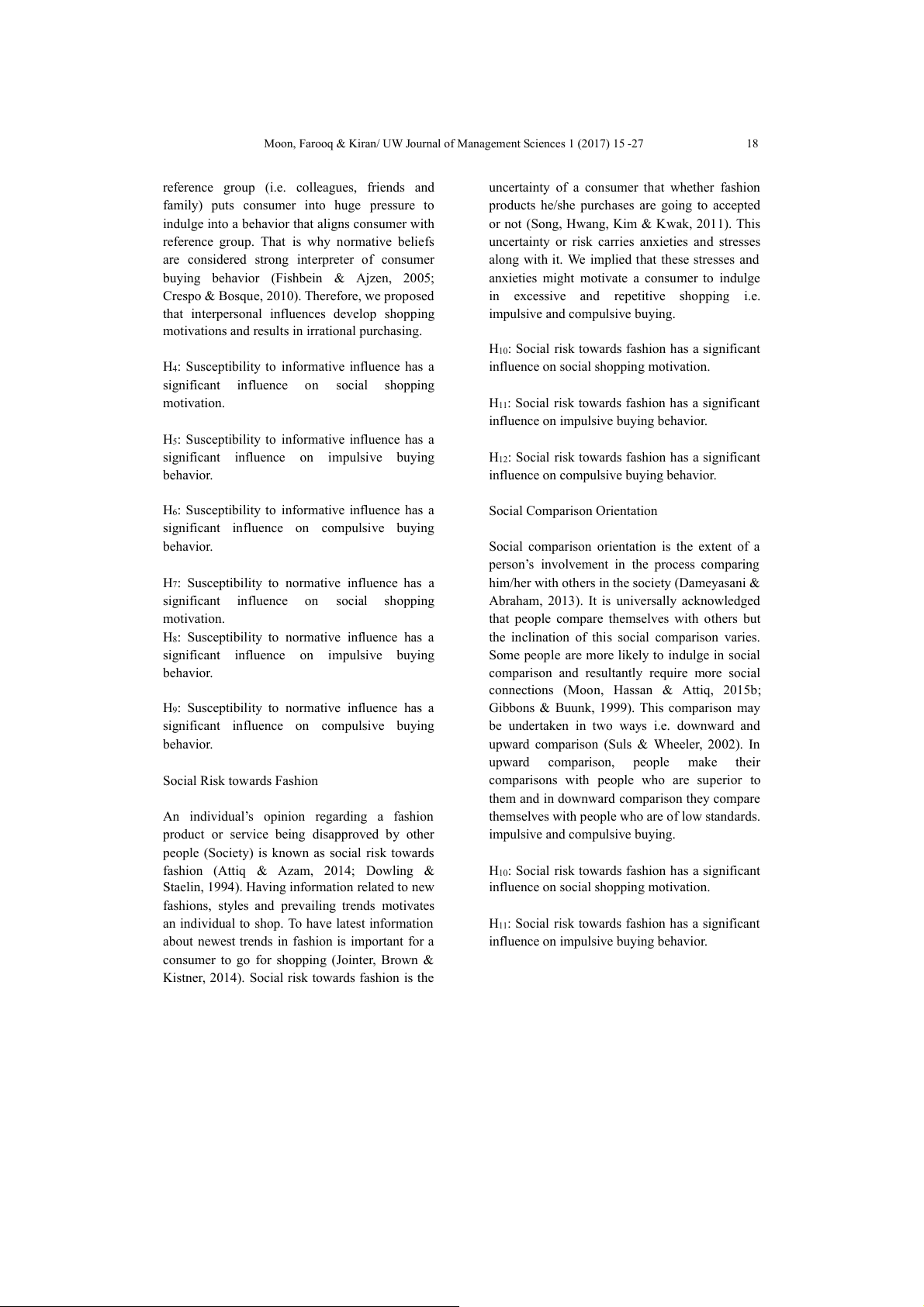
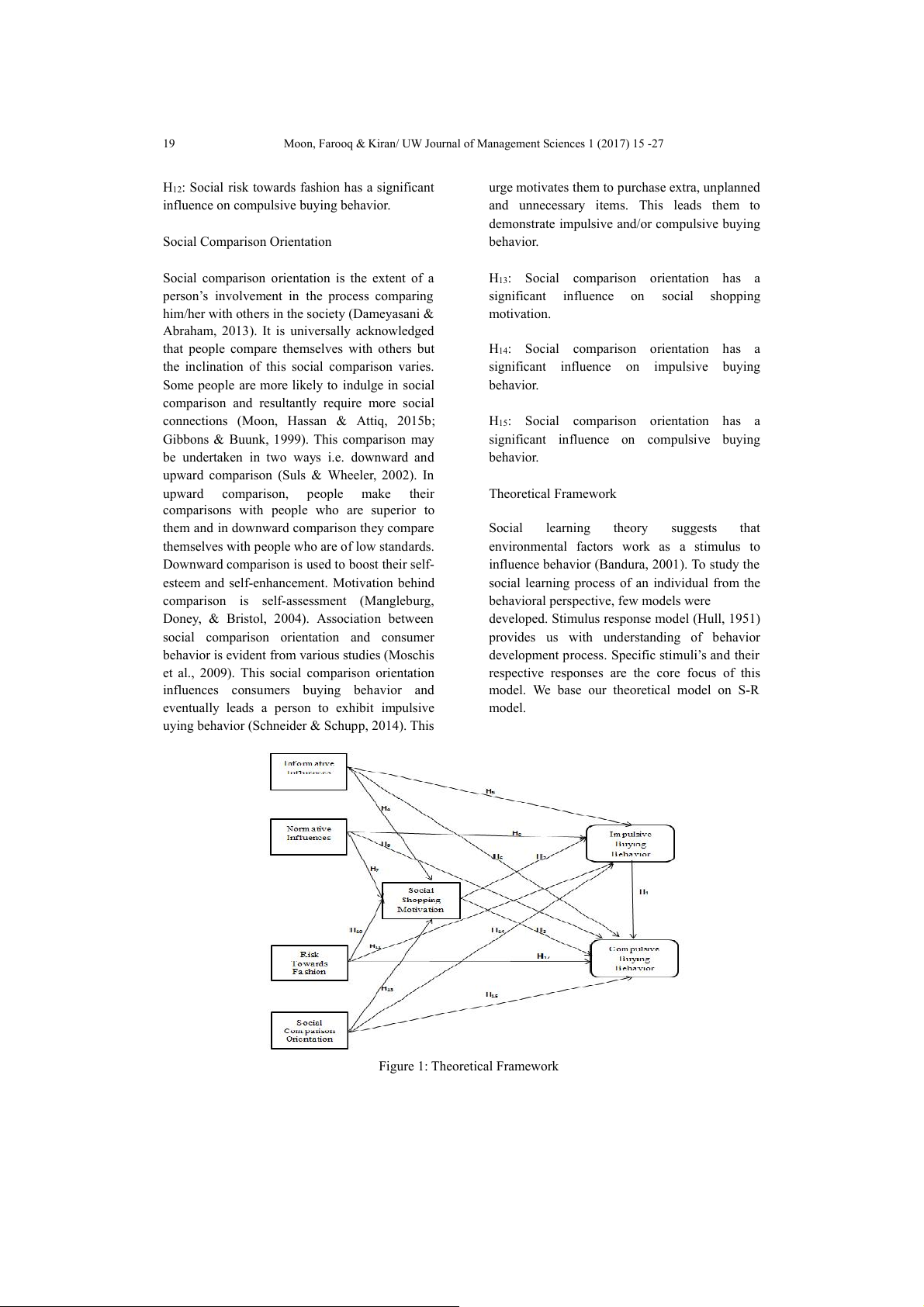
model. We base our theoretical model on S-R
eventually leads a person to exhibit impulsive model.
uying behavior (Schneider & Schupp, 2014). This
Figure 1: Theoretical Framework
Moon, Farooq & Kiran/ UW Journal of Management Sciences 1 (2017) 15 -27 20 METHODOLOGY
Two-step procedure was used to conduct
structural equation modelling (SEM) in AMOS
Sample of this study was 372 young consumer of
22. We conducted confirmatory factor analysis
Islamabad. Reason behind selecting young
for reliability and validly and for hypothesis
consumers as population for this study is to
testing, we used structural model analysis.
understand young consumer’s consumption
patterns at present and forecast how they are Sample Demographics
likely to shape up in future. Convenient sampling
technique was used in this study for collection of
Sample of 372 young consumers consisted of 187
data. Pakistan is not an advance country as far as
(50.3 %) male respondents and 191 (51.3%)
research is concerned. To the best of our
consumers fit in to age group of 18 to 22. Out of
knowledge, there are no consumer data bases
372 respondents, 166 (44.6%) had bachelors
available in the country at the moment. So it was
education while income profile of the sample
impossible for us to go for probability sampling
indicated that 89 (23%) respondents had the method.
income ranging from rupees 1 to 10000, 148
(39.8%) were earning rupees 10000 to 20000, 94
Data was collected through survey self-
(25.3) were earning rupees 20000 to 30000 and administered questionnaire adopted from
41 (11%) were earning more than rupees 30000.
literature on five point Likert scale (1=strongly
disagree, 5= strongly agree). Questionnaires were Descriptive Statistics circulated among young consumers in
universities, shopping malls, bazaars and homes
To analyze the assumption of normality we
in Islamabad, Pakistan during the months of June
utilized two most recommended measures of
and July 2016. Questionnaire constituted 43
normality i.e. skewness and kurtosis. Skewness items in total (including demographic
is a measure of symmetry of a distribution and
information). Consumers were asked to express
kurtosis measure ‘’peakedness’’ of distribution.
their opinions relating to fashion products.
In social sciences, for data to be normally Measures
distributed, Skewness and kurtosis must fall
within the range from -2 to +2 (Cameron, 2004). Compulsive buying behavior (CBB) was
In the following table, all measurement scales are
measured on 13 item scale developed by Edwards
described in terms of their respective ranges of
(1993). We measured impulsive buying behavior
Mean, Standard Deviation, Skewness & kurtosis.
(IBB) with 12 items (Han et al, 1991). 3 items of
social shopping motivation (SM) by Arnold & Structural Equation Modeling
Reynolds, (2003), 3 items of susceptibility to
informative influences (SII) (Bearden et al. Confirmatory Factor Analysis
1989), 3 items of susceptibility to informative
Confirmatory factor analysis was conducted for
influences (SNI) (Bearden et al.1989), 3 items of
confirming the measurement model with seven
social risk towards fashion (SRF) (Halepete et
latent variables (Compulsive buying behavior
al.,2009) and 6 items of social comparison
(CBB), impulsive buying behavior (IBB), social
orientation (SCO) (Gibbons & Buunk, 1999).
shopping motivations (SM), susceptibility to
informative influences (SII), susceptibility to DATA ANALYSIS
normative influences (SNI), social risk towards 21
Moon, Farooq & Kiran/ UW Journal of Management Sciences 1 (2017) 15 -27
Table 1. Descriptive Statistics (N=372) Code Mean Std. Deviation Skewness Kurtosis CBB 4.25-4.32 0.67-0.76 -0.73-1.10 0.32-2.39 IBB 3.62-4.29 0.65-1.08 -0.55-0.75 -0.13-1.34 SM 3,24-3.34 1.15-1.21 -0.03-0.45 -0.58-0.87 SII 3.44-3.56 1.08-1.23 -0.55-0.61 -0.13-0.73 SNI 3.38-3.72 1.09-1.13 -0.46-0.81 -0.06-0.48 SRF 3.60-3.76 1.04-1.08 -0,54-0.73 -0.37-0.05 SCO 3.36-3.69 0.97-1.15 -0.40-0.59 -0.16-0.56
Notes: CBB=Compulsive Buying Behavior, IBB=Impulsive Buying Behavior, SM=Social Shopping Motivations, SII=Susceptibility To
Informative Influences, SNI=Susceptibility To Normative Influences, SRF=Social Risk Towards Fashion, SCO=Social Comparison Orientation
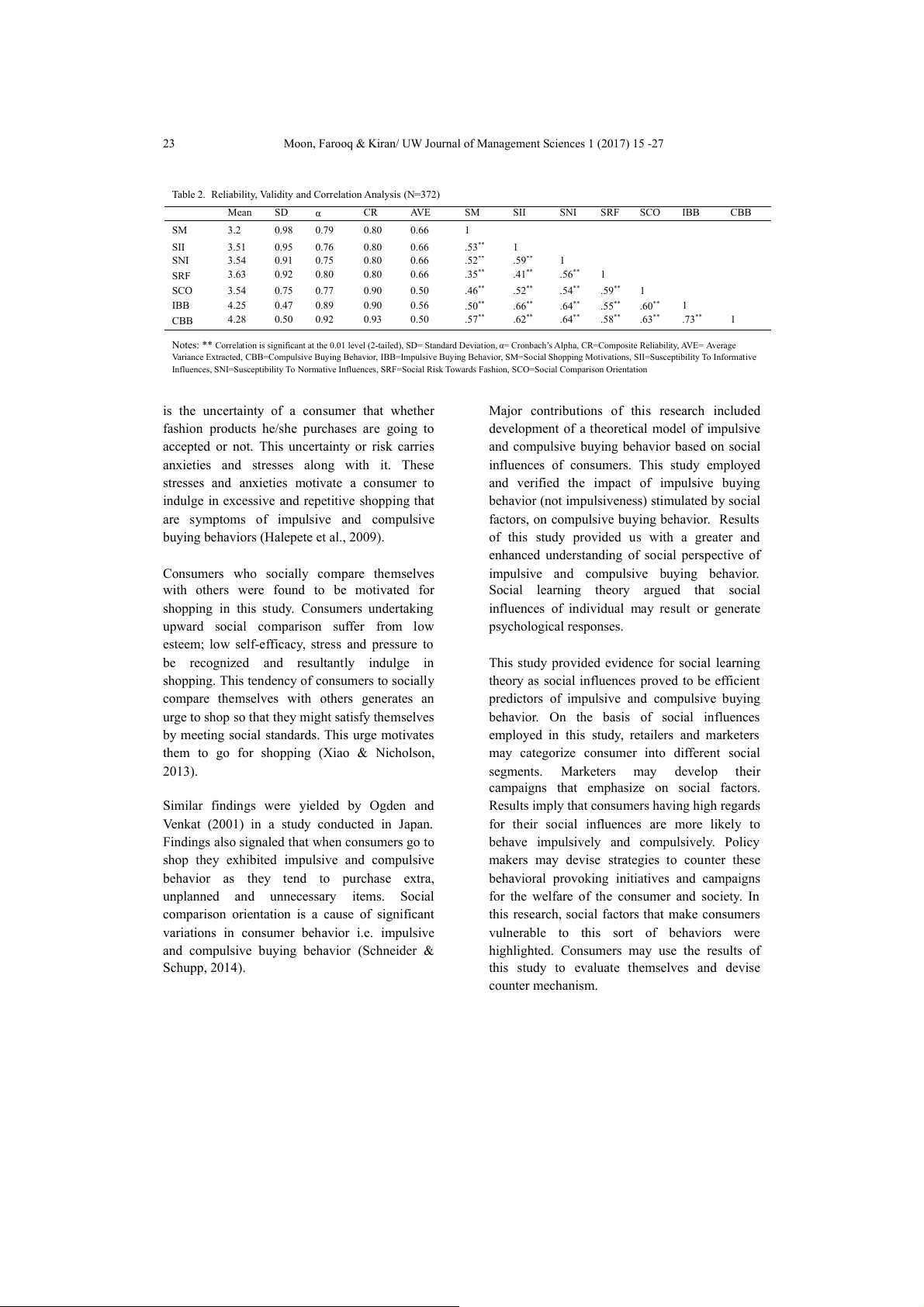
CFI = 0.95; CMIN/DF = 1.45. Table 2 indicates
fashion (SRF) and (SCI) social comparison
inter item reliability (α > 0.7), convergent (CR >
information) and 43 observed variables.
AVE ≥ 0.5) and discriminant validity (AVE ≥
0.5) for the measurement model.
A series of confirmatory factor analysis and detailed Fit CMIN/DF=1.52) for initial Structural Model
measurement model and to improve the fitness of
Structural model was composed of the mean
measurement testing of measurement model was
score of seven latent variables i.e. (SM, SII, SNI,
(Kline, 2011). Statistic indicated a non-optimal fit
SRF, SCO, IBB and CBB). We specified four
that is; (RMSEA0.04, AGFI=0.80, GFI=0.80,
(SII, SNI, SRF and SCO) out of seven latent
CFI=0.93 and model, models was re-specified by
variables as exogenous latent variables and three identifying and eliminating items with factor
latent variables i.e.SM, IBB and CBB were
loadings < 0.7 and square multiple correlation
specified as endogenous latent variables. Model
(SMC) < 0.2. The values of five recommended fit
fit indices for final structural model were
statistics for the re-specified measurement model
estimated as RMSEA = 0.01, AGFI = 0.98, GFI =
were RMSEA = 0.03; AGFI = 0.90; GFI = 0.90;
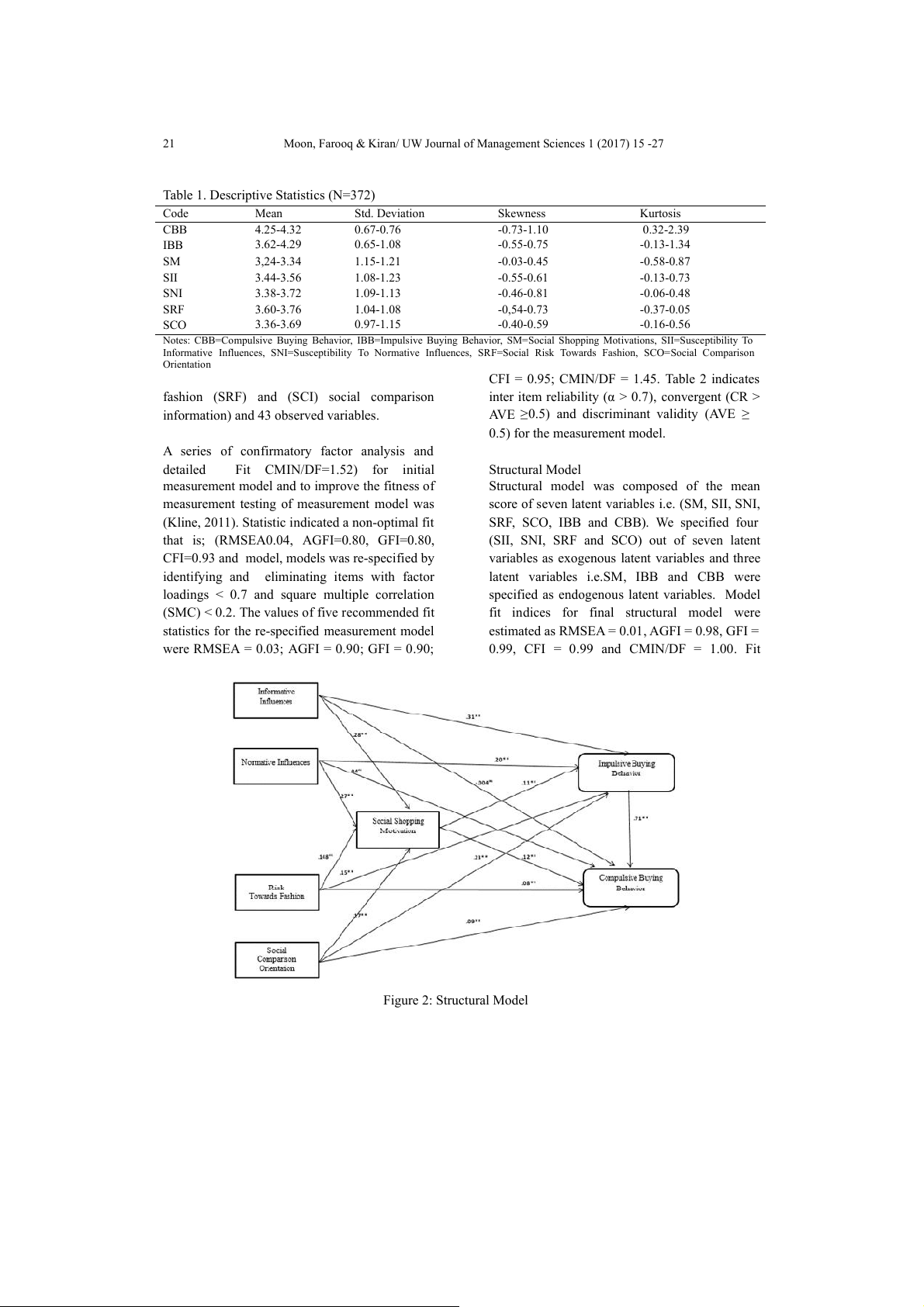
0.99, CFI = 0.99 and CMIN/DF = 1.00. Fit Figure 2: Structural Model
Moon, Farooq & Kiran/ UW Journal of Management Sciences 1 (2017) 15 -27 22
statistics for structural model indicated a best fit
purchasers, from 2.00 to 2.99 were borderline
so we moved to testing of hypothesis.
compulsive buyers, from 3.00 to 3.99 were
compulsive buyers and from 4.00 to 4.99 were Hypothesis Testing
addictive buyers. Results of this study indicated
that first two levels of compulsive buying i.e. non
In structural model analysis, the value of
compulsive buyers and recreational buyers were
standardized regression (H1: γ= 0.71, p < 0.01)
not found in respondents. Respondents of this
indicated a significant and positive relationship
study were high on compulsive buying level. This
between IBB and CBB. Significant and positive
was a very unique finding and to the best of our
relationships were found between SM & IBB
knowledge we have no study conducted on
(H2: γ= 0.11, p < 0.01), SM & CBB (H3: γ= 0.12,
general consumers who had higher compulsive
p < 0.01), SII & SM (H4: γ= 0.28, p < 0.01), SII buying levels.
& IBB (H5: γ= 0.31, p < 0.01), SNI & SM (H7:
γ= 0.27, p < 0.01), SNI & IBB (H8: γ= 0.20, p <
Findings of this research suggested that social
0.01), SRF & IBB (H11: γ= 0.15, p < 0.01), SRF
shopping motivations had a significant and
& CBB (H12: γ= 0.08, p < 0.01), SCO & SM
positive impact on impulsive and compulsive
(H13: γ= 0.17, p < 0.01), SCO & IBB (H : 14 γ=
buying behavior. Results implied that the
0.23, p < 0.01) and SCO & CBB (H15: γ= 0.09, p
consumers who shop to socialize exhibited
< 0.01). Structural model analysis indicated an
impulsive and compulsive buying behavior.
insignificant relationship between SII & CBB,
When consumers are feeling low, disturbed or
SNI & CBB and SRF & CBB. Hence we
irritated go for shopping and make unplanned and
rejected hypothesis H6, H9 and H10.
irrational purchases (Ridgway et al., 2008). DISCUSSION
Susceptibility to interpersonal influences caused
significant variations in formation of social
This study was conducted to identify the
shopping motivations and impulsive buying
relationship of social influences i.e. susceptibility
behavior of a person whereas it did not relate to
to interpersonal influences, social shopping
compulsive buying behavior. Consumers who
motivation, social comparison orientation and
took information from others (friends family peer
social risk towards fashion with consumer
groups) to be précised reality and tend to conform
irregular buying behaviors i.e. impulsive and
to the expectations of their peer groups family
compulsive buying behavior. This study explored
members and friends expectations put themselves
the relationship between impulsive buying
into constant pressure and stress(Hale, 2003) and
behavior and compulsive buying behavior. Data
resultantly feel motivated to shop (Hale, 2003).
was collected from 372 consumers of different
To alienate this stress and pressure generated
backgrounds in Pakistan. Demographic profile of from interpersonal influences, consumer
sample consumers of this study exhibited the
exhibited impulsive buying behavior. Results of
dominancy of young educated consumers.
the study were consistent with the previous
Edwards (1993) developed a continuum for
studies (e.g. Fishbein & Ajzen, 2005; Crespo &
measuring the level of compulsive buying of
Bosque, 2010). Consumers who were not
consumers. She suggested that consumers having
confident of their shopping of fashion products or
mean score on compulsive buying scale ranging
style did not feel motivated to shop, according to
from 0.00 to 0.99 were non compulsive
the results of our study. However, when they
consumers. Consumers having mean score
went for shopping they exhibit impulsive and
ranging from 1.00 to 1.99 were recreational
compulsive shopping. Social risk towards fashion 23
Moon, Farooq & Kiran/ UW Journal of Management Sciences 1 (2017) 15 -27
Table 2. Reliability, Validity and Correlation Analysis (N=372) Mean SD α CR AVE SM SII SNI SRF SCO IBB CBB SM 3.2 0.98 0.79 0.80 0.66 1 SII 3.51 0.95 0.76 0.80 0.66 .53** 1 SNI 3.54 0.91 0.75 0.80 0.66 .52** .59** 1 SRF 3.63 0.92 0.80 0.80 0.66 .35** .41** .56** 1 SCO 3.54 0.75 0.77 0.90 0.50 .46** .52** .54** .59** 1 IBB 4.25 0.47 0.89 0.90 0.56 .50** .66** .64** .55** .60** 1 CBB 4.28 0.50 0.92 0.93 0.50 .57** .62** .64** .58** .63** .73** 1
Notes: ** Correlation is significant at the 0.01 level (2-tailed), SD= Standard Deviation, α= Cronbach’s Alpha, CR=Composite Reliability, AVE= Average
Variance Extracted, CBB=Compulsive Buying Behavior, IBB=Impulsive Buying Behavior, SM=Social Shopping Motivations, SII=Susceptibility To Informative
Influences, SNI=Susceptibility To Normative Influences, SRF=Social Risk Towards Fashion, SCO=Social Comparison Orientation
is the uncertainty of a consumer that whether
Major contributions of this research included
fashion products he/she purchases are going to
development of a theoretical model of impulsive
accepted or not. This uncertainty or risk carries
and compulsive buying behavior based on social
anxieties and stresses along with it. These
influences of consumers. This study employed
stresses and anxieties motivate a consumer to
and verified the impact of impulsive buying
indulge in excessive and repetitive shopping that
behavior (not impulsiveness) stimulated by social
are symptoms of impulsive and compulsive
factors, on compulsive buying behavior. Results
buying behaviors (Halepete et al., 2009).
of this study provided us with a greater and
enhanced understanding of social perspective of
Consumers who socially compare themselves
impulsive and compulsive buying behavior.
with others were found to be motivated for
Social learning theory argued that social
shopping in this study. Consumers undertaking
influences of individual may result or generate
upward social comparison suffer from low psychological responses.
esteem; low self-efficacy, stress and pressure to
be recognized and resultantly indulge in
This study provided evidence for social learning
shopping. This tendency of consumers to socially
theory as social influences proved to be efficient
compare themselves with others generates an
predictors of impulsive and compulsive buying
urge to shop so that they might satisfy themselves
behavior. On the basis of social influences
by meeting social standards. This urge motivates
employed in this study, retailers and marketers
them to go for shopping (Xiao & Nicholson,
may categorize consumer into different social 2013).
segments. Marketers may develop their
campaigns that emphasize on social factors.
Similar findings were yielded by Ogden and
Results imply that consumers having high regards
Venkat (2001) in a study conducted in Japan.
for their social influences are more likely to
Findings also signaled that when consumers go to
behave impulsively and compulsively. Policy
shop they exhibited impulsive and compulsive
makers may devise strategies to counter these
behavior as they tend to purchase extra,
behavioral provoking initiatives and campaigns
unplanned and unnecessary items. Social
for the welfare of the consumer and society. In
comparison orientation is a cause of significant
this research, social factors that make consumers
variations in consumer behavior i.e. impulsive
vulnerable to this sort of behaviors were
and compulsive buying behavior (Schneider &
highlighted. Consumers may use the results of Schupp, 2014).
this study to evaluate themselves and devise counter mechanism.
Moon, Farooq & Kiran/ UW Journal of Management Sciences 1 (2017) 15 -27 24
surrounding. International Journal of
This research explored the structural relationship
Research Studies in Psychology, 2(3),
between social influences and compulsive buying 35-52.
behavior of Pakistani consumers. Social
Ajzen, I., & Fishbein, M. (2005). The influence
influences included social shopping motivation,
of attitudes on behavior. The handbook
susceptibility to interpersonal influences, social of attitudes, 173(221), 31.
risk towards fashion and social comparison
Arnold, M. J., & Reynolds, K. E. (2003).
orientation. Findings of this study suggested that
Hedonic shopping motivations. Journal
compulsive buying behavior is generated due to of Retailing, 79(2), 77-95.
social shopping motivation and impulsive buying
Attiq, S. (2015). Attention to Social Comparison
behavior. Social shopping motivations and other
Information and Compulsive Buying
social influences strongly predicted impulsive
Behavior: An SOR Analysis. Journal of
buying behavior. Social influences play vital role
Behavioural Sciences, 25(1), 39-58
in formation of compulsive buying behavior of
Attiq, S., & Azam, R. I. (2012). How individual young Pakistani consumers.
social values stimulate consumer
purchase decision involvement and
Sample size of this study was limited. A larger
compulsive buying behavior: a path by
representative sample size would be more path multigroups analysis. Actual
effective to generalize the results of the study.
Problem of Economics, (7), 300-308.
Sample of the study was composed of young
Attiq, S., & Azam, R. I. (2014). Materialism
consumers. Other categories of consumers should
Derives: An Analysis of Direct and
be analyzed for generalizability of results. To Indirect Impact of Materialistic
further generalize the result, the model used in Attitude in the Development of
this study may be replicated. A longitudinal study
Compulsive Buying Behavior. Pakistan
may be conducted as this was a cross sectional
Journal of Social Sciences, 34(2). 663-
study. We assessed impulsive and compulsive 682
behavior of consumers in fashion related
Bandura, A. (2001). Social cognitive theory: An
products. These behaviors may be judged in other
agentic perspective. Annual Review of
product categories like groceries, electronics, Psychology, 52(1), 1-26.
online purchasing and eatables.
Bearden, W. O., Netemeyer, R. G., & Teel, J. E.
(1989). Measurement of consumer
To further enrich the purposed model, other susceptibility to interpersonal
variables may also be included to assess influence. Journal of consumer
impulsive and compulsive buying behavior. research, 15(4), 473-481.
Differences in impulsive and compulsive buying
Black, D. W. (2007). A review of compulsive
behavior on the bases of gender, age, income etc
buying disorder. World Psychiatry,
may also be the focus of further investigation. 6(1), 14-41
Cameron, A. C. (2004). Kurtosis. The Sage REFERENCES
encyclopedia of social science research methods doi: http://dx. doi.
Abraham, J., & Dameyasani, A. W. (2013). org/10.4135/9781412950589.
Impulsive buying, cultural values
Cheng, Y. H., Chuang, S. C., Wang, S. M., &
dimensions, and symbolic meaning of
Kuo, S. Y. (2013). The effect of
money: A study on college students in
companion's gender on impulsive
Indonesia's capital city and its
purchasing: the moderating factor of 25
Moon, Farooq & Kiran/ UW Journal of Management Sciences 1 (2017) 15 -27
cohesiveness and susceptibility to intentions. Clothing and Textiles
interpersonal influence. Journal of
Research Journal, 27(2), 143-160.
Applied Social Psychology, 43(1), 227-
Han, Y. K., Morgan, G. A., Kotsiopulos, A., 236.
& Kang-Park, J. (1991). Impulse
Dholakia, U. M., & Talukdar, D. (2004). How
buying behavior of apparel purchasers.
social influence affects consumption Clothing and Textiles Research trends in emerging markets: An Journal, 9(3), 15-21. empirical investigation of the
Herrero Crespo, A., & Rodriguez del Bosque, I. consumption convergence (2010). The influence of the hypothesis. Psychology &
commercial features of the Internet on Marketing, 21(10), 775-797. the adoption of e-commerce by
Dowling, G. R., & Staelin, R. (1994). A model of consumers. Electronic Commerce
perceived risk and intended risk-
Research and Applications, 9(6), 562-
handling activity. Journal of consumer 575. research, 21(1), 119-134.
Hoyer, W. D., & MacInnis, D. J. (2007).
Edwards, E. A. (1993). Development of a new
Consumer Behavior. Houghton Mifflin
scale for measuring compulsive buying Company.
behavior. Financial Counseling and
Hull, C. L. (1951). Essentials of behavior. Planning, 4(1), 67-84.
Kline, R. B. (2015). Principles and practice of
Faber, R. J., & O'guinn, T. C. (1992). A clinical
structural equation modeling. Guilford
screener for compulsive buying. publications.
Journal of consumer Research, 19(3),
Kukar-Kinney, M., Ridgway, N. M., & Monroe, 459-469.
K. B. (2009). The relationship between
Gibbons, F. X., & Buunk, B. P. (1999). consumers’ tendencies to buy Individual differences in social
compulsively and their motivations to
comparison: development of a scale of
shop and buy on the internet. Journal of
social comparison orientation. Journal Retailing, 85(3), 298-307.
of personality and social psychology,
Kwak, H., Zinkhan, G. M., & Roushanzamir, E. 76(1), 129.
P. L. (2004). Compulsive comorbidity
Goldsmith, R. E., & Clark, R. A. (2008). An
and its psychological antecedents: a
analysis of factors affecting fashion
cross-cultural comparison between the
opinion leadership and fashion opinion US and South Korea. Journal of
seeking. Journal of Fashion Marketing
Consumer Marketing, 21(6), 418-434.
and Management, 12(3), 308-322.
LaRose, D. A. (2001). Iterative X-ray/CT
Ha, J., & Jang, S. S. (2013). Variety seeking in
registration using accelerated volume restaurant choice and its rendering (Doctoral dissertation, drivers. International Journal of
Carnegie Mellon University). Lee, J.
Hospitality Management, 32, 155-168.
A., & Kacen, J. J. (2008). Cultural
Hale, J. L., B. J. Householder, et al. (2003). The
influences on consumer satisfaction theory of reasoned action:
with impulse and planned purchase
Developments in theory and practice, decisions. Journal of Business Thousand Oaks, CA: Sage. Research, 61(3), 265-272.
Halepete, J., Littrell, M., & Park, J. (2009).
Lee, J. A., & Kacen, J. J. (2008). Cultural
Personalization of fair trade apparel
influences on consumer satisfaction consumer attitudes and
with impulse and planned purchase
Moon, Farooq & Kiran/ UW Journal of Management Sciences 1 (2017) 15 -27 26 decisions. Journal of Business marketing campaigns. Journal of Research, 61(3), 265-272.
Marketing and Consumer Research, 16,
Liu, C., & Laird, R. (2008). Parenting, peer 97-101. influence, and role model on
Moschis, G. P., Hosie, P., and Vel, P. (2009).
compulsive buying tendencies of early
Effects of family structure and
adolescent consumers. Adv. Consum.
socialization on materialism: a life Res, 35, 1036-1038.
course study in Malaysia. Journal of
Lysonski, S., & Durvasula, S. (2013). Consumer
Business and Behavioral Sciences,
decision making styles in retailing: 21(1), 166-181. evolution of mindsets and
Ogden, H. J., & Venkat, R. (2001). Social psychological impacts. Journal of
comparison and possessions: Japan vs
Consumer Marketing, 30(1), 75-87.
Canada. Asia Pacific Journal of
Mangleburg, T. F., Doney, P. M., & Bristol, T.
Marketing and Logistics, 13(2), 72-84.
(2004). Shopping with friends and
Ridgway, N. M., Kukar‐Kinney, M., & Monroe, teens’ susceptibility to peer K. B. (2008). An expanded
influence. Journal of Retailing, 80(2),
conceptualization and a new measure 101-116.
of compulsive buying. Journal of
Moon, M. A., Habib, M. D., & Attiq, S. (2015).
Consumer Research, 35(4), 622-639.
Analyzing the Sustainable Behavioral
Ridgway, N. M., Kukar‐Kinney, M., & Monroe,
Intentions: Role of Norms, Beliefs and K. B. (2008). An expanded
Values on Behavioral Intentions.
conceptualization and a new measure
Pakistan Journal of Commerce and of compulsive buying. Journal of
Social Sciences, 9(2), 524-539.
Consumer Research, 35(4), 622-639
Moon, M. A., Khalid, M. J., Awan, H. M., Attiq,
Rook, D. W., & Gardner, M. P. (1993). In the
S., Rasool, H., & Kiran, M. (2017).
mood: impulse buying’s affective
Consumer's perceptions of website's
antecedents. Research in Consumer
Moon, M. A., Khalid, M. J., Awan, H. M., Attiq, Behavior, 6(7), 1-28.
S., Rasool, H., & Kiran, M. (2017).
Schneider, S. M., & Schupp, J. (2014). Individual
Consumer's perceptions of website's
Differences in Social Comparison and
utilitarian and hedonic attributes and
its Consequences for Life Satisfaction: online purchase intentions: A
Introducing a Short Scale of the Iowa– cognitive–affective attitude
Netherlands Comparison Orientation approach. Spanish Journal of Measure. Social Indicators Marketing-ESIC. Research, 115(2), 767-789.
Moon, M. A., Rasool, H., & Attiq, S. (2015a).
Song, K., Hwang, S., Kim, Y., & Kwak, Y.
Personality and irregular buying
(2011). The Influences of On-line
behavior: adaptation and validation of
Fashion Community Network Features
core self-evaluation personality trait on the Acceptance of Fashion
model in consumer impulsive and Information. Future Information
compulsive buying behavior. Journal Technology, 445-455.
of Marketing and Consumer Research,
Suls, J., Martin, R., & Wheeler, L. (2002). Social 15, 121-131.
comparison: why, with whom, and with
Moon, M. A., Rasool, H., & Attiq, S. (2015b).
what effect?. Current directions in
An analysis of compulsive buying
psychological science, 11(5), 159-163.
behavior: Questioning the role of 27
Moon, Farooq & Kiran/ UW Journal of Management Sciences 1 (2017) 15 -27
Tauber, E. M. (1972). Why do people shop?. The
Maira Kiran is a research scholar at Department of
Journal of Marketing, 36(4). 446-49. Bioinformatics at Quaid-i- Azam University Islamabad.
Vohs, K. D., & Faber, R. J. (2007). Spent She has undertaken several
Resources: Self‐Regulatory Resource
industrial projects and research
Availability Affects Impulse Buying. project in Pakistan. Her
Journal of Consumer Research, 33(4),
research interests include Bio- informs, consumer big data and 537-547. computers and consumers.
Xiao, S. H., & Nicholson, M. (2013). A
multidisciplinary cognitive behavioural framework of impulse buying: a systematic review of the literature. International Journal of
Management Reviews, 15(3), 333-356.
Yurchisin, J., & Johnson, K. K. (2004).
Compulsive buying behavior and its
relationship to perceived social status
associated with buying, materialism, self-esteem, and apparel-product
involvement. Family and Consumer
Sciences Research Journal, 32(3), 291- 314. Author Biographies Moin Ahmad Moon is lecturer of Marketing at Air University School of Management and teaches consumer behavior and
marketing. He is perusing his Ph.D in compulsive buying behavior. His research interests include
addictive and dark consumer behaviors, sustainable
consumption and relationship marketing. He has
several publications in reputed international journals.
Amna Farooq is a Master’s student at Air University School of Management. She has undertaken several marketing
research projects in Pakistan. Her research interests include consumer psychology and
consumer’s irrational behaviors.
Tài liệu liên quan:
-
Tiểu luận Phân Tích Giá Trái Cây 2023 | Kinh tế vĩ mô | Trường Đại học kinh tế Thành Phố Hồ Chí Minh
18 9 -
Bộ câu hỏi trắc nghiệm - Kinh tế học thị trường và cầu cung | Kinh tế vĩ mô | Trường Đại học kinh tế Thành Phố Hồ Chí Minh
18 9 -
Câu Hỏi Ôn Tập Phần Thị Trường | Kinh tế vĩ mô | Trường Đại học kinh tế Thành Phố Hồ Chí Minh
24 12 -
Kinh Tế Vi Mô: Câu Hỏi và Đáp Án Quan Trọng | Kinh tế vĩ mô | Trường Đại học kinh tế Thành Phố Hồ Chí Minh
22 11 -
Tiểu luận Món Huế và Thị Trường F&B Việt Nam | Kinh tế vĩ mô | Trường Đại học kinh tế Thành Phố Hồ Chí Minh
17 9