Study Questions: Chapters 1 to 6 Insights | Microeconomics | Trường Đại học Quốc tế, Đại học Quốc gia Thành phố Hồ Chí Minh
Economics is the best defined as the study of a. How society manages its scarce resources. b. How to run a. business most profitably. c. How to predict inflation, unemployment, and stock prices. d. How the government can stop the harm from unchecked self-interest. 2. Your opportunity cost of going to a movie is a. The price of ticket. b. The price of ticket plus the cost of any soda and popcorn you buy at the theatre. c. The total cash expenditure needed to go to the movie plus the value of your time. d. Zero, as long as you enjoy the movie and consider it a worthwhile use of your time and money. Tài liệu được sưu tầm và soạn thảo dưới dạng file PDF để gửi tới các bạn cùng tham khảo, ôn tập đầy đủ kiến thức, chuẩn bị cho các buổi học thật tốt. Mời bạn đọc đón xem!
Môn: Microeconomics 613 tài liệu
Trường: Trường Đại học Quốc tế, Đại học Quốc gia Thành phố Hồ Chí Minh 1.9 K tài liệu
Tác giả:


Preview text:
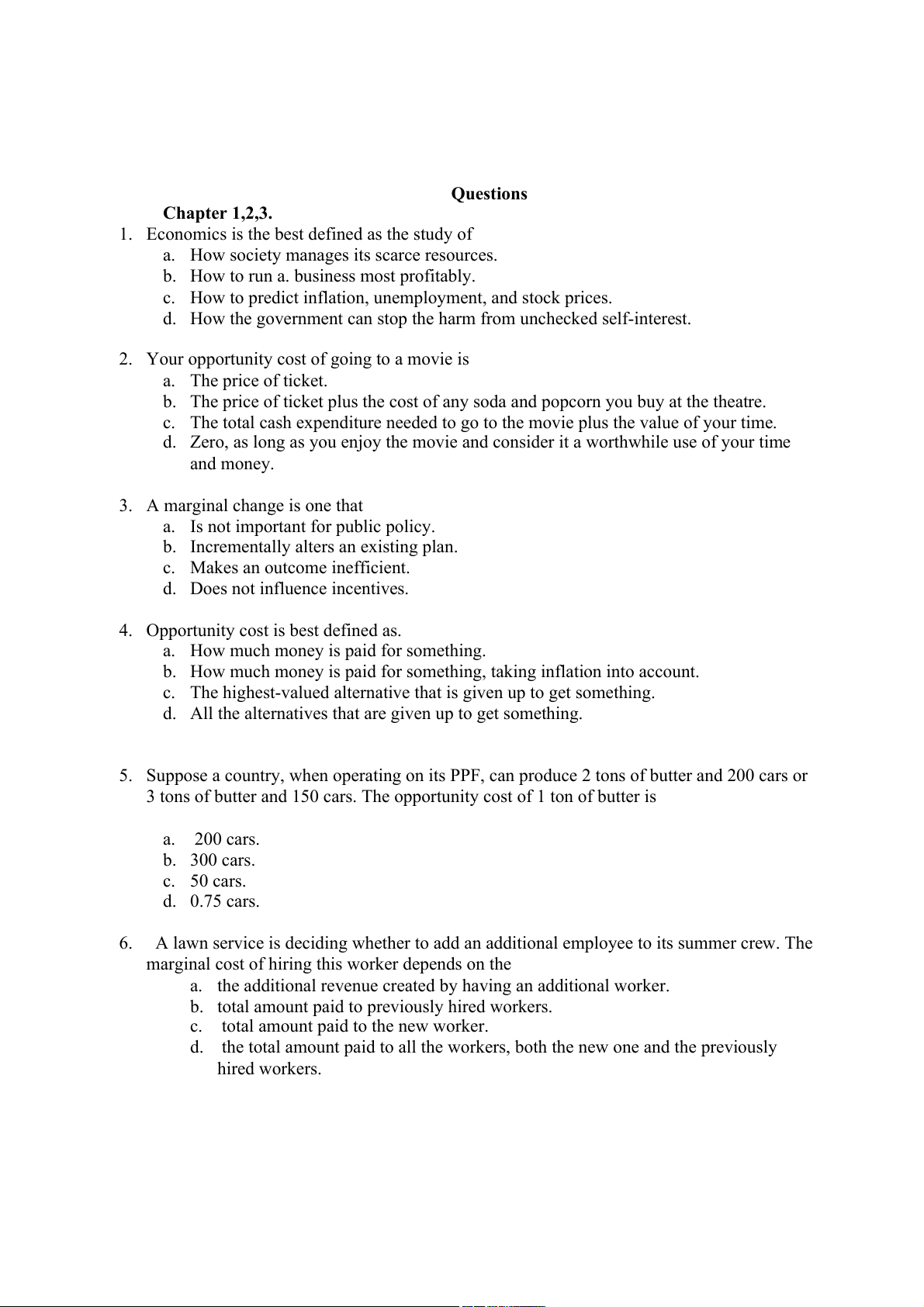
Questions Chapter 1,2,3.
1. Economics is the best defined as the study of
a. How society manages its scarce resources.
b. How to run a. business most profitably.
c. How to predict inflation, unemployment, and stock prices.
d. How the government can stop the harm from unchecked self-interest.
2. Your opportunity cost of going to a movie is a. The price of ticket.
b. The price of ticket plus the cost of any soda and popcorn you buy at the theatre.
c. The total cash expenditure needed to go to the movie plus the value of your time.
d. Zero, as long as you enjoy the movie and consider it a worthwhile use of your time and money.
3. A marginal change is one that
a. Is not important for public policy.
b. Incrementally alters an existing plan.
c. Makes an outcome inefficient.
d. Does not influence incentives.
4. Opportunity cost is best defined as.
a. How much money is paid for something.
b. How much money is paid for something, taking inflation into account.
c. The highest-valued alternative that is given up to get something.
d. All the alternatives that are given up to get something.
5. Suppose a country, when operating on its PPF, can produce 2 tons of butter and 200 cars or
3 tons of butter and 150 cars. The opportunity cost of 1 ton of butter is a. 200 cars. b. 300 cars. c. 50 cars. d. 0.75 cars.
6. A lawn service is deciding whether to add an additional employee to its summer crew. The
marginal cost of hiring this worker depends on the
a. the additional revenue created by having an additional worker.
b. total amount paid to previously hired workers.
c. total amount paid to the new worker.
d. the total amount paid to all the workers, both the new one and the previously hired workers.
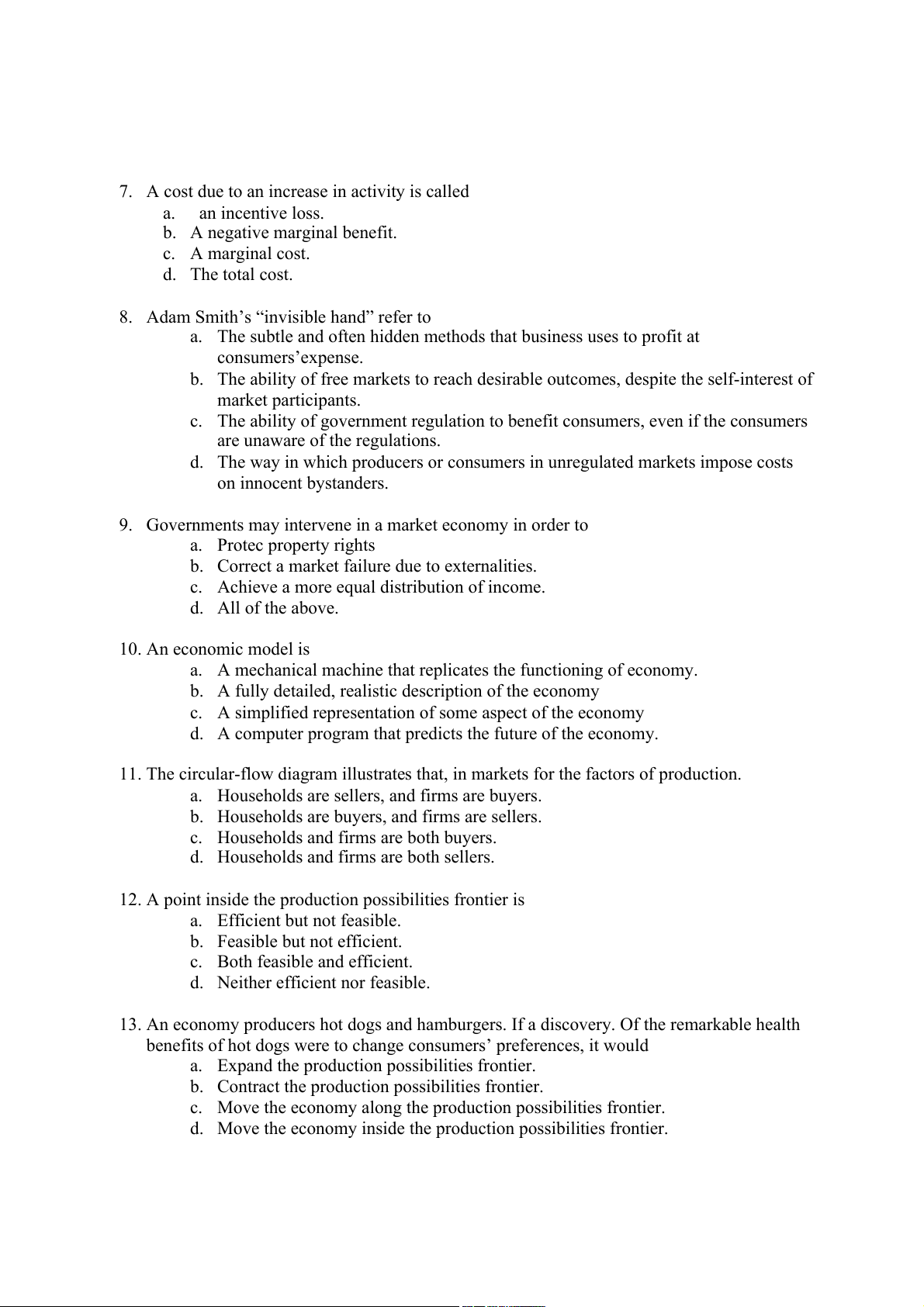
7. A cost due to an increase in activity is called a. an incentive loss.
b. A negative marginal benefit. c. A marginal cost. d. The total cost.
8. Adam Smith’s “invisible hand” refer to
a. The subtle and often hidden methods that business uses to profit at consumers’expense.
b. The ability of free markets to reach desirable outcomes, despite the self-interest of market participants.
c. The ability of government regulation to benefit consumers, even if the consumers
are unaware of the regulations.
d. The way in which producers or consumers in unregulated markets impose costs on innocent bystanders.
9. Governments may intervene in a market economy in order to a. Protec property rights
b. Correct a market failure due to externalities.
c. Achieve a more equal distribution of income. d. All of the above. 10. An economic model is
a. A mechanical machine that replicates the functioning of economy.
b. A fully detailed, realistic description of the economy
c. A simplified representation of some aspect of the economy
d. A computer program that predicts the future of the economy.
11. The circular-flow diagram illustrates that, in markets for the factors of production.
a. Households are sellers, and firms are buyers.
b. Households are buyers, and firms are sellers.
c. Households and firms are both buyers.
d. Households and firms are both sellers.
12. A point inside the production possibilities frontier is a. Efficient but not feasible. b. Feasible but not efficient.
c. Both feasible and efficient.
d. Neither efficient nor feasible.
13. An economy producers hot dogs and hamburgers. If a discovery. Of the remarkable health
benefits of hot dogs were to change consumers’ preferences, it would
a. Expand the production possibilities frontier.
b. Contract the production possibilities frontier.
c. Move the economy along the production possibilities frontier.
d. Move the economy inside the production possibilities frontier.
14. Which of the following is a positive, rather than a normative, statement?
a. Law X will reduce national income.
b. Law X is a good piece of legislation.
c. Congress ought to pass law X
d. The president should veto law X.
15. In an hour, Mateo can wash 2 cars or mow lawn, and Tyler can wash 3 cars or mow 1 lawn.
Who has the absolute advantage in car washing, and who has the absolute advantage in lawn mowing?
a. Mateo in washing, Tyler in mowing
b. Tyler in washing, Mateo in mowing
c. Mateo in washing, neither in mowing
d. Tyler in washing, neither in mowing
16. Once again, in an hour, Mateo can wash 2 cars or mow 1 lawn, and Tyler can wash 3 cars
or mow 1 lawn. Who has the comparative advantage in car washing, and who has the
comparative advantage in lawn mowing?
a. Mateo in washing, Tyler in mowing.
b. Tyler in washing, Mateo in mowing.
c. Mateo in washing, neither in mowing.
d. Tyler in washing, neither in mowing.
17. When 2 individuals produce efficiently and then make a mutually beneficial trade based on comparative advantage,
a. They both obtain consumption outside their production possibilities frontier.
b. They both obtain consumption inside their production possibilities frontier.
c. One individual consumes inside her production possibilities frontier, while the other consumes outsides hers.
d. Each individual consumes a point on her own production possibilities frontier.
18. Which goods will a nation typically import?
a. those goods in which the nation has an absolute advantage
b. those goods in which the nation has a comparative advantage
c. those goods in which other nations have an absolute advantage
d. those goods in which other nations have a comparative advantage
19. Suppose that in the United States, producing an aircraft takes 10,000 hours of labor and
producing a shirt takes 2 hours of labor. In China, producing an aircraft takes 40,000 hours
of labor and producing a shirt takes 4 hours of labor. What will these nations trade?
a. China will export aircraft, and the United States will export shirts.
b. China will export shirts, and the United States will export aircraft.
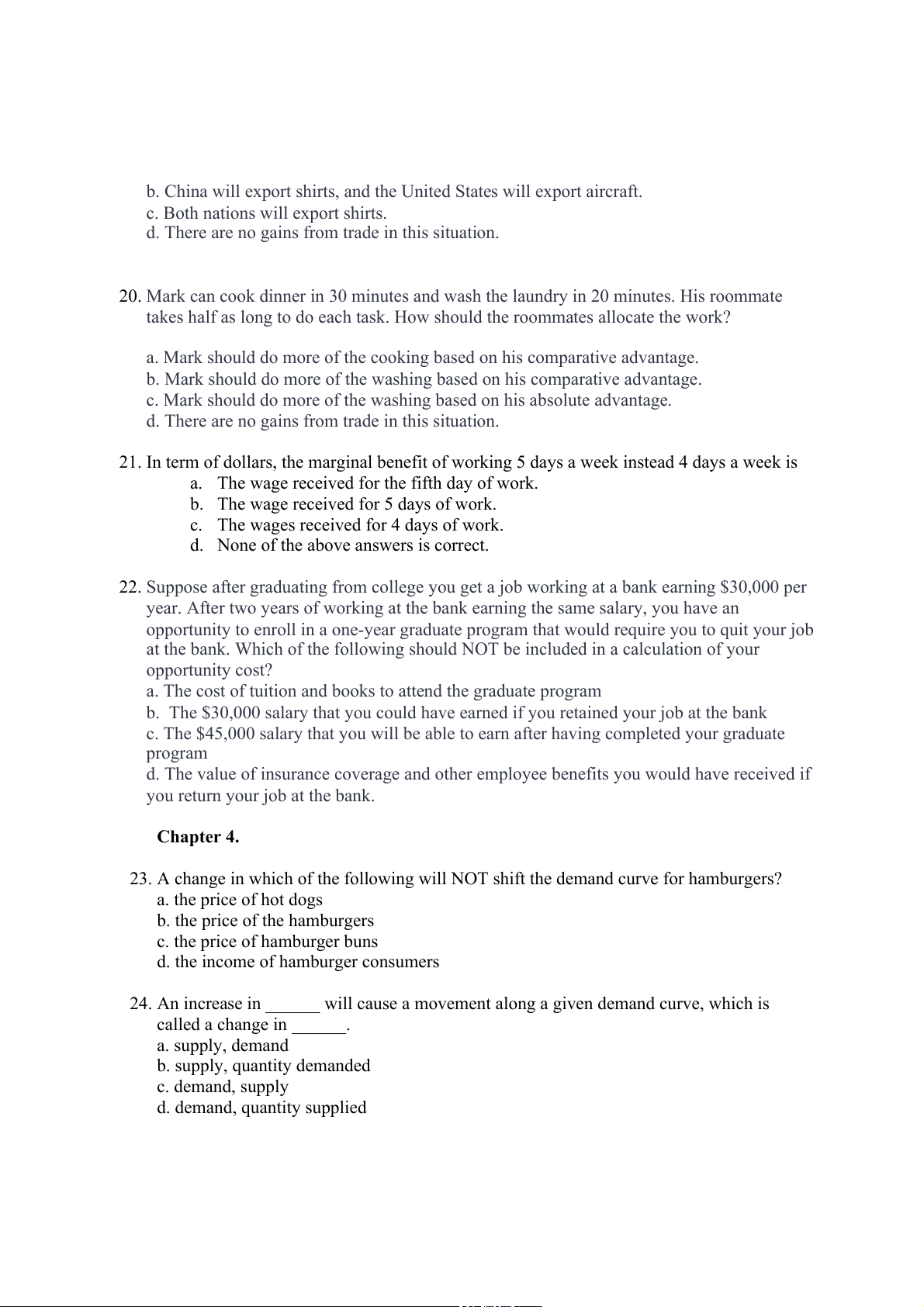
c. Both nations will export shirts.
d. There are no gains from trade in this situation.
20. Mark can cook dinner in 30 minutes and wash the laundry in 20 minutes. His roommate
takes half as long to do each task. How should the roommates allocate the work?
a. Mark should do more of the cooking based on his comparative advantage.
b. Mark should do more of the washing based on his comparative advantage.
c. Mark should do more of the washing based on his absolute advantage.
d. There are no gains from trade in this situation.
21. In term of dollars, the marginal benefit of working 5 days a week instead 4 days a week is
a. The wage received for the fifth day of work.
b. The wage received for 5 days of work.
c. The wages received for 4 days of work.
d. None of the above answers is correct.
22. Suppose after graduating from college you get a job working at a bank earning $30,000 per
year. After two years of working at the bank earning the same salary, you have an
opportunity to enroll in a one-year graduate program that would require you to quit your job
at the bank. Which of the following should NOT be included in a calculation of your opportunity cost?
a. The cost of tuition and books to attend the graduate program
b. The $30,000 salary that you could have earned if you retained your job at the bank
c. The $45,000 salary that you will be able to earn after having completed your graduate program
d. The value of insurance coverage and other employee benefits you would have received if
you return your job at the bank. Chapter 4.
23. A change in which of the following will NOT shift the demand curve for hamburgers? a. the price of hot dogs b. the price of the hamburgers c. the price of hamburger buns
d. the income of hamburger consumers
24. An increase in ______ will cause a movement along a given demand curve, which is called a change in ______. a. supply, demand b. supply, quantity demanded c. demand, supply d. demand, quantity supplied
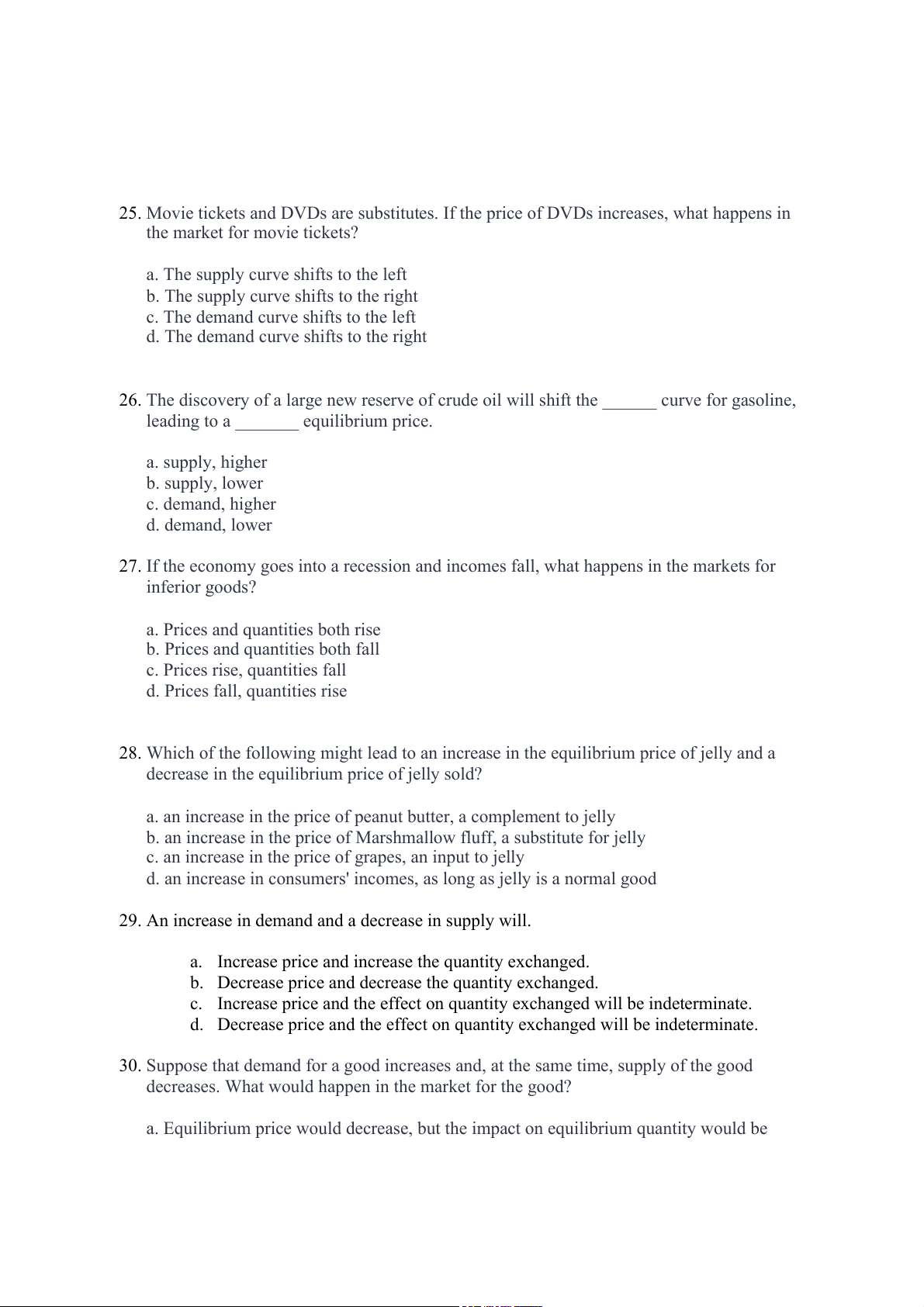
25. Movie tickets and DVDs are substitutes. If the price of DVDs increases, what happens in the market for movie tickets?
a. The supply curve shifts to the left
b. The supply curve shifts to the right
c. The demand curve shifts to the left
d. The demand curve shifts to the right
26. The discovery of a large new reserve of crude oil will shift the ______ curve for gasoline,
leading to a _______ equilibrium price. a. supply, higher b. supply, lower c. demand, higher d. demand, lower
27. If the economy goes into a recession and incomes fall, what happens in the markets for inferior goods?
a. Prices and quantities both rise
b. Prices and quantities both fall
c. Prices rise, quantities fall
d. Prices fall, quantities rise
28. Which of the following might lead to an increase in the equilibrium price of jelly and a
decrease in the equilibrium price of jelly sold?
a. an increase in the price of peanut butter, a complement to jelly
b. an increase in the price of Marshmallow fluff, a substitute for jelly
c. an increase in the price of grapes, an input to jelly
d. an increase in consumers' incomes, as long as jelly is a normal good
29. An increase in demand and a decrease in supply will.
a. Increase price and increase the quantity exchanged.
b. Decrease price and decrease the quantity exchanged.
c. Increase price and the effect on quantity exchanged will be indeterminate.
d. Decrease price and the effect on quantity exchanged will be indeterminate.
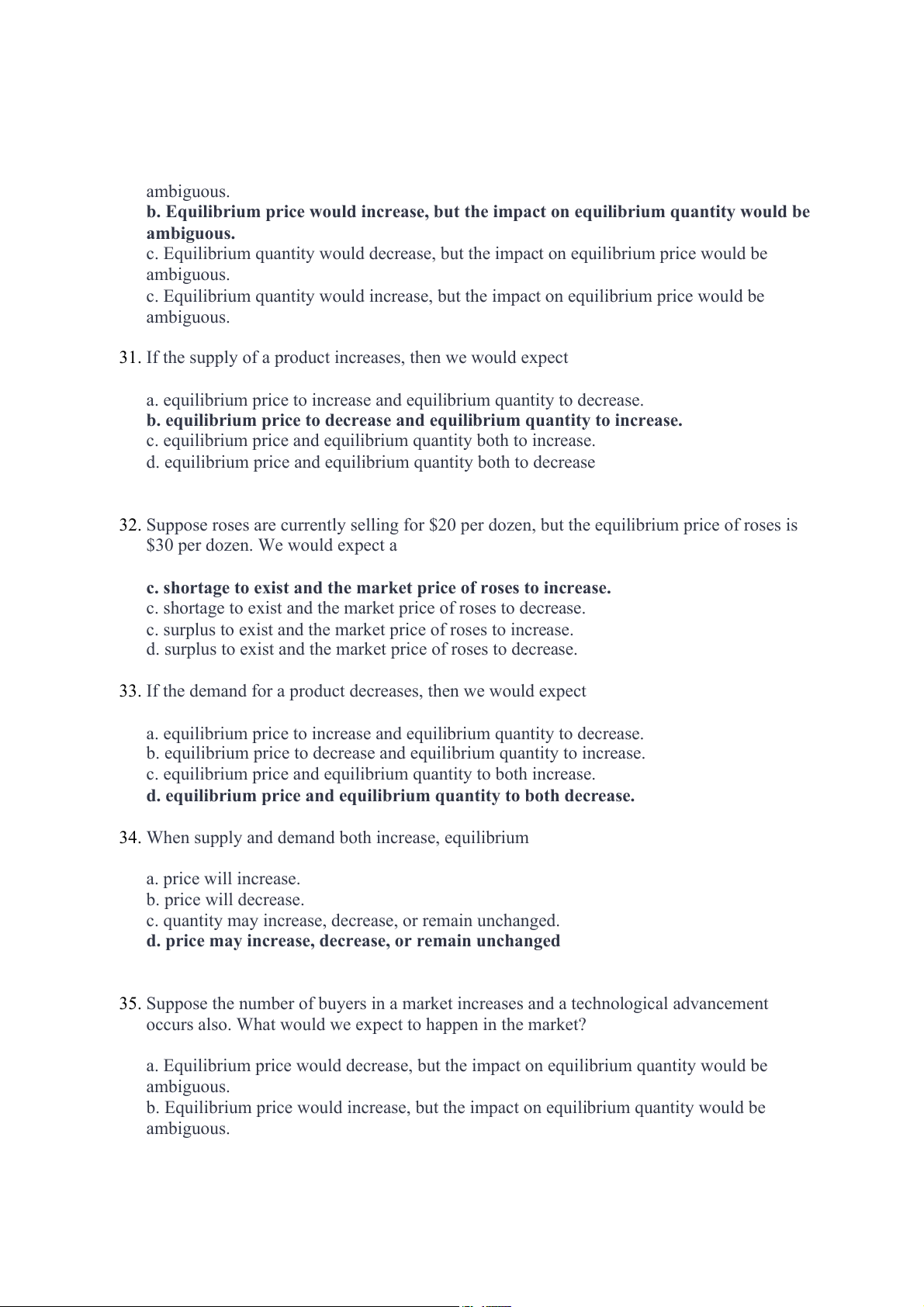
30. Suppose that demand for a good increases and, at the same time, supply of the good
decreases. What would happen in the market for the good?
a. Equilibrium price would decrease, but the impact on equilibrium quantity would be ambiguous.
b. Equilibrium price would increase, but the impact on equilibrium quantity would be ambiguous.
c. Equilibrium quantity would decrease, but the impact on equilibrium price would be ambiguous.
c. Equilibrium quantity would increase, but the impact on equilibrium price would be ambiguous.
31. If the supply of a product increases, then we would expect
a. equilibrium price to increase and equilibrium quantity to decrease.
b. equilibrium price to decrease and equilibrium quantity to increase.
c. equilibrium price and equilibrium quantity both to increase.
d. equilibrium price and equilibrium quantity both to decrease
32. Suppose roses are currently selling for $20 per dozen, but the equilibrium price of roses is
$30 per dozen. We would expect a
c. shortage to exist and the market price of roses to increase.
c. shortage to exist and the market price of roses to decrease.
c. surplus to exist and the market price of roses to increase.
d. surplus to exist and the market price of roses to decrease.
33. If the demand for a product decreases, then we would expect
a. equilibrium price to increase and equilibrium quantity to decrease.
b. equilibrium price to decrease and equilibrium quantity to increase.
c. equilibrium price and equilibrium quantity to both increase.
d. equilibrium price and equilibrium quantity to both decrease.
34. When supply and demand both increase, equilibrium a. price will increase. b. price will decrease.
c. quantity may increase, decrease, or remain unchanged.
d. price may increase, decrease, or remain unchanged
35. Suppose the number of buyers in a market increases and a technological advancement
occurs also. What would we expect to happen in the market?
a. Equilibrium price would decrease, but the impact on equilibrium quantity would be ambiguous.
b. Equilibrium price would increase, but the impact on equilibrium quantity would be ambiguous.
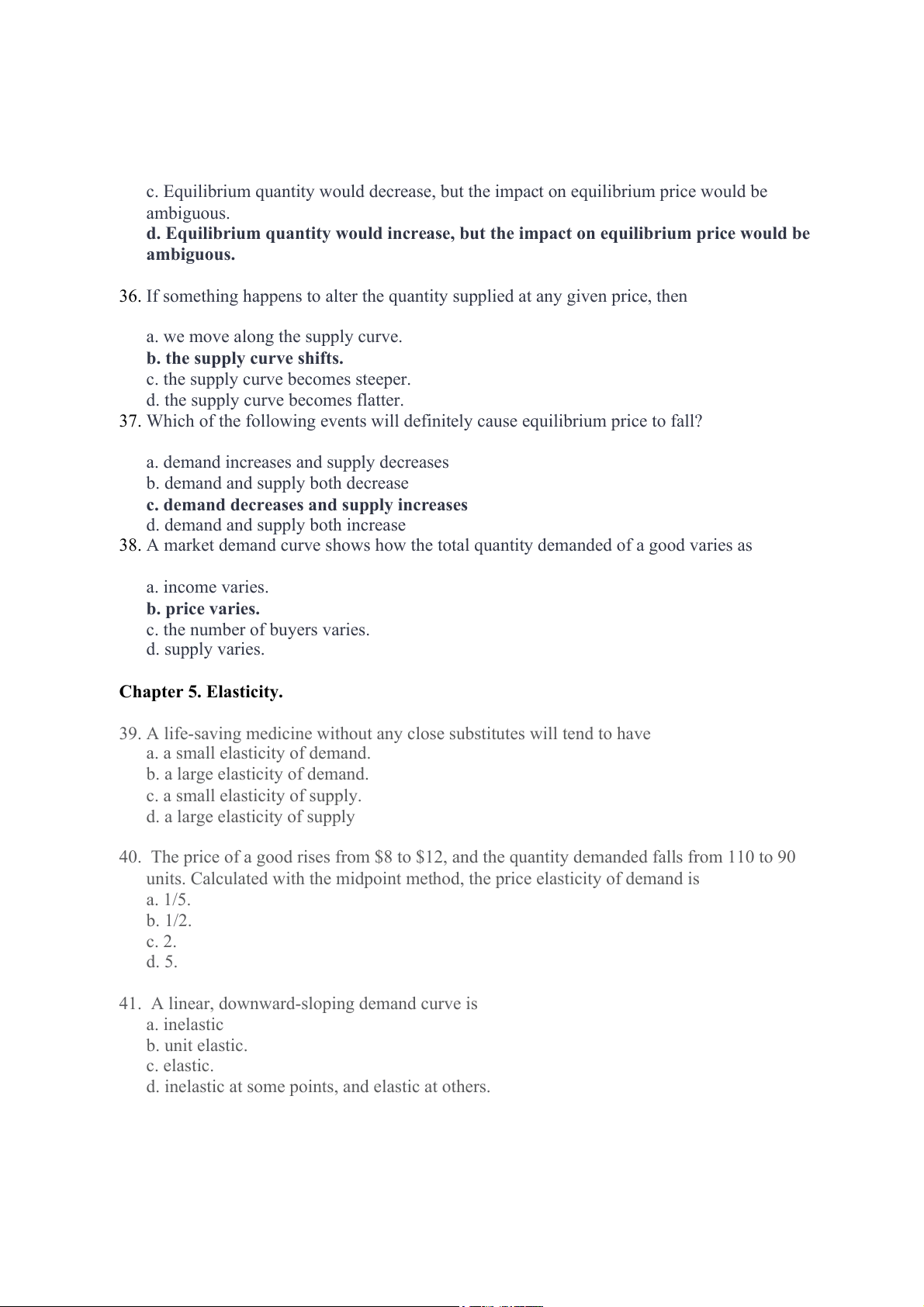
c. Equilibrium quantity would decrease, but the impact on equilibrium price would be ambiguous.
d. Equilibrium quantity would increase, but the impact on equilibrium price would be ambiguous.
36. If something happens to alter the quantity supplied at any given price, then
a. we move along the supply curve. b. the supply curve shifts.
c. the supply curve becomes steeper.
d. the supply curve becomes flatter.
37. Which of the following events will definitely cause equilibrium price to fall?
a. demand increases and supply decreases
b. demand and supply both decrease
c. demand decreases and supply increases
d. demand and supply both increase
38. A market demand curve shows how the total quantity demanded of a good varies as a. income varies. b. price varies.
c. the number of buyers varies. d. supply varies. Chapter 5. Elasticity.
39. A life-saving medicine without any close substitutes will tend to have
a. a small elasticity of demand.
b. a large elasticity of demand.
c. a small elasticity of supply.
d. a large elasticity of supply
40. The price of a good rises from $8 to $12, and the quantity demanded falls from 110 to 90
units. Calculated with the midpoint method, the price elasticity of demand is a. 1/5. b. 1/2. c. 2. d. 5.
41. A linear, downward-sloping demand curve is a. inelastic b. unit elastic. c. elastic.
d. inelastic at some points, and elastic at others.
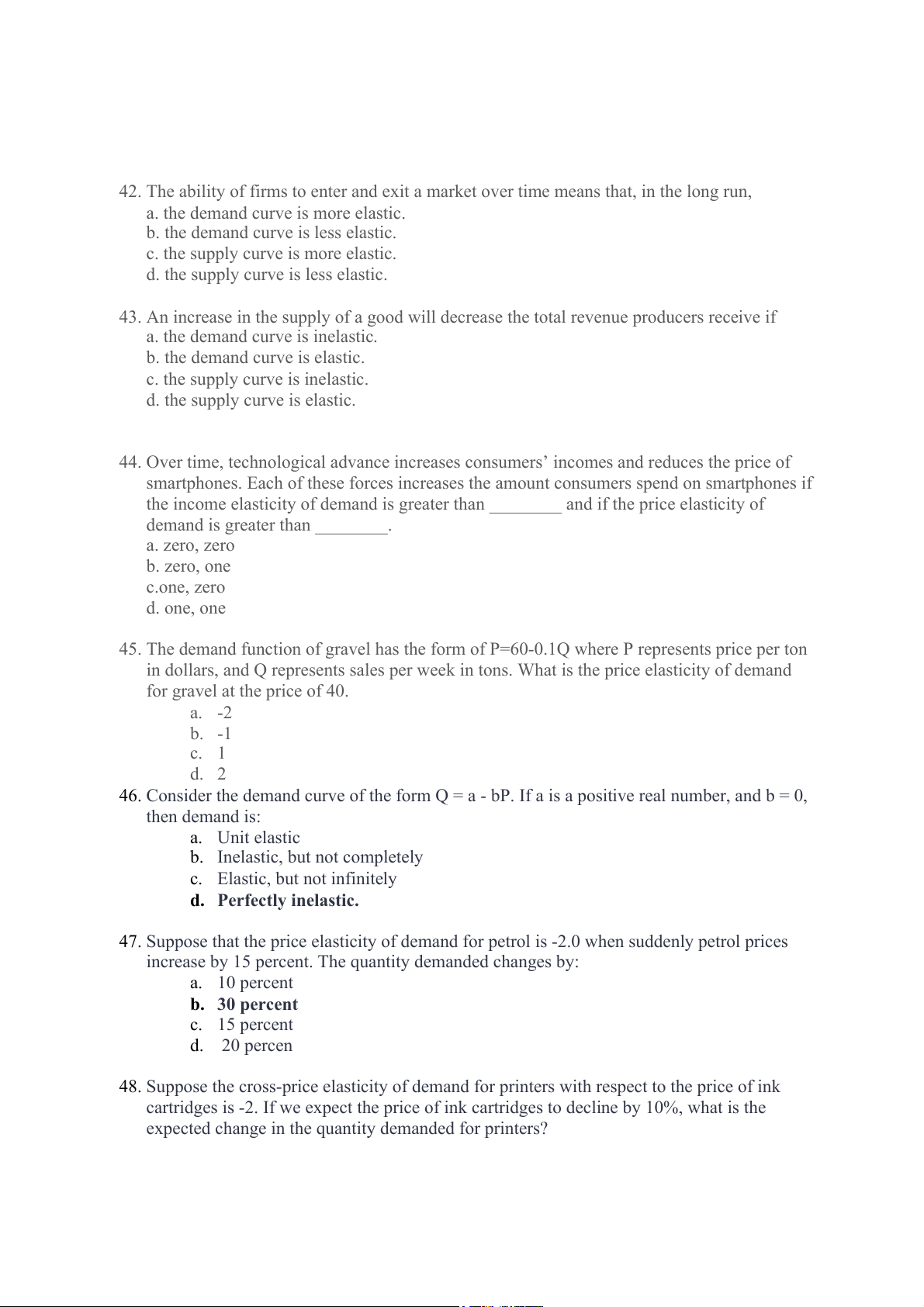
42. The ability of firms to enter and exit a market over time means that, in the long run,
a. the demand curve is more elastic.
b. the demand curve is less elastic.
c. the supply curve is more elastic.
d. the supply curve is less elastic.
43. An increase in the supply of a good will decrease the total revenue producers receive if
a. the demand curve is inelastic.
b. the demand curve is elastic.
c. the supply curve is inelastic.
d. the supply curve is elastic.
44. Over time, technological advance increases consumers’ incomes and reduces the price of
smartphones. Each of these forces increases the amount consumers spend on smartphones if
the income elasticity of demand is greater than ________ and if the price elasticity of
demand is greater than ________. a. zero, zero b. zero, one c.one, zero d. one, one
45. The demand function of gravel has the form of P=60-0.1Q where P represents price per ton
in dollars, and Q represents sales per week in tons. What is the price elasticity of demand for gravel at the price of 40. a. -2 b. -1 c. 1 d. 2
46. Consider the demand curve of the form Q = a - bP. If a is a positive real number, and b = 0, then demand is: a. Unit elastic
b. Inelastic, but not completely c. Elastic, but not infinitely
d. Perfectly inelastic.
47. Suppose that the price elasticity of demand for petrol is -2.0 when suddenly petrol prices
increase by 15 percent. The quantity demanded changes by: a. 10 percent b. 30 percent c. 15 percent d. 20 percen
48. Suppose the cross-price elasticity of demand for printers with respect to the price of ink
cartridges is -2. If we expect the price of ink cartridges to decline by 10%, what is the
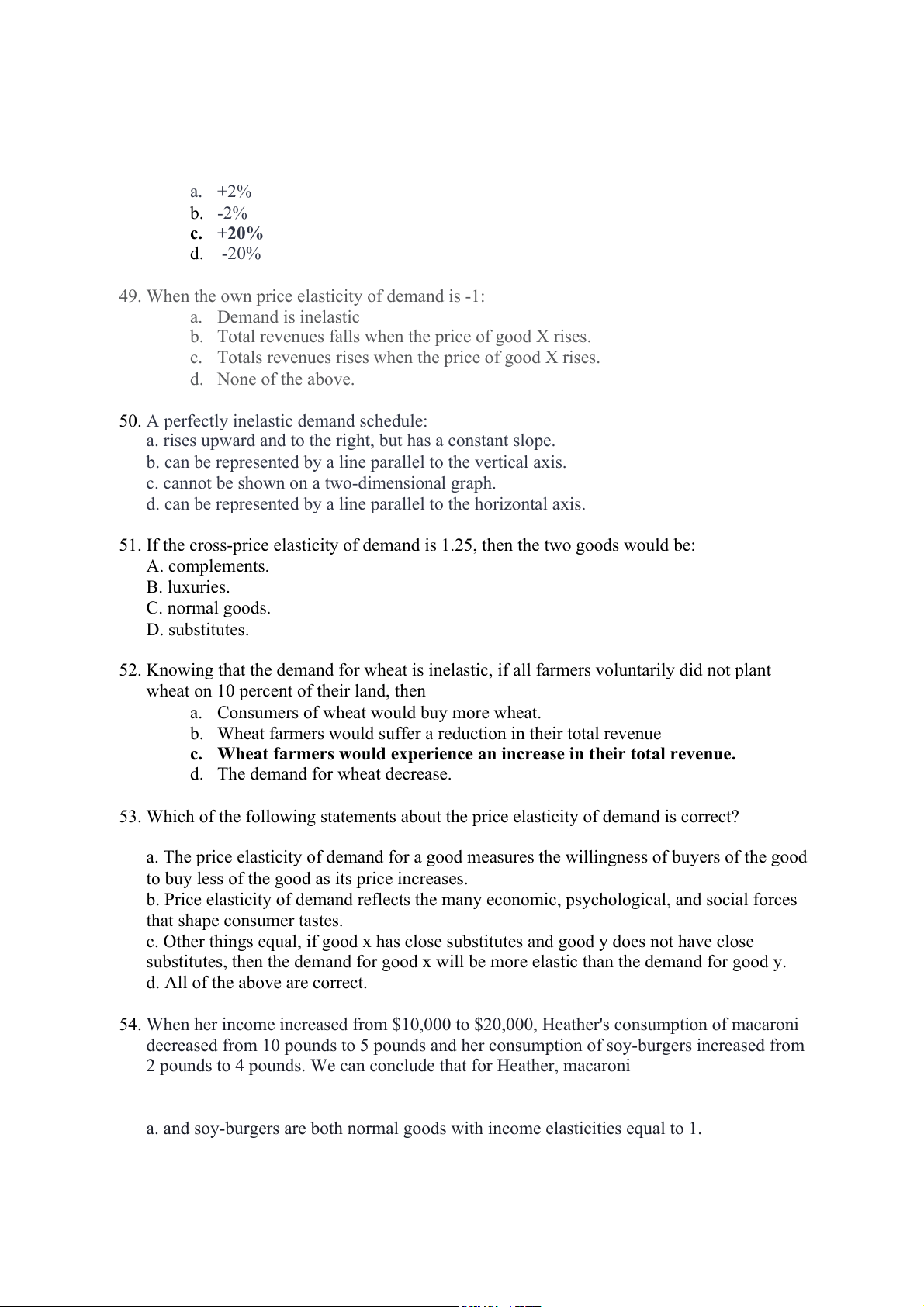
expected change in the quantity demanded for printers? a. +2% b. -2% c. +20% d. -20%
49. When the own price elasticity of demand is -1: a. Demand is inelastic
b. Total revenues falls when the price of good X rises.
c. Totals revenues rises when the price of good X rises. d. None of the above.
50. A perfectly inelastic demand schedule:
a. rises upward and to the right, but has a constant slope.
b. can be represented by a line parallel to the vertical axis.
c. cannot be shown on a two-dimensional graph.
d. can be represented by a line parallel to the horizontal axis.
51. If the cross-price elasticity of demand is 1.25, then the two goods would be: A. complements. B. luxuries. C. normal goods. D. substitutes.
52. Knowing that the demand for wheat is inelastic, if all farmers voluntarily did not plant
wheat on 10 percent of their land, then
a. Consumers of wheat would buy more wheat.
b. Wheat farmers would suffer a reduction in their total revenue
c. Wheat farmers would experience an increase in their total revenue.
d. The demand for wheat decrease.
53. Which of the following statements about the price elasticity of demand is correct?
a. The price elasticity of demand for a good measures the willingness of buyers of the good
to buy less of the good as its price increases.
b. Price elasticity of demand reflects the many economic, psychological, and social forces that shape consumer tastes.
c. Other things equal, if good x has close substitutes and good y does not have close
substitutes, then the demand for good x will be more elastic than the demand for good y.
d. All of the above are correct.
54. When her income increased from $10,000 to $20,000, Heather's consumption of macaroni
decreased from 10 pounds to 5 pounds and her consumption of soy-burgers increased from
2 pounds to 4 pounds. We can conclude that for Heather, macaroni
a. and soy-burgers are both normal goods with income elasticities equal to 1.
b. is an inferior good and soy-burgers are normal goods; both have income elasticities of 1.
c. is an inferior good with an income elasticity of -1 and soy-burgers are normal goods with an income elasticity of 1.
d. and soy-burgers are both inferior goods with income elasticities equal to -1.
55. A key determinant of the price elasticity of supply is
a. the ability of sellers to change the price of the good they produce.
b. the ability of sellers to change the amount of the good they produce.
c. how responsive buyers are to changes in sellers' prices.
d. the slope of the demand curve Chapter 6.
56. When the government imposes a binding price floor, it causes
a. the supply curve to shift to the left.
b. the demand curve to shift to the right.
c. a shortage of the good to develop.
d. a surplus of the good to develop.
57. Assume that the demand and supply curves for cars are elastic. If the government imposed
a $500 sales tax on each car, we can assume that the:
A. equilibrium price of a car would increase by less than $500.
B. price of a car would increase by exactly $500.
C. price of a car would increase by more than $500.
D. price of a car would not change if both curves were elastic.
58. 57. A tax on the sellers of TVs:
A. causes the supply curve to shift to the right.
B. leads buyers to demand a smaller quantity at every price.
C. leads sellers to supply a larger quantity at every price.
D. leads sellers to supply a smaller quantity at every pric
59. If a tax is imposed on a market with inelastic supply and elastic demand, then
a. Buyers will bear most of the burden of tax
b. Sellers will bear most of the burden of the tax.
c. The burden of the tax will be shared equally between buyers and seller.
d. It is impossible to determine how the burden of tax will be shared.
60. A price floor policy establishes a minimum price for a market. Which of the following
results from a NON binding price floor? a. Shortage b. Excess demand c. Excess supply d. Equilibrium.
61. A subsidy for the sellers of TV’s
a. Leads sellers to supply a smaller quantity at every price.
b. Leads buyers to demand a smaller quantity at every price.
c. Leads sellers to supple a larger quantity at every price.
d. Both (a) and (b) are correct.
62. In a market with a binding price ceiling, an increase in the ceiling will ________ the
quantity supplied, ________ the quantity demanded, and reduce the ________.
a. Increase, decrease, surplus.
b. Decrease, increase, surplus.
c. Increase, decrease, shortage
d. Decrease, increase, shortage.
63. A $1 per unit tax levied on consumers of a good is equivalent to
a. A $1 per unit tax levied on producers of the good.
b. A $1 per unit subsidy paid to producers of the good.
c. A price floor that raises the good’s price by $1 per unit.
d. A price ceiling that raises the good’s price by $1 per unit.
64. Which of the following would increase quantity supplied, increase quantity demanded, and
decrease the price that consumers pay?
a. The imposition of binding price floor.
b. The removal of binding price floor.
c. The passage of tax levied on producers
d. the repeal of a tax levied on producers Chapter 7.
65. Jen values her time at $60 an hour. She spends 2 hours giving Colleen a massage. Colleen
was willing to pay as much as $300 for the massage, but they negotiate a price of $200. In this transaction,
a. consumer surplus is $20 larger than producer surplus.
b. consumer surplus is $40 larger than producer surplus.
c. producer surplus is $20 larger than consumer surplus.
d. producer surplus is $40 larger than consumer surplus.
66. The demand curve for cookies is downward sloping. When the price of cookies is $2, the quantity demanded is 100.
If the price rises to $3, what happens to consumer surplus? a. It falls by less than $100. b.It falls by more than $100. c. It rises by less than $100. d. It rises by more than $100.
67. John has been working as a tutor for $300 a semester. When the university raises the price it
pays tutors to $400, Jasmine enters the market and begins tutoring as well.
How much does producer surplus rise as a result of this price increase? a. by less than $100 b. between $100 and $200 c. between $200 and $300 d. by more than $300
68. An efficient allocation of resources maximizes a. consumer surplus. b. producer surplus.
c. consumer surplus plus producer surplus.
d. consumer surplus minus producer surplus.
69. When a market is in equilibrium, the buyers are those with the ________ willingness to
pay, and the sellers are those with the ________ costs. a.highest, highest b.highest, lowest c. lowest, highest d. lowest, lowest
70. Producing a quantity larger than the equilibrium of supply and demand is inefficient
because the marginal buyer's willingness to pay is a. negative. b. zero.
c. positive but less than the marginal seller's cost.
d. positive and greater than the marginal seller's cost. Chapter 8.
71. A tax on a good has a deadweight loss if
a. The reduction in consumer and producer surplus is greater than the tax revenue.
b. The tax revenue is greater than the reduction in consumer and producer surplus.
c. The reduction in consumer surplus is greater than the reduction in producer surplus.
d. The reduction in producer surplus is greater than the reduction in consumer surplus
72. Sofia pays Sam $50 to mow her lawn every week. When the government levies a mowing
tax of $10 on Sam, he raises his price to $60. Sofia continues to hire him at the higher price.
What is the change in producer surplus, change in consumer surplus, and deadweight loss? a. $0, $0, $10 b. $0, -$10, $0 c. +$10, -$10, $10 d. +$10, -$10, $0
73. Eggs have a supply curve that is linear and upward-sloping and a demand curve that is
linear and downward-sloping.If a 2 cent per egg tax is increased to 3 cents, the deadweight loss of the tax.
a. Increases by less than 50 percent and may even decline. b. Increases by exactly 50% c. Increases by more than 50%
d. The answer depends on whether supply or demand is more elastic.
74. Peanut butter has an upward-sloping supply curve and a downward-sloping demand
curve.If a 10 cent per pound tax is increased to 15 cents, the government's tax revenue
a. increases by less than 50 percent and may even decline b. increase by exactly 50% c. increases by more than 50%
d. The answer depends on whether supply or demand is more elastic.
75. The Laffer curve illustrates that, in some circumstances, the government can reduce a tax on a good and increase the a. DWL b. Government’s tax revenue c. Equilibrium quantity d. Price paid by consumers.
76. If a policymaker wants to raise revenue by taxing goods while minimizing the deadweight
losses, he should look for goods with ________ elasticities of demand and ________ elasticities of supply. a. Small, small b. Small, large c. Large, small d. Large, large. Chapter 9.
77. If a nation that does not allow international trade in steel has a domestic price of steel lower than the world price, then
a. the nation has a comparative advantage in producing steel and would become a
steel exporter if it opened up trade
b. the nation has a comparative advantage in producing steel and would become a
steel importer if it opened up trade
c. The nation does not have a comparative advantage in producing steel and would
become a steel exporter if it opened up trade.
d. The nation does not have a comparative advantage in producing steel and would
become a steel importer if it opened up trade.
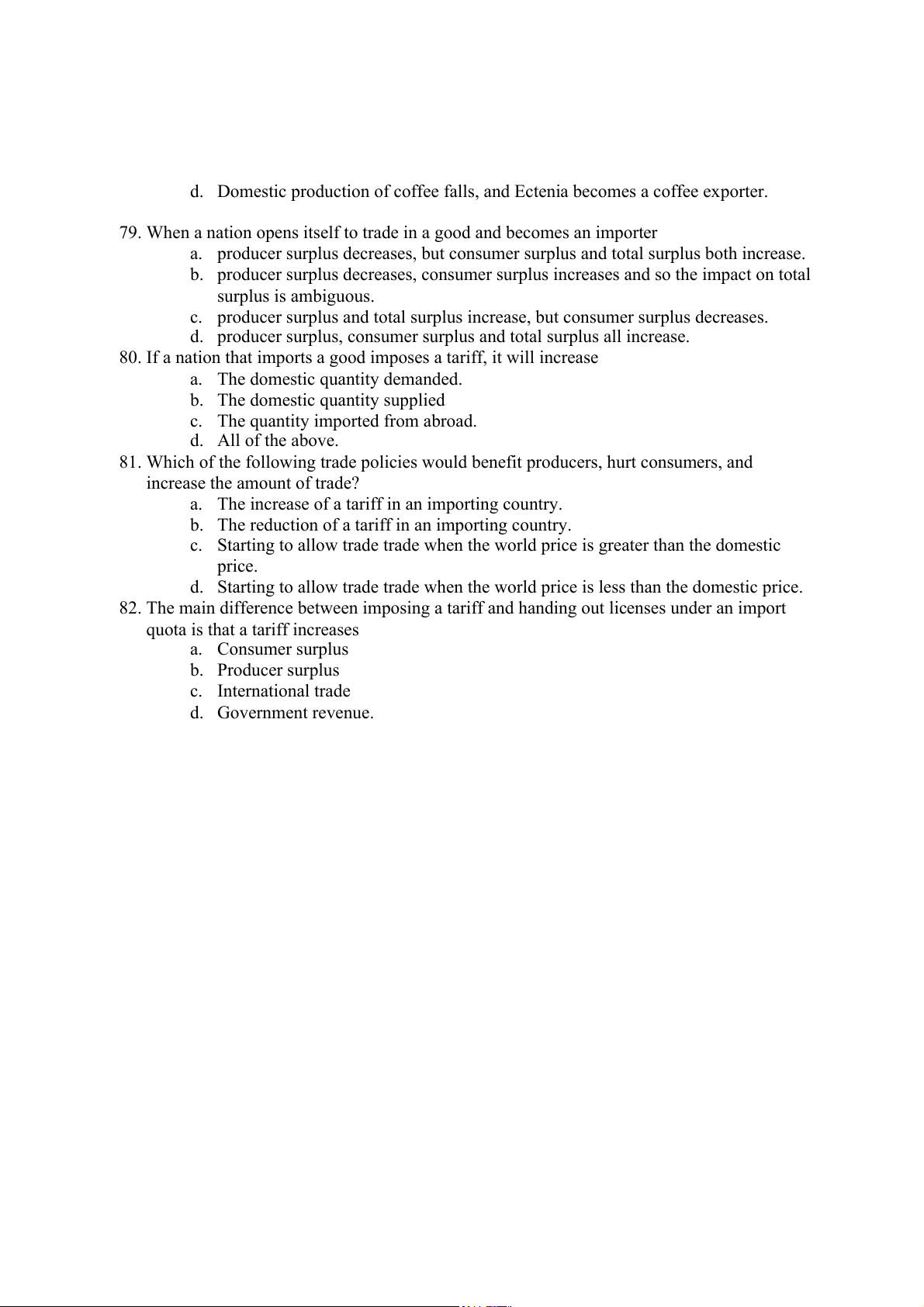
78. When the nation of Ectenia opens itself to world trade in coffee beans, the domestic price of coffee beans falls.
a. Domestic production of coffee rises, and Ectenia becomes a coffee importer.
b. Domestic production of coffee rises, and Ectenia becomes a coffee exporter.
c. Domestic production of coffee falls, and Ectenia becomes a coffee importer.
d. Domestic production of coffee falls, and Ectenia becomes a coffee exporter.
79. When a nation opens itself to trade in a good and becomes an importer
a. producer surplus decreases, but consumer surplus and total surplus both increase.
b. producer surplus decreases, consumer surplus increases and so the impact on total surplus is ambiguous.
c. producer surplus and total surplus increase, but consumer surplus decreases.
d. producer surplus, consumer surplus and total surplus all increase.
80. If a nation that imports a good imposes a tariff, it will increase
a. The domestic quantity demanded.
b. The domestic quantity supplied
c. The quantity imported from abroad. d. All of the above.
81. Which of the following trade policies would benefit producers, hurt consumers, and increase the amount of trade?
a. The increase of a tariff in an importing country.
b. The reduction of a tariff in an importing country.
c. Starting to allow trade trade when the world price is greater than the domestic price.
d. Starting to allow trade trade when the world price is less than the domestic price.
82. The main difference between imposing a tariff and handing out licenses under an import
quota is that a tariff increases a. Consumer surplus b. Producer surplus c. International trade d. Government revenue.
Tài liệu liên quan:
-
Tự Luận Vimo: Phân Tích Cung, Cầu và Thị Trường Cạnh Tranh| Microeconomics | Trường Đại học Quốc tế, Đại học Quốc gia Thành phố Hồ Chí Minh
5 3 -
Review Questions: Thinking Like an Economist | Microeconomics | Trường Đại học Quốc tế, Đại học Quốc gia Thành phố Hồ Chí Minh
5 3 -
Final Exam Quizlet Questions & Answers | Microeconomics | Trường Đại học Quốc tế, Đại học Quốc gia Thành phố Hồ Chí Minh
5 3 -
Đề thi giữa kỳ II | Microeconomics | Trường Đại học Quốc tế, Đại học Quốc gia Thành phố Hồ Chí Minh
5 3 -

Final Group Project_ The Beer Industry | Microeconomics | Trường Đại học Quốc tế, Đại học Quốc gia Thành phố Hồ Chí Minh
4 2