Test Bank for Chapter 12: The Economics of Information | Microeconomics | Trường Đại học Quốc tế, Đại học Quốc gia Thành phố Hồ Chí Minh
Adam Smith's invisible hand only leads to an efficient outcome when A) buyers are fully informed about all relevant aspects of a product and the market in which it is traded. B) buyers collect information up to the point at which the marginal cost of having more information equals the marginal benefit of having more information. C) buyers have more information about the product being traded than do sellers. D) buyers have less information about the product being traded than do sellers. Tài liệu được sưu tầm và soạn thảo dưới dạng file PDF để gửi tới các bạn cùng tham khảo, ôn tập đầy đủ kiến thức, chuẩn bị cho các buổi học thật tốt. Mời bạn đọc đón xem!
Môn: Microeconomics 613 tài liệu
Trường: Trường Đại học Quốc tế, Đại học Quốc gia Thành phố Hồ Chí Minh 1.9 K tài liệu
Tác giả:




Preview text:
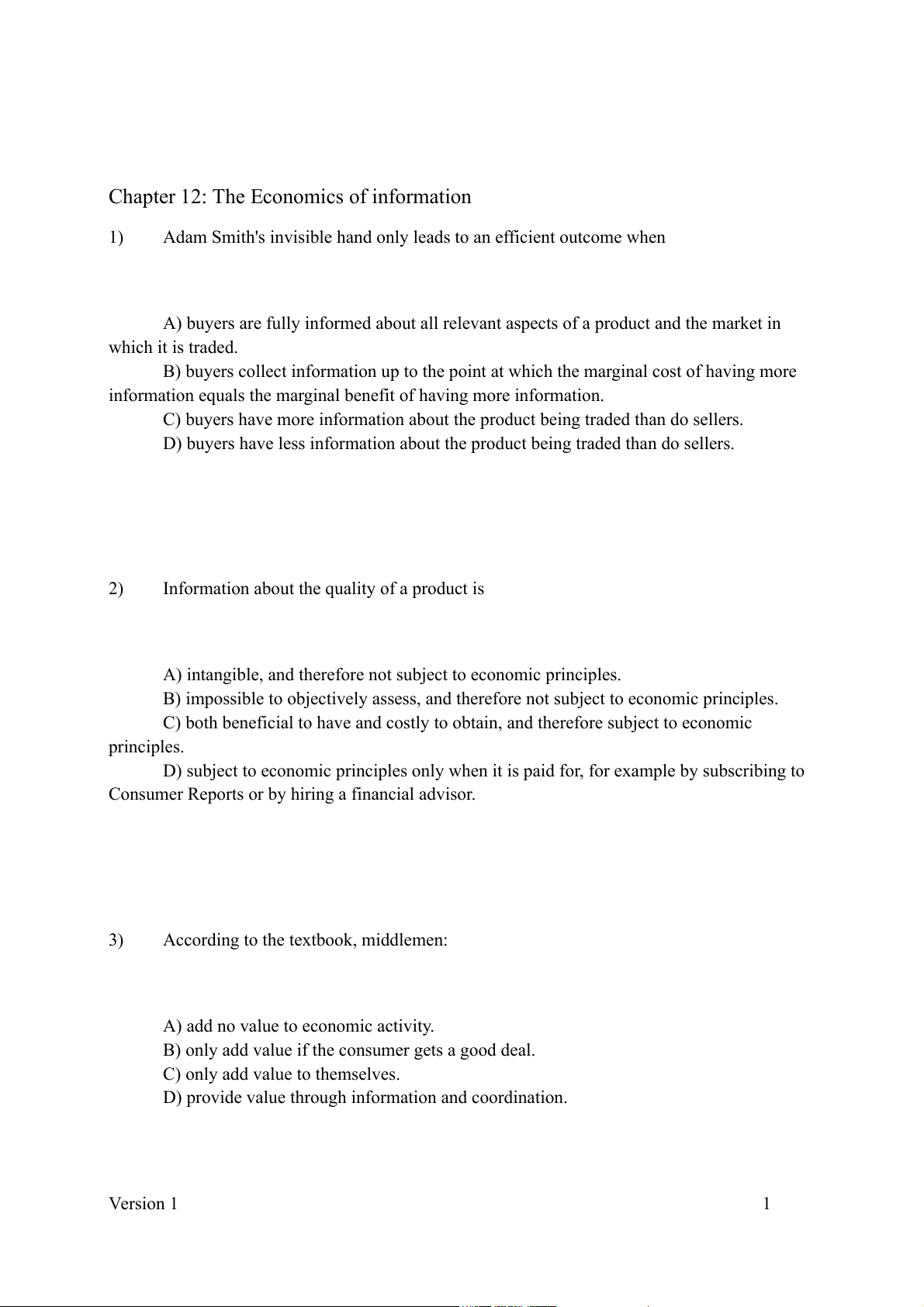
Chapter 12: The Economics of information 1)
Adam Smith's invisible hand only leads to an efficient outcome when
A) buyers are fully informed about all relevant aspects of a product and the market in which it is traded.
B) buyers collect information up to the point at which the marginal cost of having more
information equals the marginal benefit of having more information.
C) buyers have more information about the product being traded than do sellers.
D) buyers have less information about the product being traded than do sellers. 2)
Information about the quality of a product is
A) intangible, and therefore not subject to economic principles.
B) impossible to objectively assess, and therefore not subject to economic principles.
C) both beneficial to have and costly to obtain, and therefore subject to economic principles.
D) subject to economic principles only when it is paid for, for example by subscribing to
Consumer Reports or by hiring a financial advisor. 3)
According to the textbook, middlemen:
A) add no value to economic activity.
B) only add value if the consumer gets a good deal.
C) only add value to themselves.
D) provide value through information and coordination. Version 1 1 4)
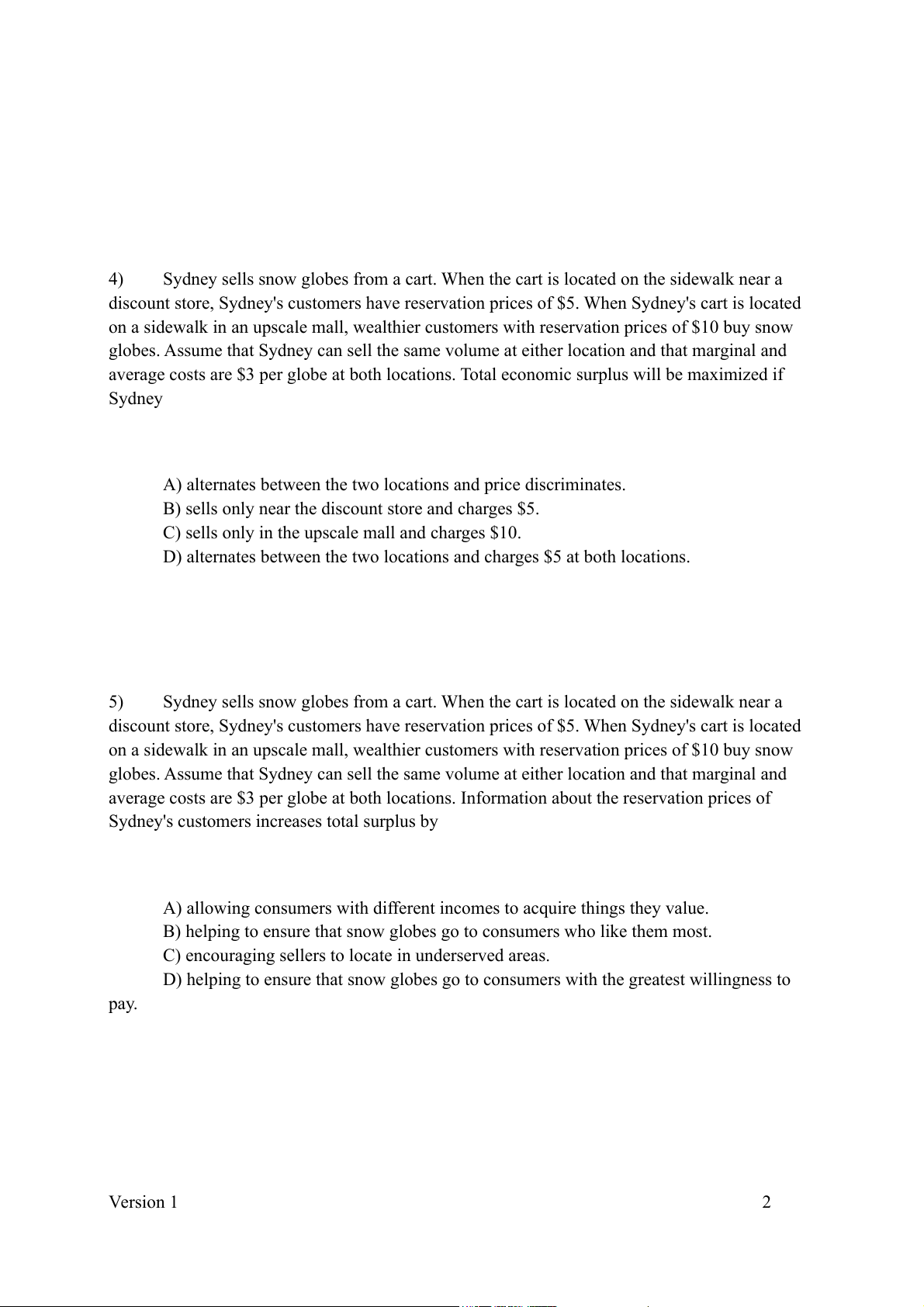
Sydney sells snow globes from a cart. When the cart is located on the sidewalk near a
discount store, Sydney's customers have reservation prices of $5. When Sydney's cart is located
on a sidewalk in an upscale mall, wealthier customers with reservation prices of $10 buy snow
globes. Assume that Sydney can sell the same volume at either location and that marginal and
average costs are $3 per globe at both locations. Total economic surplus will be maximized if Sydney
A) alternates between the two locations and price discriminates.
B) sells only near the discount store and charges $5.
C) sells only in the upscale mall and charges $10.
D) alternates between the two locations and charges $5 at both locations. 5)
Sydney sells snow globes from a cart. When the cart is located on the sidewalk near a
discount store, Sydney's customers have reservation prices of $5. When Sydney's cart is located
on a sidewalk in an upscale mall, wealthier customers with reservation prices of $10 buy snow
globes. Assume that Sydney can sell the same volume at either location and that marginal and
average costs are $3 per globe at both locations. Information about the reservation prices of
Sydney's customers increases total surplus by
A) allowing consumers with different incomes to acquire things they value.
B) helping to ensure that snow globes go to consumers who like them most.
C) encouraging sellers to locate in underserved areas.
D) helping to ensure that snow globes go to consumers with the greatest willingness to pay. Version 1 2 6)
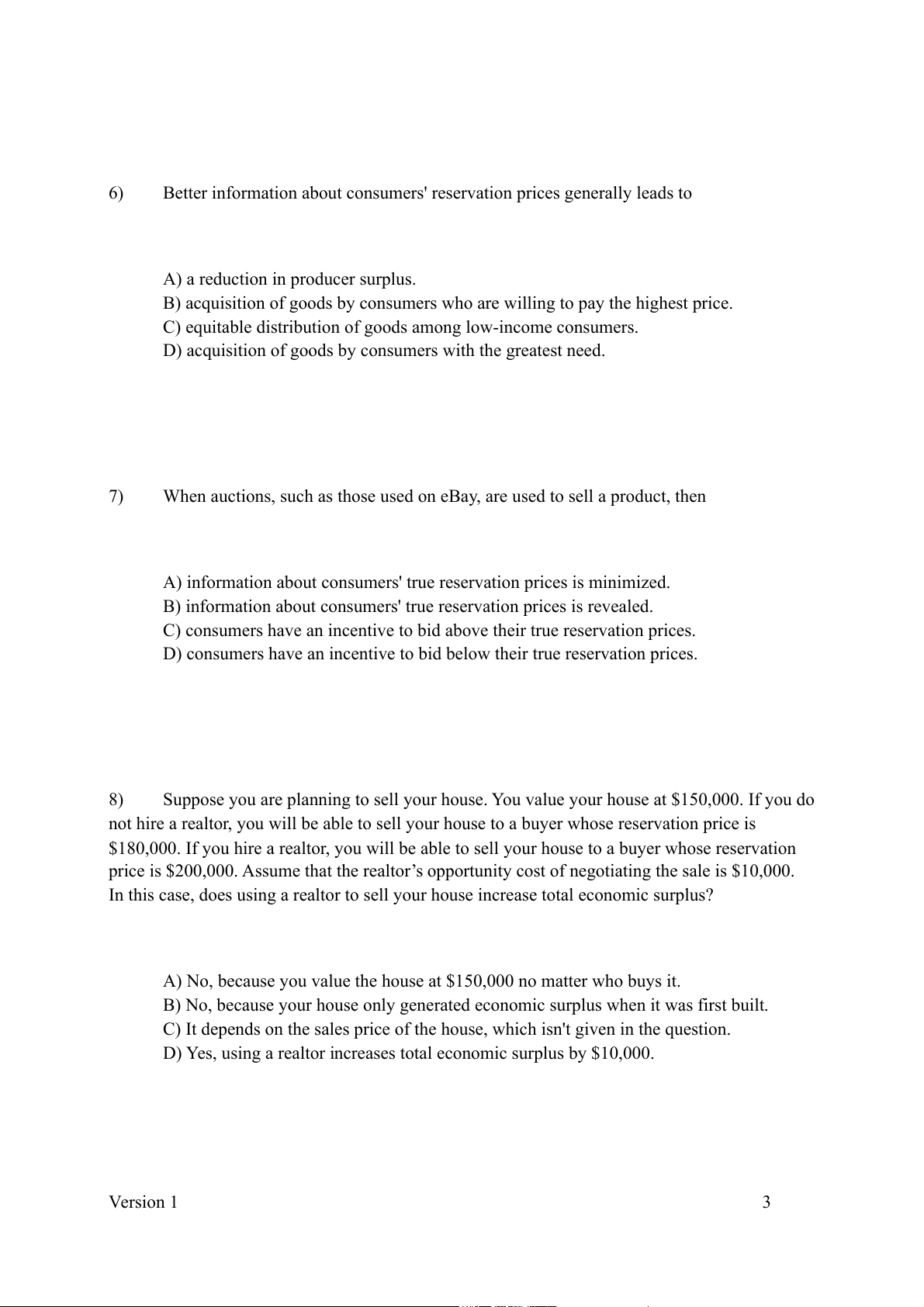
Better information about consumers' reservation prices generally leads to
A) a reduction in producer surplus.
B) acquisition of goods by consumers who are willing to pay the highest price.
C) equitable distribution of goods among low-income consumers.
D) acquisition of goods by consumers with the greatest need. 7)
When auctions, such as those used on eBay, are used to sell a product, then
A) information about consumers' true reservation prices is minimized.
B) information about consumers' true reservation prices is revealed.
C) consumers have an incentive to bid above their true reservation prices.
D) consumers have an incentive to bid below their true reservation prices. 8)
Suppose you are planning to sell your house. You value your house at $150,000. If you do
not hire a realtor, you will be able to sell your house to a buyer whose reservation price is
$180,000. If you hire a realtor, you will be able to sell your house to a buyer whose reservation
price is $200,000. Assume that the realtor’s opportunity cost of negotiating the sale is $10,000.
In this case, does using a realtor to sell your house increase total economic surplus?
A) No, because you value the house at $150,000 no matter who buys it.
B) No, because your house only generated economic surplus when it was first built.
C) It depends on the sales price of the house, which isn't given in the question.
D) Yes, using a realtor increases total economic surplus by $10,000. Version 1 3 9)
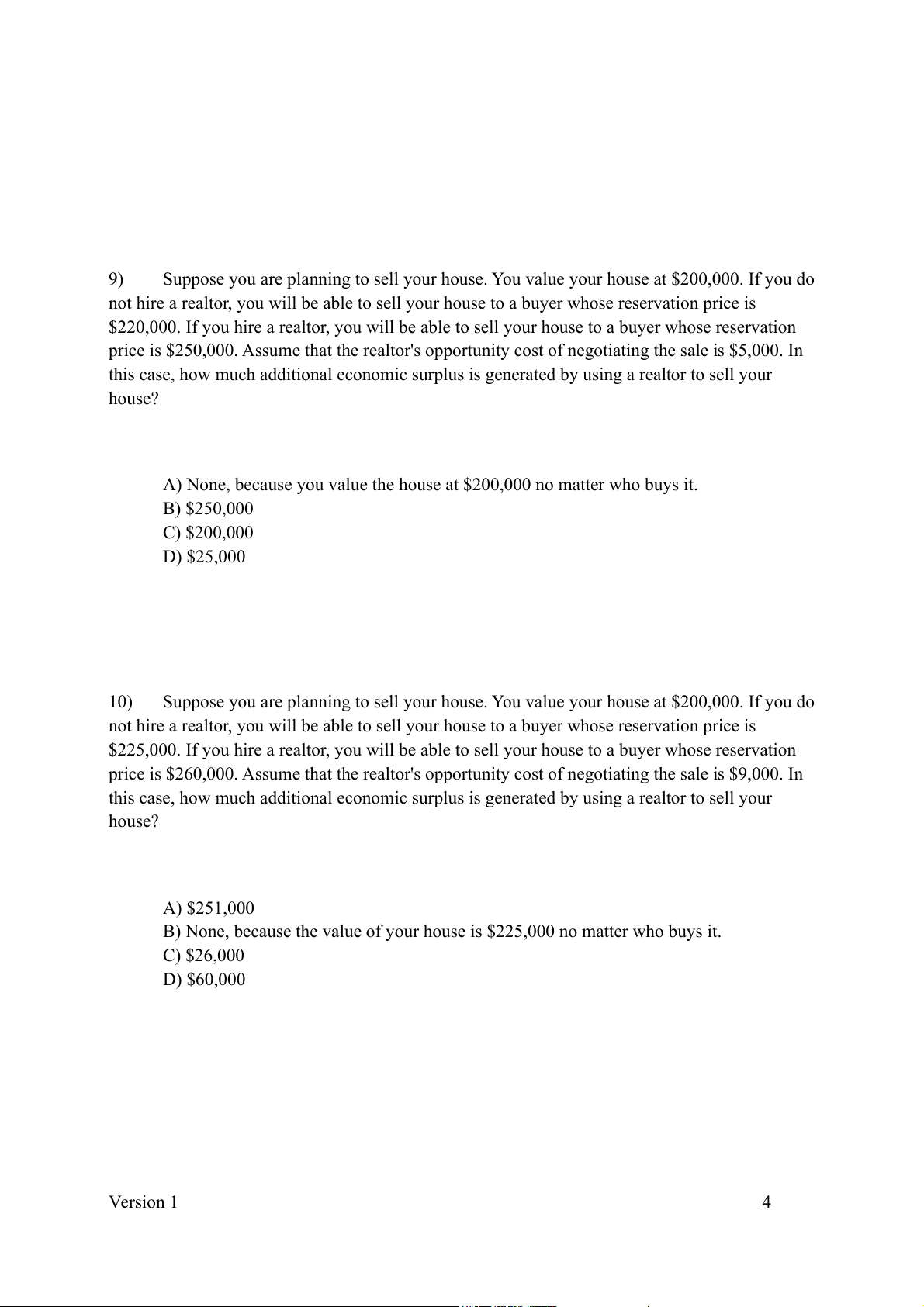
Suppose you are planning to sell your house. You value your house at $200,000. If you do
not hire a realtor, you will be able to sell your house to a buyer whose reservation price is
$220,000. If you hire a realtor, you will be able to sell your house to a buyer whose reservation
price is $250,000. Assume that the realtor's opportunity cost of negotiating the sale is $5,000. In
this case, how much additional economic surplus is generated by using a realtor to sell your house?
A) None, because you value the house at $200,000 no matter who buys it. B) $250,000 C) $200,000 D) $25,000 10)
Suppose you are planning to sell your house. You value your house at $200,000. If you do
not hire a realtor, you will be able to sell your house to a buyer whose reservation price is
$225,000. If you hire a realtor, you will be able to sell your house to a buyer whose reservation
price is $260,000. Assume that the realtor's opportunity cost of negotiating the sale is $9,000. In
this case, how much additional economic surplus is generated by using a realtor to sell your house? A) $251,000
B) None, because the value of your house is $225,000 no matter who buys it. C) $26,000 D) $60,000 Version 1 4 11)
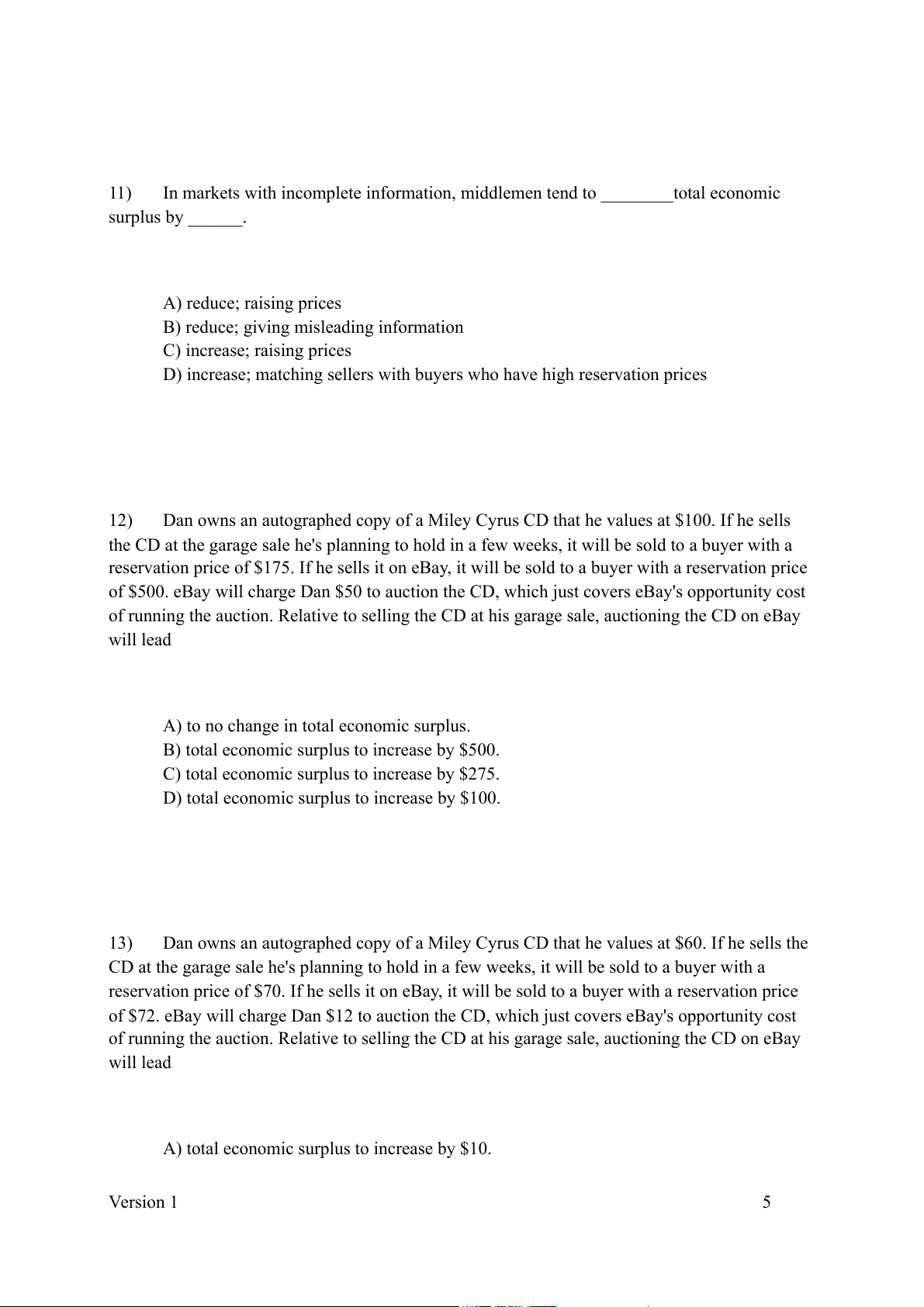
In markets with incomplete information, middlemen tend to ________total economic surplus by ______. A) reduce; raising prices
B) reduce; giving misleading information C) increase; raising prices
D) increase; matching sellers with buyers who have high reservation prices 12)
Dan owns an autographed copy of a Miley Cyrus CD that he values at $100. If he sells
the CD at the garage sale he's planning to hold in a few weeks, it will be sold to a buyer with a
reservation price of $175. If he sells it on eBay, it will be sold to a buyer with a reservation price
of $500. eBay will charge Dan $50 to auction the CD, which just covers eBay's opportunity cost
of running the auction. Relative to selling the CD at his garage sale, auctioning the CD on eBay will lead
A) to no change in total economic surplus.
B) total economic surplus to increase by $500.
C) total economic surplus to increase by $275.
D) total economic surplus to increase by $100. 13)
Dan owns an autographed copy of a Miley Cyrus CD that he values at $60. If he sells the
CD at the garage sale he's planning to hold in a few weeks, it will be sold to a buyer with a
reservation price of $70. If he sells it on eBay, it will be sold to a buyer with a reservation price
of $72. eBay will charge Dan $12 to auction the CD, which just covers eBay's opportunity cost
of running the auction. Relative to selling the CD at his garage sale, auctioning the CD on eBay will lead
A) total economic surplus to increase by $10. Version 1 5
B) total economic surplus to increase by $2.
C) to no change in total economic surplus.
D) total economic surplus to decrease by $10. 14)
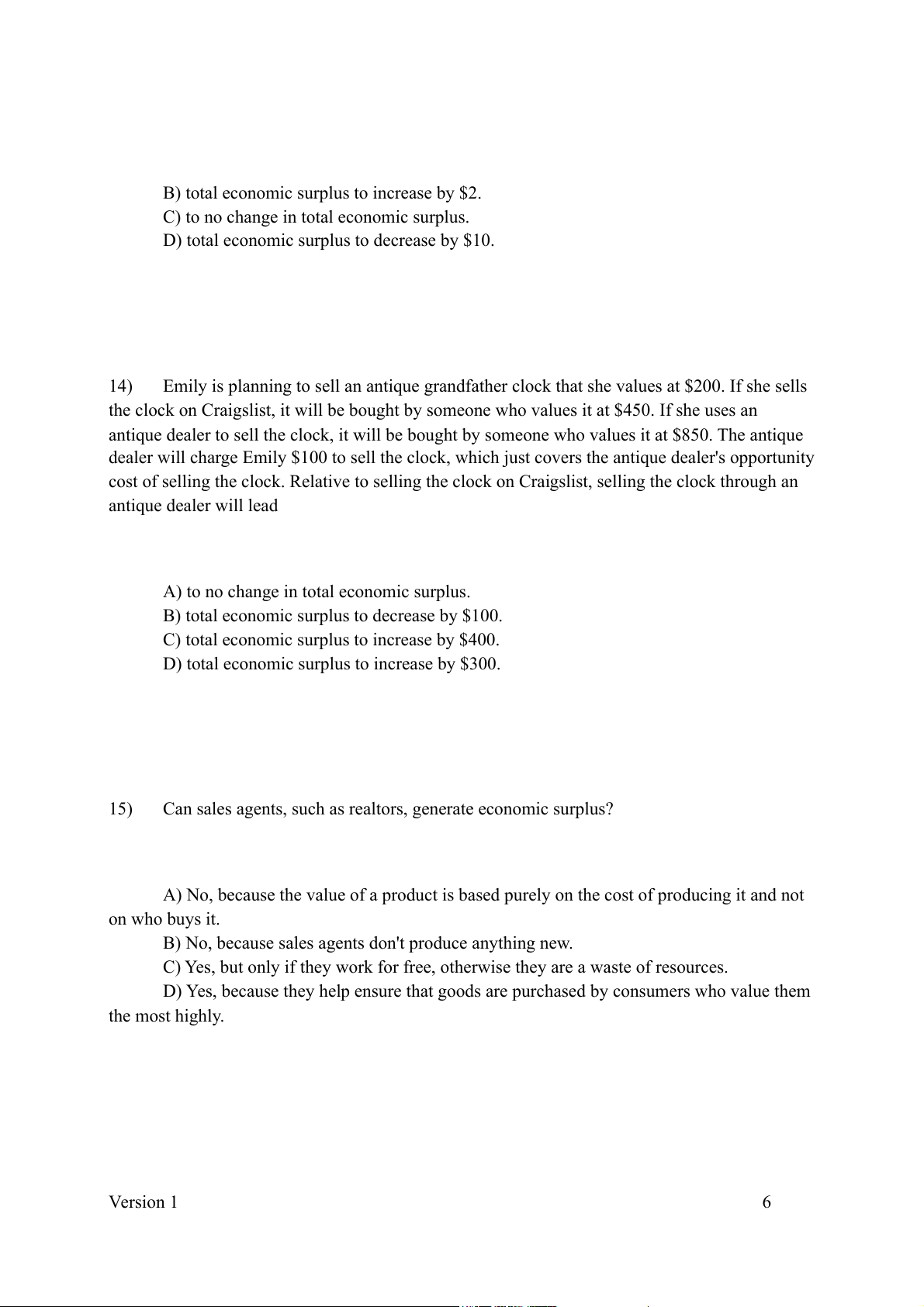
Emily is planning to sell an antique grandfather clock that she values at $200. If she sells
the clock on Craigslist, it will be bought by someone who values it at $450. If she uses an
antique dealer to sell the clock, it will be bought by someone who values it at $850. The antique
dealer will charge Emily $100 to sell the clock, which just covers the antique dealer's opportunity
cost of selling the clock. Relative to selling the clock on Craigslist, selling the clock through an antique dealer will lead
A) to no change in total economic surplus.
B) total economic surplus to decrease by $100.
C) total economic surplus to increase by $400.
D) total economic surplus to increase by $300. 15)
Can sales agents, such as realtors, generate economic surplus?
A) No, because the value of a product is based purely on the cost of producing it and not on who buys it.
B) No, because sales agents don't produce anything new.
C) Yes, but only if they work for free, otherwise they are a waste of resources.
D) Yes, because they help ensure that goods are purchased by consumers who value them the most highly. Version 1 6 16)
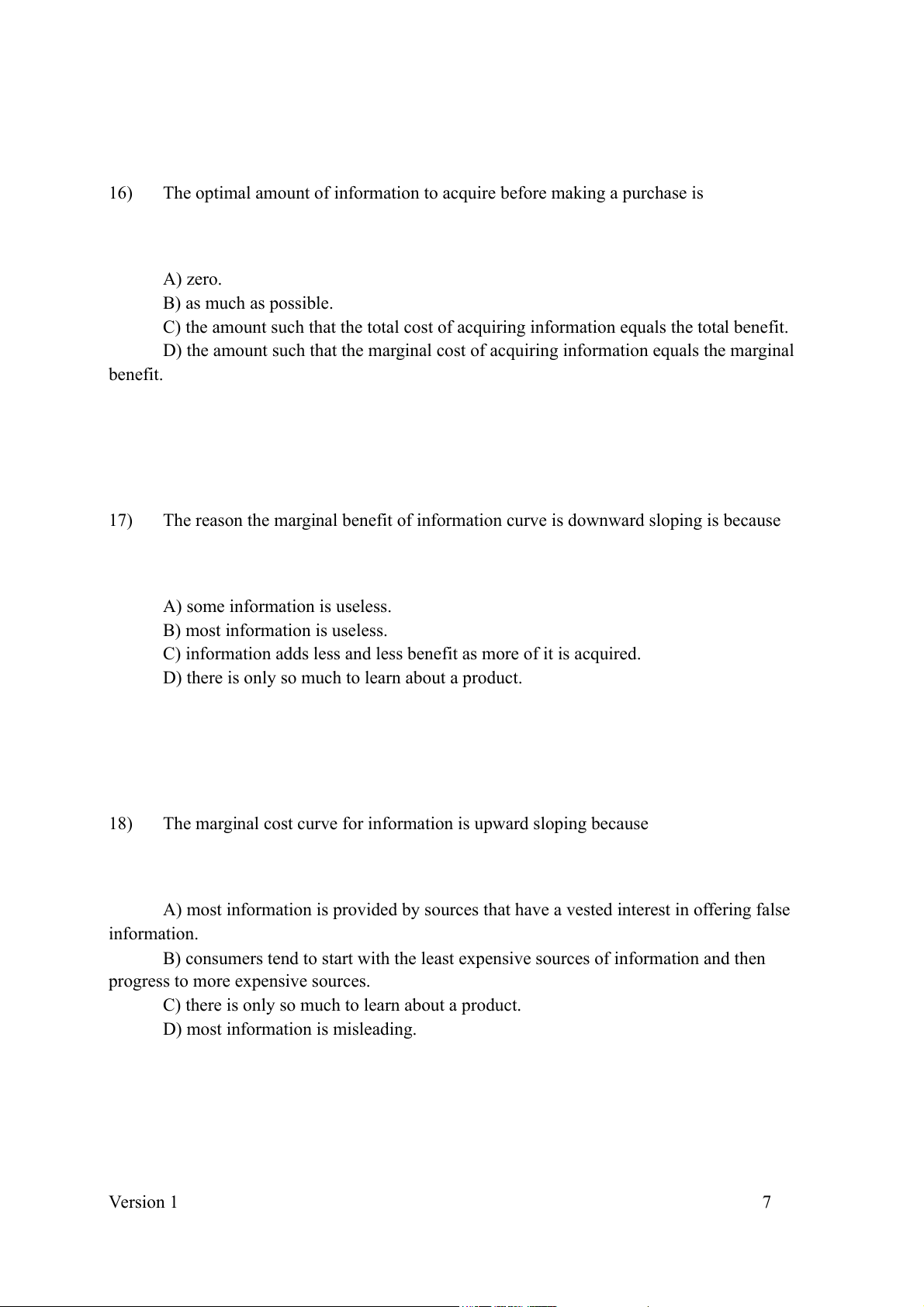
The optimal amount of information to acquire before making a purchase is A) zero. B) as much as possible.
C) the amount such that the total cost of acquiring information equals the total benefit.
D) the amount such that the marginal cost of acquiring information equals the marginal benefit. 17)
The reason the marginal benefit of information curve is downward sloping is because
A) some information is useless.
B) most information is useless.
C) information adds less and less benefit as more of it is acquired.
D) there is only so much to learn about a product. 18)
The marginal cost curve for information is upward sloping because
A) most information is provided by sources that have a vested interest in offering false information.
B) consumers tend to start with the least expensive sources of information and then
progress to more expensive sources.
C) there is only so much to learn about a product.
D) most information is misleading. Version 1 7 19)
Morgan lives in San Francisco and likes to dine out. Morgan has noticed that prices at
restaurants near popular tourist destinations in the city tend to be higher than at restaurants of the
same quality in other neighborhoods. One reason for this is that
A) search costs are higher for people who are unfamiliar with the area.
B) residents don't like to eat in restaurants frequented by tourists.
C) tourists don't worry about money while on vacation.
D) restaurant meals are a small fraction of the total cost of a vacation. 20)
Gasoline prices tend to be higher at stations that are just off the freeway than they are at
stations in the middle of town. The most likely reason for this is that
A) freeway exit stations sell a higher quality product.
B) people who buy gas at freeway exit stations tend to have higher search costs.
C) freeway exit stations are more likely to have an attached convenience store.
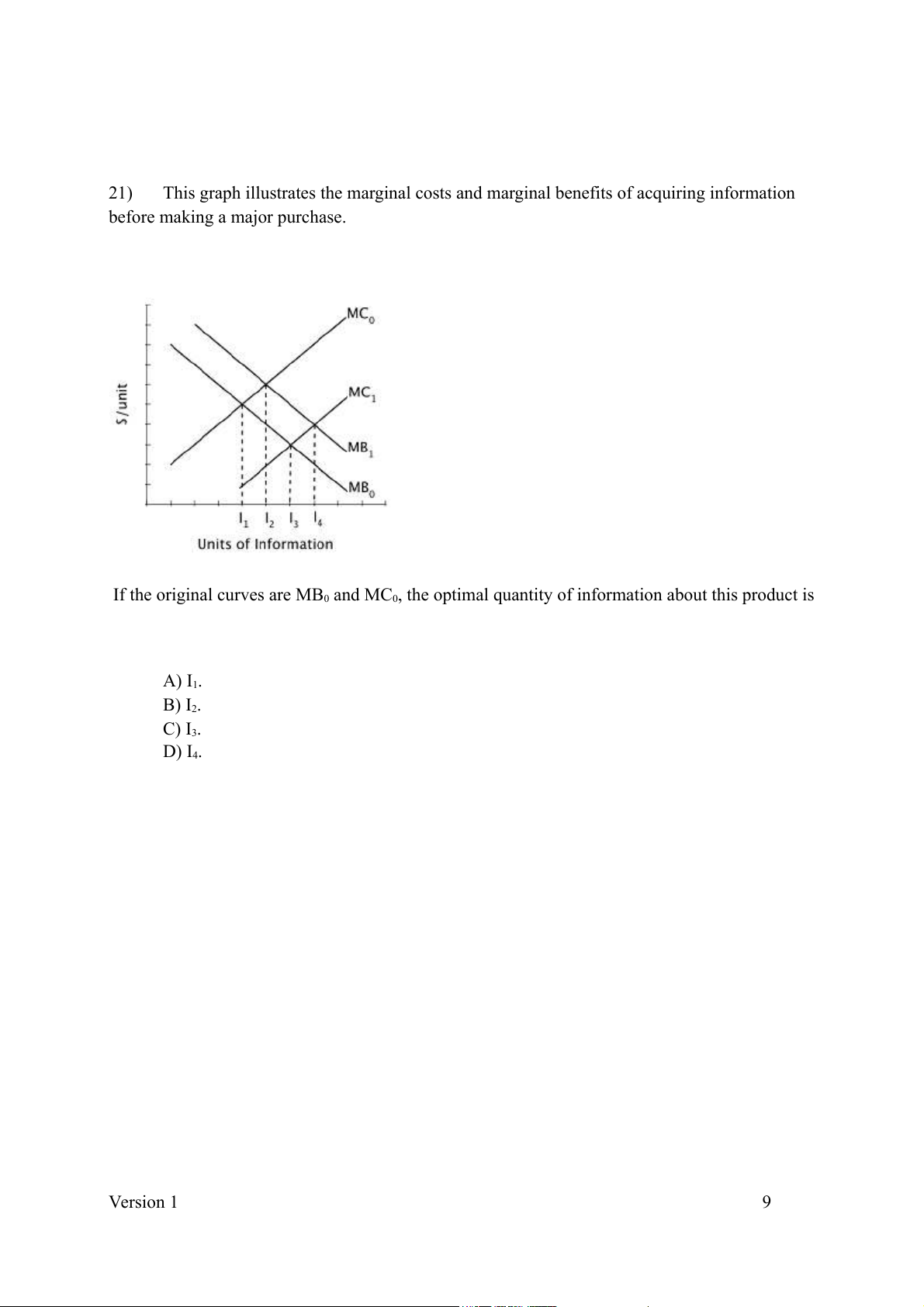
D) demand for gas at freeway exits is lower than it is in the middle of town. Version 1 8 21)
This graph illustrates the marginal costs and marginal benefits of acquiring information
before making a major purchase.
If the original curves are MB and MC 0
, the optimal quantity of information about this product is 0 A) I .1 B) I .2 C) I .3 D) I .4 Version 1 9 22)
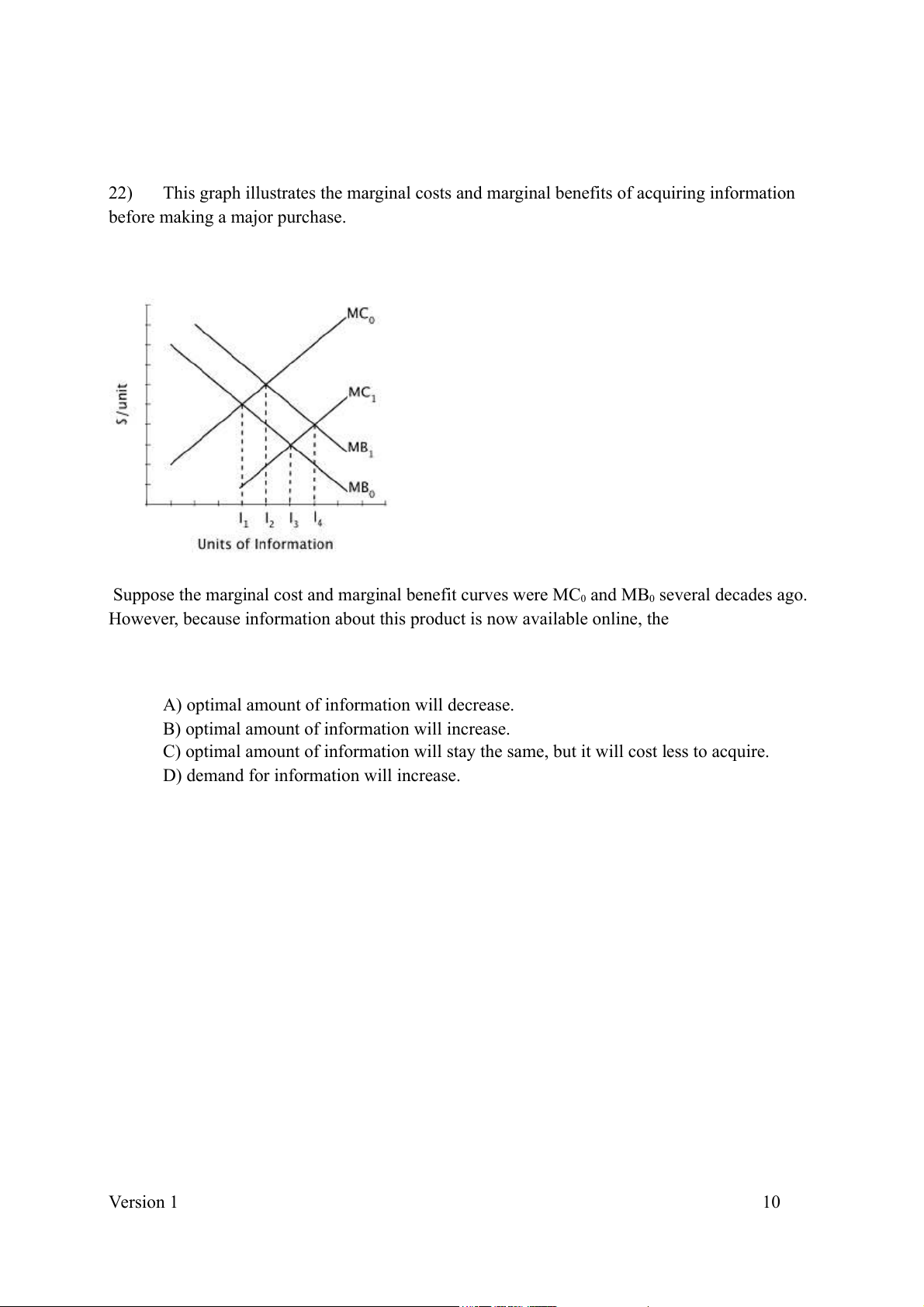
This graph illustrates the marginal costs and marginal benefits of acquiring information
before making a major purchase.
Suppose the marginal cost and marginal benefit curves were MC and MB 0 several decades ago. 0
However, because information about this product is now available online, the
A) optimal amount of information will decrease.
B) optimal amount of information will increase.
C) optimal amount of information will stay the same, but it will cost less to acquire.
D) demand for information will increase. Version 1 10 23)
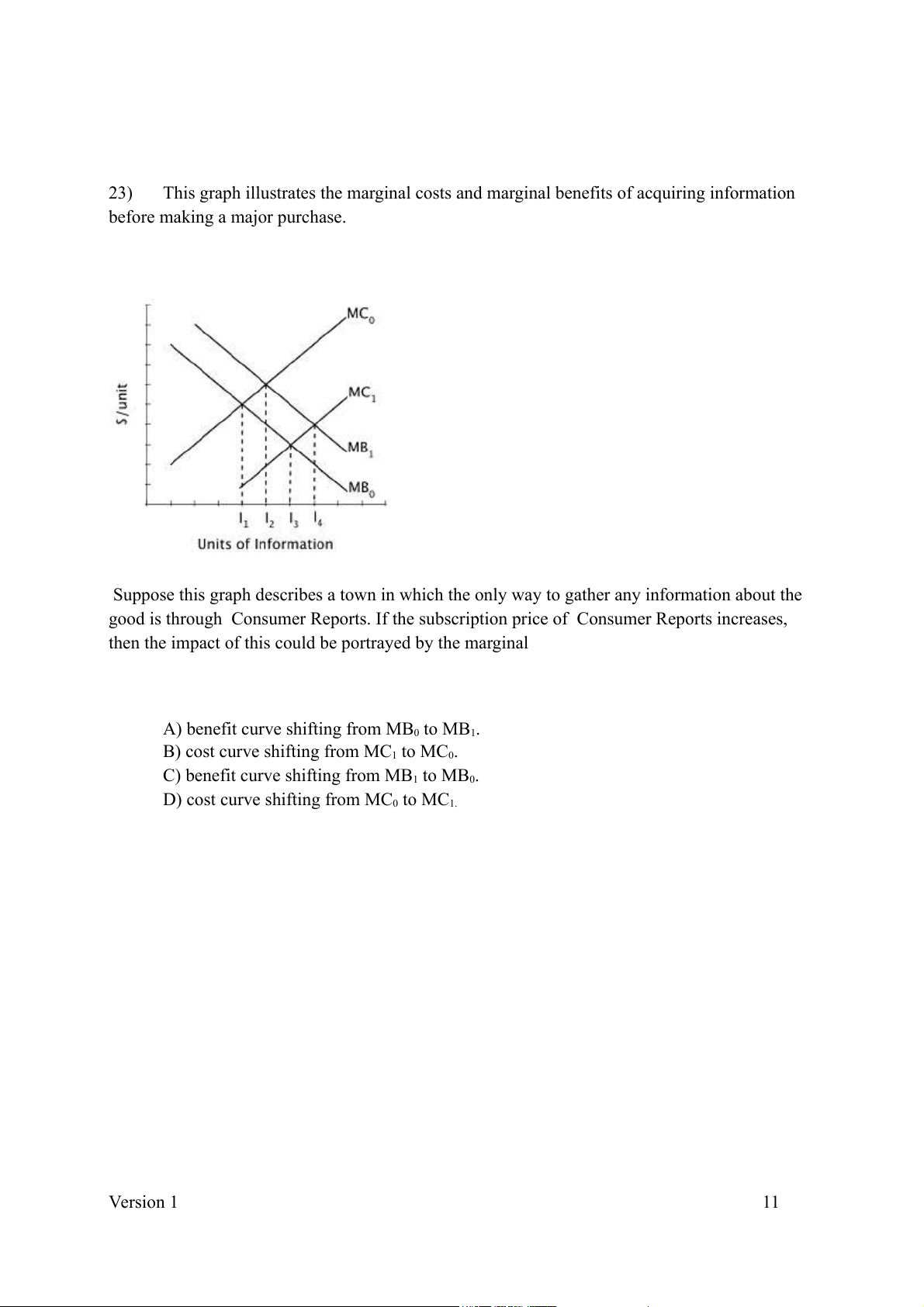
This graph illustrates the marginal costs and marginal benefits of acquiring information
before making a major purchase.
Suppose this graph describes a town in which the only way to gather any information about the
good is through Consumer Reports. If the subscription price of increases, Consumer Reports
then the impact of this could be portrayed by the marginal
A) benefit curve shifting from MB to MB 0 .1
B) cost curve shifting from MC to MC 1 .0
C) benefit curve shifting from MB to MB 1 0.
D) cost curve shifting from MC0 to MC1. Version 1 11 24)
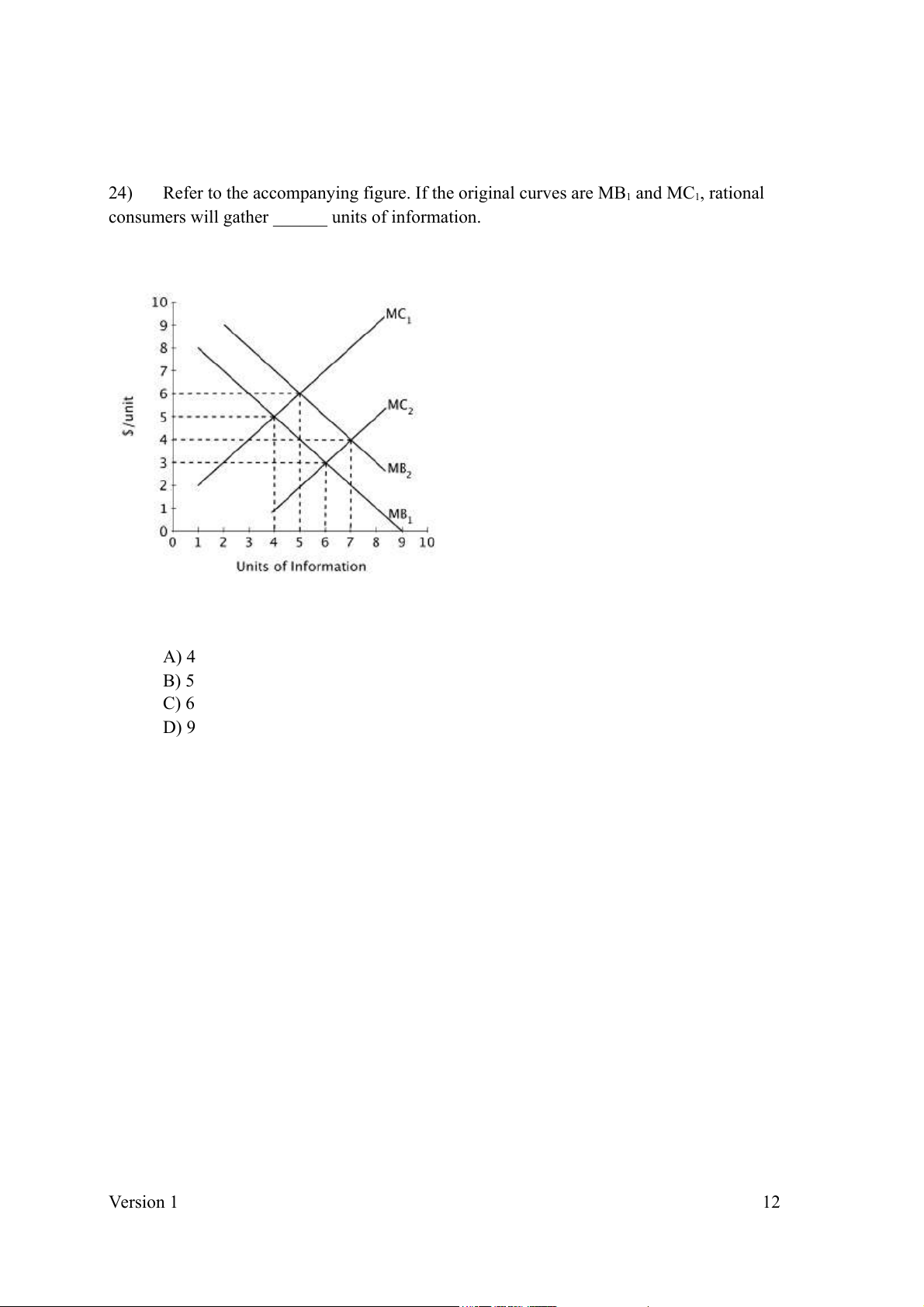
Refer to the accompanying figure. If the original curves are MB1 and MC1, rational
consumers will gather ______ units of information. A) 4 B) 5 C) 6 D) 9 Version 1 12 25)
Refer to the accompanying figure. The growth of access to the Internet will cause the marginal
A) benefit curve to shift from MB2 to MB .1
B) benefit curve to shift from MB1 to MB .2
C) cost curve to shift from MC2 to MC1.
D) cost curve to shift from MC to MC 1 .2 Version 1 13 26)
Refer to the accompanying figure. If the relevant curves are MC and MB 1 , a rational 2
consumer will acquire ______ units of information, the amount for which marginal benefit for
information is ______ its marginal cost. A) 4; equal to B) 4; more than C) 5; more than D) 5; equal to Version 1 14 27)
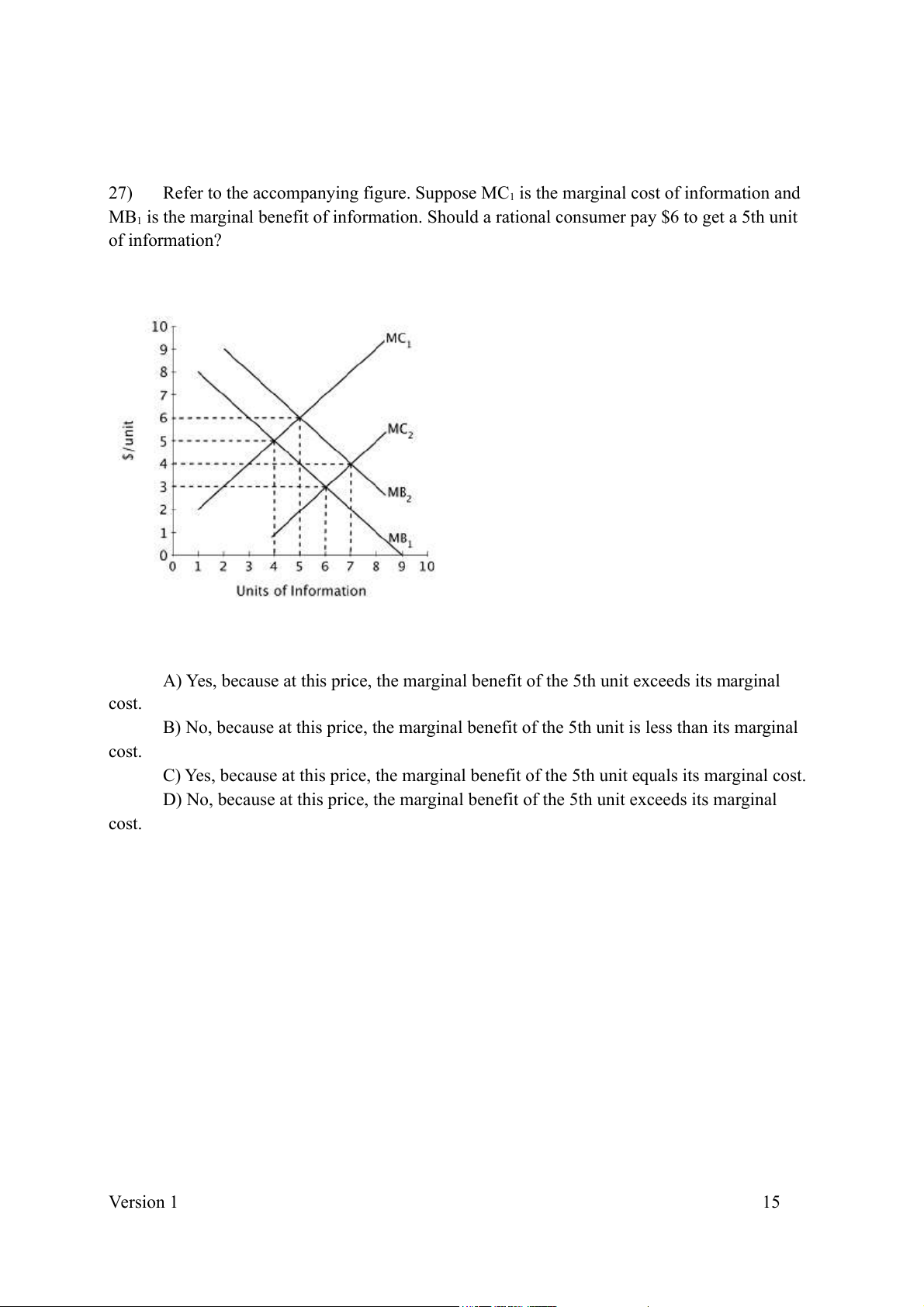
Refer to the accompanying figure. Suppose MC is the mar 1 ginal cost of information and
MB1 is the marginal benefit of information. Should a rational consumer pay $6 to get a 5th unit of information?
A) Yes, because at this price, the marginal benefit of the 5th unit exceeds its marginal cost.
B) No, because at this price, the marginal benefit of the 5th unit is less than its marginal cost.
C) Yes, because at this price, the marginal benefit of the 5th unit equals its marginal cost.
D) No, because at this price, the marginal benefit of the 5th unit exceeds its marginal cost. Version 1 15 28)
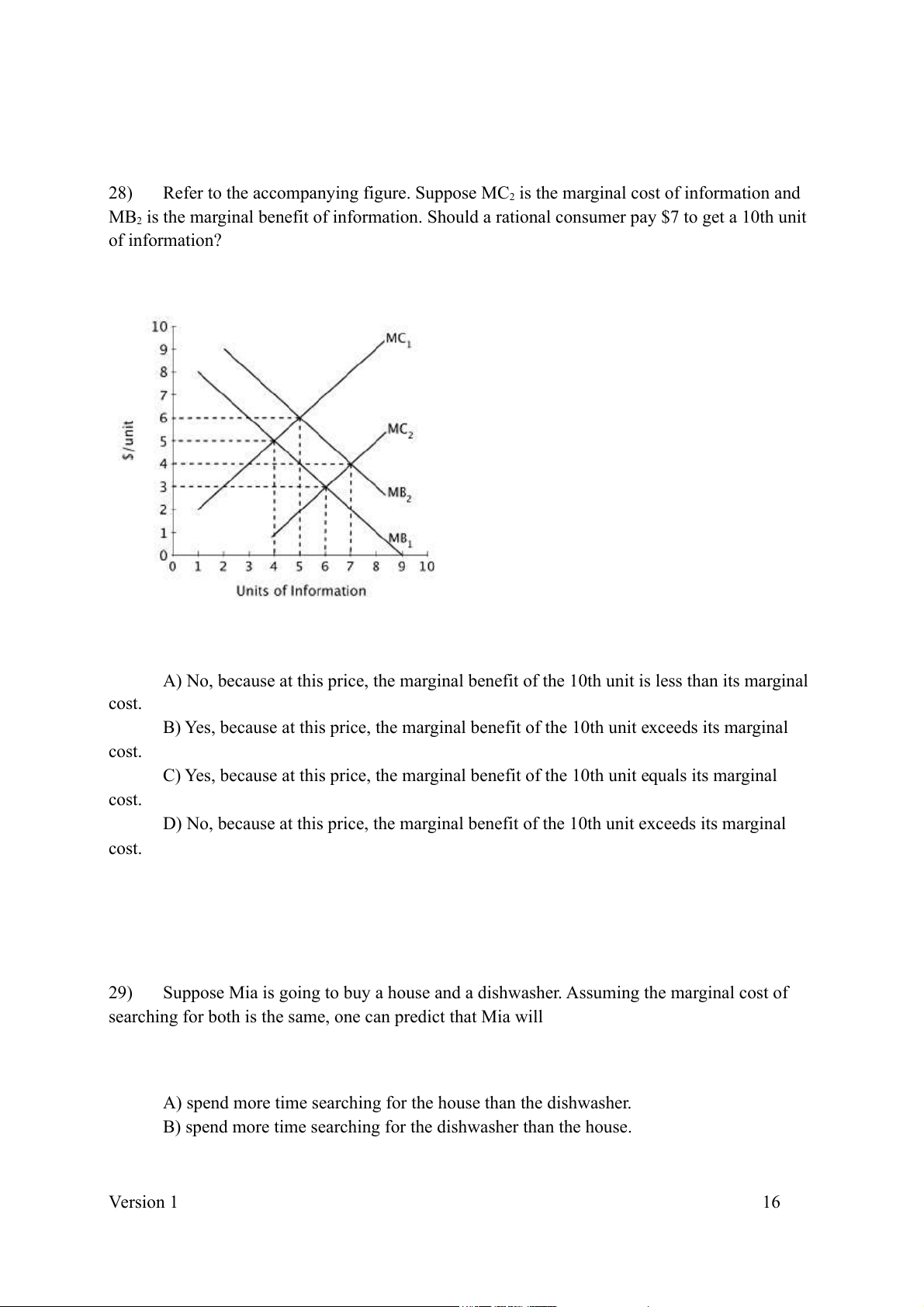
Refer to the accompanying figure. Suppose MC is the mar 2 ginal cost of information and
MB2 is the marginal benefit of information. Should a rational consumer pay $7 to get a 10th unit of information?
A) No, because at this price, the marginal benefit of the 10th unit is less than its marginal cost.
B) Yes, because at this price, the marginal benefit of the 10th unit exceeds its marginal cost.
C) Yes, because at this price, the marginal benefit of the 10th unit equals its marginal cost.
D) No, because at this price, the marginal benefit of the 10th unit exceeds its marginal cost. 29)
Suppose Mia is going to buy a house and a dishwasher. Assuming the marginal cost of
searching for both is the same, one can predict that Mia will
A) spend more time searching for the house than the dishwasher.
B) spend more time searching for the dishwasher than the house. Version 1 16
C) spend equal amounts of time searching for the dishwasher and the house.
D) trust the information from her real estate agent but not from the dishwasher salesperson. 30)
Grace and Will are moving to LA at the same time and both wish to find apartments to
rent. Grace is staying with her aunt for free while Will is paying to stay at a motel. If their search
costs are otherwise identical, one can predict that
A) Grace and Will will spend the same number of days searching.
B) Will will spend more days searching than Grace.
C) Grace will spend more days searching than Will.
D) Will will have better information. 31)
The difference between the price of electronic equipment in a retail store and on the Internet partly reflects
A) the extent to which middlemen drive the price up for extra profit.
B) the lack of competition between brick and mortar stores and online stores.
C) the value of personal attention and support at a retail store. D) excessive markup. 32)
The marginal benefit of additional information Version 1 17
A) rises as more information is collected.
B) is independent of the amount of information that has already been acquired.
C) tends to be lower for expensive items than inexpensive items.
D) falls as more information is collected. 33)
The marginal cost of collecting information
A) rises as more information is collected.
B) falls as more information is collected.
C) is now zero because of the Internet.
D) is independent of the amount of information that has already been acquired. 34)
Rationally, search should continue until
A) all search options have been explored.
B) the marginal benefit of search equals the marginal cost of search.
C) the marginal benefit of search is zero.
D) the marginal cost of search is zero. 35)
The free-rider problem arises when people Version 1 18
A) obtain a good for less than the market equilibrium price.
B) who do not pay for a good cannot be excluded from consuming it.
C) who do not pay for a good cannot consume it.
D) who pay for a good cannot consume it. 36)
The free-rider problem occurs when
A) buyers pay less than their reservation price.
B) sellers receive more than their reservation price.
C) people who do not pay for a good or service cannot be excluded from enjoying it.
D) people who pay for a good or service cannot be excluded from enjoying it. 37)
In the presence of the free-rider problem, the market will provide ______ of a good or service.
A) more than the socially optimal quantity
B) the socially optimal quantity
C) less than the socially optimal quantity
D) either more than or less than the socially optimal quantity 38)
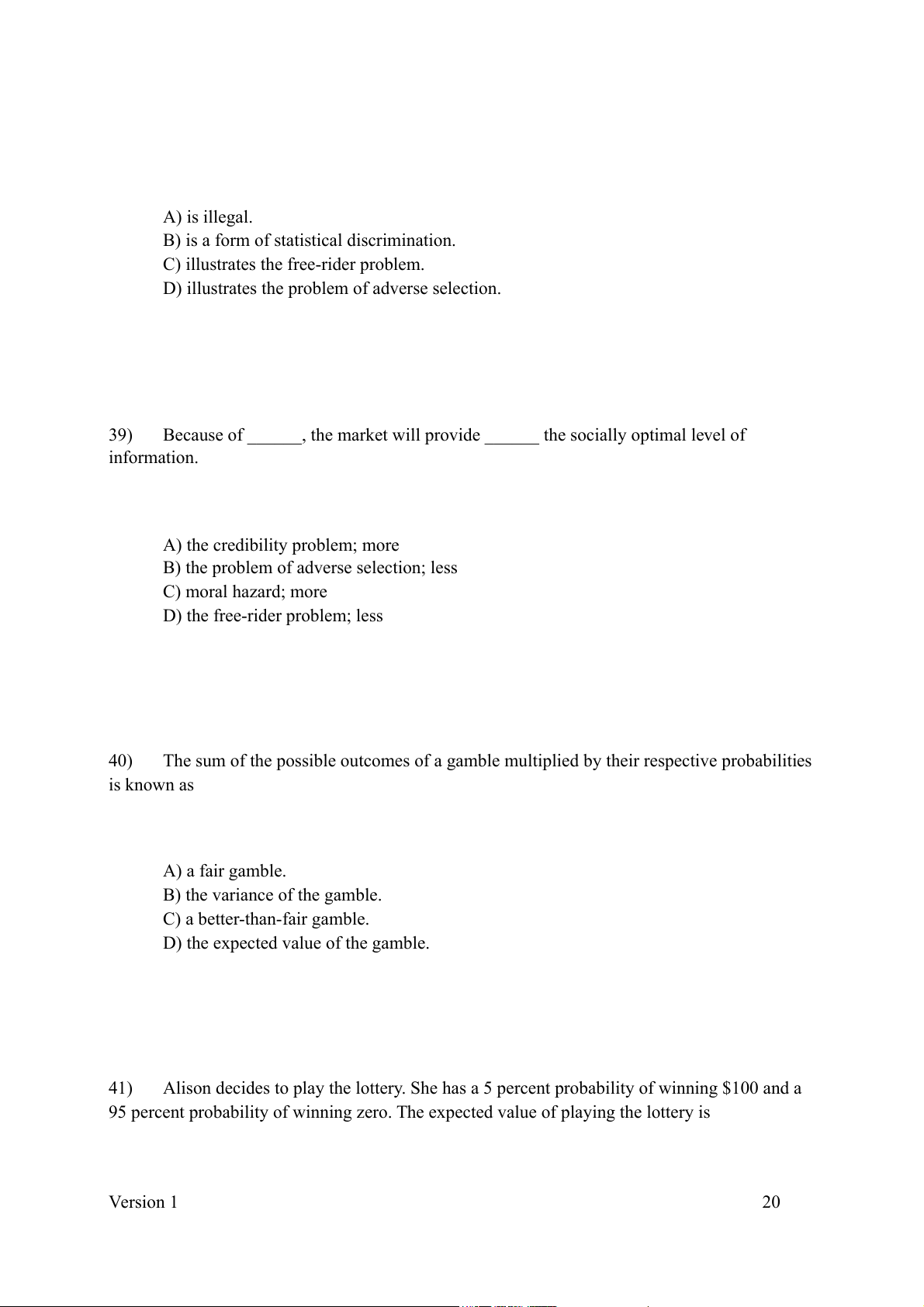
Pat goes to the local electronics store to learn about high-end audio equipment. The
salesperson spends an hour talking with Pat and demonstrating equipment. Pat then leaves and
orders an audio system on the Internet for $250 less than the price at the store. Pat's behavior Version 1 19 A) is illegal.
B) is a form of statistical discrimination.
C) illustrates the free-rider problem.
D) illustrates the problem of adverse selection. 39)
Because of ______, the market will provide ______ the socially optimal level of information.
A) the credibility problem; more
B) the problem of adverse selection; less C) moral hazard; more
D) the free-rider problem; less 40)
The sum of the possible outcomes of a gamble multiplied by their respective probabilities is known as A) a fair gamble. B) the variance of the gamble. C) a better-than-fair gamble.
D) the expected value of the gamble. 41)
Alison decides to play the lottery. She has a 5 percent probability of winning $100 and a
95 percent probability of winning zero. The expected value of playing the lottery is Version 1 20
Tài liệu liên quan:
-
Tự Luận Vimo: Phân Tích Cung, Cầu và Thị Trường Cạnh Tranh| Microeconomics | Trường Đại học Quốc tế, Đại học Quốc gia Thành phố Hồ Chí Minh
5 3 -
Review Questions: Thinking Like an Economist | Microeconomics | Trường Đại học Quốc tế, Đại học Quốc gia Thành phố Hồ Chí Minh
5 3 -
Final Exam Quizlet Questions & Answers | Microeconomics | Trường Đại học Quốc tế, Đại học Quốc gia Thành phố Hồ Chí Minh
5 3 -
Đề thi giữa kỳ II | Microeconomics | Trường Đại học Quốc tế, Đại học Quốc gia Thành phố Hồ Chí Minh
5 3 -

Final Group Project_ The Beer Industry | Microeconomics | Trường Đại học Quốc tế, Đại học Quốc gia Thành phố Hồ Chí Minh
4 2