Tóm tắt nội dung chính và phương pháp nghiên cứu | Kinh tế vĩ mô | Trường Đại học kinh tế Thành Phố Hồ Chí Minh
Business students may wonder why it is necessary to undertake a literature review. But understanding fully what a literature review is and how it can help them in their research can answer the question. It helps researchers develop and expand their research ideas, and it ensures they fully understand relevant topics and that they are familiar with recent developments. Additionally, a literature review can prevent researchers from duplicating previous research. It may even eliminate the need for a particular research project. Tài liệu được sưu tầm và soạn thảo dưới dạng file PDF để gửi tới các bạn cùng tham khảo, ôn tập đầy đủ kiến thức, chuẩn bị cho các buổi học thật tốt. Mời bạn đọc đón xem!
Môn: Kinh tế vĩ mô ( UEH) 0.9 K tài liệu
Trường: Đại học Kinh tế Thành phố Hồ Chí Minh 2.8 K tài liệu
Tác giả:

Preview text:
GenerateFreeTraffictoYourWebsite, accessed October 2022;
James Doubek and Mary Louise Kelly, ‘At 25 Years,
Understanding The Longevity of Craigslist’, NPR, February 24,
2020, https://www.npr.org/2020/02/24/808965078/at-25-years-
understanding-the-longevity-of-craigslist, last accessed October
2022; https://blog.google/around-the-globe/google-
europe/research-what-really-happened-newspaper-revenue/, accessed October 2022. P L R
Business students may wonder why it is necessary to undertake
a literature review. But understanding fully what a literature
review is and how it can help them in their research can
answer the question. It helps researchers develop and expand
their research ideas, and it ensures they fully understand
relevant topics and that they are familiar with recent
developments. Additionally, a literature review can prevent
researchers from duplicating previous research. It may even
eliminate the need for a particular research project.
The literature review follows the clarification of the problem in
the formal research process. Likely you have previously
researched the topic. But that research typically would have
involved searching briefly for publications or reports that help
in better understanding the research problem. It may also have
consisted of informal interviews with colleagues or coworkers
with similar research interests. No matter what approach you
take, previous efforts to gather information were probably less formal and not as organized.
Literature reviews are often divided into two stages. The first
stage is a review of the literature to identify existing themes,
trends, and relationships between variables. The objective of
this initial effort is to generate ideas related to your topic that
have not been researched in the past or have not been
examined using the same methods you propose to use. For
example, there may be previous research examining your ideas
or theory using qualitative approaches, but none based on a
quantitative, empirical approach.
The second stage of your literature review is much more
extensive. It focuses on identifying and describing past
theoretical research related to your topic. Theories are then
included in your work if they are directly relevant. If they are
not closely related and therefore not included, likely you will
need to explain how and why. But ultimately a literature review
must examine and comment on what has already been researched.
The literature review provides an understanding of the
relevant previous research. If your research interest is
examining why employees are quitting your organization, you
would first look at research findings addressing employee loss.
In this case, there will be a lot of previous work related to your
area of interest. If findings are few, you are likely researching a
topic that has emerged from recent changes in the business
environment. For example, research on how the Internet is
affecting organizational policies and plans is limited. If relevant
research is limited, you must attempt to adapt previous
research approaches to your new and likely innovative topic.
For example, if you chose to study factors influencing the
adoption of information technologies that facilitate electronic
records capture and storage in the medical field, research
would be limited. On the other hand, there is a great deal of
previous research on the adoption of innovations in general.
Consequently, you could examine this general area to
determine what is applicable to your research.
Some of the previous research may be directly related to your
research. If you are examining how employees accept and
adopt change in the workplace or the concepts of trust and
loyalty, there will be many directly related previous studies. But
there will be other work that is less directly related. For
example, there are fewer studies of shared values in an
organization or the climate for acceptance, yet these factors
may influence whether change in an organization is readily
accepted. Therefore, these areas must be examined to
determine how they might relate to your research.
Reviewing previous research related to your topic should
identify variables that are used to measure concepts such as job
satisfaction, corporate reputation, organizational performance,
motivation, and so forth. Such a review should also suggest how
these variables are related to one another. As you conduct your
literature review, however, you will often find the same
variables are defined differently by different researchers.
Moreover, the literature may reveal different views on how the
variables are related. Thus, a necessary outcome of the
literature review is resolving the dilemmas when research
variables are defined differently and findings about
relationships between variables are inconsistent.
If there is little research related to your topic, you may be
concerned that there is nothing of value to build upon. But this
also can be encouraging because you can easily answer another
frequent question related to research topics: “What can I do
that is unique and will make a contribution?” If you are finding
it difficult to obtain related research, another possibility is that
you’re looking at it from too narrow a perspective. For example,
if you are looking for information on the adoption of new
software to increase productivity in not-for-profit
organizations, you likely will find literature on the adoption
process and productivity but may find none on the adoption
process for new software or the adoption process in a not-for-
profit setting. When confronted with a situation like this, you
must look for ways to adapt previous research to your context.
For example, find previous research on the adoption process
for software or similar new processes in a for-profit setting and adapt it to fit your context.
The literature review has purposes other than understanding
previous work in the area. It may help to refine existing
research questions and objectives or to develop new ones. In
other instances, you may identify problems or issues
overlooked in previous research. Previous researchers may
have suggested areas for future research, to which you can
refer in identifying your own area to investigate. Of course, at a
minimum, you should examine current trends and opinions
contained in scholarly and trade journals, as well as in
newspapers and industry reports that will likely provide
insights into the research questions and objectives you may not have otherwise considered.
The literature review is one of the first steps in your research
project. But even though it begins early in the process, it often
continues to the end. For example, assume you are researching
the relationships among job satisfaction, organizational
commitment, and employee turnover. Early in the process, you
may be searching for information on how supervision and
compensation influence job satisfaction. Later, you may read an
article or, in a discussion with someone, decide that attitudes
toward coworkers should also be examined. You will then have
to expand the scope of your research to include coworkers and
their possible influence on job satisfaction.
An important question that will eventually have to be answered
is: “When do I have enough literature and can stop searching?”
The answer to that question is not obvious. At the least, you
must include all the most recent studies (those published in the
last ten years), as well as the most important literature on the
topic historically. There may also be less important work that
nonetheless needs to be included because it is topical or was
conducted by the person supervising your research. One
strategy is to review the cited references in recent and
important research and include those most often cited. The
answer given most often is you need to make sure you include
the literature on all relevant issues. But since the definition of
“relevant” often changes as your research progresses, you need
to be prepared to reopen your literature search if necessary.
Another important consideration is the balance between
applied or business sources and scholarly sources. To
distinguish between the two types, consider the following.
Scholarly sources are written in a more formal and rigorous
style and have many citations from the most prestigious
journals. In contrast, applied or business sources are written in
a much less formal style and typically have only a few
references. Moreover, scholarly sources are always subject to
peer review by two to four researchers knowledgeable about
the topic, while business publications are generally reviewed
only by the publication’s editor. Business sources include
BusinessWeek, Forbes, the Financial Times, and The Wall Street
Journal. On the other hand, the Journal of Management,
Economic Business Review, Corporate Reputation Review, the
Journal of Marketing, Journal of Academy of Marketing Science,
MIS Quarterly, and the European Journal of Operational
Research are considered scholarly sources, and their content
generally emphasizes theory as much as or more than practice.
Consulting business publications is useful because their stories
tend to cover the most recent developments. In contrast,
scholarly journals typically take several years for studies to be
published, so they do not report the most recent developments.
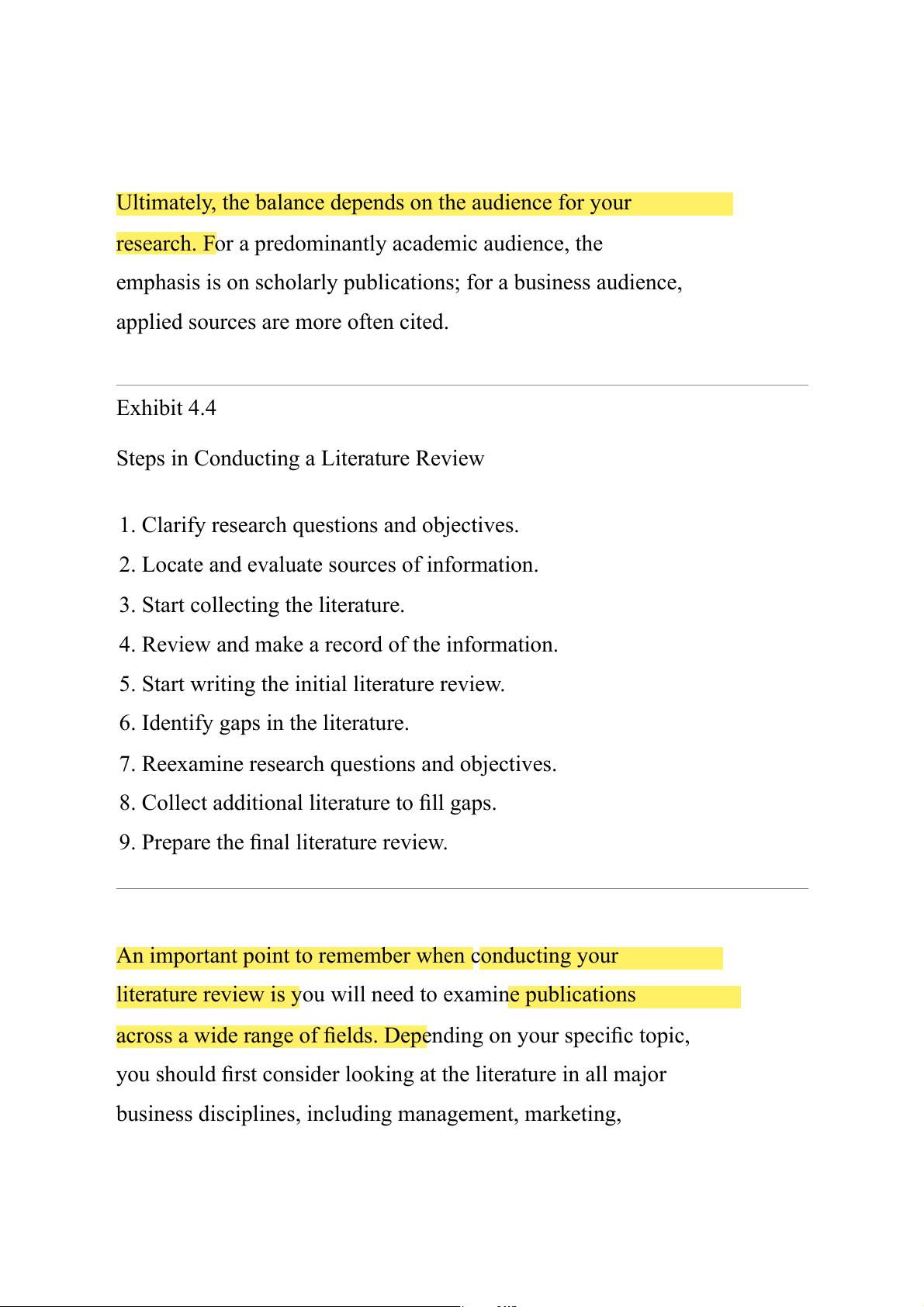
Ultimately, the balance depends on the audience for your
research. For a predominantly academic audience, the
emphasis is on scholarly publications; for a business audience,
applied sources are more often cited. Exhibit 4.4
Steps in Conducting a Literature Review
1. Clarify research questions and objectives.
2. Locate and evaluate sources of information.
3. Start collecting the literature.
4. Review and make a record of the information.
5. Start writing the initial literature review.
6. Identify gaps in the literature.
7. Reexamine research questions and objectives.
8. Collect additional literature to fill gaps.
9. Prepare the final literature review.
An important point to remember when conducting your
literature review is you will need to examine publications
across a wide range of fields. Depending on your specific topic,
you should first consider looking at the literature in all major
business disciplines, including management, marketing,
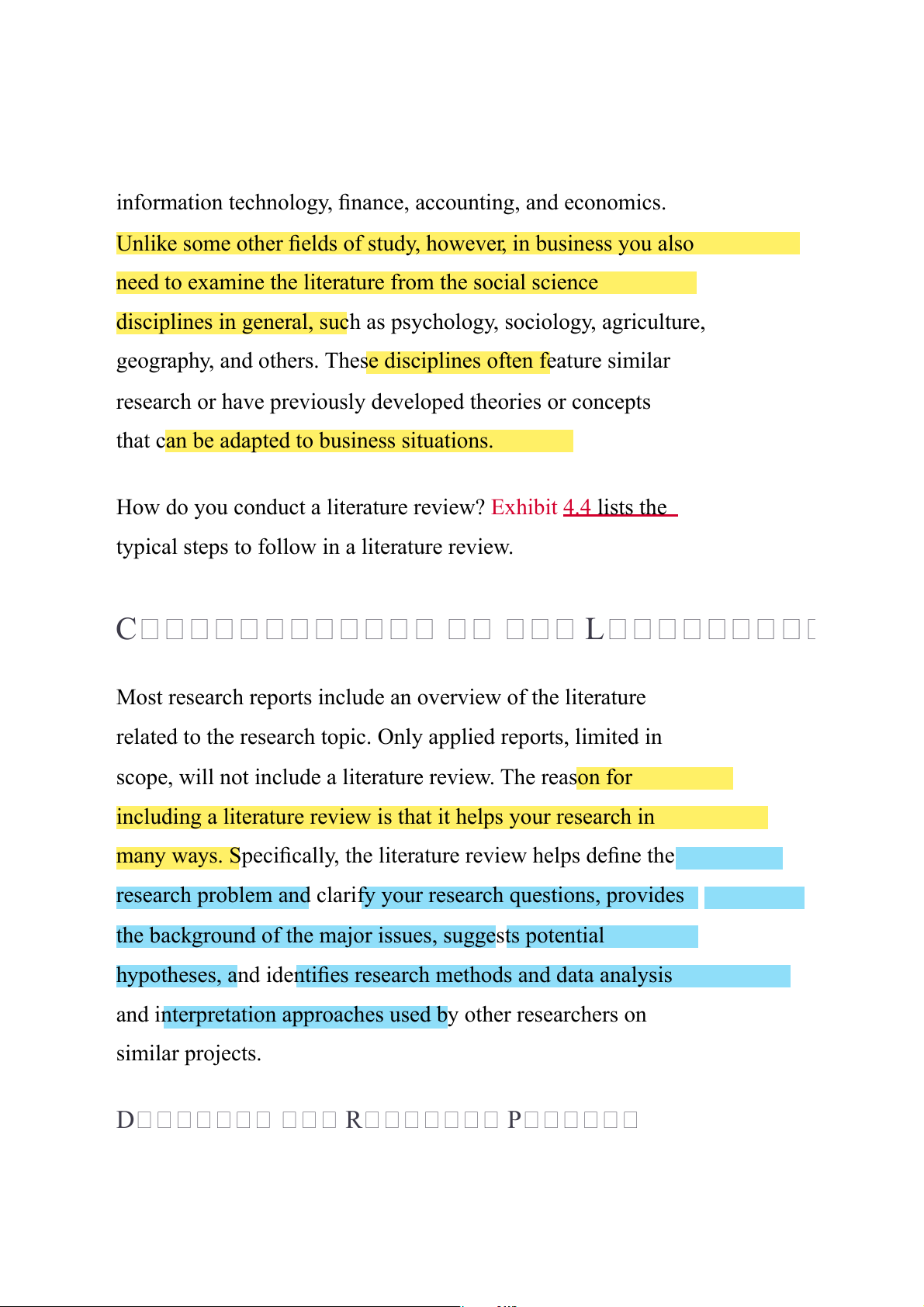
information technology, finance, accounting, and economics.
Unlike some other fields of study, however, in business you also
need to examine the literature from the social science
disciplines in general, such as psychology, sociology, agriculture,
geography, and others. These disciplines often feature similar
research or have previously developed theories or concepts
that can be adapted to business situations.
How do you conduct a literature review? Exhibit 4.4 lists the
typical steps to follow in a literature review. C L
Most research reports include an overview of the literature
related to the research topic. Only applied reports, limited in
scope, will not include a literature review. The reason for
including a literature review is that it helps your research in
many ways. Specifically, the literature review helps define the
research problem and clarify your research questions, provides
the background of the major issues, suggests potential
hypotheses, and identifies research methods and data analysis
and interpretation approaches used by other researchers on similar projects. D R P
Recall that defining the research problem is an important first
step in the research project. If you focus on the symptoms and
not the problem, your project will not be a contribution. One
way to ensure you focus on the problem and not the symptoms
is to conduct preliminary interviews with knowledgeable
people. Another way is to examine the scholarly literature and
business publications to identify similar situations. The
literature published in academic journals will be heavily
focused on defining and testing business theories. In contrast,
popular business publications typically are much more applied
and more recent. For example, wireless technology, whether
mobile phones, tablets, wearables, online access, and tracking
inventory and employees through radio frequency
identification devices(RFID) or customers using geofencing are
creating new research opportunities. These topics are relatively
new, however, and being reported widely in business
publications but have less coverage in scholarly publications.
Thus, scholarly publications can suggest appropriate research
designs and topics, but business publications are likely better
sources for initially identifying a broader variety of issues and problems to study. B I
Background information can be important to your research
project in several ways. Among the most important is
previously published literature can be used to justify your
particular research problem as deserving further study. If a
cutting-edge topic is under consideration, the business
literature may be the best source of information. If the problem
is an extension or new application of an established problem,
then academic as well as business literature should be helpful.
A background study also helps you to summarize all the major
aspects of a problem. The relevant literature is identified and
described to demonstrate you have a full understanding of past
research and how it relates to your project. Background
information can be extensive, depending on what is considered
relevant. An early strategy is to examine and collect
information on almost any topic that may be related. But as the
process continues, you must decide what the most important
issues are and what can be left out. In using this approach,
what emerges is a summary of the theories, arguments, and
findings from both the business and scholarly literature. It is
often helpful to identify the gaps in previous research that may
suggest directions for your own work. The result is a document
that identifies what has and has not been done on the subject
and where your research fits into this body of knowledge.
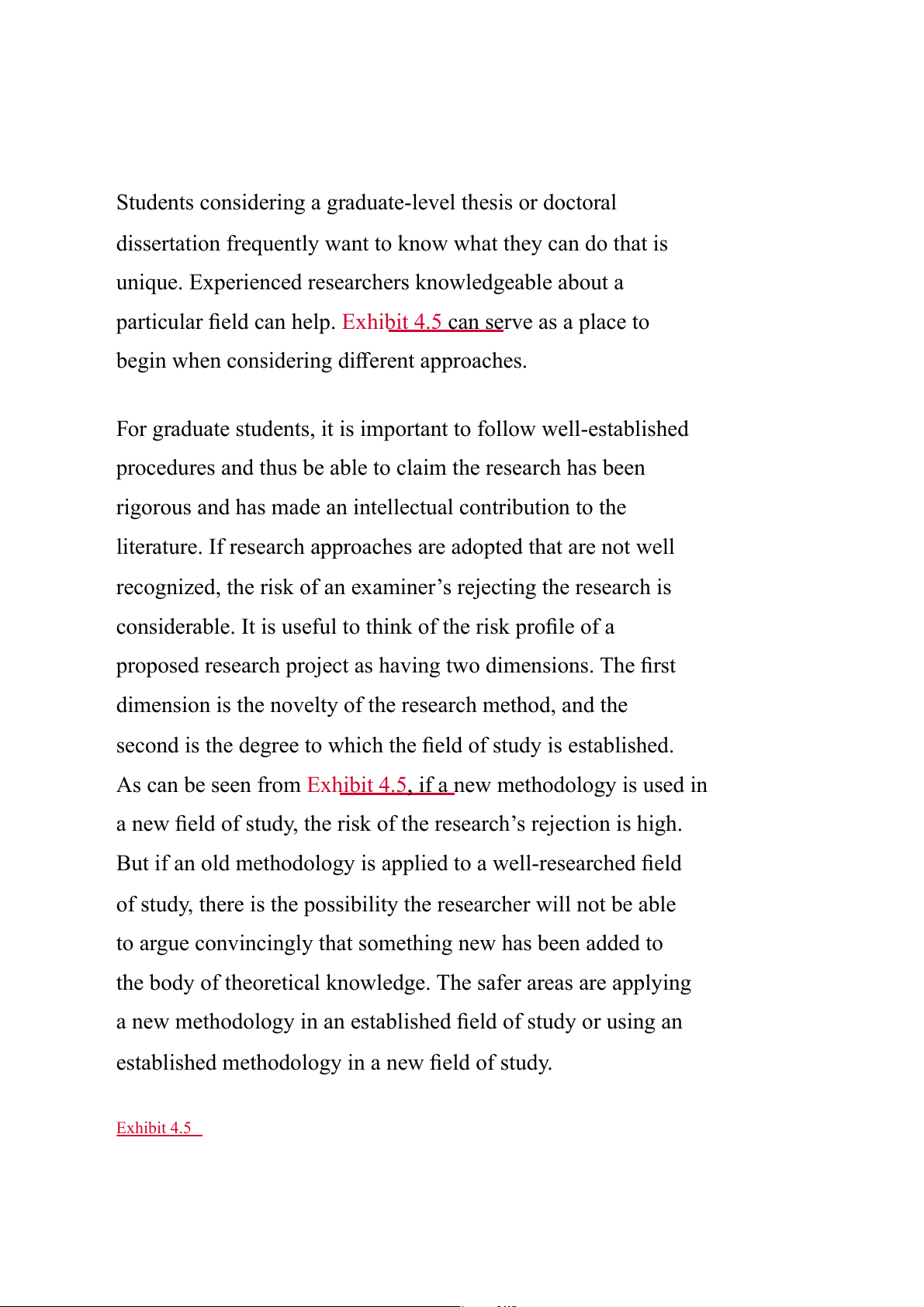
Students considering a graduate-level thesis or doctoral
dissertation frequently want to know what they can do that is
unique. Experienced researchers knowledgeable about a
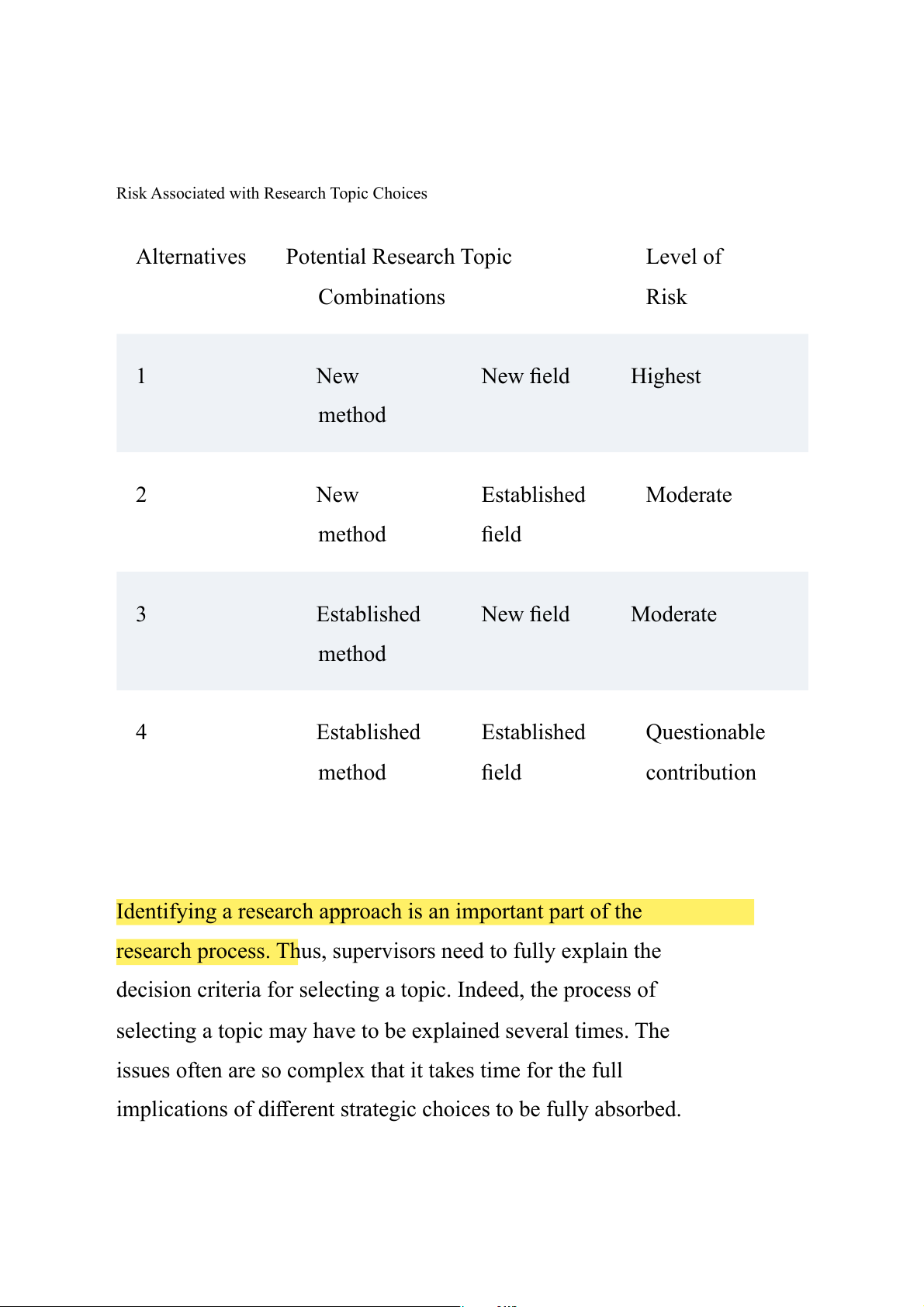
particular field can help. Exhibit 4.5 can serve as a place to
begin when considering different approaches.
For graduate students, it is important to follow well-established
procedures and thus be able to claim the research has been
rigorous and has made an intellectual contribution to the
literature. If research approaches are adopted that are not well
recognized, the risk of an examiner’s rejecting the research is
considerable. It is useful to think of the risk profile of a
proposed research project as having two dimensions. The first
dimension is the novelty of the research method, and the
second is the degree to which the field of study is established.
As can be seen from Exhibit 4.5, if a new methodology is used in
a new field of study, the risk of the research’s rejection is high.
But if an old methodology is applied to a well-researched field
of study, there is the possibility the researcher will not be able
to argue convincingly that something new has been added to
the body of theoretical knowledge. The safer areas are applying
a new methodology in an established field of study or using an
established methodology in a new field of study. Exhibit 4.5
Risk Associated with Research Topic Choices Alternatives Potential Research Topic Level of Combinations Risk 1 New New field Highest method 2 New Established Moderate method field 3 Established New field Moderate method 4 Established Established Questionable method field contribution
Identifying a research approach is an important part of the
research process. Thus, supervisors need to fully explain the
decision criteria for selecting a topic. Indeed, the process of
selecting a topic may have to be explained several times. The
issues often are so complex that it takes time for the full
implications of different strategic choices to be fully absorbed.
Students that ignore the advice of their supervisors in selecting
a topic do so at very high risk. R Q H
The literature review also helps to refine your research
questions and develop hypotheses. Possible relationships are
identified, and those that are unlikely are rejected. Factors
influencing relationships should also be identified. For
example, you may find that younger workers change jobs more
often or that older workers adapt to innovations in the
workplace more slowly. You may also find gender is associated
with the frequency of changing jobs or the willingness to accept
change. By using the literature to identify and suggest
relationships, you can create hypotheses for testing in your
study. We discuss developing research hypotheses in Chapter 6. M
The literature can be very helpful in identifying the methods
used by previous researchers to study a problem. There is no
need to reinvent what has proven useful in the past unless you
can identify a clear and important shortcoming of current
methods. Questionnaires, measurement scales, statistical
techniques, and research designs from other studies should be
examined to see if they might be useful. If they produced valid
findings before, they are likely to bear fruit in another study.
Statistical methods and research designs often require few
changes, but questionnaires and scales often must be updated
and revised to meet the needs of a new study. For example, a
study that used a perceived self-efficacy scale as part of a study
of decision-making in an industrial plant would have to be
adapted for use in a health-care setting. In other situations,
there may not be a previously published scale, and the
researcher will have to develop a new one.
Scales requiring only small revisions can often be adapted
based on the input of knowledgeable experts. Scales that must
be extensively revised should always be pretested. Where there
is no existing scale, an entirely new scale must be developed.
New scale development is described in Chapter 9.
Whether using a qualitative or quantitative approach,
researchers can almost always learn from the data analysis
approaches used in previous research. In a qualitative
approach, the literature review may help you decide when and
how to use software in analysis and which packages are best. If
you are doing quantitative research, other studies can suggest
the appropriate statistical technique or whether to use
summated scales or factor scores to represent constructs. Using
the literature to learn about possible methodologies and to
support a particular research method is therefore an important
step in designing your research. I
When reviewing the literature, you should also look at how
other researchers are interpreting their findings. What levels of
statistical significance are acceptable? Which relationships are
positive, and which are negative? How are decisions made
regarding the acceptance or rejection of hypotheses? What
sources are other researchers citing to support their
interpretations? When the findings of your research are
consistent with those of other studies, you can use those studies
to support your interpretation. If your findings oppose previous
studies, then you must explain why. Previous research may
identify reasons for your findings being different, such as using
a different sample or difficulty with a particular published
scale. Your task as a researcher, therefore, is to use the
literature to design and execute research in a way that
increases the likelihood you will obtain accurate results. L S
Tài liệu liên quan:
-
Tiểu luận Phân Tích Giá Trái Cây 2023 | Kinh tế vĩ mô | Trường Đại học kinh tế Thành Phố Hồ Chí Minh
17 9 -

Bộ câu hỏi trắc nghiệm - Kinh tế học thị trường và cầu cung | Kinh tế vĩ mô | Trường Đại học kinh tế Thành Phố Hồ Chí Minh
17 9 -
Câu Hỏi Ôn Tập Phần Thị Trường | Kinh tế vĩ mô | Trường Đại học kinh tế Thành Phố Hồ Chí Minh
24 12 -

Kinh Tế Vi Mô: Câu Hỏi và Đáp Án Quan Trọng | Kinh tế vĩ mô | Trường Đại học kinh tế Thành Phố Hồ Chí Minh
21 11 -
Tiểu luận Món Huế và Thị Trường F&B Việt Nam | Kinh tế vĩ mô | Trường Đại học kinh tế Thành Phố Hồ Chí Minh
16 8