Tổng hợp câu hỏi 10 Nguyên tắc Kinh tế học | Microeconomics | Trường Đại học Quốc tế, Đại học Quốc gia Thành phố Hồ Chí Minh
Resources are A. Scarce for households but plentiful for economies B. Plentiful for households but scarce for economies C. Scarce for both households and economies D. Plentiful for both households and economics 2. Economics is the study of A. How society manages its scarce resources B. The relationship between business and government C. How money shapes society D. Ten principles of economics. Tài liệu được sưu tầm và soạn thảo dưới dạng file PDF để gửi tới các bạn cùng tham khảo, ôn tập đầy đủ kiến thức, chuẩn bị cho các buổi học thật tốt. Mời bạn đọc đón xem!
Môn: Microeconomics 613 tài liệu
Trường: Trường Đại học Quốc tế, Đại học Quốc gia Thành phố Hồ Chí Minh 1.9 K tài liệu
Tác giả:

Preview text:
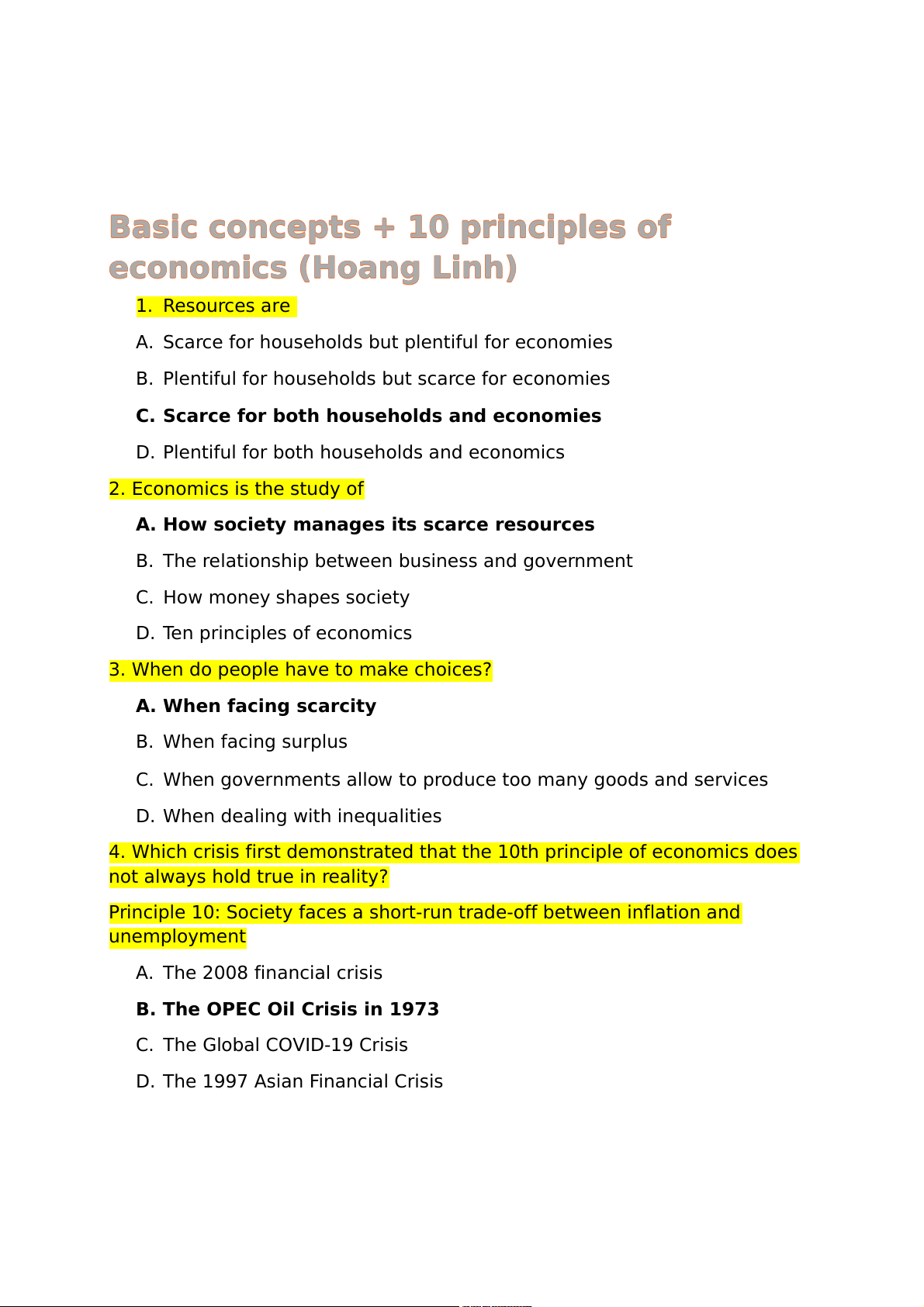
Basic concepts + 10 principles of economics (Hoang Linh) 1. Resources are
A. Scarce for households but plentiful for economies
B. Plentiful for households but scarce for economies
C. Scarce for both households and economies
D. Plentiful for both households and economics 2. Economics is the study of
A. How society manages its scarce resources
B. The relationship between business and government C. How money shapes society D. Ten principles of economics
3. When do people have to make choices? A. When facing scarcity B. When facing surplus
C. When governments allow to produce too many goods and services
D. When dealing with inequalities
4. Which crisis first demonstrated that the 10th principle of economics does
not always hold true in reality?
Principle 10: Society faces a short-run trade-off between inflation and unemployment A. The 2008 financial crisis
B. The OPEC Oil Crisis in 1973 C. The Global COVID-19 Crisis
D. The 1997 Asian Financial Crisis
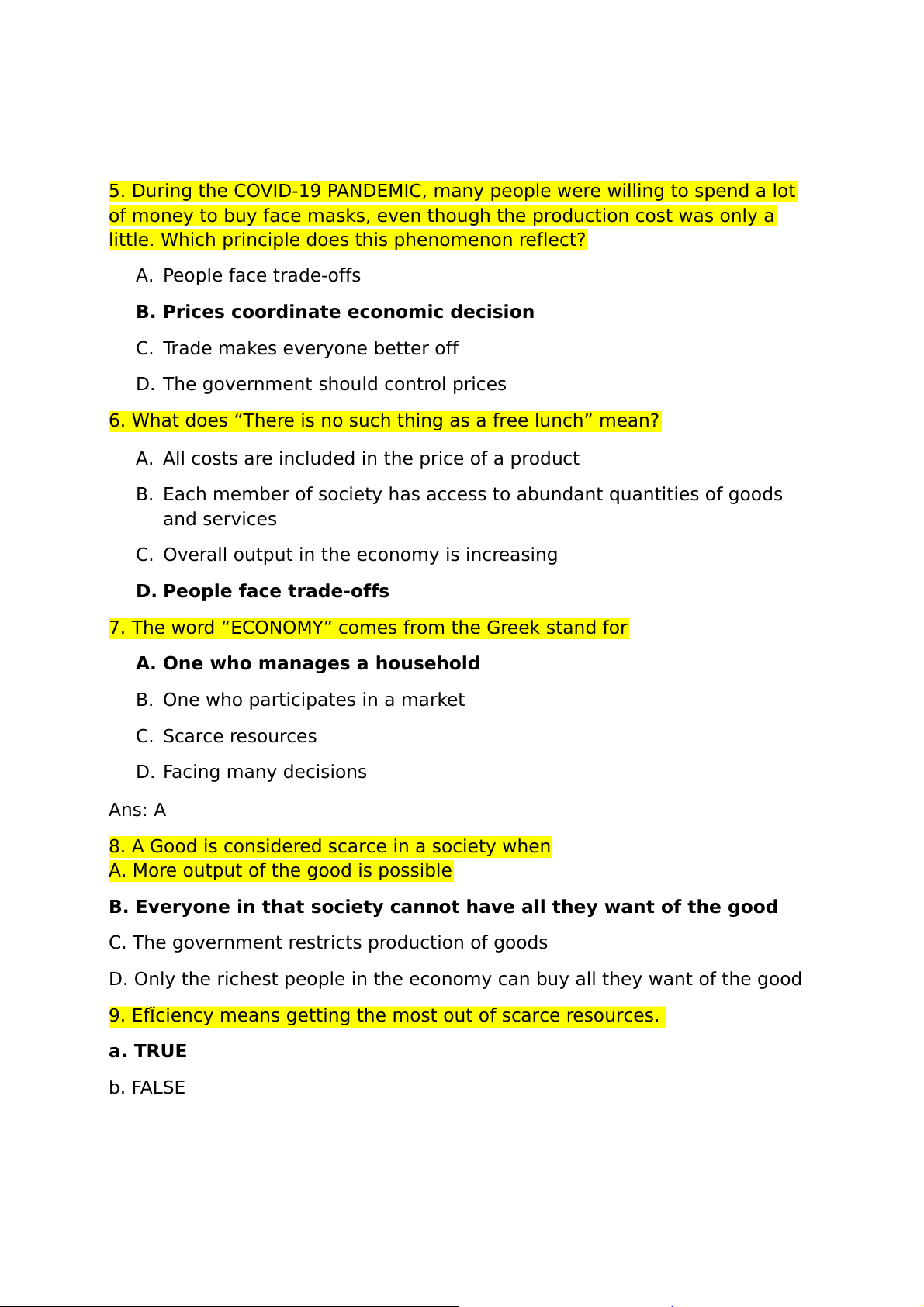
5. During the COVID-19 PANDEMIC, many people were willing to spend a lot
of money to buy face masks, even though the production cost was only a
little. Which principle does this phenomenon reflect? A. People face trade-offs
B. Prices coordinate economic decision
C. Trade makes everyone better off
D. The government should control prices
6. What does “There is no such thing as a free lunch” mean?
A. All costs are included in the price of a product
B. Each member of society has access to abundant quantities of goods and services
C. Overall output in the economy is increasing
D. People face trade-offs
7. The word “ECONOMY” comes from the Greek stand for
A. One who manages a household
B. One who participates in a market C. Scarce resources D. Facing many decisions Ans: A
8. A Good is considered scarce in a society when
A. More output of the good is possible
B. Everyone in that society cannot have all they want of the good
C. The government restricts production of goods
D. Only the richest people in the economy can buy all they want of the good
9. EfÏciency means getting the most out of scarce resources. a. TRUE b. FALSE
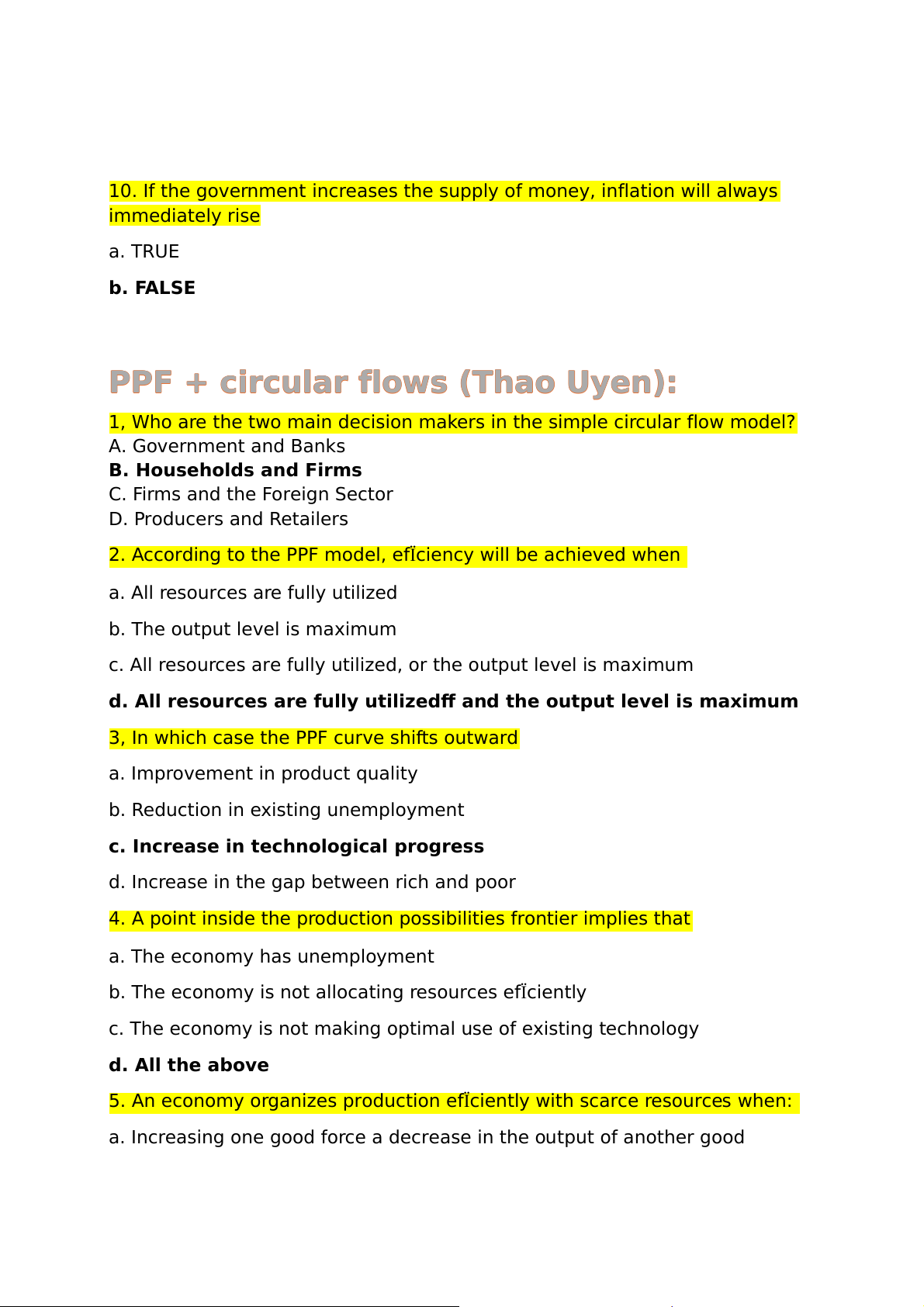
10. If the government increases the supply of money, inflation will always immediately rise a. TRUE b. FALSE
PPF + circular flows (Thao Uyen):
1, Who are the two main decision makers in the simple circular flow model? A. Government and Banks B. Households and Firms
C. Firms and the Foreign Sector D. Producers and Retailers
2. According to the PPF model, efÏciency will be achieved when
a. All resources are fully utilized b. The output level is maximum
c. All resources are fully utilized, or the output level is maximum
d. All resources are fully utilized, and the output level is maximum
3, In which case the PPF curve shifts outward
a. Improvement in product quality
b. Reduction in existing unemployment
c. Increase in technological progress
d. Increase in the gap between rich and poor
4. A point inside the production possibilities frontier implies that
a. The economy has unemployment
b. The economy is not allocating resources efÏciently
c. The economy is not making optimal use of existing technology d. All the above
5. An economy organizes production efÏciently with scarce resources when:
a. Increasing one good force a decrease in the output of another good
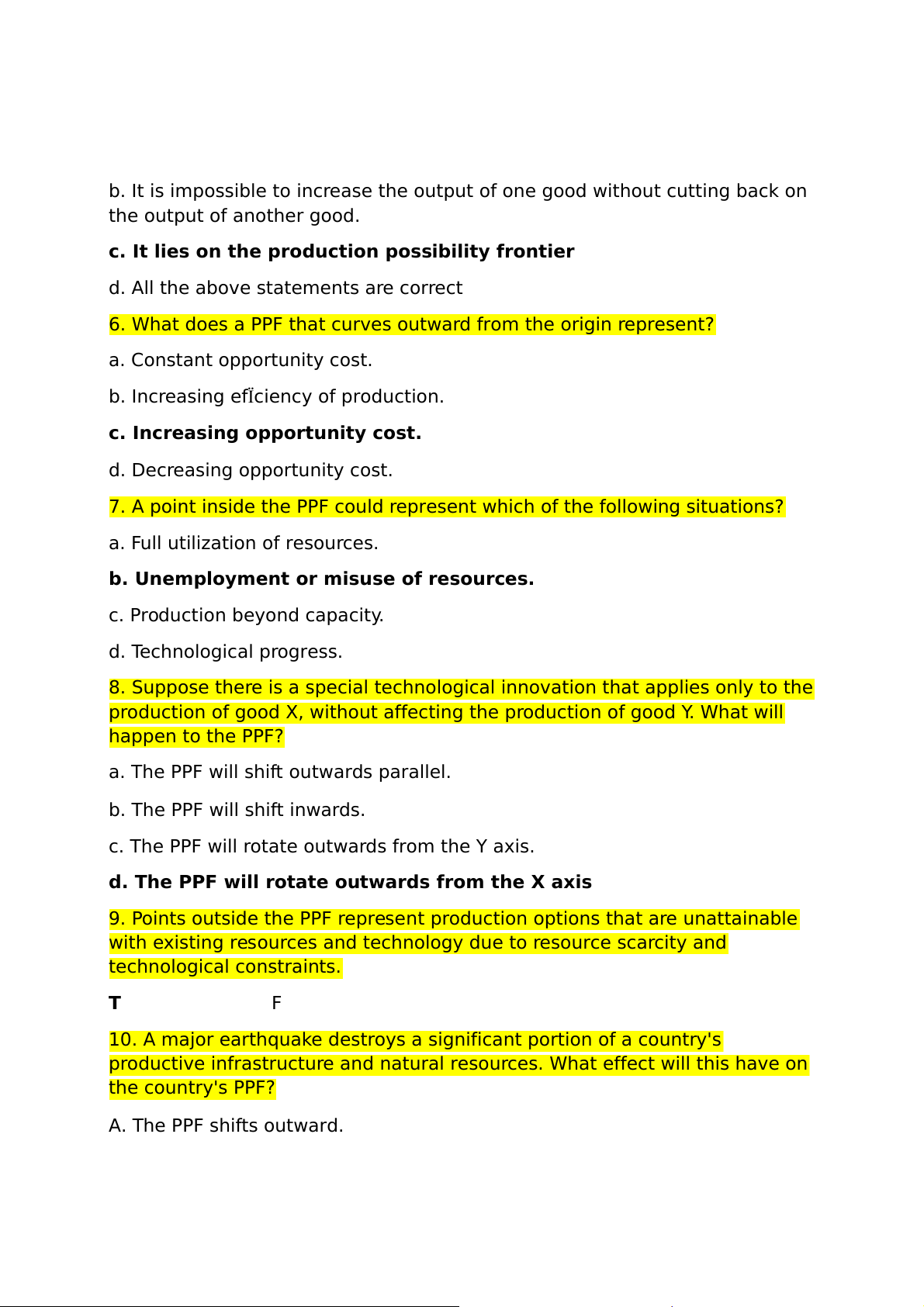
b. It is impossible to increase the output of one good without cutting back on the output of another good.
c. It lies on the production possibility frontier
d. All the above statements are correct
6. What does a PPF that curves outward from the origin represent? a. Constant opportunity cost.
b. Increasing efÏciency of production.
c. Increasing opportunity cost.
d. Decreasing opportunity cost.
7. A point inside the PPF could represent which of the following situations?
a. Full utilization of resources.
b. Unemployment or misuse of resources. c. Production beyond capacity. d. Technological progress.
8. Suppose there is a special technological innovation that applies only to the
production of good X, without affecting the production of good Y. What will happen to the PPF?
a. The PPF will shift outwards parallel. b. The PPF will shift inwards.
c. The PPF will rotate outwards from the Y axis.
d. The PPF will rotate outwards from the X axis
9. Points outside the PPF represent production options that are unattainable
with existing resources and technology due to resource scarcity and technological constraints. T F
10. A major earthquake destroys a significant portion of a country's
productive infrastructure and natural resources. What effect will this have on the country's PPF? A. The PPF shifts outward.
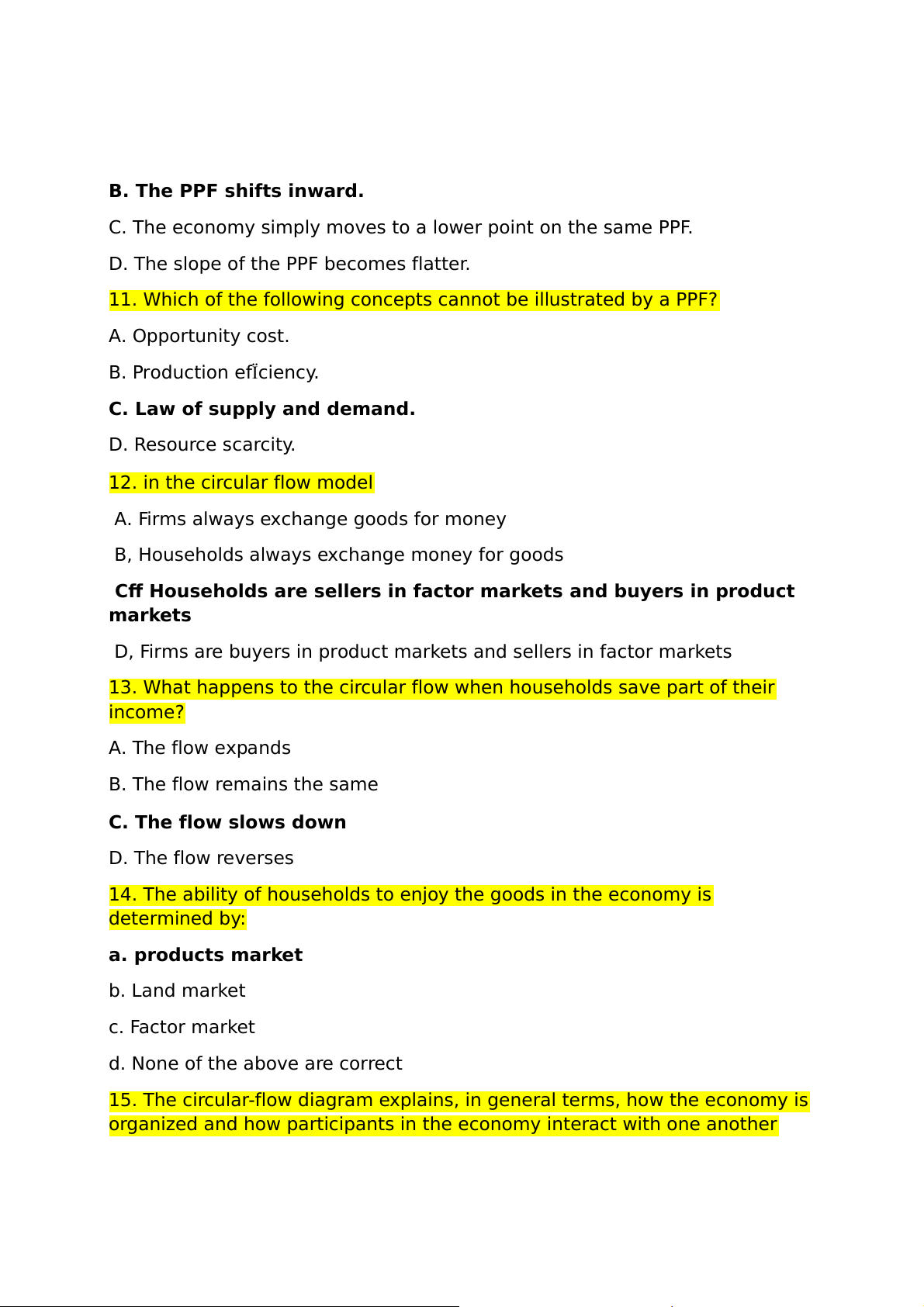
B. The PPF shifts inward.
C. The economy simply moves to a lower point on the same PPF.
D. The slope of the PPF becomes flatter.
11. Which of the following concepts cannot be illustrated by a PPF? A. Opportunity cost. B. Production efÏciency.
C. Law of supply and demand. D. Resource scarcity. 12. in the circular flow model
A. Firms always exchange goods for money
B, Households always exchange money for goods
C, Households are sellers in factor markets and buyers in product markets
D, Firms are buyers in product markets and sellers in factor markets
13. What happens to the circular flow when households save part of their income? A. The flow expands B. The flow remains the same C. The flow slows down D. The flow reverses
14. The ability of households to enjoy the goods in the economy is determined by: a. products market b. Land market c. Factor market
d. None of the above are correct
15. The circular-flow diagram explains, in general terms, how the economy is
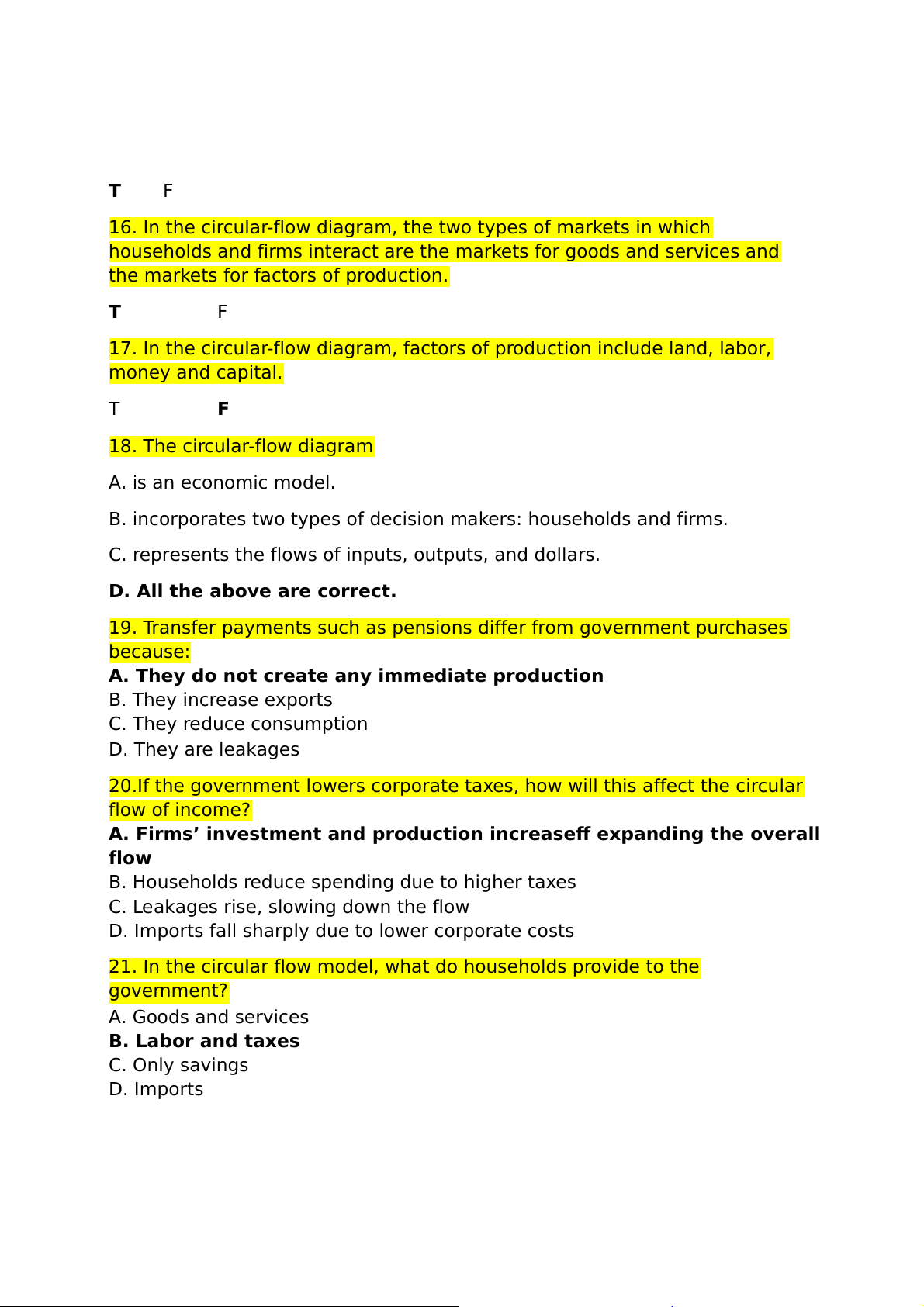
organized and how participants in the economy interact with one another T F
16. In the circular-flow diagram, the two types of markets in which
households and firms interact are the markets for goods and services and
the markets for factors of production. T F
17. In the circular-flow diagram, factors of production include land, labor, money and capital. T F 18. The circular-flow diagram A. is an economic model.
B. incorporates two types of decision makers: households and firms.
C. represents the flows of inputs, outputs, and dollars.
D. All the above are correct.
19. Transfer payments such as pensions differ from government purchases because:
A. They do not create any immediate production B. They increase exports C. They reduce consumption D. They are leakages
20.If the government lowers corporate taxes, how will this affect the circular flow of income?
A. Firms’ investment and production increase, expanding the overall flow
B. Households reduce spending due to higher taxes
C. Leakages rise, slowing down the flow
D. Imports fall sharply due to lower corporate costs
21. In the circular flow model, what do households provide to the government? A. Goods and services B. Labor and taxes C. Only savings D. Imports
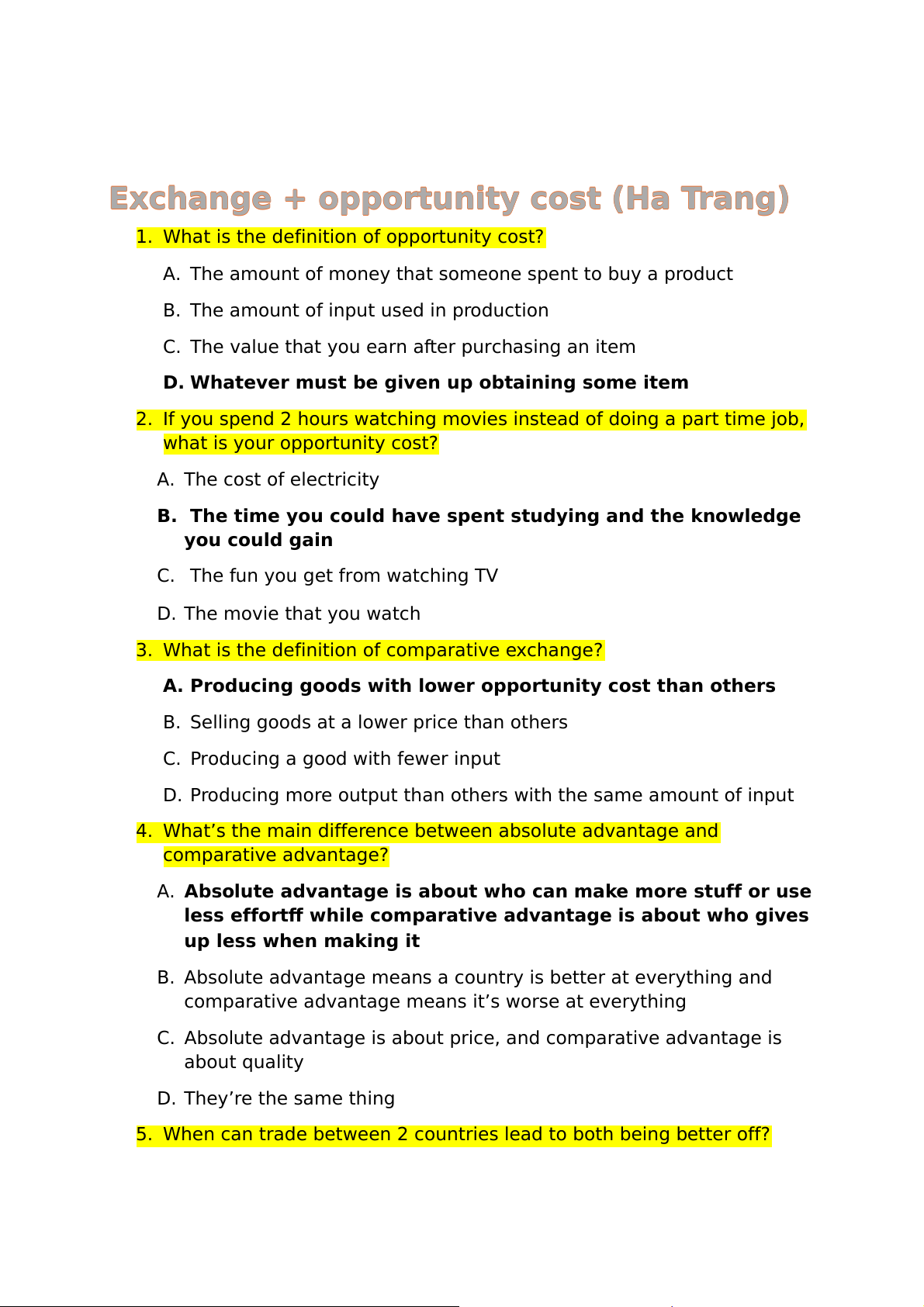
Exchange + opportunity cost (Ha Trang)
1. What is the definition of opportunity cost?
A. The amount of money that someone spent to buy a product
B. The amount of input used in production
C. The value that you earn after purchasing an item
D. Whatever must be given up obtaining some item
2. If you spend 2 hours watching movies instead of doing a part time job, what is your opportunity cost? A. The cost of electricity
B. The time you could have spent studying and the knowledge you could gain
C. The fun you get from watching TV D. The movie that you watch
3. What is the definition of comparative exchange?
A. Producing goods with lower opportunity cost than others
B. Selling goods at a lower price than others
C. Producing a good with fewer input
D. Producing more output than others with the same amount of input
4. What’s the main difference between absolute advantage and comparative advantage?
A. Absolute advantage is about who can make more stuff or use
less effort, while comparative advantage is about who gives up less when making it
B. Absolute advantage means a country is better at everything and
comparative advantage means it’s worse at everything
C. Absolute advantage is about price, and comparative advantage is about quality D. They’re the same thing
5. When can trade between 2 countries lead to both being better off?
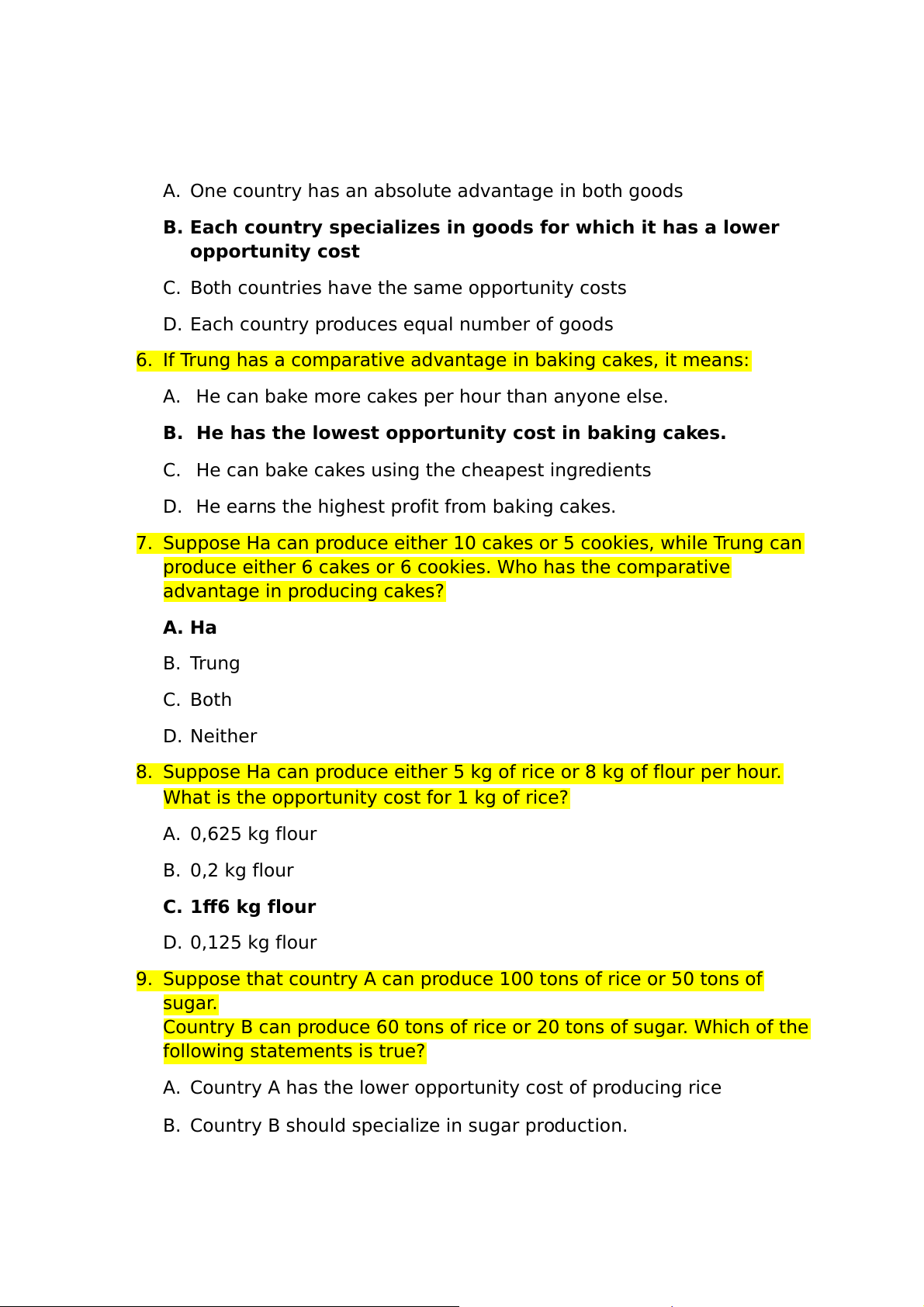
A. One country has an absolute advantage in both goods
B. Each country specializes in goods for which it has a lower opportunity cost
C. Both countries have the same opportunity costs
D. Each country produces equal number of goods
6. If Trung has a comparative advantage in baking cakes, it means:
A. He can bake more cakes per hour than anyone else.
B. He has the lowest opportunity cost in baking cakes.
C. He can bake cakes using the cheapest ingredients
D. He earns the highest profit from baking cakes.
7. Suppose Ha can produce either 10 cakes or 5 cookies, while Trung can
produce either 6 cakes or 6 cookies. Who has the comparative advantage in producing cakes? A. Ha B. Trung C. Both D. Neither
8. Suppose Ha can produce either 5 kg of rice or 8 kg of flour per hour.
What is the opportunity cost for 1 kg of rice? A. 0,625 kg flour B. 0,2 kg flour C. 1,6 kg flour D. 0,125 kg flour
9. Suppose that country A can produce 100 tons of rice or 50 tons of sugar.
Country B can produce 60 tons of rice or 20 tons of sugar. Which of the following statements is true?
A. Country A has the lower opportunity cost of producing rice
B. Country B should specialize in sugar production.
C. Country A should specialize in sugar, and Country B should specialize in rice.
D. Both countries have the same opportunity cost for sugar. 10.
Suppose that country A can produce 80 tons of coffee or 40 tons
of sugar per day while country B can produce 40 tons of coffee or 20
tons of sugar. Which of the following statements is true?
A. Country A has both absolute advantages and comparative
advantages in coffee production
B. Country B should specialize in coffee, and country A should specialize in sugar.
C. Country A should specialize in coffee, and country B should specialize in sugar.
D. There are no gains from trade because both countries have
the same opportunity cost.
Demand curve/function + Supply curve/function (Duy Dung)
1: When the price of the Matcha Latte in Myxue Tran Dai Nghia rises from
18,000 dong to 36,000 dong, the quantity demanded falls from 100 cups to 66 cups per day
What is the price elasticity of demand? A. -0.5 B. -0.61< C. -0.82 D. -0.15
2 : What is CORRECT when referring to the law of demand:
A. When price increases, quantity demand decreases
B. When price decreases, quantity demanded decreases
C. Price and quantity demanded are unrelated
D. When price increases, quantity demand increases
3. Nem chua and rau ma are special cuisines in Thanh Hoa province. In the
supermarket, when the price of nem chua increases, what will happen to the
demand for rau ma if rau ma is a substitute for nem chua? A. It increases B. It decreases C. It remains unchanged D. It fluctuates
4 : The law of supply states that:
A. When price increases, quantity supplied increases
B. When price increases, supply decreases
C. When price increases, demand increases
D. When price increases, quantity supplied remains unchanged
7 : If the price of Anh Trai Vuot Ngan Chong Gai concert ticket is decrease,
what will happen to the demand: A. It increases< B. It decreases C. It is not related D. It remains unchanged
6: If a new tax is imposed on producers, the supply curve will:
A. Shift upward (leftward) B. Shift downward (rightward) C. Stay in place D. Become vertical
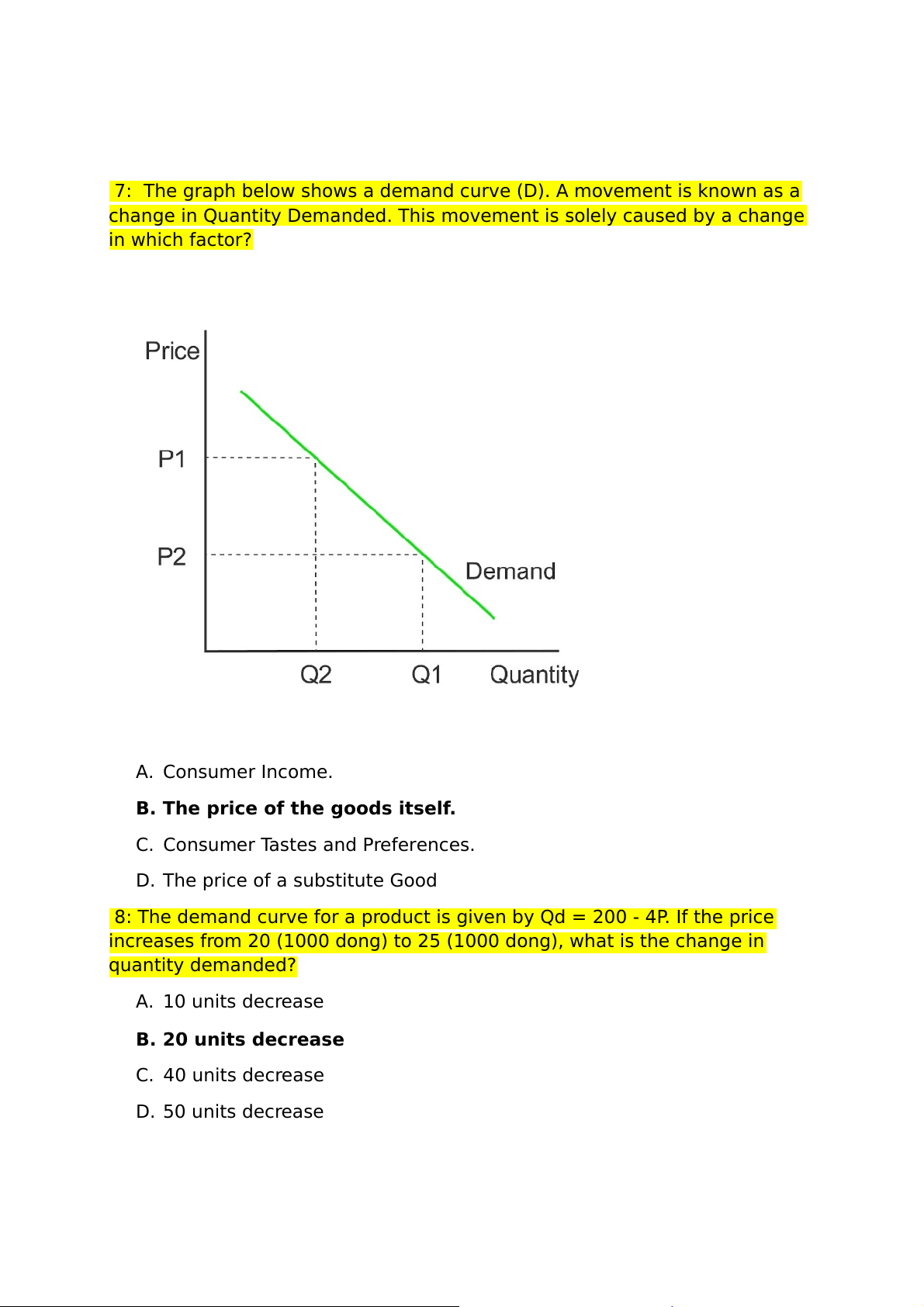
7: The graph below shows a demand curve (D). A movement is known as a
change in Quantity Demanded. This movement is solely caused by a change in which factor? A. Consumer Income.
B. The price of the goods itself.
C. Consumer Tastes and Preferences.
D. The price of a substitute Good
8: The demand curve for a product is given by Qd = 200 - 4P. If the price
increases from 20 (1000 dong) to 25 (1000 dong), what is the change in quantity demanded? A. 10 units decrease B. 20 units decrease C. 40 units decrease D. 50 units decrease
9: The demand curve for a service is Qd = 150 - 3P. If consumer income
increases and the quantity demanded at each price increases by 20 units,
what is the new demand function? A. Qd = 170 - 3P B. Qd = 150 - 3P + 20 C. Qd = 170 - 2.5P D. Qd = 170 - 3P + 20
10. When the price of a Orange laptop falls from 35 (million dong) to 28
(million dong) , the quantity demanded rises from 2000 bookings to 9000 bookings per day
What is the price elasticity of demand? A. -3,6 B. -1,8 C. -2,15 D. -5,73
11. What happens to the quantity supplied when the price of a good increase? A. It increases B. It decreases C. It stays the same D. It becomes zero
12: Which of the following would cause the demand curve for a product to shift to the right?
A. An increase in the price of the product
B. A decrease in consumer income for a normal good
C. A rise in the price of a substitute good
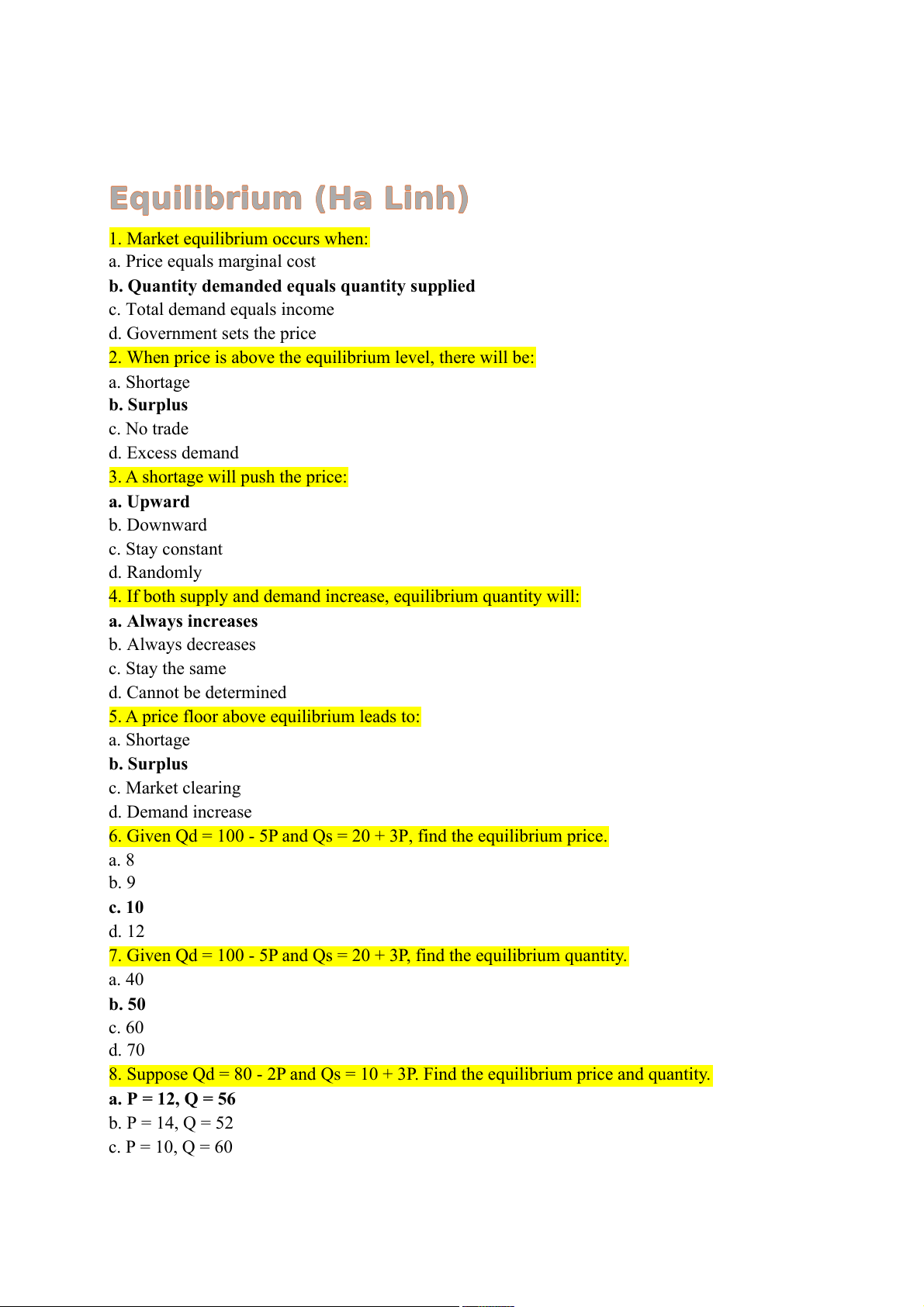
D. A decrease in population size Equilibrium (Ha Linh)
1. Market equilibrium occurs when: a. Price equals marginal cost
b. Quantity demanded equals quantity supplied
c. Total demand equals income d. Government sets the price
2. When price is above the equilibrium level, there will be: a. Shortage b. Surplus c. No trade d. Excess demand
3. A shortage will push the price: a. Upward b. Downward c. Stay constant d. Randomly
4. If both supply and demand increase, equilibrium quantity will: a. Always increases b. Always decreases c. Stay the same d. Cannot be determined
5. A price floor above equilibrium leads to: a. Shortage b. Surplus c. Market clearing d. Demand increase
6. Given Qd = 100 - 5P and Qs = 20 + 3P, find the equilibrium price. a. 8 b. 9 c. 10 d. 12
7. Given Qd = 100 - 5P and Qs = 20 + 3P, find the equilibrium quantity. a. 40 b. 50 c. 60 d. 70
8. Suppose Qd = 80 - 2P and Qs = 10 + 3P. Find the equilibrium price and quantity. a. P = 12, Q = 56 b. P = 14, Q = 52 c. P = 10, Q = 60 d. P = 15, Q = 50
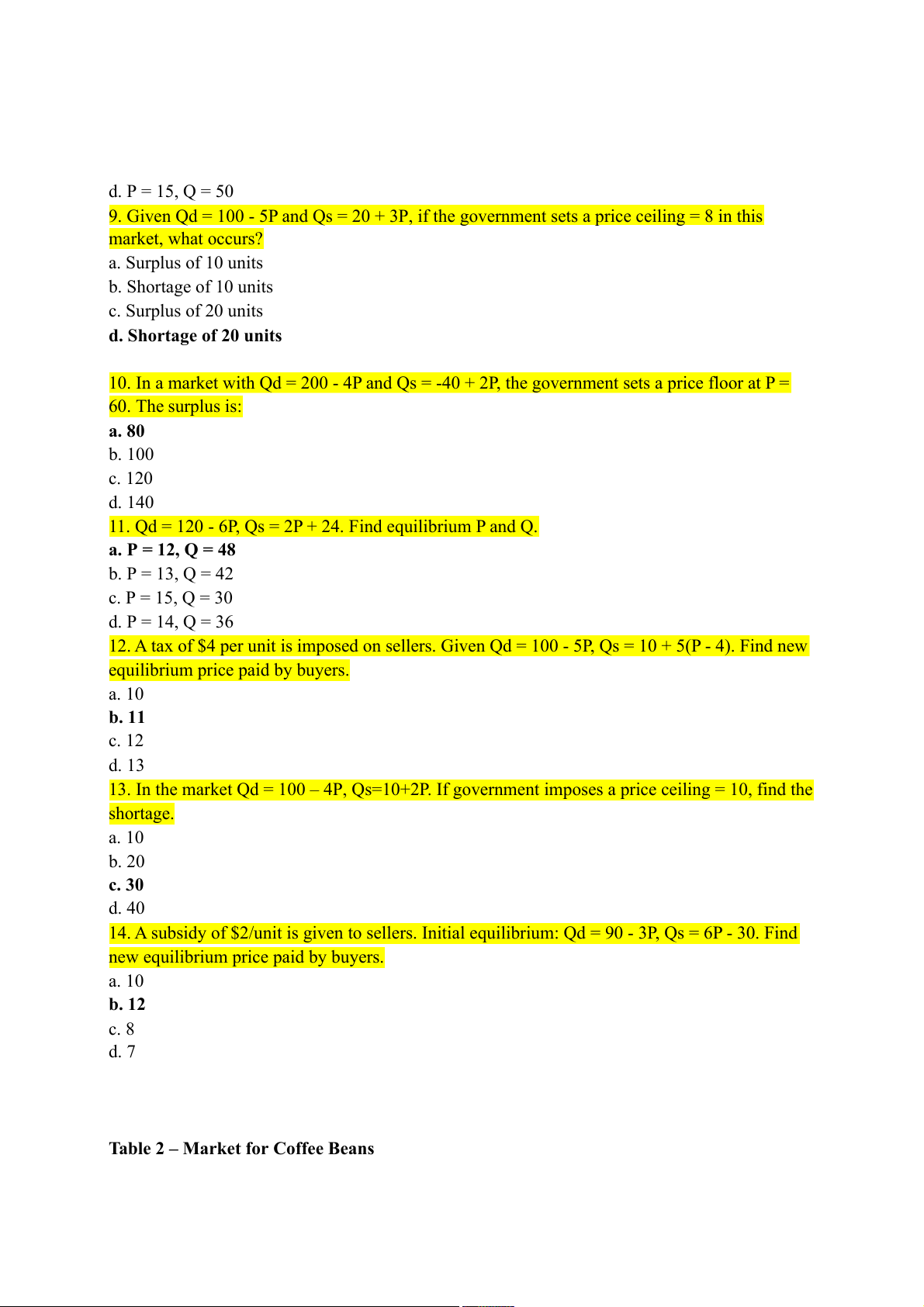
9. Given Qd = 100 - 5P and Qs = 20 + 3P, if the government sets a price ceiling = 8 in this market, what occurs? a. Surplus of 10 units b. Shortage of 10 units c. Surplus of 20 units d. Shortage of 20 units
10. In a market with Qd = 200 - 4P and Qs = -40 + 2P, the government sets a price floor at P = 60. The surplus is: a. 80 b. 100 c. 120 d. 140
11. Qd = 120 - 6P, Qs = 2P + 24. Find equilibrium P and Q. a. P = 12, Q = 48 b. P = 13, Q = 42 c. P = 15, Q = 30 d. P = 14, Q = 36
12. A tax of $4 per unit is imposed on sellers. Given Qd = 100 - 5P, Qs = 10 + 5(P - 4). Find new
equilibrium price paid by buyers. a. 10 b. 11 c. 12 d. 13
13. In the market Qd = 100 – 4P, Qs=10+2P. If government imposes a price ceiling = 10, find the shortage. a. 10 b. 20 c. 30 d. 40
14. A subsidy of $2/unit is given to sellers. Initial equilibrium: Qd = 90 - 3P, Qs = 6P - 30. Find
new equilibrium price paid by buyers. a. 10 b. 12 c. 8 d. 7
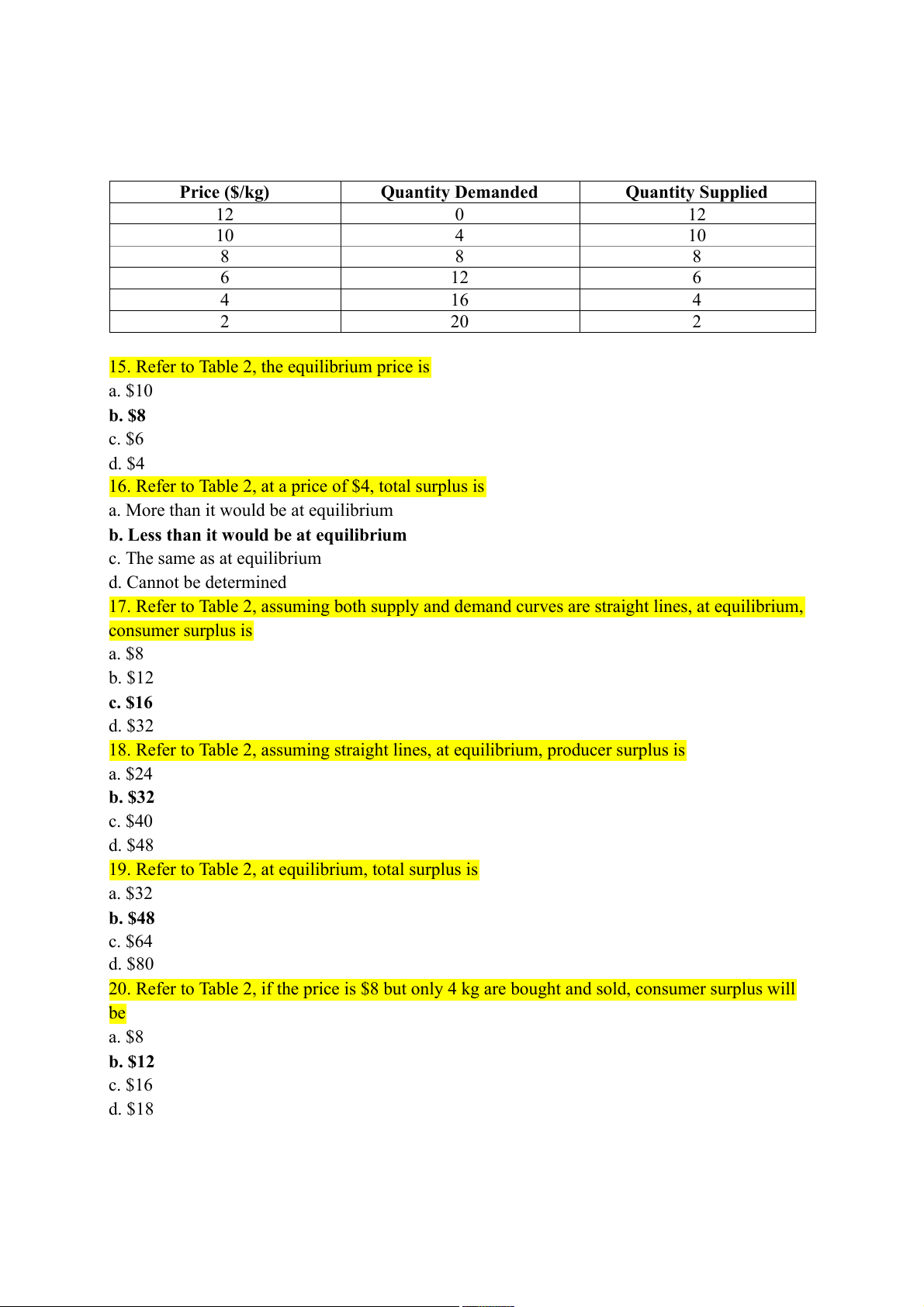
Table 2 – Market for Coffee Beans Price ($/kg) Quantity Demanded Quantity Supplied 12 0 12 10 4 10 8 8 8 6 12 6 4 16 4 2 20 2
15. Refer to Table 2, the equilibrium price is a. $10 b. $8 c. $6 d. $4
16. Refer to Table 2, at a price of $4, total surplus is
a. More than it would be at equilibrium
b. Less than it would be at equilibrium
c. The same as at equilibrium d. Cannot be determined
17. Refer to Table 2, assuming both supply and demand curves are straight lines, at equilibrium, consumer surplus is a. $8 b. $12 c. $16 d. $32
18. Refer to Table 2, assuming straight lines, at equilibrium, producer surplus is a. $24 b. $32 c. $40 d. $48
19. Refer to Table 2, at equilibrium, total surplus is a. $32 b. $48 c. $64 d. $80
20. Refer to Table 2, if the price is $8 but only 4 kg are bought and sold, consumer surplus will be a. $8 b. $12 c. $16 d. $18
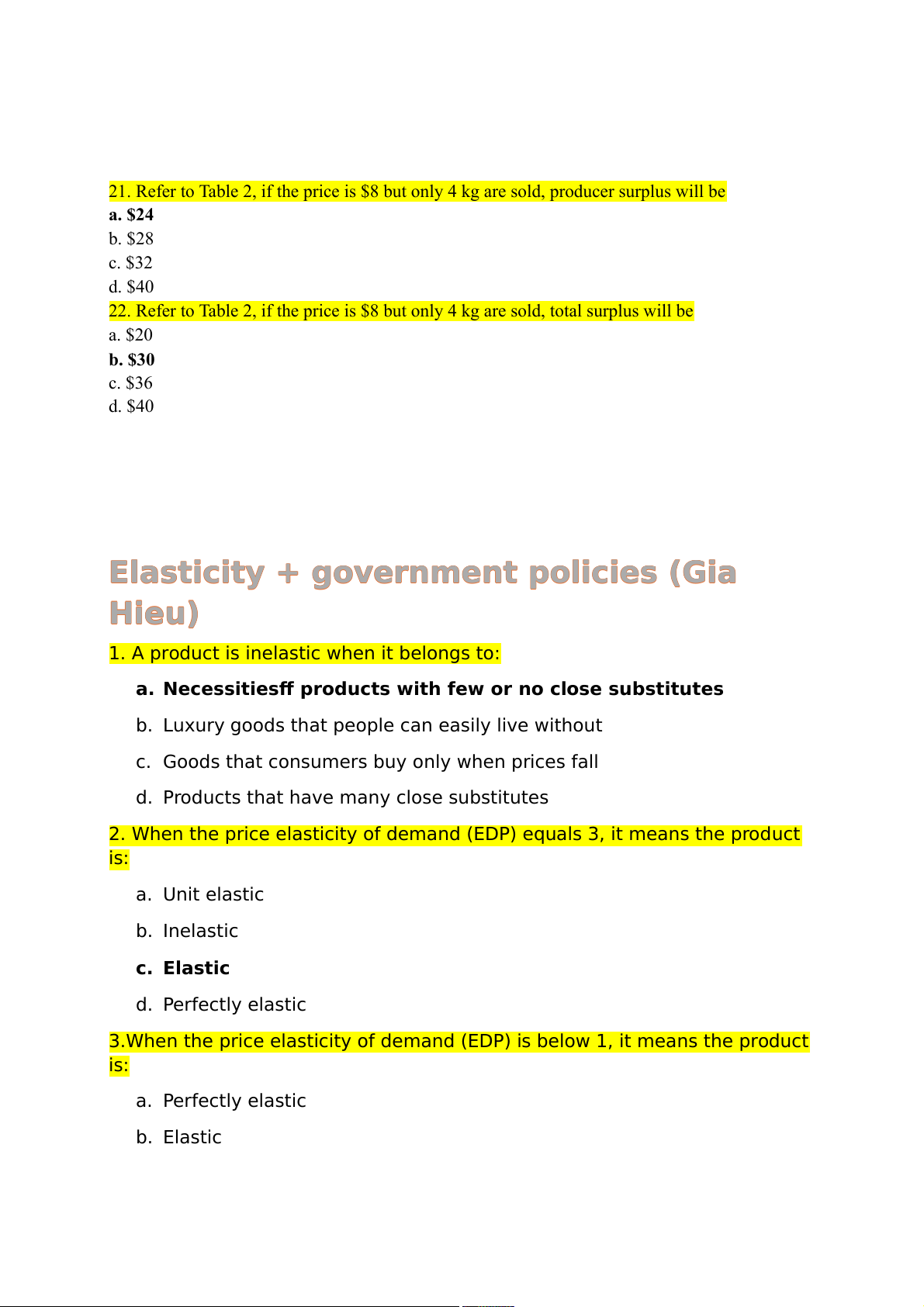
21. Refer to Table 2, if the price is $8 but only 4 kg are sold, producer surplus will be a. $24 b. $28 c. $32 d. $40
22. Refer to Table 2, if the price is $8 but only 4 kg are sold, total surplus will be a. $20 b. $30 c. $36 d. $40
Elasticity + government policies (Gia Hieu)
1. A product is inelastic when it belongs to:
a. Necessities, products with few or no close substitutes
b. Luxury goods that people can easily live without
c. Goods that consumers buy only when prices fall
d. Products that have many close substitutes
2. When the price elasticity of demand (EDP) equals 3, it means the product is: a. Unit elastic b. Inelastic c. Elastic d. Perfectly elastic
3.When the price elasticity of demand (EDP) is below 1, it means the product is: a. Perfectly elastic b. Elastic c. inelastic d. Unit elastic
4. In these products: a. electricity, b. Diamond, c. Gasoline, d. Luxury
cosmetics, e. Chocolate bars, which of them are inelastic: a. a and e b. c and d c. a and c d. all of them
5. A good X has supply and demand functions as follows: (D) Pd= 18-0,2Qd (S) Ps= 5+0,3Qs
Calculate the price elasticity of demand at the equilibrium point a. -2,46 b. -1,35 c. -2,64 d. -3
6. Comparing 2 products: fuel and meat, which one is more elastic: a. fuel b. meat
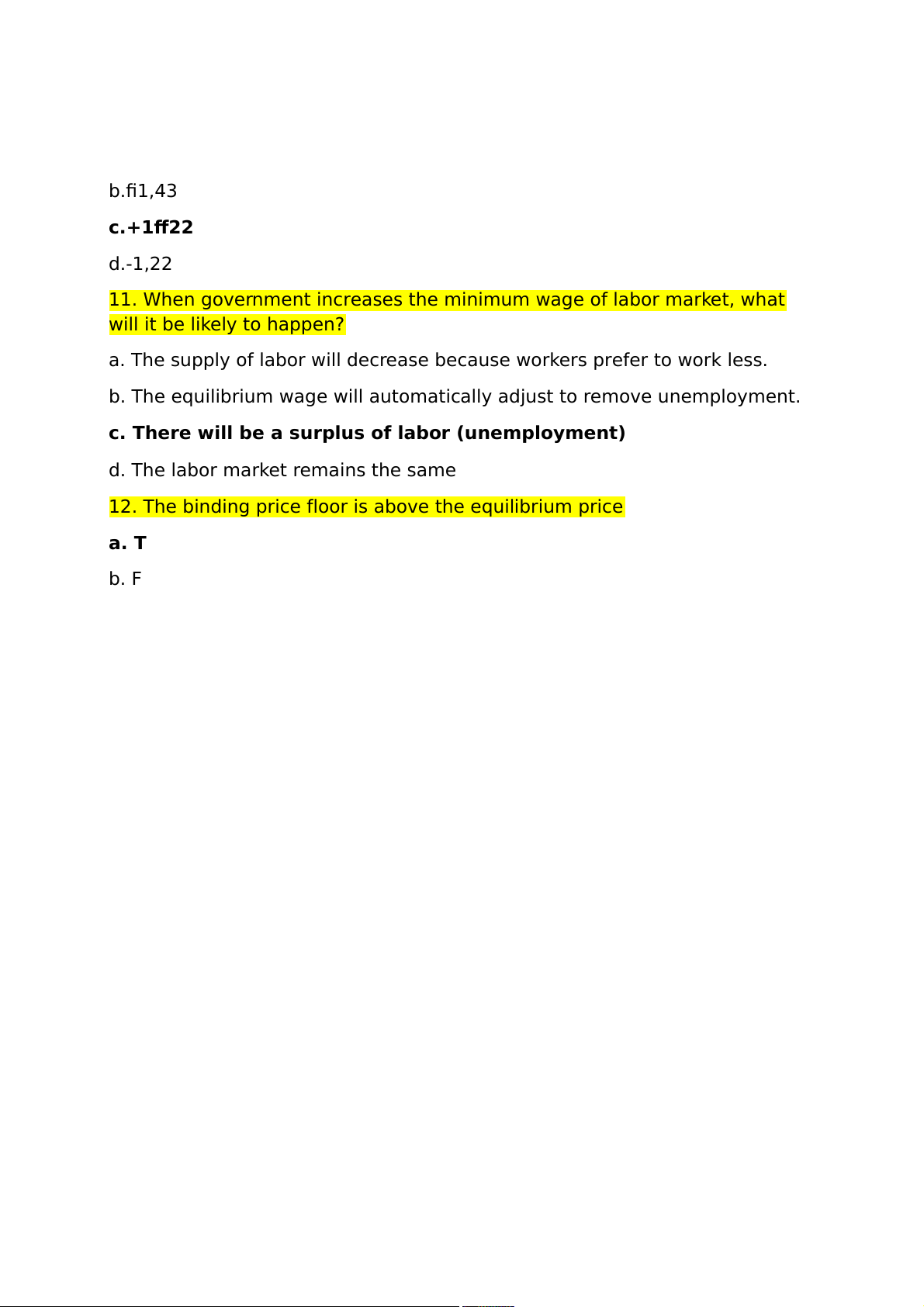
7. Calculate the price elasticity of demand when point A shifts to B a. -0.5 b. -1 c. -2 d. +1
8. Assume the increase in the price of apples decreased the quantity
demanded of vanilla ice cream, the relationship between two products is: a. complements b. substitutes c. no relationship
9. Assume the price of strawberries increases from 20$ to 25$ and the
quantity demanded falls from 15 to 10 tons. Calculate the Price elasticity of
demand using the Midpoint Method: a.-1.5 b.-2 c.-1.8 d.+2
10. The price of movie tickets decreases from $12 to $10, and as a result, the
quantity demanded of streaming subscriptions drops from 1000 to 800.
Using the midpoint method, calculate the cross-price elasticity of demand
between streaming subscriptions and movie tickets. a.-1,1 b.+1,43 c.+1,22 d.-1,22
11. When government increases the minimum wage of labor market, what will it be likely to happen?
a. The supply of labor will decrease because workers prefer to work less.
b. The equilibrium wage will automatically adjust to remove unemployment.
c. There will be a surplus of labor (unemployment)
d. The labor market remains the same
12. The binding price floor is above the equilibrium price a. T b. F
Tài liệu liên quan:
-
Tự Luận Vimo: Phân Tích Cung, Cầu và Thị Trường Cạnh Tranh| Microeconomics | Trường Đại học Quốc tế, Đại học Quốc gia Thành phố Hồ Chí Minh
5 3 -
Review Questions: Thinking Like an Economist | Microeconomics | Trường Đại học Quốc tế, Đại học Quốc gia Thành phố Hồ Chí Minh
5 3 -
Final Exam Quizlet Questions & Answers | Microeconomics | Trường Đại học Quốc tế, Đại học Quốc gia Thành phố Hồ Chí Minh
5 3 -
Đề thi giữa kỳ II | Microeconomics | Trường Đại học Quốc tế, Đại học Quốc gia Thành phố Hồ Chí Minh
5 3 -
Final Group Project_ The Beer Industry | Microeconomics | Trường Đại học Quốc tế, Đại học Quốc gia Thành phố Hồ Chí Minh
4 2