Tổng hợp lý thuyết đồ thị kinh tế: Đồ Thị Micro - Graphs | Microeconomics | Trường Đại học Quốc tế, Đại học Quốc gia Thành phố Hồ Chí Minh
Inefficient use of resources, but it is possible to produce at this point. 2. Scarcity prevents this level of production without new resources. (trade may also make this point possible). 3 to 4 Increasing opportunity costs if PPC is concave. This is due to resources not being equally adaptable both products. For constant costs the PPC will be a straight line. • Increases in the quality or quantity of resources as well as technological improvements will shift the PPC outward. Tài liệu được sưu tầm và soạn thảo dưới dạng file PDF để gửi tới các bạn cùng tham khảo, ôn tập đầy đủ kiến thức, chuẩn bị cho các buổi học thật tốt. Mời bạn đọc đón xem!
Môn: Microeconomics 613 tài liệu
Trường: Trường Đại học Quốc tế, Đại học Quốc gia Thành phố Hồ Chí Minh 1.9 K tài liệu
Tác giả:

Preview text:
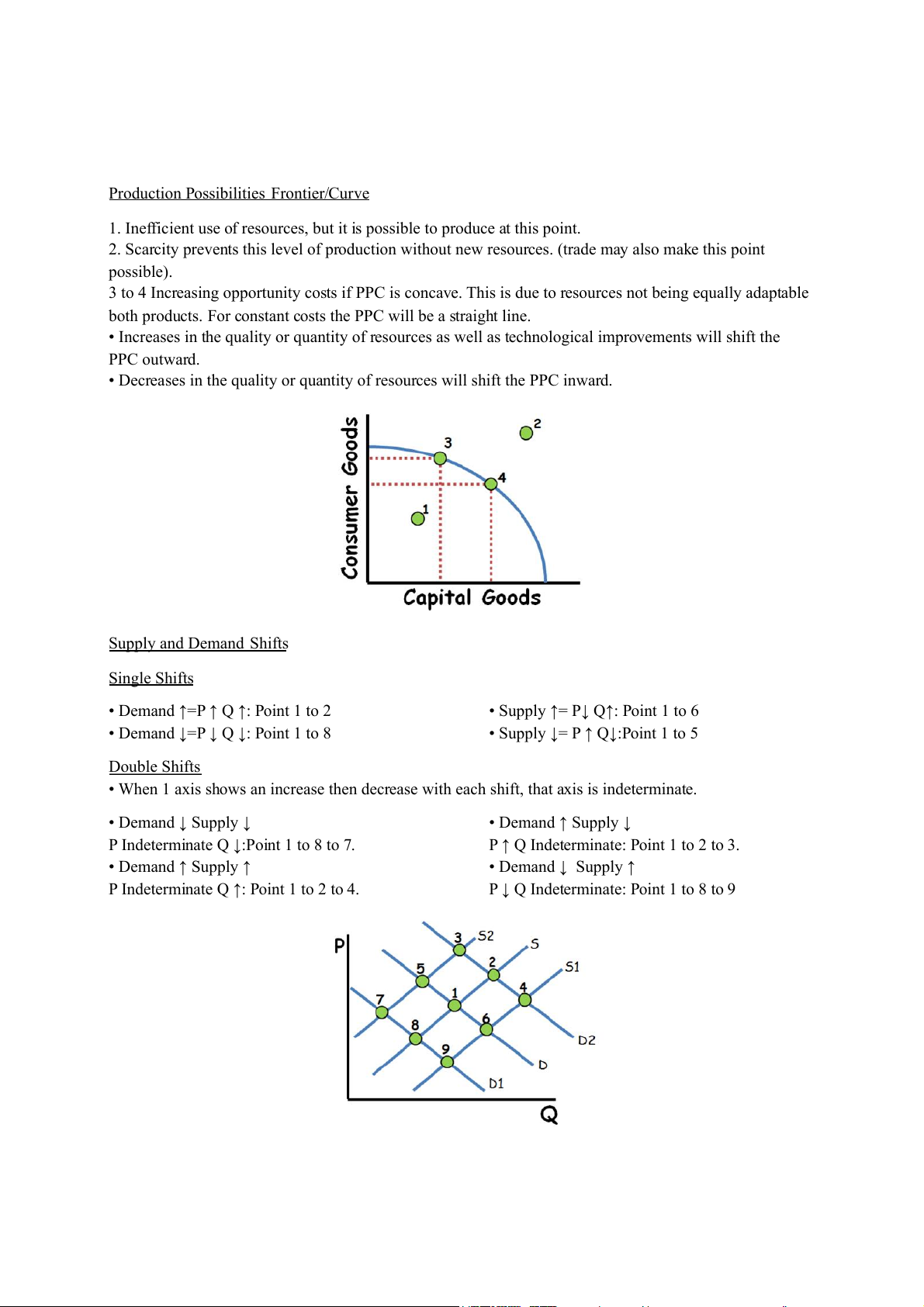
Production P ossibilities Frontier/Curve
1. Inefficient use of resources, but it is possible to produce at this point.
2. Scarcity prevents this level of production without new resources. (trade may also make this point possible).
3 to 4 Increasing opportunity costs if PPC is concave. This is due to resources not being equally adaptable
both products. For constant costs the PPC will be a straight line.
• Increases in the quality or quantity of resources as well as technological improvements will shift the PPC outward.
• Decreases in the quality or quantity of resources will shift the PPC inward. Supply and Demand Shifts Single Shifts
• Demand ↑=P ↑ Q ↑: Point 1 to 2
• Supply ↑= P↓ Q↑: Point 1 to 6
• Demand ↓=P ↓ Q ↓: Point 1 to 8
• Supply ↓= P ↑ Q↓:Point 1 to 5 Double Shifts
• When 1 axis shows an increase then decrease with each shift, that axis is indeterminate. • Demand ↓ Supply ↓ • Demand ↑ Supply ↓
P Indeterminate Q ↓:Point 1 to 8 to 7.
P ↑ Q Indeterminate: Point 1 to 2 to 3. • Demand ↑ Supply ↑ • Demand ↓ Supply ↑
P Indeterminate Q ↑: Point 1 to 2 to 4.
P ↓ Q Indeterminate: Point 1 to 8 to 9 Producer/Consumer Surplus
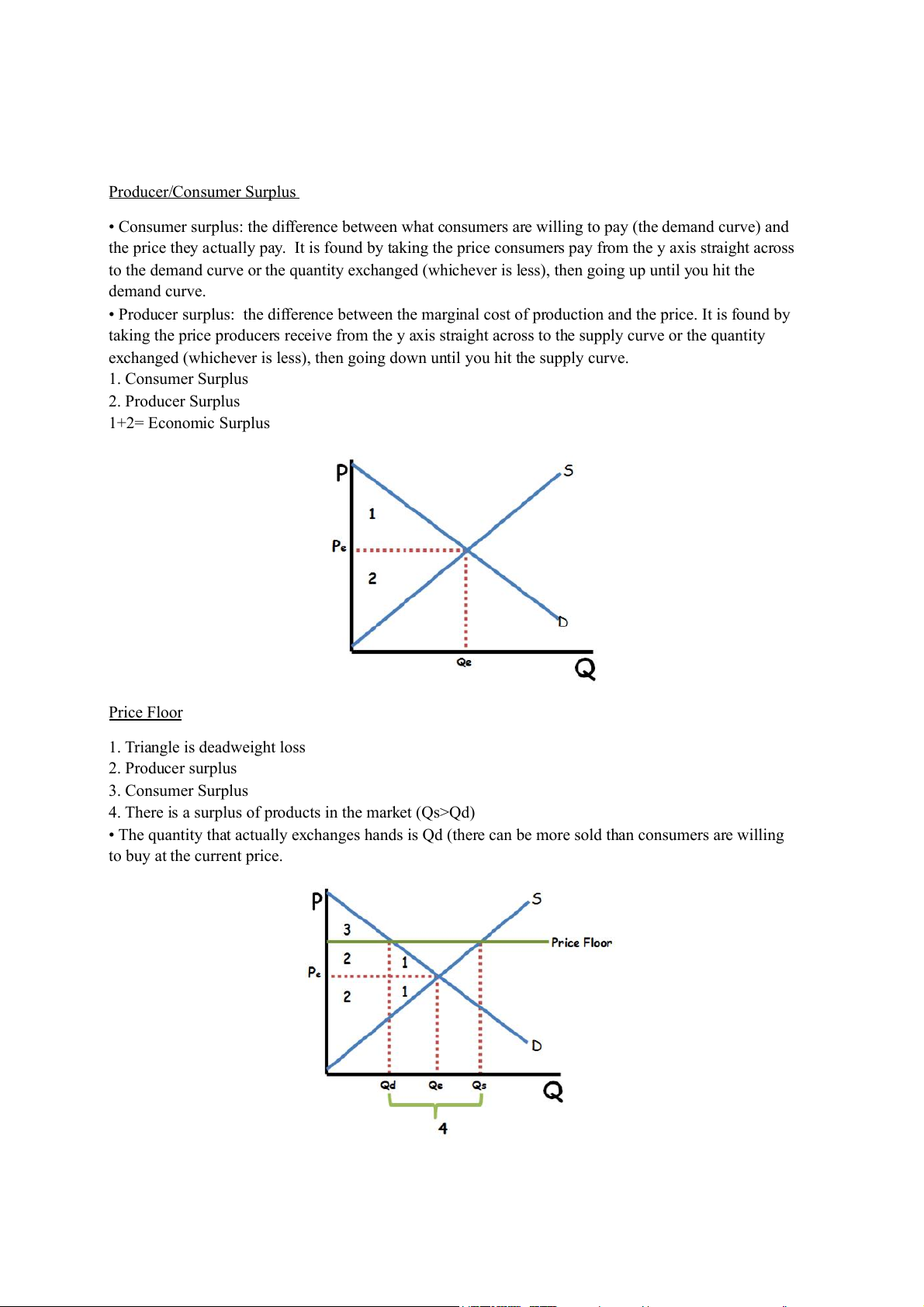
• Consumer surplus: the difference between what consumers are willing to pay (the demand curve) and
the price they actually pay. It is found by taking the price consumers pay from the y axis straight across
to the demand curve or the quantity exchanged (whichever is less), then going up until you hit the demand curve.
• Producer surplus: the difference between the marginal cost of production and the price. It is found by
taking the price producers receive from the y axis straight across to the supply curve or the quantity
exchanged (whichever is less), then going down until you hit the supply curve. 1. Consumer Surplus 2. Producer Surplus 1+2= Economic Surplus Price Floor 1. Triangle is deadweight loss 2. Producer surplus 3. Consumer Surplus
4. There is a surplus of products in the market (Qs>Qd)
• The quantity that actually exchanges hands is Qd (there can be more sold than consumers are willing to buy at the current price. Price Ceiling
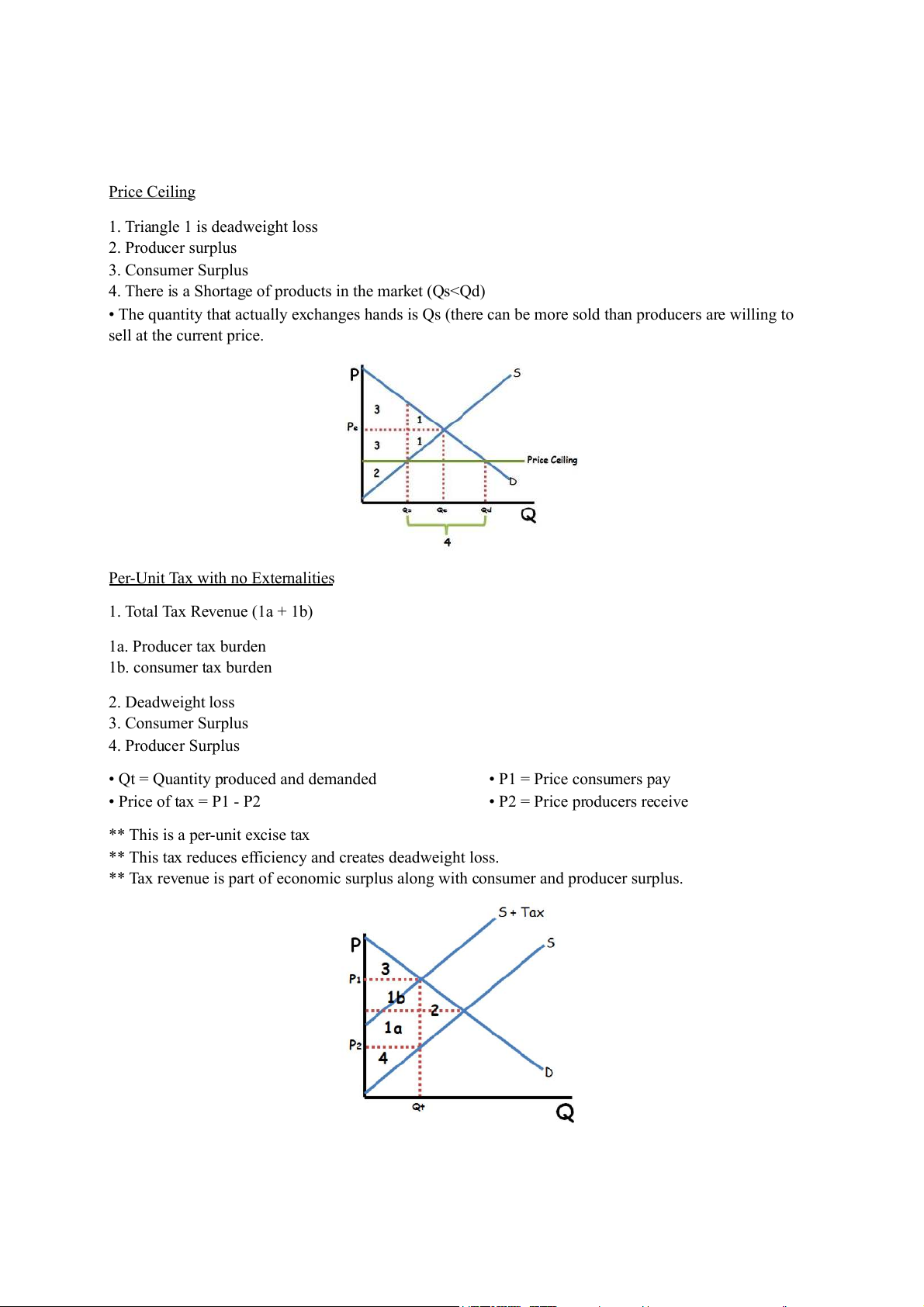
1. Triangle 1 is deadweight loss 2. Producer surplus 3. Consumer Surplus
4. There is a Shortage of products in the market (Qs• The quantity that actually exchanges hands is Qs (there can be more sold than producers are willing to sell at the current price.
Per-Unit Tax with no Externalities 1. Total Tax Revenue (1a + 1b) 1a. Producer tax burden 1b. consumer tax burden 2. Deadweight loss 3. Consumer Surplus 4. Producer Surplus
• Qt = Quantity produced and demanded • P1 = Price consumers pay • Price of tax = P1 - P2
• P2 = Price producers receive
** This is a per-unit excise tax
** This tax reduces efficiency and creates deadweight loss.
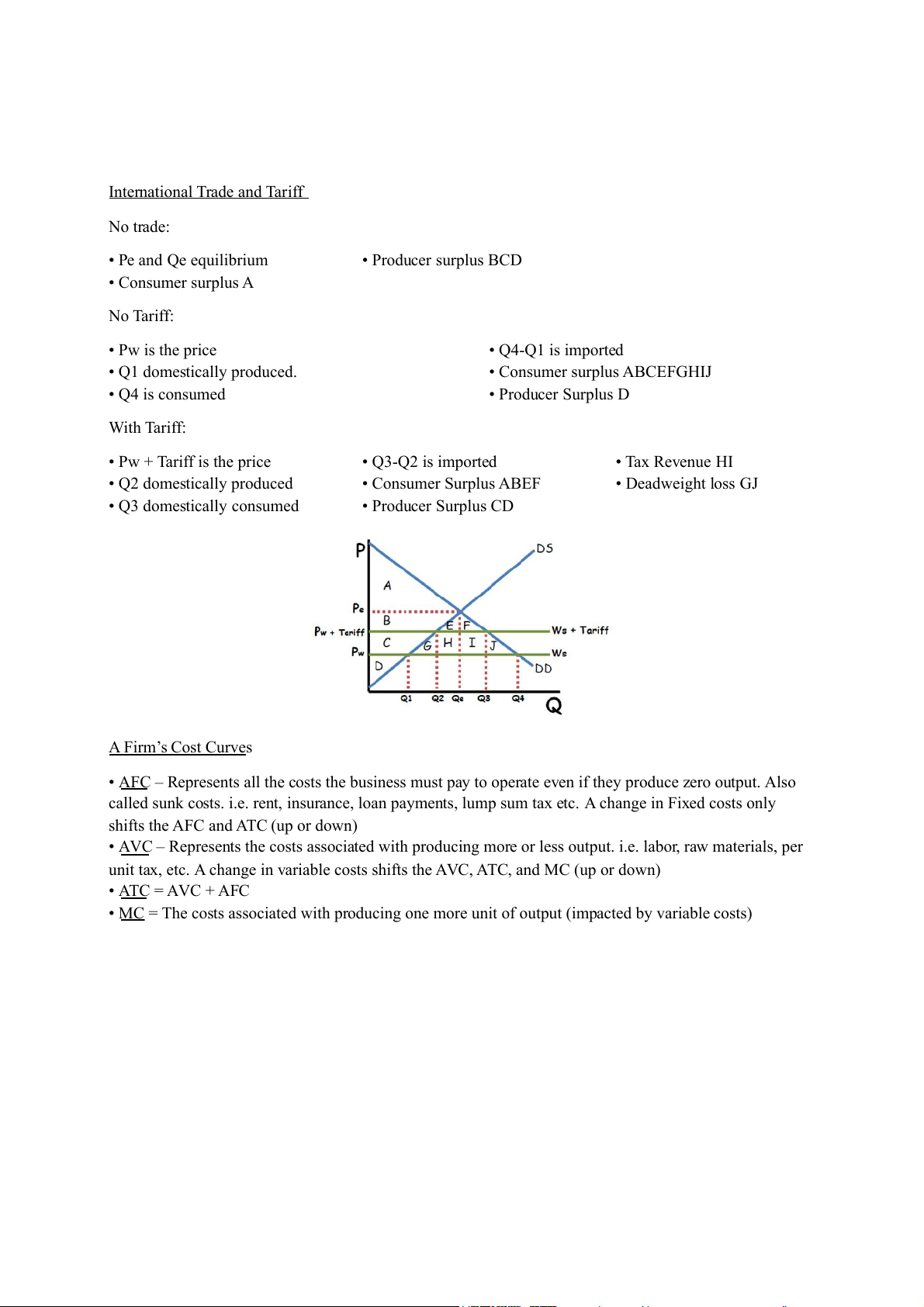
** Tax revenue is part of economic surplus along with consumer and producer surplus. Inter national Trade and Tariff No trade: • Pe and Qe equilibrium • Producer surplus BCD • Consumer surplus A No Tariff: • Pw is the price • Q4-Q1 is imported • Q1 domestically produced. • Consumer surplus ABCEFGHIJ • Q4 is consumed • Producer Surplus D With Tariff: • Pw + Tariff is the price • Q3-Q2 is imported • Tax Revenue HI • Q2 domestically produced • Consumer Surplus ABEF • Deadweight loss GJ • Q3 domestically consumed • Producer Surplus CD A Firm’s Cost Curves • – R AFC
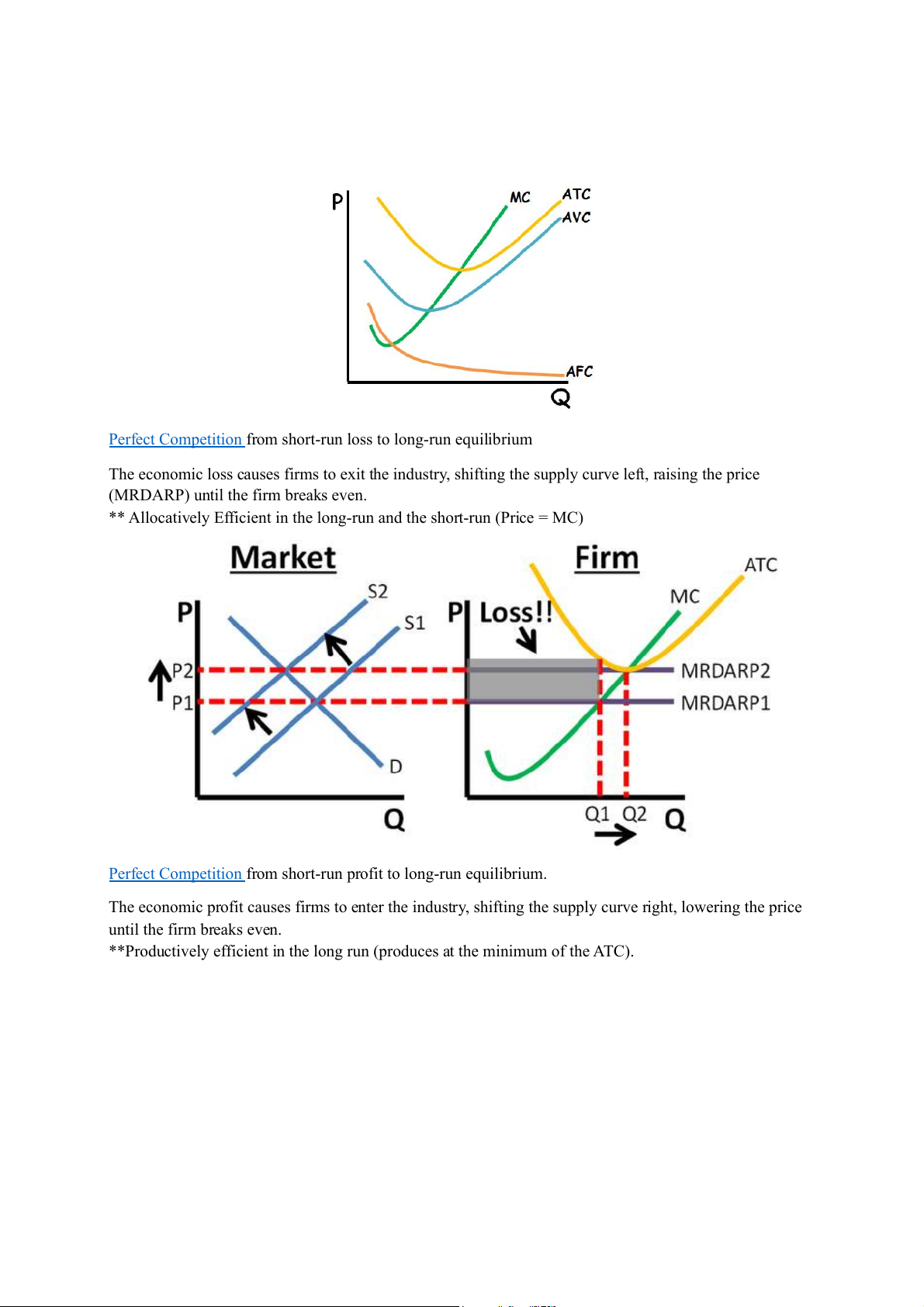
epresents all the costs the business must pay to operate even if they produce zero output. Also
called sunk costs. i.e. rent, insurance, loan payments, lump sum tax etc. A change in Fixed costs only
shifts the AFC and ATC (up or down)
• AVC – Represents the costs associated with producing more or less output. i.e. labor, raw materials, per
unit tax, etc. A change in variable costs shifts the AVC, ATC, and MC (up or down) • ATC = AVC + AFC
• MC = The costs associated with producing one more unit of output (impacted by variable costs)
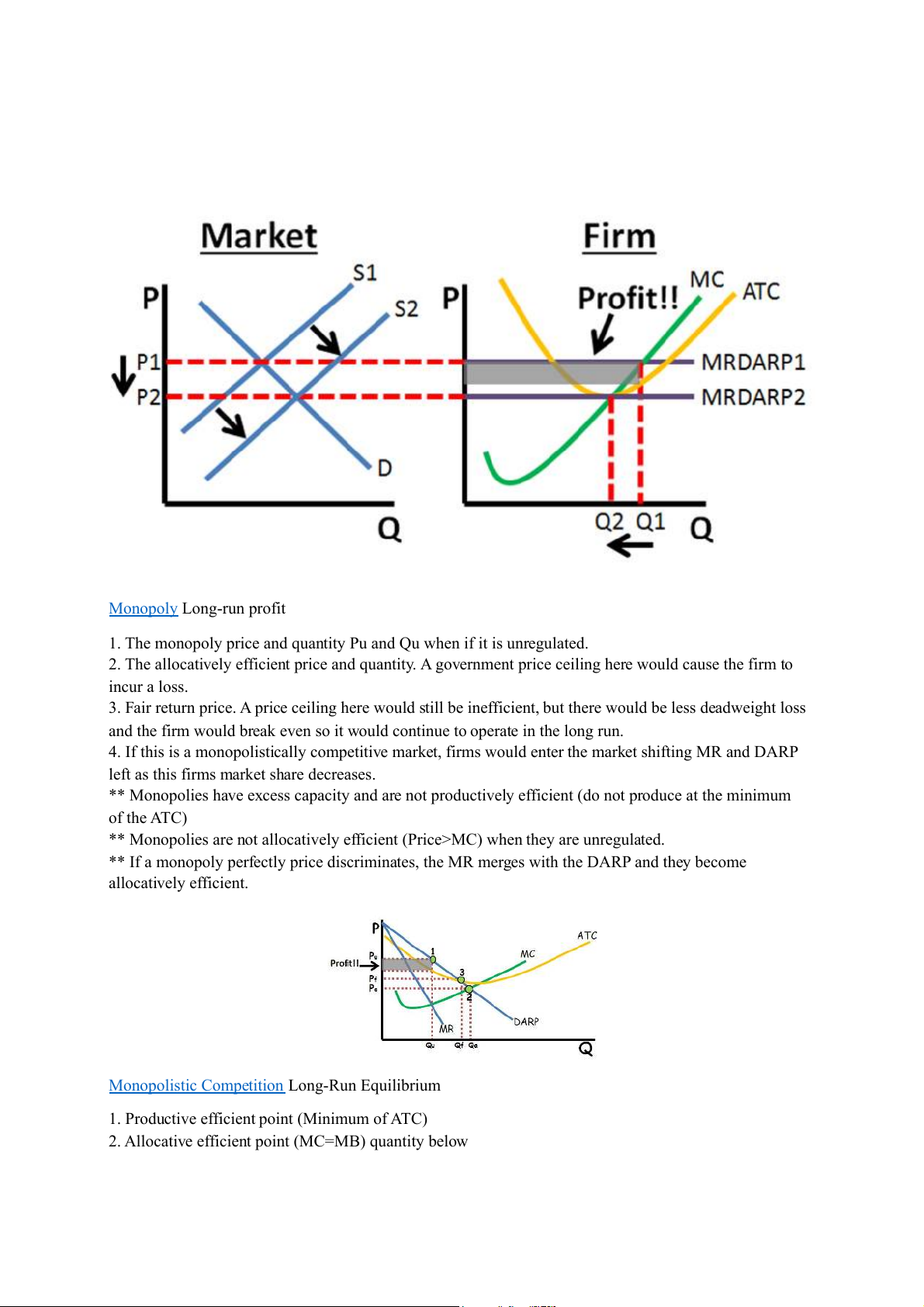
Perfect Competition from short-run loss to long-run equilibrium
The economic loss causes firms to exit the industry, shifting the supply curve left, raising the price
(MRDARP) until the firm breaks even.
** Allocatively Efficient in the long-run and the short-run (Price = MC)
Perfect Competition from short-run profit to long-run equilibrium.
The economic profit causes firms to enter the industry, shifting the supply curve right, lowering the price until the firm breaks even.
**Productively efficient in the long run (produces at the minimum of the ATC). Monopoly Long-run profit
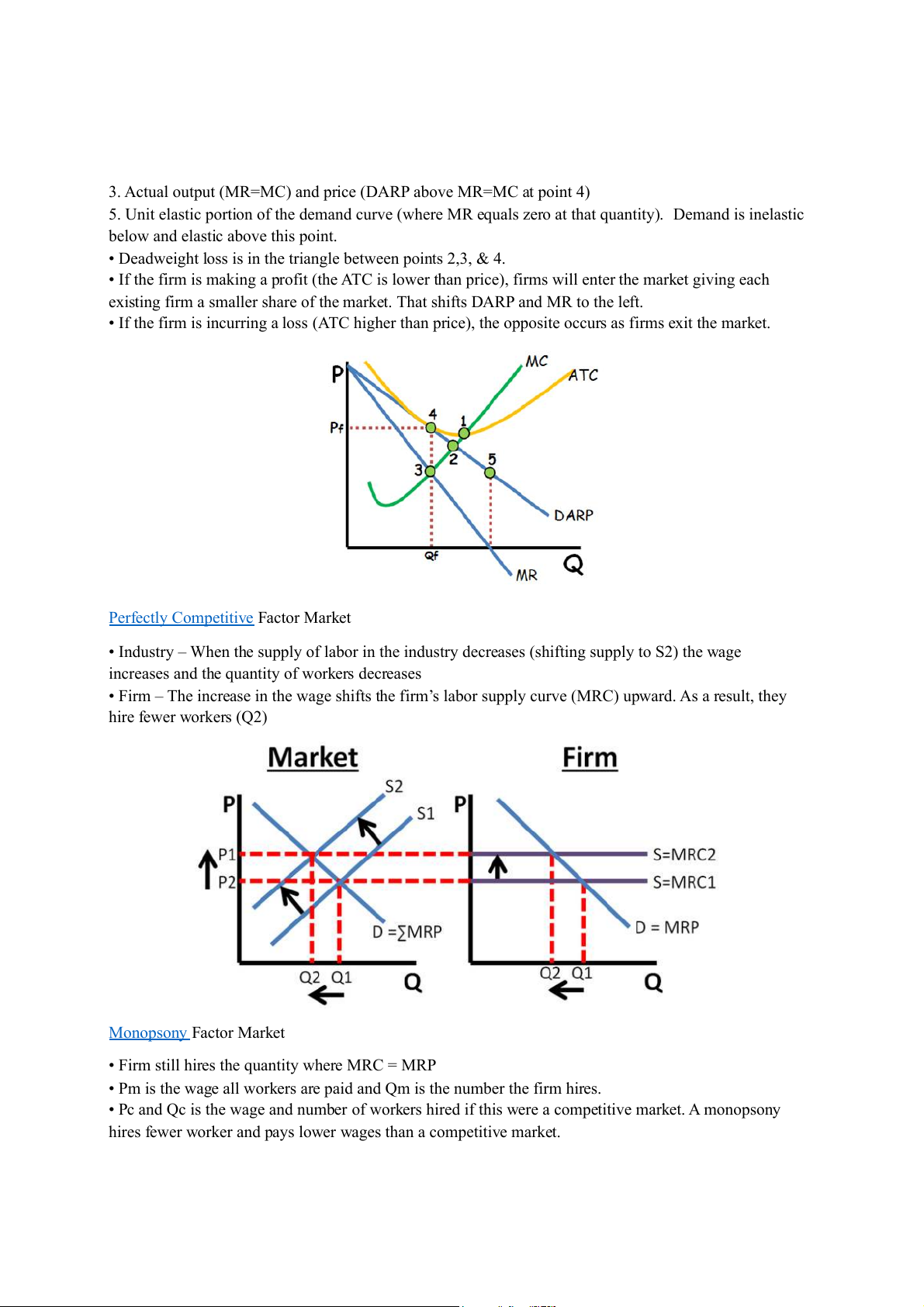
1. The monopoly price and quantity Pu and Qu when if it is unregulated.
2. The allocatively efficient price and quantity. A government price ceiling here would cause the firm to incur a loss.
3. Fair return price. A price ceiling here would still be inefficient, but there would be less deadweight loss
and the firm would break even so it would continue to operate in the long run.
4. If this is a monopolistically competitive market, firms would enter the market shifting MR and DARP
left as this firms market share decreases.
** Monopolies have excess capacity and are not productively efficient (do not produce at the minimum of the ATC)
** Monopolies are not allocatively efficient (Price>MC) when they are unregulated.
** If a monopoly perfectly price discriminates, the MR merges with the DARP and they become allocatively efficient.
Monopolistic Competition Long-Run Equilibrium
1. Productive efficient point (Minimum of ATC)
2. Allocative efficient point (MC=MB) quantity below
3. Actual output (MR=MC) and price (DARP above MR=MC at point 4)
5. Unit elastic portion of the demand curve (where MR equals zero at that quantity). Demand is inelastic
below and elastic above this point.
• Deadweight loss is in the triangle between points 2,3, & 4.
• If the firm is making a profit (the ATC is lower than price), firms will enter the market giving each
existing firm a smaller share of the market. That shifts DARP and MR to the left.
• If the firm is incurring a loss (ATC higher than price), the opposite occurs as firms exit the market.
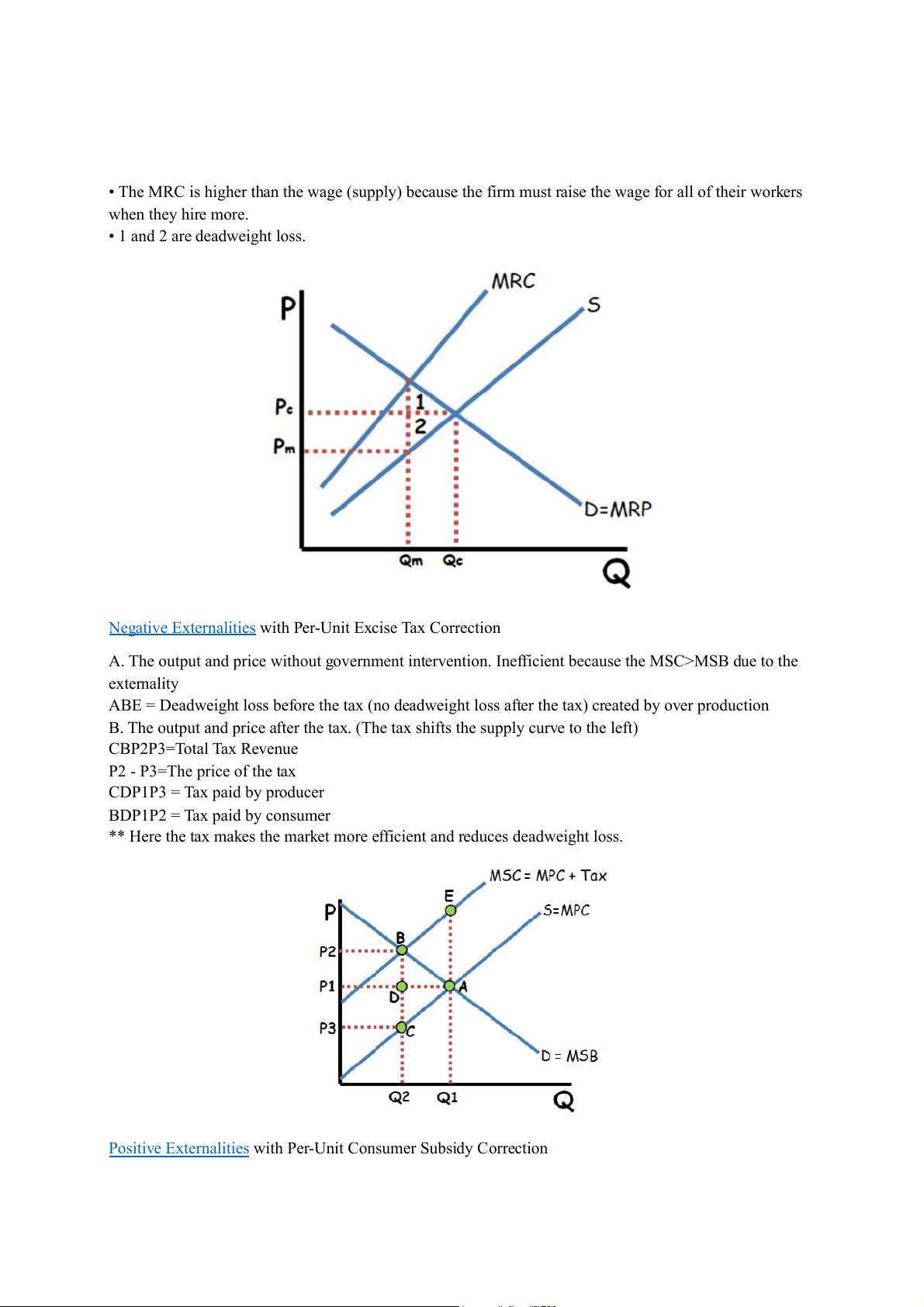
Perfectly Competitive Factor Market
• Industry – When the supply of labor in the industry decreases (shifting supply to S2) the wage
increases and the quantity of workers decreases
• Firm – The increase in the wage shifts the firm’s labor supply curve (MRC) upward. As a result, they hire fewer workers (Q2) Monopsony Factor Market
• Firm still hires the quantity where MRC = MRP
• Pm is the wage all workers are paid and Qm is the number the firm hires.
• Pc and Qc is the wage and number of workers hired if this were a competitive market. A monopsony
hires fewer worker and pays lower wages than a competitive market.
• The MRC is higher than the wage (supply) because the firm must raise the wage for all of their workers when they hire more.
• 1 and 2 are deadweight loss.
Negative Externalities with Per-Unit Excise Tax Correction
A. The output and price without government intervention. Inefficient because the MSC>MSB due to the externality
ABE = Deadweight loss before the tax (no deadweight loss after the tax) created by over production
B. The output and price after the tax. (The tax shifts the supply curve to the left) CBP2P3=Total Tax Revenue P2 - P3=The price of the tax CDP1P3 = Tax paid by producer BDP1P2 = Tax paid by consumer
** Here the tax makes the market more efficient and reduces deadweight loss.
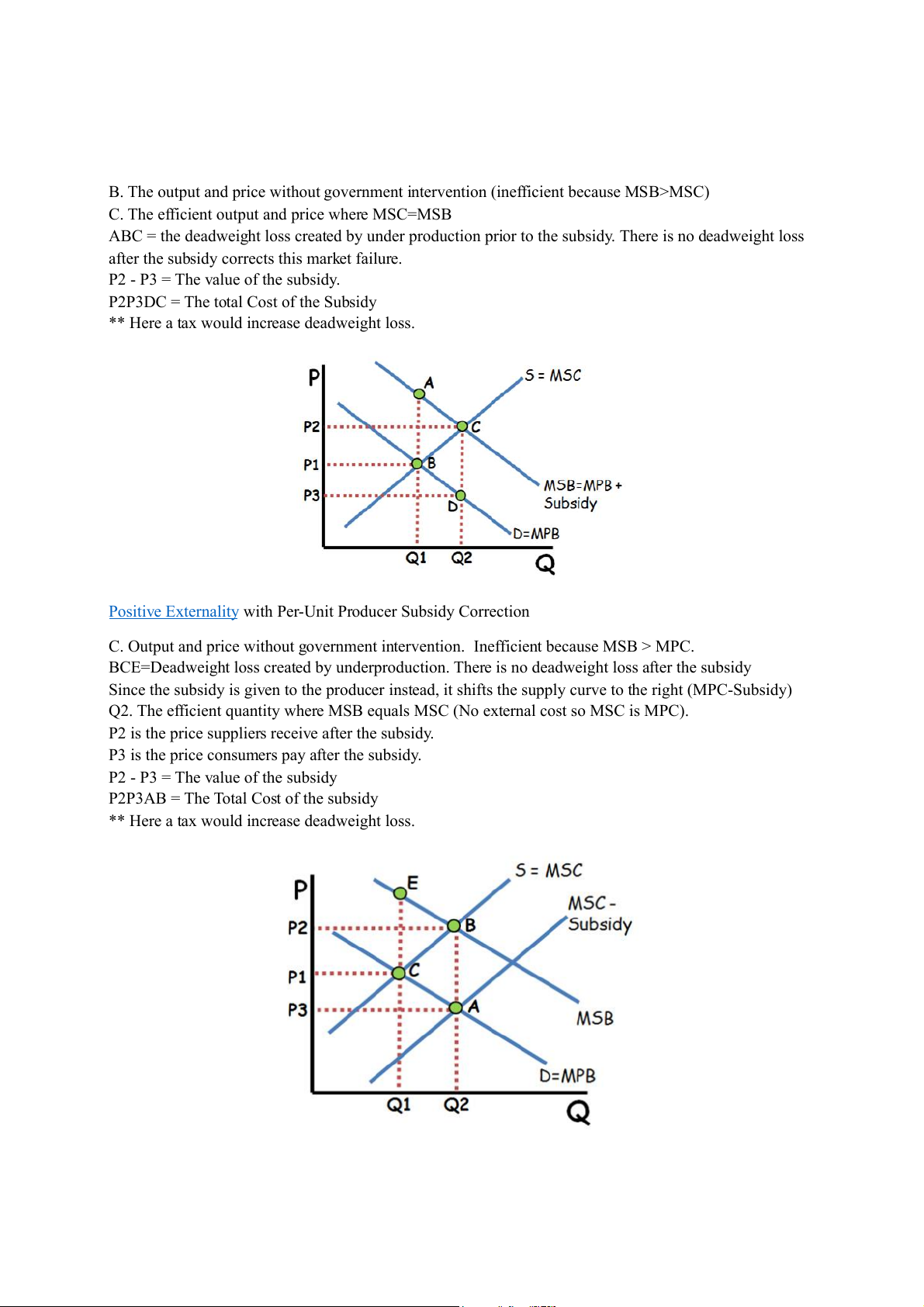
Positive Externalities with Per-Unit Consumer Subsidy Correction
B. The output and price without government intervention (inefficient because MSB>MSC)
C. The efficient output and price where MSC=MSB
ABC = the deadweight loss created by under production prior to the subsidy. There is no deadweight loss
after the subsidy corrects this market failure.
P2 - P3 = The value of the subsidy.
P2P3DC = The total Cost of the Subsidy
** Here a tax would increase deadweight loss.
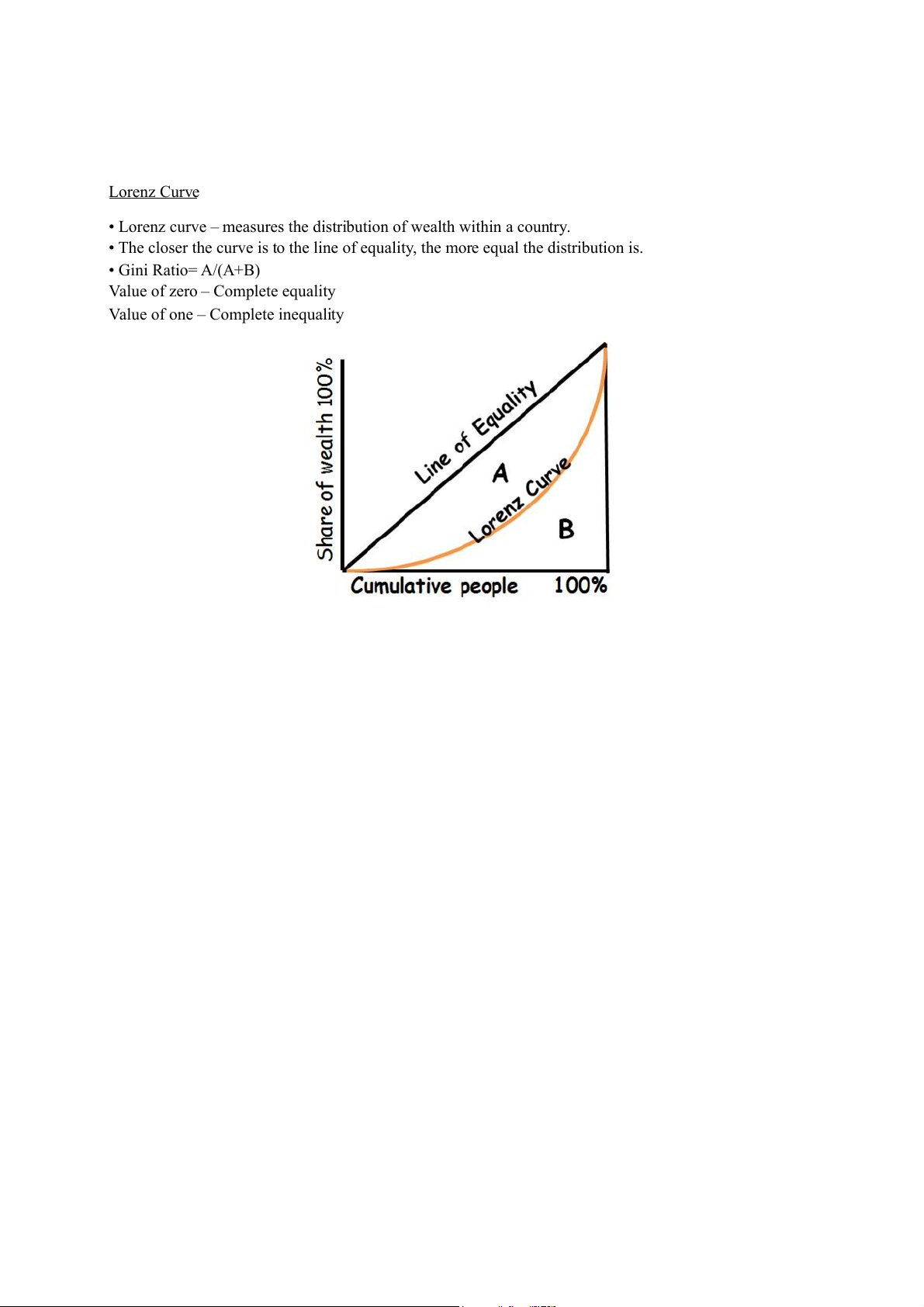
Positive Externality with Per-Unit Producer Subsidy Correction
C. Output and price without government intervention. Inefficient because MSB > MPC.
BCE=Deadweight loss created by underproduction. There is no deadweight loss after the subsidy
Since the subsidy is given to the producer instead, it shifts the supply curve to the right (MPC-Subsidy)
Q2. The efficient quantity where MSB equals MSC (No external cost so MSC is MPC).
P2 is the price suppliers receive after the subsidy.
P3 is the price consumers pay after the subsidy.
P2 - P3 = The value of the subsidy
P2P3AB = The Total Cost of the subsidy
** Here a tax would increase deadweight loss. Lorenz Curve
• Lorenz curve – measures the distribution of wealth within a country.
• The closer the curve is to the line of equality, the more equal the distribution is. • Gini Ratio= A/(A+B)
Value of zero – Complete equality
Value of one – Complete inequality
Tài liệu liên quan:
-
Tự Luận Vimo: Phân Tích Cung, Cầu và Thị Trường Cạnh Tranh| Microeconomics | Trường Đại học Quốc tế, Đại học Quốc gia Thành phố Hồ Chí Minh
5 3 -
Review Questions: Thinking Like an Economist | Microeconomics | Trường Đại học Quốc tế, Đại học Quốc gia Thành phố Hồ Chí Minh
5 3 -
Final Exam Quizlet Questions & Answers | Microeconomics | Trường Đại học Quốc tế, Đại học Quốc gia Thành phố Hồ Chí Minh
5 3 -

Đề thi giữa kỳ II | Microeconomics | Trường Đại học Quốc tế, Đại học Quốc gia Thành phố Hồ Chí Minh
5 3 -

Final Group Project_ The Beer Industry | Microeconomics | Trường Đại học Quốc tế, Đại học Quốc gia Thành phố Hồ Chí Minh
4 2