Trade Concepts and Opportunity Cost Analysis | Microeconomics | Trường Đại học Quốc tế, Đại học Quốc gia Thành phố Hồ Chí Minh
True/False question (give a brief explanation) 1. If Ha can produce more math problems per hour and more book reports per hour than Hieu can, then Ha cannot gain from trading math problems and book reports with. =>Falses. 2. It is possible for the U.S. to gain from trade with Germany even if it takes U.S. workers fewer. Tài liệu được sưu tầm và soạn thảo dưới dạng file PDF để gửi tới các bạn cùng tham khảo, ôn tập đầy đủ kiến thức, chuẩn bị cho các buổi học thật tốt. Mời bạn đọc đón xem!
Môn: Microeconomics 613 tài liệu
Trường: Trường Đại học Quốc tế, Đại học Quốc gia Thành phố Hồ Chí Minh 1.9 K tài liệu
Tác giả:


Preview text:
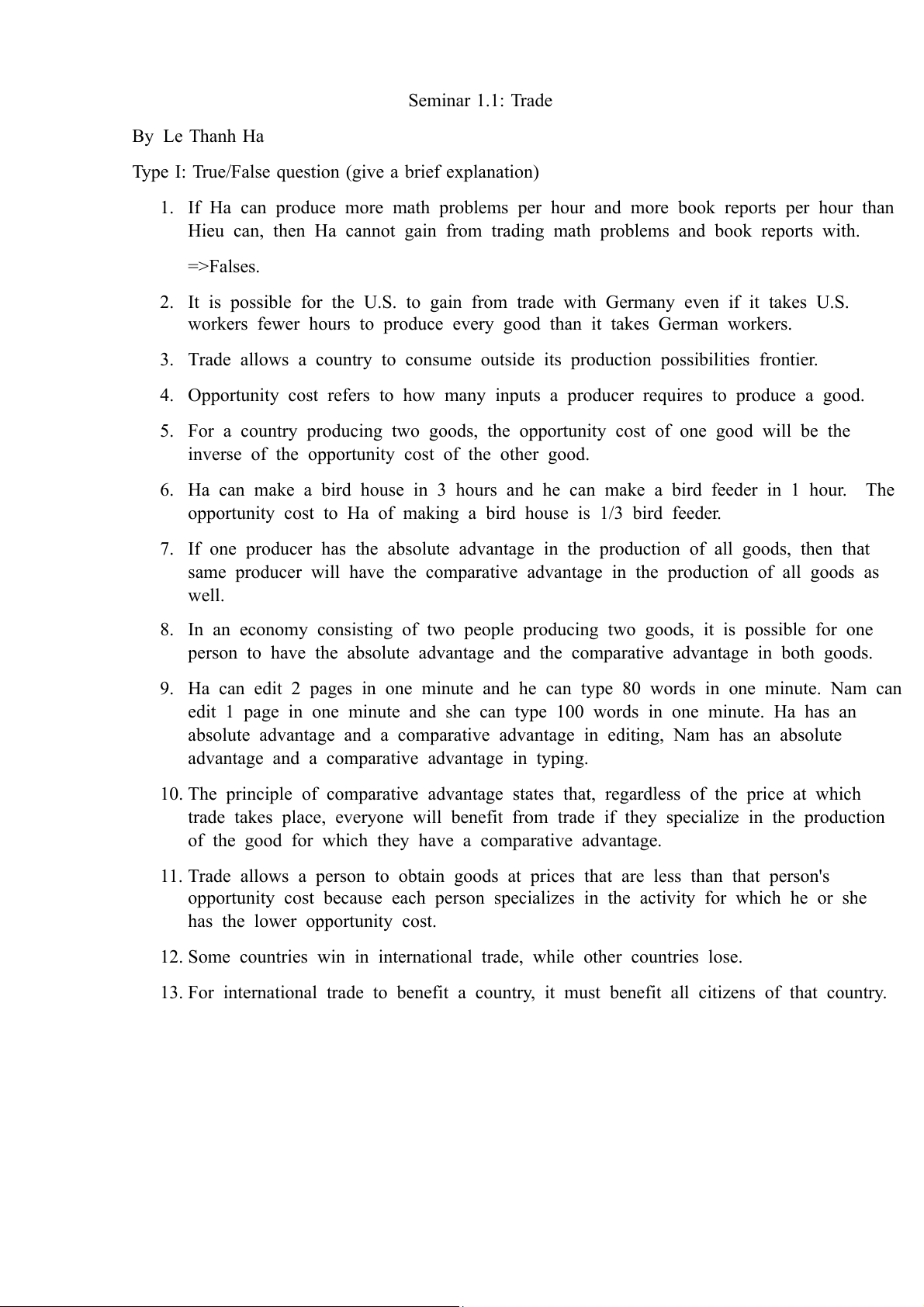
Seminar 1.1: Trade By Le Thanh Ha
Type I: True/False question (give a brief explanation)
1. If Ha can produce more math problems per hour and more book reports per hour than
Hieu can, then Ha cannot gain from trading math problems and book reports with. =>Falses.
2. It is possible for the U.S. to gain from trade with Germany even if it takes U.S.
workers fewer hours to produce every good than it takes German workers.
3. Trade allows a country to consume outside its production possibilities frontier.
4. Opportunity cost refers to how many inputs a producer requires to produce a good.
5. For a country producing two goods, the opportunity cost of one good will be the
inverse of the opportunity cost of the other good.
6. Ha can make a bird house in 3 hours and he can make a bird feeder in 1 hour. The
opportunity cost to Ha of making a bird house is 1/3 bird feeder.
7. If one producer has the absolute advantage in the production of all goods, then that
same producer will have the comparative advantage in the production of all goods as well.
8. In an economy consisting of two people producing two goods, it is possible for one
person to have the absolute advantage and the comparative advantage in both goods.
9. Ha can edit 2 pages in one minute and he can type 80 words in one minute. Nam can
edit 1 page in one minute and she can type 100 words in one minute. Ha has an
absolute advantage and a comparative advantage in editing, Nam has an absolute
advantage and a comparative advantage in typing.
10. The principle of comparative advantage states that, regardless of the price at which
trade takes place, everyone will benefit from trade if they specialize in the production
of the good for which they have a comparative advantage.
11. Trade allows a person to obtain goods at prices that are less than that person's
opportunity cost because each person specializes in the activity for which he or she
has the lower opportunity cost.
12. Some countries win in international trade, while other countries lose.
13. For international trade to benefit a country, it must benefit all citizens of that country.
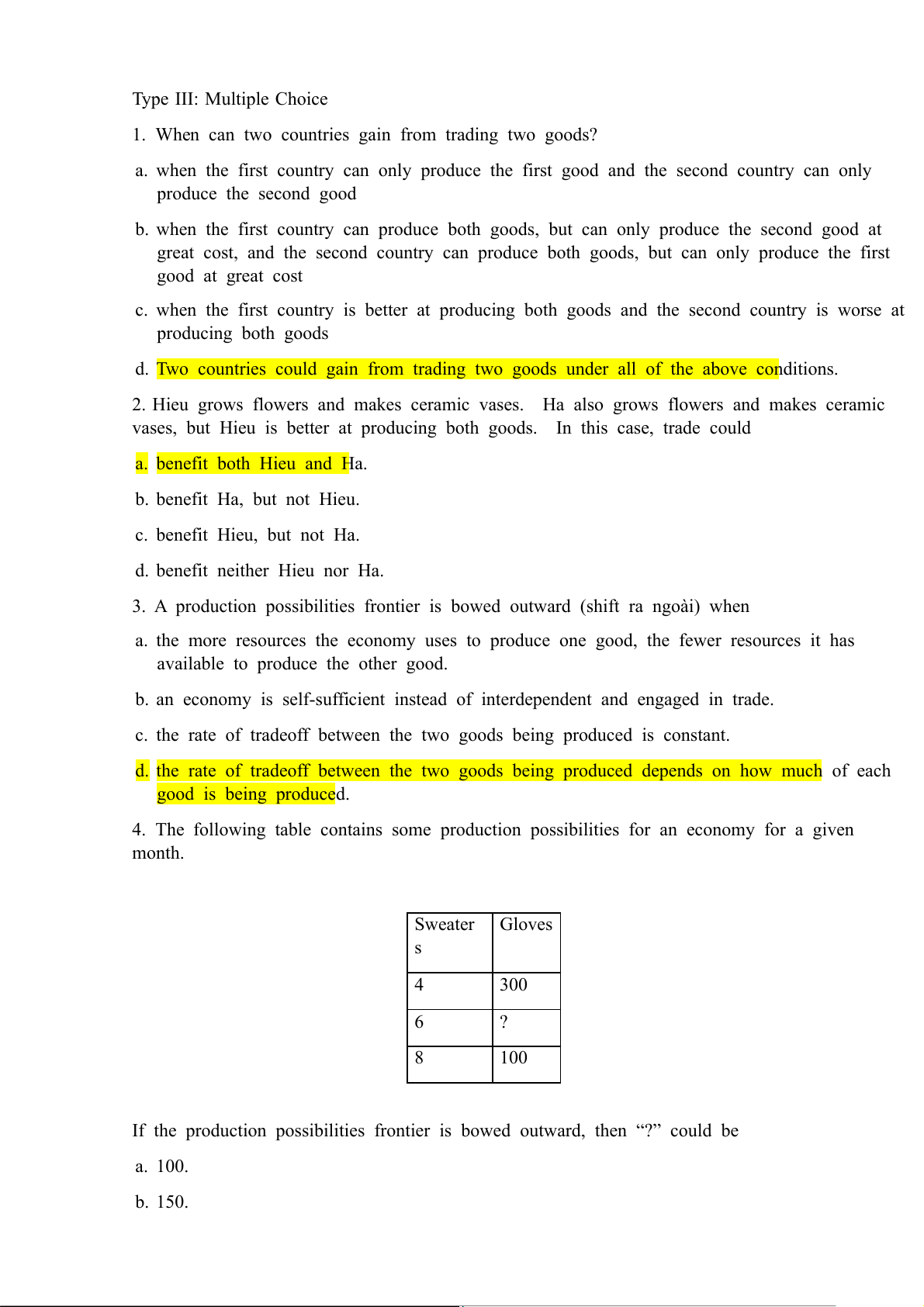
Type III: Multiple Choice
1. When can two countries gain from trading two goods?
a. when the first country can only produce the first good and the second country can only produce the second good
b. when the first country can produce both goods, but can only produce the second good at
great cost, and the second country can produce both goods, but can only produce the first good at great cost
c. when the first country is better at producing both goods and the second country is worse at producing both goods
d. Two countries could gain from trading two goods under all of the above conditions.
2. Hieu grows flowers and makes ceramic vases. Ha also grows flowers and makes ceramic
vases, but Hieu is better at producing both goods. In this case, trade could a. benefit both Hieu and Ha. b. benefit Ha, but not Hieu. c. benefit Hieu, but not Ha.
d. benefit neither Hieu nor Ha.
3. A production possibilities frontier is bowed outward (shift ra ngoài) when
a. the more resources the economy uses to produce one good, the fewer resources it has
available to produce the other good.
b. an economy is self-sufficient instead of interdependent and engaged in trade.
c. the rate of tradeoff between the two goods being produced is constant.
d. the rate of tradeoff between the two goods being produced depends on how much of each good is being produced.
4. The following table contains some production possibilities for an economy for a given month. Sweater Gloves s 4 300 6 ? 8 100
If the production possibilities frontier is bowed outward, then “?” could be a. 100. b. 150. c. 200. d. 250.
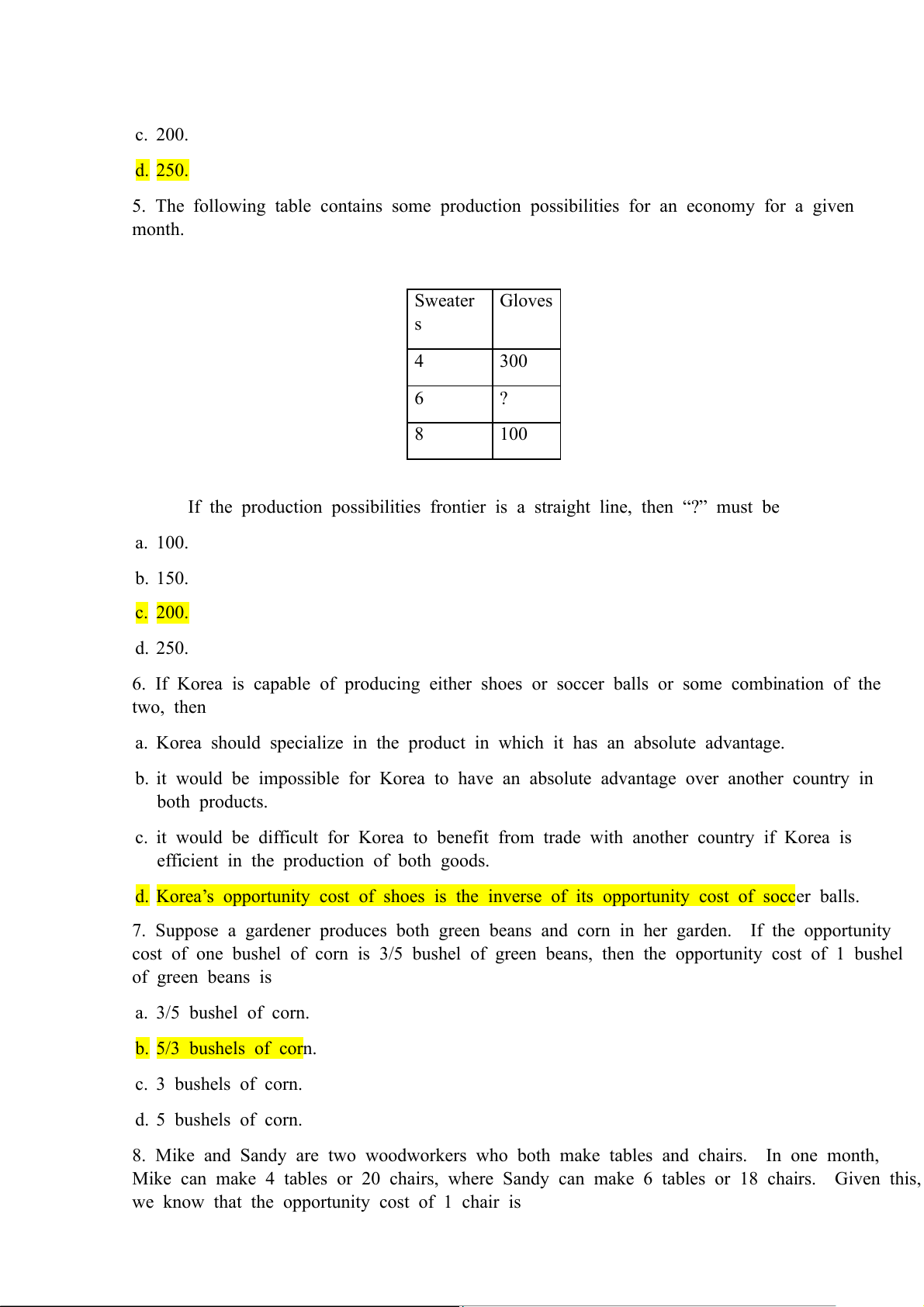
5. The following table contains some production possibilities for an economy for a given month. Sweater Gloves s 4 300 6 ? 8 100
If the production possibilities frontier is a straight line, then “?” must be a. 100. b. 150. c. 200. d. 250.
6. If Korea is capable of producing either shoes or soccer balls or some combination of the two, then
a. Korea should specialize in the product in which it has an absolute advantage.
b. it would be impossible for Korea to have an absolute advantage over another country in both products.
c. it would be difficult for Korea to benefit from trade with another country if Korea is
efficient in the production of both goods.
d. Korea’s opportunity cost of shoes is the inverse of its opportunity cost of soccer balls.
7. Suppose a gardener produces both green beans and corn in her garden. If the opportunity
cost of one bushel of corn is 3/5 bushel of green beans, then the opportunity cost of 1 bushel of green beans is a. 3/5 bushel of corn. b. 5/3 bushels of corn. c. 3 bushels of corn. d. 5 bushels of corn.
8. Mike and Sandy are two woodworkers who both make tables and chairs. In one month,
Mike can make 4 tables or 20 chairs, where Sandy can make 6 tables or 18 chairs. Given this,
we know that the opportunity cost of 1 chair is
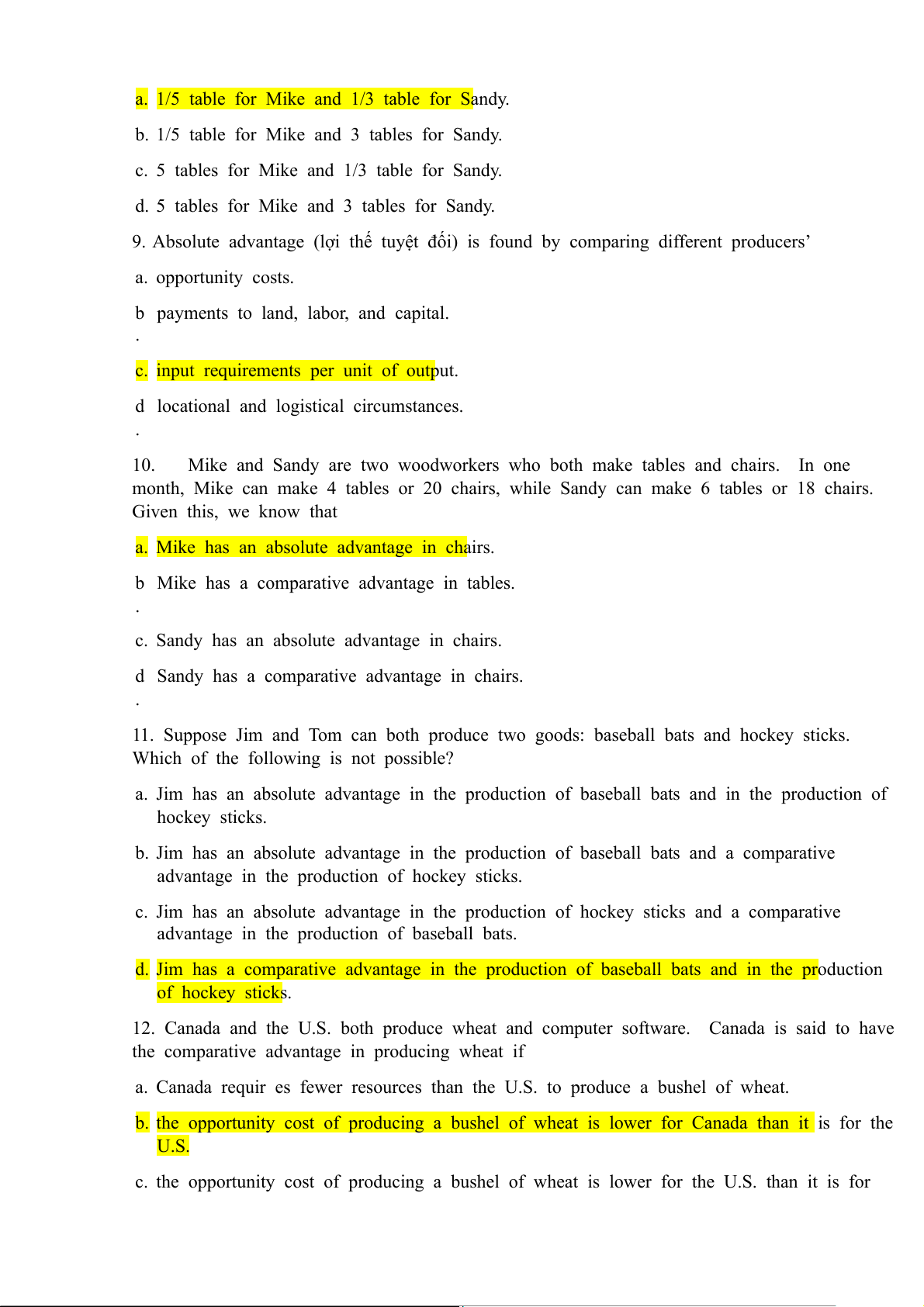
a. 1/5 table for Mike and 1/3 table for Sandy.
b. 1/5 table for Mike and 3 tables for Sandy.
c. 5 tables for Mike and 1/3 table for Sandy.
d. 5 tables for Mike and 3 tables for Sandy.
9. Absolute advantage (lợi thế tuyệt đối) is found by comparing different producers’ a. opportunity costs.
b payments to land, labor, and capital. .
c. input requirements per unit of output.
d locational and logistical circumstances. . 10.
Mike and Sandy are two woodworkers who both make tables and chairs. In one
month, Mike can make 4 tables or 20 chairs, while Sandy can make 6 tables or 18 chairs. Given this, we know that
a. Mike has an absolute advantage in chairs.
b Mike has a comparative advantage in tables. .
c. Sandy has an absolute advantage in chairs.
d Sandy has a comparative advantage in chairs. .
11. Suppose Jim and Tom can both produce two goods: baseball bats and hockey sticks.
Which of the following is not possible?
a. Jim has an absolute advantage in the production of baseball bats and in the production of hockey sticks.
b. Jim has an absolute advantage in the production of baseball bats and a comparative
advantage in the production of hockey sticks.
c. Jim has an absolute advantage in the production of hockey sticks and a comparative
advantage in the production of baseball bats.
d. Jim has a comparative advantage in the production of baseball bats and in the production of hockey sticks.
12. Canada and the U.S. both produce wheat and computer software. Canada is said to have
the comparative advantage in producing wheat if
a. Canada requir es fewer resources than the U.S. to produce a bushel of wheat.
b. the opportunity cost of producing a bushel of wheat is lower for Canada than it is for the U.S.
c. the opportunity cost of producing a bushel of wheat is lower for the U.S. than it is for Canada.
d. the U.S. has an absolute advantage over Canada in producing computer software.
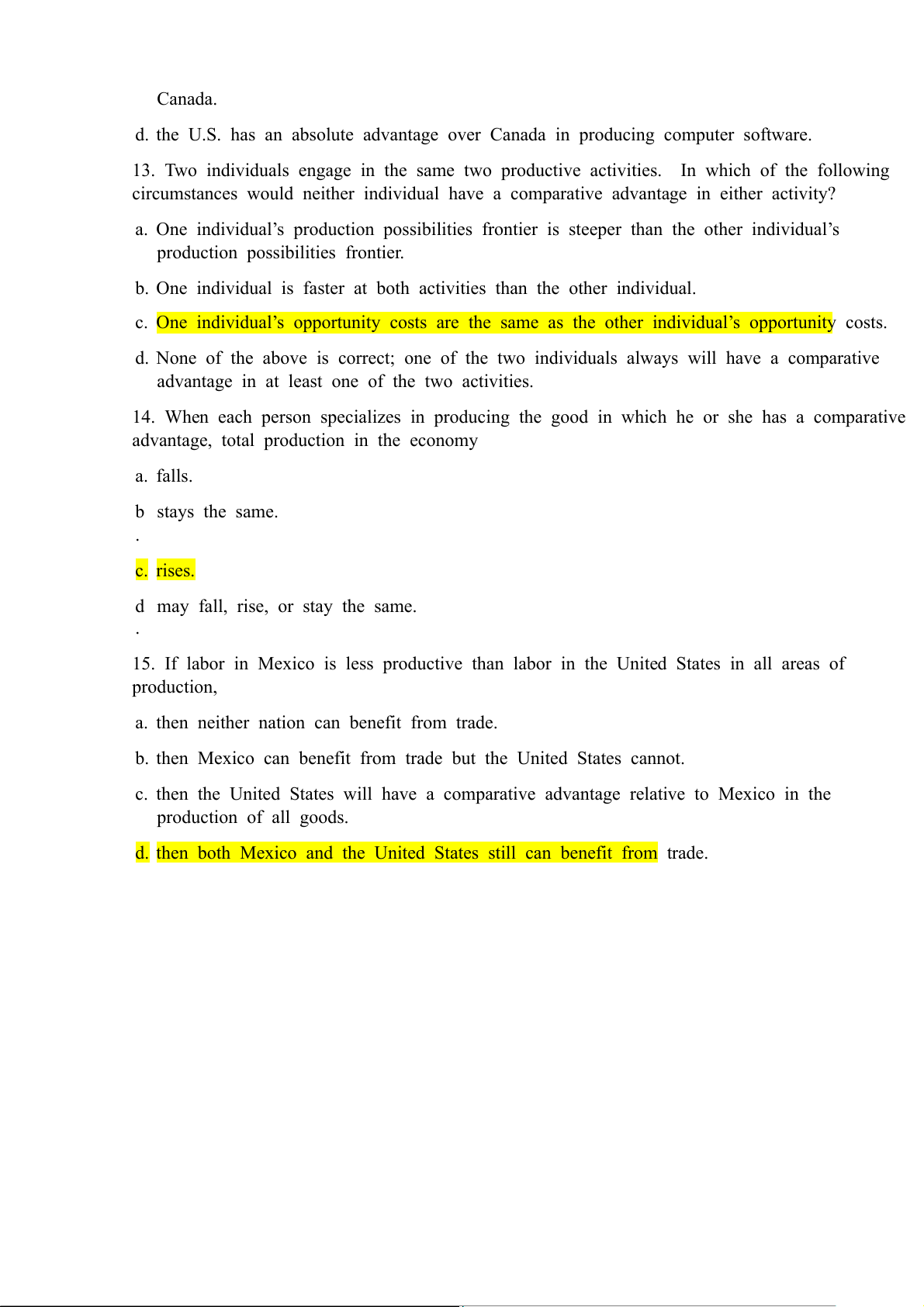
13. Two individuals engage in the same two productive activities. In which of the following
circumstances would neither individual have a comparative advantage in either activity?
a. One individual’s production possibilities frontier is steeper than the other individual’s
production possibilities frontier.
b. One individual is faster at both activities than the other individual.
c. One individual’s opportunity costs are the same as the other individual’s opportunity costs.
d. None of the above is correct; one of the two individuals always will have a comparative
advantage in at least one of the two activities.
14. When each person specializes in producing the good in which he or she has a comparative
advantage, total production in the economy a. falls. b stays the same. . c. rises.
d may fall, rise, or stay the same. .
15. If labor in Mexico is less productive than labor in the United States in all areas of production,
a. then neither nation can benefit from trade.
b. then Mexico can benefit from trade but the United States cannot.
c. then the United States will have a comparative advantage relative to Mexico in the production of all goods.
d. then both Mexico and the United States still can benefit from trade. Seminar 1.1 By Le Thanh Ha
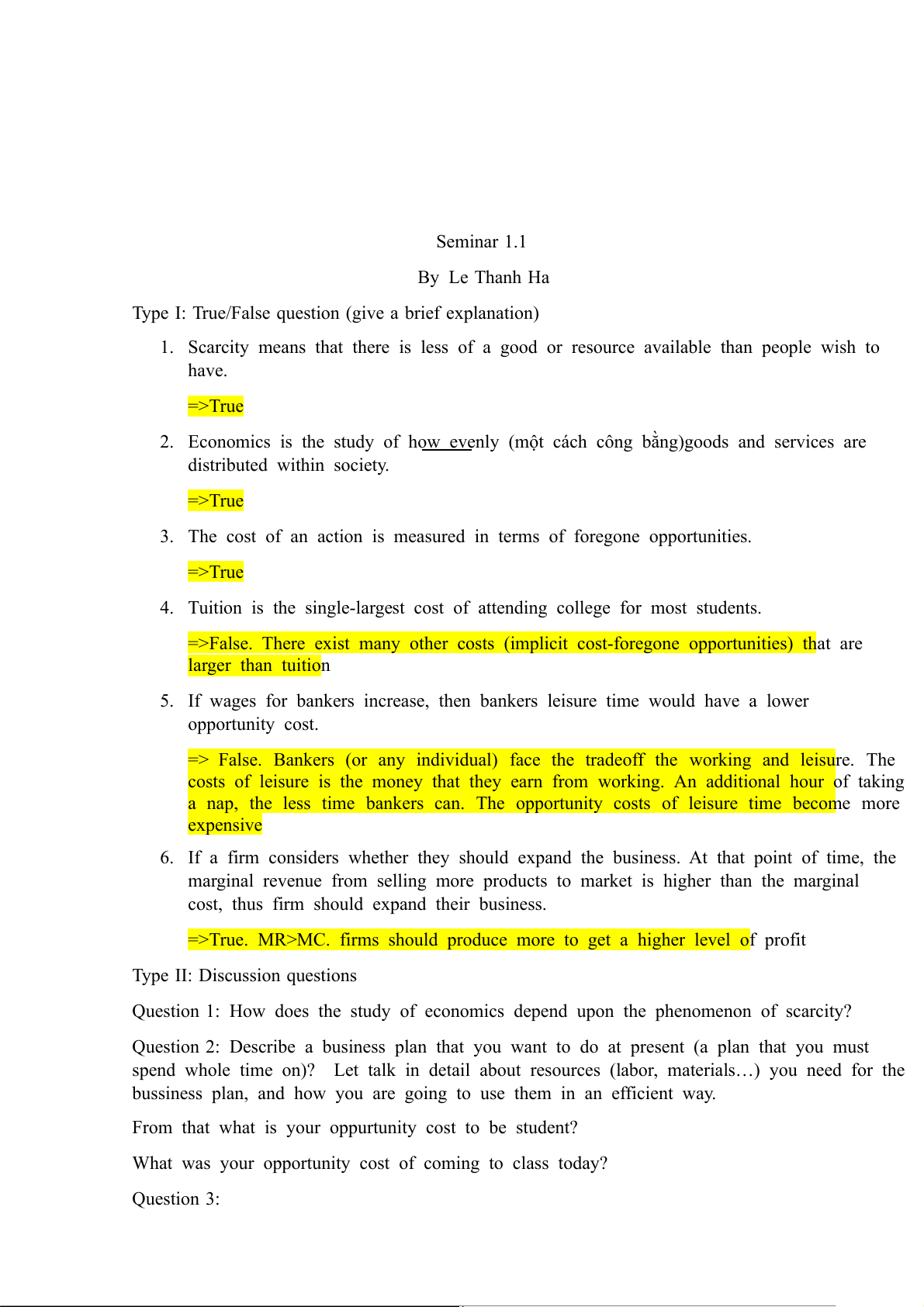
Type I: True/False question (give a brief explanation)
1. Scarcity means that there is less of a good or resource available than people wish to have. =>True
2. Economics is the study of how evenly (một cách công bằng)goods and services are distributed within society. =>True
3. The cost of an action is measured in terms of foregone opportunities. =>True
4. Tuition is the single-largest cost of attending college for most students.
=>False. There exist many other costs (implicit cost-foregone opportunities) that are larger than tuition
5. If wages for bankers increase, then bankers leisure time would have a lower opportunity cost.
=> False. Bankers (or any individual) face the tradeoff the working and leisure. The
costs of leisure is the money that they earn from working. An additional hour of taking
a nap, the less time bankers can. The opportunity costs of leisure time become more expensive
6. If a firm considers whether they should expand the business. At that point of time, the
marginal revenue from selling more products to market is higher than the marginal
cost, thus firm should expand their business.
=>True. MR>MC. firms should produce more to get a higher level of profit
Type II: Discussion questions
Question 1: How does the study of economics depend upon the phenomenon of scarcity?
Question 2: Describe a business plan that you want to do at present (a plan that you must
spend whole time on)? Let talk in detail about resources (labor, materials…) you need for the
bussiness plan, and how you are going to use them in an efficient way.
From that what is your oppurtunity cost to be student?
What was your opportunity cost of coming to class today? Question 3:
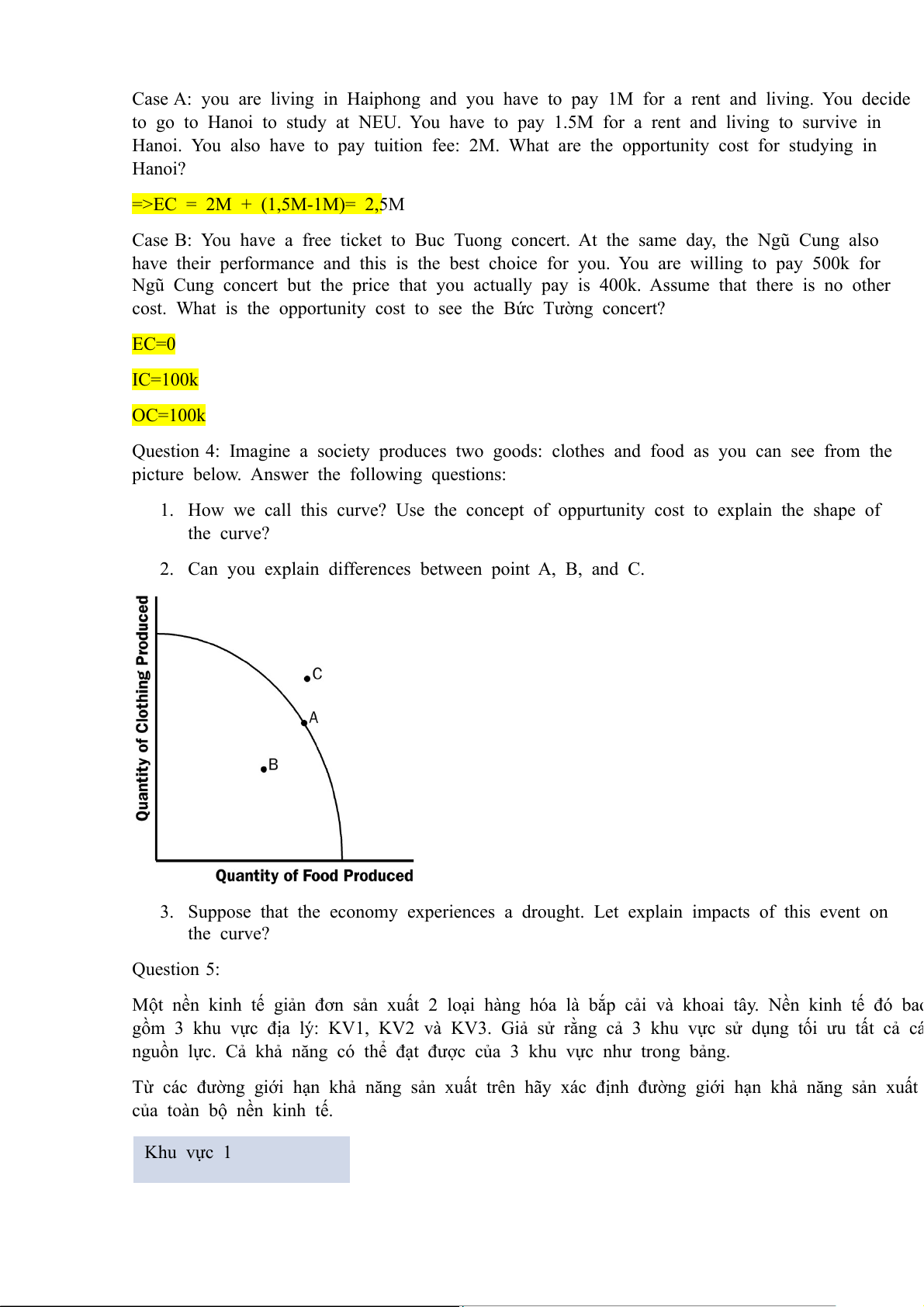
Case A: you are living in Haiphong and you have to pay 1M for a rent and living. You decide
to go to Hanoi to study at NEU. You have to pay 1.5M for a rent and living to survive in
Hanoi. You also have to pay tuition fee: 2M. What are the opportunity cost for studying in Hanoi? =>EC = 2M + (1,5M-1M)= 2,5M
Case B: You have a free ticket to Buc Tuong concert. At the same day, the Ngũ Cung also
have their performance and this is the best choice for you. You are willing to pay 500k for
Ngũ Cung concert but the price that you actually pay is 400k. Assume that there is no other
cost. What is the opportunity cost to see the Bức Tường concert? EC=0 IC=100k OC=100k
Question 4: Imagine a society produces two goods: clothes and food as you can see from the
picture below. Answer the following questions:
1. How we call this curve? Use the concept of oppurtunity cost to explain the shape of the curve?
2. Can you explain differences between point A, B, and C.
3. Suppose that the economy experiences a drought. Let explain impacts of this event on the curve? Question 5:
Một nền kinh tế giản đơn sản xuất 2 loại hàng hóa là bắp cải và khoai tây. Nền kinh tế đó bao
gồm 3 khu vực địa lý: KV1, KV2 và KV3. Giả sử rằng cả 3 khu vực sử dụng tối ưu tất cả cá
nguồn lực. Cả khả năng có thể đạt được của 3 khu vực như trong bảng.
Từ các đường giới hạn khả năng sản xuất trên hãy xác định đường giới hạn khả năng sản xuất
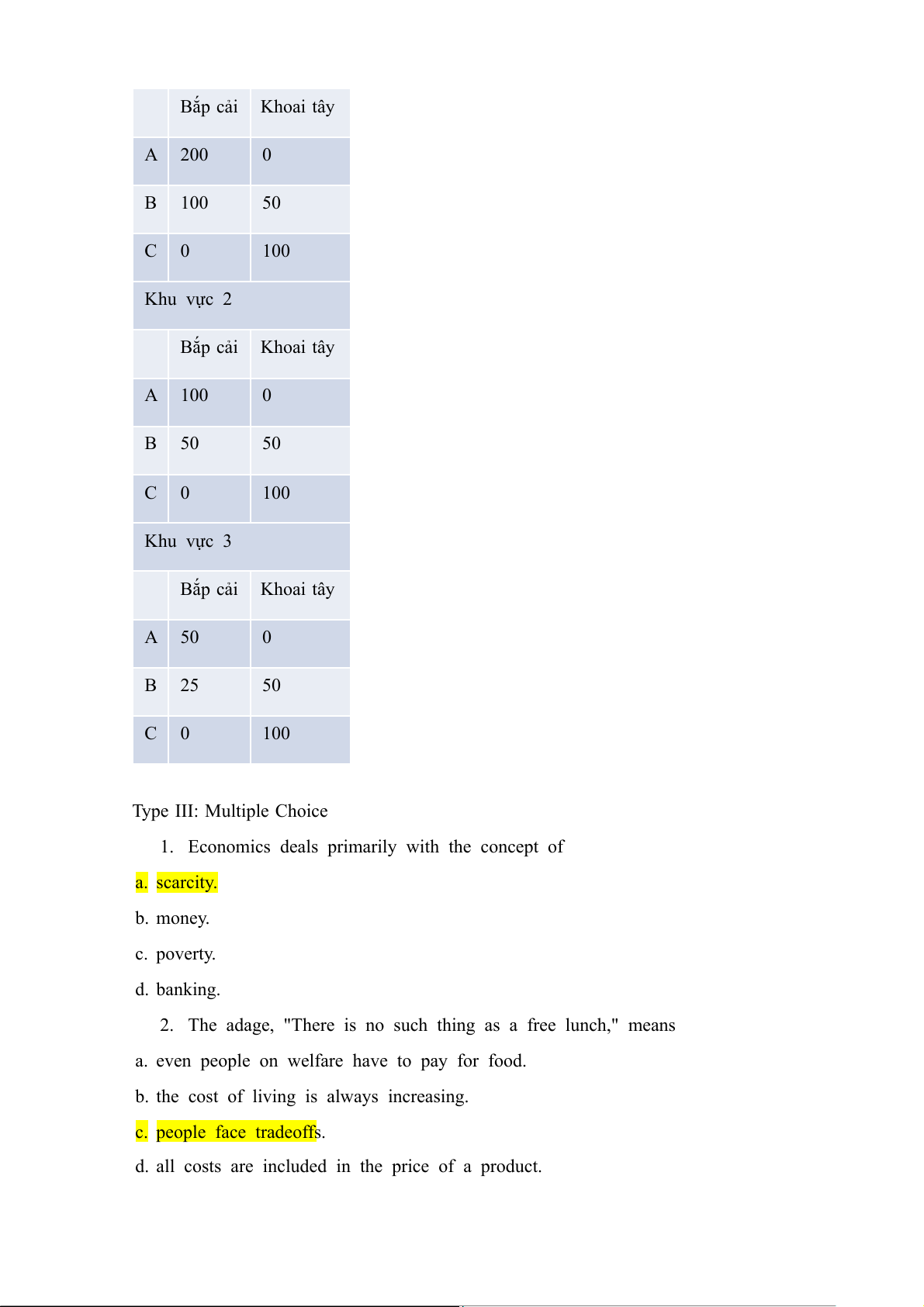
của toàn bộ nền kinh tế. Khu vực 1 Bắp cải Khoai tây A 200 0 B 100 50 C 0 100 Khu vực 2 Bắp cải Khoai tây A 100 0 B 50 50 C 0 100 Khu vực 3 Bắp cải Khoai tây A 50 0 B 25 50 C 0 100
Type III: Multiple Choice
1. Economics deals primarily with the concept of a. scarcity. b. money. c. poverty. d. banking.
2. The adage, "There is no such thing as a free lunch," means
a. even people on welfare have to pay for food.
b. the cost of living is always increasing. c. people face tradeoffs.
d. all costs are included in the price of a product.
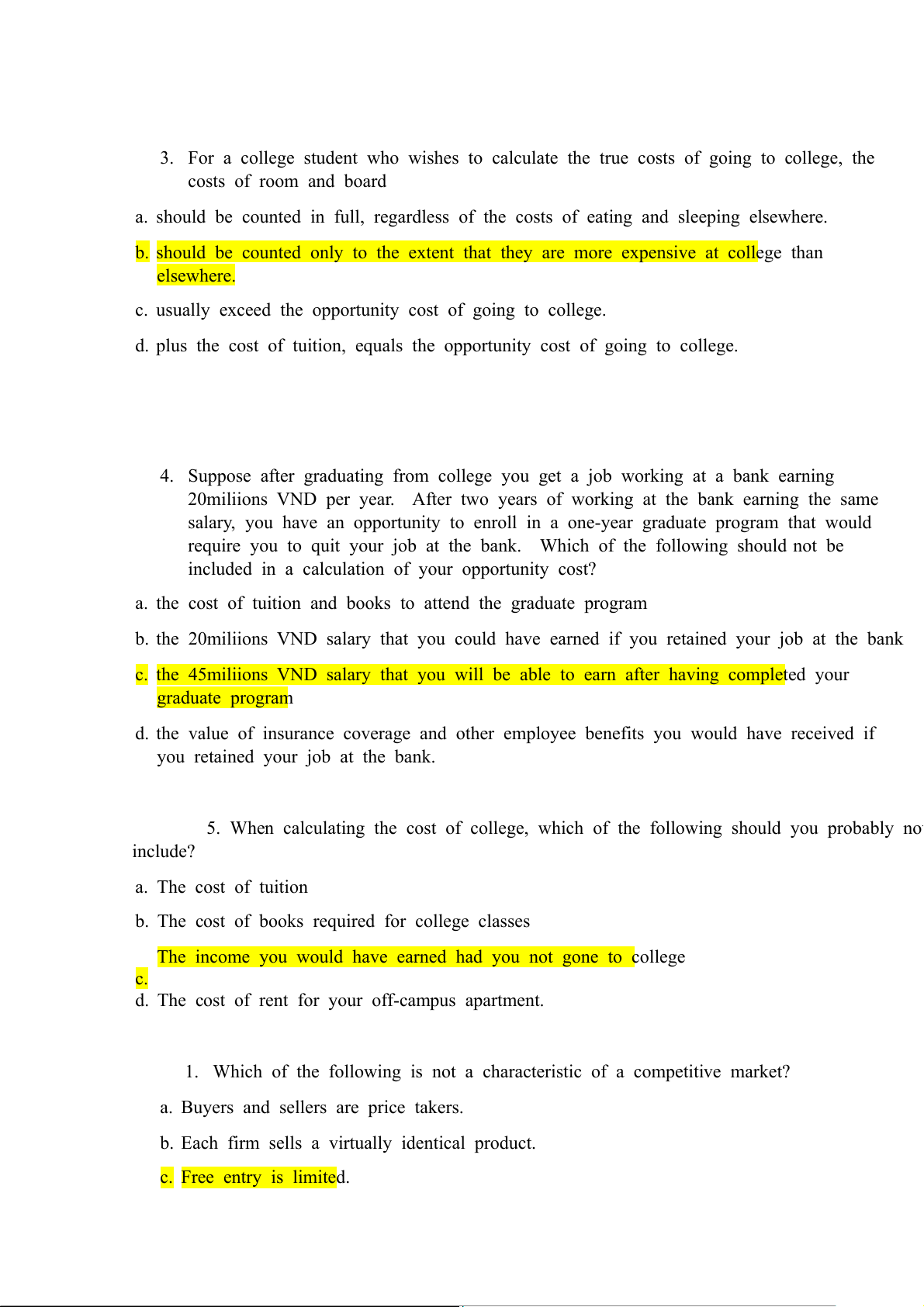
3. For a college student who wishes to calculate the true costs of going to college, the costs of room and board
a. should be counted in full, regardless of the costs of eating and sleeping elsewhere.
b. should be counted only to the extent that they are more expensive at college than elsewhere.
c. usually exceed the opportunity cost of going to college.
d. plus the cost of tuition, equals the opportunity cost of going to college.
4. Suppose after graduating from college you get a job working at a bank earning
20miliions VND per year. After two years of working at the bank earning the same
salary, you have an opportunity to enroll in a one-year graduate program that would
require you to quit your job at the bank. Which of the following should not be
included in a calculation of your opportunity cost?
a. the cost of tuition and books to attend the graduate program
b. the 20miliions VND salary that you could have earned if you retained your job at the bank
c. the 45miliions VND salary that you will be able to earn after having completed your graduate program
d. the value of insurance coverage and other employee benefits you would have received if
you retained your job at the bank.
5. When calculating the cost of college, which of the following should you probably not include? a. The cost of tuition
b. The cost of books required for college classes
The income you would have earned had you not gone to college c.
d. The cost of rent for your off-campus apartment.
1. Which of the following is not a characteristic of a competitive market?
a. Buyers and sellers are price takers.
b. Each firm sells a virtually identical product. c. Free entry is limited.
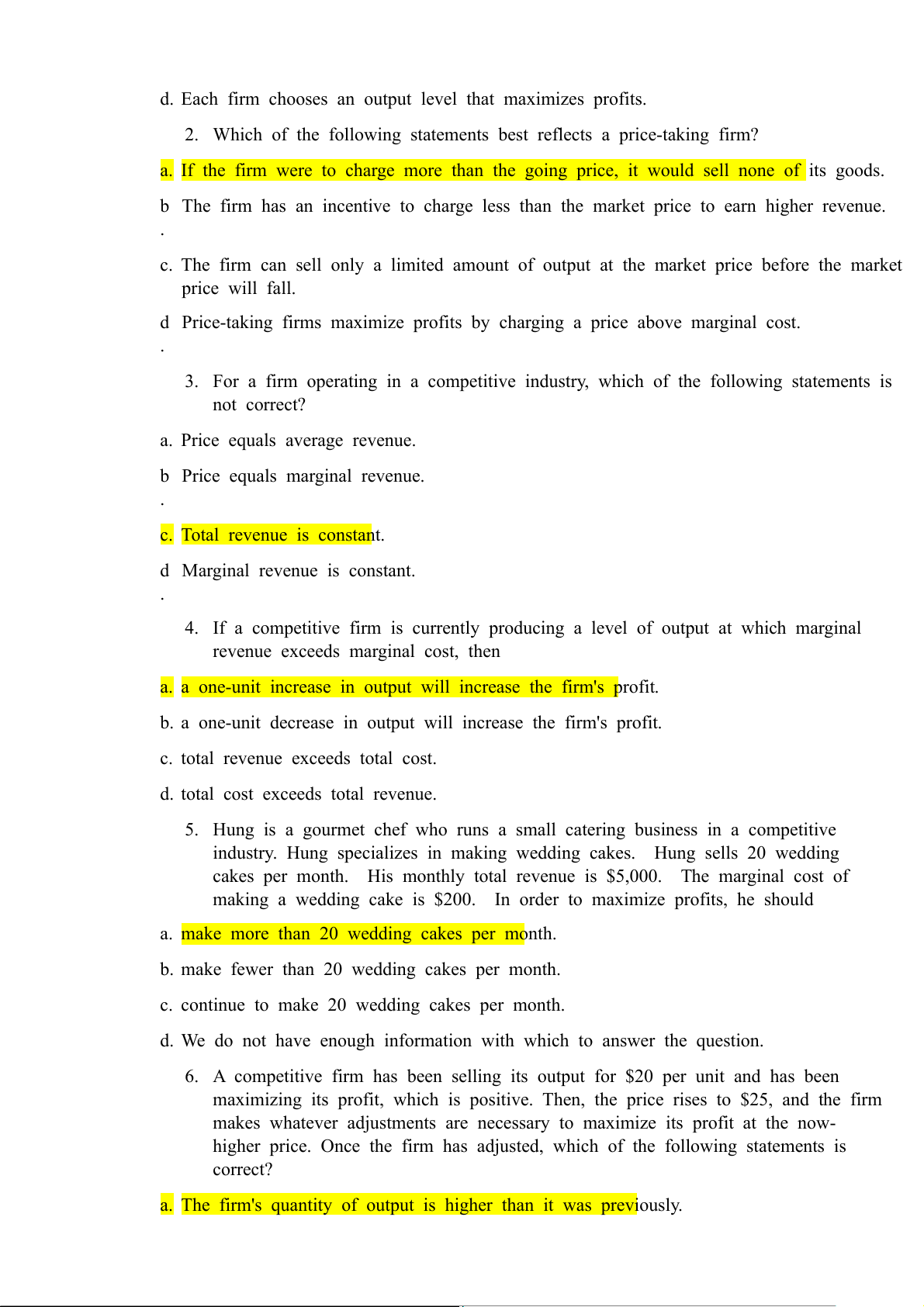
d. Each firm chooses an output level that maximizes profits.
2. Which of the following statements best reflects a price-taking firm?
a. If the firm were to charge more than the going price, it would sell none of its goods.
b The firm has an incentive to charge less than the market price to earn higher revenue. .
c. The firm can sell only a limited amount of output at the market price before the market price will fall.
d Price-taking firms maximize profits by charging a price above marginal cost. .
3. For a firm operating in a competitive industry, which of the following statements is not correct?
a. Price equals average revenue.
b Price equals marginal revenue. . c. Total revenue is constant.
d Marginal revenue is constant. .
4. If a competitive firm is currently producing a level of output at which marginal
revenue exceeds marginal cost, then
a. a one-unit increase in output will increase the firm's profit.
b. a one-unit decrease in output will increase the firm's profit.
c. total revenue exceeds total cost.
d. total cost exceeds total revenue.
5. Hung is a gourmet chef who runs a small catering business in a competitive
industry. Hung specializes in making wedding cakes. Hung sells 20 wedding
cakes per month. His monthly total revenue is $5,000. The marginal cost of
making a wedding cake is $200. In order to maximize profits, he should
a. make more than 20 wedding cakes per month.
b. make fewer than 20 wedding cakes per month.
c. continue to make 20 wedding cakes per month.
d. We do not have enough information with which to answer the question.
6. A competitive firm has been selling its output for $20 per unit and has been
maximizing its profit, which is positive. Then, the price rises to $25, and the firm
makes whatever adjustments are necessary to maximize its profit at the now-
higher price. Once the firm has adjusted, which of the following statements is correct?
a. The firm's quantity of output is higher than it was previously.
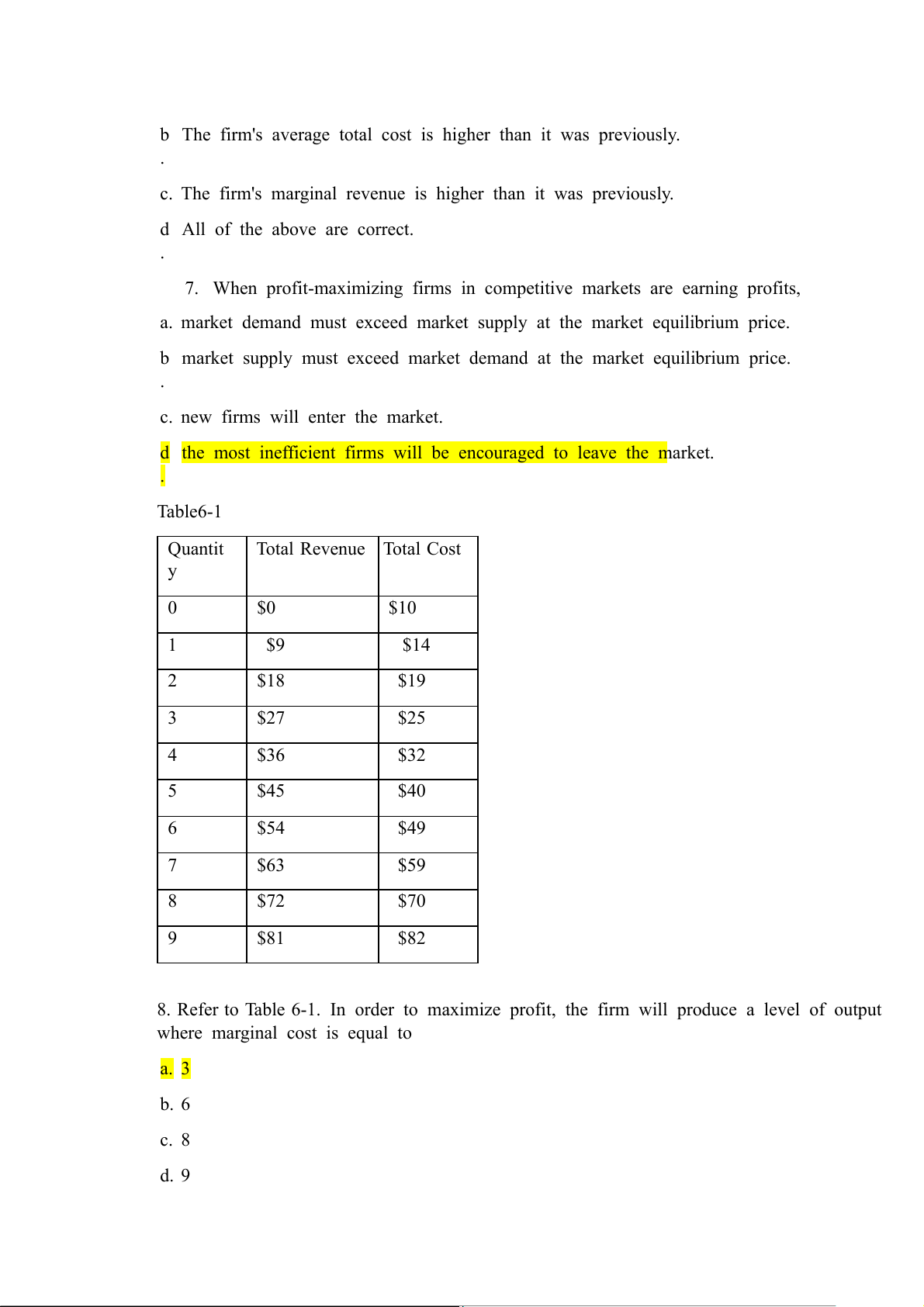
b The firm's average total cost is higher than it was previously. .
c. The firm's marginal revenue is higher than it was previously.
d All of the above are correct. .
7. When profit-maximizing firms in competitive markets are earning profits,
a. market demand must exceed market supply at the market equilibrium price.
b market supply must exceed market demand at the market equilibrium price. .
c. new firms will enter the market.
d the most inefficient firms will be encouraged to leave the market. . Table 6-1 Quantit
Total Revenue Total Cost y 0 $0 $10 1 $9 $14 2 $18 $19 3 $27 $25 4 $36 $32 5 $45 $40 6 $54 $49 7 $63 $59 8 $72 $70 9 $81 $82
8. Refer to Table 6-1. In order to maximize profit, the firm will produce a level of output
where marginal cost is equal to a. 3 b. 6 c. 8 d. 9
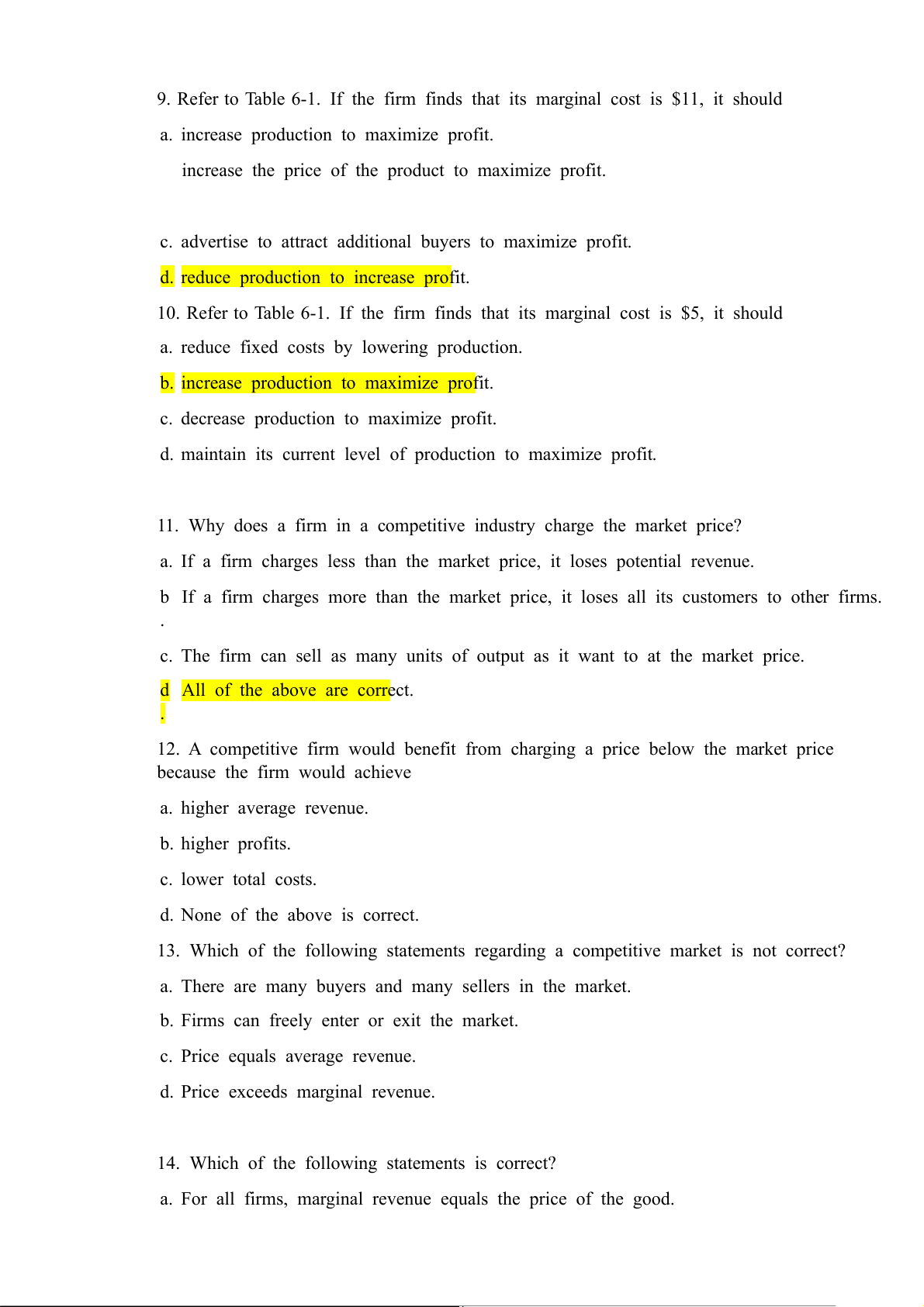
9. Refer to Table 6-1. If the firm finds that its marginal cost is $11, it should
a. increase production to maximize profit.
increase the price of the product to maximize profit.
c. advertise to attract additional buyers to maximize profit.
d. reduce production to increase profit.
10. Refer to Table 6-1. If the firm finds that its marginal cost is $5, it should
a. reduce fixed costs by lowering production.
b. increase production to maximize profit.
c. decrease production to maximize profit.
d. maintain its current level of production to maximize profit.
11. Why does a firm in a competitive industry charge the market price?
a. If a firm charges less than the market price, it loses potential revenue.
b If a firm charges more than the market price, it loses all its customers to other firms. .
c. The firm can sell as many units of output as it want to at the market price.
d All of the above are correct. .
12. A competitive firm would benefit from charging a price below the market price
because the firm would achieve a. higher average revenue. b. higher profits. c. lower total costs.
d. None of the above is correct.
13. Which of the following statements regarding a competitive market is not correct?
a. There are many buyers and many sellers in the market.
b. Firms can freely enter or exit the market.
c. Price equals average revenue.
d. Price exceeds marginal revenue.
14. Which of the following statements is correct?
a. For all firms, marginal revenue equals the price of the good.
b. Only for competitive firms does average revenue equal the price of the good.
c. Marginal revenue can be calculated as total revenue divided by the quantity sold.
d. Only for competitive firms does average revenue equal marginal revenue.
15. If a firm in a perfectly competitive market triples the number of units of output sold, then total revenue will a. more than triple. b less than triple. . c. exactly triple.
d Any of the above may be true depending on the firm’s labor productivity. .
16. Which of the following statements best expresses a firm’s profit-maximizing decision rule?
a. If marginal revenue is greater than marginal cost, the firm should increase its output.
b If marginal revenue is less than marginal cost, the firm should decrease its output. .
c. If marginal revenue equals marginal cost, the firm should continue producing its current level of output.
d All of the above are correct. .
17. Refer to Figure. If the market price is P1, in the short run, the perfectly competitive firm will earn a. positive economic profits.
b negative economic profits but will try to remain open. .
c. negative economic profits and will shut down. d zero economic profits. .
18. Refer to Figure. If the market price is P4, in the short run, the perfectly competitive firm will earn a. positive economic profits.
b negative economic profits but will try to remain open. .
c. negative economic profits and will shut down. d zero economic profits. .
19. Refer to Figure. Which of the four prices corresponds to a perfectly competitive firm
earning negative economic profits in the short run but trying to remain open? a. P1 b. P2 c. P3 d. P4
Table 5-1 Student service
Number of Workers Output (number of pet visits) 0 0 1 20 2 45 3 60 4 70
1. Refer to Table 5-1. What is the marginal product of the second worker? a.15 b.20 c.22.5 d.25
2. Refer to Table 5-1. What is the marginal product of the third worker? a.15 b.20 c.35 d.60
3. Refer to Table 5-1. Student’s service experiences diminishing marginal productivity with the addition of the a.first worker. b.second worker. c.third worker. d.fourth worker.
4. Refer to Table 5-1. Suppose that Student’s service has a fixed cost of $50 per month for her
cell phone. Each worker costs Student $60 per day. What is the shape of Student’s total cost
curve as output increases from 0 and 45?
a.Total cost increases but gets flatter.
b.Total cost increases and gets steeper.
c.Total cost decreases and gets flatter.
d.Total cost decreases but gets steeper.
5. Refer to Table 5-1. Suppose that Student’s service has a fixed cost of $50 per month for her
cell phone. Each worker costs Student $60 per day. What is the shape of Student’s total cost
curve as output increases from 45 to 70?
a.Total cost increases but gets flatter.
b.Total cost increases and gets steeper.
c.Total cost decreases and gets flatter.
d.Total cost decreases but gets steeper.
6. Let L represent the number of workers hired by a firm and let Q represent that firm's
quantity of output. Assume two points on the firm's production function are (L = 12, Q = 122)
and (L = 13, Q = 132). Then the marginal product of the 13th worker is a.8 units of output. b.10 units of output. c.122 units of output. d.132 units of output.
7. For a large firm that produces and sells automobiles, which of the following costs would be a variable cost?
a.the unemployment insurance premium that the firm pays to the state of Missouri that is
calculated based on the number of worker-hours that the firm uses
b.the cost of the steel that is used in producing automobiles
c.the cost of the electricity of running the machines on the factory floor
d.All of the above are correct.
8. Suppose that for a particular firm the only variable input into the production process is
labor and that output equals zero when no workers are hired. In addition, suppose that when
four units of output are produced, the total cost is $175, and the average variable cost is
$33.75. What would the average fixed cost be if ten units were produced? a.$4 b.$10 c.$40 d.$135 Table 5.2
Quantity of Output Fixed Variable Cost Cost 0 $20 $0 1 $20 $10 2 $20 $40 3 $20 $80 4 $20 $130 5 $20 $200 6 $20 $300
9. Refer to Table 5-2. What is the average fixed cost of producing 5 units of output? a.$4 b.$5 c.$40 d.$44
10. Refer to Table 5-2. What is the marginal cost of producing the fifth unit of output? a.$4 b.$40 c.$50 d.$70
1. When studying how some event or policy affects a market, elasticity provides information on the
a. equity effects on the market by identifying the winners and losers.
b. magnitude of the effect on the market.
c. speed of adjustment of the market in response to the event or policy.
d. number of market participants who are directly affected by the event or policy.
2. When consumers face rising gasoline prices, they typically
a. reduce their quantity demanded more in the long run than in the short run.
b. reduce their quantity demanded more in the short run than in the long run.
c. do not reduce their quantity demanded in the short run or the long run.
d. increase their quantity demanded in the short run but reduce their quantity demanded in the long run.
3. Which of the following statements about the consumers’ responses to rising gasoline prices is correct?
a. About 10 percent of the long-run reduction in quantity demanded arises because people
drive less and about 90 percent arises because they switch to more fuel-efficient cars.
b. About 90 percent of the long-run reduction in quantity demanded arises because people
drive less and about 10 percent arises because they switch to more fuel-efficient cars.
c. About half of the long-run reduction in quantity demanded arises because people drive
less and about half arises because they switch to more fuel-efficient cars.
d. Because gasoline is a necessity, consumers do not decrease their quantity demanded in
either the short run or the long run.
4. For which of the following goods would demand be most elastic? a. clothing b. blue jeans c. Tommy Hilfiger jeans
d. All three would have the same elasticity of demand since they are all related.
5. For a particular good, a 2 percent increase in price causes a 12 percent decreas
quantity demanded. Which of the following statements is most likely applicable to this good?
a. There are no close substitutes for this good. b. The good is a luxury.
c. The market for the good is broadly defined.
d. The relevant time horizon is short.
6. The smaller the price elasticity of demand, the
a. steeper the demand curve will be through a given point.
b. flatter the demand curve will be through a given point.
c. more strongly buyers respond to a change in price between any two prices P1 and P .2
d. smaller the decrease in equilibrium price when the supply curve shifts rightward from S 1 to S .2
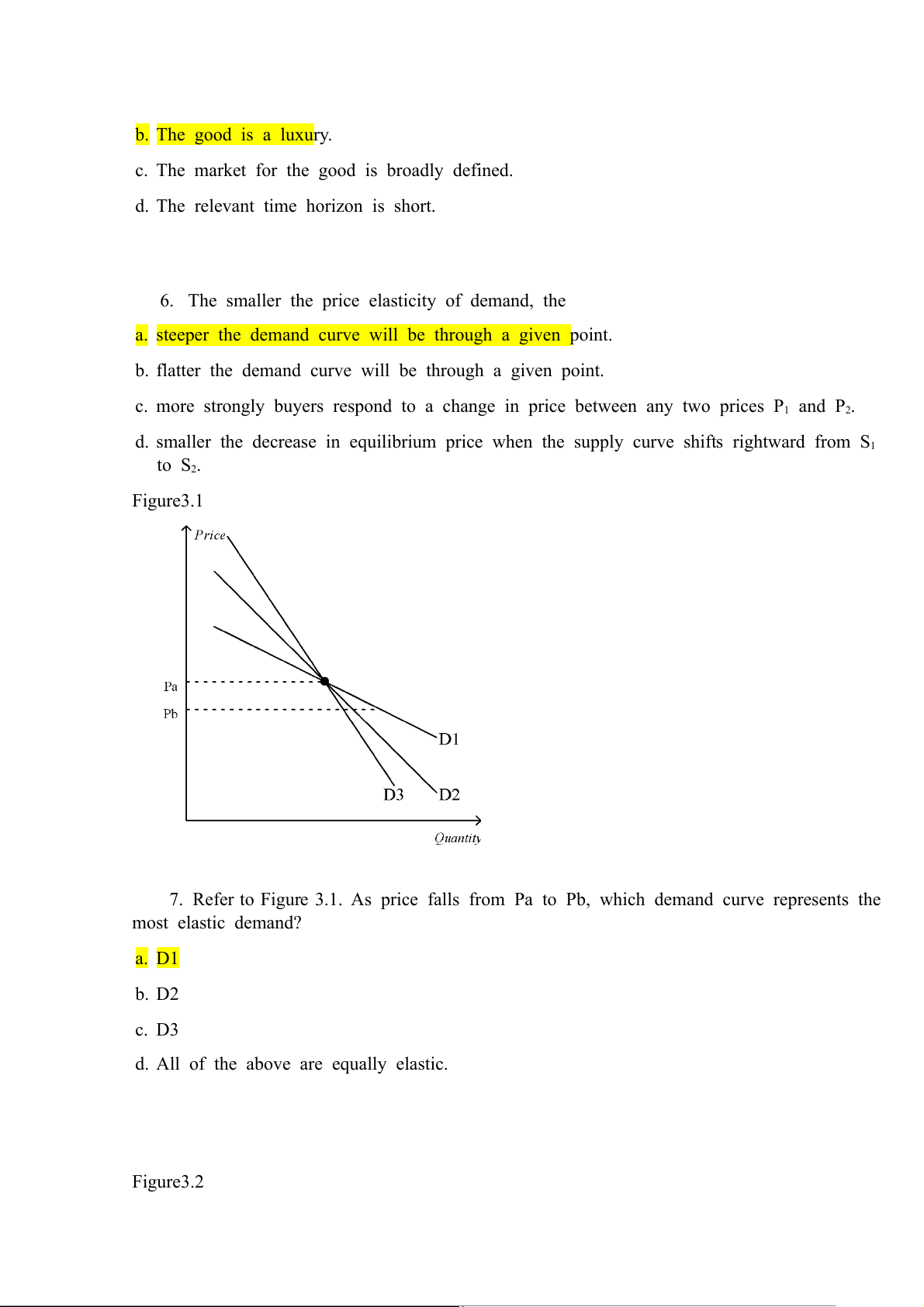
Figure 3.1
7. Refer to Figure 3.1. As price falls from Pa to Pb, which demand curve represents the most elastic demand? a. D1 b. D2 c. D3
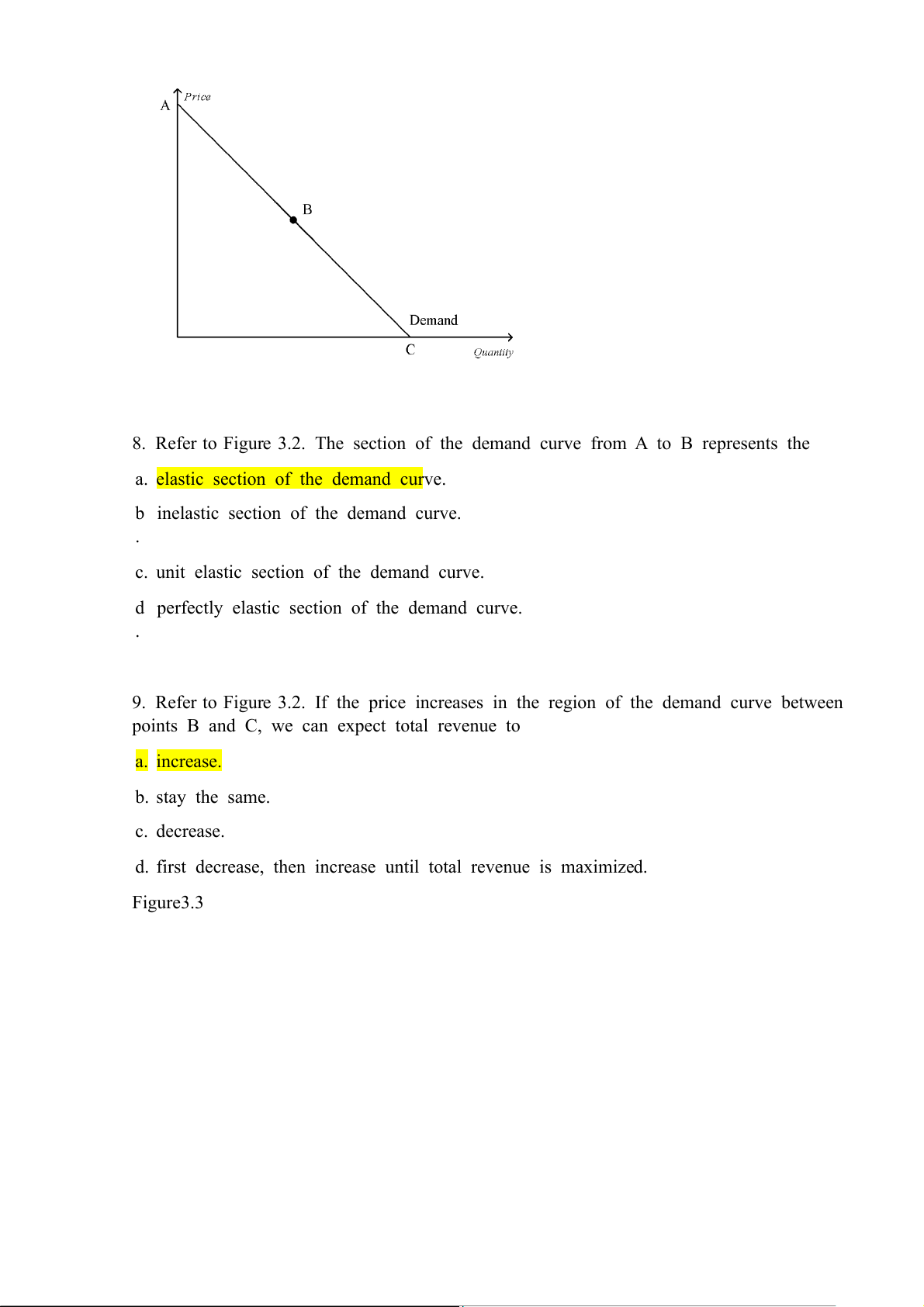
d. All of the above are equally elastic. Figure 3.2
8. Refer to Figure 3.2. The section of the demand curve from A to B represents the
a. elastic section of the demand curve.
b inelastic section of the demand curve. .
c. unit elastic section of the demand curve.
d perfectly elastic section of the demand curve. .
9. Refer to Figure 3.2. If the price increases in the region of the demand curve between
points B and C, we can expect total revenue to a. increase. b. stay the same. c. decrease.
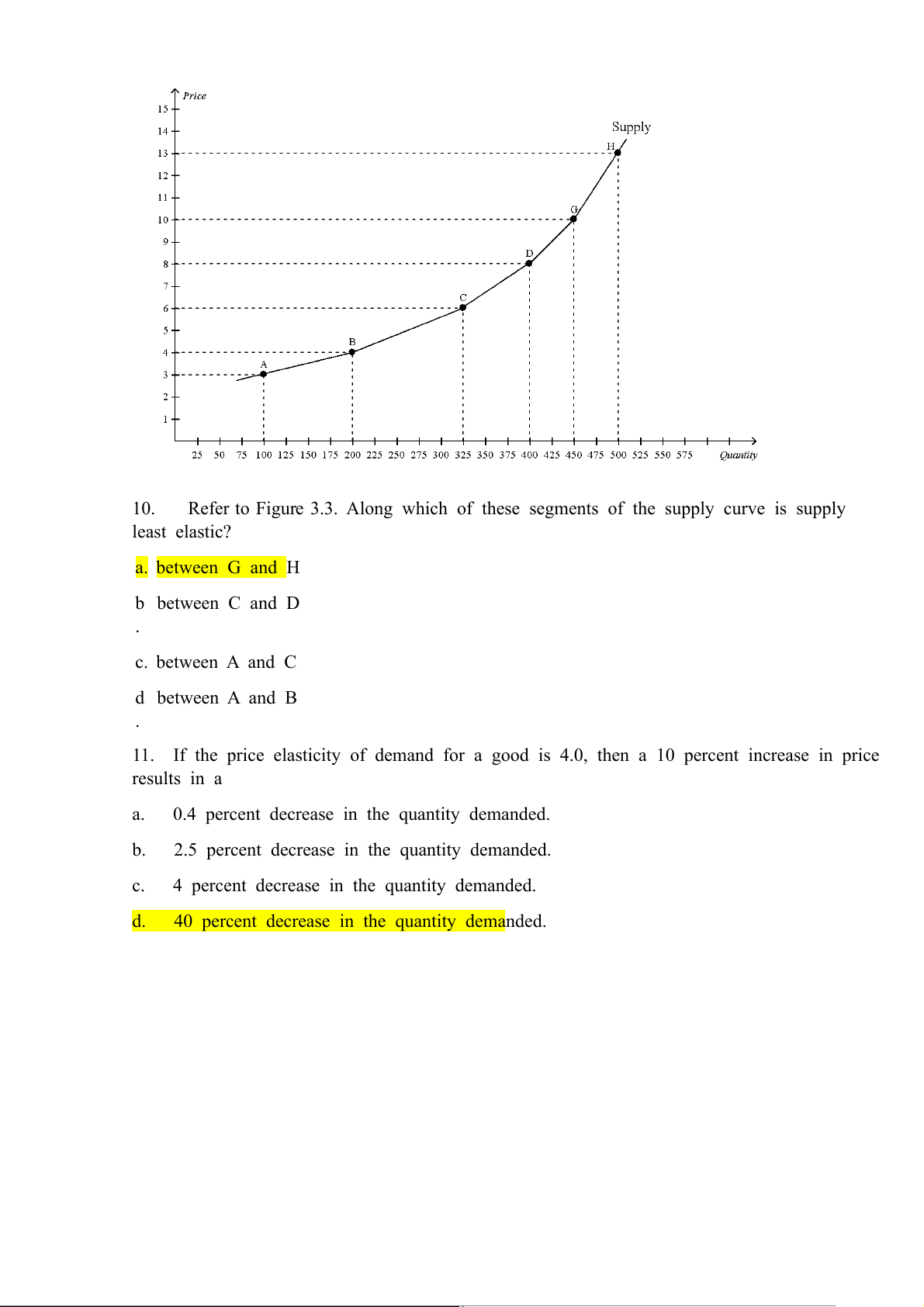
d. first decrease, then increase until total revenue is maximized. Figure 3.3 10.
Refer to Figure 3.3. Along which of these segments of the supply curve is supply least elastic? a. between G and H b between C and D . c. between A and C d between A and B .
11. If the price elasticity of demand for a good is 4.0, then a 10 percent increase in price results in a
a. 0.4 percent decrease in the quantity demanded.
b. 2.5 percent decrease in the quantity demanded.
c. 4 percent decrease in the quantity demanded.
d. 40 percent decrease in the quantity demanded.
Tài liệu liên quan:
-
Tự Luận Vimo: Phân Tích Cung, Cầu và Thị Trường Cạnh Tranh| Microeconomics | Trường Đại học Quốc tế, Đại học Quốc gia Thành phố Hồ Chí Minh
5 3 -
Review Questions: Thinking Like an Economist | Microeconomics | Trường Đại học Quốc tế, Đại học Quốc gia Thành phố Hồ Chí Minh
5 3 -
Final Exam Quizlet Questions & Answers | Microeconomics | Trường Đại học Quốc tế, Đại học Quốc gia Thành phố Hồ Chí Minh
5 3 -
Đề thi giữa kỳ II | Microeconomics | Trường Đại học Quốc tế, Đại học Quốc gia Thành phố Hồ Chí Minh
5 3 -

Final Group Project_ The Beer Industry | Microeconomics | Trường Đại học Quốc tế, Đại học Quốc gia Thành phố Hồ Chí Minh
4 2