Understanding Interdependence & Gains from Trade | Microeconomics | Trường Đại học Quốc tế, Đại học Quốc gia Thành phố Hồ Chí Minh
Look for the answers to these questions: • Why do people – and nations – choose to be economically interdependent? • How can trade make everyone better off? • What is absolute advantage? • What is comparative advantage? • How are these concepts similar? • How are they different? Tài liệu được sưu tầm và soạn thảo dưới dạng file PDF để gửi tới các bạn cùng tham khảo, ôn tập đầy đủ kiến thức, chuẩn bị cho các buổi học thật tốt. Mời bạn đọc đón xem!
Môn: Microeconomics 613 tài liệu
Trường: Trường Đại học Quốc tế, Đại học Quốc gia Thành phố Hồ Chí Minh 1.9 K tài liệu
Tác giả:



Preview text:
N. GREGORY MANKIW PRINCIPLES OF ECONOMICS Eight Edition CHAPTER Interdependence and the Gains from Trade
© 2018 Cengage Learning®. May not be scanned, copied or duplicated, or posted to a publicly accessible website, in whole or in part, except for use
as permitted in a license distributed with a certain product or service or otherwise on a password-protected website or school-approved learning 1
management system for classroom use.
Look for the answers to these questions:
• Why do people – and nations – choose to
be economically interdependent?
• How can trade make everyone better off?
• What is absolute advantage?
• What is comparative advantage?
• How are these concepts similar? • How are they different?
© 2018 Cengage Learning®. May not be scanned, copied or duplicated, or posted to a publicly accessible website, in whole or in part, except for use
as permitted in a license distributed with a certain product or service or otherwise on a password-protected website or school-approved learning 2
management system for classroom use. Interdependence Every day you rely on many hair gel from people from Cleveland, OH around the world, most of cell phone whom you’ve from Taiwan never met, to dress shirt provide you from China with the goods and services you coffee from enjoy. Kenya
© 2018 Cengage Learning®. May not be scanned, copied or duplicated, or posted to a publicly accessible website, in whole or in part, except for use 3
as permitted in a license distributed with a certain product or service or otherwise on a password-protected website or school-approved learning
management system for classroom use. Interdependence
• – One of the Ten Principles from Chapter 1
– We now learn why people – and nations – choose to be interdependent
– And how they can gain from trade
© 2018 Cengage Learning®. May not be scanned, copied or duplicated, or posted to a publicly accessible website, in whole or in part, except for use 4
as permitted in a license distributed with a certain product or service or otherwise on a password-protected website or school-approved learning
management system for classroom use. ASK THE EXPERTS
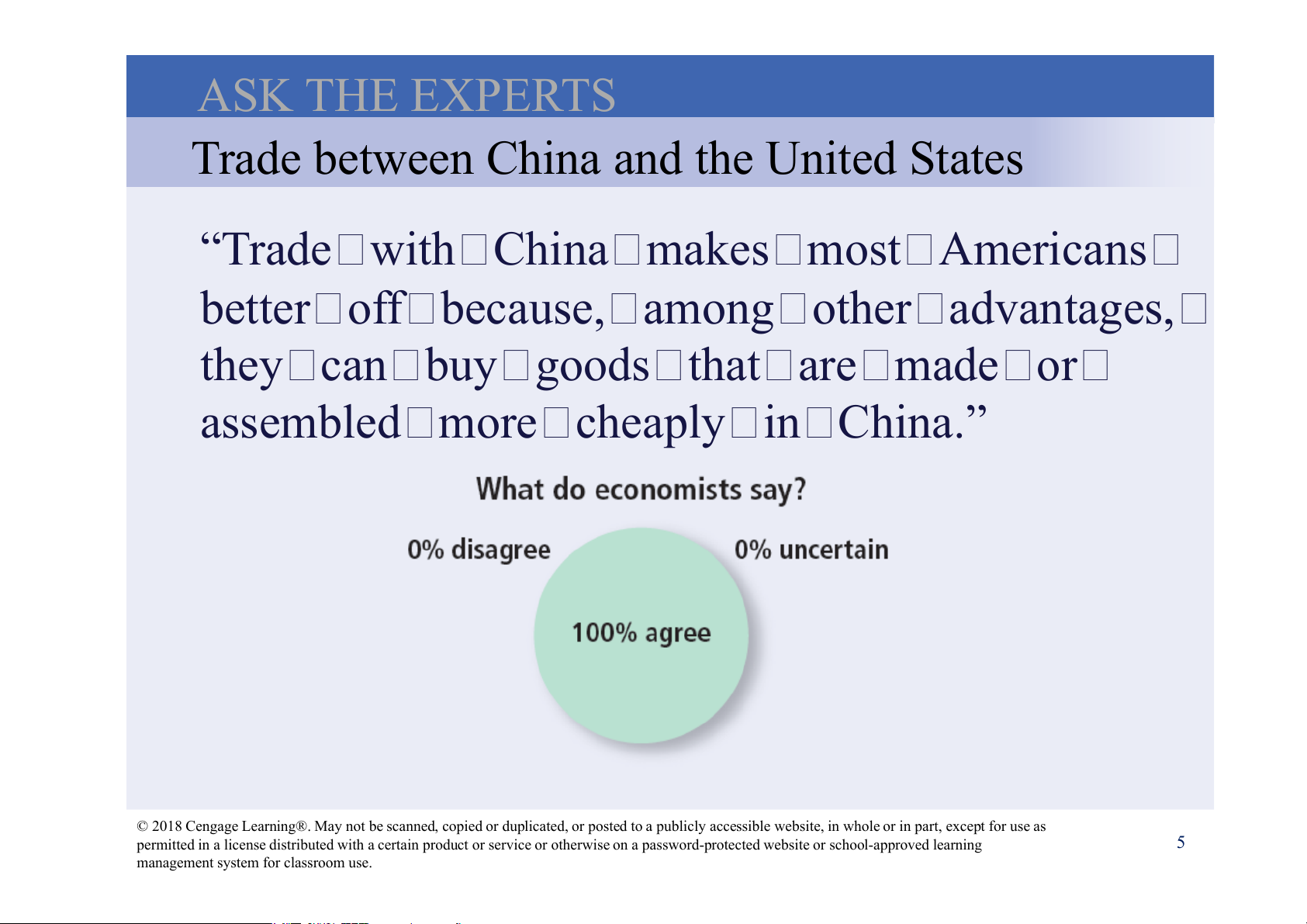
Trade between China and the United States
“Trade with China makes most Americans
better off because, among other advantages,
they can buy goods that are made or
assembled more cheaply in China.”
© 2018 Cengage Learning®. May not be scanned, copied or duplicated, or posted to a publicly accessible website, in whole or in part, except for use as
permitted in a license distributed with a certain product or service or otherwise on a password-protected website or school-approved learning 5
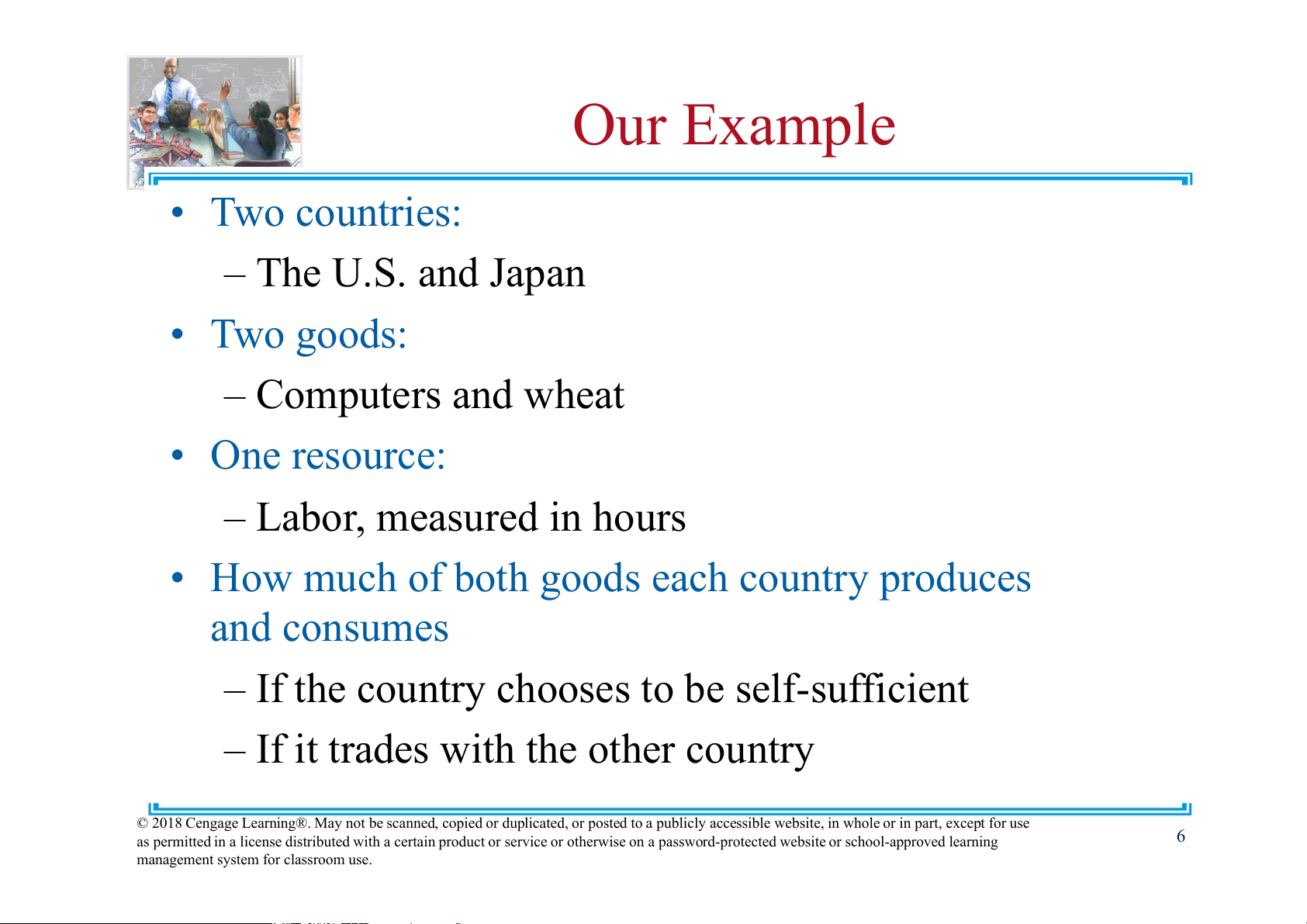
management system for classroom use. Our Example • Two countries: – The U.S. and Japan • Two goods: – Computers and wheat • One resource: – Labor, measured in hours
• How much of both goods each country produces and consumes
– If the country chooses to be self-sufficient
– If it trades with the other country
© 2018 Cengage Learning®. May not be scanned, copied or duplicated, or posted to a publicly accessible website, in whole or in part, except for use 6
as permitted in a license distributed with a certain product or service or otherwise on a password-protected website or school-approved learning
management system for classroom use. Our Example
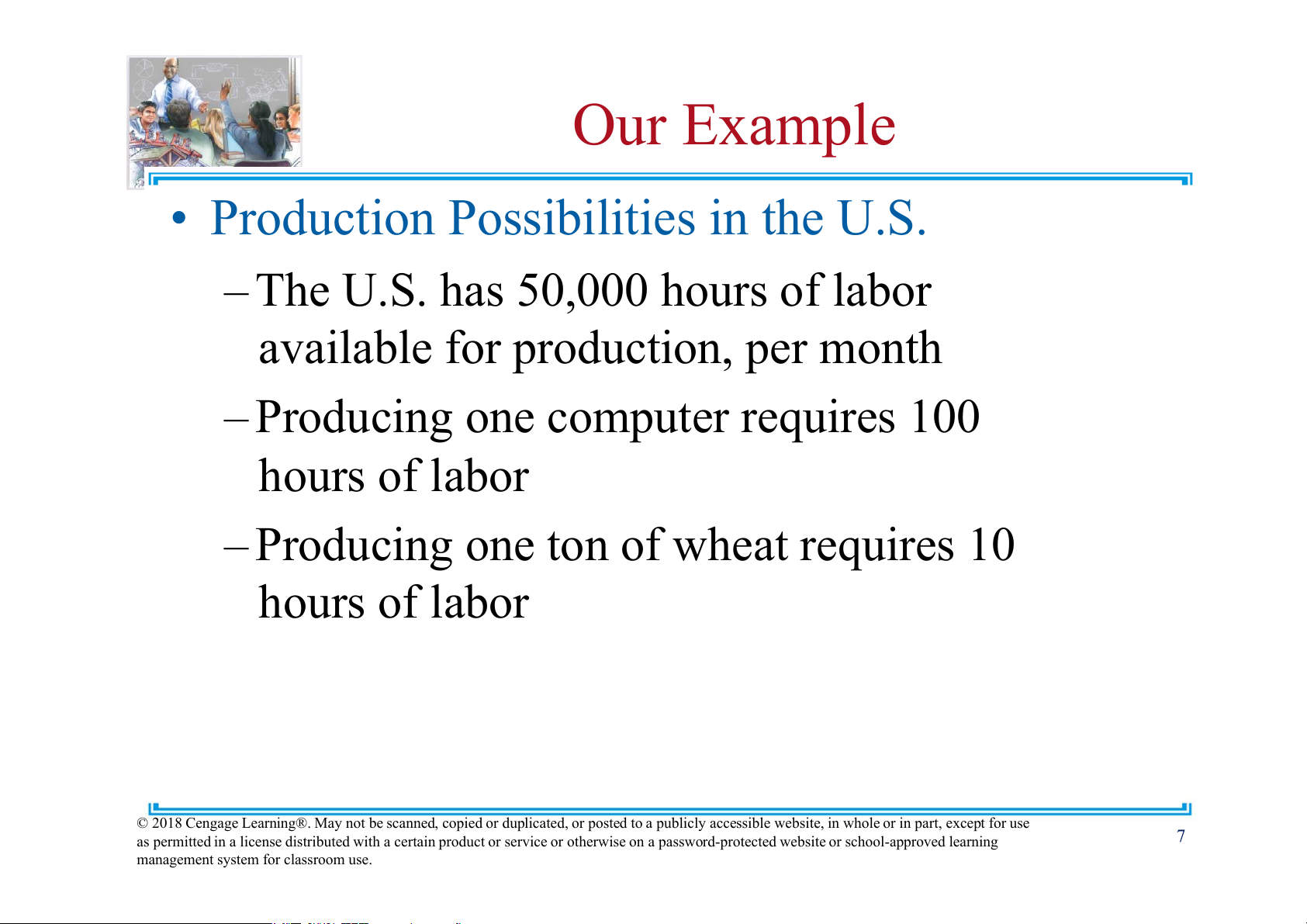
• Production Possibilities in the U.S.
– The U.S. has 50,000 hours of labor
available for production, per month
– Producing one computer requires 100 hours of labor
– Producing one ton of wheat requires 10 hours of labor
© 2018 Cengage Learning®. May not be scanned, copied or duplicated, or posted to a publicly accessible website, in whole or in part, except for use 7
as permitted in a license distributed with a certain product or service or otherwise on a password-protected website or school-approved learning
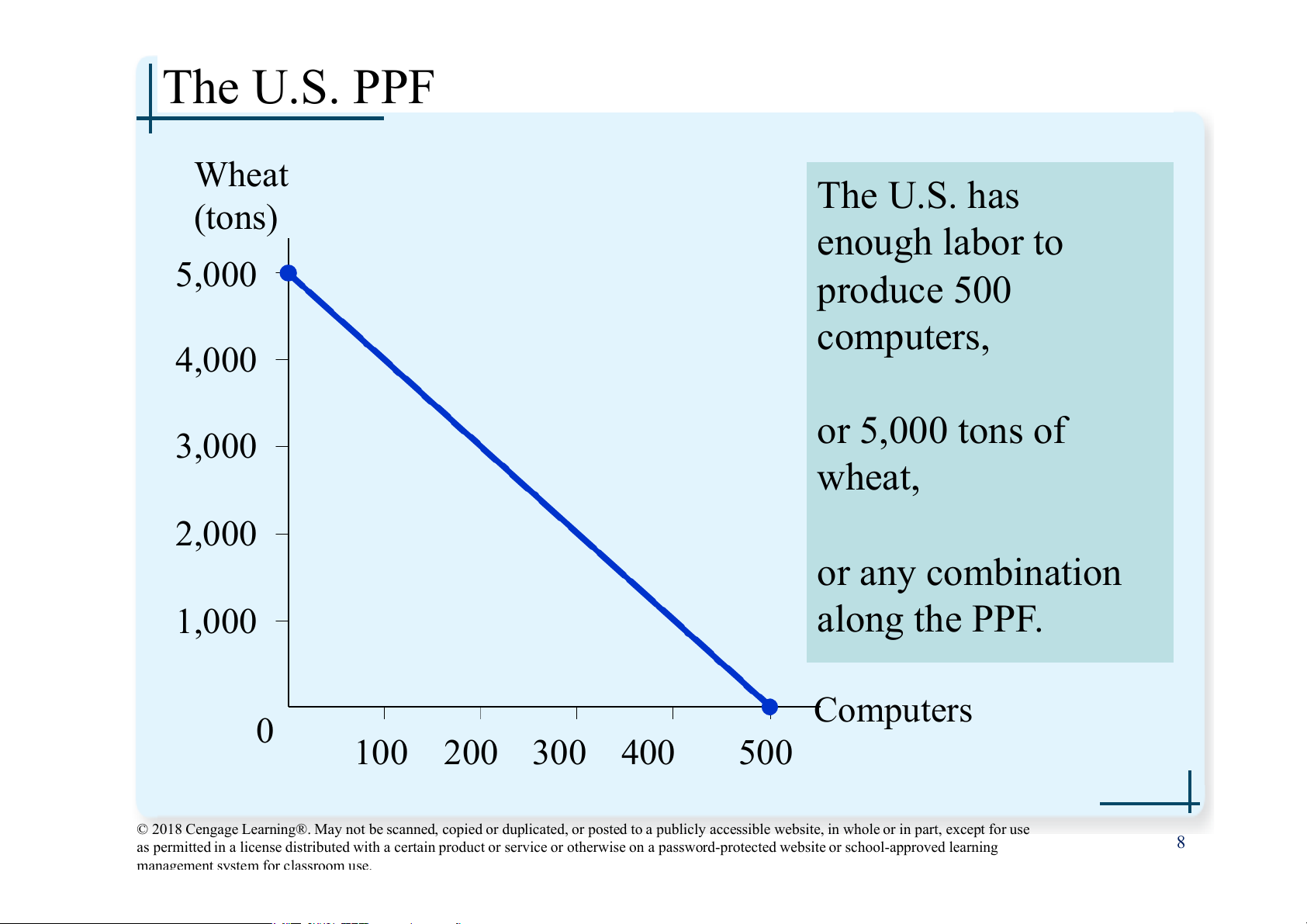
management system for classroom use. The U.S. PPF Wheat The U.S. has (tons) enough labor to 5,000 produce 500 computers, 4,000 or 5,000 tons of 3,000 wheat, 2,000 or any combination 1,000 along the PPF. Computers 0 100 200 300 400 500
© 2018 Cengage Learning®. May not be scanned, copied or duplicated, or posted to a publicly accessible website, in whole or in part, except for use 8
as permitted in a license distributed with a certain product or service or otherwise on a password-protected website or school-approved learning
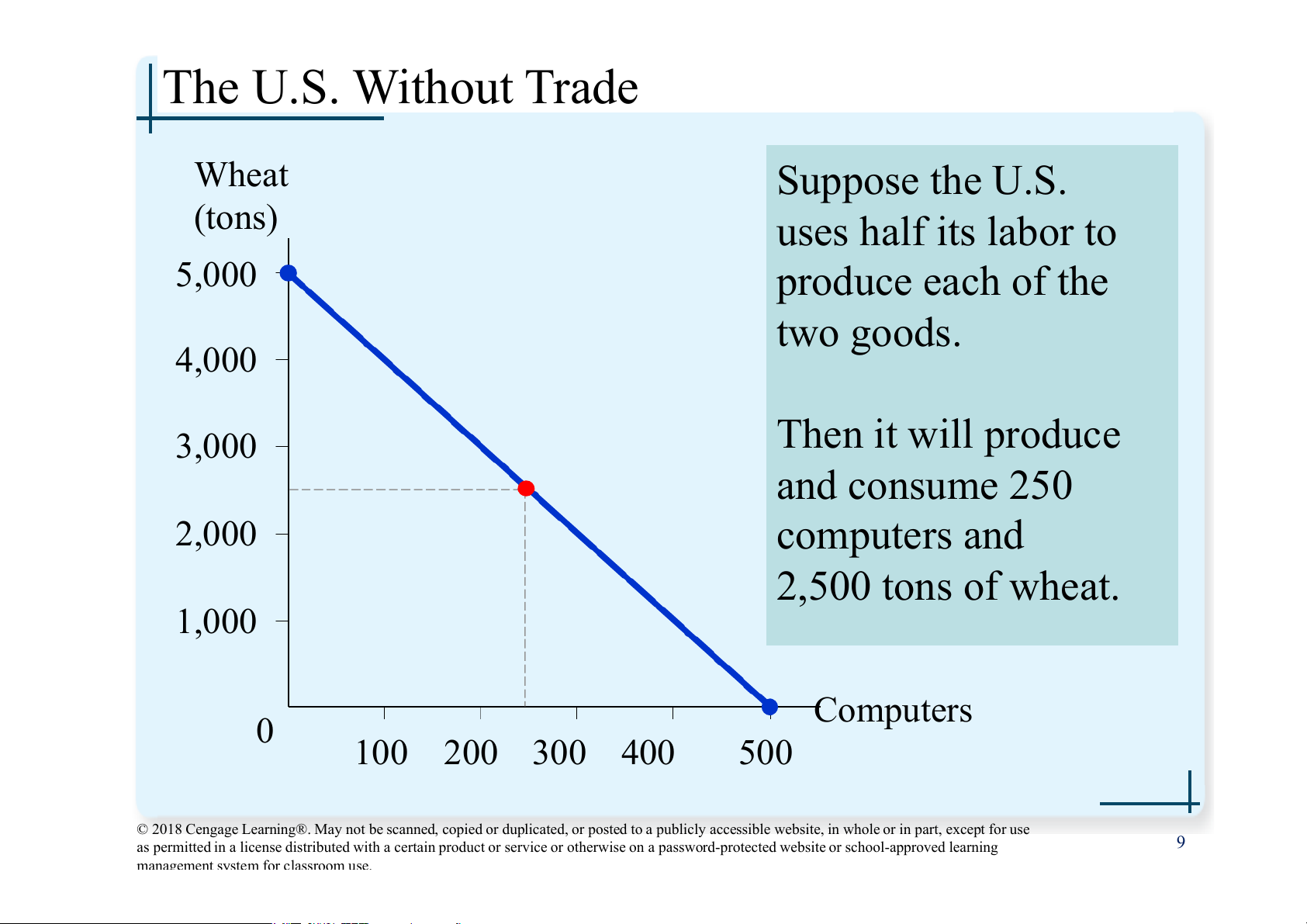
management system for classroom use. The U.S. Without Trade Wheat Suppose the U.S. (tons) uses half its labor to 5,000 produce each of the two goods. 4,000 Then it will produce 3,000 and consume 250 2,000 computers and 2,500 tons of wheat. 1,000 Computers 0 100 200 300 400 500
© 2018 Cengage Learning®. May not be scanned, copied or duplicated, or posted to a publicly accessible website, in whole or in part, except for use 9
as permitted in a license distributed with a certain product or service or otherwise on a password-protected website or school-approved learning
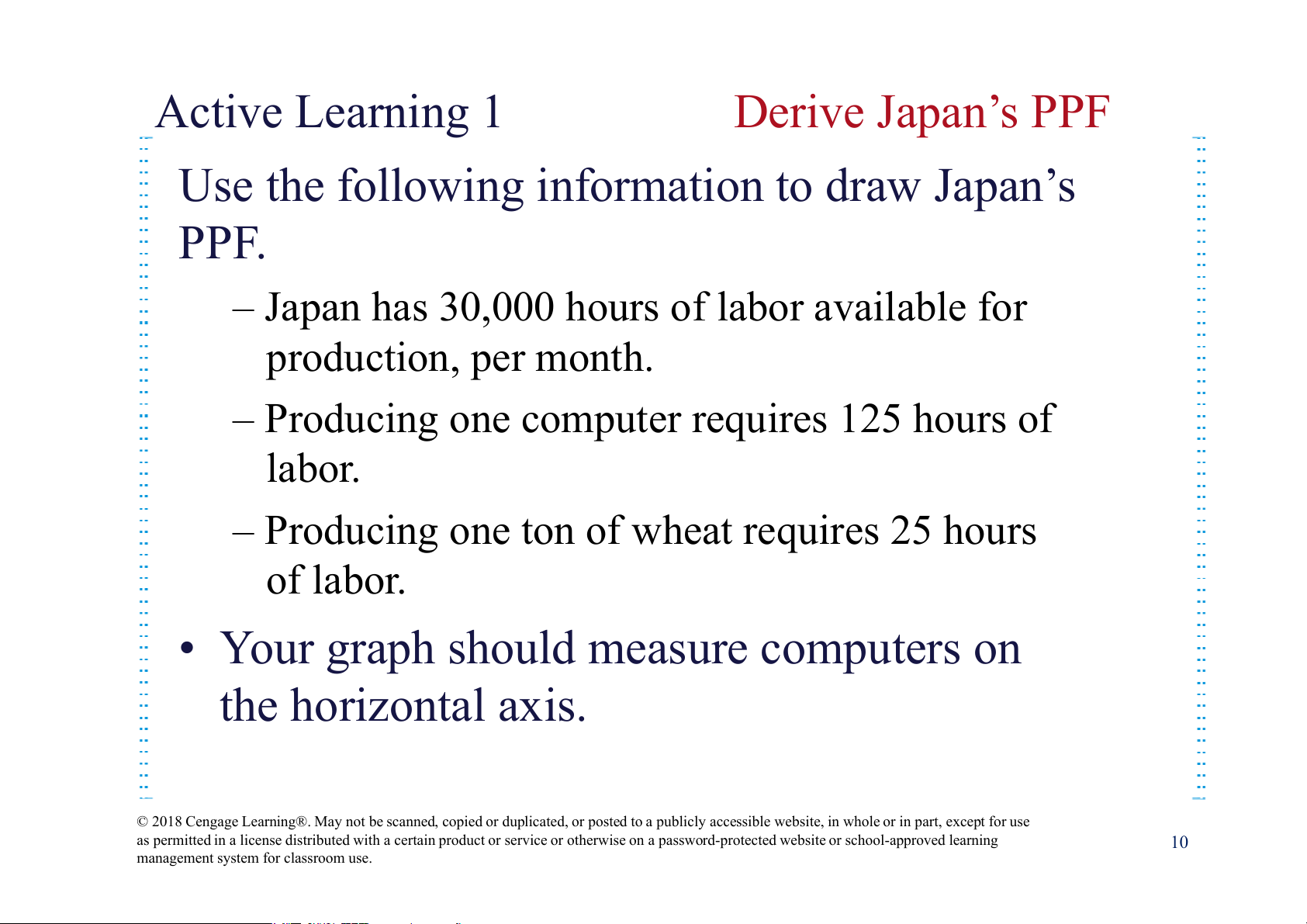
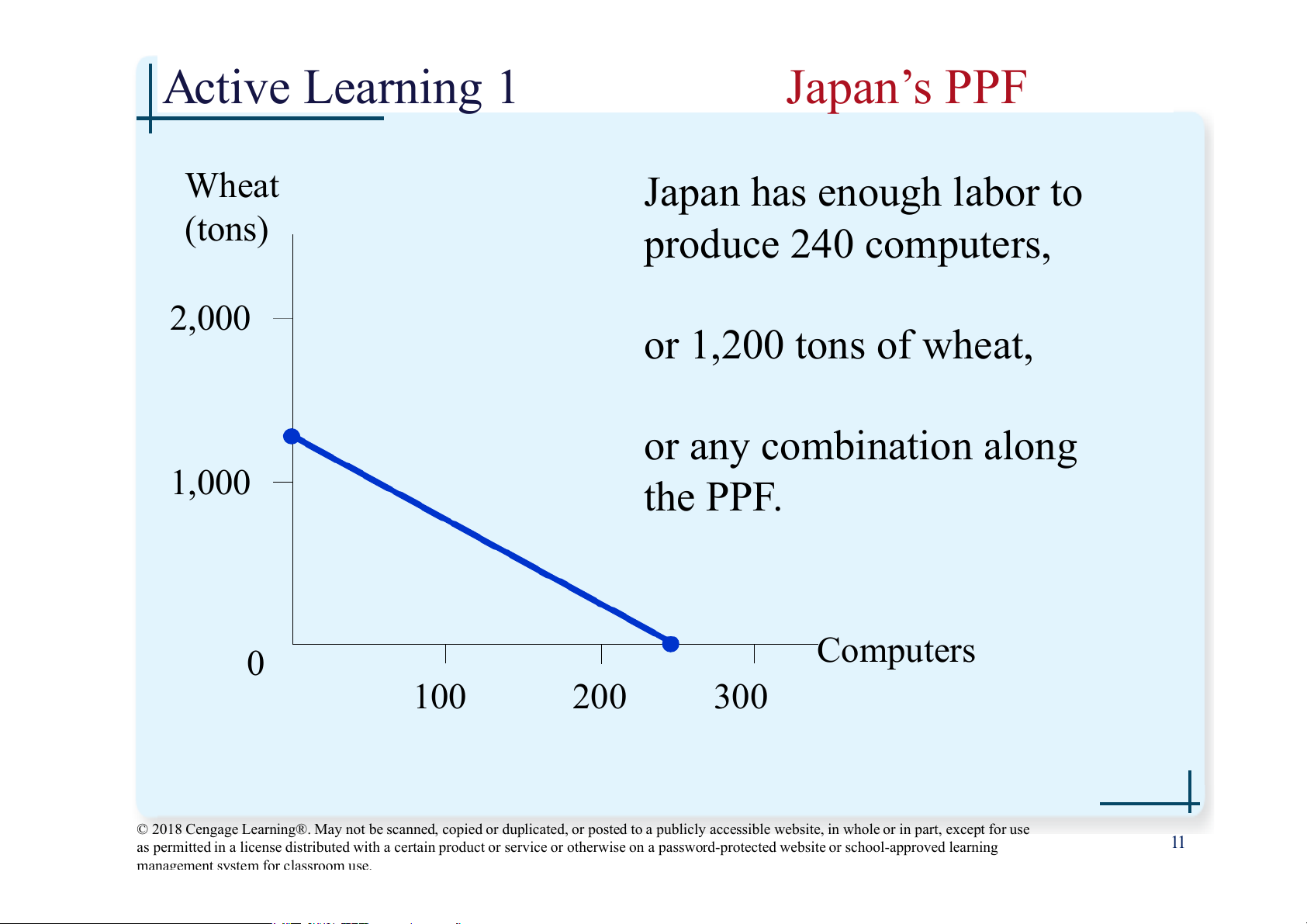
management system for classroom use. Active Learning 1 Derive Japan’s PPF
Use the following information to draw Japan’s PPF.
– Japan has 30,000 hours of labor available for production, per month.
– Producing one computer requires 125 hours of labor.
– Producing one ton of wheat requires 25 hours of labor.
• Your graph should measure computers on the horizontal axis.
© 2018 Cengage Learning®. May not be scanned, copied or duplicated, or posted to a publicly accessible website, in whole or in part, except for use
as permitted in a license distributed with a certain product or service or otherwise on a password-protected website or school-approved learning 10
management system for classroom use. Active Learning 1 Japan’s PPF Wheat Japan has enough labor to (tons) produce 240 computers, 2,000 or 1,200 tons of wheat, or any combination along 1,000 the PPF. Computers 0 100 200 300
© 2018 Cengage Learning®. May not be scanned, copied or duplicated, or posted to a publicly accessible website, in whole or in part, except for use 11
as permitted in a license distributed with a certain product or service or otherwise on a password-protected website or school-approved learning
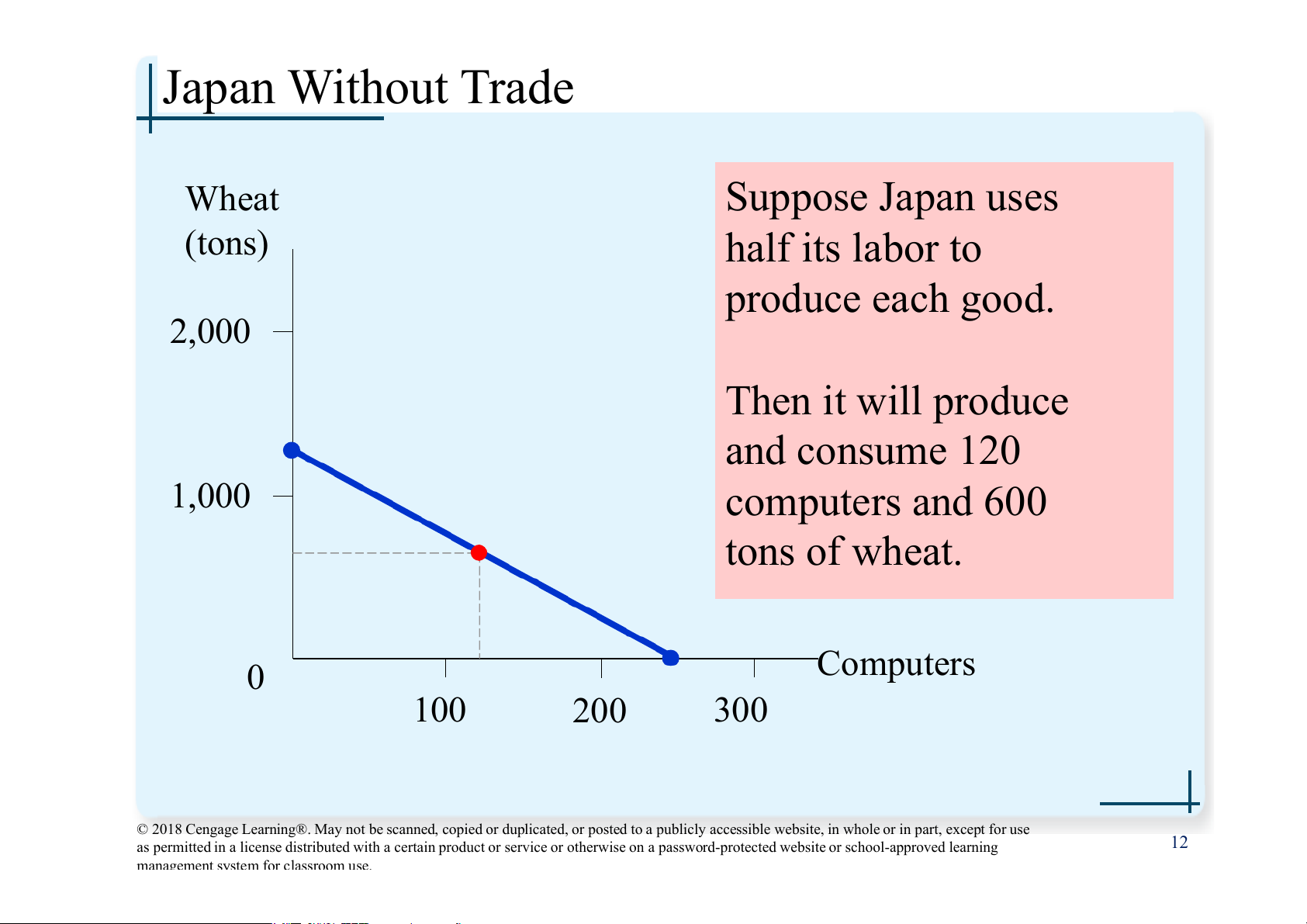
management system for classroom use. Japan Without Trade Wheat Suppose Japan uses (tons) half its labor to produce each good. 2,000 Then it will produce and consume 120 1,000 computers and 600 tons of wheat. Computers 0 100 200 300
© 2018 Cengage Learning®. May not be scanned, copied or duplicated, or posted to a publicly accessible website, in whole or in part, except for use 12
as permitted in a license distributed with a certain product or service or otherwise on a password-protected website or school-approved learning
management system for classroom use.
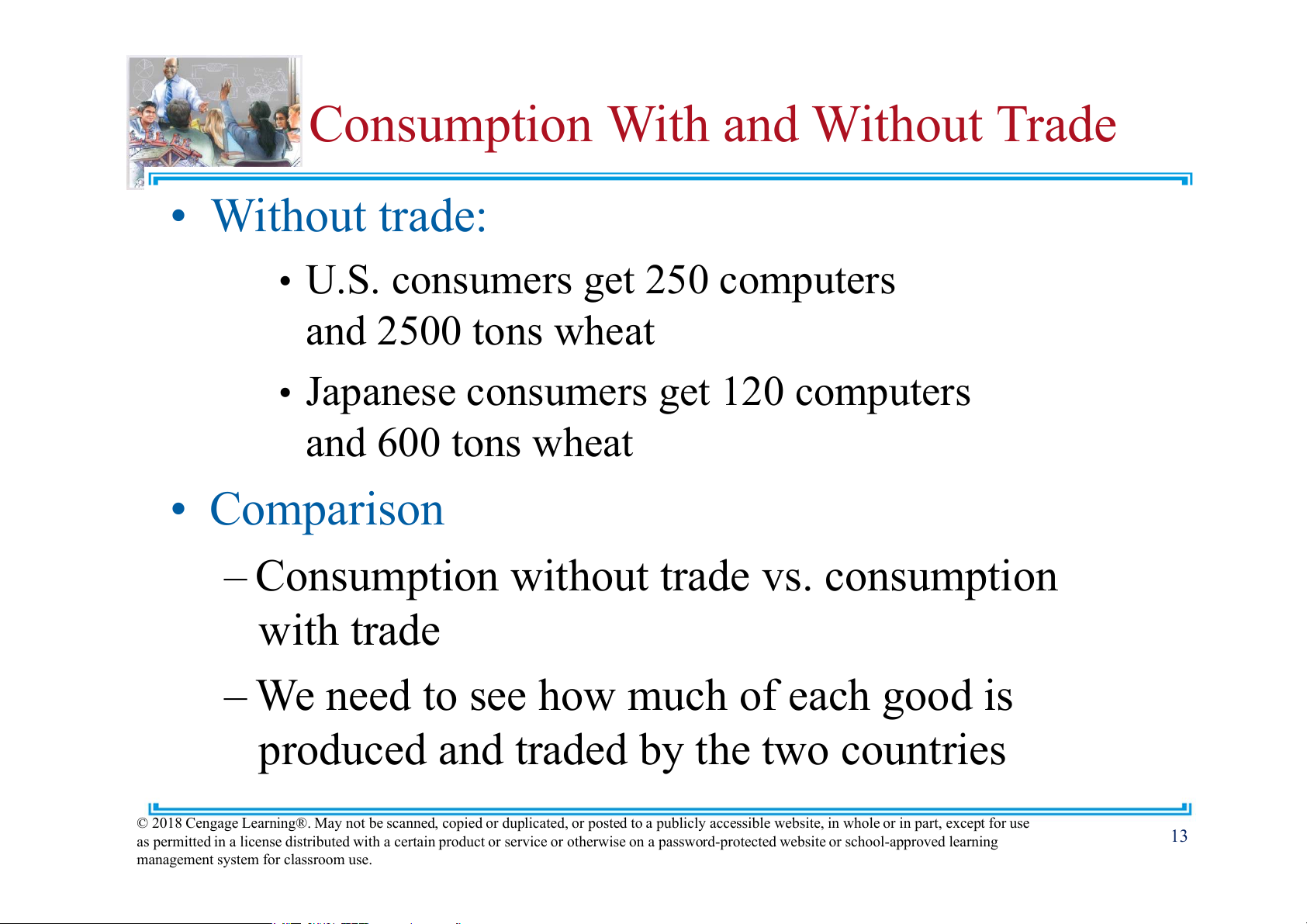
Consumption With and Without Trade • Without trade:
• U.S. consumers get 250 computers and 2500 tons wheat
• Japanese consumers get 120 computers and 600 tons wheat • Comparison
– Consumption without trade vs. consumption with trade
– We need to see how much of each good is
produced and traded by the two countries
© 2018 Cengage Learning®. May not be scanned, copied or duplicated, or posted to a publicly accessible website, in whole or in part, except for use 13
as permitted in a license distributed with a certain product or service or otherwise on a password-protected website or school-approved learning
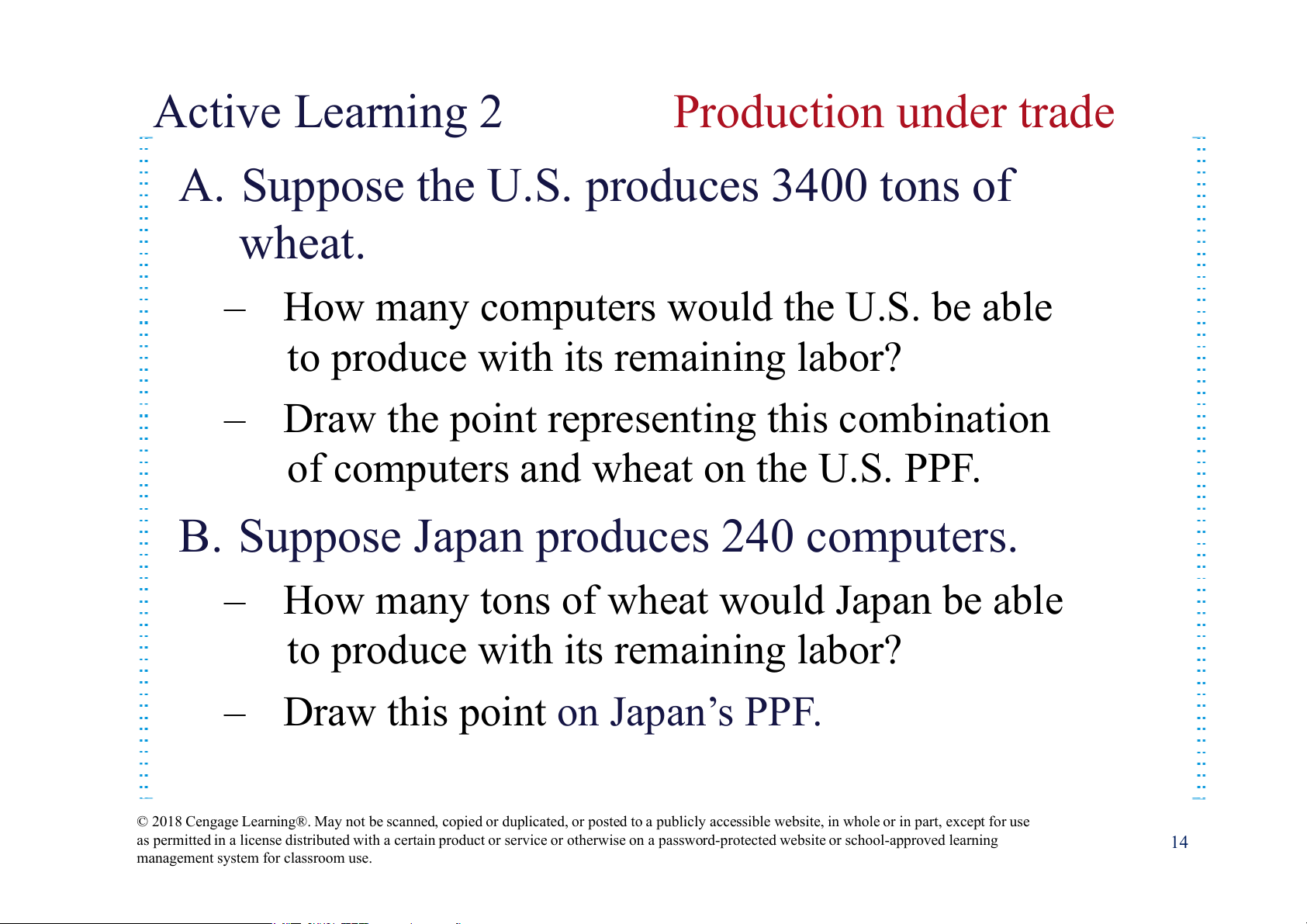
management system for classroom use. Active Learning 2 Production under trade
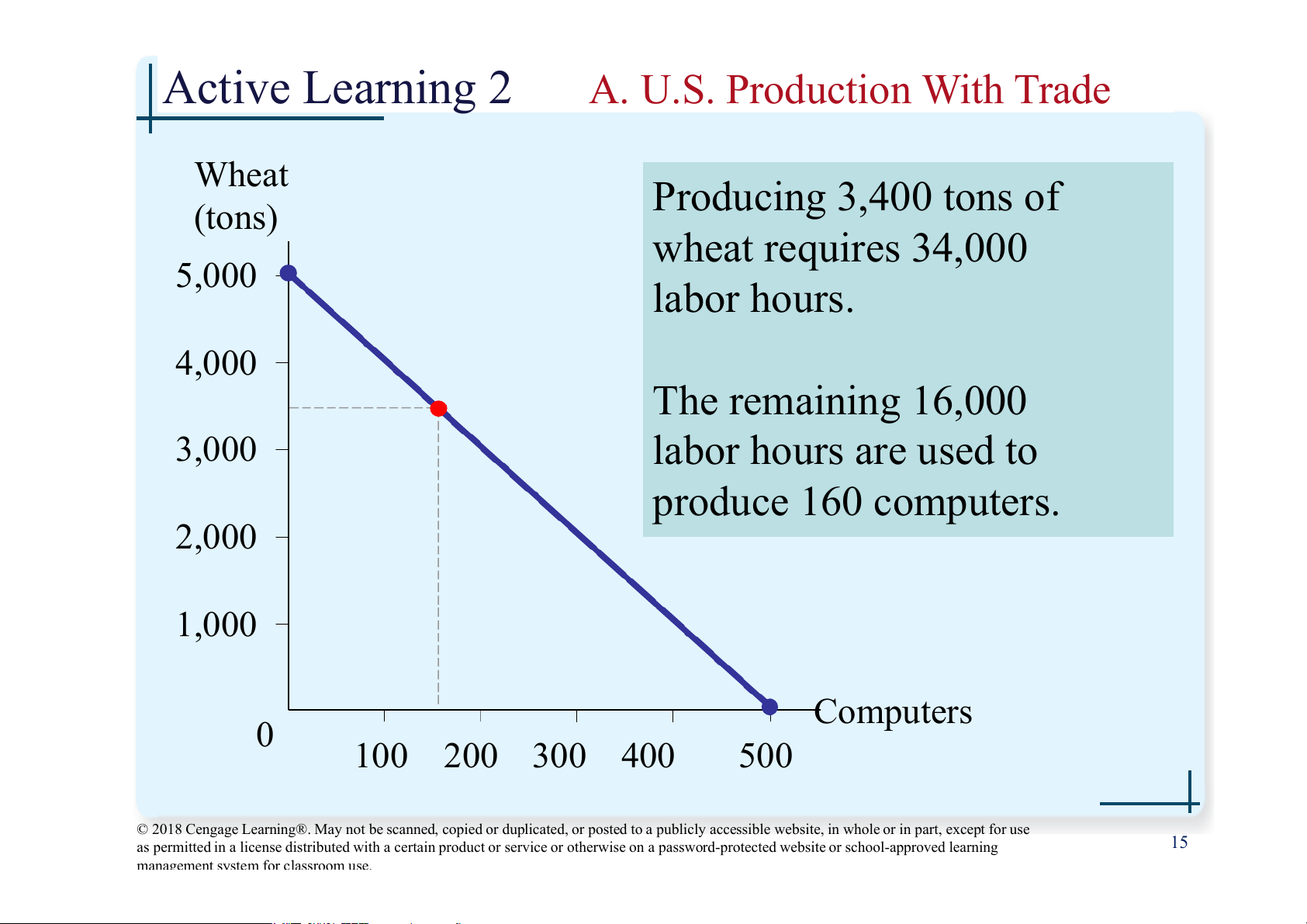
A. Suppose the U.S. produces 3400 tons of wheat.
– How many computers would the U.S. be able
to produce with its remaining labor?
– Draw the point representing this combination
of computers and wheat on the U.S. PPF.
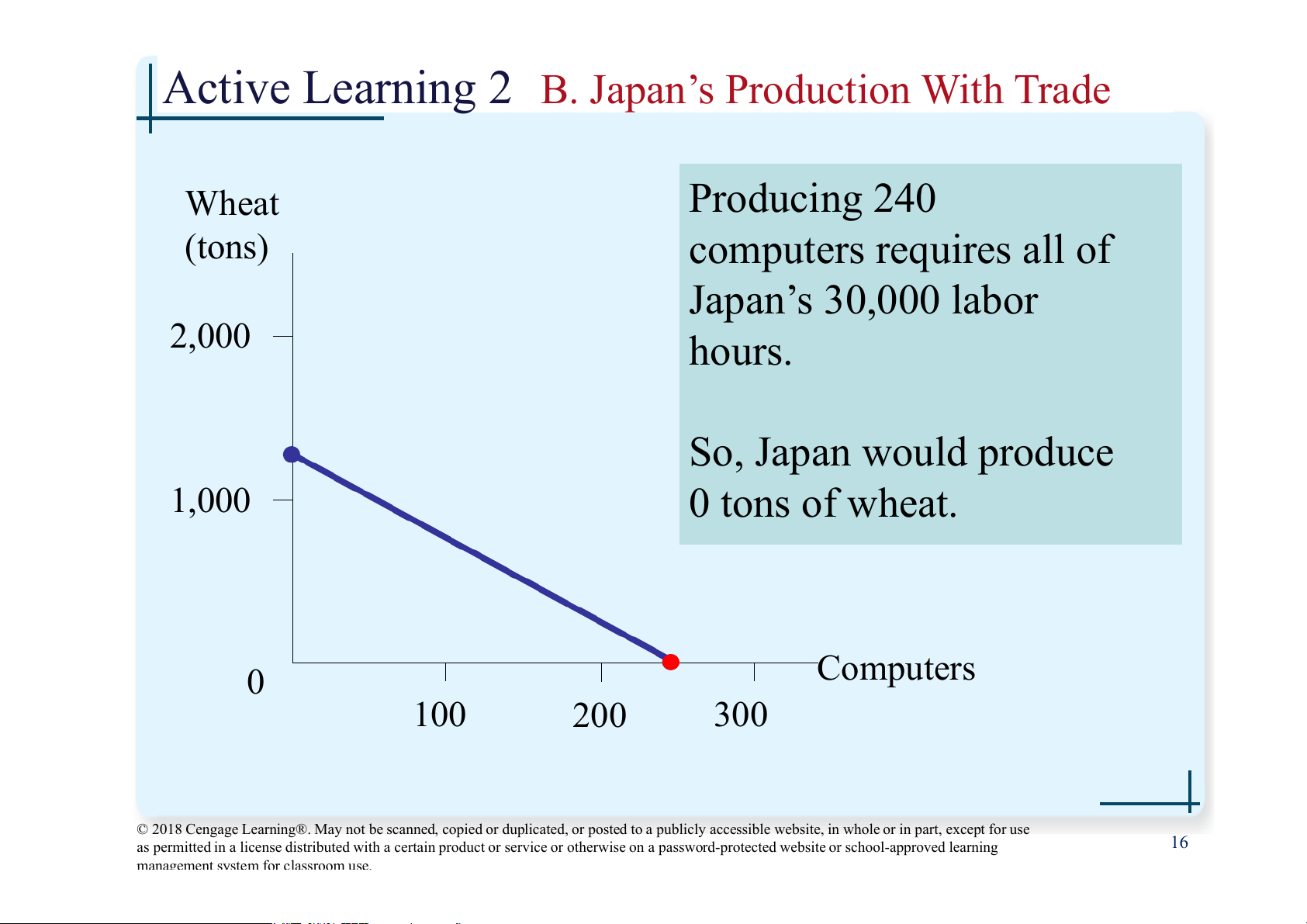
B. Suppose Japan produces 240 computers.
– How many tons of wheat would Japan be able
to produce with its remaining labor?
– Draw this point on Japan’s PPF.
© 2018 Cengage Learning®. May not be scanned, copied or duplicated, or posted to a publicly accessible website, in whole or in part, except for use
as permitted in a license distributed with a certain product or service or otherwise on a password-protected website or school-approved learning 14
management system for classroom use. Active Learning 2 A. U.S. Production With Trade Wheat Producing 3,400 tons of (tons) wheat requires 34,000 5,000 labor hours. 4,000 The remaining 16,000 3,000 labor hours are used to produce 160 computers. 2,000 1,000 Computers 0 100 200 300 400 500
© 2018 Cengage Learning®. May not be scanned, copied or duplicated, or posted to a publicly accessible website, in whole or in part, except for use 15
as permitted in a license distributed with a certain product or service or otherwise on a password-protected website or school-approved learning
management system for classroom use.
Active Learning 2 B. Japan’s Production With Trade Wheat Producing 240 (tons) computers requires all of Japan’s 30,000 labor 2,000 hours. So, Japan would produce 1,000 0 tons of wheat. Computers 0 100 200 300
© 2018 Cengage Learning®. May not be scanned, copied or duplicated, or posted to a publicly accessible website, in whole or in part, except for use 16
as permitted in a license distributed with a certain product or service or otherwise on a password-protected website or school-approved learning
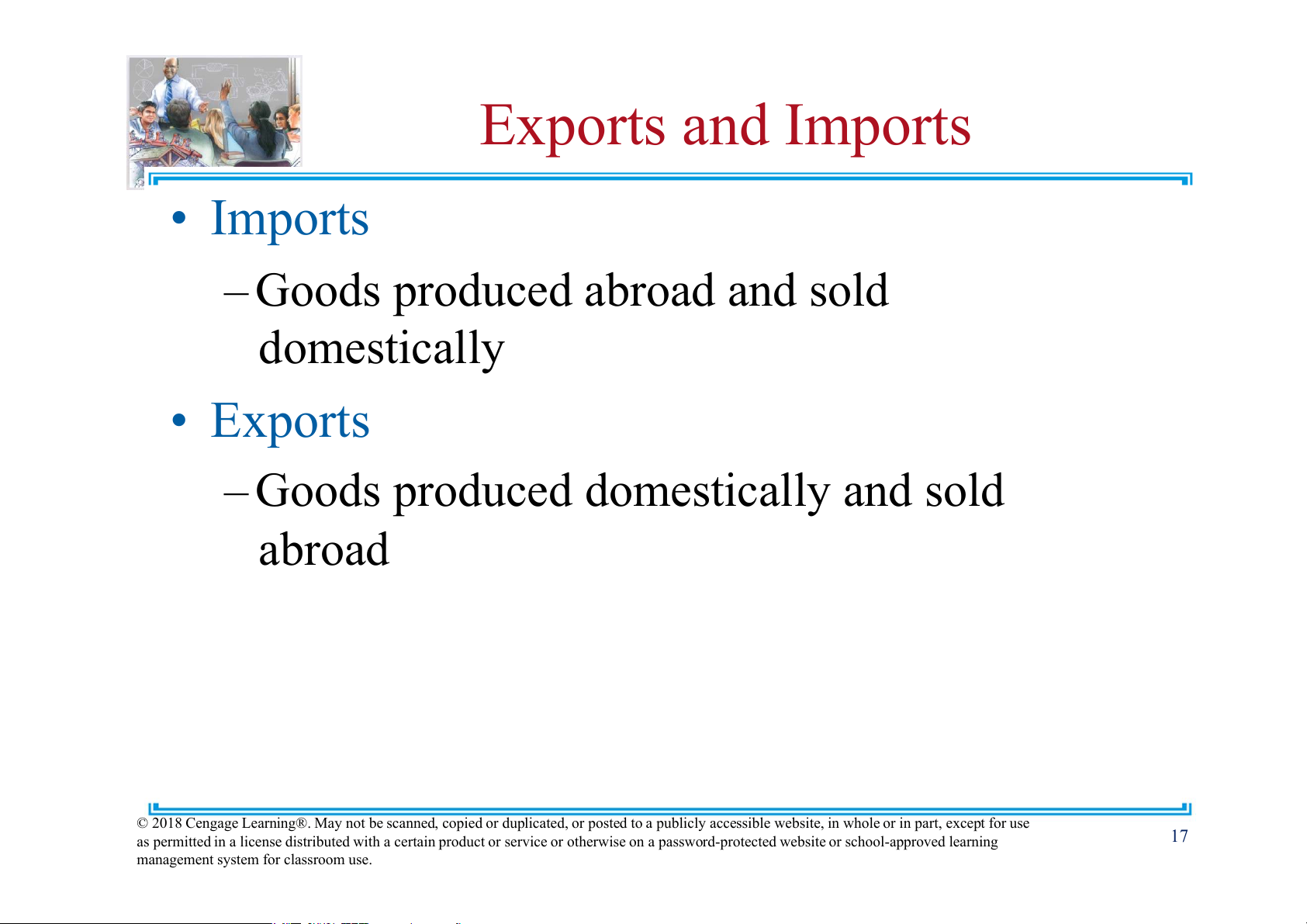
management system for classroom use. Exports and Imports • Imports
– Goods produced abroad and sold domestically • Exports
– Goods produced domestically and sold abroad
© 2018 Cengage Learning®. May not be scanned, copied or duplicated, or posted to a publicly accessible website, in whole or in part, except for use 17
as permitted in a license distributed with a certain product or service or otherwise on a password-protected website or school-approved learning
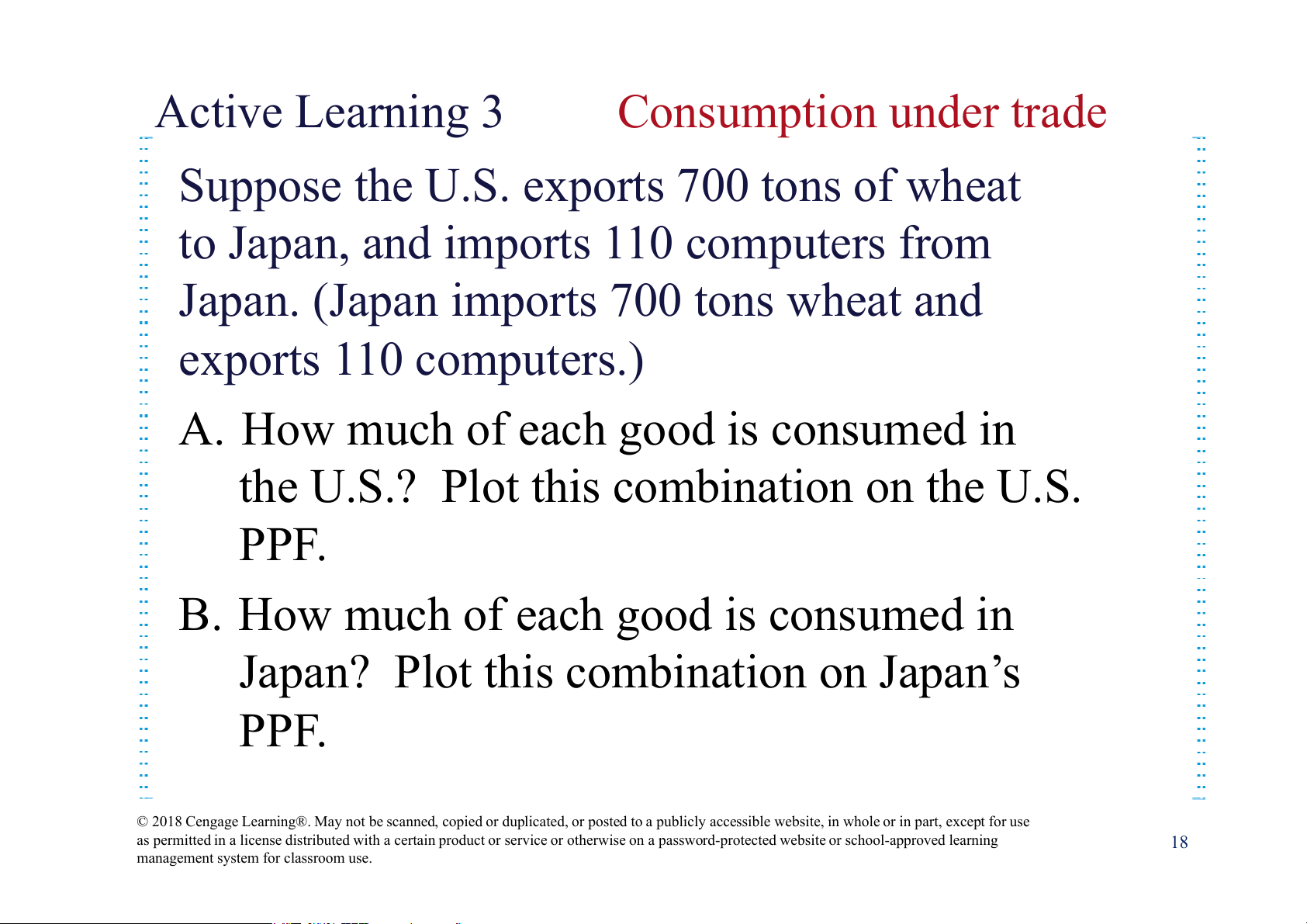
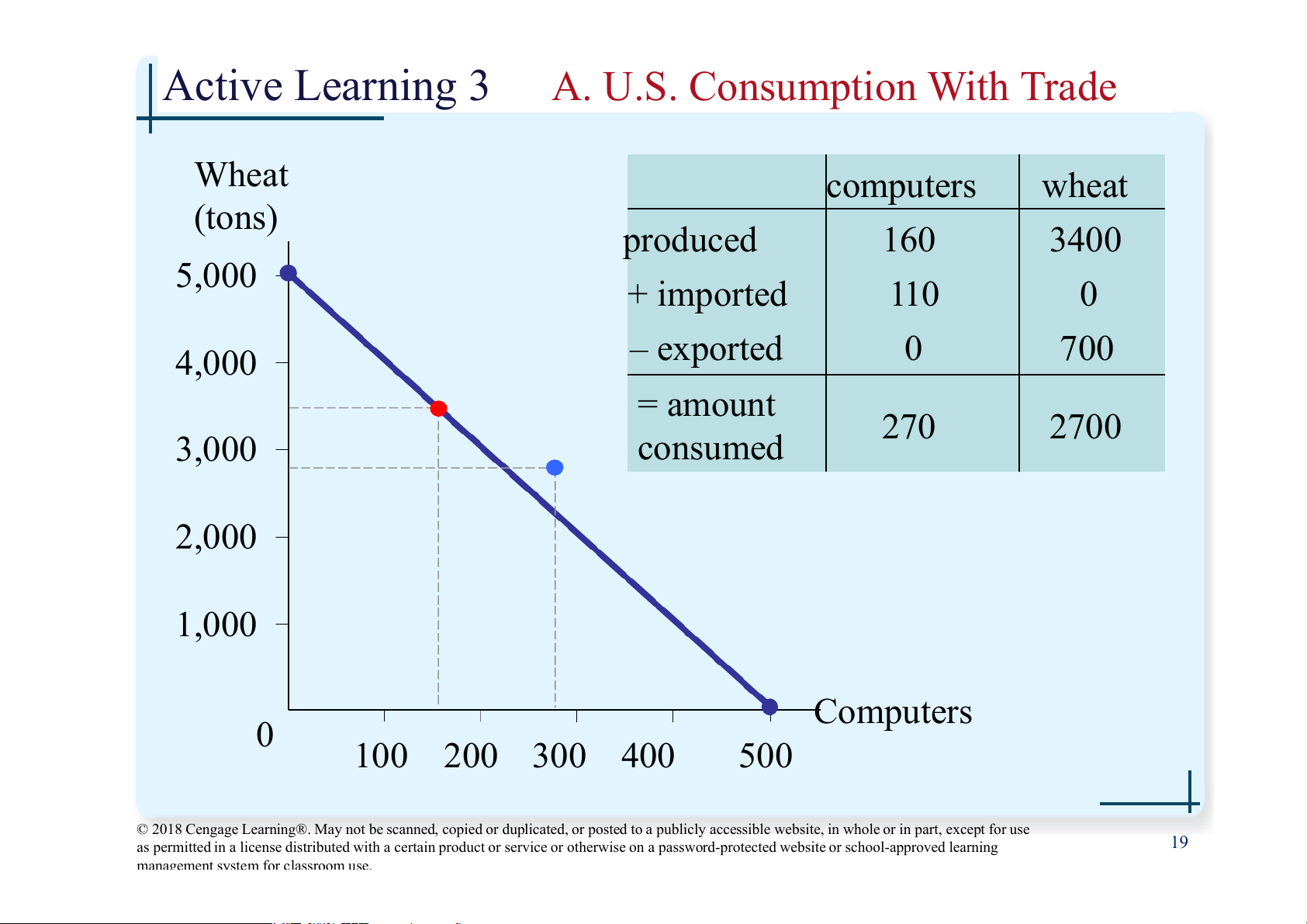
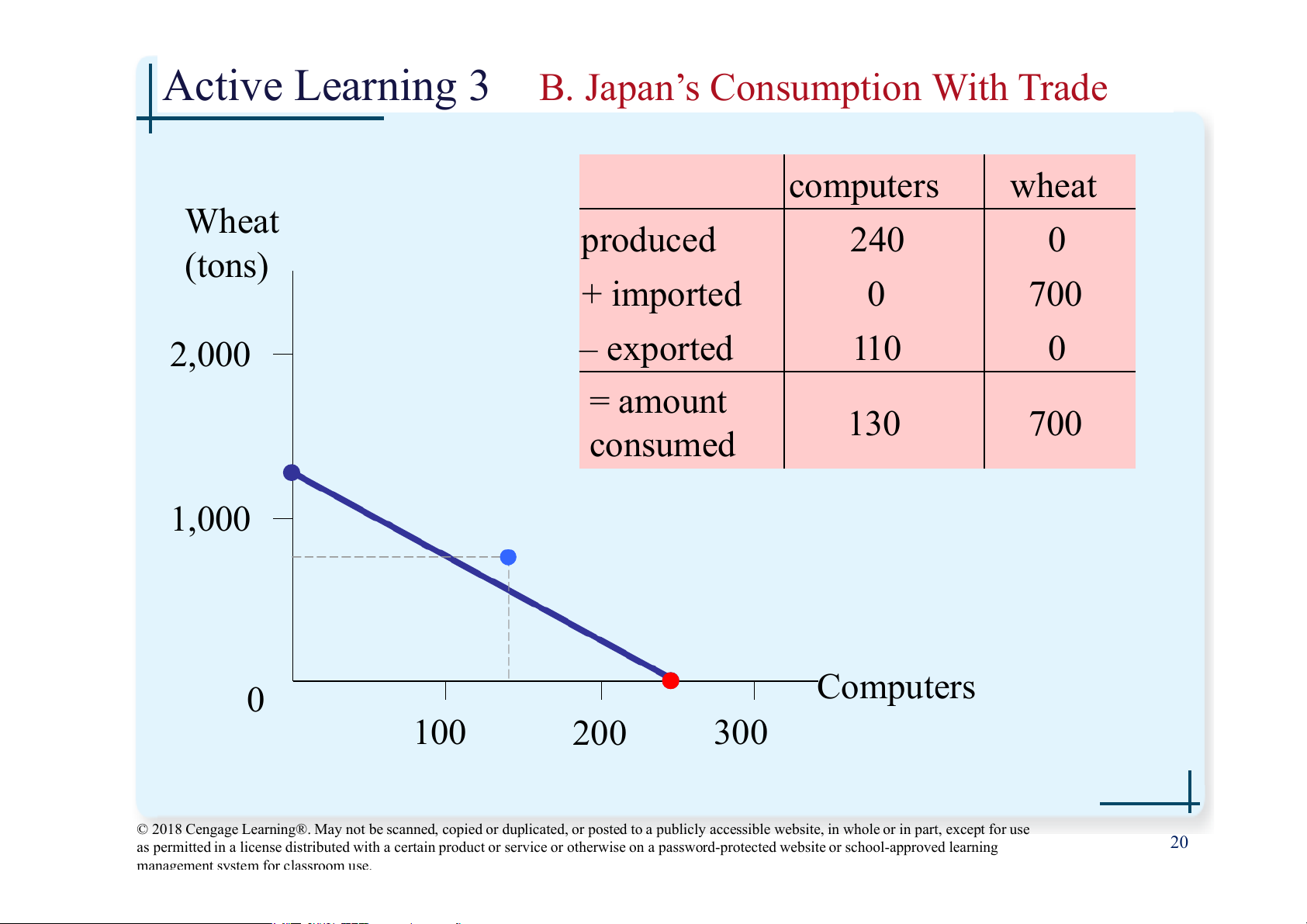
management system for classroom use. Active Learning 3 Consumption under trade
Suppose the U.S. exports 700 tons of wheat
to Japan, and imports 110 computers from
Japan. (Japan imports 700 tons wheat and exports 110 computers.)
A. How much of each good is consumed in
the U.S.? Plot this combination on the U.S. PPF.
B. How much of each good is consumed in
Japan? Plot this combination on Japan’s PPF.
© 2018 Cengage Learning®. May not be scanned, copied or duplicated, or posted to a publicly accessible website, in whole or in part, except for use
as permitted in a license distributed with a certain product or service or otherwise on a password-protected website or school-approved learning 18
management system for classroom use.
Active Learning 3 A. U.S. Consumption With Trade Wheat computers wheat (tons) produced 160 3400 5,000 + imported 110 0 4,000 – exported 0 700 = amount 270 2700 3,000 consumed 2,000 1,000 Computers 0 100 200 300 400 500
© 2018 Cengage Learning®. May not be scanned, copied or duplicated, or posted to a publicly accessible website, in whole or in part, except for use 19
as permitted in a license distributed with a certain product or service or otherwise on a password-protected website or school-approved learning
management system for classroom use.
Active Learning 3 B. Japan’s Consumption With Trade computers wheat Wheat produced 240 0 (tons) + imported 0 700 2,000 – exported 110 0 = amount 130 700 consumed 1,000 Computers 0 100 200 300
© 2018 Cengage Learning®. May not be scanned, copied or duplicated, or posted to a publicly accessible website, in whole or in part, except for use 20
as permitted in a license distributed with a certain product or service or otherwise on a password-protected website or school-approved learning
management system for classroom use.
Tài liệu liên quan:
-
Tự Luận Vimo: Phân Tích Cung, Cầu và Thị Trường Cạnh Tranh| Microeconomics | Trường Đại học Quốc tế, Đại học Quốc gia Thành phố Hồ Chí Minh
5 3 -
Review Questions: Thinking Like an Economist | Microeconomics | Trường Đại học Quốc tế, Đại học Quốc gia Thành phố Hồ Chí Minh
5 3 -
Final Exam Quizlet Questions & Answers | Microeconomics | Trường Đại học Quốc tế, Đại học Quốc gia Thành phố Hồ Chí Minh
5 3 -
Đề thi giữa kỳ II | Microeconomics | Trường Đại học Quốc tế, Đại học Quốc gia Thành phố Hồ Chí Minh
5 3 -
Final Group Project_ The Beer Industry | Microeconomics | Trường Đại học Quốc tế, Đại học Quốc gia Thành phố Hồ Chí Minh
4 2