Understanding Menu Costs and Shoeleather Costs in Inflation | Kinh tế vĩ mô | Trường Đại học kinh tế Thành Phố Hồ Chí Minh
Menu costs refers to a. the cost of more frequent price changes induced by higher inflation. b. resources used to price shop during times of high inflation. c. resources used by people to maintain lower money holdings when inflation is high. d. the distortion in incentives created by inflation when taxes do not adjust for inflation. 2. The shoeleather cost of inflation refers to a. the increased cost to the government of printing more money. b. the redistributional effects of unexpected inflation. c. the time spent searching for low prices when inflation rises. d. the waste of resources used to maintain lower money holdings. Tài liệu được sưu tầm và soạn thảo dưới dạng file PDF để gửi tới các bạn cùng tham khảo, ôn tập đầy đủ kiến thức, chuẩn bị cho các buổi học thật tốt. Mời bạn đọc đón xem!
Môn: Kinh tế vĩ mô ( UEH) 0.9 K tài liệu
Trường: Đại học Kinh tế Thành phố Hồ Chí Minh 2.8 K tài liệu
Tác giả:



Preview text:
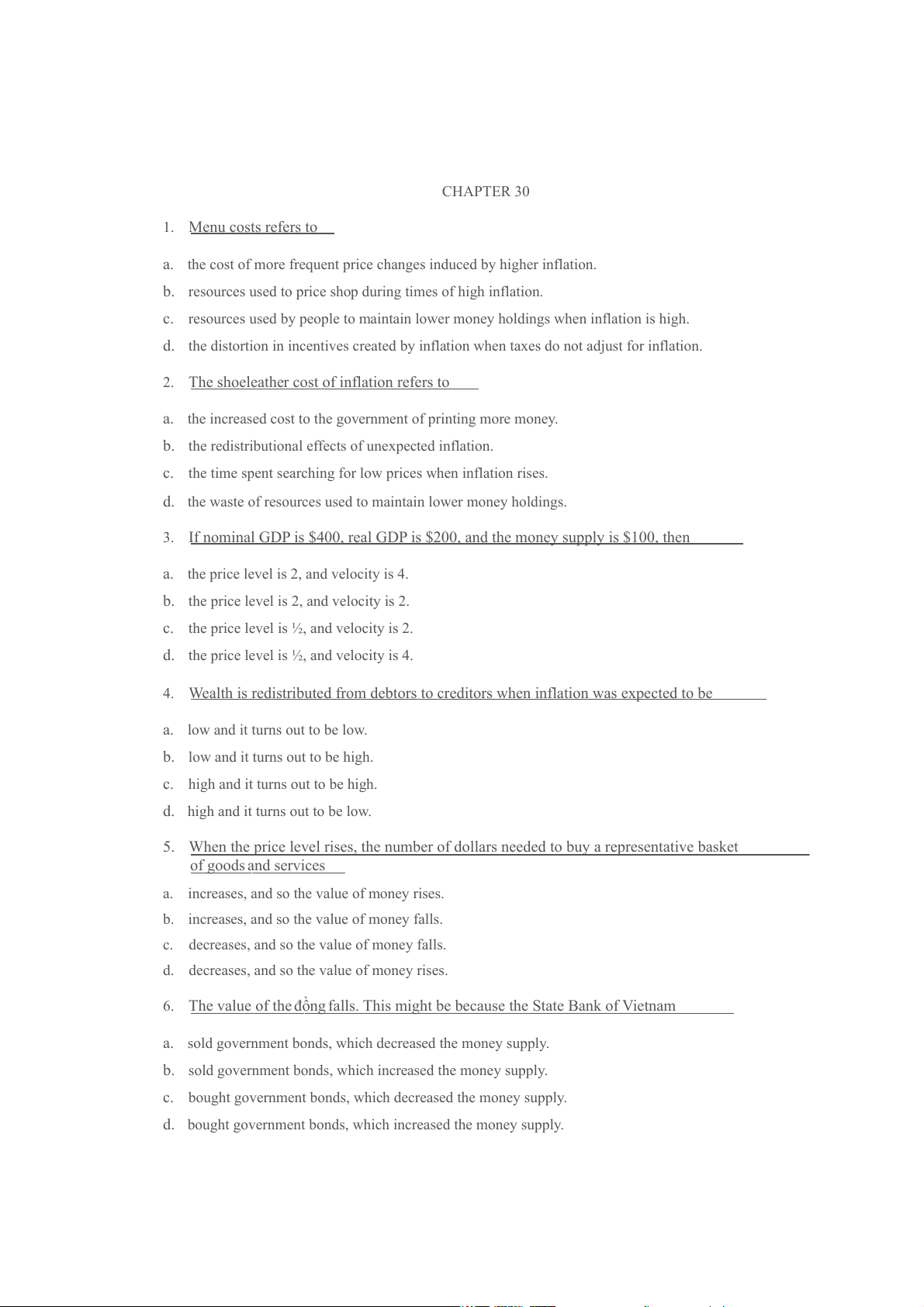
CHAPTER 30 1. Menu costs refers to
a. the cost of more frequent price changes induced by higher inflation.
b. resources used to price shop during times of high inflation.
c. resources used by people to maintain lower money holdings when inflation is high.
d. the distortion in incentives created by inflation when taxes do not adjust for inflation. 2.
The shoeleather cost of inflation refers to
a. the increased cost to the government of printing more money.
b. the redistributional effects of unexpected inflation.
c. the time spent searching for low prices when inflation rises.
d. the waste of resources used to maintain lower money holdings.
3. If nominal GDP is $400, real GDP is $200, and the money supply is $100, then
a. the price level is 2, and velocity is 4.
b. the price level is 2, and velocity is 2.
c. the price level is ½, and velocity is 2.
d. the price level is ½, and velocity is 4.
4. Wealth is redistributed from debtors to creditors when inflation was expected to be
a. low and it turns out to be low.
b. low and it turns out to be high.
c. high and it turns out to be high.
d. high and it turns out to be low.
5. When the price level rises, the number of dollars needed to buy a representative basket of goods and services
a. increases, and so the value of money rises.
b. increases, and so the value of money falls.
c. decreases, and so the value of money falls.
d. decreases, and so the value of money rises. 6. The value of the đồng
falls. This might be because the State Bank of Vietnam
a. sold government bonds, which decreased the money supply.
b. sold government bonds, which increased the money supply.
c. bought government bonds, which decreased the money supply.
d. bought government bonds, which increased the money supply.
7. Jake loaned Bob $5,000 for one year at a nominal interest rate of 10 percent. After Bob
repaid the loan in full, Jake complained that he could buy 4 percent fewer goods with the
money Bob gave him than he could before he loaned Bob the $5,000. From this we can
conclude that the rate of inflation during the year was a. 8% b. 2.5% c. 14% d. 6% 8. Money demand depends on
a. the price level and the interest rate.
b. neither the price level nor the interest rate.
c. the price level but not the interest rate.
d. the interest rate but not the price level.
9. You put money in the bank. The increase in the dollar value of your savings
a. and the change in the number of goods you can buy with your savings are both real variables.
b. is a nominal variable, but the change in the number of goods you can buy with your savings is a real variable.
c. is a real variable, but the change in the number of goods you buy with your savings is a nominal variable.
d. and the change in the number of goods you can buy with your savings are both nominal variables.
10. Suppose the price level rises, but the number of dollars you are paid per hour stays the same. This means that your a. nominal wage is lower. b. real wage is lower. c. Nominal wage is higher d. Real wage is higher 11. During the Covid-19 pandemic, velocity was decreasing. This means that the rate at which money is changing hands
a. decreasing. Other things the same, a decrease in velocity increases the price level.
b. increasing. Other things the same, an increase in velocity increases the price level.
c. decreasing. Other things the same, a decrease in velocity decreases the price level.
d. increasing. Other things the same, an increase in velocity decreases the price level. 12. The inflation tax
a. is an alternative to income taxes and government borrowing.
b. taxes most those who hold the most money.
c. is the revenue created when the government prints money.
d. All of the above are correct.
13. According to the assumptions of the quantity theory of money, if the money supply increases 5 percent, then
a. both the price level and real GDP would rise by 5 percent.
b. the price level would be unchanged and real GDP would rise by 5 percent.
c. both the price level and real GDP would be unchanged.
d. the price level would rise by 5 percent and real GDP would be unchanged.
14. According to the classical view (the quantity theory of money), to keep the price level
change at 3 percent per year when real output is growing by 5 percent per year, the money supply must
a. decrease by 5 percent per year. b. remain constant.
c. increase by more than 5 percent per year.
d. increase by 8 percent per year. 15. Money demand refers to
a. how much income people want to earn per year.
b. how much currency the Central Bank decides to print.
c. how much wealth people want to hold in liquid form.
d. the total quantity of financial assets that people want to hold.
16. When prices are falling, economists say that there is a. disinflation. b. a contraction. c. an inverted inflation. d. Deflation 17. Last year, Lan spent all of her income to purchase 200 breads at 20,000 VND per bread. This year, she spent all of her income to purchase 180 breads at 25,000 VND per bread.
a. Lan’s nominal income and real income increased this year.
b. Lan’s nominal income and real income decreased this year.
c. Lan’s nominal income decreased this year, but her real income increased.
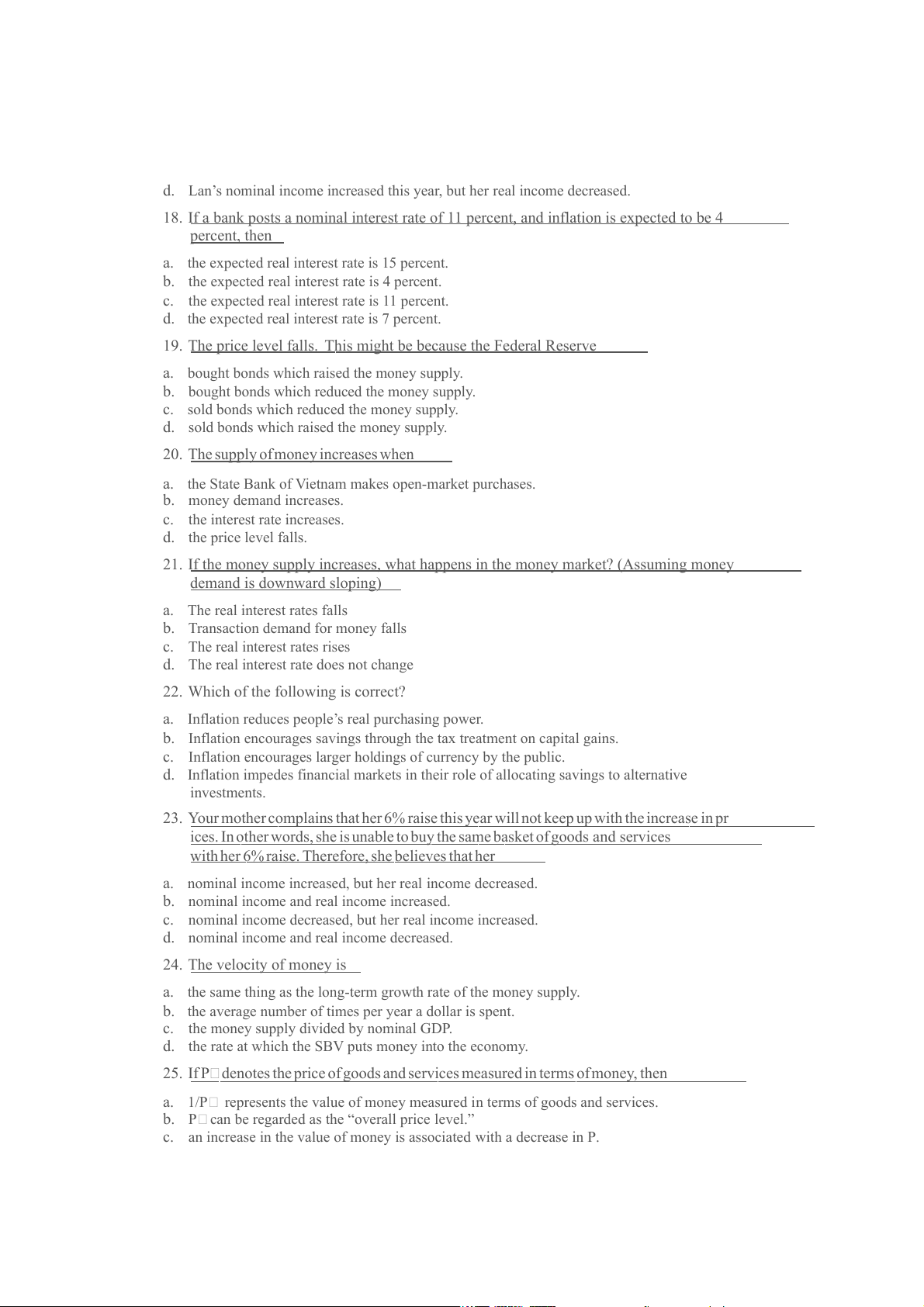
d. Lan’s nominal income increased this year, but her real income decreased.
18. If a bank posts a nominal interest rate of 11 percent, and inflation is expected to be 4 percent, then
a. the expected real interest rate is 15 percent.
b. the expected real interest rate is 4 percent.
c. the expected real interest rate is 11 percent.
d. the expected real interest rate is 7 percent. 19. The price level falls.
This might be because the Federal Reserve
a. bought bonds which raised the money supply.
b. bought bonds which reduced the money supply.
c. sold bonds which reduced the money supply.
d. sold bonds which raised the money supply. 20. The supply of money increases when
a. the State Bank of Vietnam makes open-market purchases. b. money demand increases.
c. the interest rate increases. d. the price level falls.
21. If the money supply increases, what happens in the money market? (Assuming money demand is downward sloping)
a. The real interest rates falls
b. Transaction demand for money falls
c. The real interest rates rises
d. The real interest rate does not change
22. Which of the following is correct?
a. Inflation reduces people’s real purchasing power.
b. Inflation encourages savings through the tax treatment on capital gains.
c. Inflation encourages larger holdings of currency by the public.
d. Inflation impedes financial markets in their role of allocating savings to alternative investments. 23. Y our mother complains that her 6% raise this year will not keep up with the increase in pr ices. In other words, she is
unable to buy the same basket of goods and services with
her 6% raise. Therefore, she believes that her
a. nominal income increased, but her real income decreased.
b. nominal income and real income increased.
c. nominal income decreased, but her real income increased.
d. nominal income and real income decreased. 24. The velocity of money is
a. the same thing as the long-term growth rate of the money supply.
b. the average number of times per year a dollar is spent.
c. the money supply divided by nominal GDP.
d. the rate at which the SBV puts money into the economy. 25. If P denotes the price of goods and services measured in terms of money, then
a. 1/P represents the value of money measured in terms of goods and services.
b. P can be regarded as the “overall price level.”
c. an increase in the value of money is associated with a decrease in P.
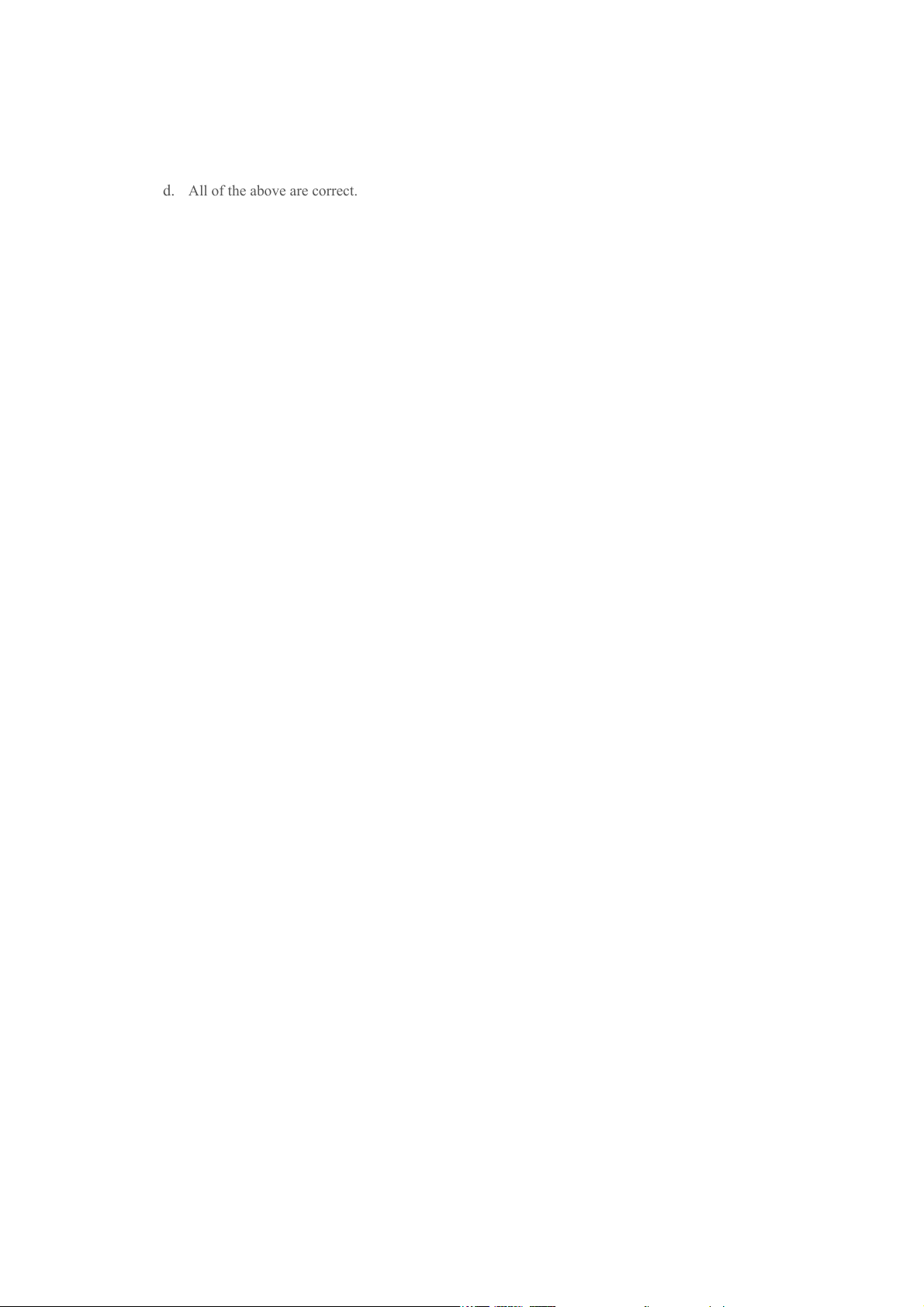
d. All of the above are correct.
Tài liệu liên quan:
-

Tiểu luận Phân Tích Giá Trái Cây 2023 | Kinh tế vĩ mô | Trường Đại học kinh tế Thành Phố Hồ Chí Minh
17 9 -
Bộ câu hỏi trắc nghiệm - Kinh tế học thị trường và cầu cung | Kinh tế vĩ mô | Trường Đại học kinh tế Thành Phố Hồ Chí Minh
17 9 -
Câu Hỏi Ôn Tập Phần Thị Trường | Kinh tế vĩ mô | Trường Đại học kinh tế Thành Phố Hồ Chí Minh
24 12 -
Kinh Tế Vi Mô: Câu Hỏi và Đáp Án Quan Trọng | Kinh tế vĩ mô | Trường Đại học kinh tế Thành Phố Hồ Chí Minh
21 11 -
Tiểu luận Món Huế và Thị Trường F&B Việt Nam | Kinh tế vĩ mô | Trường Đại học kinh tế Thành Phố Hồ Chí Minh
16 8