Assignment 9: Group 3 on Market Structures | Microeconomics | Trường Đại học Quốc tế, Đại học Quốc gia Thành phố Hồ Chí Minh
If this firm applies perfect price discrimination, they will set the price according to the demand curve, at the point where supply and demand intersect. - At that, aligning to the horizontal axis we have output of Q = 32 => The firm increase profit by taking more CS and DWL => Profit = 952.08 + 288 + 96 = 1,336.0. Tài liệu được sưu tầm và soạn thảo dưới dạng file PDF để gửi tới các bạn cùng tham khảo, ôn tập đầy đủ kiến thức, chuẩn bị cho các buổi học thật tốt. Mời bạn đọc đón xem!
Môn: Microeconomics 635 tài liệu
Trường: Trường Đại học Quốc tế, Đại học Quốc gia Thành phố Hồ Chí Minh 1.9 K tài liệu
Tác giả:

Preview text:
Microeconomics EBDB5 - Group 3 ASSIGNMENT 9 - TOPIC 9
MARKET ENTRY AND MONOPOLISTIC COMPETITION
OLIGOPOLY AND STRATEGIC BEHAVIOR Members: 1. Hoàng Trọng Hiếu 2. Trương Thu Thủy 3. Cao Văn Tài
4. Phạm Thị Nguyệt Thảo 5. Nguyễn Trung Kiên
6. Lương Thị Bạch Dương Answer
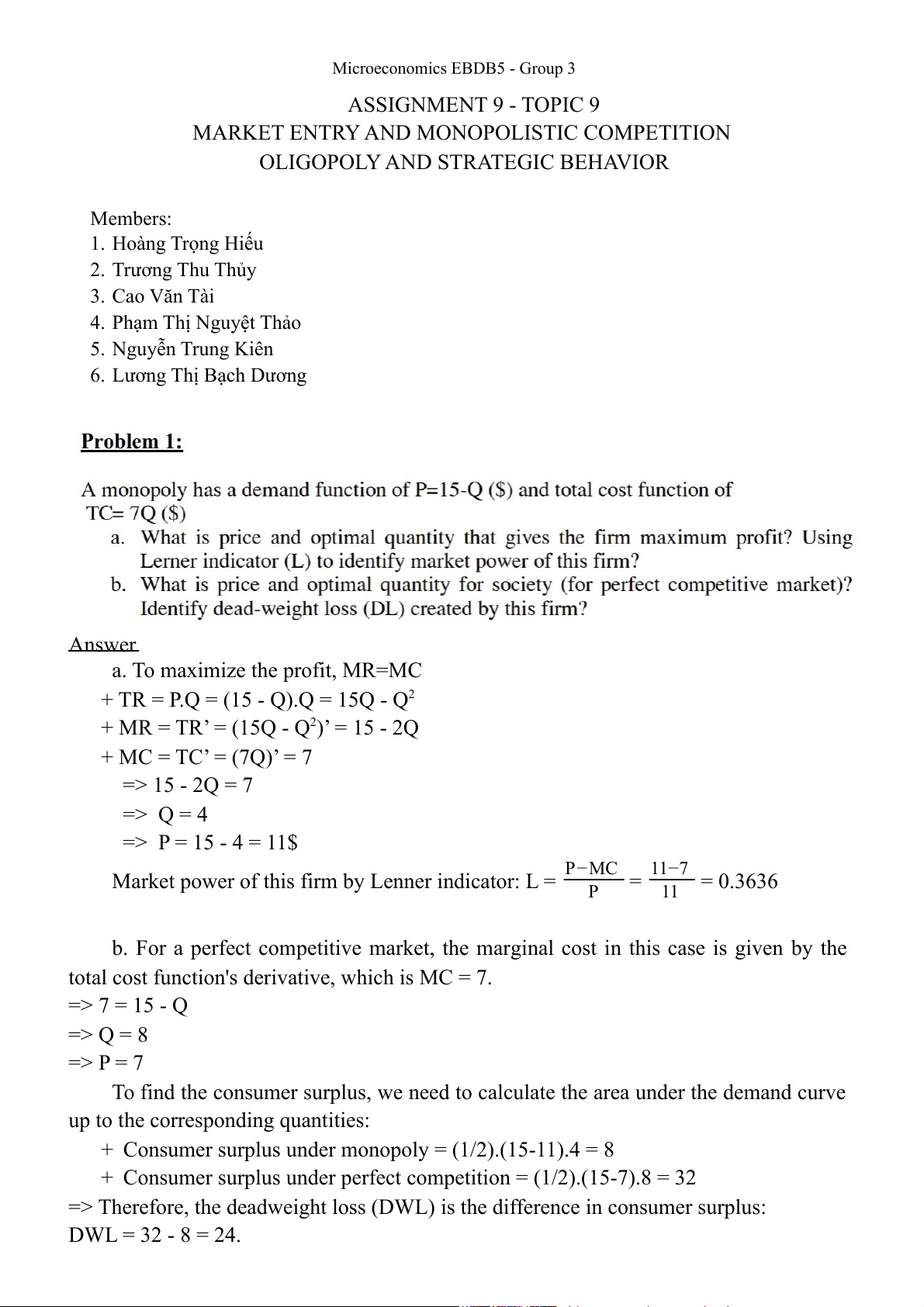
a. To maximize the profit, MR=MC
+ TR = P.Q = (15 - Q).Q = 15Q - Q2
+ MR = TR’ = (15Q - Q2)’ = 15 - 2Q + MC = TC’ = (7Q)’ = 7 => 15 - 2Q = 7 => Q = 4 => P = 15 - 4 = 11$ P−MC 11−7
Market power of this firm by Lenner indicator: L = = = 0.3636 P 11
b. For a perfect competitive market, the marginal cost in this case is given by the
total cost function's derivative, which is MC = 7. => 7 = 15 - Q => Q = 8 => P = 7
To find the consumer surplus, we need to calculate the area under the demand curve
up to the corresponding quantities:
+ Consumer surplus under monopoly = (1/2).(15-11).4 = 8
+ Consumer surplus under perfect competition = (1/2).(15-7).8 = 32
=> Therefore, the deadweight loss (DWL) is the difference in consumer surplus: DWL = 32 - 8 = 24. Microeconomics EBDB5 - Group 3 Answer
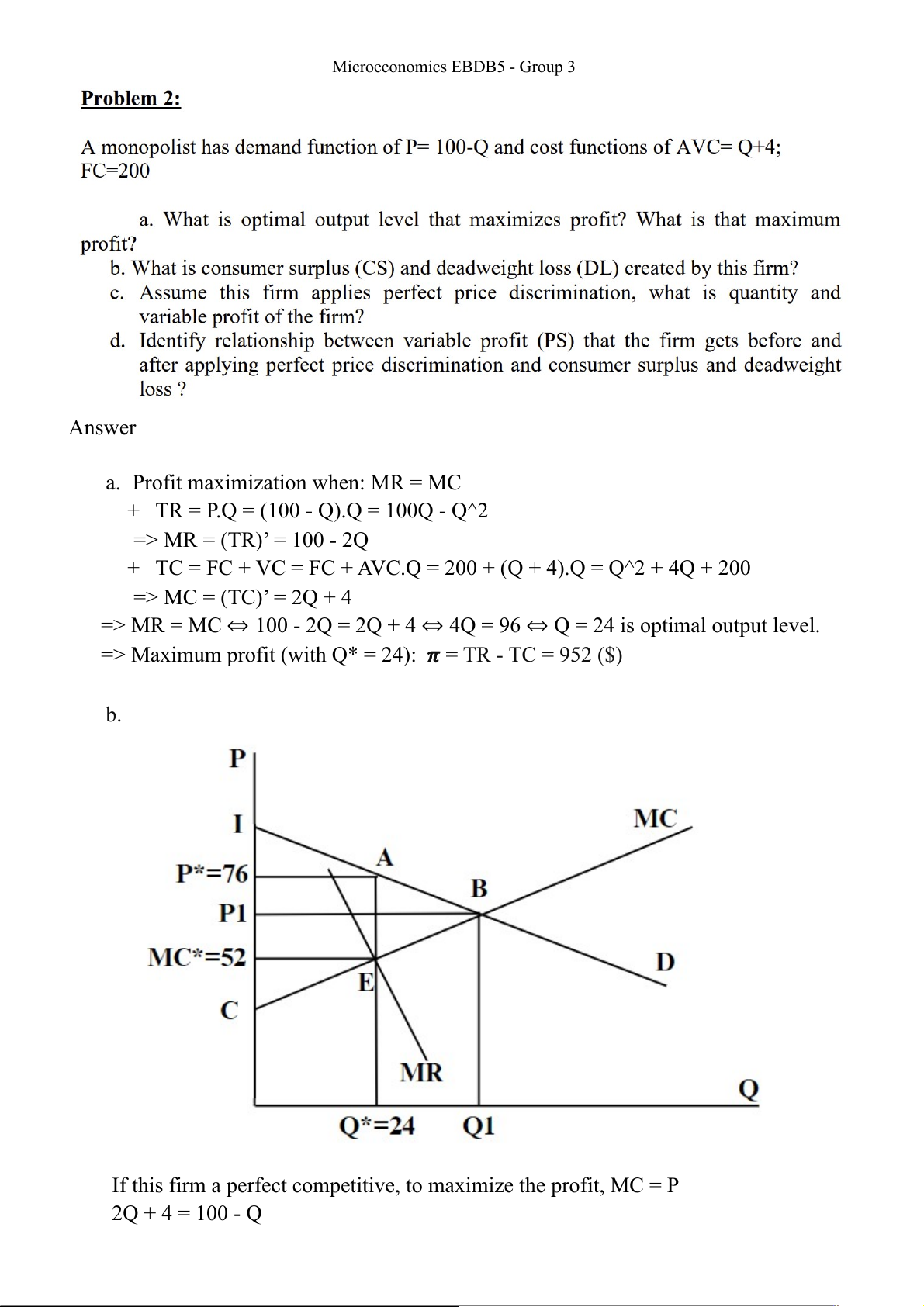
a. Profit maximization when: MR = MC
+ TR = P.Q = (100 - Q).Q = 100Q - Q^2 => MR = (TR)’ = 100 - 2Q
+ TC = FC + VC = FC + AVC.Q = 200 + (Q + 4).Q = Q^2 + 4Q + 200 => MC = (TC)’ = 2Q + 4
=> MR = MC ⇔ 100 - 2Q = 2Q + 4 ⇔ 4Q = 96
⇔ Q = 24 is optimal output level.
=> Maximum profit (with Q* = 24): 𝜋 = 𝜋 TR - TC = 952 ($) b.
If this firm a perfect competitive, to maximize the profit, MC = P 2Q + 4 = 100 - Q Microeconomics EBDB5 - Group 3 ⇔ Q1 = 32 ⇔ P1 = 68
The consumer surplus = SIAP* = 24.(100-76)/2 = 288$
The deadweight loss (DL) = SAEB = BE.AE/2 = (32-24).(76-52)/2 = 96$ c.
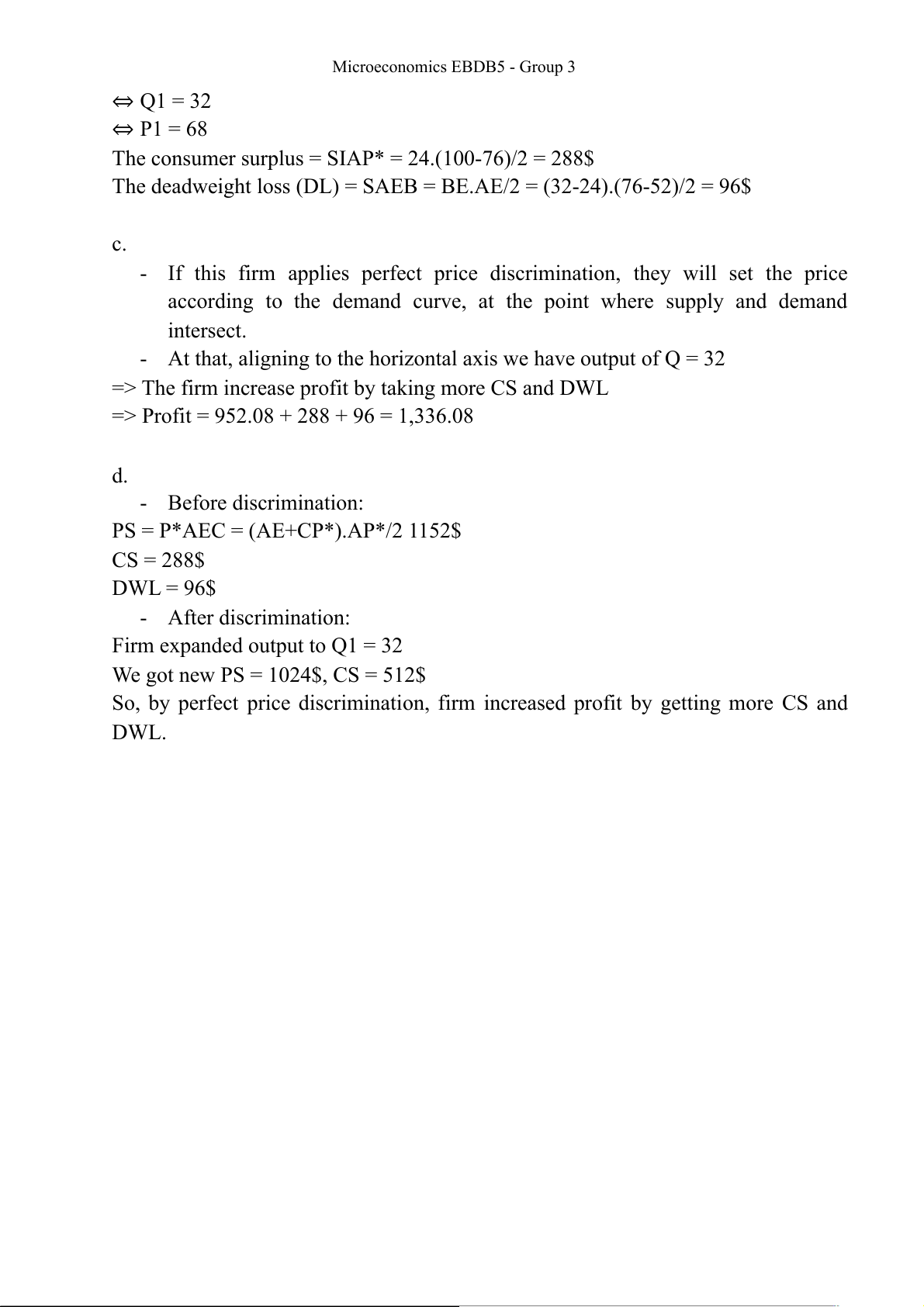
- If this firm applies perfect price discrimination, they will set the price
according to the demand curve, at the point where supply and demand intersect.
- At that, aligning to the horizontal axis we have output of Q = 32
=> The firm increase profit by taking more CS and DWL
=> Profit = 952.08 + 288 + 96 = 1,336.08 d. - Before discrimination:
PS = P*AEC = (AE+CP*).AP*/2 1152$ CS = 288$ DWL = 96$ - After discrimination:
Firm expanded output to Q1 = 32
We got new PS = 1024$, CS = 512$
So, by perfect price discrimination, firm increased profit by getting more CS and DWL.
Tài liệu liên quan:
-

Chương 3: độ co giãn và các nhân tố ảnh hưởng | Microeconomics | Trường Đại học Quốc tế, Đại học Quốc gia Thành phố Hồ Chí Minh
3 2 -
Microeconomics Syllabus | Microeconomics | Trường Đại học Quốc tế, Đại học Quốc gia Thành phố Hồ Chí Minh
3 2 -
Microeconomics Course Syllabus & Assessment Details | Microeconomics | Trường Đại học Quốc tế, Đại học Quốc gia Thành phố Hồ Chí Minh
3 2 -

Assignment 3 - Elasticity MCQs and Key Concepts | Microeconomics | Trường Đại học Quốc tế, Đại học Quốc gia Thành phố Hồ Chí Minh
3 2 -
Assignment 2 - Economic Equilibrium Analysis of Fridges and Motorcycles | Microeconomics | Trường Đại học Quốc tế, Đại học Quốc gia Thành phố Hồ Chí Minh
3 2