Assignment Presentation 4: Case Study on Luxury Demand Elasticity | Microeconomics | Trường Đại học Quốc tế, Đại học Quốc gia Thành phố Hồ Chí Minh
As part of an overall package to reduce the US Budget deficit, the Congress adopted a 10% 'luxury tax" on such big-ticket items as pleasure boats, private airplanes, high- priced cars, jewelry... Such luxury taxes are often popular because most people do not have to pay them. All taxes are painful to someone, but surely a tax that weighs only on rich people who are buying frivolous luxuries is one of the more socially painless ways to raise. Tài liệu được sưu tầm và soạn thảo dưới dạng file PDF để gửi tới các bạn cùng tham khảo, ôn tập đầy đủ kiến thức, chuẩn bị cho các buổi học thật tốt. Mời bạn đọc đón xem!
Môn: Microeconomics 635 tài liệu
Trường: Trường Đại học Quốc tế, Đại học Quốc gia Thành phố Hồ Chí Minh 1.9 K tài liệu
Tác giả:


Preview text:
Group assignment presentation 4: Case STUDY ANALYSIS
The Surprising Elasticity of Demand for Luxuries
As part of an overall package to reduce the US Budget deficit, the Congress adopted a 10%
'luxury tax" on such big-ticket items as pleasure boats, private airplanes, high- priced cars,
jewelry... Such luxury taxes are often popular because most people do not have to pay them.
All taxes are painful to someone, but surely a tax that weighs only on rich people who are
buying frivolous luxuries is one of the more socially painless ways to raise money.
However, the discussion of elasticity and inelasticity in this chapter should make you
suspicious of a key assumption underlying this tax. The assumption was that the demand for
these luxury goods was quite inelastic. We can think of the luxury tax as increasing the total
cost of producers face in bringing a goods to market, so the supply curve effectively shifts up.
Thus, when the industry supply curve shifted up in response to the new luxury tax, the
equilibrium quantity would change little while the equilibrium price would rise much, as the
rich simply paid the extra cost.
If the demand for these luxury goods was reasonable elastic, however, then the upward shift
in the supply curve would lead to a much smaller rise in equilibrium price and a lager fall in
equilibrium quantity. As it happened, sale of pleasure boats fell by nearly 90% in South
Florida, as prospective buyers bought boats in the Bahamas to avoid paying the tax. Sale of
high- priced cars like Mercedes and Lexus also fell substantially when their customers moved to buy substitution products.
This unexpected elasticity of demand carried two bits of bad news for the economy. First,
rather than falling on the wealthy as had been hoped, the burden of the new luxury tax
actually ended up falling on the workers and retailers who manufacture and sell these luxury
items, many of whom are middle class at best. Second, the luxury tax raised far less money
than had been expected. The Congressional Budget Office had forecast that the tax would
raise about $1.5 billion over five years. But in the first year, it raised only about $ 20 million.
Once the costs of setting up and enforcing the new tax were considered, it probably lost
money for the Government in its first year. Discussion Questions
1. How can you use the theory of "Supply, Demand- and elasticity " to explain the case (by using graphs)?
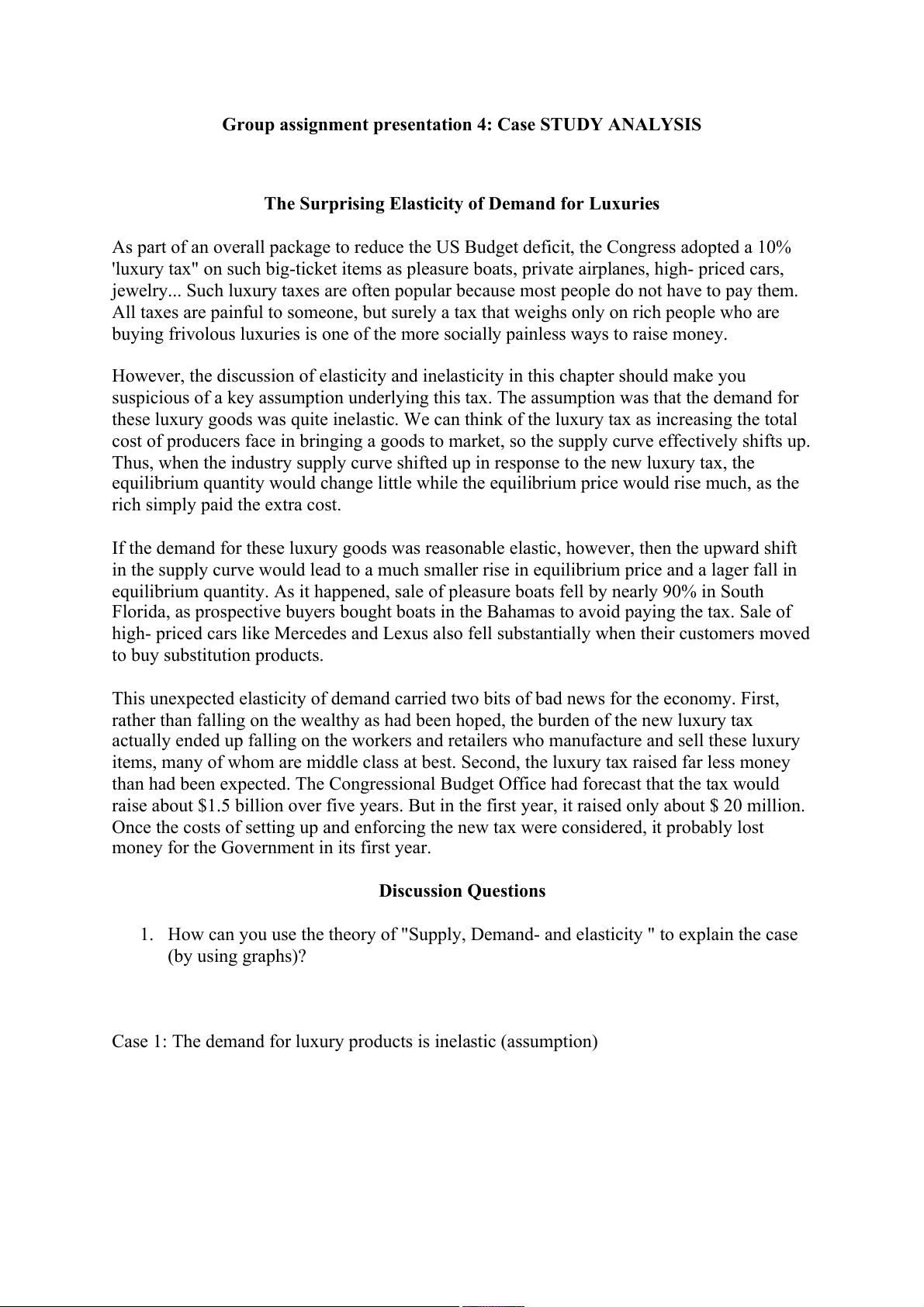
Case 1: The demand for luxury products is inelastic (assumption)
The assumption was that the demand for these luxury goods was quite inelastic. Epd < 1
In this case, the demand curve showed that the wealthy were willing to pay for the extra
cost in the price of luxury goods and beard a higher percentage of tax. The tax raised the
price of goods, leading to the increase in total revenue. That resulted in the drop of the US Budget deficit.
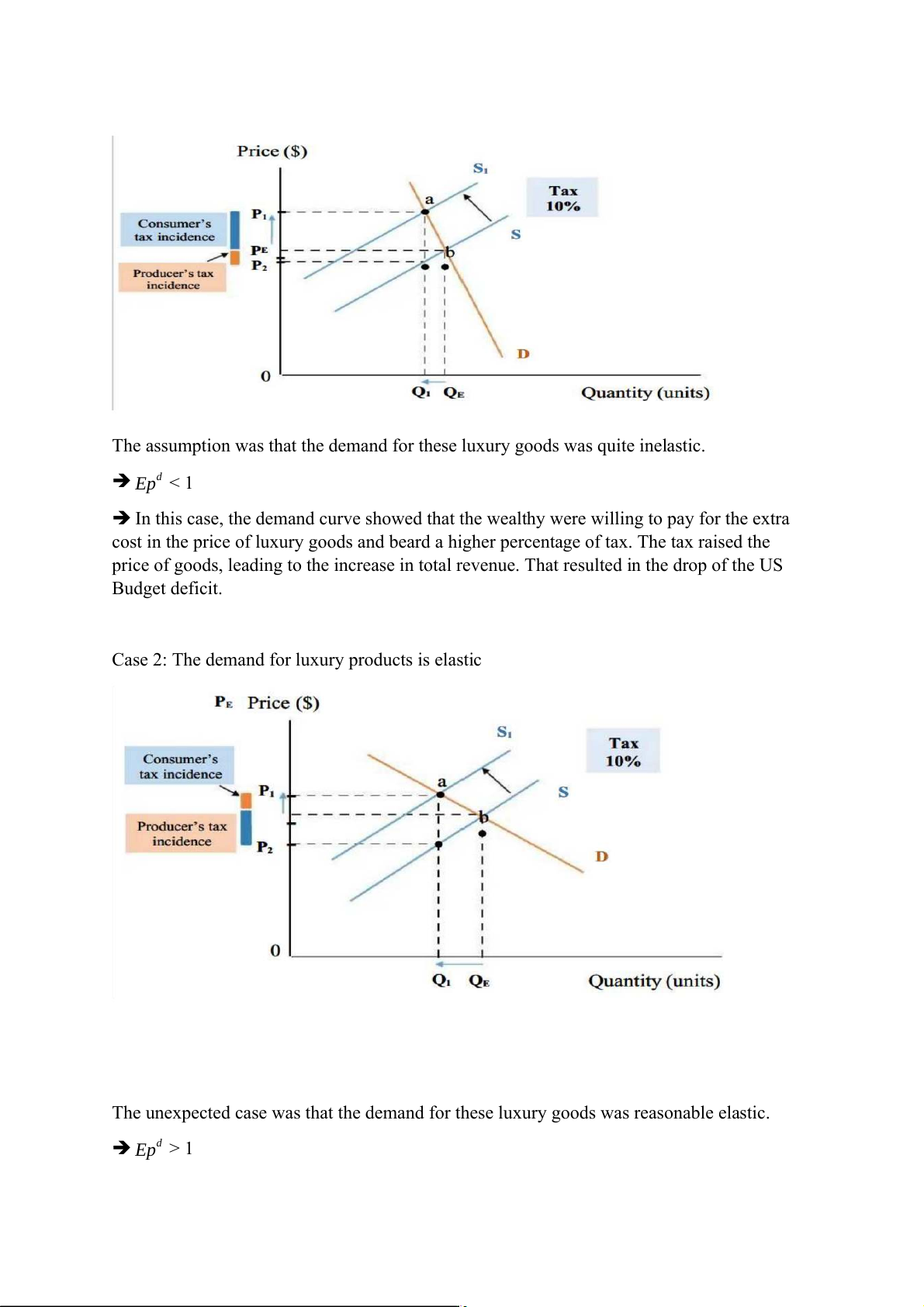
Case 2: The demand for luxury products is elastic
The unexpected case was that the demand for these luxury goods was reasonable elastic. Epd > 1
In this case, the demand curve indicated that the rich were unwilling to pay for the extra
cost of the luxury goods. So, the quantity demanded dropped dramatically. The increase in
the price of the products would lead to the drop of total revenue. Therefore, that resulted in
the fact that the luxury tax raised far less money than had been expected.
Besides, when the demand for luxury goods was elastic, the producer had to suffer from a
higher rate of luxury tax than the rich. Then, the consequence was rather than falling on the
wealthy as had been hoped, the burden of the new luxury tax actually ended up falling on the
workers and retailers who manufacture and sell these luxury items, many of whom are middle class at best.
2. What is implication for the Government in the tax policy?
By influencing incentives, taxes can affect both supply and demand factors. So the solution
for the Government is to lower tax. Reducing tax rates, for example, can help businesses hire
more workers to work more to produce more product. Besides also attracts more customer. , it
there is an opportunity for the Government to earn their targeted tax rate because consumers
can focus on buying luxury products without moving to another market to avoid high tax.
Tài liệu liên quan:
-

Chương 3: độ co giãn và các nhân tố ảnh hưởng | Microeconomics | Trường Đại học Quốc tế, Đại học Quốc gia Thành phố Hồ Chí Minh
4 2 -
Microeconomics Syllabus | Microeconomics | Trường Đại học Quốc tế, Đại học Quốc gia Thành phố Hồ Chí Minh
4 2 -
Microeconomics Course Syllabus & Assessment Details | Microeconomics | Trường Đại học Quốc tế, Đại học Quốc gia Thành phố Hồ Chí Minh
4 2 -
Assignment 3 - Elasticity MCQs and Key Concepts | Microeconomics | Trường Đại học Quốc tế, Đại học Quốc gia Thành phố Hồ Chí Minh
4 2 -
Assignment 2 - Economic Equilibrium Analysis of Fridges and Motorcycles | Microeconomics | Trường Đại học Quốc tế, Đại học Quốc gia Thành phố Hồ Chí Minh
3 2