Assignment Presentation 7: Perfect Competition Analysis | Microeconomics | Trường Đại học Quốc tế, Đại học Quốc gia Thành phố Hồ Chí Minh
If the price was 100$, what output would the firm produce and what type of profit (or loss) would the firm make? - If the price was 100$, the firm would produce 7 outputs → the profit that the firm made is at max c. Does the profitable situation in the question b exist in the long – run? Why? - The profitable situation in the question b exist in the long – run because P = MC. Tài liệu được sưu tầm và soạn thảo dưới dạng file PDF để gửi tới các bạn cùng tham khảo, ôn tập đầy đủ kiến thức, chuẩn bị cho các buổi học thật tốt. Mời bạn đọc đón xem!
Môn: Microeconomics 635 tài liệu
Trường: Trường Đại học Quốc tế, Đại học Quốc gia Thành phố Hồ Chí Minh 1.9 K tài liệu
Tác giả:

Preview text:
Group assignment presentation 7
– Phạm Thảo Nguyên
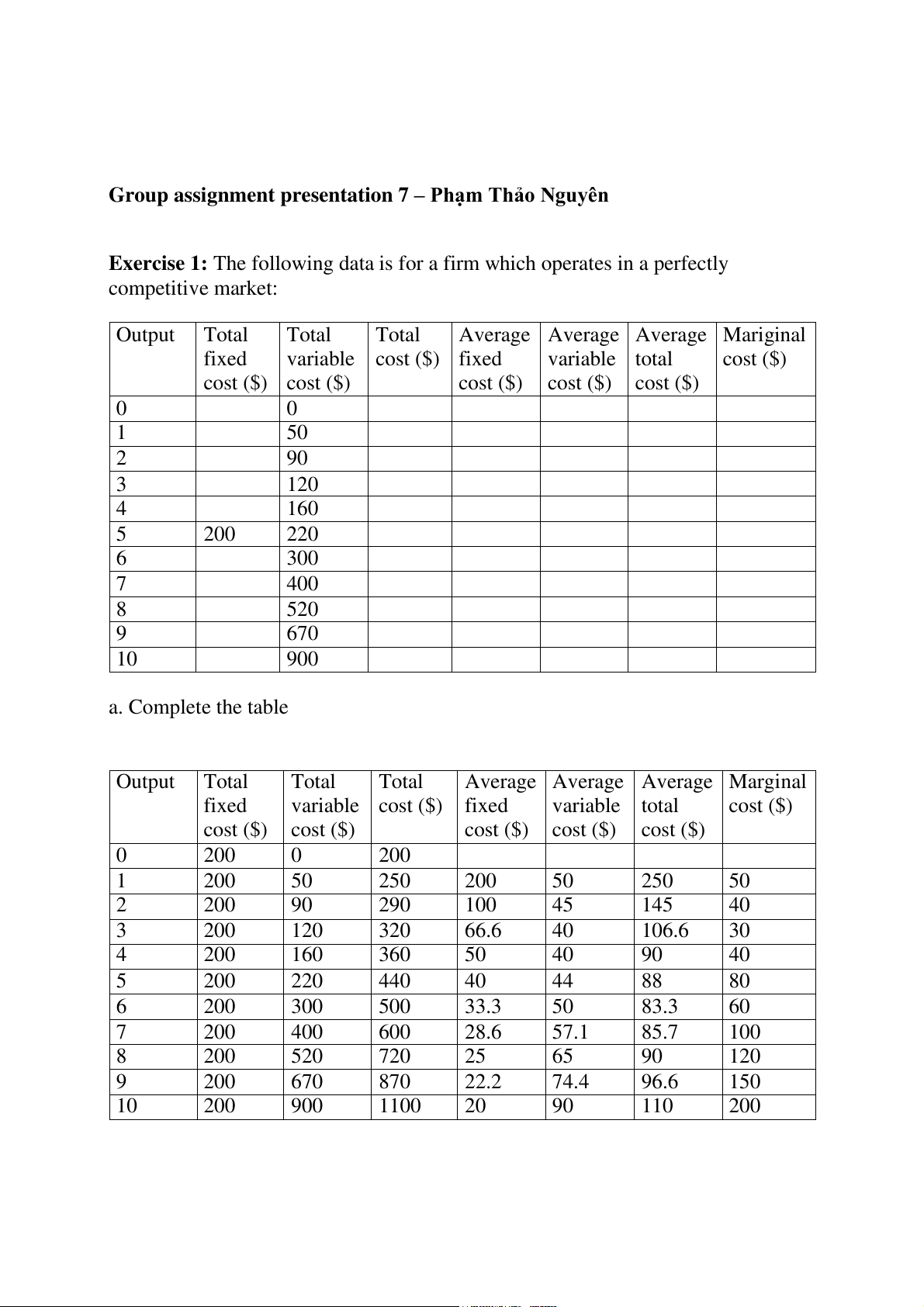
Exercise 1: The following data is for a firm which operates in a perfectly competitive market: Output Total Total Total
Average Average Average Mariginal fixed variable cost ($) fixed variable total cost ($) cost ($) cost ($) cost ($) cost ($) cost ($) 0 0 1 50 2 90 3 120 4 160 5 200 220 6 300 7 400 8 520 9 670 10 900 a. Complete the table
Output Total Total Total Average Average Average Marginal fixed variable cost ($) fixed variable total cost ($) cost ($) cost ($) cost ($) cost ($) cost ($) 0 200 0 200 1 200 50 250 200 50 250 50 2 200 90 290 100 45 145 40 3 200 120 320 66.6 40 106.6 30 4 200 160 360 50 40 90 40 5 200 220 440 40 44 88 80 6 200 300 500 33.3 50 83.3 60 7 200 400 600 28.6 57.1 85.7 100 8 200 520 720 25 65 90 120 9 200 670 870 22.2 74.4 96.6 150 10 200 900 1100 20 90 110 200
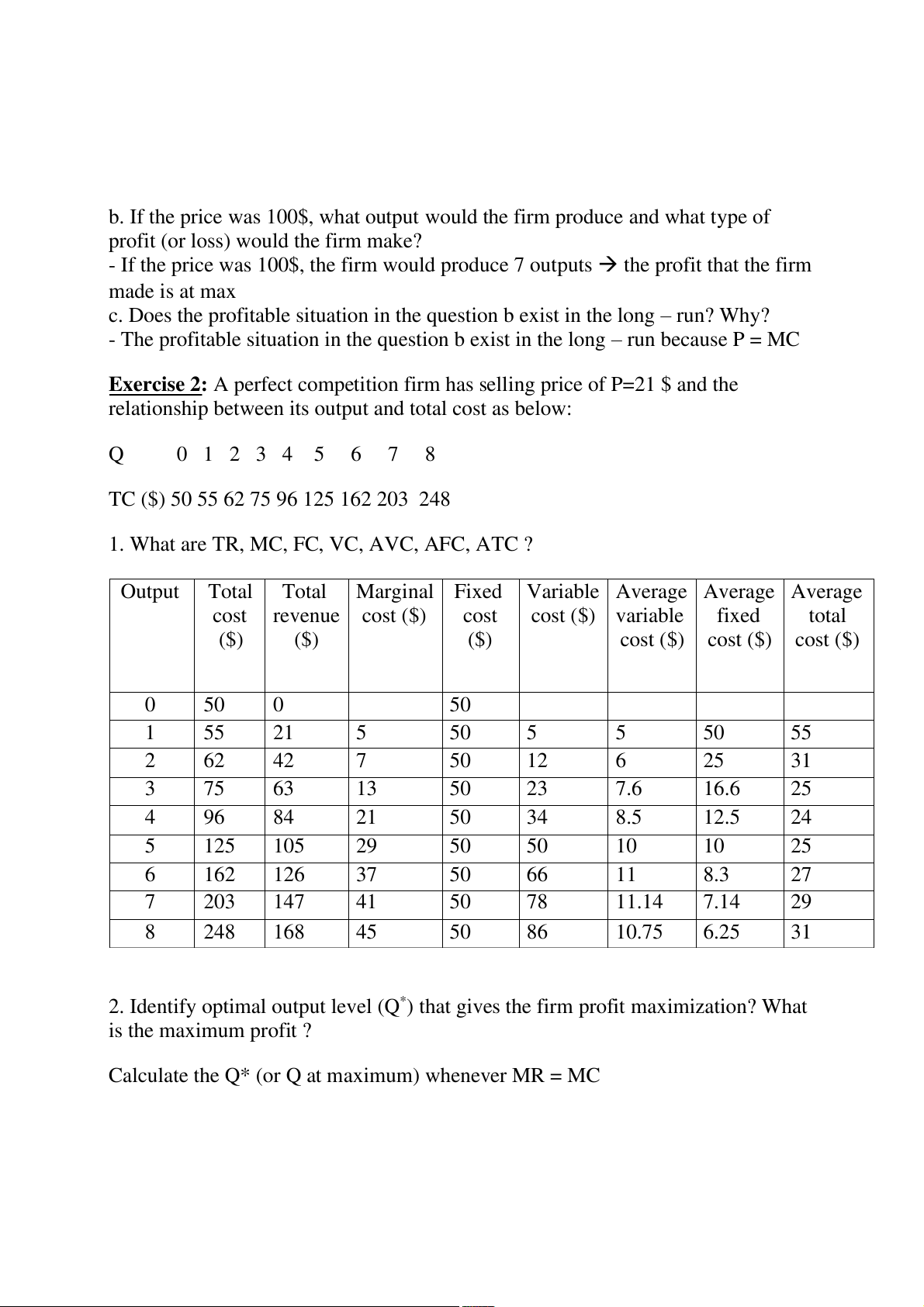
b. If the price was 100$, what output would the firm produce and what type of
profit (or loss) would the firm make?
- If the price was 100$, the firm would produce 7 outputs → the profit that the firm made is at max
c. Does the profitable situation in the question b exist in the long r – un? Why?
- The profitable situation in the question b exist in the long r – un because P = MC
Exercise 2: A perfect competition firm has selling price of P=21 $ and the
relationship between its output and total cost as below: Q 0 1 2 3 4 5 6 7 8
TC ($) 50 55 62 75 96 125 162 203 248
1. What are TR, MC, FC, VC, AVC, AFC, ATC ?
Output Total Total Marginal Fixed Variable Average Average Average cost revenue cost ($) cost cost ($) variable fixed total ($) ($) ($) cost ($) cost ($) cost ($) 0 50 0 50 1 55 21 5 50 5 5 50 55 2 62 42 7 50 12 6 25 31 3 75 63 13 50 23 7.6 16.6 25 4 96 84 21 50 34 8.5 12.5 24 5 125 105 29 50 50 10 10 25 6 162 126 37 50 66 11 8.3 27 7 203 147 41 50 78 11.14 7.14 29 8 248 168 45 50 86 10.75 6.25 31
2. Identify optimal output level (Q*) that gives the firm profit maximization? What is the maximum profit ?
Calculate the Q* (or Q at maximum) whenever MR = MC Output
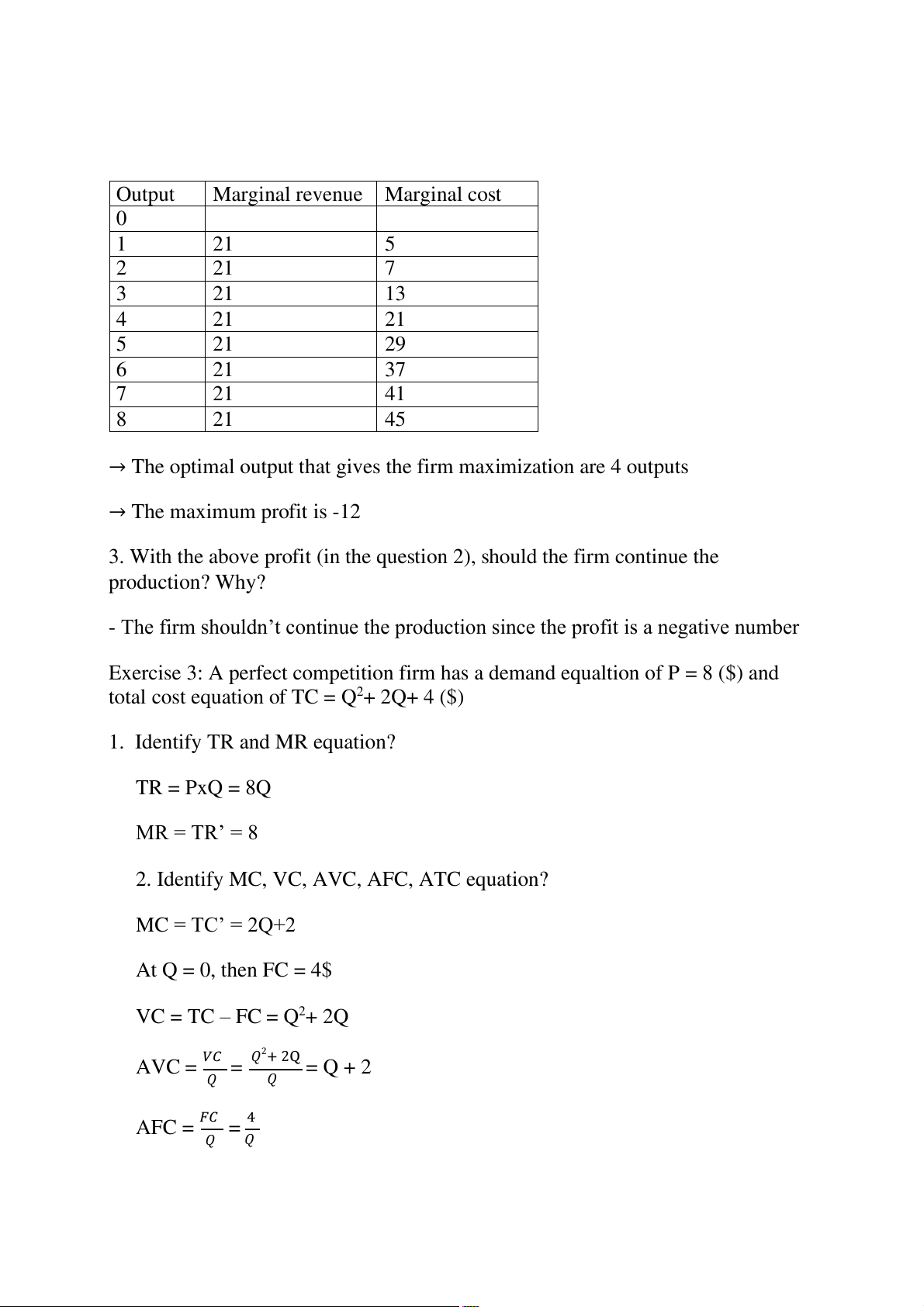
Marginal revenue Marginal cost 0 1 21 5 2 21 7 3 21 13 4 21 21 5 21 29 6 21 37 7 21 41 8 21 45
→ The optimal output that gives the firm maximization are 4 outputs → The maximum profit is -12
3. With the above profit (in the question 2), should the firm continue the production? Why?
- The firm shouldn’t continue the production since the profit is a negative number
Exercise 3: A perfect competition firm has a demand equaltion of P = 8 ($) and
total cost equation of TC = Q + 2 2Q+ 4 ($)
1. Identify TR and MR equation? TR = PxQ = 8Q MR = TR’ = 8
2. Identify MC, VC, AVC, AFC, ATC equation? MC = TC’ = 2Q+2 At Q = 0, then FC = 4$ VC = TC – FC = Q + 2 2Q
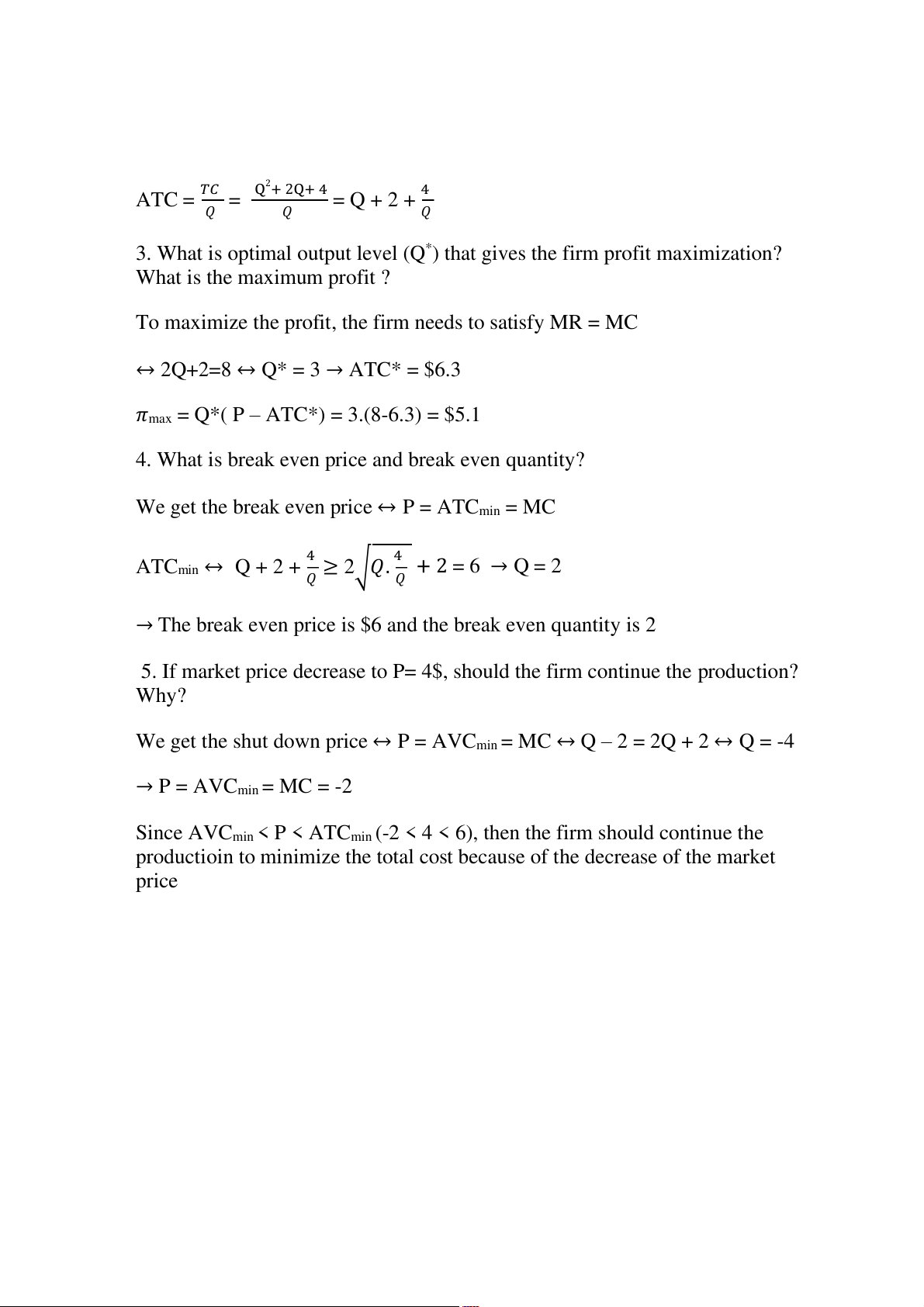
AVC = 𝑉𝐶 = 𝑄2+ 2Q = Q + 2 𝑄 𝑄 AFC = 𝐹𝐶 = 4 𝑄 𝑄 ATC = 𝑇𝐶 = Q2+ 2 + 4 Q = Q + 2 + 4 𝑄 𝑄 𝑄
3. What is optimal output level (Q*) that gives the firm profit maximization? What is the maximum profit ?
To maximize the profit, the firm needs to satisfy MR = MC
↔ 2Q+2=8 ↔ Q* = 3 → ATC* = $6.3 𝜋max = Q*( P A – TC*) = 3.(8-6.3) = $5.1
4. What is break even price and break even quantity?
We get the break even price ↔ P = ATCmin = MC
ATCmin ↔ Q + 2 + 4 ≥ 2√𝑄. 4 + 2 = 6 → Q = 2 𝑄 𝑄
→ The break even price is $6 and the break even quantity is 2
5. If market price decrease to P= 4$, should the firm continue the production? Why?
We get the shut down price ↔ P = AVCmin = MC ↔ Q 2 = 2Q – + 2 ↔ Q = -4 → P = AVCmin = MC = -2
Since AVCmin < P < ATCmin (-2 < 4 < 6), then the firm should continue the
productioin to minimize the total cost because of the decrease of the market price
Tài liệu liên quan:
-
Chương 3: độ co giãn và các nhân tố ảnh hưởng | Microeconomics | Trường Đại học Quốc tế, Đại học Quốc gia Thành phố Hồ Chí Minh
1 1 -
Microeconomics Syllabus | Microeconomics | Trường Đại học Quốc tế, Đại học Quốc gia Thành phố Hồ Chí Minh
1 1 -
Microeconomics Course Syllabus & Assessment Details | Microeconomics | Trường Đại học Quốc tế, Đại học Quốc gia Thành phố Hồ Chí Minh
1 1 -
Assignment 3 - Elasticity MCQs and Key Concepts | Microeconomics | Trường Đại học Quốc tế, Đại học Quốc gia Thành phố Hồ Chí Minh
1 1 -
Assignment 2 - Economic Equilibrium Analysis of Fridges and Motorcycles | Microeconomics | Trường Đại học Quốc tế, Đại học Quốc gia Thành phố Hồ Chí Minh
1 1