Bài tập Chương 1,2,3 | Microeconomics | Trường Đại học Quốc tế, Đại học Quốc gia Thành phố Hồ Chí Minh
Economics is best defined as the study of: a. How a business operates to achieve maximum profit. b. How to predict inflation, unemployment, and stock prices. c. How the government can protect the population from unchecked self-interest. d. How society manages its scarce resources.Question 2: The old saying, "There ain’t no such thing as a free lunch," contains much truth and relates directly to which economic principle? a. Principle 2: The cost of something is what you give up to get it. b. Principle 3: Rational people think at the margin. c. Principle 4: People respond to incentives. d. Principle 1: People face trade-offs. Tài liệu được sưu tầm và soạn thảo dưới dạng file PDF để gửi tới các bạn cùng tham khảo, ôn tập đầy đủ kiến thức, chuẩn bị cho các buổi học thật tốt. Mời bạn đọc đón xem!
Môn: Microeconomics 635 tài liệu
Trường: Trường Đại học Quốc tế, Đại học Quốc gia Thành phố Hồ Chí Minh 1.9 K tài liệu
Tác giả:


Preview text:
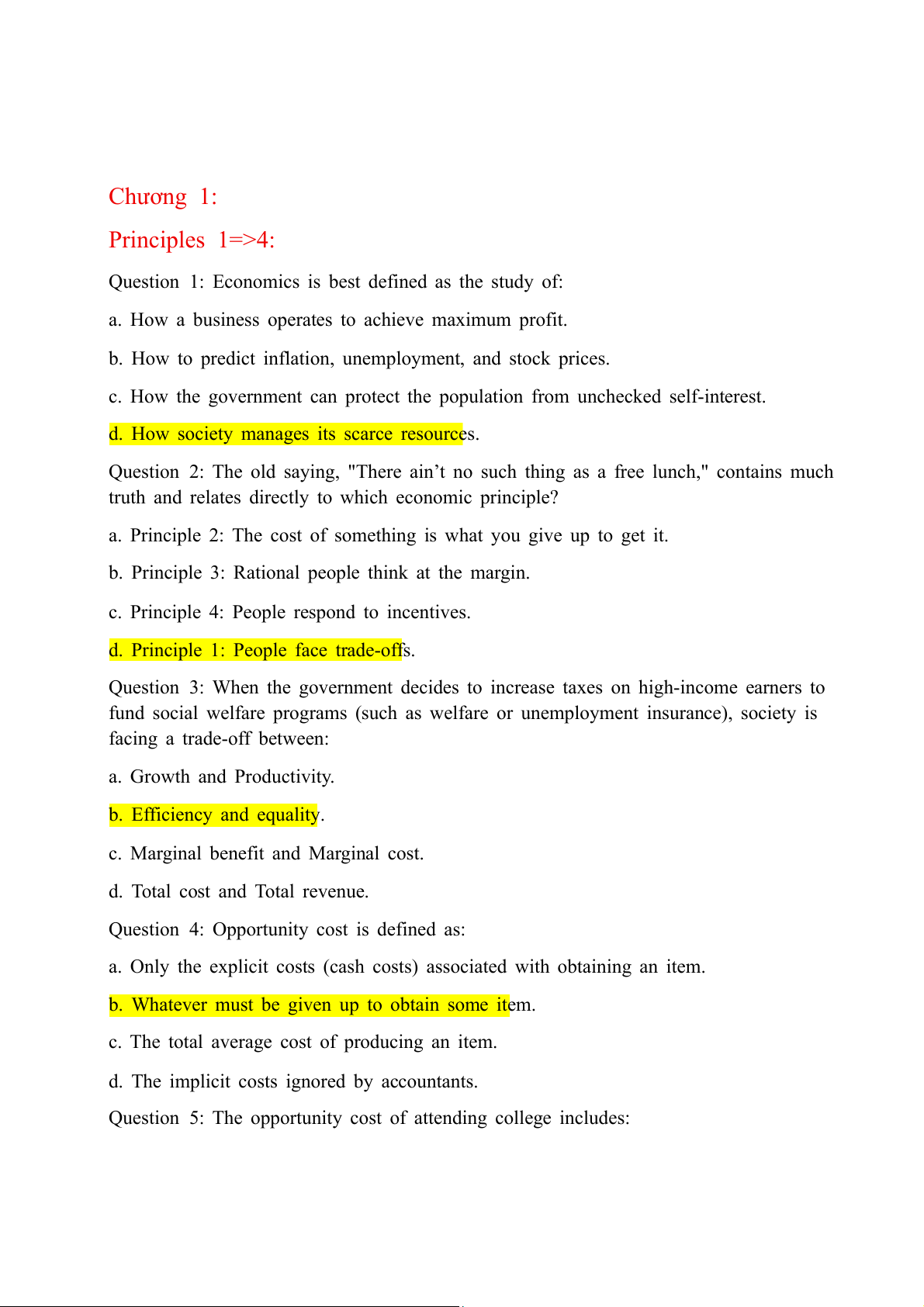
Chương 1: Principles 1=>4:
Question 1: Economics is best defined as the study of:
a. How a business operates to achieve maximum profit.
b. How to predict inflation, unemployment, and stock prices.
c. How the government can protect the population from unchecked self-interest.
d. How society manages its scarce resources.
Question 2: The old saying, "There ain’t no such thing as a free lunch," contains much
truth and relates directly to which economic principle?
a. Principle 2: The cost of something is what you give up to get it.
b. Principle 3: Rational people think at the margin.
c. Principle 4: People respond to incentives.
d. Principle 1: People face trade-offs.
Question 3: When the government decides to increase taxes on high-income earners to
fund social welfare programs (such as welfare or unemployment insurance), society is facing a trade-off between: a. Growth and Productivity. b. Efficiency and equality.
c. Marginal benefit and Marginal cost.
d. Total cost and Total revenue.
Question 4: Opportunity cost is defined as:
a. Only the explicit costs (cash costs) associated with obtaining an item.
b. Whatever must be given up to obtain some item.
c. The total average cost of producing an item.
d. The implicit costs ignored by accountants.
Question 5: The opportunity cost of attending college includes:
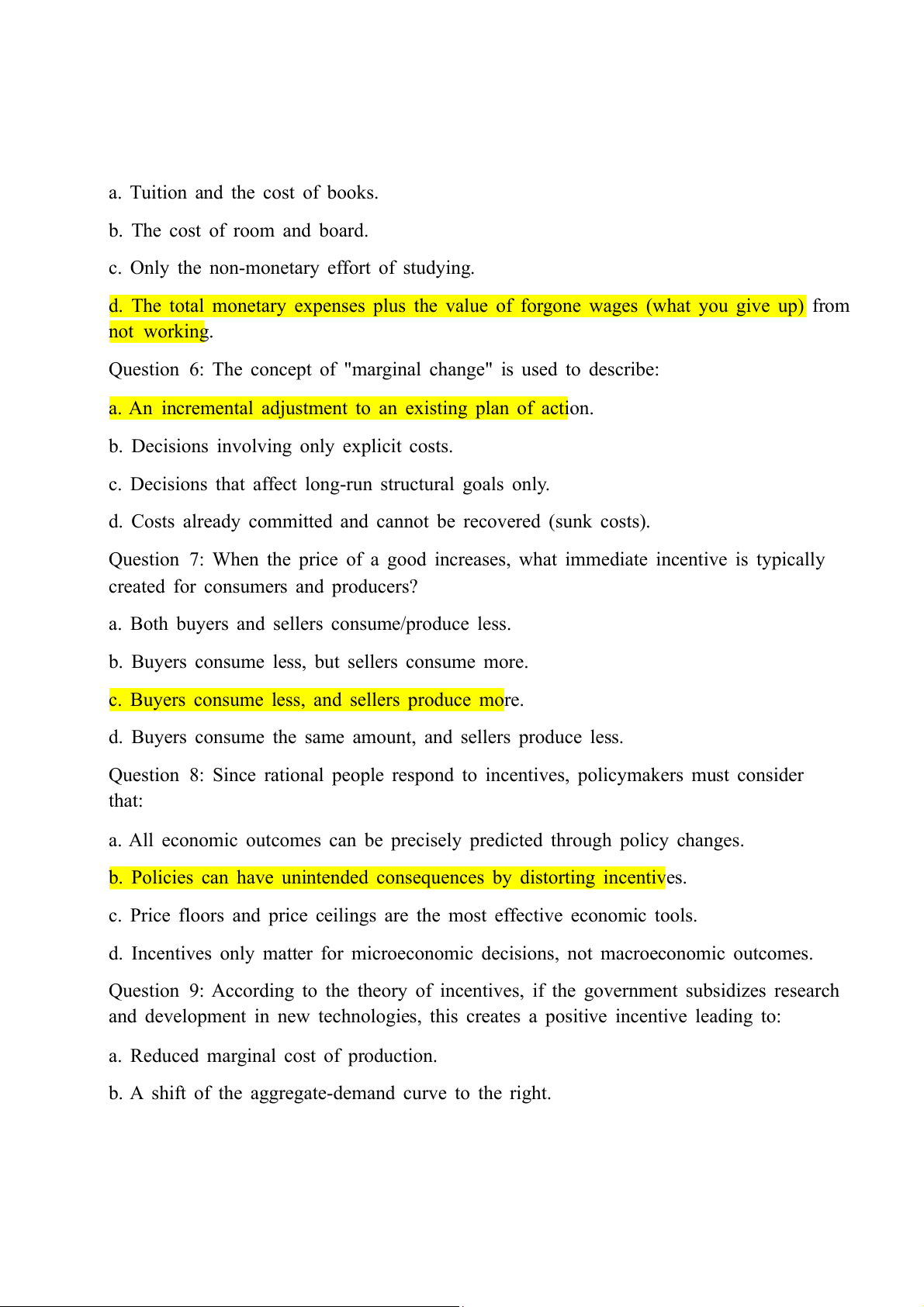
a. Tuition and the cost of books.
b. The cost of room and board.
c. Only the non-monetary effort of studying.
d. The total monetary expenses plus the value of forgone wages (what you give up) from not working.
Question 6: The concept of "marginal change" is used to describe:
a. An incremental adjustment to an existing plan of action.
b. Decisions involving only explicit costs.
c. Decisions that affect long-run structural goals only.
d. Costs already committed and cannot be recovered (sunk costs).
Question 7: When the price of a good increases, what immediate incentive is typically
created for consumers and producers?
a. Both buyers and sellers consume/produce less.
b. Buyers consume less, but sellers consume more.
c. Buyers consume less, and sellers produce more.
d. Buyers consume the same amount, and sellers produce less.
Question 8: Since rational people respond to incentives, policymakers must consider that:
a. All economic outcomes can be precisely predicted through policy changes.
b. Policies can have unintended consequences by distorting incentives.
c. Price floors and price ceilings are the most effective economic tools.
d. Incentives only matter for microeconomic decisions, not macroeconomic outcomes.
Question 9: According to the theory of incentives, if the government subsidizes research
and development in new technologies, this creates a positive incentive leading to:
a. Reduced marginal cost of production.
b. A shift of the aggregate-demand curve to the right.
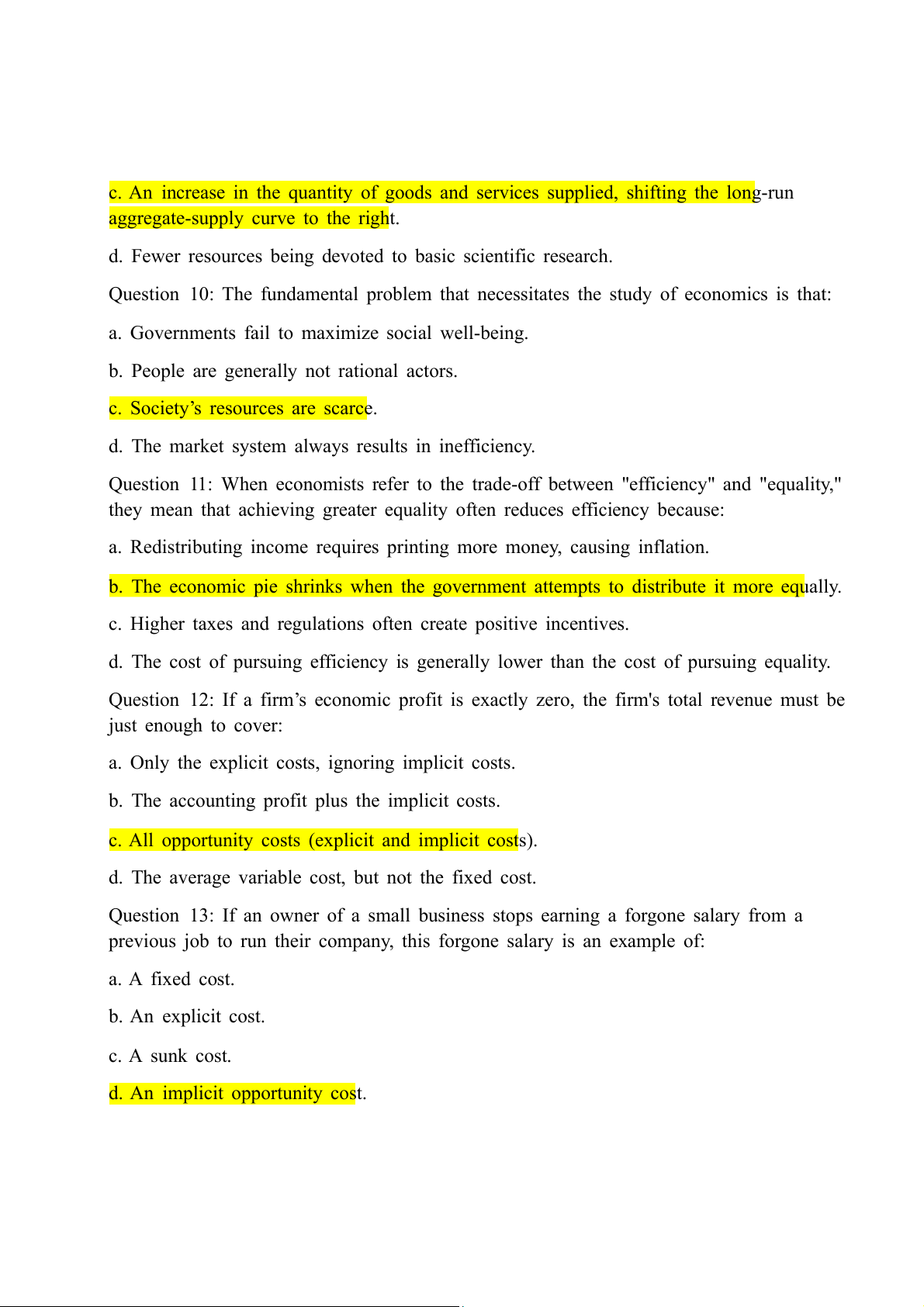
c. An increase in the quantity of goods and services supplied, shifting the long-run
aggregate-supply curve to the right.
d. Fewer resources being devoted to basic scientific research.
Question 10: The fundamental problem that necessitates the study of economics is that:
a. Governments fail to maximize social well-being.
b. People are generally not rational actors.
c. Society’s resources are scarce.
d. The market system always results in inefficiency.
Question 11: When economists refer to the trade-off between "efficiency" and "equality,"
they mean that achieving greater equality often reduces efficiency because:
a. Redistributing income requires printing more money, causing inflation.
b. The economic pie shrinks when the government attempts to distribute it more equally.
c. Higher taxes and regulations often create positive incentives.
d. The cost of pursuing efficiency is generally lower than the cost of pursuing equality.
Question 12: If a firm’s economic profit is exactly zero, the firm's total revenue must be just enough to cover:
a. Only the explicit costs, ignoring implicit costs.
b. The accounting profit plus the implicit costs.
c. All opportunity costs (explicit and implicit costs).
d. The average variable cost, but not the fixed cost.
Question 13: If an owner of a small business stops earning a forgone salary from a
previous job to run their company, this forgone salary is an example of: a. A fixed cost. b. An explicit cost. c. A sunk cost.
d. An implicit opportunity cost.
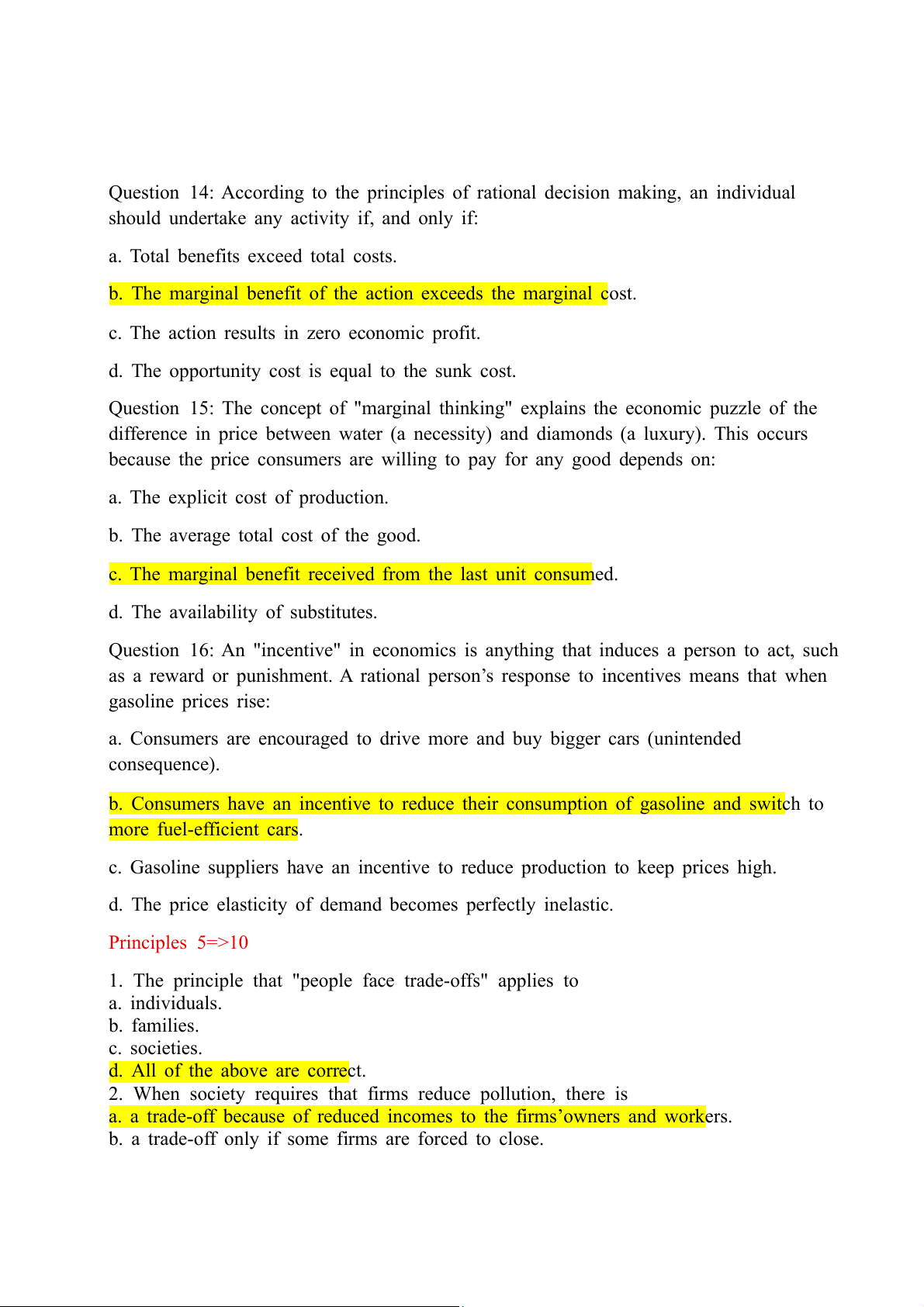
Question 14: According to the principles of rational decision making, an individual
should undertake any activity if, and only if:
a. Total benefits exceed total costs.
b. The marginal benefit of the action exceeds the marginal cost.
c. The action results in zero economic profit.
d. The opportunity cost is equal to the sunk cost.
Question 15: The concept of "marginal thinking" explains the economic puzzle of the
difference in price between water (a necessity) and diamonds (a luxury). This occurs
because the price consumers are willing to pay for any good depends on:
a. The explicit cost of production.
b. The average total cost of the good.
c. The marginal benefit received from the last unit consumed.
d. The availability of substitutes.
Question 16: An "incentive" in economics is anything that induces a person to act, such
as a reward or punishment. A rational person’s response to incentives means that when gasoline prices rise:
a. Consumers are encouraged to drive more and buy bigger cars (unintended consequence).
b. Consumers have an incentive to reduce their consumption of gasoline and switch to more fuel-efficient cars.
c. Gasoline suppliers have an incentive to reduce production to keep prices high.
d. The price elasticity of demand becomes perfectly inelastic. Principles 5=>10
1. The principle that "people face trade-offs" applies to a. individuals. b. families. c. societies.
d. All of the above are correct.
2. When society requires that firms reduce pollution, there is
a. a trade-off because of reduced incomes to the firms’owners and workers.
b. a trade-off only if some firms are forced to close.
c. no tradeoff, since the cost of reducing pollution falls only on the firms affected by the requirements.
d. no trade-off, since everyone benefits from reduced pollution.
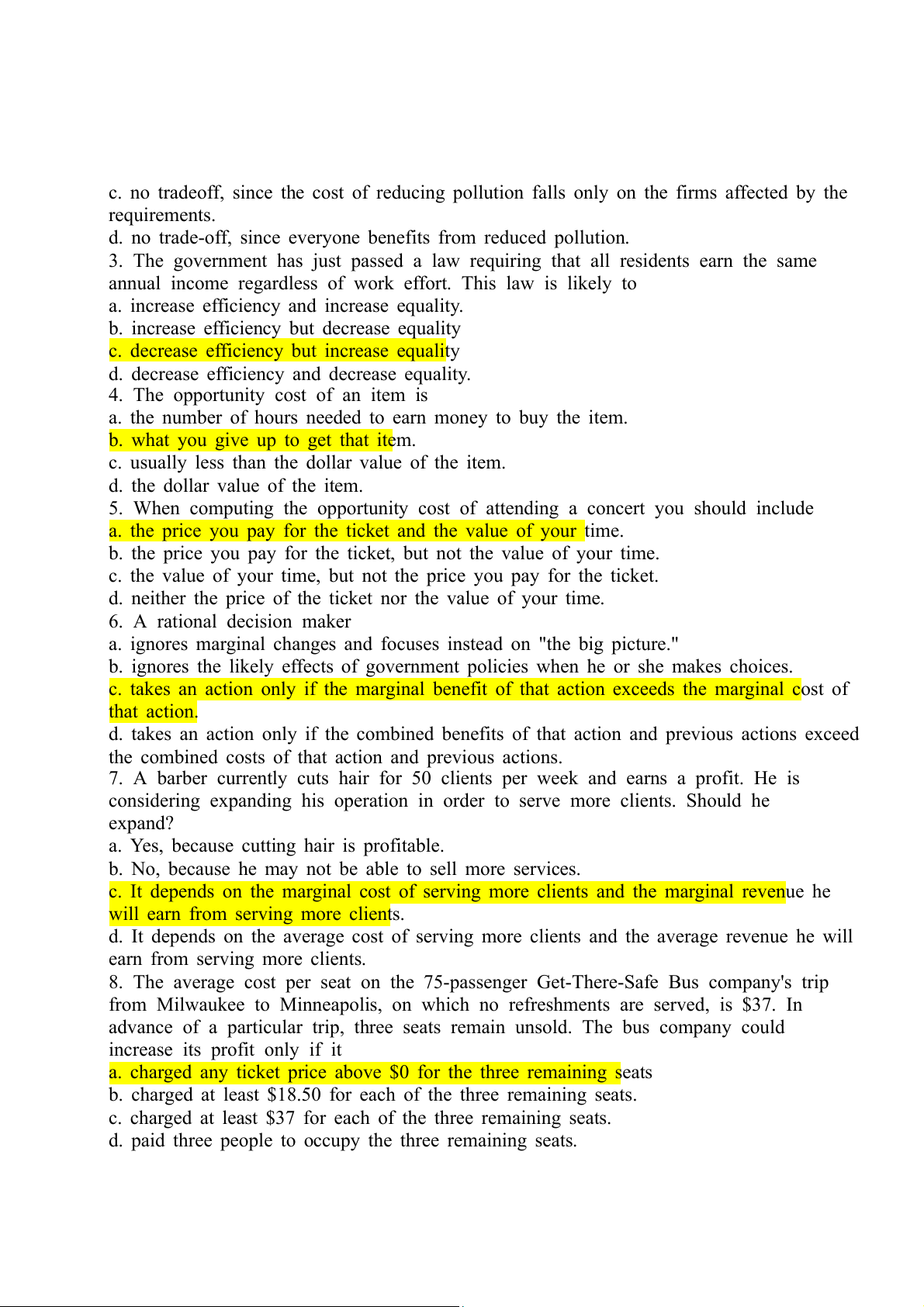
3. The government has just passed a law requiring that all residents earn the same
annual income regardless of work effort. This law is likely to
a. increase efficiency and increase equality.
b. increase efficiency but decrease equality
c. decrease efficiency but increase equality
d. decrease efficiency and decrease equality.
4. The opportunity cost of an item is
a. the number of hours needed to earn money to buy the item.
b. what you give up to get that item.
c. usually less than the dollar value of the item.
d. the dollar value of the item.
5. When computing the opportunity cost of attending a concert you should include
a. the price you pay for the ticket and the value of your time.
b. the price you pay for the ticket, but not the value of your time.
c. the value of your time, but not the price you pay for the ticket.
d. neither the price of the ticket nor the value of your time.
6. A rational decision maker
a. ignores marginal changes and focuses instead on "the big picture."
b. ignores the likely effects of government policies when he or she makes choices.
c. takes an action only if the marginal benefit of that action exceeds the marginal cost of that action.
d. takes an action only if the combined benefits of that action and previous actions exceed
the combined costs of that action and previous actions.
7. A barber currently cuts hair for 50 clients per week and earns a profit. He is
considering expanding his operation in order to serve more clients. Should he expand?
a. Yes, because cutting hair is profitable.
b. No, because he may not be able to sell more services.
c. It depends on the marginal cost of serving more clients and the marginal revenue he
will earn from serving more clients.
d. It depends on the average cost of serving more clients and the average revenue he will
earn from serving more clients.
8. The average cost per seat on the 75-passenger Get-There-Safe Bus company's trip
from Milwaukee to Minneapolis, on which no refreshments are served, is $37. In
advance of a particular trip, three seats remain unsold. The bus company could
increase its profit only if it
a. charged any ticket price above $0 for the three remaining seats
b. charged at least $18.50 for each of the three remaining seats.
c. charged at least $37 for each of the three remaining seats.
d. paid three people to occupy the three remaining seats.
9. George has spent $600 purchasing and repairing an old fishing boat, which he
expects to sell for $900 once the repairs are complete. George discovers that, in
addition to the $600 he has already spent, he needs to make an additional repair,
which will cost another $400, in order to make the boat worth $900 to potential
buyers. He can sell the boat as it is now for $400. What should he do?
a. He should sell the boat as it is now for $400.
b. He should keep the boat since it would not be rational to spend $1,000 on repairs and then sell the boat for $900.
c. He should complete the repairs and sell the boat for $900.
d. It does not matter which action he takes; the outcome is the same either way.
10. Economists are particularly adept at understanding that people respond to a. laws. b. incentive
c. punishments more than rewards.
d. rewards more than punishments.
11. Which of the following is not an example of a group responding to an incentive?
a. Students attend class because of an attendance policy that reduces their grade for absences.
b. Consumers buy more of a product when it is on sale at a reduced price.
c. Universities offer fewer online classes when they generate more revenue than traditional classes.
a. Employees work harder to earn higher commissions.
13. Suppose that a country that has a high level of output per person agrees to trade
with a country that has a low level of output per person. Which country can benefit?
a. only the one with a low level of output per person.
b. only the one with a high level of output per person. c. both d. neither
14. The government enforces property rights by
a. requiring property owners to pay property taxes.
b. providing police and courts.
c. forcing people to own property.
d. providing public parks and recreation facilities.
15. The term used to describe a situation in which markets do not allocate resources efficiently is a. economic meltdown. b. market failure. c. equilibrium
d. the effect of the invisible hand.
16. Which of the following can lead to market failure?
a. externalities and market power
b. externalities but not market power
c. market power but not externalities
d. neither externalities nor market power
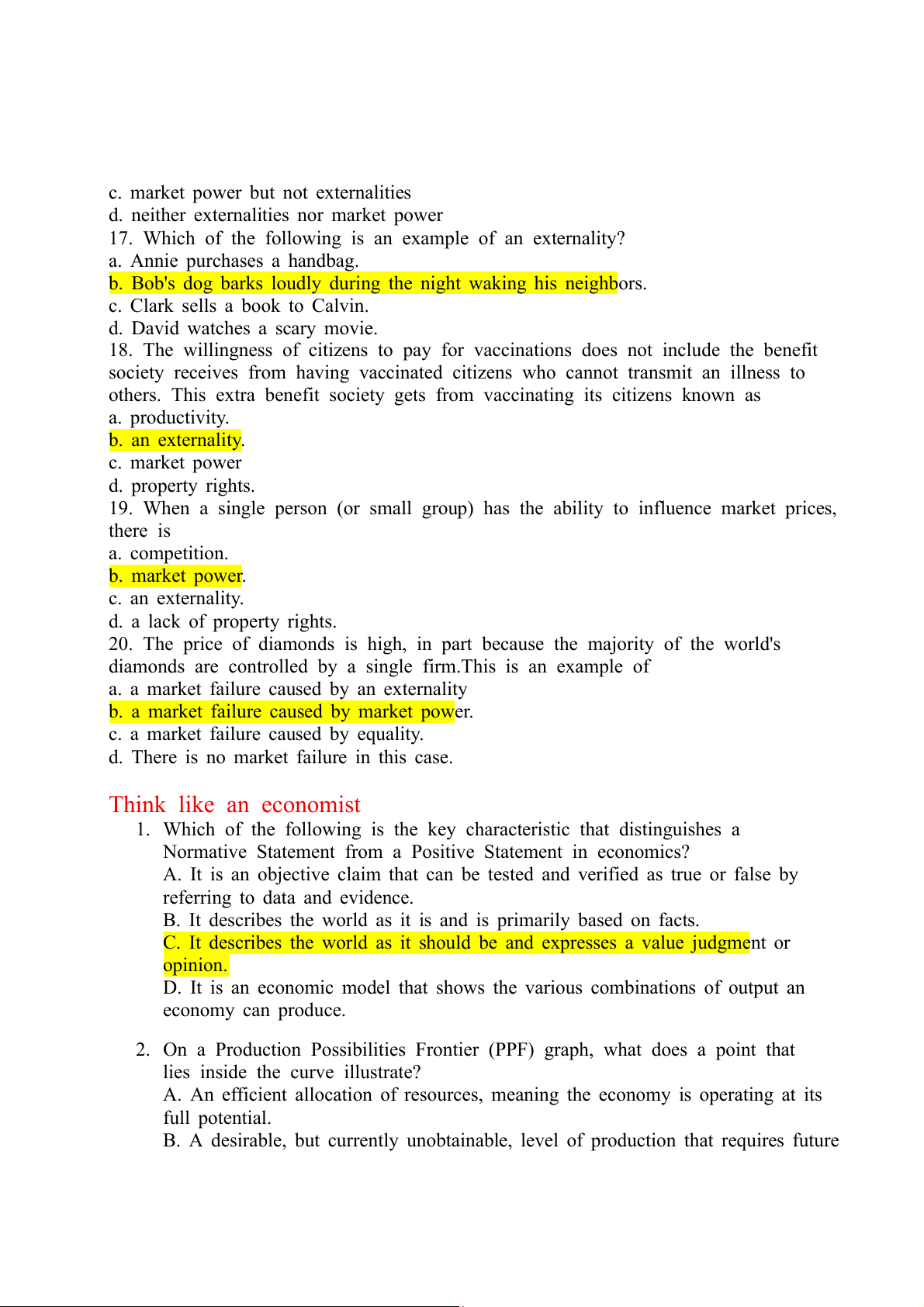
17. Which of the following is an example of an externality? a. Annie purchases a handbag.
b. Bob's dog barks loudly during the night waking his neighbors.
c. Clark sells a book to Calvin.
d. David watches a scary movie.
18. The willingness of citizens to pay for vaccinations does not include the benefit
society receives from having vaccinated citizens who cannot transmit an illness to
others. This extra benefit society gets from vaccinating its citizens known as a. productivity. b. an externality. c. market power d. property rights.
19. When a single person (or small group) has the ability to influence market prices, there is a. competition. b. market power. c. an externality. d. a lack of property rights.
20. The price of diamonds is high, in part because the majority of the world's
diamonds are controlled by a single firm.This is an example of
a. a market failure caused by an externality
b. a market failure caused by market power.
c. a market failure caused by equality.
d. There is no market failure in this case.
Think like an economist
1. Which of the following is the key characteristic that distinguishes a
Normative Statement from a Positive Statement in economics?
A. It is an objective claim that can be tested and verified as true or false by
referring to data and evidence.
B. It describes the world as it is and is primarily based on facts.
C. It describes the world as it should be and expresses a value judgment or opinion.
D. It is an economic model that shows the various combinations of output an economy can produce.
2. On a Production Possibilities Frontier (PPF) graph, what does a point that
lies inside the curve illustrate?
A. An efficient allocation of resources, meaning the economy is operating at its full potential.
B. A desirable, but currently unobtainable, level of production that requires future technological advancement.
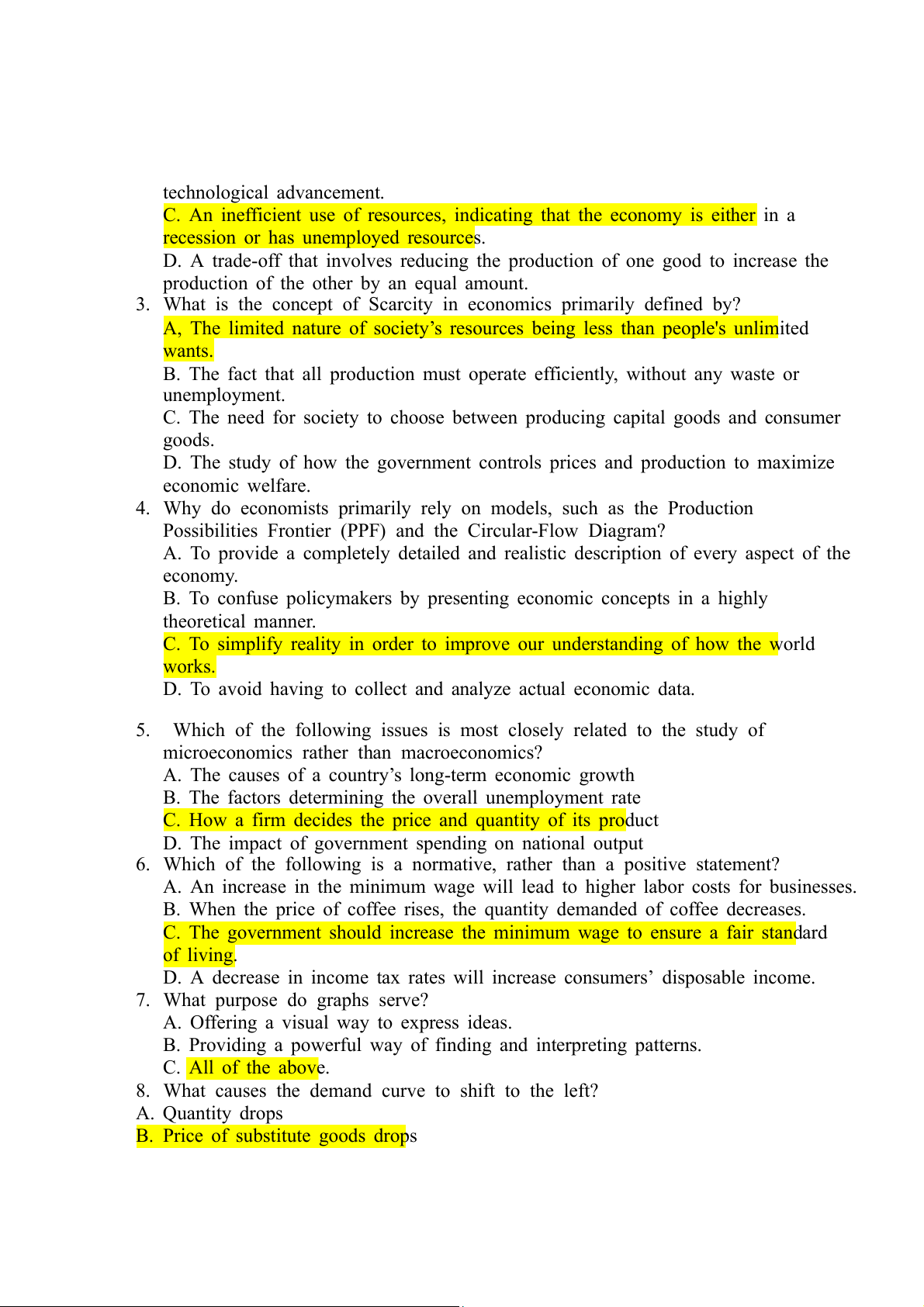
C. An inefficient use of resources, indicating that the economy is either in a
recession or has unemployed resources.
D. A trade-off that involves reducing the production of one good to increase the
production of the other by an equal amount.
3. What is the concept of Scarcity in economics primarily defined by?
A, The limited nature of society’s resources being less than people's unlimited wants.
B. The fact that all production must operate efficiently, without any waste or unemployment.
C. The need for society to choose between producing capital goods and consumer goods.
D. The study of how the government controls prices and production to maximize economic welfare.
4. Why do economists primarily rely on models, such as the Production
Possibilities Frontier (PPF) and the Circular-Flow Diagram?
A. To provide a completely detailed and realistic description of every aspect of the economy.
B. To confuse policymakers by presenting economic concepts in a highly theoretical manner.
C. To simplify reality in order to improve our understanding of how the world works.
D. To avoid having to collect and analyze actual economic data.
5. Which of the following issues is most closely related to the study of
microeconomics rather than macroeconomics?
A. The causes of a country’s long-term economic growth
B. The factors determining the overall unemployment rate
C. How a firm decides the price and quantity of its product
D. The impact of government spending on national output
6. Which of the following is a normative, rather than a positive statement?
A. An increase in the minimum wage will lead to higher labor costs for businesses.
B. When the price of coffee rises, the quantity demanded of coffee decreases.
C. The government should increase the minimum wage to ensure a fair standard of living.
D. A decrease in income tax rates will increase consumers’ disposable income.
7. What purpose do graphs serve?
A. Offering a visual way to express ideas.
B. Providing a powerful way of finding and interpreting patterns. C. All of the above.
8. What causes the demand curve to shift to the left? A. Quantity drops
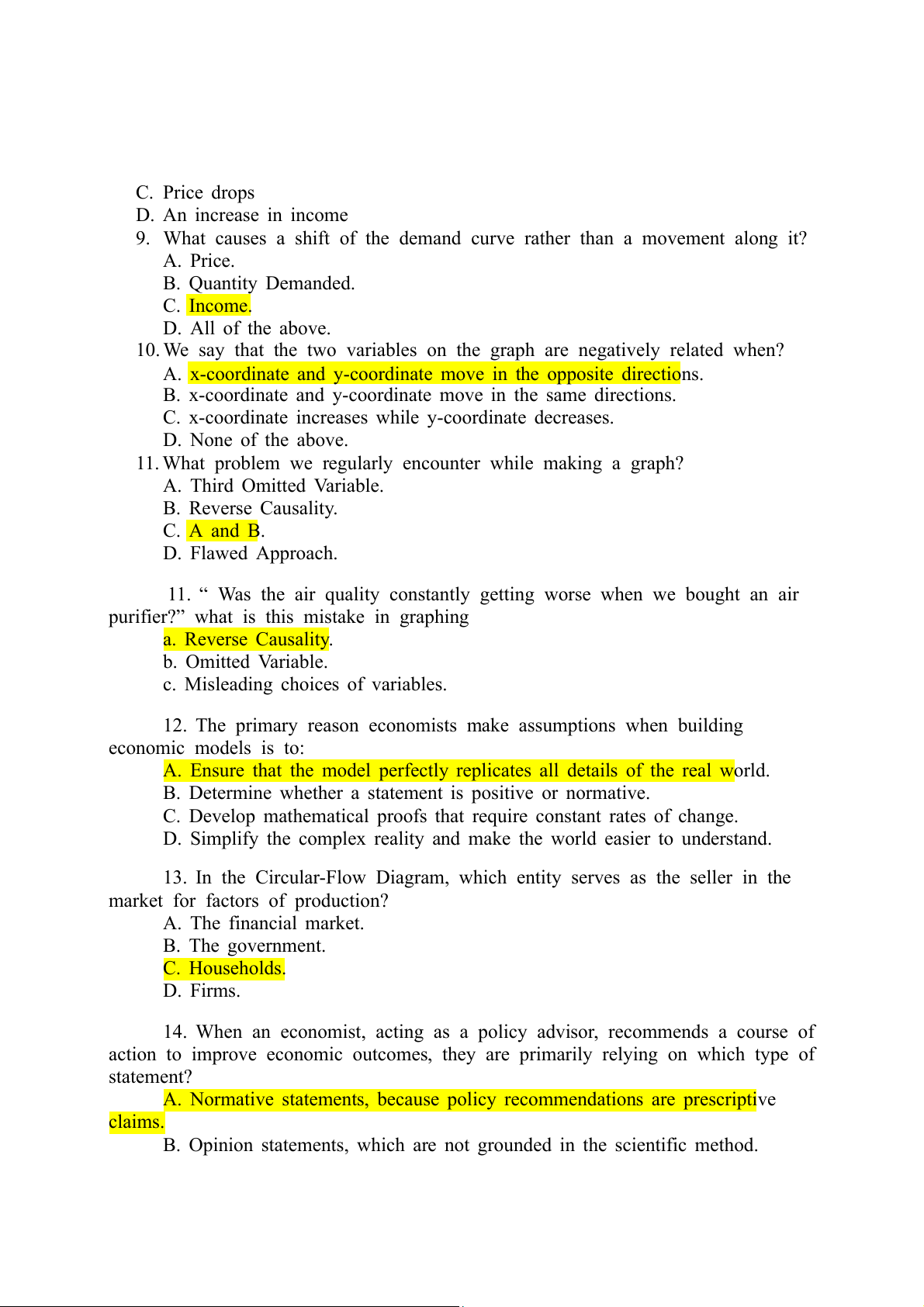
B. Price of substitute goods drops C. Price drops D. An increase in income
9. What causes a shift of the demand curve rather than a movement along it? A. Price. B. Quantity Demanded. C. Income. D. All of the above.
10. We say that the two variables on the graph are negatively related when?
A. x-coordinate and y-coordinate move in the opposite directions.
B. x-coordinate and y-coordinate move in the same directions.
C. x-coordinate increases while y-coordinate decreases. D. None of the above.
11. What problem we regularly encounter while making a graph? A. Third Omitted Variable. B. Reverse Causality. C. A and B. D. Flawed Approach.
11. “ Was the air quality constantly getting worse when we bought an air
purifier?” what is this mistake in graphing a. Reverse Causality. b. Omitted Variable.
c. Misleading choices of variables.
12. The primary reason economists make assumptions when building
economic models is to:
A. Ensure that the model perfectly replicates all details of the real world.
B. Determine whether a statement is positive or normative.
C. Develop mathematical proofs that require constant rates of change.
D. Simplify the complex reality and make the world easier to understand.
13. In the Circular-Flow Diagram, which entity serves as the seller in the
market for factors of production? A. The financial market. B. The government. C. Households. D. Firms.
14. When an economist, acting as a policy advisor, recommends a course of
action to improve economic outcomes, they are primarily relying on which type of statement?
A. Normative statements, because policy recommendations are prescriptive claims.
B. Opinion statements, which are not grounded in the scientific method.
C. Value statements, as the entire field of economics is based on moral philosophy.
D. Positive statements, because policy must be based solely on factual analysis.
Interdependence and gains from trade
1. Before Frank and Ruby engage in trade, each of them
A. consumes at a point inside his or her production possibilities frontier
B. consumes at a point on his or her production possibilities frontier
C. consumes at a point outside his or her production possibilities frontier.
D. consumes the same amounts of meat and potatoes as the other
2 . In an hour, Mateo can wash 2 cars or mow 1 lawn, and Sophia can wash 3 cars or
mow 1 lawn. Who has the absolute advantage in car washing, and who has the
absolute advantage in lawn mowing?
A. Mateo in washing, Sophia in mowing
B. Sophia in washing, Mateo in mowing
C. Mateo in washing, neither in mowing
D. Sophia in washing, neither in mowing
3. When Mateo and Sophia produce efficiently and make a mutually beneficial trade
based on comparative advantage,
A. Mateo mows more and Sophia washes more.
B. Mateo washes more and Sophia mows more.
C. Mateo and Sophia both wash more.
D. Mateo and Sophia both mow more.
4. A nation will typically import those goods in which
A. the nation has an absolute advantage
B. the nation has a comparative advantage
C. other nations have an absolute advantage
D. Other nations have a comparative advantage.
5. Suppose that in the United States, producing an aircraft takes 10,000 hours of
labor and producing a shirt takes 2 hours of labor. In China, producing an aircraft
takes 40,000 hours of labor and producing a shirt takes 4hours of labor. What will
these nations trade?
A. China will export aircraft, and the United States will export shirts.
B. China will export shirts, and the United States will export aircraft.
C. Both nations will export shirts.
D. There are no gains from trade in this situation.
6 . Kayla can cook dinner in 30 minutes and wash the laundry in 20 minutes. Her
roommate takes twice as long to do each task. How should the roommates allocate the work?
A. Kayla should do more of the cooking based on her comparative advantage.
B. Kayla should do more of the washing based on her comparative advantage.
C. Kayla should do more of the washing based on her absolute advantage.
D. There are no gains from trade in this situation
7. Using the same amount of time and resources, Anna can either build 6 models or
prepare 4 experiments, and Pam can either build 9 models or prepare 6
experiments. Who should specialize in the production of which goods?
A. There is no opportunity to gain from trade because neither person has a
comparative advantage in producing either good
B. Anna should specialize in models and Pam should specialize in experiments
C. Pam should specialize in both goods
D. Anna should specialize in models but nobody should specialize in processing experiments
E. Pam should specialize in models and Anna should specialize in experiments
8. Using the same amount of time and resources, Tommer can either write 100 lines
of code or process 20 reports and Charlotte can either write 120 lines of code or
process 20 reports. Which of these trading prices will Charlotte and Tomer agree on
if they specialize and trade?
A. 1 line of code trades for 1 of a report
B. 1 line of code trades for 0.5 of a report
C. 1 line of code trades for 0.25 of a report
D. 1 line of code trades for 0.18 of a report
9.Mike and Sandy are two woodworkers who both make tables and chairs. In one
month, Mike can make 4 tables or 20 chairs, where Sandy can make 6 tables or 18
chairs. Given this, we know that the opportunity cost of 1 table for
a. Mike is 1/5 chair and 1/3 chair for Sandy
b. Mike is 5 chairs and 3 chairs for Sandy
c. Mike is 1/3 chair and 1/5 chair for Sandy
d. Mike is 3 chairs and 5 chairs for Sandy
10. These figures illustrate the production possibilities available to Barney and
Betty with 8 hours of labor in their bakery
10.1 According to the graphs shown, the opportunity cost of 1 loaf of bread for Barney is a. 1/4 pie. b. 1/2 pie. c. 1 pie. d. 2 pies.
10.2 According to the graphs shown, the opportunity cost of 1 pie for Betty is a. 1/4 loaf of bread. b. 3/4 loaf of bread. c. 1 loaf of bread. d. 4/3 loaves of bread.
10.3 According to the graphs shown, Barney has an absolute advantage in
a. both goods and Betty has an absolute advantage in neither good.
b. loaves of bread and Betty has an absolute advantage in pies.
c. neither good and Betty has an absolute advantage in both goods.
d. pies and Betty has an absolute advantage in loaves of bread.
10.4 According to the graphs shown, Barney has a comparative advantage in
a. both goods and Betty has a comparative advantage in neither good.
b. loaves of bread and Betty has a comparative advantage in pies.
c. neither good and Betty has a comparative advantage in both goods.
d. pies and Betty has a comparative advantage in loaves of bread.
10.5 According to the graphs shown, if Barney and Betty both specialize in the good
in which they have a comparative advantage, total production of bread will be
a. 7 and total production of pies will be 15
b. 20 and total production of pies will be 14.
c. 27 and total production of pies will be 29.
d. 40 and total production of pies will be 22.
11. You have a free ticket to see the Bức Tường show (it cannot be resold to others).
On the same day, the band Ngũ Cung is also performing, and this is your most
attractive alternative choice. Normally, you are willing to pay 500,000 VND to see
the Ngũ Cung show, but today the ticket price for their show is only 400,000 VND.
Assume that there are no other costs outside of attending the two shows. What is the
opportunity cost of attending the Bức Tường show? A. 900 B. 200 C. 100 D. 400
12. The table below shows the production possibilities of Country X for 2 goods
What is the opportunity cost of one ton of apples in Country X? A. 250 bales of wool B. 40 bales of wool C. 0.025 bales of wool D. 4,000 bales of wool
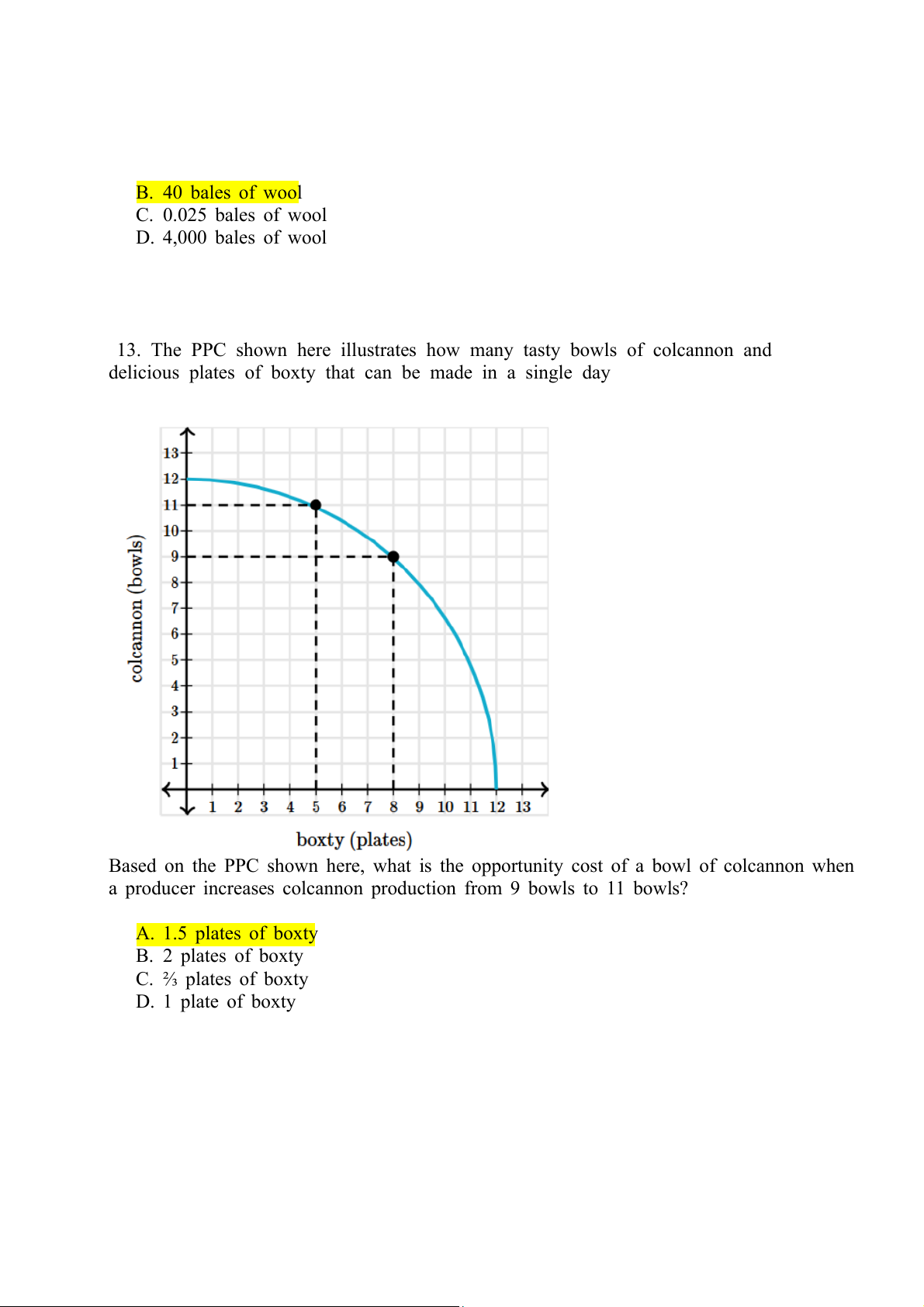
13. The PPC shown here illustrates how many tasty bowls of colcannon and
delicious plates of boxty that can be made in a single day
Based on the PPC shown here, what is the opportunity cost of a bowl of colcannon when
a producer increases colcannon production from 9 bowls to 11 bowls? A. 1.5 plates of boxty B. 2 plates of boxty C. ⅔ plates of boxty D. 1 plate of boxty
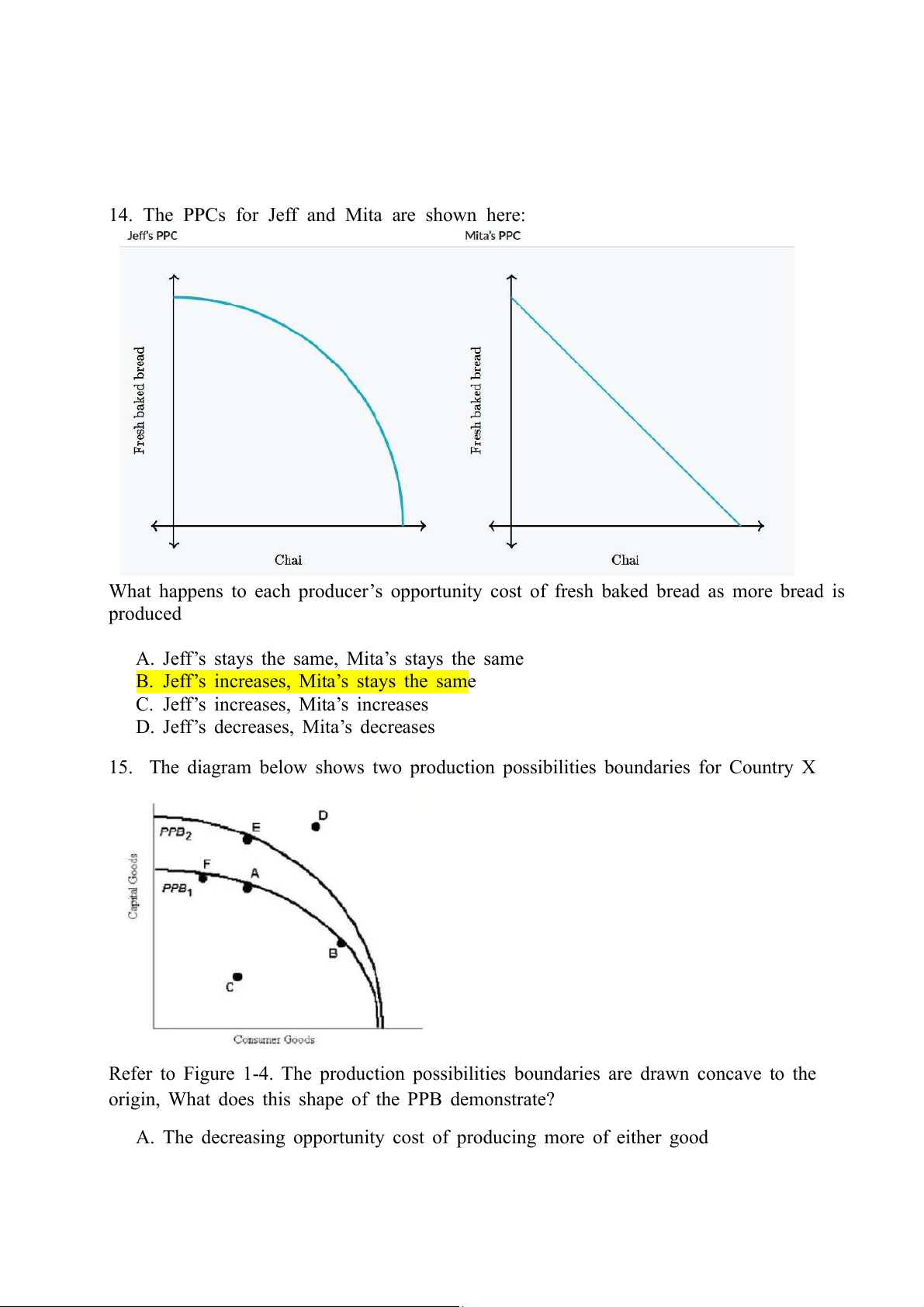
14. The PPCs for Jeff and Mita are shown here:
What happens to each producer’s opportunity cost of fresh baked bread as more bread is produced
A. Jeff’s stays the same, Mita’s stays the same
B. Jeff’s increases, Mita’s stays the same
C. Jeff’s increases, Mita’s increases
D. Jeff’s decreases, Mita’s decreases
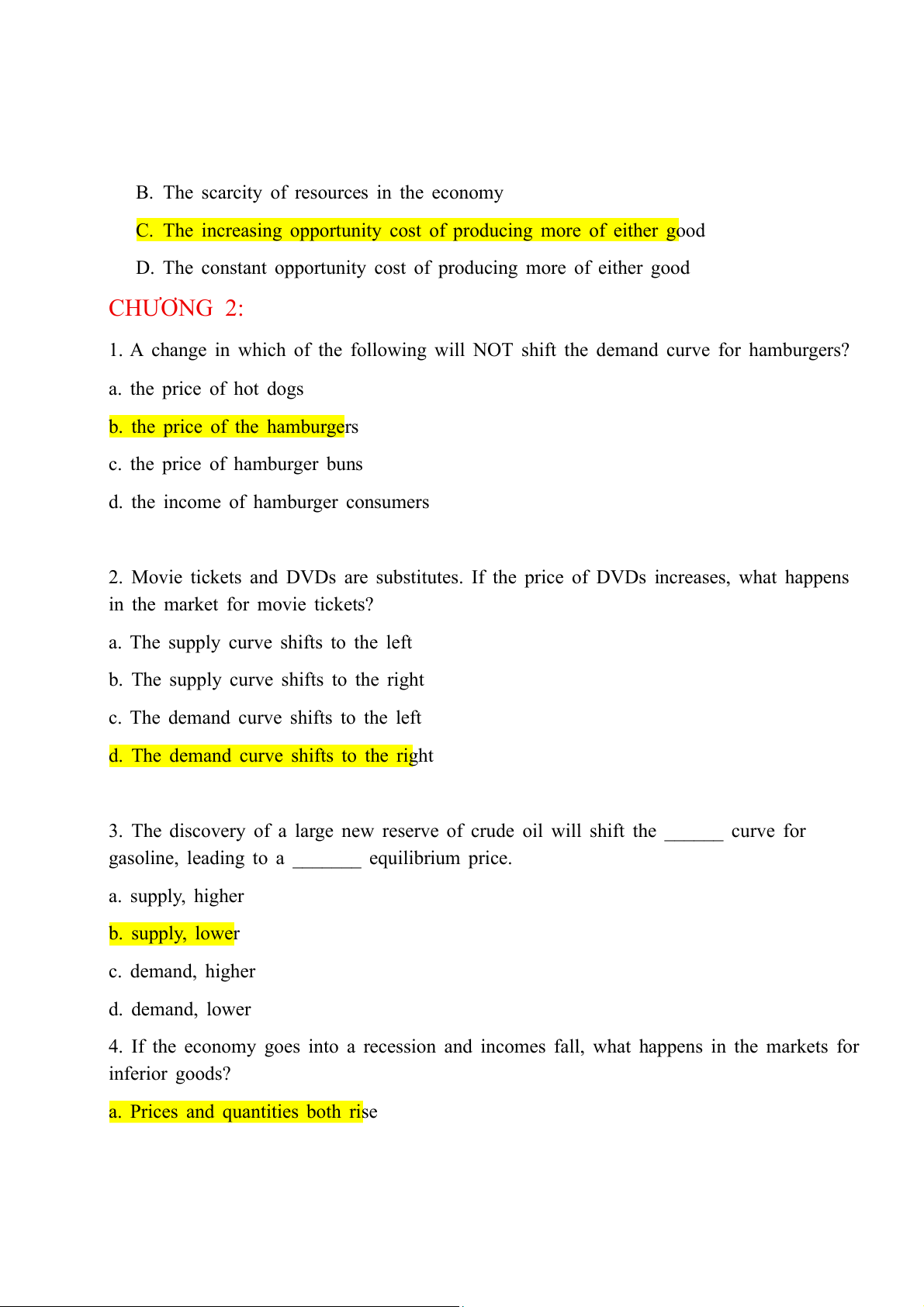
15. The diagram below shows two production possibilities boundaries for Country X
Refer to Figure 1-4. The production possibilities boundaries are drawn concave to the
origin, What does this shape of the PPB demonstrate?
A. The decreasing opportunity cost of producing more of either good
B. The scarcity of resources in the economy
C. The increasing opportunity cost of producing more of either good
D. The constant opportunity cost of producing more of either good CHƯƠNG 2:
1. A change in which of the following will NOT shift the demand curve for hamburgers? a. the price of hot dogs
b. the price of the hamburgers
c. the price of hamburger buns
d. the income of hamburger consumers
2. Movie tickets and DVDs are substitutes. If the price of DVDs increases, what happens
in the market for movie tickets?
a. The supply curve shifts to the left
b. The supply curve shifts to the right
c. The demand curve shifts to the left
d. The demand curve shifts to the right
3. The discovery of a large new reserve of crude oil will shift the ______ curve for
gasoline, leading to a _______ equilibrium price. a. supply, higher b. supply, lower c. demand, higher d. demand, lower
4. If the economy goes into a recession and incomes fall, what happens in the markets for inferior goods?
a. Prices and quantities both rise
b. Prices and quantities both fall
c. Prices rise, quantities fall
d. Prices fall, quantities rise
5. An increase in demand and a decrease in supply will.
a. Increase price and increase the quantity exchanged.
b. Decrease the price and decrease the quantity exchanged.
c. Increase price, and the effect on quantity exchanged will be indeterminate.
d. Decrease price, and the effect on quantity exchanged will be indeterminate.
6. The demand for umbrellas increases sharply during the rainy season. This shows that:
A. Income is the main determinant of demand
B. Tastes and preferences affect demand
C. Price of related goods affects demand
D. Demand is perfectly elastic
7. When the price of coffee rises, the demand for tea increases. This indicates that coffee and tea are: A. Complementary goods B. Substitutes C. Inferior goods D. Normal goods
8. If the government announces that gasoline prices will double next month, what will
likely happen to the current demand for gasoline? A. It will decrease B. It will stay the same C. It will increase
D. It will become perfectly elastic
9. A sudden trend on social media makes everyone want a certain brand of sneakers.
What happens to the demand curve? A. It shifts left B. It shifts right
C. It moves upward along the curve D. It stays unchanged
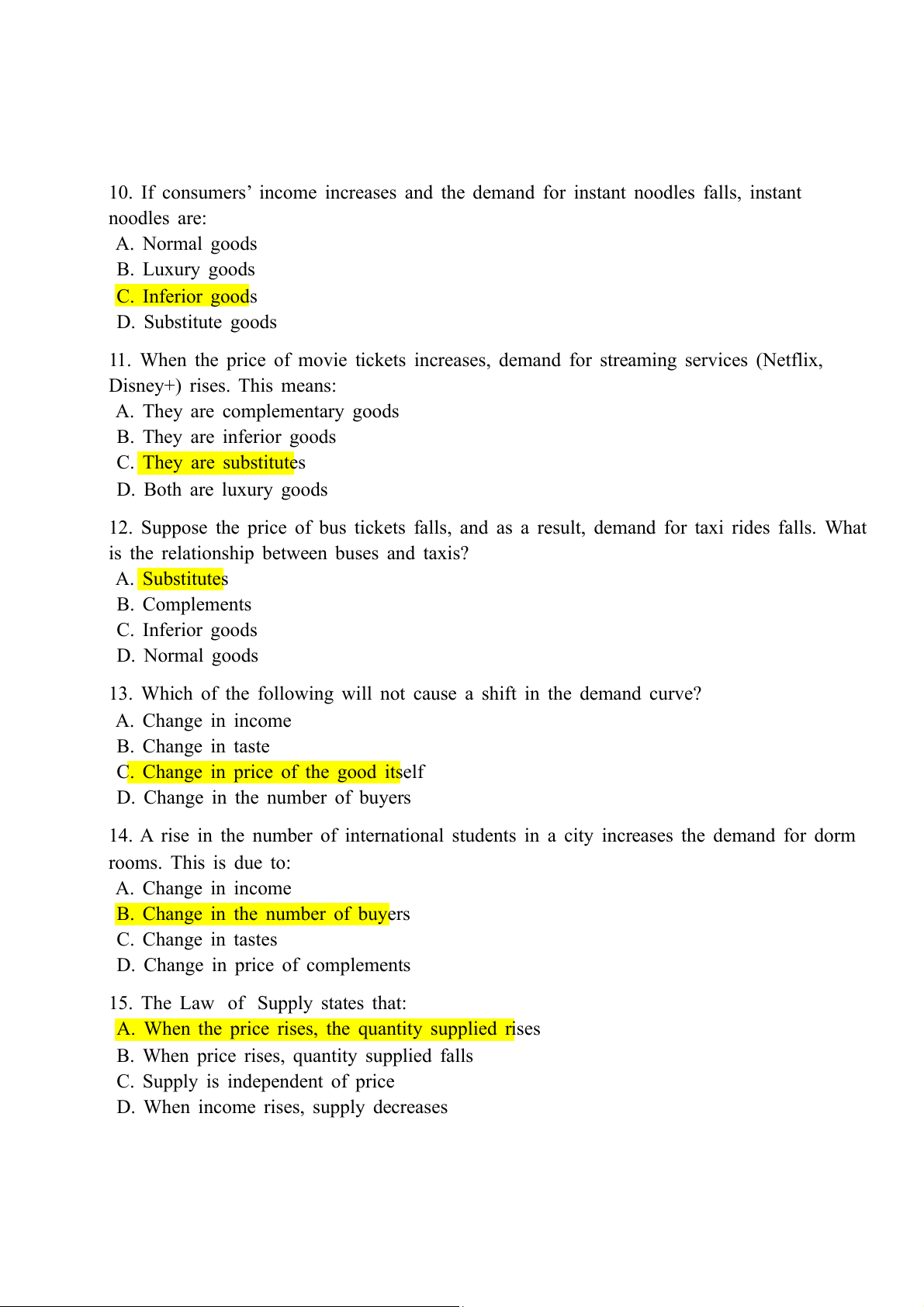
10. If consumers’ income increases and the demand for instant noodles falls, instant noodles are: A. Normal goods B. Luxury goods C. Inferior goods D. Substitute goods
11. When the price of movie tickets increases, demand for streaming services (Netflix, Disney+) rises. This means:
A. They are complementary goods B. They are inferior goods C. They are substitutes D. Both are luxury goods
12. Suppose the price of bus tickets falls, and as a result, demand for taxi rides falls. What
is the relationship between buses and taxis? A. Substitutes B. Complements C. Inferior goods D. Normal goods
13. Which of the following will not cause a shift in the demand curve? A. Change in income B. Change in taste
C. Change in price of the good itself
D. Change in the number of buyers
14. A rise in the number of international students in a city increases the demand for dorm rooms. This is due to: A. Change in income
B. Change in the number of buyers C. Change in tastes
D. Change in price of complements
15. The Law of Supply states that:
A. When the price rises, the quantity supplied rises
B. When price rises, quantity supplied falls
C. Supply is independent of price
D. When income rises, supply decreases
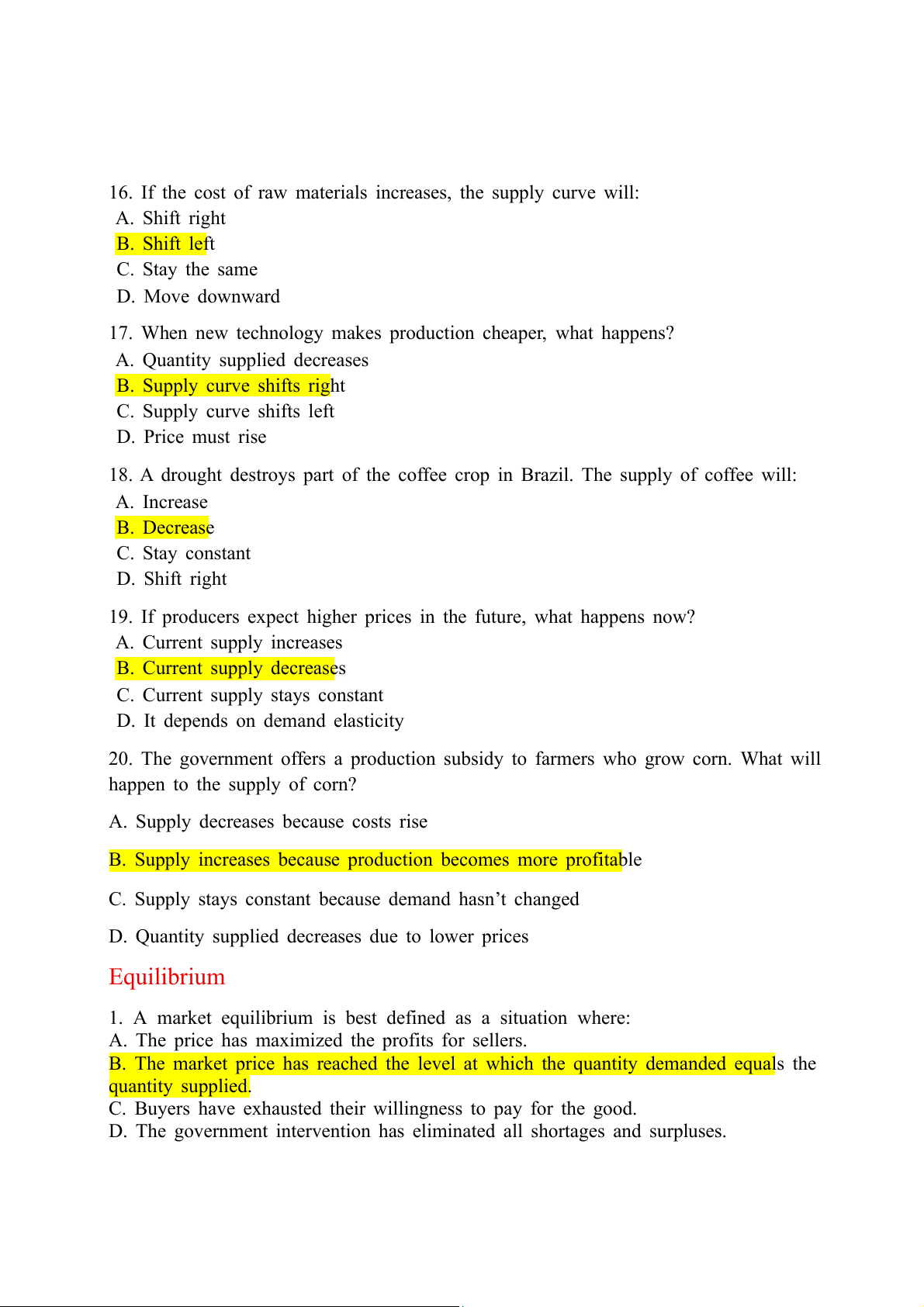
16. If the cost of raw materials increases, the supply curve will: A. Shift right B. Shift left C. Stay the same D. Move downward
17. When new technology makes production cheaper, what happens?
A. Quantity supplied decreases B. Supply curve shifts right C. Supply curve shifts left D. Price must rise
18. A drought destroys part of the coffee crop in Brazil. The supply of coffee will: A. Increase B. Decrease C. Stay constant D. Shift right
19. If producers expect higher prices in the future, what happens now? A. Current supply increases B. Current supply decreases
C. Current supply stays constant
D. It depends on demand elasticity
20. The government offers a production subsidy to farmers who grow corn. What will happen to the supply of corn?
A. Supply decreases because costs rise
B. Supply increases because production becomes more profitable
C. Supply stays constant because demand hasn’t changed
D. Quantity supplied decreases due to lower prices Equilibrium
1. A market equilibrium is best defined as a situation where:
A. The price has maximized the profits for sellers.
B. The market price has reached the level at which the quantity demanded equals the quantity supplied.
C. Buyers have exhausted their willingness to pay for the good.
D. The government intervention has eliminated all shortages and surpluses.
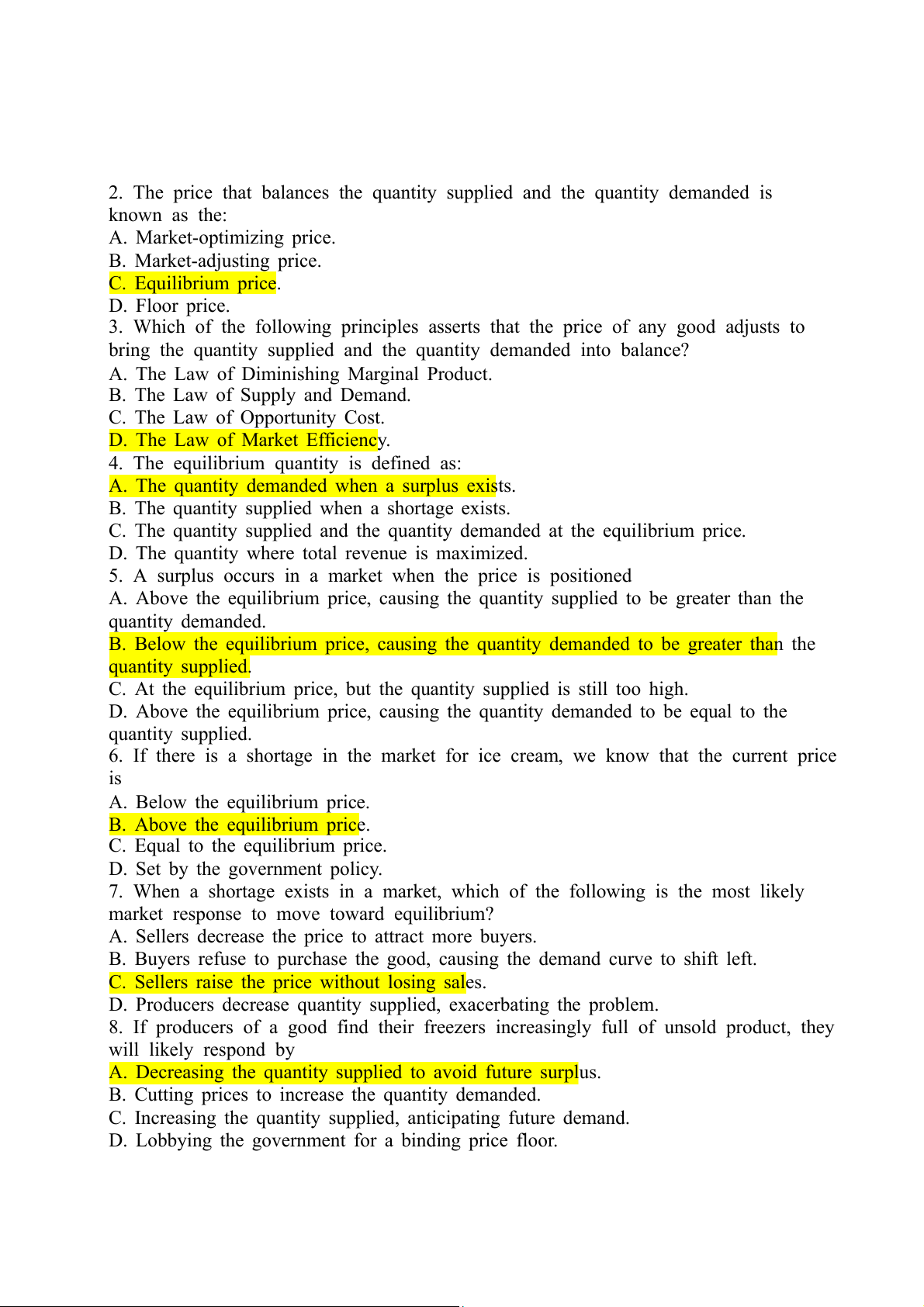
2. The price that balances the quantity supplied and the quantity demanded is
known as the: A. Market-optimizing price. B. Market-adjusting price. C. Equilibrium price. D. Floor price.
3. Which of the following principles asserts that the price of any good adjusts to
bring the quantity supplied and the quantity demanded into balance?
A. The Law of Diminishing Marginal Product.
B. The Law of Supply and Demand.
C. The Law of Opportunity Cost.
D. The Law of Market Efficiency.
4. The equilibrium quantity is defined as:
A. The quantity demanded when a surplus exists.
B. The quantity supplied when a shortage exists.
C. The quantity supplied and the quantity demanded at the equilibrium price.
D. The quantity where total revenue is maximized.
5. A surplus occurs in a market when the price is positioned
A. Above the equilibrium price, causing the quantity supplied to be greater than the quantity demanded.
B. Below the equilibrium price, causing the quantity demanded to be greater than the quantity supplied.
C. At the equilibrium price, but the quantity supplied is still too high.
D. Above the equilibrium price, causing the quantity demanded to be equal to the quantity supplied.
6. If there is a shortage in the market for ice cream, we know that the current price is
A. Below the equilibrium price.
B. Above the equilibrium price.
C. Equal to the equilibrium price.
D. Set by the government policy.
7. When a shortage exists in a market, which of the following is the most likely
market response to move toward equilibrium?
A. Sellers decrease the price to attract more buyers.
B. Buyers refuse to purchase the good, causing the demand curve to shift left.
C. Sellers raise the price without losing sales.
D. Producers decrease quantity supplied, exacerbating the problem.
8. If producers of a good find their freezers increasingly full of unsold product, they
will likely respond by
A. Decreasing the quantity supplied to avoid future surplus.
B. Cutting prices to increase the quantity demanded.
C. Increasing the quantity supplied, anticipating future demand.
D. Lobbying the government for a binding price floor.
Tài liệu liên quan:
-
Chương 3: độ co giãn và các nhân tố ảnh hưởng | Microeconomics | Trường Đại học Quốc tế, Đại học Quốc gia Thành phố Hồ Chí Minh
0 0 -
Microeconomics Syllabus | Microeconomics | Trường Đại học Quốc tế, Đại học Quốc gia Thành phố Hồ Chí Minh
0 0 -
Microeconomics Course Syllabus & Assessment Details | Microeconomics | Trường Đại học Quốc tế, Đại học Quốc gia Thành phố Hồ Chí Minh
0 0 -
Assignment 3 - Elasticity MCQs and Key Concepts | Microeconomics | Trường Đại học Quốc tế, Đại học Quốc gia Thành phố Hồ Chí Minh
0 0 -
Assignment 2 - Economic Equilibrium Analysis of Fridges and Motorcycles | Microeconomics | Trường Đại học Quốc tế, Đại học Quốc gia Thành phố Hồ Chí Minh
0 0