Bài tập Kinh tế học về Monopoly và Cạnh tranh hoàn hảo | Microeconomics | Trường Đại học Quốc tế, Đại học Quốc gia Thành phố Hồ Chí Minh
An advance in farm technology that results in an increased market supply is a. good for farmers because it raises prices for their products but bad for consumers because it raises prices consumers pay for food. b. bad for farmers because total revenue will fall but good for consumers because prices for food will fall. c. good for farmers because it raises prices for their products and also good for consumers because more output is available for consumption. Tài liệu được sưu tầm và soạn thảo dưới dạng file PDF để gửi tới các bạn cùng tham khảo, ôn tập đầy đủ kiến thức, chuẩn bị cho các buổi học thật tốt. Mời bạn đọc đón xem!
Môn: Microeconomics 635 tài liệu
Trường: Trường Đại học Quốc tế, Đại học Quốc gia Thành phố Hồ Chí Minh 1.9 K tài liệu
Tác giả:

Preview text:
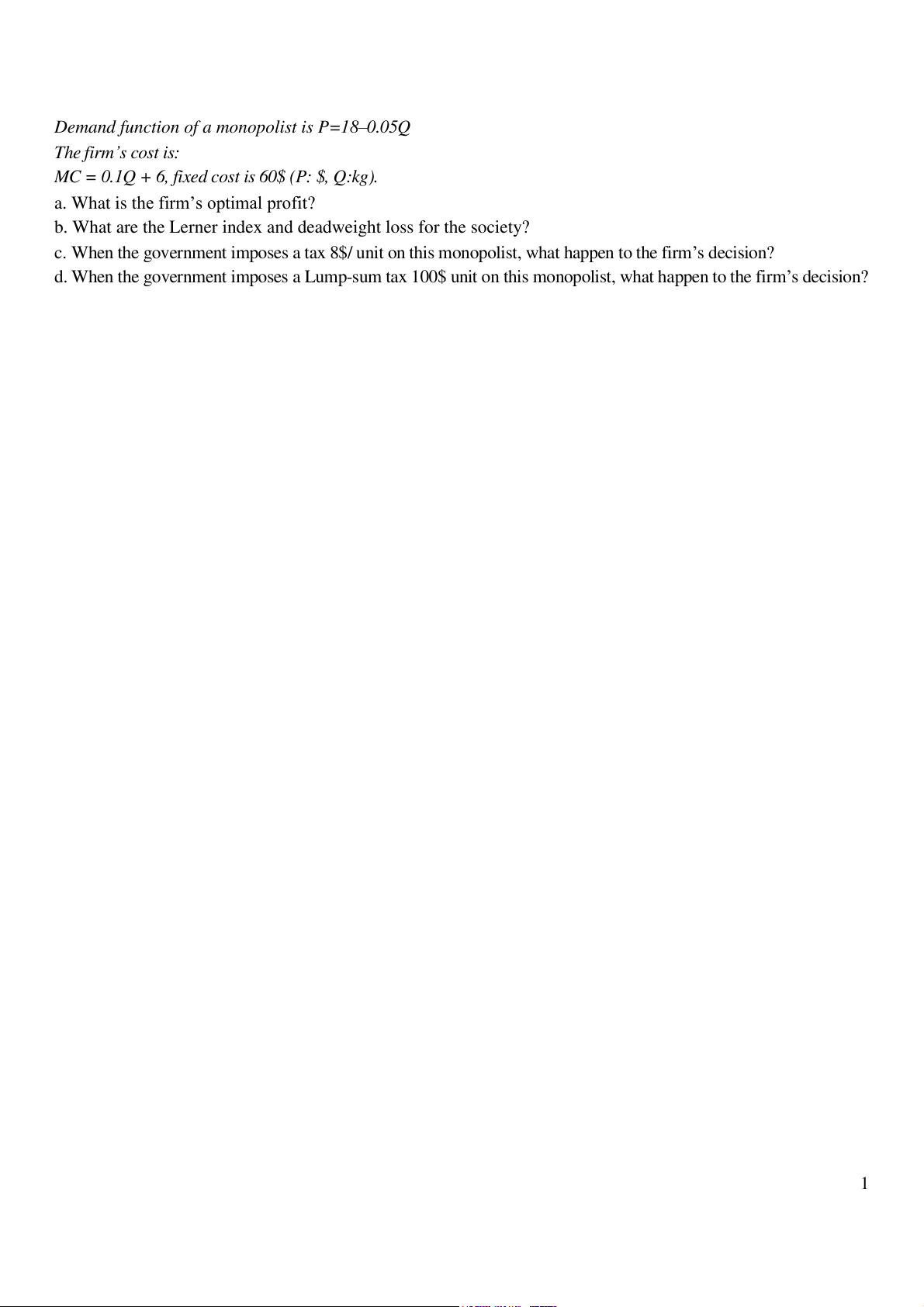
Demand function of a monopolist is P=18–0.05Q The firm’s cost is:
MC = 0.1Q + 6, fixed cost is 60$ (P: $, Q:kg).
a. What is the firm’s optimal profit?
b. What are the Lerner index and deadweight loss for the society?
c. When the government imposes a tax 8$/ unit on this monopolist, what happen to the firm’s decision?
d. When the government imposes a Lump-sum tax 100$ unit on this monopolist, what happen to the firm’s decision? 1
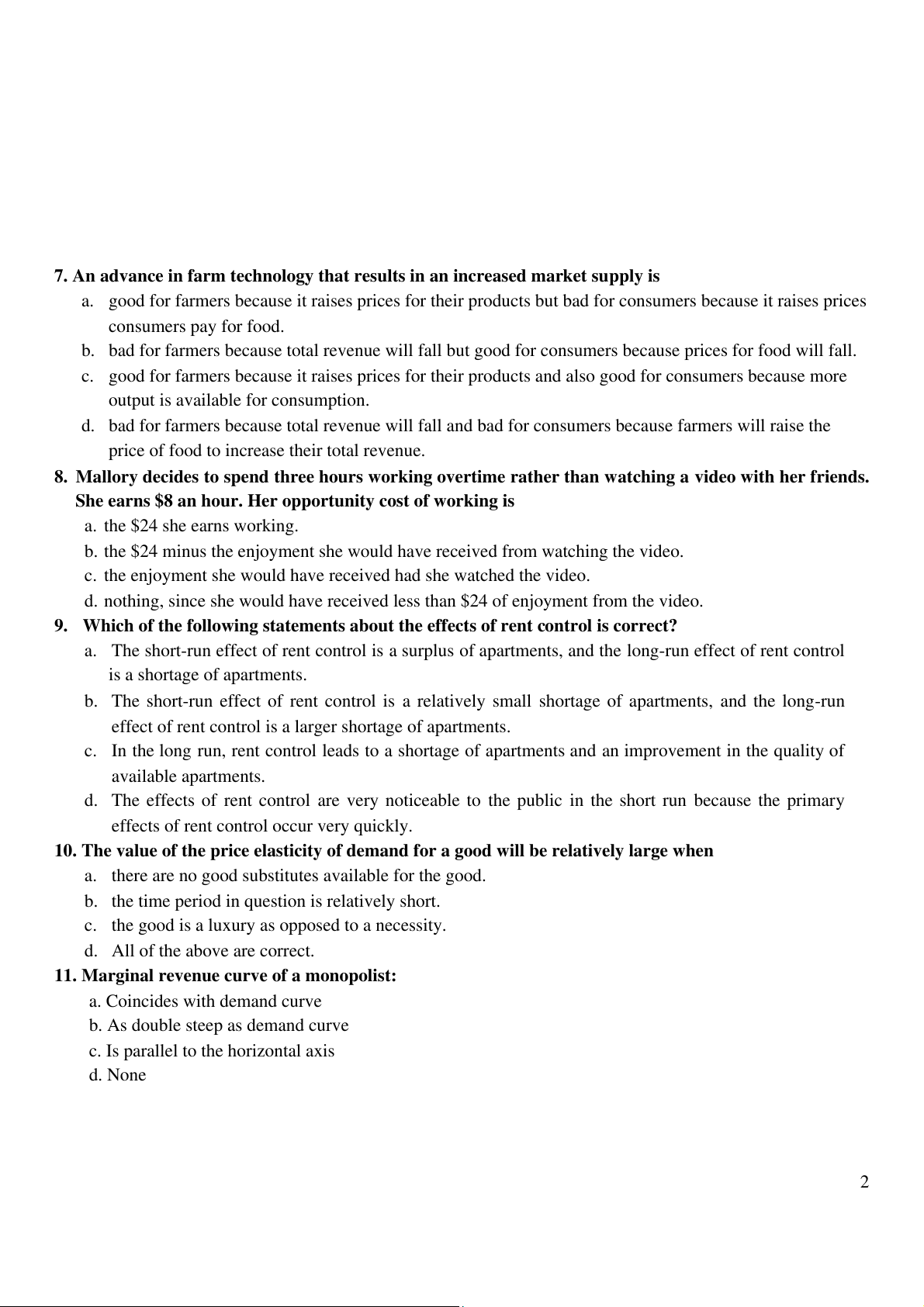
7. An advance in farm technology that results in an increased market supply is
a. good for farmers because it raises prices for their products but bad for consumers because it raises prices consumers pay for food.
b. bad for farmers because total revenue will fall but good for consumers because prices for food will fall.
c. good for farmers because it raises prices for their products and also good for consumers because more
output is available for consumption.
d. bad for farmers because total revenue will fall and bad for consumers because farmers will raise the
price of food to increase their total revenue.
8. Mallory decides to spend three hours working overtime rather than watching a video with her friends.
She earns $8 an hour. Her opportunity cost of working is a. the $24 she earns working.
b. the $24 minus the enjoyment she would have received from watching the video.
c. the enjoyment she would have received had she watched the video.
d. nothing, since she would have received less than $24 of enjoyment from the video.
9. Which of the following statements about the effects of rent control is correct?
a. The short-run effect of rent control is a surplus of apartments, and the long-run effect of rent control is a shortage of apartments.
b. The short-run effect of rent control is a relatively small shortage of apartments, and the long-run
effect of rent control is a larger shortage of apartments.
c. In the long run, rent control leads to a shortage of apartments and an improvement in the quality of available apartments.
d. The effects of rent control are very noticeable to the public in the short run because the primary
effects of rent control occur very quickly.
10. The value of the price elasticity of demand for a good will be relatively large when
a. there are no good substitutes available for the good.
b. the time period in question is relatively short.
c. the good is a luxury as opposed to a necessity.
d. All of the above are correct.
11. Marginal revenue curve of a monopolist:
a. Coincides with demand curve
b. As double steep as demand curve
c. Is parallel to the horizontal axis d. None 2
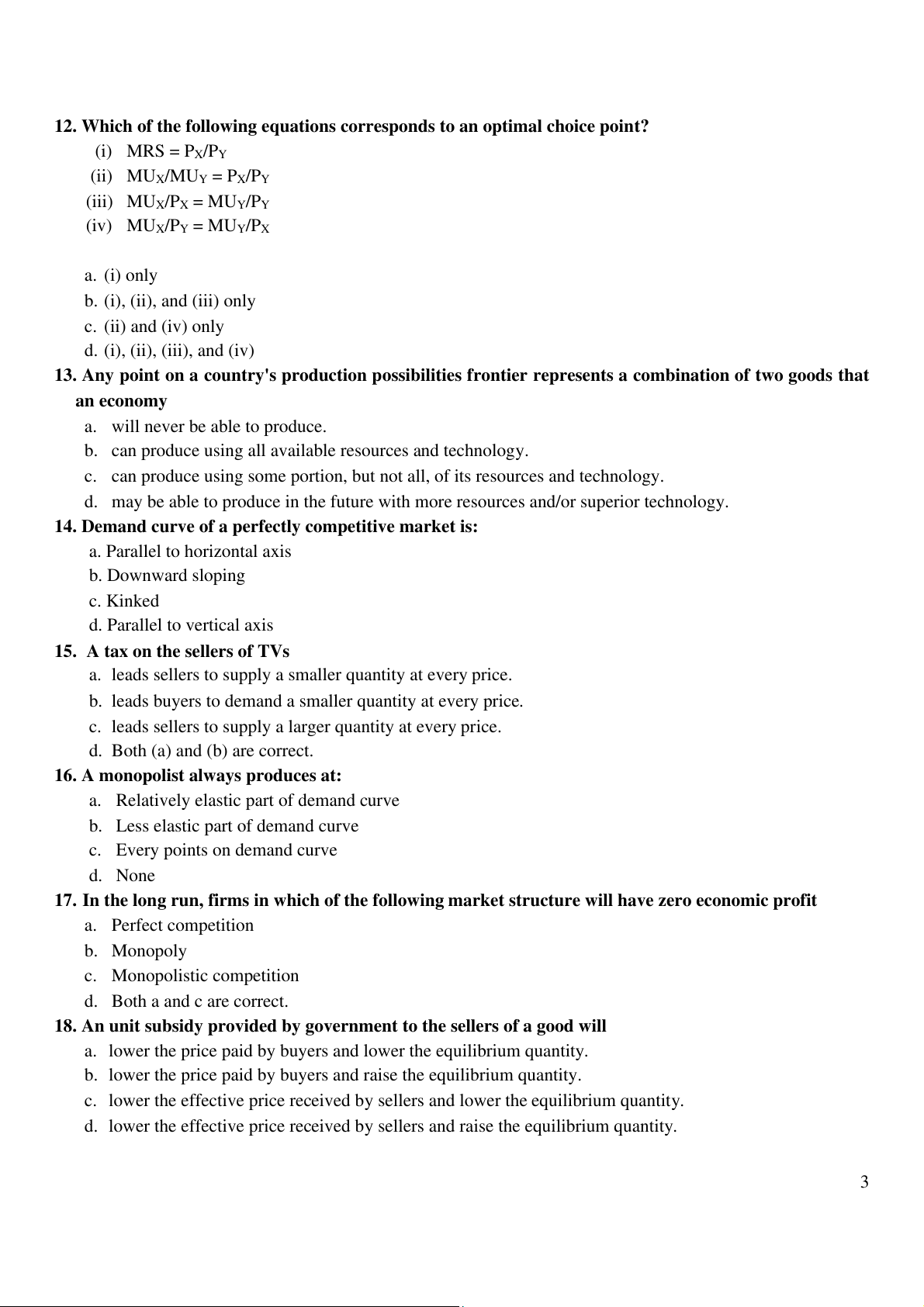
12. Which of the following equations corresponds to an optimal choice point? (i) MRS = PX/PY (ii) MUX/MUY = PX/PY (iii) MUX/PX = MUY/PY (iv) MUX/PY = MUY/PX a. (i) only b. (i), (ii), and (iii) only c. (ii) and (iv) only d. (i), (ii), (iii), and (iv)
13. Any point on a country's production possibilities frontier represents a combination of two goods that an economy
a. will never be able to produce.
b. can produce using all available resources and technology.
c. can produce using some portion, but not all, of its resources and technology.
d. may be able to produce in the future with more resources and/or superior technology.
14. Demand curve of a perfectly competitive market is:
a. Parallel to horizontal axis b. Downward sloping c. Kinked d. Parallel to vertical axis
15. A tax on the sellers of TVs
a. leads sellers to supply a smaller quantity at every price.
b. leads buyers to demand a smaller quantity at every price.
c. leads sellers to supply a larger quantity at every price.
d. Both (a) and (b) are correct.
16. A monopolist always produces at:
a. Relatively elastic part of demand curve
b. Less elastic part of demand curve
c. Every points on demand curve d. None
17. In the long run, firms in which of the following market structure will have zero economic profit a. Perfect competition b. Monopoly c. Monopolistic competition d. Both a and c are correct.
18. An unit subsidy provided by government to the sellers of a good will
a. lower the price paid by buyers and lower the equilibrium quantity.
b. lower the price paid by buyers and raise the equilibrium quantity.
c. lower the effective price received by sellers and lower the equilibrium quantity.
d. lower the effective price received by sellers and raise the equilibrium quantity. 3
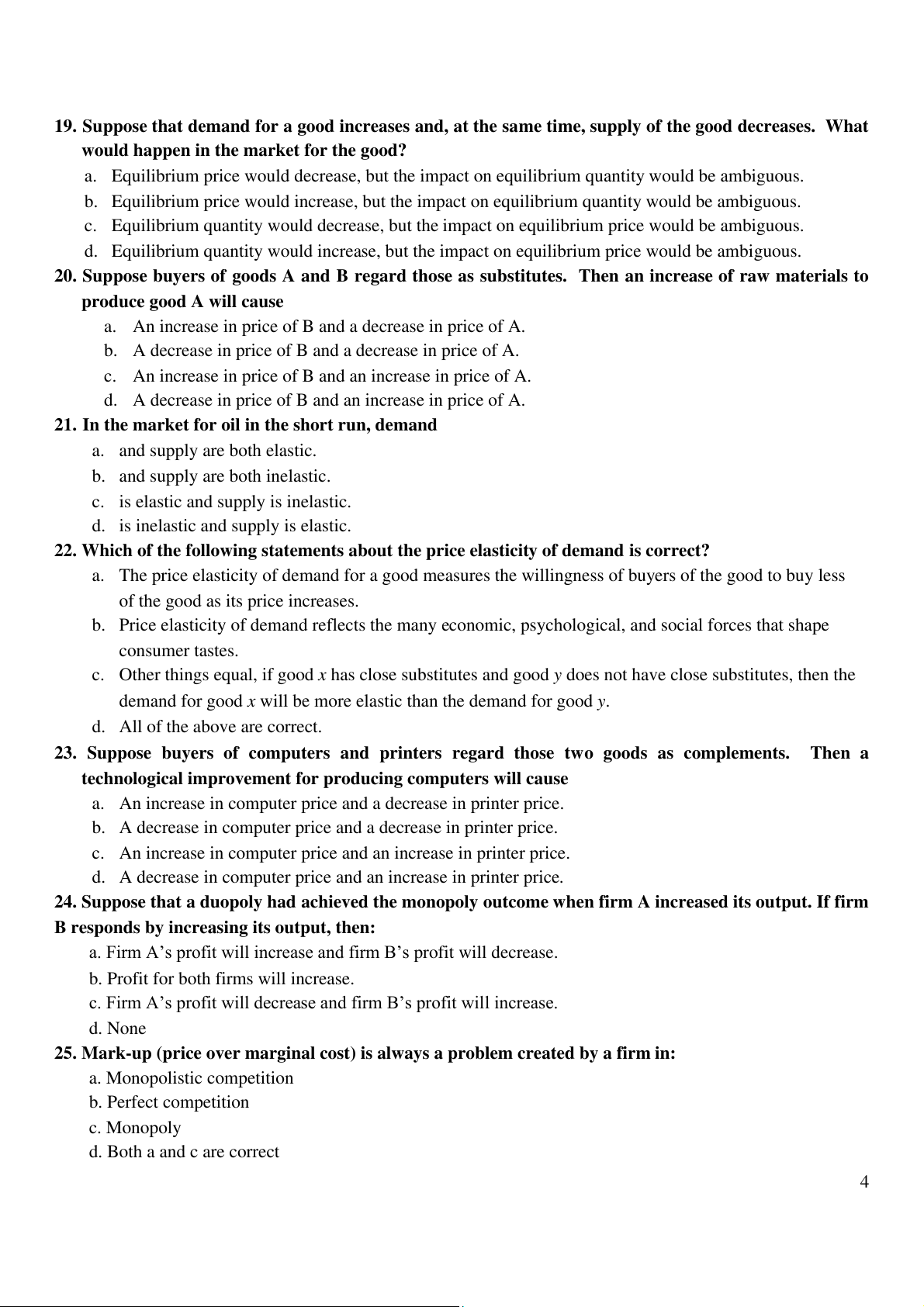
19. Suppose that demand for a good increases and, at the same time, supply of the good decreases. What
would happen in the market for the good?
a. Equilibrium price would decrease, but the impact on equilibrium quantity would be ambiguous.
b. Equilibrium price would increase, but the impact on equilibrium quantity would be ambiguous.
c. Equilibrium quantity would decrease, but the impact on equilibrium price would be ambiguous.
d. Equilibrium quantity would increase, but the impact on equilibrium price would be ambiguous.
20. Suppose buyers of goods A and B regard those as substitutes. Then an increase of raw materials to
produce good A will cause
a. An increase in price of B and a decrease in price of A.
b. A decrease in price of B and a decrease in price of A.
c. An increase in price of B and an increase in price of A.
d. A decrease in price of B and an increase in price of A.
21. In the market for oil in the short run, demand
a. and supply are both elastic.
b. and supply are both inelastic.
c. is elastic and supply is inelastic.
d. is inelastic and supply is elastic.
22. Which of the following statements about the price elasticity of demand is correct?
a. The price elasticity of demand for a good measures the willingness of buyers of the good to buy less
of the good as its price increases.
b. Price elasticity of demand reflects the many economic, psychological, and social forces that shape consumer tastes.
c. Other things equal, if good x has close substitutes and good y does not have close substitutes, then the
demand for good x will be more elastic than the demand for good y.
d. All of the above are correct.
23. Suppose buyers of computers and printers regard those two goods as complements. Then a
technological improvement for producing computers will cause
a. An increase in computer price and a decrease in printer price.
b. A decrease in computer price and a decrease in printer price.
c. An increase in computer price and an increase in printer price.
d. A decrease in computer price and an increase in printer price.
24. Suppose that a duopoly had achieved the monopoly outcome when firm A increased its output. If firm
B responds by increasing its output, then:
a. Firm A’s profit will increase and firm B’s profit will decrease.
b. Profit for both firms will increase.
c. Firm A’s profit will decrease and firm B’s profit will increase. d. None
25. Mark-up (price over marginal cost) is always a problem created by a firm in: a. Monopolistic competition b. Perfect competition c. Monopoly d. Both a and c are correct 4
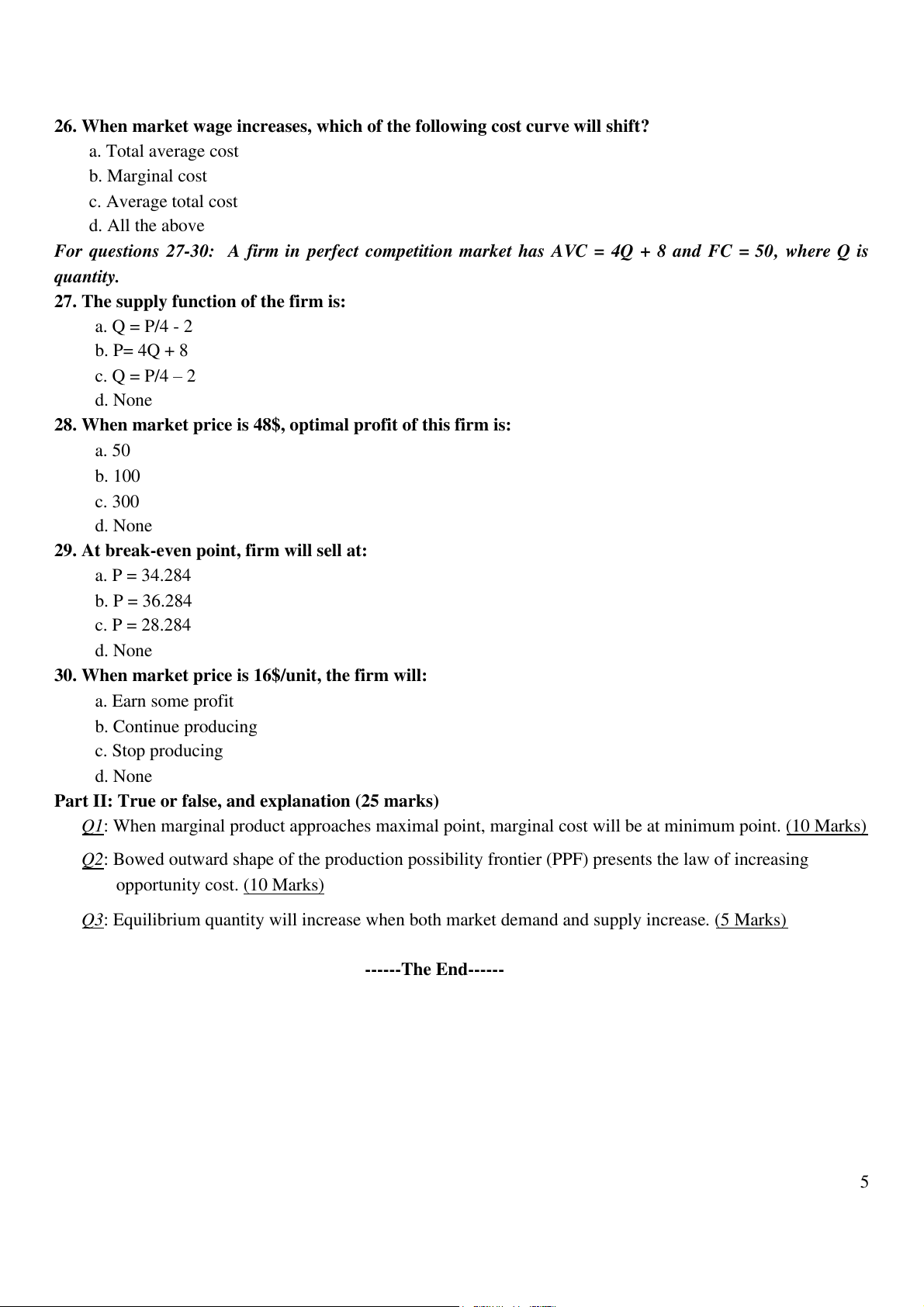
26. When market wage increases, which of the following cost curve will shift? a. Total average cost b. Marginal cost c. Average total cost d. All the above
For questions 27-30: A firm in perfect competition market has AVC = 4Q + 8 and FC = 50, where Q is quantity.
27. The supply function of the firm is: a. Q = P/4 - 2 b. P= 4Q + 8 c. Q = P/4 – 2 d. None
28. When market price is 48$, optimal profit of this firm is: a. 50 b. 100 c. 300 d. None
29. At break-even point, firm will sell at: a. P = 34.284 b. P = 36.284 c. P = 28.284 d. None
30. When market price is 16$/unit, the firm will: a. Earn some profit b. Continue producing c. Stop producing d. None
Part II: True or false, and explanation (25 marks)
Q1: When marginal product approaches maximal point, marginal cost will be at minimum point. (10 Marks)
Q2: Bowed outward shape of the production possibility frontier (PPF) presents the law of increasing opportunity cost. (10 Marks)
Q3: Equilibrium quantity will increase when both market demand and supply increase. (5 Marks) ------The End------ 5
Tài liệu liên quan:
-
Chương 3: độ co giãn và các nhân tố ảnh hưởng | Microeconomics | Trường Đại học Quốc tế, Đại học Quốc gia Thành phố Hồ Chí Minh
4 2 -
Microeconomics Syllabus | Microeconomics | Trường Đại học Quốc tế, Đại học Quốc gia Thành phố Hồ Chí Minh
4 2 -
Microeconomics Course Syllabus & Assessment Details | Microeconomics | Trường Đại học Quốc tế, Đại học Quốc gia Thành phố Hồ Chí Minh
4 2 -
Assignment 3 - Elasticity MCQs and Key Concepts | Microeconomics | Trường Đại học Quốc tế, Đại học Quốc gia Thành phố Hồ Chí Minh
4 2 -
Assignment 2 - Economic Equilibrium Analysis of Fridges and Motorcycles | Microeconomics | Trường Đại học Quốc tế, Đại học Quốc gia Thành phố Hồ Chí Minh
4 2