Bài tập ôn tập tuần 8 | Microeconomics | Trường Đại học Quốc tế, Đại học Quốc gia Thành phố Hồ Chí Minh
To decide the quantity to produce, we need to compare MR and MC In this situation, we can relize that at Q=6, MR=3 and MC=2, MC and MR have the nearest gap but still satisfy MR>MC, so the monopolish will produce 6 units of product c. The monopolist will charge a price of $5.5 d. The profit will. Tài liệu được sưu tầm và soạn thảo dưới dạng file PDF để gửi tới các bạn cùng tham khảo, ôn tập đầy đủ kiến thức, chuẩn bị cho các buổi học thật tốt. Mời bạn đọc đón xem!
Môn: Microeconomics 635 tài liệu
Trường: Trường Đại học Quốc tế, Đại học Quốc gia Thành phố Hồ Chí Minh 1.9 K tài liệu
Tác giả:


Preview text:
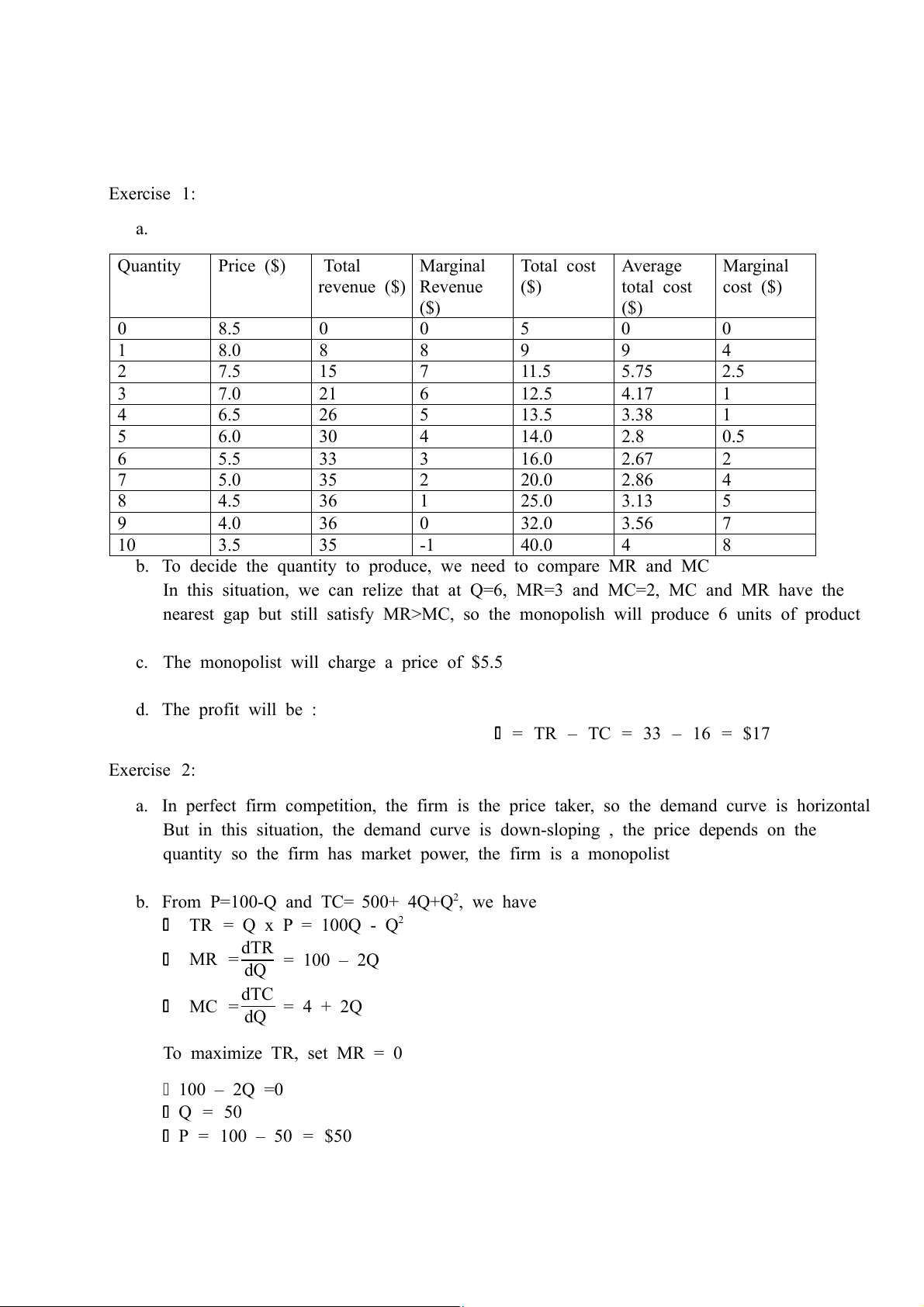
Exercise 1: a. Quantity Price ($) Total Marginal Total cost Average Marginal revenue ($) Revenue ($) total cost cost ($) ($) ($) 0 8.5 0 0 5 0 0 1 8.0 8 8 9 9 4 2 7.5 15 7 11.5 5.75 2.5 3 7.0 21 6 12.5 4.17 1 4 6.5 26 5 13.5 3.38 1 5 6.0 30 4 14.0 2.8 0.5 6 5.5 33 3 16.0 2.67 2 7 5.0 35 2 20.0 2.86 4 8 4.5 36 1 25.0 3.13 5 9 4.0 36 0 32.0 3.56 7 10 3.5 35 -1 40.0 4 8
b. To decide the quantity to produce, we need to compare MR and MC
In this situation, we can relize that at Q=6, MR=3 and MC=2, MC and MR have the
nearest gap but still satisfy MR>MC, so the monopolish will produce 6 units of product
c. The monopolist will charge a price of $5.5 d. The profit will be :
= TR – TC = 33 – 16 = $17 Exercise 2:
a. In perfect firm competition, the firm is the price taker, so the demand curve is horizontal
But in this situation, the demand curve is down-sloping , the price depends on the
quantity so the firm has market power, the firm is a monopolist b. From P=100-Q and TC= 500+ 4Q+Q , 2 we have TR = Q x P = 100Q - Q2 dTR MR = dQ = 100 – 2Q dTC MC = dQ = 4 + 2Q To maximize TR, set MR = 0 100 – 2Q =0 Q = 50
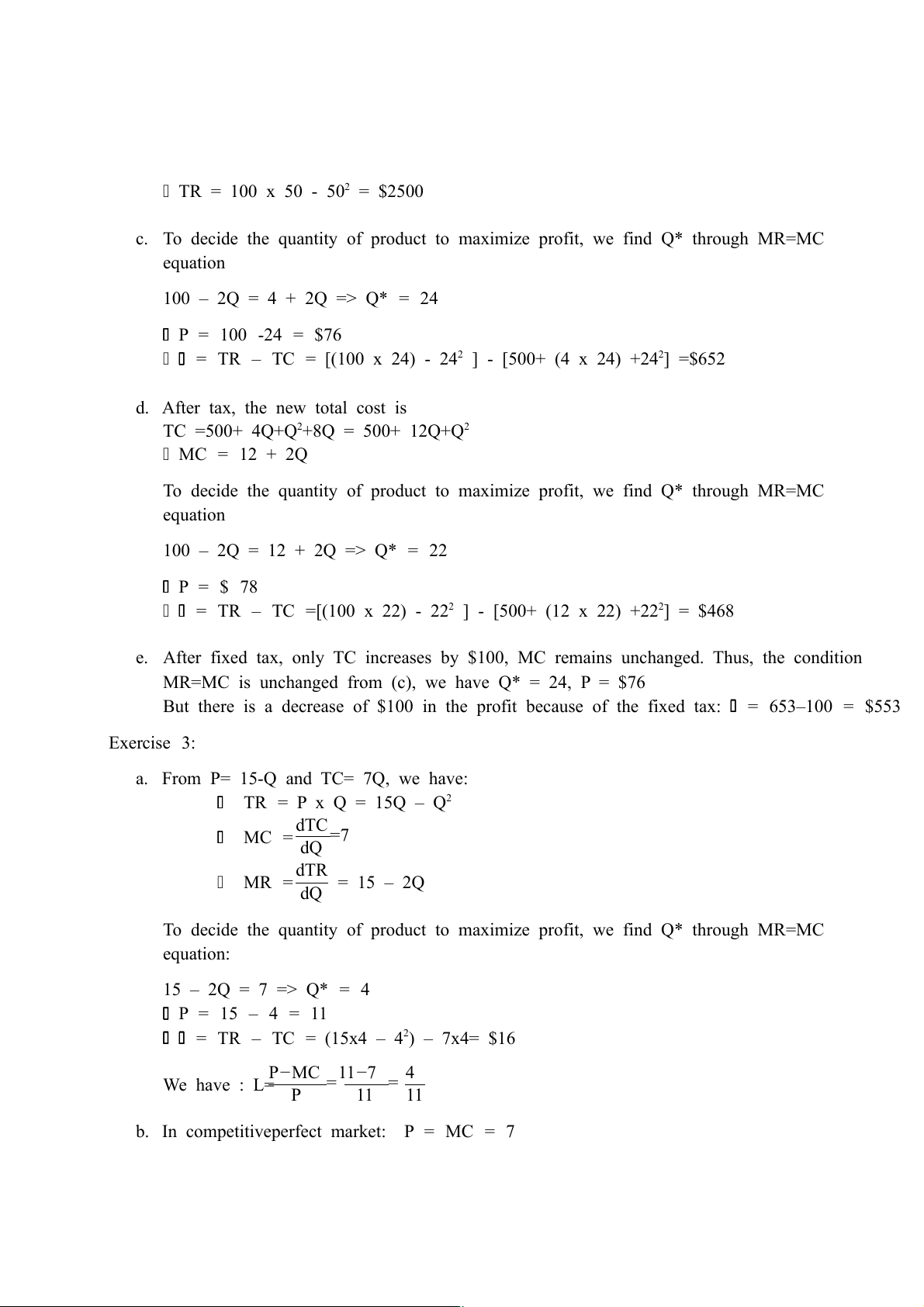
P = 100 – 50 = $50 TR = 100 x 50 - 50 2 = $2500
c. To decide the quantity of product to maximize profit, we find Q* through MR=MC equation
100 – 2Q = 4 + 2Q => Q* = 24
P = 100 -24 = $76
= TR – TC = [(100 x 24) - 24 2 ] - [500+ (4 x 24) +24 ] 2 =$652
d. After tax, the new total cost is
TC =500+ 4Q+Q2+8Q = 500+ 12Q+Q2 MC = 12 + 2Q
To decide the quantity of product to maximize profit, we find Q* through MR=MC equation
100 – 2Q = 12 + 2Q => Q* = 22 P = $ 78
= TR – TC =[(100 x 22) - 22 2 ] - [500+ (12 x 22) +22 ] 2 = $468
e. After fixed tax, only TC increases by $100, MC remains unchanged. Thus, the condition
MR=MC is unchanged from (c), we have Q* = 24, P = $76
But there is a decrease of $100 in the profit because of the fixed tax: = 653–100 = $553 Exercise 3:
a. From P= 15-Q and TC= 7Q, we have: TR = P x Q = 15Q – Q2 dTC MC = =7 dQ dTR MR = dQ = 15 – 2Q
To decide the quantity of product to maximize profit, we find Q* through MR=MC equation:
15 – 2Q = 7 => Q* = 4
P = 15 – 4 = 11
= TR – TC = (15x4 – 42) – 7x4= $16 P−MC 11−7 4 We have : L= = = P 11 11
b. In competitiveperfect market: P = MC = 7
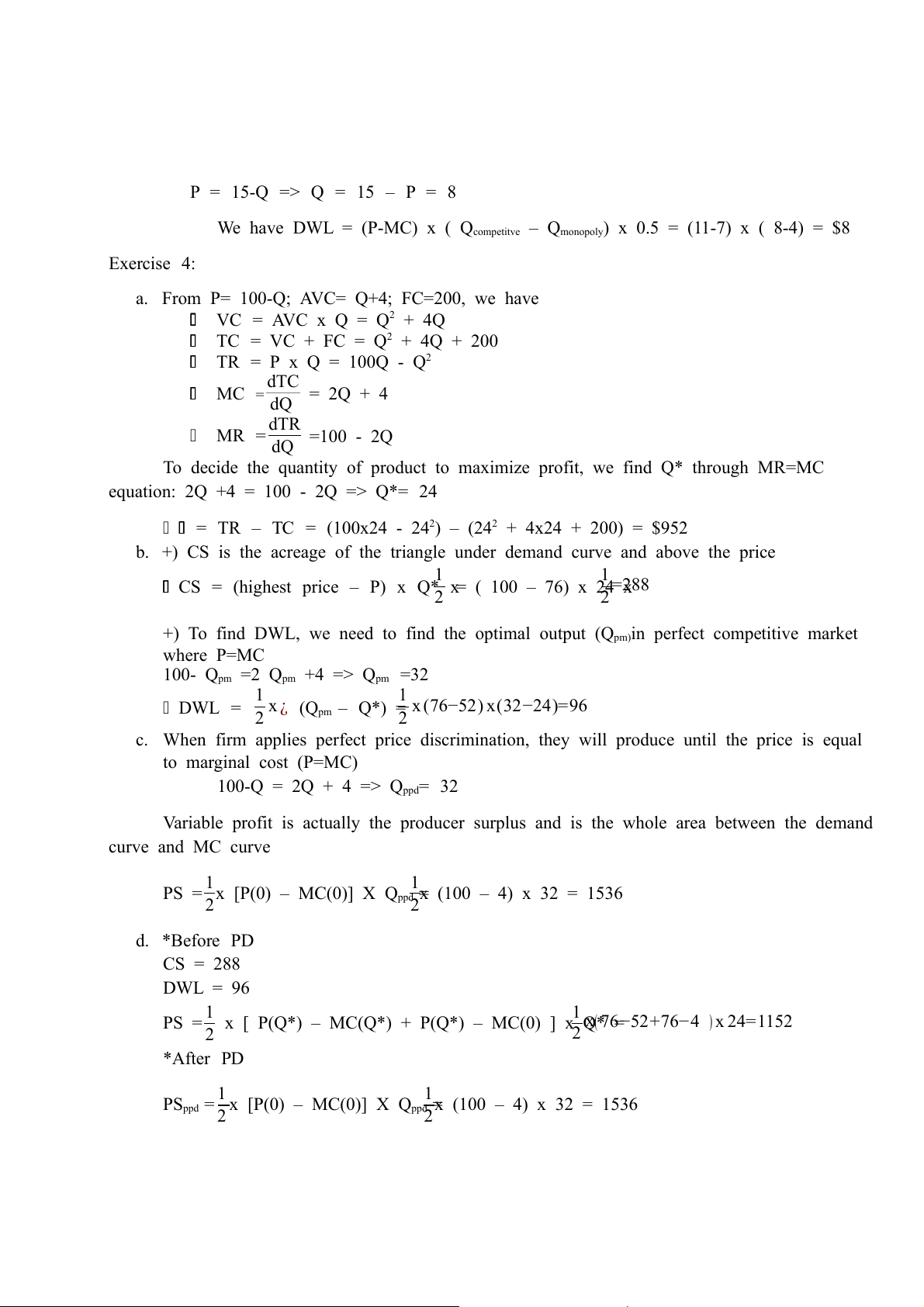
P = 15-Q => Q = 15 – P = 8
We have DWL = (P-MC) x ( Qcompetitve – Qmonopoly) x 0.5 = (11-7) x ( 8-4) = $8 Exercise 4:
a. From P= 100-Q; AVC= Q+4; FC=200, we have VC = AVC x Q = Q2 + 4Q
TC = VC + FC = Q2 + 4Q + 200 TR = P x Q = 100Q - Q2 dTC MC = dQ = 2Q + 4 dTR MR = dQ =100 - 2Q
To decide the quantity of product to maximize profit, we find Q* through MR=MC
equation: 2Q +4 = 100 - 2Q => Q*= 24
= TR – TC = (100x24 - 24 ) 2 – (24 2 + 4x24 + 200) = $952
b. +) CS is the acreage of the triangle under demand curve and above the price 1 1
CS = (highest price – P) x Q* x =288
2 = ( 100 – 76) x 24 x 2
+) To find DWL, we need to find the optimal output (Qpm)in perfect competitive market where P=MC
100- Qpm =2 Qpm +4 => Qpm =32 1 1 DWL = x ¿ x (76−52) x(32−24)=96 2
(Qpm – Q*) = 2
c. When firm applies perfect price discrimination, they will produce until the price is equal to marginal cost (P=MC)
100-Q = 2Q + 4 => Qppd= 32
Variable profit is actually the producer surplus and is the whole area between the demand curve and MC curve 1 1 PS = x x 2 [P(0) – MC(0)] X Qppd = 2 (100 – 4) x 32 = 1536 d. *Before PD CS = 288 DWL = 96 1 1 PS = x( 76−52+76−4 ) x 24=1152
2 x [ P(Q*) – MC(Q*) + P(Q*) – MC(0) ] x Q* = 2 *After PD 1 1 PSppd = x x 2 [P(0) – MC(0)] X Qppd = 2 (100 – 4) x 32 = 1536
So, after applying perfect price discrimination, the firm successfully raise PS from 1152
to 1536 by capturing CS and DWL into extra producer surplus
Tài liệu liên quan:
-

Chương 3: độ co giãn và các nhân tố ảnh hưởng | Microeconomics | Trường Đại học Quốc tế, Đại học Quốc gia Thành phố Hồ Chí Minh
3 2 -
Microeconomics Syllabus | Microeconomics | Trường Đại học Quốc tế, Đại học Quốc gia Thành phố Hồ Chí Minh
3 2 -
Microeconomics Course Syllabus & Assessment Details | Microeconomics | Trường Đại học Quốc tế, Đại học Quốc gia Thành phố Hồ Chí Minh
3 2 -

Assignment 3 - Elasticity MCQs and Key Concepts | Microeconomics | Trường Đại học Quốc tế, Đại học Quốc gia Thành phố Hồ Chí Minh
3 2 -
Assignment 2 - Economic Equilibrium Analysis of Fridges and Motorcycles | Microeconomics | Trường Đại học Quốc tế, Đại học Quốc gia Thành phố Hồ Chí Minh
3 2