Boost your vocabulary Cambridge Ielts 16 Dinh Thang A&M Ielts
Boost your vocabulary Cambridge Ielts 16 Dinh Thang A&M Ielts
Môn: Food industry 11 tài liệu
Trường: Đại học Công nghiệp Thực phẩm Thành phố Hồ Chí Minh 257 tài liệu
Tác giả:
















































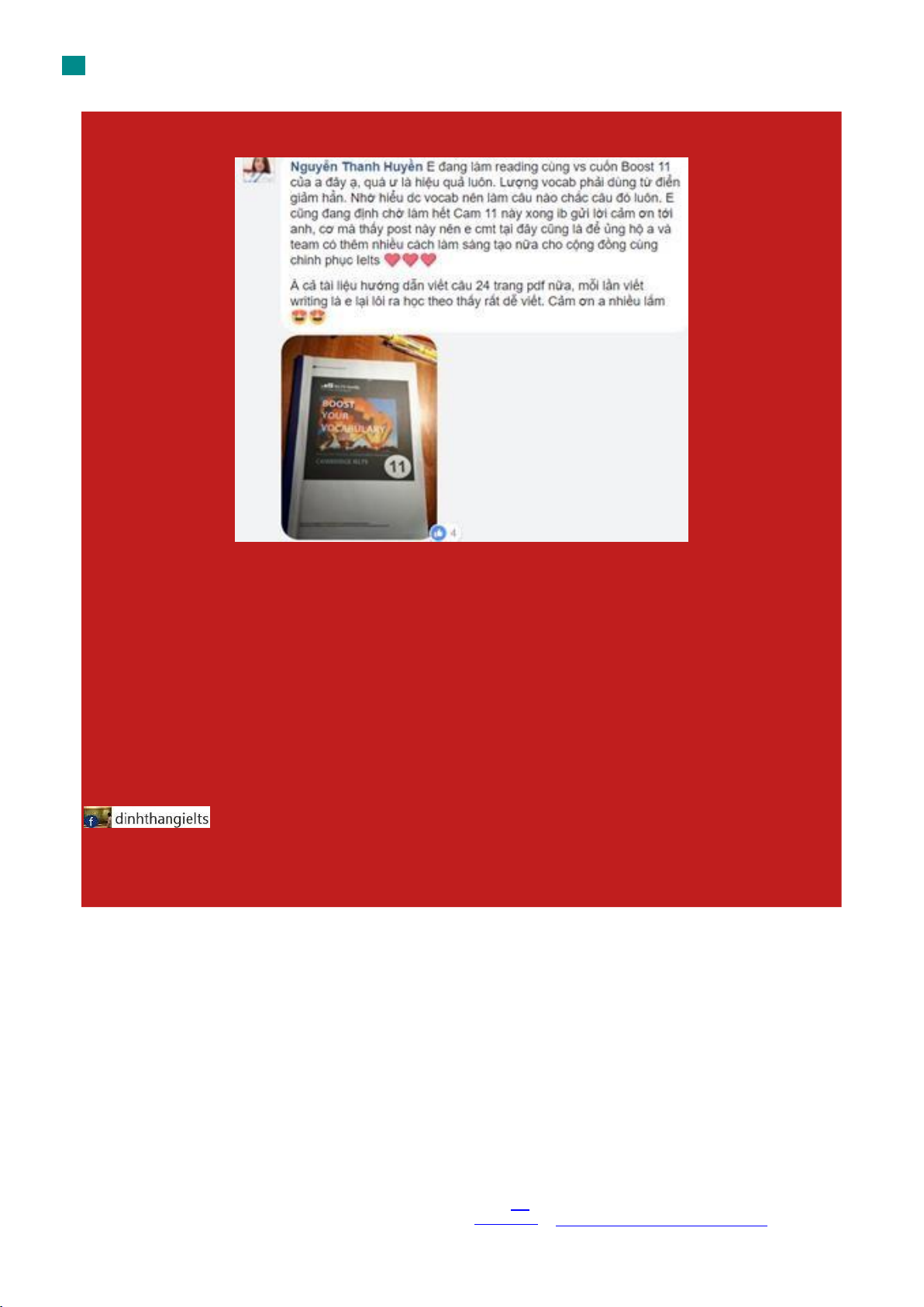

Preview text:
lOMoAR cPSD| 30964149 lOMoAR cPSD| 30964149 lOMoAR cPSD| 30964149
Cuốn sách này là của
………………………………………………………………………………………………………………
Điểm mục tiêu cho phần thi IELTS Reading là: …………
Để làm được điều này, mình sẽ đọc cuốn sách này ít nhất …. lần/tuần.
Tài liệu gốc The Official Cambridge Guide to IELTS của NXB Đại học Cambridge-Mua sách gốc tại link
Biên tập cuốn sách Boost your vocabulary này được thực hiện bởi IELTS Family-Các nhóm tự học IELTS lOMoAR cPSD| 30964149 LỜI GIỚI THIỆU Chào các bạn,
Các bạn đang cầm trên tay cuốn “Boost your vocabulary” được biên soạn bởi mình và các bạn trong
nhóm A&M|IELTS. Cuốn sách được viết nhằm mục đích giúp các bạn đang muốn cải thiện vốn từ
vựng cho phần thi Reading trong IELTS. Sách được viết dựa trên nền tảng bộ The Official Cambridge
Guide to IELTS của Nhà xuất bản Đại học Cambridge – Anh Quốc.
Trong quá trình thực hiện, mình và các bạn trong nhóm đã dành nhiều thời gian để nghiên cứu cách
thức đưa nội dung sao cho khoa học và dễ dùng nhất với các bạn. Tuy vậy, cuốn sách không khỏi có
những hạn chế nhất định. Mọi góp ý để cải thiện nội dung cuốn sách mọi người xin gửi về email Trân trọng cảm ơn, Thầy Đinh Thắng
Tài liệu gốc The Official Cambridge Guide to IELTS của NXB Đại học Cambridge-Mua sách gốc tại link
Biên tập cuốn sách Boost your vocabulary này được thực hiện bởi IELTS Family-Các nhóm tự học IELTS lOMoAR cPSD| 30964149
TÁC GIẢ & NHÓM THỰC HIỆN
Thầy giáo Đinh Thắng
Hiện tại là giáo viên dạy IELTS tại Hà Nội
từ cuối năm 2012, sáng lập A&M | IELTS
cung cấp các khóa học IELTS và tiếng
Anh học thuật. Chứng chỉ ngành ngôn
ngữ Anh, đại học Brighton, Anh Quốc,
2016.Từng làm việc tại tổ chức giáo dục
quốc tế Language Link Việt Nam (2011- 2012) Facebook.com/dinhthangielts
… cùng các bạn trong team A&M - Nhật Hà, Ngọc Khuê, Phùng Vân, Thu Hằng.
Tài liệu gốc The Official Cambridge Guide to IELTS của NXB Đại học Cambridge-Mua sách gốc tại link
Biên tập cuốn sách Boost your vocabulary này được thực hiện bởi IELTS Family-Các nhóm tự học IELTS lOMoAR cPSD| 30964149
BOOST YOUR VOCABULARY – CAMBRIDGE IELTS 16
03 LÝ DO TẠI SAO NÊN HỌC TỪ VỰNG THEO CUỐN SÁCH NÀY
1. Không còn mất nhiều thời gian cho việc tra từ
Các từ học thuật (academic words) trong sách đều có kèm giải thích hoặc từ đồng nghĩa. Bạn tiết
kiệm được đáng kể thời gian gõ từng từ vào từ điển và tra. Chắc chắn những bạn thuộc dạng
“không được chăm chỉ lắm trong việc tra từ vựng” sẽ thích điều này.
2. Tập trung bộ nhớ vào các từ quan trọng
Mặc dù cuốn sách không tra hết các từ giúp bạn nhưng sách đã chọn ra các từ quan trọng và phổ
biến nhất giúp bạn. Như vậy, bạn có thể tập trung bộ nhớ vào các từ này, thay vì phải mất công nhớ
các từ không quan trọng. Bạn nào đạt Reading từ 7.0 trở lên đều sẽ thấy rất nhiều trong số các từ
này thuộc loại hết sức quen thuộc
3. Học một từ nhớ nhiều từ
Rất nhiều từ được trình bày theo synonym (từ đồng nghĩa), giúp các bạn có thể xem lại và học thêm
các từ có nghĩa tương đương hoặc giống như từ gốc. Có thể nói, đây là phương pháp học hết sức
hiệu quả vì khi học một từ như impact, bạn có thể nhớ lại hoặc học thêm một loạt các từ nghĩa
tương đương như significant, vital, imperative, chief, key. Nói theo cách khác thì nếu khả năng ghi
nhớ của bạn tốt thì cuốn sách này giúp bạn đấy số lượng từ vựng lên một cách đáng kể. 1
Tài liệu gốc Cambridge IELTS của NXB Đại học Cambridge-Mua sách gốc tại link
Biên tập cuốn sách Boost your vocabulary này được thực hiện bởi thầy Đinh Thắng & IELTS Family-Các nhóm tự học IELTS lOMoAR cPSD| 30964149
BOOST YOUR VOCABULARY – CAMBRIDGE IELTS 16
HƯỚNG DẪN SỬ DỤNG SÁCH
ĐỐI TƯỢNG SỬ DỤNG SÁCH
Nhìn chung các bạn cần có mức độ từ vựng tương đương 5.5 trở lên (theo thang điểm 9 của
IELTS), nếu không có thể sẽ gặp nhiều khó khăn trong việc sử dụng sách này.
CÁC BƯỚC SỬ DỤNG
CÁCH 1: LÀM TEST TRƯỚC, HỌC TỪ VỰNG SAU
Bước 1: Bạn in cuốn sách này ra. Nên in bìa màu để có thêm động lực học. Cuốn sách được
thiết kế cho việc đọc trực tiếp, không phải cho việc đọc online nên bạn nào đọc online sẽ có thể thấy
khá bất tiện khi tra cứu, đối chiếu từ vựng
Bước 2: Tìm mua cuốn Cambridge IELTS (Các cuốn mới nhất từ 8-16) của Nhà xuất bản
Cambridge để làm. Hãy cẩn thận đừng mua nhầm sách lậu. Sách của nhà xuất bản Cambridge
được tái bản tại Việt Nam thường có bìa và giấy dày, chữ rất rõ nét.
Bước 3: Làm một bài test hoặc passage bất kỳ trong bộ sách trên. Ví dụ passage 1, test 1 của Cambridge IELTS 13.
Bước 4: Đối chiếu với cuốn sách này, bạn sẽ lọc ra các từ vựng quan trọng cần học.
Ví dụ passage 1, test 1 của Cambridge IELTS 13, bài về Tourism New Zealand Website: Bạn sẽ thấy
4.1 Cột bên trái là bản text gốc, trong đó bôi đậm các từ học thuật - academic word
4.2 Cột bên phải chứa các từ vựng này theo kèm định nghĩa (definition) hoặc từ đồng nghĩa (synonym) 2
Tài liệu gốc Cambridge IELTS của NXB Đại học Cambridge-Mua sách gốc tại link
Biên tập cuốn sách Boost your vocabulary này được thực hiện bởi thầy Đinh Thắng & IELTS Family-Các nhóm tự học IELTS lOMoAR cPSD| 30964149
BOOST YOUR VOCABULARY – CAMBRIDGE IELTS 16
CÁCH 2: HỌC TỪ VỰNG TRƯỚC, ĐỌC TEST SAU
Bước 1: Bạn in cuốn sách này ra. Nên in bìa màu để có thêm động lực học. Cuốn sách được
thiết kế cho việc đọc trực tiếp, không phải cho việc đọc online nên bạn nào đọc online sẽ có thể thấy
khá bất tiện khi tra cứu, đối chiếu từ vựng
Bước 2: Đọc cột bên trái như đọc báo. Duy trì hàng ngày. Khi nào không hiểu từ nào thì
xem nghĩa hoặc synonym của từ đó ở cột bên phải. Giai đoạn này giúp bạn phát triển việc
đọc tự nhiên, thay vì đọc theo kiểu làm test. Bạn càng hiểu nhiều càng tốt. Cố gắng nhớ từ theo ngữ cảnh.
Bước 3: Làm một bài test hoặc passage bất kỳ trong bộ sách Cambridge IELTS. Ví dụ
bạn đọc xong cuốn Boost your vocabulary 13 này thì có thể quay lại làm các test trong cuốn
10 chẳng hạn. Làm test xong thì cố gắng phát hiện các từ đã học trong cuốn 13. Bạn
nào có khả năng ghi nhớ tốt chắc chắn sẽ gặp lại rất nhiều từ đã học. Bạn nào có khả năng
ghi nhớ vừa phải cũng sẽ gặp lại không ít từ.
Bước 4: Đọc cuốn Boost your vocabulary tương ứng với test bạn vừa làm. Ví dụ trong cuốn Boost your vocabulary 10.
Tóm lại, mình ví dụ 1 chu trình đầy đủ theo cách này
B1. Đọc hiểu và học từ cuốn Boost your vocabulary 13
B2. Làm test 1 trong cuốn Boost your vocabulary 10
B3. Đọc hiểu và học từ cuốn Boost your vocabulary 10 & tìm các từ lặp lại mà bạn đã đọc trong cuốn Boost your vocabulary 13 3
Tài liệu gốc Cambridge IELTS của NXB Đại học Cambridge-Mua sách gốc tại link
Biên tập cuốn sách Boost your vocabulary này được thực hiện bởi thầy Đinh Thắng & IELTS Family-Các nhóm tự học IELTS lOMoAR cPSD| 30964149
BOOST YOUR VOCABULARY – CAMBRIDGE IELTS 16 TEST 1 READING PASSAGE 1
polar= close to or relating to the North Pole or the South P Pole
threaten= to be likely to harm or destroy something
climate= the typical weather conditions in a particular area
olar bears are being increasingly threatened by the
far-reaching= having a great influence or effect
consequence= result, effect, outcome
uniquely= in a way that is different from anything or anyone else
adapt= to gradual y change your behaviour and attitudes in
effects of climate change, but their disappearance could have
order to be successful in a new situation
extreme= very unusual and severe or serious
far-reaching consequences. They are uniquely adapted to
temperature= a measure of how hot or cold a place or thing is
the extreme conditions of the Arctic Circle, where
reach= if something reaches a particular rate, amount etc, it
increases until it is at that rate or amount
temperatures can reach —40°C. One reason for this is that
underneath= under, beneath, below
comparative= relative, proportional
they have up to 11 centimetres of fat underneath their skin.
adipose= relating to animal fat
tissue= the material forming animal or plant cel s
Humans with comparative levels of adipose tissue would be
obese= very fat in a way that is unhealthy
suffer from something= to have a particular disease or considered
medical condition, especial y for a long time
obese and would be likely to suffer from diabetes
diabetes= a serious disease in which there is too much and heart sugar in your blood
disease. Yet the polar bear experiences no such
disease= an il ness which affects a person, animal, or plant consequences.
colleague= coworker, partner, teammate, associate
A 2014 study by Sin Ping Liu and
shed light on something= to make something easier to
colleagues sheds light on
understand, by providing new or better information
mystery= an event, situation etc that people do not
this mystery. They compared the genetic structure of polar
understand or cannot explain because they do not know enough about it
genetic= relating to genes or genetics 4
Tài liệu gốc Cambridge IELTS của NXB Đại học Cambridge-Mua sách gốc tại link
Biên tập cuốn sách Boost your vocabulary này được thực hiện bởi thầy Đinh Thắng & IELTS Family-Các nhóm tự học IELTS lOMoAR cPSD| 30964149
BOOST YOUR VOCABULARY – CAMBRIDGE IELTS 16
bears with that of their closest relatives from a warmer
relative= a member of your family = relation
determine= decide, conclude, establish, finalize
climate, the brown bears. This allowed them to determine the
survive= to continue to live after an accident, war, or illness
genes that have allowed polar bears to survive in one of the
gene= a part of a cell in a living thing that controls
what it looks like, how it grows, and how it develops.
toughest environments on Earth. Liu and his colleagues found
People get their genes from their parents
the polar bears had a gene known as APoB, winch reduces
tough= hard, dangerous, threatening, harsh
density= the degree to which an area is filled with
levels of low-density lipoproteins (LDLs) — a form of 'bad' people or things
lipoproteins= any of a group of soluble proteins that
cholesterol. In humans, mutations of this gene are
combine with and transport fat or other lipids in the blood plasma
associated with increased risk of heart disease. Polar bears
cholesterol= a chemical substance found in your blood
may therefore be an important study model to understand
mutation= change, alteration, transformation, heart disease in humans. modification
be associated with somebody or something= to
be related to a particular subject, activity etc
The genome of the polar bear may also provide the solution
genome= all the genes in one type of living thing
solution= answer, key, explanation
for another condition, one that particularly affects our older
osteoporosis= a medical condition in which your bones become weak and break easily
generation: osteoporosis. This is a disease where bones
insufficient= not enough, lacking, inadequate, deficient
show reduced density, usually caused by
calcium= a silver-white metal that helps to form teeth, insufficient bones, and chalk exercise, reduced
intake= the amount of food, drink etc that you take into
calcium intake or food starvation. Bone your body tissue is
starvation= hunger, food shortage, famine
constantly being remodelled, meaning that bone is
constantly= continuously, frequently, repetitively
added or removed, depending on nutrient availability and the remodel= to change the shape, structure, or
appearance of something, especially a building
stress that the bone is under. Female polar bears, however,
nutrient= a chemical or food that provides what is
needed for plants or animals to live and grow
undergo extreme conditions during every pregnancy. Once
availability= the state of being able to be used, bought, or found
autumn comes around, these females will dig maternity dens
undergo= experience, feel, suffer, go through
pregnancy= when a woman has a baby growing inside
in the snow and will remain there throughout the winter, both her body
maternity= relating to a woman who is pregnant or who
before and after the birth of their cubs. This process results has just had a baby
den= the home of some animals, for example lions or
in about six months of fasting, where the female bears have to foxes
cub= the baby of a wild animal such as a lion or a bear
keep themselves and their cubs alive, depleting their own
deplete= to reduce the amount of something that is present or available
calcium and calorie reserves. Despite this, their bones remain
reserve= a supply of something kept to be used if it is needed strong and dense.
dense= thick, solid, compressed, condensed
Physiologists Alanda Lennox and Allen Goodship found an
physiologist= a person who studies physiology
explanation= reason, account, clarification
explanation for this paradox in 2008. They discovered that
paradox= a situation that seems strange because it
involves two ideas or qualities that are very different
pregnant bears were able to increase the density of their
emerge= to appear or come out from somewhere
bones before they started to build their dens. In addition, six
significant= large, considerable, major, big
hibernate= if an animal hibernates, it sleeps for the
months later, when they finally emerged from the den with whole winter
capacity= ability, capability, power
their cubs, there was no evidence of significant loss of bone
resort to something= to do something bad, extreme,
or difficult because you cannot think of any other way
density. Hibernating brown bears do not have this capacity to deal with a problem
reformation= when something is completely
and must therefore resort to major bone reformation in the
changed in order to improve it 5
Tài liệu gốc Cambridge IELTS của NXB Đại học Cambridge-Mua sách gốc tại link
Biên tập cuốn sách Boost your vocabulary này được thực hiện bởi thầy Đinh Thắng & IELTS Family-Các nhóm tự học IELTS lOMoAR cPSD| 30964149
BOOST YOUR VOCABULARY – CAMBRIDGE IELTS 16
following spring. If the mechanism of bone remodelling in
mechanism= a system or a way of behaving that
helps a living thing to avoid or protect itself from
polar bears can be understood, many bedridden humans, and something difficult or dangerous
bedridden= unable to leave your bed, especially
even astronauts, could potentially benefit. because you are old or ill
conservation= the protection of natural things such
The medical benefits of the polar bear for humanity certainly
as animals, plants, forests etc, to prevent them from
have their importance in our conservation efforts, but these being spoiled or destroyed
should not be the only factors taken into consideration. We
possess= have, own, hold, keep
tend to want to protect animals we think are intelligent and
perceive= see, understand, identify, recognize
anecdotal= consisting of short stories based on
possess emotions, such as elephants and primates. Bears, on someone’s personal experience
the other hand, seem to be perceived as stupid and in many
assumption= something that you think is true
cases violent. And yet anecdotal evidence from the field
although you have no definite proof
challenges those assumptions, suggesting for example that
observe= see, witness, detect, spot
polar bears have good problem-solving abilities. A male bear
manipulate= to make someone think and behave
exactly as you want them to, by skilfully deceiving or
called GoGo in Tennoji Zoo, Osaka, has even been influencing them
observed making use of a tool to manipulate his
multiple= many, numerous, various
environment. The bear used a tree branch on multiple
dislodge= to force or knock something out of its occasions to position
dislodge a piece of meat hung out of his reach.
barrel= a large curved container with a flat top and
Problem-solving ability has also been witnessed in wild polar
bottom, made of wood or metal, and used for storing
bears, although not as obviously as with GoGo. A calculated beer, wine etc
move by a male bear involved running and jumping onto
platform= a tall structure built so that people can
barrels in an attempt to get to a photographer standing on a
stand or work above the surrounding area
platform four metres high.
In other studies, such as one by Alison Ames in 2008, polar
deliberate= purposeful, conscious, intentional,
bears showed deliberate and focussed manipulation. For calculated, planned
example, Ames observed bears putting objects in piles and
agile= able to move quickly and easily
then knocking them over in what appeared to be a game. The
thought-out= planned and organized carefully,
study demonstrates that bears are capable of well etc agile and
creativity= imagination, originality,
thought-out behaviours. These examples suggest bears have inventiveness
greater creativity and problem-solving abilities than previously thought.
As for emotions, while the evidence is once again anecdotal,
frustration= the feeling of being annoyed, upset, or
many bears have been seen to hit out at ice and snow —
impatient, because you cannot control or change a seemingly out of
situation, or achieve something
frustration — when they have just missed
unusual= strange, odd. Bizarre
out on a kill. Moreover, polar bears can form unusual
sled= a small vehicle used for sliding over snow,
relationships with other species, including playing with the
often used by children or in some sports
dogs used to pull sleds in the Arctic. Remarkably, one hand-
remarkably= amazingly, outstandingly,
raised polar bear called Agee has formed a close relationship extraordinarily, surprisingly
astonishing= amazing, surprising, shocking
with her owner Mark Dumas to the point where they even swim actively= in a way that involves doing a lot of
together. This is even more astonishing since polar bears are practical things
known to actively hunt humans in the wild.
hunt= to chase animals and birds in order to kill or catch them
in the wild= in natural and free conditions, not kept or controlled by people
If climate change were to lead to their extinction, this would
extinction= when a particular type of animal or plant stops existing
mean not only the loss of potential breakthroughs in human
potential= possible, latent, probable, likely
breakthrough= an important new discovery in
medicine, but more importantly, the disappearance of an
something you are studying, especially one made intelligent, after trying for a long time majestic animal.
majestic= very big, impressive, or beautiful 6
Tài liệu gốc Cambridge IELTS của NXB Đại học Cambridge-Mua sách gốc tại link
Biên tập cuốn sách Boost your vocabulary này được thực hiện bởi thầy Đinh Thắng & IELTS Family-Các nhóm tự học IELTS lOMoAR cPSD| 30964149
BOOST YOUR VOCABULARY – CAMBRIDGE IELTS 16 TEST 1 READING PASSAGE 2
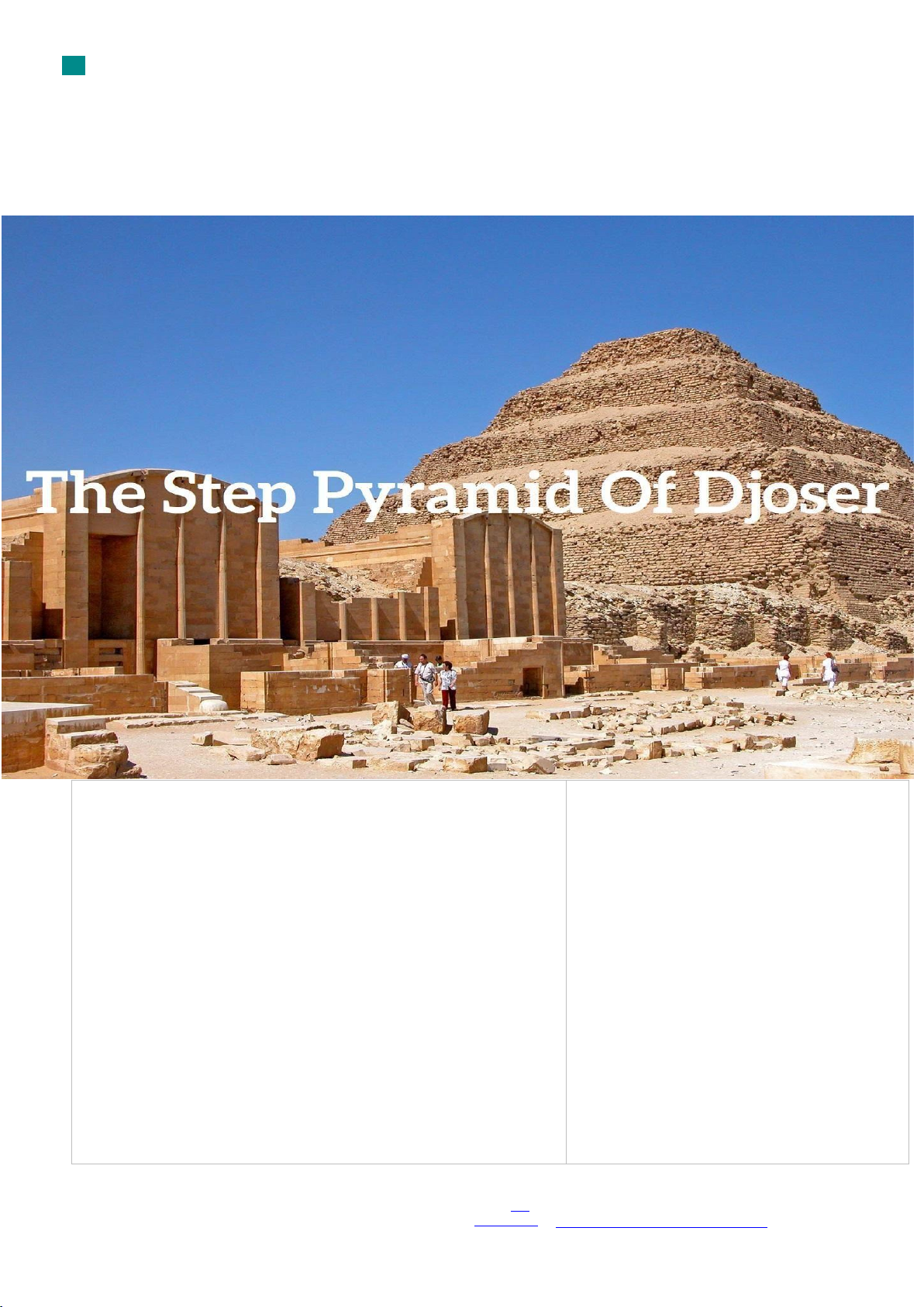
pyramid= a large stone building with four triangular
(=three-sided) walls that slope in to a point at the
top, especially in Egypt and Central America
The pyramids are the most famous monuments of monument= a building, statue, or other large
structure that is built to remind people of an
ancient Egypt and still hold enormous interest for people in
important event or famous person
the present day. These grand, impressive tributes to the
ancient= early, antique, olden
enormous= huge, vast, giant
memory of the Egyptian kings have become linked with the
interest= attraction, fascination, appeal
grand= outstanding, impressive, majestic
country even though other cultures, such as the Chinese and
impressive= something that is impressive makes
you admire it because it is very good, large,
Mayan, also built pyramids. The evolution of the pyramid form important etc
has been written and argued about for centuries. However,
tribute= something that you say, do, or give in order
to express your respect or admiration for someone
there is no question that, as far as Egypt is concerned, it
evolution= development, growth, progression, advancement
began with one monument to one king designed by one
as far as something is concerned: about
something, with regard to something
brilliant architect: the Step Pyramid of Djoser at Saqqara.
brilliant= excellent, great, wonderful
architect= someone whose job is to design buildings 7
Tài liệu gốc Cambridge IELTS của NXB Đại học Cambridge-Mua sách gốc tại link
Biên tập cuốn sách Boost your vocabulary này được thực hiện bởi thầy Đinh Thắng & IELTS Family-Các nhóm tự học IELTS lOMoAR cPSD| 30964149
BOOST YOUR VOCABULARY – CAMBRIDGE IELTS 16
Djoser was the first king of the Third Dynasty of Egypt and the prior to= before
reign= the period when someone is king, queen, or
first to build in stone. Prior to Djoser's reign, tombs were emperor
tomb= a stone structure above or below the ground where
rectangular monuments made of dried clay brick, which a dead person is buried
rectangular= having the shape of a rectangle
covered underground passages where the deceased person clay= a type of heavy sticky earth that can be used for making pots, bricks etc
was buried. For reasons which remain unclear, Djoser's main
brick= a hard block of baked clay used for building walls, houses etc
official, whose name was Imhotep, conceived of building a
underground= below the surface of the earth
passage= way, road, channel, route, path
taller, more impressive tomb for his king by stacking stone deceased= dead
bury= to put someone who has died in a grave
slabs on top of one another, progressively making them
conceive= think of, consider, perceive
smaller, to form the shape now known as the Step Pyramid.
stack= load, pile, heap
slab= a thick flat piece of a hard material such as
Djoser is thought to have reigned for 19 years, but some stone
progressively= increasingly, gradually
historians and scholars attribute a much longer time for his
historian= someone who studies history, or the history of a particular thing
rule, owing to the number and size of the monuments he built.
scholar= an intelligent and well-educated person
attribute= assign, attach, ascribe
The Step Pyramid has been thoroughly examined and
investigated over the last century, and it is now known that the
thoroughly= completely, totally
building process went through many different stages. Historian
examine= investigate, check, analyze, explore
Marc Van de Mieroop comments on this, writing 'Much
experimentation= the process of testing
various ideas, methods etc to find out how
experimentation was involved, which is especially clear in the good or effective they are
construction of the pyramid in the center of the complex. It
construction= building, creation
had several plans ... before it became the first Step Pyramid in
complex= a group of buildings, or a large
history, piling six levels on top of one another ... The weight of
building with many parts, used for a particular
the enormous mass was a challenge for the builders, who purpose
placed the stones at an inward incline in order to prevent the
inward= inner, interior, hidden monument breaking up.' incline= a slope
When finally completed, the Step Pyramid rose 62 meters high courtyard= an open space that is completely or
and was the tallest structure of its time. The complex in which
partly surrounded by buildings
it was built was the size of a city in ancient Egypt and included
shrine= a place that is connected with a holy event
or holy person, and that people visit to pray
a temple, courtyards, shrines, and living quarters for the
quarter= an area of a town
priests. It covered a region of 16 hectares and was
priest= someone who is specially trained to perform
surrounded by a wall 10.5 meters high. The wall had 13 false
religious duties and ceremonies in the Christian church
doors cut into it with only one true entrance cut into the south-
entrance= a door, gate etc that you go through to
east corner; the entire wall was then ringed by a trench 750 enter a place
trench= a long narrow hole dug into the surface of
meters long and 40 meters wide. The false doors and the the ground
trench were incorporated into the complex to discourage
false= untrue, incorrect, wrong
unwanted visitors. If someone wished to enter, he or she would incorporate= to include something as part of a group, system, plan etc
have needed to know in advance how to find the location of the discourage= to persuade someone not to do
true opening in the wall. Djoser was so proud of his
something, especially by making it seem difficult or bad
accomplishment that he broke the tradition of having only his
accomplishment= something successful or
own name on the monument and had Imhotep's name carved
impressive that is achieved after a lot of effort and on it as well. hard work
carve= to cut a pattern or letter on the surface of something
The burial chamber of the tomb, where the king's body was
chamber= hal , boardroom, meeting room laid to rest, was dug
beneath= under, underneath, below
beneath the base of the pyramid,
base= the lowest part or surface of something 8
Tài liệu gốc Cambridge IELTS của NXB Đại học Cambridge-Mua sách gốc tại link
Biên tập cuốn sách Boost your vocabulary này được thực hiện bởi thầy Đinh Thắng & IELTS Family-Các nhóm tự học IELTS lOMoAR cPSD| 30964149
BOOST YOUR VOCABULARY – CAMBRIDGE IELTS 16
surrounded by a vast maze of long tunnels that had rooms
surround= to be all around someone or something on every side
off them to discourage robbers. One of the most mysterious
maze= a complicated and confusing arrangement of streets, roads etc
discoveries found inside the pyramid was a large number of
tunnel= a passage that has been dug under the
ground for cars, trains etc to go through stone
robber= someone who steals money or property
vessels. Over 40,000 of these vessels, of various forms
mysterious= strange, unexplained, unsolved
and shapes, were discovered in storerooms off the pyramid's
discovery= finding, innovation, breakthrough
underground passages. They are inscribed with the names of
vessel= a ship or large boat
inscribe= to carefully cut, print, or write words on
rulers from the First and Second Dynasties of Egypt and made
something, especially on the surface of a stone or
from different kinds of stone. There is no agreement among coin scholars and
archaeologist= someone who studies ancient
archaeologists on why the vessels were placed
societies by examining what remains of their
in the tomb of Djoser or what they were supposed to buildings, graves, tools etc
represent. The archaeologist Jean-Philippe Lauer, who
represent= to be a symbol of something
excavate= if a scientist or archaeologist excavates
excavated most of the pyramid and complex, believes they
an area of land, they dig carefully to find ancient
were originally stored and then given a 'proper burial' by Djoser objects, bones etc
honor= respect, pay tribute to
in his pyramid to honor his predecessors. There are other
predecessor= someone who had your job before
historians, however, who claim the vessels were dumped into you started doing it the
shaft= a passage which goes down through a
shafts as yet another attempt to prevent grave robbers
building or down into the ground, so that someone
from getting to the king's burial chamber.
or something can get in or out
attempt= effort, try, go
Unfortunately, all of the precautions and intricate design of
precaution= something you do in order to prevent
something dangerous or unpleasant from happening
the underground network did not prevent ancient robbers from intricate= complicated, complex, sophisticated, tricky
finding a way in. Djoser's grave goods, and even his body, network= system
were stolen at some point in the past and all archaeologists
valuable= things that you own that are worth a lot of
money, such as jewellery, cameras etc
found were a small number of his valuables overlooked by
overlook= to not notice something, or not see how important it is
the thieves. There was enough left throughout the pyramid
thief= someone who steals things from another person or place
and its complex, however, to astonish and amaze the
astonish= surprise, overwhelm, amaze
archaeologists who excavated it.
exaggeration= a statement or way of saying
Egyptologist Miroslav Verner writes, 'Few monuments hold a
something that makes something seem better,
place in human history as significant as that of the Step larger etc than it really is
constitute= to be considered to be something
Pyramid in Saqqara ... It can be said without exaggeration
milestone= a very important event in the
that this pyramid complex constitutes a milestone in the development of something
evolution of monumental stone architecture in Egypt and in the revolutionary= completely new and different,
especially in a way that leads to great improvements
world as a whole.' The Step Pyramid was a revolutionary
archetype= a perfect example of something,
advance in architecture and became the archetype which all
because it has all the most important qualities of
things that belong to that type
the other great pyramid builders of Egypt would follow. 9
Tài liệu gốc Cambridge IELTS của NXB Đại học Cambridge-Mua sách gốc tại link
Biên tập cuốn sách Boost your vocabulary này được thực hiện bởi thầy Đinh Thắng & IELTS Family-Các nhóm tự học IELTS lOMoAR cPSD| 30964149
BOOST YOUR VOCABULARY – CAMBRIDGE IELTS 16 TEST 1 READING PASSAGE 3 A
leading= best, most important, or most successful
consultancy= a company that gives advice on a
ccording to a leading business consultancy, 3-14% of particular subject
workforce= all the people who work in a particular
industry or company, or are available to work in a particular country or area
the global workforce will need to switch to a different
switch= to change from doing or using one thing to doing or using another
occupation within the next 10-15 years, and all workers will
occupation= job, work, career, profession
adapt= to gradually change your behaviour and
need to adapt as their occupations evolve alongside
attitudes in order to be successful in a new situation
increasingly capable machines. Automation – or ‘embodied
evolve= change, grow, progress, advance
capable= able to do things well
automation= the use of computers and machines
artificial intelligence’ (AI) – is one aspect of the disruptive instead of people to do a job
embody= represent, exemplify, symbolize
effects of technology on the labour market. ‘Disembodied AI’,
artificial= false, fake, non-natural, man-made
disruptive= causing problems and preventing
like the algorithms running in our smartphones, is another.
something from continuing in its usual way
algorithm= a set of instructions that are followed in
a fixed order and used for solving a mathematical
problem, making a computer program etc
Dr Stella Pachidi from Cambridge Judge Business School
believes that some of the most
fundamental changes are
fundamental= important, central, essential,
happening as a result of the ‘algorithmication’ of jobs that are vital
dependent on data rather than on production – the so-called
knowledge economy. Algorithms are capable of learning from
undertake= to accept that you are responsible data to
for a piece of work, and start to do it
undertake tasks that previously needed human 10
Tài liệu gốc Cambridge IELTS của NXB Đại học Cambridge-Mua sách gốc tại link
Biên tập cuốn sách Boost your vocabulary này được thực hiện bởi thầy Đinh Thắng & IELTS Family-Các nhóm tự học IELTS lOMoAR cPSD| 30964149
BOOST YOUR VOCABULARY – CAMBRIDGE IELTS 16
judgement, such as reading legal contracts, analysing
judgement= an opinion that you form, especially
after thinking carefully about something
medical scans and gathering market intelligence.
legal= lawful, permissible, legitimate, rightful
contract= an official agreement between two or
‘In many cases, they can outperform humans,’ says Pachidi.
more people, stating what each will do
analyse= to examine or think about something
‘Organisations are attracted to using algorithms because they
carefully, in order to understand it
medical= relating to medicine and the treatment of disease or injury
want to make choices based on what they consider is “perfect
scan= a medical test in which a special machine
produces a picture of something inside your body
information”, as well as to reduce costs and enhance
outperform= to be more successful than someone or something else
enhance= improve, increase, boost productivity.’
productivity= output, efficiency, production
‘But these enhancements are not without consequences,’
consequence= result, effect, outcome
cognitive= related to the process of knowing,
says Pachidi. ‘If routine cognitive tasks are taken over by AI,
understanding, and learning something
take over= to take control of something
how do professions develop their future experts?’ she asks.
expert= someone who has a special skill or special
knowledge of a subject, gained as a result of training
‘One way of learning about a job is “legitimate peripheral or experience
peripheral= not as important as other things or
participation” – a novice stands next to experts and learns by
people in a particular activity, idea, or situation
novice= beginner, learner, trainee, apprentice
observation. If this isn’t happening, then you need to find new
observation= the process of watching something or ways to learn.’
someone carefully for a period of time
Another issue is the extent to which the technology influences
monitor= check, watch, supervise, examine
telecommunication= the sending and receiving of
or even controls the workforce. For over two years, Pachidi
messages by telephone, radio, television etc
contact= communication with a person,
monitored a telecommunications company. ‘The way organization, country etc
client= someone who gets services or advice from a
telecoms salespeople work is through personal and frequent
professional person, company, or organization
assess= evaluate, judge, consider
contact with clients, using the benefit of experience to
define= to describe something correctly and
thoroughly, and to say what standards, limits,
assess a situation and reach a decision. However, the
qualities etc it has that make it different from other
company had started using a[n] … algorithm that things defined
campaign= a series of actions intended to achieve
when account managers should contact certain customers
a particular result relating to politics or business, or a social improvement
about which kinds of campaigns and what to offer them.’
external= outside, exterior, outer
The algorithm – usually built by external designers – often
designer= someone whose job is to make plans or
patterns for clothes, furniture, equipment etc
becomes the keeper of knowledge, she explains. In cases like
short-sighted= not considering the possible effects in
the future of something that seems good now – used to show disapproval
this, Pachidi believes, a short-sighted view begins to creep
creep into= to move in a quiet, careful way, especially to avoid attracting attention
into working practices whereby workers learn through the
exploration= examination, search, investigation
experimentation= the process of testing various
‘algorithm’s eyes’ and become dependent on its instructions.
ideas, methods etc to find out how good or effective they are
Alternative explorations – where experimentation and
instinct= a natural tendency to behave in a
particular way or a natural ability to know something,
human instinct lead to progress and new ideas – are which is not learned
discourage= to persuade someone not to do effectively
something, especially by making it seem difficult or discouraged. bad 11
Tài liệu gốc Cambridge IELTS của NXB Đại học Cambridge-Mua sách gốc tại link
Biên tập cuốn sách Boost your vocabulary này được thực hiện bởi thầy Đinh Thắng & IELTS Family-Các nhóm tự học IELTS lOMoAR cPSD| 30964149
BOOST YOUR VOCABULARY – CAMBRIDGE IELTS 16
Pachidi and colleagues even observed people developing
colleague= coworker, associate, partner,
strategies to make the algorithm work to their own advantage. collaborator
‘We are seeing cases where workers feed the algorithm with
strategy= plan, policy, approach, tactic false data to reach their
target= aim, goal, objective
targets,’ she reports.
scenario= a situation that could possibly happen
It’s scenarios like these that many researchers are working to researcher= someone who studies a subject in
detail in order to discover new facts or test new
avoid. Their objective is to make AI technologies more ideas
trustworthy= truthful, honest, reliable
trustworthy and transparent, so that organisations and
transparent= a lie, excuse etc that is transparent
individuals understand how AI decisions are made. In the does not deceive people
in the meantime= in the period of time between
meantime, says Pachidi, ‘We need to make sure we fully
now and a future event, or between two events in the past
understand the dilemmas that this new world raises regarding
dilemma= a situation in which it is very difficult to
decide what to do, because all the choices seem
expertise, occupational boundaries and control.’ equally good or equally bad
expertise= special skills or knowledge in a
Economist Professor Hamish Low believes that the future of
particular subject, that you learn by experience or work will involve training
major transitions across the whole life
boundary= the real or imaginary line that marks the
course for everyone: ‘The traditional
edge of a state, country etc, or the edge of an area
trajectory of full-time
of land that belongs to someone
education followed by full-time work followed by a pensioned
major= big, large, considerable, leading
transition= when something changes from one form
retirement is a thing of the past,’ says Low. Instead, he or state to another
trajectory= the events that happen during a period
envisages a multistage employment life: one where retraining of time, which often lead to a particular aim or result
envisage= to think that something is likely to
happens across the life course, and where multiple jobs and happen in the future
no job happen by choice at different stages.
multistage= conducted by or occurring in stages
multiple= many, numerous, various
predict= to say that something will happen, before it
On the subject of job losses, Low believes the predictions are happens
founded on a fallacy: ‘It assumes that the number of jobs is
fallacy= a false idea or belief, especially one that a
fixed. If in 30 years, half of 100 jobs are being carried out by lot of people believe is true
robots, that doesn’t mean we are left with just 50 jobs for
carry out= to do something that needs to be
humans. The number of jobs will increase: we would organized and planned expect
expect= hope, suppose, think, foresee there to be 150 jobs.’
Dr Ewan McGaughey, at Cambridge’s Centre for Business
apocalyptic= warning people about terrible events
that will happen in the future
Research and King’s College London, agrees that
misguided= intended to be helpful but in fact making a situation worse
‘apocalyptic’ views about the future of work are misguided.
restrict= limit, curb, control, constrain
supply= an amount of something that is available to
‘It’s the laws that restrict the supply of capital to the job be used market, not the
capital= money or property, especially when it is
advent of new technologies that causes
used to start a business or to produce more wealth unemployment.’
advent= arrival, start, beginning
unemployment= when someone does not have a job
publish= to arrange for a book, magazine etc to be
His recently published research answers the question of written, printed, and sold
whether automation, AI and robotics will mean a ‘jobless jobless= unemployed
future’ by looking at the causes of unemployment. ‘History is
redundancy= a situation in which someone has to
clear that change can mean redundancies. But social policies
leave their job, because they are no longer needed can
tackle= deal with, work on
tackle this through retraining and redeployment.’
redeploy= to move someone or something to a different place or job
(re-= again i.e rebroadcast) 12
Tài liệu gốc Cambridge IELTS của NXB Đại học Cambridge-Mua sách gốc tại link
Biên tập cuốn sách Boost your vocabulary này được thực hiện bởi thầy Đinh Thắng & IELTS Family-Các nhóm tự học IELTS lOMoAR cPSD| 30964149
BOOST YOUR VOCABULARY – CAMBRIDGE IELTS 16
He adds: ‘If there is going to be change to jobs as a result of AI seize a chance/an opportunity/the initiative=
to quickly and eagerly do something when you have the chance to
and robotics then I’d like to see governments seizing the
enforce= to make something happen or force someone to do something
security= things that are done to keep a person, building,
opportunity to improve policy to enforce good job security.
or country safe from danger or crime
programme= to arrange for something to happen as part
We can “reprogramme” the law to prepare for a fairer future of of a series of planned events or activities
a call to arms= something that makes people want to take
action and get involved in an attempt to deal with a bad
work and leisure.’ McGaughey’s findings are a call to arms to situation
pre-empt= to make what someone has planned to do or
say unnecessary or ineffective by saying or doing
leaders of organisations, governments and banks to pre-empt something first
bold= very strong or bright so that you notice them the coming changes with
policy= a way of doing something that has been official y
bold new policies that guarantee
agreed and chosen by a political party, a business, or another organization
full employment, fair incomes and a thriving economic
guarantee= ensure, secure, maintain, protect
thriving= a thriving company, business etc is very successful democracy.
democracy= a situation or system in which everyone is
equal and has the right to vote, make decisions etc
‘The promises of these new technologies are astounding.
astounding= amazing, surprising, shocking
They deliver humankind the capacity to live in a way that
revolution= a complete change in ways of thinking,
nobody could have once imagined,’ he adds. ‘Just as the methods of working etc industrial
subsistence= the condition of only just having
revolution brought people past subsistence
enough money or food to stay alive
agriculture, and the corporate revolution enabled mass
agriculture= the practice or science of farming
production, a third revolution has been pronounced. But it will
corporate= shared by or involving all the members of a group
not only be one of technology. The next revolution will be
mass= a large amount or quantity of something social.’
pronounced= very great or noticeable 13
Tài liệu gốc Cambridge IELTS của NXB Đại học Cambridge-Mua sách gốc tại link
Biên tập cuốn sách Boost your vocabulary này được thực hiện bởi thầy Đinh Thắng & IELTS Family-Các nhóm tự học IELTS lOMoAR cPSD| 30964149
BOOST YOUR VOCABULARY – CAMBRIDGE IELTS 16 TEST 2 READING PASSAGE 1 T
huge= giant, enormous, vast, massive
figure= a person in a painting or a model of a he person
cutting of huge figures or ‘geoglyphs’ into the earth
geoglyph= A large-scale image or design produced
in the natural landscape by techniques such as
aligning rocks or gravel or removing soil or sod, the
complete form of which is visible only aerially or at a
of English hillsides has taken place for more than 3,000 distance
hillside= the sloping side of a hill
years. There are 56 hill figures scattered around England, with take place= happen, occur, have effect
scatter= if someone scatters a lot of things, or if
they scatter, they are thrown or dropped over a wide
the vast majority on the chalk downlands of the country’s area in an irregular way
majority= most of the people or things in a group
downland= gently rolling hill country, especially in
southern counties. The figures include giants, horses, southern England
county= an area of a state or country that has its
own government to deal with local matters
crosses and regimental badges. Although the majority of
cross= an object, picture, or mark in the shape of a
cross, used as a sign of the Christian faith or for decoration
these geoglyphs date within the last 300 years or so, there are
regimental= connected with a particular regiment (= a large group of soldiers)
badge= a small piece of metal or plastic that you
one or two that are much older.
carry to show people that you work for a particular organization 14
Tài liệu gốc Cambridge IELTS của NXB Đại học Cambridge-Mua sách gốc tại link
Biên tập cuốn sách Boost your vocabulary này được thực hiện bởi thầy Đinh Thắng & IELTS Family-Các nhóm tự học IELTS lOMoAR cPSD| 30964149
BOOST YOUR VOCABULARY – CAMBRIDGE IELTS 16
The most famous of these figures is perhaps also the most
mysterious= strange, odd, unsolved, inexplicable
re-date= to change the date of
(re-= again i.e rebroadcast)
mysterious – the Uffington White Horse in Oxfordshire. The
previously= before, beforehand, formerly, earlier
assign= to give a particular time, value, place etc to
White Horse has recently been re-dated and shown to be something
ancient= antique, old-fashioned, obsolete, outdated, prehistoric
even older than its previously assigned ancient pre-Roman
controversial= causing a lot of disagreement, because
many people have strong opinions about the subject Iron Age date. More being discussed
controversial is the date of the
enigmatic= mysterious and difficult to understand
historian= someone who studies history, or the history
enigmatic Long Man of Wilmington in Sussex. While many of a particular thing
convince= to make someone feel certain that something is true
historians are convinced the figure is prehistoric, others
artistic= relating to art or culture
monk= a member of an all-male religious group that
believe that it was the work of an artistic monk from a nearby
lives apart from other people in a monastery
nearby= near, close, in the neighborhood
priory= a building where a group of monks or nuns live,
priory and was created between the 11th and 15th centuries.
which is smaller and less important than an abbey
The method of cutting these huge figures was simply to
method= way, technique, means
overlie= to lie over something
remove the overlying grass to reveal the gleaming white
(over-= above; beyond; across i.e overhanging
branches, overhead telephone wires)
chalk below. However, the grass would soon grow over the
reveal= tell, disclose, make known, expose
gleaming= bright and shiny from being cleaned
geoglyph again unless it was regularly cleaned or scoured by
scour= to clean something very thoroughly by
rubbing it with a rough material
a fairly large team of people. One reason that the vast majority
associated= related, linked, connected
of hill figures have disappeared is that when the traditions
fade= to gradually disappear
bother= to make the effort to do something
associated with the figures faded, people no longer bothered
exactly= accurately, precisely, correctly
thus= so, therefore, consequently, as a result
or remembered to clear away the grass to expose the chalk
original= existing or happening first, before other people or things
outline. Furthermore, over hundreds of years the outlines
survive= to continue to live after an accident, war, or illness
would sometimes change due to people not always cutting in
be a testament to something= to prove or show
very clearly that something exists or is true
exactly the same place, thus creating a different shape to the
continuity= the state of continuing for a period of
original geoglyph. The fact that any ancient hill figures
time, without problems, interruptions, or changes
stretch= to continue over a period of time or in a
survive at all in England today is testament to the strength
series, or to make something do this
millennia= a period of 1,000 years
and continuity of local customs and beliefs which, in one case
at least, must stretch back over millennia.
unique= unusually good and special
stylized= drawn, written, or performed in an artificial
style that does not look natural or real, but that is still
The Uffington White Horse is a unique, stylised pleasant to look at
representation= the act of representing someone or something
representation of a horse consisting of a long, sleek back,
sleek= sleek hair or fur is straight, shiny, and healthy- looking
thin disjointed legs, a streaming tail, and a bird-like beaked
disjointed= a disjointed activity or system is one in
which the different parts do not work well together
beaked= having or resembling a beak
head. The elegant creature almost melts into the landscape.
elegant= beautiful, attractive, or graceful
melt into something= to gradually become hidden by
The horse is situated 2.5 km from Uffington village on a something steep
landscape= an area of countryside or land of a
particular type, used especially when talking about its
slope close to the Late Bronze Age* (c. 7th century BCE) appearance
steep= a road, hill etc that is steep slopes at a high angle 15
Tài liệu gốc Cambridge IELTS của NXB Đại học Cambridge-Mua sách gốc tại link
Biên tập cuốn sách Boost your vocabulary này được thực hiện bởi thầy Đinh Thắng & IELTS Family-Các nhóm tự học IELTS lOMoAR cPSD| 30964149
BOOST YOUR VOCABULARY – CAMBRIDGE IELTS 16
hillfort of Uffington Castle and below the Ridgeway, a long-
track= path, pathway, road, way distance Neolithic** track.
be surrounded by something= to be all around
The Uffington Horse is also surrounded by Bronze Age burial
someone or something on every side
mound= a pile of earth or stones that looks like a
mounds. It is not far from the Bronze Age cemetery of small hill
Lambourn Seven Barrows, which consists of more than 30
cemetery= a piece of land, usually not belonging to
a church, in which dead people are buried
well-preserved burial mounds. The carving has been placed
well-preserved= a well-preserved building or object
is old but still in good condition
in such a way as to make it extremely difficult to see from
carving= the activity or skill of carving something
close quarters= if something happens or is done at
close quarters, and like many geoglyphs is best appreciated
close quarters, it happens inside a small space or is
done from a short distance away
from the air. Nevertheless, there are certain areas of the Vale
appreciate= to understand how good or useful of the White Horse, the someone or something is
valley containing and named after the
valley= an area of lower land between two lines of
enigmatic creature, from which an
hills or mountains, usually with a river flowing
adequate impression may through it
be gained. Indeed on a clear day the carving can be seen from adequate= enough, sufficient
impression= the opinion or feeling you have about up to 30 km away.
someone or something because of the way they seem
The earliest evidence of a horse at Uffington is from the 1070s
CE when ‘White Horse Hill’ is mentioned in documents from
evidence= proof, sign, indication
the nearby Abbey of Abingdon, and the first reference to the
reference= part of something you say or write
horse itself is soon after, in 1190 CE. However, the carving is
believed to date back much further than that. Due to the
in which you mention a person or thing
similarity of the Uffington White Horse to the stylised
depictions of horses on 1st century BCE coins, it had been
depiction= description, representation,
thought that the creature must also date to that period. portrayal
However, in 1995 Optically Stimulated Luminescence (OSL)
testing was carried out by the Oxford Archaeological Unit on
soil from two of the lower layers of the horse’s body, and from
base= the lowest part or surface of something
construction= building, creation
another cut near the base. The result was a date for the
horse’s construction somewhere between 1400 and 600 BCE
– in other words, it had a Late Bronze Age or Early Iron Age origin.
The latter end of this date range would tie the carving of the
tribal= relating to a tribe or tribes
emblem= symbol, logo, sign, badge
horse in with occupation of the nearby Uffington hillfort,
inhabitant= occupant, resident, citizen
alternatively= used for suggesting something different
indicating that it may represent a tribal emblem marking the
researcher= someone who studies a subject in detail
in order to discover new facts or test new ideas
land of the inhabitants of the hillfort. Alternatively, the
goddess= a female being who is believed to control
the world or part of it, or represents a particular quality
carving may have been carried out during a Bronze or Iron Age worship= to show respect and love for a god,
especially by praying in a religious building
ritual. Some researchers see the horse as representing the
protector= someone or something that protects someone or something else
Celtic*** horse goddess Epona, who was worshipped as a
fertility= the ability of a person, animal, or plant to
produce babies, young animals, or seeds
protector of horses, and for her associations with fertility.
import= to introduce something new or different in a
place where it did not previously exist
However, the cult of Epona was not imported from Gaul
cult= an extreme religious group that is not part of an established religion 16
Tài liệu gốc Cambridge IELTS của NXB Đại học Cambridge-Mua sách gốc tại link
Biên tập cuốn sách Boost your vocabulary này được thực hiện bởi thầy Đinh Thắng & IELTS Family-Các nhóm tự học IELTS lOMoAR cPSD| 30964149
BOOST YOUR VOCABULARY – CAMBRIDGE IELTS 16
(France) until around the first century CE. This date is at least
probably= maybe, possibly, perhaps
ritual= done as part of a rite or ritual
six centuries after the Uffington Horse was probably carved.
significance= importance, impact
Nevertheless, the horse had great ritual and economic
attest= to show or prove that something is true
significance during the Bronze and Iron Ages, as attested by
jewellery= small things that you wear for
its depictions on jewellery and other metal objects. It is
decoration, such as rings or necklaces
native= your native country, town etc is the place
possible that the carving represents a goddess in native where you were born
mythology, such as Rhiannon, described in later Welsh
mythology= set of ancient myths
mythology as a beautiful woman dressed in gold and riding a white horse.
The fact that geoglyphs can disappear easily, along with their temporary= continuing for only a limited period of
associated rituals and meaning, indicates that they were never time
gesture= a movement of part of your body,
intended to be anything more than temporary gestures. But
especially your hands or head, to show what you
this does not lessen their importance. These giant carvings are mean or how you feel
a fascinating glimpse into the minds of their creators and how
glimpse= a quick look at someone or something
they viewed the landscape in which they lived.
that does not allow you to see them clearly 17
Tài liệu gốc Cambridge IELTS của NXB Đại học Cambridge-Mua sách gốc tại link
Biên tập cuốn sách Boost your vocabulary này được thực hiện bởi thầy Đinh Thắng & IELTS Family-Các nhóm tự học IELTS lOMoAR cPSD| 30964149
BOOST YOUR VOCABULARY – CAMBRIDGE IELTS 16 TEST 2 READING PASSAGE 2 M
bacteria= very small living things, some of which cause il ness or disease
populate= if an area is populated by a particular group of people, they live there
icrobes, most of them bacteria, have populated this
outlive= to remain alive after someone else has died
(out-= being or becoming bigger, further, greater etc than
someone or something else i.e outgrow)
invisible= unseen, unseeable, undetectable
the naked eye= if you can see something with the naked
eye, you can see it without using anything to help you,
planet since long before animal life developed and they will such as a telescope
ubiquitous= seeming to be everywhere – sometimes used humorously
outlive us. Invisible to the naked eye, they are ubiquitous.
inhabit= live, dwel , occupy, populate
seaweed= a plant that grows in the sea
coral= a hard red, white, or pink substance formed from
They inhabit the soil, air, rocks and water and are present
the bones of very small sea creatures, which is often used to make jewel ery
within every form of life, from
utterly= completely, absolutely, total y, extremely, entirely
seaweed and coral to dogs and
absorb= to take in liquid, gas, or another substance from
the surface or space around something
humans. And, as Yong explains in his utterly absorbing and
hugely= vastly, enormously, immensely, massively
mess with somebody/something= to get involved with
someone or something that may cause problems or be
hugely important book, we mess with them at our peril. dangerous
peril= danger, threat, risk
species= a group of animals or plants whose members
Every species has its own colony of microbes, called a
are similar and can breed together to produce young animals or plants
‘microbiome’, and these microbes vary not only between
colony= a group of animals or plants of the same type that
are living or growing together
species but also between individuals and within different parts
microbe= an extremely small living thing which you can
only see if you use a microscope
of each individual. What is amazing is that while the number of
vary= differ, diverge, contrast, be different 18
Tài liệu gốc Cambridge IELTS của NXB Đại học Cambridge-Mua sách gốc tại link
Biên tập cuốn sách Boost your vocabulary này được thực hiện bởi thầy Đinh Thắng & IELTS Family-Các nhóm tự học IELTS lOMoAR cPSD| 30964149
BOOST YOUR VOCABULARY – CAMBRIDGE IELTS 16
human cells in the average person is about 30 trillion, the
cell= the smallest part of a living thing that can exist independently
number of microbial ones is higher – about 39 trillion. At best,
trillion= the number 1,000,000,000,000 Yong
inform= notify, update, tell
informs us, we are only 50 per cent human. Indeed,
scientist= someone who works or is trained in
some scientists even suggest we should think of each science
single= only, sole, solo
species and its microbes as a single unit, dubbed a
dub= to give something or someone a name that describes them in some way ‘holobiont’.
In each human there are microbes that live only in the
armpit= the hollow place under your arm where it
stomach, the mouth or the armpit and by and large they do so joins your body
peacefully. So ‘bad’ microbes are just microbes out of context.
peacefully= quietly, calmly, tranquilly
contentedly= happy and satisfied because your life
Microbes that sit contentedly in the human gut (where there is good
are more microbes than there are stars in the galaxy) can
gut= all the organs in someone’s body, especially become
when they have come out of their body
deadly if they find their way into the bloodstream.
deadly= poisonous, lethal, fatal, toxic
These communities are constantly changing too. The right
bloodstream= the blood flowing in your body
hand shares just one sixth of its microbes with the left hand.
community= the people who live in the same area, town etc
And, of course, we are surrounded by microbes. Every time
constantly= continually, continuously, regularly,
we eat, we swallow a million microbes in each gram of food; frequently
we are continually swapping microbes with other humans, pets be surrounded by something= to be all around
someone or something on every side and the world at large.
swallow= to make food or drink go down your throat and towards your stomach
extraordinarily= extremely, very, unusual y, amazingly
It’s a fascinating topic and Yong, a young British science
adept= skil ful, skil ed, expert, proficient
lightness= the state of being light
panache= a way of doing things that makes them seem
journalist, is an extraordinarily adept guide. Writing with
easy and exciting, and makes other people admire you
have a knack of doing something= to have a tendency to do something
lightness and panache, he has a knack of explaining
complex= difficult, complicated
term= a word or expression with a particular meaning,
complex science in terms that are both easy to understand
especial y one that is used for a specific subject or type of language
enthralling= fascinating, captivating, engrossing
and totally enthralling. Yong is on a mission. Leading us
mission= goal, purpose, duty, objective
gently= kindly, smoothly, lightly
bizarre= unusual, odd, strange
gently by the hand, he takes us into the world of microbes – a
alien= unfamiliar, foreign, outlandish
a bid to do something = an attempt to achieve or obtain something
bizarre, alien planet – in a bid to persuade us to love them
persuade= to make someone decide to do something,
especial y by giving them reasons why they should do it, or
as much as he does. By the end, we do.
asking them many times to do it
For most of human history we had no idea that microbes
exist= to happen or be present in a particular
existed. The first man to see these extraordinarily potent situation or place
creatures was a Dutch lens-maker called Antony van
potent= strong, powerful, effective
Leeuwenhoek in the 1670s. Using microscopes of his own
magnify= to make something seem bigger or
louder, especially using special equipment
design that could magnify up to 270 times, he examined a
examine= check, investigate, research, explore
drop of water from a nearby lake and found it teeming with
nearby= near, close, close to
tiny creatures he called ‘animalcules’. It wasn’t until nearly two
teem with somebody/something= to be very full of
hundred years later that the research of French biologist Louis
people or animals, all moving about
tiny= small, little, petite, insignificant
Pasteur indicated that some microbes caused disease. It was
endure= to remain alive or continue to exist for a
Pasteur’s ‘germ theory’ that gave bacteria the poor image that long time endures today. 19
Tài liệu gốc Cambridge IELTS của NXB Đại học Cambridge-Mua sách gốc tại link
Biên tập cuốn sách Boost your vocabulary này được thực hiện bởi thầy Đinh Thắng & IELTS Family-Các nhóm tự học IELTS lOMoAR cPSD| 30964149
BOOST YOUR VOCABULARY – CAMBRIDGE IELTS 16
Yong’s book is in many ways a plea for microbial tolerance,
plea= a request that is urgent or full of emotion
pointing out that while fewer than one hundred species of
tolerance= willingness to allow people to do, say, or
believe what they want without criticizing or punishing
bacteria bring disease, many thousands more play a vital role them
in maintaining our health. The book also acknowledges that
acknowledge= recognize, accept, admit
our attitude towards bacteria is not a simple one. We tend to
supposedly= used when saying what many people say
or believe is true, especially when you disagree with
see the dangers posed by bacteria, yet at the same time we them
are sold yoghurts and drinks that supposedly nurture
nurture= to feed and take care of a child or a plant
‘friendly’ bacteria. In reality, says Yong, bacteria should not be while it is growing viewed as either friends or foe= an enemy
foes, villains or heroes. Instead we
villain= a bad person or criminal
should realise we have a symbiotic relationship, that can be
symbiotic= a symbiotic relationship is one in which the
mutually beneficial or mutually destructive.
people, organizations, or living things involved depend on each other
mutually= equally, jointly, commonly
destructive= damaging, harmful, detrimental
What then do these millions of organisms do? The answer is unravel= solve, find an answer, sort out
pretty much everything. New research is now
aid= help, assist, support unravelling the
digestion= the process of digesting food
regulate= to make a machine or your body work at a
ways in which bacteria aid digestion, regulate our immune
particular speed, temperature etc
immune= someone who is immune to a particular disease cannot catch it
systems, eliminate toxins, produce vitamins, affect our
eliminate= remove, eradicate, abolish, exclude, reduce
toxin= a poisonous substance, especially one that is behaviour and even
produced by bacteria and causes a particular disease
combat obesity. ‘They actually help us
combat= fight, battle, oppose
obsession= an extreme unhealthy interest in
become who we are,’ says Yong. But we are facing a growing
something or worry about something, which stops you
from thinking about anything else problem. Our
hygiene= the practice of keeping yourself and the
obsession with hygiene, our overuse of
things around you clean in order to prevent diseases
antibiotic= a drug that is used to kill bacteria and cure
antibiotics and our unhealthy, low-fibre diets are disrupting infections
disrupt= interrupt, upset, disturb
soar= rise, increase, skyrocket
the bacterial balance and may be responsible for soaring
allergy= a medical condition in which you become ill or
in which your skin becomes red and painful because
rates of allergies and immune problems, such as
you have eaten or touched a particular substance
inflammatory= an inflammatory disease or medical condition causes inflammation
inflammatory bowel disease (IBD).
bowel= one part of this system of tubes
The most recent research actually turns accepted norms
upside down. For example, there are studies indicating that the norm= standard, rule, custom
excessive use of household detergents and antibacterial
excessive= extreme, too much, unnecessary
products actual y destroys the microbes that normally keep the detergent= a liquid or powder used for
more dangerous germs at bay. Other studies show that washing clothes, dishes etc
keeping a dog as a pet gives children early exposure to a
diverse range of bacteria, which may help protect them against allergies later.
The readers of Yong’s book must be prepared for a decidedly
glamorous= attractive, exciting, and related to wealth and success
unglamorous world. Among the less appealing case studies
appealing= interesting, attractive, tempting
fungus= a simple type of plant that has no leaves or
is one about a fungus that is wiping out entire populations of
flowers and that grows on plants or other surfaces
wipe out= to destroy, remove, or get rid of
frogs and that can be halted by a rare microbial bacterium. something completely
Another is about squid that carry
halt= stop, pause, finish
luminescent bacteria that
luminescence= a soft shining light 20
Tài liệu gốc Cambridge IELTS của NXB Đại học Cambridge-Mua sách gốc tại link
Biên tập cuốn sách Boost your vocabulary này được thực hiện bởi thầy Đinh Thắng & IELTS Family-Các nhóm tự học IELTS lOMoAR cPSD| 30964149
BOOST YOUR VOCABULARY – CAMBRIDGE IELTS 16 protect them against
predator= an animal that kills and eats other
predators. However, if you can animals
overcome your distaste for some of the investigations, the
overcome= to successfully control a feeling or
problem that prevents you from achieving something
reasons for Yong’s enthusiasm become clear. The microbial
distaste= dislike, disgust, disfavor
enthusiasm= a strong feeling of interest and
world is a place of wonder. Already, in an attempt to stop
enjoyment about something and an eagerness to be involved in it
mosquitoes spreading dengue fever – a disease that infects
spread= if something spreads or is spread, it
becomes larger or moves so that it affects more
400 million people a year – mosquitoes are being loaded with people or a larger area
a bacterium to block the disease. In the future, our ability to
dengue= an illness commonly found in hot
countries, caused by the bite of a mosquito which
manipulate microbes means we could construct buildings with
has been infected with a virus
infect= to give someone a disease
useful microbes built into their walls to fight off infections. Just
manipulate= to make someone think and behave
exactly as you want them to, by skillfully deceiving
imagine a neonatal hospital ward coated in a specially mixed or influencing them
neonatal= relating to babies that have just been
cocktail of microbes so that babies get the best start in life. born 21
Tài liệu gốc Cambridge IELTS của NXB Đại học Cambridge-Mua sách gốc tại link
Biên tập cuốn sách Boost your vocabulary này được thực hiện bởi thầy Đinh Thắng & IELTS Family-Các nhóm tự học IELTS lOMoAR cPSD| 30964149
BOOST YOUR VOCABULARY – CAMBRIDGE IELTS 16 TEST 2 READING PASSAGE 3 A
wisdom= understanding, knowledge, sense
cross cultures, wisdom has been considered one of the revered= respected, admired, valued
quality= feature, characteristic, attribute, trait
be few and far between= to be rare
empirical= experiential, experimental, observed most
research= study, examination, investigation
revered human qualities. Although the truly wise may inquiry
seem few and far between, empirical research examining
examine= investigate, check, analyze, explore
exceptional= unusually good, outstanding
wisdom suggests that it isn’t an exceptional trait possessed
possess= have, own, hold, keep
handful of= a few, not many, hardly any
by a small handful of bearded philosophers after all – in fact, beard= facial hair, moustache, mustache
the latest studies suggest that most of us have the
philosopher= theorist, truth-seeker, thinker ability to
ability= aptitude, skill, capability, capacity
make wise decisions, given the right context.
context= setting, background, situation, circumstance
‘It appears that experiential, situational, and cultural factors are even more
experiential= based on experience or related to
powerful in shaping wisdom than previously experience
imagined,’ says Associate Professor Igor Grossmann of the
cultural= belonging or relating to a particular society and its way of life
University of Waterloo in Ontario, Canada. ‘Recent empirical
powerful= influential, controlling, dominant, great findings from
previously= before, beforehand, formerly, earlier
cognitive, developmental, social, and personality
cognitive= reasoning, mental, intellectual 22
Tài liệu gốc Cambridge IELTS của NXB Đại học Cambridge-Mua sách gốc tại link
Biên tập cuốn sách Boost your vocabulary này được thực hiện bởi thầy Đinh Thắng & IELTS Family-Các nhóm tự học IELTS lOMoAR cPSD| 30964149
BOOST YOUR VOCABULARY – CAMBRIDGE IELTS 16
psychology cumulatively suggest that people’s ability to
psychology= mind, thinking, mindset
cumulatively= in a way that increases by one
reason wisely varies dramatically across experiential and addition after another
situational contexts. Understanding the role of such
reason= think, rationalize, analyze, solve
vary= differ, diverge, contrast, be different
contextual factors offers unique insights into understanding
dramatically= in a great and sudden way
contextual= relating to a particular context
wisdom in daily life, as well as how it can be enhanced and
unique= unusually good and special
insight= vision, understanding, awareness taught.’
enhance= improve, increase, boost, develop
It seems that it’s not so much that some people simply
possess= own, have, hold, enjoy
possess wisdom and others lack it, but that our ability to
external= outside, exterior, outward, outer
impossible= not possible, unfeasible, impracticable,
reason wisely depends on a variety of external factors. ‘It is unworkable
impossible to characterize thought processes attributed to
characterize= describe, portray, illustrate, depict
wisdom without considering the
attribute something to somebody/something= to
role of contextual factors,’
believe or say that a situation or event is caused by
explains Grossmann. ‘In other words, wisdom is not solely an something
“inner quality” but rather unfolds as a function of situations
role= part, position, responsibility, job solely= only, merely
people happen to be in. Some situations are more likely to
inner= internal, innermost, inside, interior
promote wisdom than others.’
unfold= if a series of events unfolds, they happen
promote= encourage, help, stimulate, support
Coming up with a definition of wisdom is challenging, but
challenging= demanding, difficult, tough
colleague= coworker, associate, partner, Grossmann and his collaborator
colleagues have identified four key
framework= structure, frame, scaffold
intellectual= intelligent, knowledgeable, academic
characteristics as part of a framework of wise reasoning. One rational
humility= modesty, shyness, self-effacement,
is intellectual humility or recognition of the limits of our own unpretentiousness
recognition= identification, detection,
distinguishing, differentiation
knowledge, and another is appreciation of perspectives
appreciation= gratitude, gratefulness, obligation thankfulness
wider than the issue at hand. Sensitivity to the possibility of
perspective= view, viewpoint, outlook
relation= relative, family member, next of kin change in social
compromise= cooperation, negotiation, concession
relations is also key, along with compromise conciliation
sensitivity= sympathy, understanding, kindliness
or integration of different attitudes and beliefs.
integration= addition, mixing, combination, incorporation
Grossmann and his colleagues have also found that one of the reliable= dependable, consistent, unfailing,
most reliable ways to support wisdom in our own day-to-day trustworthy
decisions is to look at scenarios from a third-party
scenario= a situation that could possibly happen
perspective, as though giving advice to a friend. Research
focal= central, crucial, important, principal
suggests that when adopting a first-person viewpoint we focus
interpersonal= relational, social, personal
moral= good, right, honest, ethical
on ‘the focal features of the environment’ and when we adopt
justice= fairness, impartiality, righteousness,
a third-person, ‘observer’ viewpoint we reason more broadly evenhandedness
and focus more on interpersonal and moral ideals such as
impartial= neutral, fair, unbiased, objective
justice and impartiality. Looking at problems from this more
expansive= extensive, vast, wide, spread-out
foster= promote, further, advance, cultivate
expansive viewpoint appears to foster cognitive processes related to wise decisions.
What are we to do, then, when confronted with situations like a disagreement with a
confront= meet, face, encounter, handle, tackle
spouse or negotiating a contract at
spouse= a husband or wife
work, that require us to take a personal stake? Grossmann
negotiate= talk, discuss, consult, confer
argues that even when we aren’t able to change the situation,
contract= agreement, bond, indenture
stake= investment, claim, share 23
Tài liệu gốc Cambridge IELTS của NXB Đại học Cambridge-Mua sách gốc tại link
Biên tập cuốn sách Boost your vocabulary này được thực hiện bởi thầy Đinh Thắng & IELTS Family-Các nhóm tự học IELTS lOMoAR cPSD| 30964149
BOOST YOUR VOCABULARY – CAMBRIDGE IELTS 16
we can still evaluate these experiences from different
evaluate= assess, estimate, calculate, value perspectives.
peak= the time when something or someone is best,
For example, in one experiment that took place during the
greatest, highest, most successful etc
peak of a recent economic recession, graduating college
recession= decline, collapse, downturn, slump seniors were asked to
reflect= think, consider, ponder
reflect on their job prospects. The
prospect= possibility, likelihood, probability,
students were instructed to imagine their career either ‘as if potential
you were a distant observer’ or ‘before your own eyes as if
distant= far, remote, faraway
instruct= teach, train, coach, tutor, educate
you were right there’. Participants in the group assigned to the observer= spectator, witness, viewer, onlooker
‘distant observer’ role displayed more wisdom-related
assign= attribute, ascribe, impute
reasoning (intellectual humility and recognition of change) than display= show, exhibition, presentation, demonstration
did participants in the control group.
participant= member, contributor, partaker
instruct= to officially tell someone what to do
In another study, couples in long-term romantic relationships
visualize= to form a picture of someone or
were instructed to visualize an unresolved relationship something in your mind
conflict either through the eyes of an outsider or from their
unresolved= an unresolved problem or question
own perspective. Participants then discussed the incident with has not been answered or solved
their partner for 10 minutes, after which they wrote down their
conflict= a state of disagreement or argument
between people, groups, countries etc
thoughts about it. Couples in the ‘other’s eyes’ condition were incident= an event, especially one that is unusual,
significantly more likely to rely on wise reasoning – important, or violent
recognizing others’ perspectives and searching for a
condition= state, form, situation, circumstance
compromise – compared to the couples in the egocentric
significantly= considerably, notably, substantially condition.
compromise= cooperation, negotiation, concession
egocentric= thinking only about yourself and not
‘Ego-decentering promotes greater focus on others and
about what other people might need or want
enables a bigger picture, conceptual view of the experience,
conceptual= dealing with ideas, or based on them
affording recognition of intellectual humility and change,’ says
afford= to provide something or allow something to Grossmann. happen
We might associate wisdom with intelligence or particular
associate= connect, relate, link, correlate
personality traits, but research shows only a small positive crystallized=
trait= a particular quality in someone’s character
relationship between wise thinking and crystallized
openness= honesty, directness, frankness, sincerity
intelligence and the personality traits of openness and
agreeableness= friendliness, kindness, sociability pleasantness
agreeableness. ‘It is remarkable how much people can vary
remarkable= notable, amazing, outstanding,
in their wisdom from one situation to the next, and how much extraordinary
stronger such contextual effects are for understanding the
judgment= an opinion that you form, especially
after thinking carefully about something
relationship between wise judgment and its social and
generalized= global, universal, widespread,
affective outcomes as compared to the generalized “traits”,’ sweeping, comprehensive
Grossmann explains. ‘That is, knowing how wisely a person
outcome= result, consequence, effect, conclusion
behave= act, perform, work, deport yourself
behaves in a given situation is more informative for
informative= educational, revealing, enlightening
understanding their emotions or useful, instructive
likelihood to forgive [or]
likelihood= possibility, probability, prospect, chance
retaliate as compared to knowing whether the person may be
forgive= pardon, excuse, absolve, exonerate, let off wise “in general”.’
retaliate= react, hit back, strike back, get even, get revenge 24
Tài liệu gốc Cambridge IELTS của NXB Đại học Cambridge-Mua sách gốc tại link
Biên tập cuốn sách Boost your vocabulary này được thực hiện bởi thầy Đinh Thắng & IELTS Family-Các nhóm tự học IELTS lOMoAR cPSD| 30964149
BOOST YOUR VOCABULARY – CAMBRIDGE IELTS 16 TEST 3 READING PASSAGE 1 S
base on= to use something as the thing from which something else is developed
hipbuilding today is based on science and ships are
sophisticated= complex, complicated, difficult
tool= instrument, implement, device, means
ancient= antique, old-fashioned, obsolete, outdated,
built using computers and sophisticated tools. Shipbuilding in prehistoric
rely on= depend on, count on, trust, be sure of
ancient Rome, however, was more of an art relying on
estimation= approximation, estimate, assessment,
estimation, inherited techniques and personal experience. valuation
The Romans were not traditionally sailors but mostly land-
inherit= receive, get, come into, accede to
technique= method, way, means
based people, who learned to build ships from the people that
traditionally= according to tradition
they conquered, namely the Greeks and the Egyptians.
sailor= someone who works on a ship
conquer= defeat, beat, overpower
There are a few surviving written documents that give
survive= live, endure, continue, last, stay alive
document= text, file, paper, record
descriptions and representations of ancient Roman ships,
description= account, report, explanation, portrayal
representation= symbol, image, depiction, demonstration
including the sails and rigging. Excavated vessels also
rigging= ropes, chains, wires
excavate= dig, mine, quarry, exhume
provide some clues about ancient shipbuilding techniques.
vessel= a ship or large boat
clue= sign, hint, evidence
Studies of these have taught us that ancient Roman
outer= outside, exterior, outdoor, outward shipbuilders built the
hull= the main part of a ship that goes in the water
outer hull first, then proceeded with the
proceed= continue, keep, go on
frame and the rest of the ship. Planks used to build the outer
frame= structure, framework, scaffold, support
plank= a long narrow piece of wooden board, used
especially for making structures to walk on 25
Tài liệu gốc Cambridge IELTS của NXB Đại học Cambridge-Mua sách gốc tại link
Biên tập cuốn sách Boost your vocabulary này được thực hiện bởi thầy Đinh Thắng & IELTS Family-Các nhóm tự học IELTS lOMoAR cPSD| 30964149
BOOST YOUR VOCABULARY – CAMBRIDGE IELTS 16
hull were initially sewn together. Starting from the 6th century
initially= firstly, at first, primarily
sew= stitch, seam, baste, hem
BCE, they were fixed using a method called mortise and
fix= repair, mend, correct
mortise= a hole cut in a piece of wood or stone so
tenon, whereby one plank locked into another without the
that the shaped end of another piece will fit there need for firmly
stitching. Then in the first centuries of the current
tenon= an end of a piece of wood, that has been cut
to fit exactly into a mortise in order to form a strong
era, Mediterranean shipbuilders shifted to another joint
shipbuilding method, still in use today, which consisted of
stitching= sewing, seam, needlework, embroidery
era= age, epoch, eon, period
building the frame first and then proceeding with the hull and
shift= change, alter, transfer
consist of something= be made of, be made up of,
the other components of the ship. This method was more contain, be composed of
component= part, piece, element
systematic and dramatically shortened ship construction
systematic= organized carefully and done
times. The ancient Romans built large thoroughly merchant ships and
dramatically= radically, noticeably, severely,
warships whose size and technology were unequalled until the
considerably, spectacularly, vividly
construction= building, creation, erection 16th century CE.
merchant= seller, trader, tradesperson
Warships were built to be lightweight and very speedy. They
lightweight= trivial, insubstantial, inconsequential, unimportant
speedy= quick, immediate, fast
had to be able to sail near the coast, which is why they had no coast= shore, shoreline, coastline, seashore
ballast= heavy material that is carried by a ship to
ballast or excess load and were built with a long, narrow hul .
make it more steady in the water
excess= extra, spare, surplus
load= weight, cargo, shipment, capacity
They did not sink when damaged and often would lie crippled narrow= thin, fine, slim, slender, slight
sink= descend, drop, go under, go down, go under
on the sea’s surface following naval battles. They had a the surface
cripple= to damage something badly so that it no
longer works or is no longer effective
bronze battering ram, which was used to pierce the timber
surface= the top layer of an area of water or land
naval= marine, nautical, maritime, seafaring
hulls or break the oars of enemy vessels. Warships used both
battle= fight, clash, combat, encounter
bronze= a hard metal that is a mixture of copper
wind (sails) and human power (oarsmen) and were therefore and tin
battering= when someone or something is severely
damaged, defeated, criticized etc
very fast. Eventual y, Rome’s navy became the largest and
ram= a machine that hits something again and
again to force it into a position
most powerful in the Mediterranean, and the Romans had
pierce= stab, impale, cut, slice
timber= wood used for building or making things
oar= a long pole with a wide flat blade at one end,
control over what they therefore called Mare Nostrum meaning used for rowing a boat
enemy= opponent, adversary, foe, rival ‘our sea’.
powerful= influential, controlling, dominant, great
dominant= more powerful, important, or
There were many kinds of warship. The ‘trireme’ was the
noticeable than other people or things
dominant warship from the 7th to 4th century BCE. It had
rower= oarsperson, sculler, cockswain
rowers in the top, middle and lower levels, and approximately approximately= about, around, roughly, almost
50 rowers in each bank. The rowers at the bottom had the
expose= subject, endanger, imperil, put in
most uncomfortable position as they were under the other danger
contrary= conflicting, opposing, different,
rowers and were exposed to the water entering through the disagreeing
oar-holes. It is worth noting that contrary to popular
perception= view, opinion
perception, rowers were not slaves but mostly Roman citizens
supersede= succeed, supplant, replace, surpass
enrolled in the military. The trireme was superseded by larger
enroll= register, join, sign up ships with even more rowers. 26
Tài liệu gốc Cambridge IELTS của NXB Đại học Cambridge-Mua sách gốc tại link
Biên tập cuốn sách Boost your vocabulary này được thực hiện bởi thầy Đinh Thắng & IELTS Family-Các nhóm tự học IELTS lOMoAR cPSD| 30964149
BOOST YOUR VOCABULARY – CAMBRIDGE IELTS 16
Merchant ships were built to transport lots of cargo over long
transport= convey, move, bring, carry, ship
distances and at a reasonable cost. They had a wider hull,
cargo= load, freight, consignment, shipment
double planking and a solid interior for added stability. Unlike
reasonable= inexpensive, affordable, cheap,
warships, their V-shaped hull was deep underwater, meaning moderate, economical
that they could not sail too close to the coast. They usually had stability= constancy, steadiness, firmness, two huge side solidity
rudders located off the stern and controlled by a small
rudder= a flat part at the back of a ship or
tiller bar connected to a system of cables. They had
aircraft that can be turned in order to control
from one to three masts with large square sails and a small
the direction in which it moves
triangular sail at the bow. Just like warships, merchant ships
stern= the back of a ship
used oarsmen, but coordinating the hundreds of rowers in both tiller= wheel, rudder, controls
types of ship was not an easy task. In order to assist them,
mast= a tall pole on which the sails or flags on
music would be played on an instrument, and oars would then a ship are hung keep time with this.
The cargo on merchant ships included raw materials (e.g. iron
standard= norm, average, benchmark
bars, copper, marble and granite), and agricultural products
granite= a very hard grey rock, often used in
(e.g. grain from Egypt’s Nile valley). During the Empire, Rome building
was a huge city by ancient standards of about one million
inhabitant= occupant, resident, citizen
inhabitants. Goods from all over the world would come to the
gigantic= huge, enormous, vast
city through the port of Pozzuoli situated west of the bay of
approach= come near, move toward
Naples in Italy and through the gigantic port of Ostia situated
intercept= interrupt, stop, seize, capture
at the mouth of the Tiber River. Large merchant ships would
drag= pull, haul, draw, heave
quay= dock, dockside, wharf, pier, harbor
approach the destination port and, just like today, be
intercepted by a number of towboats that would drag them to the quay.
The time of travel along the many sailing routes could vary
navigation= steering, direction finding, routing widely.
compass= an instrument that shows directions and
Navigation in ancient Rome did not rely on
has a needle that always points north
sophisticated instruments such as compasses but on
observation= watching, scrutiny, inspection
experience, local knowledge and observation of natural
phenomenon= occurrence, fact, experience,
phenomena. In conditions of good visibility, seamen in the happening
Mediterranean often had the mainland or islands in sight,
visibility= distance, range, horizon which greatly
facilitate= help, aid, assist, make easy
facilitated navigation. They sailed by noting their position= location, place, site, spot
position relative to a succession of recognisable landmarks.
succession= series, sequence, chain, run
When weather conditions were not good or where land was no
recognizable= familiar, identifiable, detectible,
longer visible, Roman mariners estimated directions from the
detectable, distinguishable, noticeable pole star or, with less mariner= a sailor
accuracy, from the Sun at noon. They
accuracy= correctness, accurateness, exactness
also estimated directions relative to the wind and swell. precision
Overall, shipping in ancient Roman times resembled shipping
swell= the way the sea moves up and down
today with large vessels regularly crossing the seas and
resemble= look like, bear a resemblance to, be
bringing supplies from their Empire. similar to
regularly= frequently, often, repeatedly, recurrently
supply= source, stock, amount, quantity, resource , 27
Tài liệu gốc Cambridge IELTS của NXB Đại học Cambridge-Mua sách gốc tại link
Biên tập cuốn sách Boost your vocabulary này được thực hiện bởi thầy Đinh Thắng & IELTS Family-Các nhóm tự học IELTS lOMoAR cPSD| 30964149
BOOST YOUR VOCABULARY – CAMBRIDGE IELTS 16 TEST 3 READING PASSAGE 2
ancient= antique, old-fashioned, obsolete, outdated, W prehistoric
shrink= to become smaller, or to make something
el above the treeline in Norway’s highest mountains,
smaller, through the effects of heat or water
vanish= disappear, go, evaporate
treasure= a group of valuable things such as gold, silver, jewels etc
preserve= protect, conserve, safeguard, save
ancient fields of ice are shrinking as Earth’s climate warms.
arrow= a weapon usually made from a thin straight
piece of wood with a sharp point at one end, that
As the ice has vanished, it has been giving up the treasures it you shoot with a bow has
artefact= object, article, item, piece
preserved in cold storage for the last 6,000 years – items
archaeologist= someone who studies ancient such as ancient
societies by examining what remains of their
arrows and skis from Viking Age traders. And buildings, graves, tools etc
those artefacts have provided archaeologists with some
surprising= astonishing, astounding, amazing, shocking, startling
surprising insights into how ancient Norwegians made their
insight= vision, understanding, awareness, perception livings.
B Organic materials like textiles and hides are relatively rare
textile= fabric, cloth, material, knit
hide= skin, pelt, fleece, fur
finds at archaeological sites. This is because unless they’re
rare= uncommon, unusual, odd
protected from the microorganisms that cause decay, they
microorganism= bug, germ, virus, microbe, bacteria
tend not to last long. Extreme cold is one reliable way to keep
extreme= great, tremendous, severe, acute, intense
reliable= dependable, unswerving, unfailing,
artefacts relatively fresh for a few thousand years, but once trustworthy
thaw= melt, defrost, soften, liquify
thawed out, these materials experience degradation relatively degradation= an experience or situation that makes you feel ashamed and angry
swiftly. With climate change shrinking ice cover around the
swift= speedy, fast, quick, rapid 28
Tài liệu gốc Cambridge IELTS của NXB Đại học Cambridge-Mua sách gốc tại link
Biên tập cuốn sách Boost your vocabulary này được thực hiện bởi thầy Đinh Thắng & IELTS Family-Các nhóm tự học IELTS lOMoAR cPSD| 30964149
BOOST YOUR VOCABULARY – CAMBRIDGE IELTS 16
world, glacial archaeologists need to race the clock to find
glacial= relating to ice and glaciers, or formed by glaciers
newly revealed artefacts, preserve them, and study them. If
race= run, sprint, hurry, speed, dash, rush
reveal= expose, uncover, show, bare
something fragile dries and is windblown it might very soon be preserve= protect, conserve, safeguard, save lost to science, or an
fragile= easily broken or damaged
arrow might be exposed and then
arrow= a weapon usually made from a thin straight
covered again by the next snow and remain
piece of wood with a sharp point at one end, that well-preserved. you shoot with a bow
The unpredictability means that glacial archaeologists have exposed= not covered
well-preserved= a well-preserved building or object
to be systematic in their approach to fieldwork.
is old but still in good condition
unpredictable= random, erratic, changeable,
impulsive, volatile, irregular, variable
systematic= orderly, methodical, regular, organized
approach= method, tactic, line, slant, style
C Over a nine-year period, a team of archaeologists, which
survey= examine, review, study, inspect,
included Lars Pilo of Oppland County Council, Norway, and investigate
James Barrett of the McDonald Institute for Archaeological
patch= area, spot, blotch, bit, smear
reindeer= a large deer with long wide antlers
Research, surveyed patches of ice in Oppland, an area of
(=horns), that lives in cold northern areas
south-central Norway that is home to some of the country’s
congregate= to come together in a group highest mountains.
escape= flee, bolt, abscond, run away, get away
Reindeer once congregated on these icy
route= way, road, course, path, direction
patches in the later summer months to escape biting insects,
thread= to put a thread, string, rope etc through a
and from the late Stone Age**, hunters followed. In addition, hole
settlement= an official agreement or decision that
trade routes threaded through the mountain passes of
ends an argument, a court case, or a fight, or the
Oppland, linking settlements in Norway to the rest of Europe. action of making an agreement The slow but
steady= stable, firm, fixed, solid
steady movement of glaciers tends to destroy
destroy= damage, break, spoil, wreck, ruin
anything at their bases, so the team focused on stationary
base= the lowest part or surface of something
patches of ice, mostly above 1,400 metres. That ice is found
amid= among, amongst, within, in
boulder= a large round piece of rock
amid fields of frost-weathered boulders, fallen rocks, and
bedrock= base, basis, core, heart, root
exposed bedrock that for nine months of the year is buried
bury= to put someone who has died in a grave
beneath= under, underneath, below
beneath snow. ‘Fieldwork is hard work – hiking with all our
permafrost= a layer of soil that is always frozen in
equipment, often camping on permafrost – but very
countries where it is very cold
rewarding= satisfying, worthwhile, gratifying,
rewarding. You’re rescuing the archaeology, bringing the pleasing, fulfilling
melting ice to wider attention, discovering a unique
unique= unusually good and special
environmental history and really connecting with the natural environment,’ says Barrett.
edge= brink, verge, threshold, point
D At the edges of the contracting ice patches, archaeologists
contract= to become smaller or narrower
found more than 2,000 artefacts, which formed a material
record= note, memo, document, information
be associated with somebody or something= to
record that ran from 4,000 BCE to the beginnings of the
be related to a particular subject, activity etc
Renaissance in the 14th century. Many of the artefacts are
misplace= to lose something for a short time by
associated with hunting. Hunters would have easily putting it in the wrong place
misplaced arrows and they often discarded broken bows
discard= to get rid of something
bow= a weapon used for shooting arrows, made of
rather than take them all the way home. Other items could
a long thin piece of wood held in a curve by a tight
have been used by hunters traversing the high mountain string
passes of Oppland: all-purpose items like tools, skis, and
traverse= cross, pass over, get over horse tack.
tack= a small nail with a sharp point and a flat top
E Barrett’s team radiocarbon-dated 153 of the artefacts and
compared those dates to the timing of major environmental
timing= the skill of doing something at exactly the
changes in the region – such as periods of cooling or warming right time
– and major social and economic shifts – such as the growth
region= area, district, county, section
shift= change, alter, transfer 29
Tài liệu gốc Cambridge IELTS của NXB Đại học Cambridge-Mua sách gốc tại link
Biên tập cuốn sách Boost your vocabulary này được thực hiện bởi thầy Đinh Thắng & IELTS Family-Các nhóm tự học IELTS lOMoAR cPSD| 30964149
BOOST YOUR VOCABULARY – CAMBRIDGE IELTS 16
of farming settlements and the spread of international trade
settlement= community, village, town,
networks leading up to the Viking Age. They found that some neighborhood
periods had produced lots of artefacts, which
spread= expanse, distribution, range, extent, indicates that increase
people had been pretty active in the mountains during those network= system
times. But there were few or no signs of activity during other
indicate= specify, show, signpost, direct, point to periods. F What was
surprising= astonishing, astounding, amazing,
surprising, according to Barrett, was the timing of shocking, startling
these periods. Oppland’s mountains present daunting terrain
daunting= deterring, discouraging, scaring
and in periods of extreme cold, glaciers could frightening block the higher
terrain= a particular type of land
mountain passes and make travel in the upper reaches of the
block= stop, obstruct, impede, hinder, jam, prevent
mountains extremely difficult. Archaeologists assumed people pass= passage, route, road, way would
assume= guess, think, suppose, presume
stick to lower elevations during a time like the Late
stuff= gear, equipment, property, kit
Antique Little Ice Age, a short period of deeper-than-usual cold stick= attach, glue, fix, join
from about 536-600 CE. But it turned out that hunters kept
elevation= a height above the level of the sea
venture= a new business activity that involves
regularly venturing into the mountains even when the climate taking risks
turned cold, based on the amount of stuff they had apparently apparently= actually, evidently, obviously dropped there. ‘
remarkably= extraordinarily, outstandingly,
Remarkably, though, the finds from the ice extremely
may have continued through this period, perhaps suggesting
supplement= addition, extra, complement
that the importance of mountain hunting increased to enhancement
harvest= the time when crops are gathered from the
supplement failing agricultural harvests in times of low
fields, or the act of gathering them
temperatures,’ says Barrett. A colder turn in the Scandinavian
temperature= a measure of how hot or cold a place
climate would likely have meant or thing is
widespread crop failures, so
widespread= extensive, prevalent, general,
more people would have depended on hunting to make up common, rife for those losses.
failure= an occasion when crops do not grow or
produce food, for example because of bad weather
depend on= rely on, count on, bank on, trust
make up for= compensate
G Many of the artefacts Barrett’s team recovered date from
recover= replace something that has been lost or
the beginning of the Viking Age, the 700s through to the 900s
to get better after an illness, accident, shock etc
CE. Trade networks connecting Scandinavia with Europe and
trade= the activity of buying, selling, or exchanging
the Middle East were expanding around this time. Although
goods within a country or between countries
we usually think of ships when we think of Scandinavian
expand= enlarge, get bigger, develop expansion, these recent
discovery= finding, innovation, breakthrough
discoveries show that plenty of
plenty of= a lot of, lots of
goods travel ed on overland routes, like the mountain passes
overland= across land, not by sea or air
of Oppland. And growing Norwegian towns, along with export
export= the business of selling and sending goods
markets, would have created a booming demand for hides to to other countries
fight off the cold, as well as
booming= having a period of great prosperity or
antlers to make useful things like rapid economic growth
combs. Business must have been good for hunters.
demand= request, plea, call
antler= one of the two horns of a male deer
H Norway’s mountains are probably still hiding a lot of history – and
prehistory= early history, dawn of time,
prehistory – in remote ice patches. When Barrett’s team looked at the dates for their ancient history
sample of 153 artefacts, they
remote= distant, isolated, far-flung, far-off
noticed a gap with almost no artefacts from about 3,800 to
sample= example, model, illustration
2,200 BCE. In fact, archaeological finds from that period are
disintegrate= to break up, or make something
rare all over Norway. The researchers say that could be
break up, into very small pieces
because many of those artefacts have already disintegrated
extract= to remove an object from somewhere,
or are still frozen in the ice. That means archaeologists could especially with difficulty be
retreat= if an area of water, snow, or land retreats, it
extracting some of those artefacts from retreating ice in gradually gets smaller years to come. 30
Tài liệu gốc Cambridge IELTS của NXB Đại học Cambridge-Mua sách gốc tại link
Biên tập cuốn sách Boost your vocabulary này được thực hiện bởi thầy Đinh Thắng & IELTS Family-Các nhóm tự học IELTS lOMoAR cPSD| 30964149
BOOST YOUR VOCABULARY – CAMBRIDGE IELTS 16 TEST 3 READING PASSAGE 3
international= global, worldwide, universal, transnational A
discover= find, uncover, realize
thermometer= a piece of equipment that measures
the temperature of the air, of your body etc
An international team of scientists led by the
molecule= particle, bit, iota, jot
seasonal= periodic, cyclic, regular, recurrent, cyclical
temperature= a measure of how hot or cold a place
University of Cambridge has discovered that the or thing is
researcher= someone who studies a subject in
‘thermometer’ molecule in plants enables them to develop
detail in order to discover new facts or test new ideas
according to seasonal temperature changes. Researchers
reveal= tell, disclose, make known, expose
detect= see, witness, spot
have revealed that molecules called phytochromes – used by function= purpose, meaning, role, job plants to
cellular= consisting of or relating to the cells of
detect light during the day – actually change their plants or animals
function in darkness to become cellular temperature gauges
gauge= an instrument for measuring the size or amount of something
that measure the heat of the night. The new findings, published phytochrome= any of a group of proteins bound to
light-absorbing pigments in many plants that play a
in the journal Science, show that phytochromes control
role in initiating floral and developmental processes
when activated by red or near-infrared radiation
genetic switches in response to temperature as well as light
genetic= relating to genes or genetics to
switch= change, shift, adjustment, difference,
dictate plant development. modification
dictate= determine, influence, shape, control
pace= speed, rapidity, rate
B At night, these molecules change states, and the pace at
proportional= relative, relational, comparative
which they change is ‘directly proportional to temperature’,
mercury= a heavy silver-white poisonous metal that
say scientists, who compare phytochromes to mercury in a
is liquid at ordinary temperatures, and is used in thermometers 31
Tài liệu gốc Cambridge IELTS của NXB Đại học Cambridge-Mua sách gốc tại link
Biên tập cuốn sách Boost your vocabulary này được thực hiện bởi thầy Đinh Thắng & IELTS Family-Các nhóm tự học IELTS lOMoAR cPSD| 30964149
BOOST YOUR VOCABULARY – CAMBRIDGE IELTS 16
thermometer. The warmer it is, the faster the molecular change stimulate= excite, inspire, motivate, encourage – arouse
stimulating plant growth.
growth= development, evolution, progress
C Farmers and gardeners have known for hundreds of years
responsive= reacting quickly, in a positive way
how responsive plants are to temperature: warm winters bud= to produce buds
cause many trees and flowers to
predict= to say that something will happen, before it bud early, something happens
humans have long used to predict weather and harvest times
pinpoint= identify, locate, find
for the coming year. The latest research pinpoints for the first
mechanism= means, method, system, procedure
time a molecular mechanism in plants that reacts to
react= respond, counter, answer, reply temperature – often
trigger= activate, cause, start, initiate
triggering the buds of spring we long to see at the end of winter.
D With weather and temperatures set to become ever more
unpredictable= random, erratic, changeable,
impulsive, volatile, irregular, variable
unpredictable due to climate change, researchers say the
discovery that this light-sensing molecule also functions as the
internal= interior, inner, inside, core
breed= have babies, reproduce, procreate
internal thermometer in plant cells could help us breed
estimate= guess, reckon, value, appraise,
tougher crops. ‘It is estimated that agricultural yields will need guesstimate
to double by 2050, but climate change is a major threat to
yield= harvest, crop, produce
achieve= attain, realize, reach, complete, do
achieving this. Key crops such as wheat and rice are
sensitive= delicate, irritable, susceptible, allergic
sensitive to high temperatures. Thermal stress reduces crop
thermal= relating to or caused by heat
yields by around 10% for every one degree increase in
sense= detect, identify, recognize, feel
temperature,’ says lead researcher Dr Philip Wigge from
potential= the possibility that something will
Cambridge’s Sainsbury Laboratory. ‘Discovering the molecules develop in a particular way, or have a particular that allow plants to effect
sense temperature has the potential to
accelerate= speed up, hurry, quicken
accelerate the breeding of crops resilient to thermal stress
resilient= hardy, strong, tough, robust, resistant and climate change.’
bind= attach, connect, unite, tie
E In their active state, phytochrome molecules bind themselves to DNA to
restrict= limit, curb, control, constrain
restrict plant growth. During the day,
sunlight activates the molecules, slowing down growth. If a
occur= take place, happen, have effect
shade= shadow, dark, darkness
plant finds itself in shade, phytochromes are quickly
compete= try to win, contend, fight
inactivated – enabling it to grow faster to find sunlight again. sundown= sunset
This is how plants compete to escape each other’s shade.
escape= flee, bolt, abscond, run away, get away
‘Light-driven changes to phytochrome activity occur very fast,
gradually= slowly, steadily, in stages
in less than a second,’ says Wigge. At night, however, it’s a
revert= to change back to a situation that existed in
different story. Instead of a rapid deactivation following the past
sundown, the molecules gradually change from their active to measure= amount, degree, quantity, portion
inactive state. This is called ‘dark reversion’. ‘Just as mercury
deactivate= neutralize, disable, disengage, switch
rises in a thermometer, the rate at which phytochromes revert off
to their inactive state during the night is a direct measure of temperature,’ says Wigge.
F ‘The lower the temperature, the slower the rate at which
inactivity= the state of not doing anything, not
phytochromes revert to inactivity, so the molecules spend moving, or not working
more time in their active, growth-suppressing state. This is
suppress= overpower, overwhelm, overturn,
why plants are slower to grow in winter. Warm temperatures conquer, defeat
accelerate dark reversion, so that phytochromes rapidly reach
detach= separate, remove, disengage,
an inactive state and detach themselves from the plant’s DNA disconnect, isolate
– allowing genes to be expressed and plant growth to
evolve= change, grow, progress, advance
resume.’ Wigge believes phytochrome thermo-sensing
co-opt= to persuade someone to help or
evolved at a later stage, and co-opted the biological network support you
already used for light-based growth during the downtime of
accelerate= hurry, hasten, quicken, rush night.
resume= restart, continue, start again 32
Tài liệu gốc Cambridge IELTS của NXB Đại học Cambridge-Mua sách gốc tại link
Biên tập cuốn sách Boost your vocabulary này được thực hiện bởi thầy Đinh Thắng & IELTS Family-Các nhóm tự học IELTS lOMoAR cPSD| 30964149
BOOST YOUR VOCABULARY – CAMBRIDGE IELTS 16
G Some plants mainly use day length as an indicator of the
indicator= sign, marker, guide, statistic
species= a group of animals or plants whose
season. Other species, such as daffodils, have considerable members are similar and can breed together to
produce young animals or plants
temperature sensitivity, and can flower months in advance
dual= having two of something or two parts
during a warm winter. In fact, the discovery of the
well-known= known by a lot of people dual role of
rhyme= a short poem or song, especially for
phytochromes provides the science behind a well-known
children, using words that rhyme
daffodil= a tall yellow spring flower with a tube-
rhyme long used to predict the coming season: oak before shaped part in the middle
considerable= large, major, big, significant
ash we’ll have a splash, ash before oak we’re in for a soak.
in advance= before something happens or is expected to happen
Wigge explains: ‘Oak trees rely much more on temperature,
predict= forecast, foresee, envisage, expect
likely using phytochromes as thermometers to dictate
oak= a large tree that is common in northern
countries, or the hard wood of this tree
development, whereas ash trees rely on measuring day length ash= the soft grey powder that remains after something has been burned
to determine their seasonal timing. A warmer spring, and
splash= the sound of a liquid hitting something or being moved around quickly
consequently a higher likeliness of a hot summer, will result
soak= wet, sodden, drench, dowse, douse
rely on/upon somebody/something= depend on,
in oak leafing before ash. A cold spring will see the opposite. count on, trust
determine= decide, conclude, establish, finalize
As the British know only too well, a colder summer is likely to
consequently= so, thus, therefore, accordingly, as be a rain-soaked one.’ a result likeliness= likelihood
finding= discovery, conclusion, result, outcome
H The new findings are the culmination of twelve years of
the culmination of something= something,
research involving scientists from Germany, Argentina and the
especially something important, that happens at the
end of a long period of effort or development
US, as well as the Cambridge team. The work was done in a
mustard= a plant with yellow flowers and seeds that
are used to make mustard sauce
model system, using a mustard plant called Arabidopsis, but
advance= development, improvement, spread progress
Wigge says the phytochrome genes necessary for temperature rapidly= fast, quickly, speedily, swiftly
sensing are found in crop plants as well. ‘Recent
identify= classify, recognize, find, detect advances in
alter= change, modify, adjust, vary
plant genetics now mean that scientists are able to rapidly
precise= exact, accurate, correct
uniquely= exclusively, exceptionally, distinctively
identify the genes controlling these processes in crop plants,
outstanding= unusually good, exceptional
transfer= move, transport, relocate, remove, shift
and even alter their activity using precise molecular
nearby= near, close, in the neighborhood
well-positioned= to be in a situation in which you
“scalpels”,’ adds Wigge. ‘Cambridge is uniquely well-
will be able to do something successfully
collaborator= coworker, colleague, partner
positioned to do this kind of research as we have teammate
biology= the scientific study of living things
outstanding collaborators nearby who work on more applied
process= procedure, development, course,
aspects of plant biology, and can help us transfer this new progression knowledge into the field.’ 33
Tài liệu gốc Cambridge IELTS của NXB Đại học Cambridge-Mua sách gốc tại link
Biên tập cuốn sách Boost your vocabulary này được thực hiện bởi thầy Đinh Thắng & IELTS Family-Các nhóm tự học IELTS lOMoAR cPSD| 30964149
BOOST YOUR VOCABULARY – CAMBRIDGE IELTS 16 TEST 4 READING PASSAGE 1
persian= someone from Iran, especially in the time when it was called Persia T
civilization= people society, nation, culture
tunnel= channel, passageway, subway, shaft
reliable= dependable, consistent, steadfast, unfailing
he Persians, who lived in present-day Iran, were one of
settlement= community, village, town, neighborhood
millennium= a period of 1,000 years
qanat= an underground aqueduct used (as in the
Middle East) to convey water from a source (such as
the first civilizations to build tunnels that provided a reliable
an aquifer) through the force of gravity especially for the purpose of irrigation
supply of water to human settlements in dry areas. In the
method= way, technique, means
construction= building, creation
early first millennium BCE, they introduced the qanat method consist of something= be made of, be made up of, contain, be composed of
of tunnel construction, which consisted of placing posts over route= pass, passage, road, way
a hill in a straight line, to ensure that the tunnel kept to its
vertical= perpendicular, upright, erect, straight up ≠ horizontal
route, and then digging vertical shafts down into the ground
shaft= a passage which goes down through a
at regular intervals. Underground, workers removed the
building or down into the ground, so that someone or something can get in or out
earth from between the ends of the shafts, creating a tunnel.
at regular intervals= something that happens at
regular intervals happens often
The excavated soil was taken up to the surface using the
underground= below the surface of the earth
excavate= dig, mine, quarry, exhume
shafts, which also provided ventilation during the work. Once
surface= outside, exterior, top
the tunnel was completed, it allowed water to
ventilate= air, air out, freshen, circulate air flow from the top
flow= flood, stream, gush, run
of a hillside down towards a canal, which supplied water for
canal= a long passage dug into the ground and filled
with water, either for boats to travel along, or to take
human use. Remarkably, some qanats built by the Persians water to a place
supply= provide, bring, give
2,700 years ago are still in use today. 34
Tài liệu gốc Cambridge IELTS của NXB Đại học Cambridge-Mua sách gốc tại link
Biên tập cuốn sách Boost your vocabulary này được thực hiện bởi thầy Đinh Thắng & IELTS Family-Các nhóm tự học IELTS lOMoAR cPSD| 30964149
BOOST YOUR VOCABULARY – CAMBRIDGE IELTS 16
They later passed on their knowledge to the Romans, who
remarkably= amazingly, outstandingly,
also used the qanat method to construct water-supply tunnels extraordinarily, surprisingly for
pass on= convey, send, impart, communicate
agriculture. Roman qanat tunnels were constructed with
agriculture= the practice or science of farming
vertical shafts dug at intervals of between 30 and 60 meters.
equip= prepare, train, arm
The shafts were equipped with handholds and footholds to
handhold= a part of something that you can hold
help those climbing in and out of them and were covered with onto when climbing it
a wooden or stone lid. To ensure that the shafts were vertical,
foothold= a small hole or crack where you can safely
put your foot when climbing a steep rock
Romans hung a plumb line from a rod placed across the top
lid= a cover for the open part of a pot, box, or other
of each shaft and made sure that the weight at the end of it container
hung in the center of the shaft. Plumb lines were also used to
ensure= guarantee, confirm, certify, warrant, make
measure the depth of the shaft and to determine the slope of sure
the tunnel. The 5.6-kilometer-long Claudius tunnel, built in 41
plumb= exactly upright or level
rod= a long thin pole or bar
CE to drain the Fucine Lake in central Italy, had shafts that
determine= decide, conclude, establish, finalize
were up to 122 meters deep, took 11 years to build and
slope= a piece of ground or a surface that slopes
involved approximately 30,000 workers.
measure= calculate, compute, quantify, gage
drain= empty, bleed, remove, tap
By the 6th century BCE, a second method of tunnel
construction appeared called the counter-excavation method,
appear= happen, occur, exist, surface, emerge
in which the tunnel was constructed from both ends. It was
end= the part of a place or object that is furthest from
used to cut through high mountains when the qanat method its beginning or centre was not a practical
alternative= other, another, substitute, alternate
alternative. This method required greater
advanced= higher, superior, sophisticated,
planning and advanced knowledge of surveying, mathematics developed
and geometry as both ends of a tunnel had to meet correctly
geometry= the study in mathematics of the angles
at the center of the mountain. Adjustments to the direction of and shapes formed by the relationships of lines,
the tunnel also had to be made whenever builders
surfaces, and solid objects in space
adjustment= change, alteration, modification, tuning
encountered geological problems or when it deviated from its
direction= way, course, track, route, path
set path. They constantly checked the tunnel’s advancing
encounter= face, meet, run into
direction, for example, by looking back at the light that
deviate= to change what you are doing so that you
penetrated through the tunnel mouth, and made corrections
are not following an expected plan, idea, or type of
whenever necessary. Large deviations could happen, and they behaviour
could result in one end of the tunnel not being
constantly= continuously, frequently, repetitively usable. An
penetrate= enter, pierce, infiltrate, breach
inscription written on the side of a 428-meter tunnel, built by
usable= practical, serviceable, working, functioning
the Romans as part of the Saldae aqueduct system in
inscription= writing, caption, engraving
modern-day Algeria, describes how the two teams of builders
aqueduct= channel, conduit, canal, watercourse
missed each other in the mountain and how the later
lateral= side, cross, adjacent, sideways construction of a
corridor= passage, passageway, hall, hallway
lateral link between both corridors corrected
initial= first, early, original the initial error.
error= mistake, fault, inaccuracy
The Romans dug tunnels for their roads using the counter-
excavation method, whenever they encountered obstacles
obstacle= problem, difficulty, hindrance
such as hills or mountains that were too high for roads to pass
mineral= a substance that is formed naturally in
over. An example is the 37-meter-long, 6-meter-high, Furlo
the earth, such as coal, salt, stone, or gold.
Pass Tunnel built in Italy in 69-79 CE. Remarkably, a modern
Minerals can be dug out of the ground and used
road still uses this tunnel today. Tunnels were also built for
extraction= removal, withdrawal, abstraction,
mineral extraction. Miners would locate a mineral vein and taking out
then pursue it with shafts and tunnels underground. Traces of
locate= find, trace, discover, detect such tunnels used to
vein= a thin layer of a valuable metal or mineral
mine gold can still be found at the which is contained in rock
Dolaucothi mines in Wales. When the sole purpose of a tunnel mine= excavate, quarry, dig, extract
was mineral extraction, construction required less planning, as
sole= only, solitary, single, individual
the tunnel route was determined by the mineral vein.
determine= decide, conclude, establish, finalize
Roman tunnel projects were carefully planned and carried
out. The length of time it took to construct a tunnel depended
carefully= cautiously, wisely, prudently
carry out= to do something that needs to be
on the method being used and the type of rock being organized and planned 35
Tài liệu gốc Cambridge IELTS của NXB Đại học Cambridge-Mua sách gốc tại link
Biên tập cuốn sách Boost your vocabulary này được thực hiện bởi thầy Đinh Thắng & IELTS Family-Các nhóm tự học IELTS lOMoAR cPSD| 30964149
BOOST YOUR VOCABULARY – CAMBRIDGE IELTS 16
excavated. The qanat construction method was usually faster
construct= build, make, create, erect
than the counter-excavation method as it was more
depend on= rely on, count on, trust
straightforward. This was because the mountain could be
straightforward= simple and easy to understand ≠
excavated not only from the tunnel mouths but also from complicated
shafts. The type of rock could also influence construction
influence= affect, shape, change, guide
times. When the rock was hard, the Romans employed a employ= use, utilize
technique called fire quenching which consisted of heating
technique= method, system, practice, procedure the rock with fire, and then
quench a fire/flames= to stop a fire from burning
suddenly cooling it with cold water
crack= to break or to make something break
so that it would crack. Progress through hard rock could be
consist of= be made of, be made up of, contain, be
very slow, and it was not uncommon for tunnels to take years, composed of
if not decades, to be built. Construction marks left on a Roman
suddenly= quickly and unexpectedly
tunnel in Bologna show that the rate of advance through solid progress= development, growth, advancement improvement
rock was 30 centimeters per day. In contrast, the rate of
uncommon= rare, unusual, infrequent
advance of the Claudius tunnel can be calculated at 1.4
rate= speed, tempo, pace
meters per day. Most tunnels had inscriptions showing the
advance= development, improvement, progress
names of patrons who ordered construction and sometimes
solid= hard or firm, with a fixed shape, and not a the name of the liquid or gas
architect. For example, the 1.4-kilometer
Claudius= (10 BC-54 AD) the emperor of Rome from
Cevlik tunnel in Turkey, built to divert the floodwater
AD 41 to 54, who made Britain part of the Roman
threatening the harbor of the ancient city of Seleuceia Pieria, Empire
had inscriptions on the entrance, still visible today, that also
calculate= compute, analyze, estimate, determine
indicate that the tunnel was started in 69 CE and was reckon completed in 81 CE.
patron= someone who supports the activities of an
organization, for example by giving money
order= request, ask for, command
architect= someone whose job is to design buildings
divert= redirect, deflect, reroute, switch
ancient= early, antique, olden
threaten= to be likely to harm or destroy something
entrance= entry, access, doorway, door ≠ exit
visible= noticeable, observable, perceptible, evident
indicate= specify, show, signpost, direct, point to 36
Tài liệu gốc Cambridge IELTS của NXB Đại học Cambridge-Mua sách gốc tại link
Biên tập cuốn sách Boost your vocabulary này được thực hiện bởi thầy Đinh Thắng & IELTS Family-Các nhóm tự học IELTS lOMoAR cPSD| 30964149
BOOST YOUR VOCABULARY – CAMBRIDGE IELTS 16 TEST 4 READING PASSAGE 2
pacifier= a rubber object that you give a baby to L suck so that it does not cry
toddler= baby, kid, child ook
school age= the age at which a child is old enough
around on your next plane trip. The iPad is the new to go to school hunch= bend, huddle
passenger= traveler, customer, fare, commuter
flotilla= a group of small ships
pacifier for babies and toddlers. Younger school-aged
skim= read quickly, speed-read, browse
unbeknown to somebody= without that person
children read stories on smartphones; older kids don’t read at knowing about it
invisible= unseeable, undetectable, obscure, imperceptible
all, but hunch over video games. Parents and other
game-changing= having a big effect on the
conditions in an area such as business
passengers read on tablets or skim a flotilla of email and
transformation= change, alteration, mutation, modification
link= connect, relate, associate
news feeds. Unbeknown to most of us, an invisible, game-
neuronal= relating to a nerve cell or a neuron (= a basic unit of a nerve cell)
changing transformation links everyone in this picture: the
circuit= route, course, track, trail, path
underlie= motivate, cause, inspire, trigger
ability= aptitude, skill, capability, capacity
neuronal circuit that underlies the brain’s ability to read is
subtly= intelligently, sensitively, artfully
rapidly= fast, quickly, speedily, swiftly
subtly, rapidly changing and this has implications for
implication= suggestion, inference, association, consequence
everyone from the pre-reading toddler to the expert adult.
expert= having a special skill or special knowledge of a subject ≠ inexpert 37
Tài liệu gốc Cambridge IELTS của NXB Đại học Cambridge-Mua sách gốc tại link
Biên tập cuốn sách Boost your vocabulary này được thực hiện bởi thầy Đinh Thắng & IELTS Family-Các nhóm tự học IELTS lOMoAR cPSD| 30964149
BOOST YOUR VOCABULARY – CAMBRIDGE IELTS 16
As work in neurosciences indicates, the acquisition of
neuroscience= the scientific study of the brain
indicate= show, suggest, reveal
literacy necessitated a new circuit in our species’ brain more
acquisition= gaining, attainment, achievement, purchase
than 6,000 years ago. That circuit evolved from a very simple
literacy= the state of being able to read and write
necessitate= require, demand, need, dictate
mechanism for decoding basic information, like the number
evolve= change, grow, progress, advance
species= a group of animals or plants whose
members are similar and can breed together to
of goats in one’s herd, to the present, highly elaborated
produce young animals or plants
mechanism= means, method, system, procedure
reading brain. My research depicts how the present reading
decode= make sense of, work out, interpret, translate
herd= group, flock, drove, pack
brain enables the development of some of our most important
depict= show, represent, describe, illustrate
enable= allow, permit, aid, empower
intellectual and affective processes: internalized
intellectual= intelligent, knowledgeable, academic, rational knowledge, analogical
affective= emotional, sentimental, moving, touching
reasoning, and inference; perspective- process= procedure, development, course, progression
taking and empathy; critical analysis and the generation of
internalize= adopt, affect, assume
reasoning= analysis, logic, calculation, thought
inference= implication, interpretation, suggestion
insight. Research surfacing in many parts of the world now
empathy= understanding, sympathy, compassion,
responsiveness, identification
cautions that each of these essential ‘deep reading’
critical= analytical, judicious, diagnostic, serious, detailed
processes may be under threat as we move into digital-based
generation= production, making, creation, invention
insight= vision, understanding, awareness, perception modes of reading.
caution= warn, alert, notify, signal This is not a simple,
binary= consisting of two parts
binary issue of print versus digital reading
innovation= finding, discovery, breakthrough
and technological innovation. As MIT scholar Sherry Turkle err= to make a mistake
has written, we do not err as a society when we innovate but
ignore= pay no attention to, take no notice of,
when we ignore what we disrupt or diminish while overlook, disregard
innovating. In this hinge moment between print and
disrupt= disturb, upset, interrupt digital
diminish= reduce, lessen, weaken, moderate
cultures, society needs to confront what is diminishing in the
digital= numerical, alphanumeric, numerary,
expert reading circuit, what our children and older students are numeral
not developing, and what we can do about it.
confront= meet, face, encounter, handle
We know from research that the reading circuit is not given to genetic= relating to genes or genetics
human beings through a genetic blueprint like vision or
blueprint= design, pattern
language; it needs an environment to develop. Further, it will
vision= eyesight, sight, ability to see
adapt to that environment’s requirements – from different
adapt= adjust, become accustomed, get used to, writing systems to the familiarize yourself
characteristics of whatever medium is
characteristic= quality, attribute, trait, feature
used. If the dominant medium advantages processes that are
medium= way, avenue, mode, method, means
fast, multi-task oriented and well-suited for large volumes of
dominant= more powerful, important, or noticeable
information, like the current digital medium, so will the reading than other people or things
circuit. As UCLA psychologist Patricia Greenfield writes, the
multi-task= to do several things at the same time
result is that less attention and time will be
requirement= obligation, condition, must, necessity
allocated to slower, volume= quantity, amount, degree, size
time-demanding deep reading processes.
allocate= assign, allot, apportion, distribute, give, share
Increasing reports from educators and from researchers in psychology and the
humanity= people in general
humanities bear this out. English
scholar= an intelligent and well-educated person
literature scholar and teacher Mark Edmundson describes
how many college students actively avoid the classic literature 38
Tài liệu gốc Cambridge IELTS của NXB Đại học Cambridge-Mua sách gốc tại link
Biên tập cuốn sách Boost your vocabulary này được thực hiện bởi thầy Đinh Thắng & IELTS Family-Các nhóm tự học IELTS lOMoAR cPSD| 30964149
BOOST YOUR VOCABULARY – CAMBRIDGE IELTS 16
of the 19th and 20th centuries in favour of something simpler
patience= tolerance, persistence, endurance ≠
as they no longer have the patience to read longer, denser, impatience
more difficult texts. We should be less concerned with
dense= crowded, full, thick, jam-packed
students’ ‘cognitive impatience’, however, than by what may
cognitive= reasoning, mental, intellectual,
underlie it: the potential inability of large numbers of students perceptive
to read with a level of critical analysis sufficient to
potential= possible, latent, probable, likely
comprehend the complexity of thought and argument found in
sufficient= enough, adequate more
comprehend= understand, know, grasp demanding texts.
demanding= difficult, hard, challenging, tough, severe
Multiple studies show that digital screen use may be causing a
variety of troubling downstream effects on reading troubling= worrying
comprehension in older high school and college students. In
downstream= relating to an activity, product
Stavanger, Norway, psychologist Anne Mangen and her
etc that depends on or happens after another activity etc
colleagues studied how high school students comprehend the
colleague= coworker, partner, teammate,
same material in different mediums. Mangen’s group asked associate
subjects questions about a short story whose plot had
plot= story, storyline, action, outline
universal student appeal; half of the students read the story
universal= worldwide, general, common
on a tablet, the other half in paperback. Results indicated that
appeal= charm, attraction, interest
students who read on print were superior in their
superior= excellent, high-class, top-quality,
comprehension to screen-reading peers, particularly in their exclusive
ability to sequence detail and reconstruct the plot in
sequence= order, arrange, structure chronological order.
chronological= sequential, consecutive, linear
Ziming Liu from San Jose State University has conducted a
series of studies which indicate that the ‘new norm’ in reading
norm= standard, rule, custom
is skimming, involving word-spotting and browsing through
perceive= see, understand, identify,
the text. Many readers now use a pattern when reading in recognize
which they sample the first line and then word- spot through
browse= surf, look, glance
the rest of the text. When the reading brain skims like this, it
sample= test, try, taste, experiment
reduces time allocated to deep reading processes. In other
spot= see, notice, recognize
words, we don’t have time to grasp complexity, to understand
complexity= difficulty, intricacy,
another’s feelings, to perceive beauty, and to create thoughts complication involvedness of the reader’s own.
The possibility that critical analysis, empathy and other deep
possibility= likelihood, opportunity, prospect reading
analysis= study, investigation, examination, scrutiny
processes could become the unintended ‘collateral
process= procedure, course, development,
damage’ of our digital culture is not a straightforward binary progression
issue about print versus digital reading. It is about how we all
intend= mean, aim, propose, plan
have begun to read on various mediums and how that
collateral= relating to something or happening as a
changes not only what we read, but also the
result of it, but not as important purposes for
various= numerous, many, several, countless
which we read. Nor is it only about the young. The subtle
straightforward= simple and easy to understand
atrophy of critical analysis and empathy affects us all equally.
purpose= intention, aim, objective
It affects our ability to navigate a constant bombardment of
atrophy= weaken, shrivel, degenerate, deteriorate
information. It incentivizes a retreat to the most familiar stores equally= evenly, equivalently, alike
of unchecked information, which require and receive no
navigate= direct, steer, circumnavigate
constant= frequent, persistent, recurrent, continual
analysis, leaving us susceptible to false information and
bombardment= attack, offensive, assault irrational ideas.
incentivize= to give someone a reason to do
something, especially by offering them a reward
susceptible= prone, disposed, vulnerable, at risk
irrational= illogical, unreasonable, foolish, crazy
There’s an old rule in neuroscience that does not alter with
age: use it or lose it. It is a very
alter= change, modify, adjust, vary hopeful principle when
hopeful= promising, encouraging, positive
applied to critical thought in the reading brain because it
principle= belief, attitude, opinion, value, standard
apply= relate, pertain, affect, concern
redress= equalize, right, rectify, remedy 39
Tài liệu gốc Cambridge IELTS của NXB Đại học Cambridge-Mua sách gốc tại link
Biên tập cuốn sách Boost your vocabulary này được thực hiện bởi thầy Đinh Thắng & IELTS Family-Các nhóm tự học IELTS lOMoAR cPSD| 30964149
BOOST YOUR VOCABULARY – CAMBRIDGE IELTS 16
implies choice. The story of the changing reading brain is
imply= suggest, infer, hint at, point toward
hardly finished. We possess both the science and the
entrenched= fixed, rooted, engrained, ingrained
technology to identify and redress the changes in how we
extraordinary= notable, amazing, outstanding,
read before they become entrenched. If we work to remarkable
possess= have, own, hold, keep
understand exactly what we will lose, alongside the
identify= classify, recognize, find, detect
exactly= accurately, closely, correctly
extraordinary new capacities that the digital world has
brought us, there is as much reason for excitement as caution. 40
Tài liệu gốc Cambridge IELTS của NXB Đại học Cambridge-Mua sách gốc tại link
Biên tập cuốn sách Boost your vocabulary này được thực hiện bởi thầy Đinh Thắng & IELTS Family-Các nhóm tự học IELTS lOMoAR cPSD| 30964149
BOOST YOUR VOCABULARY – CAMBRIDGE IELTS 16 TEST 4 READING PASSAGE 3
artificial= false, fake, non-natural, man-made A
intelligence= cleverness, aptitude, intellect
predict= forecast, foresee, envisage, expect Artificial
map= chart, plot, plan, draw, represent
intelligence (AI) can already predict the
occur= take place, happen, have effect
patient= someone who is receiving medical treatment
future. Police forces are using it to
from a doctor or in a hospital
map when and where crime
stroke= if someone has a stroke, an artery (=tube
is likely to occur. Doctors can use it to predict when a patient
carrying blood) in their brain suddenly bursts or
is most likely to have a heart attack or
becomes blocked, so that they may die or be unable to
stroke. Researchers use some muscles
are even trying to give AI imagination so it can plan for
researcher= someone who studies a subject in detail
in order to discover new facts or test new ideas
unexpected consequences. Many decisions in our lives
imagination= creativity, originality, inventiveness
require a good forecast, and AI is almost always better at
unexpected= surprising, unpredicted, unanticipated
forecasting than we are. Yet for all these technological
consequence= result, effect, outcome
require= demand, expect, necessitate
advances, we still seem to deeply lack confidence in AI
advance= development, improvement, spread
predictions. Recent cases show that people don’t like progress relying
lack= not have, be short of, be deficient in
on AI and prefer to trust human experts, even if these experts
confidence= sureness, self-assurance, self-reliance
are wrong. If we want AI to real y
rely on= depend on, count on, trust, be sure of
benefit people, we need to
trust= believe, have faith in, confide in
find a way to get people to trust it. To do that, we need to
expert= specialist, professional, authority
understand why people are so reluctant to trust AI in the first
benefit= help, promote, profit, aid
reluctant= unwilling, unenthusiastic, disinclined, place. hesitant
giant= huge, enormous, vast, massive
B Take the case of Watson for Oncology, one of technology
supercomputer= processer, processor, CPU, mainframe
giant IBM’s supercomputer programs. Their attempt to
attempt= effort, try, go
promote= encourage, help, stimulate, support
promote this program to cancer doctors was a PR disaster.
disaster= tragedy, ruin, adversity, catastrophe
The AI promised to deliver top-quality recommendations on
deliver= bring, transport, carry, send
recommendation= advice, proposal, suggestion 41
Tài liệu gốc Cambridge IELTS của NXB Đại học Cambridge-Mua sách gốc tại link
Biên tập cuốn sách Boost your vocabulary này được thực hiện bởi thầy Đinh Thắng & IELTS Family-Các nhóm tự học IELTS lOMoAR cPSD| 30964149
BOOST YOUR VOCABULARY – CAMBRIDGE IELTS 16
the treatment of 12 cancers that accounted for 80% of the
treatment= cure, healing, care, medicine, remedy
account for= comprise, make up, represent,
world’s cases. But when doctors first interacted with Watson, constitute
interact= relate, cooperate, interrelate, work
they found themselves in a rather difficult situation. On the one together hand, if Watson provided
guidance= help, assistance, support, direction
guidance about a treatment that
coincide= happen together, concur, overlap, agree,
coincided with their own opinions, physicians did not see match
actual= real, definite, genuine, authentic
much point in Watson’s recommendations. The supercomputer generate= make, produce, create, cause
contradict= deny, reverse, oppose, challenge
was simply telling them what they already knew, and these
typically= characteristically, classically, naturally stereotypically
recommendations did not change the actual treatment. On the competent= capable, able, knowledgeable, other hand, if Watson experienced
generated a recommendation that
plausible= reasonable, believable, credible, probable
contradicted the experts’ opinion, doctors would typically
algorithm= a set of instructions that are followed in
conclude that Watson wasn’t competent. And the machine
a fixed order and used for solving a mathematical
problem, making a computer program etc
wouldn’t be able to explain why its treatment was plausible
complex= difficult, complicated, intricate
consequently= so, thus, therefore, accordingly, as
because its machine-learning algorithms were simply too a result
suspicion= doubt, misgiving, thought, distrust
complex to be fully understood by humans. Consequently,
disbelief= doubt, distrust, skepticism, incredulity this has caused even more
ignore= pay no attention to, take no notice of,
suspicion and disbelief, leading overlook, disregard
many doctors to ignore the seemingly outlandish AI
seemingly= apparently, outwardly, ostensibly
outlandish= unusual, bizarre, strange, weird
recommendations and stick to their own expertise.
stick= attach, glue, fix, join
expertise= skill, knowledge, proficiency, knowhow
C This is just one example of people’s lack of confidence in AI
reluctance= unwillingness, disinclination, hesitancy
and their reluctance to accept what AI has to offer. Trust in
reliability= dependability, consistency,
other people is often based on our understanding of how
steadfastness, trustworthiness
psychological= mental, emotional, spiritual
others think and having experience of their reliability. This
fairly= quite, moderately, rather, relatively
helps create a psychological feeling of safety. AI, on the other unfamiliar= new, untried, unknown, strange, alien
hand, is still fairly new and unfamiliar to most people. Even if
technically= precisely, exactly, theoretically, it can be officially
technically explained (and that’s not always the case), AI’s decision-making
process= procedure, course, development,
process is usually too difficult for progression
most people to comprehend. And interacting with something
comprehend= understand, know, grasp
we don’t understand can cause anxiety and give us a sense
interact= relate, cooperate, interrelate, work
that we’re losing control. Many people are also simply not together familiar with many
anxiety= worry, nervousness, concern, unease
instances of AI actual y working, because it
control= power, domination, management
often happens in the background. Instead, they are acutely
instance= example, illustration, representative
aware of instances where AI goes wrong. Embarrassing AI
acutely= very, intensely, highly, deeply
failures receive a disproportionate amount of media attention, disproportionate= uneven, unequal, inconsistent,
emphasising the message that we cannot rely on technology. unbalanced Machine learning is not
emphasize= stress, highlight, accentuate, underline
foolproof, in part because the humans
foolproof= safe, guaranteed, infallible, perfect who design it aren’t.
various= numerous, many, several, countless
D Feelings about AI run deep. In a recent experiment, people
automation= mechanization, computerization, robotics
from a range of backgrounds were given various sci-fi films
regardless of= irrespective of, despite,
about AI to watch and then asked questions about automation notwithstanding, no matter
in everyday life. It was found that,
depict= show, represent, describe, illustrate
regardless of whether the
cinematic= filmic, movielike, photographic
film they watched depicted AI in a positive or negative light,
vision= foresight, imagination, prediction
simply watching a cinematic vision of our technological future polarize= separate, differentiate, divide, split
attitude= position, stance, manner, viewpoint
polarised the participants’ attitudes. Optimists became more
optimist= hoper, idealist, romantic, utopian 42
Tài liệu gốc Cambridge IELTS của NXB Đại học Cambridge-Mua sách gốc tại link
Biên tập cuốn sách Boost your vocabulary này được thực hiện bởi thầy Đinh Thắng & IELTS Family-Các nhóm tự học IELTS lOMoAR cPSD| 30964149
BOOST YOUR VOCABULARY – CAMBRIDGE IELTS 16
extreme in their enthusiasm for AI and sceptics became
extreme= great, tremendous, severe, intense even more
enthusiasm= eagerness, interest, passion,
guarded. This suggests people use relevant keenness
evidence about AI in a biased manner to support their existing sceptic= doubter, disbeliever, questioner
attitudes, a deep-rooted human tendency known as
guarded= cautious, hesitant, careful
relevant= related, applicable, pertinent
“confirmation bias”. As AI is represented more and more in
evidence= proof, sign, indication
media and entertainment, it could lead to a society split
biased= unfair, partial, prejudiced, influenced
between those who benefit from AI and those who reject it.
tendency= trend, movement, drive, inclination
confirmation= validation, authorization, approval
More pertinently, refusing to accept the advantages offered
represent= symbolize, exemplify, denote, embody
by AI could place a large group of people at a serious
pertinently= relevantly, appositely, appropriately, suitably disadvantage.
disadvantage= difficulty, drawback, shortcoming, weakness ≠ advantage
E Fortunately, we already have some ideas about how to
improve trust in AI. Simply having previous experience with
fortunately= luckily, providentially, opportunely
AI can significantly improve people’s opinions about the
improve= enhance, increase, boost, develop
previous= earlier, prior, former, aforementioned
technology, as was found in the study mentioned above.
experience= knowledge, involvement, skill, practice
Evidence also suggests the more you use other technologies
significantly= considerably, appreciably, drastically,
such as the internet, the more you trust them. Another notably
solution= answer, key, resolution
solution may be to reveal more about the algorithms which AI
reveal= expose, uncover, show, bare
uses and the purposes they serve. Several high-profile
purpose= intention, aim, objective
serve= function, work, operate, act
social media companies and online marketplaces already
high-profile= prominent, prestigious, conspicuous
release transparency reports about government requests
release= announce, publish, circulate, issue and
transparency= openness, clearness,
surveillance disclosures. A similar practice for AI could
unmistakability, unambiguousness
help people have a better understanding of the way algorithmic request= demand, appeal, wish decisions are made.
surveillance= observation, watch, scrutiny
disclosure= revelation, expose, discovery
F Research suggests that allowing people some control over
enable= allow, permit, empower, qualify, aid
AI decision-making could also improve trust and enable AI to
freedom= liberty, autonomy, self-determination, choice
learn from human experience. For example, one study showed slightly= a little, marginally, faintly
that when people were allowed the freedom to slightly
modify= change, adapt, adjust, alter
satisfied= pleased, fulfilled, contented, happy
modify an algorithm, they felt more satisfied with its
superior= excellent, high-class, top-quality,
decisions, more likely to believe it was superior and more exclusive
likely to use it in the future. We don’t need to understand the
intricate= complicated, complex, sophisticated, tricky
intricate inner workings of AI systems, but if people are
inner= internal, innermost, inside, interior
given a degree of responsibility for how they are
degree= amount, quantity, level, scale, extent
workings= mechanisms, machineries, works
implemented, they will be more willing to accept AI into their
implement= apply, realize, execute, employ lives.
willing= agreeable, eager, keen, ready 43
Tài liệu gốc Cambridge IELTS của NXB Đại học Cambridge-Mua sách gốc tại link
Biên tập cuốn sách Boost your vocabulary này được thực hiện bởi thầy Đinh Thắng & IELTS Family-Các nhóm tự học IELTS lOMoAR cPSD| 30964149
BOOST YOUR VOCABULARY – CAMBRIDGE IELTS 16 PHỤ LỤC
IELTS READING ANSWER SHEET | Phiên bản chỉnh sửa
Phù hợp việc tự luyện IELTS Reading tại nhà
Để làm tốt bài thi IELTS Reading, một điều quan trọng là có chiến lược làm bài nhanh và
hiệu quả. Trong đó, kỹ năng sử dụng answer sheet đóng vai trò rất quan trọng. Một số
bạn thậm chí không sử dụng answer sheet trong lúc luyện tập. Điều này là không nên vì rất
nhiều trường hợp transfer câu trả lời từ sách sang answer sheet sẽ bị nhầm. Ngoài ra,
khác với listening có 10 phút để transfer câu trả lời từ booklet sang answer sheet, trong bài
thi reading, các bạn nên điền câu trả lời trực tiếp vào answer sheet lúc làm bài để tiết kiệm tối đa thời gian.
Dưới đây là link answer sheet dùng cho bài thi Reading sử dụng trong các kỳ thi IELTS chính thức
https://drive.google.com/open?id=0B2TIoHBJlsvnXzRhR29MN25FSFFiWDVGcDc4SVhrYmc3cU4w
Tuy nhiên, để phục vụ việc ghi chép các lỗi thường gặp trong quá trình làm bài và tạo điều
kiện cho việc “rút kinh nghiệm” trong các lần làm bài kế tiếp, mình khuyên các bạn sử dụng answer sheet sau Link download
https://drive.google.com/open?id=1C_bY208s2_zK8FKzJzqCvPpSoCx4TLd8 44
Tài liệu gốc Cambridge IELTS của NXB Đại học Cambridge-Mua sách gốc tại link
Biên tập cuốn sách Boost your vocabulary này được thực hiện bởi thầy Đinh Thắng & IELTS Family-Các nhóm tự học IELTS lOMoAR cPSD| 30964149
BOOST YOUR VOCABULARY – CAMBRIDGE IELTS 16
Ưu điểm của answer sheet này
Các phần thông tin chỉ dùng cho kỳ thi thật đã được cắt bỏ, thay vào đó là cột thông
tin problem và solution để các bạn có thể ghi chú các thông tin cần thiết sau mỗi lần làm bài
Bảng điểm tham khảo để các bạn tiện đối chiếu sau khi làm bài xong
Hướng dẫn cách ghi answer sheet mới
Sau đó ghim các tờ answer sheet của bạn lại thành 1 quyển và đọc đi đọc lại thường
xuyên, và đặc biệt là đọc thật kỹ trước khi làm một test mới 45
Tài liệu gốc Cambridge IELTS của NXB Đại học Cambridge-Mua sách gốc tại link
Biên tập cuốn sách Boost your vocabulary này được thực hiện bởi thầy Đinh Thắng & IELTS Family-Các nhóm tự học IELTS lOMoAR cPSD| 30964149
BOOST YOUR VOCABULARY – CAMBRIDGE IELTS 16
Ảnh chụp answer sheet của học sinh mình áp dụng theo cách phía trên. Nhờ việc rút kinh
nghiệm từ những lỗi sai và áp dụng các giải pháp do bạn ấy tự đưa ra thì từ lúc bắt đầu học
làm được khoảng 18-20/40 câu đúng (tương đương 5.5), bạn ấy đã tiến bộ rất nhiều và trong
2 lần thi thật thì đạt lần lượt 6.5 và 7.0 Reading) 46
Tài liệu gốc Cambridge IELTS của NXB Đại học Cambridge-Mua sách gốc tại link
Biên tập cuốn sách Boost your vocabulary này được thực hiện bởi thầy Đinh Thắng & IELTS Family-Các nhóm tự học IELTS lOMoAR cPSD| 30964149
BOOST YOUR VOCABULARY – CAMBRIDGE IELTS 16
RẤT CÁM ƠN CÁC BẠN ĐÃ SỬ DỤNG CUỐN SÁCH. MÌNH RẤT
MONG NHẬN ĐƯỢC THÊM NHỮNG Ý KIẾN ĐÓNG GÓP CŨNG NHƯ
NHỮNG CHIA SẺ VỀ VIỆC BẠN ĐÃ DÙNG SÁCH HIỆU QUẢ TRONG VIỆC
LÀM BÀI IELTS READING RA SAO. TEAM SOẠN SÁCH SẼ CẢM THẤY CÓ
THÊM ĐỘNG LỰC LỚN NẾU BẠN SHARE NHỮNG ĐÁNH GIÁ VỀ CUỐN
SÁCH TRÊN CÁC GROUP CŨNG NHƯ FACEBOOK CÁ NHÂN. 47
Tài liệu gốc Cambridge IELTS của NXB Đại học Cambridge-Mua sách gốc tại link
Biên tập cuốn sách Boost your vocabulary này được thực hiện bởi thầy Đinh Thắng & IELTS Family-Các nhóm tự học IELTS lOMoAR cPSD| 30964149
BOOST YOUR VOCABULARY – CAMBRIDGE IELTS 16
https://www.facebook.com/groups/IELTSfamily/permalink/1789370387775377 48
Tài liệu gốc Cambridge IELTS của NXB Đại học Cambridge-Mua sách gốc tại link
Biên tập cuốn sách Boost your vocabulary này được thực hiện bởi thầy Đinh Thắng & IELTS Family-Các nhóm tự học IELTS lOMoAR cPSD| 30964149
BOOST YOUR VOCABULARY – CAMBRIDGE IELTS 16 49
Tài liệu gốc Cambridge IELTS của NXB Đại học Cambridge-Mua sách gốc tại link
Biên tập cuốn sách Boost your vocabulary này được thực hiện bởi thầy Đinh Thắng & IELTS Family-Các nhóm tự học IELTS lOMoAR cPSD| 30964149
BOOST YOUR VOCABULARY – CAMBRIDGE IELTS 16
https://www.facebook.com/groups/IELTSfamily/permalink/1791366800909069
https://www.facebook.com/dinhthangielts/posts/2037751856500217
https://www.facebook.com/groups/IELTSfamily/permalink/1495634343815651/ 50
Tài liệu gốc Cambridge IELTS của NXB Đại học Cambridge-Mua sách gốc tại link
Biên tập cuốn sách Boost your vocabulary này được thực hiện bởi thầy Đinh Thắng & IELTS Family-Các nhóm tự học IELTS lOMoAR cPSD| 30964149
BOOST YOUR VOCABULARY – CAMBRIDGE IELTS 16
Phía trên là một vài trong số rất nhiều review tích cực mà team đã
nhận được và thực sự đã giúp bọn mình rất nhiều trong thời gian
qua. Hy vọng team sẽ đón nhận thêm nhiều review như vậy nữa. Trân trọng, 51
Tài liệu gốc Cambridge IELTS của NXB Đại học Cambridge-Mua sách gốc tại link
Biên tập cuốn sách Boost your vocabulary này được thực hiện bởi thầy Đinh Thắng & IELTS Family-Các nhóm tự học IELTS lOMoAR cPSD| 30964149
BOOST YOUR VOCABULARY – CAMBRIDGE IELTS 16
Bạn có thể tìm bộ tài liệu Boost your vocabulary từ cuốn 8 đến 16 tại
Facebook Group IELTS family – Các nhóm tự học IELTS Hoặc
facebook.com/dinhthangielts ielts-dinhthang.com
Ngoài ra, các bạn có thể tham gia group Hội chia sẻ sách Boost
your vocabulary để cùng chia sẻ cách học theo sách này hiệu quả
và đọc các bài liên quan đến sách.
Một số dự án liên quan
1. 60s vocabulary: Học từ vựng bằng cách pha trộn giữa tiếng Anh và tiếng Việt trong các
bài Reading của quyển Boost your Vocabulary.
2. Word root: Học từ vựng thông qua gốc từ, bằng cách này các bạn có thể học 1 gốc từ
nhưng có thể biết và hiểu > 10 từ vựng khác.
3. Học từ vựng qua báo chí: Ôn luyện và hệ thống lại từ vựng đã và đang học trong các
quyển Boost Your Vocabualry.
Link group: https://www.facebook.com/groups/boostyourvocabulary
Từ 2017 đến nay, bộ sách vẫn đang được cung cấp MIỄN PHÍ. Bạn
nào sử dụng sách và thấy có kết quả tốt thì rất mong các bạn hãy chia
sẻ với team làm sách và mọi người cùng biết. Xin đừng im lặng.
Chân thành cám ơn các bạn! Thầy Đinh Thắng
Founder A&M | IELTS 52
Tài liệu gốc Cambridge IELTS của NXB Đại học Cambridge-Mua sách gốc tại link
Biên tập cuốn sách Boost your vocabulary này được thực hiện bởi thầy Đinh Thắng & IELTS Family-Các nhóm tự học IELTS
Tài liệu liên quan:
-
Đồ án - Công nghệ sản xuất bánh quy xốp môn Food industry | Đại học Công nghiệp Thực phẩm Thành phố Hồ Chí Minh
100 50 -

Tiểu luận Nghiên cứu công nghệ sấy thực phẩm môn Food industry | Đại học Công nghiệp Thực phẩm Thành phố Hồ Chí Minh
93 47 -
Các quy trình cơ bản trong công nghệ chế biến thủy sản – Bài tập môn Food industry | Đại học Công nghiệp Thực phẩm Thành phố Hồ Chí Minh
66 33 -
Quy trình kiểm soát chất lượng nấu và kết tinh đường môn Food industry | Đại học Công nghiệp Thực phẩm Thành phố Hồ Chí Minh
82 41 -

Quá trình cô đặc bằng nhiệt trong Công nghiệp chế biến thực phẩm môn Food industry | Đại học Công nghiệp Thực phẩm Thành phố Hồ Chí Minh
103 52