Budget Constraints and Consumer Choice Revision Questions | Microeconomics | Trường Đại học Quốc tế, Đại học Quốc gia Thành phố Hồ Chí Minh
Suppose a consumer has an income of $800 per month and that she spends her entire income each month on beer and bratwurst. The price of a pint of beer is $5, and the price of a bratwurst is $4. Which of the following combinations of beers and bratwursts represents a point that would lie to the interior of the consumer’s budget constraint? a. 160 beers and 200 bratwursts b. 40 beers and 50 bratwursts c. 80 beers and 100 bratwursts d. 160 beers and 0 bratwur. Tài liệu được sưu tầm và soạn thảo dưới dạng file PDF để gửi tới các bạn cùng tham khảo, ôn tập đầy đủ kiến thức, chuẩn bị cho các buổi học thật tốt. Mời bạn đọc đón xem!
Môn: Microeconomics 635 tài liệu
Trường: Trường Đại học Quốc tế, Đại học Quốc gia Thành phố Hồ Chí Minh 1.9 K tài liệu
Tác giả:

Preview text:
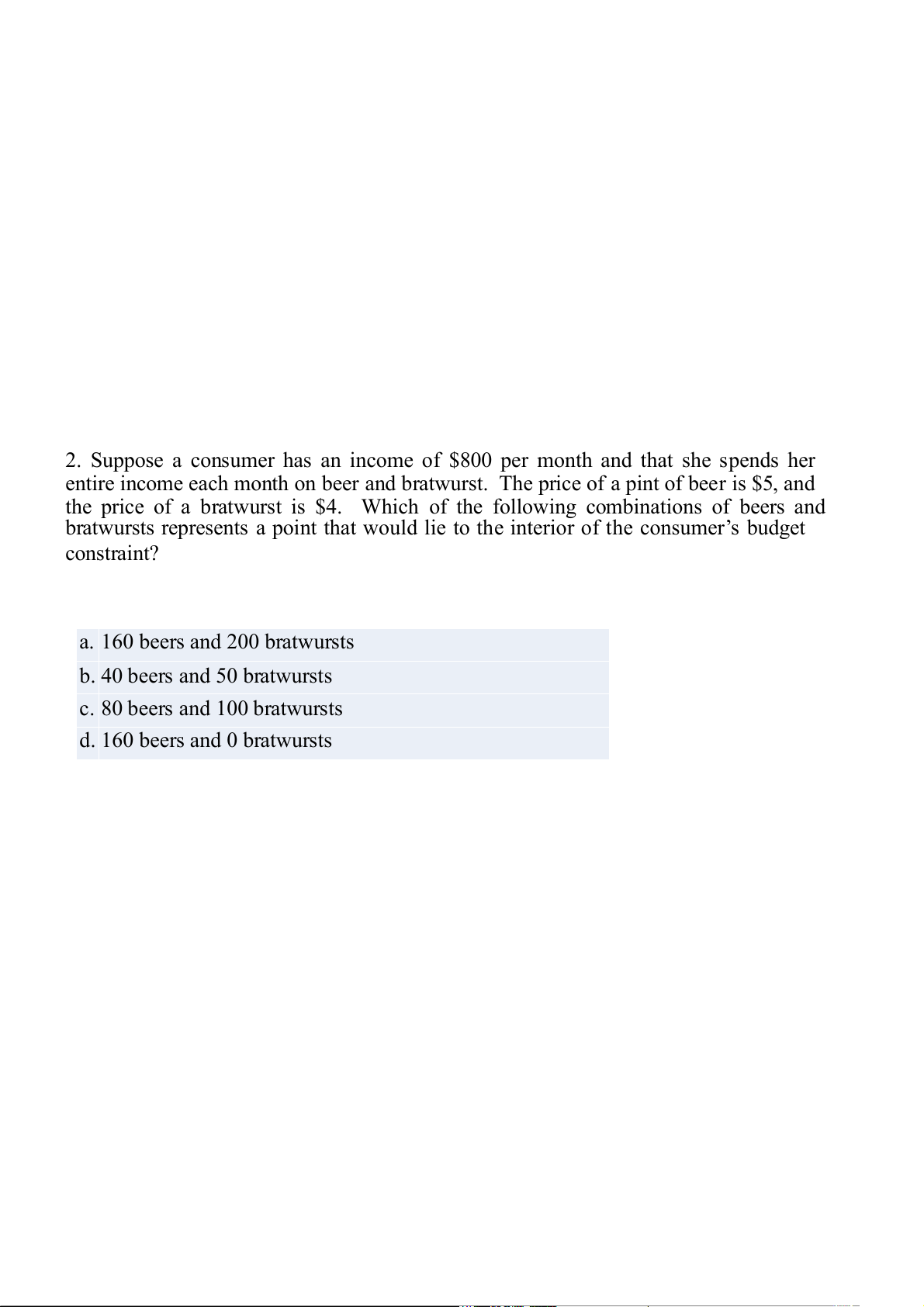
Revis ev ion io qu q estion io s 2. Suppos
e a consumer has an income of $800 pe
r month and that she spends her entire income eac
h month on beer and bratwurst. The price of a pint of beer is $5, and the price o
f a bratwurst is $4. Which of the followin g combinations of beers and
bratwursts represents a point tha twould lie t
o the interior of the consumer’s budget constraint?
a. 160 beers and 200 bratwursts b. 40 beers and 50 bratwursts c. 80 beers and 100 bratwursts d. 160 beers and 0 bratwursts
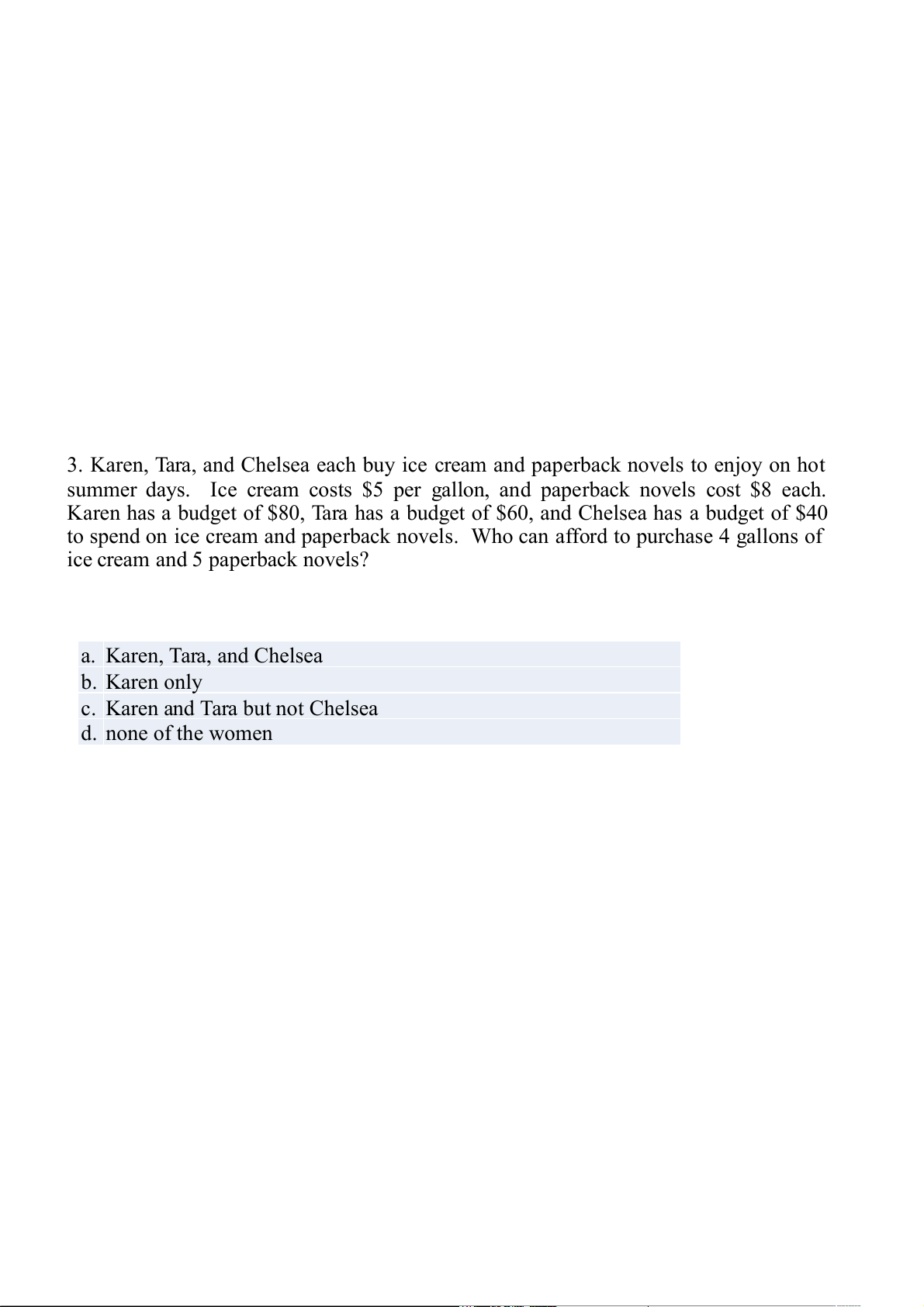
3. Karen, Tara, and Chelsea each buy ice cream and paperback novels t o enjo y o n hot
summer days. Ice cream costs $5 per gallon, and paperback novels cos t $8 each. Karen has a budget o f $8 , 0 Tara has a budget of $6 ,
0 and Chelsea has a budget of $4 0
to spend on ice cream and paperback novels. Who can afford to purchase 4 gallons of
ice cream and 5 paperback novels? a. Karen, Tara, and Chelsea b. Karen only
c. Karen and Tara but not Chelsea d. none of the women
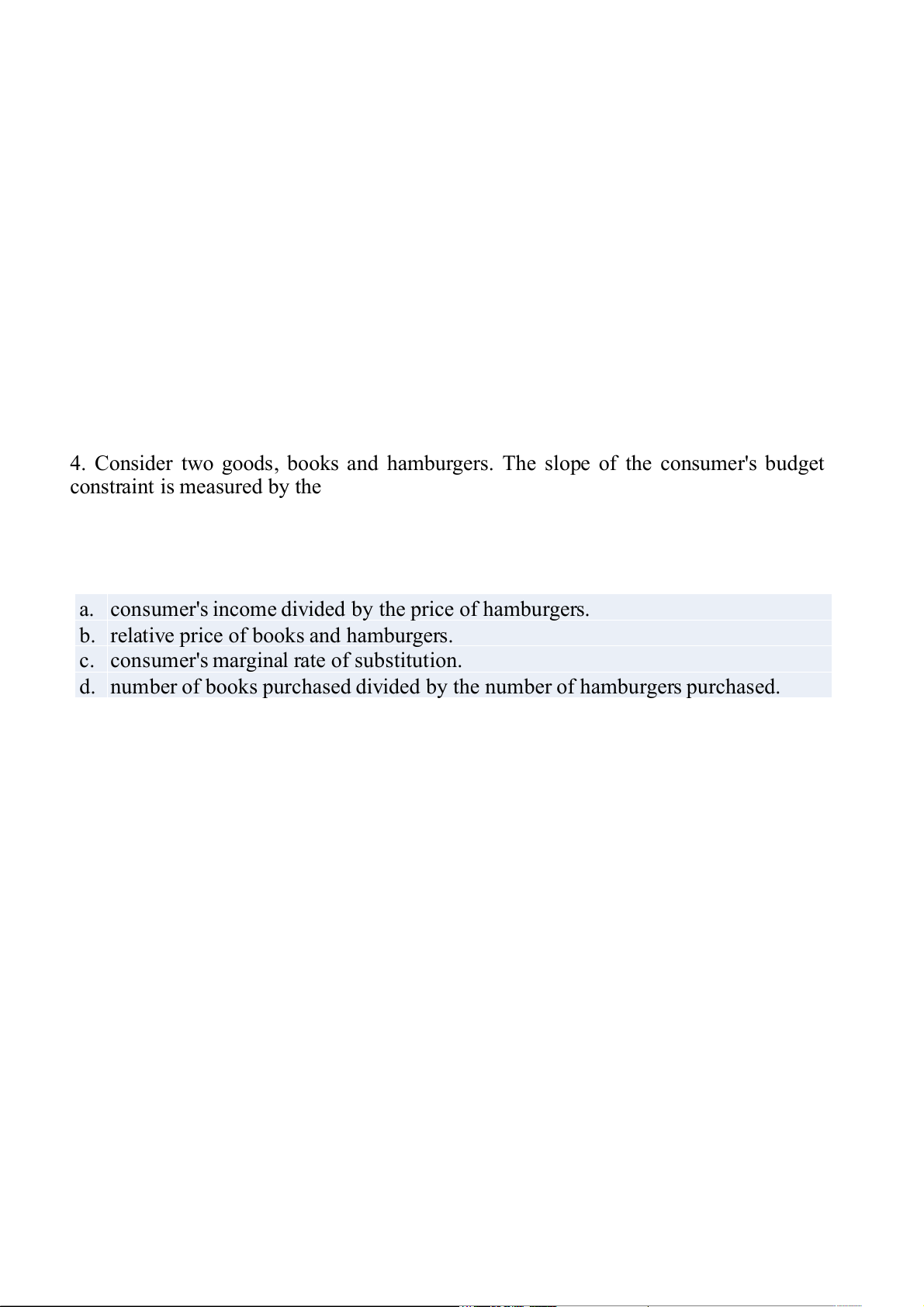
4. Consider two goods, books and hamburgers. The slope of the consumer's budget constraint is measured b y the
a. consumer's income divided by the price of hamburgers.
b. relative price of books and hamburgers.
c. consumer's marginal rate of substitution.
d. number of books purchased divided by the number of hamburgers purchased. 5. Suppos
e a consumer spends his income o
n CDs and DVDs. If his income decreases,
the budget constraint for CDs and DVDs will
a. shift outward, parallel to the original budget constraint.
b. shift inward, parallel to the original budget constraint.
c. rotate outward along the CD axis because he can afford more CDs.
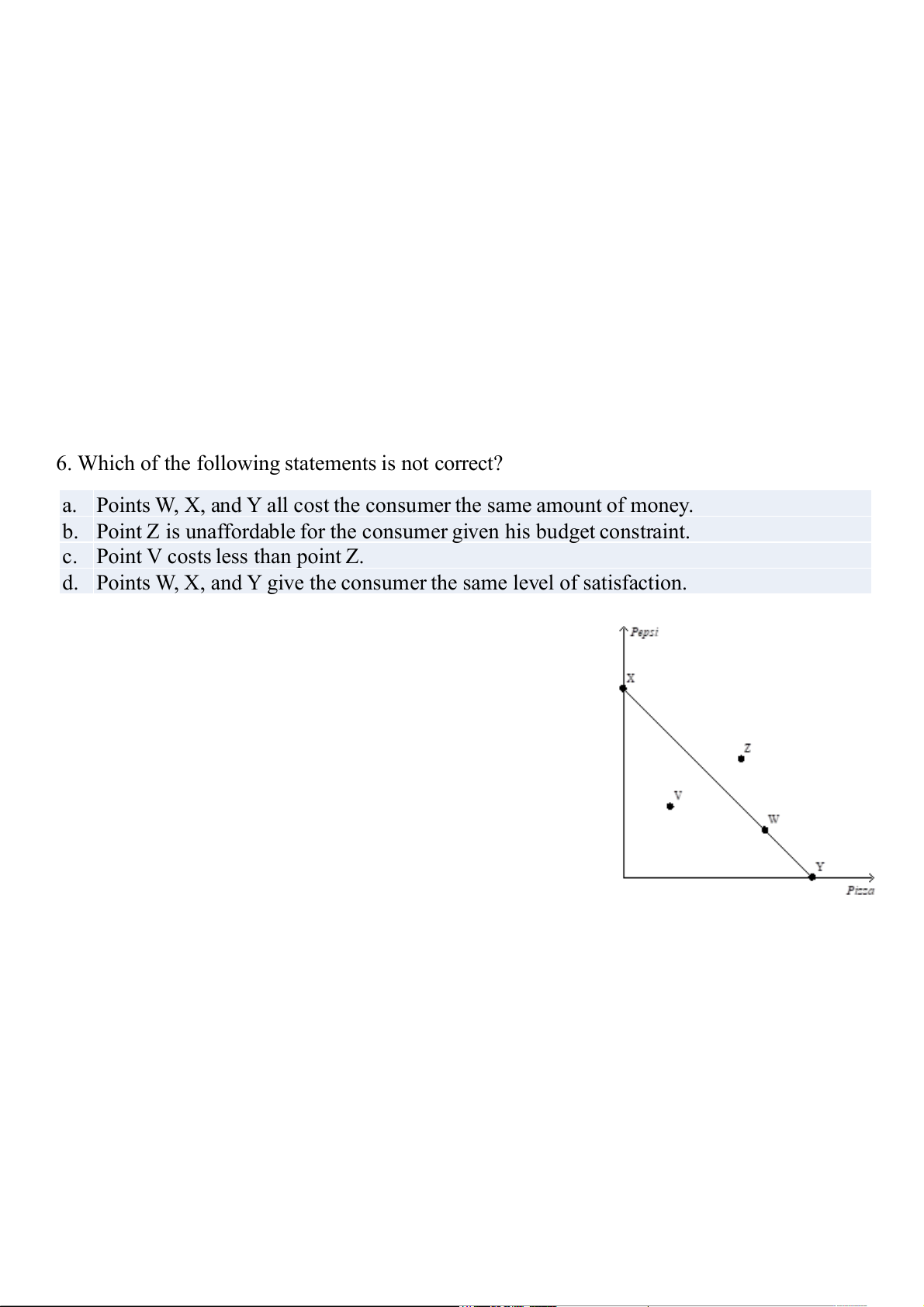
d. rotate outward along the DVD axis because he can afford more DVDs. 6. Which of th e followin g statements is not correct?
a. Points W, X, and Y all cost the consumer the same amount of money.
b. Point Z is unaffordable for the consumer given his budget constraint.
c. Point V costs less than point Z.
d. Points W, X, and Y give the consumer the same level of satisfaction.
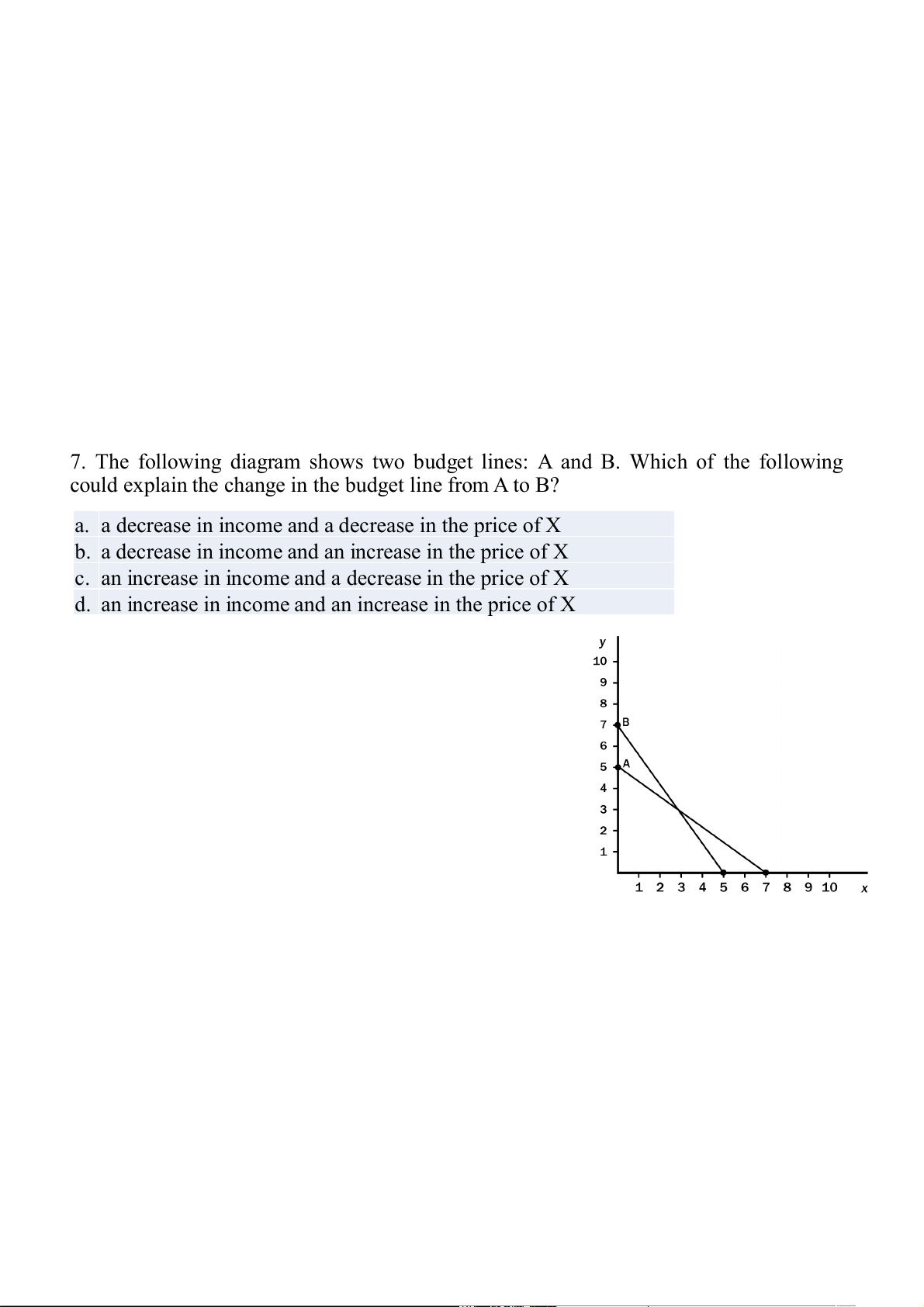
7. The following diagram shows two budget lines: A and B. Which of the following
could explain the change in the budget line from A t o B?
a. a decrease in income and a decrease in the price of X
b. a decrease in income and an increase in the price of X
c. an increase in income and a decrease in the price of X
d. an increase in income and an increase in the price of X
8. Suppose a consumer spends her income on two goods: music CDs and DVDs. The price of
a CD is $8, and the price of a DVD is $20. If we graph the budget constraint by placing the
quantity of CDs purchased on the horizontal axis, what is the slope of the budget constraint? a. -5.0 b. -2.5 c. -0.4
d. The slope of the budget constraint cannot be determined without knowing the income
the consumer has available to spend on the two goods.
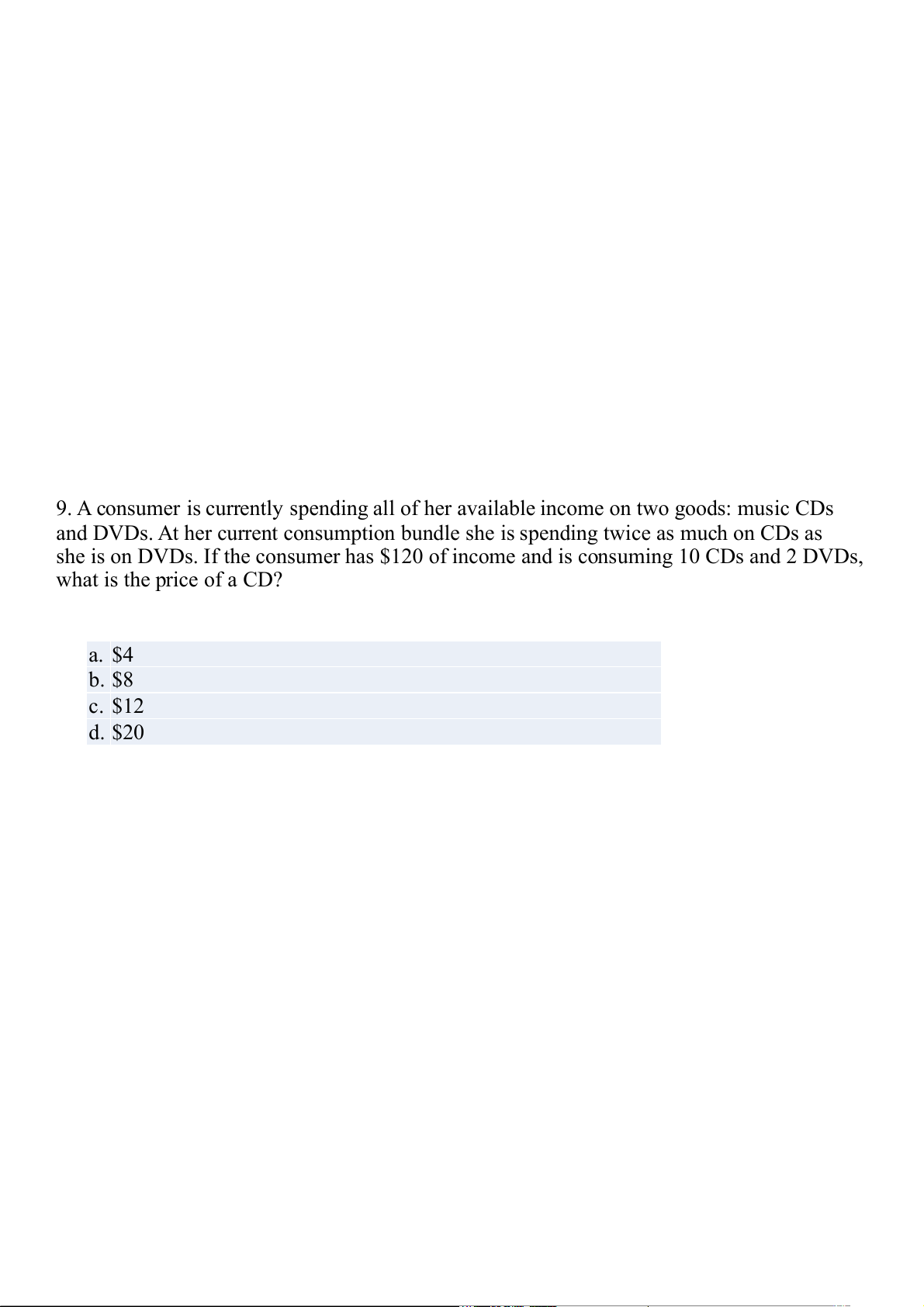
9. A consumer is currently spending all of her available income on two goods: music CDs
and DVDs. At her current consumption bundle she is spending twice as much on CDs as
she is on DVDs. If the consumer has $120 of income and is consuming 10 CDs and 2 DVDs, what is the price of a CD? a. $4 b. $8 c. $12 d. $20
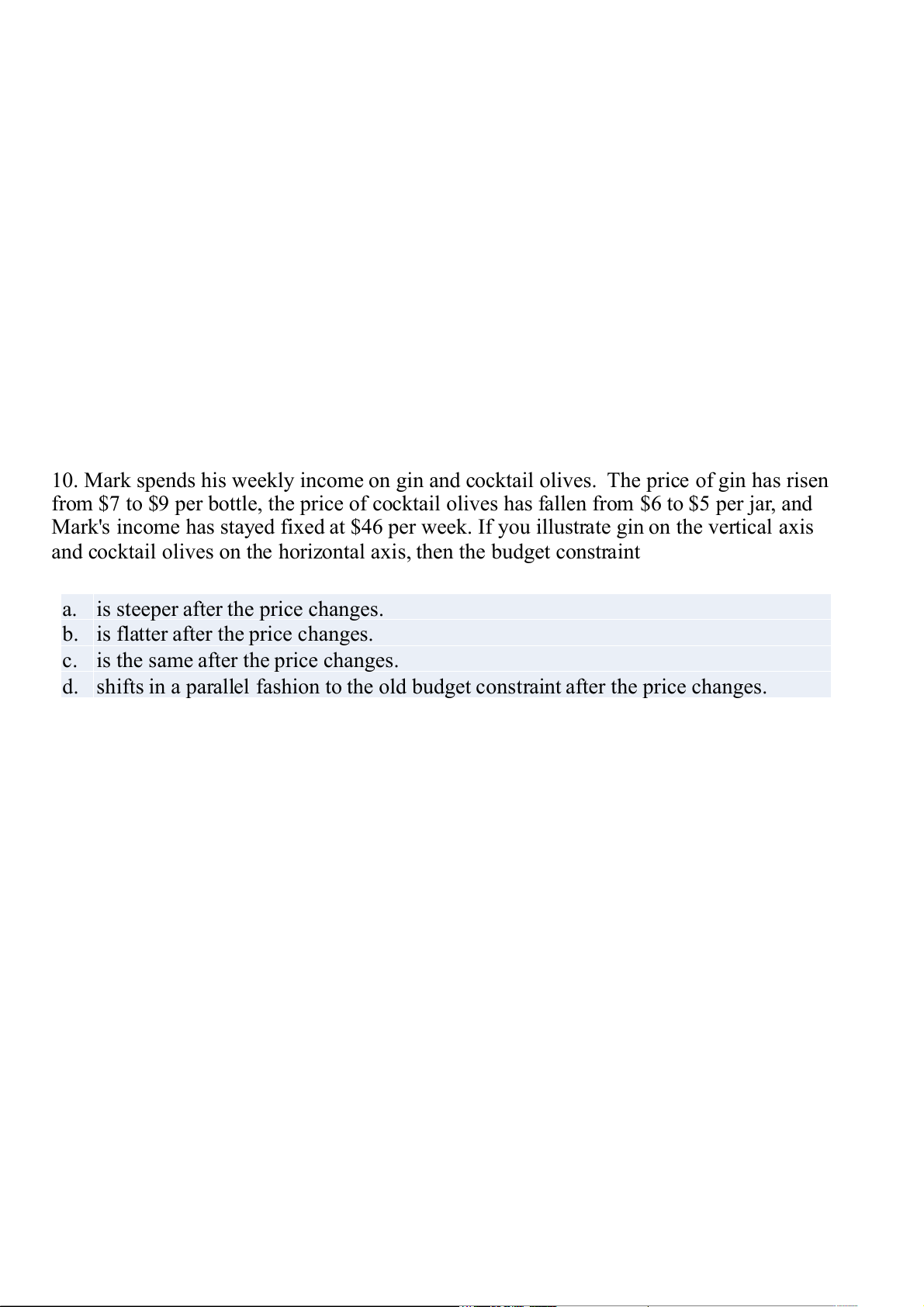
10. Mark spends his weekly income on gin and cocktail olives. The price of gin has risen
from $7 to $9 per bottle, the price of cocktail olives has fallen from $6 to $5 per jar, and
Mark's income has stayed fixed at $46 per week. If you illustrate gin on the vertical axis
and cocktail olives on the horizontal axis, then the budget constraint
a. is steeper after the price changes.
b. is flatter after the price changes.
c. is the same after the price changes.
d. shifts in a parallel fashion to the old budget constraint after the price changes.
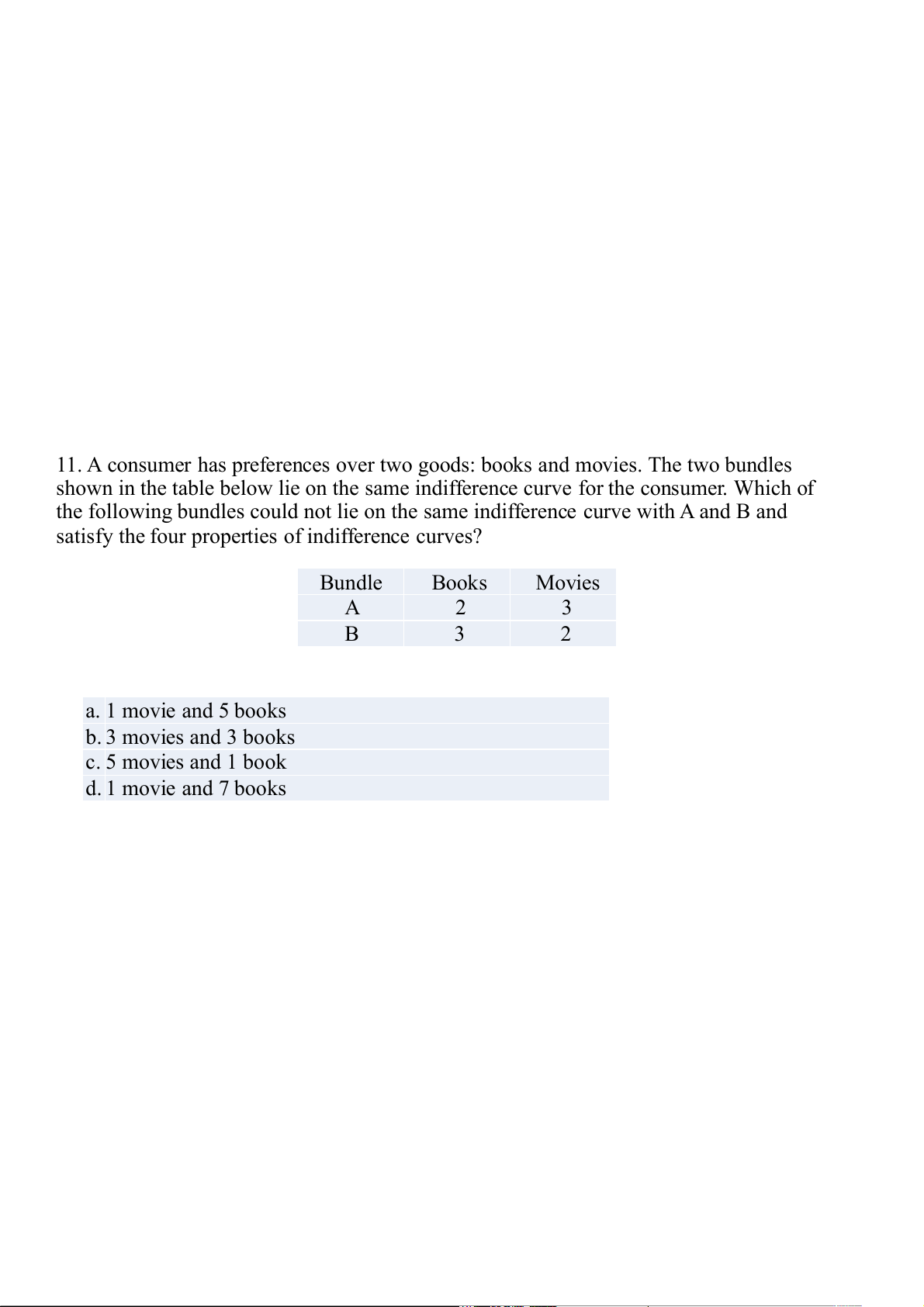
11. A consumer has preferences over two goods: books and movies. The two bundles
shown in the table below lie on the same indifference curve for the consumer. Which of
the following bundles could not lie on the same indifference curve with A and B and
satisfy the four properties of indifference curves? Bundle Books Movies A 2 3 B 3 2 a. 1 movie and 5 books b. 3 movies and 3 books c. 5 movies and 1 book d. 1 movie and 7 books
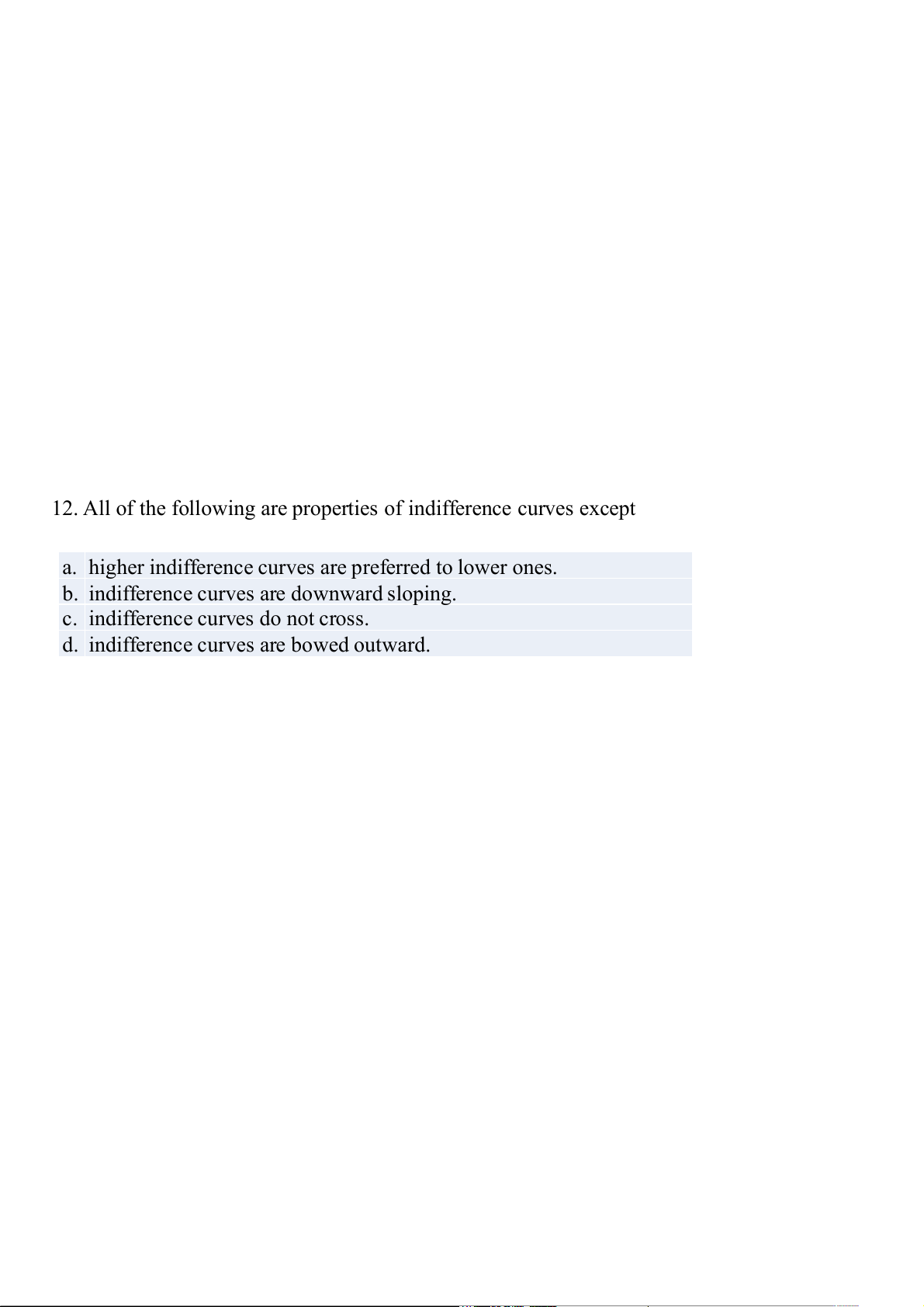
12. All of the following are properties of indifference curves except
a. higher indifference curves are preferred to lower ones.
b. indifference curves are downward sloping.
c. indifference curves do not cross.
d. indifference curves are bowed outward.
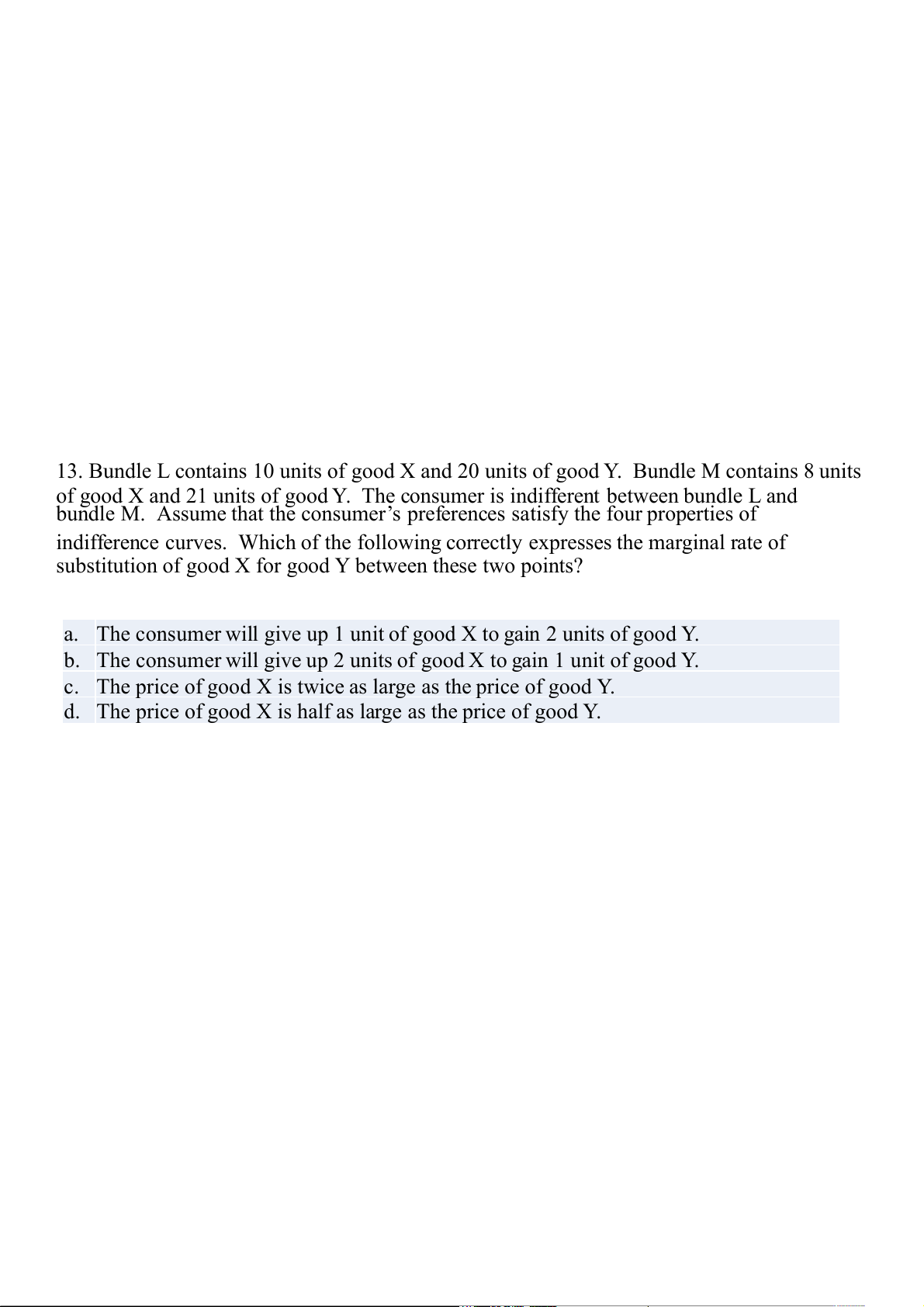
13. Bundle L contains 10 units of good X and 20 units of good Y. Bundle M contains 8 units
of good X and 21 units of good Y. The consumer is indifferent between bundle L and
bundle M. Assume that the consumer’s preferences satisfy the four properties of
indifference curves. Which of the following correctly expresses the marginal rate of
substitution of good X for good Y between these two points?
a. The consumer will give up 1 unit of good X to gain 2 units of good Y.
b. The consumer will give up 2 units of good X to gain 1 unit of good Y.
c. The price of good X is twice as large as the price of good Y.
d. The price of good X is half as large as the price of good Y.
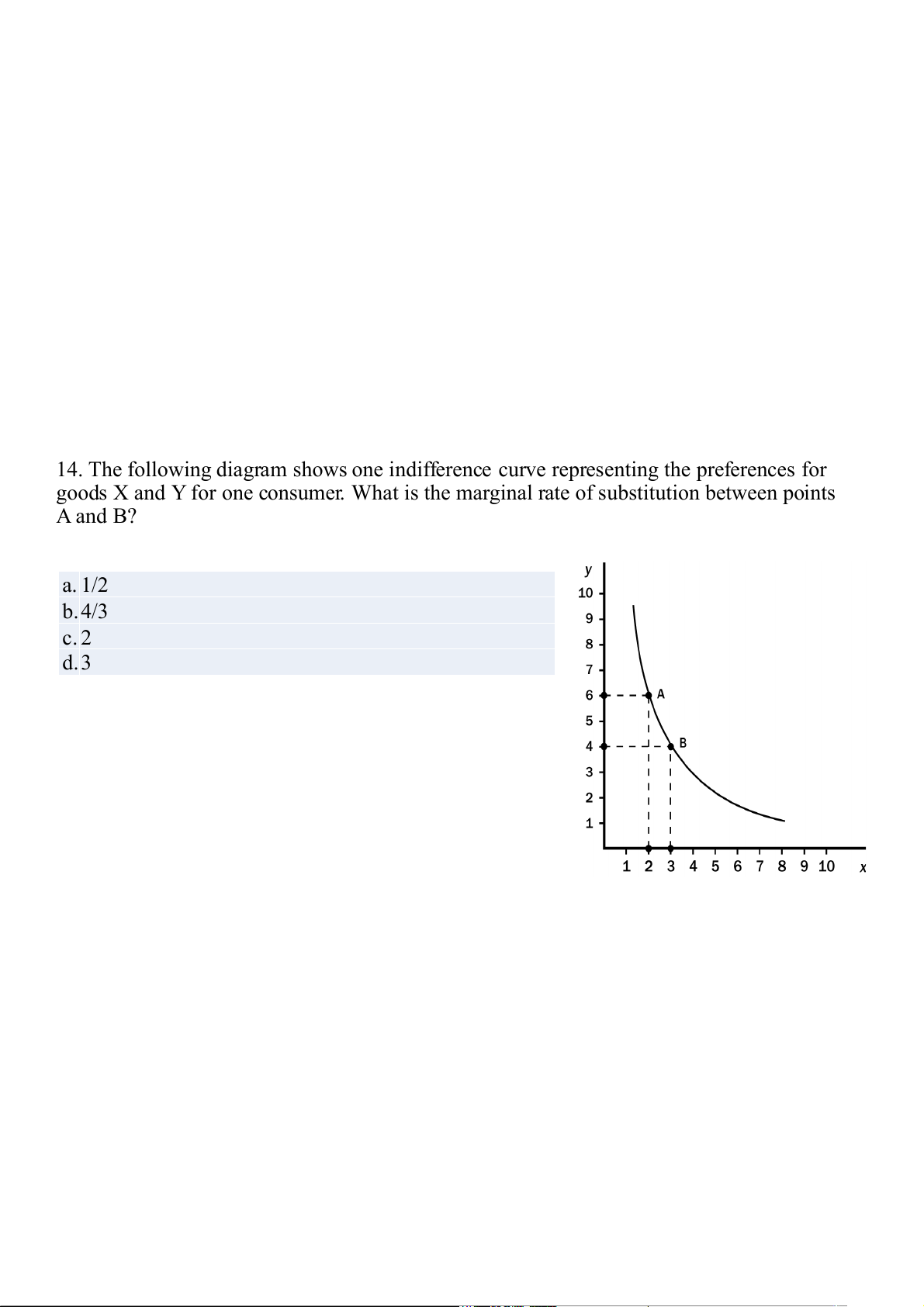
14. The following diagram shows one indifference curve representing the preferences for
goods X and Y for one consumer. What is the marginal rate of substitution between points A and B? a. 1/2 b.4/3 c. 2 d.3
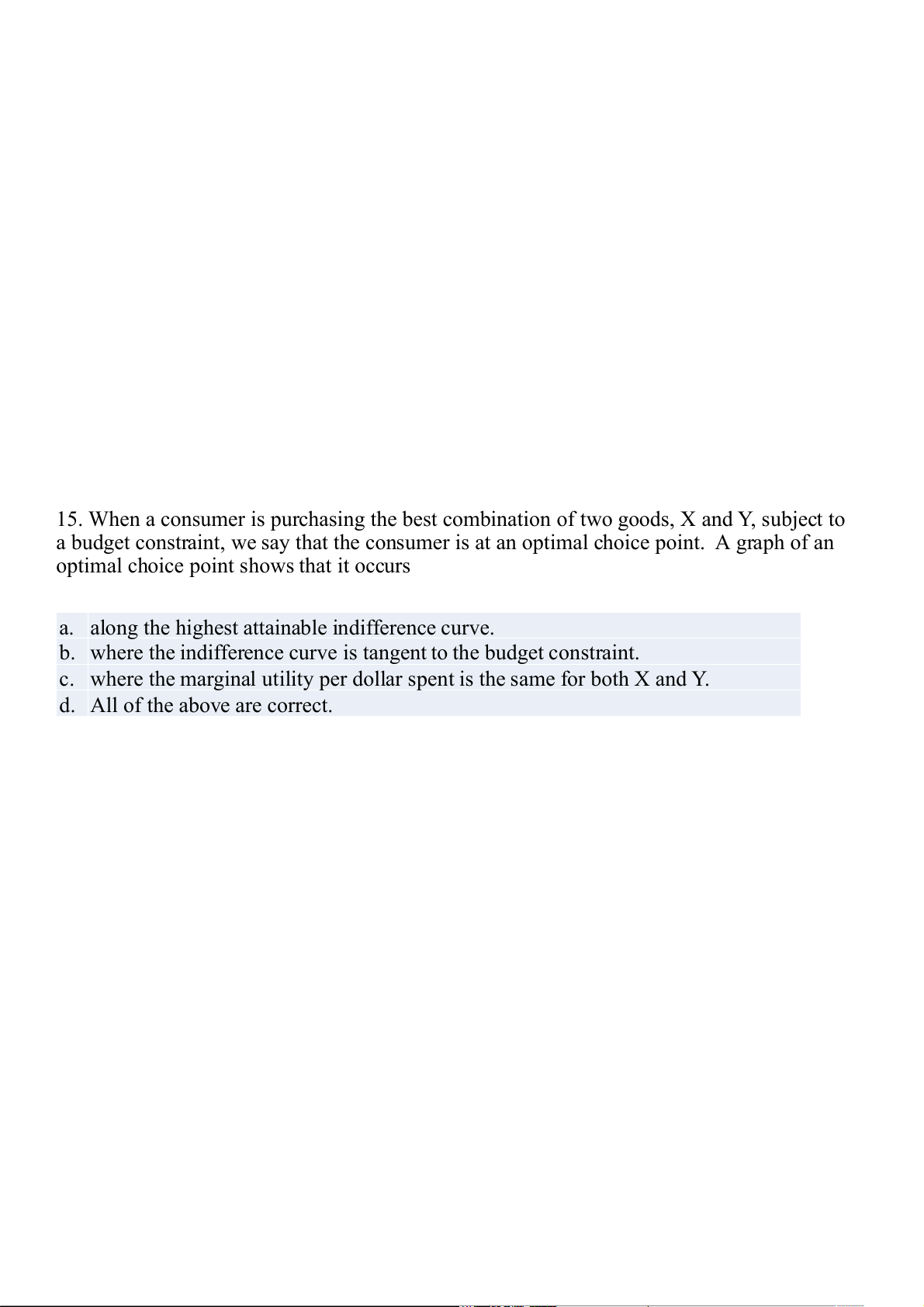
15. When a consumer is purchasing the best combination of two goods, X and Y, subject to
a budget constraint, we say that the consumer is at an optimal choice point. A graph of an
optimal choice point shows that it occurs
a. along the highest attainable indifference curve.
b. where the indifference curve is tangent to the budget constraint.
c. where the marginal utility per dollar spent is the same for both X and Y.
d. All of the above are correct.
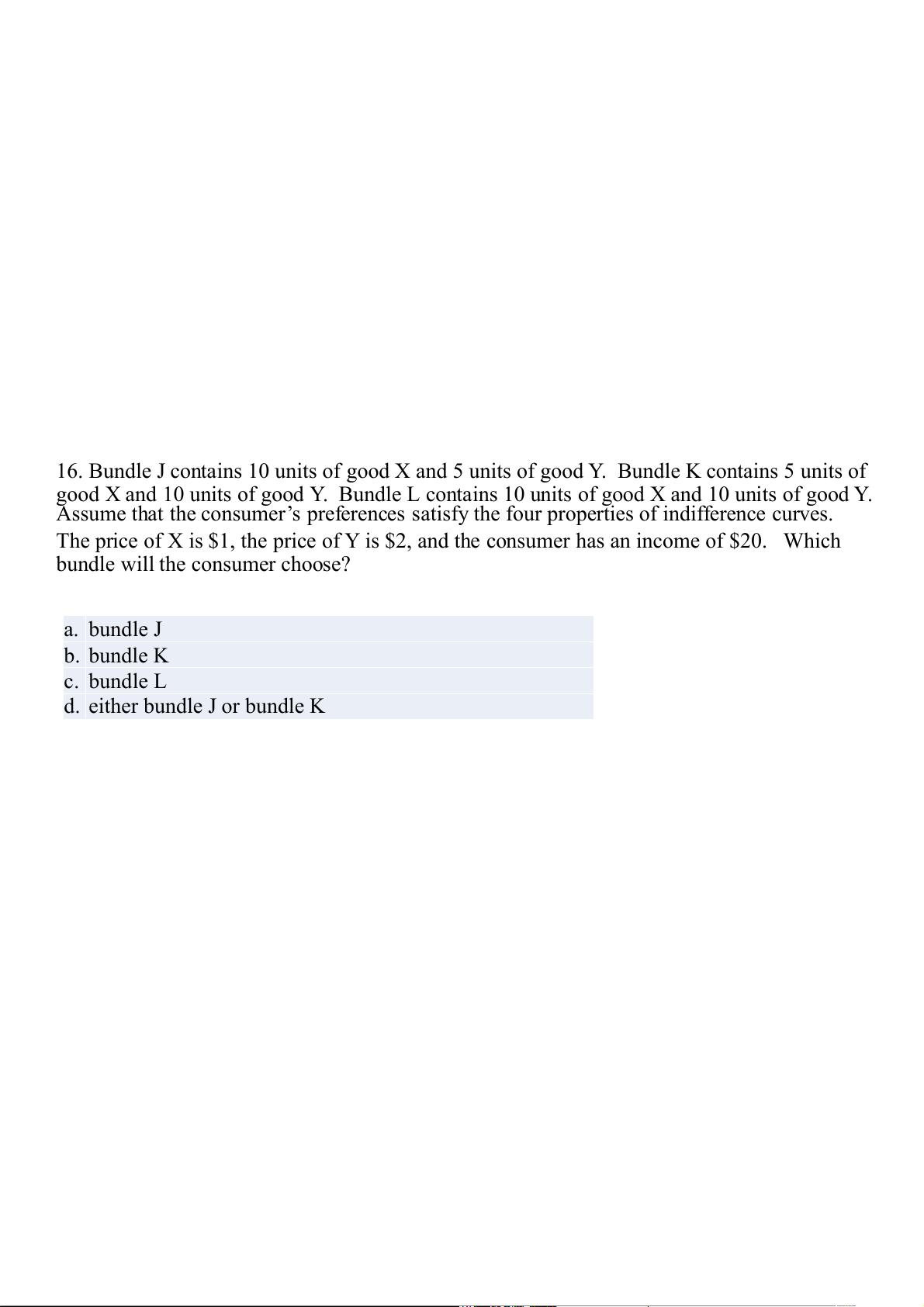
16. Bundle J contains 10 units of good X and 5 units of good Y. Bundle K contains 5 units of
good X and 10 units of good Y. Bundle L contains 10 units of good X and 10 units of good Y.
Assume that the consumer’s preferences satisfy the four properties of indifference curves.
The price of X is $1, the price of Y is $2, and the consumer has an income of $20. Which
bundle will the consumer choose? a. bundle J b. bundle K c. bundle L d. either bundle J or bundle K
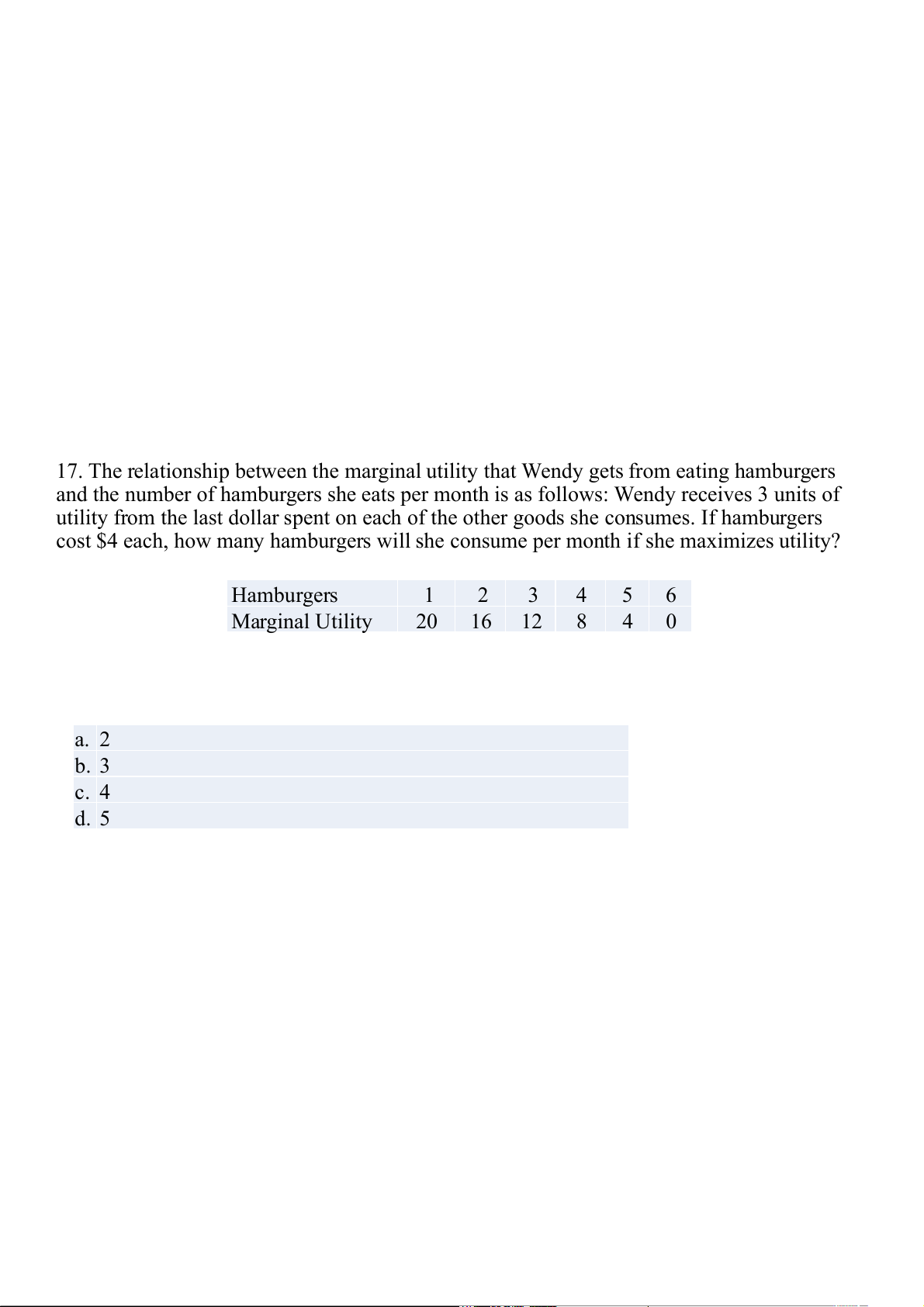
17. The relationship between the marginal utility that Wendy gets from eating hamburgers
and the number of hamburgers she eats per month is as follows: Wendy receives 3 units of
utility from the last dollar spent on each of the other goods she consumes. If hamburgers
cost $4 each, how many hamburgers will she consume per month if she maximizes utility? Hamburgers 1 2 3 4 5 6 Marginal Utility 20 16 12 8 4 0 a. 2 b. 3 c. 4 d. 5
18. If the consumer's income and all prices simultaneously decrease by one-half, then the optimum consumption will
a. shift outward relative to the old optimum.
b. move leftward along the old budget constraint.
c. shift inward relative to the old optimum. d. not change.
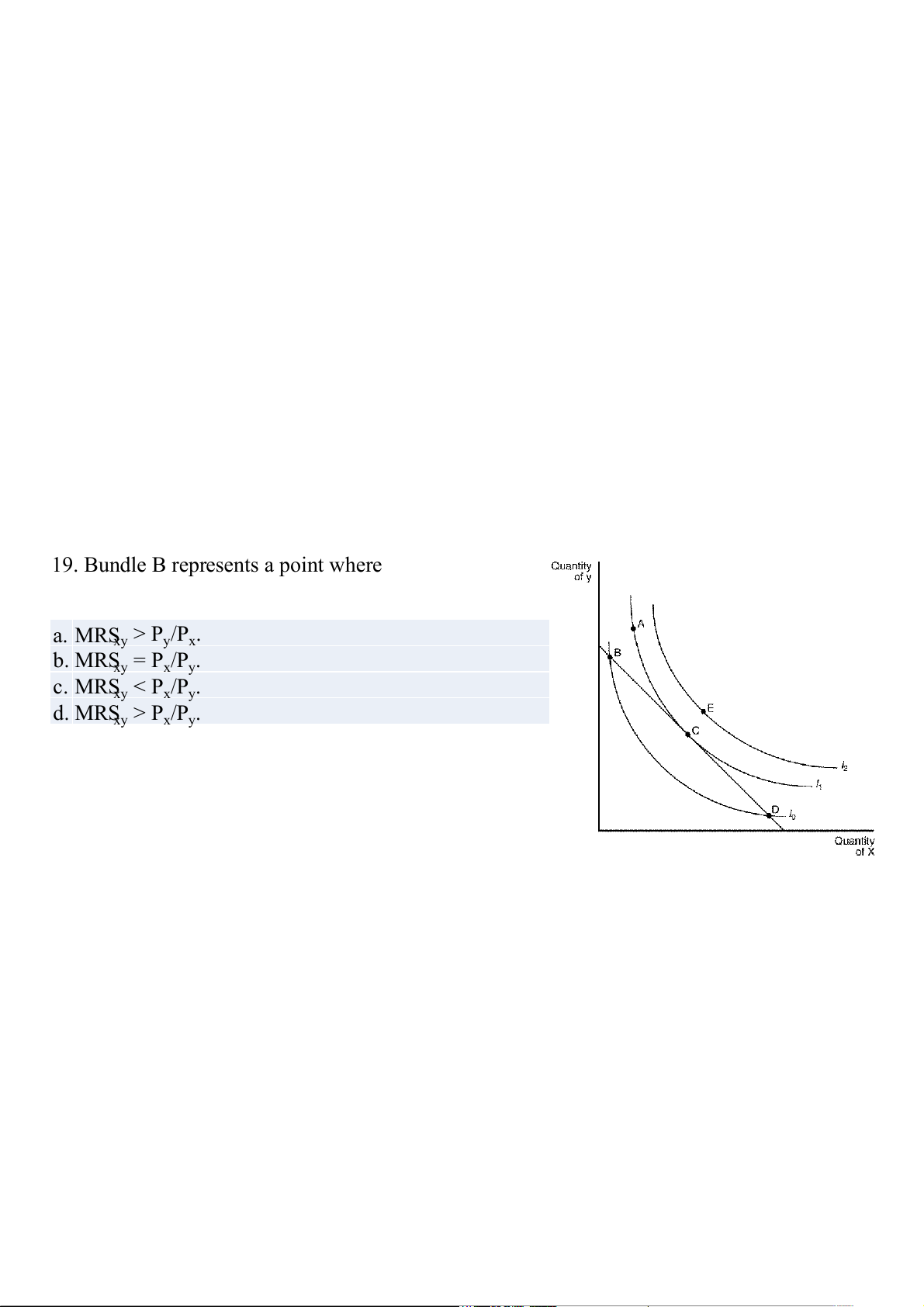
19. Bundle B represents a point where a. MRSxy > Py/Px. b. MRSxy = Px/ y P . c. MRSxy < Px/ y P . d. MRSxy > Px/ y P .
20. A firm's opportunity costs of production are equal to its a. explicit costs only. b. implicit costs only.
c. explicit costs + implicit costs.
d. explicit costs + implicit costs + total revenue.
Tài liệu liên quan:
-
Chương 3: độ co giãn và các nhân tố ảnh hưởng | Microeconomics | Trường Đại học Quốc tế, Đại học Quốc gia Thành phố Hồ Chí Minh
4 2 -
Microeconomics Syllabus | Microeconomics | Trường Đại học Quốc tế, Đại học Quốc gia Thành phố Hồ Chí Minh
4 2 -
Microeconomics Course Syllabus & Assessment Details | Microeconomics | Trường Đại học Quốc tế, Đại học Quốc gia Thành phố Hồ Chí Minh
4 2 -
Assignment 3 - Elasticity MCQs and Key Concepts | Microeconomics | Trường Đại học Quốc tế, Đại học Quốc gia Thành phố Hồ Chí Minh
4 2 -
Assignment 2 - Economic Equilibrium Analysis of Fridges and Motorcycles | Microeconomics | Trường Đại học Quốc tế, Đại học Quốc gia Thành phố Hồ Chí Minh
4 2