Case Study Analysis: Market Efficiency & Tax Impact in Microeconomics | Microeconomics | Trường Đại học Quốc tế, Đại học Quốc gia Thành phố Hồ Chí Minh
Therefore, the supply curve shifts to the left, which means the price on luxury items will increase strongly. However, the rich actually are willing to pay the extra cost to buy the luxury items which they really wanted. When price has a big change, quantity demand only changes a little. In this case, buyers endure more burden of tax. Tài liệu được sưu tầm và soạn thảo dưới dạng file PDF để gửi tới các bạn cùng tham khảo, ôn tập đầy đủ kiến thức, chuẩn bị cho các buổi học thật tốt. Mời bạn đọc đón xem!
Môn: Microeconomics 635 tài liệu
Trường: Trường Đại học Quốc tế, Đại học Quốc gia Thành phố Hồ Chí Minh 1.9 K tài liệu
Tác giả:

Preview text:
MicroeconomicsEBDB5-Group3
TOPIC4:MARKETEFFICIENCYANDGOVERNMENT
INTERVENTION:TAXANDPRICECONTROLS ASSIGNMENT4::CASESTUDYANALYSIS
TheSurprisingElasticityofDemandforLuxuries Members: 1. Hoàng Trọng Hiếu 2. Trương Thu Thủy 3. Cao Văn Tài
4. Phạm Thị Nguyệt Thảo 5. Nguyễn Trung Kiên
6. Lương Thị Bạch Dương
Question1:How can you use the theory of "Supply, Demand- and elasticity "
to explain the case (by using graphs)? ● Case1:
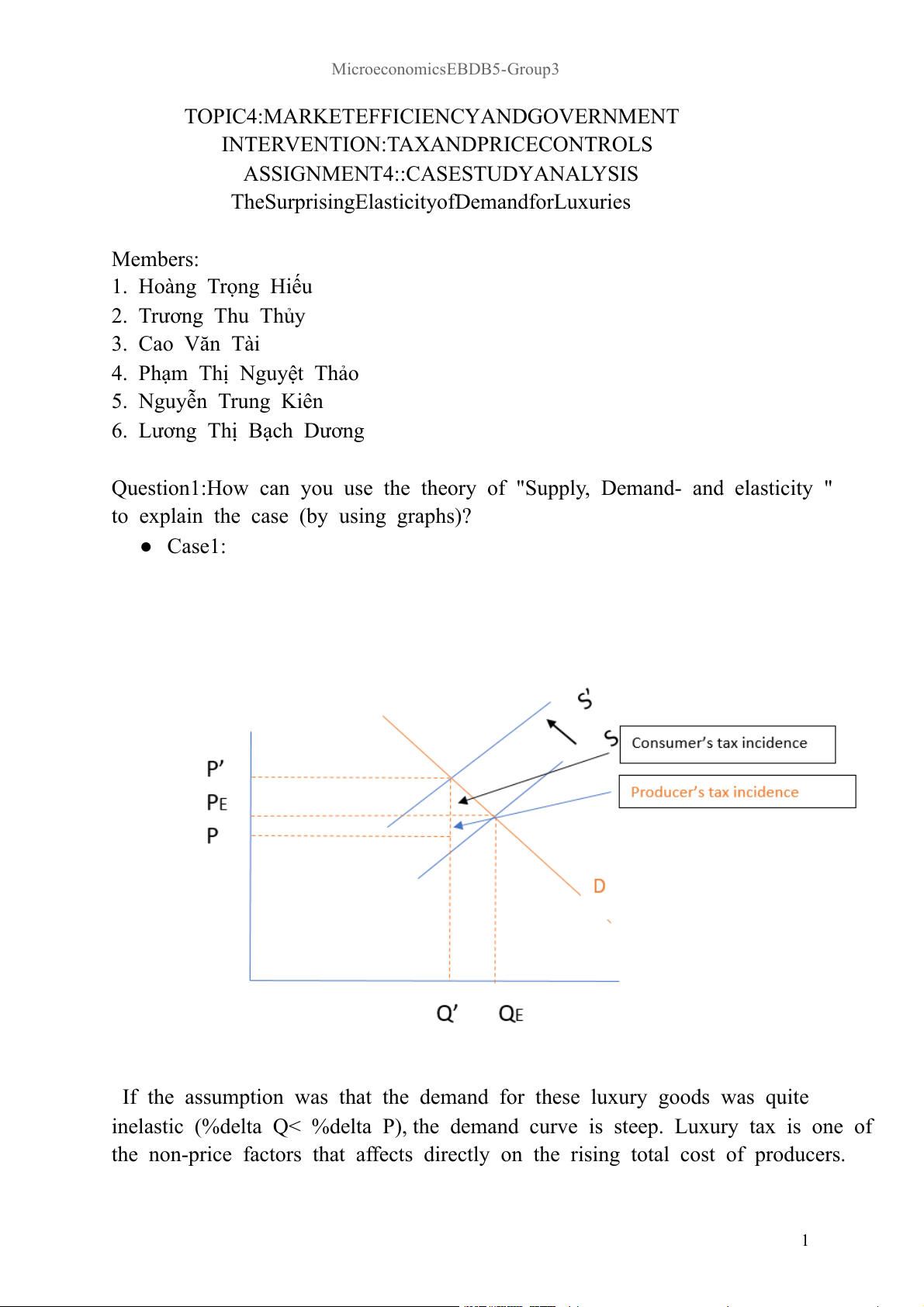
If the assumption was that the demand for these luxury goods was quite
inelastic (%delta Q< %delta P), the demand curve is steep. Luxury tax is one of
the non-price factors that affects directly on the rising total cost of producers. 1 MicroeconomicsEBDB5-Group3
Therefore, the supply curve shifts to the left, which means the price on luxury
items will increase strongly. However, the rich actually are willing to pay the
extra cost to buy the luxury items which they really wanted. When price has a
big change, quantity demand only changes a little. In this case, buyers endure more burden of tax. ● Case2:
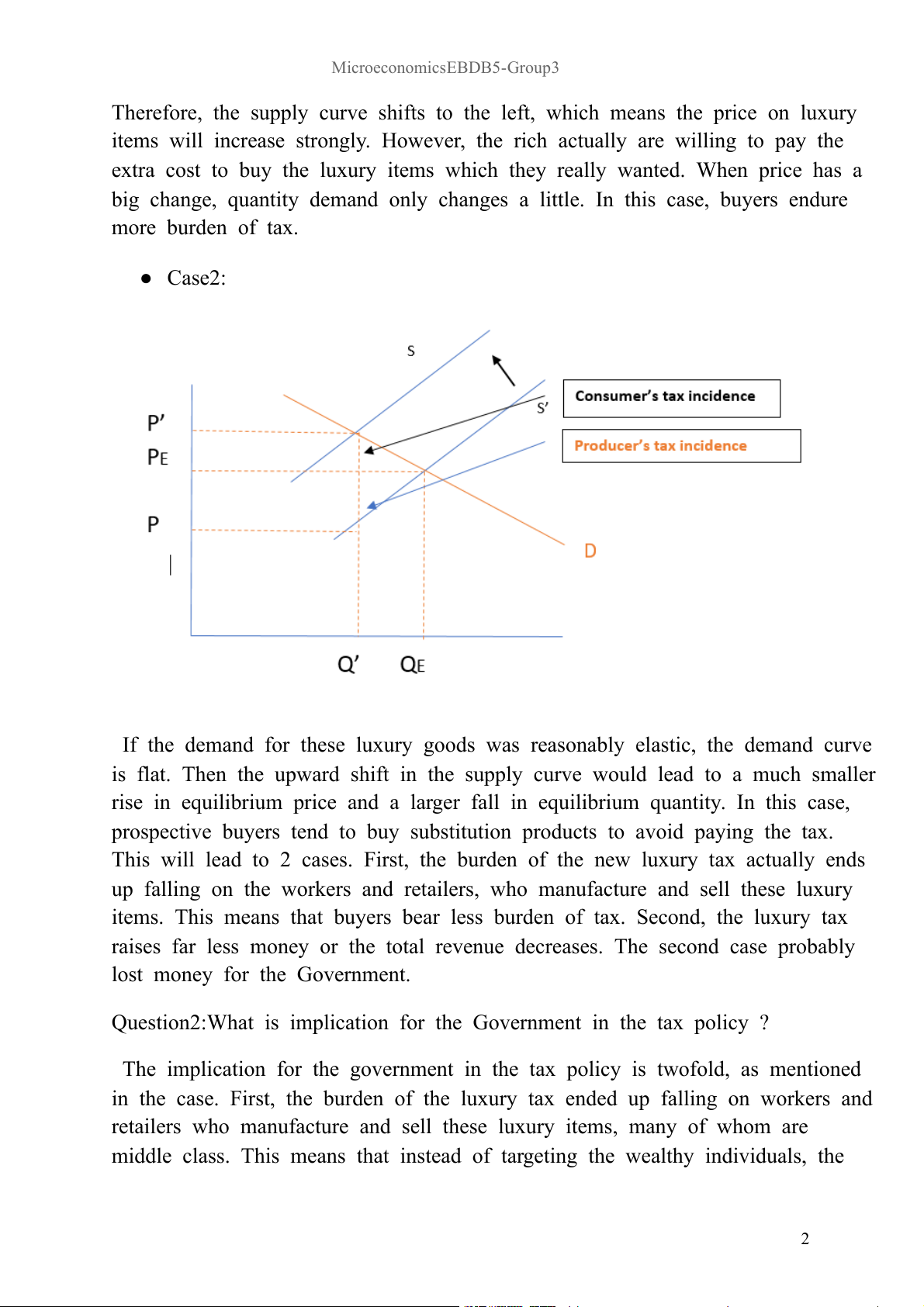
If the demand for these luxury goods was reasonably elastic, the demand curve
is flat. Then the upward shift in the supply curve would lead to a much smaller
rise in equilibrium price and a larger fall in equilibrium quantity. In this case,
prospective buyers tend to buy substitution products to avoid paying the tax.
This will lead to 2 cases. First, the burden of the new luxury tax actually ends
up falling on the workers and retailers, who manufacture and sell these luxury
items. This means that buyers bear less burden of tax. Second, the luxury tax
raises far less money or the total revenue decreases. The second case probably lost money for the Government.
Question2:What is implication for the Government in the tax policy ?
The implication for the government in the tax policy is twofold, as mentioned
in the case. First, the burden of the luxury tax ended up falling on workers and
retailers who manufacture and sell these luxury items, many of whom are
middle class. This means that instead of targeting the wealthy individuals, the 2 MicroeconomicsEBDB5-Group3
tax indirectly affected the livelihoods of those involved in the production and sale of luxury goods.
Second, the luxury tax raised far less money than expected. The Congressional
Budget Office had forecasted that the tax would generate approximately $1.5
billion over five years, but in the first year, it only raised about $20 million. This
significant discrepancy suggests that the tax policy did not achieve its revenue-raising goal.
Furthermore, when considering the costs associated with setting up and
enforcing the new tax, it is likely that the government ended up losing money in
the first year. This implies that the tax policy did not fulfill its intended purpose
of improving the government's financial position and reducing the budget deficit. 3
Tài liệu liên quan:
-
Chương 3: độ co giãn và các nhân tố ảnh hưởng | Microeconomics | Trường Đại học Quốc tế, Đại học Quốc gia Thành phố Hồ Chí Minh
6 3 -
Microeconomics Syllabus | Microeconomics | Trường Đại học Quốc tế, Đại học Quốc gia Thành phố Hồ Chí Minh
5 3 -
Microeconomics Course Syllabus & Assessment Details | Microeconomics | Trường Đại học Quốc tế, Đại học Quốc gia Thành phố Hồ Chí Minh
5 3 -
Assignment 3 - Elasticity MCQs and Key Concepts | Microeconomics | Trường Đại học Quốc tế, Đại học Quốc gia Thành phố Hồ Chí Minh
5 3 -
Assignment 2 - Economic Equilibrium Analysis of Fridges and Motorcycles | Microeconomics | Trường Đại học Quốc tế, Đại học Quốc gia Thành phố Hồ Chí Minh
6 3