Chapter 02 PPT: Understanding Comparative Advantage Concepts | Microeconomics | Trường Đại học Quốc tế, Đại học Quốc gia Thành phố Hồ Chí Minh
Explain and apply the Principle of Comparative Advantage. 2. Explain and apply the Principle of Increasing Opportunity Cost (also called the Low-Hanging-Fruit Principle). Use a production possibilities curve to illustrate opportunity cost and comparative advantage. 3. Identify factors that shift the menu of. Tài liệu được sưu tầm và soạn thảo dưới dạng file PDF để gửi tới các bạn cùng tham khảo, ôn tập đầy đủ kiến thức, chuẩn bị cho các buổi học thật tốt. Mời bạn đọc đón xem!
Môn: Microeconomics 635 tài liệu
Trường: Trường Đại học Quốc tế, Đại học Quốc gia Thành phố Hồ Chí Minh 1.9 K tài liệu
Tác giả:




Preview text:
Chapter 2 Comparative Advantage
© 2022 McGraw Hill. All rights reserved. Authorized only for instructor use in the classroom. No reproduction or distribution without the prior written consent of McGraw Hill Education. Learning Objectives
1. Explain and apply the Principle of Comparative Advantage.
2. Explain and apply the Principle of Increasing Opportunity
Cost (also called the Low-Hanging-Fruit Principle). Use a
production possibilities curve to illustrate opportunity cost and comparative advantage.
3. Identify factors that shift the menu of production possibilities.
4. Explain the role of comparative advantage in international
trade and describe why some jobs are more vulnerable to outsourcing than others. 2 © 2022 McGraw Hill. Exchange and Opportunity Cost
" Kelly Wearstler, a highly successful and influential
interior designer, is equipped to do other design work:
Should she design her own web page?
3 Opportunity cost per hour: $500
3 Hiring someone to complete the work: Less than $500 per hour " Do It Yourself only when
Opportunity cost < hired cost 3 © 2022 McGraw Hill. Exchange and Opportunity Cost
" A person has an absolute advantage at a particular task if he or
she can perform the task in fewer hours than the other person
" A person has a comparative advantage at a particular task if his
or her opportunity cost of performing the task is lower than the
other personÕs opportunity cost
" Comparative advantage doesnÕt just care about your skill at a task,
but about your skill at that task compared to your skill at other tasks 4 © 2022 McGraw Hill.
The Principle of Comparative Advantage
The Principle of Comparative Advantage
Everyone does best when each person (or each country)
concentrates on the activities for which his or her opportunity cost is the lowest. 5 © 2022 McGraw Hill. 6 © 2022 McGraw Hill. The Principle of Comparative Advantage
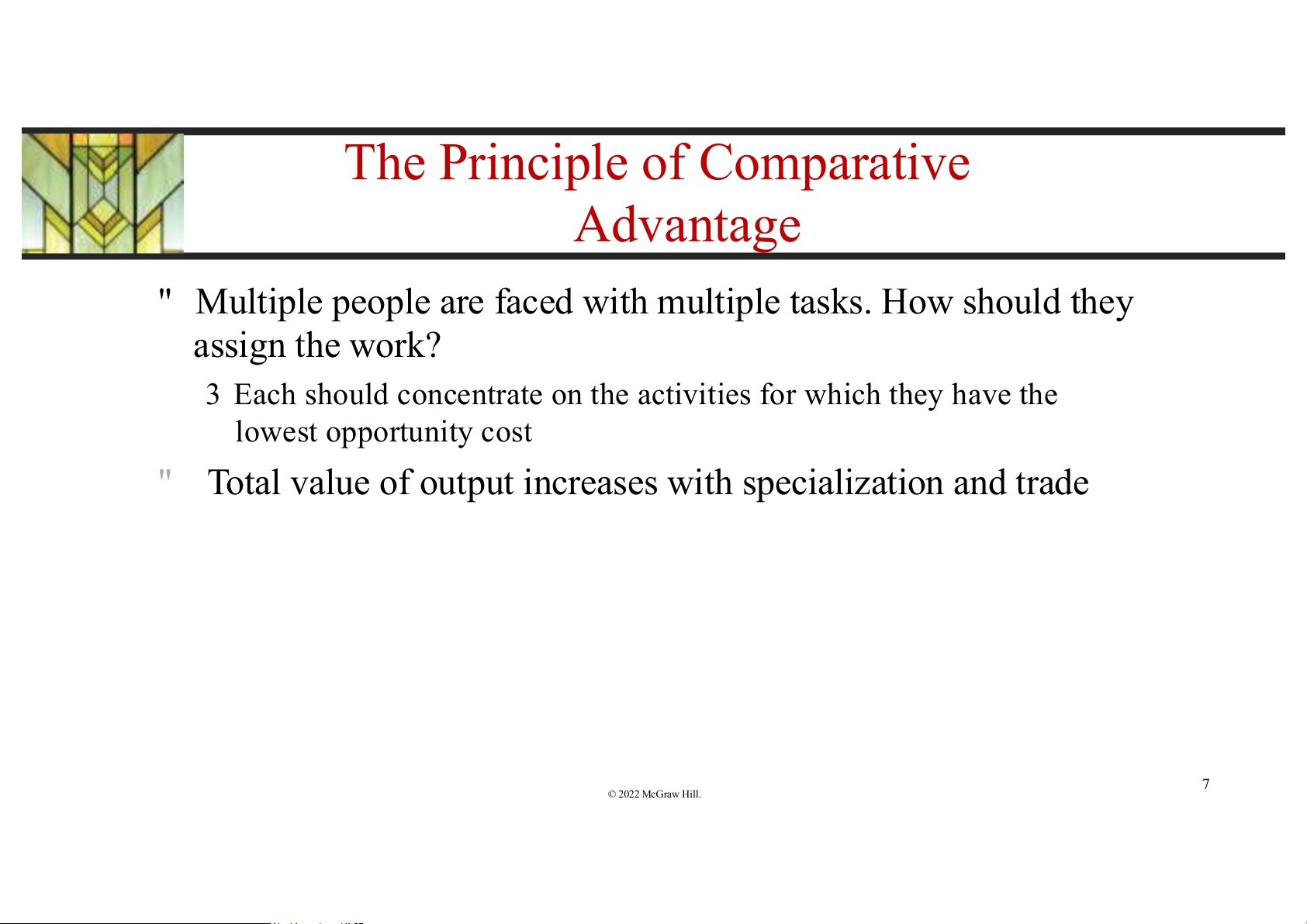
" Multiple people are faced with multiple tasks. How should they assign the work?
3 Each should concentrate on the activities for which they have the lowest opportunity cost
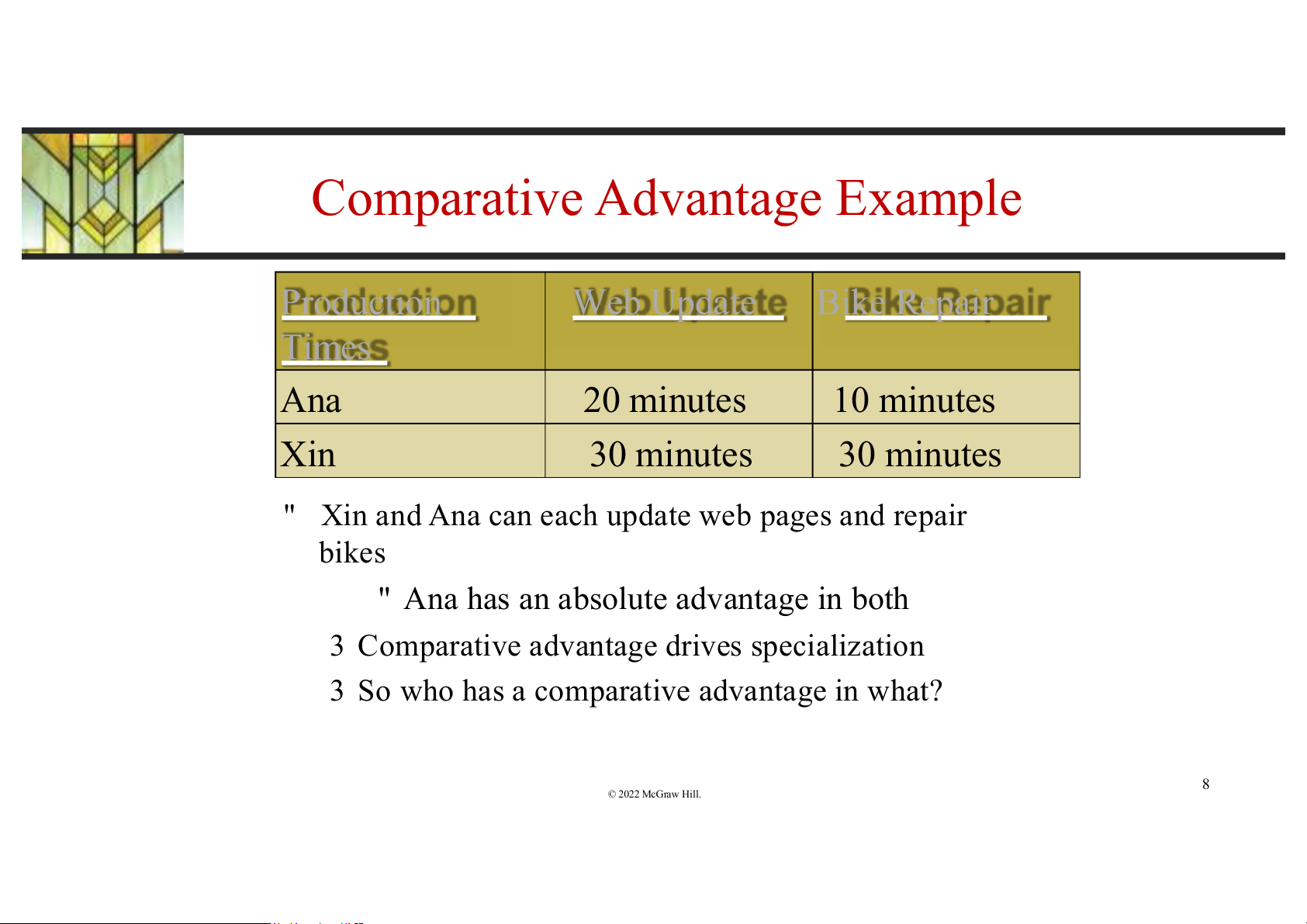
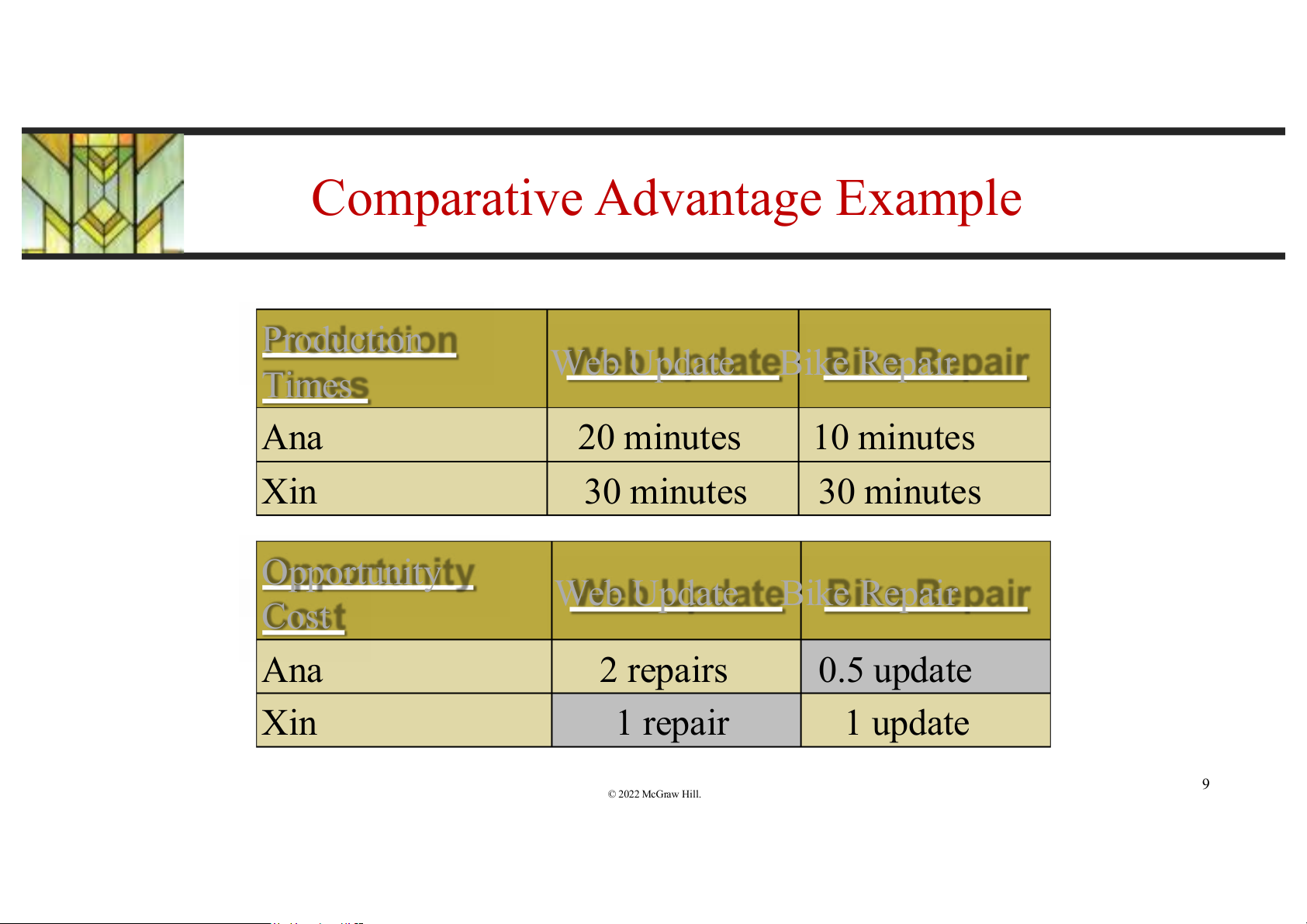
" Total value of output increases with specialization and trade 7 © 2022 McGraw Hill. Comparative Advantage Example Production Web Update Bike Repair Times Ana 20 minutes 10 minutes Xin 30 minutes 30 minutes
" Xin and Ana can each update web pages and repair bikes
" Ana has an absolute advantage in both
3 Comparative advantage drives specialization
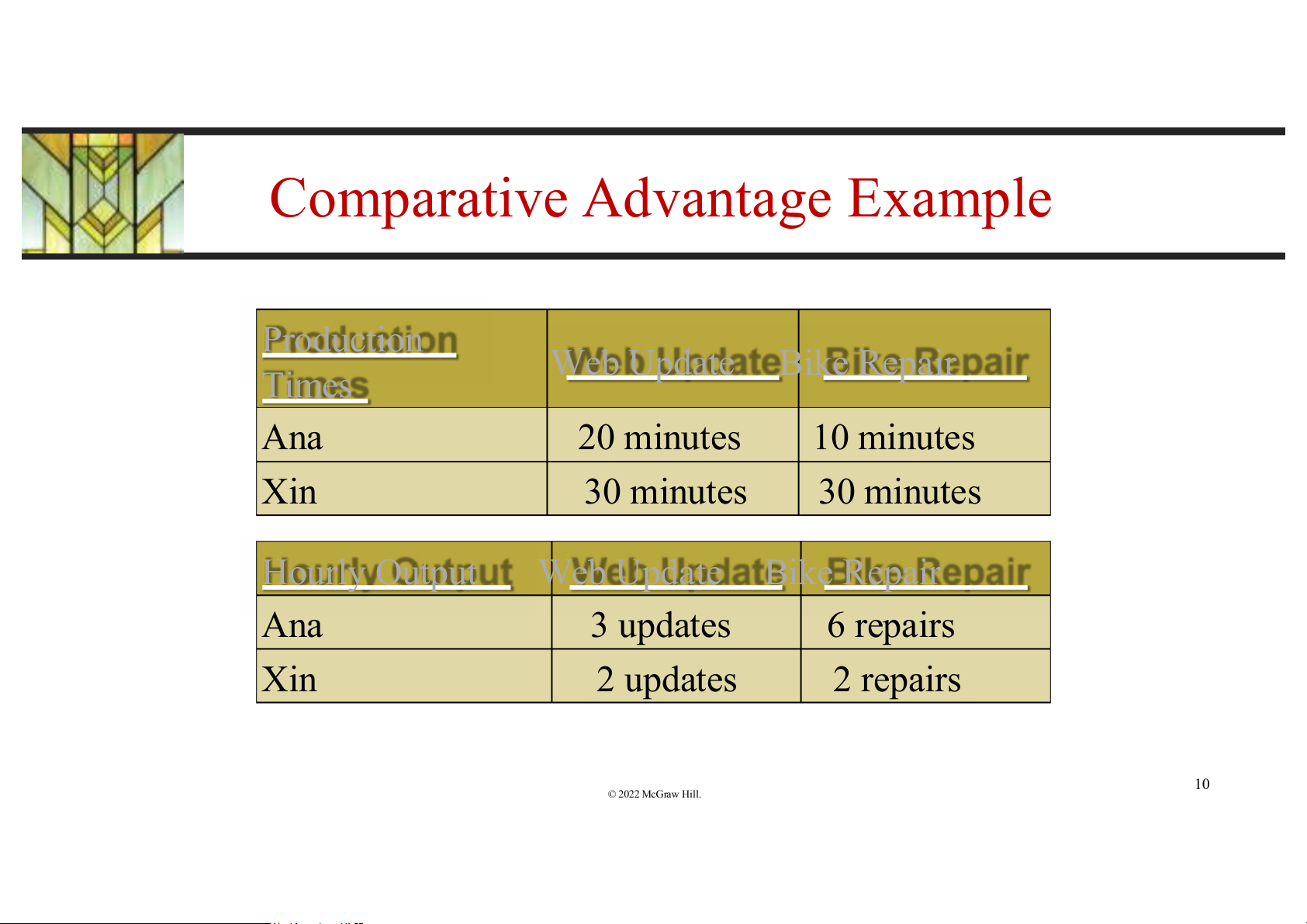
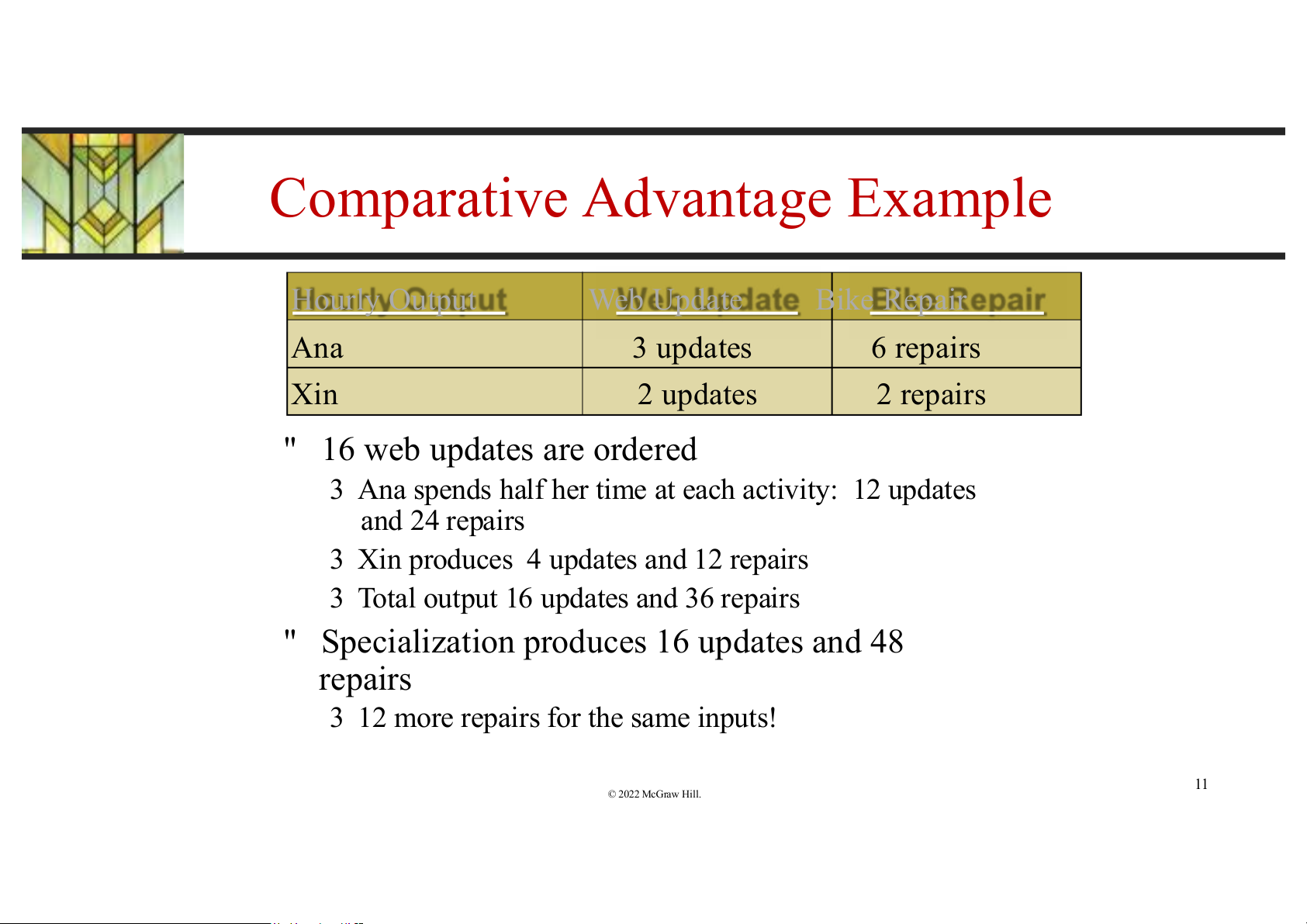
3 So who has a comparative advantage in what? 8 © 2022 McGraw Hill. Comparative Advantage Example Production Web Update Bike Repair Times Ana 20 minutes 10 minutes Xin 30 minutes 30 minutes Opportunity Web Update Bike Repair Cost Ana 2 repairs 0.5 update Xin 1 repair 1 update 9 © 2022 McGraw Hill. Comparative Advantage Example Production Web Update Bike Repair Times Ana 20 minutes 10 minutes Xin 30 minutes 30 minutes Hourly Output Web Update Bike Repair Ana 3 updates 6 repairs Xin 2 updates 2 repairs 10 © 2022 McGraw Hill. Comparative Advantage Example Hourly Output Web Update Bike Repair Ana 3 updates 6 repairs Xin 2 updates 2 repairs " 16 web updates are ordered
3 Ana spends half her time at each activity: 12 updates and 24 repairs
3 Xin produces 4 updates and 12 repairs
3 Total output 16 updates and 36 repairs
" Specialization produces 16 updates and 48 repairs
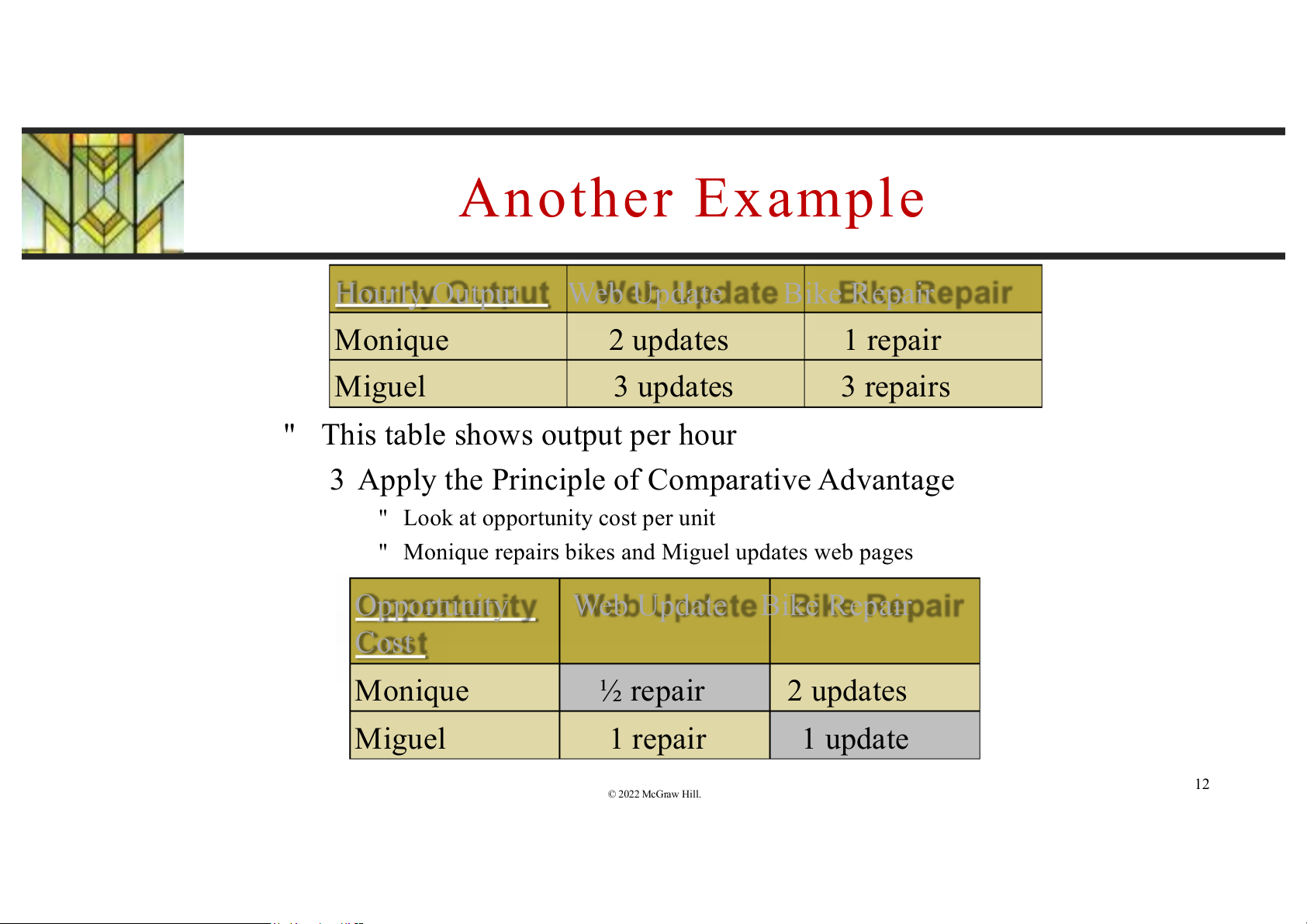
3 12 more repairs for the same inputs! 11 © 2022 McGraw Hill. Another Example Hourly Output Web Update Bike Repair Monique 2 updates 1 repair Miguel 3 updates 3 repairs
" This table shows output per hour
3 Apply the Principle of Comparative Advantage
" Look at opportunity cost per unit
" Monique repairs bikes and Miguel updates web pages Opportunity Web Update Bike Repair Cost Monique ½ repair 2 updates Miguel 1 repair 1 update 12 © 2022 McGraw Hill.
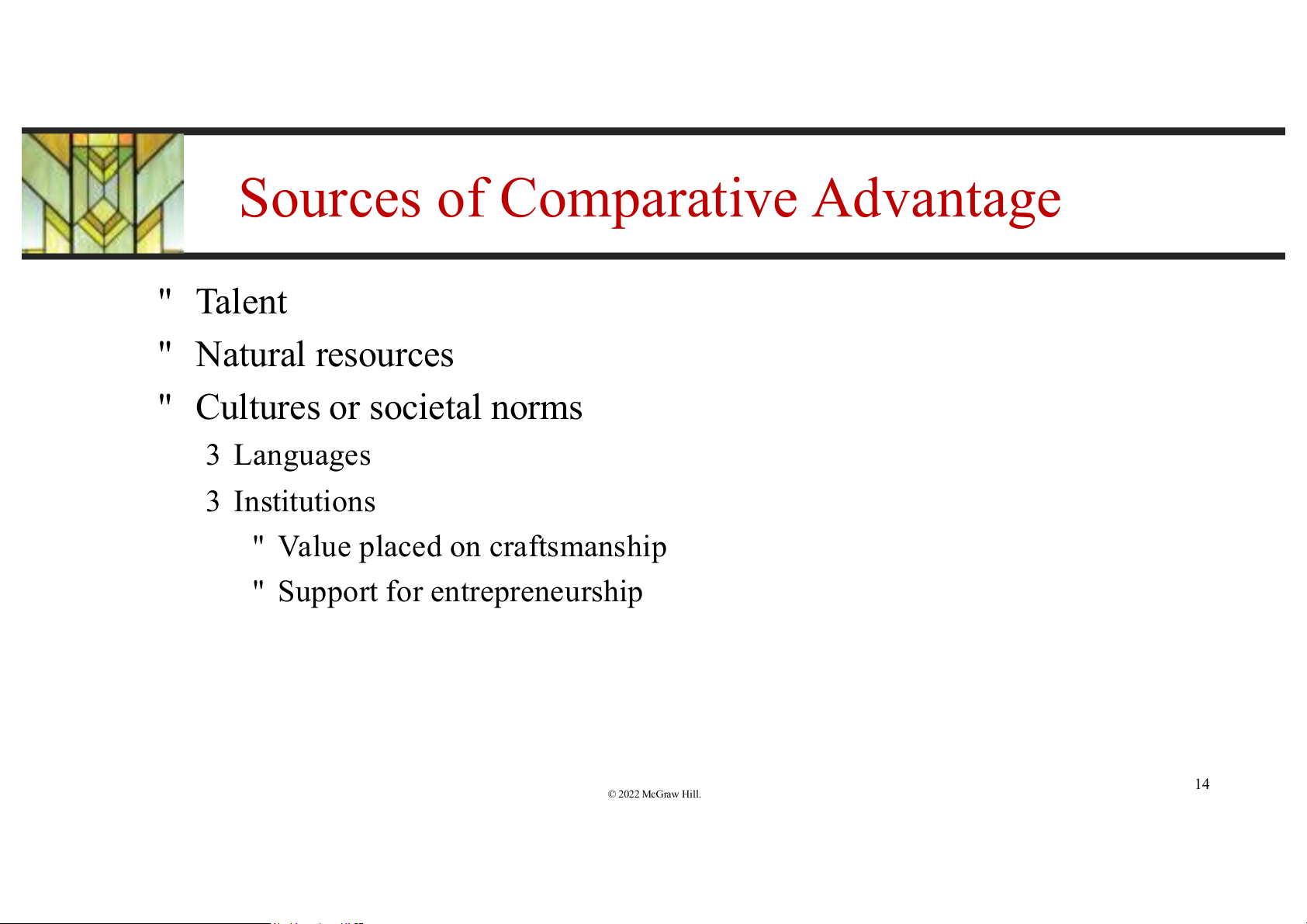
Sources of Comparative Advantage " Talent " Natural resources " Cultures or societal norms 3 Languages 3 Institutions
" Value placed on craftsmanship " Support for entrepreneurship 14 © 2022 McGraw Hill. Production Possibilities Curve
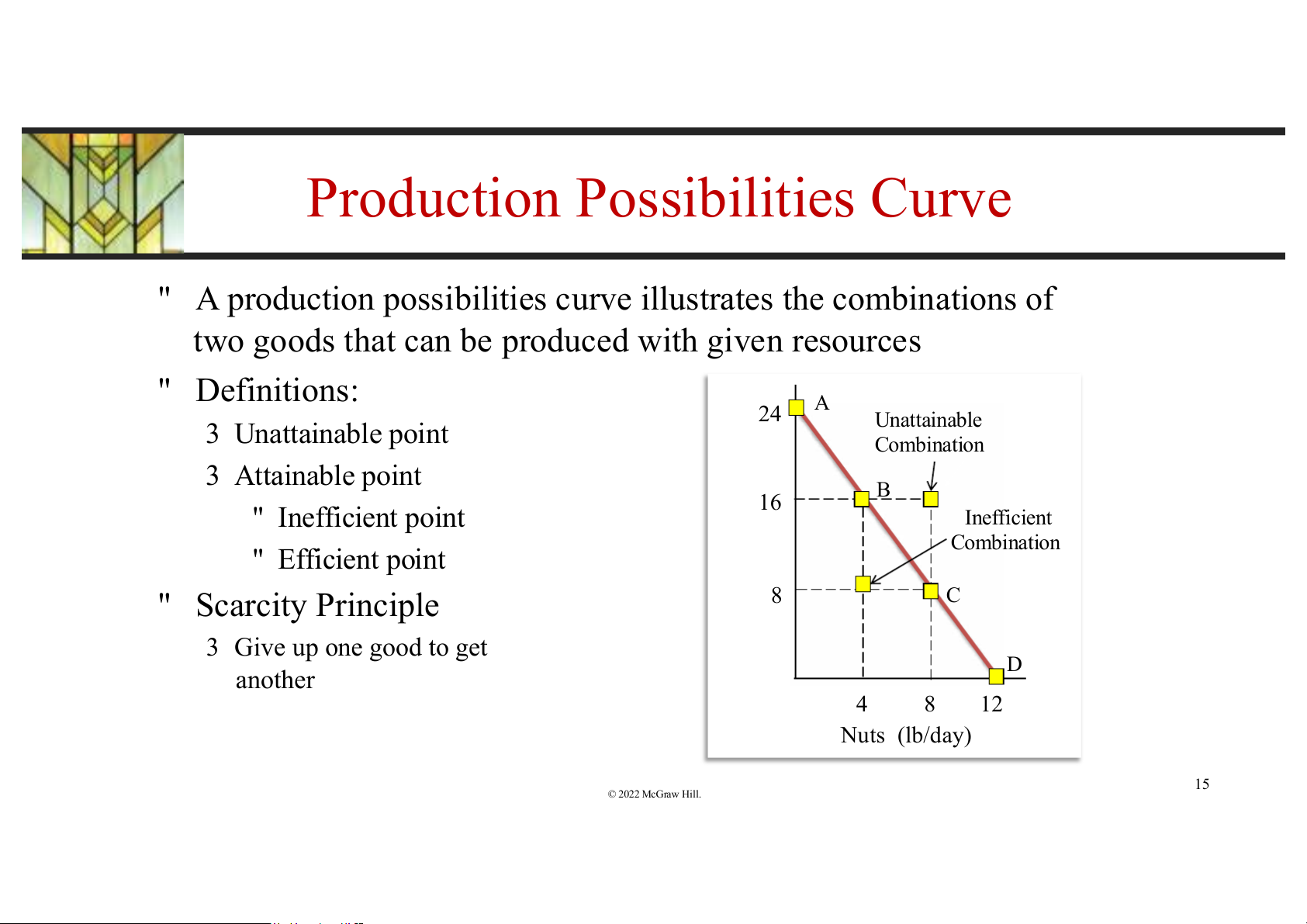
" A production possibilities curve illustrates the combinations of
two goods that can be produced with given resources " Definitions: A 24 3 Unattainable point Unattainable Combination 3 Attainable point B " Inefficient point 16 Inefficient Combination " Efficient point " Scarcity Principle offee (lb/day) 8 C C 3 Give up one good to get D another 4 8 12 Nuts (lb/day) 15 © 2022 McGraw Hill.
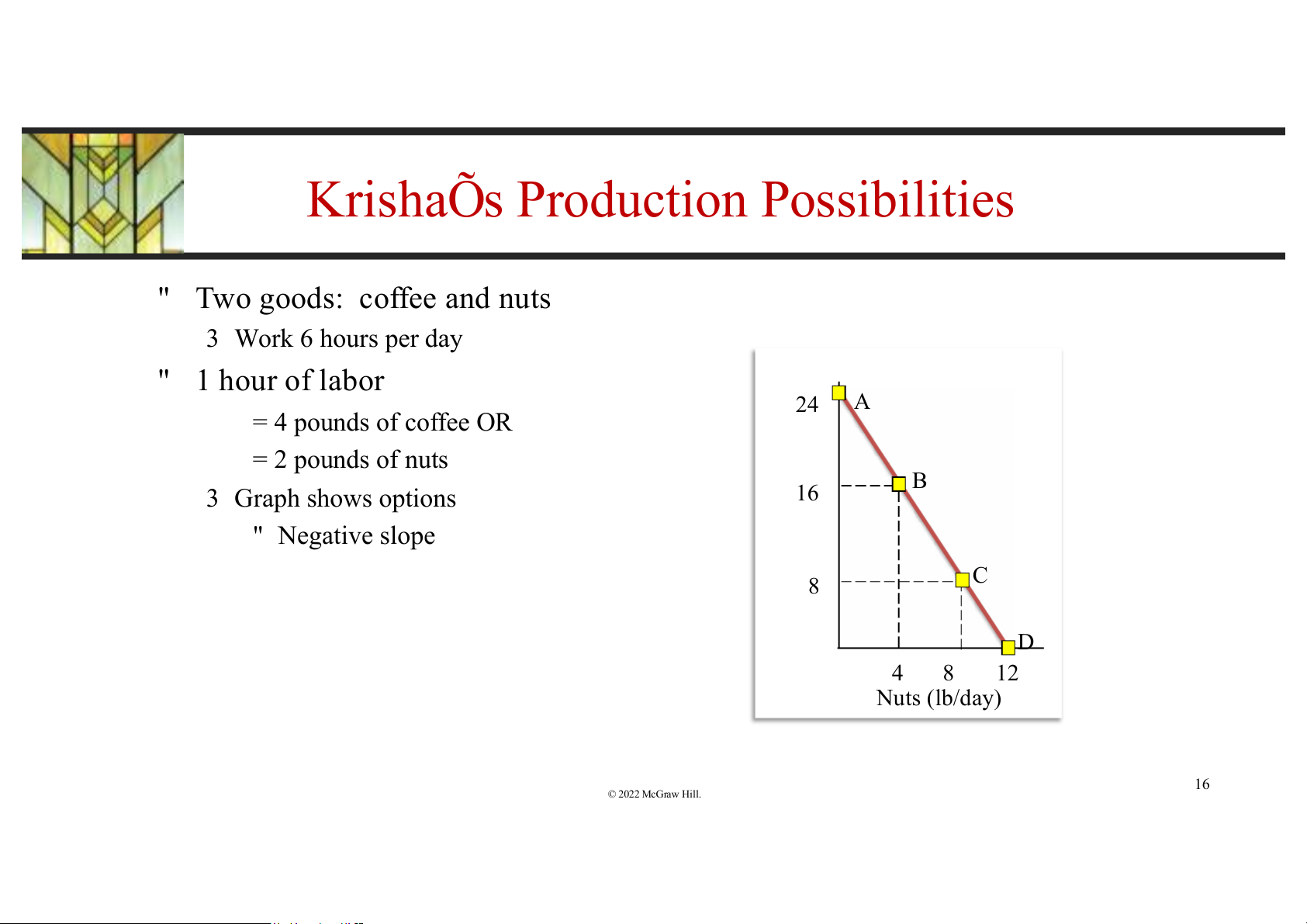
KrishaÕs Production Possibilities " Two goods: coffee and nuts 3 Work 6 hours per day " 1 hour of labor 24 A = 4 pounds of coffee OR = 2 pounds of nuts B 3 Graph shows options 16 " Negative slope offee (lb/day) C 8 C D 4 8 12 Nuts (lb/day) 16 © 2022 McGraw Hill. KrishaÕs Opportunity Costs " Marginal cost: Ð 8 coffee " Marginal benefit: 4 nuts Loss in coffee 24 A Gain in nuts
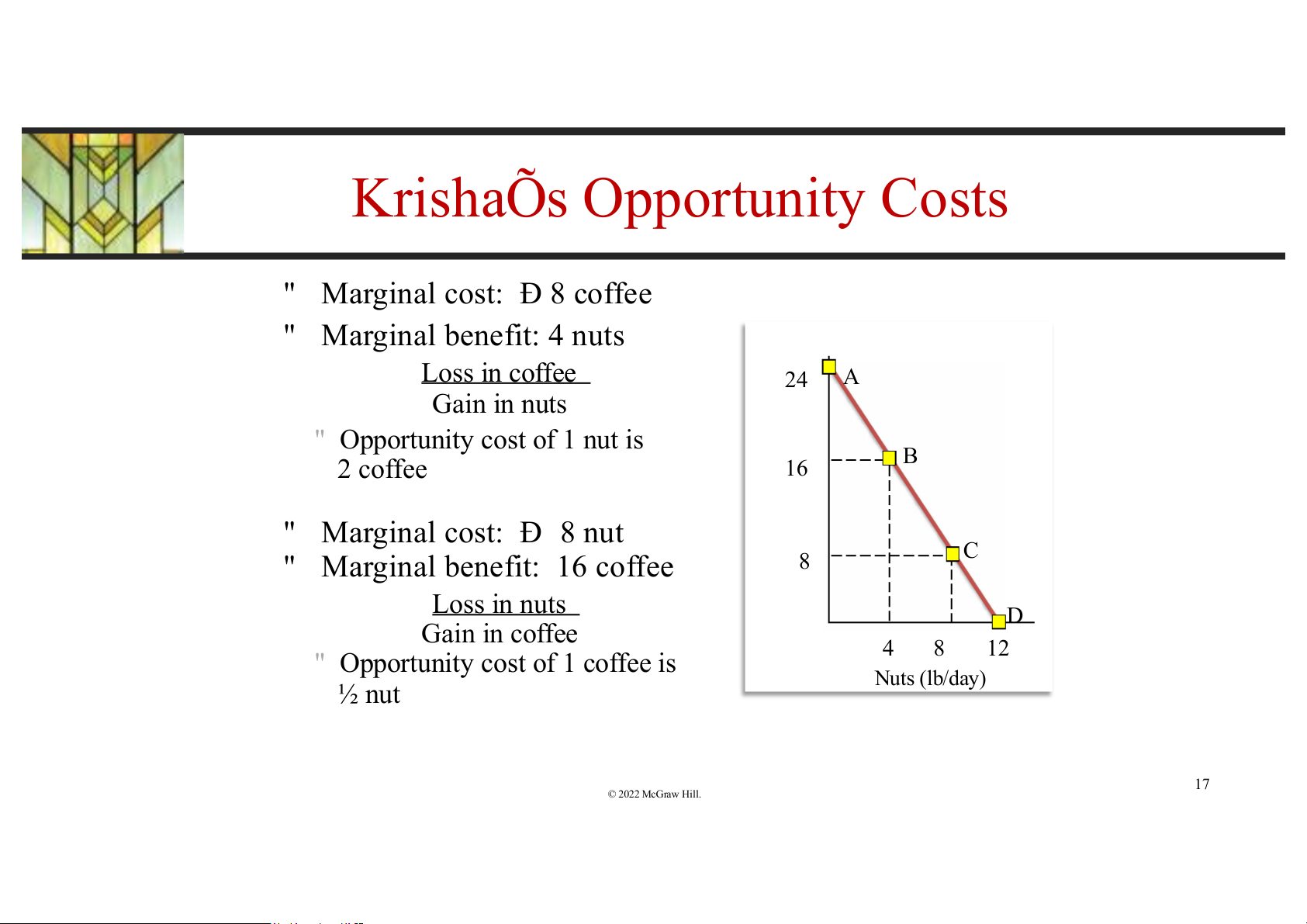
" Opportunity cost of 1 nut is 2 coffee 16 B " Marginal cost: Ð 8 nut offee (lb/day) " Marginal benefit: 16 coffee C 8 C Loss in nuts D Gain in coffee
" Opportunity cost of 1 coffee is 4 8 12 Nuts (lb/day) ½ nut 17 © 2022 McGraw Hill.
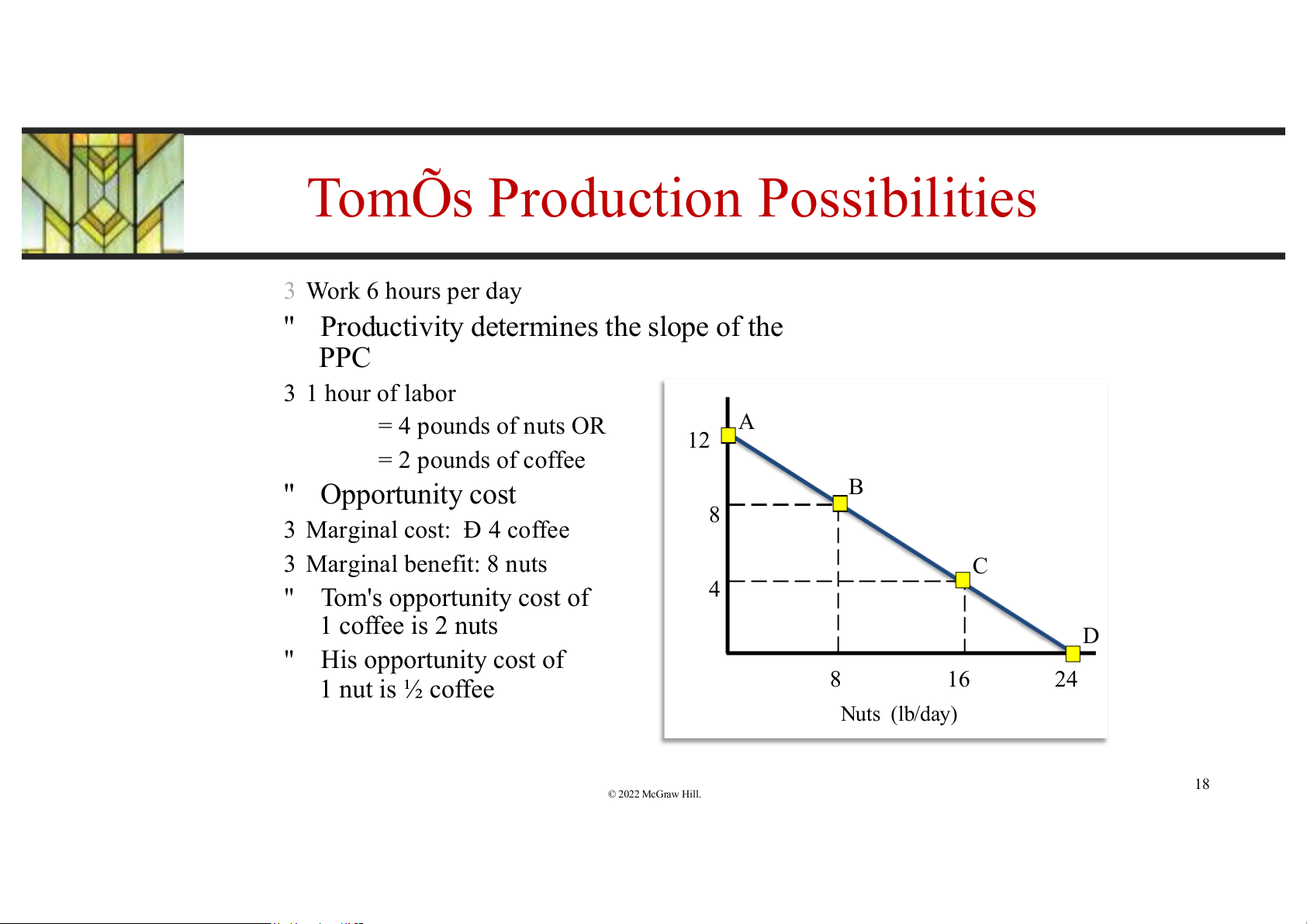
TomÕs Production Possibilities 3 Work 6 hours per day
" Productivity determines the slope of the PPC 3 1 hour of labor = 4 pounds of nuts OR A 12 = 2 pounds of coffee " Opportunity cost B 8 3 Marginal cost: Ð 4 coffee 3 Marginal benefit: 8 nuts C " Tom's opportunity cost of offee (lb/day) 4 1 coffee is 2 nuts C D " His opportunity cost of 1 nut is ½ coffee 8 16 24 Nuts (lb/day) 18 © 2022 McGraw Hill. Tom, Meet Krisha " PPCs show comparative advantage " Krisha's curve is steeper, 24 Krisha9s PPC better for coffee " Tom's curve is flatter, better for nuts " Comparative advantage is 12 offee (lb/day) a comparison Tom9s PPC C " To get 1 coffee " Krisha gives up ½ nuts 12 24 " Tom gives up 2 nuts Nuts (lb/day) 19 © 2022 McGraw Hill.
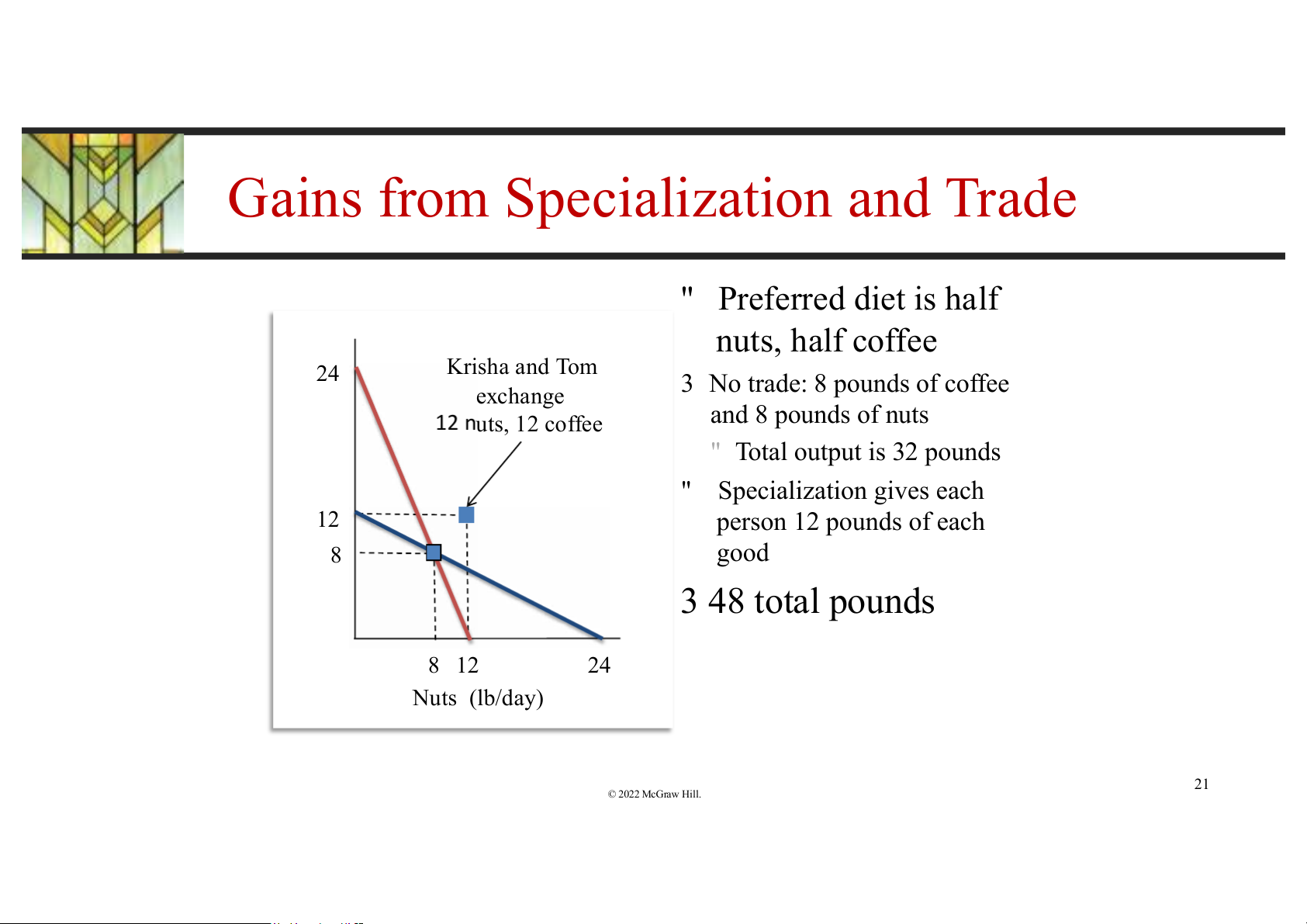
Gains from Specialization and Trade
" Without trade, each person can consume along his production possibilities curve
3 What you produce determines what you consume
" With trade, each person's consumption can be greater than production
3 Produce according to comparative advantage 3 Trade to get what you want 20 © 2022 McGraw Hill.
Gains from Specialization and Trade " Preferred diet is half nuts, half coffee Krisha and Tom 24
3 No trade: 8 pounds of coffee exchange and 8 pounds of nuts uts, 12 coffee " Total output is 32 pounds " Specialization gives each 12 person 12 pounds of each offee (lb/day) 8 good C 3 48 total pounds 8 12 24 Nuts (lb/day) 21 © 2022 McGraw Hill.
Tài liệu liên quan:
-
Chương 3: độ co giãn và các nhân tố ảnh hưởng | Microeconomics | Trường Đại học Quốc tế, Đại học Quốc gia Thành phố Hồ Chí Minh
4 2 -
Microeconomics Syllabus | Microeconomics | Trường Đại học Quốc tế, Đại học Quốc gia Thành phố Hồ Chí Minh
4 2 -
Microeconomics Course Syllabus & Assessment Details | Microeconomics | Trường Đại học Quốc tế, Đại học Quốc gia Thành phố Hồ Chí Minh
4 2 -
Assignment 3 - Elasticity MCQs and Key Concepts | Microeconomics | Trường Đại học Quốc tế, Đại học Quốc gia Thành phố Hồ Chí Minh
4 2 -
Assignment 2 - Economic Equilibrium Analysis of Fridges and Motorcycles | Microeconomics | Trường Đại học Quốc tế, Đại học Quốc gia Thành phố Hồ Chí Minh
4 2