Chapter 1: Key Concepts in Economics | Microeconomics | Trường Đại học Quốc tế, Đại học Quốc gia Thành phố Hồ Chí Minh
A society faces many decisions, like a household (where the term "economics" is derived from). These decisions are no longer miscellaneous, but they turn out more sophisticated, like deciding what jobs will be done and who will do them on a large scale. - Unfortunately, resources are scarce. Society cannot produce all the goods and services people wish to have. Also, in most societies, resources are not allocated by an all-powerful dictator but by a combination of choices, driven by millions of households and firms. → Therefore, it is essential to have a management, or a study about this management, focusing on how society manages. Tài liệu được sưu tầm và soạn thảo dưới dạng file PDF để gửi tới các bạn cùng tham khảo, ôn tập đầy đủ kiến thức, chuẩn bị cho các buổi học thật tốt. Mời bạn đọc đón xem!
Môn: Microeconomics 635 tài liệu
Trường: Trường Đại học Quốc tế, Đại học Quốc gia Thành phố Hồ Chí Minh 1.9 K tài liệu
Tác giả:



Preview text:
Chapter 1: Ten Principles of Economics Monday, September 15, 2025 9:25 PM 01 | pre-lesson questions
- A society faces many decisions, like a household (where the term "economics" is derived from). These decisions are no longer
miscellaneous, but they turn out more sophisticated, like deciding what jobs will be done and who will do them on a large scale.
- Unfortunately, resources are scarce. Society cannot produce all the goods and services people wish to have. Also, in most societies,
resources are not allocated by an all-powerful dictator but by a combination of choices, driven by millions of households and firms.
→ Therefore, it is essential to have a management, or a study about this management, focusing on how society manages its
scarce resources, which is called economics
○ Economists study how people make decisions - how they work, what they buy, how much they save, how they invest their savings, etc.
how people interact with others - selling and buying activities…
analyze trends and forces that affect the economy - growth in average income, inflation, etc. 1) People face trade-offs
- Must remember: There is no such thing as a free lunch. To get something we like, we usually have to give up something we have or
something else we also like. Making decisions requires trade-offs: to achieve one goal, we must sacrifice one another.
e.g. : to have more money to buy stuff, one has to work longer hours, with less time for leisure
- When people are grouped in societies, they face different kinds of trade-offs.
↳ One classic trade-off is between "guns and butter". If people spend more on national defense (guns) to protect its shores, the less
it can spend on consumer goods (butter) to raise the standard of living at home.
↳ Or consider the pollution regulations: if we want to improve the environment and residents' health, more resources will be
allocated to environmentally friendly methods, which may lead to a drop in profits or eventually affect the incomes of the firms'
owners, workers, and customers. r
e.g.: FDI (Foreign Direct Investment) >< FII (Foreign Indirect Investment). In the last 30 years VN relied on FDI. However if the
government rose the cost of labor in VN, this funding would go away --> Why?: because the labor costs of VN is cheap so foreigners
invest in our country more. If they return the investment, many workers in VN would lose their jobs.
ᯓ★ Interest rate is the percentage cost of borrowing money or the return earned on lending it, calculated on the principal
amount over time, typically annually.
ᯓ★ About Efficiency and Equality:
→ Efficiency: Society gets the most from its scarce resources
→ Equality: Prosperity is distributed uniformly among society's members
✦ A trade- o: to achieve greater equality, we could redistribute income from the wealthy to the poor, but this reduces the incentive to
work and produce, shrinking the size of the economic "pie" (cause people find nothing to work harder). We only choose one out of two, if
we choose eciency, the equality would be destroyed and vice versa.
⇒In other words, efficiency refers to the size of the economic pie, while equality refers to how the pie is divided into indiv idual slices.
2) The Cost of Something Is What You Give Up to Get It
- When people make decisions, they must compare the costs with the benefits of alternatives. Decision makers should be aware of
the opportunity costs that accompany every possible action.
ᯓ★ The Opportunity Cost of an item is whatever must be given up to obtain that item. ᯓ -
★ The Sunk Cost is the cost that you have to pay whatever your decisions are. It is not relevant to your choices.
3) Rational people think at the margin
Assumption: People are rational. Rational people are people who systematically and purposefully do the best they can to achieve their
[ECON101(125)TT_14] Microeconomics Page 1
objectives. Also, they understand that life decisions are rarely black and white but usually involve shades of gray. What is a marginal change?
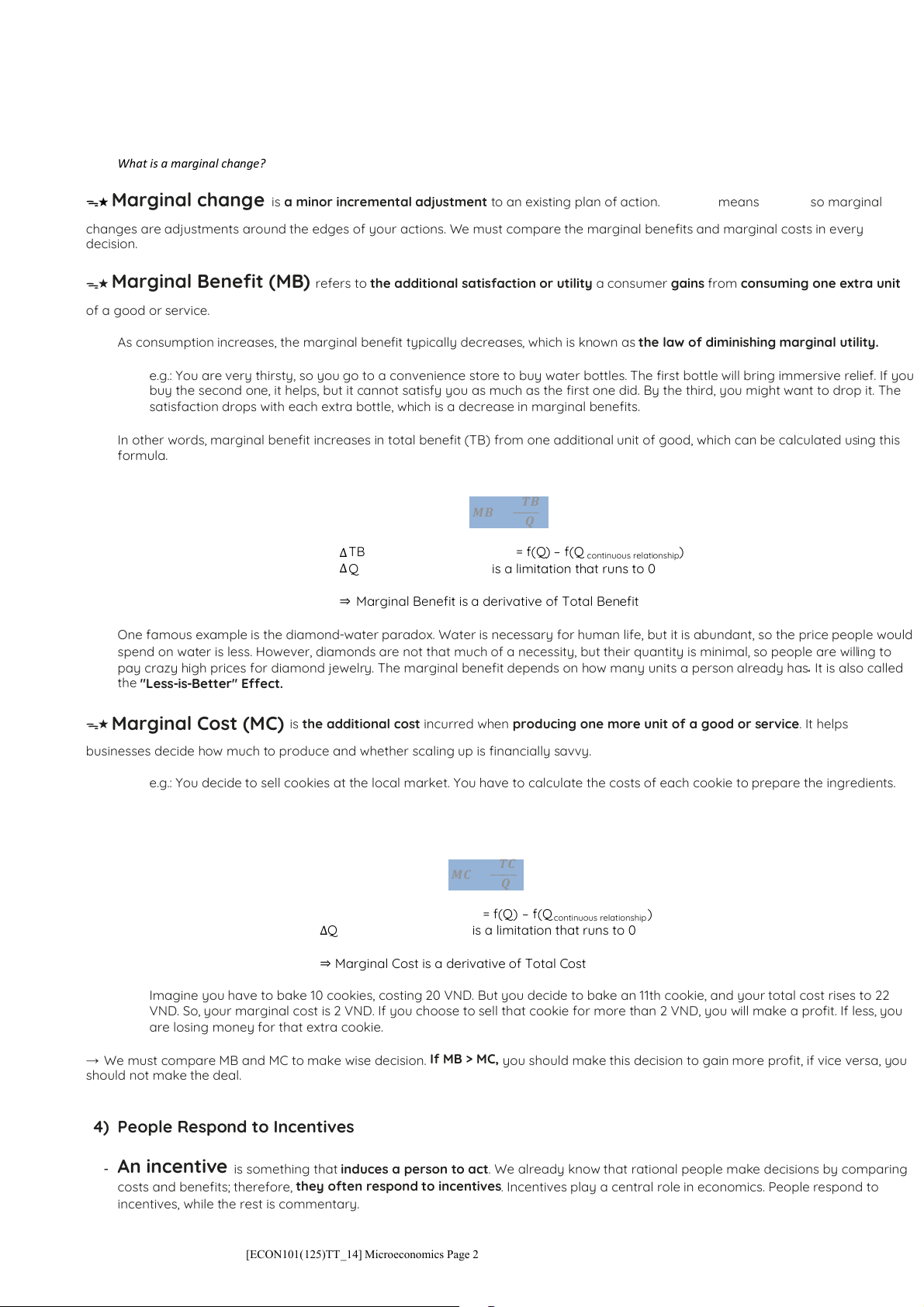
ᯓ★ Marginal change is a minor incremental adjustment to an existing plan of action. "Margin" means "edge", so marginal
changes are adjustments around the edges of your actions. We must compare the marginal benefits and marginal costs in every decision.
ᯓ★ Marginal Benefit (MB) refers to the additional satisfaction or utility a consumer gains from consuming one extra unit of a good or service.
As consumption increases, the marginal benefit typically decreases, which is known as the law of diminishing marginal utility.
e.g.: You are very thirsty, so you go to a convenience store to buy water bottles. The first bottle will bring immersive relief. If you
buy the second one, it helps, but it cannot satisfy you as much as the first one did. By the third, you might want to drop it. The
satisfaction drops with each extra bottle, which is a decrease in marginal benefits.
In other words, marginal benefit increases in total benefit (TB) from one additional unit of good, which can be calculated using this formula. ∆𝑻𝑩 𝑴𝑩 = ⎯⎯⎯⎯ ∆𝑸
∆ TB stands for "change in total benefit" = f(Q) – f(Q continuous relationship)
∆ Q stands for "change in quantity" is a limitation that runs to 0
⇒ Marginal Benefit is a derivative of Total Benefit
One famous example is the diamond-water paradox. Water is necessary for human life, but it is abundant, so the price people would
spend on water is less. However, diamonds are not that much of a necessity, but their quantity is minimal, so people are willing to
pay crazy high prices for diamond jewelry. The marginal benefit depends on how many units a person already has. It is also called the "Less-is-Better" Effect.
ᯓ★ Marginal Cost (MC) is the additional cost incurred when producing one more unit of a good or service. It helps
businesses decide how much to produce and whether scaling up is financially savvy.
e.g.: You decide to sell cookies at the local market. You have to calculate the costs of each cookie to prepare the ingredients. ∆𝑻𝑪 𝑴𝑪 = ⎯⎯⎯⎯ ∆𝑸
∆TC stands for "change in total cost" = f(Q) – f(Q continuous relationship)
∆Q stands for "change in quantity" is a limitation that runs to 0
⇒ Marginal Cost is a derivative of Total Cost
Imagine you have to bake 10 cookies, costing 20 VND. But you decide to bake an 11th cookie, and your total cost rises to 22
VND. So, your marginal cost is 2 VND. If you choose to sell that cookie for more than 2 VND, you will make a profit. If less, you
are losing money for that extra cookie.
→ We must compare MB and MC to make wise decision. If MB > MC, you should make this decision to gain more profit, if vice versa, you should not make the deal.
4) People Respond to Incentives
- An incentive is something that induces a person to act. We already know that rational people make decisions by comparing
costs and benefits; therefore, they often respond to incentives. Incentives play a central role in economics. People respond to
incentives, while the rest is commentary.
[ECON101(125)TT_14] Microeconomics Page 2
✦ Incentives play the key role in analyzing how markets work.
e.g.: If the price of apples rises, people decide to eat less apples. Meanwhile, orchards decide to hire more workers to harvest more apples.
→ The rise of price is a kind of incentives, influences the behavior of both consumers and producers, also drives the market's
allocation on scarce resources.
- Incentives are also used effectively in policy making . Governments and policymakers change the rights or benefits that people
face, and as a result, they alter their behavior (higher taxes on cigarettes, less people smoke; more legal steps to import
electronics, people will buy more local products)
5) Trade Can Make Everyone Better Off
- Indeed, competition always exists in markets. These competitions include the share of customers, production size, etc. However,
competition between firms or countries is not a game that must determine whether one side wins or loses. These trades between
two competitors actually make both better off.
✦ Trade allows people to specialize in their best activities; by trading with others, people can buy various goods and services at preferred prices.
e.g.: Countries benefit from trade and specialization. They can get better prices for exported products, cheaper prices for goods they
import, and cheaper prices for those they import.
ᯓ★ Comparative Advantage (Relative Advantage) is the ability of a person to perform an activity or produce a
good or service at a lower opportunity cost than someone else. (everyone should have their own comparative advantages)
✦ The key to Comparative Advantage is the opportunity cost. Consider two countries, France and the United States, that can produce both wines & cloths
○ France: One hour of labor can produce five wines and ten cloths
→ The opportunity cost to produce one wine is two cloths
The opportunity cost to produce one cloth is 0.5 wine
○ The US: One hour of labor can produce ten wines and six cloths
→ The opportunity cost to produce one wine is 1.67 cloth
The opportunity cost of producing one cloth is 0.6 wine.
⇒ As readily seen, France's opportunity cost of a wine is more than the US's, so the US has a comparative advantage in producin g wine.
Meanwhile, France's opportunity cost of a cloth is less than the US's, so France has a comparative advantage in producing cloth
ᯓ★ Absolute Advantage is the ability of an individual, firm, or country to produce a greater quantity of a good or service than
its competitors using the same amount of resources, or to produce the same amount using fewer resources.
For instance, France has an absolute advantage in producing wine, because it can produce twice as fast as the US in one hour.
✦ France and the US specialize in producing goods in which they have a comparative advantage
↳ Consider if France only produces 30 cloths and the US produces 20 wines in an hour:
France sells ten cloths to the US and buys seven wines / The US sells seven wines to France and buys ten cloths
⇒ In one hour, both countries gain more goods by trading with others while allocating more resources to produce a larger quantity of
goods that they have a comparative advantage in the market, which is called achieving gains from trade.
ᯓ★ A Barter Trade is a direct exchange of goods or services for other goods or services, without using money as a medium of
exchange. This cashless system is one of the oldest forms of commerce, requiring both parties in the transaction to agree on a mutually
beneficial exchange, such as a farmer providing crops in exchange for a carpenter's labor to build a fence.
6) Markets Are Usually a Good Way to Organize Economic Activity
ᯓ★ A Market refers to any system, venue, or arrangement where buyers and sellers interact to exchange goods, services, or resources.
✦ Background : Due to the collapse of communism in the Soviet Union and Eastern European countries in the late 1980s and early 1990s,
in which government ocials used to be in the best position to allocate the economy's scarce resources, the market economy system has been developed.
✦ Organizing economic activities means determining: what goods and services to produce, how much of each to produce, how firms
produce, who produces and consumes these products, etc.
ᯓ★ A Market Economy is an economy that allocates resources through the decentralized decisions made by many firms and
households as they interact in markets for goods and services.
↳ Decentralized decisions refer to choices made by individuals or smaller groups (firms, households, consumers) rather than a central
[ECON101(125)TT_14] Microeconomics Page 3
authority ≠ centralized decisions (choices made by a government or central body dictate most economic or organizational choices)
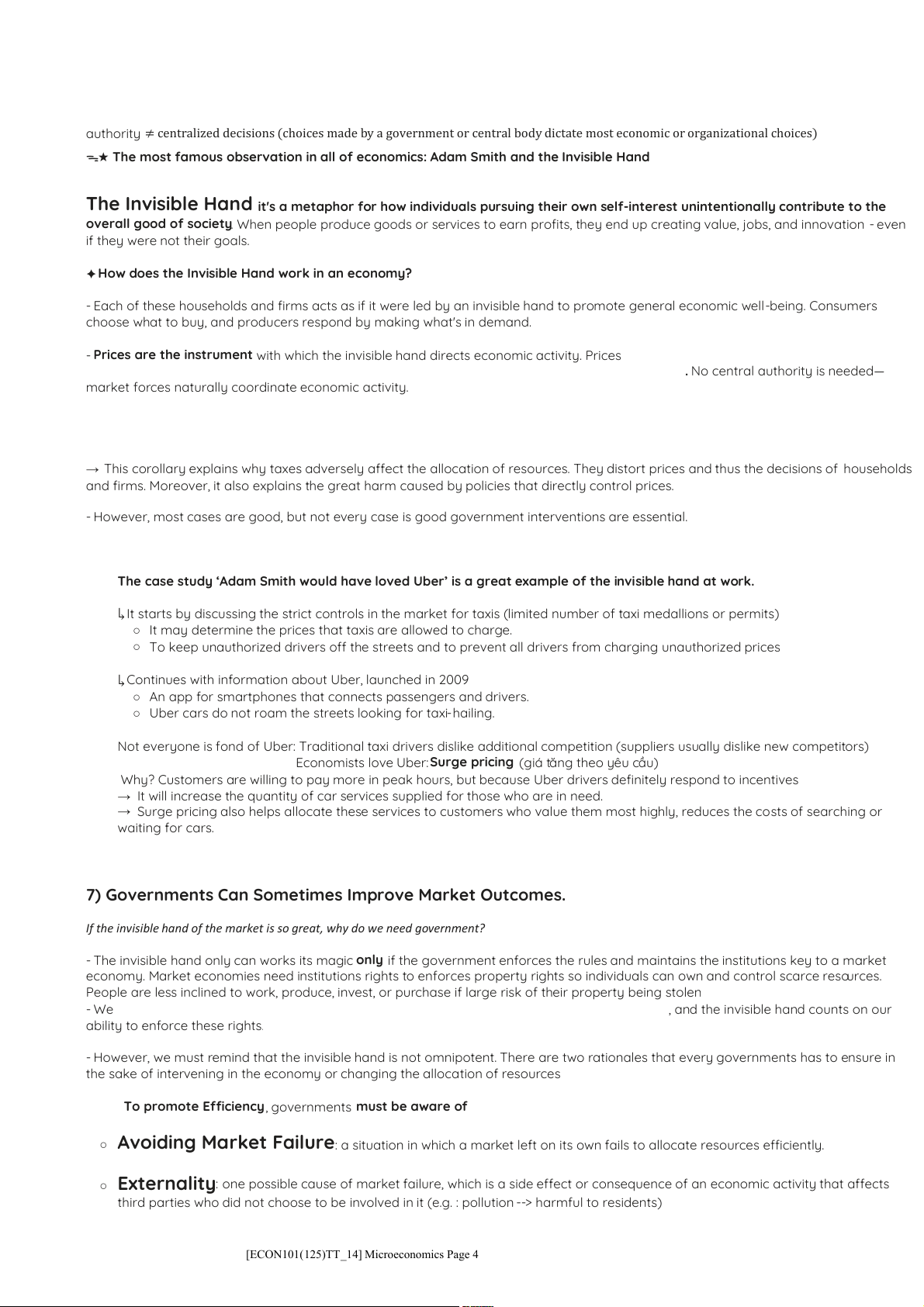
ᯓ★ The most famous observation in all of economics: Adam Smith and the Invisible Hand
The Invisible Hand it's a metaphor for how individuals pursuing their own self-interest unintentionally contribute to the
overall good of society. When people produce goods or services to earn profits, they end up creating value, jobs, and innovation - even if they were not their goals.
✦ How does the Invisible Hand work in an economy?
- Each of these households and firms acts as if it were led by an invisible hand to promote general economic well-being. Consumers
choose what to buy, and producers respond by making what's in demand.
- Prices are the instrument with which the invisible hand directs economic activity. Prices adjust based on supply and demand, guiding
individual buyers and sellers to reach outcomes that maximize the overall well-being of society. No central authority is needed—
market forces naturally coordinate economic activity.
↳ Smith's insight has an important corollary: When a government prevents prices from adjusting naturally to supply and demand, it
hinders the invisible hand's ability to coordinate the decisions of households and firms that comprise an economy.
→ This corollary explains why taxes adversely affect the allocation of resources. They distort prices and thus the decisions of households
and firms. Moreover, it also explains the great harm caused by policies that directly control prices.
- However, most cases are good, but not every case is good government interventions are essential.
The case study ‘Adam Smith would have loved Uber’ is a great example of the invisible hand at work.
↳ It starts by discussing the strict controls in the market for taxis (limited number of taxi medallions or permits)
○ It may determine the prices that taxis are allowed to charge.
○ To keep unauthorized drivers off the streets and to prevent all drivers from charging unauthorized prices
↳ Continues with information about Uber, launched in 2009
○ An app for smartphones that connects passengers and drivers.
○ Uber cars do not roam the streets looking for taxi-hailing.
Not everyone is fond of Uber: Traditional taxi drivers dislike additional competition (suppliers usually dislike new competitors)
Economists love Uber: Surge pricing (giá tăng theo yêu cầu)
Why? Customers are willing to pay more in peak hours, but because Uber drivers definitely respond to incentives
→ It will increase the quantity of car services supplied for those who are in need.
→ Surge pricing also helps allocate these services to customers who value them most highly, reduces the costs of searching or waiting for cars.
7) Governments Can Sometimes Improve Market Outcomes.
If the invisible hand of the market is so great, why do we need government?
- The invisible hand only can works its magic only if the government enforces the rules and maintains the institutions key to a market
economy. Market economies need institutions rights to enforces property rights so individuals can own and control scarce resources.
People are less inclined to work, produce, invest, or purchase if large risk of their property being stolen
- We all rely on government-provided police and courts to enforce rights over things we produce, and the invisible hand counts on our
ability to enforce these rights.
- However, we must remind that the invisible hand is not omnipotent. There are two rationales that every governments has to ensure in
the sake of intervening in the economy or changing the allocation of resources
To promote Efficiency, governments must be aware of
○ Avoiding Market Failure: a situation in which a market left on its own fails to allocate resources efficiently.
○ Externality: one possible cause of market failure, which is a side effect or consequence of an economic activity that affects
third parties who did not choose to be involved in it (e.g. : pollution --> harmful to residents)
[ECON101(125)TT_14] Microeconomics Page 4
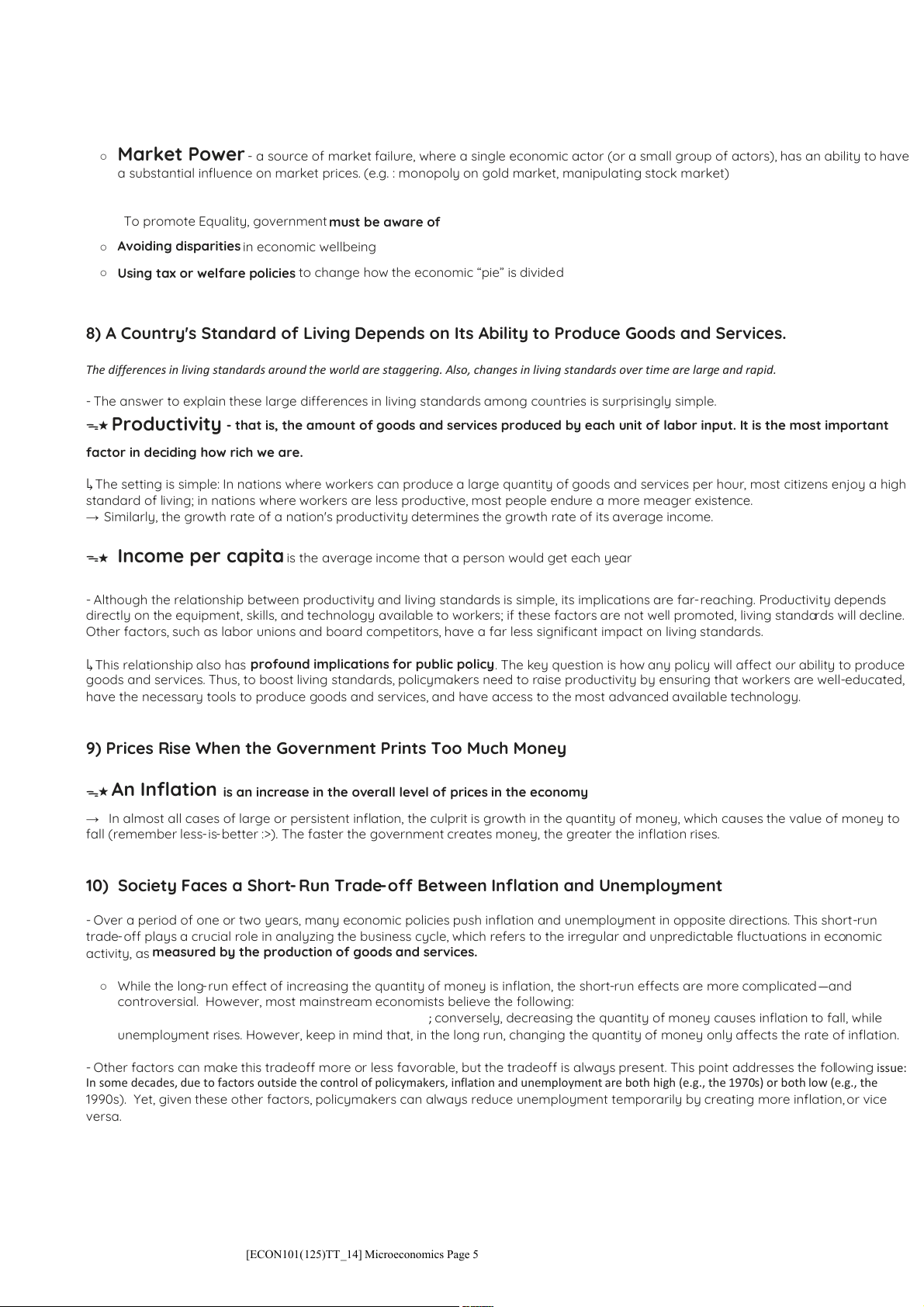
○ Market Power - a source of market failure, where a single economic actor (or a small group of actors), has an ability to have
a substantial influence on market prices. (e.g. : monopoly on gold market, manipulating stock market)
To promote Equality, government must be aware of Avoiding disparities ○ in economic wellbeing
○ Using tax or welfare policies to change how the economic “pie” is divided
8) A Country's Standard of Living Depends on Its Ability to Produce Goods and Services.
The differences in living standards around the world are staggering. Also, changes in living standards over time are large and rapid.
- The answer to explain these large differences in living standards among countries is surprisingly simple.
ᯓ★ Productivity - that is, the amount of goods and services produced by each unit of labor input. It is the most important
factor in deciding how rich we are.
↳ The setting is simple: In nations where workers can produce a large quantity of goods and services per hour, most citizens enjoy a high
standard of living; in nations where workers are less productive, most people endure a more meager existence.
→ Similarly, the growth rate of a nation's productivity determines the growth rate of its average income.
ᯓ★ Income per capita is the average income that a person would get each year
- Although the relationship between productivity and living standards is simple, its implications are far-reaching. Productivity depends
directly on the equipment, skills, and technology available to workers; if these factors are not wel promoted, living standards will decline.
Other factors, such as labor unions and board competitors, have a far less significant impact on living standards.
↳ This relationship also has profound implications for public policy. The key question is how any policy will affect our ability to produce
goods and services. Thus, to boost living standards, policymakers need to raise productivity by ensuring that workers are well-educated,
have the necessary tools to produce goods and services, and have access to the most advanced available technology.
9) Prices Rise When the Government Prints Too Much Money
ᯓ★ An Inflation is an increase in the overall level of prices in the economy
→ In almost all cases of large or persistent inflation, the culprit is growth in the quantity of money, which causes the value of money to
fall (remember less-is-better :>). The faster the government creates money, the greater the inflation rises.
10) Society Faces a Short- Run Trade-off Between Inflation and Unemployment
- Over a period of one or two years, many economic policies push inflation and unemployment in opposite directions. This short-run
trade-off plays a crucial role in analyzing the business cycle, which refers to the irregular and unpredictable fluctuations in economic
activity, as measured by the production of goods and services.
○ While the long-run effect of increasing the quantity of money is inflation, the short-run effects are more complicated—and
controversial. However, most mainstream economists believe the following: In the short run, increasing the quantity of money
causes inflation to rise, while unemployment falls; conversely, decreasing the quantity of money causes inflation to fall, while
unemployment rises. However, keep in mind that, in the long run, changing the quantity of money only affects the rate of inflation.
- Other factors can make this tradeoff more or less favorable, but the tradeoff is always present. This point addresses the fol owing issue:
In some decades, due to factors outside the control of policymakers, inflation and unemployment are both high (e.g., the 1970s) or both low (e.g., the
1990s). Yet, given these other factors, policymakers can always reduce unemployment temporarily by creating more inflation, or vice versa.
[ECON101(125)TT_14] Microeconomics Page 5
Tài liệu liên quan:
-

Chương 3: độ co giãn và các nhân tố ảnh hưởng | Microeconomics | Trường Đại học Quốc tế, Đại học Quốc gia Thành phố Hồ Chí Minh
0 0 -
Microeconomics Syllabus | Microeconomics | Trường Đại học Quốc tế, Đại học Quốc gia Thành phố Hồ Chí Minh
0 0 -
Microeconomics Course Syllabus & Assessment Details | Microeconomics | Trường Đại học Quốc tế, Đại học Quốc gia Thành phố Hồ Chí Minh
0 0 -
Assignment 3 - Elasticity MCQs and Key Concepts | Microeconomics | Trường Đại học Quốc tế, Đại học Quốc gia Thành phố Hồ Chí Minh
0 0 -
Assignment 2 - Economic Equilibrium Analysis of Fridges and Motorcycles | Microeconomics | Trường Đại học Quốc tế, Đại học Quốc gia Thành phố Hồ Chí Minh
1 1