Chapter 1: Key Concepts in Economics - Ten Principles Overview | Microeconomics | Trường Đại học Quốc tế, Đại học Quốc gia Thành phố Hồ Chí Minh
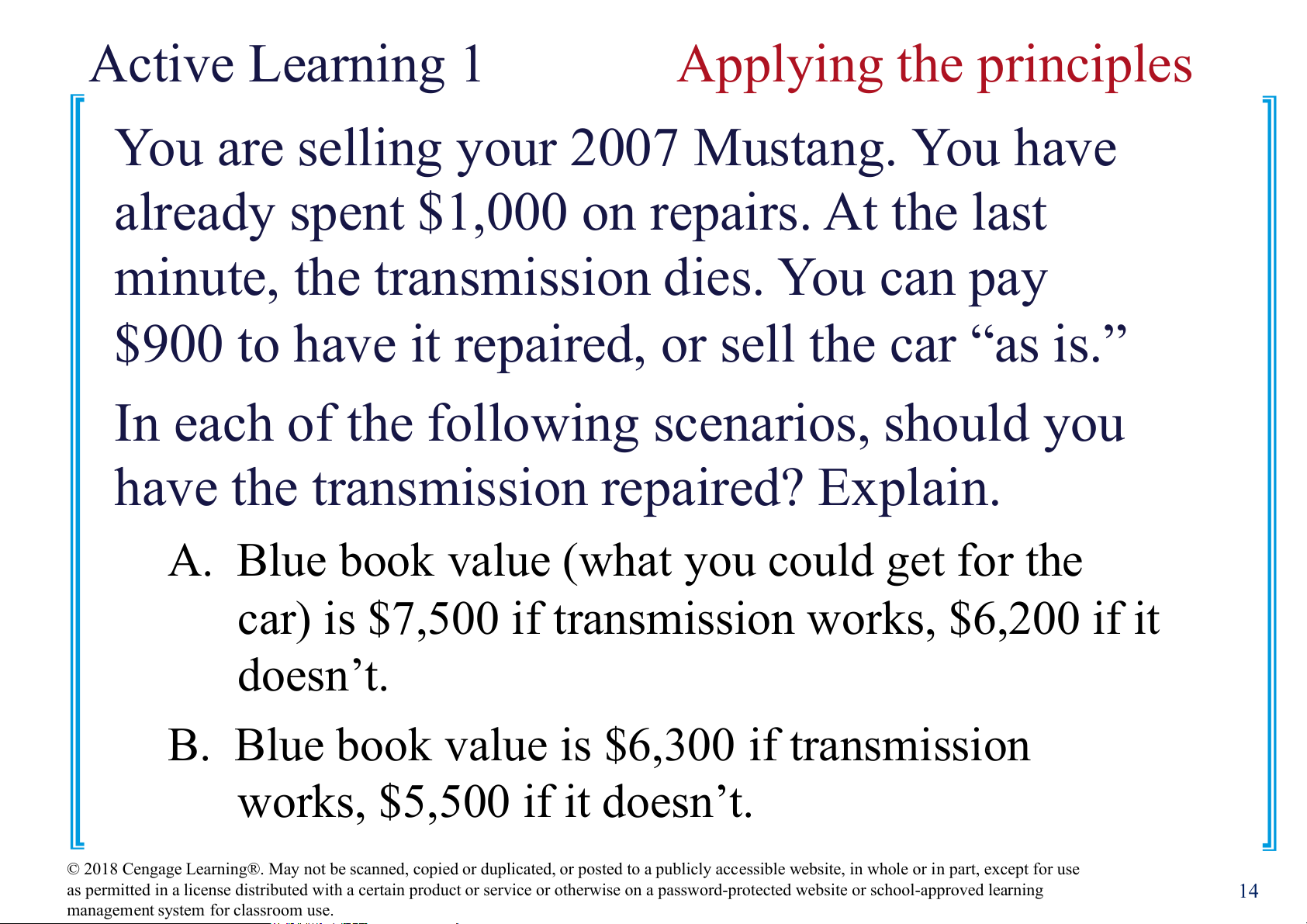
Active Learning 1 Applying the principles You are selling your 2007 Mustang. You have already spent $1,000 on repairs. At the last minute, the transmission dies. You can pay $900 to have it repaired, or sell the car “as is. ” In each of the following scenarios, should you have the transmission repaired? Explain. A. Blue book value (what you could get for the car) is $7,500 if transmission works, $6,200 if it doesn’t. B. Blue book value is $6,300 if transmission works, $5,500 if it doesn’t. Tài liệu được sưu tầm và soạn thảo dưới dạng file PDF để gửi tới các bạn cùng tham khảo, ôn tập đầy đủ kiến thức, chuẩn bị cho các buổi học thật tốt. Mời bạn đọc đón xem!
Môn: Microeconomics 635 tài liệu
Trường: Trường Đại học Quốc tế, Đại học Quốc gia Thành phố Hồ Chí Minh 1.9 K tài liệu
Tác giả:




Preview text:
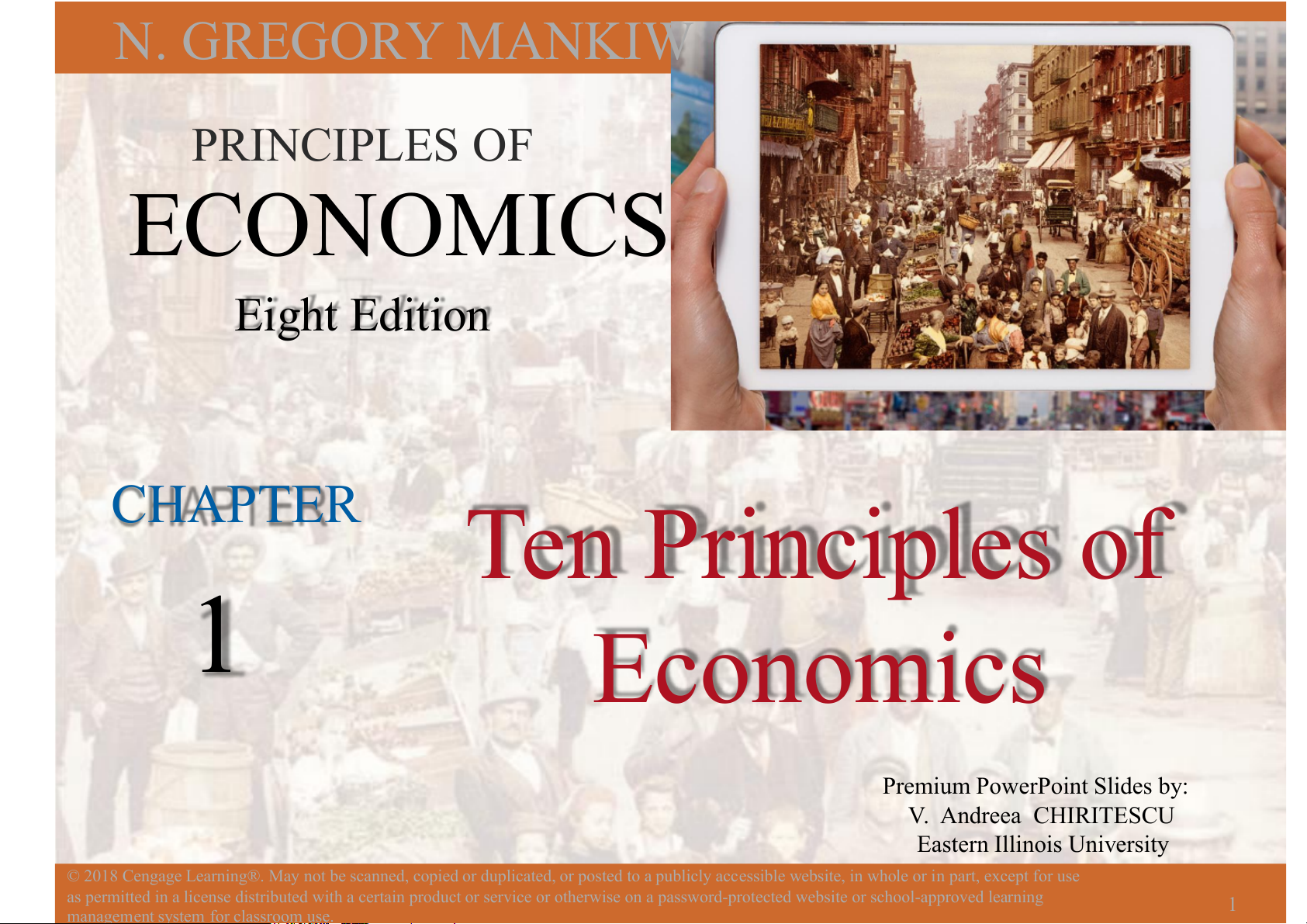
N. GREGORY MANKIW PRINCIPLES OF ECONOMICS Eight Edition CHAPTER Ten Principles of 1 Economics Premium PowerPoint Slides by: V. Andreea CHIRITESCU Eastern Illinois University
© 2018 Cengage Learning®. May not be scanned, copied or duplicated, or posted to a publicly accessible website, in whole or in a p rt, except for use
as permitted in a license distributed with a certain product or service or otherwise on a password-protected website or school-approved learning 1
management system for classroom use. g y
Look for the answers to these questions:
• What kinds of questions does economics address?
• What are the principles of how people make decisions?
• What are the principles of how people interact?
• What are the principles of how the economy as a whole works?
© 2018 Cengage Learning®. May not be scanned, copied or duplicated, or posted to a publicly accessible website, in whole or in a p rt, except for use
as permitted in a license distributed with a certain product or service or otherwise on a password-protected website or school-approved learning 2
management system for classroom use. Ten Principles of Economics • Resources are scarce
• Scarcity: the limited nature of society’s resources
– Society has limited resources
• Cannot produce all the goods and services people wish to have • Economics
– The study of how society manages its scarce resources
© 2018 Cengage Learning®. May not be scanned, copied or duplicated, or posted to a publicly accessible website, in whole or in a p rt, except for use
as permitted in a license distributed with a certain product or service or otherwise on a password-protected website or school-approved learning 3
management system for classroom use. Ten Principles of Economics • Economists study:
– How people decide what to buy,
how much to work, save, and spend
– How firms decide how much to produce, how many workers to hire
– How society decides how to divide its
resources between national defense,
consumer goods, protecting the environment, and other needs
© 2018 Cengage Learning®. May not be scanned, copied or duplicated, or posted to a publicly accessible website, in whole or in a p rt, except for use
as permitted in a license distributed with a certain product or service or otherwise on a password-protected website or school-approved learning 4
management system for classroom use. How People Make Decisions
Principle 1: People face trade-offs
Principle 2: The cost of something is what you give up to get it
Principle 3: Rational people think at the margin
Principle 4: People respond to incentives
© 2018 Cengage Learning®. May not be scanned, copied or duplicated, or posted to a publicly accessible website, in whole or in a p rt, except for use
as permitted in a license distributed with a certain product or service or otherwise on a password-protected website or school-approved learning 5
management system for classroom use.
Principle 1: People Face Trade-offs
• To get something that we like, we have to
give up something else that we also like
– Going to a party the night before an exam • Less time for studying
– Having more money to buy stuff
• Working longer hours, less time for leisure
– Protecting the environment
• Resources could be used to produce consumer goods
© 2018 Cengage Learning®. May not be scanned, copied or duplicated, or posted to a publicly accessible website, in whole or in a p rt, except for use
as permitted in a license distributed with a certain product or service or otherwise on a password-protected website or school-approved learning 6
management system for classroom use.
Principle 1: People Face Trade-offs • Society faces trade-offs:
– The more it spends on national defense (guns) to protect its shores
• The less it can spend on consumer goods
(butter) to raise the standard of living at home
– Pollution regulations: cleaner environment and improved health
• But at the cost of reducing the incomes of the
firms’ owners, workers, and customers
© 2018 Cengage Learning®. May not be scanned, copied or duplicated, or posted to a publicly accessible website, in whole or in a p rt, except for use
as permitted in a license distributed with a certain product or service or otherwise on a password-protected website or school-approved learning 7
management system for classroom use.
Principle 1: People Face Trade-offs
• Efficiency: society gets the most from its scarce resources
• Equality: prosperity is distributed uniformly among society’s members • Tradeoff:
– To achieve greater equality, could
redistribute income from wealthy to poor
– But this reduces incentive to work and
produce, shrinks the size of economic “pie”
© 2018 Cengage Learning®. May not be scanned, copied or duplicated, or posted to a publicly accessible website, in whole or in a p rt, except for use
as permitted in a license distributed with a certain product or service or otherwise on a password-protected website or school-approved learning 8
management system for classroom use.
Principle 2: The Cost of Something Is What You Give Up to Get It • Making decisions:
– Compare costs with benefits of alternatives
– Need to include opportunity costs • Opportunity cost
– Whatever must be given up to obtain some item
© 2018 Cengage Learning®. May not be scanned, copied or duplicated, or posted to a publicly accessible website, in whole or in a p rt, except for use
as permitted in a license distributed with a certain product or service or otherwise on a password-protected website or school-approved learning 9
management system for classroom use.
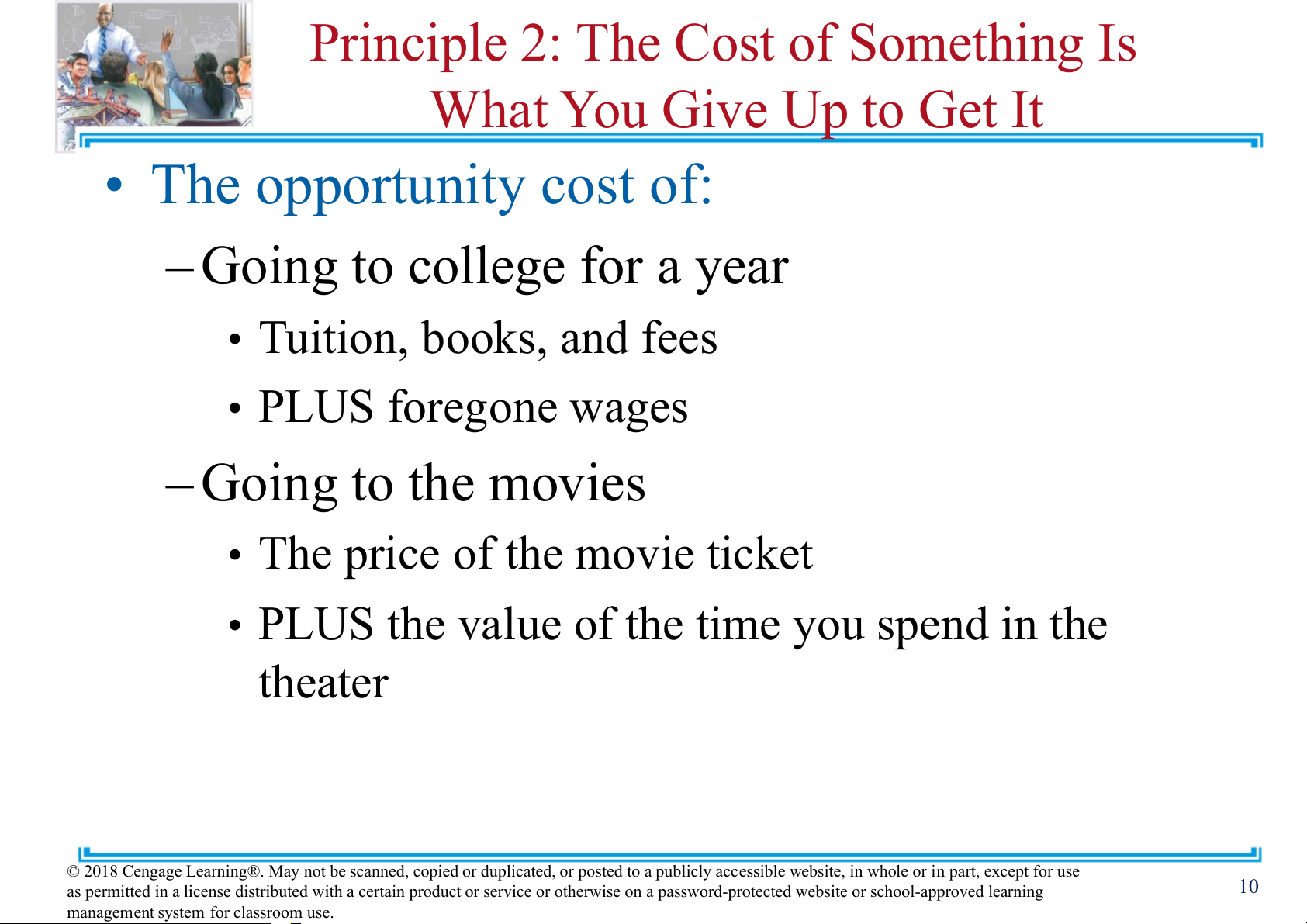
Principle 2: The Cost of Something Is What You Give Up to Get It • The opportunity cost of:
– Going to college for a year • Tuition, books, and fees • PLUS foregone wages – Going to the movies
• The price of the movie ticket
• PLUS the value of the time you spend in the theater
© 2018 Cengage Learning®. May not be scanned, copied or duplicated, or posted to a publicly accessible website, in whole or in a p rt, except for use
as permitted in a license distributed with a certain product or service or otherwise on a password-protected website or school-approved learning 10
management system for classroom use.
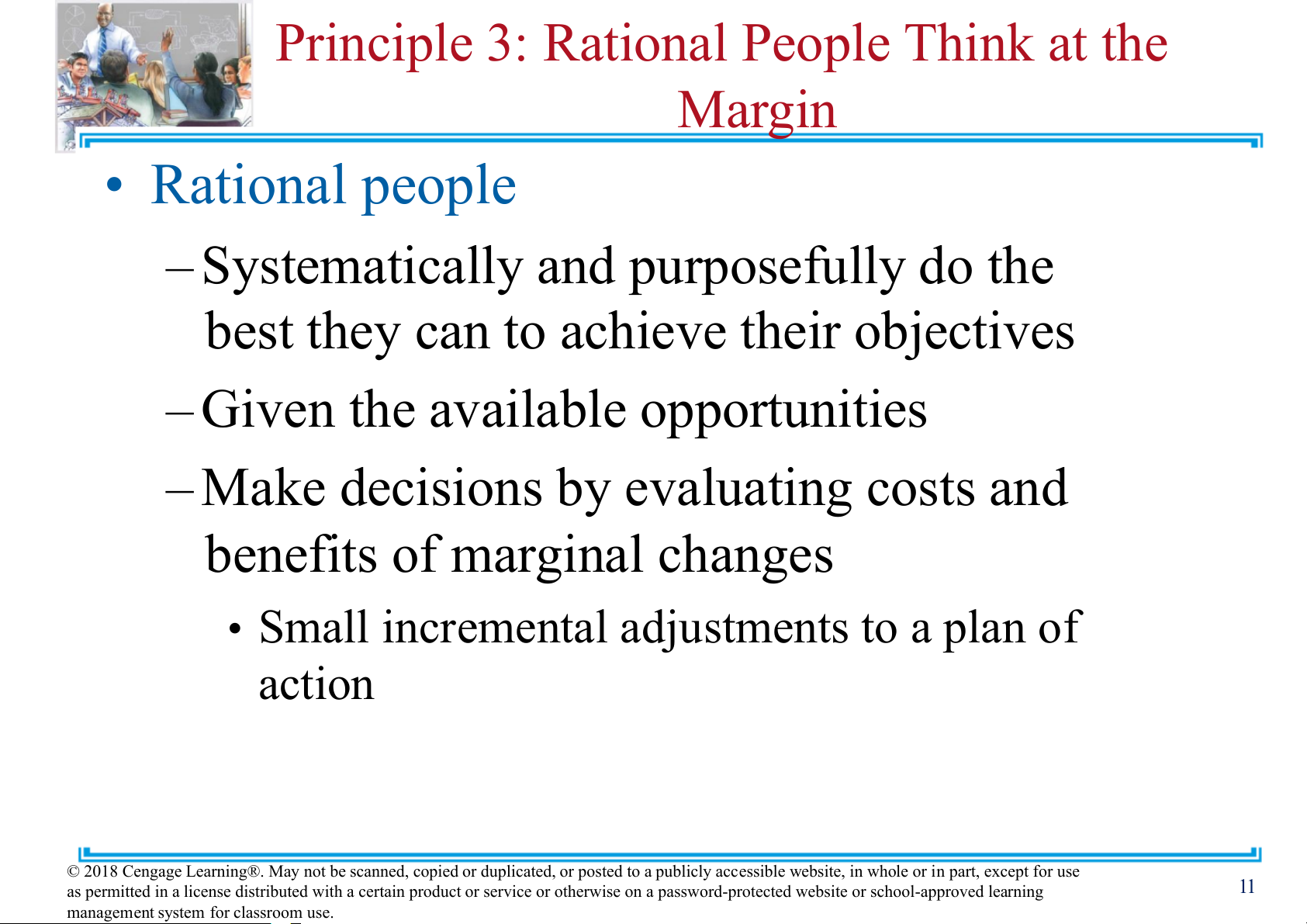
Principle 3: Rational People Think at the Margin • Rational people
– Systematically and purposefully do the
best they can to achieve their objectives
– Given the available opportunities
– Make decisions by evaluating costs and benefits of marginal changes
• Small incremental adjustments to a plan of action
© 2018 Cengage Learning®. May not be scanned, copied or duplicated, or posted to a publicly accessible website, in whole or in a p rt, except for use
as permitted in a license distributed with a certain product or service or otherwise on a password-protected website or school-approved learning 11
management system for classroom use.
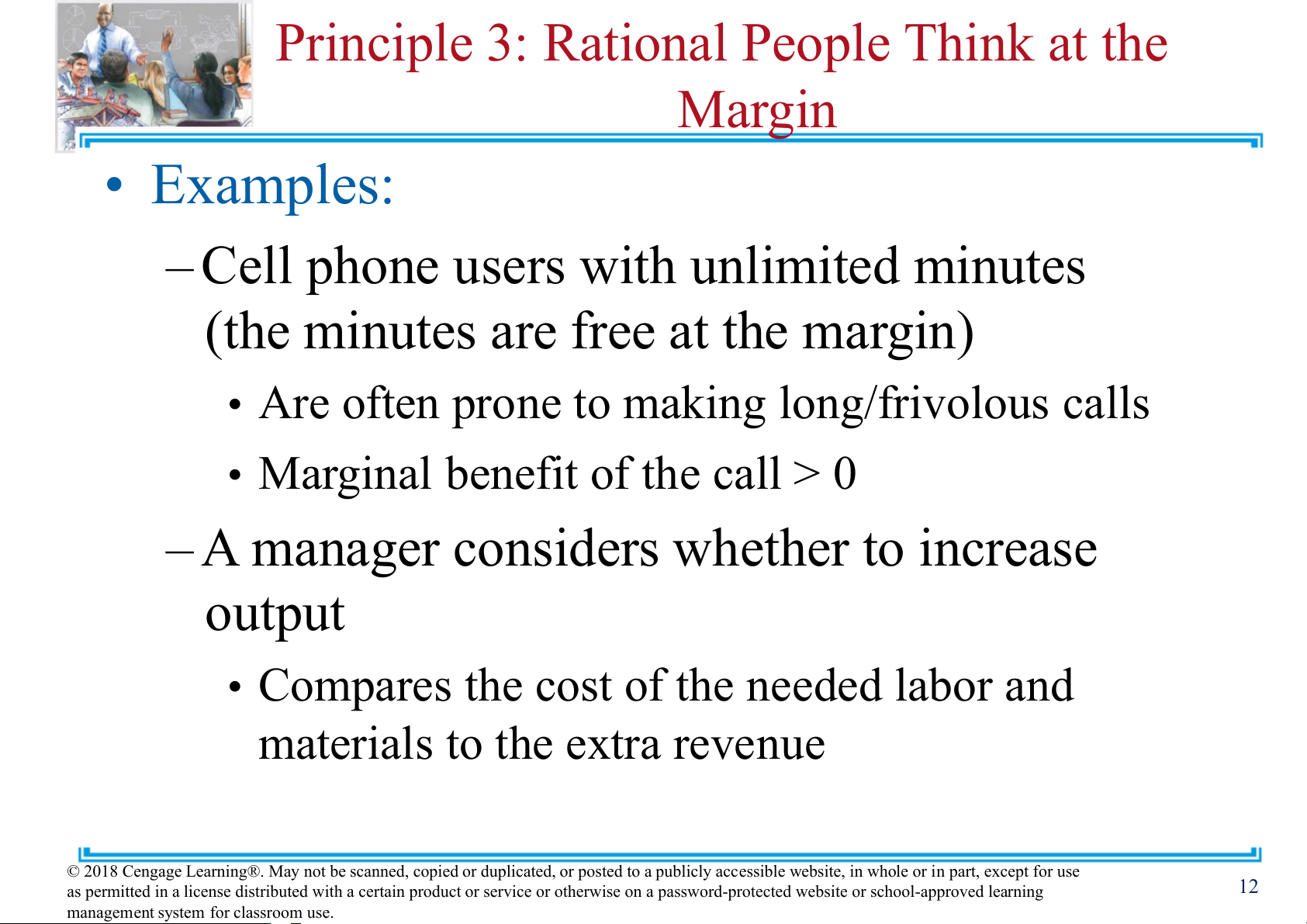
Principle 3: Rational People Think at the Margin • Examples:
– Cell phone users with unlimited minutes
(the minutes are free at the margin)
• Are often prone to making long/frivolous calls
• Marginal benefit of the call > 0
– A manager considers whether to increase output
• Compares the cost of the needed labor and materials to the extra revenue
© 2018 Cengage Learning®. May not be scanned, copied or duplicated, or posted to a publicly accessible website, in whole or in a p rt, except for use
as permitted in a license distributed with a certain product or service or otherwise on a password-protected website or school-approved learning 12
management system for classroom use.
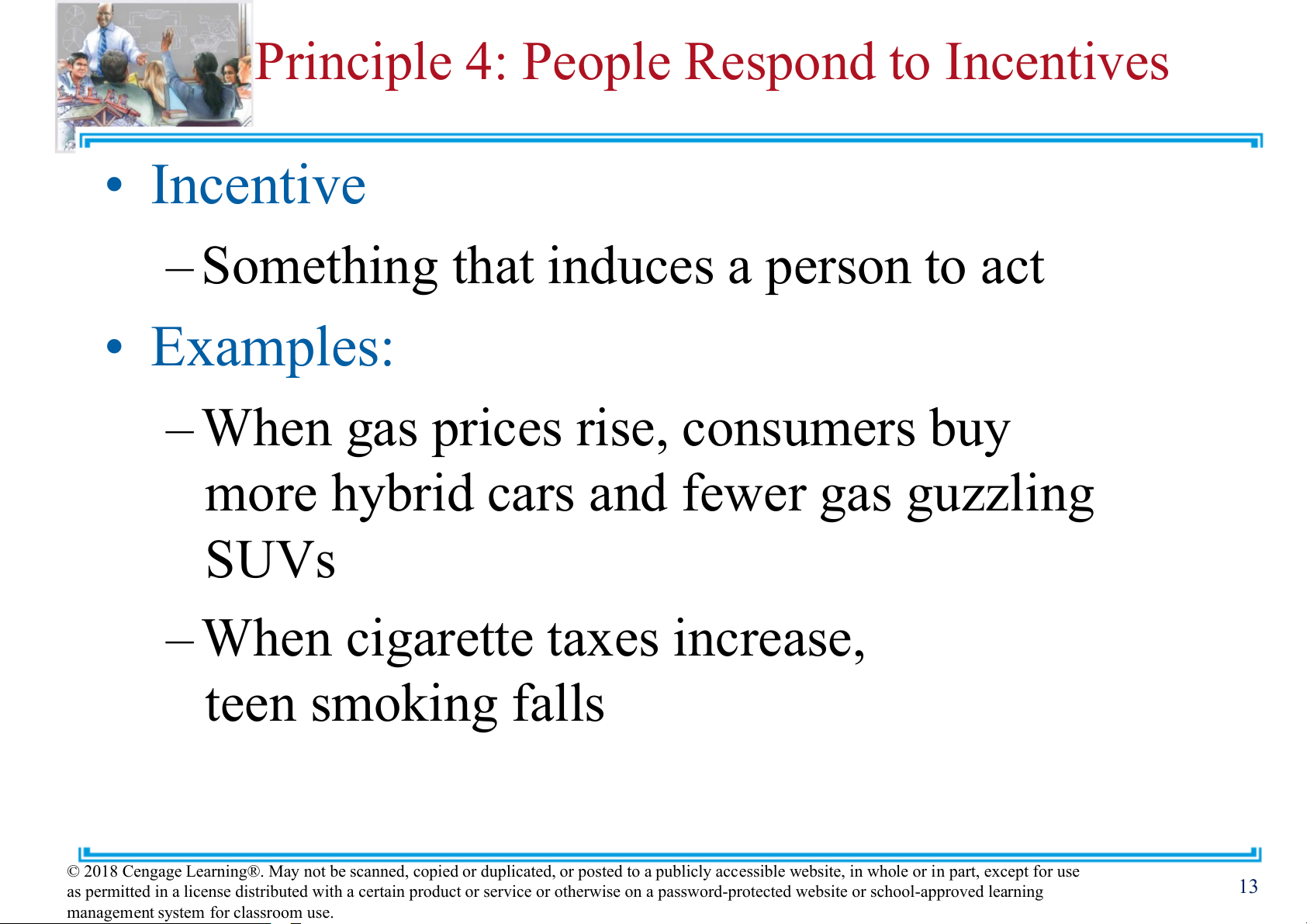
Principle 4: People Respond to Incentives • Incentive
– Something that induces a person to act • Examples:
– When gas prices rise, consumers buy
more hybrid cars and fewer gas guzzling SUVs
– When cigarette taxes increase, teen smoking falls
© 2018 Cengage Learning®. May not be scanned, copied or duplicated, or posted to a publicly accessible website, in whole or in a p rt, except for use
as permitted in a license distributed with a certain product or service or otherwise on a password-protected website or school-approved learning 13
management system for classroom use. Active Learning 1 Applying the principles
You are selling your 2007 Mustang. You have
already spent $1,000 on repairs. At the last
minute, the transmission dies. You can pay
$900 to have it repaired, or sell the car “as is.”
In each of the following scenarios, should you
have the transmission repaired? Explain.
A. Blue book value (what you could get for the
car) is $7,500 if transmission works, $6,200 if it doesn’t.
B. Blue book value is $6,300 if transmission works, $5,500 if it doesn’t.
© 2018 Cengage Learning®. May not be scanned, copied or duplicated, or posted to a publicly accessible website, in whole or in a p rt, except for use
as permitted in a license distributed with a certain product or service or otherwise on a password-protected website or school-approved learning 14
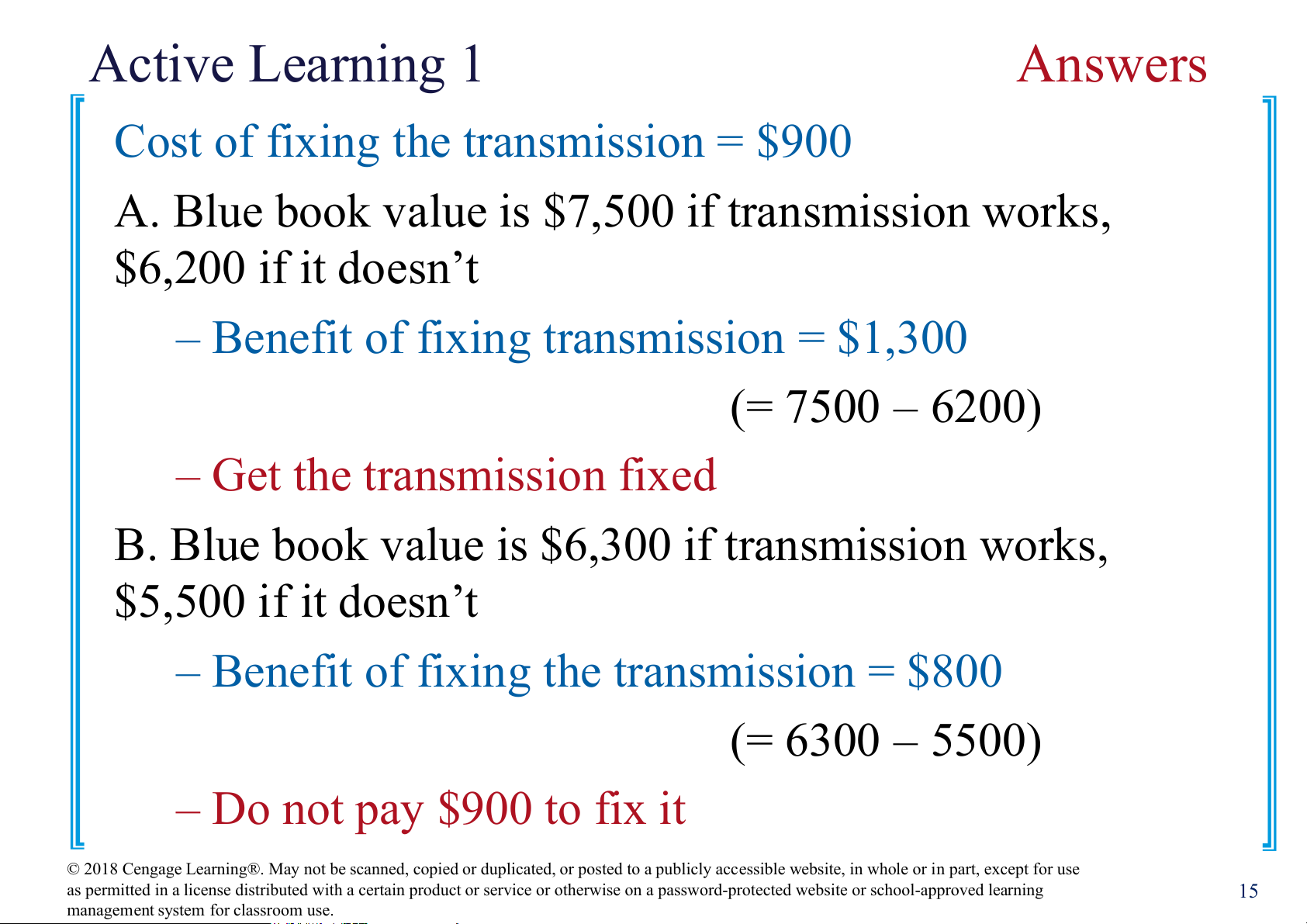
management system for classroom use. Active Learning 1 Answers
Cost of fixing the transmission = $900
A. Blue book value is $7,500 if transmission works, $6,200 if it doesn’t
– Benefit of fixing transmission = $1,300 (= 7500 – 6200)
– Get the transmission fixed
B. Blue book value is $6,300 if transmission works, $5,500 if it doesn’t
– Benefit of fixing the transmission = $800 (= 6300 – 5500) – Do not pay $900 to fix it
© 2018 Cengage Learning®. May not be scanned, copied or duplicated, or posted to a publicly accessible website, in whole or in a p rt, except for use
as permitted in a license distributed with a certain product or service or otherwise on a password-protected website or school-approved learning 15
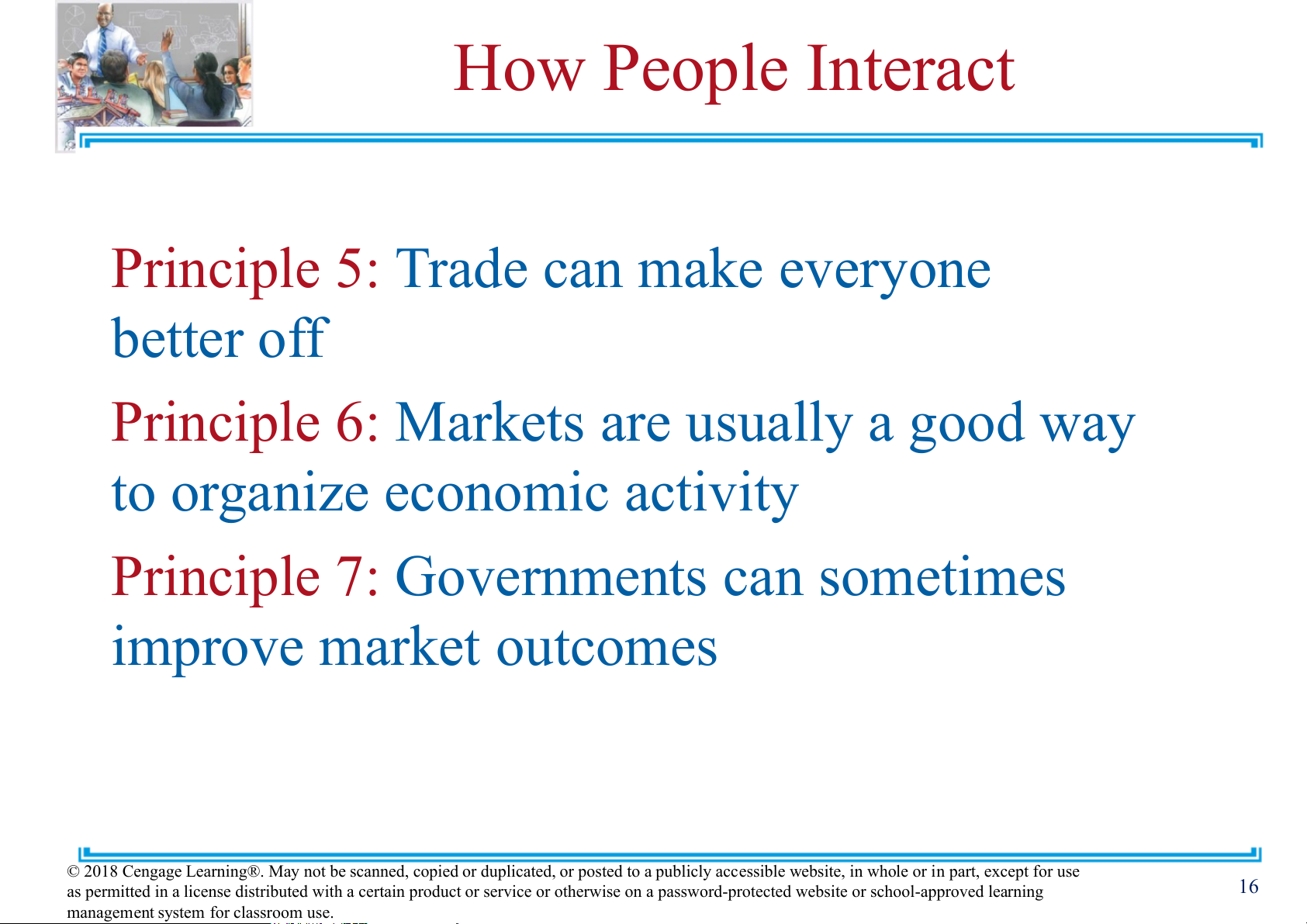
management system for classroom use. How People Interact
Principle 5: Trade can make everyone better off
Principle 6: Markets are usually a good way to organize economic activity
Principle 7: Governments can sometimes improve market outcomes
© 2018 Cengage Learning®. May not be scanned, copied or duplicated, or posted to a publicly accessible website, in whole or in a p rt, except for use
as permitted in a license distributed with a certain product or service or otherwise on a password-protected website or school-approved learning 16
management system for classroom use.
Principle 5: Trade Can Make Everyone Better Off • People benefit from trade:
– People can buy a greater variety of goods and services at lower cost
• Countries benefit from trade and specialization
– Get a better price abroad for goods they produce
– Buy other goods more cheaply from
abroad than could be produced at home
© 2018 Cengage Learning®. May not be scanned, copied or duplicated, or posted to a publicly accessible website, in whole or in a p rt, except for use
as permitted in a license distributed with a certain product or service or otherwise on a password-protected website or school-approved learning 17
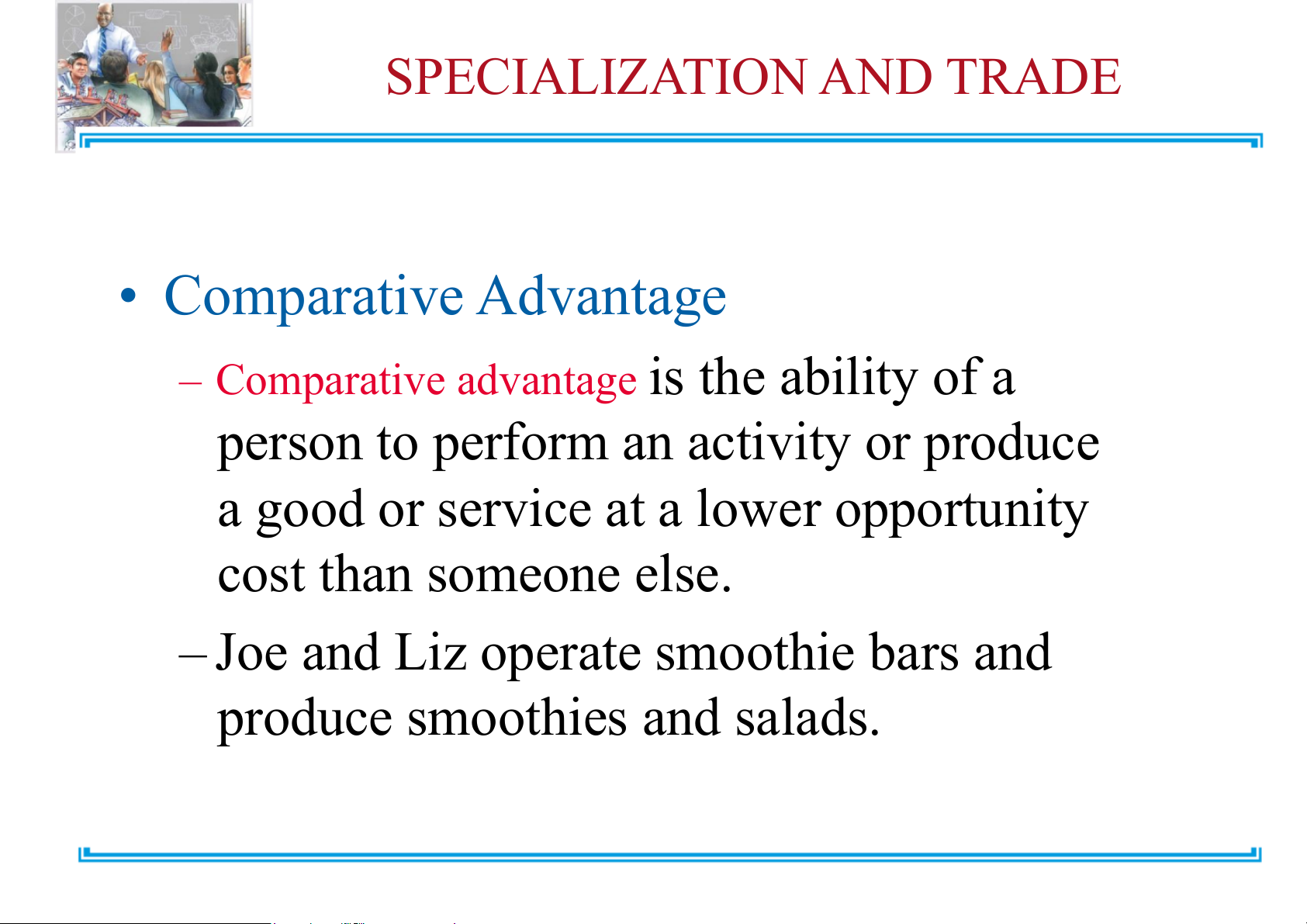
management system for classroom use. SPECIALIZATION AND TRADE • Comparative Advantage
– Comparative advantage is the ability of a
person to perform an activity or produce
a good or service at a lower opportunity cost than someone else.
– Joe and Liz operate smoothie bars and produce smoothies and salads. SPECIALIZATION AND TRADE Liz's Smoothie Bar
In an hour, Liz can produce either 30 smoothies or 30 salads. Liz's opportunity cost of
producing 1 smoothie is 1 salad.
Liz's opportunity cost of producing 1 salad is 1 smoothie.
Each hour, Liz splits her time equally between smoothies and salads and
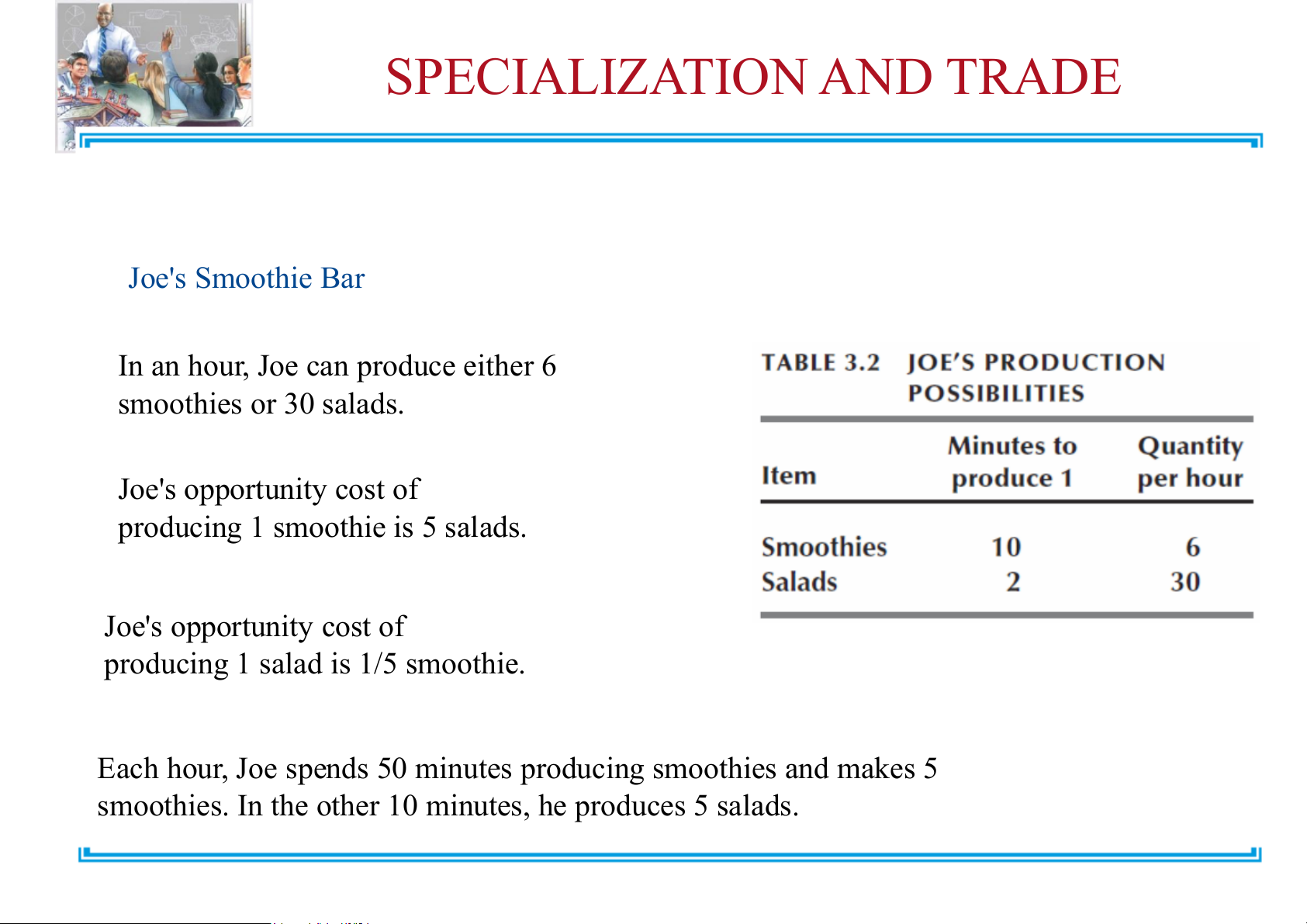
produces 15 smoothies and 15 salads. SPECIALIZATION AND TRADE Joe's Smoothie Bar
In an hour, Joe can produce either 6 smoothies or 30 salads. Joe's opportunity cost of
producing 1 smoothie is 5 salads. Joe's opportunity cost of
producing 1 salad is 1/5 smoothie.
Each hour, Joe spends 50 minutes producing smoothies and makes 5
smoothies. In the other 10 minutes, he produces 5 salads.
Tài liệu liên quan:
-
Chương 3: độ co giãn và các nhân tố ảnh hưởng | Microeconomics | Trường Đại học Quốc tế, Đại học Quốc gia Thành phố Hồ Chí Minh
4 2 -
Microeconomics Syllabus | Microeconomics | Trường Đại học Quốc tế, Đại học Quốc gia Thành phố Hồ Chí Minh
4 2 -
Microeconomics Course Syllabus & Assessment Details | Microeconomics | Trường Đại học Quốc tế, Đại học Quốc gia Thành phố Hồ Chí Minh
4 2 -
Assignment 3 - Elasticity MCQs and Key Concepts | Microeconomics | Trường Đại học Quốc tế, Đại học Quốc gia Thành phố Hồ Chí Minh
4 2 -
Assignment 2 - Economic Equilibrium Analysis of Fridges and Motorcycles | Microeconomics | Trường Đại học Quốc tế, Đại học Quốc gia Thành phố Hồ Chí Minh
4 2