Chapter 1 Summary: Thinking Like an Economist | Microeconomics | Trường Đại học Quốc tế, Đại học Quốc gia Thành phố Hồ Chí Minh
Scarcity is a fundamental fact of life. There is never enough time, money, or energy to do everything we want to do or have everything we’d like to have. Economics is the study of how people make choices under conditions of scarcity and of the results of those choices for society. That such trade-offs are widespread and important is one of the core principles of economics. Tài liệu được sưu tầm và soạn thảo dưới dạng file PDF để gửi tới các bạn cùng tham khảo, ôn tập đầy đủ kiến thức, chuẩn bị cho các buổi học thật tốt. Mời bạn đọc đón xem!
Môn: Microeconomics 635 tài liệu
Trường: Trường Đại học Quốc tế, Đại học Quốc gia Thành phố Hồ Chí Minh 1.9 K tài liệu
Tác giả:

Preview text:
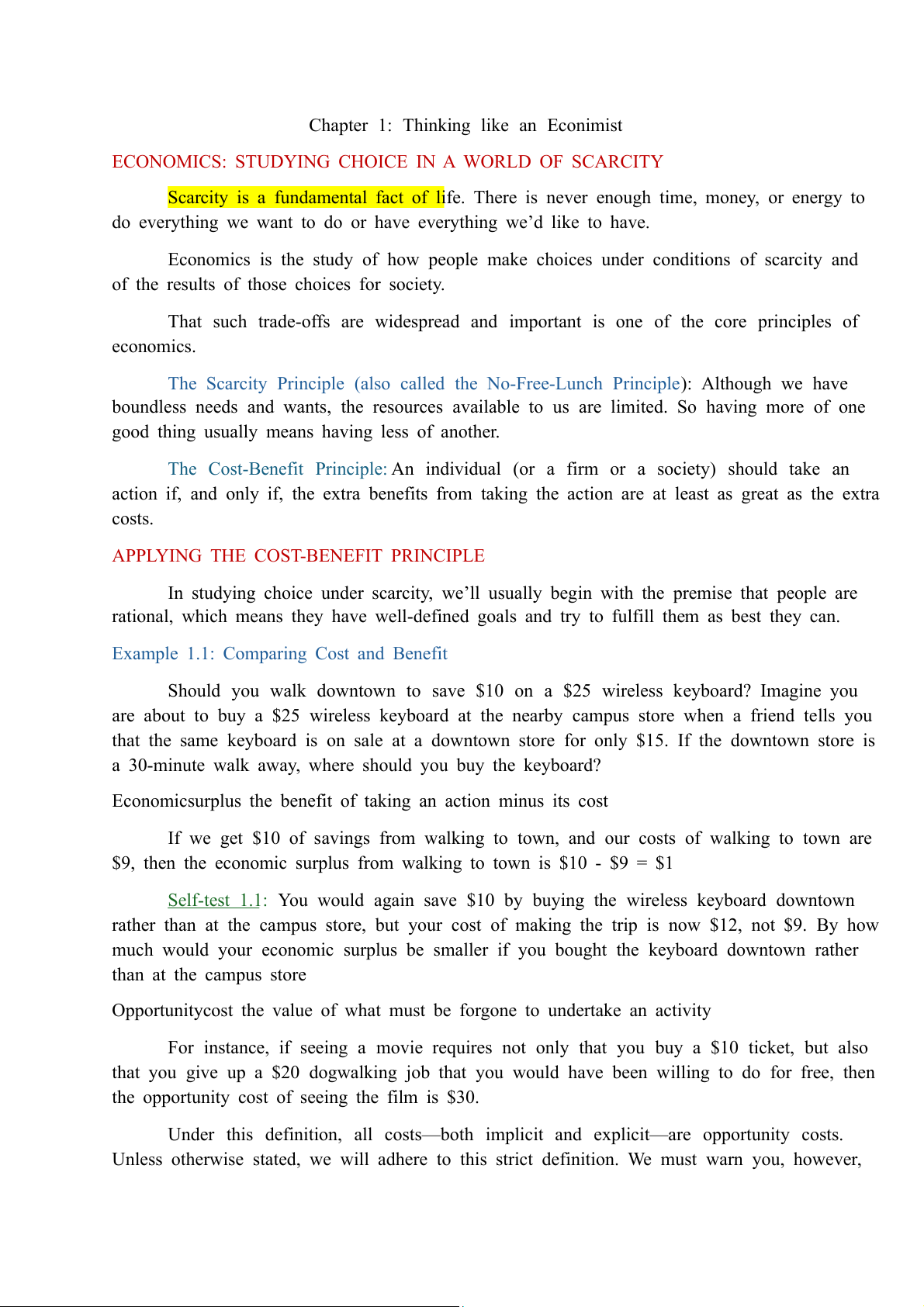
Chapter 1: Thinking like an Econimist
ECONOMICS: STUDYING CHOICE IN A WORLD OF SCARCITY
Scarcity is a fundamental fact of life. There is never enough time, money, or energy to
do everything we want to do or have everything we’d like to have.
Economics is the study of how people make choices under conditions of scarcity and
of the results of those choices for society.
That such trade-offs are widespread and important is one of the core principles of economics.
The Scarcity Principle (also called the No-Free-Lunch Principle): Although we have
boundless needs and wants, the resources available to us are limited. So having more of one
good thing usually means having less of another.
The Cost-Benefit Principle: An individual (or a firm or a society) should take an
action if, and only if, the extra benefits from taking the action are at least as great as the extra costs.
APPLYING THE COST-BENEFIT PRINCIPLE
In studying choice under scarcity, we’ll usually begin with the premise that people are
rational, which means they have well-defined goals and try to fulfill them as best they can.
Example 1.1: Comparing Cost and Benefit
Should you walk downtown to save $10 on a $25 wireless keyboard? Imagine you
are about to buy a $25 wireless keyboard at the nearby campus store when a friend tells you
that the same keyboard is on sale at a downtown store for only $15. If the downtown store is
a 30-minute walk away, where should you buy the keyboard?
Economic surplus the benefit of taking an action minus its cost
If we get $10 of savings from walking to town, and our costs of walking to town are
$9, then the economic surplus from walking to town is $10 - $9 = $1
Self-test 1.1: You would again save $10 by buying the wireless keyboard downtown
rather than at the campus store, but your cost of making the trip is now $12, not $9. By how
much would your economic surplus be smaller if you bought the keyboard downtown rather than at the campus store
Opportunity cost the value of what must be forgone to undertake an activity
For instance, if seeing a movie requires not only that you buy a $10 ticket, but also
that you give up a $20 dogwalking job that you would have been willing to do for free, then
the opportunity cost of seeing the film is $30.
Under this definition, all costs—both implicit and explicit—are opportunity costs.
Unless otherwise stated, we will adhere to this strict definition. We must warn you, however,
that some economists use the term opportunity cost to refer only to the implicit value of opportunities forgone.
Thus, in the example just discussed, these economists wouldn’t include the $10 ticket
price when calculating the oppor tunity cost of seeing the film. But virtually all economists
would agree that your opportunity cost of not doing the dogwalking job is $20.
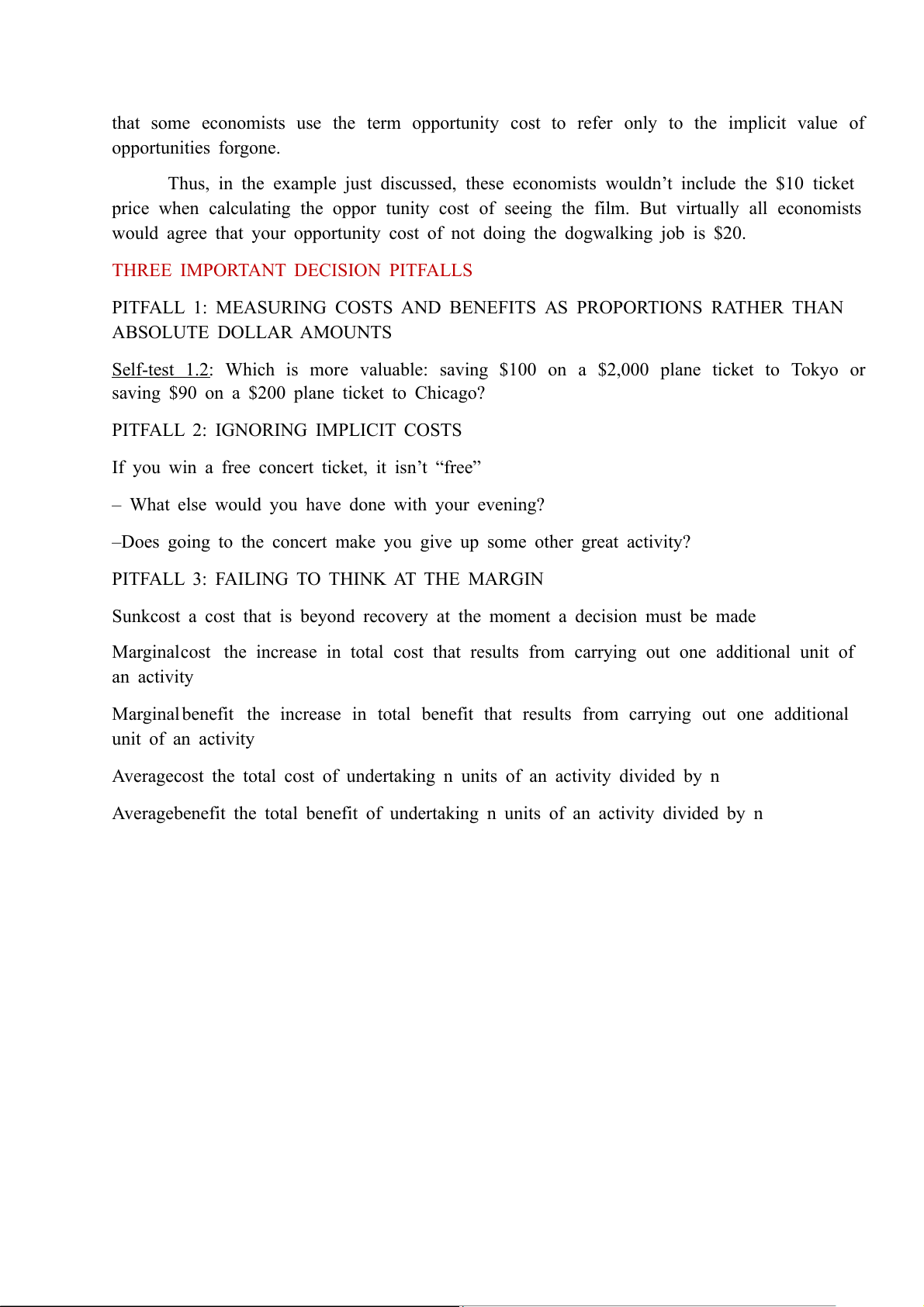
THREE IMPORTANT DECISION PITFALLS
PITFALL 1: MEASURING COSTS AND BENEFITS AS PROPORTIONS RATHER THAN ABSOLUTE DOLLAR AMOUNTS
Self-test 1.2: Which is more valuable: saving $100 on a $2,000 plane ticket to Tokyo or
saving $90 on a $200 plane ticket to Chicago?
PITFALL 2: IGNORING IMPLICIT COSTS
If you win a free concert ticket, it isn’t “free”
– What else would you have done with your evening?
–Does going to the concert make you give up some other great activity?
PITFALL 3: FAILING TO THINK AT THE MARGIN
Sunk cost a cost that is beyond recovery at the moment a decision must be made
Marginal cost the increase in total cost that results from carrying out one additional unit of an activity
Marginal benefit the increase in total benefit that results from carrying out one additional unit of an activity
Average cost the total cost of undertaking n units of an activity divided by n
Average benefit the total benefit of undertaking n units of an activity divided by n
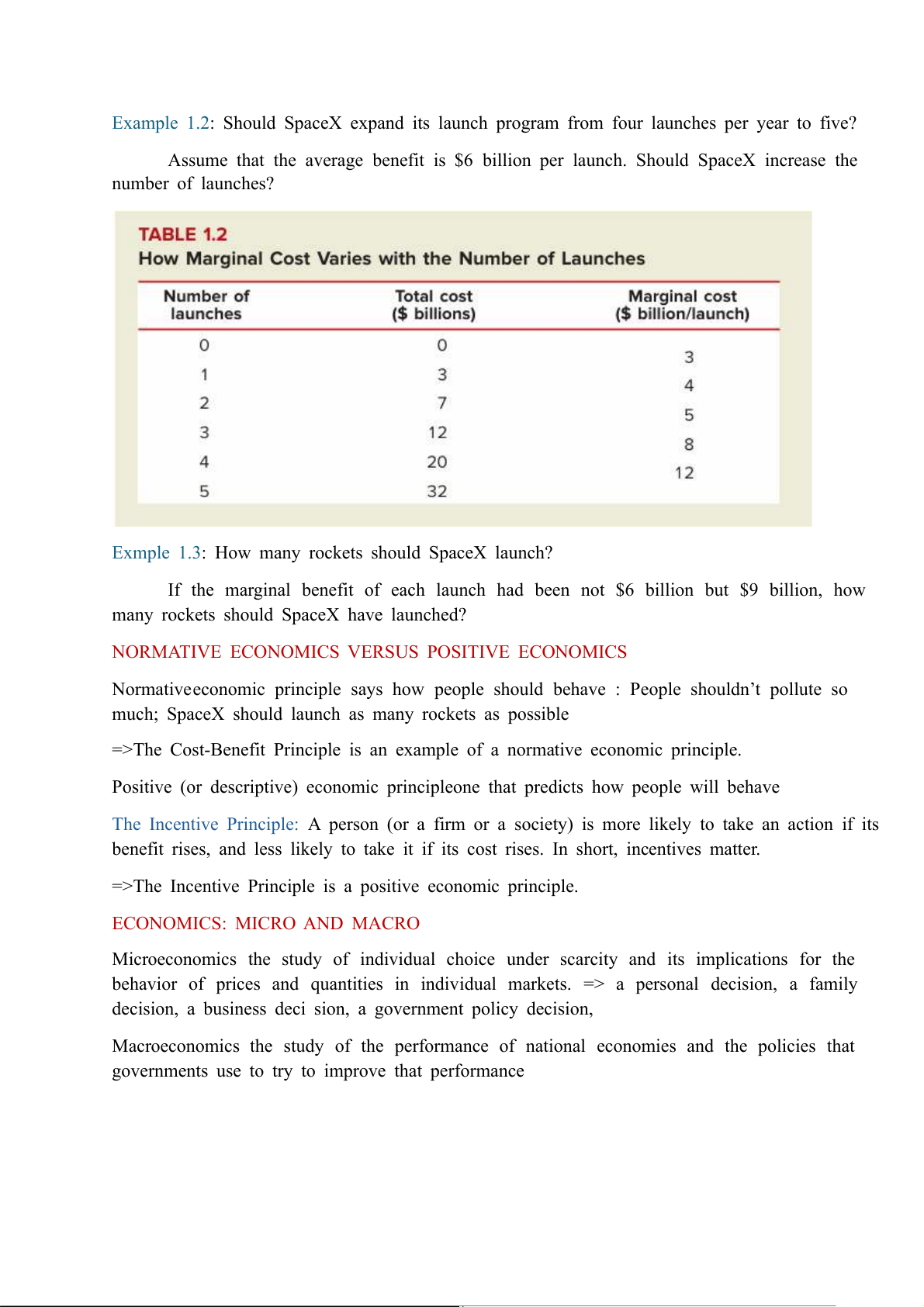
Example 1.2: Should SpaceX expand its launch program from four launches per year to five?
Assume that the average benefit is $6 billion per launch. Should SpaceX increase the number of launches?
Exmple 1.3: How many rockets should SpaceX launch?
If the marginal benefit of each launch had been not $6 billion but $9 billion, how
many rockets should SpaceX have launched?
NORMATIVE ECONOMICS VERSUS POSITIVE ECONOMICS
Normative economic principle says how people should behave : People shouldn’t pollute so
much; SpaceX should launch as many rockets as possible
=>The Cost-Benefit Principle is an example of a normative economic principle.
Positive (or descriptive) economic principleone that predicts how people will behave
The Incentive Principle: A person (or a firm or a society) is more likely to take an action if its
benefit rises, and less likely to take it if its cost rises. In short, incentives matter.
=>The Incentive Principle is a positive economic principle. ECONOMICS: MICRO AND MACRO
Microeconomics the study of individual choice under scarcity and its implications for the
behavior of prices and quantities in individual markets. => a personal decision, a family
decision, a business deci sion, a government policy decision,
Macroeconomics the study of the performance of national economies and the policies that
governments use to try to improve that performance
Tài liệu liên quan:
-
Chương 3: độ co giãn và các nhân tố ảnh hưởng | Microeconomics | Trường Đại học Quốc tế, Đại học Quốc gia Thành phố Hồ Chí Minh
0 0 -
Microeconomics Syllabus | Microeconomics | Trường Đại học Quốc tế, Đại học Quốc gia Thành phố Hồ Chí Minh
1 1 -
Microeconomics Course Syllabus & Assessment Details | Microeconomics | Trường Đại học Quốc tế, Đại học Quốc gia Thành phố Hồ Chí Minh
1 1 -
Assignment 3 - Elasticity MCQs and Key Concepts | Microeconomics | Trường Đại học Quốc tế, Đại học Quốc gia Thành phố Hồ Chí Minh
1 1 -
Assignment 2 - Economic Equilibrium Analysis of Fridges and Motorcycles | Microeconomics | Trường Đại học Quốc tế, Đại học Quốc gia Thành phố Hồ Chí Minh
1 1