Chapter 12 Quiz - Multiple Choice Questions | Microeconomics | Trường Đại học Quốc tế, Đại học Quốc gia Thành phố Hồ Chí Minh
Tài liệu được sưu tầm và soạn thảo dưới dạng file PDF với mục đích hỗ trợ học tập và tham khảo. Nội dung tài liệu được trình bày rõ ràng, dễ tiếp cận, phù hợp cho việc ôn tập và củng cố kiến thức trong quá trình học đại học. Đây sẽ là nguồn tư liệu hữu ích giúp các bạn sinh viên chuẩn bị tốt hơn cho các buổi học, đồng thời mở rộng thêm hiểu biết về môn học. Hy vọng tài liệu này sẽ mang lại nhiều giá trị và hỗ trợ các bạn trong hành trình học tập. Mời bạn đọc cùng tham khảo!
Môn: Microeconomics 635 tài liệu
Trường: Trường Đại học Quốc tế, Đại học Quốc gia Thành phố Hồ Chí Minh 1.9 K tài liệu
Tác giả:

Preview text:
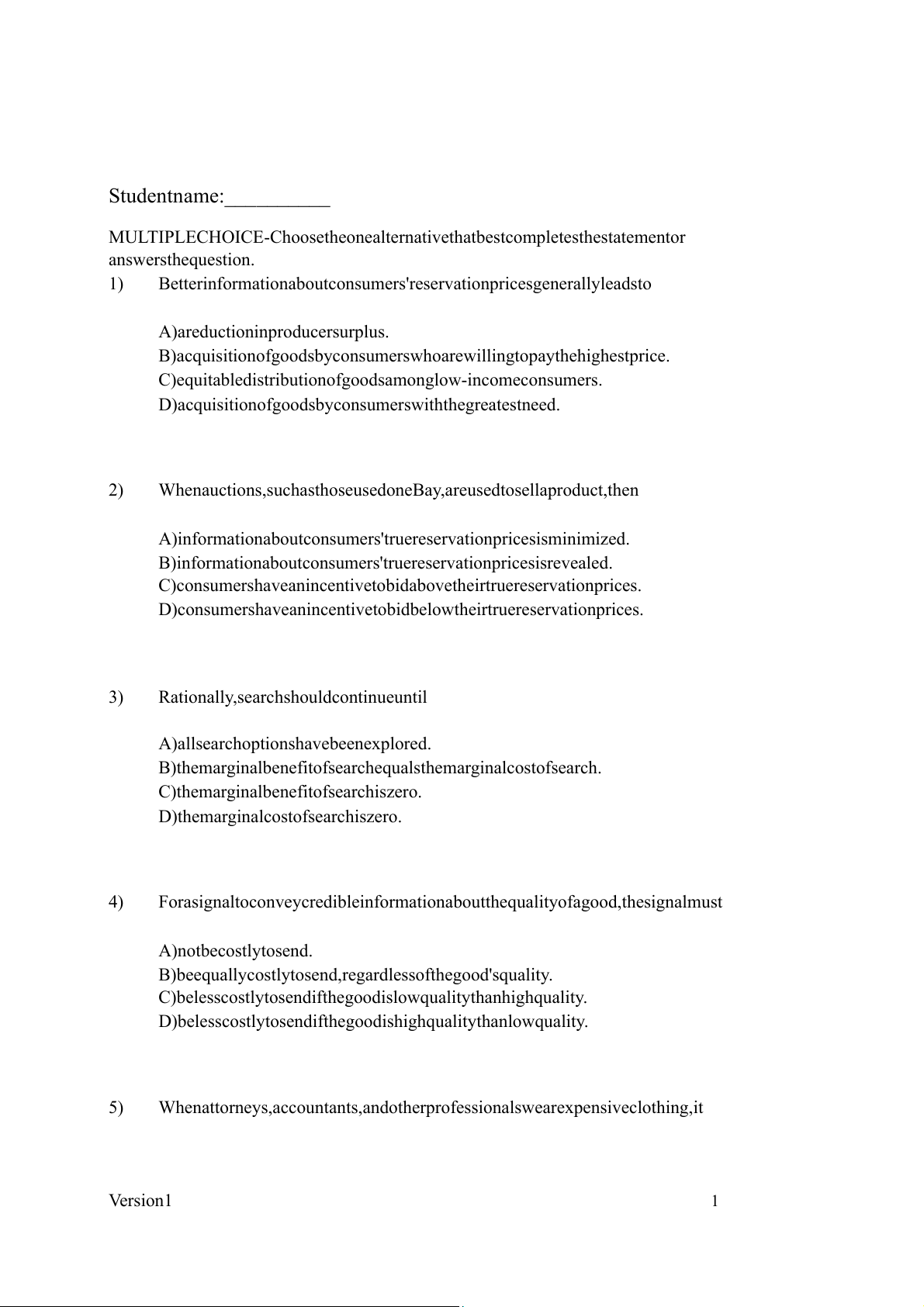
Student name:__________
MULTIPLE CHOICE - Choose the one alternative that best completes the statement or
answers the question. 1)
Better information about consumers' reservation prices generally leads to
A) a reduction in producer surplus.
B) acquisition of goods by consumers who are willing to pay the highest price.
C) equitable distribution of goods among low-income consumers.
D) acquisition of goods by consumers with the greatest need. 2)
When auctions, such as those used on eBay, are used to sell a product, then
A) information about consumers' true reservation prices is minimized.
B) information about consumers' true reservation prices is revealed.
C) consumers have an incentive to bid above their true reservation prices.
D) consumers have an incentive to bid below their true reservation prices. 3)
Rationally, search should continue until
A) all search options have been explored.
B) the marginal benefit of search equals the marginal cost of search.
C) the marginal benefit of search is zero.
D) the marginal cost of search is zero. 4)
For a signal to convey credible information about the quality of a good, the signal must A) not be costly to send.
B) be equally costly to send, regardless of the good's quality.
C) be less costly to send if the good is low quality than high quality.
D) be less costly to send if the good is high quality than low quality. 5)
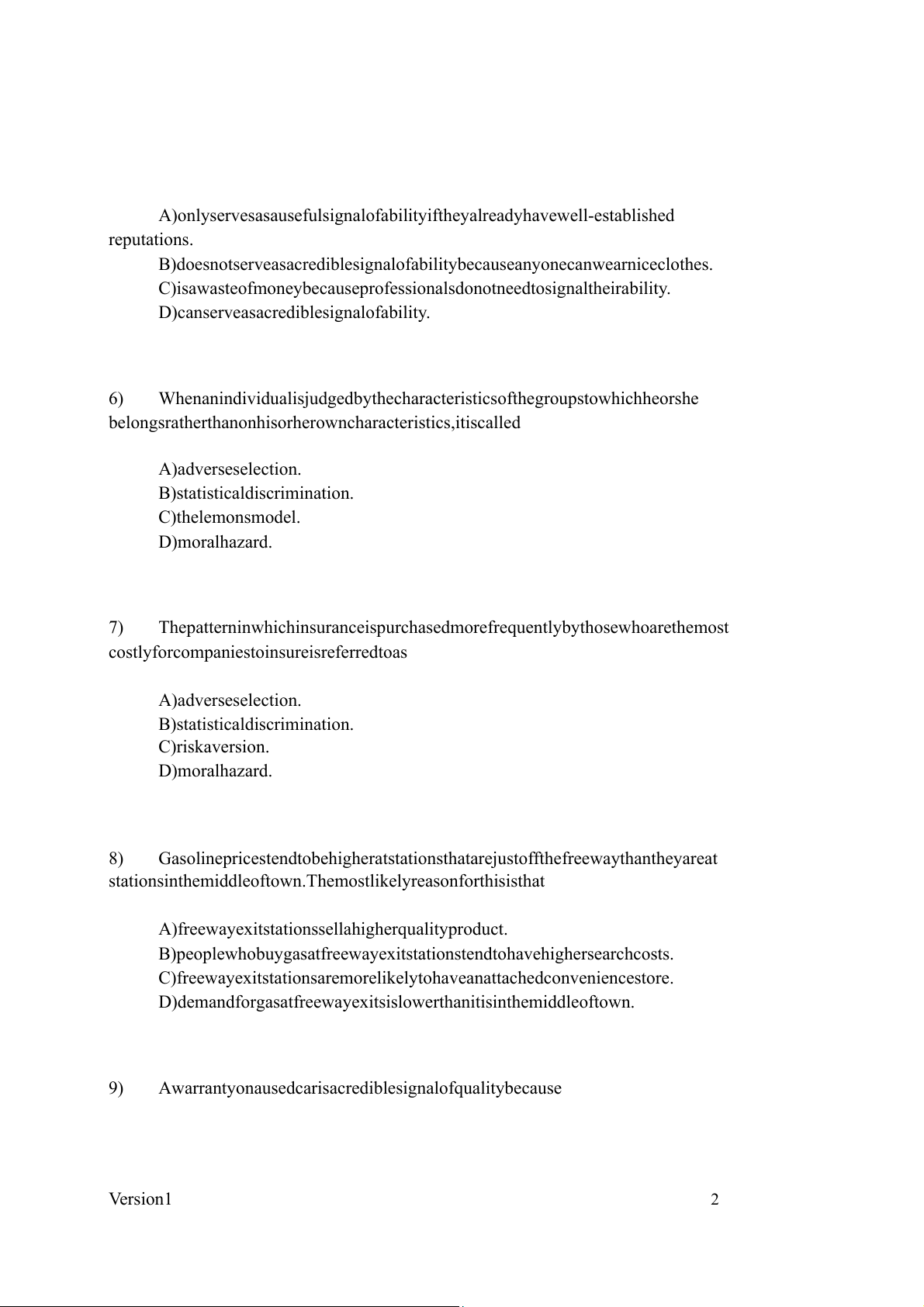
When attorneys, accountants, and other professionals wear expensive clothing, it Version 1 1
A) only serves as a useful signal of ability if they already have well-established reputations.
B) does not serve as a credible signal of ability because anyone can wear nice clothes.
C) is a waste of money because professionals do not need to signal their ability.
D) can serve as a credible signal of ability. 6)
When an individual is judged by the characteristics of the groups to which he or she
belongs rather than on his or her own characteristics, it is called A) adverse selection.
B) statistical discrimination. C) the lemons model. D) moral hazard. 7)
The pattern in which insurance is purchased more frequently by those who are the most
costly for companies to insure is referred to as A) adverse selection.
B) statistical discrimination. C) risk aversion. D) moral hazard. 8)
Gasoline prices tend to be higher at stations that are just off the freeway than they are at
stations in the middle of town. The most likely reason for this is that
A) freeway exit stations sell a higher quality product.
B) people who buy gas at freeway exit stations tend to have higher search costs.
C) freeway exit stations are more likely to have an attached convenience store.
D) demand for gas at freeway exits is lower than it is in the middle of town. 9)
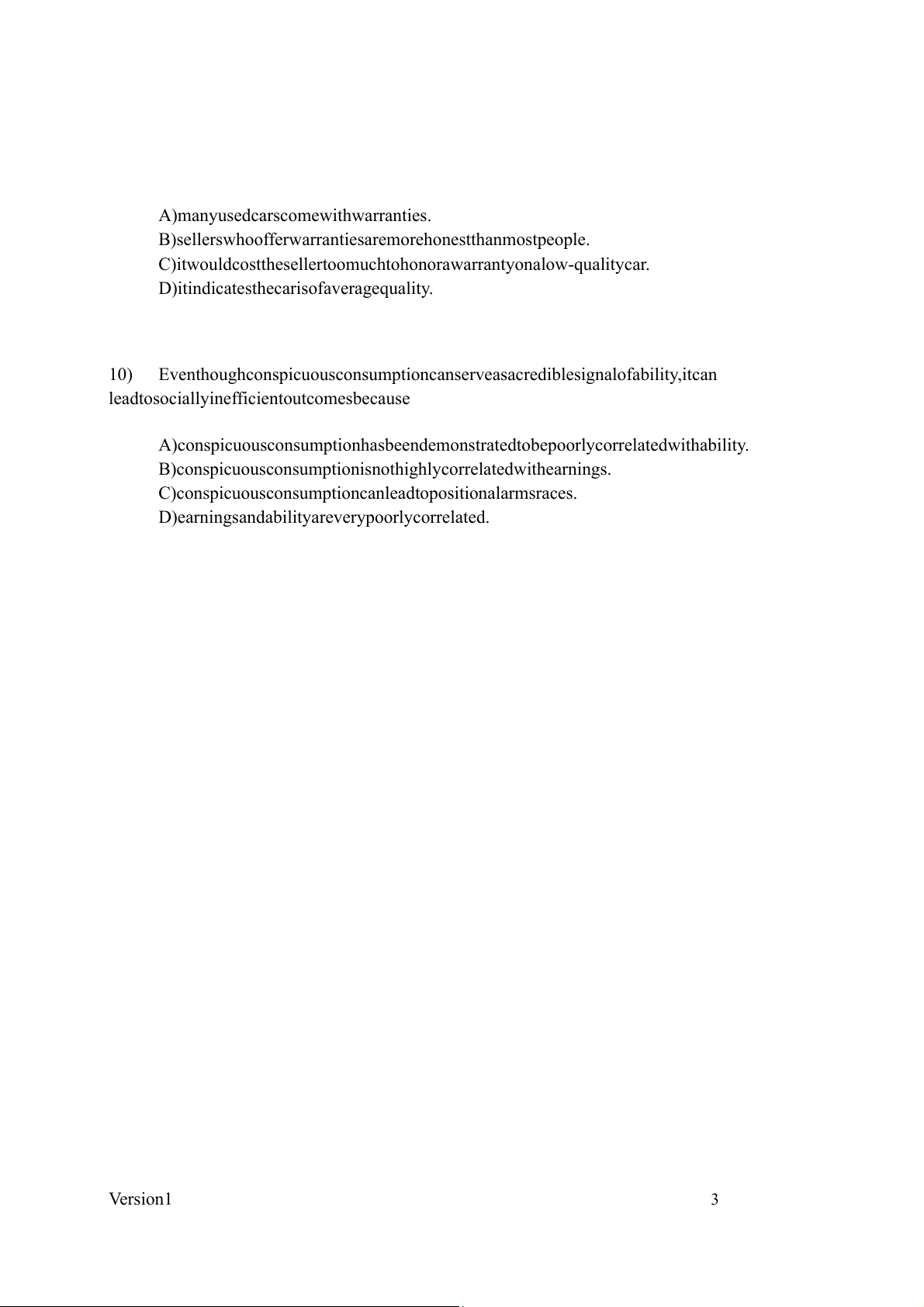
A warranty on a used car is a credible signal of quality because Version 1 2
A) many used cars come with warranties.
B) sellers who offer warranties are more honest than most people.
C) it would cost the seller too much to honor a warranty on a low-quality car.
D) it indicates the car is of average quality. 10)
Even though conspicuous consumption can serve as a credible signal of ability, it can
lead to socially inefficient outcomes because
A) conspicuous consumption has been demonstrated to be poorly correlated with ability.
B) conspicuous consumption is not highly correlated with earnings.
C) conspicuous consumption can lead to positional arms races.
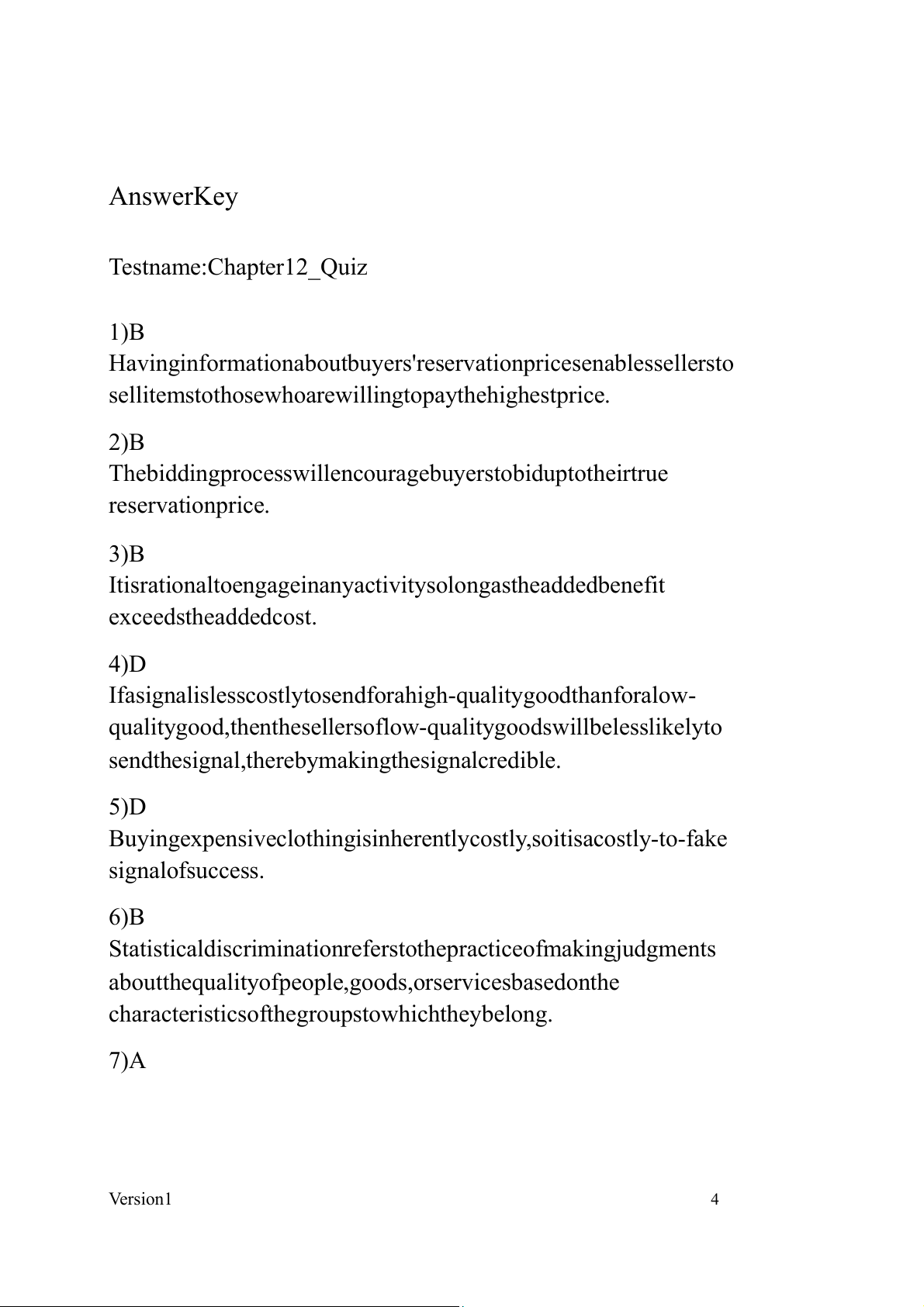
D) earnings and ability are very poorly correlated. Version 1 3 Answer Key
Test name: Chapter 12_Quiz 1) B
Having information about buyers' reservation prices enables sellers to
sell items to those who are willing to pay the highest price. 2) B
The bidding process will encourage buyers to bid up to their true reservation price. 3) B
It is rational to engage in any activity so long as the added benefit exceeds the added cost. 4) D
If a signal is less costly to send for a high-quality good than for a low-
quality good, then the sellers of low-quality goods will be less likely to
send the signal, thereby making the signal credible. 5) D
Buying expensive clothing is inherently costly, so it is a costly-to-fake signal of success. 6) B
Statistical discrimination refers to the practice of making judgments
about the quality of people, goods, or services based on the
characteristics of the groups to which they belong. 7) A Version 1 4
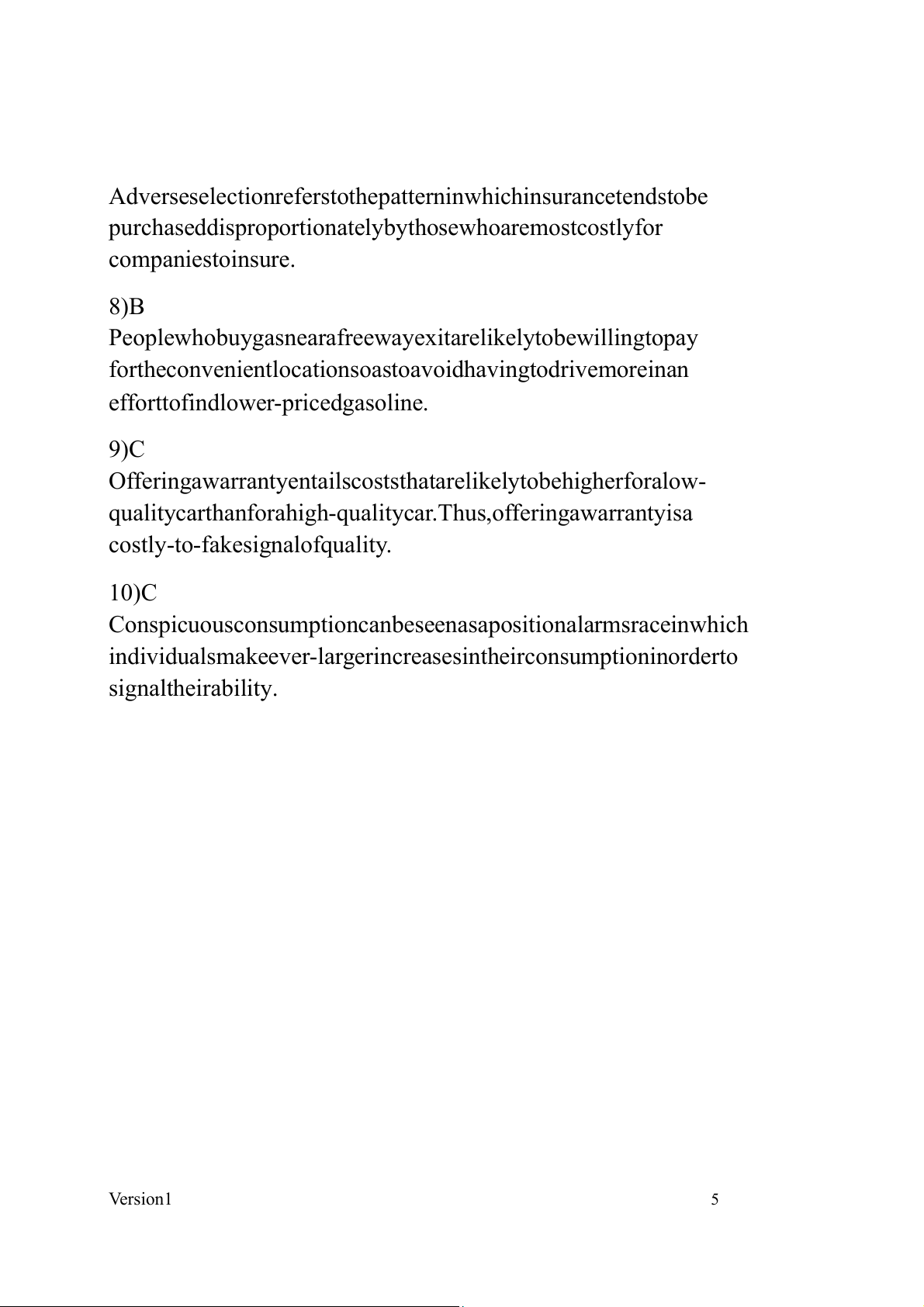
Adverse selection refers to the pattern in which insurance tends to be
purchased disproportionately by those who are most costly for companies to insure. 8) B
People who buy gas near a freeway exit are likely to be willing to pay
for the convenient location so as to avoid having to drive more in an
effort to find lower-priced gasoline. 9) C
Offering a warranty entails costs that are likely to be higher for a low-
quality car than for a high-quality car. Thus, offering a warranty is a
costly-to-fake signal of quality. 10) C
Conspicuous consumption can be seen as a positional arms race in which
individuals make ever-larger increases in their consumption in order to signal their ability . Version 1 5
Tài liệu liên quan:
-
Chương 3: độ co giãn và các nhân tố ảnh hưởng | Microeconomics | Trường Đại học Quốc tế, Đại học Quốc gia Thành phố Hồ Chí Minh
4 2 -
Microeconomics Syllabus | Microeconomics | Trường Đại học Quốc tế, Đại học Quốc gia Thành phố Hồ Chí Minh
4 2 -
Microeconomics Course Syllabus & Assessment Details | Microeconomics | Trường Đại học Quốc tế, Đại học Quốc gia Thành phố Hồ Chí Minh
4 2 -
Assignment 3 - Elasticity MCQs and Key Concepts | Microeconomics | Trường Đại học Quốc tế, Đại học Quốc gia Thành phố Hồ Chí Minh
4 2 -
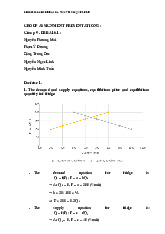
Assignment 2 - Economic Equilibrium Analysis of Fridges and Motorcycles | Microeconomics | Trường Đại học Quốc tế, Đại học Quốc gia Thành phố Hồ Chí Minh
4 2