Chapter 13: True/False Statements on Production Costs | Microeconomics | Trường Đại học Quốc tế, Đại học Quốc gia Thành phố Hồ Chí Minh
Input elasticity of output is equal to the ratio of marginal product divided by average product. 2. Cobb-Douglas production function ( Q = K^{0.3}L^{0.7} ) indicates that capital elasticity of output is greater than labour elasticity of output. 3. When a production function becomes steeper, the marginal product is decreasing. 4. When total output is increasing, the marginal product of a variable input can still decrease but must be greater than zero. Tài liệu được sưu tầm và soạn thảo dưới dạng file PDF để gửi tới các bạn cùng tham khảo, ôn tập đầy đủ kiến thức, chuẩn bị cho các buổi học thật tốt. Mời bạn đọc đón xem!
Môn: Microeconomics 635 tài liệu
Trường: Trường Đại học Quốc tế, Đại học Quốc gia Thành phố Hồ Chí Minh 1.9 K tài liệu
Tác giả:


Preview text:
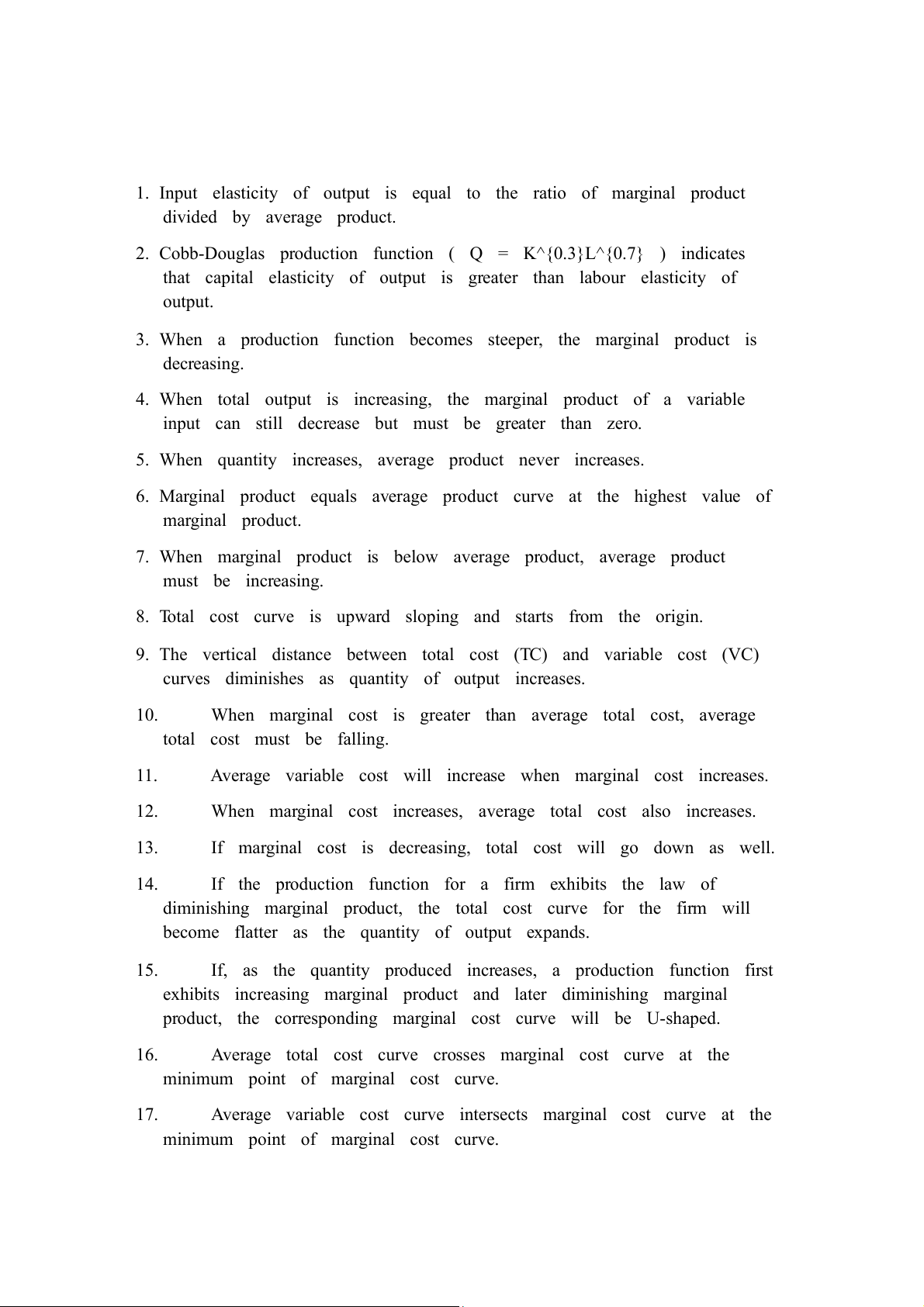
1. Input elasticity of output is equal to the ratio of marginal product divided by average product.
2. Cobb-Douglas production function ( Q = K^{0.3}L^{0.7} ) indicates
that capital elasticity of output is greater than labour elasticity of output.
3. When a production function becomes steeper, the marginal product is decreasing.
4. When total output is increasing, the marginal product of a variable
input can still decrease but must be greater than zero.
5. When quantity increases, average product never increases.
6. Marginal product equals average product curve at the highest value of marginal product.
7. When marginal product is below average product, average product must be increasing.
8. Total cost curve is upward sloping and starts from the origin.
9. The vertical distance between total cost (TC) and variable cost (VC)
curves diminishes as quantity of output increases. 10.
When marginal cost is greater than average total cost, average total cost must be falling. 11.
Average variable cost will increase when marginal cost increases. 12.
When marginal cost increases, average total cost also increases. 13.
If marginal cost is decreasing, total cost will go down as well. 14.
If the production function for a firm exhibits the law of
diminishing marginal product, the total cost curve for the firm will
become flatter as the quantity of output expands. 15.
If, as the quantity produced increases, a production function first
exhibits increasing marginal product and later diminishing marginal
product, the corresponding marginal cost curve will be U-shaped. 16.
Average total cost curve crosses marginal cost curve at the
minimum point of marginal cost curve. 17.
Average variable cost curve intersects marginal cost curve at the
minimum point of marginal cost curve. 18.
The vertical distance between average total cost curve and
average variable cost curve remains unchanged when quantity of output changes. 19.
All average cost curves in short-run production are U-shaped. 20.
Marginal cost curve crosses all average cost curves at their minimum points. 21.
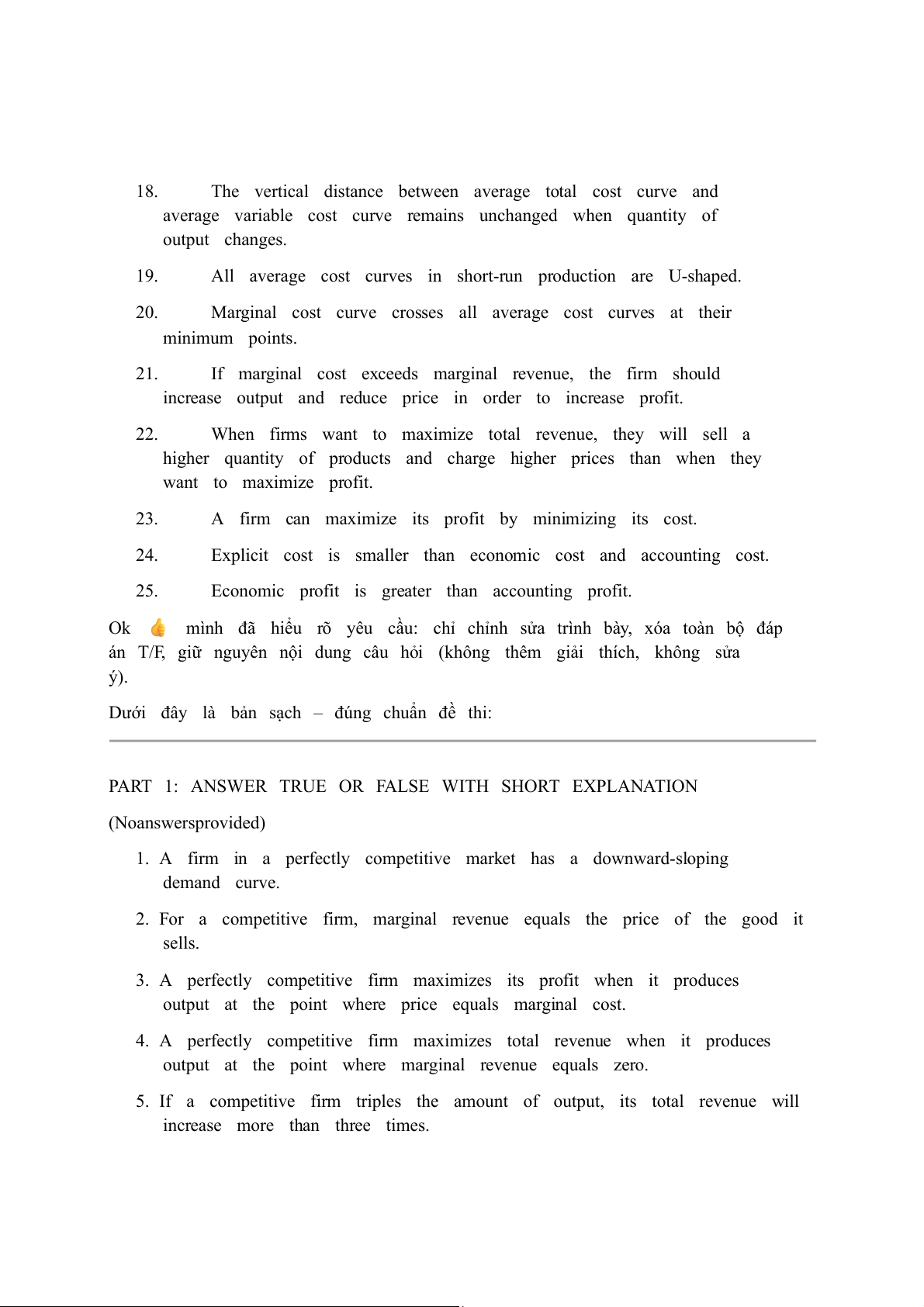
If marginal cost exceeds marginal revenue, the firm should
increase output and reduce price in order to increase profit. 22.
When firms want to maximize total revenue, they will sell a
higher quantity of products and charge higher prices than when they want to maximize profit. 23.
A firm can maximize its profit by minimizing its cost. 24.
Explicit cost is smaller than economic cost and accounting cost. 25.
Economic profit is greater than accounting profit.
Ok 👍 mình đã hiểu rõ yêu cầu: chỉ chỉnh sửa trình bày, xóa toàn bộ đáp
án T/F, giữ nguyên nội dung câu hỏi (không thêm giải thích, không sửa ý).
Dưới đây là bản sạch – đúng chuẩn đề thi:
PART 1: ANSWER TRUE OR FALSE WITH SHORT EXPLANATION
(No answers provided)
1. A firm in a perfectly competitive market has a downward-sloping demand curve.
2. For a competitive firm, marginal revenue equals the price of the good it sells.
3. A perfectly competitive firm maximizes its profit when it produces
output at the point where price equals marginal cost.
4. A perfectly competitive firm maximizes total revenue when it produces
output at the point where marginal revenue equals zero.
5. If a competitive firm triples the amount of output, its total revenue will
increase more than three times.
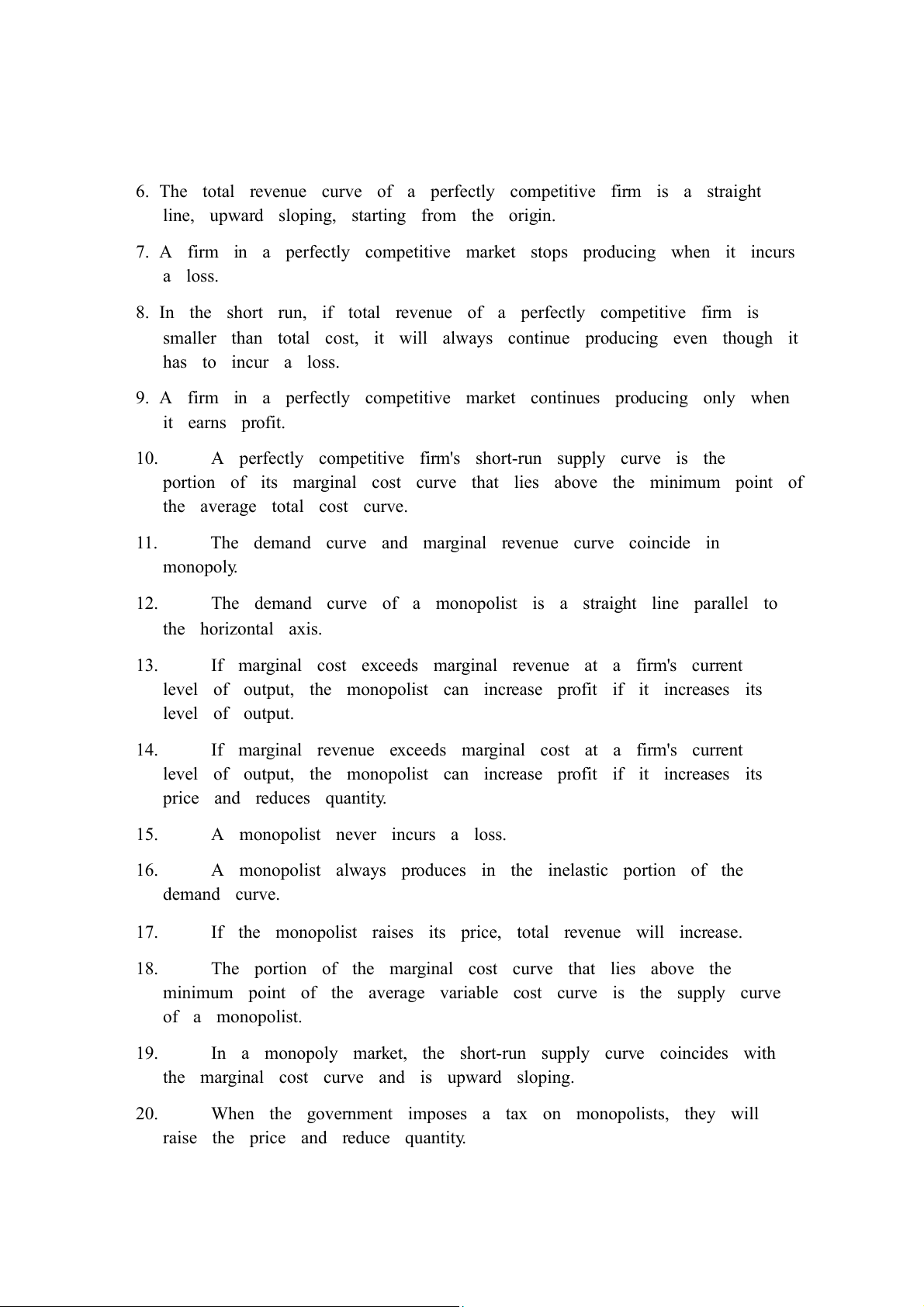
6. The total revenue curve of a perfectly competitive firm is a straight
line, upward sloping, starting from the origin.
7. A firm in a perfectly competitive market stops producing when it incurs a loss.
8. In the short run, if total revenue of a perfectly competitive firm is
smaller than total cost, it will always continue producing even though it has to incur a loss.
9. A firm in a perfectly competitive market continues producing only when it earns profit. 10.
A perfectly competitive firm's short-run supply curve is the
portion of its marginal cost curve that lies above the minimum point of the average total cost curve. 11.
The demand curve and marginal revenue curve coincide in monopoly. 12.
The demand curve of a monopolist is a straight line parallel to the horizontal axis. 13.
If marginal cost exceeds marginal revenue at a firm's current
level of output, the monopolist can increase profit if it increases its level of output. 14.
If marginal revenue exceeds marginal cost at a firm's current
level of output, the monopolist can increase profit if it increases its price and reduces quantity. 15.
A monopolist never incurs a loss. 16.
A monopolist always produces in the inelastic portion of the demand curve. 17.
If the monopolist raises its price, total revenue will increase. 18.
The portion of the marginal cost curve that lies above the
minimum point of the average variable cost curve is the supply curve of a monopolist. 19.
In a monopoly market, the short-run supply curve coincides with
the marginal cost curve and is upward sloping. 20.
When the government imposes a tax on monopolists, they will
raise the price and reduce quantity. 21.
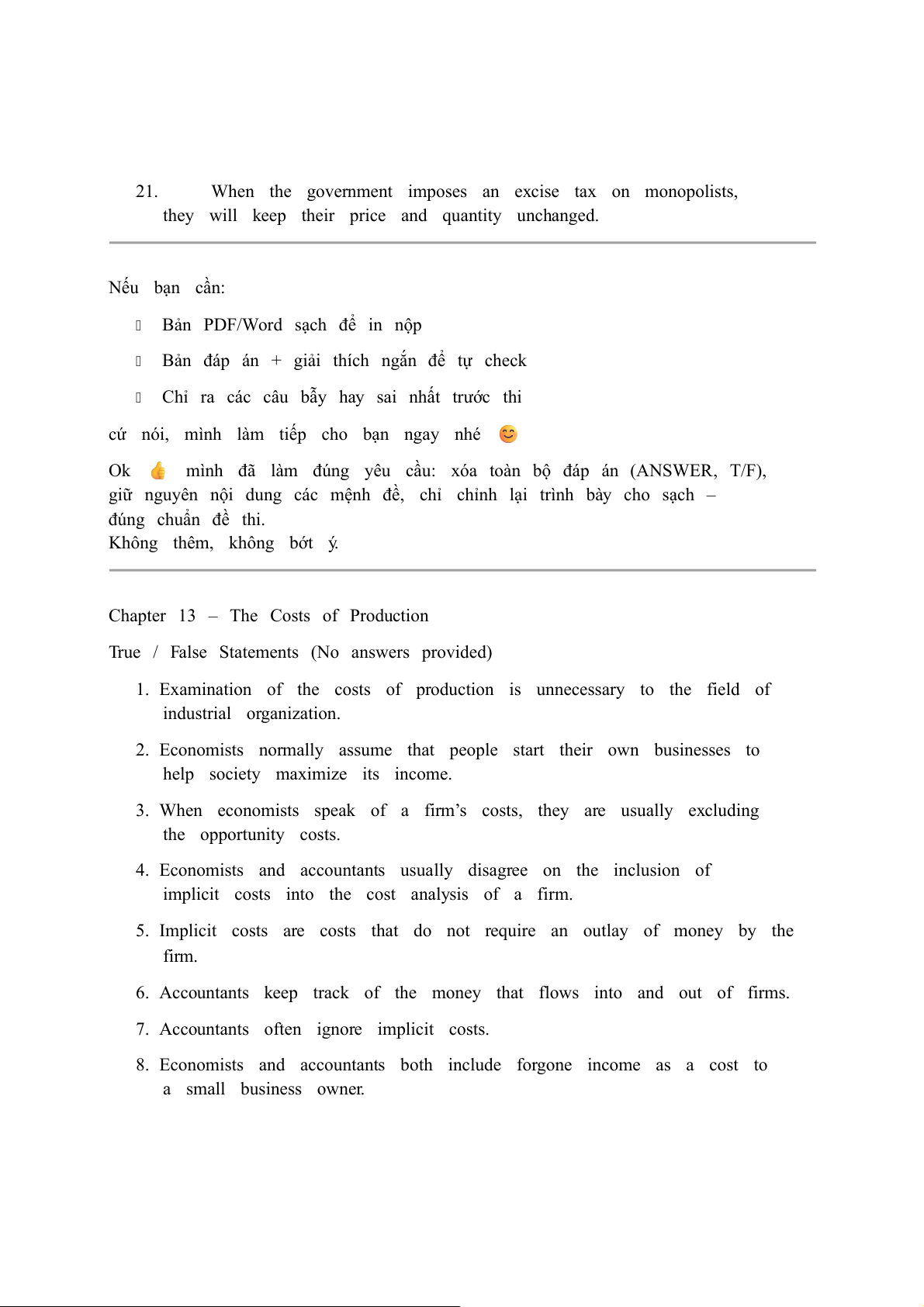
When the government imposes an excise tax on monopolists,
they will keep their price and quantity unchanged. Nếu bạn cần:
Bản PDF/Word sạch để in nộp
Bản đáp án + giải thích ngắn để tự check
Chỉ ra các câu bẫy hay sai nhất trước thi
cứ nói, mình làm tiếp cho bạn ngay nhé 😊
Ok 👍 mình đã làm đúng yêu cầu: xóa toàn bộ đáp án (ANSWER, T/F),
giữ nguyên nội dung các mệnh đề, chỉ chỉnh
lại trình bày cho sạch –
đúng chuẩn đề thi. Không thêm, không bớt ý.
Chapter 13 – The Costs of Production
True / False Statements (No answers provided)
1. Examination of the costs of production is unnecessary to the field of industrial organization.
2. Economists normally assume that people start their own businesses to
help society maximize its income.
3. When economists speak of a firm’s costs, they are usually excluding the opportunity costs.
4. Economists and accountants usually disagree on the inclusion of
implicit costs into the cost analysis of a firm.
5. Implicit costs are costs that do not require an outlay of money by the firm.
6. Accountants keep track of the money that flows into and out of firms.
7. Accountants often ignore implicit costs.
8. Economists and accountants both include forgone income as a cost to a small business owner.
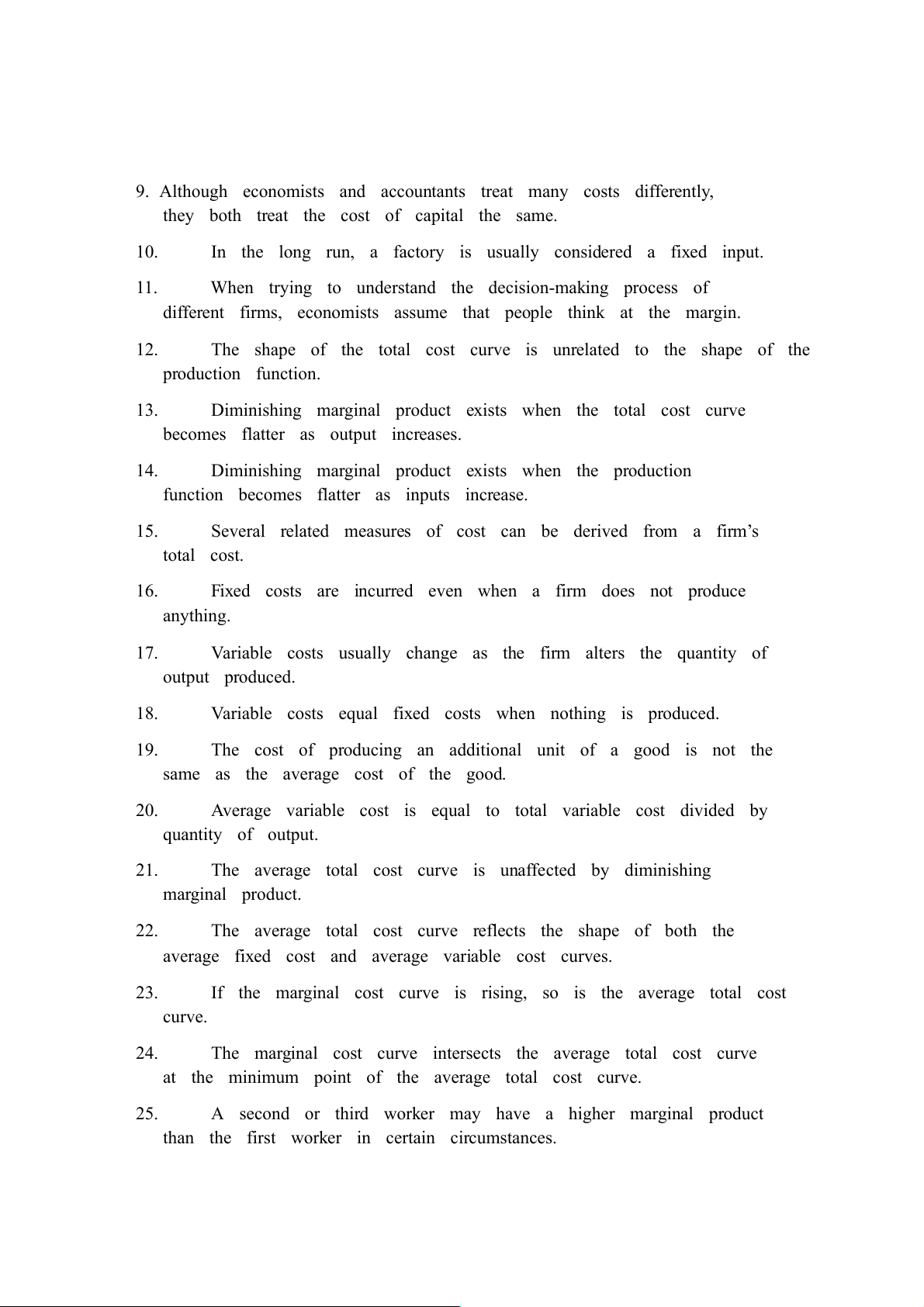
9. Although economists and accountants treat many costs differently,
they both treat the cost of capital the same. 10.
In the long run, a factory is usually considered a fixed input. 11.
When trying to understand the decision-making process of
different firms, economists assume that people think at the margin. 12.
The shape of the total cost curve is unrelated to the shape of the production function. 13.
Diminishing marginal product exists when the total cost curve
becomes flatter as output increases. 14.
Diminishing marginal product exists when the production
function becomes flatter as inputs increase. 15.
Several related measures of cost can be derived from a firm’s total cost. 16.
Fixed costs are incurred even when a firm does not produce anything. 17.
Variable costs usually change as the firm alters the quantity of output produced. 18.
Variable costs equal fixed costs when nothing is produced. 19.
The cost of producing an additional unit of a good is not the
same as the average cost of the good. 20.
Average variable cost is equal to total variable cost divided by quantity of output. 21.
The average total cost curve is unaffected by diminishing marginal product. 22.
The average total cost curve reflects the shape of both the
average fixed cost and average variable cost curves. 23.
If the marginal cost curve is rising, so is the average total cost curve. 24.
The marginal cost curve intersects the average total cost curve
at the minimum point of the average total cost curve. 25.
A second or third worker may have a higher marginal product
than the first worker in certain circumstances. 26.
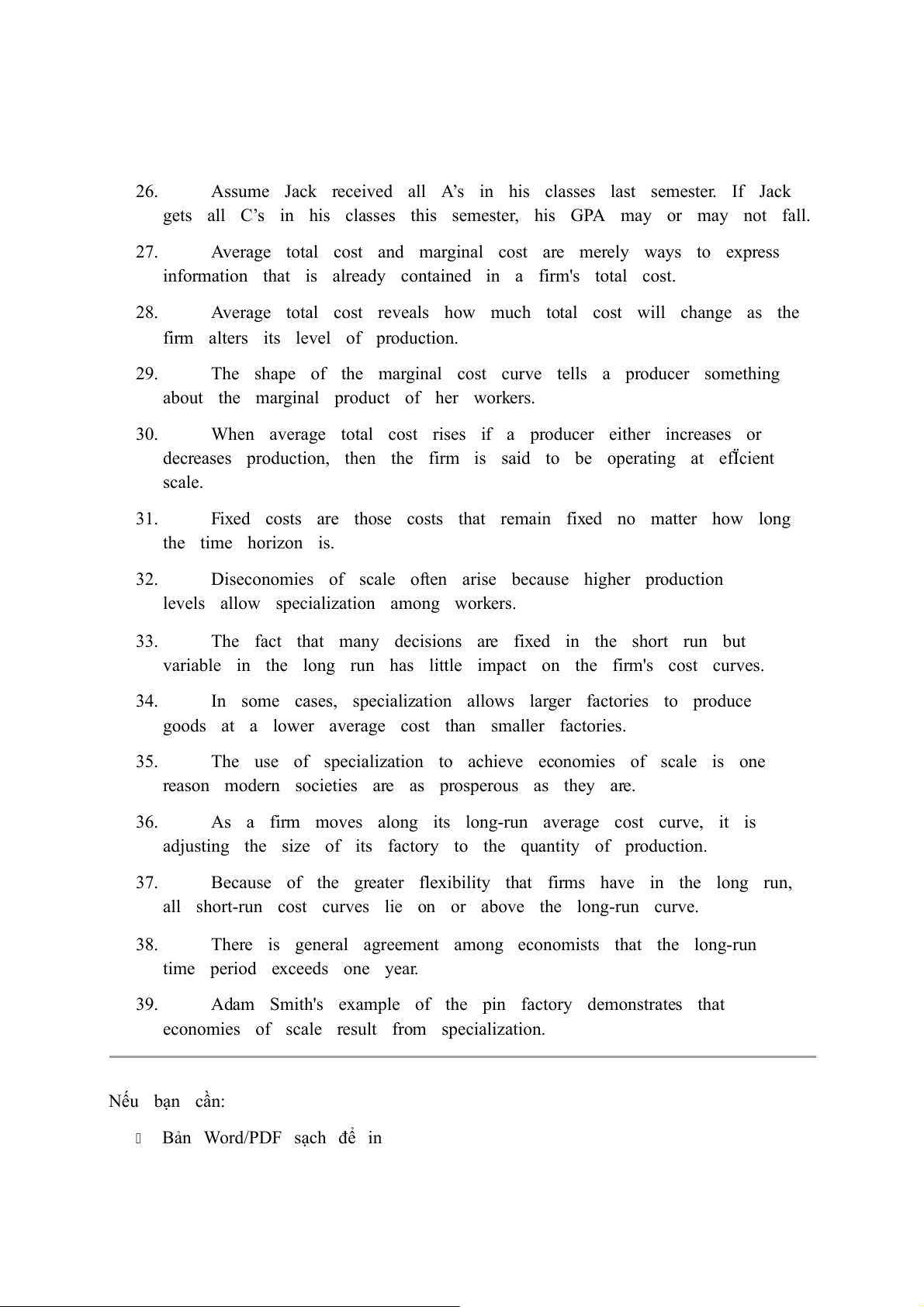
Assume Jack received all A’s in his classes last semester. If Jack
gets all C’s in his classes this semester, his GPA may or may not fall. 27.
Average total cost and marginal cost are merely ways to express
information that is already contained in a firm's total cost. 28.
Average total cost reveals how much total cost will change as the
firm alters its level of production. 29.
The shape of the marginal cost curve tells a producer something
about the marginal product of her workers. 30.
When average total cost rises if a producer either increases or
decreases production, then the firm is said to be operating at efÏcient scale. 31.
Fixed costs are those costs that remain fixed no matter how long the time horizon is. 32.
Diseconomies of scale often arise because higher production
levels allow specialization among workers. 33.
The fact that many decisions are fixed in the short run but
variable in the long run has little impact on the firm's cost curves. 34.
In some cases, specialization allows larger factories to produce
goods at a lower average cost than smaller factories. 35.
The use of specialization to achieve economies of scale is one
reason modern societies are as prosperous as they are. 36.
As a firm moves along its long-run average cost curve, it is
adjusting the size of its factory to the quantity of production. 37.
Because of the greater flexibility that firms have in the long run,
all short-run cost curves lie on or above the long-run curve. 38.
There is general agreement among economists that the long-run time period exceeds one year. 39.
Adam Smith's example of the pin factory demonstrates that
economies of scale result from specialization. Nếu bạn cần:
Bản Word/PDF sạch để in
Bản đáp án + giải thích ngắn theo đúng giáo trình Mankiw
Khoanh vùng các câu “bẫy rất hay thi” của Chapter 13
cứ nói, mình làm tiếp cho bạn ngay nhé 📘✨
Tài liệu liên quan:
-
Chương 3: độ co giãn và các nhân tố ảnh hưởng | Microeconomics | Trường Đại học Quốc tế, Đại học Quốc gia Thành phố Hồ Chí Minh
4 2 -
Microeconomics Syllabus | Microeconomics | Trường Đại học Quốc tế, Đại học Quốc gia Thành phố Hồ Chí Minh
4 2 -
Microeconomics Course Syllabus & Assessment Details | Microeconomics | Trường Đại học Quốc tế, Đại học Quốc gia Thành phố Hồ Chí Minh
4 2 -
Assignment 3 - Elasticity MCQs and Key Concepts | Microeconomics | Trường Đại học Quốc tế, Đại học Quốc gia Thành phố Hồ Chí Minh
4 2 -
Assignment 2 - Economic Equilibrium Analysis of Fridges and Motorcycles | Microeconomics | Trường Đại học Quốc tế, Đại học Quốc gia Thành phố Hồ Chí Minh
4 2