Chapter 14 Quiz - Multiple Choice Questions | Microeconomics | Trường Đại học Quốc tế, Đại học Quốc gia Thành phố Hồ Chí Minh
Tài liệu được sưu tầm và soạn thảo dưới dạng file PDF với mục đích hỗ trợ học tập và tham khảo. Nội dung tài liệu được trình bày rõ ràng, dễ tiếp cận, phù hợp cho việc ôn tập và củng cố kiến thức trong quá trình học đại học. Đây sẽ là nguồn tư liệu hữu ích giúp các bạn sinh viên chuẩn bị tốt hơn cho các buổi học, đồng thời mở rộng thêm hiểu biết về môn học. Hy vọng tài liệu này sẽ mang lại nhiều giá trị và hỗ trợ các bạn trong hành trình học tập. Mời bạn đọc cùng tham khảo!
Môn: Microeconomics 635 tài liệu
Trường: Trường Đại học Quốc tế, Đại học Quốc gia Thành phố Hồ Chí Minh 1.9 K tài liệu
Tác giả:

Preview text:
Student name:__________
MULTIPLE CHOICE - Choose the one alternative that best completes the statement or
answers the question. 1)
If a good can be consumed by one person without reducing its availability to others, then it is a ______ good. A) nonexcludable B) pure public C) common D) nonrival 2)
A good or service that is highly nonrival and highly nonexcludable is a ______ good. A) pure public B) commons C) collective D) private 3)
To derive the market demand curve for a private good, one sums the ______. For a public good, one sums the ______.
A) individual quantities at various prices; individual quantities at various prices
B) individual prices at various quantities; individual quantities at various prices
C) individual quantities at various prices; individual prices at various quantities
D) individual prices at various quantities; individual prices at various quantities 4)
Suppose a private monopolist is supplying a good that is nonrival but excludable. The
market demand for the good is P = 24 – 3 Q. If the marginal cost of providing this good is $0,
but the firm charges $12, then the monopolist will provide ______ units, and the efficient number of units is ______. Version 1 1 A) 4; 8 B) 6; 8 C) 2; 2 D) 4; 2 5)
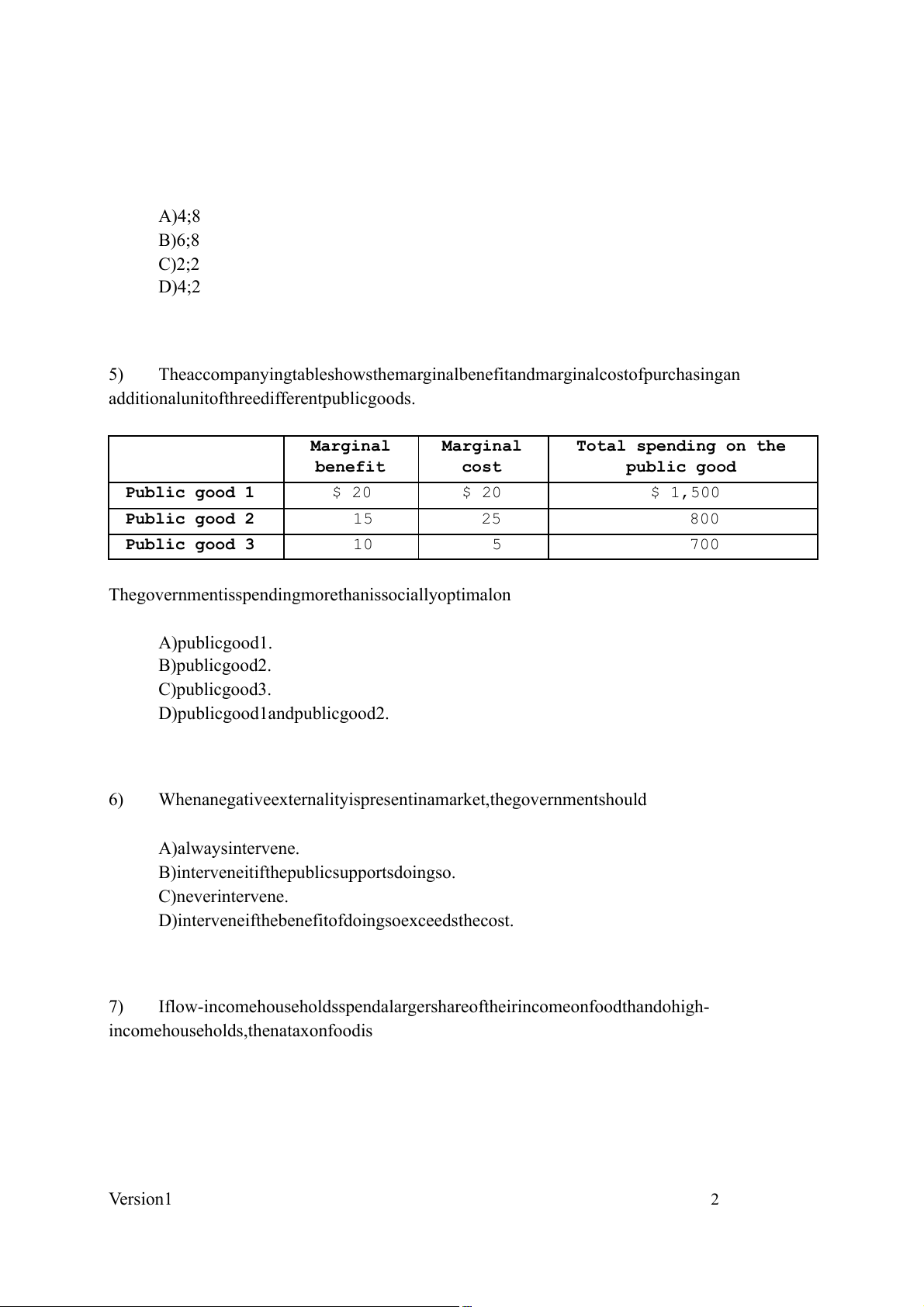
The accompanying table shows the marginal benefit and marginal cost of purchasing an
additional unit of three different public goods. Marginal Marginal Total spending on the benefit cost public good Public good 1 $ 20 $ 20 $ 1,500 Public good 2 15 25 800 Public good 3 10 5 700
The government is spending more than is socially optimal on A) public good 1. B) public good 2. C) public good 3.
D) public good 1 and public good 2. 6)
When a negative externality is present in a market, the government should A) always intervene.
B) intervene it if the public supports doing so. C) never intervene.
D) intervene if the benefit of doing so exceeds the cost. 7)
If low-income households spend a larger share of their income on food than do high-
income households, then a tax on food is Version 1 2 A) a progressive tax. B) a regressive tax. C) a proportional tax.
D) a way to redistribute from the wealthy to the poor. 8)
The deadweight loss from taxing a good will be smaller for goods
A) whose supply and demand curves are more inelastic.
B) whose supply and demand curves are more elastic.
C) that are relatively expensive.
D) that are consumed by a large fraction of the population. 9) A proportional tax results in
A) a larger percentage of income going to taxes as income rises.
B) a smaller percentage of income going to taxes as income rises.
C) the same dollar amount going to taxes for all taxpayers.
D) the same percentage of income going to taxes for all taxpayers. Version 1 3 10)
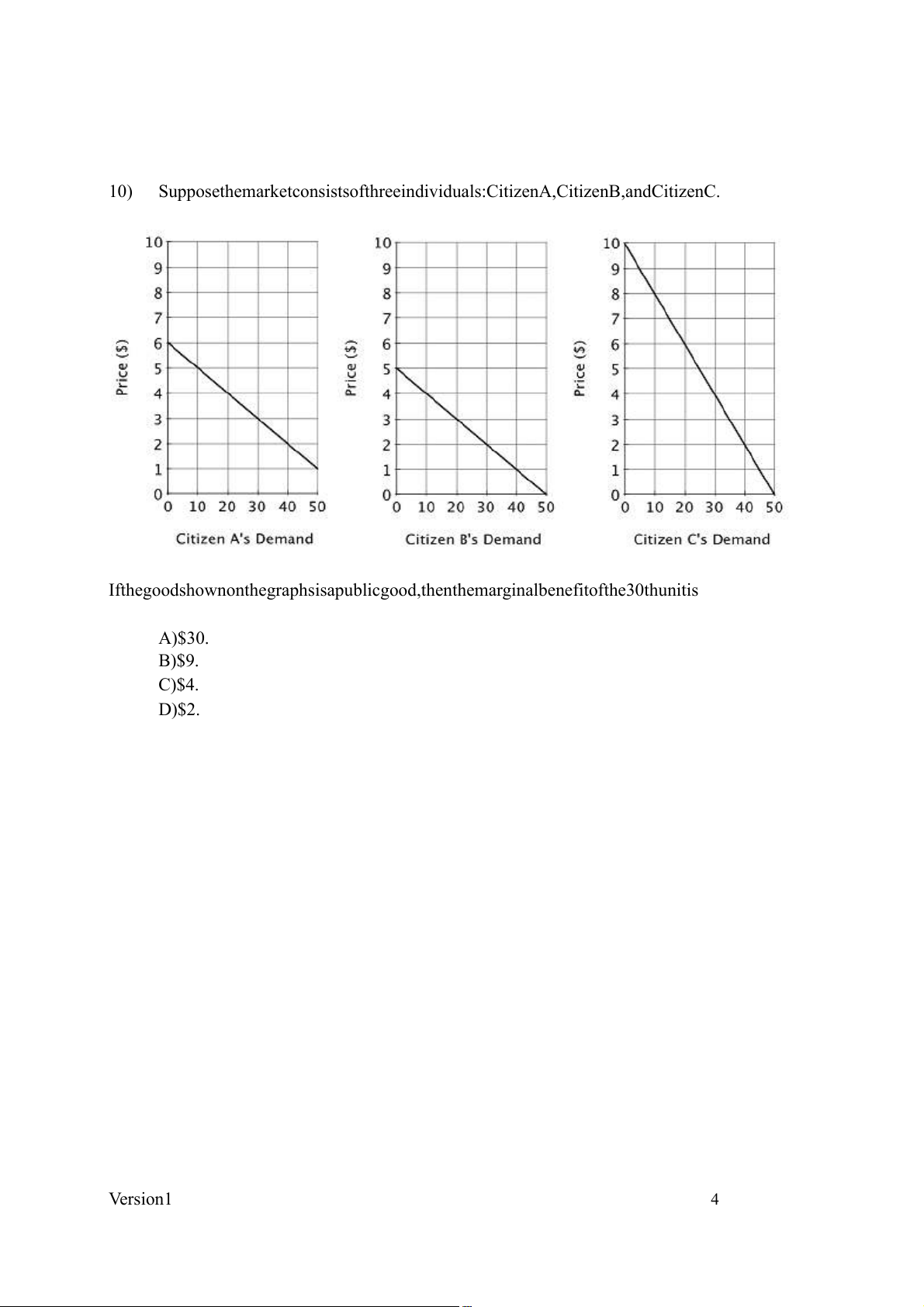
Suppose the market consists of three individuals: Citizen A, Citizen B, and Citizen C.
If the good shown on the graphs is a public good, then the marginal benefit of the 30th unit is A) $30. B) $9. C) $4. D) $2. Version 1 4 Answer Key
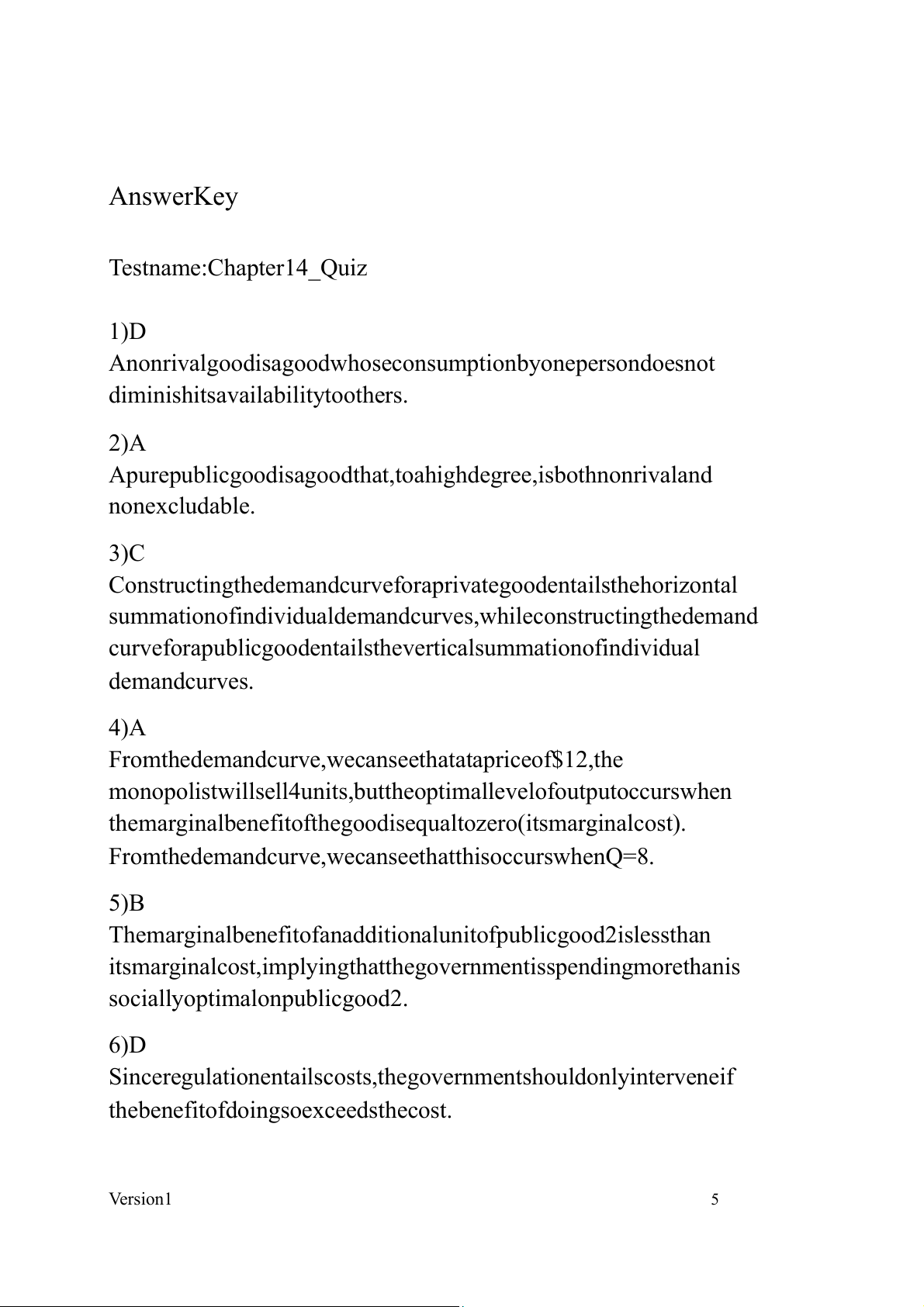
Test name: Chapter 14_Quiz 1) D
A nonrival good is a good whose consumption by one person does not
diminish its availability to others. 2) A
A pure public good is a good that, to a high degree, is both nonrival and nonexcludable. 3) C
Constructing the demand curve for a private good entails the horizontal
summation of individual demand curves, while constructing the demand
curve for a public good entails the vertical summation of individual demand curves. 4) A
From the demand curve, we can see that at a price of $12, the
monopolist will sell 4 units, but the optimal level of output occurs when
the marginal benefit of the good is equal to zero (its marginal cost).
From the demand curve, we can see that this occurs when Q = 8. 5) B
The marginal benefit of an additional unit of public good 2 is less than
its marginal cost, implying that the government is spending more than is
socially optimal on public good 2. 6) D
Since regulation entails costs, the government should only intervene if
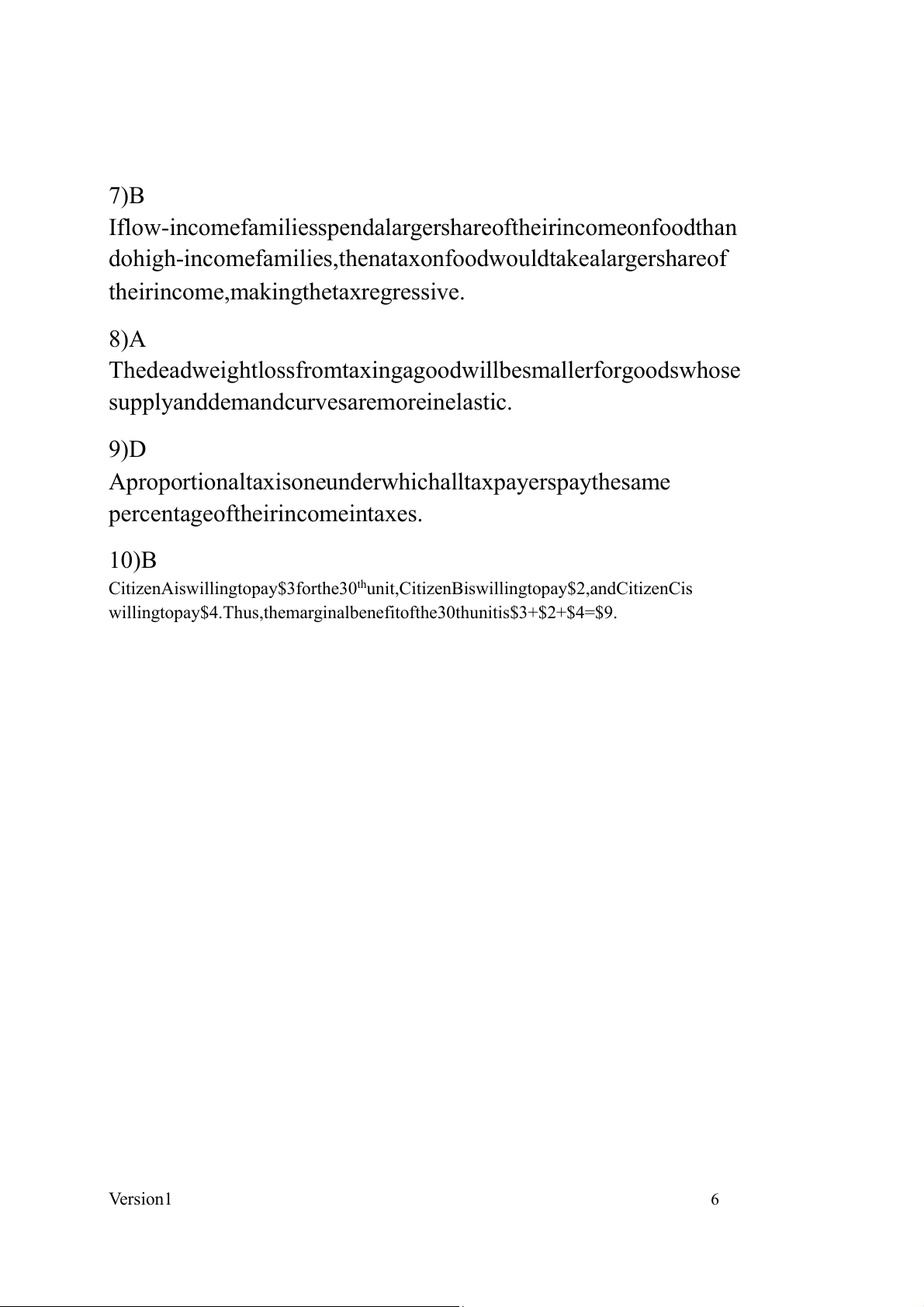
the benefit of doing so exceeds the cost. Version 1 5 7) B
If low-income families spend a larger share of their income on food than
do high-income families, then a tax on food would take a larger share of
their income, making the tax regressive. 8) A
The deadweight loss from taxing a good will be smaller for goods whose
supply and demand curves are more inelastic. 9) D
A proportional tax is one under which all taxpayers pay the same
percentage of their income in taxes. 10) B
Citizen A is willing to pay $3 for the 30th unit, Citizen B is willing to pay $2, and Citizen C is
willing to pay $4. Thus, the marginal benefit of the 30th unit is $3 + $2 + $4 = $9. Version 1 6
Tài liệu liên quan:
-

Chương 3: độ co giãn và các nhân tố ảnh hưởng | Microeconomics | Trường Đại học Quốc tế, Đại học Quốc gia Thành phố Hồ Chí Minh
3 2 -
Microeconomics Syllabus | Microeconomics | Trường Đại học Quốc tế, Đại học Quốc gia Thành phố Hồ Chí Minh
3 2 -
Microeconomics Course Syllabus & Assessment Details | Microeconomics | Trường Đại học Quốc tế, Đại học Quốc gia Thành phố Hồ Chí Minh
3 2 -
Assignment 3 - Elasticity MCQs and Key Concepts | Microeconomics | Trường Đại học Quốc tế, Đại học Quốc gia Thành phố Hồ Chí Minh
3 2 -
Assignment 2 - Economic Equilibrium Analysis of Fridges and Motorcycles | Microeconomics | Trường Đại học Quốc tế, Đại học Quốc gia Thành phố Hồ Chí Minh
3 2