Chapter 15 Quiz - Multiple Choice Questions | Microeconomics | Trường Đại học Quốc tế, Đại học Quốc gia Thành phố Hồ Chí Minh
The production possibility curve (PPC) shows the _____ production of one good for ______ production level of the other good. A) minimum; every possible B) maximum; every possible C) minimum; the maximum D) maximum; the minimum 3) An economy has two workers, Paula and Ricardo. Every day they work, Paula can produce 4 computers or 16 shirts, and Ricardo can produce 6 computers or 12 shirts. What is the opportunity cost for Paula to produce one shirt? A) 1/4 of a computer B) 1/2 of a computer C) 2 computers D) 4 computers. Tài liệu được sưu tầm và soạn thảo dưới dạng file PDF để gửi tới các bạn cùng tham khảo, ôn tập đầy đủ kiến thức, chuẩn bị cho các buổi học thật tốt. Mời bạn đọc đón xem!
Môn: Microeconomics 635 tài liệu
Trường: Trường Đại học Quốc tế, Đại học Quốc gia Thành phố Hồ Chí Minh 1.9 K tài liệu
Tác giả:



Preview text:
Student name:__________
MULTIPLE CHOICE - Choose the one alternative that best completes the statement or
answers the question. 1)
A society could achieve a higher level of production if
A) each person in the society is a jack-of-all trades.
B) each person specializes according to their comparative advantage.
C) it does not trade with other nations.
D) it does not have taxes on imported goods. 2)
The production possibility curve (PPC) shows the _____ production of one good for
______ production level of the other good. A) minimum; every possible B) maximum; every possible C) minimum; the maximum D) maximum; the minimum 3)
An economy has two workers, Paula and Ricardo. Every day they work, Paula can
produce 4 computers or 16 shirts, and Ricardo can produce 6 computers or 12 shirts. What is the
opportunity cost for Paula to produce one shirt? A) 1/4 of a computer B) 1/2 of a computer C) 2 computers D) 4 computers Version 1 1 4)
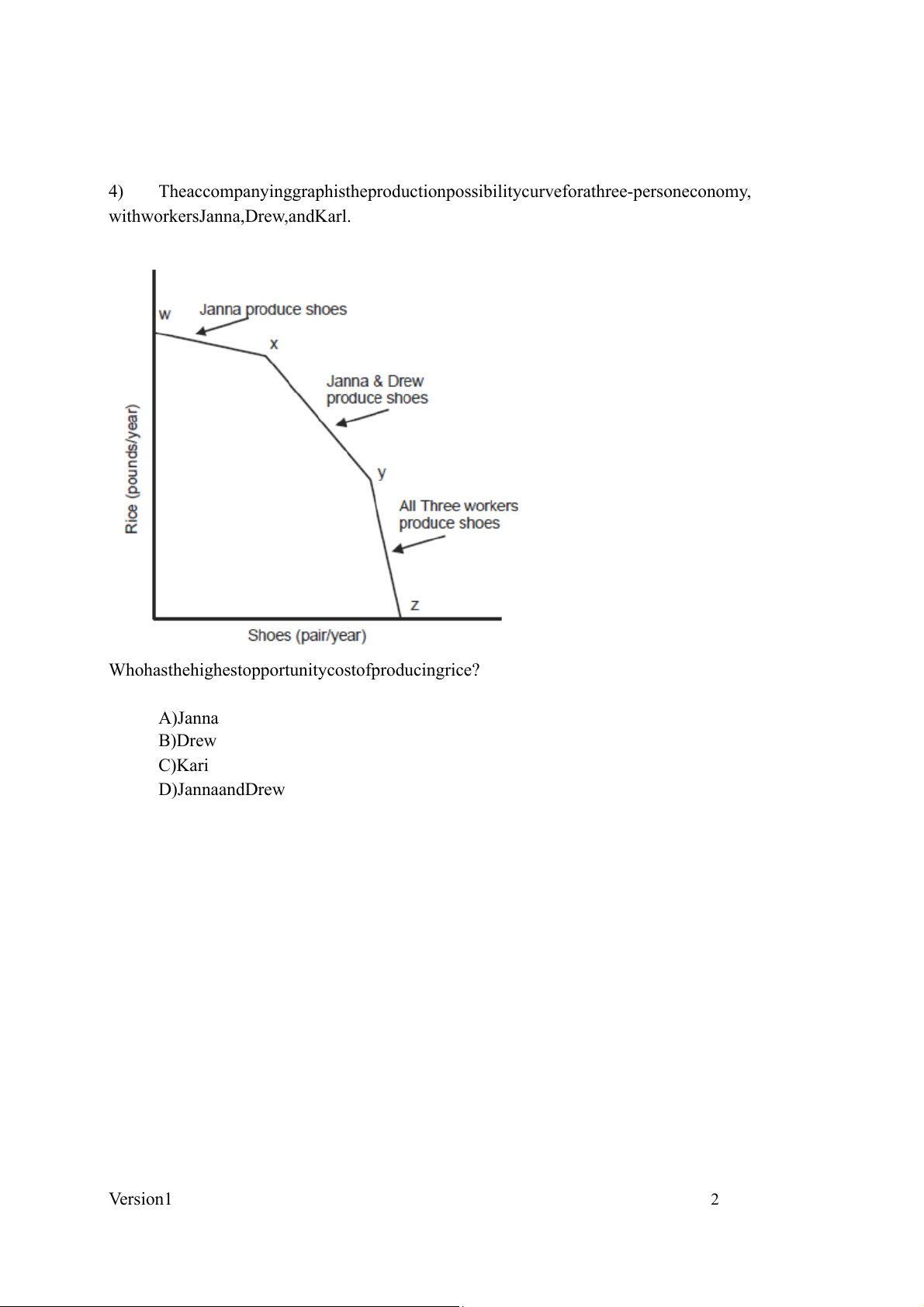
The accompanying graph is the production possibility curve for a three-person economy,
with workers Janna, Drew, and Karl.
Who has the highest opportunity cost of producing rice? A) Janna B) Drew C) Kari D) Janna and Drew Version 1 2 5)
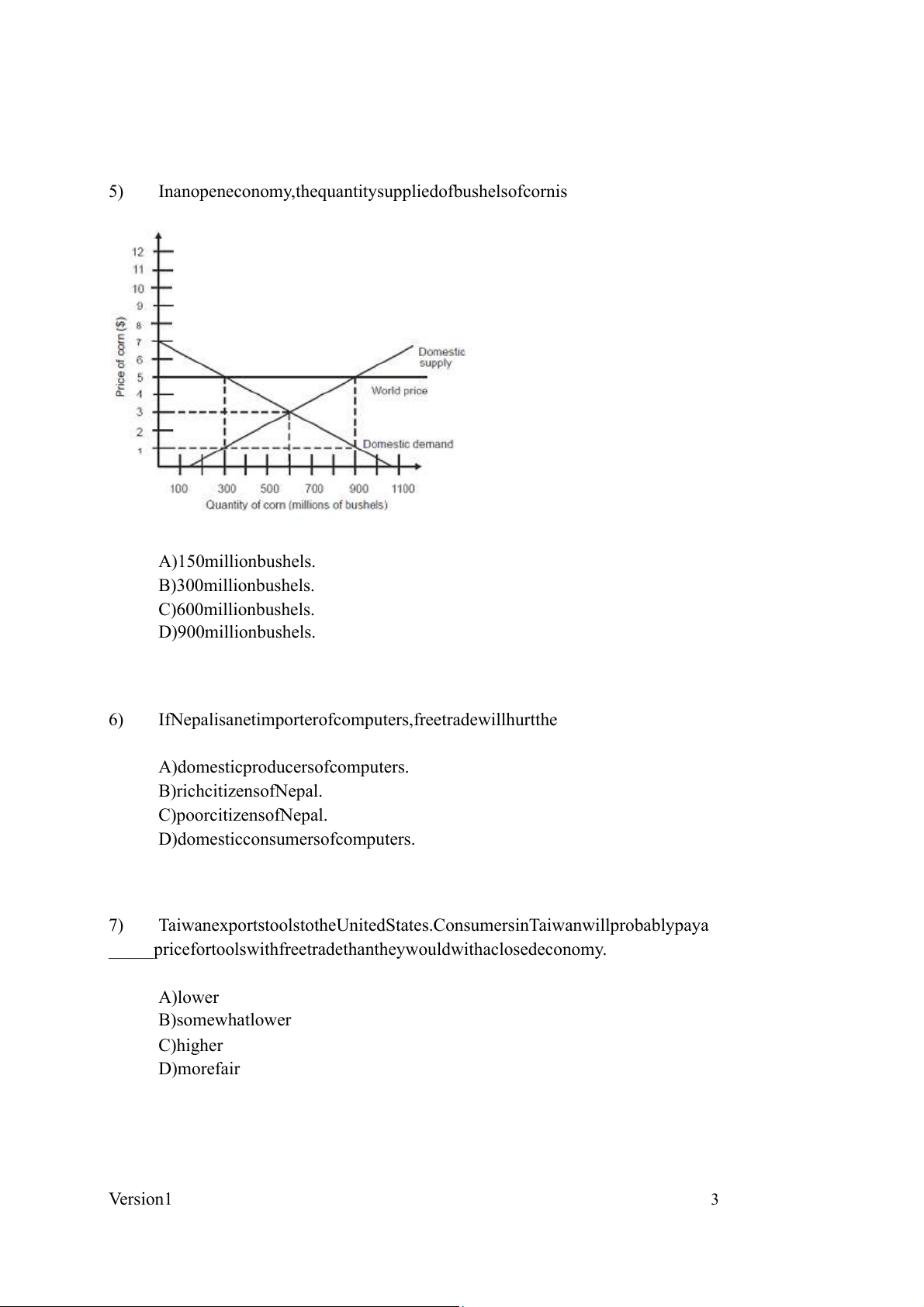
In an open economy, the quantity supplied of bushels of corn is A) 150 million bushels. B) 300 million bushels. C) 600 million bushels. D) 900 million bushels. 6)
If Nepal is a net importer of computers, free trade will hurt the
A) domestic producers of computers. B) rich citizens of Nepal. C) poor citizens of Nepal.
D) domestic consumers of computers. 7)
Taiwan exports tools to the United States. Consumers in Taiwan will probably pay a
_____ price for tools with free trade than they would with a closed economy. A) lower B) somewhat lower C) higher D) more fair Version 1 3 8)
Suppose a government is considering imposing either a tariff or a quota on imported
grain, and either policy will result in exactly 750 tons of grain being imported. How do these policies differ?
A) The price of grain under the tariff will be higher than the price under the quota.
B) The price of grain under the quota will be higher than the price under the tariff.
C) Domestic production will be higher with the quota than with the tariff.
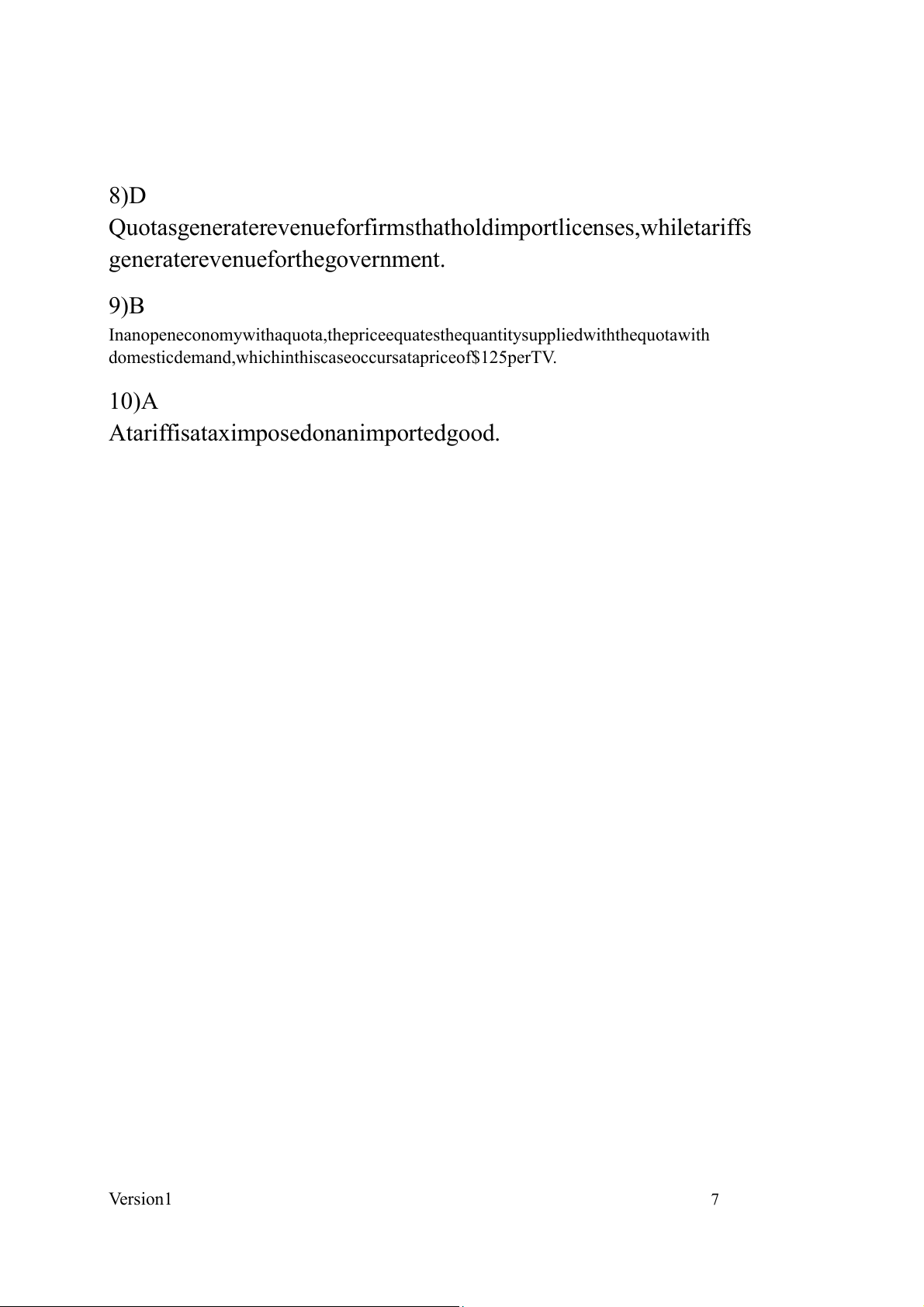
D) The quota will generate revenue for the firms that hold import licenses, while the tariff
will generate revenue for the government. 9)
Based on the information in the accompanying graph, what is the price of a TV in an open economy with a quota? A) $150 B) $125 C) $100 D) $75 10)
A tariff is a tax imposed on ______ good. Version 1 4 A) an imported B) a luxury C) an illegal D) a domestic Version 1 5 Answer Key
Test name: Chapter 15_Quiz 1) B
Specialization according to one's comparative advantage, combined with
trade between producers of different goods and services, allows a society
to achieve a higher level of productivity and standard of living. 2) B
The production possibilities curve is a graph that shows the maximum
amount of each good that can be produced, at every possible level of production of the other good. 3) A
In the time it takes Paula to make 16 shirts, she could have made 4
computers, so she gives up 1/4 of a computer for every shirt she makes. 4) A
As we move from point Z to point Y to point X and finally to point W, Janna is the final person
to give up shoe production in favor of rice production. This means that Janna must have the
comparative advantage in shoe production; this means that she must also have the comparative
disadvantage (and higher opportunity cost) in rice production. 5) D
In an open economy, the price of corn will equal the world price, which in this case is $5 per
bushel. At that price, the quantity of corn supplied domestically is 900 million bushels. 6) A
Free trade hurts the producers of imported goods. 7) C
If a country is a net exporter of a good, it implies that the world price of
the good is higher than the price when the economy is closed. Version 1 6 8) D
Quotas generate revenue for firms that hold import licenses, while tariffs
generate revenue for the government. 9) B
In an open economy with a quota, the price equates the quantity supplied with the quota with
domestic demand, which in this case occurs at a price of $125 per TV. 10) A
A tariff is a tax imposed on an imported good. Version 1 7
Tài liệu liên quan:
-
Chương 3: độ co giãn và các nhân tố ảnh hưởng | Microeconomics | Trường Đại học Quốc tế, Đại học Quốc gia Thành phố Hồ Chí Minh
3 2 -
Microeconomics Syllabus | Microeconomics | Trường Đại học Quốc tế, Đại học Quốc gia Thành phố Hồ Chí Minh
3 2 -
Microeconomics Course Syllabus & Assessment Details | Microeconomics | Trường Đại học Quốc tế, Đại học Quốc gia Thành phố Hồ Chí Minh
3 2 -
Assignment 3 - Elasticity MCQs and Key Concepts | Microeconomics | Trường Đại học Quốc tế, Đại học Quốc gia Thành phố Hồ Chí Minh
3 2 -
Assignment 2 - Economic Equilibrium Analysis of Fridges and Motorcycles | Microeconomics | Trường Đại học Quốc tế, Đại học Quốc gia Thành phố Hồ Chí Minh
3 2