Chapter 7: Consumers, Producers & Efficiency Exam Notes | Microeconomics | Trường Đại học Quốc tế, Đại học Quốc gia Thành phố Hồ Chí Minh
At the equilibrium price of a good, the good will be purchased by those buyers who a. value the good more than price. b. value the good less than price. c. have the money to buy the good. d. consider the good a necessity. ANS: A DIF: 1 REF: 7-3 NAT: Analytic LOC: Supply and demand TOP: Efficiency MSC: Interpretive 19. Which of the following statements is not correct about a market in equilibrium? Tài liệu được sưu tầm và soạn thảo dưới dạng file PDF để gửi tới các bạn cùng tham khảo, ôn tập đầy đủ kiến thức, chuẩn bị cho các buổi học thật tốt. Mời bạn đọc đón xem!
Môn: Microeconomics 635 tài liệu
Trường: Trường Đại học Quốc tế, Đại học Quốc gia Thành phố Hồ Chí Minh 1.9 K tài liệu
Tác giả:

Preview text:
Chapter 7
Consumers, Producers, and the Efficiency of Markets TRUE/FALSE 1.
Welfare economics is the study of the welfare system. ANS: F DIF: 1 REF: 7-1 NAT: Analytic LOC: Supply and demand TOP: Welfare MSC: Definitional 2.
The willingness to pay is the maximum amount that a buyer will pay for a good and measures how much the buyer values the good. ANS: T DIF: 1 REF: 7-1 NAT: Analytic LOC: Supply and demand TOP: Willingness to pay MSC: Definitional 3.
For any given quantity, the price on a demand curve represents the marginal buyer's willingness to pay. ANS: T DIF: 2 REF: 7-1 NAT: Analytic LOC: Supply and demand TOP: Willingness to pay MSC: Interpretive 4.
A buyer is willing to buy a product at a price greater than or equal to his willingness to pay, but would refuse
to buy a product at a price less than his willingness to pay. ANS: F DIF: 1 REF: 7-1 NAT: Analytic LOC: Supply and demand TOP: Willingness to pay MSC: Definitional 5.
Consumer surplus is the amount a buyer actually has to pay for a good minus the amount the buyer is willing to pay for it. ANS: F DIF: 1 REF: 7-1 NAT: Analytic LOC: Supply and demand TOP: Consumer surplus MSC: Definitional 6.
Consumer surplus is the amount a buyer is willing to pay for a good minus the amount the buyer actually has to pay for it. ANS: T DIF: 1 REF: 7-1 NAT: Analytic LOC: Supply and demand TOP: Consumer surplus MSC: Definitional 7.
Consumer surplus measures the benefit to buyers of participating in a market. ANS: T DIF: 1 REF: 7-1 NAT: Analytic LOC: Supply and demand TOP: Consumer surplus MSC: Interpretive 8.
Consumer surplus can be measured as the area between the demand curve and the equilibrium price. ANS: T DIF: 1 REF: 7-1 NAT: Analytic LOC: Supply and demand TOP: Consumer surplus MSC: Interpretive 9.
Consumer surplus can be measured as the area between the demand curve and the supply curve. ANS: F DIF: 1 REF: 7-1 NAT: Analytic LOC: Supply and demand TOP: Consumer surplus MSC: Interpretive 10.
Joel has a 1966 Mustang, which he sells to Susie, an avid car collector. Susie is pleased since she paid $8,000
for the car but would have been willing to pay $11,000 for the car. Susie's consumer surplus is $2,000. ANS: F DIF: 1 REF: 7-1 NAT: Analytic LOC: Supply and demand TOP: Consumer surplus MSC: Interpretive 453
454 Chapter 7/Consumers, Producers, and the Efficiency of Markets 11.
If Darby values a soccer ball at $50, and she pays $40 for it, her consumer surplus is $10. ANS: T DIF: 1 REF: 7-1 NAT: Analytic LOC: Supply and demand TOP: Consumer surplus MSC: Applicative 12.
If Darby values a soccer ball at $50, and she pays $40 for it, her consumer surplus is $90. ANS: F DIF: 1 REF: 7-1 NAT: Analytic LOC: Supply and demand TOP: Consumer surplus MSC: Applicative 13.
All else equal, an increase in supply will cause an increase in consumer surplus. ANS: T DIF: 2 REF: 7-1 NAT: Analytic LOC: Supply and demand TOP: Consumer surplus MSC: Applicative 14.
Suppose there is an increase in supply that reduces market price. Consumer surplus increases because (1)
consumer surplus received by existing buyers increases and (2) new buyers enter the market. ANS: T DIF: 2 REF: 7-1 NAT: Analytic LOC: Supply and demand TOP: Consumer surplus MSC: Interpretive 15.
If the government imposes a binding price floor in a market, then the consumer surplus in that market will increase. ANS: F DIF: 2 REF: 7-1 NAT: Analytic LOC: Supply and demand TOP: Consumer surplus MSC: Applicative 16.
If the government imposes a binding price floor in a market, then the consumer surplus in that market will decrease. ANS: T DIF: 2 REF: 7-1 NAT: Analytic LOC: Supply and demand TOP: Consumer surplus MSC: Applicative 17.
Each seller of a product is willing to sell as long as the price he or she can receive is greater than the
opportunity cost of producing the product. ANS: T DIF: 1 REF: 7-2 NAT: Analytic LOC: Supply and demand TOP: Opportunity cost MSC: Interpretive 18.
At any quantity, the price given by the supply curve shows the cost of the lowest-cost seller. ANS: F DIF: 2 REF: 7-2 NAT: Analytic LOC: Supply and demand TOP: Opportunity cost MSC: Interpretive 19.
In a competitive market, sales go to those producers who are willing to supply the product at the lowest price. ANS: T DIF: 1 REF: 7-2 NAT: Analytic LOC: Supply and demand TOP: Efficiency MSC: Interpretive 20.
Producer surplus is the amount a seller is paid minus the cost of production. ANS: T DIF: 1 REF: 7-2 NAT: Analytic LOC: Supply and demand TOP: Producer surplus MSC: Definitional 21.
Producer surplus is the cost of production minus the amount a seller is paid. ANS: F DIF: 1 REF: 7-2 NAT: Analytic LOC: Supply and demand TOP: Producer surplus MSC: Definitional
Chapter 7/Consumers, Producers, and the Efficiency of Markets 455 22.
All else equal, an increase in demand will cause an increase in producer surplus. ANS: T DIF: 2 REF: 7-2 NAT: Analytic LOC: Supply and demand TOP: Producer surplus MSC: Applicative 23.
All else equal, a decrease in demand will cause an increase in producer surplus. ANS: F DIF: 2 REF: 7-2 NAT: Analytic LOC: Supply and demand TOP: Producer surplus MSC: Applicative 24.
If producing a soccer ball costs Jake $5, and he sells it for $40, his producer surplus is $45. ANS: F DIF: 1 REF: 7-2 NAT: Analytic LOC: Supply and demand TOP: Producer surplus MSC: Applicative 25.
If producing a soccer ball costs Jake $5, and he sells it for $40, his producer surplus is $35. ANS: T DIF: 1 REF: 7-2 NAT: Analytic LOC: Supply and demand TOP: Producer surplus MSC: Applicative 26.
Connie can clean windows in large office buildings at a cost of $1 per window. The market price for window-
cleaning services is $3 per window. If Connie cleans 100 windows, her producer surplus is $100. ANS: F DIF: 2 REF: 7-2 NAT: Analytic LOC: Supply and demand TOP: Producer surplus MSC: Applicative 27.
Connie can clean windows in large office buildings at a cost of $1 per window. The market price for window-
cleaning services is $3 per window. If Connie cleans 100 windows, her producer surplus is $200. ANS: T DIF: 2 REF: 7-2 NAT: Analytic LOC: Supply and demand TOP: Producer surplus MSC: Applicative 28.
The area below the price and above the supply curve measures the producer surplus in a market. ANS: T DIF: 2 REF: 7-2 NAT: Analytic LOC: Supply and demand TOP: Producer surplus MSC: Interpretive 29.
The area below the demand curve and above the supply curve measures the producer surplus in a market. ANS: F DIF: 2 REF: 7-2 NAT: Analytic LOC: Supply and demand TOP: Producer surplus MSC: Interpretive 30.
If the government imposes a binding price ceiling in a market, then the producer surplus in that market will increase. ANS: F DIF: 2 REF: 7-2 NAT: Analytic LOC: Supply and demand TOP: Producer surplus MSC: Applicative 31.
When demand increases so that market price increases, producer surplus increases because (1) producer
surplus received by existing sellers increases, and (2) new sellers enter the market. ANS: T DIF: 2 REF: 7-2 NAT: Analytic LOC: Supply and demand TOP: Producer surplus MSC: Interpretive 32.
Total surplus in a market is consumer surplus minus producer surplus. ANS: F DIF: 1 REF: 7-3 NAT: Analytic LOC: Supply and demand TOP: Total surplus MSC: Definitional
456 Chapter 7/Consumers, Producers, and the Efficiency of Markets 33.
Total surplus = Value to buyers - Costs to sellers. ANS: T DIF: 2 REF: 7-3 NAT: Analytic LOC: Supply and demand TOP: Total surplus MSC: Interpretive 34.
Total surplus in a market can be measured as the area below the supply curve plus the area above the demand
curve, up to the point of equilibrium. ANS: F DIF: 2 REF: 7-3 NAT: Analytic LOC: Supply and demand TOP: Total surplus MSC: Interpretive 35.
Producing a soccer ball costs Jake $5. He sells it to Darby for $35. Darby values the soccer ball at $50. For
this transaction, the total surplus in the market is $40. ANS: F DIF: 2 REF: 7-3 NAT: Analytic LOC: Supply and demand TOP: Total surplus MSC: Applicative 36.
The equilibrium of supply and demand in a market maximizes the total benefits to buyers and sellers of participating in that market. ANS: T DIF: 2 REF: 7-3 NAT: Analytic LOC: Supply and demand TOP: Efficiency MSC: Interpretive 37.
Efficiency refers to whether a market outcome is fair, while equality refers to whether the maximum amount
of output was produced from a given number of inputs. ANS: F DIF: 1 REF: 7-3 NAT: Analytic LOC: Supply and demand TOP: Efficiency | Equality MSC: Definitional 38.
Efficiency is related to the size of the economic pie, whereas equality is related to how the pie gets sliced and distributed. ANS: T DIF: 1 REF: 7-3 NAT: Analytic LOC: Supply and demand TOP: Efficiency | Equality MSC: Definitional 39.
Free markets allocate (a) the supply of goods to the buyers who value them most highly and (b) the demand
for goods to the sellers who can produce them at least cost. ANS: T DIF: 2 REF: 7-3 NAT: Analytic LOC: Supply and demand TOP: Efficiency MSC: Interpretive 40.
Economists generally believe that, although there may be advantages to society from ticket-scalping, the costs
to society of this activity outweigh the benefits. ANS: F DIF: 2 REF: 7-3 NAT: Analytic LOC: Supply and demand TOP: Efficiency MSC: Interpretive 41.
Economists argue that restrictions against ticket scalping actually drive up the cost of many tickets. ANS: T DIF: 2 REF: 7-3 NAT: Analytic LOC: Supply and demand TOP: Efficiency MSC: Interpretive 42.
If the United States legally allowed for a market in transplant organs, it is estimated that one kidney would sell for at least $100,000. ANS: F DIF: 2 REF: 7-3 NAT: Analytic LOC: Supply and demand TOP: Efficiency | Equality MSC: Interpretive 43.
Even though participants in the economy are motivated by self-interest, the "invisible hand" of the
marketplace guides this self-interest into promoting general economic well-being. ANS: T DIF: 2 REF: 7-3 NAT: Analytic LOC: Supply and demand TOP: Invisible hand MSC: Interpretive
Chapter 7/Consumers, Producers, and the Efficiency of Markets 457 44.
The current policy on kidney donation effectively sets a price ceiling of zero. ANS: T DIF: 2 REF: 7-3 NAT: Analytic LOC: Supply and demand TOP: Efficiency MSC: Interpretive 45.
Unless markets are perfectly competitive, they may fail to maximize the total benefits to buyers and sellers. ANS: T DIF: 2 REF: 7-4 NAT: Analytic LOC: Supply and demand TOP: Efficiency MSC: Interpretive 46.
In order to conclude that markets are efficient, we assume that they are perfectly competitive. ANS: T DIF: 2 REF: 7-4 NAT: Analytic LOC: Supply and demand TOP: Efficiency MSC: Applicative 47.
Markets will always allocate resources efficiently. ANS: F DIF: 2 REF: 7-4 NAT: Analytic LOC: Supply and demand TOP: Efficiency MSC: Applicative 48.
When markets fail, public policy can potentially remedy the problem and increase economic efficiency. ANS: T DIF: 2 REF: 7-4 NAT: Analytic LOC: Supply and demand TOP: Market failure MSC: Interpretive 49.
Market power and externalities are examples of market failures. ANS: T DIF: 2 REF: 7-4 NAT: Analytic LOC: Supply and demand TOP: Market failure MSC: Interpretive SHORT ANSWER 1.
Answer each of the following questions about demand and consumer surplus. a.
What is consumer surplus, and how is it measured? b.
What is the relationship between the demand curve and the willingness to pay? c.
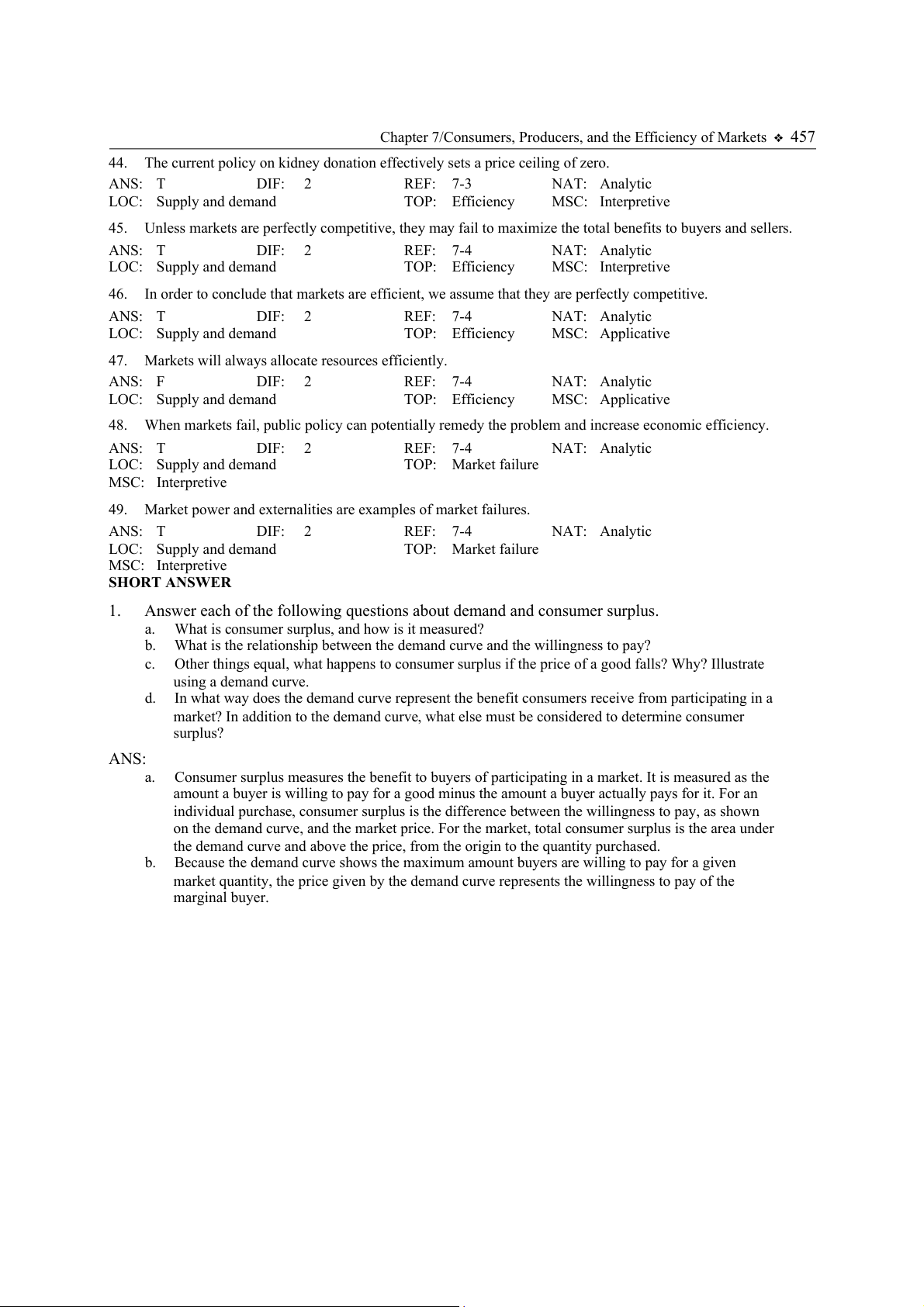
Other things equal, what happens to consumer surplus if the price of a good falls? Why? Illustrate using a demand curve. d.
In what way does the demand curve represent the benefit consumers receive from participating in a
market? In addition to the demand curve, what else must be considered to determine consumer surplus? ANS: a.
Consumer surplus measures the benefit to buyers of participating in a market. It is measured as the
amount a buyer is willing to pay for a good minus the amount a buyer actually pays for it. For an
individual purchase, consumer surplus is the difference between the willingness to pay, as shown
on the demand curve, and the market price. For the market, total consumer surplus is the area under
the demand curve and above the price, from the origin to the quantity purchased. b.
Because the demand curve shows the maximum amount buyers are willing to pay for a given
market quantity, the price given by the demand curve represents the willingness to pay of the marginal buyer.
458 Chapter 7/Consumers, Producers, and the Efficiency of Markets c.
When the price of a good falls, consumer surplus increases for two reasons. First, those buyers
who were already buying the good receive an increase in consumer surplus because they are
paying less (area B). Second, some new buyers enter the market because the price of the good is
now lower than their willingness to pay (area C); hence, there is additional consumer surplus
generated from their purchases. The graph should show that as price falls from P2 to P1,
consumer surplus increases from area A to area A+B+C. d.
Since the demand curve represents the maximum price the marginal buyer is willing to pay for a
good, it must also represent the maximum benefit the buyer expects to receive from consuming
the good. Consumer surplus must take into account the amount the buyer actually pays for the
good, with consumer surplus measured as the difference between what the buyer is willing to pay
and what he/she actually paid. Consumer surplus, then, measures the benefit the buyer didn't have to "pay for." Price A P 2 B C P 1 D F Demand Q2 Q1 Quanti ty DIF: 2 REF: 7-1 NAT: Analytic LOC: Supply and demand TOP: Consumer surplus MSC: Interpretive
Chapter 7/Consumers, Producers, and the Efficiency of Markets 459 2.
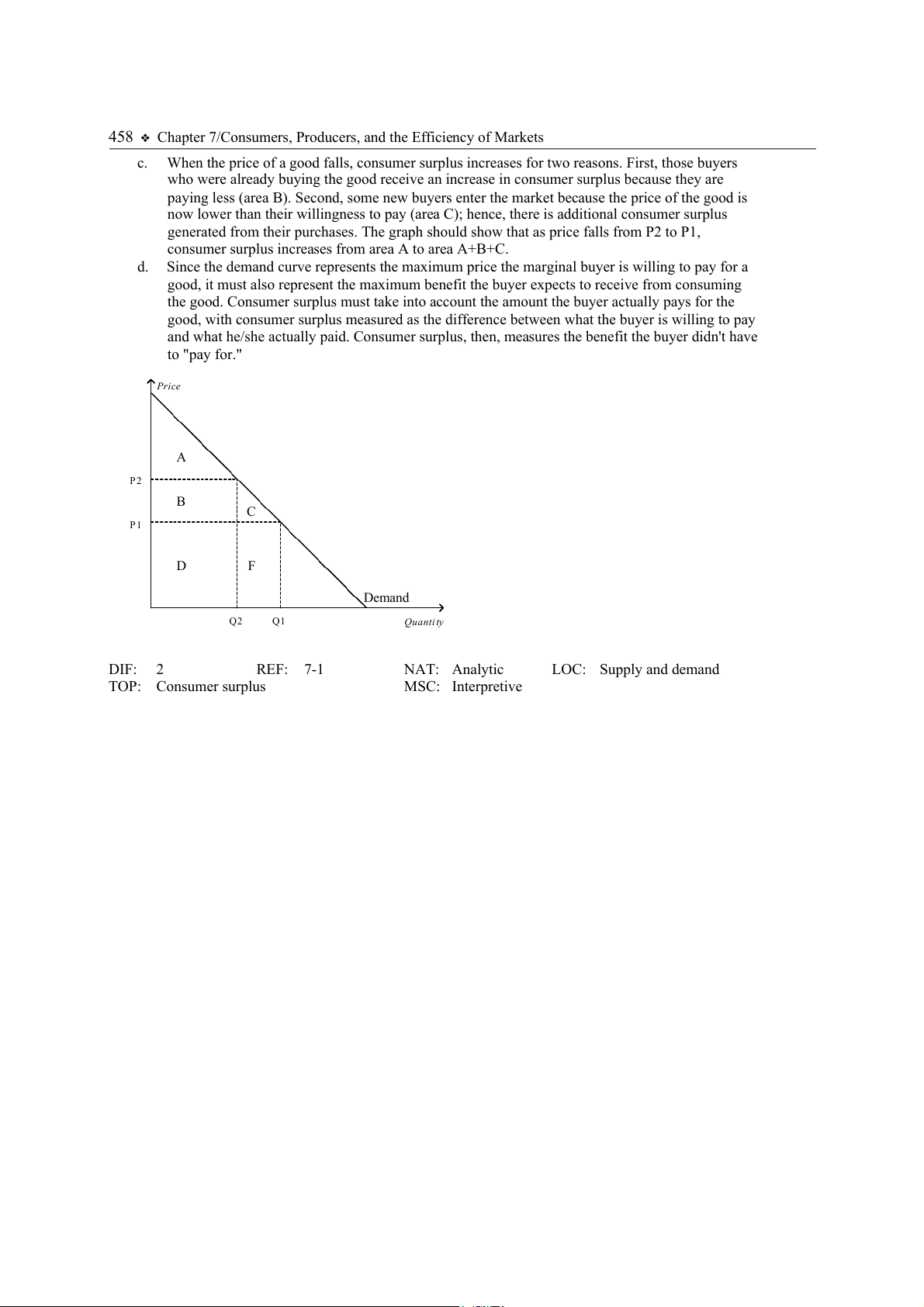
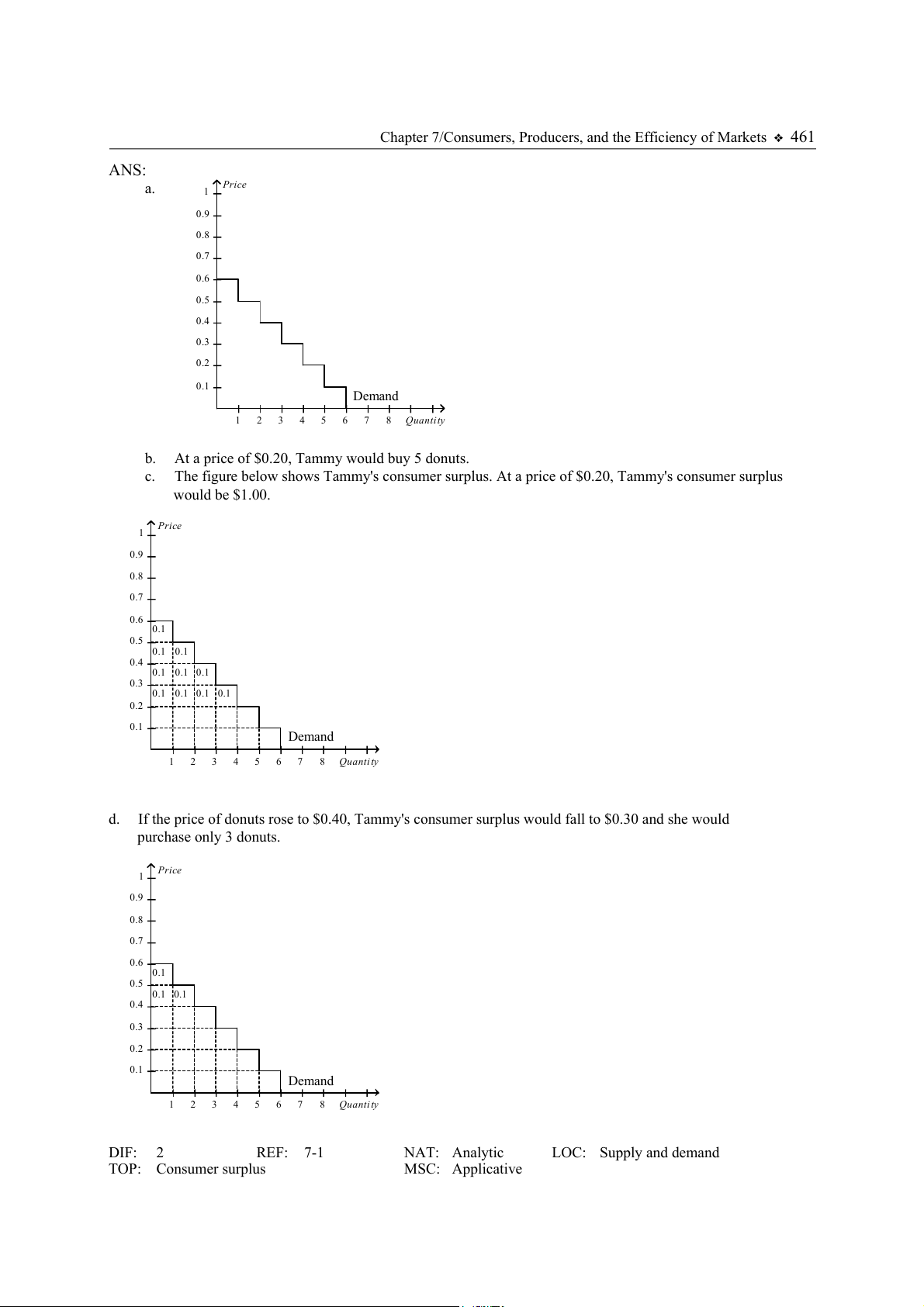
Tammy loves donuts. The table shown reflects the value Tammy places on each donut she eats: Value of first donut $0.60 Value of second donut $0.50 Value of third donut $0.40 Value of fourth donut $0.30 Value of fifth donut $0.20 Value of sixth donut $0.10
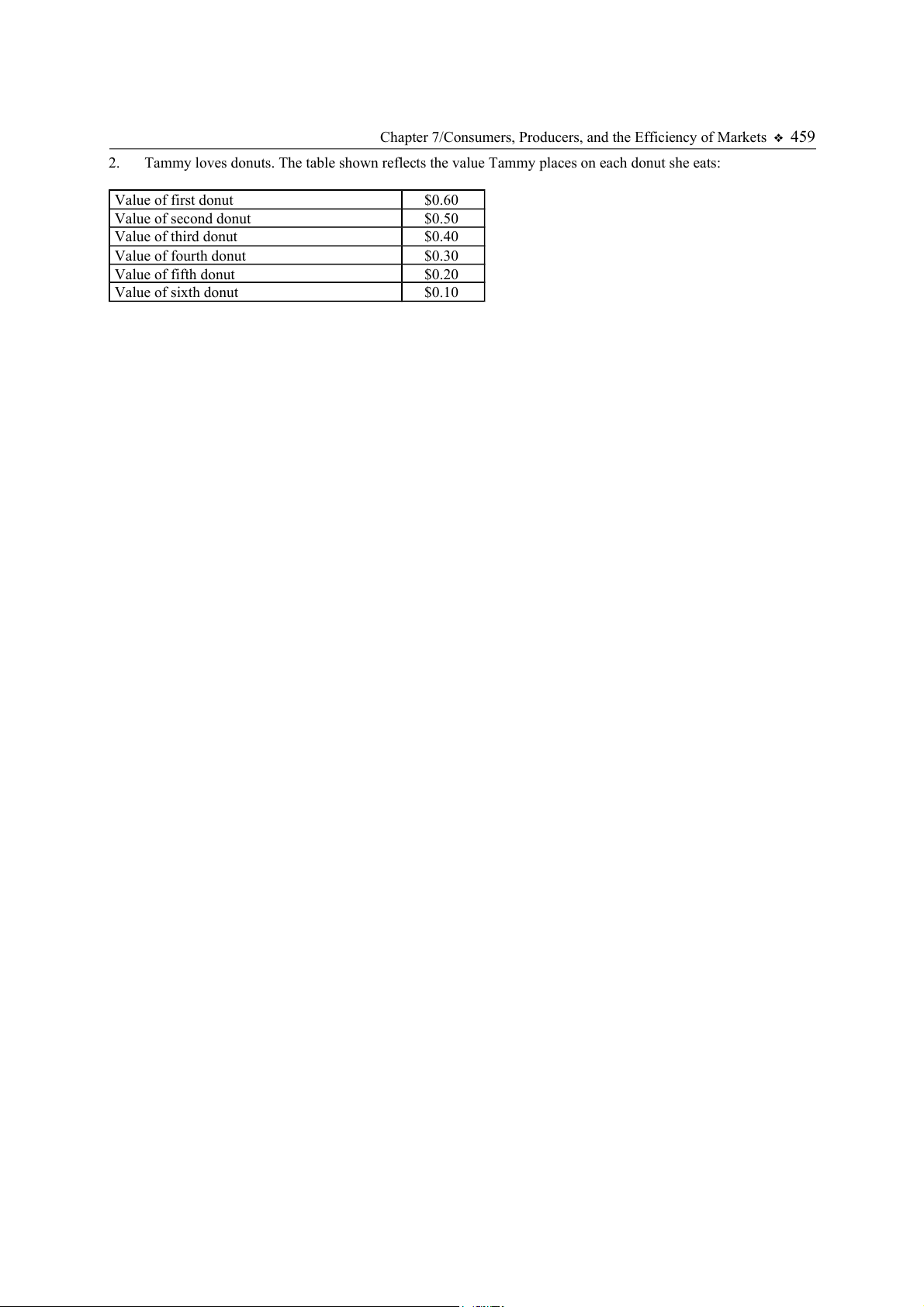
460 Chapter 7/Consumers, Producers, and the Efficiency of Markets a.
Use this information to construct Tammy's demand curve for donuts. b.
If the price of donuts is $0.20, how many donuts will Tammy buy? c.
Show Tammy's consumer surplus on your graph. How much consumer surplus would she have at a price of $0.20? d.
If the price of donuts rose to $0.40, how many donuts would she purchase now? What would
happen to Tammy's consumer surplus? Show this change on your graph.
Chapter 7/Consumers, Producers, and the Efficiency of Markets 461 ANS: a. Price 1 0.9 0.8 0.7 0.6 0.5 0.4 0.3 0.2 0.1 Demand 1 2 3 4 5 6 7 8 Quanti ty b.
At a price of $0.20, Tammy would buy 5 donuts. c.
The figure below shows Tammy's consumer surplus. At a price of $0.20, Tammy's consumer surplus would be $1.00. Price 1 0.9 0.8 0.7 0.6 0.1 0.5 0.1 0.1 0.4 0.1 0.1 0.1 0.3 0.1 0.1 0.1 0.1 0.2 0.1 Demand 1 2 3 4 5 6 7 8 Quanti ty d.
If the price of donuts rose to $0.40, Tammy's consumer surplus would fall to $0.30 and she would purchase only 3 donuts. Price 1 0.9 0.8 0.7 0.6 0.1 0.5 0.1 0.1 0.4 0.3 0.2 0.1 Demand 1 2 3 4 5 6 7 8 Quanti ty DIF: 2 REF: 7-1 NAT: Analytic LOC: Supply and demand TOP: Consumer surplus MSC: Applicative
462 Chapter 7/Consumers, Producers, and the Efficiency of Markets 3.
Answer each of the following questions about supply and producer surplus. a.
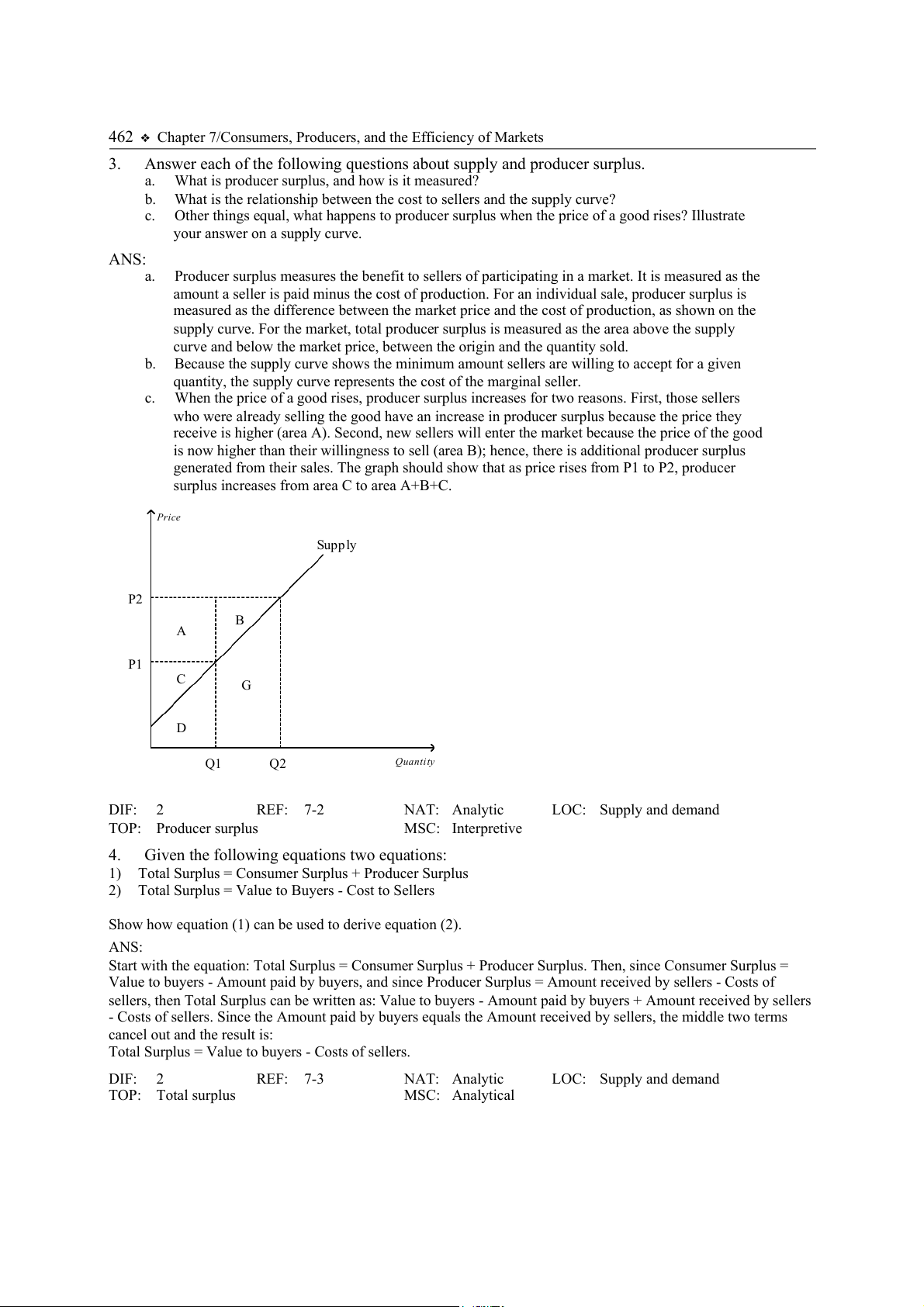
What is producer surplus, and how is it measured? b.
What is the relationship between the cost to sellers and the supply curve? c.
Other things equal, what happens to producer surplus when the price of a good rises? Illustrate your answer on a supply curve. ANS: a.
Producer surplus measures the benefit to sellers of participating in a market. It is measured as the
amount a seller is paid minus the cost of production. For an individual sale, producer surplus is
measured as the difference between the market price and the cost of production, as shown on the
supply curve. For the market, total producer surplus is measured as the area above the supply
curve and below the market price, between the origin and the quantity sold. b.
Because the supply curve shows the minimum amount sellers are willing to accept for a given
quantity, the supply curve represents the cost of the marginal seller. c.
When the price of a good rises, producer surplus increases for two reasons. First, those sellers
who were already selling the good have an increase in producer surplus because the price they
receive is higher (area A). Second, new sellers will enter the market because the price of the good
is now higher than their willingness to sell (area B); hence, there is additional producer surplus
generated from their sales. The graph should show that as price rises from P1 to P2, producer
surplus increases from area C to area A+B+C. Price Supp ly P2 B A P1 C G D Q1 Q2 Quanti ty DIF: 2 REF: 7-2 NAT: Analytic LOC: Supply and demand TOP: Producer surplus MSC: Interpretive 4.
Given the following equations two equations: 1)
Total Surplus = Consumer Surplus + Producer Surplus 2)
Total Surplus = Value to Buyers - Cost to Sellers
Show how equation (1) can be used to derive equation (2). ANS:
Start with the equation: Total Surplus = Consumer Surplus + Producer Surplus. Then, since Consumer Surplus =
Value to buyers - Amount paid by buyers, and since Producer Surplus = Amount received by sellers - Costs of
sellers, then Total Surplus can be written as: Value to buyers - Amount paid by buyers + Amount received by sellers
- Costs of sellers. Since the Amount paid by buyers equals the Amount received by sellers, the middle two terms cancel out and the result is:
Total Surplus = Value to buyers - Costs of sellers. DIF: 2 REF: 7-3 NAT: Analytic LOC: Supply and demand TOP: Total surplus MSC: Analytical
Chapter 7/Consumers, Producers, and the Efficiency of Markets 463 5.
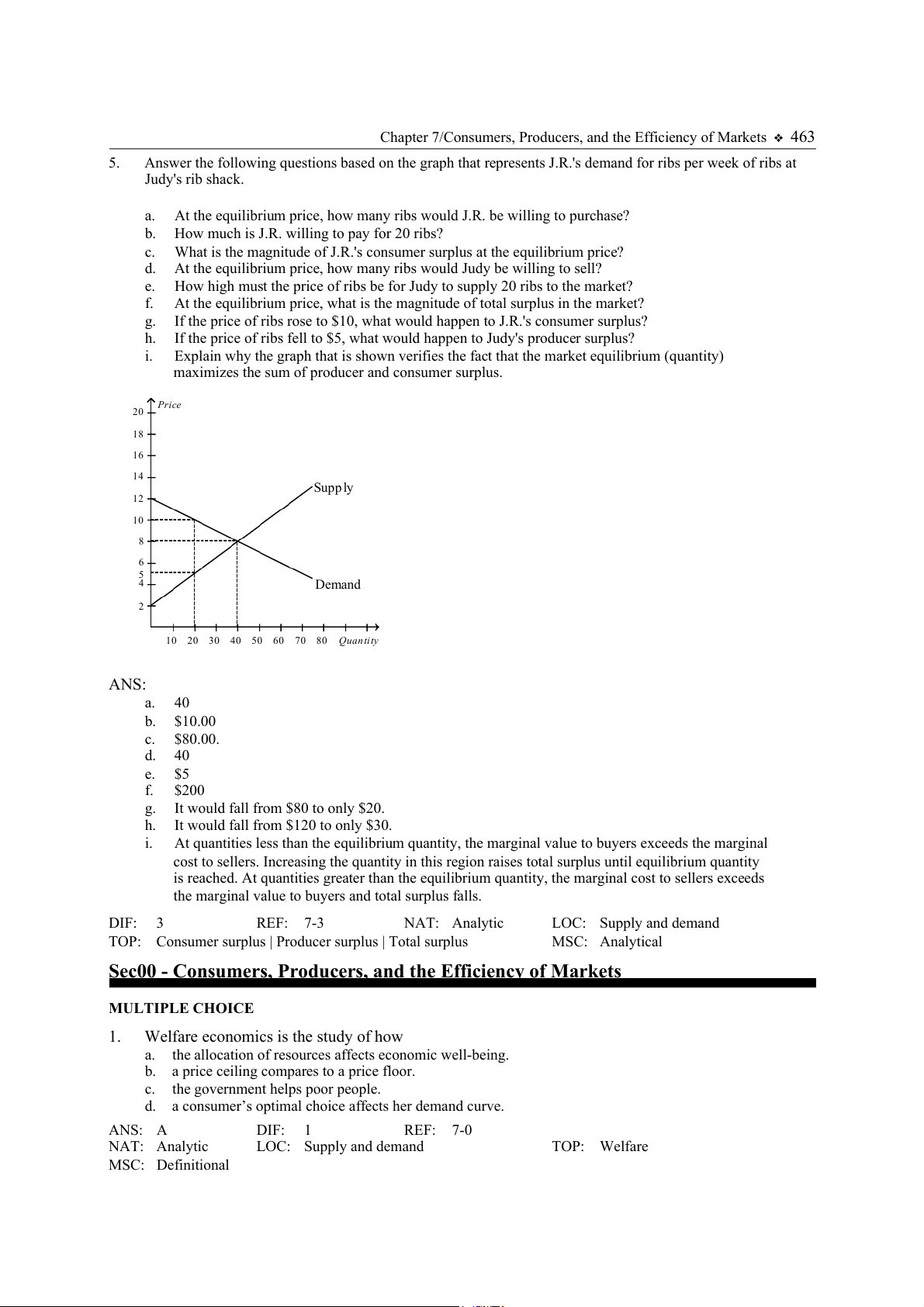
Answer the following questions based on the graph that represents J.R.'s demand for ribs per week of ribs at Judy's rib shack. a.
At the equilibrium price, how many ribs would J.R. be willing to purchase? b.
How much is J.R. willing to pay for 20 ribs? c.
What is the magnitude of J.R.'s consumer surplus at the equilibrium price? d.
At the equilibrium price, how many ribs would Judy be willing to sell? e.
How high must the price of ribs be for Judy to supply 20 ribs to the market? f.
At the equilibrium price, what is the magnitude of total surplus in the market? g.
If the price of ribs rose to $10, what would happen to J.R.'s consumer surplus? h.
If the price of ribs fell to $5, what would happen to Judy's producer surplus? i.
Explain why the graph that is shown verifies the fact that the market equilibrium (quantity)
maximizes the sum of producer and consumer surplus. Price 20 18 16 14 Supp ly 12 10 8 6 5 4 Demand 2 10 20 30 40 50 60 70 80 Quan ti ty ANS: a. 40 b. $10.00 c. $80.00. d. 40 e. $5 f. $200 g.
It would fall from $80 to only $20. h.
It would fall from $120 to only $30. i.
At quantities less than the equilibrium quantity, the marginal value to buyers exceeds the marginal
cost to sellers. Increasing the quantity in this region raises total surplus until equilibrium quantity
is reached. At quantities greater than the equilibrium quantity, the marginal cost to sellers exceeds
the marginal value to buyers and total surplus falls. DIF: 3 REF: 7-3 NAT: Analytic LOC: Supply and demand TOP:
Consumer surplus | Producer surplus | Total surplus MSC: Analytical
Sec00 - Consumers, Producers, and the Efficiency of Markets MULTIPLE CHOICE 1.
Welfare economics is the study of how a.
the allocation of resources affects economic well-being. b.
a price ceiling compares to a price floor. c.
the government helps poor people. d.
a consumer’s optimal choice affects her demand curve. ANS: A DIF: 1 REF: 7-0 NAT: Analytic LOC: Supply and demand TOP: Welfare MSC: Definitional
464 Chapter 7/Consumers, Producers, and the Efficiency of Markets 2.
Welfare economics is the study of a. taxes and subsidies. b.
how technology is best put to use in the production of goods and services. c.
government welfare programs for needy people. d.
how the allocation of resources affects economic well-being. ANS: D DIF: 1 REF: 7-0 NAT: Analytic LOC: Supply and demand TOP: Welfare MSC: Definitional 3.
Welfare economics is the study of a.
the well-being of less fortunate people. b.
welfare programs in the United States. c.
how the allocation of resources affects economic well-being. d.
the effect of income redistribution on work effort. ANS: C DIF: 1 REF: 7-0 NAT: Analytic LOC: Supply and demand TOP: Welfare MSC: Definitional 4.
The study of how the allocation of resources affects economic well-being is called a. consumer economics. b. macroeconomics. c. willingness-to-pay economics. d. welfare economics. ANS: D DIF: 1 REF: 7-0 NAT: Analytic LOC: Supply and demand TOP: Welfare MSC: Definitional 5.
An example of positive analysis is studying a.
how market forces produce equilibrium. b.
whether equilibrium outcomes are fair. c.
whether equilibrium outcomes are socially desirable. d.
if income distributions are fair. ANS: A DIF: 1 REF: 7-0 NAT: Analytic LOC: Supply and demand TOP: Positive statements MSC: Definitional 6.
An example of normative analysis is studying a.
how market forces produce equilibrium. b. surpluses and shortages. c.
whether equilibrium outcomes are socially desirable. d. income distributions. ANS: C DIF: 1 REF: 7-0 NAT: Analytic LOC: Supply and demand TOP: Normative statements MSC: Definitional 7.
Which of the Ten Principles of Economics does welfare economics explain more fully? a.
The cost of something is what you give up to get it. b.
Markets are usually a good way to organize economic activity. c.
Trade can make everyone better off. d.
A country’s standard of living depends on its ability to produce goods and services. ANS: B DIF: 2 REF: 7-0 NAT: Analytic LOC: Supply and demand TOP: Welfare MSC: Interpretive
Chapter 7/Consumers, Producers, and the Efficiency of Markets 465 8.
Which of the Ten Principles of Economics does welfare economics explain more fully? a.
The cost of something is what you give up to get it. b.
Rational people think at the margin. c.
Markets are usually a good way to organize economic activity. d. People respond to incentives. ANS: C DIF: 2 REF: 7-0 NAT: Analytic LOC: Supply and demand TOP: Welfare MSC: Interpretive 9.
One of the basic principles of economics is that markets are usually a good way to organize
economic activity. This principle is explained by the study of a. factor markets. b. energy markets. c. welfare economics. d. labor economics. ANS: C DIF: 1 REF: 7-0 NAT: Analytic LOC: Supply and demand TOP: Welfare MSC: Interpretive
10. A result of welfare economics is that the equilibrium price of a product is considered to be the best price because it a.
maximizes both the total revenue for firms and the quantity supplied of the product. b.
maximizes the combined welfare of buyers and sellers. c.
minimizes costs and maximizes output. d.
minimizes the level of welfare payments. ANS: B DIF: 2 REF: 7-0 NAT: Analytic LOC: Supply and demand TOP: Welfare MSC: Interpretive
11. The particular price that results in quantity supplied being equal to quantity demanded is the best price because it a. maximizes costs of the seller. b.
maximizes tax revenue for the government. c.
maximizes the combined welfare of buyers and sellers. d.
minimizes the expenditure of buyers. ANS: C DIF: 2 REF: 7-0 NAT: Analytic LOC: Supply and demand TOP: Welfare MSC: Interpretive
12. Welfare economics explains which of the following in the market for DVDs? a.
The government sets the price of DVDs; firms respond to the price by producing a specific level of output. b.
The government sets the quantity of DVDs; firms respond to the quantity by charging a specific price. c.
The market equilibrium price for DVDs maximizes the total welfare to DVD buyers and sellers. d.
The market equilibrium price for DVDs maximizes consumer welfare but minimizes producer welfare. ANS: C DIF: 2 REF: 7-0 NAT: Analytic LOC: Supply and demand TOP: Welfare MSC: Interpretive
466 Chapter 7/Consumers, Producers, and the Efficiency of Markets
Sec01 - Consumers, Producers, and the Efficiency of Markets - Consumer Surplus MULTIPLE CHOICE 1.
The maximum price that a buyer will pay for a good is called the a. cost. b. willingness to pay. c. equity. d. efficiency. ANS: B DIF: 1 REF: 7-1 NAT: Analytic LOC: Supply and demand TOP: Willingness to pay MSC: Definitional 2.
Suppose Larry, Moe and Curly are bidding in an auction for a mint-condition video of Charlie
Chaplin's first movie. Each has in mind a maximum amount that he will bid. This maximum is called a. a resistance price. b. willingness to pay. c. consumer surplus. d. producer surplus. ANS: B DIF: 1 REF: 7-1 NAT: Analytic LOC: Supply and demand TOP: Willingness to pay MSC: Definitional 3.
Suppose Chris and Laura attend a charity benefit and participate in a silent auction. Each has in
mind a maximum amount that he or she will bid for an oil painting by a locally famous artist. This maximum is called a. deadweight loss. b. willingness to pay. c. consumer surplus. d. producer surplus. ANS: B DIF: 1 REF: 7-1 NAT: Analytic LOC: Supply and demand TOP: Willingness to pay MSC: Definitional 4. Willingness to pay a.
measures the value that a buyer places on a good. b.
is the amount a seller actually receives for a good minus the minimum amount the seller is willing to accept. c.
is the maximum amount a buyer is willing to pay minus the minimum amount a seller is willing to accept. d.
is the amount a buyer is willing to pay for a good minus the amount the buyer actually pays for it. ANS: A DIF: 2 REF: 7-1 NAT: Analytic LOC: Supply and demand TOP: Willingness to pay MSC: Definitional 5.
A consumer's willingness to pay directly measures a.
the extent to which advertising and other external forces have influenced the consumer’s preferences. b.
the cost of a good to the buyer. c.
how much a buyer values a good. d. consumer surplus. ANS: C DIF: 2 REF: 7-1 NAT: Analytic TOP: Willingness to pay MSC: Interpretive
Chapter 7/Consumers, Producers, and the Efficiency of Markets 467 6.
When a buyer’s willingness to pay for a good is equal to the price of the good, the a.
buyer’s consumer surplus for that good is maximized. b.
buyer will buy as much of the good as the buyer’s budget allows. c.
price of the good exceeds the value that the buyer places on the good. d.
buyer is indifferent between buying the good and not buying it. ANS: D DIF: 2 REF: 7-1 NAT: Analytic LOC: Supply and demand TOP: Willingness to pay MSC: Interpretive 7.
In which of the following circumstances would a buyer be indifferent about buying a good? a.
The amount of consumer surplus the buyer would experience as a result of buying the good is zero. b.
The price of the good is equal to the buyer’s willingness to pay for the good. c.
The price of the good is equal to the value the buyer places on the good. d. All of the above are correct. ANS: D DIF: 2 REF: 7-1 NAT: Analytic LOC: Supply and demand TOP: Willingness to pay MSC: Interpretive 8.
A demand curve reflects each of the following except the a.
willingness to pay of all buyers in the market. b.
value each buyer in the market places on the good. c.
highest price buyers are willing to pay for each quantity. d.
ability of buyers to obtain the quantity they desire. ANS: D DIF: 2 REF: 7-1 NAT: Analytic LOC: Supply and demand TOP: Willingness to pay MSC: Interpretive 9. Consumer surplus is a.
the amount a buyer is willing to pay for a good minus the amount the buyer actually pays for it. b.
the amount a buyer is willing to pay for a good minus the cost of producing the good. c.
the amount by which the quantity supplied of a good exceeds the quantity demanded of the good. d.
a buyer's willingness to pay for a good plus the price of the good. ANS: A DIF: 2 REF: 7-1 NAT: Analytic LOC: Supply and demand TOP: Consumer surplus MSC: Definitional 10. Consumer surplus a.
is the amount of a good that a consumer can buy at a price below equilibrium price. b.
is the amount a consumer is willing to pay minus the amount the consumer actually pays. c.
is the number of consumers who are excluded from a market because of scarcity. d.
measures how much a seller values a good. ANS: B DIF: 2 REF: 7-1 NAT: Analytic LOC: Supply and demand TOP: Consumer surplus MSC: Definitional 11. Consumer surplus is the a.
amount of a good consumers get without paying anything. b.
amount a consumer pays minus the amount the consumer is willing to pay. c.
amount a consumer is willing to pay minus the amount the consumer actually pays. d. value of a good to a consumer. ANS: C DIF: 1 REF: 7-1 NAT: Analytic LOC: Supply and demand TOP: Consumer surplus MSC: Definitional
468 Chapter 7/Consumers, Producers, and the Efficiency of Markets
12. Consumer surplus is equal to the a.
Value to buyers - Amount paid by buyers. b.
Amount paid by buyers - Costs of sellers. c.
Value to buyers - Costs of sellers. d.
Value to buyers - Willingness to pay of buyers. ANS: A DIF: 2 REF: 7-1 NAT: Analytic LOC: Supply and demand TOP: Consumer surplus MSC: Definitional
13. On a graph, the area below a demand curve and above the price measures a. producer surplus. b. consumer surplus. c. deadweight loss. d. willingness to pay. ANS: B DIF: 1 REF: 7-1 NAT: Analytic LOC: Supply and demand TOP: Consumer surplus MSC: Interpretive
14. On a graph, consumer surplus is represented by the area a.
between the demand and supply curves. b.
below the demand curve and above price. c.
below the price and above the supply curve. d.
below the demand curve and to the right of equilibrium price. ANS: B DIF: 2 REF: 7-1 NAT: Analytic LOC: Supply and demand TOP: Consumer surplus MSC: Interpretive
15. Consumer surplus in a market can be represented by the a.
area below the demand curve and above the price. b.
distance from the demand curve to the horizontal axis. c.
distance from the demand curve to the vertical axis. d.
area below the demand curve and above the horizontal axis. ANS: A DIF: 2 REF: 7-1 NAT: Analytic LOC: Supply and demand TOP: Consumer surplus MSC: Interpretive 16. Consumer surplus is a.
a concept that helps us make normative statements about the desirability of market outcomes. b.
represented on a graph by the area below the demand curve and above the price. c.
a good measure of economic welfare if buyers' preferences are the primary concern. d. All of the above are correct. ANS: D DIF: 2 REF: 7-1 NAT: Analytic LOC: Supply and demand TOP: Consumer surplus MSC: Interpretive
17. In a market, the marginal buyer is the buyer a.
whose willingness to pay is higher than that of all other buyers and potential buyers. b.
whose willingness to pay is lower than that of all other buyers and potential buyers. c.
who is willing to buy exactly one unit of the good. d.
who would be the first to leave the market if the price were any higher. ANS: D DIF: 2 REF: 7-1 NAT: Analytic LOC: Supply and demand TOP: Marginal buyer MSC: Definitional
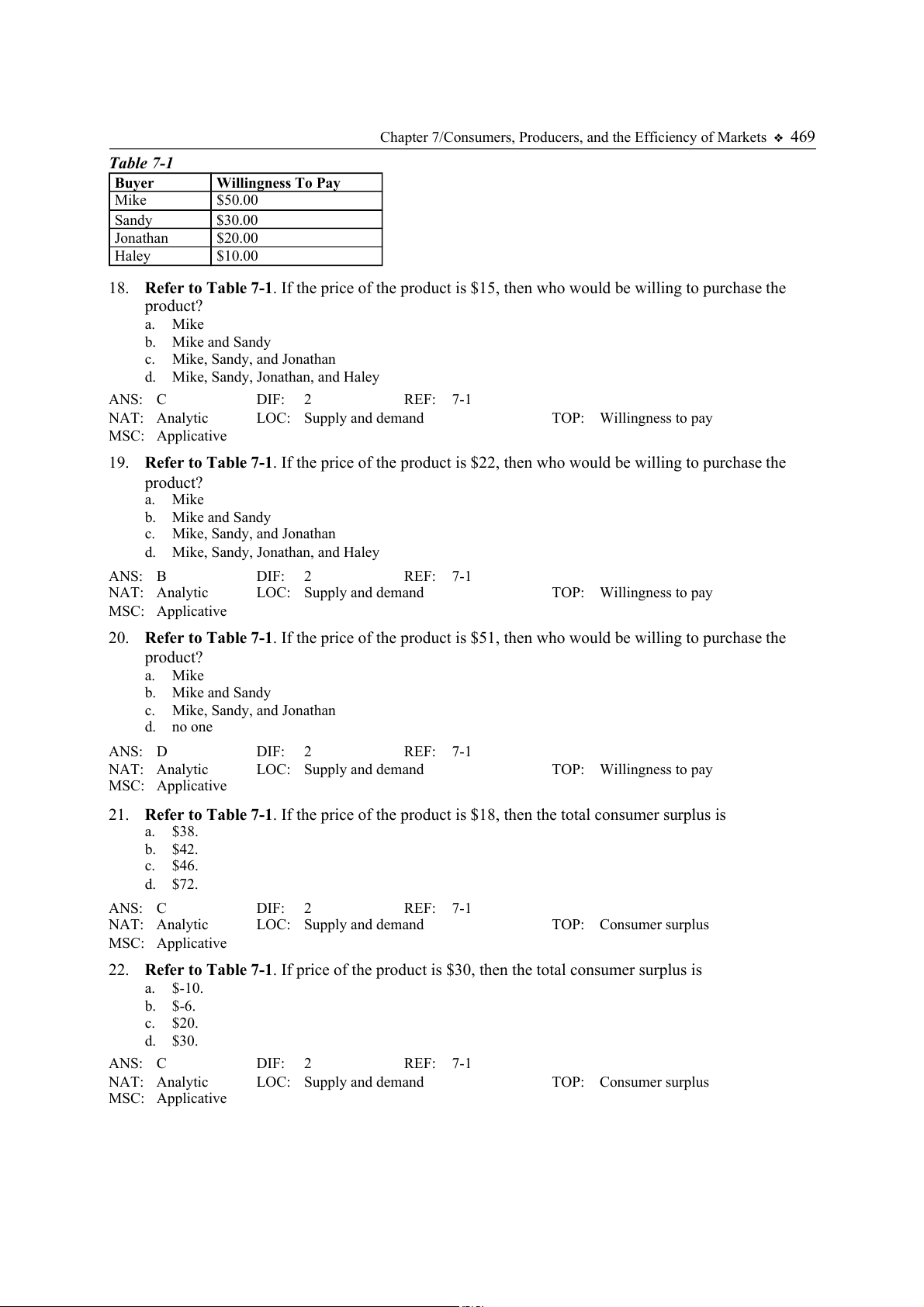
Chapter 7/Consumers, Producers, and the Efficiency of Markets 469 Table 7-1 Buyer Willingness To Pay Mike $50.00 Sandy $30.00 Jonathan $20.00 Haley $10.00
18. Refer to Table 7-1. If the price of the product is $15, then who would be willing to purchase the product? a. Mike b. Mike and Sandy c. Mike, Sandy, and Jonathan d.
Mike, Sandy, Jonathan, and Haley ANS: C DIF: 2 REF: 7-1 NAT: Analytic LOC: Supply and demand TOP: Willingness to pay MSC: Applicative
19. Refer to Table 7-1. If the price of the product is $22, then who would be willing to purchase the product? a. Mike b. Mike and Sandy c. Mike, Sandy, and Jonathan d.
Mike, Sandy, Jonathan, and Haley ANS: B DIF: 2 REF: 7-1 NAT: Analytic LOC: Supply and demand TOP: Willingness to pay MSC: Applicative
20. Refer to Table 7-1. If the price of the product is $51, then who would be willing to purchase the product? a. Mike b. Mike and Sandy c. Mike, Sandy, and Jonathan d. no one ANS: D DIF: 2 REF: 7-1 NAT: Analytic LOC: Supply and demand TOP: Willingness to pay MSC: Applicative
21. Refer to Table 7-1. If the price of the product is $18, then the total consumer surplus is a. $38. b. $42. c. $46. d. $72. ANS: C DIF: 2 REF: 7-1 NAT: Analytic LOC: Supply and demand TOP: Consumer surplus MSC: Applicative
22. Refer to Table 7-1. If price of the product is $30, then the total consumer surplus is a. $-10. b. $-6. c. $20. d. $30. ANS: C DIF: 2 REF: 7-1 NAT: Analytic LOC: Supply and demand TOP: Consumer surplus MSC: Applicative
470 Chapter 7/Consumers, Producers, and the Efficiency of Markets Table 7-2
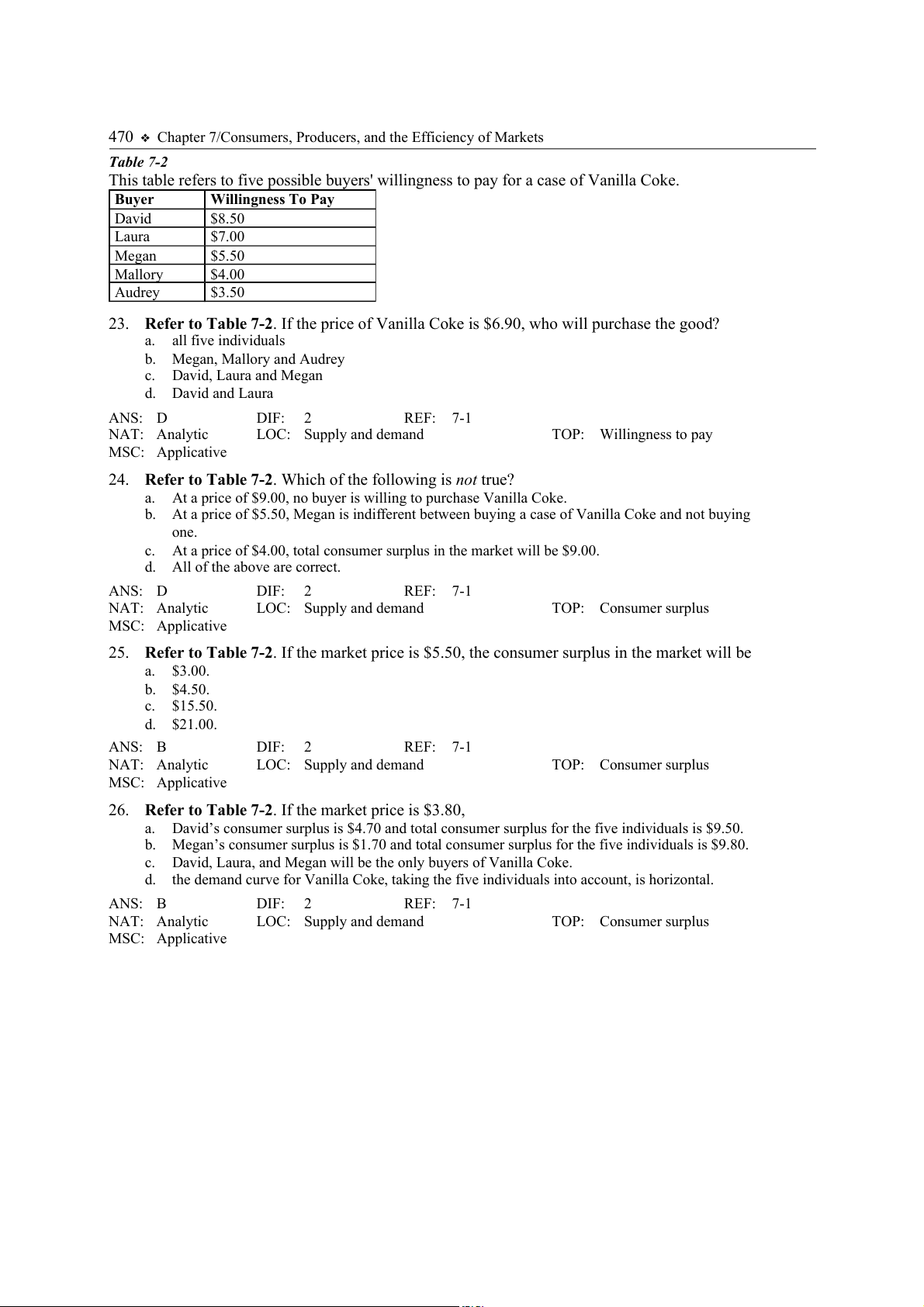
This table refers to five possible buyers' willingness to pay for a case of Vanilla Coke. Buyer Willingness To Pay David $8.50 Laura $7.00 Megan $5.50 Mallory $4.00 Audrey $3.50
23. Refer to Table 7-2. If the price of Vanilla Coke is $6.90, who will purchase the good? a. all five individuals b. Megan, Mallory and Audrey c. David, Laura and Megan d. David and Laura ANS: D DIF: 2 REF: 7-1 NAT: Analytic LOC: Supply and demand TOP: Willingness to pay MSC: Applicative
24. Refer to Table 7-2. Which of the following is not true? a.
At a price of $9.00, no buyer is willing to purchase Vanilla Coke. b.
At a price of $5.50, Megan is indifferent between buying a case of Vanilla Coke and not buying one. c.
At a price of $4.00, total consumer surplus in the market will be $9.00. d. All of the above are correct. ANS: D DIF: 2 REF: 7-1 NAT: Analytic LOC: Supply and demand TOP: Consumer surplus MSC: Applicative
25. Refer to Table 7-2. If the market price is $5.50, the consumer surplus in the market will be a. $3.00. b. $4.50. c. $15.50. d. $21.00. ANS: B DIF: 2 REF: 7-1 NAT: Analytic LOC: Supply and demand TOP: Consumer surplus MSC: Applicative
26. Refer to Table 7-2. If the market price is $3.80, a.
David’s consumer surplus is $4.70 and total consumer surplus for the five individuals is $9.50. b.
Megan’s consumer surplus is $1.70 and total consumer surplus for the five individuals is $9.80. c.
David, Laura, and Megan will be the only buyers of Vanilla Coke. d.
the demand curve for Vanilla Coke, taking the five individuals into account, is horizontal. ANS: B DIF: 2 REF: 7-1 NAT: Analytic LOC: Supply and demand TOP: Consumer surplus MSC: Applicative
Chapter 7/Consumers, Producers, and the Efficiency of Markets 471 Table 7-3
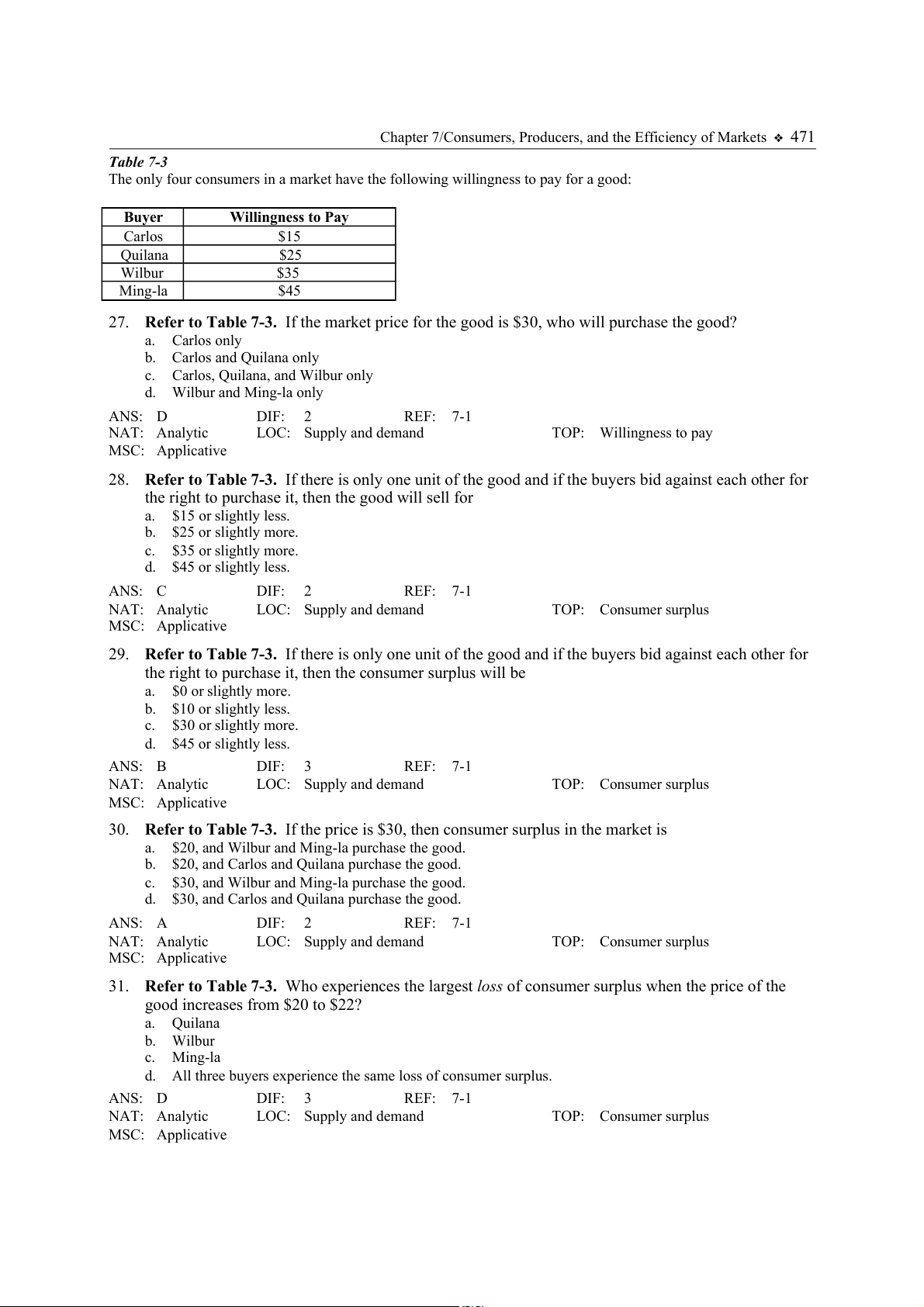
The only four consumers in a market have the following willingness to pay for a good: Buyer Willingness to Pay Carlos $15 Quilana $25 Wilbur $35 Ming-la $45
27. Refer to Table 7-3. If the market price for the good is $30, who will purchase the good? a. Carlos only b. Carlos and Quilana only c.
Carlos, Quilana, and Wilbur only d. Wilbur and Ming-la only ANS: D DIF: 2 REF: 7-1 NAT: Analytic LOC: Supply and demand TOP: Willingness to pay MSC: Applicative
28. Refer to Table 7-3. If there is only one unit of the good and if the buyers bid against each other for
the right to purchase it, then the good will sell for a. $15 or slightly less. b. $25 or slightly more. c. $35 or slightly more. d. $45 or slightly less. ANS: C DIF: 2 REF: 7-1 NAT: Analytic LOC: Supply and demand TOP: Consumer surplus MSC: Applicative
29. Refer to Table 7-3. If there is only one unit of the good and if the buyers bid against each other for
the right to purchase it, then the consumer surplus will be a. $0 or slightly more. b. $10 or slightly less. c. $30 or slightly more. d. $45 or slightly less. ANS: B DIF: 3 REF: 7-1 NAT: Analytic LOC: Supply and demand TOP: Consumer surplus MSC: Applicative
30. Refer to Table 7-3. If the price is $30, then consumer surplus in the market is a.
$20, and Wilbur and Ming-la purchase the good. b.
$20, and Carlos and Quilana purchase the good. c.
$30, and Wilbur and Ming-la purchase the good. d.
$30, and Carlos and Quilana purchase the good. ANS: A DIF: 2 REF: 7-1 NAT: Analytic LOC: Supply and demand TOP: Consumer surplus MSC: Applicative
31. Refer to Table 7-3. Who experiences the largest loss of consumer surplus when the price of the
good increases from $20 to $22? a. Quilana b. Wilbur c. Ming-la d.
All three buyers experience the same loss of consumer surplus. ANS: D DIF: 3 REF: 7-1 NAT: Analytic LOC: Supply and demand TOP: Consumer surplus MSC: Applicative
472 Chapter 7/Consumers, Producers, and the Efficiency of Markets Table 7-4
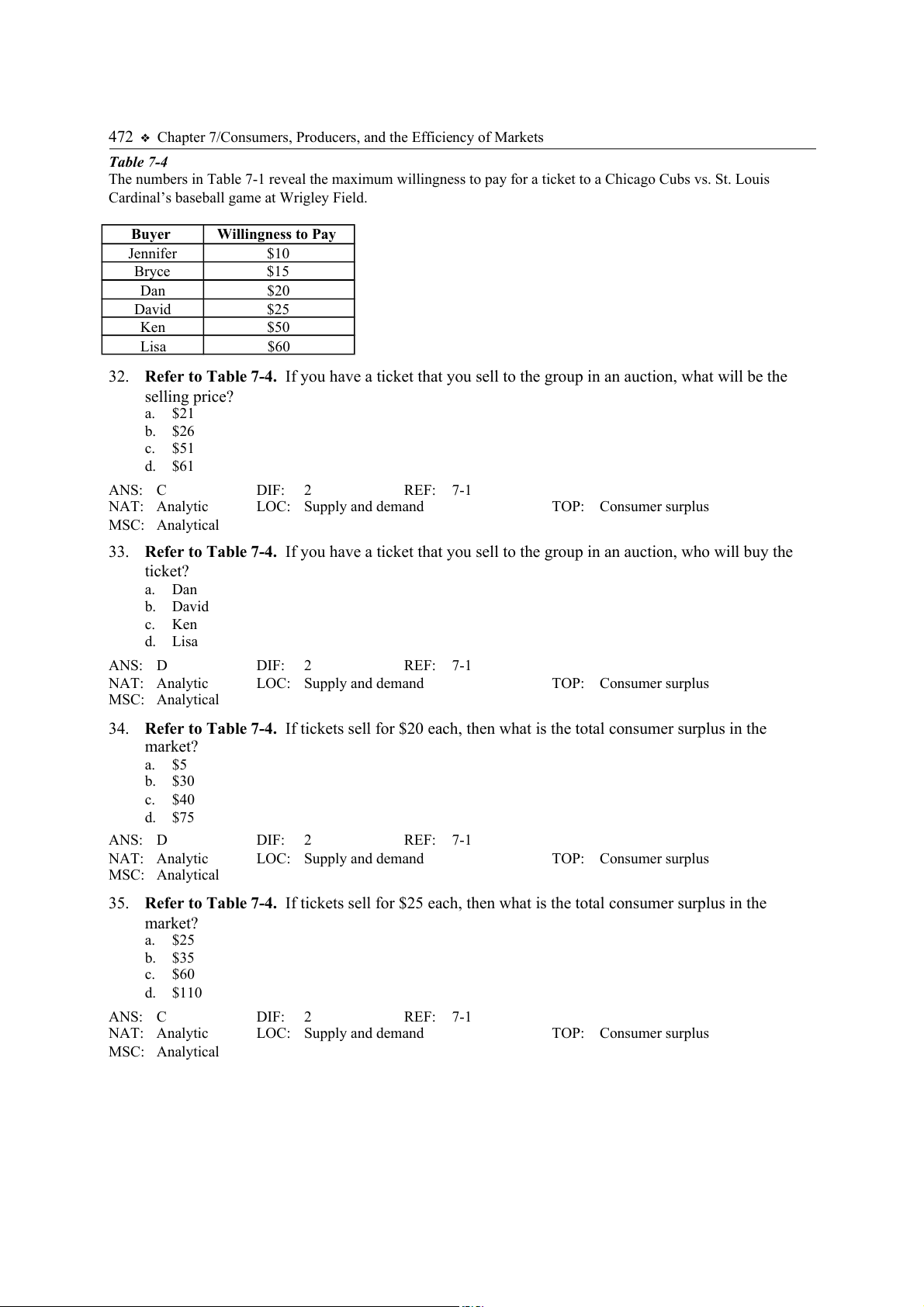
The numbers in Table 7-1 reveal the maximum willingness to pay for a ticket to a Chicago Cubs vs. St. Louis
Cardinal’s baseball game at Wrigley Field. Buyer Willingness to Pay Jennifer $10 Bryce $15 Dan $20 David $25 Ken $50 Lisa $60
32. Refer to Table 7-4. If you have a ticket that you sell to the group in an auction, what will be the selling price? a. $21 b. $26 c. $51 d. $61 ANS: C DIF: 2 REF: 7-1 NAT: Analytic LOC: Supply and demand TOP: Consumer surplus MSC: Analytical
33. Refer to Table 7-4. If you have a ticket that you sell to the group in an auction, who will buy the ticket? a. Dan b. David c. Ken d. Lisa ANS: D DIF: 2 REF: 7-1 NAT: Analytic LOC: Supply and demand TOP: Consumer surplus MSC: Analytical
34. Refer to Table 7-4. If tickets sell for $20 each, then what is the total consumer surplus in the market? a. $5 b. $30 c. $40 d. $75 ANS: D DIF: 2 REF: 7-1 NAT: Analytic LOC: Supply and demand TOP: Consumer surplus MSC: Analytical
35. Refer to Table 7-4. If tickets sell for $25 each, then what is the total consumer surplus in the market? a. $25 b. $35 c. $60 d. $110 ANS: C DIF: 2 REF: 7-1 NAT: Analytic LOC: Supply and demand TOP: Consumer surplus MSC: Analytical
Tài liệu liên quan:
-
Chương 3: độ co giãn và các nhân tố ảnh hưởng | Microeconomics | Trường Đại học Quốc tế, Đại học Quốc gia Thành phố Hồ Chí Minh
5 3 -
Microeconomics Syllabus | Microeconomics | Trường Đại học Quốc tế, Đại học Quốc gia Thành phố Hồ Chí Minh
5 3 -
Microeconomics Course Syllabus & Assessment Details | Microeconomics | Trường Đại học Quốc tế, Đại học Quốc gia Thành phố Hồ Chí Minh
5 3 -
Assignment 3 - Elasticity MCQs and Key Concepts | Microeconomics | Trường Đại học Quốc tế, Đại học Quốc gia Thành phố Hồ Chí Minh
5 3 -
Assignment 2 - Economic Equilibrium Analysis of Fridges and Motorcycles | Microeconomics | Trường Đại học Quốc tế, Đại học Quốc gia Thành phố Hồ Chí Minh
5 3