Competitive Market vs. Monopoly - Key Comparisons & Analysis | Microeconomics | Trường Đại học Quốc tế, Đại học Quốc gia Thành phố Hồ Chí Minh
Competive market is the most effective market in term of Welfare By compare the competitive market and monopoly in term Price, Quantity, Net Social Benefit Net Social Benefit (NSB)= Consumer’s Surplus (CS)+ Producer’s Surplus (PS) Competitive market is considered as the most effective market (NSB is maximized in the competitive market) Monopoly decreases their quantity and then price will increase Qm<Qc and Pm>Pc Welfare Analysis: There is the deadweight loss (DwL) in the monopoly. Tài liệu được sưu tầm và soạn thảo dưới dạng file PDF để gửi tới các bạn cùng tham khảo, ôn tập đầy đủ kiến thức, chuẩn bị cho các buổi học thật tốt. Mời bạn đọc đón xem!
Môn: Microeconomics 635 tài liệu
Trường: Trường Đại học Quốc tế, Đại học Quốc gia Thành phố Hồ Chí Minh 1.9 K tài liệu
Tác giả:

Preview text:
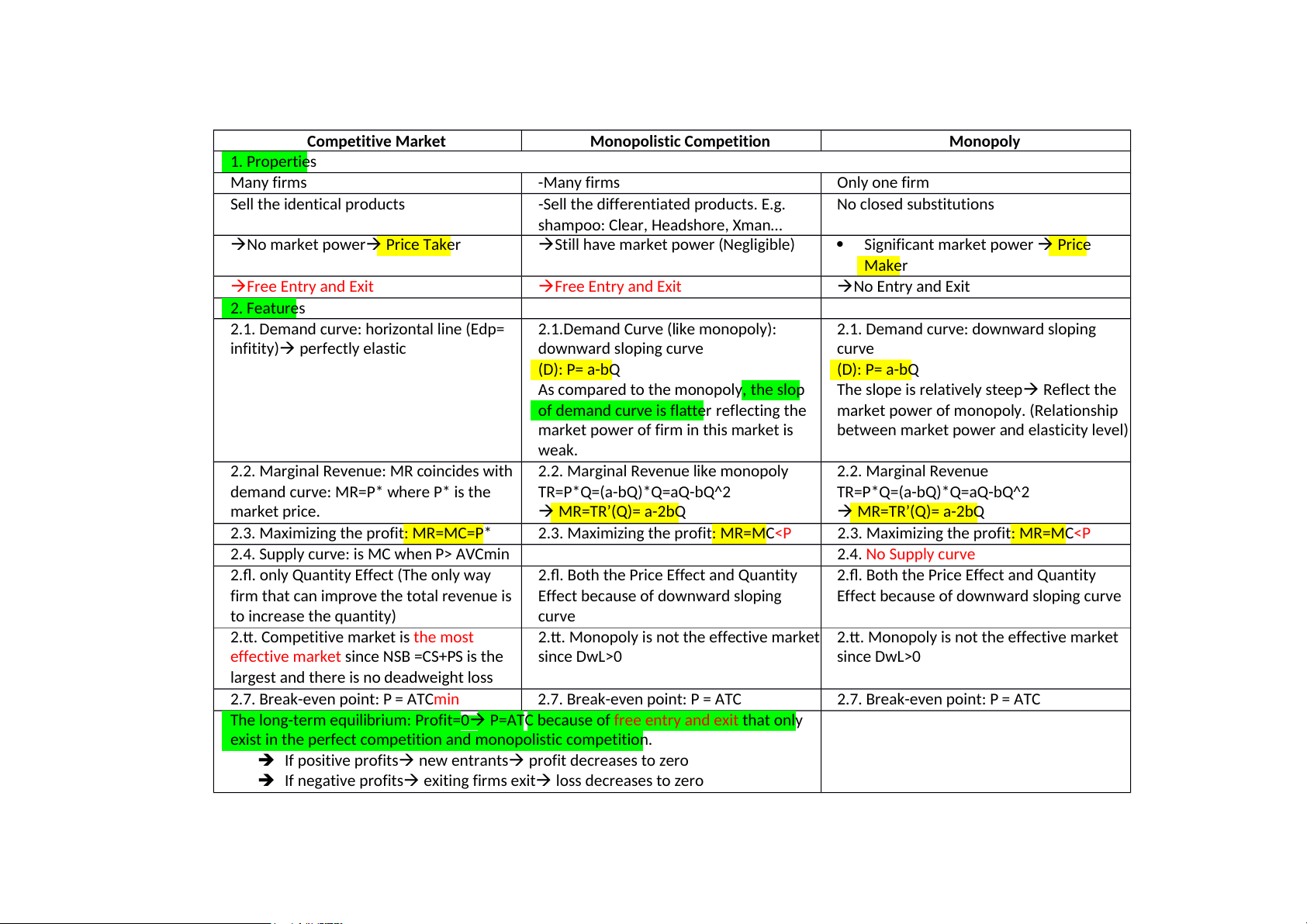
Competitive Market
Monopolistic Competition Monopoly 1. Properties Many firms -Many firms Only one firm Sell the identical products
-Sell the differentiated products. E.g. No closed substitutions
shampoo: Clear, Headshore, Xman…
No market power Price Taker
Still have market power (Negligible) Significant market power Price Maker Free Entry and Exit Free Entry and Exit No Entry and Exit 2. Features
2.1. Demand curve: horizontal line (Edp=
2.1.Demand Curve (like monopoly):
2.1. Demand curve: downward sloping infitity) perfectly elastic downward sloping curve curve (D): P= a-bQ (D): P= a-bQ
As compared to the monopoly, the slop The slope is relatively steep Reflect the
of demand curve is flatter reflecting the
market power of monopoly. (Relationship
market power of firm in this market is
between market power and elasticity level) weak.
2.2. Marginal Revenue: MR coincides with
2.2. Marginal Revenue like monopoly 2.2. Marginal Revenue
demand curve: MR=P* where P* is the TR=P*Q=(a-bQ)*Q=aQ-bQ^2 TR=P*Q=(a-bQ)*Q=aQ-bQ^2 market price. MR=TR’(Q)= a-2bQ MR=TR’(Q)= a-2bQ
2.3. Maximizing the profit: MR=MC=P*
2.3. Maximizing the profit: MR=MC
2.3. Maximizing the profit: MR=MC
2.4. Supply curve: is MC when P> AVCmin 2.4. No Supply curve
2.5. only Quantity Effect (The only way
2.5. Both the Price Effect and Quantity
2.5. Both the Price Effect and Quantity
firm that can improve the total revenue is
Effect because of downward sloping
Effect because of downward sloping curve to increase the quantity) curve
2.6. Competitive market is the most
2.6. Monopoly is not the effective market
2.6. Monopoly is not the effective market
effective market since NSB =CS+PS is the since DwL>0 since DwL>0
largest and there is no deadweight loss
2.7. Break-even point: P = ATCmin 2.7. Break-even point: P = ATC 2.7. Break-even point: P = ATC
The long-term equilibrium: Profit=0 P=ATC because of free entry and exit that only
exist in the perfect competition and monopolistic competition.
If positive profits new entrants profit decreases to zero
If negative profits exiting firms exit loss decreases to zero
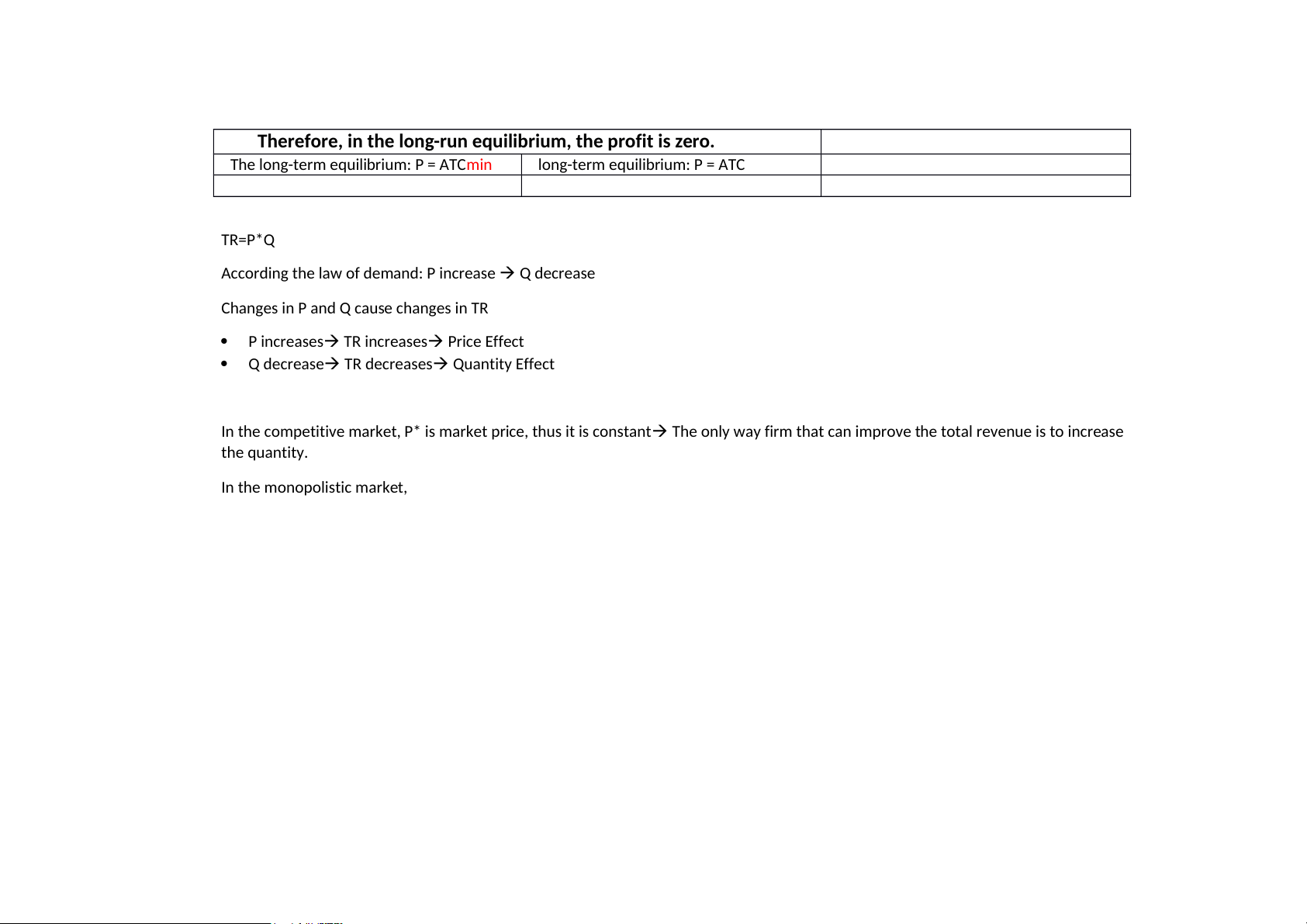
Therefore, in the long-run equilibrium, the profit is zero.
The long-term equilibrium: P = ATCmin long-term equilibrium: P = ATC TR=P*Q
According the law of demand: P increase Q decrease
Changes in P and Q cause changes in TR
P increases TR increases Price Effect
Q decrease TR decreases Quantity Effect
In the competitive market, P* is market price, thus it is constant
The only way firm that can improve t
he total revenue is to increase the quantity. In the monopolistic market,
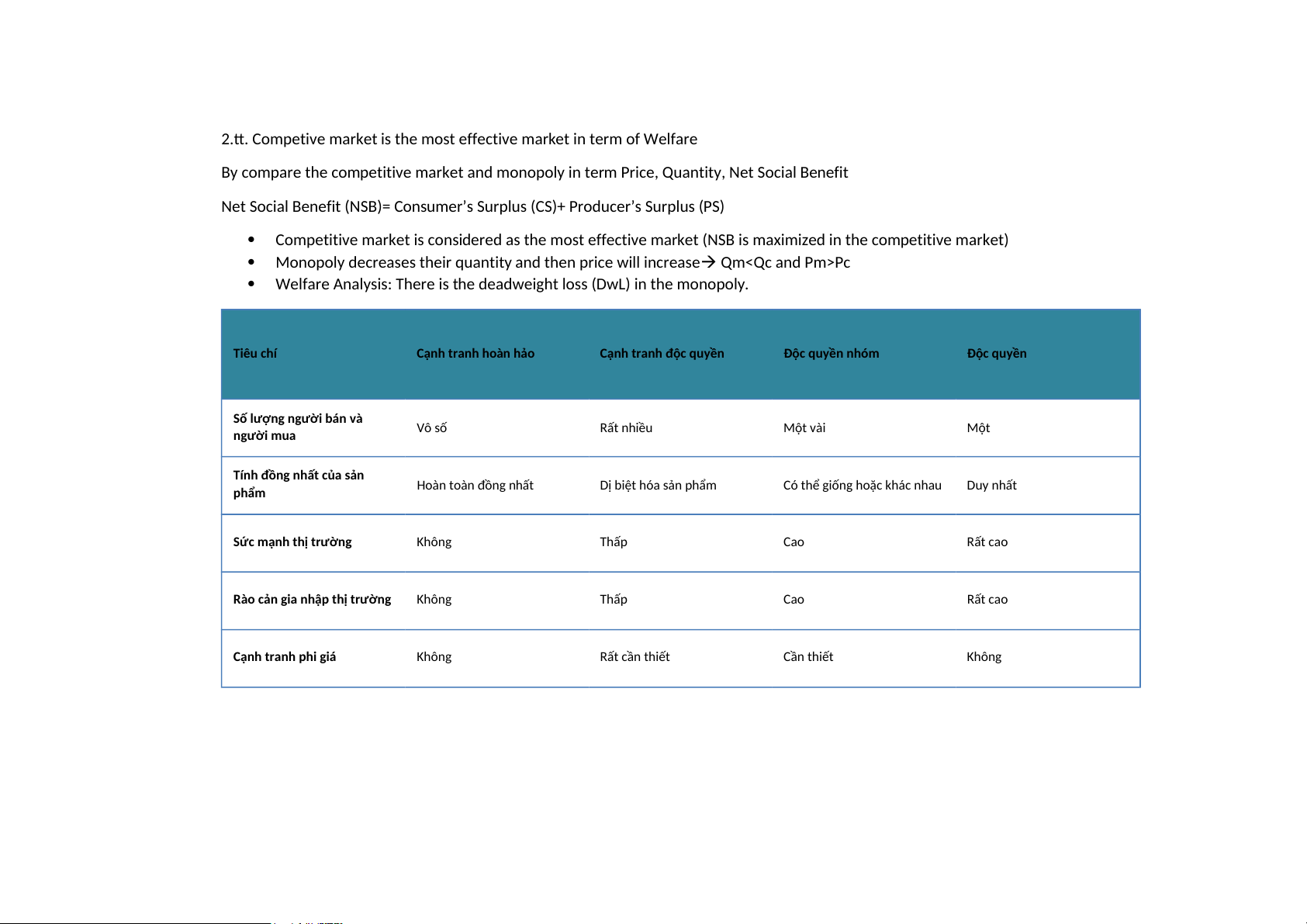
2.6. Competive market is the most effective market in term of Welfare
By compare the competitive market and monopoly in term Price, Quantity, Net Social Benefit
Net Social Benefit (NSB)= Consumer’s Surplus (CS)+ Producer’s Surplus (PS)
Competitive market is considered as the most effective market (NSB is maximized in the competitive market)
Monopoly decreases their quantity and then price will increase QmPc
Welfare Analysis: There is the deadweight loss (DwL) in the monopoly. Tiêu chí
Cạnh tranh hoàn hảo
Cạnh tranh độc quyền Độc quyền nhóm Độc quyền
Số lượng người bán và Vô số Rất nhiều Một vài Một người mua
Tính đồng nhất của sản Hoàn toàn đồng nhất Dị biệt hóa sản phẩm
Có thể giống hoặc khác nhau Duy nhất phẩm
Sức mạnh thị trường Không Thấp Cao Rất cao
Rào cản gia nhập thị trường Không Thấp Cao Rất cao Cạnh tranh phi giá Không Rất cần thiết Cần thiết Không
Tài liệu liên quan:
-

Chương 3: độ co giãn và các nhân tố ảnh hưởng | Microeconomics | Trường Đại học Quốc tế, Đại học Quốc gia Thành phố Hồ Chí Minh
4 2 -
Microeconomics Syllabus | Microeconomics | Trường Đại học Quốc tế, Đại học Quốc gia Thành phố Hồ Chí Minh
4 2 -
Microeconomics Course Syllabus & Assessment Details | Microeconomics | Trường Đại học Quốc tế, Đại học Quốc gia Thành phố Hồ Chí Minh
4 2 -
Assignment 3 - Elasticity MCQs and Key Concepts | Microeconomics | Trường Đại học Quốc tế, Đại học Quốc gia Thành phố Hồ Chí Minh
4 2 -
Assignment 2 - Economic Equilibrium Analysis of Fridges and Motorcycles | Microeconomics | Trường Đại học Quốc tế, Đại học Quốc gia Thành phố Hồ Chí Minh
4 2