Consumers, Producers, and Market Efficiency Concepts | Microeconomics | Trường Đại học Quốc tế, Đại học Quốc gia Thành phố Hồ Chí Minh
Welfare economics: the study of how the allocation of resources affects economic well-being 2. Willingness to pay: the maximum amount that a buyer will pay for a good 3. Consumer surplus: the amount a buyer is willing to pay for a good minus the amount the buyer actually pays for it 4. Cost: the value of everything a seller must give up to produce a good 5. Producer surplus: the amount a seller is paid for a good minus the seller’s cost of providing it. Tài liệu được sưu tầm và soạn thảo dưới dạng file PDF để gửi tới các bạn cùng tham khảo, ôn tập đầy đủ kiến thức, chuẩn bị cho các buổi học thật tốt. Mời bạn đọc đón xem!
Môn: Microeconomics 635 tài liệu
Trường: Trường Đại học Quốc tế, Đại học Quốc gia Thành phố Hồ Chí Minh 1.9 K tài liệu
Tác giả:

Preview text:
Consumers, Producers, and the Efficiency of Markets Terms and Definitions
1. Welfare economics: the study of how the allocation of resources affects economic well-being
2. Willingness to pay: the maximum amount that a buyer will pay for a good
3. Consumer surplus: the amount a buyer is willing to pay for a good minus the
amount the buyer actually pays for it
4. Cost: the value of everything a seller must give up to produce a good
5. Producer surplus: the amount a seller is paid for a good minus the seller’s cost of providing it
6. Efficiency: the property of a resource allocation of maximizing the total surplus
received by all members of society
7. Equality: the property of distributing prosperity uniformly among the members of society
8. Market failure: the inability of some unregulated markets to allocate resources efficiently Practice Problems
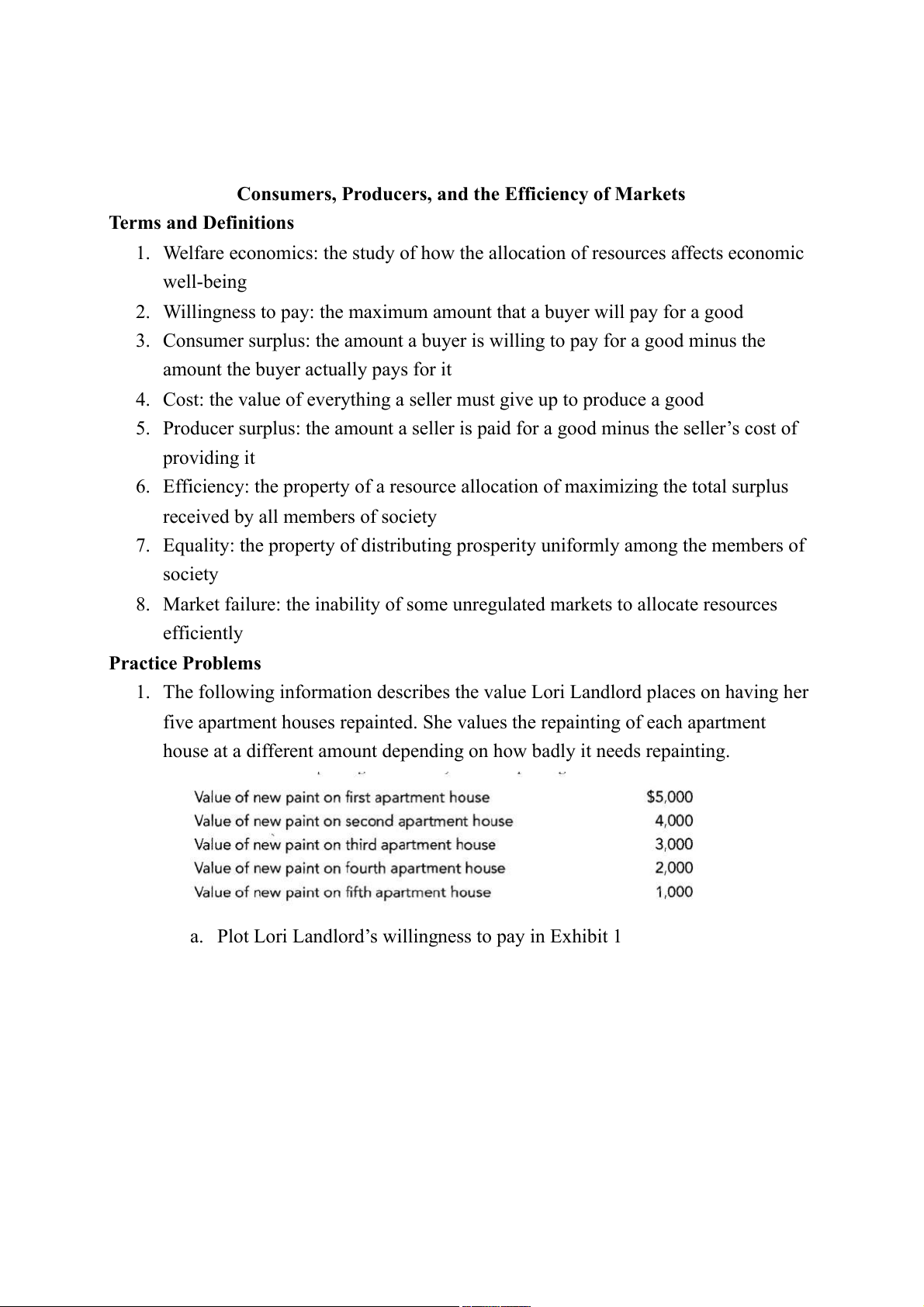
1. The following information describes the value Lori Landlord places on having her
five apartment houses repainted. She values the repainting of each apartment
house at a different amount depending on how badly it needs repainting.
a. Plot Lori Landlord’s willingness to pay in Exhibit 1
b. If the price to repaint her apartments is $5,000 each, how many will she
repaint? What is the value of her consumer surplus
She will only repaint the first apartment house, CS=0
c. Suppose the price to repaint her apartments falls to $2,000 each. How many
apartments will Lori choose to have repainted? What is the value of her consumer surplus?
She will repaint 4 apartment houses from the first to the fourth one. Her consumer surplus is $6000
d. What happened to Ms. Landlord’s consumer surplus when the price of
having her apartments repainted fell? Why?
The consumer surplus rose when the price of having the apartments
repainted fell. Because when the price fell, she paid less for each
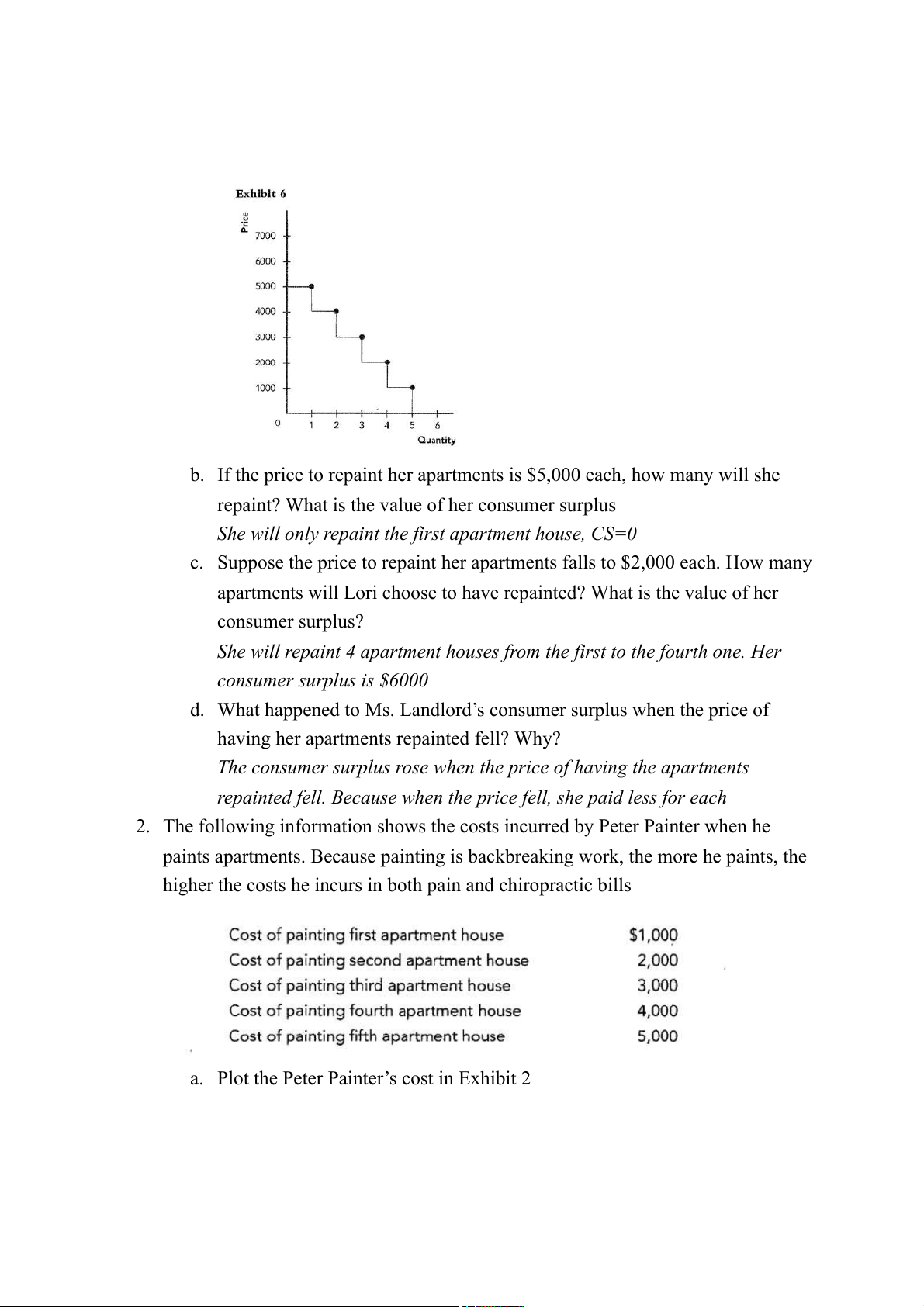
2. The following information shows the costs incurred by Peter Painter when he
paints apartments. Because painting is backbreaking work, the more he paints, the
higher the costs he incurs in both pain and chiropractic bills
a. Plot the Peter Painter’s cost in Exhibit 2
b. If the price of painting apartment houses is $2000 each, how many will he
paint? What is the value of his producer surplus?
He will paint 2 houses. His producer surplus is: $1000
c. Suppose the price to paint apartments rises to $4000 each. How many
apartments will Peter choose to repaint? What is the value of his producer surplus?
He will repaint 4 houses, the first to the fourth. His producer surplus is $6000
d. What happened to Mr. Painter’s producer surplus when the price to paint apartments rose? Why?
When the price to paint apartments rose, the producer surplus rose.
Because the cost of production is constant, the higher the price, the more producer surplus rises.
He received greater producer surplus on the unit he would have produced
anyway plus additional surplus on the units he now chooses to produce due to the increase in price
3. Use the information about willingness to pay and cost from question 1 and 2 above
to answer the following questions
a. If a benevolent social planner sets the price off painting apartment houses at
$5,000, what is the value of consumer surplus? producer surplus? total surplus? CS=0; PS=4000 => TS=4000
b. If a benevolent social planner sets the price off painting apartment houses at
$1,000, what is the value of consumer surplus? producer surplus? total surplus? CS= 4000; PS=0 => TS=4000
c. If the price for painting apartment houses is allowed to move to its free
market equilibrium price of $3,000, what is the value of consumer surplus,
producer surplus, and total surplus in the market? How does total surplus in
the free market compare to the total surplus generated by the social planner?
CS= 3000; PS= 3000 => TS = 6000 => TS in the free market is greater
than TS generated by the social planner
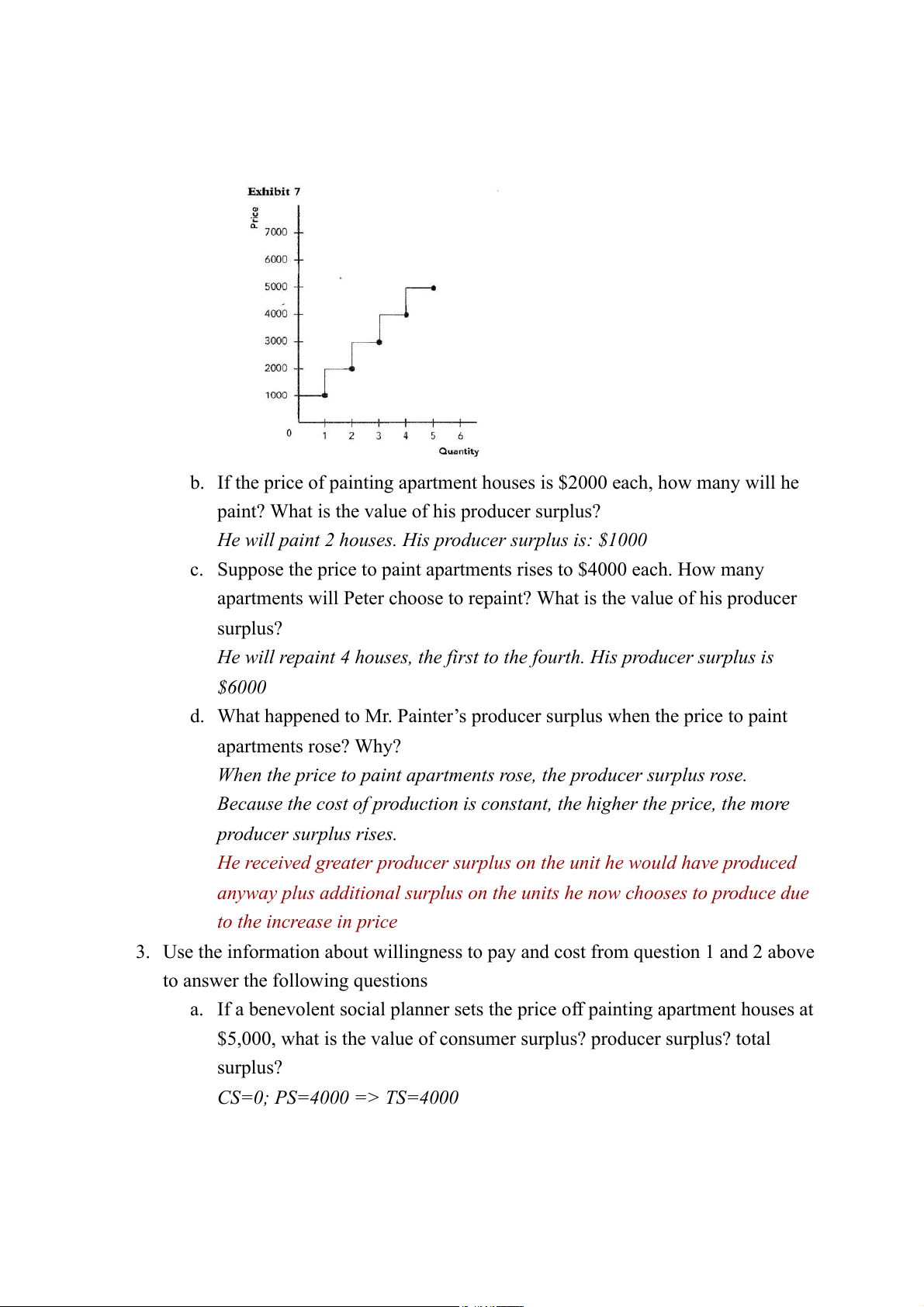
4. (...) Show consumer and producer surplus for the free market equilibrium price
and quantity. Is this allocation of resources efficient? Why and why not?
This allocation of resources is efficient. Because it maximizes the total surplus
Because at a quantity that is less than the equilibrium quantity, we fail to produce
units that buyers value more than their cost. At a quantity above the equilibrium
quantity, we produce units that cost more than the buyers value them. At
equilibrium, we produce all possible units that are valued in excess of what they
cost, which maximize total surplus
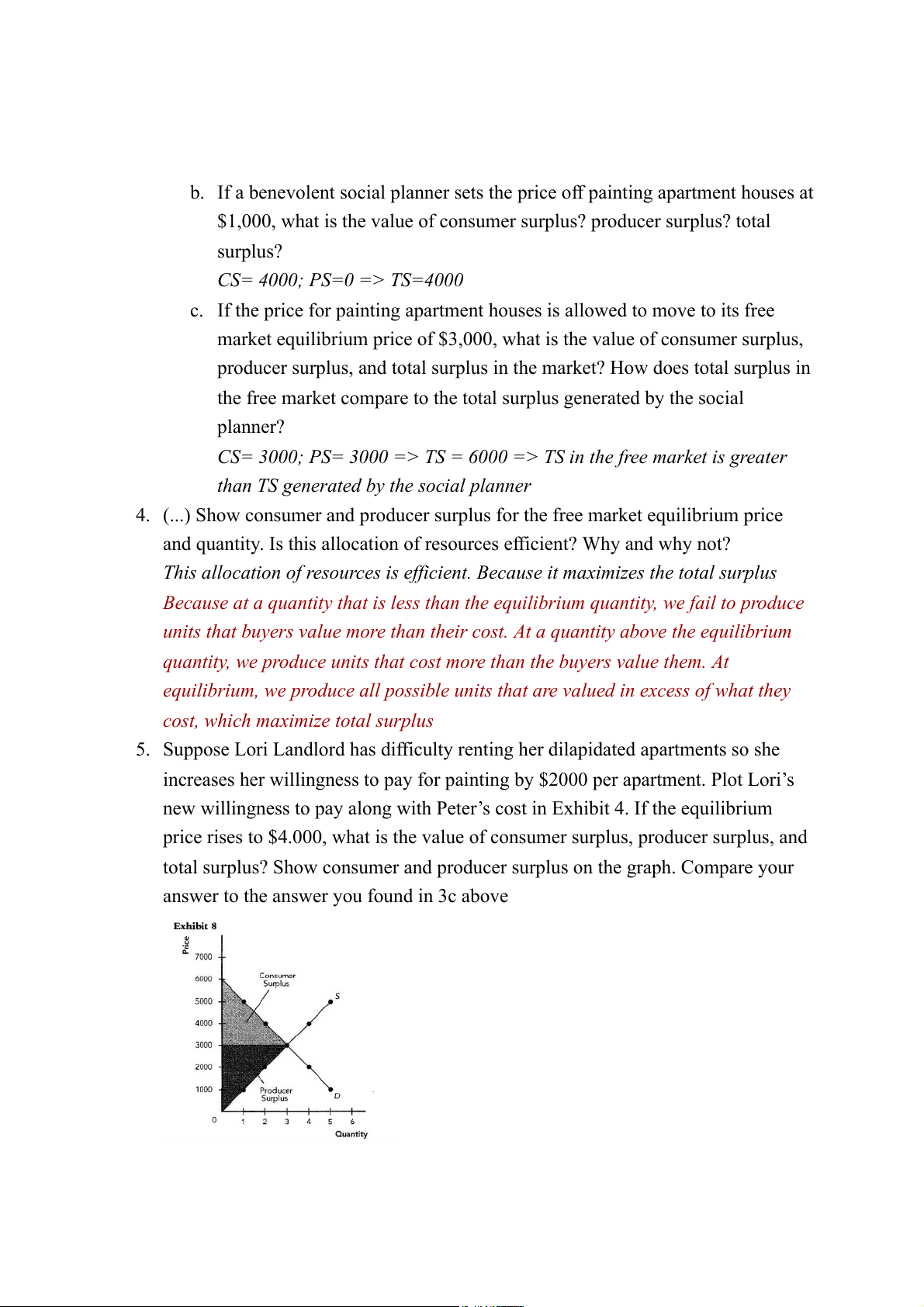
5. Suppose Lori Landlord has difficulty renting her dilapidated apartments so she
increases her willingness to pay for painting by $2000 per apartment. Plot Lori’s
new willingness to pay along with Peter’s cost in Exhibit 4. If the equilibrium
price rises to $4.000, what is the value of consumer surplus, producer surplus, and
total surplus? Show consumer and producer surplus on the graph. Compare your
answer to the answer you found in 3c above
CS= 6000, PS=6000 => TS=12000, it’s doubled Short-Answer Questions
1. What is the relationship between the buyer’s willingness to pay for a good and the demand curve for that good
At any Q, the height of the D curve is the WTP of the marginal buyer, the buyer
who would leave the market if P were any higher
The height of the demand curve at any quantity is the marginal buyer’s willingness
to pay. Therefore, a plot of buyer’s willingness to pay for each quantity is a plot of the demand curve
2. What is consumer surplus and how is it measure
Amount a buyer is willing to pay minus the amount the buyer actually pays
It is measured as the area below the demand curve and above the price
3. What is the value of consumer surplus for the marginal buyer? Why?
zero, because the price equals the WTP’s price, making them indifferent between buying and not buying
Because the marginal buyer is the buyer who would leave the market if the price
were any higher. Therefore, they are paying their willingness to pay and are receiving no surplus
4. If the cost for Moe to mow a lawn is $5, for Larry to mow a lawn is $7, and for
Curly to mow a lawn is $9, what is the value of their producer surplus if each
mows a lawn and the price for lawn mowing is $10.
For Moe: 5; for Larry: 3; for Curly: 1 => TS=9
5. What is the relationship between the seller’s cost to produce a good and the supply curve for that good?
At each Q, the height of the S curve is the cost of the marginal seller, the seller
who would leave the market if the price were any lower
The height of the supply curve at any quantity is the marginal seller’s cost.
Therefore, a plot of the seller’s cost for each quantity is a plot of the supply curve
6. What is producer surplus and how is it measured
the amount that seller is paid for a production minus the cost of the production
It is measured as the area below the price and above the supply curve
7. When the price of a good rises, what happens to producer surplus? Why?
PS rise because the cost of production is constant
Producer surplus increases because existing sellers receive a greater surplus on
the units they were already going to sell and new sellers enter the market because
the price is now above their cost
8. Can a benevolent social planner choose a quantity that provides greater economic
welfare than the equilibrium quantity generated in a competitive market? Why?
No, because the equilibrium quantity has already maximized total surplus
9. What does an economist mean by “efficiency”?
It means to maximize total surplus / a resource allocation that maximizes the total
surplus received by all members of society
10. Is a competitive market efficient? Why and why not?
Yes, because it maximizes total surplus but only without any market failures. With
market failures, competitive market outcome may be inefficient
11. How does a competitive market choose which producers will produce and sell a product?
the producer whose cost of production is lower or equal the price will produce and
sell a product so that the resources will be allocated efficiently True/False Questions
1. F => consumer surplus = WTP-Price 2. T 3. F => $1.00
4. F => producer surplus = Price - Cost of production / it is a measure of the benefits
of market participation to the sellers in a market 5. T 6. T 7. T 8. F => TS=CS+PS 9. F => higher/above 10. T 11. T 12. T 13. T 14. T
15. F => just only producing if the cost of production is lower or equal the price Multiple Choice Question 1. d 5. c 9. c => d 13. c 17. c 2. c 6. a 10. e 14. d => e 18. b 3. b 7. d 11. a 15. c 19. a 4. b 8. e 12. d => b 16. d 20. c Advanced Critical Thinking
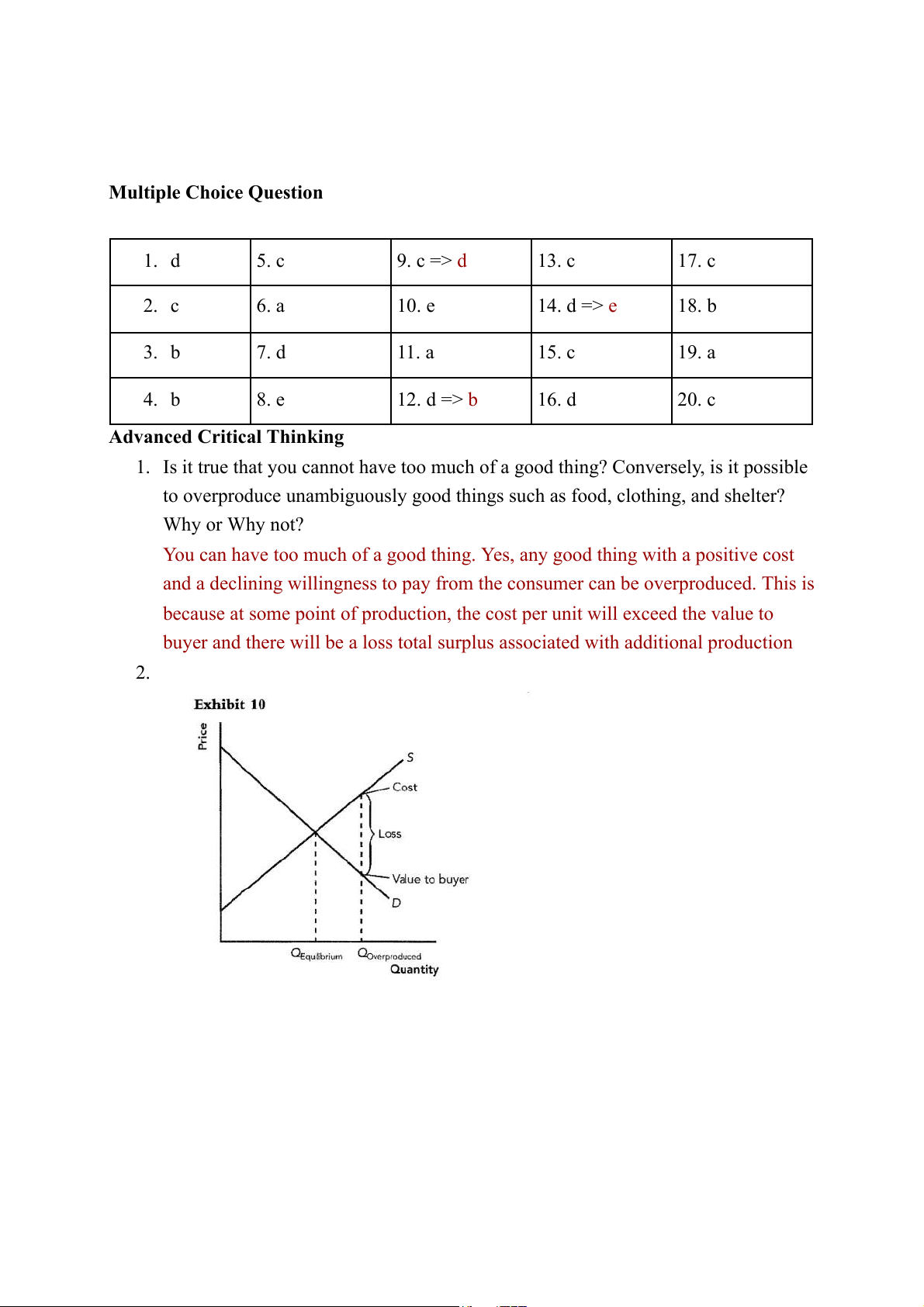
1. Is it true that you cannot have too much of a good thing? Conversely, is it possible
to overproduce unambiguously good things such as food, clothing, and shelter? Why or Why not?
You can have too much of a good thing. Yes, any good thing with a positive cost
and a declining willingness to pay from the consumer can be overproduced. This is
because at some point of production, the cost per unit will exceed the value to
buyer and there will be a loss total surplus associated with additional production 2.
Tài liệu liên quan:
-
Chương 3: độ co giãn và các nhân tố ảnh hưởng | Microeconomics | Trường Đại học Quốc tế, Đại học Quốc gia Thành phố Hồ Chí Minh
5 3 -
Microeconomics Syllabus | Microeconomics | Trường Đại học Quốc tế, Đại học Quốc gia Thành phố Hồ Chí Minh
5 3 -
Microeconomics Course Syllabus & Assessment Details | Microeconomics | Trường Đại học Quốc tế, Đại học Quốc gia Thành phố Hồ Chí Minh
5 3 -
Assignment 3 - Elasticity MCQs and Key Concepts | Microeconomics | Trường Đại học Quốc tế, Đại học Quốc gia Thành phố Hồ Chí Minh
5 3 -
Assignment 2 - Economic Equilibrium Analysis of Fridges and Motorcycles | Microeconomics | Trường Đại học Quốc tế, Đại học Quốc gia Thành phố Hồ Chí Minh
5 3