Econ 101 Assignment 5: Utility Maximization and Budget Lines | Microeconomics | Trường Đại học Quốc tế, Đại học Quốc gia Thành phố Hồ Chí Minh
Identify the budget line equation for this consumer From the hypothesis: "A consumer who uses $60 to buy 2 goods: X and Y. Given that price of the good X is $3 per unit and price of the good Y is $1 per unit", we have the budget line equation for this customer: 3X+Y=6. Tài liệu được sưu tầm và soạn thảo dưới dạng file PDF để gửi tới các bạn cùng tham khảo, ôn tập đầy đủ kiến thức, chuẩn bị cho các buổi học thật tốt. Mời bạn đọc đón xem!
Môn: Microeconomics 635 tài liệu
Trường: Trường Đại học Quốc tế, Đại học Quốc gia Thành phố Hồ Chí Minh 1.9 K tài liệu
Tác giả:

Preview text:
Problem 1:
Suppose that a consumer who uses $60 to buy 2 goods: X and Y. Given
that price of the good X is $3 per unit and price of the good Y is $1 per
unit. Suppose that the utility function of this consumer is TU=XY
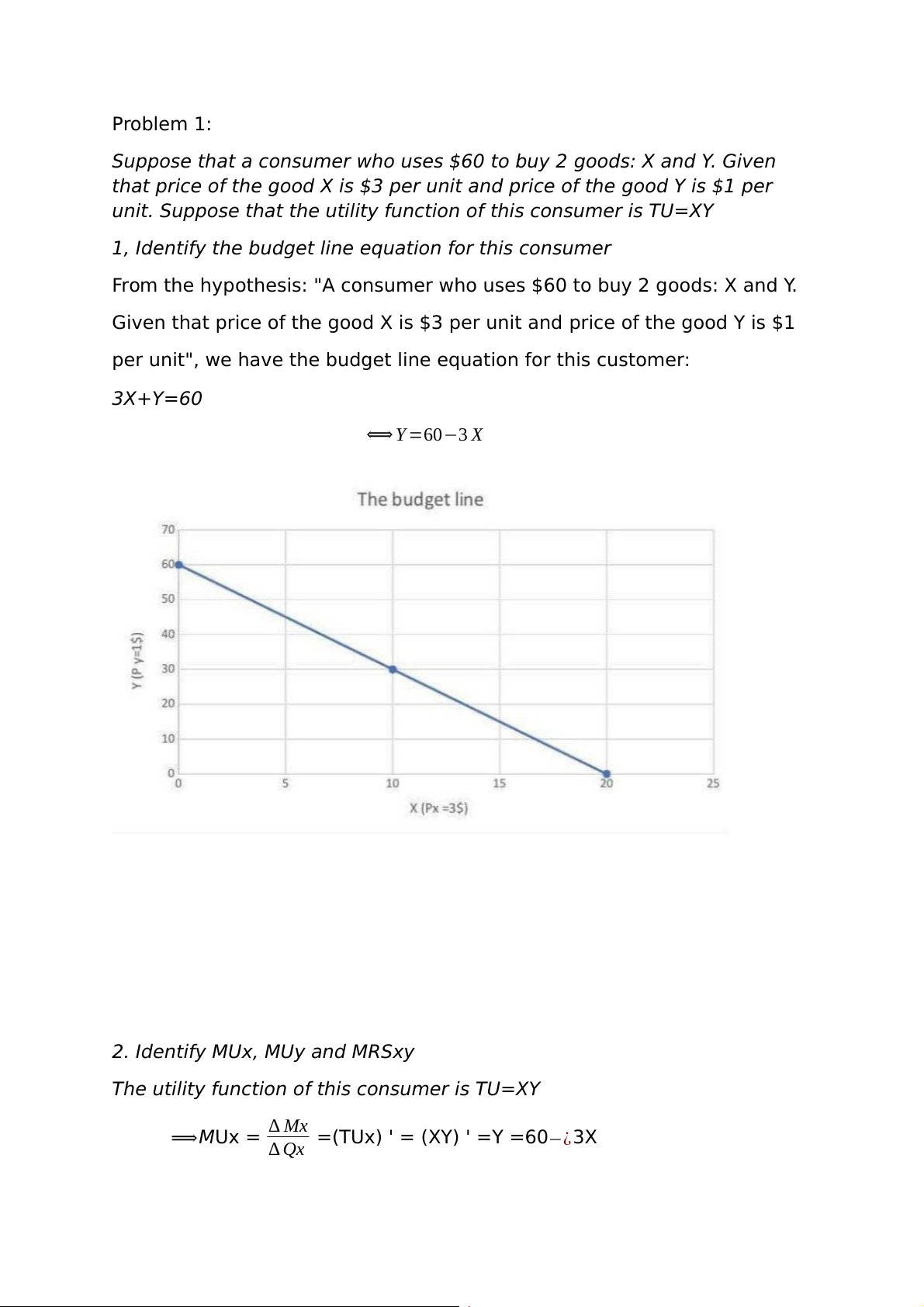
1, Identify the budget line equation for this consumer
From the hypothesis: "A consumer who uses $60 to buy 2 goods: X and Y.
Given that price of the good X is $3 per unit and price of the good Y is $1
per unit", we have the budget line equation for this customer: 3X+Y=60 ⟺ Y =60−3 X
2. Identify MUx, MUy and MRSxy
The utility function of this consumer is TU=XY ∆ Mx ⟹MUx =
=(TUx) ' = (XY) ' =Y =60−¿3X ∆ Qx 60−Y
⟹ MUy= ∆ My =¿(TUy) ' = (XY) ' =X = ∆ Qy 3 180−9 X
⟹MRSxy ¿ MUx = Y = MUy X 60−Y
3. What are optimal quantity of good X (X*) and optimal quantity of good
Y (Y*) that he should buy to maximize his utility Px
To maximize his utility : MRSxy = = MUx Py MUy We have : = MUx {MUx Px Py 3 X +Y =6 = X { Y3 1 3 X +Y =6
{ 3 X=Y ⟺{X=10 3 X +Y =6 Y =30 Problem 2:
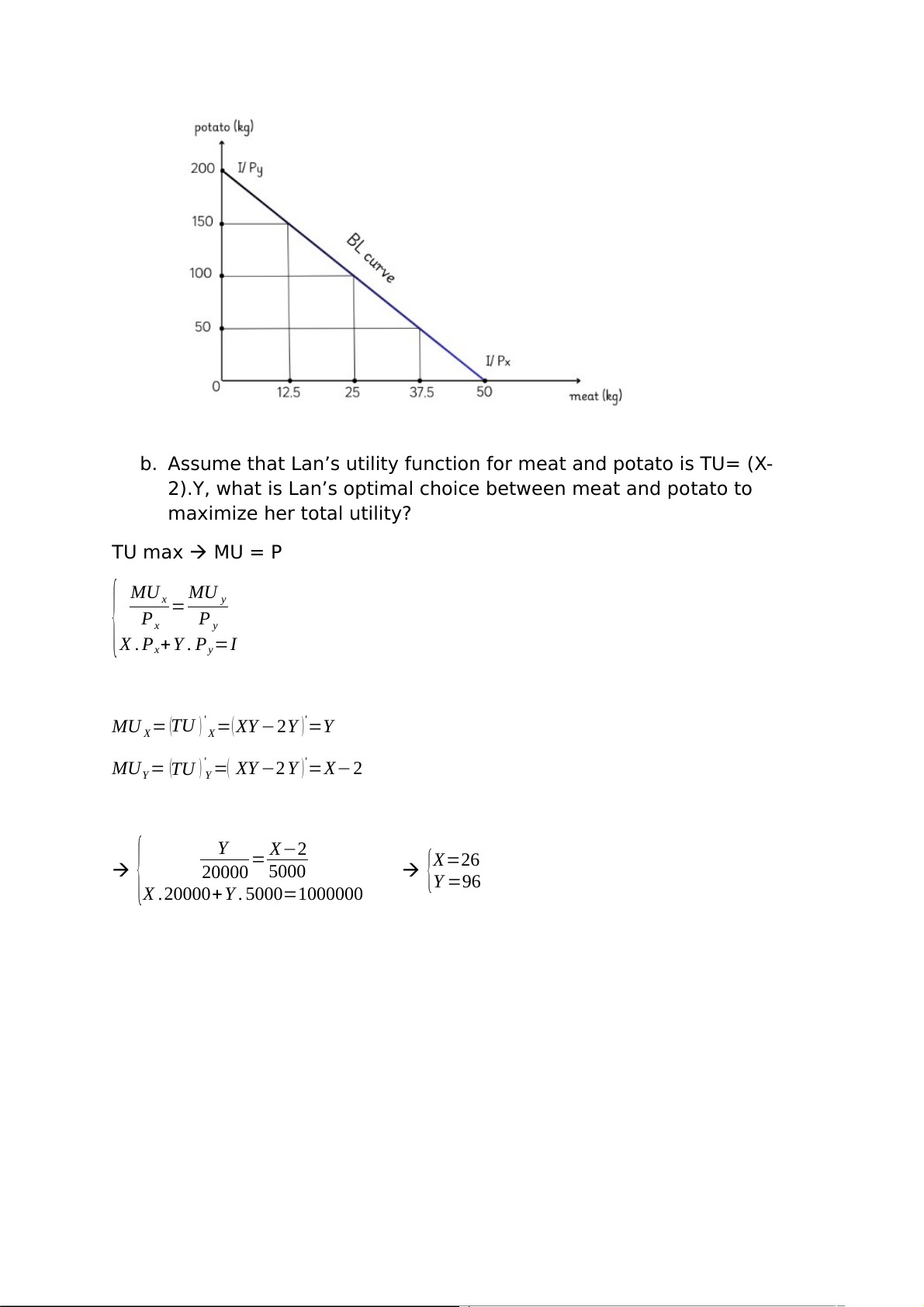
a. Identify Lan’s budget line equation and draw that BL curve
* Identify Lan’s budget line:
X. P + Y. P = I X Y
X. 20000 + Y. 5000 = 1000000 4X + Y = 200 * BL curve:
b. Assume that Lan’s utility function for meat and potato is TU= (X-
2).Y, what is Lan’s optimal choice between meat and potato to maximize her total utility? TU max MU = P { MU MU x = y P P x y X . P + Y . P = y I x
MU = (TU )' =(XY −2Y )'=Y X X
MU = (TU )' =( XY −2 Y )'=X−2 Y Y = X−2 { Y 20000 5000 {X=26 Y =96
X .20000+ Y . 5000 1000000 =
Tài liệu liên quan:
-
Chương 3: độ co giãn và các nhân tố ảnh hưởng | Microeconomics | Trường Đại học Quốc tế, Đại học Quốc gia Thành phố Hồ Chí Minh
1 1 -
Microeconomics Syllabus | Microeconomics | Trường Đại học Quốc tế, Đại học Quốc gia Thành phố Hồ Chí Minh
1 1 -
Microeconomics Course Syllabus & Assessment Details | Microeconomics | Trường Đại học Quốc tế, Đại học Quốc gia Thành phố Hồ Chí Minh
1 1 -
Assignment 3 - Elasticity MCQs and Key Concepts | Microeconomics | Trường Đại học Quốc tế, Đại học Quốc gia Thành phố Hồ Chí Minh
1 1 -
Assignment 2 - Economic Equilibrium Analysis of Fridges and Motorcycles | Microeconomics | Trường Đại học Quốc tế, Đại học Quốc gia Thành phố Hồ Chí Minh
1 1