Economics Concepts & Practice Questions | Microeconomics | Trường Đại học Quốc tế, Đại học Quốc gia Thành phố Hồ Chí Minh
Question 1: Economics may best be defined as: A: the interaction between macro and micro considerations. B: the study of the behaviour of people and institutions in the production, distribution, and consumption of scarce goods. C: the empirical testing of value judgements through the use of induction and deduction. D: the use of policy to refute facts and hypotheses. Question 2: The study of economics is primarily concerned with: A: keeping private businesses from losing money. B: demonstrating that capitalistic economies are superior to socialistic economies. Tài liệu được sưu tầm và soạn thảo dưới dạng file PDF để gửi tới các bạn cùng tham khảo, ôn tập đầy đủ kiến thức, chuẩn bị cho các buổi học thật tốt. Mời bạn đọc đón xem!
Môn: Microeconomics 635 tài liệu
Trường: Trường Đại học Quốc tế, Đại học Quốc gia Thành phố Hồ Chí Minh 1.9 K tài liệu
Tác giả:


Preview text:
Question 1: Economics may best be defined as:
A: the interaction between macro and micro considerations.
B: the study of the behaviour of people and institutions in the production,
distribution, and consumption of scarce goods.
C: the empirical testing of value judgements through the use of induction and deduction.
D: the use of policy to refute facts and hypotheses.
Question 2: The study of economics is primarily concerned with:
A: keeping private businesses from losing money.
B: demonstrating that capitalistic economies are superior to socialistic economies.
C: choices that are made in seeking to use scarce resources efficiently.
D: determining the most equitable distribution of society's output.
Question 3: The term ‘ceteris paribus’ means: A: if event A precedes event B, A has caused B.
B: economics deals with facts, not values. C: other things being equal.
D: prosperity inevitably follows recession.
Question 4: The concept of economic efficiency is primarily concerned with:
A: the limited wants and unlimited resources dilemma.
B: considerations of equity in the distribution of wealth.
C: obtaining the maximum output from available resources.
D: the conservation of irreplaceable natural resources.
Question 5: The fundamental problem of economics is:
A: to establish an equitable system of personal and business taxation.
B: to establish a democratic political framework for the provision of social goods and services.
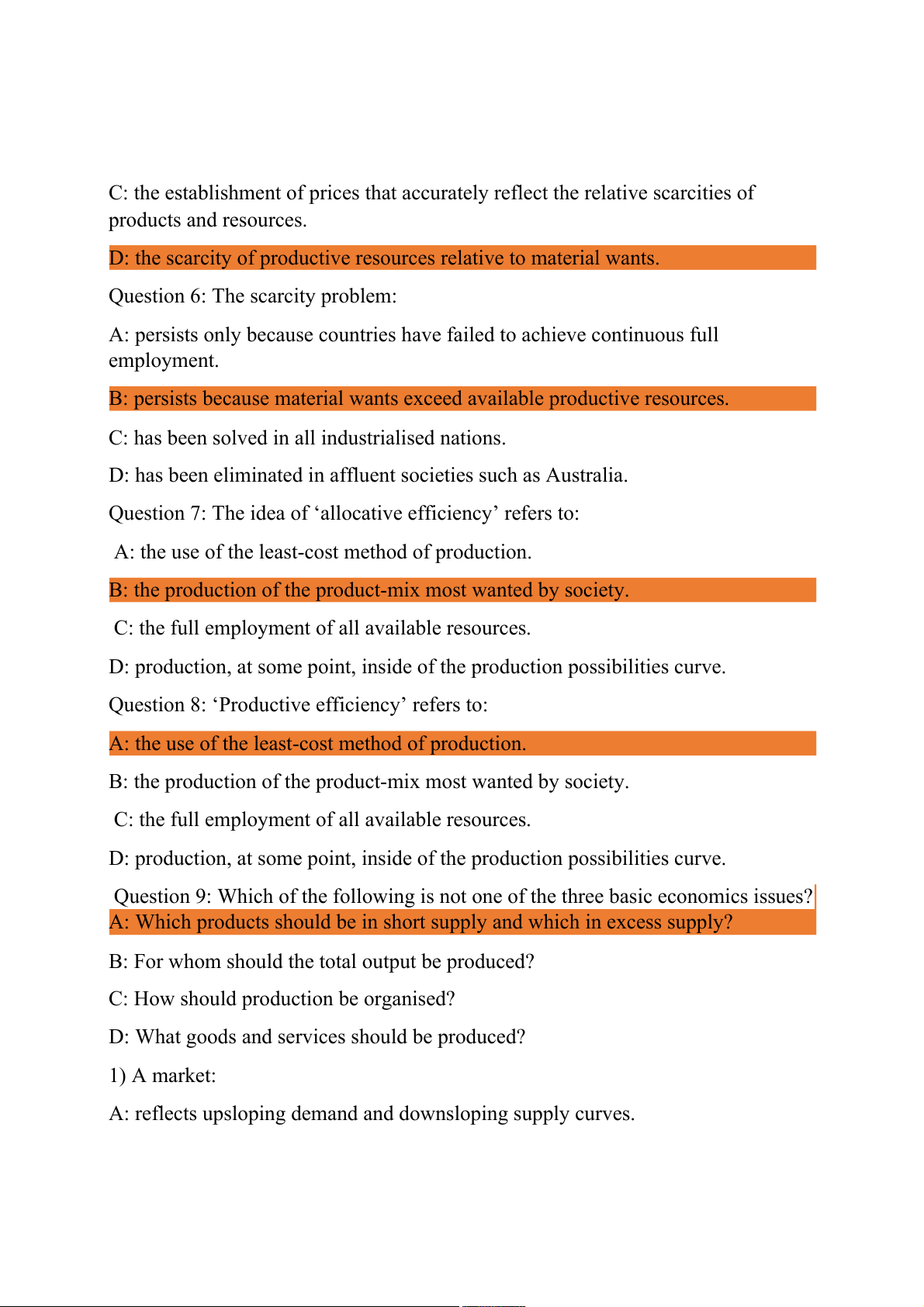
C: the establishment of prices that accurately reflect the relative scarcities of products and resources.
D: the scarcity of productive resources relative to material wants.
Question 6: The scarcity problem:
A: persists only because countries have failed to achieve continuous full employment.
B: persists because material wants exceed available productive resources.
C: has been solved in all industrialised nations.
D: has been eliminated in affluent societies such as Australia.
Question 7: The idea of ‘allocative efficiency’ refers to:
A: the use of the least-cost method of production.
B: the production of the product-mix most wanted by society.
C: the full employment of all available resources.
D: production, at some point, inside of the production possibilities curve.
Question 8: ‘Productive efficiency’ refers to:
A: the use of the least-cost method of production.
B: the production of the product-mix most wanted by society.
C: the full employment of all available resources.
D: production, at some point, inside of the production possibilities curve.
Question 9: Which of the following is not one of the three basic economics issues?
A: Which products should be in short supply and which in excess supply?
B: For whom should the total output be produced?
C: How should production be organised?
D: What goods and services should be produced? 1) A market:
A: reflects upsloping demand and downsloping supply curves.
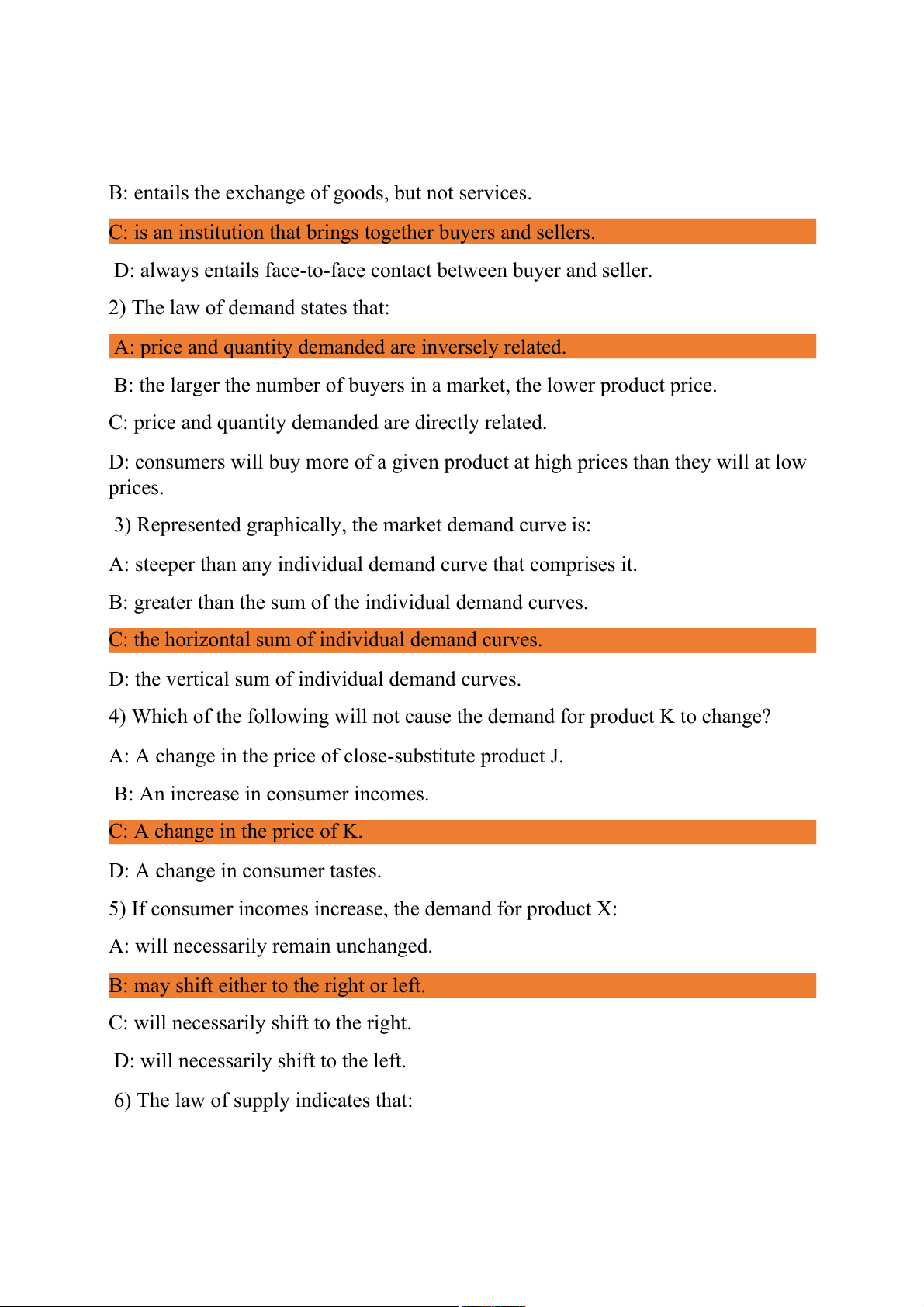
B: entails the exchange of goods, but not services.
C: is an institution that brings together buyers and sellers.
D: always entails face-to-face contact between buyer and seller.
2) The law of demand states that:
A: price and quantity demanded are inversely related.
B: the larger the number of buyers in a market, the lower product price.
C: price and quantity demanded are directly related.
D: consumers will buy more of a given product at high prices than they will at low prices.
3) Represented graphically, the market demand curve is:
A: steeper than any individual demand curve that comprises it.
B: greater than the sum of the individual demand curves.
C: the horizontal sum of individual demand curves.
D: the vertical sum of individual demand curves.
4) Which of the following will not cause the demand for product K to change?
A: A change in the price of close-substitute product J.
B: An increase in consumer incomes.
C: A change in the price of K.
D: A change in consumer tastes.
5) If consumer incomes increase, the demand for product X:
A: will necessarily remain unchanged.
B: may shift either to the right or left.
C: will necessarily shift to the right.
D: will necessarily shift to the left.
6) The law of supply indicates that:
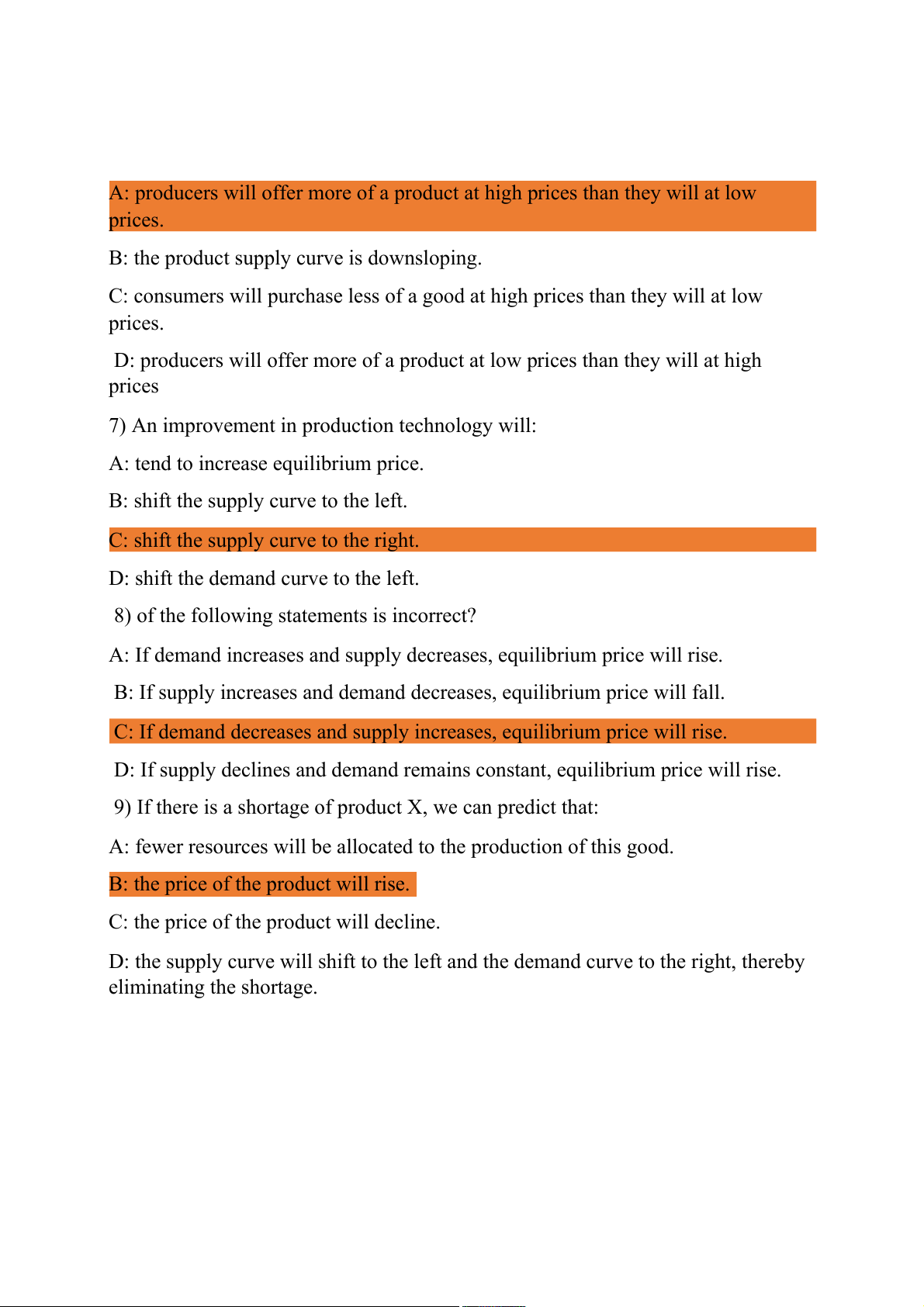
A: producers will offer more of a product at high prices than they will at low prices.
B: the product supply curve is downsloping.
C: consumers will purchase less of a good at high prices than they will at low prices.
D: producers will offer more of a product at low prices than they will at high prices
7) An improvement in production technology will:
A: tend to increase equilibrium price.
B: shift the supply curve to the left.
C: shift the supply curve to the right.
D: shift the demand curve to the left.
8) of the following statements is incorrect?
A: If demand increases and supply decreases, equilibrium price will rise.
B: If supply increases and demand decreases, equilibrium price will fall.
C: If demand decreases and supply increases, equilibrium price will rise.
D: If supply declines and demand remains constant, equilibrium price will rise.
9) If there is a shortage of product X, we can predict that:
A: fewer resources will be allocated to the production of this good.
B: the price of the product will rise.
C: the price of the product will decline.
D: the supply curve will shift to the left and the demand curve to the right, thereby eliminating the shortage.
Tài liệu liên quan:
-
Chương 3: độ co giãn và các nhân tố ảnh hưởng | Microeconomics | Trường Đại học Quốc tế, Đại học Quốc gia Thành phố Hồ Chí Minh
4 2 -
Microeconomics Syllabus | Microeconomics | Trường Đại học Quốc tế, Đại học Quốc gia Thành phố Hồ Chí Minh
4 2 -
Microeconomics Course Syllabus & Assessment Details | Microeconomics | Trường Đại học Quốc tế, Đại học Quốc gia Thành phố Hồ Chí Minh
4 2 -
Assignment 3 - Elasticity MCQs and Key Concepts | Microeconomics | Trường Đại học Quốc tế, Đại học Quốc gia Thành phố Hồ Chí Minh
4 2 -
Assignment 2 - Economic Equilibrium Analysis of Fridges and Motorcycles | Microeconomics | Trường Đại học Quốc tế, Đại học Quốc gia Thành phố Hồ Chí Minh
4 2