Economics Exercise Questions and Concepts | Microeconomics | Trường Đại học Quốc tế, Đại học Quốc gia Thành phố Hồ Chí Minh
What concept does economics deal primarily with? A. Money and banking B. Poverty and wealth C. Scarcity and choice D. Debits and credits 2. Which of the following is NOT included in the decisions that every society must make? A. what goods will be produced B. who will produce the goods C. what determines consumer preferences D. who will consume the goods 3. For what reason do both households and societies face many decisions? A. because resources are scarce B. because populations may increase or decrease over time C. because wages for households and therefore society fluctuate with business cycles D. because people, by nature. Tài liệu được sưu tầm và soạn thảo dưới dạng file PDF để gửi tới các bạn cùng tham khảo, ôn tập đầy đủ kiến thức, chuẩn bị cho các buổi học thật tốt. Mời bạn đọc đón xem!
Môn: Microeconomics 635 tài liệu
Trường: Trường Đại học Quốc tế, Đại học Quốc gia Thành phố Hồ Chí Minh 1.9 K tài liệu
Tác giả:

Preview text:
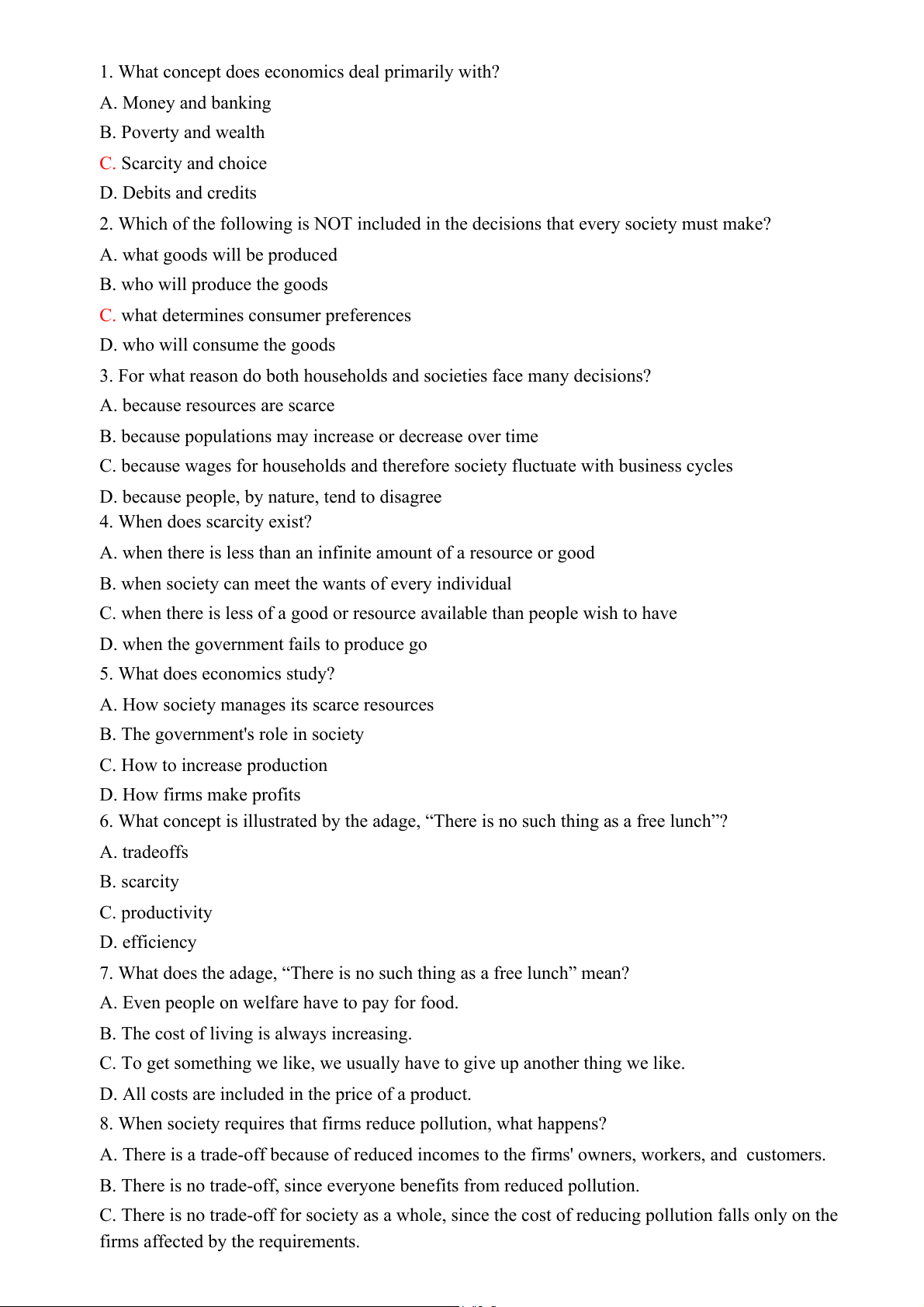
1. What concept does economics deal primarily with? A. Money and banking B. Poverty and wealth C. Scarcity and choice D. Debits and credits
2. Which of the following is NOT included in the decisions that every society must make? A. what goods will be produced B. who will produce the goods
C. what determines consumer preferences D. who will consume the goods
3. For what reason do both households and societies face many decisions?
A. because resources are scarce
B. because populations may increase or decrease over time
C. because wages for households and therefore society fluctuate with business cycles
D. because people, by nature, tend to disagree 4. When does scarcity exist?
A. when there is less than an infinite amount of a resource or good
B. when society can meet the wants of every individual
C. when there is less of a good or resource available than people wish to have
D. when the government fails to produce go 5. What does economics study?
A. How society manages its scarce resources
B. The government's role in society C. How to increase production D. How firms make profits
6. What concept is illustrated by the adage, “There is no such thing as a free lunch”? A. tradeoffs B. scarcity C. productivity D. efficiency
7. What does the adage, “There is no such thing as a free lunch” mean?
A. Even people on welfare have to pay for food.
B. The cost of living is always increasing.
C. To get something we like, we usually have to give up another thing we like.
D. All costs are included in the price of a product.
8. When society requires that firms reduce pollution, what happens?
A. There is a trade-off because of reduced incomes to the firms' owners, workers, and customers.
B. There is no trade-off, since everyone benefits from reduced pollution.
C. There is no trade-off for society as a whole, since the cost of reducing pollution falls only on the
firms affected by the requirements.
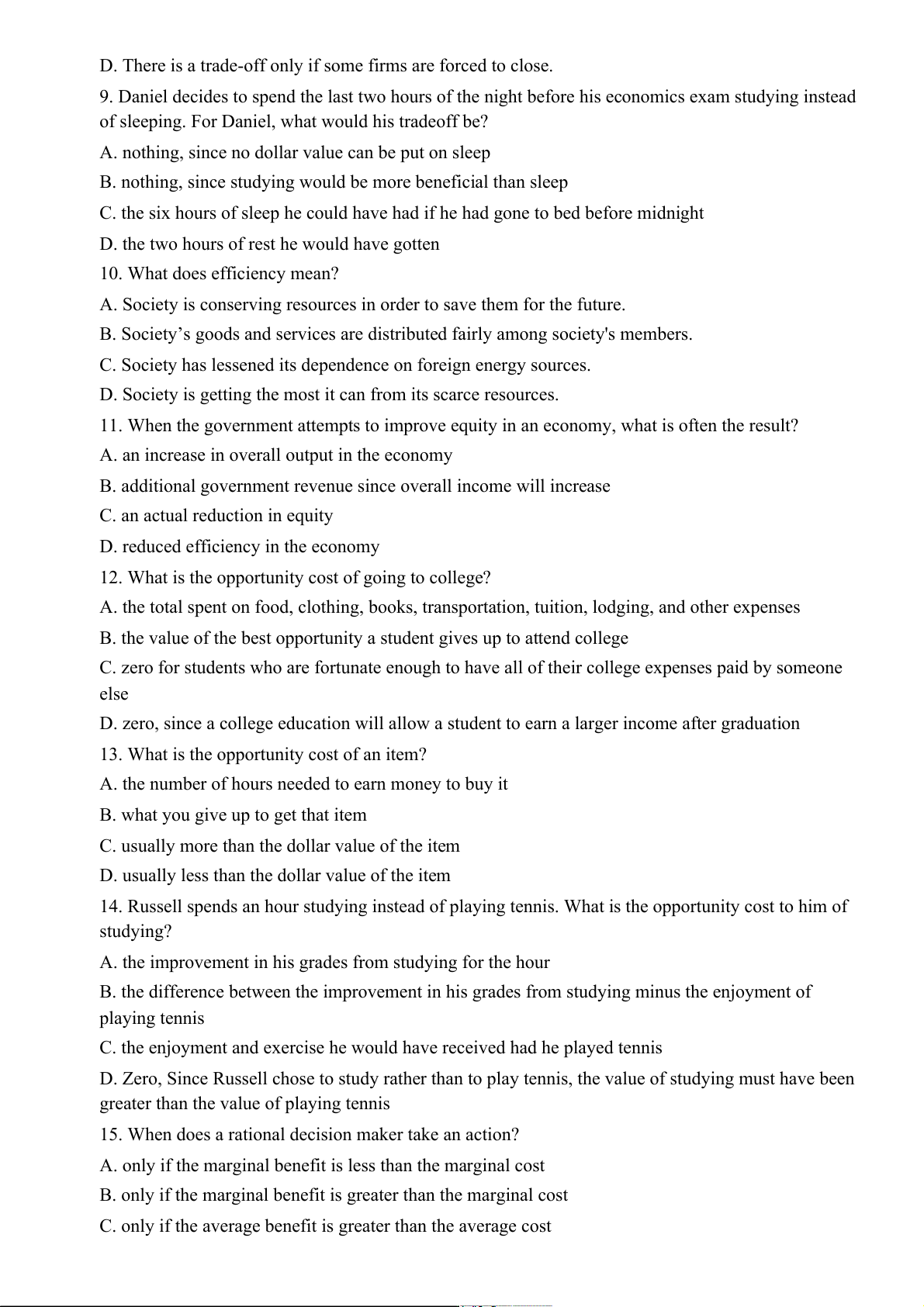
D. There is a trade-off only if some firms are forced to close.
9. Daniel decides to spend the last two hours of the night before his economics exam studying instead
of sleeping. For Daniel, what would his tradeoff be?
A. nothing, since no dollar value can be put on sleep
B. nothing, since studying would be more beneficial than sleep
C. the six hours of sleep he could have had if he had gone to bed before midnight
D. the two hours of rest he would have gotten 10. What does efficiency mean?
A. Society is conserving resources in order to save them for the future.
B. Society’s goods and services are distributed fairly among society's members.
C. Society has lessened its dependence on foreign energy sources.
D. Society is getting the most it can from its scarce resources.
11. When the government attempts to improve equity in an economy, what is often the result?
A. an increase in overall output in the economy
B. additional government revenue since overall income will increase
C. an actual reduction in equity
D. reduced efficiency in the economy
12. What is the opportunity cost of going to college?
A. the total spent on food, clothing, books, transportation, tuition, lodging, and other expenses
B. the value of the best opportunity a student gives up to attend college
C. zero for students who are fortunate enough to have all of their college expenses paid by someone else
D. zero, since a college education will allow a student to earn a larger income after graduation
13. What is the opportunity cost of an item?
A. the number of hours needed to earn money to buy it
B. what you give up to get that item
C. usually more than the dollar value of the item
D. usually less than the dollar value of the item
14. Russell spends an hour studying instead of playing tennis. What is the opportunity cost to him of studying?
A. the improvement in his grades from studying for the hour
B. the difference between the improvement in his grades from studying minus the enjoyment of playing tennis
C. the enjoyment and exercise he would have received had he played tennis
D. Zero, Since Russell chose to study rather than to play tennis, the value of studying must have been
greater than the value of playing tennis
15. When does a rational decision maker take an action?
A. only if the marginal benefit is less than the marginal cost
B. only if the marginal benefit is greater than the marginal cost
C. only if the average benefit is greater than the average cost
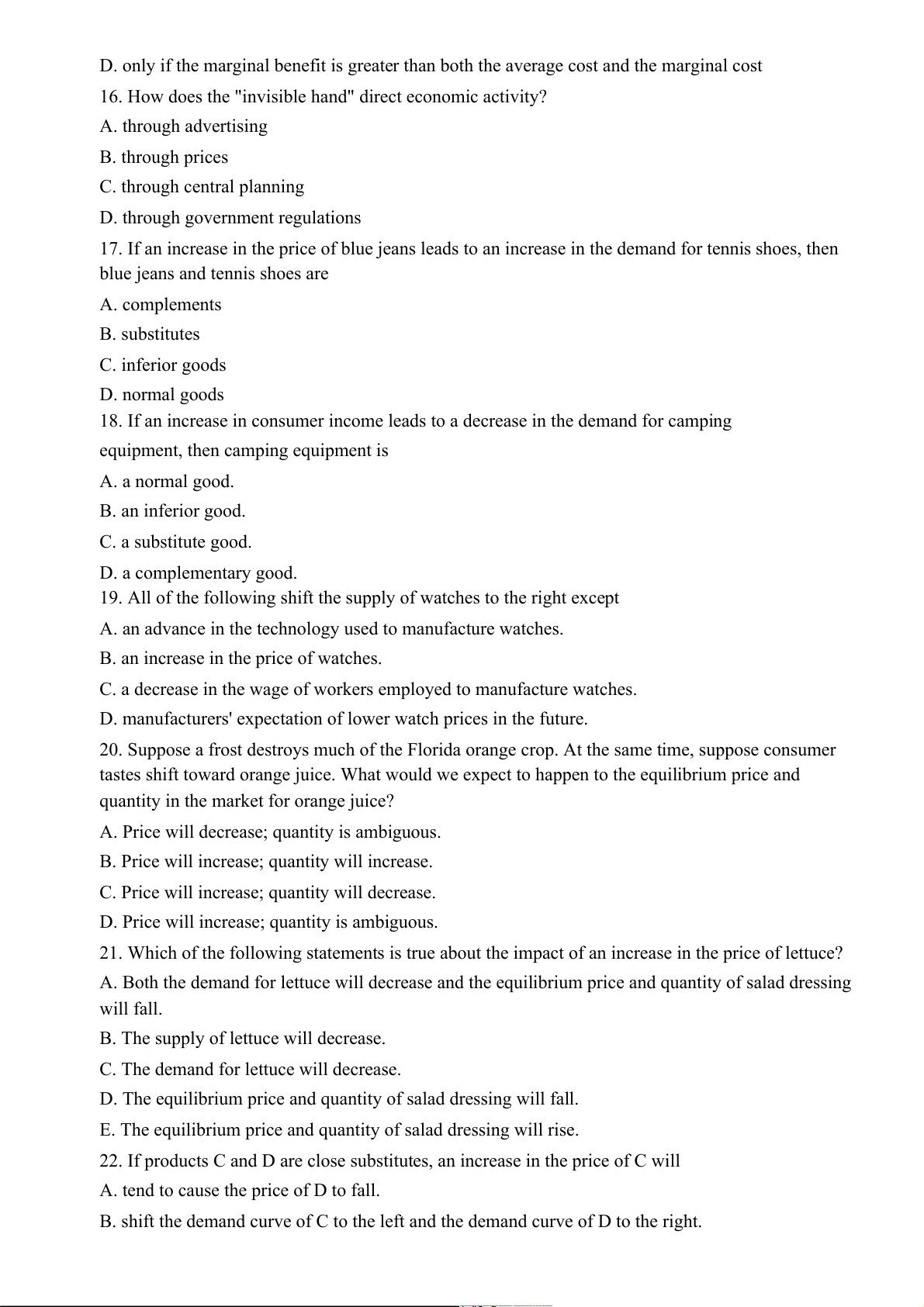
D. only if the marginal benefit is greater than both the average cost and the marginal cost
16. How does the "invisible hand" direct economic activity? A. through advertising B. through prices C. through central planning
D. through government regulations
17. If an increase in the price of blue jeans leads to an increase in the demand for tennis shoes, then
blue jeans and tennis shoes are A. complements B. substitutes C. inferior goods D. normal goods
18. If an increase in consumer income leads to a decrease in the demand for camping
equipment, then camping equipment is A. a normal good. B. an inferior good. C. a substitute good. D. a complementary good.
19. All of the following shift the supply of watches to the right except
A. an advance in the technology used to manufacture watches.
B. an increase in the price of watches.
C. a decrease in the wage of workers employed to manufacture watches.
D. manufacturers' expectation of lower watch prices in the future.
20. Suppose a frost destroys much of the Florida orange crop. At the same time, suppose consumer
tastes shift toward orange juice. What would we expect to happen to the equilibrium price and
quantity in the market for orange juice?
A. Price will decrease; quantity is ambiguous.
B. Price will increase; quantity will increase.
C. Price will increase; quantity will decrease.
D. Price will increase; quantity is ambiguous.
21. Which of the following statements is true about the impact of an increase in the price of lettuce?
A. Both the demand for lettuce will decrease and the equilibrium price and quantity of salad dressing will fall.
B. The supply of lettuce will decrease.
C. The demand for lettuce will decrease.
D. The equilibrium price and quantity of salad dressing will fall.
E. The equilibrium price and quantity of salad dressing will rise.
22. If products C and D are close substitutes, an increase in the price of C will
A. tend to cause the price of D to fall.
B. shift the demand curve of C to the left and the demand curve of D to the right.
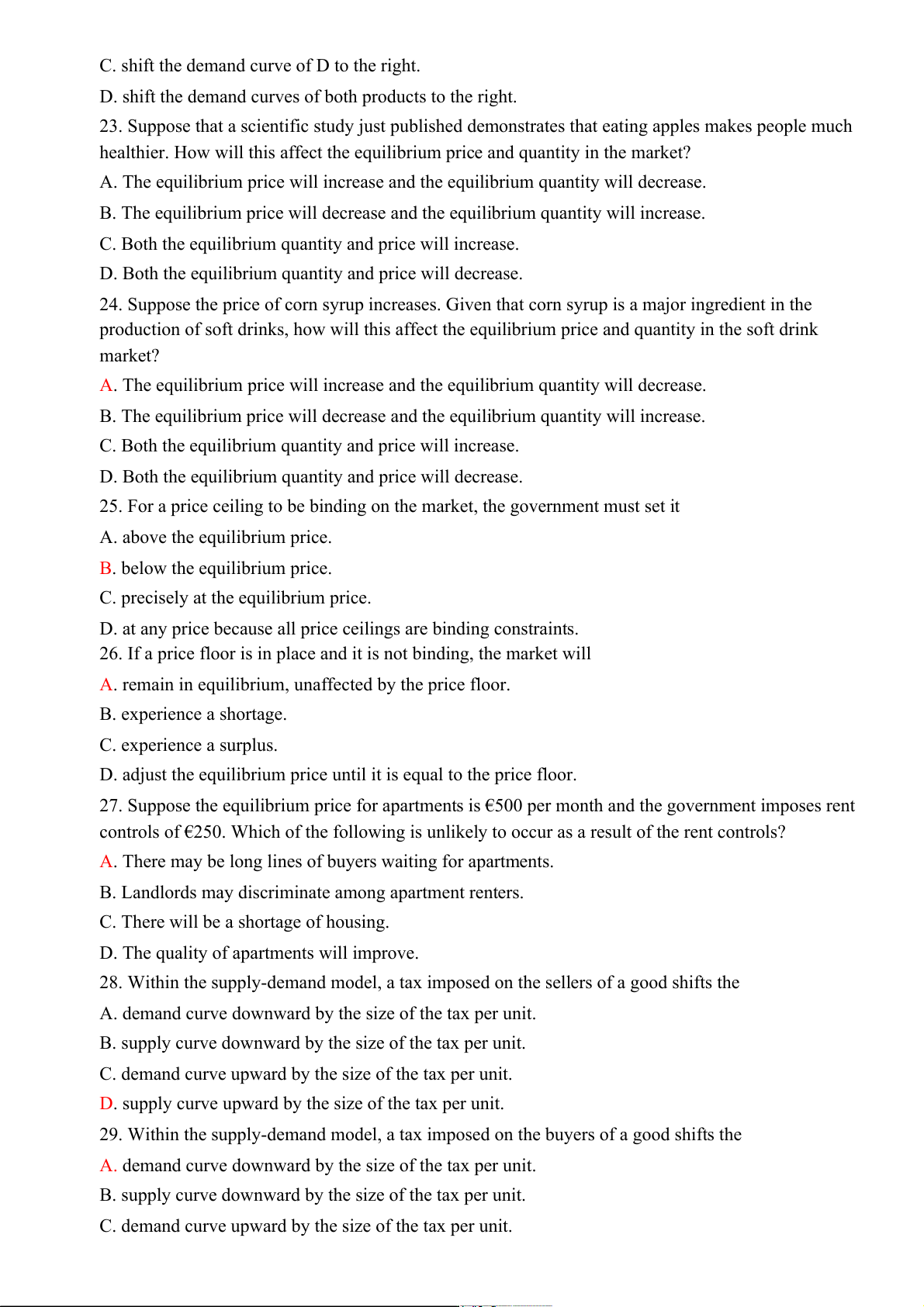
C. shift the demand curve of D to the right.
D. shift the demand curves of both products to the right.
23. Suppose that a scientific study just published demonstrates that eating apples makes people much
healthier. How will this affect the equilibrium price and quantity in the market?
A. The equilibrium price will increase and the equilibrium quantity will decrease.
B. The equilibrium price will decrease and the equilibrium quantity will increase.
C. Both the equilibrium quantity and price will increase.
D. Both the equilibrium quantity and price will decrease.
24. Suppose the price of corn syrup increases. Given that corn syrup is a major ingredient in the
production of soft drinks, how will this affect the equilibrium price and quantity in the soft drink market?
A. The equilibrium price will increase and the equilibrium quantity will decrease.
B. The equilibrium price will decrease and the equilibrium quantity will increase.
C. Both the equilibrium quantity and price will increase.
D. Both the equilibrium quantity and price will decrease.
25. For a price ceiling to be binding on the market, the government must set it
A. above the equilibrium price.
B. below the equilibrium price.
C. precisely at the equilibrium price.
D. at any price because all price ceilings are binding constraints.
26. If a price floor is in place and it is not binding, the market will
A. remain in equilibrium, unaffected by the price floor. B. experience a shortage. C. experience a surplus.
D. adjust the equilibrium price until it is equal to the price floor.
27. Suppose the equilibrium price for apartments is €500 per month and the government imposes rent
controls of €250. Which of the following is unlikely to occur as a result of the rent controls?
A. There may be long lines of buyers waiting for apartments.
B. Landlords may discriminate among apartment renters.
C. There will be a shortage of housing.
D. The quality of apartments will improve.
28. Within the supply-demand model, a tax imposed on the sellers of a good shifts the
A. demand curve downward by the size of the tax per unit.
B. supply curve downward by the size of the tax per unit.
C. demand curve upward by the size of the tax per unit.
D. supply curve upward by the size of the tax per unit.
29. Within the supply-demand model, a tax imposed on the buyers of a good shifts the
A. demand curve downward by the size of the tax per unit.
B. supply curve downward by the size of the tax per unit.
C. demand curve upward by the size of the tax per unit.
D. supply curve upward by the size of the tax per unit.
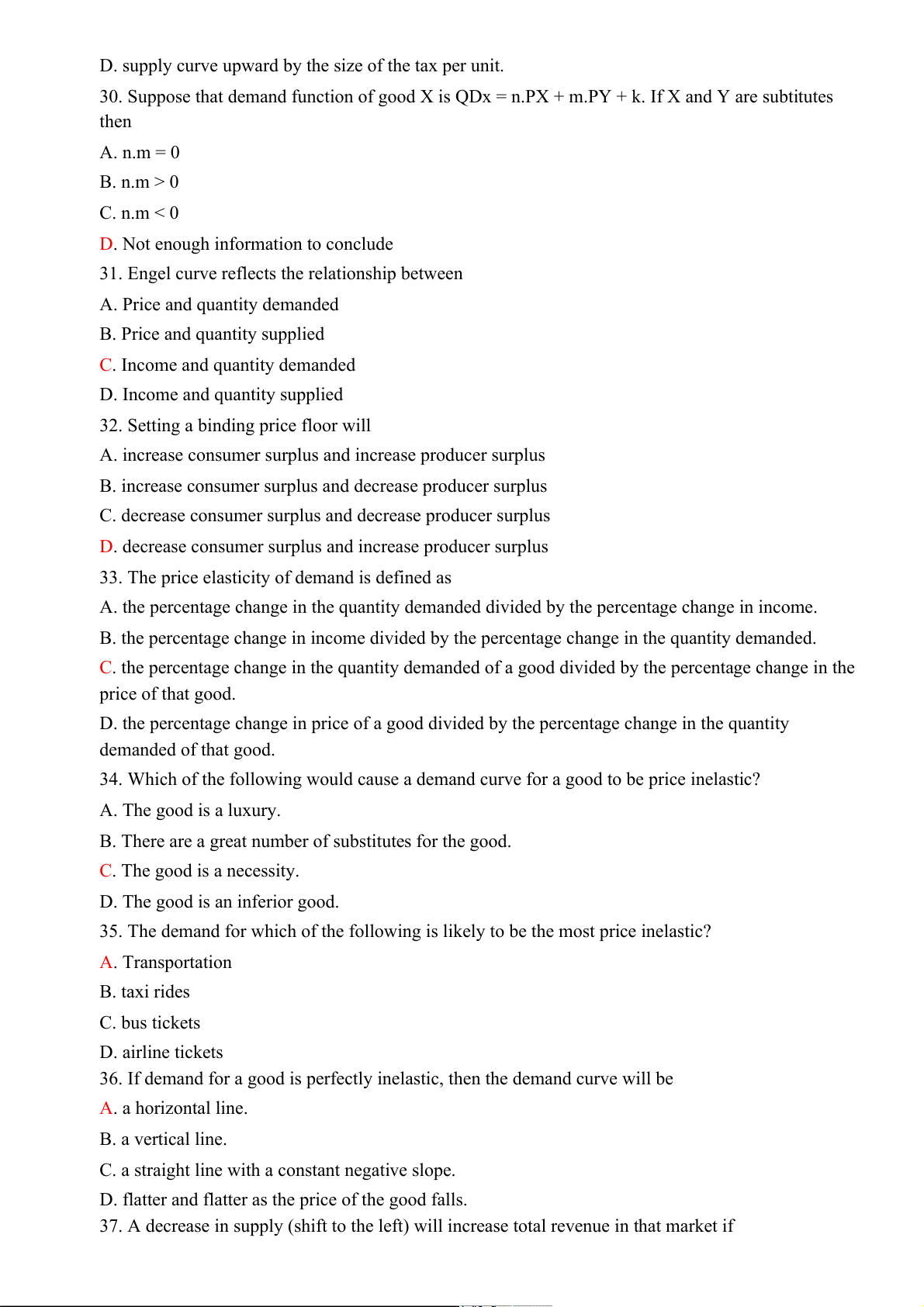
30. Suppose that demand function of good X is QDx = n.PX + m.PY + k. If X and Y are subtitutes then A. n.m = 0 B. n.m > 0 C. n.m < 0
D. Not enough information to conclude
31. Engel curve reflects the relationship between A. Price and quantity demanded B. Price and quantity supplied
C. Income and quantity demanded
D. Income and quantity supplied
32. Setting a binding price floor will
A. increase consumer surplus and increase producer surplus
B. increase consumer surplus and decrease producer surplus
C. decrease consumer surplus and decrease producer surplus
D. decrease consumer surplus and increase producer surplus
33. The price elasticity of demand is defined as
A. the percentage change in the quantity demanded divided by the percentage change in income.
B. the percentage change in income divided by the percentage change in the quantity demanded.
C. the percentage change in the quantity demanded of a good divided by the percentage change in the price of that good.
D. the percentage change in price of a good divided by the percentage change in the quantity demanded of that good.
34. Which of the following would cause a demand curve for a good to be price inelastic? A. The good is a luxury.
B. There are a great number of substitutes for the good. C. The good is a necessity.
D. The good is an inferior good.
35. The demand for which of the following is likely to be the most price inelastic? A. Transportation B. taxi rides C. bus tickets D. airline tickets
36. If demand for a good is perfectly inelastic, then the demand curve will be A. a horizontal line. B. a vertical line.
C. a straight line with a constant negative slope.
D. flatter and flatter as the price of the good falls.
37. A decrease in supply (shift to the left) will increase total revenue in that market if A. demand is price inelastic B. supply is price elastic. C. supply is price inelastic. D. demand is price elastic.
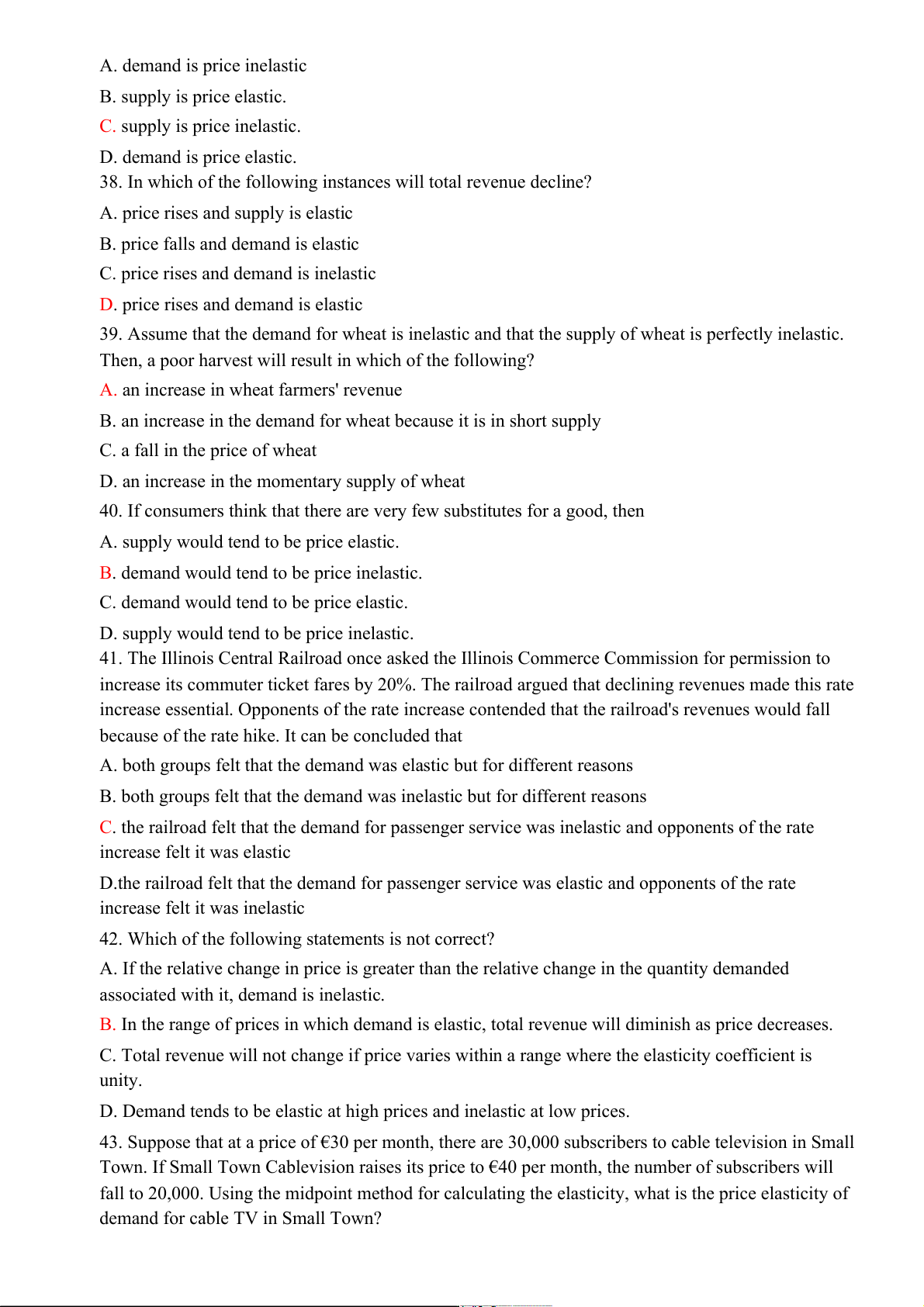
38. In which of the following instances will total revenue decline?
A. price rises and supply is elastic
B. price falls and demand is elastic
C. price rises and demand is inelastic
D. price rises and demand is elastic
39. Assume that the demand for wheat is inelastic and that the supply of wheat is perfectly inelastic.
Then, a poor harvest will result in which of the following?
A. an increase in wheat farmers' revenue
B. an increase in the demand for wheat because it is in short supply
C. a fall in the price of wheat
D. an increase in the momentary supply of wheat
40. If consumers think that there are very few substitutes for a good, then
A. supply would tend to be price elastic.
B. demand would tend to be price inelastic.
C. demand would tend to be price elastic.
D. supply would tend to be price inelastic.
41. The Illinois Central Railroad once asked the Illinois Commerce Commission for permission to
increase its commuter ticket fares by 20%. The railroad argued that declining revenues made this rate
increase essential. Opponents of the rate increase contended that the railroad's revenues would fall
because of the rate hike. It can be concluded that
A. both groups felt that the demand was elastic but for different reasons
B. both groups felt that the demand was inelastic but for different reasons
C. the railroad felt that the demand for passenger service was inelastic and opponents of the rate increase felt it was elastic
D.the railroad felt that the demand for passenger service was elastic and opponents of the rate increase felt it was inelastic
42. Which of the following statements is not correct?
A. If the relative change in price is greater than the relative change in the quantity demanded
associated with it, demand is inelastic.
B. In the range of prices in which demand is elastic, total revenue will diminish as price decreases.
C. Total revenue will not change if price varies within a range where the elasticity coefficient is unity.
D. Demand tends to be elastic at high prices and inelastic at low prices.
43. Suppose that at a price of €30 per month, there are 30,000 subscribers to cable television in Small
Town. If Small Town Cablevision raises its price to €40 per month, the number of subscribers will
fall to 20,000. Using the midpoint method for calculating the elasticity, what is the price elasticity of
demand for cable TV in Small Town? A. -1.4 B. -0.66 C. -0.75 D. -2.0
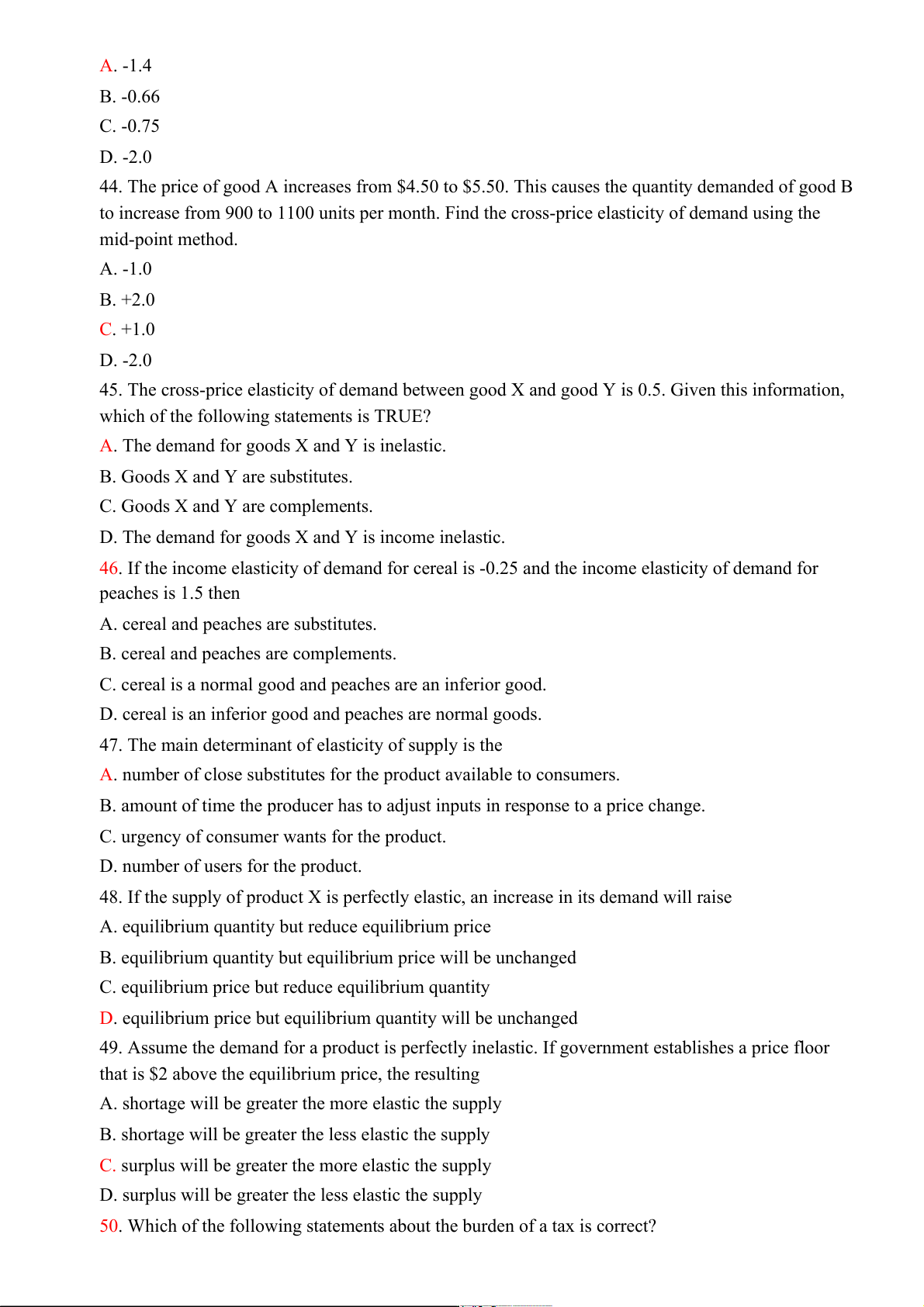
44. The price of good A increases from $4.50 to $5.50. This causes the quantity demanded of good B
to increase from 900 to 1100 units per month. Find the cross-price elasticity of demand using the mid-point method. A. -1.0 B. +2.0 C. +1.0 D. -2.0
45. The cross-price elasticity of demand between good X and good Y is 0.5. Given this information,
which of the following statements is TRUE?
A. The demand for goods X and Y is inelastic.
B. Goods X and Y are substitutes.
C. Goods X and Y are complements.
D. The demand for goods X and Y is income inelastic.
46. If the income elasticity of demand for cereal is -0.25 and the income elasticity of demand for peaches is 1.5 then
A. cereal and peaches are substitutes.
B. cereal and peaches are complements.
C. cereal is a normal good and peaches are an inferior good.
D. cereal is an inferior good and peaches are normal goods.
47. The main determinant of elasticity of supply is the
A. number of close substitutes for the product available to consumers.
B. amount of time the producer has to adjust inputs in response to a price change.
C. urgency of consumer wants for the product.
D. number of users for the product.
48. If the supply of product X is perfectly elastic, an increase in its demand will raise
A. equilibrium quantity but reduce equilibrium price
B. equilibrium quantity but equilibrium price will be unchanged
C. equilibrium price but reduce equilibrium quantity
D. equilibrium price but equilibrium quantity will be unchanged
49. Assume the demand for a product is perfectly inelastic. If government establishes a price floor
that is $2 above the equilibrium price, the resulting
A. shortage will be greater the more elastic the supply
B. shortage will be greater the less elastic the supply
C. surplus will be greater the more elastic the supply
D. surplus will be greater the less elastic the supply
50. Which of the following statements about the burden of a tax is correct?
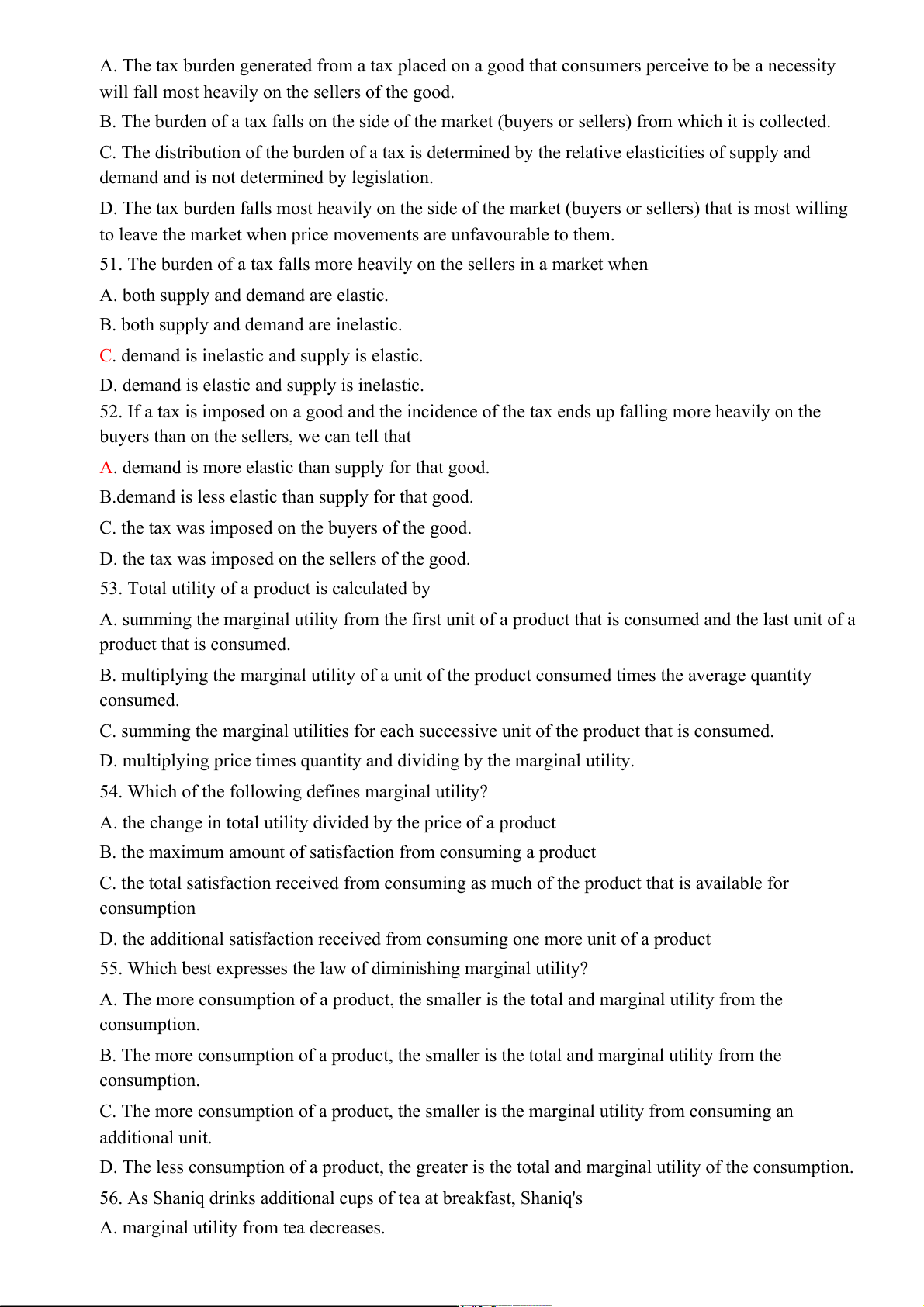
A. The tax burden generated from a tax placed on a good that consumers perceive to be a necessity
will fall most heavily on the sellers of the good.
B. The burden of a tax falls on the side of the market (buyers or sellers) from which it is collected.
C. The distribution of the burden of a tax is determined by the relative elasticities of supply and
demand and is not determined by legislation.
D. The tax burden falls most heavily on the side of the market (buyers or sellers) that is most willing
to leave the market when price movements are unfavourable to them.
51. The burden of a tax falls more heavily on the sellers in a market when
A. both supply and demand are elastic.
B. both supply and demand are inelastic.
C. demand is inelastic and supply is elastic.
D. demand is elastic and supply is inelastic.
52. If a tax is imposed on a good and the incidence of the tax ends up falling more heavily on the
buyers than on the sellers, we can tell that
A. demand is more elastic than supply for that good.
B.demand is less elastic than supply for that good.
C. the tax was imposed on the buyers of the good.
D. the tax was imposed on the sellers of the good.
53. Total utility of a product is calculated by
A. summing the marginal utility from the first unit of a product that is consumed and the last unit of a product that is consumed.
B. multiplying the marginal utility of a unit of the product consumed times the average quantity consumed.
C. summing the marginal utilities for each successive unit of the product that is consumed.
D. multiplying price times quantity and dividing by the marginal utility.
54. Which of the following defines marginal utility?
A. the change in total utility divided by the price of a product
B. the maximum amount of satisfaction from consuming a product
C. the total satisfaction received from consuming as much of the product that is available for consumption
D. the additional satisfaction received from consuming one more unit of a product
55. Which best expresses the law of diminishing marginal utility?
A. The more consumption of a product, the smaller is the total and marginal utility from the consumption.
B. The more consumption of a product, the smaller is the total and marginal utility from the consumption.
C. The more consumption of a product, the smaller is the marginal utility from consuming an additional unit.
D. The less consumption of a product, the greater is the total and marginal utility of the consumption.
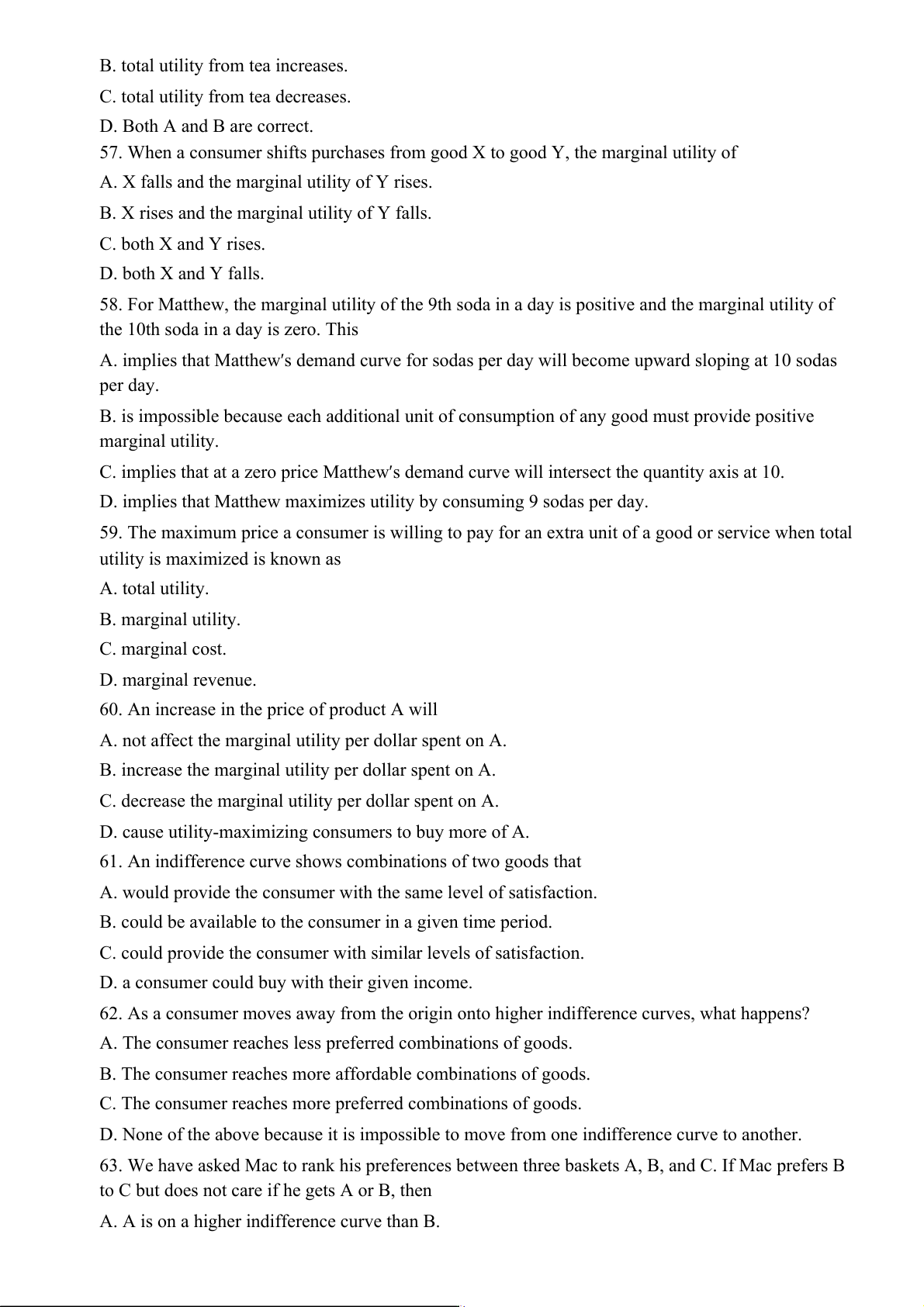
56. As Shaniq drinks additional cups of tea at breakfast, Shaniq's
A. marginal utility from tea decreases.
B. total utility from tea increases.
C. total utility from tea decreases. D. Both A and B are correct.
57. When a consumer shifts purchases from good X to good Y, the marginal utility of
A. X falls and the marginal utility of Y rises.
B. X rises and the marginal utility of Y falls. C. both X and Y rises. D. both X and Y falls.
58. For Matthew, the marginal utility of the 9th soda in a day is positive and the marginal utility of
the 10th soda in a day is zero. This
A. implies that Matthew s demand curve for sodas per day will become upward sloping at 10 sodas ʹ per day.
B. is impossible because each additional unit of consumption of any good must provide positive marginal utility.
C. implies that at a zero price Matthewʹs demand curve will intersect the quantity axis at 10.
D. implies that Matthew maximizes utility by consuming 9 sodas per day.
59. The maximum price a consumer is willing to pay for an extra unit of a good or service when total
utility is maximized is known as A. total utility. B. marginal utility. C. marginal cost. D. marginal revenue.
60. An increase in the price of product A will
A. not affect the marginal utility per dollar spent on A.
B. increase the marginal utility per dollar spent on A.
C. decrease the marginal utility per dollar spent on A.
D. cause utility-maximizing consumers to buy more of A.
61. An indifference curve shows combinations of two goods that
A. would provide the consumer with the same level of satisfaction.
B. could be available to the consumer in a given time period.
C. could provide the consumer with similar levels of satisfaction.
D. a consumer could buy with their given income.
62. As a consumer moves away from the origin onto higher indifference curves, what happens?
A. The consumer reaches less preferred combinations of goods.
B. The consumer reaches more affordable combinations of goods.
C. The consumer reaches more preferred combinations of goods.
D. None of the above because it is impossible to move from one indifference curve to another.
63. We have asked Mac to rank his preferences between three baskets A, B, and C. If Mac prefers B
to C but does not care if he gets A or B, then
A. A is on a higher indifference curve than B.
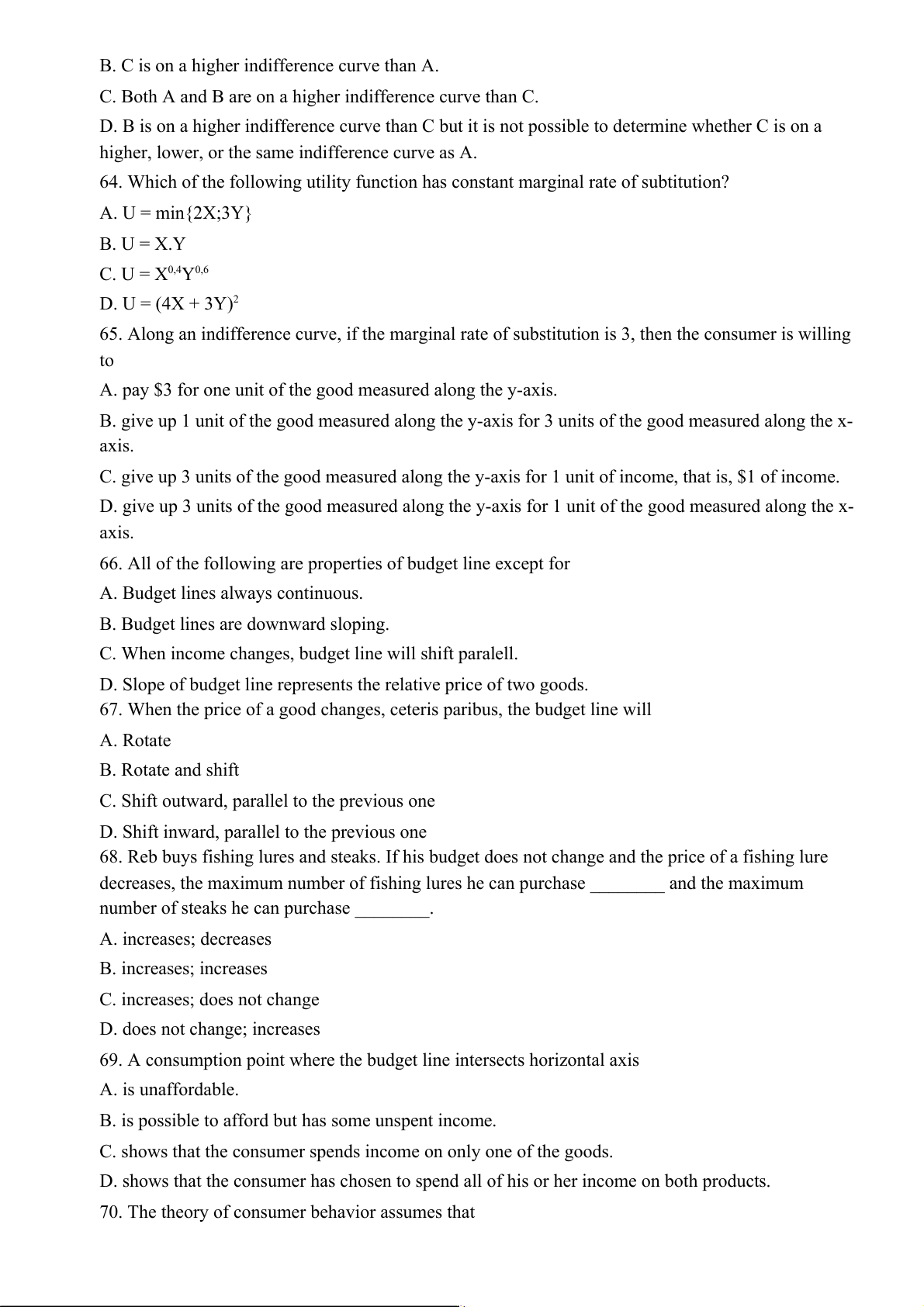
B. C is on a higher indifference curve than A.
C. Both A and B are on a higher indifference curve than C.
D. B is on a higher indifference curve than C but it is not possible to determine whether C is on a
higher, lower, or the same indifference curve as A.
64. Which of the following utility function has constant marginal rate of subtitution? A. U = min{2X;3Y} B. U = X.Y C. U = X0,4Y0,6 D. U = (4X + 3Y)2
65. Along an indifference curve, if the marginal rate of substitution is 3, then the consumer is willing to
A. pay $3 for one unit of the good measured along the y-axis.
B. give up 1 unit of the good measured along the y-axis for 3 units of the good measured along the x- axis.
C. give up 3 units of the good measured along the y-axis for 1 unit of income, that is, $1 of income.
D. give up 3 units of the good measured along the y-axis for 1 unit of the good measured along the x- axis.
66. All of the following are properties of budget line except for
A. Budget lines always continuous.
B. Budget lines are downward sloping.
C. When income changes, budget line will shift paralell.
D. Slope of budget line represents the relative price of two goods.
67. When the price of a good changes, ceteris paribus, the budget line will A. Rotate B. Rotate and shift
C. Shift outward, parallel to the previous one
D. Shift inward, parallel to the previous one
68. Reb buys fishing lures and steaks. If his budget does not change and the price of a fishing lure
decreases, the maximum number of fishing lures he can purchase ________ and the maximum
number of steaks he can purchase ________. A. increases; decreases B. increases; increases C. increases; does not change D. does not change; increases
69. A consumption point where the budget line intersects horizontal axis A. is unaffordable.
B. is possible to afford but has some unspent income.
C. shows that the consumer spends income on only one of the goods.
D. shows that the consumer has chosen to spend all of his or her income on both products.
70. The theory of consumer behavior assumes that
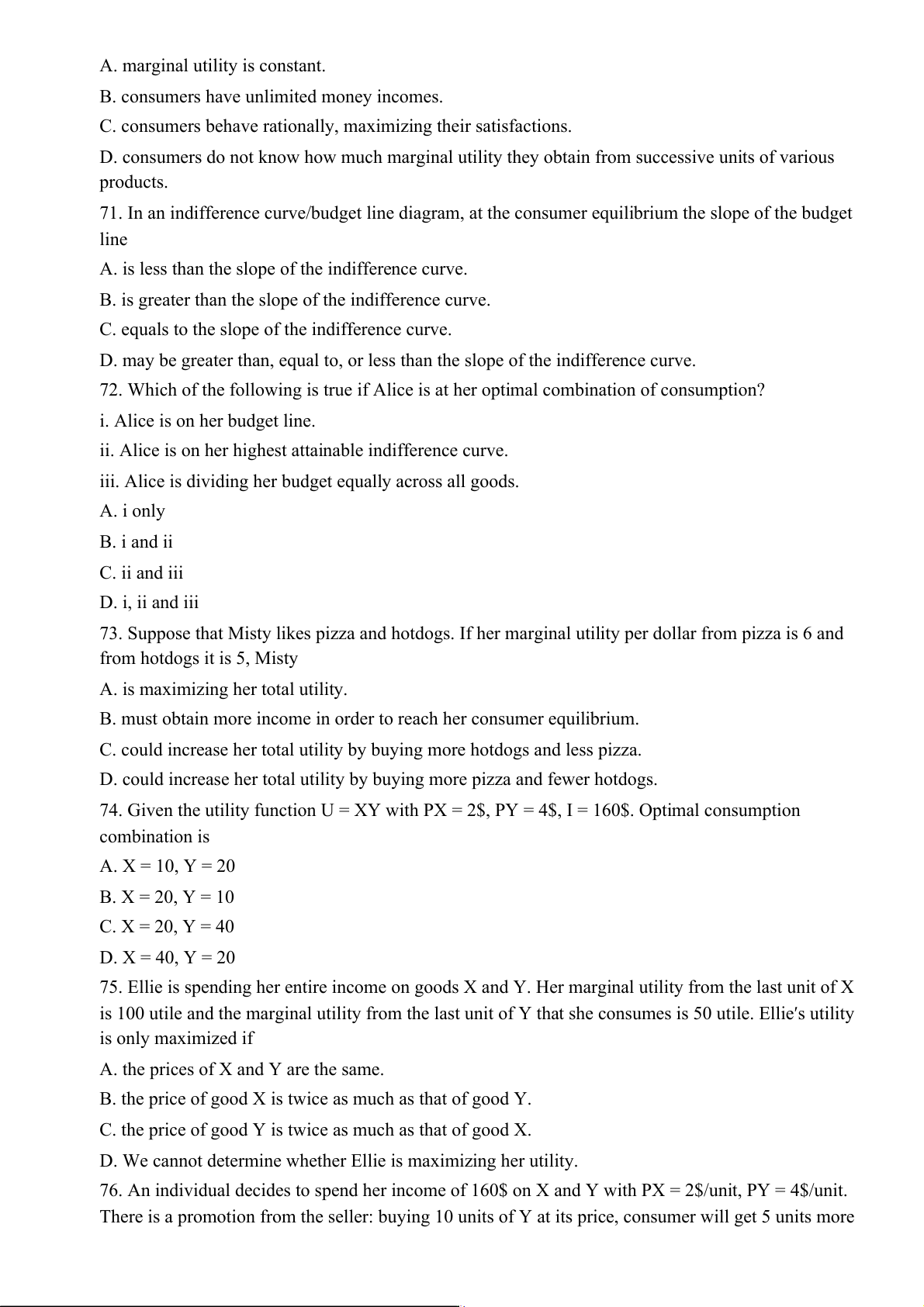
A. marginal utility is constant.
B. consumers have unlimited money incomes.
C. consumers behave rationally, maximizing their satisfactions.
D. consumers do not know how much marginal utility they obtain from successive units of various products.
71. In an indifference curve/budget line diagram, at the consumer equilibrium the slope of the budget line
A. is less than the slope of the indifference curve.
B. is greater than the slope of the indifference curve.
C. equals to the slope of the indifference curve.
D. may be greater than, equal to, or less than the slope of the indifference curve.
72. Which of the following is true if Alice is at her optimal combination of consumption?
i. Alice is on her budget line.
ii. Alice is on her highest attainable indifference curve.
iii. Alice is dividing her budget equally across all goods. A. i only B. i and ii C. ii and iii D. i, ii and iii
73. Suppose that Misty likes pizza and hotdogs. If her marginal utility per dollar from pizza is 6 and from hotdogs it is 5, Misty
A. is maximizing her total utility.
B. must obtain more income in order to reach her consumer equilibrium.
C. could increase her total utility by buying more hotdogs and less pizza.
D. could increase her total utility by buying more pizza and fewer hotdogs.
74. Given the utility function U = XY with PX = 2$, PY = 4$, I = 160$. Optimal consumption combination is A. X = 10, Y = 20 B. X = 20, Y = 10 C. X = 20, Y = 40 D. X = 40, Y = 20
75. Ellie is spending her entire income on goods X and Y. Her marginal utility from the last unit of X
is 100 utile and the marginal utility from the last unit of Y that she consumes is 50 utile. Ellie s utility ʹ is only maximized if
A. the prices of X and Y are the same.
B. the price of good X is twice as much as that of good Y.
C. the price of good Y is twice as much as that of good X.
D. We cannot determine whether Ellie is maximizing her utility.
76. An individual decides to spend her income of 160$ on X and Y with PX = 2$/unit, PY = 4$/unit.
There is a promotion from the seller: buying 10 units of Y at its price, consumer will get 5 units more
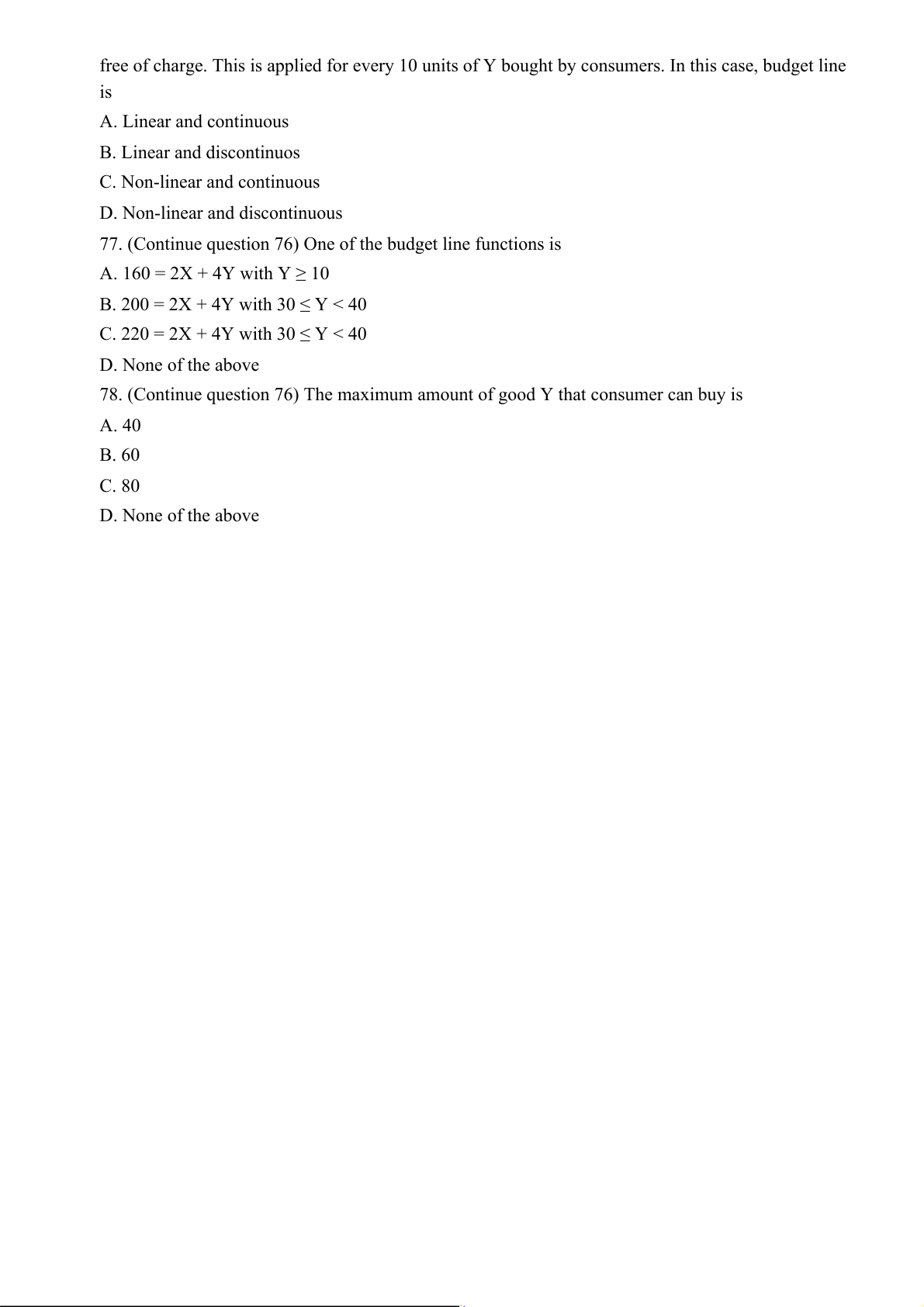
free of charge. This is applied for every 10 units of Y bought by consumers. In this case, budget line is A. Linear and continuous B. Linear and discontinuos C. Non-linear and continuous
D. Non-linear and discontinuous
77. (Continue question 76) One of the budget line functions is A. 160 = 2X + 4Y with Y ≥ 10
B. 200 = 2X + 4Y with 30 ≤ Y < 40
C. 220 = 2X + 4Y with 30 ≤ Y < 40 D. None of the above
78. (Continue question 76) The maximum amount of good Y that consumer can buy is A. 40 B. 60 C. 80 D. None of the above
Tài liệu liên quan:
-
Chương 3: độ co giãn và các nhân tố ảnh hưởng | Microeconomics | Trường Đại học Quốc tế, Đại học Quốc gia Thành phố Hồ Chí Minh
4 2 -
Microeconomics Syllabus | Microeconomics | Trường Đại học Quốc tế, Đại học Quốc gia Thành phố Hồ Chí Minh
4 2 -
Microeconomics Course Syllabus & Assessment Details | Microeconomics | Trường Đại học Quốc tế, Đại học Quốc gia Thành phố Hồ Chí Minh
4 2 -
Assignment 3 - Elasticity MCQs and Key Concepts | Microeconomics | Trường Đại học Quốc tế, Đại học Quốc gia Thành phố Hồ Chí Minh
4 2 -
Assignment 2 - Economic Equilibrium Analysis of Fridges and Motorcycles | Microeconomics | Trường Đại học Quốc tế, Đại học Quốc gia Thành phố Hồ Chí Minh
4 2