Economics Quiz - Type III Multiple Choice Examination Notes | Microeconomics | Trường Đại học Quốc tế, Đại học Quốc gia Thành phố Hồ Chí Minh
Economics deals primarily with the concept of a. scarcity. 2. The adage, "There is no such thing as a free lunch," means c. people face tradeoffs. 3. For a college student who wishes to calculate the true costs of going to college, the costs of room and board b. should be counted only to the extent that they are more expensive at college than elsewhere. 4. Suppose after graduating from college you get a job working at a bank earning 20miliions VND per year Which of the following. Tài liệu được sưu tầm và soạn thảo dưới dạng file PDF để gửi tới các bạn cùng tham khảo, ôn tập đầy đủ kiến thức, chuẩn bị cho các buổi học thật tốt. Mời bạn đọc đón xem!
Môn: Microeconomics 635 tài liệu
Trường: Trường Đại học Quốc tế, Đại học Quốc gia Thành phố Hồ Chí Minh 1.9 K tài liệu
Tác giả:


Preview text:
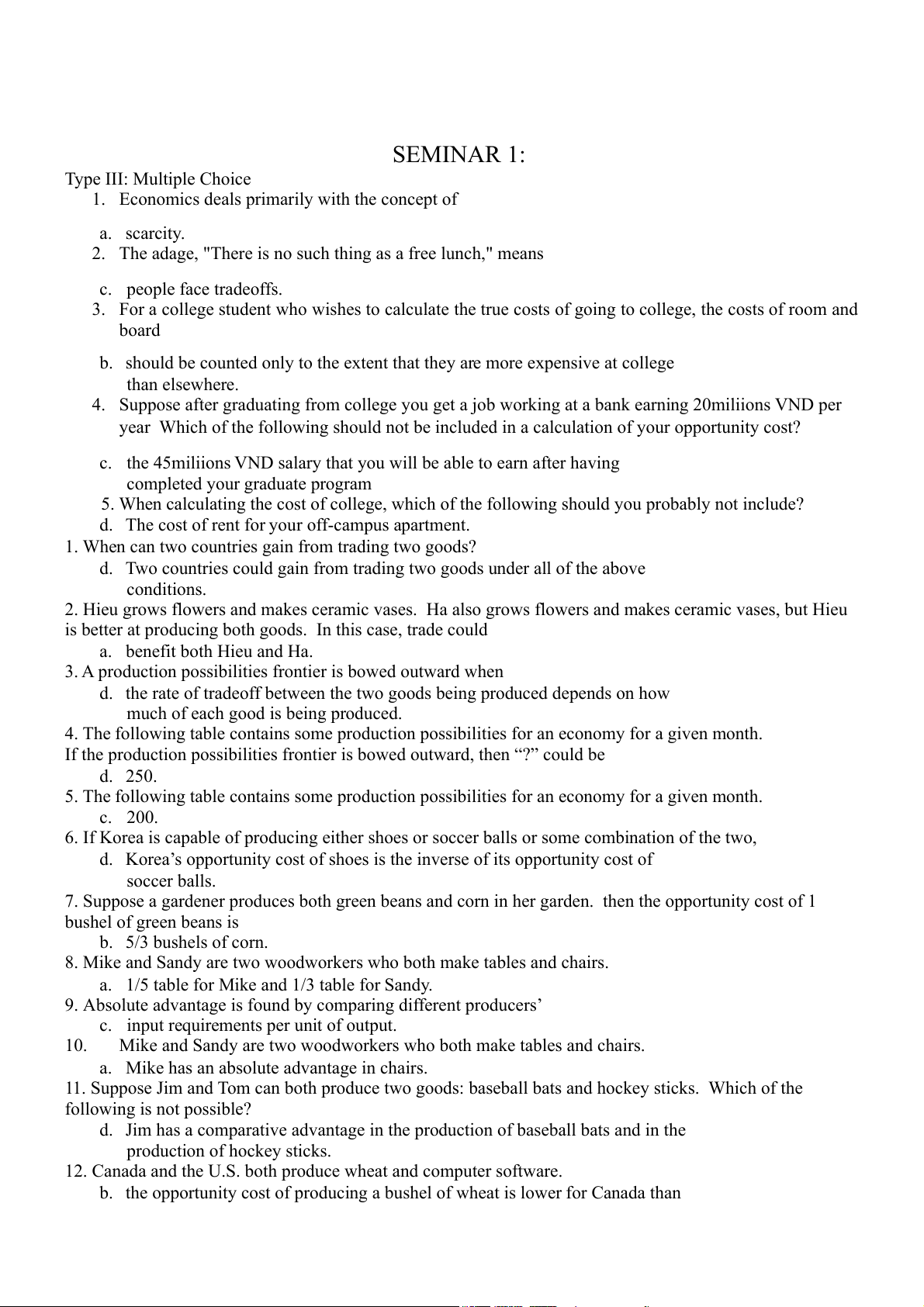
SEMINAR 1: Type III: Multiple Choice
1. Economics deals primarily with the concept of a. scarcity.
2. The adage, "There is no such thing as a free lunch," means c. people face tradeoffs.
3. For a college student who wishes to calculate the true costs of going to college, the costs of room and board
b. should be counted only to the extent that they are more expensive at college than elsewhere.
4. Suppose after graduating from college you get a job working at a bank earning 20miliions VND per
year Which of the following should not be included in a calculation of your opportunity cost?
c. the 45miliions VND salary that you will be able to earn after having
completed your graduate program
5. When calculating the cost of college, which of the following should you probably not include?
d. The cost of rent for your off-campus apartment.
1. When can two countries gain from trading two goods?
d. Two countries could gain from trading two goods under all of the above conditions.
2. Hieu grows flowers and makes ceramic vases. Ha also grows flowers and makes ceramic vases, but Hieu
is better at producing both goods. In this case, trade could a. benefit both Hieu and Ha.
3. A production possibilities frontier is bowed outward when
d. the rate of tradeoff between the two goods being produced depends on how
much of each good is being produced.
4. The following table contains some production possibilities for an economy for a given month.
If the production possibilities frontier is bowed outward, then “?” could be d. 250.
5. The following table contains some production possibilities for an economy for a given month. c. 200.
6. If Korea is capable of producing either shoes or soccer balls or some combination of the two,
d. Korea’s opportunity cost of shoes is the inverse of its opportunity cost of soccer balls.
7. Suppose a gardener produces both green beans and corn in her garden. then the opportunity cost of 1 bushel of green beans is b. 5/3 bushels of corn.
8. Mike and Sandy are two woodworkers who both make tables and chairs.
a. 1/5 table for Mike and 1/3 table for Sandy.
9. Absolute advantage is found by comparing different producers’
c. input requirements per unit of output. 10.
Mike and Sandy are two woodworkers who both make tables and chairs.
a. Mike has an absolute advantage in chairs.
11. Suppose Jim and Tom can both produce two goods: baseball bats and hockey sticks. Which of the following is not possible?
d. Jim has a comparative advantage in the production of baseball bats and in the production of hockey sticks.
12. Canada and the U.S. both produce wheat and computer software.
b. the opportunity cost of producing a bushel of wheat is lower for Canada than it is for the U.S.
13. Two individuals engage in the same two productive activities.
c. One individual’s opportunity costs are the same as the other individual’s opportunity costs.
14. When each person specializes in producing the good in which he or she has a comparative advantage,
total production in the economy c. rises.
15. If labor in Mexico is less productive than labor in the United States in all areas of production,
d. then both Mexico and the United States still can benefit from trade. SEMINAR 2
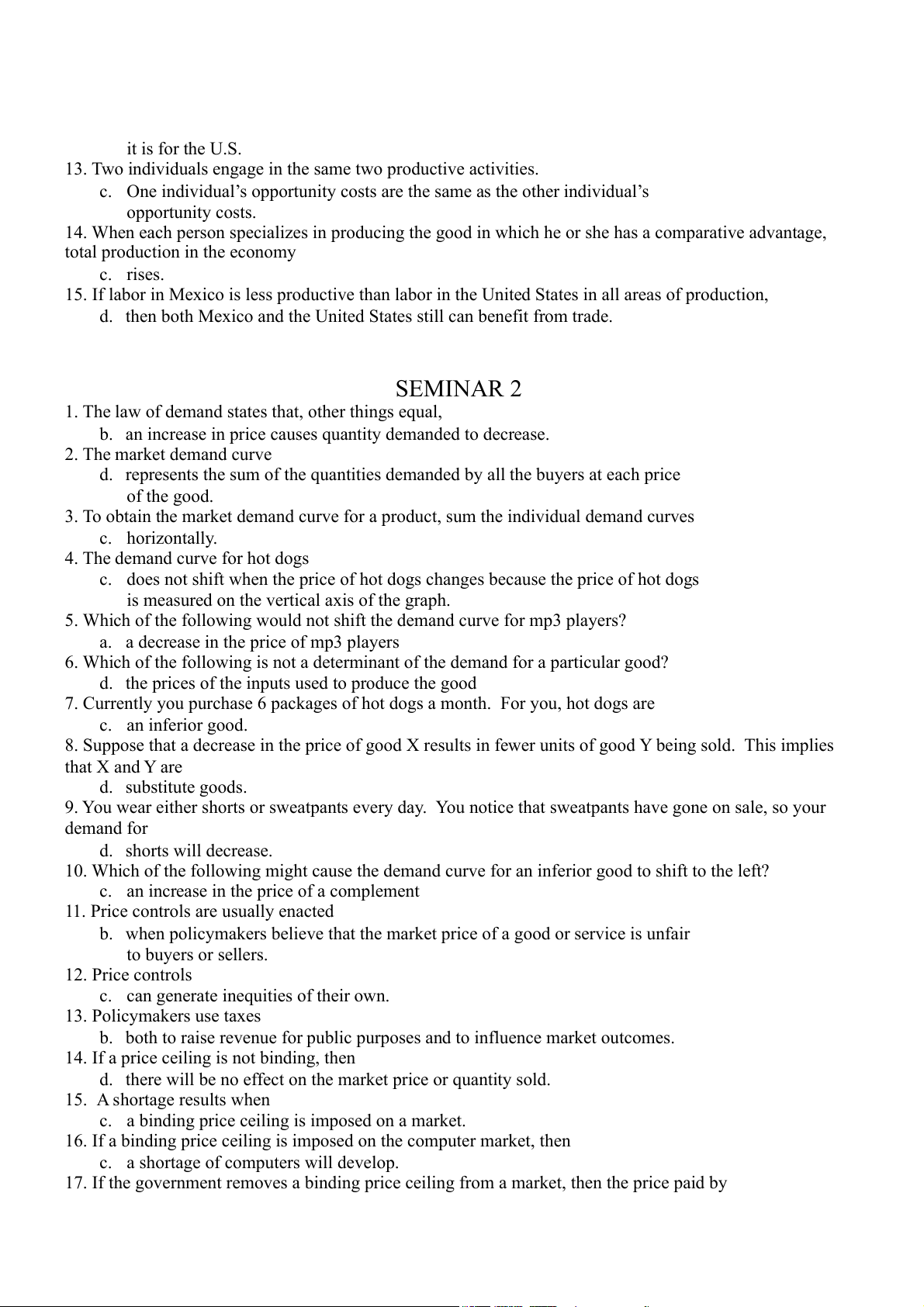
1. The law of demand states that, other things equal,
b. an increase in price causes quantity demanded to decrease. 2. The market demand curve
d. represents the sum of the quantities demanded by all the buyers at each price of the good.
3. To obtain the market demand curve for a product, sum the individual demand curves c. horizontally.
4. The demand curve for hot dogs
c. does not shift when the price of hot dogs changes because the price of hot dogs
is measured on the vertical axis of the graph.
5. Which of the following would not shift the demand curve for mp3 players?
a. a decrease in the price of mp3 players
6. Which of the following is not a determinant of the demand for a particular good?
d. the prices of the inputs used to produce the good
7. Currently you purchase 6 packages of hot dogs a month. For you, hot dogs are c. an inferior good.
8. Suppose that a decrease in the price of good X results in fewer units of good Y being sold. This implies that X and Y are d. substitute goods.
9. You wear either shorts or sweatpants every day. You notice that sweatpants have gone on sale, so your demand for d. shorts will decrease.
10. Which of the following might cause the demand curve for an inferior good to shift to the left?
c. an increase in the price of a complement
11. Price controls are usually enacted
b. when policymakers believe that the market price of a good or service is unfair to buyers or sellers. 12. Price controls
c. can generate inequities of their own. 13. Policymakers use taxes
b. both to raise revenue for public purposes and to influence market outcomes.
14. If a price ceiling is not binding, then
d. there will be no effect on the market price or quantity sold. 15. A shortage results when
c. a binding price ceiling is imposed on a market.
16. If a binding price ceiling is imposed on the computer market, then
c. a shortage of computers will develop.
17. If the government removes a binding price ceiling from a market, then the price paid by
a. increase and the quantity sold in the market will increase.
18. When a binding price ceiling is imposed on a market to benefit buyers,
c. some buyers benefit and some buyers are harmed. SEMINAR 3 Type III: Multiple Choices
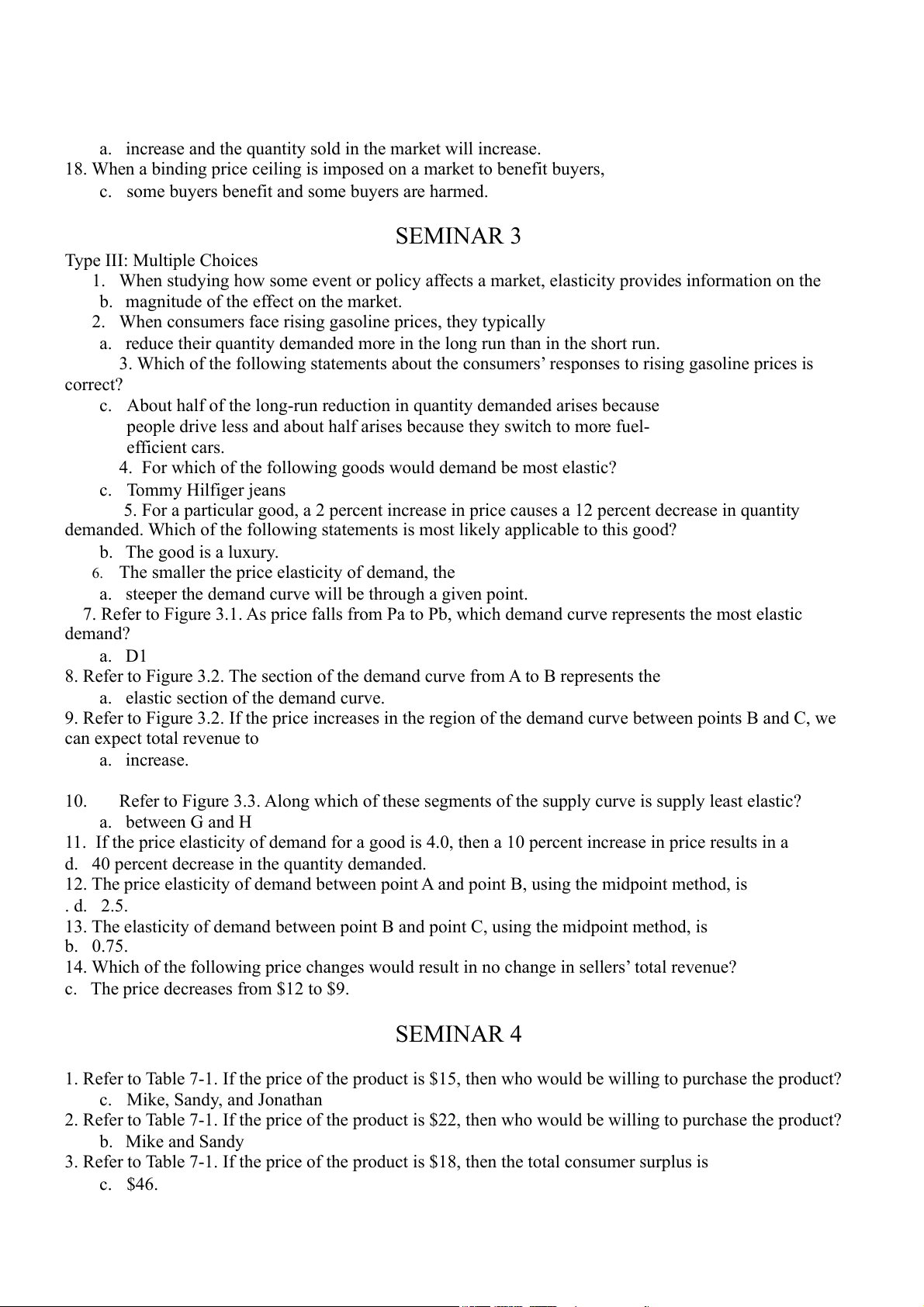
1. When studying how some event or policy affects a market, elasticity provides information on the
b. magnitude of the effect on the market.
2. When consumers face rising gasoline prices, they typically
a. reduce their quantity demanded more in the long run than in the short run.
3. Which of the following statements about the consumers’ responses to rising gasoline prices is correct?
c. About half of the long-run reduction in quantity demanded arises because
people drive less and about half arises because they switch to more fuel- efficient cars.
4. For which of the following goods would demand be most elastic? c. Tommy Hilfiger jeans
5. For a particular good, a 2 percent increase in price causes a 12 percent decrease in quantity
demanded. Which of the following statements is most likely applicable to this good? b. The good is a luxury.
6. The smaller the price elasticity of demand, the
a. steeper the demand curve will be through a given point.
7. Refer to Figure 3.1. As price falls from Pa to Pb, which demand curve represents the most elastic demand? a. D1
8. Refer to Figure 3.2. The section of the demand curve from A to B represents the
a. elastic section of the demand curve.
9. Refer to Figure 3.2. If the price increases in the region of the demand curve between points B and C, we can expect total revenue to a. increase. 10.
Refer to Figure 3.3. Along which of these segments of the supply curve is supply least elastic? a. between G and H
11. If the price elasticity of demand for a good is 4.0, then a 10 percent increase in price results in a
d. 40 percent decrease in the quantity demanded.
12. The price elasticity of demand between point A and point B, using the midpoint method, is . . d. 2.5
13. The elasticity of demand between point B and point C, using the midpoint method, is b. 0.75.
14. Which of the following price changes would result in no change in sellers’ total revenue?
c. The price decreases from $12 to $9. SEMINAR 4
1. Refer to Table 7-1. If the price of the product is $15, then who would be willing to purchase the product? c. Mike, Sandy, and Jonathan
2. Refer to Table 7-1. If the price of the product is $22, then who would be willing to purchase the product? b. Mike and Sandy
3. Refer to Table 7-1. If the price of the product is $18, then the total consumer surplus is c. $46.
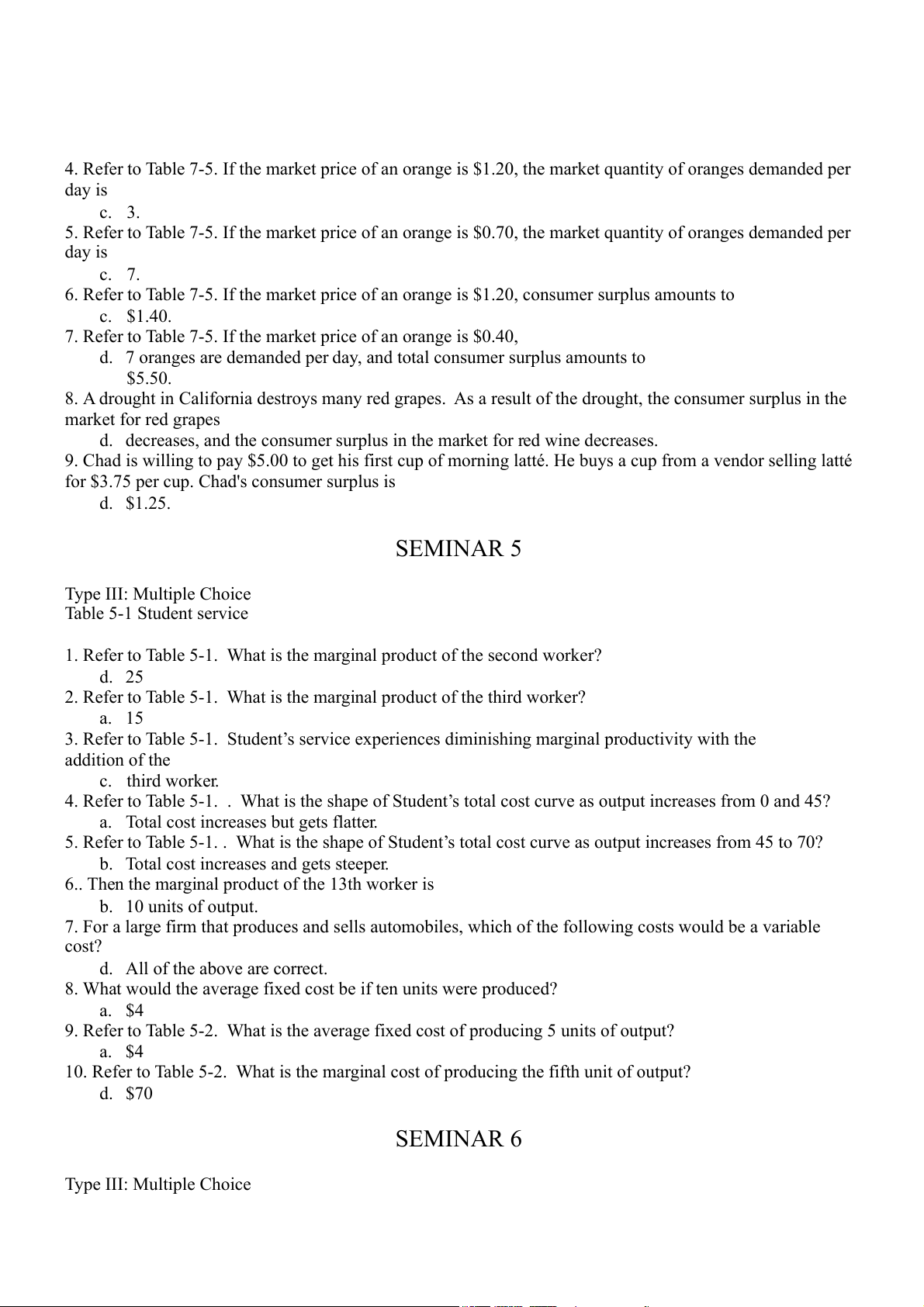
4. Refer to Table 7-5. If the market price of an orange is $1.20, the market quantity of oranges demanded per day is c. 3.
5. Refer to Table 7-5. If the market price of an orange is $0.70, the market quantity of oranges demanded per day is c. 7.
6. Refer to Table 7-5. If the market price of an orange is $1.20, consumer surplus amounts to c. $1.40.
7. Refer to Table 7-5. If the market price of an orange is $0.40,
d. 7 oranges are demanded per day, and total consumer surplus amounts to $5.50.
8. A drought in California destroys many red grapes. As a result of the drought, the consumer surplus in the market for red grapes
d. decreases, and the consumer surplus in the market for red wine decreases.
9. Chad is willing to pay $5.00 to get his first cup of morning latté. He buys a cup from a vendor selling latté
for $3.75 per cup. Chad's consumer surplus is d. $1.25. SEMINAR 5 Type III: Multiple Choice Table 5-1 Student service
1. Refer to Table 5-1. What is the marginal product of the second worker? d. 25
2. Refer to Table 5-1. What is the marginal product of the third worker? a. 15
3. Refer to Table 5-1. Student’s service experiences diminishing marginal productivity with the addition of the c. third worker.
4. Refer to Table 5-1. . What is the shape of Student’s total cost curve as output increases from 0 and 45?
a. Total cost increases but gets flatter.
5. Refer to Table 5-1. . What is the shape of Student’s total cost curve as output increases from 45 to 70?
b. Total cost increases and gets steeper.
6.. Then the marginal product of the 13th worker is b. 10 units of output.
7. For a large firm that produces and sells automobiles, which of the following costs would be a variable cost?
d. All of the above are correct.
8. What would the average fixed cost be if ten units were produced? a. $4
9. Refer to Table 5-2. What is the average fixed cost of producing 5 units of output? a. $4
10. Refer to Table 5-2. What is the marginal cost of producing the fifth unit of output? d. $70 SEMINAR 6 Type III: Multiple Choice
1. Which of the following is not a characteristic of a competitive market? c. Free entry is limited.
2. Which of the following statements best reflects a price-taking firm?
a. If the firm were to charge more than the going price, it would sell none of its goods.
3. For a firm operating in a competitive industry, which of the following statements is not correct? c. Total revenue is constant.
4. If a competitive firm is currently producing a level of output at which marginal revenue exceeds marginal cost, then
a. a one-unit increase in output will increase the firm's profit.
5. Hung is a gourmet chef who runs a small catering business in a competitive industry. Hung
specializes in making wedding cakes In order to maximize profits, he should
a. make more than 20 wedding cakes per month.
6. A competitive firm has been selling its output for $20 per unit and has been maximizing its profit,
which is positive. Once the firm has adjusted, which of the following statements is correct?
d. All of the above are correct.
7. When profit-maximizing firms in competitive markets are earning profits,
c. new firms will enter the market.
8. Refer to Table 6-1. In order to maximize profit, the firm will produce a level of output where marginal cost is equal to d. 9
9. Refer to Table 6-1. If the firm finds that its marginal cost is $11, it should
d. reduce production to increase profit.
10. Refer to Table 6-1. If the firm finds that its marginal cost is $5, it should
b. increase production to maximize profit.
11. Why does a firm in a competitive industry charge the market price?
d. All of the above are correct.
12. A competitive firm would benefit from charging a price below the market price because the firm would achieve
d. None of the above is correct.
13. Which of the following statements regarding a competitive market is not correct?
d. Price exceeds marginal revenue.
14. Which of the following statements is correct?
d. Only for competitive firms does average revenue equal marginal revenue.
15. If a firm in a perfectly competitive market triples the number of units of output sold, then total revenue will c. exactly triple.
16. Which of the following statements best expresses a firm’s profit-maximizing decision rule?
d. All of the above are correct.
17. Refer to Figure. If the market price is P1, in the short run, the perfectly competitive firm will earn a. positive economic profits.
18. Refer to Figure. If the market price is P4, in the short run, the perfectly competitive firm will earn
c. negative economic profits and will shut down.
19. Refer to Figure. Which of the four prices corresponds to a perfectly competitive firm earning negative
economic profits in the short run but trying to remain open? c. P3 SEMINAR 7 Type III: Multiple Choice
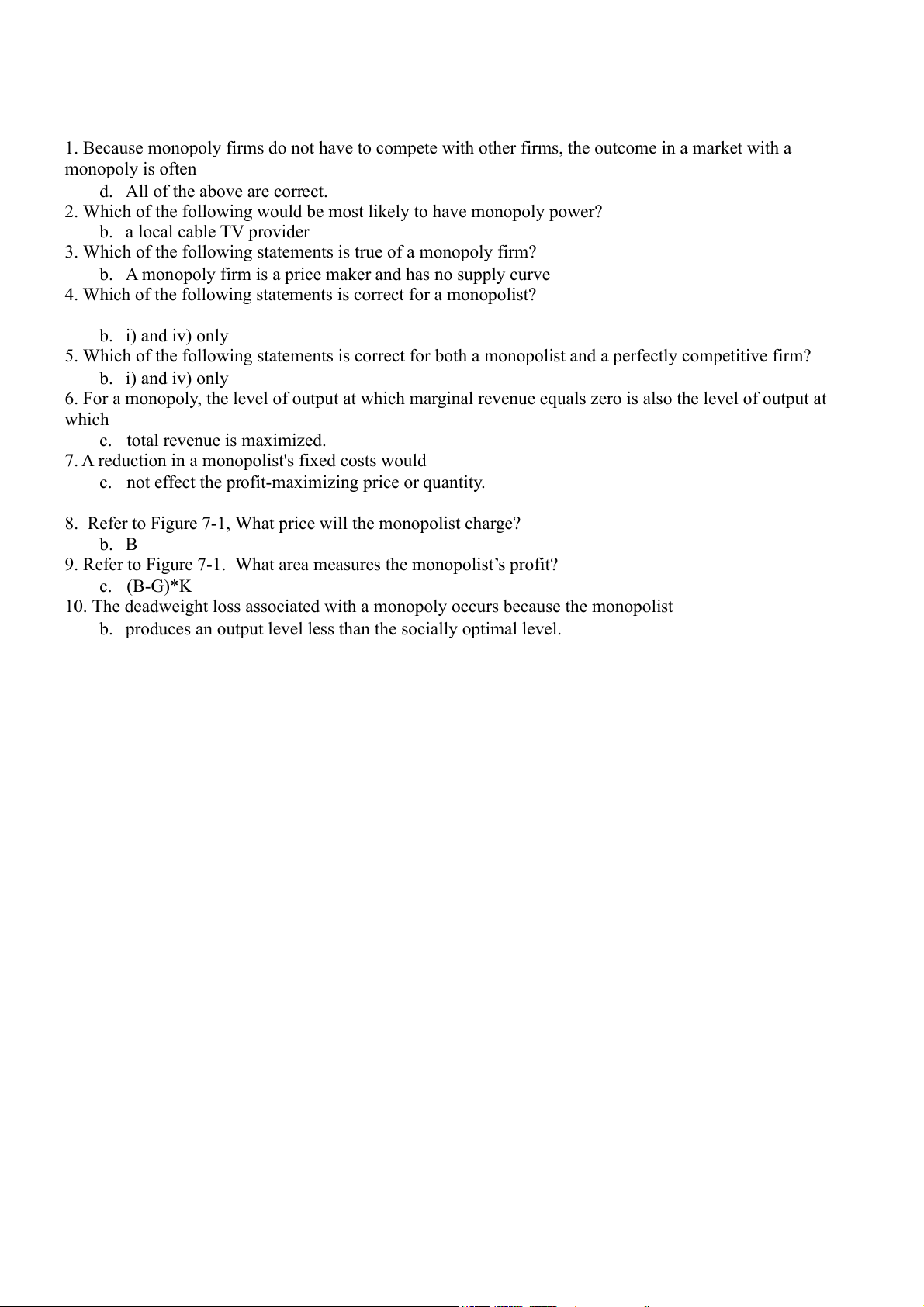
1. Because monopoly firms do not have to compete with other firms, the outcome in a market with a monopoly is often
d. All of the above are correct.
2. Which of the following would be most likely to have monopoly power? b. a local cable TV provider
3. Which of the following statements is true of a monopoly firm?
b. A monopoly firm is a price maker and has no supply curve
4. Which of the following statements is correct for a monopolist? b. i) and iv) only
5. Which of the following statements is correct for both a monopolist and a perfectly competitive firm? b. i) and iv) only
6. For a monopoly, the level of output at which marginal revenue equals zero is also the level of output at which c. total revenue is maximized.
7. A reduction in a monopolist's fixed costs would
c. not effect the profit-maximizing price or quantity.
8. Refer to Figure 7-1, What price will the monopolist charge? b. B
9. Refer to Figure 7-1. What area measures the monopolist’s profit? c. (B-G)*K
10. The deadweight loss associated with a monopoly occurs because the monopolist
b. produces an output level less than the socially optimal level.
Tài liệu liên quan:
-
Chương 3: độ co giãn và các nhân tố ảnh hưởng | Microeconomics | Trường Đại học Quốc tế, Đại học Quốc gia Thành phố Hồ Chí Minh
6 3 -
Microeconomics Syllabus | Microeconomics | Trường Đại học Quốc tế, Đại học Quốc gia Thành phố Hồ Chí Minh
5 3 -
Microeconomics Course Syllabus & Assessment Details | Microeconomics | Trường Đại học Quốc tế, Đại học Quốc gia Thành phố Hồ Chí Minh
5 3 -
Assignment 3 - Elasticity MCQs and Key Concepts | Microeconomics | Trường Đại học Quốc tế, Đại học Quốc gia Thành phố Hồ Chí Minh
5 3 -
Assignment 2 - Economic Equilibrium Analysis of Fridges and Motorcycles | Microeconomics | Trường Đại học Quốc tế, Đại học Quốc gia Thành phố Hồ Chí Minh
6 3