Elasticity Concepts and Applications | Microeconomics | Trường Đại học Quốc tế, Đại học Quốc gia Thành phố Hồ Chí Minh
Elasticity: a measure of the responsiveness of the quantity demanded or quantity supplied to one of its determinants 2. Price elasticity of demand: a measure of how much the quantity demanded of a good responds to a change in the price of that good 3. Elastic: when the quantity demanded or supplied responds substantially to a change in one of its determinants 4. Inelastic: when the quantity demanded or supplied responds only slightly to a change. Tài liệu được sưu tầm và soạn thảo dưới dạng file PDF để gửi tới các bạn cùng tham khảo, ôn tập đầy đủ kiến thức, chuẩn bị cho các buổi học thật tốt. Mời bạn đọc đón xem!
Môn: Microeconomics 635 tài liệu
Trường: Trường Đại học Quốc tế, Đại học Quốc gia Thành phố Hồ Chí Minh 1.9 K tài liệu
Tác giả:


Preview text:
Elasticity and Its Application Terms and Definitions
1. Elasticity: a measure of the responsiveness of the quantity demanded or quantity
supplied to one of its determinants
2. Price elasticity of demand: a measure of how much the quantity demanded of a
good responds to a change in the price of that good
3. Elastic: when the quantity demanded or supplied responds substantially to a
change in one of its determinants
4. Inelastic: when the quantity demanded or supplied responds only slightly to a
change in one of its determinants
5. Total revenue: the amount paid by buyers and received by sellers of a good computed as PxQ
6. Income elasticity of demand: a measure of how much the quantity demanded of a
good responds to a change in consumer’s income
7. Cross-price elasticity of demand: a measure of how much the quantity demanded
of one good responds to a change in the price of another good
8. Price elasticity of supply: a measure of how much the quantity supplied of a good
responds to a change in the price of that good
9. Normal good: a good characterized by a positive income elasticity
10. Inferior good: a good characterized by a negative income elasticity Practice Problems
1. For each pair of goods listed below, which good would you expect to have the more elastic demand? Why?
a. Cigarettes; a trip to Florida over spring break
a trip to Florida because it is a luxury whereas cigarettes are a necessity (to smokers)
b. An AIDS vaccine over the next months, an AIDS vaccine over the next five years
an AIDS vaccine over the next five years because there are likely to be more
substitutes (alternative medications) developed over this time period and
consumer’s behavior may be modified over longer time periods c. Beer and Budweiser
Budweiser because it is a more narrowly defined market than beer so there
are more substitutes for Budweiser than for beer d. Insulin and Aspirin
Aspirin because there are many substitutes for aspirin but few substitutes for insulin
2. Suppose the Daily Newspaper estimates that if it raises the price of its newspaper
from $1.00 to $1.50 when the number of subscribers will fall from 50.000 to 40.000
a. What is the price elasticity of demand for the Daily Newspaper when
elasticity is calculated using the midpoint method ~ 0.56
b. What is the advantage of using the midpoint method
With the midpoint method, the value of which elasticity is the same whether
you begin at a price of $1.00 and raise it to $1.50 or begin at a price of $1.50 and reduce it to $1.00
c. If the Daily Newspaper’s only concern is to maximize total revenue, should
it raise the price of a newspaper from $1.00 to $1.50? Why and Why not?
because EdP = 5/9 <1 => when P raise => TR rise => should increase the price
3. The table below provides the demand schedule for motel rooms at Small Town
Motel. Use the information provided to complete the table. Answer the following
questions based on your responses in the table. Use the midpoint method to
calculate the percentage changes used to generate the elasticities.
a. Over what range of price is the demand for motel room elastic? To
maximize total revenue, should Small Town Motel raise or lower the price within this range?
range: $80 to $120; lower its price
b. Over what range of price is the demand for motel rooms inelastic? To
maximize total revenue, should Small Town Motel raise or lower the price within this range?
range: $20 to $60; raise its price
c. Over what range of price is the demand for motel rooms unit elastic? To
maximize total revenue, should Small Town Motel raise or lower the price within this range?
range $60 to $80; it doesn’t matter. For these prices, a change in price
proportionately changes the quantity demanded, so total revenue is unchanged
4. The demand schedule from question 3 above is reproduced below along with
another demand schedule when consumer incomes have risen to $60,000 from
$50,000. Use this information to answer the following questions. Use the
midpoint method to calculate the percentage changes used to generate the elasticities.
a. What is the income elasticity of demand when motel rooms rent for $40 2.2
b. What is the income elasticity of demand when motel rooms rent for $100 4,2
c. Are motel rooms normal or inferior goods? Why?
Motel rooms are normal goods because Ed > 1 (positive) I
d. Are motel rooms likely to be necessities or luxuries? Why?
Motel rooms are likely luxury goods because EdI > 1 (large, greater than 1).
5. For each pair of goods listed below, which goods would you expect to have the more elastic supply? Why?
a. Television, because the production of televisions can be increased in
response to an increase in the price of televisions whereas the quantity of beachfront property is fixed
b. Crude oil over the next year, because production of oil over the next year
can more easily be increased than the production of oil over the next week
c. A Van Gogh print, because more of them can be created in response to an
increase in price whereas the quantity of an original work is fixed Short-Answer Questions
1. Whether the good is necessity or a luxury, the availability of close substitutes, the
definition of the market, and the time horizon over which demand is measured
2. If demand is inelastic. Will an increase in price raise or lower total revenue? Why?
It will increase TR, because a large increase in price will be accompanied by only
a small reduction in the quantity demanded if demand is inelastic
3. Zero, therefore it is considered perfectly inelastic
4. Infinite, therefore it is considered perfectly elastic
5. -½ => Eggs are inferior goods
6. Suppose a firm is operating at half capacity. Is the supply curve for output likely to
be relatively elastic or inelastic? Why?
Elastic, because a small increase in price will induce the firm to increase production by a large amount
7. Is the price elasticity of supply for fresh fish likely to be elastic or inelastic when
measured over the time period of one day?Why?
Inelastic (nearly vertical), because once the fish are caught, the quantity offered
for the sale is fixed and must be sold before it spoils, regardless of the price
8. If a demand curve is linear, is the elasticity constant the demand curve? Which
part tends to be elastic and which part tends to be inelastic? Why?
No. The upper part tends to be elastic while the lower part tends to be inelastic.
This is because on the upper part, for example, a one-unit change in the price is
small percentage change while a one-unit change in quantity is a large percentage
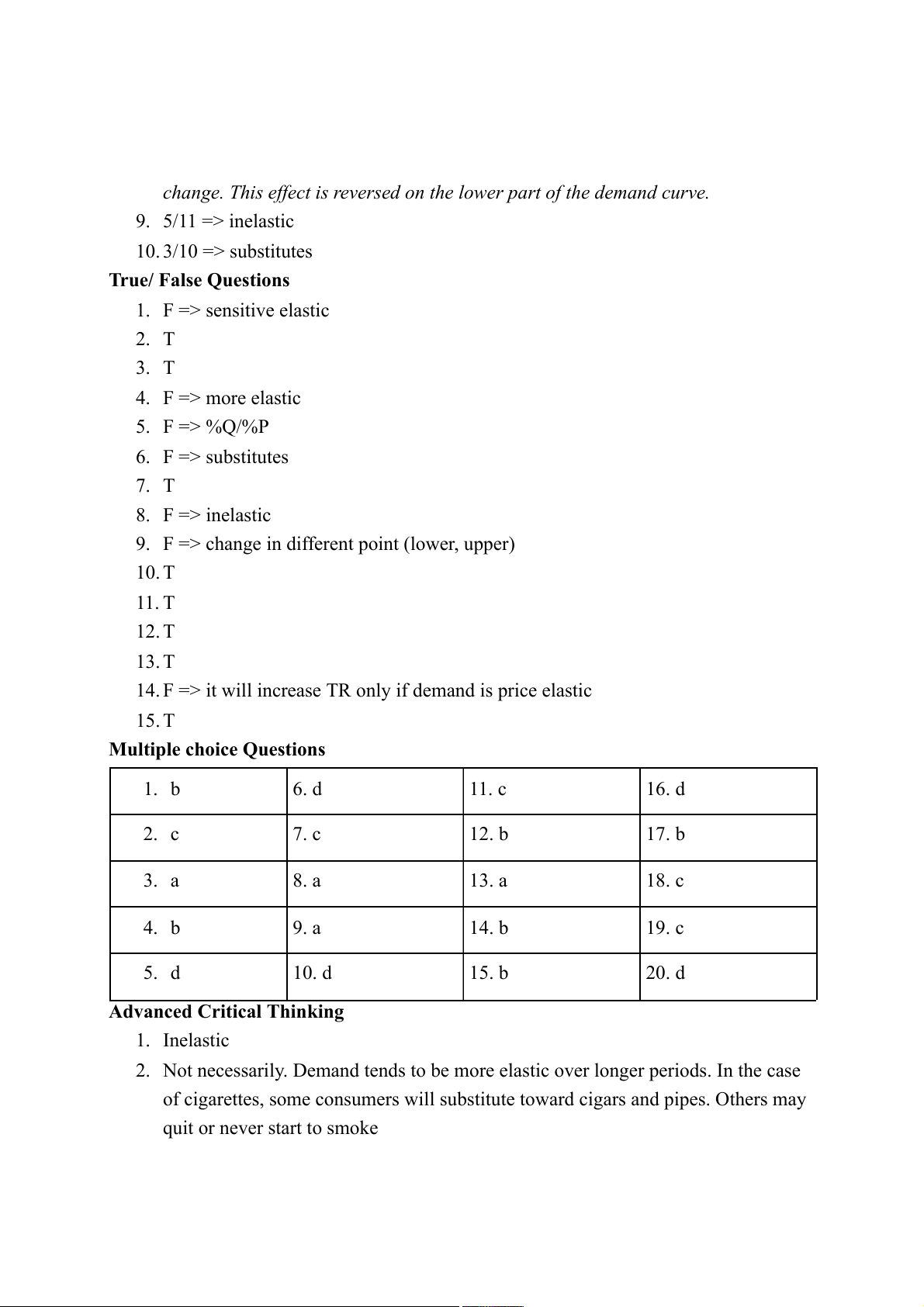
change. This effect is reversed on the lower part of the demand curve. 9. 5/11 => inelastic 10. 3/10 => substitutes True/ False Questions 1. F => sensitive elastic 2. T 3. T 4. F => more elastic 5. F => %Q/%P 6. F => substitutes 7. T 8. F => inelastic
9. F => change in different point (lower, upper) 10. T 11. T 12. T 13. T
14. F => it will increase TR only if demand is price elastic 15. T Multiple choice Questions 1. b 6. d 11. c 16. d 2. c 7. c 12. b 17. b 3. a 8. a 13. a 18. c 4. b 9. a 14. b 19. c 5. d 10. d 15. b 20. d Advanced Critical Thinking 1. Inelastic
2. Not necessarily. Demand tends to be more elastic over longer periods. In the case
of cigarettes, some consumers will substitute toward cigars and pipes. Others may quit or never start to smoke
3. No. While the demand for cigarettes may be inelastic, the demand for any one
brand is likely to be much more elastic because consumers can substitute toward other lower price brands
Tài liệu liên quan:
-
Chương 3: độ co giãn và các nhân tố ảnh hưởng | Microeconomics | Trường Đại học Quốc tế, Đại học Quốc gia Thành phố Hồ Chí Minh
5 3 -
Microeconomics Syllabus | Microeconomics | Trường Đại học Quốc tế, Đại học Quốc gia Thành phố Hồ Chí Minh
5 3 -
Microeconomics Course Syllabus & Assessment Details | Microeconomics | Trường Đại học Quốc tế, Đại học Quốc gia Thành phố Hồ Chí Minh
5 3 -
Assignment 3 - Elasticity MCQs and Key Concepts | Microeconomics | Trường Đại học Quốc tế, Đại học Quốc gia Thành phố Hồ Chí Minh
5 3 -
Assignment 2 - Economic Equilibrium Analysis of Fridges and Motorcycles | Microeconomics | Trường Đại học Quốc tế, Đại học Quốc gia Thành phố Hồ Chí Minh
5 3