Elasticity Concepts and Examples | Microeconomics | Trường Đại học Quốc tế, Đại học Quốc gia Thành phố Hồ Chí Minh
Tài liệu được sưu tầm và soạn thảo dưới dạng file PDF với mục đích hỗ trợ học tập và tham khảo. Nội dung tài liệu được trình bày rõ ràng, dễ tiếp cận, phù hợp cho việc ôn tập và củng cố kiến thức trong quá trình học đại học. Đây sẽ là nguồn tư liệu hữu ích giúp các bạn sinh viên chuẩn bị tốt hơn cho các buổi học, đồng thời mở rộng thêm hiểu biết về môn học. Hy vọng tài liệu này sẽ mang lại nhiều giá trị và hỗ trợ các bạn trong hành trình học tập. Mời bạn đọc cùng tham khảo!
Môn: Microeconomics 635 tài liệu
Trường: Trường Đại học Quốc tế, Đại học Quốc gia Thành phố Hồ Chí Minh 1.9 K tài liệu
Tác giả:



Preview text:
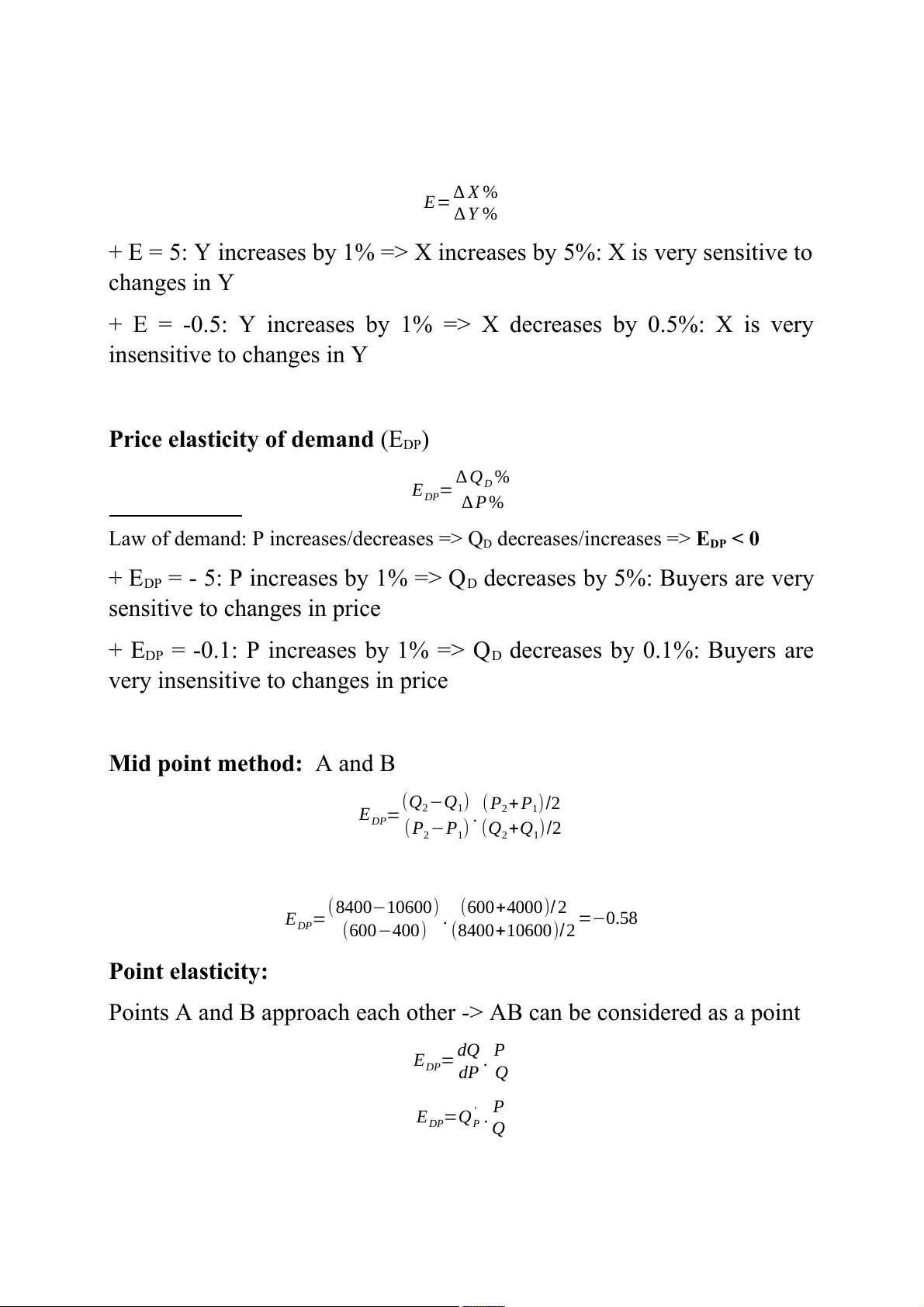
E= ∆ X % ∆ Y %
+ E = 5: Y increases by 1% => X increases by 5%: X is very sensitive to changes in Y
+ E = -0.5: Y increases by 1% => X decreases by 0.5%: X is very insensitive to changes in Y
Price elasticity of demand (EDP) ∆ Q % E = D DP ∆ P %
Law of demand: P increases/decreases => QD decreases/increases => EDP < 0
+ EDP = - 5: P increases by 1% => QD decreases by 5%: Buyers are very sensitive to changes in price
+ EDP = -0.1: P increases by 1% => QD decreases by 0.1%: Buyers are
very insensitive to changes in price
Mid point method: A and B
(Q −Q ) (P +P )/2 E = 2 1 2 1 . DP
(P −P ) (Q +Q )/2 2 1 2 1 (8400 10600 − ) (600 4000 2 + )/ E = . =−0.58 DP (600−400) (8400+10600)/2 Point elasticity:
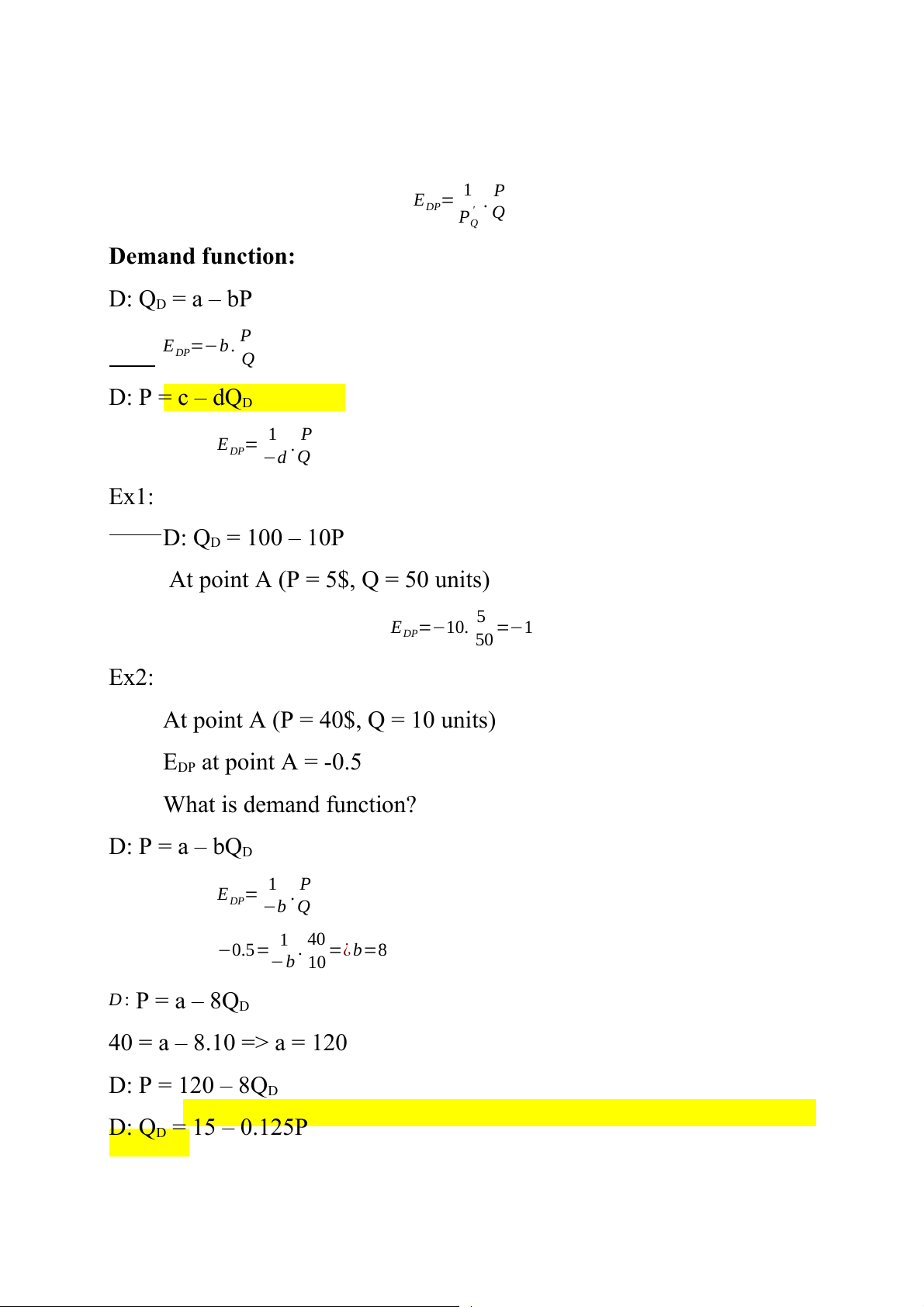
Points A and B approach each other -> AB can be considered as a point P E = dQ . DP dP Q P E =Q ' . DP P Q 1 P E = . DP P ' Q Q Demand function: D: QD = a – bP P E =−b . DP Q D: P = c – dQD 1 P E = . DP −d Q Ex1: D: QD = 100 – 10P
At point A (P = 5$, Q = 50 units) 5 E =−10. =−1 DP 50 Ex2:
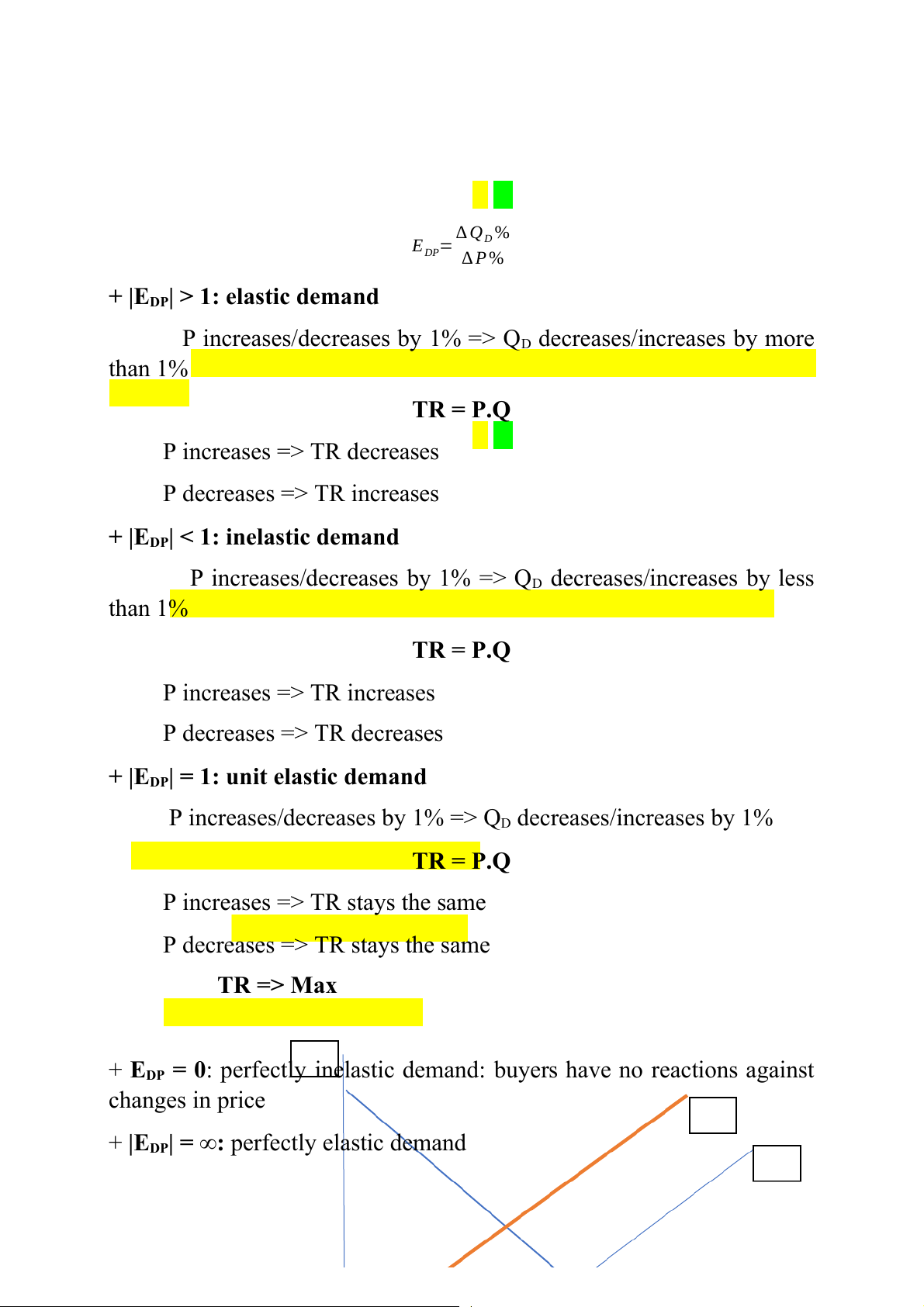
At point A (P = 40$, Q = 10 units) EDP at point A = -0.5 What is demand function? D: P = a – bQD 1 P E = . DP −b Q 1 40 −0.5= . =¿ b=8 −b 10 D : P = a – 8QD 40 = a – 8.10 => a = 120 D: P = 120 – 8QD D: QD = 15 – 0.125P ∆ Q % E = D DP ∆ P %
+ |EDP| > 1: elastic demand
P increases/decreases by 1% => QD decreases/increases by more than 1% TR = P.Q P increases => TR decreases P decreases => TR increases
+ |EDP| < 1: inelastic demand
P increases/decreases by 1% => QD decreases/increases by less than 1% TR = P.Q P increases => TR increases P decreases => TR decreases
+ |EDP| = 1: unit elastic demand
P increases/decreases by 1% => QD decreases/increases by 1% TR = P.Q
P increases => TR stays the same
P decreases => TR stays the same TR => Max
+ EDP = 0: perfectly inelastic demand: buyers have no reactions against changes in price + |EDP perfectly elast | = ∞: ic demand Agricultural production
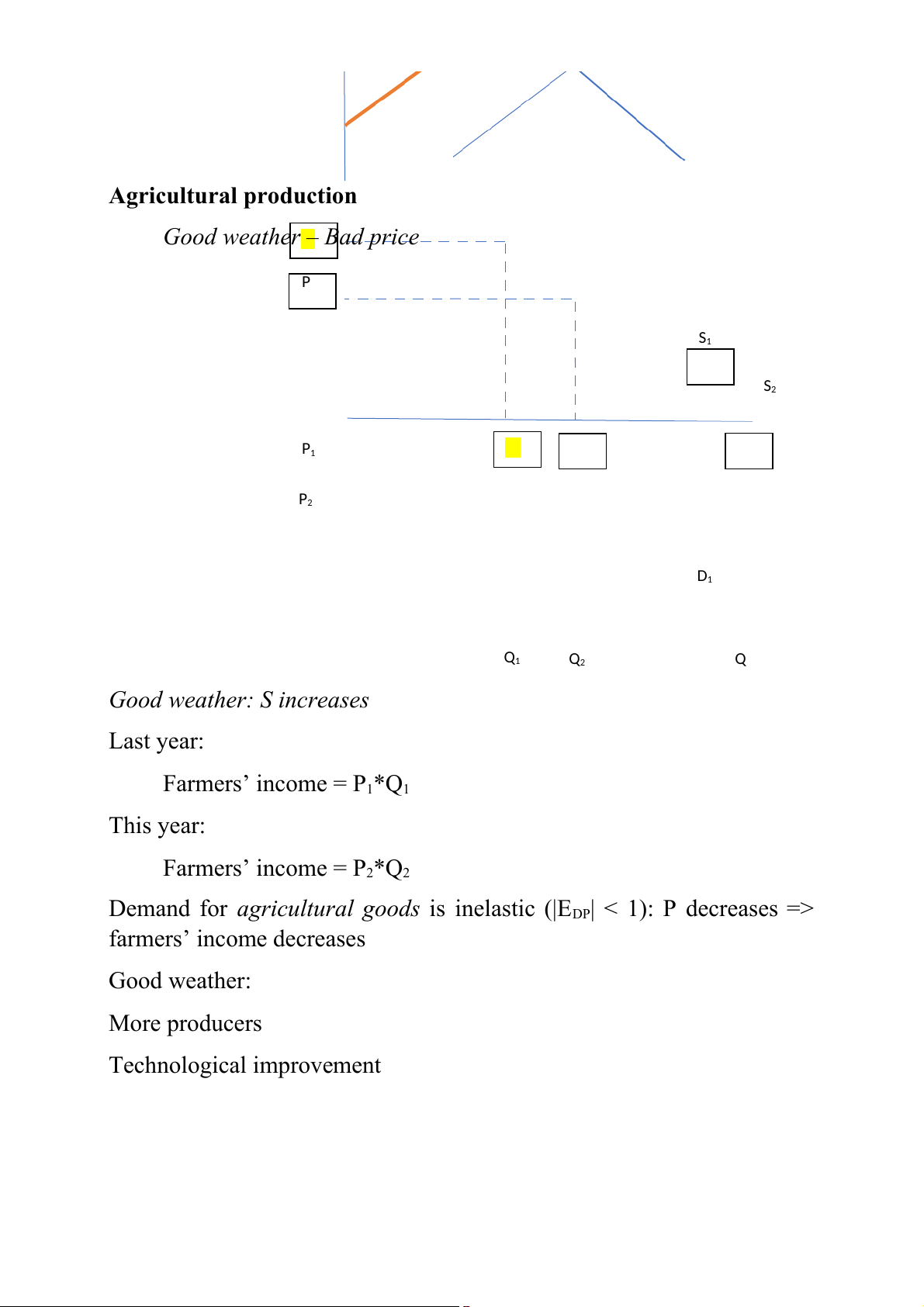
Good weather – Bad price P S1 S2 P1 P2 D1 Q1 Q2 Q
Good weather: S increases Last year: Farmers’ income = P1*Q1 This year: Farmers’ income = P2*Q2
Demand for agricultural
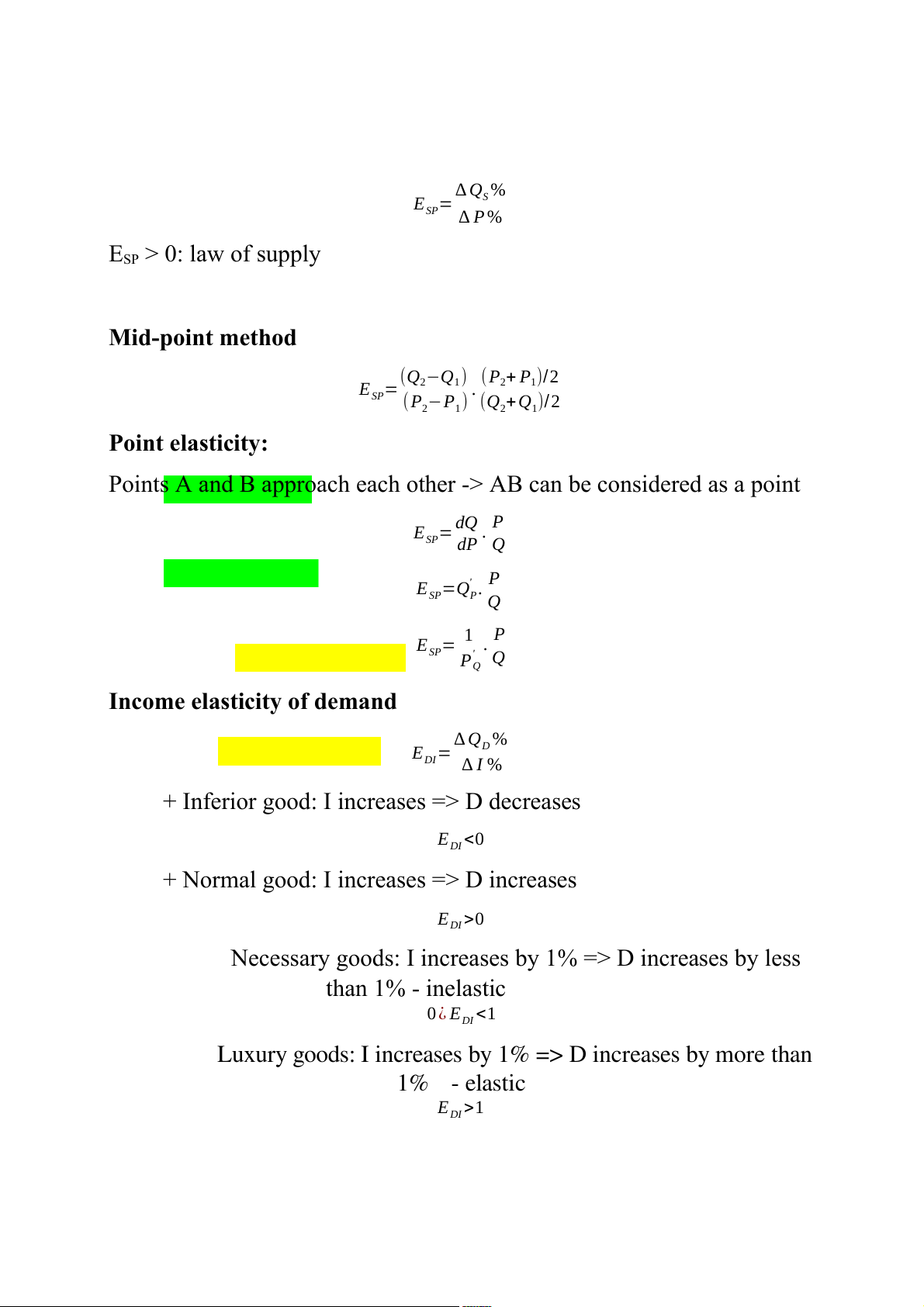
goods is inelastic (|EDP| < 1): P decreases => farmers’ income decreases Good weather: More producers Technological improvement ∆ Q % E = S SP ∆ P % ESP > 0: law of supply Mid-point method
(Q −Q ) (P + P )/2 2 1 E = 2 1 . SP
(P −P ) (Q + Q )/2 2 1 2 1 Point elasticity:
Points A and B approach each other -> AB can be considered as a point P E = dQ . SP dP Q P E =Q' . SP P Q 1 P E = . SP P' Q Q
Income elasticity of demand ∆ Q % E = D DI ∆ I %
+ Inferior good: I increases => D decreases E <0 DI
+ Normal good: I increases => D increases E >0 DI
Necessary goods: I increases by 1% => D increases by less than 1% - inelastic 0 ¿ E <1 DI
Luxury goods: I increases by 1% => D increases by more than 1% - elastic E >1 DI
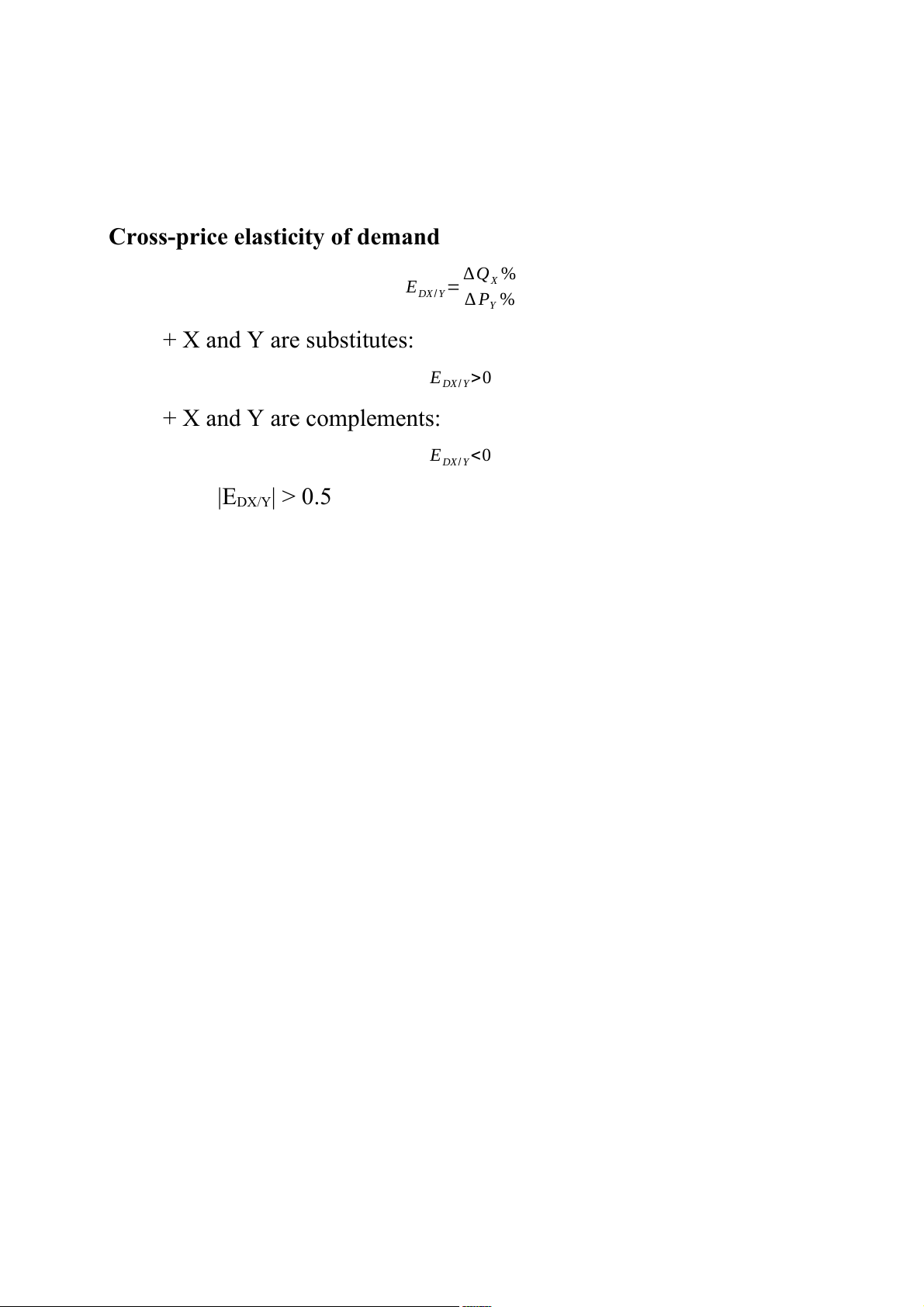
Cross-price elasticity of demand ∆ Q % E = X DX / Y ∆ P % Y + X and Y are substitutes: E >0 DX / Y + X and Y are complements: E <0 DX / Y |EDX/Y| > 0.5
Tài liệu liên quan:
-
Chương 3: độ co giãn và các nhân tố ảnh hưởng | Microeconomics | Trường Đại học Quốc tế, Đại học Quốc gia Thành phố Hồ Chí Minh
5 3 -
Microeconomics Syllabus | Microeconomics | Trường Đại học Quốc tế, Đại học Quốc gia Thành phố Hồ Chí Minh
5 3 -
Microeconomics Course Syllabus & Assessment Details | Microeconomics | Trường Đại học Quốc tế, Đại học Quốc gia Thành phố Hồ Chí Minh
5 3 -
Assignment 3 - Elasticity MCQs and Key Concepts | Microeconomics | Trường Đại học Quốc tế, Đại học Quốc gia Thành phố Hồ Chí Minh
5 3 -
Assignment 2 - Economic Equilibrium Analysis of Fridges and Motorcycles | Microeconomics | Trường Đại học Quốc tế, Đại học Quốc gia Thành phố Hồ Chí Minh
5 3