Elasticity: Understanding Demand Response Dynamics | Microeconomics | Trường Đại học Quốc tế, Đại học Quốc gia Thành phố Hồ Chí Minh
According to the law of demand: Side Effect: P increases Q decreasesMagnitude Effect: How many units does the quantity demanded decrease?Example: when the price of vegetable (broconi) increases by 10% and the price of electricity increases by 10%? The quantity demanded will change by the same amount?Ans: NO but HOWQuestions: what characteristics of goods/market can determine the response sensitivity of customers to changes in price? Tài liệu được sưu tầm và soạn thảo dưới dạng file PDF để gửi tới các bạn cùng tham khảo, ôn tập đầy đủ kiến thức, chuẩn bị cho các buổi học thật tốt. Mời bạn đọc đón xem!
Môn: Microeconomics 635 tài liệu
Trường: Trường Đại học Quốc tế, Đại học Quốc gia Thành phố Hồ Chí Minh 1.9 K tài liệu
Tác giả:


Preview text:
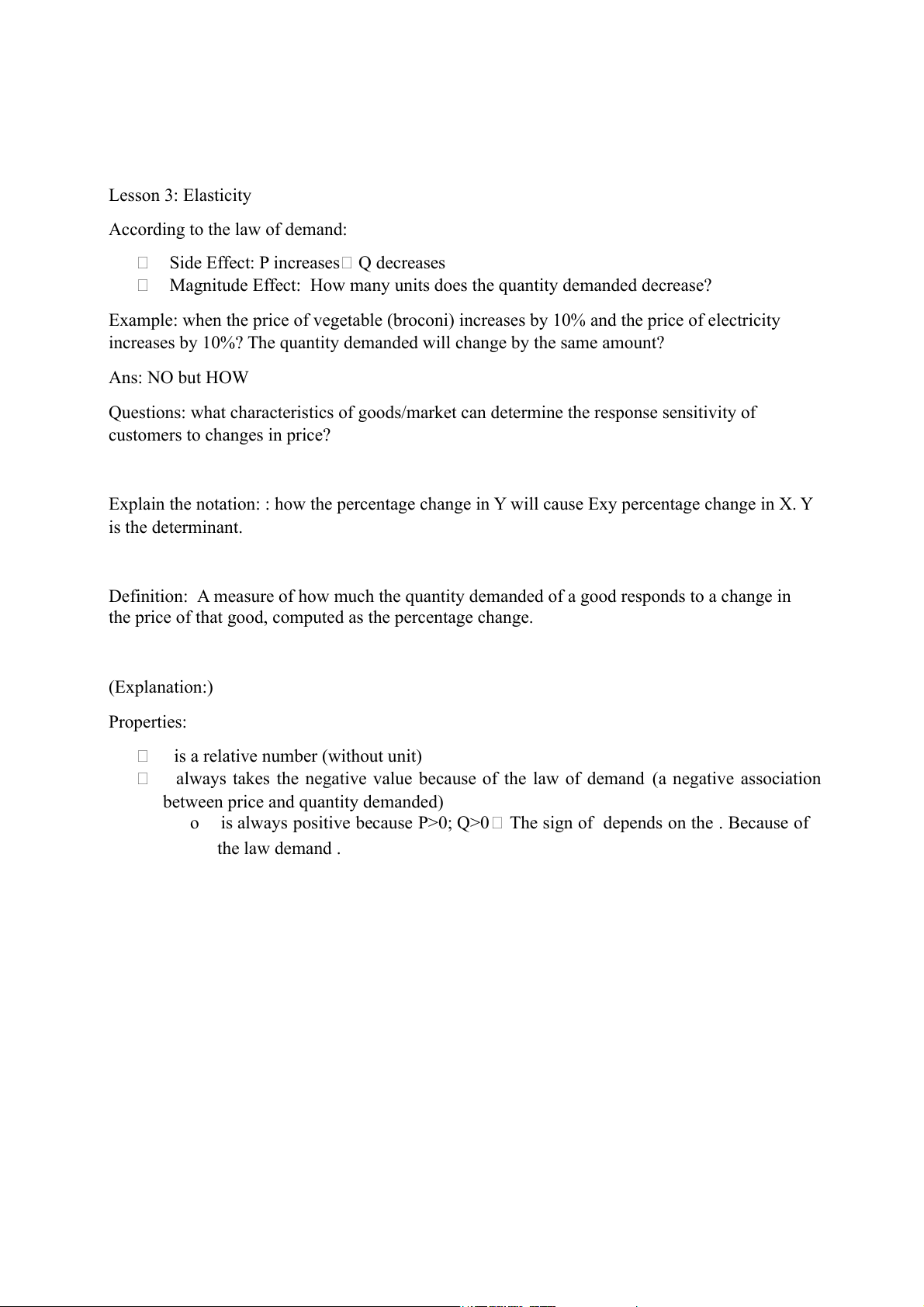
Lesson 3: Elasticity
According to the law of demand:
Side Effect: P increases Q decreases
Magnitude Effect: How many units does the quantity demanded decrease?
Example: when the price of vegetable (broconi) increases by 10% and the price of electricity
increases by 10%? The quantity demanded will change by the same amount? Ans: NO but HOW
Questions: what characteristics of goods/market can determine the response sensitivity of customers to changes in price?
Explain the notation: : how the percentage change in Y will cause Exy percentage change in X. Y is the determinant.
Definition: A measure of how much the quantity demanded of a good responds to a change in
the price of that good, computed as the percentage change. (Explanation:) Properties:
is a relative number (without unit)
always takes the negative value because of the law of demand (a negative association
between price and quantity demanded)
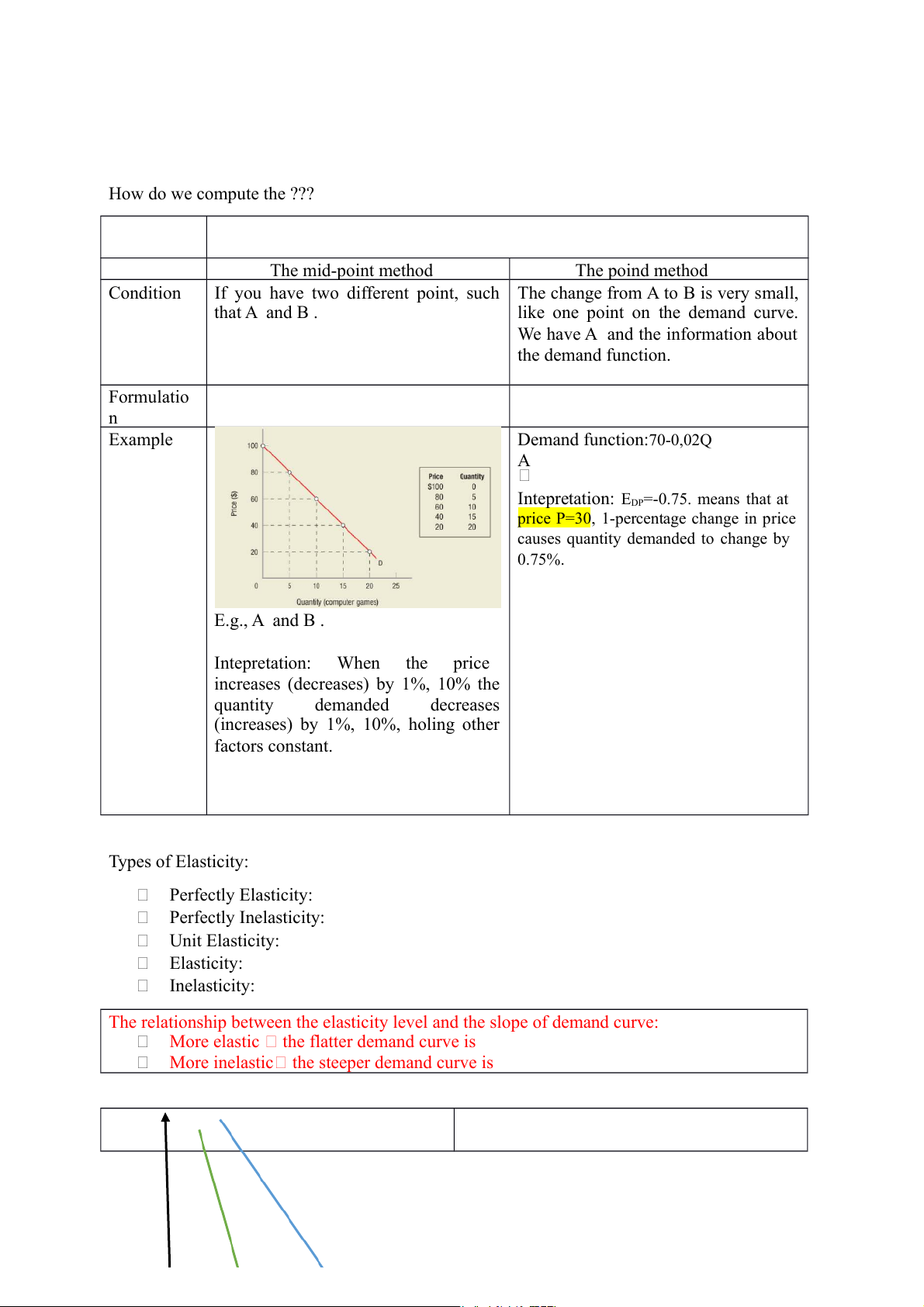
o is always positive because P>0; Q>0 The sign of depends on the . Because of the law demand . How do we compute the ??? The mid-point method The poind method Condition
If you have two different point, such The change from A to B is very small, that A and B .
like one point on the demand curve.
We have A and the information about the demand function. Formulatio n Example Demand function:70-0,02Q A
Intepretation: EDP=-0.75. means that at
price P=30, 1-percentage change in price
causes quantity demanded to change by 0.75%. E.g., A and B . Intepretation: When the price
increases (decreases) by 1%, 10% the quantity demanded decreases
(increases) by 1%, 10%, holing other factors constant. Types of Elasticity: Perfectly Elasticity: Perfectly Inelasticity: Unit Elasticity: Elasticity: Inelasticity:
The relationship between the elasticity level and the slope of demand curve:
More elastic the flatter demand curve is
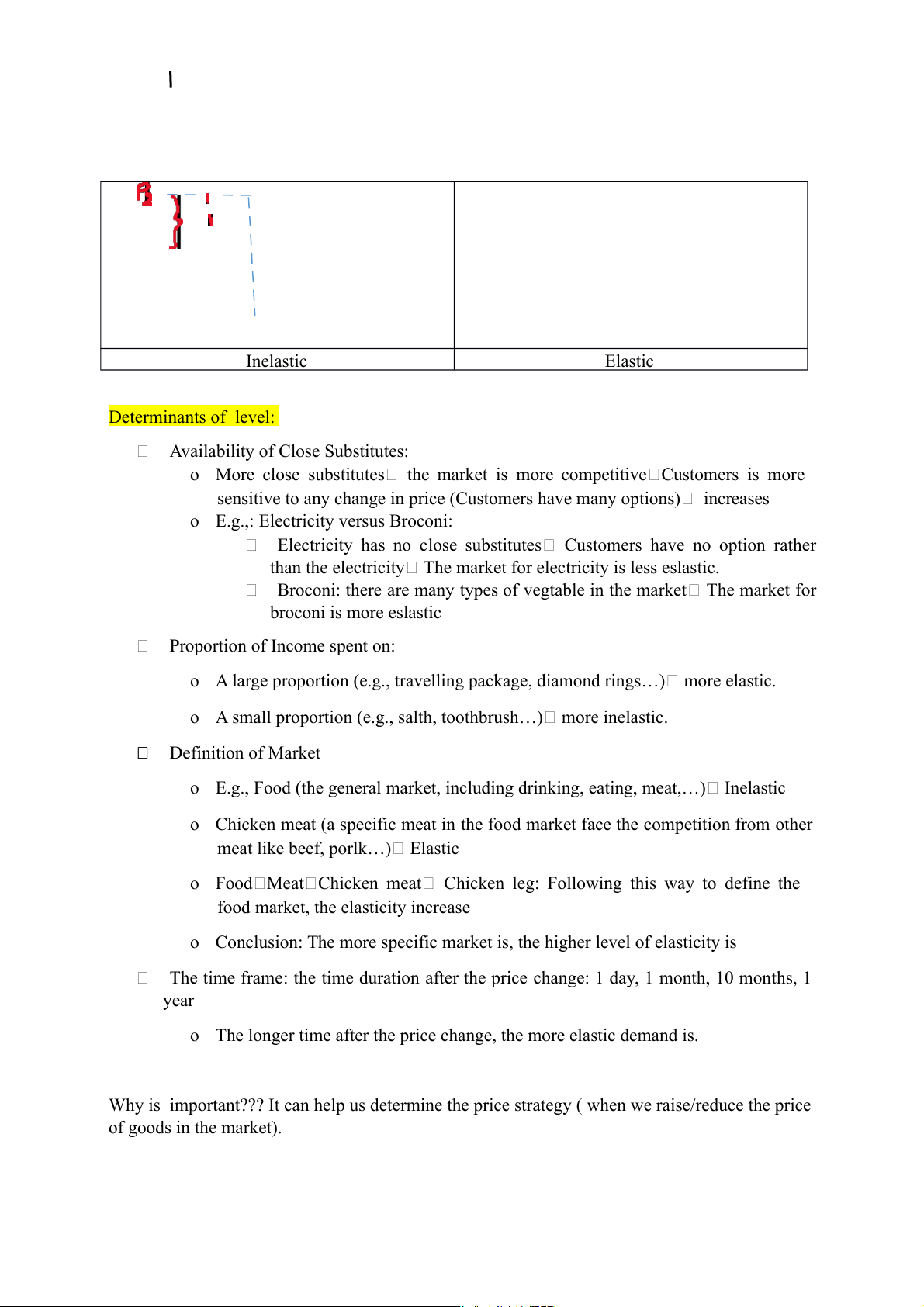
More inelastic the steeper demand curve is Inelastic Elastic Determinants of level:
Availability of Close Substitutes:
o More close substitutes the market is more competitive Customers is more
sensitive to any change in price (Customers have many options) increases
o E.g.,: Electricity versus Broconi:
Electricity has no close substitutes Customers have no option rather
than the electricity The market for electricity is less eslastic.
Broconi: there are many types of vegtable in the market The market for broconi is more eslastic Proportion of Income spent on:
o A large proportion (e.g., travelling package, diamond rings…) more elastic.
o A small proportion (e.g., salth, toothbrush…) more inelastic. Definition of Market
o E.g., Food (the general market, including drinking, eating, meat,…) Inelastic
o Chicken meat (a specific meat in the food market face the competition from other
meat like beef, porlk…) Elastic
o Food Meat Chicken meat Chicken leg: Following this way to define the
food market, the elasticity increase
o Conclusion: The more specific market is, the higher level of elasticity is
The time frame: the time duration after the price change: 1 day, 1 month, 10 months, 1 year
o The longer time after the price change, the more elastic demand is.
Why is important??? It can help us determine the price strategy ( when we raise/reduce the price of goods in the market).
Consider the situation that the firm want to raise the price (P), there are two effects in the market:
Price Effects on Revenue (TR): P increases TR increases
Quantity Effects on Revenue (TR): P increases Q decreases TR decreases
Finally, whether TR increases or decreases??? The answer will depend on the fact that
the price effect is greater or smaller than the quanity effect. Price Strategy:
If the market is elastic, the firm should reduce the price because TR increases due to an expansion of market share.
If the market is inelastic, the firm should raise the price because the customer will
accept to continue to consume at the higher price.
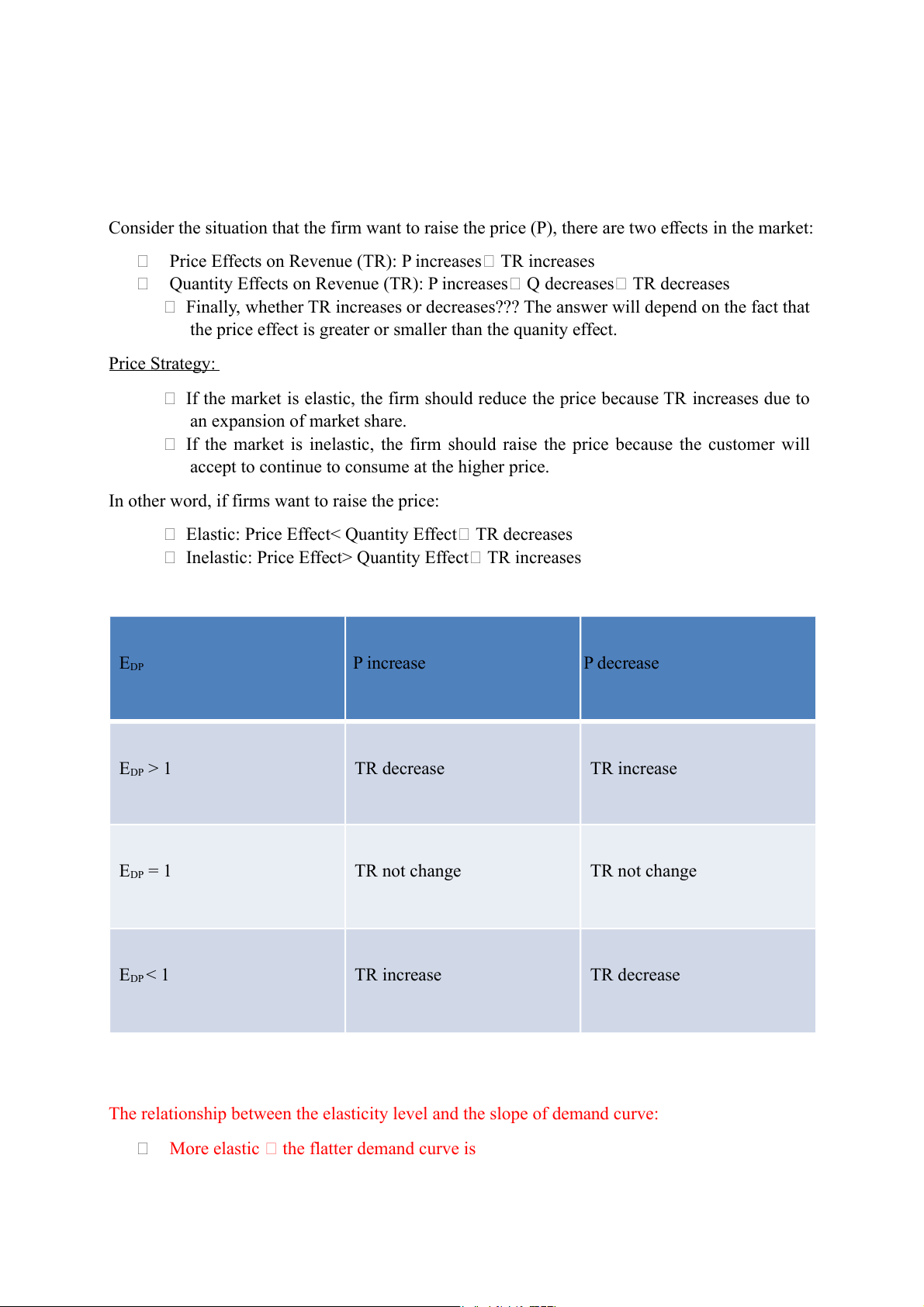
In other word, if firms want to raise the price:
Elastic: Price Effect< Quantity Effect TR decreases
Inelastic: Price Effect> Quantity Effect TR increases EDP P increase P decrease EDP > 1 TR decrease TR increase EDP = 1 TR not change TR not change EDP < 1 TR increase TR decrease
The relationship between the elasticity level and the slope of demand curve:
More elastic the flatter demand curve is
More inelastic the steeper demand curve is
The Slope and Elasticity are two different concept: Slope Elasticity Demand Function (D): P= a-bQ Slope of demand function= -b Elasticity: Slope is constant
Thus, is conditional on the point on
the demand curve (Depend on the value of ). Elasticity change along the demand curve
How does the elasticity change along the demand curve?
The slope of linear demand curve is constant.
The price elasticity of demand decreases from the
left hand side to the right hand side.
Alternatively, the demand is more elastic at a high price. At point A: At point B: Similarly, w can prove that:
decreases when moving from A to B.
At the higher price, the demand is more elastic. Price elastic of demand:
Cross-price elasticity of demand:
How to calculate the cross-price elasticity of demand: mid-point method and point method. Example:
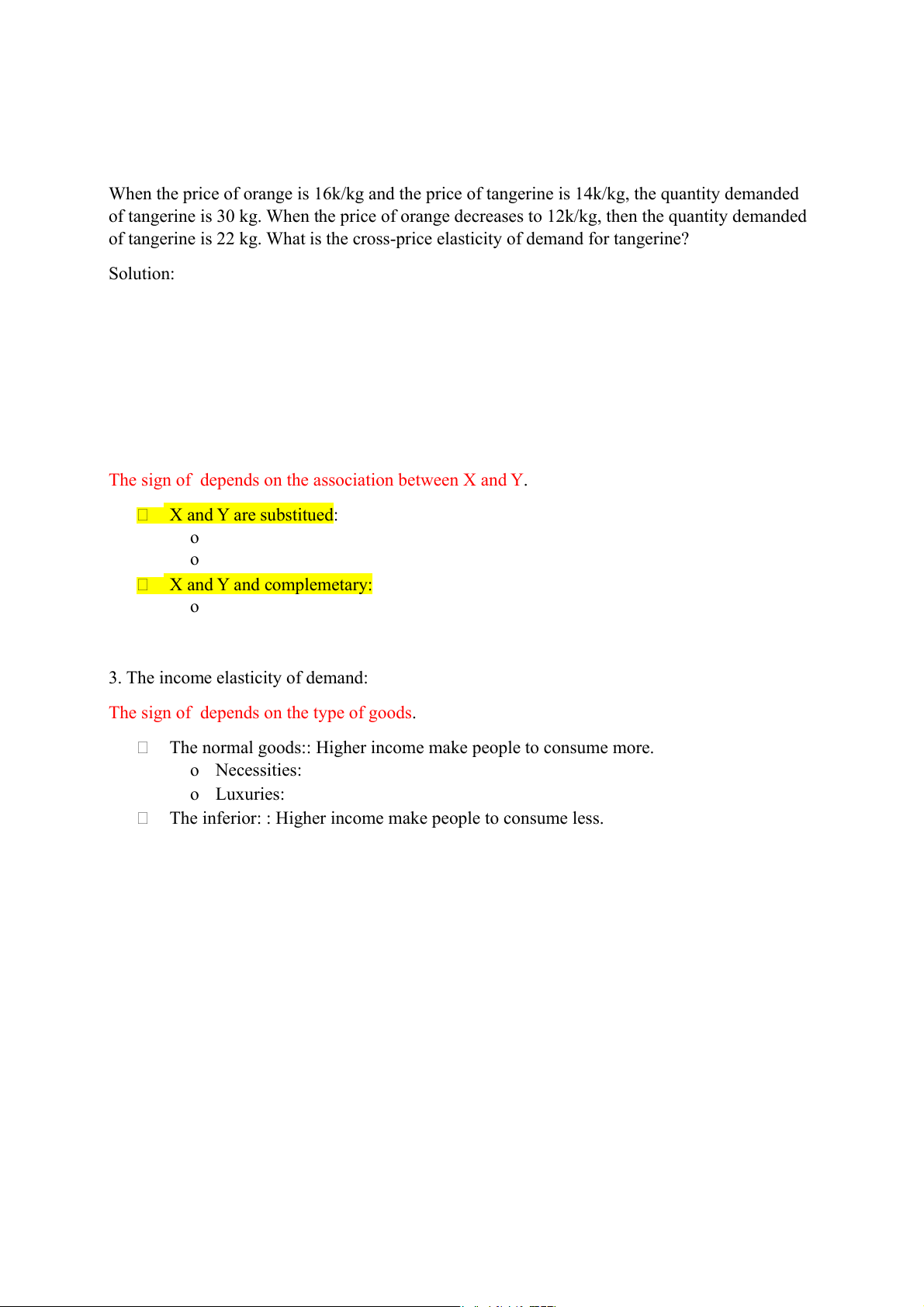
When the price of orange is 16k/kg and the price of tangerine is 14k/kg, the quantity demanded
of tangerine is 30 kg. When the price of orange decreases to 12k/kg, then the quantity demanded
of tangerine is 22 kg. What is the cross-price elasticity of demand for tangerine? Solution:
The sign of depends on the association between X and Y. X and Y are substitued: o o X and Y and complemetary: o
3. The income elasticity of demand:
The sign of depends on the type of goods.
The normal goods:: Higher income make people to consume more. o Necessities: o Luxuries:
The inferior: : Higher income make people to consume less.
Tài liệu liên quan:
-
Chương 3: độ co giãn và các nhân tố ảnh hưởng | Microeconomics | Trường Đại học Quốc tế, Đại học Quốc gia Thành phố Hồ Chí Minh
3 2 -
Microeconomics Syllabus | Microeconomics | Trường Đại học Quốc tế, Đại học Quốc gia Thành phố Hồ Chí Minh
3 2 -
Microeconomics Course Syllabus & Assessment Details | Microeconomics | Trường Đại học Quốc tế, Đại học Quốc gia Thành phố Hồ Chí Minh
3 2 -
Assignment 3 - Elasticity MCQs and Key Concepts | Microeconomics | Trường Đại học Quốc tế, Đại học Quốc gia Thành phố Hồ Chí Minh
3 2 -
Assignment 2 - Economic Equilibrium Analysis of Fridges and Motorcycles | Microeconomics | Trường Đại học Quốc tế, Đại học Quốc gia Thành phố Hồ Chí Minh
3 2